What Is Orchestration in Computing? Types, Benefits & Future Trends


Orchestration has become a foundational concept in the digital era, allowing businesses to stitch together everything from container deployments to business processes into a seamless flow. When done well, orchestration transforms scattered tasks into cohesive, automated workflows, unlocking reliability, scalability and cost efficiency. In the AI space, Clarifai leads this orchestration revolution with its compute orchestration platform that works across clouds and on‑premises, helping organizations deploy and run AI efficiently. This article demystifies orchestration in computing, explains how it differs from automation, highlights major tools and use cases, and offers practical guidance for getting started.

Quick Digest: What’s Coming in This Guide

  • What is orchestration? Orchestration coordinates multiple automated tasks and services to deliver an end‑to‑end outcome. It operates like a conductor managing an orchestra, ensuring every component plays its part at the right time.
  • Why now? Companies rely on microservices, containers and hybrid clouds, making manual coordination impossible. Orchestration simplifies deployment, scaling and reliability.
  • Key distinctions: Understand how orchestration differs from automation and choreography, and why these concepts matter.
  • Types and tools: Explore different types of orchestration—containers, workflows, infrastructure—and compare leading tools like Kubernetes, Airflow, Terraform, and Clarifai’s orchestration platform.
  • Benefits and challenges: Learn about the scalability, cost savings and reliability orchestration brings, as well as potential pitfalls like complexity and security risks.
  • Best practices: Discover patterns such as decoupled design, observability, and CI/CD that ensure orchestration success.
  • Emerging trends: Get a glimpse of the future with AI‑driven orchestration, edge computing, multi‑cloud strategies and generative AI that helps design systems.
  • How to start: Follow a step‑by‑step guide and see how Clarifai’s compute orchestration and local runners can simplify your journey.
  • FAQs: Wrap up with answers to common questions.

Understanding Orchestration—Definition, Evolution & Concepts

How Has Orchestration Evolved and What Does It Mean?

In computing, orchestration refers to the automated coordination of multiple tasks, services and resources to achieve a desired outcome. Think of a conductor guiding an orchestra—each musician (task) must play the right note at the right time for the piece (workflow) to come together. Similarly, orchestration tools manage dependencies, sequence tasks, handle failures and scale resources to deliver complex workflows. Initially, teams relied on cron jobs and custom scripts to automate single tasks. As systems grew into distributed architectures with containers and microservices, manual coordination became unsustainable. Modern orchestration emerged to bridge disparate components into unified workflows, making deployment and scaling seamless.

Why Is Orchestration Important in Today’s Digital Landscape?

Companies deploy applications across hybrid clouds, edge devices and on‑premises environments. Manual oversight can’t scale with such complexity. Orchestration solves this by managing lifecycles (start, stop, scale), handling retries, sequencing tasks, monitoring performance and recovering from failures automatically. In the AI domain, Clarifai’s unified control plane orchestrates AI models across different infrastructures, helping customers optimize costs and avoid vendor lock‑in. The modern emphasis on agility and DevOps makes orchestration critical—organizations can deploy changes faster while ensuring reliability.

Expert Insights & Statistics

  • Survey data indicates that more than 80 % of organizations use containers in production, and 87 % run microservices, many managed by orchestration platforms.
  • Dynatrace reports that organizations adopting container orchestration see improved scalability and more than 60 % of infrastructure workloads deployed on Kubernetes.
  • Clarifai states that their compute orchestration can deliver up to 90 % less compute needed, handle 1.6 million inference requests per second, and provide 99.999 % reliability.
  • Expert tip: Think of orchestration as the glue that binds microservices and tasks. Without it, your system is like a group of musicians practicing solo—talented individually but chaotic together.

Creative Example: The Factory Analogy

Imagine a factory assembling smartphones. Each station performs a specific task—cutting glass, installing chips, applying adhesive. If each station works independently, parts pile up or run out. An orchestration system acts like the factory supervisor: it determines when each station should start, stops when needed, handles shortages, and ensures every phone flows smoothly down the line. Similarly, orchestration in computing coordinates tasks so that data moves through pipelines, containers spin up and down, and services communicate reliably.


Orchestration vs. Automation vs. Choreography – Clear Distinctions

What’s the Difference Between Orchestration and Automation?

Automation involves executing a single task or a sequence of static steps automatically—like a script that backs up a database every night. Orchestration, on the other hand, coordinates multiple automated tasks, making decisions based on system state, dependencies and business rules. It ensures tasks run in the correct order, handle failures gracefully and scale up or down based on demand. Think of automation as playing one instrument and orchestration as leading an entire orchestra.

How Does Choreography Fit In?

Choreography relates primarily to event‑driven microservices. In choreography, each service listens for events and reacts independently without a central coordinator. This peer‑to‑peer model can be highly scalable but may introduce complexity if not designed carefully. Orchestration, in contrast, relies on a central controller (the orchestrator) that directs services and coordinates their interactions. Choosing between orchestration and choreography depends on your architecture: orchestration provides visibility and control; choreography offers loose coupling and autonomy.

Expert Insights & Advanced Tips

  • Red Hat experts note that automation is a subset of orchestration; while automation can perform tasks, orchestration adds decision logic and state awareness.
  • Microservice architects often blend both: they use orchestration for complex workflows that need oversight and choreography for event‑driven communication when services must respond quickly to changes.
  • Advanced tip: Avoid coupling your orchestration tool tightly to business logic. Keep business rules separate so you can switch orchestrators without rewriting core services.
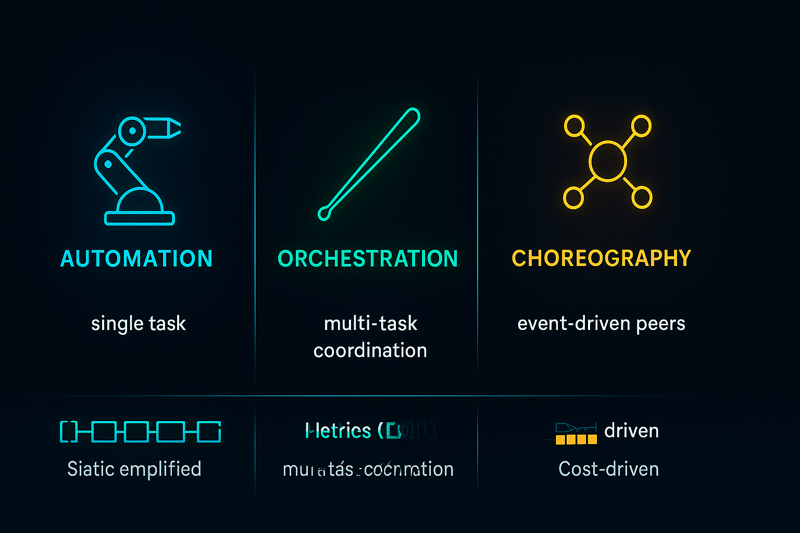
Orchestration vs. Automation vs. Choreography


Types of Orchestration in Computing

Orchestration spans multiple domains. Understanding the different types helps you select the right tool for your workload.

Container Orchestration

Container orchestration automates the deployment, scaling and management of containerized applications. Kubernetes leads this space, supporting features such as auto‑scaling, service discovery, rolling updates and fault tolerance. Others include Docker Swarm (simpler but less flexible) and Apache Mesos (used for big data workloads). Clarifai’s compute orchestration integrates with Kubernetes but offers a unified control plane to manage AI workloads across multiple clusters and regions. The platform automatically provisions GPU or TPU resources, handles scaling, and optimizes compute usage.

Workflow or Data Orchestration

Workflow orchestration coordinates tasks across data pipelines, ETL/ELT processes and batch jobs. Tools like Apache Airflow, Dagster, Prefect and Argo Workflows allow you to define Directed Acyclic Graphs (DAGs) that specify task order, dependencies, scheduling and retries. These tools are crucial for data teams running complex pipelines. Clarifai’s orchestration platform enables deploying AI pipelines that include data ingestion, model inference and result post‑processing; you can run them on Clarifai’s shared compute, your VPC or on‑premises servers.

Microservices Orchestration

Microservices orchestration focuses on coordinating multiple services to deliver business processes. Service orchestrators or workflow engines manage API calls, handle retries and enforce business logic. Spring Cloud Data Flow and Camunda are examples, and serverless orchestrators like AWS Step Functions or Azure Durable Functions perform similar roles for event‑driven functions. Clarifai’s platform orchestrates AI microservices (e.g., image recognition, text analysis, custom models) to create complex AI pipelines.

Cloud & Infrastructure Orchestration

Infrastructure orchestration automates the provisioning, scaling and configuration of compute, storage and network resources. Tools like Terraform, AWS CloudFormation and Pulumi allow teams to define infrastructure as code (IaC), manage state and deploy across providers. Clarifai’s compute orchestration simplifies infrastructure management by offering a single control plane to run models on cloud, VPC or on‑premises, with auto‑scaling and cost optimisation.

Business Process Orchestration

Beyond IT, orchestration can coordinate enterprise workflows such as order fulfillment, supply chain management and HR processes. Business Process Management (BPM) platforms and BPMN modeling tools allow analysts to design workflows that cross departmental boundaries. They integrate with systems like ERP and CRM to automate tasks and approvals.

Edge & IoT Orchestration (Emerging)

With the rise of edge computing, orchestrating workloads across thousands of IoT devices becomes critical. Edge orchestration ensures that models run near the data source for low latency while central control manages updates and resource distribution. Research from MDPI highlights emerging frameworks for edge orchestration that use machine learning to predict workloads and schedule tasks. Clarifai’s compute orchestration supports deploying models to edge devices through Local Runners, which allow models to run locally while still being accessible via the Clarifai API.

Expert Insights & Data Points

  • IDC predicts that by 2025, 75 % of enterprise data will be generated at the edge, requiring edge orchestration solutions.
  • Clarifai’s Local Runners enable running models on workstations or on‑premises servers and exposing them through Clarifai’s API; this provides secure, low‑latency inference while using a unified management interface.
  • Step Functions and Durable Functions simplify orchestrating serverless microservices. They handle retries, state machines and parallel execution, making them ideal for event‑driven architecture.
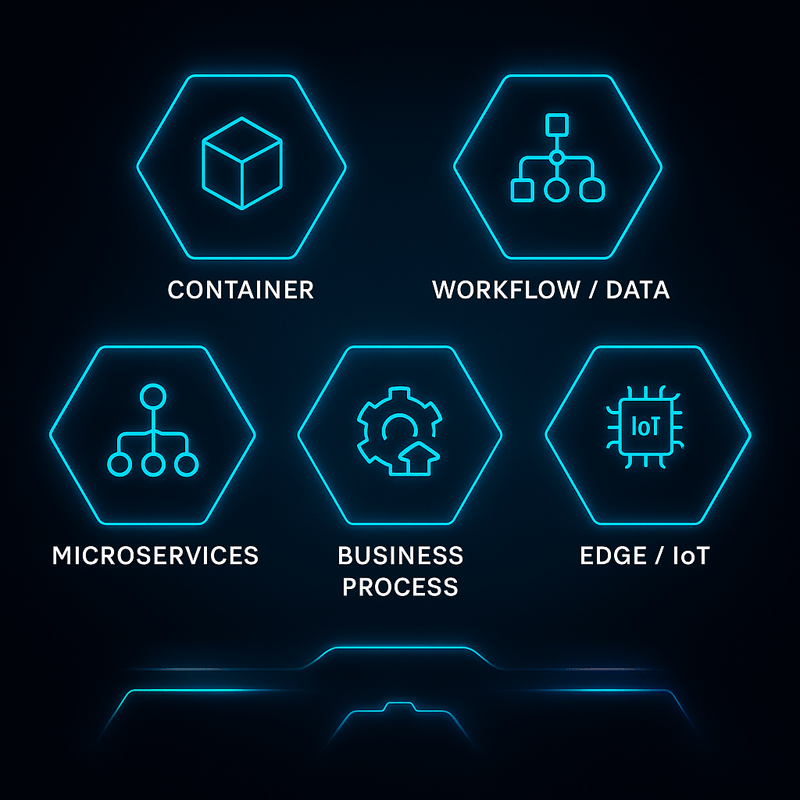
Types of orchestration


Leading Orchestration Tools & Platforms: Comparisons and Lists

Selecting the right orchestration tool depends on your workload, team skills and business goals. This section compares popular options across categories and highlights Clarifai’s unique strengths.

Container Orchestrators

Feature

Kubernetes

Docker Swarm

Apache Mesos

Clarifai Compute Orchestration

Scalability & Ecosystem

Industry standard with a vast ecosystem; runs microservices at scale.

Simpler setup but limited features.

Designed for large clusters; used by big data frameworks.

Built on Kubernetes but provides unified control plane and AI‑optimized scaling.

Ease of Use

Steep learning curve; extensive configuration.

Easier to start; fewer features.

Complex; typically used in research environments.

Abstraction layer hides Kubernetes complexity; automatically optimizes GPU/TPU usage.

Managed Services

EKS (AWS), GKE (Google), AKS (Azure).

Docker Swarm is self‑managed.

Mesos requires self‑hosting.

Clarifai offers shared and dedicated compute, or connects to your own clusters.

Use Cases

General microservices, AI pipelines, hybrid cloud.

Small teams wanting simple container management.

Large‑scale data processing (Hadoop, Spark).

AI/ML workloads, inference at scale, hybrid deployments, cost optimisation.

Note: Clarifai’s platform is not a direct replacement for Kubernetes; it builds on top of it, focusing specifically on orchestrating AI models and inference pipelines. It provides a single control plane for managing compute across environments and adds features like GPU fractioning, batching, autoscaling and serverless provisioning.

Workflow & Data Orchestrators

  • Apache Airflow: Popular open‑source DAG‑based orchestrator. Highly extensible and community‑supported but can be challenging to scale.
  • Prefect: Modern Python‑based orchestrator with declarative flows and a cloud dashboard. Good for data engineering tasks.
  • Dagster: A data‑centric orchestrator with strong type checking and observability features.
  • Argo Workflows: Kubernetes‑native workflow engine, ideal for cloud‑native pipelines. Supports containerized tasks and artifacts.

Clarifai: Allows orchestrating AI workflows by chaining models (e.g., image detection → object classification → text extraction). The platform manages containerization and scaling automatically, so data scientists can focus on building workflows instead of infrastructure.

Infrastructure & IaC Orchestrators

  • Terraform: Cloud‑agnostic tool for defining and provisioning infrastructure. Uses HCL language; state management can be complex.
  • Pulumi: Allows writing IaC in languages like TypeScript, Python and Go; easier integration with existing codebases.
  • Ansible: Agentless configuration management with a large module library; good for provisioning and deploying applications.
  • CloudFormation: AWS‑native orchestration; integrates tightly with AWS resources.

Clarifai: Abstracts infrastructure details by offering a serverless compute layer for AI models. You can deploy models on Clarifai’s shared cloud, dedicated clusters or your own VPC/on‑premises environment, all through a consistent API.

Serverless & Function Orchestrators

  • AWS Step Functions and Azure Durable Functions: Provide state machines for orchestrating serverless functions, handling retries, branching and parallelism.
  • Google Workflows: Similar to Step Functions but integrated with Google Cloud services.

These services are well‑suited for event‑driven microservices and IoT applications. Clarifai can integrate serverless functions within AI pipelines; for example, a Step Function could trigger Clarifai’s inference API.

Expert Insights & Key Statistics

  • DZone reports that 54 % of Kubernetes users adopt it for hybrid/multi‑cloud deployments, 49 % for new cloud‑native apps and 46 % for modernizing existing apps. This shows the versatility of container orchestration.
  • Survey results reveal that 75 % of developers use Kubernetes and 87 % run microservices on it. However, only 54 % of projects are mostly successful, indicating room for improvement.
  • Clarifai’s compute orchestration helps reduce compute costs by fractioning GPUs, batching requests and using spot instances; this can cut expenses by up to 90 %.
  • Fairwinds predicts that cluster consolidation, multi‑cloud strategies and tools like Karpenter will dominate orchestration by 2025.

Benefits & Use Cases of Orchestration

How Does Orchestration Deliver Value?

Scalability & Elasticity

Orchestration automatically scales services based on demand, spinning up additional instances during peak times and scaling down when idle. In container orchestrators like Kubernetes, autoscalers monitor CPU/memory and adjust the number of pods. In Clarifai’s platform, autoscaling works across clusters and regions, handling millions of inference requests per second while minimizing resource use.

Reliability & Fault Tolerance

Orchestrators provide self‑healing capabilities—if a container or service fails, the orchestrator restarts it or reroutes traffic. They manage rolling updates, handle retries and ensure overall system stability. Clarifai’s orchestration offers 99.999 % reliability, ensuring AI services stay available even during infrastructure failures.

Faster Deployment & Time to Market

CI/CD pipelines integrated with orchestration allow developers to push code frequently with confidence. Rolling updates, blue‑green deployments and canary releases ensure zero downtime. By automating deployment tasks, teams can iterate faster.

Cost Optimization & Resource Efficiency

Orchestrators allocate resources efficiently, preventing overprovisioning. Clarifai uses GPU fractioning, batching, autoscaling and spot instances to optimize costs. This means models only use GPU time when needed, significantly reducing expenses.

Multi‑Cloud & Hybrid Operations

Orchestration allows deploying workloads across multiple clouds, on‑premises data centers and edge nodes. This flexibility avoids vendor lock‑in and enables global scalability. Clarifai’s control plane can manage models across your VPC, on‑premises servers and Clarifai’s cloud.

AI/ML & Edge Use Cases

With the growing adoption of AI and IoT, orchestrating models at scale becomes critical. Clarifai’s platform lets you run models at the edge via Local Runners while maintaining central control and monitoring. This ensures low‑latency inference for applications like autonomous vehicles, retail cameras and industrial sensors.

Business Process Automation

Beyond IT, orchestration automates cross‑departmental workflows. For example, an order processing pipeline might orchestrate inventory checks, payment processing and shipping notifications, integrating with ERP and CRM systems.

Expert Insights & Data Points

  • Survey data shows that the microservices orchestration market is projected to reach USD 13.2 billion by 2034 with a 21.2 % CAGR.
  • Dynatrace reports that 63 % of organizations deploy Kubernetes for infrastructure workloads.
  • Industry opinion: Orchestration doesn’t just save money—it enhances innovation by freeing engineers from operational toil. This shift empowers teams to focus on building value.
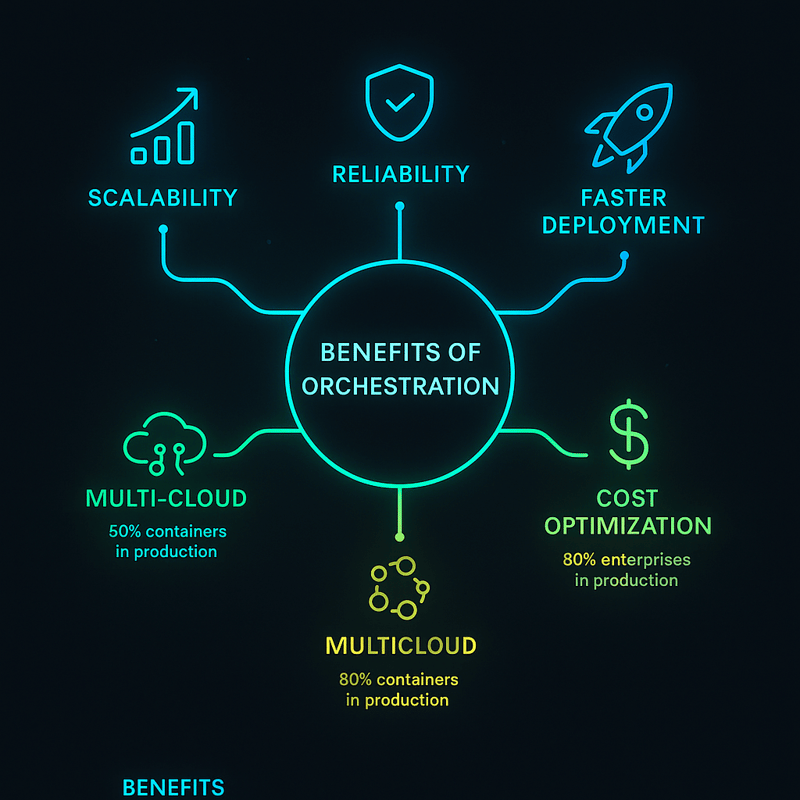
Benefits of orchestration


Challenges, Risks & When Not to Use Orchestration

Where Does Orchestration Fall Short?

Complexity & Learning Curve

While orchestration simplifies operations, platforms like Kubernetes come with a steep learning curve. Managing clusters, writing YAML manifests and configuring RBAC can be overwhelming for small teams. Developers report that Kubernetes setup and management are resource‑intensive.

Security Risks & Misconfiguration

Misconfigured orchestration can open security holes. Without proper RBAC, network policies and vulnerability scanning, clusters become susceptible to attacks. Survey data reveals that 13 % of developers think orchestration worsens security. Tools like Clarifai include best‑practice security defaults and allow deployment into your own VPC or on‑premises environment without exposing ports.

Cost Overrun & Resource Sprawl

If not monitored, orchestration can lead to wasted resources. Idle pods, over‑provisioned nodes and persistent volumes drive up cloud bills. According to Fairwinds research, 25 % of developers find cost optimization challenging. Clarifai mitigates this by automatically adjusting compute to workload demand.

Latency & Performance Overhead

Adding orchestration layers can introduce latency. Tools need to manage scheduling and context switching. For latency‑sensitive edge applications, over‑orchestration might not be ideal.

Over‑Engineering for Small Projects

For simple monolithic applications, orchestration may be overkill. Microservices and orchestration bring many benefits, but they also introduce complexity. Reports show that not all microservice projects succeed, with only 54 % mostly successful. Evaluate whether your project truly benefits from microservices or if a simpler architecture would suffice.

Vendor Lock‑In

Choosing a proprietary orchestrator can lock you into a single provider. Look for tools supporting open standards. Clarifai addresses this by allowing customers to connect their own compute resources and avoid cloud vendor lock‑in.

Expert Insights & Cautionary Tales

  • Fairwinds survey reveals that the top challenges developers face with Kubernetes include high complexity, cost optimization and security.
  • O’Reilly’s microservices study reports that while many companies adopt microservices, only half find substantial success, underscoring the need for planning and expertise.
  • Advice: Start small. Use managed services or platforms like Clarifai to minimize complexity. Optimize gradually and avoid blindly splitting monoliths.

Best Practices & Architectural Patterns for Orchestration

How to Design Effective Orchestration Architectures

Design for Decoupling & Statelessness

Orchestration works best when services are loosely coupled and stateless. Each service should expose clear APIs and avoid storing state locally. This enables the orchestrator to scale services horizontally without coordination headaches. Use patterns like the Strangler Fig to gradually break monoliths into microservices.

Balance Orchestration & Choreography

Not every interaction needs central orchestration. Use event‑driven architecture where services can react to events independently (choreography) and apply orchestration for complex workflows requiring control. For example, use Step Functions to orchestrate a data pipeline but rely on asynchronous messaging (Kafka) for simple event flows.

Adopt CI/CD & Infrastructure as Code (IaC)

Automate everything: use CI/CD to deploy application code and IaC tools (Terraform, Pulumi) to manage infrastructure. This ensures reproducibility, easier rollbacks and fewer manual errors.

Implement Observability & Monitoring Early

Instrumentation is critical. Deploy metrics, logs and traces to understand performance. According to surveys, 65 % of organizations use Grafana, 62 % use Prometheus and 21 % use Datadog for observability. Clarifai’s platform provides monitoring and cost dashboards, allowing you to track inference usage and performance.

Automate Security & Apply Least Privilege

Enable RBAC, enforce network policies and integrate vulnerability scanning into CI/CD. Tools like OPA (Open Policy Agent) or Kyverno can enforce policies. Clarifai’s compute orchestration allows you to deploy models into your own VPC or on‑premises clusters, controlling ingress and egress ports.

Optimize Costs & Autoscaling

Set resource requests and limits appropriately, use autoscaling policies, and leverage spot instances or pre‑emptible VMs. Clarifai automatically scales compute and uses GPU fractioning and batching to minimize costs.

Document Workflows & Version Control

Use BPMN diagrams or YAML manifests to document workflows. Track changes through version control. This ensures reproducibility and collaboration.

Expert Insights & Research Highlights

  • Researchers apply long short‑term memory (LSTM) networks to predict workloads and inform autoscaling decisions in microservices.
  • Generative AI and large language models (LLMs) are being used to suggest microservice boundaries and optimize orchestration patterns.
  • Fairwinds predicts the rise of cluster consolidation and multi‑cloud orchestration tools like Karpenter.
  • Clarifai automatically handles model containerization and packing, so you focus on building models rather than managing Dockerfiles.

Case Studies & Real‑World Examples

Success Stories of Orchestration

Netflix: Microservices at Scale

Netflix famously migrated from a monolithic architecture to over 700 microservices to support its global streaming service. Kubernetes (via Titus) orchestrates containers to handle millions of concurrent streams, performing rolling updates and autoscaling effortlessly. This transformation enabled Netflix to scale globally, experiment quickly and deliver a high‑quality user experience. While Netflix built its own orchestration, many companies can replicate similar benefits by adopting tools like Kubernetes or Clarifai’s compute orchestration for AI workloads.

Uber: Rapid Feature Integration

Uber transitioned to microservices to reduce feature integration time from three days to three hours. They reorganized 2,200 services into 70 domains, creating a domain‑driven architecture that improved operational efficiency. Orchestration played a key role in coordinating these services and ensuring reliability under heavy load.

Banking & Finance

Financial institutions deploy microservices for transaction processing and risk analysis. Orchestration ensures compliance and auditability. AI models for fraud detection run in orchestrated pipelines, requiring high reliability and low latency.

Retail & E‑Commerce

E‑commerce platforms use orchestration to manage inventory, payments, recommendations and delivery logistics. AI models for image search, product tagging and customer personalization run through orchestrated workflows. Clarifai’s platform can orchestrate these models across cloud and on‑premises, optimizing cost and latency.

Cautionary Tales

  • A startup attempted to adopt microservices too early. The overhead of managing Kubernetes and service communication slowed development, leading to missed deadlines. Eventually, they returned to a monolithic service until their team matured.
  • A research organization ran a data pipeline with numerous dependencies but lacked orchestration. When one task failed, the entire pipeline broke. After adopting a workflow orchestrator (Airflow), they gained visibility into failures and improved reliability.

Expert Insights & Lessons Learned

  • Enterprises need to evaluate readiness before diving into microservices. If team size is small and the domain is stable, a monolith may suffice.
  • Case studies show that success hinges on careful planning, adoption of observability and robust deployment strategies. Merely adopting microservices without culture change leads to failure.

Emerging Trends & Future of Orchestration (2025+ Outlook)

What Innovations Are Shaping Orchestration’s Future?

AI‑Driven & Predictive Orchestration

Machine learning techniques like LSTM and Bi‑LSTM can analyze metrics and predict workloads, enabling orchestrators to scale ahead of demand. Tools such as Karpenter (AWS) and Cluster Autoscaler use predictive algorithms to manage node pools. Clarifai leverages AI to optimize inference workloads, batching requests and scaling clusters efficiently.

Edge & IoT Orchestration

As IoT devices proliferate, orchestrating workloads at the edge becomes crucial. 5G and AI chips enable real‑time processing on devices. Orchestrators must manage remote updates, handle intermittent connectivity and ensure security. Local Runners from Clarifai demonstrate how to run models at the edge while maintaining centralized control.

Multi‑Cloud & Hybrid Orchestration

Organizations increasingly spread workloads across multiple clouds to avoid vendor lock‑in and increase resilience. Tools like Crossplane and Rafay manage multi‑cluster deployments. Clarifai’s orchestration supports multi‑cloud by enabling models to run on Clarifai’s cloud, dedicated clusters or customer VPCs.

Serverless & Function Orchestration

Serverless architectures reduce operational overhead and cost. Future orchestrators will blend container and function orchestration, enabling developers to choose the best compute paradigm for each task.

Generative AI & LLM‑Assisted Design

Generative AI can analyze code and traffic patterns to suggest microservice boundaries, security policies and resource allocation. Imagine an orchestrator that recommends splitting a service into two based on usage or suggests adding a circuit breaker pattern. Clarifai’s AI expertise positions it well to integrate such features into its platform.

Observability & FinOps Evolution

Observability tools will use AI to detect anomalies, foresee capacity bottlenecks and recommend cost savings. FinOps practices will become integral, with orchestrators providing cost dashboards and optimization hints. Clarifai’s cost monitoring helps users track compute spending and efficiency.

Security & Compliance

With increasing threats, zero‑trust architectures, policy‑as‑code and supply chain security will be standard. Orchestrators will integrate scanning and policy engines into the workflow.

Expert Insights & Research Trends

  • Market analysts forecast significant growth for AI‑driven orchestration and edge computing solutions.
  • Fairwinds notes that cluster consolidation and multi‑cloud strategies will drive orchestration adoption.
  • MDPI review highlights research into AI methods for optimizing microservices design and orchestration.
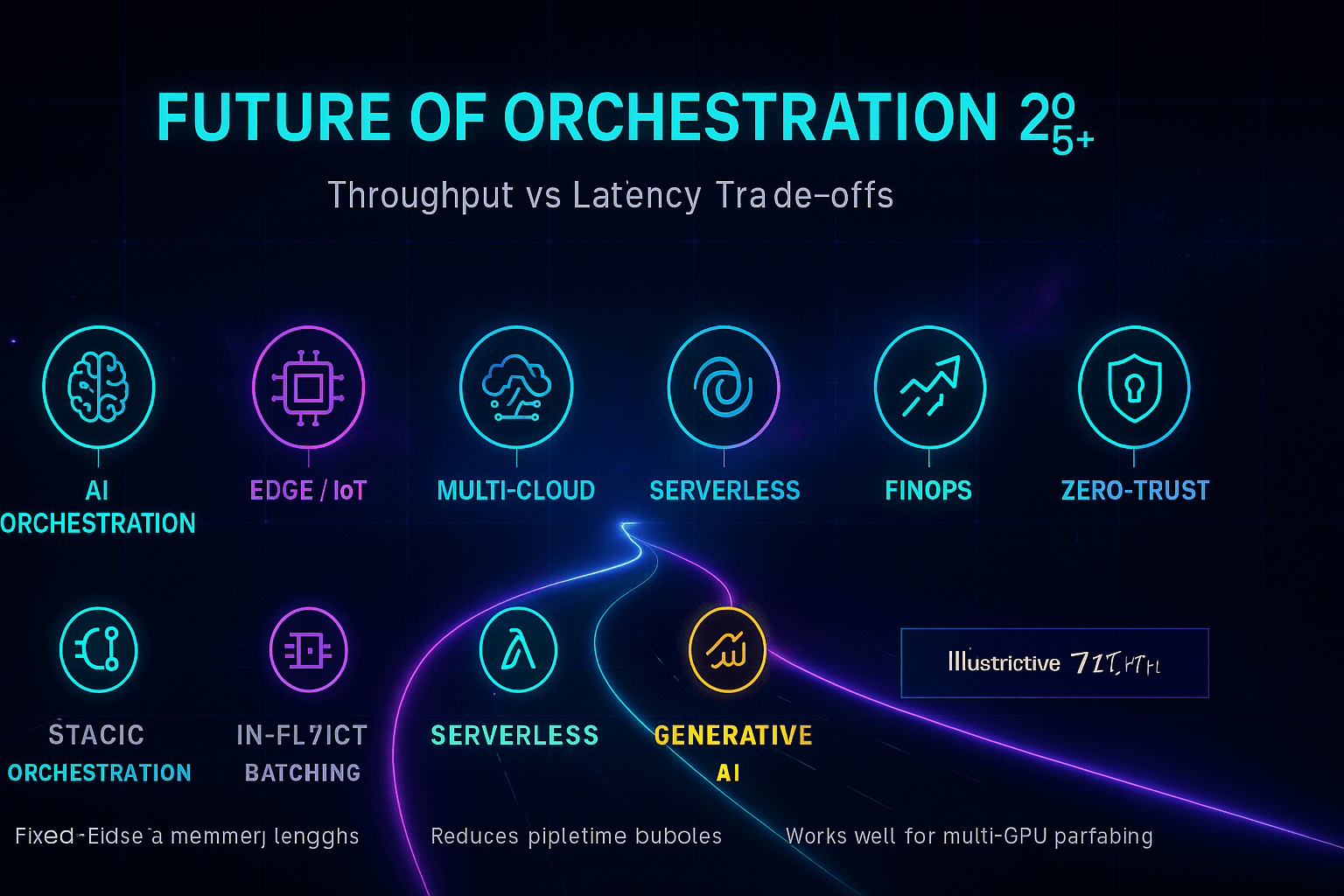
Future of orchestration


Getting Started with Orchestration—Skills, Steps & Resources

What Skills Are Required?

  • Fundamental knowledge of distributed systems: Understand concurrency, networking, service discovery and fault tolerance.
  • Containerization basics: Learn Docker and how to build container images.
  • Programming languages & APIs: Proficiency in languages like Python, Go or Java; familiarity with REST APIs.
  • Infrastructure & Networking: Learn about VPCs, subnets, load balancers and DNS.
  • CI/CD & IaC: Experience with pipelines (Jenkins, GitHub Actions) and IaC tools.
  • Security concepts: Understand RBAC, TLS, secrets management and policy enforcement.

Step‑by‑Step Guide to Implementing Orchestration

  1. Set Up Docker: Install Docker and run a simple container (e.g., Nginx). Create your own container image for a small app.
  2. Deploy to Kubernetes (or Clarifai):
    • Install a local Kubernetes cluster (e.g., minikube) or use a managed service (EKS, GKE).
    • Write a deployment manifest for your container and deploy it. Observe how pods scale and restart.
    • Alternatively, sign up for Clarifai’s platform, upload a model, and run it on shared compute. Clarifai handles containerization and scaling for you.
  3. Define a Workflow: Use Airflow or Dagster to build a simple DAG (e.g., ETL pipeline). Configure dependencies and schedules.
  4. Add Observability: Integrate Prometheus and Grafana or use Clarifai’s built‑in monitoring to track metrics.
  5. Secure & Optimize: Apply RBAC, secrets management and resource limits. Experiment with autoscaling parameters.
  6. Scale to Production: Evaluate multi‑cloud deployment, high availability and backup strategies. Consider using Clarifai for AI workloads to reduce operational burden and access features like GPU fractioning.

Tips for Small Teams

  • Use managed services: For container orchestration, choose a managed Kubernetes (GKE, EKS, AKS) or a specialized AI platform like Clarifai. This reduces operational overhead.
  • Start simple: Begin with a monolith and gradually break off services. Introduce orchestration only where needed.
  • Invest in training: Encourage team members to take Kubernetes and cloud certifications (CKA, CKAD). Clarifai offers documentation and tutorials tailored to AI deployment.
  • Join communities: Engage with open‑source communities (CNCF, Kubernetes Slack) and attend webinars to stay updated.

Clarifai Product Integration – Compute Orchestration & Local Runners

Clarifai offers a compute orchestration platform designed specifically for AI/ML workloads. Here’s how it integrates naturally into your orchestration journey:

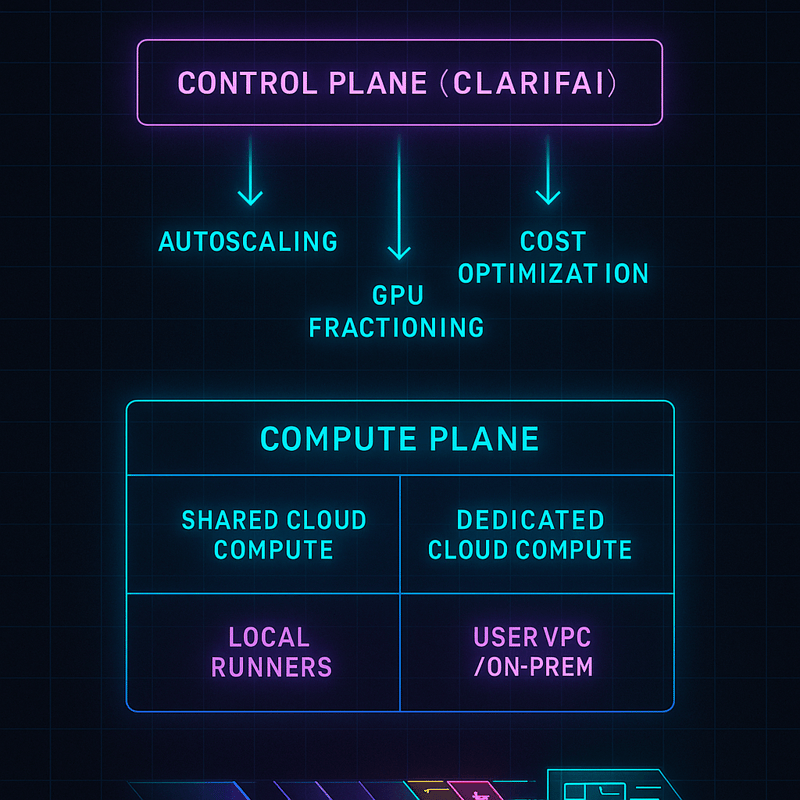
  • Unified Control Plane: Manage your AI compute, costs and performance through a single portal. This control plane abstracts underlying Kubernetes complexity and lets you run models on shared or dedicated hardware.
  • Flexible Deployment Options: Deploy models on Clarifai’s cloud, your VPC, or on‑premises clusters. Options include shared SaaS, dedicated SaaS, self‑managed VPC, on‑premises, multi‑site, and full platform deployment.
  • Cost Optimization Features: Clarifai leverages GPU fractioning, batching, autoscaling, and spot instances to reduce compute costs.
  • Local Runners: Run models locally on workstations or servers and expose them via Clarifai’s API. This allows low‑latency inference without sending data to the cloud.
  • Model Management & Packaging: Clarifai handles containerization, model packing and dependency management, so you can focus on building models.
  • Monitoring & Analytics: The platform provides dashboards to monitor inference requests, compute usage and costs, ensuring transparency.
  • Enterprise-Grade Security: Deploy models into your own VPC or on‑premises clusters without exposing ports; Clarifai adheres to security best practices.

By incorporating Clarifai into your orchestration strategy, you gain the benefits of Kubernetes and other orchestrators while leveraging specialized AI optimization and cost control.
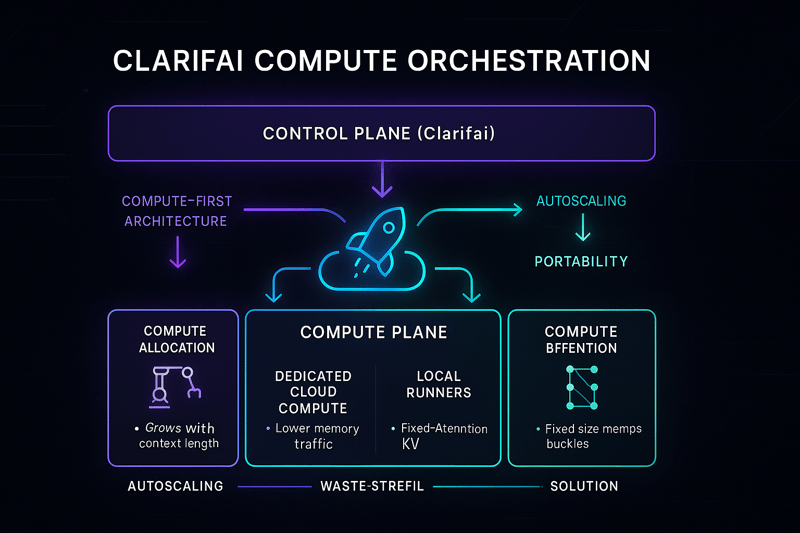
Clarifai Compute Orchestration


Frequently Asked Questions

Q1: What is the difference between orchestration and automation?
A: Automation executes repetitive tasks automatically (e.g., backing up a database), whereas orchestration coordinates multiple automated tasks, making decisions based on dependencies and system state. Orchestration involves scheduling, scaling, error handling and complex workflows.

Q2: Do I always need orchestration for microservices?
A: Not necessarily. Small microservice systems can use event‑driven communication without central orchestration. As complexity grows—hundreds of services, multi‑cloud deployments, compliance requirements—an orchestrator becomes essential for reliability and visibility.

Q3: How does Clarifai’s orchestration differ from Kubernetes?
A: Clarifai builds on Kubernetes to provide a unified control plane for AI workloads. It hides Kubernetes complexity, automatically handles containerization and scaling, and optimizes GPU/TPU usage. It also offers specialized features like Local Runners and AI cost dashboards.

Q4: Can I use Clarifai’s local runners without internet access?
A: Yes. Local Runners let you run models on local machines or private clusters and expose them via Clarifai’s API. They operate offline and sync results when connectivity is restored.

Q5: Which orchestrator should I choose for data pipelines?
A: For data pipelines, consider Airflow, Dagster, Argo Workflows or Prefect. If your pipelines involve AI/ML models, Clarifai can orchestrate model inference alongside data processing, providing cost optimization and multi‑cloud deployment.

Q6: What are the upcoming trends in orchestration?
A: Expect AI‑driven scaling, edge & IoT orchestration, multi‑cloud strategies, serverless function orchestration, generative AI assisting design, FinOps integration, and enhanced security.


Conclusion: Orchestrating the Future

Orchestration is more than just a buzzword—it’s the backbone of modern computing, enabling organizations to deliver reliable, scalable and cost‑effective services. By automating coordination across containers, microservices, workflows and infrastructure, orchestration unlocks agility and innovation. However, it also demands careful planning, security and observability. Platforms like Clarifai’s compute orchestration combine best‑in‑class orchestration with AI‑specific optimizations, making it easier for businesses to deploy and run AI workloads anywhere. As the future brings AI‑driven orchestration, edge computing and generative design, embracing orchestration today ensures your systems are ready for tomorrow’s challenges.


How OpenAI and Microsoft’s New Pact Unlocks the Path to AGI


OpenAI is one step closer to a radical transformation. This week, the company signed a “memorandum of understanding” with its biggest backer Microsoft, clearing a major hurdle in the AI lab’s plan to become a for-profit company. Continue reading “How OpenAI and Microsoft’s New Pact Unlocks the Path to AGI”

ML Lifecycle Management Guide: Best Practices & Tools


Machine‑learning models are living organisms—they grow, adapt, and eventually degrade. Managing their lifecycle is the difference between a proof‑of‑concept and a sustainable AI product. This guide shows you how to plan, build, deploy, monitor, and govern models while tapping into Clarifai’s platform for orchestration, local execution, and generative AI.

Quick Digest—What Does This Guide Cover?

  • Definition & Importance: Understand what ML lifecycle management means and why it matters.
  • Planning & Data: Learn how to define business problems and collect and prepare data.
  • Development & Deployment: See how to train, evaluate and deploy models.
  • Monitoring & Governance: Discover strategies for monitoring, drift detection and compliance.
  • Advanced Topics: Dive into LLMOps, edge deployments and emerging trends.
  • Real‑World Stories: Explore case studies highlighting successes and lessons.

What Is ML Lifecycle Management?

Quick Summary: What does the ML lifecycle entail?

  • ML lifecycle management covers the complete journey of a model, from problem framing and data engineering to deployment, monitoring and decommissioning. It treats data, models and code as co‑evolving artifacts and ensures they remain reliable, compliant and valuable over time.

Understanding the Full Lifecycle

Every machine‑learning (ML) project travels through several phases that often overlap and iterate. The lifecycle begins with clearly defining the problem, transitions into collecting and preparing data, moves on to model selection and training, and culminates in deploying models into production environments. However, the journey doesn’t end there—continuous monitoring, retraining and governance are critical to ensuring the model continues to deliver value.

A well‑managed lifecycle provides many benefits:

  • Predictable performance: Structured processes reduce ad‑hoc experiments and inconsistent results.
  • Reduced technical debt: Documentation and version control prevent models from becoming black boxes.
  • Regulatory compliance: Governance mechanisms ensure that the model’s decisions are explainable and auditable.
  • Operational efficiency: Automation and orchestration cut down deployment cycles and maintenance costs.

Expert Insights

  • Holistic view: Experts emphasize that lifecycle management integrates data pipelines, model engineering and software integration, treating them as inseparable pieces of a product.
  • Agile iterations: Leaders recommend iterative cycles – small experiments, quick feedback and regular adjustments.
  • Compliance by design: Compliance isn’t an afterthought; incorporate ethical and legal considerations from the planning stage.

How Do You Plan and Define Your ML Project?

Quick Summary: Why is planning critical for ML success?

  • Effective ML projects start with a clear problem definition, detailed objectives and agreed‑upon success metrics. Without alignment on business goals, models may solve the wrong problem or produce outputs that aren’t actionable.

Laying a Strong Foundation

Before you touch code or data, ask why the model is needed. Collaboration with stakeholders is vital here:

  1. Identify stakeholders and their objectives. Understand who will use the model and how its outputs will influence decisions.
  2. Define success criteria. Set measurable key performance indicators (KPIs) such as accuracy, recall, ROI or customer satisfaction.
  3. Outline constraints and risks. Consider ethical boundaries, regulatory requirements and resource limitations.
  4. Translate business goals into ML tasks. Frame the problem in ML terms (classification, regression, recommendation) while documenting assumptions.

Creative Example – Predictive Maintenance in Manufacturing

Imagine a factory wants to reduce downtime by predicting machine failures. Stakeholders (plant managers, maintenance teams, data scientists) meet to define the goal: prevent unexpected breakdowns. They agree on success metrics like “reduce downtime by 30 %” and set constraints such as “no additional sensors”. This clear planning ensures the subsequent data collection and modeling efforts are aligned.

Expert Insights

  • Stakeholder interviews: Involve not just executives but also frontline operators; they often offer valuable context.
  • Document assumptions: Record what you think is true about the problem (e.g., data availability, label quality) so you can revisit later.
  • Alignment prevents scope creep: A defined scope keeps the team focused and prevents unnecessary features.

How to Engineer and Prepare Data for ML?

Quick Summary: What are the core steps in data engineering?

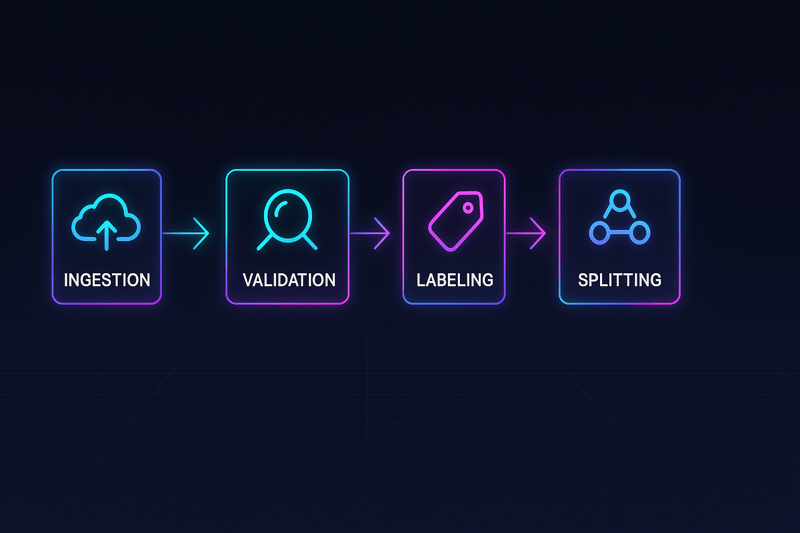
  • Data engineering includes ingestion, exploration, validation, cleaning, labeling and splitting. These steps ensure that raw data becomes a reliable, structured dataset ready for modeling.

Data Ingestion & Integration

The first task is collecting data from diverse sources – databases, APIs, logs, sensors or third‑party feeds. Use frameworks like Spark or HDFS for large datasets, and document where each piece of data comes from. Consider generating synthetic data if certain classes are rare.

Exploration & Validation

Once data is ingested, profile it to understand distributions and detect anomalies. Compute statistics like mean, variance and cardinality; build histograms and correlation matrices. Validate data with rules: check for missing values, out‑of‑range numbers or duplicate entries.

Data Cleaning & Wrangling

Cleaning data involves fixing errors, imputing missing values and standardizing formats. Techniques range from simple (mean imputation) to advanced (time‑aware imputation for sequences). Standardize categorical values (e.g., unify “USA,” “United States,” “U.S.”) to avoid fragmentation.

Labeling & Splitting

Label each data point with the correct outcome, a task often requiring human expertise. Use annotation tools or Clarifai’s AI Lake to streamline labeling. After labeling, split the dataset into training, validation and test sets. Use stratified sampling to preserve class distributions.

Expert Insights

  • Data quality > Model complexity: A simple algorithm on clean data often outperforms a complex algorithm on messy data.
  • Iterative approach: Data engineering is rarely one‑and‑done. Plan for multiple passes as you discover new issues.
  • Documentation matters: Track every transformation – regulators may require lineage logs for auditing.

Data Pipeline for Machine Learning


How to Perform EDA and Feature Engineering?

Quick Summary: Why do you need EDA and feature engineering?

  • Exploratory data analysis (EDA) uncovers patterns and anomalies that guide model design, while feature engineering transforms raw data into meaningful inputs.

Exploratory Data Analysis (EDA)

Start by visualizing distributions using histograms, scatter plots and box plots. Look for skewness, outliers and relationships between variables. Uncover patterns like seasonality or clusters; identify potential data leakage or mislabeled records. Generate hypotheses: for example, “Does weather affect customer demand?”

Feature Engineering & Selection

Feature engineering is the art of creating new variables that capture underlying signals. Common techniques include:

  • Combining variables (e.g., ratio of clicks to impressions).
  • Transforming variables (log, square root, exponential).
  • Encoding categorical values (one‑hot encoding, target encoding).
  • Aggregating over time (rolling averages, time since last purchase).

After generating features, select the most informative ones using statistical tests, tree‑based feature importance or L1 regularization.

Creative Example – Feature Engineering in Finance

Consider a credit‑scoring model. Beyond income and credit history, engineers create a “credit utilization ratio”, capturing the percentage of credit in use relative to the limit. They also compute “time since last delinquent payment” and “number of inquiries in the past six months.” These engineered features often have stronger predictive power than raw variables.

Expert Insights

  • Domain expertise pays dividends: Collaborate with subject‑matter experts to craft features that capture domain nuances.
  • Less is more: A smaller set of high‑quality features often outperforms a large but noisy set.
  • Beware of leakage: Don’t use future information (e.g., last payment outcome) when training your model.

How to Develop, Experiment and Train ML Models?

Quick Summary: What are the key steps in model development?

  • Model development involves selecting algorithms, training them iteratively, evaluating performance and tuning hyperparameters. Packaging models into portable formats (e.g., ONNX) facilitates deployment.

Selecting Algorithms

Choose models that fit your data type and problem:

  • Structured data: Logistic regression, decision trees, gradient boosting.
  • Sequential data: Recurrent neural networks, transformers.
  • Images and video: Convolutional neural networks (CNNs).

Start with simple models to establish baselines, then progress to more complex architectures if needed.

Training & Hyperparameter Tuning

Training involves feeding labeled data into your model, optimizing a loss function via algorithms like gradient descent. Use cross‑validation to avoid overfitting and evaluate different hyperparameter settings. Tools like Optuna or hyperopt automate search across hyperparameters.

Evaluation & Tuning

Evaluate models using appropriate metrics:

  • Classification: Accuracy, precision, recall, F1 score, AUC.
  • Regression: Mean Absolute Error (MAE), Root Mean Squared Error (RMSE).

Tune hyperparameters iteratively – adjust learning rates, regularization parameters or architecture depth until performance plateaus.

Packaging for Deployment

Once trained, export your model to a standardized format like ONNX or PMML. Version the model and its metadata (training data, hyperparameters) to ensure reproducibility.

Expert Insights

  • No free lunch: Complex models can overfit; always benchmark against simpler baselines.
  • Fairness & bias: Evaluate your model across demographic groups and implement mitigation if needed.
  • Experiment tracking: Use tools like Clarifai’s built‑in tracking or MLflow to log hyperparameters, metrics and artifacts.

How to Deploy and Serve Your Model?

Quick Summary: What are the best practices for deployment?

  • Deployment transforms a trained model into an operational service. Choose the right serving pattern (batch, real‑time or streaming) and leverage containerization and orchestration tools to ensure scalability and reliability.

Deployment Strategies

  • Batch inference: Suitable for offline analytics; run predictions on a schedule and write results to storage.
  • Real‑time inference: Deploy models as microservices accessible via REST/gRPC APIs to provide immediate predictions.
  • Streaming inference: Process continuous data streams (e.g., Kafka topics) and update models frequently.

Infrastructure & Orchestration

Package your model in a container (Docker) and deploy it on a platform like Kubernetes. Implement autoscaling to handle varying loads and ensure resilience. For serverless deployments, consider cold‑start latency.

Testing & Rollbacks

Before going live, perform integration tests to ensure the model works within the larger application. Use blue/green deployment or canary release strategies to roll out updates incrementally and roll back if issues arise.

Expert Insights

  • Model performance monitoring: Even after deployment, performance may vary due to changing data; see the monitoring section next.
  • Infrastructure as code: Use Terraform or CloudFormation to define your deployment environment, ensuring consistency across stages.
  • Clarifai’s edge: Deploy models using Clarifai’s compute orchestration platform to manage resources across cloud, on‑prem and edge.

How to Monitor Models and Manage Drift?

Quick Summary: Why is monitoring essential?

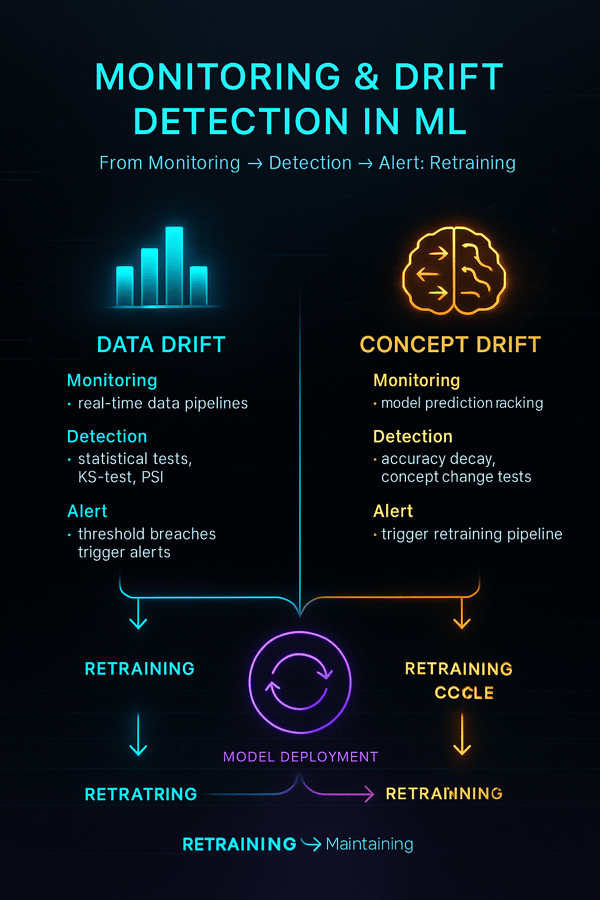
  • Models degrade over time due to data drift, concept drift and changes in the environment. Continuous monitoring tracks performance, detects drift and triggers retraining.

Monitoring Metrics

  • Functional performance: Track metrics like accuracy, precision, recall or MAE on real‑world data.
  • Operational performance: Monitor latency, throughput and resource utilization.
  • Drift detection: Measure differences between training data distribution and incoming data. Tools like Evidently AI and NannyML excel at detecting general drift and pinpointing drift timing respectively.

Alerting & Retraining

Set thresholds for metrics; trigger alerts and remedial actions when thresholds are breached. Automate retraining pipelines so the model adapts to new data patterns.

Creative Example – E‑commerce Demand Forecasting

A retailer’s demand‑forecasting model suffers a drop in accuracy after a major marketing campaign. Monitoring picks up the data drift and triggers retraining with post‑campaign data. This timely retraining prevents stockouts and overstock issues, saving millions.

Expert Insights

  • Amazon’s lesson: During the COVID‑19 pandemic, Amazon’s supply‑chain models failed due to unexpected demand spikes – a cautionary tale on the importance of drift detection.
  • Comprehensive monitoring: Track both input distributions and prediction outputs for a complete picture.
  • Clarifai’s dashboard: Clarifai’s Model Performance Dashboard visualizes drift, performance degradation and fairness metrics.

Monitoring & Drift Detection in ML


Why Do Model Governance and Risk Management Matter?

Quick Summary: What is model governance?

  • Model governance ensures that models are transparent, accountable and compliant. It encompasses processes that control access, document lineage and align models with legal requirements.

Governance & Compliance

Model governance integrates with MLOps by covering six phases: business understanding, data engineering, model engineering, quality assurance, deployment and monitoring. It enforces access control, documentation and auditing to meet regulatory requirements.

Regulatory Frameworks

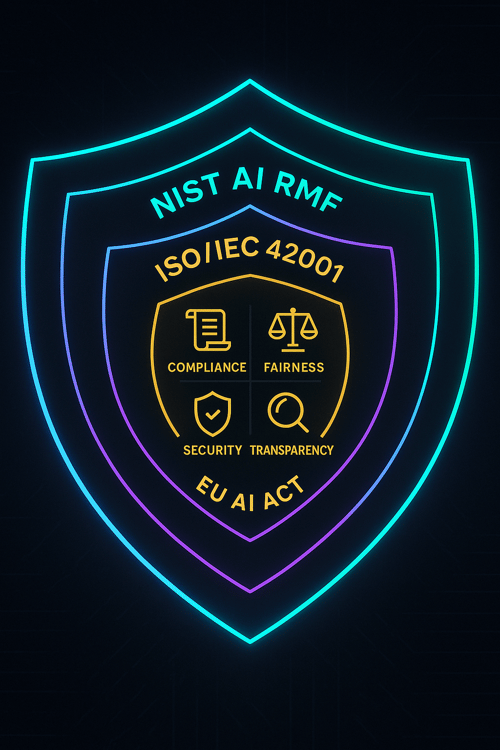
  • EU AI Act: Classifies AI systems into risk categories. High‑risk systems must satisfy strict documentation, transparency and human oversight requirements.
  • NIST AI RMF: Suggests functions (Govern, Map, Measure, Manage) that organizations should perform throughout the AI lifecycle.
  • ISO/IEC 42001: An emerging standard that will specify AI management system requirements.

Implementing Governance

Establish roles and responsibilities, separate model builders from validators, and create an AI board involving legal, technical and ethics experts. Document training data sources, feature selection, model assumptions and evaluation results.

Expert Insights

  • Comprehensive records: Keeping detailed records of model decisions and interactions helps in investigations and audits.
  • Ethical AI: Governance is not just about compliance – it ensures that AI systems align with organizational values and social expectations.
  • Clarifai’s tools: Clarifai’s Control Center offers granular permission controls and SOC2/ISO 27001 compliance out of the box, easing governance burdens.
    Responsible AI & Governance Frameworks


How to Ensure Reproducibility and Track Experiments?

Quick Summary: Why is reproducibility important?

  • Reproducibility ensures that models can be consistently rebuilt and audited. Experiment tracking centralizes metrics and artifacts for comparison and collaboration.

Version Control & Data Lineage

Use Git for code and DVC (Data Version Control) or Git‑LFS for large datasets. Log random seeds, environment variables and library versions to avoid non‑deterministic results. Keep transformation scripts under version control.

Experiment Tracking

Tools like MLflow, Neptune.ai or Clarifai’s built‑in tracker enable you to log hyperparameters, metrics, artifacts and environment details, and tag experiments for easy retrieval. Use dashboards to compare runs and decide which models to promote.

Model Registry

A model registry is a centralized store for models and their metadata. It tracks versions, performance, stage (staging, production), and references to data and code. Unlike object storage, a registry provides context and supports rollbacks.

Expert Insights

  • Reproducibility is non‑negotiable for regulated industries; auditors may request to reproduce a prediction made years ago.
  • Tags and naming conventions: Use consistent naming patterns for experiments to avoid confusion.
  • Clarifai’s advantage: Clarifai’s platform integrates experiment tracking and model registry, so models move seamlessly from development to deployment.

How to Automate Your ML Lifecycle?

Quick Summary: What role does automation play in MLOps?

  • Automation streamlines repetitive tasks, accelerates releases and reduces human error. CI/CD pipelines, continuous training and infrastructure‑as‑code are key mechanisms.

CI/CD for Machine Learning

Adopt continuous integration and delivery pipelines:

  1. Continuous integration: Automate code tests, data validation and static analysis on every commit.
  2. Continuous delivery: Automate deployment of models to staging environments.
  3. Continuous training: Trigger training jobs automatically when new data arrives or drift is detected.

Infrastructure‑as‑Code & Orchestration

Define infrastructure (compute, networking, storage) using Terraform or CloudFormation to ensure consistent and repeatable environments. Use Kubernetes to orchestrate containers and implement autoscaling.

Clarifai Integration

Clarifai’s compute orchestration simplifies automation: you can deploy your models anywhere (cloud, on‑prem or edge) and scale them automatically. Local runners let you test or run models offline using the same API, making CI/CD pipelines more robust.

Expert Insights

  • Automate tests: ML pipelines need tests beyond unit tests – include checks for data schema and distribution.
  • Small increments: Deploying small changes more frequently reduces risk.
  • Self‑healing pipelines: Build pipelines that react to drift detection by automatically retraining and redeploying.

How to Orchestrate Compute Resources Effectively?

Quick Summary: What is compute orchestration and why is it important?

  • Compute orchestration manages the allocation and scaling of hardware resources (CPU, GPU, memory) across different environments (cloud, on‑prem, edge). It optimizes cost, performance and reliability.

Hybrid Deployment Options

Organizations can choose from:

  • Shared cloud: Pay‑as‑you‑go compute resources managed by providers.
  • Dedicated cloud: Dedicated environments for predictable performance.
  • On‑premise: For data sovereignty or latency requirements.
  • Edge: For real‑time inference near data sources.

Clarifai’s Hybrid Platform

Clarifai’s platform offers a unified control plane where you can orchestrate workloads across shared compute, dedicated environments and your own VPC or edge hardware. Autoscaling and cost optimization features help right‑size compute and allocate resources dynamically.

Cost Optimization Strategies

  • Right‑size instances: Choose instance types matching workload demands.
  • Spot instances: Reduce costs by using spare capacity at discounted rates.
  • Scheduling: Run compute‑intensive tasks during off‑peak hours to save on electricity and cloud fees.

Expert Insights

  • Resource monitoring: Continuously monitor resource utilization to avoid idle capacity.
  • MIG (Multi‑Instance GPU): Partition GPUs to run multiple models concurrently, improving utilization.
  • Clarifai’s local runners keep compute local to reduce latency and cloud costs.

Clarifai’s Compute Orchestration for ML Lifecycle


How to Deploy Models at the Edge and On‑Device?

Quick Summary: What are edge deployments and when are they useful?

  • Edge deployments run models on devices close to where data is generated, reducing latency and preserving privacy. They’re ideal for IoT, mobile and remote environments.

Why Edge?

Edge inference avoids round‑trip latency to the cloud and ensures models continue to operate even if connectivity is intermittent. It also keeps sensitive data local, which may be crucial for regulated industries.

Tools and Frameworks

  • TensorFlow Lite, ONNX Runtime and Core ML enable models to run on mobile phones and embedded devices.
  • Hardware acceleration: Devices like NVIDIA Jetson or smartphone NPUs provide the processing power needed for inference.
  • Resilient updates: Use over‑the‑air updates with rollback to ensure reliability.

Clarifai’s Edge Solutions

Clarifai’s local runners deliver consistent APIs across cloud and edge and can run on devices like Jetson. They allow you to test locally and deploy seamlessly with minimal code changes.

Expert Insights

  • Model size matters: Compress models via quantization or pruning to fit on resource‑constrained devices.
  • Data capture: Collect telemetry from edge devices to improve models over time.
  • Connectivity planning: Implement caching and asynchronous syncing to handle network outages.

What Is LLMOps and How to Handle Generative AI?

Quick Summary: How is LLMOps different from MLOps?

  • LLMOps applies lifecycle management to large language models (LLMs) and generative AI, addressing unique challenges like prompt management, privacy and hallucination detection.

The Rise of Generative AI

Large language models (LLMs) like GPT‑family and Claude can generate text, code and even images. Managing these models requires specialized practices:

  • Model selection: Evaluate open models and choose one that fits your domain.
  • Customisation: Fine‑tune or prompt‑engineer the model for your specific task.
  • Data privacy: Use pseudonymisation or anonymisation to protect sensitive data.
  • Retrieval‑Augmented Generation (RAG): Combine LLMs with vector databases to fetch accurate facts while keeping proprietary data off the model’s training corpus.

Prompt Management & Evaluation

  • Prompt repositories: Store and version prompts just like code.
  • Guardrails: Monitor outputs for hallucinations, toxicity or bias. Use tools like Clarifai’s generative AI evaluation service to measure and mitigate issues.

Clarifai’s Generative AI Offering

Clarifai provides pre‑trained text and image generation models with APIs for easy integration. Their platform allows you to fine‑tune prompts and evaluate generative output with built‑in guardrails.

Expert Insights

  • LLMs can be unpredictable: Always test prompts across diverse inputs.
  • Ethical considerations: LLMs can produce harmful or biased content; implement filters and oversight mechanisms.
  • LLM cost: Generative models require substantial compute. Using Clarifai’s hybrid compute orchestration helps you manage costs while leveraging the latest models.

Why Is Collaboration Essential for MLOps?

Quick Summary: How do teams collaborate in MLOps?

  • MLOps is inherently cross‑functional, requiring cooperation between data scientists, ML engineers, operations teams, product owners and domain experts. Effective collaboration hinges on communication, shared tools and mutual understanding.

Building Cross‑Functional Teams

  • Roles & Responsibilities: Define roles clearly (data engineer, ML engineer, MLOps engineer, domain expert).
  • Shared Documentation: Maintain documentation of datasets, feature definitions and model assumptions in collaborative platforms (Confluence, Notion).
  • Communication Rituals: Conduct daily stand‑ups, weekly syncs and retrospectives to align objectives.

Early Involvement of Domain Experts

Domain experts should be part of planning, feature engineering and evaluation phases to catch mistakes and add context. Encourage them to review model outputs and highlight anomalies.

Expert Insights

  • Psychological safety: Foster an environment where team members can question assumptions without fear.
  • Training: Encourage cross‑training – engineers learn domain context; domain experts gain ML literacy.
  • Clarifai’s Community: Clarifai offers community forums and support channels to help teams collaborate and get expert help.

What Do Real‑World Case Studies Teach Us?

Quick Summary: What lessons come from real deployments?

  • Real‑world case studies reveal the importance of monitoring, edge deployment and preparedness for drift. They highlight how Clarifai’s platform accelerates success.

Ride‑Sharing – Handling Weather‑Driven Drift

A ride‑sharing company monitored travel‑time predictions using Clarifai’s dashboard. When heavy rain caused unusual travel patterns, drift detection flagged the change. An automated retraining job updated the model with the new data, preventing inaccurate ETAs and maintaining user trust.

Manufacturing – Edge Monitoring of Machines

A factory deployed a computer‑vision model to detect equipment anomalies. Using Clarifai’s local runner on Jetson devices, they achieved real‑time inference without sending video to the cloud. Night‑time updates ensured the model stayed current without disrupting production.

Supply Chain – Consequences of Ignoring Drift

During COVID‑19, Amazon’s supply‑chain prediction algorithms failed due to unprecedented demand spikes for household goods, leading to bottlenecks. The lesson: incorporate extreme scenarios into risk management and monitor for unexpected drifts.

Benchmarking Drift Detection Tools

Researchers evaluated open‑source drift tools and found Evidently AI best for general drift detection and NannyML for pinpointing drift timing. Choosing the right tool depends on your use case.

Expert Insights

  • Monitoring pays off: Early detection and retraining saved the ride‑sharing and manufacturing companies from costly errors.
  • Edge vs cloud: Edge deployments cut latency but require strong update mechanisms.
  • Tool selection: Evaluate tools for functionality, scalability, and integration ease.

What Future Trends Will Shape ML Lifecycle Management?

Quick Summary: Which trends should you watch?

  • Responsible AI frameworks (NIST AI RMF, EU AI Act) and standards (ISO/IEC 42001) will shape governance, while LLMOps, federated learning, and AutoML will transform development.

Responsible AI & Regulation

The NIST AI RMF encourages organizations to govern, map, measure and manage AI risks. The EU AI Act categorizes systems by risk and will require high‑risk models to pass conformity assessments. ISO/IEC 42001 is in development to standardize AI management.

LLMOps & Generative AI

As generative models proliferate, LLMOps will become essential. Expect new tools for prompt management, fairness auditing and generative content identification.

Federated Learning & Privacy

Federated learning will enable collaborative training across multiple devices without sharing raw data, boosting privacy and complying with regulations. Differential privacy and secure aggregation will further protect sensitive information.

Low‑Code/AutoML & Citizen Data Scientists

AutoML platforms will democratize model development, enabling non‑experts to build models. However, organizations must balance automation with governance and oversight.

Research Gaps & Opportunities

A systematic mapping study highlights that few research papers tackle deployment, maintenance and quality assurance. This gap offers opportunities for innovation in MLOps tooling and methodology.

Expert Insights

  • Stay adaptable: Regulations will evolve; build flexible governance and compliance processes.
  • Invest in education: Equip your team with knowledge of ethics, law and emerging technologies.
  • Clarifai’s roadmap: Clarifai continues to integrate emerging practices (e.g., RAG, generative AI guardrails) into its platform, making it easier to adopt future trends.

Conclusion – How to Get Started and Succeed

Managing the ML lifecycle is a marathon, not a sprint. By planning carefully, preparing data meticulously, experimenting responsibly, deploying robustly, monitoring continuously and governing ethically, you set the stage for long‑term success. Clarifai’s hybrid AI platform offers tools for orchestration, local execution, model registry, generative AI and fairness auditing, making it easier to adopt best practices and accelerate time to value.

Actionable Next Steps

  1. Audit your workflow: Identify gaps in version control, data quality or monitoring.
  2. Implement data pipelines: Automate ingestion, validation and cleaning.
  3. Track experiments: Use an experiment tracker and model registry.
  4. Automate CI/CD: Build pipelines that test, train and deploy models continuously.
  5. Monitor & retrain: Set up drift detection and automated retraining triggers.
  6. Prepare for compliance: Document data sources, features and evaluation metrics; adopt frameworks like NIST AI RMF.
  7. Explore Clarifai: Leverage Clarifai’s compute orchestration, local runners and generative AI tools to simplify infrastructure and accelerate innovation.

Frequently Asked Questions

Q1: How frequently should models be retrained?
Retraining frequency depends on data drift and business requirements. Use monitoring to detect when performance drops below acceptable thresholds and trigger retraining.

Q2: What differentiates MLOps from LLMOps?
MLOps manages any machine‑learning model’s lifecycle, while LLMOps focuses on large language models, adding challenges like prompt management, privacy preservation and hallucination detection.

Q3: Are edge deployments always better?
No. Edge deployments reduce latency and improve privacy, but they require lightweight models and robust update mechanisms. Use them when latency, bandwidth or privacy demands outweigh the complexity.

Q4: How do model registries improve reproducibility?
Model registries store versions, metadata and deployment status, making it easy to roll back or compare models; object storage alone lacks this context.

Q5: What does Clarifai offer beyond open‑source tools?
Clarifai provides end‑to‑end solutions, including compute orchestration, local runners, experiment tracking, generative AI tools and fairness audits, combined with enterprise‑grade security and support


OpenAI’s Landmark Study Reveals How We Really Use ChatGPT


OpenAI, in partnership with the National Bureau of Economic Research, just released the largest study to date on how people are using ChatGPT, analyzing user messages from May 2024 to June 2025. Continue reading “OpenAI’s Landmark Study Reveals How We Really Use ChatGPT”

Clarifai Ranks at the Top for Performance and Cost-Efficiency


Artificial Analysis, an independent benchmarking platform, evaluated providers serving GPT-OSS-120B across latency, throughput, and price. In these tests, Clarifai’s Compute Orchestration delivered 0.27 s Time to First Token (TTFT) and 313 tokens per second at a blended price near $0.16 per 1M tokens. These results place Clarifai in the benchmark’s “most attractive” zone for high speed and low price.

Inside the Benchmarks: How Clarifai Stacks Up

Artificial Analysis benchmarks focus on three core metrics that map directly to production workloads:

  • Time to First Token (TTFT): the delay from request to the first streamed token. Lower TTFT improves responsiveness in chatbots, copilots, and agent loops.

  • Tokens per second (throughput): the average streaming rate, a strong indicator of completion speed and efficiency.

  • Blended price per million tokens: a normalized cost metric that accounts for both input and output tokens, allowing apples-to-apples comparisons across providers.

On GPT-OSS-120B, Clarifai achieved:

  • TTFT: 0.27 s 

  • Throughput: 313 tokens/sec

  • Blended price: $0.16 per 1M tokens

  • Overall: Ranked in the benchmark’s “most attractive” quadrant for speed and cost efficiency

These numbers validate Clarifai’s ability to balance low latency, high throughput, and cost optimization—key factors for scaling large models like GPT-OSS-120B.

Below is a comparison of output speed versus price across major providers for GPT-OSS-120B. Clarifai stands out in the “most attractive quadrant,” combining high throughput with competitive pricing.

Output Speed vs Price (10 Sep 25)  (2)

Output Speed vs. Price

Below chart compares latency (time to first token) against output speed. Clarifai demonstrates one of the lowest latencies while maintaining top-tier throughput—placing it among the best-in-class providers.

Latency vs Output Speed (10 Sep 25)  (1)

Latency vs. Output Speed


GPU and Hardware-Agnostic Inference at Scale with Clarifai

Clarifai’s Compute Orchestration is designed to maximize performance and efficiency regardless of the underlying hardware.

Key elements include:

  • Vendor-agnostic deployment: Seamlessly deploy models on any CPU, GPU, or accelerator in our SaaS, your own cloud or on-premises infrastructure, or in air-gapped environments without lock-in.
  • Autoscaling and right-sizing: Dynamic scaling ensures resources adapt to workload spikes while minimizing idle costs.

  • GPU fractioning and efficiency: Techniques that maximize utilization by running multiple models or tenants on the same GPU fleet.

  • Runtime flexibility: Support for frameworks such as TensorRT-LLM, vLLM, and SGLang across GPU generations like H100 and B200, giving teams the flexibility to optimize for either latency or throughput.

This orchestration-first approach matters for GPT-OSS-120B, a compute-intensive Mixture-of-Experts model, where careful tuning of schedulers, batching strategies, and runtime choices can drastically affect performance and cost.

What these results mean for engineering teams

For developers and platform teams, Clarifai’s benchmark performance translates into clear benefits when deploying GPT-OSS-120B in production:

  1. Faster, smoother user experiences
    With a median TTFT of ~0.27 s, applications deliver instant feedback. In multi-step agent workflows, lower TTFT compounds to significantly reduce response times.

  2. Improved cost efficiency
    High throughput (~313 tokens/sec) combined with ~$0.16 per 1M tokens allows teams to serve more requests per GPU hour while keeping budgets predictable.

  3. Operational flexibility
    Teams can choose between latency-optimized or throughput-optimized runtimes and scale seamlessly across infrastructures, avoiding vendor lock-in.

  4. Applicable to diverse use cases

    • Enterprise copilots: faster draft generation and real-time assistance

    • RAG and analytics pipelines: efficient summarization of long documents with lower costs

    • Agentic workflows: repeated tool calls with minimal latency overhead

Try out GPT-OSS-120B

Benchmarks are useful, but the best way to evaluate performance is to try the model yourself. Clarifai makes it simple to experiment and integrate GPT-OSS-120B into real workflows.

1. Test in the Playground

You can directly explore GPT-OSS-120B in Clarifai’s Playground with an interactive UI—perfect for rapid experimentation, prompt design, and side-by-side model comparisons.

Try GPT-OSS-120B in the Playground

2. Access via the API

For production use, GPT-OSS-120B is fully accessible through Clarifai’s OpenAI-compatible API. This means you can integrate the model with the same tooling and workflows you already use for OpenAI models—while benefiting from Clarifai’s orchestration efficiency and cost-performance advantages.

Broad SDK and runtime support

Developers can call GPT-OSS-120B across a wide range of environments, including:

  • Python (Clarifai Python SDK, OpenAI-compatible API, gRPC)

  • Node.js (Clarifai SDK, OpenAI-compatible clients, Vercel AI SDK)

  • JavaScript, PHP, Java, cURL and more

This flexibility allows you to integrate GPT-OSS-120B directly into your existing pipelines with minimal code changes.

Python example (OpenAI-compatible API)

See the Clarifai Inference documentation for details on authentication, supported SDKs, and advanced features like streaming, batching, and deployment flexibility.

Conclusion

Artificial Analysis’s independent evaluation of GPT-OSS-120B highlights Clarifai as one of the leading platforms for speed and cost efficiency. By combining fast token streaming (313 tok/s), low latency (0.27 s TTFT), and a competitive blended price ($0.16/M tokens), Clarifai delivers the kind of performance that matters most for production-scale inference.

For ML and engineering teams, this means more responsive user experiences, efficient infrastructure utilization, and confidence in scaling GPT-OSS-120B without unpredictable costs. Read the full Artificial Analysis benchmarks.

If you’d like to discuss these results or have questions about running GPT-OSS-120B in production, join us in our Discord Channel. Our team and community are there to help with deployment strategies, GPU choices, and optimizing your AI infrastructure.


Replit’s CEO Says Your Company’s Org Chart Is Obsolete. Here’s What Replaces It.


Replit CEO Amjad Masad just laid out a vision for the future of business, and it looks nothing like the companies we work in today. Continue reading “Replit’s CEO Says Your Company’s Org Chart Is Obsolete. Here’s What Replaces It.”

Top AI Infrastructure Companies | Comprehensive Comparison Guide


Top AI infrastructure company

Top AI Infrastructure Companies: A Comprehensive Comparison Guide

Artificial intelligence (AI) is no longer just a buzzword; many businesses are struggling to scale models because they lack the right infrastructure. AI infrastructure comprises technologies for computing, data management, networking, and orchestration that work together to train, deploy, and serve models. In this guide, we’ll explore the market, compare top AI infrastructure companies, and highlight new trends that will transform computing. Understanding this space will empower you to make better decisions whether you’re building a startup or modernizing your operations.

Quick Summary: What Will You Learn in This Guide?

  • What is AI infrastructure? A specialized technology stack—including computation, data, platform services, networking, and governance—that supports model training and inference.
  • Why should you care? The market is growing rapidly, projected from $23.5 billion in 2021 to over $309 billion by 2031. Businesses spend billions on specialist chips, GPU data centers, and MLOps platforms.
  • Who are the leaders? Major cloud platforms like AWS, Google Cloud, and Azure dominate, while hardware giants NVIDIA and AMD produce cutting-edge GPUs. Rising players like CoreWeave and Lambda Labs offer affordable GPU clouds.
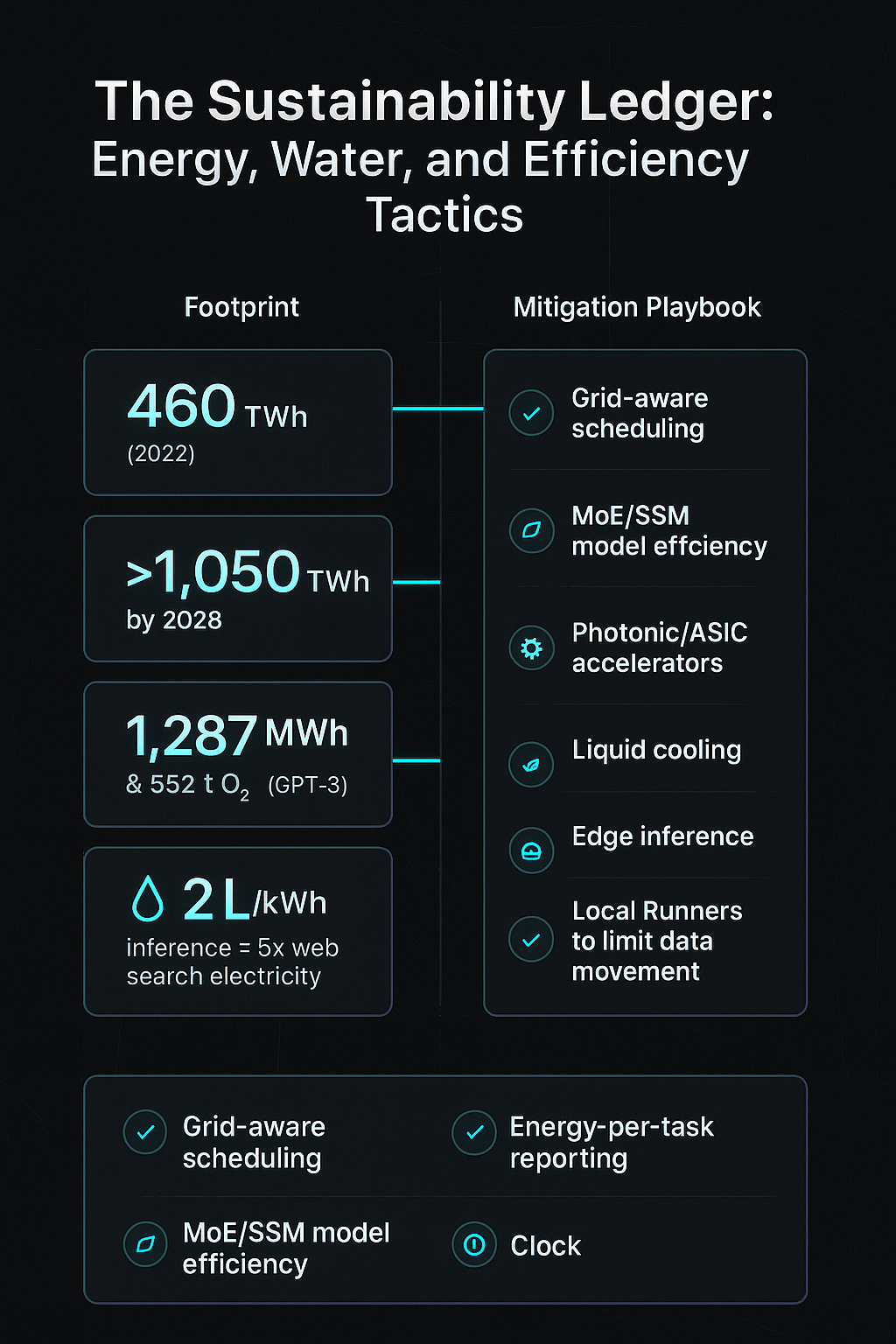
  • How to choose? Consider computational power, cost transparency, latency, energy efficiency, security, and ecosystem support. Sustainability matters—training GPT-3 consumed 1,287 MWh of electricity and released 552 tons of CO₂.
  • Clarifai’s view: Clarifai helps businesses manage data, run models, and deploy them across cloud and edge contexts. It offers local runners and managed inference for quick iteration with cost control and compliance.

What Is AI Infrastructure, and Why Is It Important?

What Makes AI Infrastructure Different from Traditional IT?

AI infrastructure is built for high-compute workloads like training language models and running computer vision pipelines. Traditional servers struggle with large tensor computations and high data throughput. Thus, AI systems rely on accelerators like GPUs, TPUs, and ASICs for parallel processing. Additional components include data pipelines, MLOps platforms, network fabrics, and governance frameworks, ensuring repeatability and regulatory compliance. NVIDIA CEO Jensen Huang coined AI as “the essential infrastructure of our time,” highlighting that AI workloads need a tailored stack.

Why Is an Integrated Stack Essential?

To train advanced models, teams must coordinate compute resources, storage, and orchestration across clusters. DataOps 2.0 tools handle data ingestion, cleaning, labeling, and versioning. After training, inference services must respond quickly. Without a unified stack, teams face bottlenecks, hidden costs, and security issues. A survey by the AI Infrastructure Alliance shows only 5–10 % of businesses have generative AI in production due to complexity. Adopting a full AI-optimized stack enables organizations to accelerate deployment, reduce costs, and maintain compliance.

Expert Opinions

  • New architectures matter: Bessemer Venture Partners notes that state-space models and Mixture-of-Experts architectures lower compute requirements while preserving accuracy.
  • Next-generation GPUs and algorithms: Devices like NVIDIA H100/B100 and techniques such as Ring Attention and KV-cache optimization dramatically speed up training.
  • DataOps & observability: As models grow, teams need robust DataOps and observability tools to manage datasets and monitor bias, drift, and latency.

What Is the Current AI Infrastructure Market Landscape?

How Big Is the Market and What’s the Growth Forecast?

The AI infrastructure market is booming. ClearML and the AI Infrastructure Alliance report it was worth $23.5 billion in 2021 and will grow to over $309 billion by 2031. Generative AI is expected to hit $98.1 billion by 2025 and $667 billion by 2030. In 2024, global cloud infrastructure spending reached $336 billion, with half of the growth attributed to AI. By 2025, cloud AI spending is projected to exceed $723 billion.

How Wide Is the Adoption Across Industries?

Generative AI adoption spans multiple sectors:

  • Healthcare (47 %)
  • Financial services (63 %)
  • Media and entertainment (69 %)

Big players are investing heavily in AI infrastructure: Microsoft plans to spend $80 billion, Alphabet up to $75 billion, Meta between $60 – 65 billion, and Amazon around $100 billion. However, 96 % of organizations intend to further expand their AI computing power, and 64 % already use generative AI—illustrating the rapid pace of adoption.

Expert Opinions

  • Enterprise embedding: By 2025, 67 % of AI spending will come from businesses integrating AI into core operations.
  • Industry valuations: Startups like CoreWeave are valued near $19 billion, reflecting a strong demand for GPU clouds.
  • Regional dynamics: North America holds 38.9 % of generative AI revenue, while Asia-Pacific experiences 47 % year-over-year growth.

How Are AI Infrastructure Providers Classified?

Compute and accelerators

The compute layer supplies raw power for AI. It includes GPUs, TPUs, AI ASICs, and emerging photonic chips. Major hardware companies like NVIDIA, AMD, Intel, and Cerebras dominate, but specialized providers—AWS Trainium/Inferentia, Groq, Etched, Tenstorrent—deliver custom chips for specific tasks. Photonic chips promise almost zero energy use in convolution operations. Later sections cover each vendor in more detail.

Cloud & hyperscale platforms

Major hyperscalers provide all-in-one stacks that combine computing, storage, and AI services. AWS, Google Cloud, Microsoft Azure, IBM, and Oracle offer managed training, pre-built foundation models, and bespoke chips. Regional clouds like Alibaba and Tencent serve local markets. These platforms attract enterprises seeking security, global availability, and automated deployment.

AI‑native cloud start‑ups

New entrants such as CoreWeave, Lambda Labs, Together AI, and Voltage Park focus on GPU-rich clusters optimized for AI workloads. They offer on-demand pricing, transparent billing, and quick scaling without the overhead of general-purpose clouds. Some, like Groq and Tenstorrent, create dedicated chips for ultra-low-latency inference.

DataOps, observability & orchestration

DataOps 2.0 platforms handle data ingestion, classification, versioning, and governance. Tools like Databricks, MLflow, ClearML, and Hugging Face provide training pipelines and model registries. Observability services (e.g., Arize AI, WhyLabs, Credo AI) monitor performance, bias, and drift. Frameworks like LangChain, LlamaIndex, Modal, and Foundry enable developers to link models and agents for complex tasks. These layers are essential for deploying AI in real-world environments.

Expert Opinions

  • Modular stacks: Bessemer points out that the AI infrastructure stack is increasingly modular—different providers cover compute, deployment, data management, observability, and orchestration.
  • Hybrid deployments: Organizations leverage cloud, hybrid, and on-prem deployments to balance cost, performance, and data sovereignty.
  • Governance importance: Governance is now seen as central, covering security, compliance, and ethics.

AI Infrastructure Stack


Who Are the Top AI Infrastructure Companies?

Clarifai:

Clarifai stands out in the LLMOps + Inference Orchestration + Data/MLOps space, serving as an AI control plane. It links data, models, and compute across cloud, VPC, and edge environments—unlike hyperscale clouds that focus primarily on raw compute. Clarifai’s key strengths include:

  • Compute orchestration that routes workloads to the best-fit GPUs or specialized processors across clouds or on-premises.
  • Autoscaling inference endpoints and Local Runners for air-gapped or low-latency deployments, enabling rapid deployment with predictable costs.
  • Integration of data labeling, vector search, retrieval-augmented generation (RAG), finetuning, and evaluation into one governed workflow—eliminating brittle glue code.
  • Enterprise governance with approvals, audit logs, and role-based access control to ensure compliance and traceability.
  • A multi-cloud and on-prem strategy to reduce total cost and prevent vendor lock-in.

For organizations seeking both control and scale, Clarifai becomes the infrastructure backbone—reducing the total cost of ownership and ensuring consistency from lab to production.

Clarifai - Ai infrastructure

Amazon Web Services:

AWS excels at AI infrastructure. SageMaker simplifies model training, tuning, deployment, and monitoring. Bedrock provides APIs to both proprietary and open foundation models. Custom chips like Trainium (training) and Inferentia (inference) offer excellent price-performance. Nova, a family of generative models, and Graviton processors for general compute add versatility. The global network of AWS data centers ensures low-latency access and regulatory compliance.

Expert Opinions

  • Accelerators: AWS’s Trainium chips deliver up to 30 % better price-performance than comparable GPUs.
  • Bedrock’s flexibility: Integration with open-source frameworks lets developers fine-tune models without worrying about infrastructure.
  • Serverless inference: AWS supports serverless inference endpoints, reducing costs for applications with bursty traffic.

Google Cloud’s AI:

At Google Cloud, Vertex AI anchors the AI stack—managing training, tuning, and deployment. TPUs accelerate training for large models such as Gemini and PaLM. Vertex integrates with BigQuery, Dataproc, and Datastore for seamless data ingestion and management, and supports pre-built pipelines.

Insights from Experts

  • TPU advantage: TPUs handle matrix multiplication efficiently, ideal for transformer models.
  • Data fabric: Integration with Google’s data tools ensures seamless operations.
  • Open models: Google releases models like Gemini to encourage collaboration while leveraging its compute infrastructure.

Microsoft Azure AI

Microsoft Azure AI offers AI services through Azure Machine Learning, Azure OpenAI Service, and Foundry. Users can choose from NVIDIA GPUs, B200 GPUs, and NP-series instances. The Foundry marketplace introduces a real-time compute market and multi-agent orchestration. Responsible AI tools help developers evaluate fairness and interpretability.

Experts Highlight

  • Deep integration: Azure aligns closely with Microsoft productivity tools and offers robust identity and security.
  • Partner ecosystem: Collaboration with OpenAI and Databricks enhances its capabilities.
  • Innovation in Foundry: Real-time compute markets and multi-agent orchestration show Azure’s move beyond traditional cloud resources.

IBM Watsonx and Oracle Cloud Infrastructure

IBM Watsonx offers capabilities for building, governing, and deploying AI across hybrid clouds. It provides a model library, data storage, and governance layer to manage the lifecycle and compliance. Oracle Cloud Infrastructure delivers AI-enabled databases, high-performance computing, and transparent pricing.

Expert Opinions

  • Hybrid focus: IBM is strong in hybrid and on-prem solutions—suitable for regulated industries.
  • Governance: Watsonx emphasizes governance and responsible AI, appealing to compliance-driven sectors.
  • Integrated data: OCI ties AI services directly to its autonomous database, reducing latency and data movement.

What About Regional Cloud and Edge Providers?

Alibaba Cloud and Tencent Cloud offer AI chips such as Hanguang and NeuroPilot, tailored to local rules and languages in Asia-Pacific. Edge providers like Akamai and Fastly enable low-latency inference at network edges, essential for IoT and real-time analytics.


Which Companies Lead in Hardware and Chip Innovation?

How Does NVIDIA Maintain Its Performance Leadership?

NVIDIA leads the market with its H100, B100, and upcoming Blackwell GPUs. These chips power many generative AI models and data centers. DGX systems bundle GPUs, networking, and software for optimized performance. Features such as tensor cores, NVLink, and fine-grained compute partitioning support high-throughput parallelism and better utilization.

Expert Advice

  • Performance gains: The H100 significantly outperforms the previous generation, offering more performance per watt and higher memory bandwidth.
  • Ecosystem strength: NVIDIA’s CUDA and cuDNN are foundations for many deep-learning frameworks.
  • Plug-and-play clusters: DGX-SuperPODs allow enterprises to rapidly deploy supercomputing clusters.

What Are AMD and Intel Doing?

AMD competes with MI300X and MI400 GPUs, focusing on high-bandwidth memory and cost efficiency. Intel develops Gaudi accelerators and Habana Labs technology while integrating AI features into Xeon processors.

Expert Insights

  • Cost-effective performance: AMD’s GPUs often deliver excellent price-performance, especially for inference workloads.
  • Gaudi’s unique design: Intel uses specialized interconnects to speed tensor operations.
  • CPU-level AI: Integrating AI acceleration into CPUs benefits edge and mid-scale workloads.

Who Are the Specialized Chip Innovators?

  • AWS Trainium/Inferentia lowers cost per FLOP and energy use for training and inference.
  • Cerebras Systems produces the Wafer-Scale Engine (WSE), boasting 850 k AI cores.
  • Groq designs chips for ultra-low-latency inference, ideal for real-time applications like autonomous vehicles.
  • Etched builds the Sohu ASIC for transformer inference, dramatically improving energy efficiency.
  • Tenstorrent employs RISC-V cores and is building decentralized data centers.
  • Photonic chip makers like Lightmatter use light to conduct convolution with almost no energy.

Expert Perspectives

  • Diversifying hardware: The rise of specialized chips signals a move toward task-specific hardware.
  • Energy efficiency: Photonic and transformer-specific chips cut power consumption dramatically.
  • Emerging vendors: Companies like Groq, Tenstorrent, and Lightmatter show that tech giants are not the only ones who can innovate.

Which Startups and Data Center Providers Are Shaping AI Infrastructure?

What Is CoreWeave’s Value Proposition?

CoreWeave evolved from cryptocurrency mining to become a prominent GPU cloud provider. It provides on-demand access to NVIDIA’s latest Blackwell and RTX PRO GPUs, coupled with high-performance InfiniBand networking. Pricing can be up to 80 % lower than traditional clouds, making it popular with startups and labs.

Expert Advice

  • Scale advantage: CoreWeave manages hundreds of thousands of GPUs and is expanding data centers with $6 billion in funding.
  • Transparent pricing: Customers can clearly see costs and reserve capacity for guaranteed availability.
  • Enterprise partnerships: CoreWeave collaborates with AI labs to provide dedicated clusters for large models.

How Does Lambda Labs Stand Out?

Lambda Labs offers developer-friendly GPU clouds with 1-Click clusters and transparent pricing—A100 at $1.25/hr, H100 at $2.49/hr. It raised $480 million to build liquid-cooled data centers and earned SOC2 Type II certification.

Expert Advice

  • Transparency: Clear pricing reduces surprise fees.
  • Compliance: SOC2 and ISO certifications make Lambda appealing for regulated industries.
  • Innovation: Liquid-cooled data centers enhance energy efficiency and density.

What Do Together AI, Voltage Park, and Tenstorrent Offer?

  • Together AI is building an open-source cloud with pay-as-you-go compute.
  • Voltage Park offers clusters of H100 GPUs at competitive prices.
  • Tenstorrent integrates RISC-V cores and aims for decentralized data centers.

Expert Opinions

  • Demand drivers: The shortage of GPUs and high cloud costs drive the rise of AI data center startups.
  • Emerging names: Other players include Lightmatter, Iren, Rebellions.ai, and Rain AI.
  • Open ecosystems: Together AI fosters collaboration by releasing models and tools publicly.

AI Infrastructure Roles by Category


What About Data & MLOps Infrastructure: From DataOps 2.0 to Observability?

Why Is DataOps Critical for AI?

DataOps oversees data gathering, cleaning, transformation, labeling, and versioning. Without robust DataOps, models risk drift, bias, and reproducibility issues. In generative AI, managing millions of data points demands automated pipelines. Bessemer calls this DataOps 2.0, emphasizing that data pipelines must scale like the compute layer.

Why Is Observability Essential?

After deployment, models require continuous monitoring to catch performance degradation, bias, and security threats. Tools like Arize AI and WhyLabs track metrics and detect drift. Governance platforms like Credo AI and Aporia ensure compliance with fairness and privacy requirements. Observability grows critical as models interact with real-time data and adapt via reinforcement learning.

How Do Orchestration Frameworks Work?

LangChain, LlamaIndex, Modal, and Foundry allow developers to stitch together multiple models or services to build LLM agents, chatbots, and autonomous workflows. These frameworks manage state, context, and errors. Clarifai’s platform offers built-in workflows and compute orchestration for both local and cloud environments. With Clarifai’s Local Runners, you can train models where data resides and deploy inference on Clarifai’s managed platform for scalability and privacy.

Expert Insights

  • Production gap: Only 5–10 % of businesses have generative AI in production because DataOps and orchestration are too complex.
  • Workflow automation: Orchestration frameworks are essential as AI moves from static endpoints to agent-based applications.
  • Clarifai integration: Clarifai’s dataset management, annotations, and workflows make DataOps and MLOps accessible at scale.

What Criteria Matter When Comparing AI Infrastructure Providers?

How Important Are Compute Power and Scalability?

Having cutting-edge hardware is essential. Providers should offer latest GPUs or specialized chips (H100, B200, Trainium) and support large clusters. Compare network bandwidth (InfiniBand vs. Ethernet) and memory bandwidth because transformer models are memory-bound. Scalability depends on a provider’s ability to quickly expand capacity across regions.

Why Is Pricing Transparency Crucial?

Hidden expenses can derail projects. Many hyperscalers have complex pricing models based on compute hours, storage, and egress. AI-native clouds like CoreWeave and Lambda Labs stand out with simple pricing. Consider reserved capacity discounts, spot pricing, and serverless inference to minimize costs. Clarifai’s pay-as-you-go model auto-scales inference for cost optimization.

How Does Performance and Latency Affect Your Choice?

Performance varies across hardware generations, interconnects, and software stacks. MLPerf benchmarks offer standardized metrics. Latency matters for real-time applications (e.g., chatbots, self-driving cars). Specialized chips like Groq and Sohu achieve microsecond-level latencies. Evaluate how providers handle bursts and maintain consistent performance.

Why Focus on Sustainability and Energy Efficiency?

AI’s environmental impact is significant:

  • Data centers used 460 TWh of electricity in 2022; projected to exceed 1,050 TWh by 2026.
  • Training GPT-3 consumed 1,287 MWh and emitted 552 tons of CO₂.
  • Photonic chips offer near-zero energy convolution, and cooling accounts for considerable water use.

Choose providers committed to renewable energy, efficient cooling, and carbon offsets. Clarifai’s ability to orchestrate compute on local hardware reduces data transport and emissions.

How Does Security & Compliance Affect Decisions?

AI systems must protect sensitive data and follow regulations. Ask about SOC2, ISO 27001, and GDPR certifications. 55 % of businesses report increased cyber threats after adopting AI, and 46 % cite cybersecurity gaps. Look for providers with encryption, granular access controls, audit logging, and zero-trust architectures. Clarifai offers enterprise-grade security and on-prem deployment options.

What About Ecosystem & Integration?

Choose providers compatible with popular frameworks (PyTorch, TensorFlow, JAX), container tools (Docker, Kubernetes), and hybrid deployments. A broad partner ecosystem enhances integration. Clarifai’s API interoperates with external data sources and supports REST, gRPC, and Edge run times.

Expert Insights

  • Skills shortage: 61 % of firms lack specialists in computing; 53 % lack data scientists.
  • Capital intensity: Building full-stack AI infrastructure costs billions—only well-funded companies can compete.
  • Risk management: Investments should align with business goals and risk tolerance, as TrendForce advises.

What Is the Environmental Impact of AI Infrastructure?

How Big Are the Energy and Water Demands?

AI infrastructure consumes huge amounts of resources. Data centers used 460 TWh of electricity in 2022 and may surpass 1,050 TWh by 2026. Training GPT-3 used 1,287 MWh and emitted 552 tons of CO₂. Inference consumes five times more electricity than a typical web search. Cooling also demands around 2 liters of water per kilowatt-hour.

How Are Data Centers Adapting?

Data centers adopt energy-efficient chips, liquid cooling, and renewable power. HPE’s fanless liquid-cooled design reduces electricity and noise. Photonic chips eliminate resistance and heat. Companies like Iren and Lightmatter build data centers tied to renewable energy. The ACEEE warns that AI data centers could use 9 % of U.S. electricity by 2030, advocating for energy-per-AI-task metrics and grid-aware scheduling.

What Sustainable Practices Can Businesses Adopt?

  • Better scheduling: Run non-urgent training jobs during off-peak periods to utilize surplus renewable energy.
  • Model efficiency: Apply techniques like state-space models and Mixture-of-Experts to reduce compute needs.
  • Edge inference: Deploy models locally to reduce data center traffic and latency.
  • Monitoring & reporting: Track per-model energy use and work with providers who disclose carbon footprints.
  • Clarifai’s local runners: Train on-prem and scale inference via Clarifai’s orchestrator to cut data transfer.

Expert Opinions

  • Future grids: The ACEEE recommends aligning workloads with renewable availability.
  • Transparent metrics: Without clear metrics, companies risk overbuilding infrastructure.
  • Continuous innovation: Photonic computing, RISC-V, and dynamic scheduling are critical for sustainable AI.

Sustainability Ledger


What Are the Challenges and Future Trends in AI Infrastructure?

Why Are Compute Scalability and Memory Bottlenecks Critical?

As Moore’s Law slows, scaling compute becomes difficult. Memory bandwidth now limits transformer training. Techniques like Ring Attention and KV-cache optimization reduce compute load. Mixture-of-Experts distributes work across multiple experts, lowering memory needs. Future GPUs will feature larger caches and faster HBM.

What Drives Capital Intensity and Supply Chain Risks?

Building AI infrastructure is extremely capital-intensive. Only large tech firms and well-funded startups can build chip fabs and data centers. Geopolitical tensions and export restrictions create supply chain risks, delaying hardware and driving the need for diversified architecture and regional production.

Why Are Transparency and Explainability Important?

Stakeholders demand explainable AI, but many providers keep performance data proprietary. Openness is difficult to balance with competitive advantage. Vendors are increasingly providing white-box architectures, open benchmarks, and model cards.

How Are Specialized Hardware and Algorithms Evolving?

Emerging state-space models and transformer variants require different hardware. Startups like Etched and Groq build chips tailored for specific use cases. Photonic and quantum computing may become mainstream. Expect a diverse ecosystem with multiple specialized hardware types.

What’s the Impact of Agent-Based Models and Serverless Compute?

Agent-based architectures demand dynamic orchestration. Serverless GPU backends like Modal and Foundry allocate compute on-demand, working with multi-agent frameworks to power chatbots and autonomous workflows. This approach democratizes AI development by removing server management.

Expert Opinions

  • Goal-driven strategy: Align investments with clear business objectives and risk tolerance.
  • Infrastructure scaling: Plan for future architectures despite uncertain chip roadmaps.
  • Geopolitical awareness: Diversify suppliers and develop contingency plans to handle supply chain disruptions.

How Should Governance, Ethics, and Compliance Be Addressed?

What Does the Governance Layer Involve?

Governance covers security, privacy, ethics, and regulatory compliance. AI providers must implement encryption, access controls, and audit trails. Frameworks like SOC2, ISO 27001, FedRAMP, and the EU AI Act ensure legal adherence. Governance also demands ethical considerations—avoiding bias, ensuring transparency, and respecting user rights.

How Do You Manage Compliance and Risk?

Perform risk assessments considering data residency, cross-border transfers, and contractual obligations. 55 % of businesses experience increased cyber threats after adopting AI. Clarifai helps with compliance through granular roles, permissions, and on-premise options, enabling safe deployment while reducing legal risks.

Expert Opinions

  • Transparency challenge: Stakeholders demand greater transparency and clarity.
  • Fairness and bias: Evaluate fairness and bias within the model lifecycle, using tools like Clarifai’s Data Labeler.
  • Regulatory horizon: Stay updated on emerging laws (e.g., EU AI Act, US Executive Orders) and adapt infrastructure accordingly.

Final Thoughts and Suggestions

AI infrastructure is evolving rapidly as demand and technology progress. The market is shifting from generic cloud platforms to specialized providers, custom chips, and agent-based orchestration. Environmental concerns are pushing companies toward energy-efficient designs and renewable integration. When evaluating vendors, organizations must look beyond performance to consider cost transparency, security, governance, and environmental impact.

Actionable Recommendations

  • Choose hardware and cloud services tailored to your workload (training, inference, deployment). Use dedicated chips (like Trainium or Sohu) for high-volume inference; reserve GPUs for large training jobs.
  • Plan capacity ahead: The demand for GPUs often exceeds supply. Reserve resources or partner with providers who can guarantee availability.
  • Optimize sustainability: Use model-efficient techniques, schedule jobs during renewable peaks, and choose providers with transparent carbon reporting.
  • Prioritize governance: Ensure providers meet compliance standards and offer robust security. Include fairness and bias monitoring from the start.
  • Leverage Clarifai: Clarifai’s platform manages datasets, annotations, model deployment, and orchestration. Local runners allow on-prem training and seamless scaling to the cloud, balancing performance, cost, and data sovereignty.

FAQs

Q1: How do AI infrastructure and IT infrastructure differ?
A: AI infrastructure uses specialized accelerators, DataOps pipelines, observability tools, and orchestration frameworks for training and deploying ML models, whereas traditional IT infrastructure handles generic compute, storage, and networking.

Q2: Which cloud service is best for AI workloads?
A: It depends on the needs. AWS offers the most custom chips and managed services; Google Cloud excels with high-performance TPUs; Azure integrates seamlessly with business tools. For GPU-heavy workloads, specialized clouds like CoreWeave and Lambda Labs may provide better value. Compare compute options, pricing transparency, and ecosystem support.

Q3: How can I make my AI deployment more sustainable?
A: Use energy-efficient hardware, schedule jobs during periods of low demand, employ Mixture-of-Experts or state-space models, partner with providers investing in renewable energy, and report carbon metrics. Running inference at the edge or using Clarifai’s local runners reduces data center usage.

Q4: What should I look for in start-up AI clouds?
A: Seek transparent pricing, access to the latest GPUs, compliance certifications, and reliable customer support. Understand their approach to demand spikes, whether they offer reserved instances, and evaluate their financial stability and growth plans.

Q5: How does Clarifai integrate with AI infrastructure?
A: Clarifai provides a unified platform for dataset management, annotation, model training, and inference deployment. Its compute orchestrator connects to multiple cloud providers or on-prem servers, while local runners enable training and inference in controlled environments, balancing speed, cost, and compliance.


How Replit Made Its AI Agent 10X More Autonomous in a Single Leap


AI coding platform Replit just raised $250 million, tripling its valuation to $3 billion. But the real story isn’t just the money. It’s the launch of Agent 3, a next-generation AI developer that can build, test, and debug applications almost entirely on its own. Continue reading “How Replit Made Its AI Agent 10X More Autonomous in a Single Leap”

Model Quantization: Meaning, Benefits & Techniques


Introduction

In the age of ever‑growing deep neural networks, models like large language models (LLMs) and vision–language models (VLMs) are scaling to billions of parameters, making them incredibly powerful but also resource‑hungry. A 70‑billion‑parameter model needs roughly 280 GB of memory, making deployment on standard hardware or edge devices impractical. Model quantization provides a solution by reducing the precision of weights and activations, compressing the model footprint and improving computational efficiency without a complete redesign. Research shows that reducing from 32‑bit to 8‑bit representation can offer a 4× reduction in model size and 2–3× speedup while delivering up to a 16× increase in performance per watt. This article demystifies quantization, explores different techniques, highlights emerging research, and explains how Clarifai’s platform can help you harness quantization for efficient AI deployment.

After reading this comprehensive guide, you’ll understand what quantization is, why it’s important, how to implement it, the latest trends and innovations, and common misconceptions. We also weave in real‑world case studies, insights from leading researchers, and subtle pointers on using Clarifai’s compute orchestration and inference platform to make your quantized models production‑ready.

Quick Digest

To give you a quick overview, here are the core points covered in this article:

  • Definition and intuition – what quantization means and how it reduces model complexity by mapping continuous values to a finite set of integers.
  • Benefits and motivations – why quantization delivers dramatic savings in memory, energy, and latency; for example, INT8 quantization can provide up to 16× performance per watt and 4× lower memory bandwidth consumption compared with FP32 models.
  • Types of quantization – post‑training vs. quantization‑aware training (QAT), dynamic vs. static quantization, weight‑only schemes, and more.
  • Key parameters and challenges – understanding bit widths, scales, zero‑points, symmetric vs. asymmetric quantization, calibration, and common pitfalls.
  • State‑of‑the‑art innovations – exploring new techniques like ZeroQAT, FlatQuant, Commutative Vector Quantization (CommVQ), and VLMQ, which reduce model size even further while preserving accuracy.
  • Practical implementation steps – a step‑by‑step guide to quantizing your model, plus tools and libraries that support quantization (PyTorch, TensorFlow, hardware‑specific optimizers, etc.).
  • Clarifai integration – how Clarifai’s compute orchestration, model inference engine, and local runners simplify deployment of quantized models in production.
  • Future trends and ethical considerations – where quantization is headed, how to address potential fairness issues, and how to evaluate quantized models responsibly.

Let’s dive deep into the world of quantization and unlock efficiency without sacrificing capability.

Understanding Model Quantization in Simple Terms

Quick Summary: What does model quantization mean?

Model quantization reduces the numerical precision of neural network weights and activations—from high‑precision floats like FP32 to low‑precision integers or fixed‑point formats—so that the model consumes less memory and runs faster. Instead of storing 32‑bit floating‑point numbers, we map them to a finite set of discrete values, such as 8‑bit or 4‑bit integers. This mapping is defined by a scale factor and a zero‑point, ensuring that continuous values are represented faithfully within a smaller range. By lowering precision, models can leverage hardware‑accelerated integer arithmetic and compress weights to save bandwidth.

Breaking it Down

Imagine you’re measuring temperatures with a highly precise digital thermometer that shows values like 23.456 °C. If you only need to know whether it’s approximately 23 °C or 24 °C, you could round to the nearest whole number. Quantization applies a similar concept to neural networks: we round or rescale continuous weights and activations to smaller integer representations. This reduces storage from 32 bits to 8 bits (or even less), shrinking the model size by around 4× and enabling 2–3× faster inference.

Quantization uses two main parameters:

  1. Scale (S) – a scaling factor that converts floating‑point values into integer ranges. For example, to map values into an 8‑bit range, you compute a scale based on the maximum absolute value in the tensor.
  2. Zero‑point (Z) – an offset that aligns zero in floating‑point space to zero in integer space. Symmetric quantization sets the zero‑point to zero, which is efficient but wastes range when distributions are skewed. Asymmetric quantization uses a non‑zero zero‑point to fully utilize the integer range, improving accuracy for skewed distributions.

Together, these parameters enable mapping between floating‑point tensors and low‑precision integers, maintaining as much information as possible within the reduced bit width. When quantized weights and activations are multiplied and accumulated, hardware can use efficient integer arithmetic, boosting throughput and reducing energy consumption.

Expert Insights

  • Compression and speed trade‑off – Studies show that moving from 32‑bit to 8‑bit integers gives a 4× model size reduction and 2–3× speedup on typical hardware. Moving further down to 4‑bit reduces size but requires more careful calibration.
  • Energy efficiency – Qualcomm’s research highlights that INT8 quantization provides up to a 16× increase in performance per watt and 4× lower memory bandwidth usage compared with FP32 models. This is crucial for edge devices where power and memory are limited.
  • LLM resource savings – According to a resource‑efficient LLM study, a 70 B model normally demands about 280 GB of memory. Quantization can compress these models into forms that fit on a single GPU, enabling democratized access to large models.
  • Real data shows minimal accuracy loss – Research shows that carefully calibrated INT8 and 4‑bit quantization typically incurs less than 1 % accuracy drop on major tasks.

Creative Example

Think of high‑resolution digital photography. A RAW image captures huge amounts of detail but consumes gigabytes of storage. If you’re sharing photos on social media, you often compress the image to JPEG—it’s still crisp to the human eye but much smaller. Quantization is like compressing your AI model: you keep the important patterns while discarding unneeded precision. The result is a model that runs quickly on a smartphone without lugging around the “RAW file” weight.

Why Model Quantization Matters for AI Efficiency

Quick Summary: Why should we care about quantization?

Quantization is essential because it transforms bloated neural networks into leaner versions that are faster, energy‑efficient, and deployable on resource‑constrained hardware. By trading precision for efficiency, quantization enables AI to run on edge devices, reduces cloud inference costs, and even improves generalization by adding regularization noise during training.

The Case for Efficiency

Modern AI models are growing exponentially. Without compression, deploying them at scale becomes cost‑prohibitive and environmentally unsustainable. Quantization directly addresses three pain points:

  1. Memory footprint – High‑precision models occupy massive memory. Quantizing to 8‑bit cuts memory usage by 75 % and lowers memory bandwidth requirements. For LLMs that typically need hundreds of gigabytes, this makes the difference between using expensive multi‑GPU setups and running on a single GPU or even edge hardware.
  2. Computation speed – Lower‑precision operations are faster and more parallelizable. Quantization leverages specialized hardware (such as integer arithmetic units) to deliver 2–3× throughput improvements and up to 16× higher performance per watt.
  3. Energy consumption – AI inference can be energy‑intensive. A recent article from Qualcomm shows that moving from FP32 to INT8 reduces energy consumption significantly, leading to power savings and enabling longer battery life on mobile devices.

In addition to these tangible benefits, quantization also introduces noise that can act as a form of regularization, sometimes improving a model’s generalization and robustness. By compressing weights, the model might become less sensitive to small perturbations and thus better at handling outliers.

Impact on Edge and Cloud Deployment

Edge devices such as drones, wearables, and smart cameras have limited compute resources. Quantization makes it feasible to deploy complex models like object detectors or voice assistants locally, ensuring low‑latency responses and data privacy, since data doesn’t need to travel to the cloud. In the cloud, quantization reduces inference latency and energy costs, making AI services more sustainable and affordable.

Expert Insights

  • Energy savings translate into sustainability – USC Viterbi researchers note that quantization reduces training time and hardware resources, enabling more efficient learning and lowering energy consumption. Less energy usage means reduced carbon footprint, an increasingly important consideration for AI practitioners.
  • Improved generalization – Some studies show that noise introduced through quantization can act like a regularizer, improving model generalization on certain tasks. This counterintuitive benefit means you may get better performance on unseen data without additional training.
  • Edge AI adoption – Okoone explains that quantization is crucial for Edge AI, enabling models to run in real time on devices with constrained power budgets. By converting 32‑bit weights to 16‑bit or 8‑bit, you free up bandwidth and allow privacy‑preserving, on‑device inference.

Creative Example

Imagine you’re trying to fit several wardrobes worth of clothes into a single suitcase. By rolling your clothes tightly (analogous to quantization), you can pack more items without wrinkling them—saving space and making travel easier. Quantization similarly packs neural network parameters into a smaller space so your AI “suitcase” fits in a phone or IoT device.

Benefits of Model Quantization

Different Types of Quantization: PTQ, QAT, Dynamic, Static, and Weight‑Only

Quick Summary: What quantization approaches exist, and when should you use them?

There are multiple quantization strategies, each balancing ease of use and accuracy. The main categories are post‑training quantization (PTQ), quantization‑aware training (QAT), dynamic quantization, static quantization, and weight‑only quantization. PTQ converts a pre‑trained model to low precision without retraining; QAT simulates quantization during training so the model can adapt to precision loss; dynamic quantization quantizes activations on the fly during inference; static quantization pre‑computes ranges using a calibration dataset; weight‑only quantization focuses exclusively on compressing weights and keeps activations in higher precision.

Post‑Training Quantization (PTQ)

PTQ is the simplest to implement. You take a trained model and quantize it after training. There are two flavors:

  1. Dynamic PTQ – Only weights are pre‑quantized; activations are quantized at inference time. It doesn’t require any calibration dataset and works well for models where activation distribution doesn’t vary significantly. Tools like PyTorch’s dynamic quantization API follow this approach.
  2. Static PTQ – Weights and activations are quantized offline using a calibration dataset to estimate activation ranges. Static PTQ achieves higher accuracy than dynamic PTQ because it accurately maps the activation distribution.

PTQ is ideal when you don’t have access to training data or when retraining is expensive. However, extremely low bit‑widths (e.g., 2‑bit) may cause significant accuracy drops with PTQ alone.

Quantization‑Aware Training (QAT)

QAT inserts fake quantization operations during training, allowing the model to adapt to low precision. It requires the original training data and additional compute but yields superior accuracy, especially at lower bit widths (e.g., 4‑bit). QAT can also mitigate the accuracy loss due to outliers in LLMs. Recently, researchers proposed ZeroQAT, which uses zeroth‑order optimization to perform QAT without backpropagation—reducing the computational and memory burden while retaining QAT’s benefits. By estimating gradients using only forward passes, ZeroQAT enables quantization‑aware learning for large models that previously couldn’t afford full backpropagation.

Dynamic vs. Static Quantization

The terms dynamic and static refer to how activation ranges are determined. Dynamic quantization computes quantization parameters on the fly during inference, making it flexible when activation ranges vary widely. Static quantization, by contrast, uses a pre‑computed calibration dataset to estimate the ranges and generally yields better accuracy because it approximates the distribution more closely. According to ’s overview, static quantization is typically applied to convolutional neural networks with a calibration dataset. Dynamic quantization is more common for LSTM and transformer models where activation distributions fluctuate.

Weight‑Only Quantization

Weight‑only quantization compresses only the model weights, leaving activations in higher precision (e.g., FP16 or FP8). This approach simplifies hardware design and still yields significant memory savings. Weight‑only schemes such as AWQ (Activation‑aware Weight Quantization) and GPTQ (Gradient Post‑Training Quantization) have been widely adopted for LLMs. Recent research also explores 2‑bit and 1‑bit weight quantization for transformer models, which can deliver dramatic compression when combined with techniques like outlier smoothing.

Expert Insights

  • Dataset requirements – ’s comparison chart shows that dynamic and weight‑only PTQ require no calibration dataset, making them attractive for use cases with limited data. Static PTQ and QAT require calibration or fine‑tuning datasets to compute activation ranges or backpropagate through quantization operations.
  • Performance vs. accuracy – Research indicates that PTQ typically sacrifices more accuracy when using very low bit‑widths, whereas QAT preserves accuracy but requires additional training time. Tools like ZeroQAT bridge this gap by enabling QAT without full backpropagation.
  • Use‑case suitability – Weight‑only quantization is best for hardware‑accelerated inference where activation precision is critical. Dynamic quantization is ideal for LSTMs and RNNs due to variable sequence lengths. Static PTQ with per‑channel quantization works well for CNNs.

Creative Example

Consider transporting water in different containers. Dynamic quantization is like using a flexible water bag that adjusts its shape based on the water volume—it’s adaptive but less precise. Static quantization is like pre‑filling rigid bottles of fixed sizes after measuring the water volume—more precise but requires planning. QAT is akin to training to pour water with those bottles from the start, ensuring there’s minimal spillage when the containers change size later.

Quantization Types

Key Parameters and Challenges in Quantization

Quick Summary: What controls quantization quality, and what are the challenges?

Quantization quality depends on bit width, scale, zero‑point selection, calibration strategy, and granularity. Challenges include distribution asymmetry, outlier handling, range clipping, computational overhead for calibration, and maintaining numerical stability. Ensuring fairness and avoiding catastrophic accuracy loss requires careful design.

Bit Width and Numerical Range

The bit width determines how many discrete levels are available. INT8 allows 256 levels, while INT4 offers only 16. Lower bit widths yield greater compression but increase quantization error. Per‑channel quantization, where each channel has its own scale and zero‑point, generally performs better than per‑tensor quantization, which uses a single scale across the entire tensor. Symmetric quantization simplifies implementation but wastes dynamic range when the distribution is skewed. Asymmetric quantization uses a non‑zero zero‑point to fully utilize the integer range and is preferred when weight distributions are asymmetric.

Calibration and Range Estimation

For static quantization, you need a calibration dataset to estimate the minimum and maximum of activations. Several calibration methods exist:

  • Min–max – uses the global minimum and maximum values. It’s simple but sensitive to outliers.
  • Percentile calibration – discards extreme outliers by using percentiles (e.g., 99th percentile). This method can improve robustness.
  • Mean‑square error (MSE) calibration – selects quantization parameters that minimize MSE between quantized and original activations. It often yields the best accuracy but is more computationally intensive.

Outliers and Distribution Mismatch

Large models like LLMs often have heavy‑tailed weight distributions and activation outliers. Standard quantization struggles with these outliers because they require large ranges that waste precision for common values. Techniques such as SmoothQuant, Outlier Channel Splitting, and Adaptive Quantization clip or smooth outliers, enabling more efficient use of the available range. ZeroQAT and FlatQuant also address outliers by jointly learning clipping thresholds and flattening distributions, reducing the gap between quantized and full‑precision models.

Challenges and Pitfalls

  1. Accuracy drop – The most obvious challenge is preserving accuracy when reducing precision. Poorly calibrated quantization can lead to significant performance degradation, especially at 4‑bit or 2‑bit precision.
  2. Hardware support – Some hardware supports specific data types (e.g., INT8, FP8). Quantization schemes must align with hardware capabilities to realize performance gains.
  3. Compounding errors – In sequential quantization, errors may accumulate across layers. Techniques like per‑channel quantization and QAT mitigate this.
  4. Fairness and bias – Quantization may introduce disparities in model outputs across different demographic groups if calibration data is unrepresentative. You must evaluate quantized models across various slices to ensure fairness.

Expert Insights

  • Scale and zero‑point matter – Properly choosing scale and zero‑point is crucial. Low‑bit quantization research notes that these parameters determine how floating‑point values map to integers. Using asymmetric quantization often improves accuracy when distributions aren’t centered around zero.
  • Advanced calibration methods – Percentile and MSE calibration better handle outliers. Calibration is not a one‑size‑fits‑all process; you may need to experiment with different strategies for each layer.
  • Outlier smoothing – Techniques like SmoothQuant and the FlatQuant method reduce the impact of extreme values by transforming weights and activations to a flatter distribution. This enables near‑lossless 4‑bit quantization for LLMs.

Creative Example

Think of trying to tune a radio. If your tuner (quantizer) has only a few preset channels (low bit width), you must position the dial carefully to avoid static. Similarly, setting the right scale and offset (zero‑point) ensures your “radio” picks up the right frequency without losing the signal amid noise.


Key Parameters and Challenges of QuantizationQuantization for LLMs and VLMs: State‑of‑the‑Art Innovations
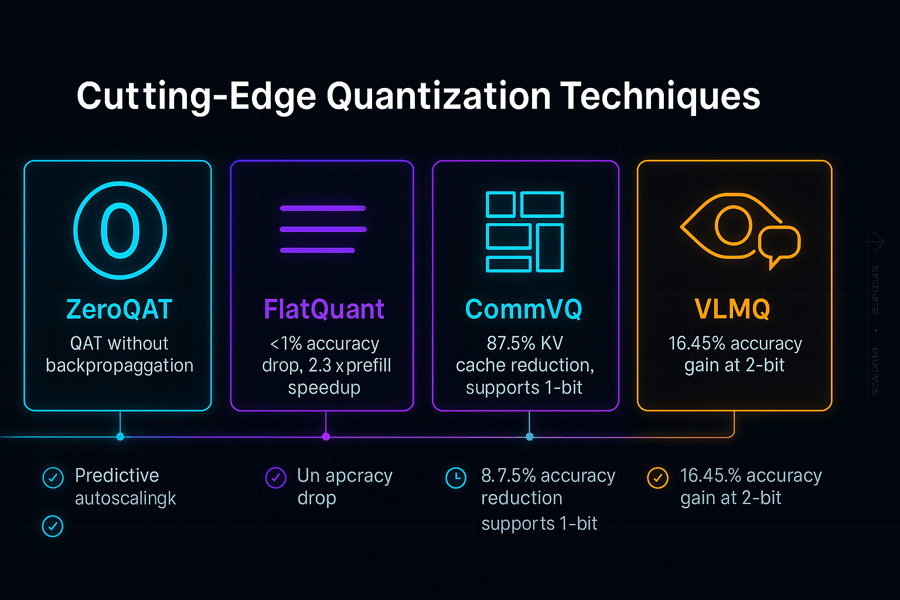
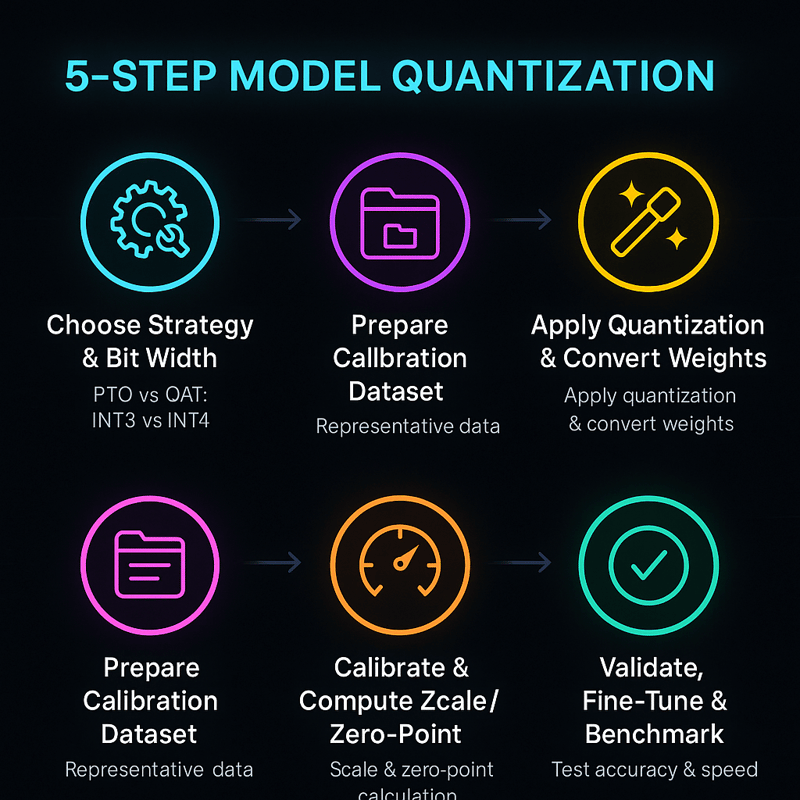
Quick Summary: What breakthroughs have emerged in quantizing giant models?

Recent research has introduced innovative techniques for quantizing large language and vision–language models, overcoming challenges like outliers, memory bottlenecks, and long context lengths. Innovations include ZeroQAT (zeroth‑order QAT), FlatQuant (affine transformations to flatten distributions), CommVQ (KV cache compression), and VLMQ (importance‑aware Hessian augmentation). These methods enable 4‑bit or even 1‑bit quantization with minimal accuracy loss, making deployment of 70B‑parameter models on single GPUs possible.

ZeroQAT and QAT Advances

Standard QAT uses backpropagation to learn quantized weights, which is computationally intensive. ZeroQAT proposes a zeroth‑order optimization‑based QAT framework, leveraging forward‑only gradient estimation. This eliminates backpropagation and dramatically reduces memory requirements while still learning optimal clipping thresholds and weight transformations. Experiments show that ZeroQAT delivers low‑bit quantization (e.g., 4‑bit) with accuracy comparable to full‑precision models but with significantly lower computational overhead.

FlatQuant: Flattening Distributions for 4‑bit Quantization

The FlatQuant technique addresses the problem of outliers in LLMs. Researchers observed that transformed weights and activations can still have steep, dispersed distributions, leading to quantization errors. FlatQuant applies learnable affine transformations to flatten these distributions before quantization. The method calibrates an optimal transformation for each linear layer in hours and fuses all operations into a single kernel. Results show less than 1 % accuracy drop for W4A4 quantization of large models like LLaMA‑3‑70B, 2.3× prefill speedups, and 1.7× decoding speedups compared with FP16 models.

Commutative Vector Quantization (CommVQ) for KV Cache Compression

When running LLMs with long context lengths, the key–value (KV) cache becomes a memory bottleneck. CommVQ introduces a codebook‑based additive quantization to compress the KV cache, using a lightweight encoder and codebook that can be decoded with a simple matrix multiplication. The codebook is designed to be commutative with rotary positional embeddings, enabling efficient integration into the self‑attention mechanism. Experiments show that CommVQ reduces the FP16 KV cache size by 87.5 % for 2‑bit quantization, and remarkably, it enables 1‑bit KV cache quantization with minimal accuracy loss. This allows a LLaMA‑3.1 8B model with 128K context length to run on a single RTX 4090 GPU.

VLMQ: Quantization for Vision–Language Models

Vision–language models combine text and image inputs, leading to modality imbalance, where vision tokens dominate. Traditional Hessian‑based PTQ methods treat all tokens equally, causing performance degradation when applied to VLMs. VLMQ introduces an importance‑aware objective that enhances the Hessian by assigning higher importance to salient tokens and lower importance to redundant vision tokens. It computes token‑level importance through a single lightweight block‑wise backward pass and supports parallel weight updates. Evaluations across eight benchmarks show a 16.45 % accuracy improvement under 2‑bit quantization.

Expert Insights

  • Convergence of weight‑only methods – Innovative weight‑only schemes like ZeroQAT and FlatQuant demonstrate that 4‑bit or 3‑bit quantization can match full‑precision accuracy by carefully flattening distributions and jointly learning clipping thresholds.
  • KV cache compression unlocks long context inference – CommVQ shows that compressing the KV cache is critical for scaling context lengths without scaling hardware. By reducing KV size by 87.5 %, CommVQ enables 128K context inference on commodity GPUs.
  • Vision tokens require special attention – VLMQ highlights that treating all tokens equally leads to poor quantization performance in VLMs. A token‑importance approach can deliver significant accuracy gains under low‑bit quantization.

Creative Example

Imagine compressing an entire library of books to fit in your pocket. Simple book compression might remove words at random, causing you to lose context. New innovations like CommVQ and VLMQ act like expert librarians: they identify key phrases (important tokens) and efficiently encode them in a pocket‑sized format while preserving the story. As a result, you still comprehend the narrative, even though the representation is extremely compact.

Cutting Edge Quantization Techniques

Practical Steps to Quantize Models: A Step‑by‑Step Guide

Quick Summary: How can you quantize your model effectively?

Quantizing a model involves selecting the appropriate scheme, preparing data, calibrating ranges, applying quantization, and validating the result. The process will vary depending on the framework you use, but the high‑level steps remain consistent.

Step 1: Choose a Quantization Strategy and Bit Width

Decide whether you need PTQ, QAT, dynamic, static, or weight‑only quantization. For quick deployment, PTQ is the fastest; for maximum accuracy with low bit widths, opt for QAT. Determine the bit width (e.g., 8‑bit, 4‑bit) based on your accuracy targets and hardware constraints. If your target hardware supports INT8 or FP8, start there; more experimental formats like FP4 or 2‑bit may need advanced techniques like FlatQuant or ZeroQAT.

Step 2: Prepare a Calibration Dataset (for Static PTQ)

For static PTQ, compile a representative dataset that covers the range of inputs your model will see. This dataset should include outliers and typical examples to ensure the computed activation ranges are meaningful. Without a diverse calibration set, your quantization parameters may misrepresent rare but important values, degrading accuracy.

Step 3: Calibrate and Compute Scale/Zero‑Point

Run the model on the calibration dataset and record activation statistics (min, max, percentiles, etc.). Compute scale and zero‑point values using methods like min–max, percentile, or MSE calibration. Per‑channel calibration usually yields better accuracy than per‑tensor calibration. Some frameworks automatically optimize these parameters with accuracy‑aware tuning.

Step 4: Apply Quantization and Convert Weights

Use your chosen library to convert weights and activations according to the selected scheme. For PTQ, the conversion happens once after calibration. For QAT, quantization operators are inserted during training. Ensure the operations align with your hardware’s supported data types (INT8, INT4, FP8, etc.) and that you take advantage of specialized kernels (e.g., NVIDIA TensorRT or Intel AMX units) for maximum performance.

Step 5: Validate, Fine‑Tune, and Benchmark

After quantization, evaluate the model on a validation set to assess accuracy, latency, and energy consumption. If accuracy drops more than acceptable, try different calibration methods, adjust bit width, or switch to QAT. Benchmark the quantized model on your target hardware to measure speed and memory improvements. Iterate until you achieve the desired balance between compression and performance.

Expert Insights

  • Hardware‑aligned quantization – Use quantization formats supported by your hardware (e.g., INT8 for most CPUs and GPUs, FP8 for new AI accelerators). Aligning the bit width with hardware capabilities maximizes speed gains.
  • Layer‑wise tuning – Some layers are more sensitive to precision loss. For example, attention layers in transformers often require higher precision. Consider keeping these layers in higher precision while quantizing others.
  • Test across workloads – Evaluate quantized models on different tasks and data distributions. This ensures robustness and fairness across user groups.

Creative Example

Quantizing a model is like downscaling a high‑resolution video. First you choose the resolution (bit width); then you decide if you want to compress the entire movie or just certain scenes. You adjust brightness and contrast (calibration) to keep the important details visible. Finally, you play the video on different devices to make sure it looks good everywhere.


5 step quantizationTools and Libraries for Quantization: From Open‑Source to Clarifai’s Platform

Quick Summary: Which frameworks support quantization, and how does Clarifai fit in?

Multiple frameworks and toolkits offer quantization support, and Clarifai integrates these capabilities into its platform through compute orchestration, model inference services, and local runners. The right tool depends on your model architecture, deployment environment, and hardware.

Commonly Used Libraries

  1. Framework‑native tools – Popular libraries like PyTorch and TensorFlow provide built‑in modules for dynamic, static, and QAT quantization. These modules simplify conversion and allow you to define quantization configurations directly in your code.
  2. Intel Neural Compressor and Open‑Source Toolkits – Intel’s Neural Compressor offers a scikit‑learn‑like API to apply PTQ and QAT across frameworks, introducing features like accuracy‑aware tuning and smooth quantization. Other libraries such as AIMET, SparseML, and Model Compression Toolkit (MCT) add advanced features like synthetic data generation, per‑channel quantization, and visualization.
  3. Hardware‑optimized toolchains – Vendors like NVIDIA provide toolkits (e.g., NVFP4 support) for quantizing models specifically for their GPUs. NVFP4 is a 4‑bit floating‑point format optimized for Blackwell GPUs, and frameworks like TensorRT Model Optimizer support a range of formats including FP8, FP4, INT8, and dynamic KV cache quantization.

Clarifai’s Approach and Product Integration

Clarifai is a market leader in AI model deployment and inference. Its platform integrates quantization via multiple touchpoints:

  • Compute orchestration – Clarifai manages compute resources across GPUs and CPUs. When you deploy a quantized model, Clarifai’s orchestrator automatically selects hardware that supports low‑precision arithmetic and scales resources based on demand.
  • Model inference engine – The platform supports inference on quantized models through optimized runtimes. Models quantized using PTQ or QAT can be loaded into Clarifai’s inference pipelines, benefiting from lower latency and cost.
  • Local runners – For on‑device or edge deployments, Clarifai offers local runners that execute models offline. These runners support INT8 and INT4 quantization, enabling privacy‑preserving inference on mobile devices, smart cameras, or drones.
  • Auto‑deployment and monitoring – Clarifai’s monitoring tools track performance metrics (latency, throughput) and accuracy of quantized models in production. The system flags drift or performance regressions, allowing you to re‑calibrate or retrain models as needed.

Expert Insights

  • Integration ease – Selecting a tool is not just about quantization algorithms; it’s about workflow integration. Clarifai unifies model training, quantization, deployment, and monitoring within a single platform, reducing engineering overhead.
  • Hardware abstraction – Clarifai abstracts away the complexity of choosing hardware for quantized models. Whether your target is a GPU, CPU, or edge device, Clarifai maps the quantized model to the right environment automatically.
  • Future‑proofing – As new formats like NVFP4, FP8, and 1‑bit KV quantization emerge, Clarifai continues to integrate these technologies into its stack, ensuring your models remain at the cutting edge.

Creative Example

Using Clarifai is like plugging your appliances into a smart power strip. You can connect devices with different voltage requirements (quantized models with various bit widths), and the strip automatically adjusts the power delivery (hardware resources) so everything runs efficiently. It also monitors energy usage and alerts you if a device (model) draws too much power or stops working properly.

Addressing Misconceptions and Ethical Considerations

Quick Summary: What are common myths about quantization, and how can we mitigate ethical concerns?

Quantization is sometimes misunderstood. People worry that it destroys accuracy, that it’s only useful for tiny models, or that it’s just a compression trick. There are also ethical considerations: quantization can exacerbate bias if the calibration data is unrepresentative, and it may affect fairness across demographic groups. Addressing these concerns requires understanding the myths and implementing best practices.

Myth 1: Quantization Always Hurts Accuracy

While naive quantization can degrade performance, research demonstrates that carefully calibrated INT8 or 4‑bit quantization can achieve near‑FP32 accuracy. Innovations like SmoothQuant, FlatQuant, and ZeroQAT minimize accuracy loss even at 4‑bit precision. It’s important to choose the right bit width, calibration strategy, and, if necessary, QAT to achieve target accuracy.

Myth 2: Quantization Equals Compression Only

Quantization is about more than compression. It enables hardware‑accelerated integer arithmetic, improving inference speed and energy efficiency. While compression reduces model size, the real advantage is faster, more energy‑efficient computation. Moreover, quantization’s noise can improve generalization by acting like regularization.

Myth 3: Quantization Is Only for Edge Devices

Quantization is beneficial both on the edge and in the cloud. Cloud inference can become prohibitively expensive at scale due to compute costs and energy use. Quantized models consume fewer resources and can serve more requests per watt, lowering operating costs and environmental impact.

Ethical Considerations

  1. Bias and fairness – Calibration data must reflect the diversity of the deployment context. If certain groups are underrepresented, quantization might distort the model’s outputs for those groups. Always test quantized models across demographic slices and fine‑tune calibration parameters to avoid bias amplification.
  2. Transparency – Disclose when you’re using quantized models. Users may need to understand potential trade‑offs in accuracy or fairness.
  3. Responsibility – Quantization should be part of a broader model‑optimization strategy that includes pruning, distillation, and fairness checks. Don’t rely on quantization alone to address all performance or bias issues.

Expert Insights

  • Fairness requires data diversity – Use a diverse calibration dataset to ensure the quantization parameters generalize across user groups. This reduces the risk of introducing bias through uneven range mapping.
  • Regular auditing – Implement continuous monitoring to detect drift or bias. Clarifai’s monitoring tools can trigger re‑calibration or QAT when metrics deviate.
  • Education and consent – When deploying AI that uses quantized models, inform users about the technology and invite feedback. Transparency builds trust and allows users to report unexpected behavior.

Creative Example

Think of quantization like shrinking a detailed map to a smaller scale. If you cut off important neighborhoods (minority data) during the shrinking process, you risk misrepresenting the territory. With a comprehensive map (diverse calibration data) and careful scaling (calibration methods), you preserve essential details even in a miniature version.

Future Trends: Where Model Quantization Is Heading

Quick Summary: What innovations and directions will shape the next generation of quantization?

Future research is pushing quantization beyond INT8, exploring FP4, INT2, 1‑bit, and even vector quantization techniques. Innovations focus on combining quantization with other compression methods, automating bit‑width selection, and tailoring quantization for new architectures like multimodal and generative models.

Ultra‑Low Bit and Mixed‑Precision Quantization

The next frontier involves 2‑bit and 1‑bit quantization. While these extremely low precisions typically incur large accuracy losses, techniques like CommVQ demonstrate that 1‑bit KV cache quantization is feasible for long‑context LLMs. Researchers are exploring adaptive mixed‑precision schemes that assign different bit widths to different layers or even individual channels, balancing accuracy and efficiency.

Vector and Commutative Quantization

Vector quantization compresses groups of parameters using learned codebooks. CommVQ extends this idea to the KV cache and ensures that decoding integrates seamlessly into self‑attention. Future work may expand vector quantization to other components (e.g., feed‑forward layers) and explore non‑commutative codebooks for additional flexibility.

Quantization for Multimodal and Generative Models

As VLMs and multimodal generative models gain prominence, importance‑aware quantization like VLMQ will become essential. New research is developing token‑dependent scaling and attention‑aware quantization to handle the heterogeneity of multimodal inputs. Generative models, such as diffusion or video synthesis models, require unique quantization strategies to maintain quality.

Automated Quantization and AI‑Driven Design

Automated hyperparameter search for quantization—AutoQuantize, for example—chooses bit widths and calibration methods without manual tuning. Future tools may use AI to design quantization schemes that adapt to data distribution in real time. Meta‑learning approaches could generate personalized quantization strategies for each model, dataset, or hardware platform.

Integration with Hardware Innovation

Hardware vendors are introducing novel data types like NVFP4 for 4‑bit floating‑point arithmetic and support for FP8 and FP6. As these formats mature, quantization frameworks will incorporate them, enabling even better trade‑offs between accuracy and efficiency. Cross‑layer quantization and on‑the‑fly bit‑width adjustment will likely become standard features.

Expert Insights

  • Ultra‑low bit quantization needs innovation – Achieving acceptable accuracy at 1‑bit or 2‑bit precision is challenging, but methods like CommVQ and vector quantization show promise.
  • Importance‑aware and adaptive schemes – Approaches that assign different bit widths to tokens, layers, or channels are gaining traction, as seen with VLMQ’s token‑importance weighting.
  • Synergy with other techniques – Combining quantization with pruning, knowledge distillation, and sparsity will yield even more efficient models. These hybrid strategies will become mainstream as AI models scale further.

Creative Example

Imagine a future where your smartphone runs a billion‑parameter LLM offline. It automatically adjusts the precision of each part of the model based on your current task, delivering maximum efficiency when you’re writing an email and full accuracy when you’re using it for language translation. Quantization will be dynamic and personalized, controlled by AI systems that understand context and hardware capabilities.

Conclusion and Key Takeaways

Model quantization is no longer just an optional optimization—it’s a cornerstone of efficient and sustainable AI deployment. By mapping high‑precision weights and activations to lower‑precision representations, quantization slashes memory usage, boosts throughput, and enhances energy efficiency. There are multiple approaches (PTQ, QAT, dynamic, static, weight‑only), each with trade‑offs between simplicity and accuracy. Symmetric vs. asymmetric quantization, scale and zero‑point selection, and calibration methods are critical to preserving accuracy.

Recent innovations such as ZeroQAT, FlatQuant, CommVQ, and VLMQ push the boundaries, enabling 4‑bit and even 1‑bit quantization with minimal accuracy loss. These advances open the door to deploying giant models on standard hardware and edge devices, democratizing AI access. Clarifai’s platform integrates quantization throughout its compute orchestration, inference engine, and local runners, making it easy for practitioners to leverage quantized models without deep expertise.

As we look ahead, quantization will evolve in tandem with hardware improvements, multimodal models, and automated design tools. Harnessing quantization effectively requires understanding the technology, selecting the right scheme, and continuously monitoring performance and fairness. By doing so, you’ll deliver AI that’s not only powerful but also practical and responsible.

FAQs

1. What is model quantization?

Model quantization is the process of converting high‑precision weights and activations into lower‑precision formats like INT8 or INT4 to reduce memory usage and improve computational efficiency.

2. Does quantization always degrade accuracy?

No. When properly calibrated, quantization can maintain accuracy within 1 % of full‑precision models. Advanced techniques like SmoothQuant and ZeroQAT mitigate accuracy loss even at low bit widths.

3. When should I use post‑training quantization vs. quantization‑aware training?

Use post‑training quantization for fast deployment when you lack training data or compute resources. Choose quantization‑aware training when you need the highest accuracy at low bit widths or when dealing with models sensitive to precision loss. Techniques like ZeroQAT make QAT feasible for large models by removing backpropagation overhead.

4. Does quantization reduce energy consumption?

Yes. INT8 quantization can improve performance per watt by up to 16× and reduce memory bandwidth by 4×. This translates into lower energy consumption and longer battery life for edge devices.

5. How does Clarifai support quantized models?

Clarifai’s platform offers compute orchestration, an optimized inference engine, and local runners to deploy quantized models seamlessly. It automatically selects the right hardware, manages resources, and monitors performance, freeing you to focus on model design and calibration.