Choosing the Right AI for Your Business


Struggling to decide between ChatGPT-4 and Gemini Advanced for your business? 

I get it—choosing between these AI powerhouses can feel overwhelming, especially when you’re looking to boost your business’s success.

Here’s the thing: Gemini Advanced shines with its ability to handle different types of content and fits perfectly if you’re already using Google’s tools. Meanwhile, ChatGPT-4 excels at deep conversations and quick responses, plus its API is super flexible for custom solutions.

Now, let us understand Gemini Advanced Vs ChatGPT 4 basics, that will help you find the perfect AI partner for your specific needs.

Understanding Gemini Advanced and ChatGPT-4

Gemini Advanced

Gemini Advanced, developed by Google, is designed for businesses needing robust multimodal capabilities, allowing for the seamless processing of text and image data. It’s easy integration with current workflows makes it ideal for organizations looking for actionable insights and advanced AI features across various input types.

gemini advanced vs chatgpt 4

Key Features

  • 1M Token Context Window: Handle large datasets, such as 1,500 pages of documents or spreadsheets, with ease.
  • Priority Access to New Features: Gain early access to Google’s latest AI advancements.
  • Enhanced Data Analysis: Extract deeper insights and generate detailed summaries from complex datasets.
  • Google Workspace Integration: Boost productivity by integrating seamlessly into Gmail, Docs, and other Google apps.
  • 2 TB Cloud Storage: Ample space for data storage is included with the Google One AI Premium Plan.
  • Gemini Live: Engage in real-time voice-based brainstorming and topic simplification.

Use Cases

  • Education: Providing detailed explanations based on multimedia content.
  • Content Creation: Assisting in generating creative content that requires multiple input formats.
  • Customer Support: Offering nuanced responses that consider various user inputs.
  • Marketing: Automate the creation of personalized, multimedia advertising campaigns.

Ideal Business Scenarios

  • Multimodal Analysis: Process and correlate data from text, images, audio, and video seamlessly.
  • Predictive Insights: Leverage cutting-edge AI for market trends, customer behavior, and operational forecasting.
  • Enhanced Collaboration: Generate real-time data visualizations and insights for team alignment.
  • Immersive Learning: Integrate AI with VR/AR for enhanced, interactive educational experiences.
  • Dynamic Content Creation: Build engaging multimedia lessons tailored to diverse learning styles.
  • Advanced Automation: Streamline grading, attendance, and personalized student progress tracking.

ChatGPT-4

Created by OpenAI, ChatGPT-4 is a leading AI model specializing in conversational AI and API flexibility. It’s designed to assist businesses with natural language processing tasks, making it a versatile tool for customer service, content creation, and business automation.

gemini advanced vs chatgpt 4

Key Features

  • Advanced Reasoning: Handle complex problems with greater accuracy and logical precision.
  • Creativity and Collaboration: Collaborate on creative tasks like story writing, music composition, or content editing.
  • Longer Context Handling: Maintain consistent, coherent conversations and generate detailed documents.
  • Visual Input: Process and respond to visual inputs, boosting versatility for specific tasks.
  • Safety and Alignment: Enhanced safeguards reduce the risk of harmful content by 82% compared to previous versions.
  • Human Feedback Integration: Continuous updates improve performance and ensure better alignment with user needs.

By mastering the right ChatGPT prompt styles, users can fully optimize creative tasks like brainstorming, story writing, or content editing, making ChatGPT an even more effective tool.

Use Cases

  • Customer Support: Automate service interactions with chatbots capable of handling complex queries and personalized responses.
  • Content Creation: Generate high-quality marketing materials, blog posts, and reports in a natural, conversational tone.
  • Business Automation: Streamline workflows by integrating into CRM systems to automate lead management and optimize sales processes.

Ideal Business Scenarios 

  • Consolidate and analyze data from diverse sources (text, images, videos). 
  • Identify trends and forecast outcomes for strategic decisions.  
  • Automate detailed, executive-friendly report generation.
  • Deliver personalized learning paths with real-time feedback.  
  • Generate quizzes, lesson plans, and summaries efficiently.  
  • Automate grading, scheduling, and administrative tasks.  

Feature Comparison

Feature ChatGPT-4 Gemini Advanced
Natural Language Processing (NLP) Highly accurate with deep conversational fluency and context understanding. Handles complex queries and provides human-like responses. Excellent NLP capabilities, with strong context understanding for both short and long-form conversations. Can generate responses in multiple languages.
Multimodal Input Handling Primarily focused on text-based inputs, integrated with APIs to handle images and files indirectly. Robust support for both text and image data, making it suitable for multimodal applications like visual recognition and cross-media analysis.
Integration Capabilities Flexible API, compatible with a wide range of business tools, including CRM and CMS platforms for automation and customer interaction. Seamless integration with Google’s ecosystem and other business tools, supporting a range of data types for enhanced workflows across industries.
Customization Options Offers some degree of customization for specific tasks and industries via fine-tuning APIs, but is more generalized in application. Allows for more advanced customization, particularly for multimodal tasks, providing tailored AI models for specialized business needs.
Performance & Speed Fast response times and reliable performance, optimized for real-time interactions. High performance, optimized for both speed and handling complex multimodal data in real-time.
Scalability Easily scalable for high-volume use, with the ability to handle large numbers of requests through APIs. Scalable for businesses requiring multimodal AI across various channels and data types, suitable for large enterprises.
Security & Privacy Strong privacy measures, complying with major regulations (e.g., GDPR, CCPA). Data is processed with high-security standards. High emphasis on security, especially within the Google ecosystem, ensuring compliance with global data privacy standards.
Cost Efficiency Flexible pricing options based on usage, with cost-effective models for businesses of all sizes. Pricing typically aligned with Google Cloud services; may vary based on usage and integration needs, but can scale efficiently for large enterprises.
Support for Third-Party Tools Extensive support for third-party integrations, with a large ecosystem of connectors for various business tools. Primarily supports Google and related third-party tools, but offers robust integrations within that ecosystem for seamless workflow management.
Model Updates & Maintenance Regular updates with new features and improvements based on user feedback and industry needs. Frequent updates driven by Google’s AI advancements, ensuring continuous improvements and adaptation to new data types and industries.

Performance Evaluation: Gemini Advanced vs. ChatGPT-4

Let me break down how these AI powerhouses perform in different areas. I’ve tested them extensively, and here’s what I’ve found:

Content Creation

Let’s talk about ChatGPT-4 first. You know what really makes it shine in content creation? It’s fantastic at generating engaging content like blog posts and marketing materials. Here’s what impresses me most:

gemini advanced vs chatgpt 4
  • Speed: We’re talking lightning-fast – you get your content in just 2-3 seconds.
  • Conversational Flow: It writes like a real person, which your readers will love.

This makes it perfect when you need content in a hurry, especially for those last-minute marketing campaigns.

Now, Gemini Advanced? It’s built differently. It is designed for longer-form, detail-intensive content creation. Here’s what makes it special:

gemini advanced vs chatgpt 4
  • Large Context Window: It can handle up to 1 million tokens – think entire research papers or detailed reports. 
gemini advanced vs chatgpt 4

However, its slower response time (5 to 7 seconds) and less conversational fluency compared to ChatGPT-4 can be a drawback for some use cases.

Customer Support Automation

Let me tell you about ChatGPT Plus in customer service – it’s pretty impressive:

  • It gets personal with customers, making each chat feel unique
  • Responds super quick, which keeps your customers happy

This makes it particularly effective for real-time support scenarios. 

I’ve seen some cool real-world examples too. MavenAGI’s AI-powered customer service agents, used by companies such as Tripadvisor and ClickUp, showcase ChatGPT-4’s ability to improve response efficiency, with examples like a 25% increase in responses per hour and maintaining high customer satisfaction scores.

Gemini Advanced might be slower to respond, but it’s got its own superpower – it plays really well with Google Workspace:

  • It smoothly connects with all your customer data
  • Makes sharing docs and working together a breeze

This is super helpful if your team’s already using Google tools day-to-day.

Data Analysis and Insights

Here’s something interesting I’ve noticed while testing both tools. Gemini Advanced steals the show when it comes to crunching numbers:

  • Robust Analytical Tools: Processes complex datasets efficiently, enabling detailed insights for decision-making.
  • Google Services Integration: Strengthens its value proposition for businesses needing advanced analytics combined with ai for workspace productivity.

Now, ChatGPT-4?  It’s great for basic analytical support, such as summarizing trends and interpreting data, but it’s not your go-to for deep data diving.

Benchmark Results

Let me share some real numbers I’ve seen – they’re pretty eye-opening:

  • Accuracy on Questions: ChatGPT-4 achieved a 57.14% correct response rate on text-only questions compared to Gemini’s 46.72%. For simpler questions, ChatGPT-4 scored 68.99%, outperforming Gemini at 49.61%.
  • ChatGPT-4 jumps in with answers 89.2% of the time without needing extra prompting, compared to Gemini’s 73.8%.

What does this tell us? ChatGPT-4 is your champion for everyday conversations and simpler tasks, while Gemini Advanced is your power player for the technical heavy lifting.

Pricing and Value Proposition: ChatGPT-4 vs. Gemini Advanced

Let’s talk about money – because let’s face it, budget matters! Here’s how these tools stack up:

ChatGPT-4

gemini advanced vs chatgpt 4

ChatGPT-4 offers tiered pricing to meet various user needs, from casual to enterprise-level.

  • Free Tier: Basic access to ChatGPT with limitations on model access, response speed, and session length.
  • Paid Tiers:
    • ChatGPT Plus: $20/month gets you the good stuff – faster responses and first dibs on new features
    • Team Plan: $30 per user monthly (or $25 if you pay yearly) – great for collaboration
    • Enterprise: Starting around $60 per user monthly for the big players – you’ll need to chat with them for exact pricing

Value for Money:

  • Individual Users: For $20/month, the Plus plan offers access to GPT-4, providing advanced AI features ideal for writing, problem-solving, and creative tasks.
  • Businesses: The Team plan enhances productivity with AI-driven collaboration tools at $30/user/month.
  • Enterprises: The Enterprise plan offers robust solutions, improving efficiency and customer engagement through advanced security and support.

ROI: ChatGPT-4 boosts productivity, reduces labor costs, and improves customer satisfaction, making it a valuable investment for businesses.

Gemini Advanced

Gemini Advanced offers flexible pricing to suit different needs, from individual users to large enterprises:

gemini advanced vs chatgpt 4
  • Free Tier: A one-month trial allows users to explore features without cost.
  • Paid Tiers:
    • Gemini Advanced Subscription: $19.99/month for access to advanced AI models (Gemini 1.5 Pro), 2TB Google Drive storage, and integration with Google Workspace.
    • Gemini Business Plan: $24/user/month, designed for small to medium businesses, offering essential AI capabilities.
    • Gemini Enterprise Plan: $36/user/month, with unlimited access to features, AI-powered meetings, and advanced security for large organizations.

Value for Money
For $19.99/month, individuals can handle complex tasks like coding and document analysis with a 1 million token context window. Businesses benefit from scalable solutions that streamline workflows, improve decision-making, and save time.

ROI for Businesses
Gemini Advanced boosts efficiency, improves decision-making through analytics, and reduces operational costs by automating tasks.

Use Case Scenarios: ChatGPT-4 vs. Gemini Advanced

Let me paint some real-world pictures of how these AIs shine in different situations:

ChatGPT-4

  • Customer Support: An e-commerce company automates customer service with ChatGPT-4, acting as an intelligent chatbot to handle inquiries, track orders, and resolve complaints. This improves response times and customer satisfaction.
  • Content Creation: A marketing team uses ChatGPT-4 to quickly generate blog posts, social media captions, and ad copy. Its conversational tone boosts productivity and helps refine messaging.
  • Business Automation: A mid-sized company integrates ChatGPT-4 with CRMs to automate tasks like drafting emails, generating reports, and managing lead generation, improving efficiency.

Gemini Advanced

  • Multimodal Data Processing: A healthcare provider uses Gemini Advanced to analyze both medical images and text records, improving diagnostics and decision-making.
  • Marketing Campaigns: A global retailer creates personalized campaigns with Gemini Advanced by analyzing customer preferences and processing text and image data for targeted content.
  • Product Recommendations: An online retailer uses Gemini Advanced’s multimodal capabilities to enhance its recommendation system with customer behavior and product visuals, driving personalized recommendations.

Hypothetical Case

Let’s start with few impressive numbers that caught our attention

  • A software company that cut support costs by 40% and made customers 30% happier using ChatGPT-4.
  • A retail chain that boosted sales by 25% just by letting Gemini Advanced handle their personalized marketing.

Pros and Cons: ChatGPT-4 vs. Gemini Advanced

Let’s break down what’s great (and not so great) about each of these AI powerhouses. I’ve spent a ton of time with both, so let me share what I’ve discovered:

ChatGPT-4
Pros
:

  • Exceptional Conversational AI: Delivers human-like responses, ideal for customer support, content generation, and virtual assistants.
  • Affordable: At $20/month, it’s great value for small and medium-sized businesses.
  • Flexible Integration: Easily integrates with CRMs and CMS platforms.
  • Customizable Features: Allows businesses to create custom GPTs, use plugins, and run Python code for specialized tasks.

Cons:

  • Limited Multimodal Support: Primarily focused on text-based tasks, lacking advanced visual capabilities.
  • Scaling Costs: Pricing increases significantly with heavy enterprise usage.
  • Not Ideal for Complex Data: Less effective for industries needing sophisticated image or multimodal analysis.

Gemini Advanced
Pros:

  • Multimodal Capabilities: Processes both text and images, making it ideal for healthcare, retail, and marketing.
  • Google Workspace Integration: Enhances productivity with seamless integration into Gmail, Docs, Sheets, etc.
  • Scalable for Complex Operations: Well-suited for businesses handling large datasets and advanced AI needs.
  • Advanced Features: Includes real-time voice interactions (Gemini Live) and 2TB of cloud storage through Google One AI Premium.

Cons:

  • Higher Costs for Premium Features: Usage-based pricing can be expensive, especially for large-scale operations.
  • Steeper Learning Curve: Advanced features may require technical expertise to fully utilize.
  • Free Tier Limitations: Limited functionality in the free version, with advanced features behind premium subscriptions.

Access Gemini Advanced & ChatGPT 4 in Weam AI

While hardnessing the full potential of Gen AI businesses faces various challenges. Few of those obstacles that need to be addressed are the high costs and specialization issues. Utilizing both Gemini and ChatGPT simultaneously can be prohibitively expensive, especially for organizations requiring diverse outputs like image generation and analytical insights.

  • The Challenge: Specialization of every Gen AI model varies depending on their training. However it too forces businesses to adopt multiple models to meet their varied needs, leading to increased expenses and complex workflows.
  • A Solution: Weam AI offers a strategic, cost-effective solution by integrating the capabilities of multiple generative AI models into a single, unified platform. It enables businesses to adapt multi modal LLM strategies without spending on various models. 

With Weam AI business can achieve significant cost savings while using multiple Gen AI models. It streamlines their workflow, allows them to not deviate from the path of scaling, and capitalise on diverse AI functionalities conveniently.

Key Benefits of Weam AI:

  • Cost Efficiency: Consolidates multiple AI systems into one platform, significantly lowering expenses associated with using separate models.
  • Flexibility and Adaptability: Offers tailored AI services that cater to a wide array of business needs, from image generation to data analytics.
  • Enhanced Productivity: Simplifies workflows by providing a unified platform, reducing complexity, and enabling teams to work more effectively.

The End!

Picking between Gemini Advanced and ChatGPT-4 really boils down to what matters most for your business.

From what I’ve seen, if you’re juggling lots of different types of data and you’re already using Google’s tools, Gemini Advanced might be your best bet. But hey, if you’re more focused on having great conversations with customers, streamlining your text workflows, and keeping costs down, I’d say ChatGPT-4 is the way to go.

The great thing is, a platform like Weam offers access to both models so you can try and Start for free to see which one suits you best. 

It’s all about knowing what you need – crunching complex data or having smooth, natural conversations. Let me help you figure that out with some common questions I hear.

Frequently Asked Questions

What are the main differences between Gemini Advanced and ChatGPT-4?

Gemini Advanced excels in multimodal capabilities, allowing businesses to process both text and image data. It is best for complex, data-driven tasks and integrates seamlessly with Google Cloud. ChatGPT-4 is more affordable, focused on text-based tasks, and excels in conversational AI, content creation, and customer support.

Which of the two models is better for small businesses?

In my experience, ChatGPT-4 is usually the smarter choice for smaller operations. Here’s why: it’s easier on the wallet, super user-friendly, and packs a punch when it comes to things like customer service and content creation. You don’t need a PhD to figure it out, and it gets the job done without the fancy price tag.

Can these AI tools handle multilingual tasks?

Absolutely! Both tools are pretty impressive here. ChatGPT-4 is your go-to for things like helping customers or creating content in multiple languages. Gemini Advanced takes it a step further – it can analyze multilingual data and even work with images across languages.

What kind of support do these models offer for businesses?

ChatGPT-4 keeps it simple with easy-to-follow guides and a helpful community – perfect if you’re running a smaller operation. Gemini Advanced goes all out with the big-business treatment – you get dedicated tech teams and all the perks of Google Cloud’s support system if you’re running something larger.

Sam Altman Says OpenAI Is “Confident We Know How to Build AGI”


Sam Altman, CEO of OpenAI, just took his vision for artificial intelligence to a whole new level—and made it very clear he’s not worried if people call it science fiction. Continue reading “Sam Altman Says OpenAI Is “Confident We Know How to Build AGI””

Streamline AI Insights with the Unified Clarifai Control Center


11.0_blog_hero

This blog post focuses on new features and improvements. For a comprehensive list, including bug fixes, please see the release notes.

Control Center

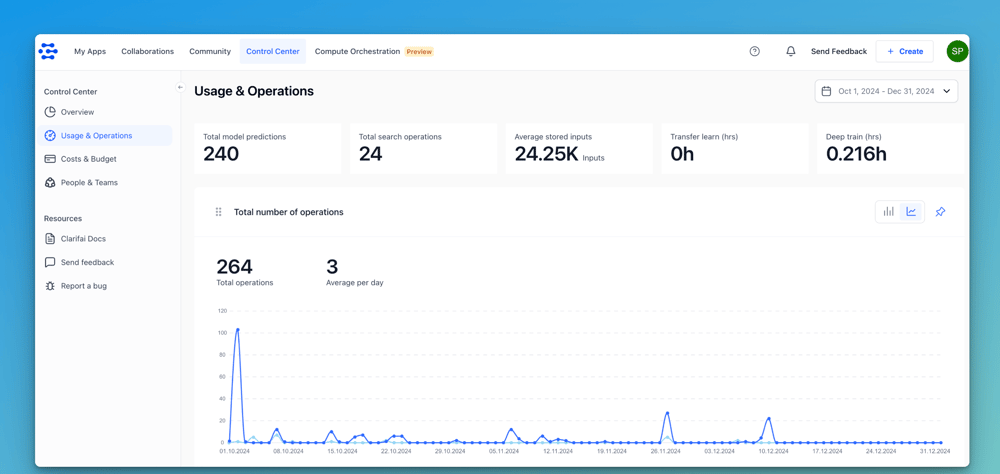
Clarifai’s Control Center is a unified dashboard, a single pane of glass to monitor everything happening within your account on the Clarifai platform. It serves as the sole source of truth for various information dimensions, enabling you to make informed decisions based on data from different sources.

It transforms raw data such as model predictions, search operations, stored inputs, and model training hours into actionable insights. You can observe how your teams function and how it impacts operations and spend, and also audit any user-initiated event to trace its origin.

The key functionalities include charts of different types, tables, date ranges, as well as filtering and sorting options.

Ready to gain deeper insights and streamline your account management? Explore more about the Clarifai Control Center here.

Several Improvements to the Control Center

We’ve been actively enhancing the Control Center to deliver a smoother, more intuitive experience. Here are the latest updates in this release:

  • Streamlined Charts: The totals column has been hidden in the following charts: Total Model Predictions by ID and Total Model Predictions by Type. This update improves clarity and focus in the display.
  • Improved Navigation: Fixed an issue where the corresponding tab in the left sidebar wouldn’t highlight when viewing a detailed report page of a chart. The sidebar now correctly reflects the selected section, ensuring smoother navigation.
  • Chart Date Fix: Resolved an issue where dates were missing on some charts, ensuring complete and accurate data representation.
  • Chart Pinning Notifications: Pinning or unpinning charts now triggers a notification at the top of the screen, displaying either “Chart pinned to the Overview” or “Chart unpinned from the Overview”, based on the action.
  • Calendar Enhancements: Significant improvements have been made to the calendar feature for a more flexible and seamless user experience:
    • Users can now manually input dates to set a custom date range.
    • The dropdown arrow for selecting custom date ranges now navigates through months one at a time (instead of two).
    • Selecting a single day is now possible, removing the previous two-day minimum restriction.
    • The current day is highlighted with a non-filled circle for better visibility.
    • Selecting future dates is no longer allowed.

Screenshot 2025-01-12 at 9.29.31 PM

Organization Settings and Management

  • Introduced Financial Manager role for organizations: This role provides access to key financial data, including current spending based on the organization’s pricing plan and budget settings, enabling better financial oversight and management.
  • Expanded permissions for the Labeler Lead role: Labeler Leads can now create, modify, and delete concepts, giving them greater control over the labeling process.

Improvements to the Python SDK

We’ve made significant updates to the Python SDK to improve functionality, flexibility, and performance. Here’s what’s new:

1. Flexible Data Ingestion

  • Labels are now optional in Dataloaders, allowing better integration with the clarifai-datautils library and providing greater flexibility for data processing pipelines.

2. Improved Model Development

  • Added model building logs for enhanced tracking and debugging during the development process.
  • Introduced a user_id field in the RAG class to support better user identification.

3. Local Model Testing and Deployment

  • Added support for testing and running models locally within a container for greater control and convenience.
  • Enabled CLI support for the Model Predict functionality to streamline testing and predictions.

4. Optimized Docker and Torch Support

  • Updated the Dockerfile for Sglang, improving compatibility and overall performance.
  • Updated available Torch images with additional code refactoring for enhanced maintainability.

5. Bug Fixes and Refinements

  • Resolved an issue with local model testing to ensure smoother functionality.
  • Fixed edge case issues with bounding box information for improved accuracy.
  • Removed protobuf from the requirements to eliminate conflicts with clarifai-grpc.

6. Enhanced Data Handling

  • Added support for downloading data.parts as bytes, providing greater flexibility in data usage.

7. Environment and Reliability Improvements

  • Changed the default environment to prod for model uploads, aligning with production-ready standards.
  • Added tests for all stream and generate methods, boosting reliability and confidence in functionality.
  • Included code coverage test reports in PRs to ensure continuous quality control. 

Learn more about them here.

Platform Improvements

Made updates to enhance navigation and improve the user experience across the platform:

Improved Navigation Highlighting:

  • Top-level navigation items now accurately reflect the active section, providing clearer context for users.
  • When visiting resource pages under the “My Apps” or “Community” sections, the corresponding navigation items are highlighted for better orientation:
    • Navigating to a page like /user-id/app-id/models/model-id highlights the “My Apps” menu item.
    • Visiting /explore/apps highlights the “Community” menu item.
  • Pages outside these sections, such as /settings/billing, do not highlight any navigation item, ensuring accurate context.


How to Engage, Qualify and Demo Buyers 24/7 with AI


FullContext uses AI to engage, qualify, and demo your buyers 24/7 via natural language conversations.

It does that by unifying conversational and content agents, which can then engage in conversation with prospects and show them resources related to the conversation via live chat and email.

The result? A smarter GTM workflow powered by AI agents.

We spoke with Graham Ralston, GTM Strategy at FullContext, to learn more about how this AI marketing solution works.

In a single sentence or statement, describe FullContext.

Go-to-market (GTM) orchestration using natural language to program agents for inbound and outbound.

How does FullContext use AI in its products or services?

We created the first unified AI conversational + content (product tours, videos, PDFs, etc) agent. You no longer need to build linear path flows, instead use natural language to instruct your agents who can engage in conversation and show resources related to the conversation both in a live chat or via email.

What are the primary marketing use cases for your AI-powered solutions?

Inbound (interactive tours, chat, self guided tour) and outbound (agents for email sequencing) with the goal of scheduling meeting with our solution.

What makes your AI-powered solution smarter than traditional approaches and products?

It saves time and money with an easy setup using natural language. Marketers can deploy a use case in under 10 minutes by crawling their website to train an agent and using a natural language prompt to instruct the agent. The full orchestration allows us to enrich website visitors as signals, engage in conversation, and orchestrate outbound email sequences. 

Are there any minimum requirements for marketers to get value out of your AI-powered technology? (e.g. data, list size, etc.)

Website traffic for inbound and campaign ideas for outbound.

Go to Vendor Website

Who are your ideal customers in terms of company size and industries?

Size: 20-500 employees. Industries: Tech, Manufacturing, Recruiting.

What do you see as the limitations of AI as it exists today?

Not necessarily AI, but website visitor enrichment still has a long way to go for companies to truly trust. We still need first-party verification for user identity. 

What do you see as the future potential of AI in marketing?

A transformation from the traditional website to agents led landing pages that adapt in live time to the buyer’s interest.

Any other thoughts on AI in marketing, or advice for marketers who are just starting with AI?

Don’t sit on the sidelines, get started now and experiment!

Go to Vendor Website


A Guide for Powerful Gen AI


We’ve been discussing the progress of AGI for quite a long time now. However we are almost forgetting the dark knight which actually makes a difference. In terms of our daily workflow, generating results and productivity, choosing the right LLM has become crucial right?

However today there are multiple LLMs available for you to choose. In this guide we will learn more about different types of LLMs, choosing the right one for your workflow, and best practices. Read along!

Understanding Different Types of LLMs

For those of you not familiar with the term; LLM in AI means a type of artificial intelligence and it’s closely associated with Gen AI. The AI works on deep learning techniques, processing data, analyzing patterns, and providing results using high level computational power.

choosing the right LLM

Open-source vs. proprietary models

ELI5 Corner:-

  • Imagine you’re cooking a meal. With a proprietary recipe (like KFC’s secret blend), you get a proven, ready-to-use formula but can’t modify or share it. 
  • In contrast, an open-source recipe (like your grandmother’s published cookbook) allows you to not only use it but also adapt it, improve it, and share your modifications with others.
  • Similarly, in the AI world, this distinction between open-source and proprietary models shapes how we can use, modify, and build upon existing AI technologies.

Example:-

choosing the right LLM

General-purpose LLMs vs. specialized models

The primary difference between these two types of LLM is easy to understand. One is a titan of the industry and the counterpart is a master craftsman. Choosing between the two will depend on various factors. Do remember general purpose LLMs stride confidently across vast domains, while specialized dance precisely within carefully trained boundaries.

choosing the right LLM

Key Factors in LLM Selection

Performance Metrics

  • Accuracy and reliability: Accuracy here refers to generating relevant responses. A higher accuracy means LLM is able to provide meaningful outputs. Reliability on the other hand refers to the consistency in mass producing results with source backed datasets.
    • For example: During a marketing campaign you need factually accurate data. If the model lacks accuracy your generated campaign will not perform as you expected.
    • Repercussions: Overlooking both accuracy and reliability leads to misleading information. So make sure you have been tracking the accuracy of your options while choosing the right LLM.
  • Processing speed: The speed at which responses are generated from LLMs. Particularly important for real-time interactions.
    • For example: A chatbot interacting with potential buyers on your ecommerce platform.
    • Repercussions: Slow interactivity leads to frustration, lost sales opportunities, and poor user experience.
  • Resource requirements: Revolves around the computational resources. Different models have varying demands. Assessing requirements is the right approach to carry out robust implementation of LLMs.
    • For example: A law firm wants to introduce an enterprise grade local LLM-based AI solution for automating their documentation workflow.
    • Repercussions: Without assessing proper requirements while choosing the right LLM, even simple tasks such as document analysis may consume excessive power. It might lead to frequent crashes and slow processing power.
  • Cost considerations: It may contain ongoing licensing fees, third party fees, energy consumption, and expenses related to model scaling with the organization.
    • For example: Many companies shifted to hybrid cloud architecture for AI advancement and accounting the cost thoroughly. It gave them the ability to run ahead with full speed without worrying about the high cost environment.
    • Repercussions: Do remember while the model may offer superior performance, the high licensing fees, increased cloud computing costs, and expenses for necessary infrastructure upgrades quickly escalate.

Best Practical Tips for Consideration

Every leader wants to implement an AI model ensuring efficiency and long-term sustainability. Hence these considerations play an important role while choosing the right LLM (Large Language Model) for your organization.

  • Licensing and usage rights: learn about the licensing and usage rights. For enterprise grade implementation make sure LLM providers can legally use and distribute the AI model according to your needs.
  • Privacy and security features: Ask for data privacy and protection regulations. Find out whether or not the LLM has a safeguarding feature against breaches and unauthorized access.
  • Support and documentation: Inquire about the LLMs provides comprehensive support and documentation. Ignore these and you will face challenges in troubleshooting major errors.
  • Community engagement: Active community engagement provides valuable insights about different types of LLM. Find a good community and be an active member. It will increase your innovation capabilities, and allow you to explore critical updates.

A Simple Selection Framework for Choosing the Right LLM

Before studying the framework let me help you understand how to effectively implement it. A framework is important in building an AI ready workforce.

  1. Start with the Assessment Phase; gathering relevant information about your daily workflow, requirements, challenges, and areas of improvements.
  2. Utilize a Decision Matrix to evaluate your specific requirements in relation to both general-purpose and specialized LLMs.
  3. Follow the Selection Guidelines for first phase decision making in choosing the right LLM.
  4. Employ the Implementation Roadmap to strategize your deployment.
  5. Monitor Results and Impacts using provide metrics.
choosing the right LLM

To implement the framework correctly just pick a popular LLM model. If you are confused below we’ve provided information about what are the most popular LLM models.

Remember choosing the right LLM does not mean filtering your choice based on popularity. However the list does provide you with a starting point to begin your search. Each has its own strengths and weaknesses so choose wisely.

Model Parameters Pricing Key Capabilities
GPT-4 1.76T (estimated) Starting $0.03/1K tokens Strongest general reasoning, coding, and creative tasks
Gemini Ultra ~1.5T (estimated) $0.01/1K tokens Multimodal processing, strong coding, mathematical reasoning
Gemma 7B – 8B Free, open source Good for deployment on consumer hardware, efficient inference
Llama 2 7B – 70B Free, open source Strong performance/size ratio, good for fine-tuning
Claude 3 Not disclosed $0.015/1K tokens (Sonnet) Strong reasoning, analysis, and coding capabilities
Command ~7B Research only Specialized in instruction following and coding
Falcon 7B – 180B Free, open source Good multilingual support, efficient training
DBRX ~7B Research only Optimized for dialogue and conversational tasks
Mixtral 8x7B 47B effective Free, open source Strong performance across tasks, efficient MoE architecture
Phi-3 ~3.8B Free, open source Compact but powerful, good for resource-constrained settings
Grok ~314B (estimated) Subscription based Real-time data access, conversational abilities

Table 0.1.0

As you can see, diverse types of LLMs have gained popularity since the introduction of Gen AI to the market. Carefully consider their price plans, features, ease of use, and additional relevant factors before making your choice.

Find Your Preferred Gen AI Model in Weam AI

Using the AIaaS product is super easy and it can effortlessly integrate with your team’s daily workflow. Need to adopt AI faster to be better? Learn all about Weam; and our aim in helping you adopt AI for scalable growth. Stay informed, make better decisions, and keep innovating.

Ready to Choose the Right LLM for You?

People always discuss how implementing AI into your workflow will help you increase productivity astonishingly. Your habit of saving time for performing a task will also change. The result will drastically improve and you will start focusing on progressive strategies and methodologies to implement.

Remember making a decision towards better scaling and growth of your business needs thorough evaluation. Evaluation of parameters, capabilities of LLMs, and understanding your skills to be proficient with those Gen AI models.

FAQ

What factors should I consider when selecting an LLM for my application?

Think about your specific needs: task requirements, budget, and technical capabilities. Consider factors like accuracy needs, processing speed, and whether you need specialized features like code generation or multilingual support.

How can I determine the performance of different LLMs?

Test the models with your specific use cases. Compare accuracy, response time, and consistency. Create a small test set of typical tasks and evaluate how each model handles them.

Are open-source LLMs options available for LLMs?

Yes! Popular options include Llama 2, Mistral, and Falcon. They’re free to use but remember you’ll need to handle hosting and maintenance costs yourself.

What is the importance of the model’s knowledge cutoff?

It’s the last date of the model’s training data. Important for tasks requiring current information. Less critical for historical or fundamental topics.

How do I assess the cost-effectiveness of an LLM?

Calculate total costs including API fees, infrastructure, and maintenance. Compare against performance benefits. Consider your usage volume and specific requirements.

“It Will Not Be an Easy Century”


OpenAI just rocked the AI world with o3, its newest model many believe is a major leap toward artificial general intelligence (AGI)—and possibly even artificial superintelligence (ASI).

As the implications of o3 sink in, two members of OpenAI’s team have posted some bold, thought-provoking takes on what all this means for policy, governance, and the future of humanity. Continue reading ““It Will Not Be an Easy Century””

OpenAI o3, Superintelligence, AGI Policy Implications, New Altman Interview on Musk Feud & GPT-5 Behind Schedule


We might have taken a holiday break, but the world of AI didn’t! In this fast-paced rapid-fire episode, Paul and Mike are back to catch you up on everything you missed.

From OpenAI’s o3 model breaking human-level reasoning barriers to Sam Altman dropping cryptic hints about superintelligence, we’ve got all the updates. Plus, discover Google’s new “AI mode,” and why Microsoft is betting $80 billion on next-gen data centers.

Listen or watch below—and see below for show notes and the transcript. Continue reading “OpenAI o3, Superintelligence, AGI Policy Implications, New Altman Interview on Musk Feud & GPT-5 Behind Schedule”

How AI Is Revolutionizing The Food Industry With Automation?


How AI is Revolutionizing the Food Industry with Automation?

The food business is renowned for its rich history, but because of its continuous challenges, such as labor shortages, supply chain disruptions, and food waste, this industry has shifted its focus to technology to simplify its business and enhance customer experience.

Artificial Intelligence (AI) is severely transforming this sector by embracing automatons. AI application development in the food business is a global trend now. From smart kitchens to optimizing food delivery, predictive analytics, and improvements of customer services, AI is increasingly being integrated into the way food businesses operate. This article guides on how automation is transforming the food industry through AI.

AI and Its Impact on the Food Industry

From speech and image recognition to making data-driven decisions, AI performs tasks that people consider unique to human intelligence. In the food industry, AI is no longer a concept but a tool that accelerates automation across the supply chain, production (cooking), and customer-facing services delivery. AI app development remains at the forefront of these processes in the future ahead and saves a lot for companies.

Let’s examine how AI app development is improving all facets of the food industry and automating processes.

  1. Smart Kitchens and Food Preparation

In a modern kitchen, efficiency and consistency play a huge role. AI-based robotic chefs and automation tools have transcended human capabilities for unprecedented accuracy in cooking. They can chop, stir, grill, or even plate a dish. They depend on AI algorithms which allow them to replicate human culinary action.

Besides that, AI improves the overall workflow of a kitchen. Apps integrated with AI can predict inventory levels of ingredients and suggest new recipes based on stock available. Even smart cooking systems that work through AI can adjust to conditions such as temperature changes or spoiled ingredients, so dishes are always at the best they can be.

AI-based systems can also find inefficiencies in kitchen practices based on past cooking sessions data. Such systems make recommendations to improve operations and reduce wastage and staff utilization. Such automation does not only enhance efficiency but also efficiency and quality, both important aspects in sustaining the satisfaction of customers.

  1. Food Delivery and Logistics Optimization 

Perhaps the most impactful change AI is making in the food sector is related to delivery and logistics. As more consumers begin to place orders online, this necessitates greater food business efficiency in their delivery operations. AI development of food apps plays a critical role in streamlining it.

With its power to know real-time traffic, weather conditions, and historical delivery performance, AI-powered apps can accurately predict delivery times. AI algorithms also determine the most efficient routes for delivery drivers to ensure that food arrives at its destination hot and on time. AI systems can also predict the demand for deliveries in specific areas so that food businesses can better allocate their resources (delivery drivers, for example).

Additionally, AI-powered smart logistics platforms assist restaurants and food companies to manage their supply chains in more efficient ways. By analyzing past data or based on forecast demand, AI applications help businesses maintain proper stock levels. This reduces waste and makes sure a business does not overstock or run out of popular ingredients.

  1. Customer Service Automation

In the food industry, good customer service is key to business success. AI-powered chatbots and virtual assistants help businesses automate customer interactions that result in faster response times and more personalized experiences.

These chatbots powered by AI can take orders, answer frequently asked questions, or suggest menu items based on previous customer behavior and preferences. The use of machine learning algorithms has made AI chatbots more efficient at analyzing the user’s queries and providing quick response.

Furthermore, AI applications can gather data on customers and evaluate the same for a customized experience. For example, with AI, the order history of a customer can be traced, and it can provide a list of similar products or even offer discounts on items that have been most purchased. It helps in building loyalty among customers and also enhances their overall experience.

AI also changes the in-restaurant experience. Many fast-food chains as well as restaurants make use of in-kiosk ordering through AI systems that gather a customer’s order. Such kiosks can recognize customer’s preferences, propose combinations of food and even deal with payments that reduce waiting time and free time for wait staff to perform something else.

  1. Inventory Management and Waste Reduction

There is always the challenge of either overstocking or understocking food businesses. Overstocking resulted in food spoilage and waste, while understocking led to missed sales and customer dissatisfaction. Fortunately, AI-powered inventory management systems are being used by food businesses to optimize stock levels, minimize waste, and increase profits.

Using factors include seasonality, weather, local events, and historical data, predictive analytics apps can forecast the demand for various food items. This helps businesses predict their needs for proper inventory at the right time without overordering at any given moment. AI tracks expiry dates; it will make automatic suggestions to reorder items close to going bad, thus minimizing waste and ensuring the kitchen is fully stocked with fresh ingredients.

Restaurants can also make use of AI to understand the preferences of customers and sales records. It informs and lets restaurants know exactly how much of each ingredient is required for any given dish, hence waste is minimized. For example, when a restaurant consumes fewer amounts of a particular dish, the AI system decreases the stock of that particular dish automatically, hence reducing food waste.

  1. Personalized Recommendations and Menu Optimization

AI-powered recommendation engines transform the way food businesses approach menu design as well as interacting with their customers. AI apps are capable of gauging customer preferences and purchasing behavior and even sentiment from social media or online reviews to help businesses tailor their menus according to customers’ needs.

For example, AI applications create new menu items based on the preferences of the customers, trends, and even nutritional requirements. This enables restaurants and food companies to provide different types of dishes and bring in more customers.

Apart from optimizing the menu, AI can make recommendations to the customer. Customers using AI-powered food ordering apps will gain added personalization-based suggestions based on their past order history and dietary preferences. These personalized experiences create a far more engaging customer journey, resulting in higher satisfaction, and thereby more business.

  1. Predictive Analytics for Demand Forecasting

Using historical data, customer behavior, and market dynamics, AI food apps can predict the demand of a particular dish or an ingredient at a certain time. For example, using AI applications, the pizza restaurant can predict demand on Friday evenings or during peak days. A business will ensure they have in stock all the ingredients to cater to their customers without overstocking, which not only improves a business’s operational efficiency but also ensures that food wastage and the inconvenience of a customer are reduced.

AI is also unavoidable when it comes to the seasonal fluctuations of demand in food businesses. Like, for instance, restaurants might have a huge peak during holidays like Thanksgiving or summer. Through AI-based apps, businesses can track such shifts and adjust their production schedules, as well as the number of employees, simultaneously aligning their inventory levels.

  1. Enhancing Food Safety and Quality Control

Artificial Intelligence applications also track food preparation processes from raw material preparation up to packaging to determine potential faults that might influence quality or safety. It can be in the form of contamination or spoilage in food through the examination of visual and sensor data, which gives advance warnings against dangerous food products’ circulation, reducing the instance of food poisonings and maintaining good hygiene and safety standards in commerce.

Additionally, AI can help ensure that food products meet regulatory requirements. Apps driven by AI can monitor compliance with food safety standards, track the certification process, and produce reports so food businesses are on top of regulations.

Conclusion

Applications of Artificial Intelligence also monitor the preparation processes of foods from the preparatory stages of raw materials to the packaging. This helps identify the potential faults that may affect quality or safety. It may include contamination and food spoilage, which is through analyzing visual and sensor data, providing advance warnings on hazardous food products circulation; thereby lowering instances of food poisoning and upholding high standards of hygiene and safety in commerce.

Apart from controlling food safety, AI is also there to ensure that products offered pass the regulatory requirements. AI-driven apps monitor compliance with food safety standards, track the certification process, and produce reports so food businesses are on top of regulations.


Top 10 Artificial Intelligence Technology Trends


A 30-Sec Summary

  • Artificial Intelligence Technology Trends is one of the trending topics that are widely talked over nowadays in technology & business circles. Many industry analysts & experts argue that AI is the future; but, when we look around and analyze, we are convinced that it’s not the future; it is the present.
  • Artificial intelligence in general is showing promise for individuals who need to analyze data, perform repetitive tasks and enhance workflow with a hybrid system of AI bots and real employees.
  • AI market is predicted to achieve $390.9 billion by the year 2025 and it is anticipated that Artificial intelligence will resolve 20% (Approx.) of neglected medicinal services requests.
  • It has become a significant part of numerous business operations, aiding to better understand and enhance management functions and at the end, customer experience.

Artificial Intelligence is the technical story of 2010 decade. Over the past decade, machines that are indeed considered “intelligent” – capable of thinking, learning and performing like humans – have begun to become a reality outside of science fiction.

Get to know More About: What is Artificial Intelligence? And what are the Examples of AI?
As we started the new decade, advanced technology is changing at a rapid speed. The prediction engine that could shape the course of AI in the next decade has not yet been built, and we can be very sure of what will happen in the coming years. Expenditure on research, development and expansion continues to increase and discussions on broader social issues are raging.

Get a free quote

Today, we are here to help you get an idea about the AI technology trends that will change the 2020 decade:
Let’s dig in!

Top 10 Artificial Intelligence Technology Trends We Will Be Watching in 2020 Decade

#1 AI Monitors and Refines business processes

While the initial robots in the organizations were primarily associated with automated manual tasks like production routes and manufacturing, today’s AI-based robots take on the repetitive tasks but essential work that we do on computers.

The repetitive tasks like farms filling, report generation and document creation and instructions will be completely automated in the coming years by the machines and learn for us in a quicker and streamlined way.

This automation is called as ‘Robotic Process Automation’ which saves time and money, leaving humans to spend much time on strategic, interpersonal, creative, and complex tasks.

#2 AI Becomes More Useful As Data Becomes More Accessible & Accurate

The quality of data accessible is regularly an obstruction to organizations and businesses wanting to move towards automated AI is driven decision making. But, as innovation and strategies for reproducing real-world mechanisms and procedures in the digital space have improved over the late years, precise information has gotten progressively available.

Simulators have progressed to the phase where vehicle manufacturers and others are busy on the development of autonomous driving cars and other vehicles can obtain thousands of hours of driving data even without laboratory vehicles, which dramatically reduces cost and increases data quality. This decade sees a rise in the availability and accuracy of real-world simulations, which will lead to more accurate and robust AI.

#3 More Personalization Takes Place In Real-Time

This Artificial intelligence technology trend is driven by the success of ecommerce giants such as Google, Alibaba, Facebook, and Amazon and the ability to provide personalized recommendations and experiences.

Artificial Intelligence enables customers to accurately and rapidly project a 360-degree view in real-time when communicating through mobile apps and online portals, discovering how their expectations fit our needs and requirements with ever-developing accuracy.

For example, Domino’s know when we need pizza, and make sure the “Order Now” button is in front of us when we feel hungry, creating solutions to provide each other industry personalized consumer experiences.

#4 More Usage of AI in Games, Music and Films

However, the influence of AI on entertainment media is likely to increase. We have recently seen ‘ Robert de Niro de-Aged’ with the assistance of Artificial Intelligence, in Martin Scorsese epic. The use of AI in making incredible visual effects and computer graphics is likely to become increasingly common in the films.

Likewise, AI-generated music will be a trend in 2020, and human will differently enjoy this machine-generated music. Fully AI-created music may not be everyone’s choice, where AI excels at creating dynamic soundtracks – imagine smart playlists on platforms like Google Music or Spotify that match the pace and mood of our daily lives with remarkable tempo and tune.

AI is used to create human-like rivals that challenge players to compete and adjust game play and difficulty dynamically so that video games continue to provide a compelling task for gamers of all skill levels.

#5 Human Interaction Increases with AI

Most of us are accustomed to the idea of working with AI-powered bots and tools in our everyday lives. It builds tools that make the people skills – AI yet manageable such as attendance, strategy, design, and interactive skill and at the same time, enhancing them with the super-fast analytics capabilities provided by the vast datasets updated in real-time.

For most of us, it’s about learning new methods or learning new to use human skills along with these new software-based and robotic tools.

This AI trend is evident throughout 2020, and if your employer does not invest in Artificial intelligence tools and training, it is worth considering how well they will grow in the upcoming years.

Good to know more about:  10 Best Artificial Intelligence Applications

#6 More and More Devices Are Implementing AI-Powered Technology

As the expertise and hardware wanted to implement AI become more accessible and cheaper, we will be using it in a growing number of devices, gadgets, and tools. In 2019 we were already accustomed to running applications that provide AI-powered predictions on mobile, computers, and even on watches.

As we are in 2020 decade and hardware and hardware costs decline, AI tools will increasingly be incorporated into our automobiles, office equipment and home appliances. Growing up with models such as augmented and virtual reality displays and the cloud and the IoT, the coming year will see more and more devices of all sizes and shapes will start thinking and learning about themselves.

#7 AI increasingly at the “edge”

The AI technology that we now use to interact in our everyday lives takes place mostly “in the cloud” – when we web search through the various recommendations on entertainment platforms like Netflix, data-based algorithms function high on processors powered by remote data centers, on our desks and hands.

However, as these algorithms become increasingly capable of operating on low-power and more efficient devices, Artificial Intelligence is taking place at the edge computing closer to where data is collected and utilized.

Custom processors designed to perform analytics on the fly become part of the technology we communicate daily and we are mostly able to do this even if we have moss and non-existent internet connections.

#8 Deepfakes Get Better, Er, and Even Worse

Deepfake is another exciting AI technology trend that has made tremendous progress in recent years. 2019 has seen viral, thankfully humorous deep fakes on many social media networks like Facebook, Whatsapp, Instagram, Twitter, etc.

But this advanced technology is getting worldlier over time. This opens wide avenues to very worrying consequences that could damages or destroys reputation in the real world.

Since deep fakes are already so hard to distinguish from real video, how can we find whether something is fake or real? It is critical because Deep fake can be used immediately to spread cyber threats, political information, and corporate sabotage.

Facebook and Google are trying to break out of potential negative facet by unveiling thousands of deep fake scenes to teach them how to identify AI.

#9 AI Is Even More Prevalent In Cyber Security

As social engineering attacks, phishing, and hacking have become much more sophisticated, and they are powered by Artificial intelligence algorithms, smart and digital technology plays a vital role in protecting data from the intrusion of these attempts into our daily lives.

The rollout of 5G and other high-speed wifi technology brings enormous opportunities for enterprises to offer services in innovative and creative ways. Still, they open doors to more mature cyber attacks. The cost of cyber security continues to rise and is highly sought after by those with relevant skills.

#10 AI Recognizes Us Even If We Do Not

It is the fact that the intensity of facial recognition technology is likely to boost as we have entered into the 2020 decade. Governments and corporate companies across the world are widely investing in these methods of identifying the people and describing behavior and activities of them.

As this has some negative impact, San Francisco has banned the use of facial recognition by municipal and police agencies in 2019, and others are likely to halt in this year.

But the query of whether humans will eventually accept these intrusions into their lives, instead of increased convenience and security, is likely to become a topic of discussion in the coming year.

Confused to choose the right path Recommended reading: Top Artificial intelligence Companies in US, India & Europe

CONCLUSION

Artificial intelligence technology has the potential to redefine and reshape the way humans work and live. We all expect more AI-enabled solutions in the workplace as a growing AI trend in 2020 decade. These AI tools help us create new customer experiences, better results and guarantee that we achieve our goals in an efficient and timely manner.

We all know that AI has already had a tremendous impact on various markets, transforming the way businesses work and the way they approach their users. Companies that have experienced these important changes will have the choice to embrace and become market leaders or to stand in awe of change.

Boost Your Business Growth by Using Artificial Intelligence

USM Business Systems has vast experience and best practices in using AI and its technologies, deliver high-level AI solutions and apps.

Contact us today to know your business needs so that we get back to you to provide a solution.
Thanks for reading the blog!

Get a free quote