Role Of Blockchain In The Real Estate Industry


Role of Blockchain in the Real Estate Industry

Real estate is one of the oldest industries in an economy. Still, these sectors also suffer from many disadvantages like higher transaction costs, longer time processes, and a general lack of transparency in this buying, selling, and property management process.

Technology advancements have influenced many businesses, and the real estate sector is no exception. Among them, blockchain is one technology that has had a significant impact. Blockchain is a decentralized digital ledger that securely and transparently records transactions across several computers.

Blockchain is increasingly utilized in various sectors and its distinguishing properties like preserving data integrity, decreasing the need for middlemen, and enabling smart contracts make it a promising solution for overcoming traditional real estate challenges.

Here, we’ll look at how blockchain is changing the real estate sector, addressing current issues and opening up new options for investors, buyers, and property managers.

How Blockchain Addresses The Challenges Of the Real Estate Industry

  1. Transparency

Blockchain is a decentralized ledger, recording all transactions. This also reduces the possibilities of fraudulent activities, such as false documents or listings of properties. Buyers and sellers get a clear, verifiable history of ownership, so the integrity of transactions can be ensured.

  1. Reduction of Middlemen

Blockchain allows peer-to-peer transactions, so buyers and sellers can conduct business directly with one another. This reduces the need for brokers, banks, and legal consultants, allowing the process to proceed faster and more efficiently. With fewer middlemen, the chance of human error is reduced.

  1. Reduced Operational Costs

Removing the middleman leads to huge savings on fee-related issues with a real estate transaction. For example, a smart contract essentially includes a self-executed contract, which can even be coded into its direct application; most of these administrative duties are carried out automatically. This will create room for more percentages to buy in.

  1. Improved Data Management.

All records on a blockchain are encrypted and spread across a network of computers, making them extremely resistant to hacking and data loss. This assures that property records, ownership information, and transaction histories are reliable and secure.

Blockchain Applications in Real Estate:

  1. Tokenization

Blockchain technology allows properties to be divided into digital tokens, which represent fractional ownership. This technique democratizes real estate investment by allowing individuals to invest in tiny amounts of high-value assets. It also improves liquidity by allowing the purchase and sale of property shares on blockchain-based marketplaces.

  1. Property Management

Landlords and property managers can use blockchain-based services to manage tenant contracts, collect rent, and track maintenance requests. This improves data management efficiency and reduces the chances of disputes. Several real estate businesses have started employing blockchain technology to handle rental payments and property management operations, providing landlords and tenants with a smooth experience.

  1. Decentralization.

Decentralized property records are another area where blockchain has had a significant impact. Typically, traditional land ownership documents can be manipulated. However, blockchain technology assures that papers and data are preserved securely in a decentralized and irreversible manner. This eliminates any possibility of fraud or misinterpretation. Countries like Sweden and Dubai have experimented with blockchain-based land registries to reduce fraud and assure safe property transfers.

  1. Crowdfunding

Blockchain is gaining popularity as a means of crowdfunding real estate projects. Tokenized assets help developers raise funds from several small investors, making new projects more easily funded. Platforms such as Fundrise and RealBlocks have already started blockchain-based real estate crowdfunding efforts, giving developers and investors an alternative option for finance or investments.

Challenges and Limitations of Blockchain Adoption in Real Estate

While blockchain has significant advantages for the real estate sector, there are a few obstacles that limit its widespread use. One of the primary challenges is regulatory and legal constraints. The legal frameworks governing real estate differ by country, and many countries lack legislation unique to blockchain-based transactions. This causes confusion and may delay the introduction of blockchain solutions. For example, compliance criteria for digital asset transactions have yet to be established, making it difficult for blockchain-based property transactions to obtain legal recognition.

Another problem is due to technological restrictions. Integrating blockchain technology into existing real estate systems can be difficult and expensive. Many traditional property databases were not designed to accommodate blockchain integration, which might cause data synchronization concerns. Furthermore, as the application of blockchain is still relatively new, there is a scarcity of trained individuals who understand both blockchain and real estate. So, deployment of blockchain technology can be difficult.

Market adoption and awareness are also key challenges. Although blockchain is gaining popularity, there is still a lack of awareness about how it works and the benefits it offers in the real estate business. Many stakeholders, such as property owners, brokers, and legal professionals, may be unwilling to adopt a new technology that they view as difficult.

Finally, concerns regarding scalability and cost can limit blockchain use. While blockchain can minimize expenses associated with middlemen, implementing solutions using blockchain involves a considerable upfront investment in technology and infrastructure. Due to the volume of transactions on the blockchain network grows, scalability concerns may occur, thereby slowing transaction processing time.

Benefits of Blockchain Technology for the Real Estate Industry

With important development ongoing, blockchain technology reportedly looks promising in the near future for the real estate segment. It is believed to see higher adoption in real estate on the back of rising development in technology and shift of legal jurisdictions. In some industry reports, growth will be high with rising interests in decentralized finance and other digital assets within the real estate market involving the application of blockchain technology. Further, with more companies experimenting with blockchain-based solutions, the industry as a whole will experience wider acceptance and use.

Emerging technologies such as AI and IoT will improve blockchain applications in real estate. Artificial intelligence can be combined with blockchain to automate property valuations and risk assessments, making the process faster and more accurate. The Internet of Things (IoT) can be combined with blockchain to improve smart property management by securely recording data from connected devices on the blockchain, allowing for improved tracking of building maintenance and energy usage.

For investors, blockchain will make real estate investments more accessible by tokenizing them, allowing for fractional ownership and eliminating entry hurdles. The smart contracts will raise property management standards for managers and landlords, simply because they will reduce expense costs and administrative duties. Governments must start implementing block-chain based land registries to be regarded as pivotal agents in this process. It will set new norms for property transactions and for confirming ownership.

Conclusion

Blockchain is one of those changes slowly altering the nature of property transactions. It has made the whole real estate landscape more transparent, secure, and efficient but only to everybody. Well, for companies, it’s not a walk in the park to implement blockchain, though; changing rules, adapting to the advancing technology might be tough, but for those who are meant to accept it, lots of good things await them.

At USM Business Systems, we guide you through how blockchain will create the future for real estate. Let us talk together about how to transform business. Contact us today on customized solutions designed to upgrade your operations to the new level.


VR In Medical Training: The Future Healthcare Applications


VR in Medical Training: The Future Healthcare Applications

Virtual Reality (VR) is revolutionizing medical education by altering how medical students learn and practice. It enables students to practice in realistic surroundings, acquiring experience without the hazards associated with the traditional teaching approaches. With medical procedures becoming increasingly complex, modern training tools are more important than ever. This change is making medical education more hands-on, interesting, and successful, thereby improving the abilities and confidence of future healthcare practitioners.

Herein, we will discuss how virtual reality (VR) is impacting medical teaching, including its benefits, real-world instances, and the challenges associated with its implementation. 

How Does Virtual Reality Impact Medical Education?

 VR technology enables users to fully immerse themselves in a realistic environment by wearing specially designed headsets. In medical education, virtual reality assists in creating realistic scenarios in which students and experts can learn through practice. Virtual reality (VR) provides immersive experiences that enhance learning, as opposed to traditional methods that rely on textbooks, mannequins, or live demonstrations. Trainees can practice procedures, interact with virtual patients, and receive prompt feedback.

Furthermore, VR resolves several challenges associated with traditional training methods. Students can practice tough circumstances until they are comfortable using virtual reality (VR) to study at their own pace. By bridging the gap between theory and practice, VR ensures that students develop the skills and confidence necessary to manage real-world events.

Advantages of Using Virtual Reality in Medical Training 

Uniform Training: VR-powered applications or solutions can create virtual simulations of real-time training purposes. The trainee can enter an active learning environment. VR apps break down the border between virtual reality and actual reality.

Cost Efficiency: While the initial investment in VR technology may be significant, it saves money over time by eliminating the requirement for physical training materials and venues.

Accessibility: Virtual reality (VR) provides medical training to students in rural areas and beyond, allowing learners from all over the world to participate in high-quality programs.

Feedback and Performance evolution: VR apps provides instant feedback during practice, allowing students to detect and correct errors in real-time. This strategy allows students to learn quickly and gain confidence. This promotes faster skill development and guarantees that students can learn effectively. 

Soft Skills Development: Virtual Reality helps improve patient communication and empathy. By arranging realistic scenarios, healthcare practitioners can strengthen their communication skills, which are essential for patient care.

Improved Preparation for Rare or Complex Problems: Through VR training, students can experience rare or complicated medical issues that are not frequently addressed in conventional training. This experience makes it easy for people to deal with unusual events in real life.

Applications of VR in Medical Education

Virtual Reality has a wide range of applications in medical teaching, making it an adaptable tool for a variety of learning scenarios. One important application is surgical training. VR creates a realistic environment in which surgeons can practice complex procedures, allowing them to improve their skills while ensuring patient safety. This technique improves both preparation and actual performance.

Another useful application of VR is anatomy education, in which students use 3D visualization tools to understand human anatomy. Students can learn more about anatomy than they might with traditional studies when they are in a virtual learning environment.

Emergency healthcare training can also benefit with virtual reality technology emergence. By replicating actual disasters, virtual reality teaches medical professionals how to effectively handle high-stress situations. This program assists people in improving their ability to make decisions and maintain composure under duress

Challenges of Using Virtual Reality for Medical Education

Despite VR’s significant contribution to medical education, plenty of issues remain. The first main obstacle is the upfront investment necessary to implement VR. Implementing VR-powered training needs a considerable investment in setting up the VR software and infrastructure. It might be too expensive for many medical schools and healthcare facilities.

Another challenge is the technical demands of VR. Reliable hardware and ongoing technical support are necessary for high-quality VR systems. The resources required to maintain these systems’ functionality are not available to all institutions. Technical difficulties that arise during training sessions could disrupt the experience and even restrict learning.

The next big barrier is opposition to change. Many healthcare personnel are used to traditional training methods such as mannequins and textbooks, and they may find it difficult to adapt to VR.

Finally, there are regulatory challenges. Medical training must adhere to specified norms and accreditation requirements. Integrating VR into medical education while remaining compliant with these rules can be difficult. VR programs must be thoroughly validated to meet accrediting bodies’ standards, which can be a time-consuming and expensive procedure.

Conclusion 

VR applications are revolutionizing the field of medical education through dynamic and immersive learning and practicing critical skills in the most realistic environment. Healthcare professionals of the future will be much more ready, resilient, and equipped to handle ongoing changes in contemporary medicine. Such enhanced expertise from VR apps will continue to bridge gaps between theoretical and real-time practice. Therefore, with such realistic simulations, even the most intricate procedures and the rarest cases can be trained for medical students, which boosts their confidence and skill development.

USM is one of the best VR app development companies. With our best practices in the design and development of VR mobile apps, we help you optimize your medical training ways and improve student satisfaction.

Let’s connect.


Open invitation to industry experts and passionate writers


Weam AI is a platform designed for digital agencies. We want to help digital agencies grow with meaningful product innovation and knowledge sharing, and you can help.

Why Write for Weam?

We offer expert editorial support. If the topic is right, we will help you build the brief, provide suggestions, and make edits. We want you to share your thoughts and stories. We will publish the piece under your name, and happy to spread the word with our subscribers.

Writing Guidelines

Embrace Your Unique Voice

Your perspective is the algorithm nobody else has coded.

  • Write in first-person perspective
  • Share personal experiences, learnings, and insights
  • Be authentic and transparent
  • Your story matters

Topical Focus

Weam is essentially an AI platform for digital agencies. Naturally, we’re passionate about AI and agencies. We are interested in publishing on following topics.

  • AI innovations and how they can impact on digital agencies
  • Case studies on how your unique approach made an impact for you or your client.
  • Agency growth techniques, strategies, learnings, etc.
  • Machine learning breakthroughs.
  • Emerging AI technological trends on AI models or platforms.
  • Ground-breaking tools that can help agencies save time, money, or efforts.
  • Productivity hacks for digital agencies.
  • Ethical AI technology development.
  • News in AI that you think everyone should read.

Craft Compelling Content

Content Originality Matters:

Whoa! Hold On, before writing, ask yourself.

  • What’s my unique perspective?
  • What fresh angle can I bring?
  • Am I challenging existing narratives?
  • Would this intrigue an AI professional?

Headline Checklist:

  • 80 characters or less
  • Provocative and informative
  • Avoids clickbait
  • Reflects article content
  • Sparks curiosity

Introduction:

  • Set up a burning question
  • Clearly state article’s value
  • Hook readers immediately
  • Demonstrate expertise

Writing Standards:

  • Use clear, accessible language
  • Break complex concepts simply
  • Provide real-world examples
  • Cite credible sources

Formatting Guidelines:

  • Use markdown
  • Include subheadings
  • Utilize bullet points
  • Add relevant visuals
  • Ensure readability

Credibility is key:

  • Share professional background
  • Attribute sources correctly
  • Provide context for insights
  • Demonstrate expertise

Visual Storytelling:

  • Include at least 2-3 images with sources
  • Use graphs/infographics
  • Embed relevant videos
  • Break text with media
  • Enhance educational value

SEO:

  • Ideal to pick the best keyword for the theme of the article
  • Add necessary long tail queries.
  • Link to credible resources. We appreciate meaningful links that match the context. Any unnecessary links will be removed.
  • Please avoid adding fluff, just for the sake of adding more content.

What We Don’t Want

  • Purely promotional content
  • Unsubstantiated claims
  • Overly technical jargons
  • Lack of practical insights

Submission Process

  1. Contact us on marketing@weam.ai
  2. Keep the subject line as “Content Topics for Weam AI”. We might miss out on emails that does not have this subject line.
  3. Pitch at least 3 topics that matches our guidelines.
  4. Wait for our editor to reach out and respond.
  5. Our editorial team holds all the rights to approve or reject the draft.

We look forward to reading your pitch!

Clarifai 10.11: Compute Orchestration [Public-Preview]


10.11_blog_hero

This blog post focuses on new features and improvements. For a comprehensive list, including bug fixes, please see the release notes.

Compute Orchestration [Public-Preview]

We’re thrilled to introduce the public preview of Clarifai’s new Compute Orchestration.

You can now take advantage of Clarifai’s unified control plane to orchestrate your AI workloads: Optimize your AI compute, avoid vendor lock-in, and control spend more efficiently.

Why it matters:

  • Use compute as efficiently as possible: We optimize your resources automatically and reduce compute costs using GPU fractioning, batching, autoscaling, spot instances, and more.
  • Deploy on any hardware or environment: Seamlessly deploy models in any environment, such as in our SaaS or your VPC, on-premise, or air-gapped.

  • Maintain security and flexibility: Deploy into your VPC or on-premises Kubernetes clusters without opening inbound ports, VPC peering, or custom IAM roles.

Ready to unlock more flexibility and efficiency for your AI workloads? Read more about Compute Orchestration here. Contact us for free Public Preview Access here.

Improvements to the Single Input-Viewer screen

When you click on an input listed on the Input-Manager page, you will be redirected to the Input-Viewer screen, where you can view its details. We have introduced several improvements to the Input-Viewer screen:

  • Added ability for users to rotate images and adjust their brightness, sharpness, contrast, and saturation.
  • Improved the autocomplete functionality in the concept search field, making the displayed suggestions to be more relevant when users search for concepts.
  • Relocated the “Add new concept” option to the bottom of the autocomplete table, which appears when users use the search field to annotate inputs with concepts. You can also now use keyboard shortcuts to move from one option to another.
  • Added more keyboard shortcuts for labeling inputs in the Input-Viewer.
  • Improved the visual design of classification and object regions in the Input-Viewer, enhancing clarity and user experience.

    Screenshot 2024-12-05 at 12.01.24 PM

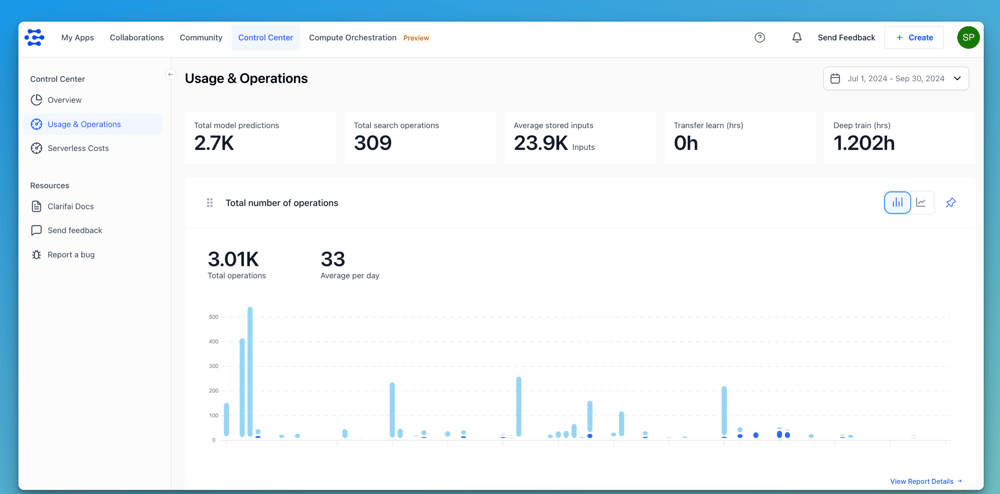
Control Center is a unified dashboard, a single pane of glass to monitor everything happening within your account in the Clarifai platform. It serves as the sole source of truth for various information dimensions, enabling you to make informed decisions based on data from different sources. You can read more about it here. In this release we have made improvements to the Control Center:

  • Implemented locale-based date formatting for charts. This ensures the user’s browser locale is used to adjust the date format automatically based on their location (e.g., US or EU date formats).
  • Previously, selecting a range like the last 7 days included the current day, even though data for the current date was often unavailable. This has been fixed so that the current date is now excluded when selecting the last “x” days.
  • We’ve updated Org access for Control Center pages. Previously, only Org Admins could access any of these pages. Now, Org Admins, Org Contributors, and Org Users can access the Overview and Usage pages, while the Costs page remains accessible only to Org Admins.

    Screenshot 2024-12-05 at 12.09.43 PM

Improved concept capabilities with additional features

  • You can now create extensive concept hierarchies, accommodating thousands of concepts across up to 10 levels. Concepts can be named using period delimiters (e.g., parent.child.subchild.subsubchild.subsubsubchild), such as vehicle.tracked_vehicle.tank.sherman.M4A3, for intuitive navigation through the hierarchical layers.
  • Added a dedicated page that allows you to list, view, and manage concepts, including adding metadata like descriptions, images, and URLs. You can expand each concept to view its hierarchy, displaying all child concepts under each parent in an organized structure.

Ready to start building?

Explore our Quickstart guide to learn more about Compute Orchestration. Contact us here for free Public Preview Access and to get started!

If you have any questions, send us a message on our Community Discord channel. Thanks for reading!


Perplexity Shopping, Microsoft Ignite 2024, AI “Manhattan Project,” Suno v4 and More


In the past week, we’ve seen some huge AI news stories break… 

Here’s what you need to know about what’s going on: Continue reading “Perplexity Shopping, Microsoft Ignite 2024, AI “Manhattan Project,” Suno v4 and More”

Build AI Ready Workforce in 2025


As advance forward understanding the use of Large Language Models (LLMs) in your business, numerous effective usage can be found. At this stage where the use is still highly debatable people are still looking for effective ways to build your AI ready workforce. An approach we are going to take into consideration through this blog is use of Multiple LLMs for the benefit of your business.

Yes, you may have already learned the initial benefits of Gen AI agents and bots. However exploring one particular, i.e; ‘Enhances Team Collaboration’ many companies believe there resides true efficiency. Post-exploration stage companies have discovered that using AI agents with multiple LLMs is impressive, How? That is what we are going to understand in this article uncovering AI for workplace productivity.

What is a Multi LLM Platform? Made for AI Ready Workforce

Definition: A platform where the user has access to multiple large language models. It helps the user to perform various tasks that require different Multiple LLMs using a single dashboard.

OpenAI was the first company to introduce ChatGPT, a GenAI chatbot helping people to perform complex tasks in no time. People later discovered that ChatGPT is a large language model itself, well to be specific families of LLMs. Past 3 years now we are at a stage where multiple tech giants have already launched their own large language models.

Popular Large Language Models

AI Ready Workforce

Above mentioned are some of the most popular LLMs. Each has its own key features, achieved parameters, use cases, and provides access to different sets of information.

So it really comes down to the diversity of solutions that we as a user are being presented with. First you must have believed that AI as a single solution to your everyday problems. But now after being presented with numerous options, multiple LLMs, it surely has become complex.  As for work it raises a question which AI in the workforce will provide significant value.

How about finding every multiple LLM at one place? This way you can use one LLM to decide the structure of a report and another to write the report itself. Don’t worry you are not the only one using multiple LLMs, many people do and hence the time for Multi-LLM platform had to be originated.

Now that you have a hint of what a multiple large language model is, let’s focus on the “Why?” part. However, with the introduction of Multi-LLM AI as a service product, people do raise questions. “Why would I use multiple models; LLMs with different features?”. Let’s break it down shall we?

Importance of Multi-LLM Strategy for AI Ready Workforce

Every business needs to spin ideas faster each quarter. Whether it’s strategizing, performing, or acting with resilience, you and your team need to outsmart competitors. Companies are already geared up for integrating Gen AI in the workforce & businesses.

AI Ready Workforce

Image Source: Microsoft Work Trends & Index

A multi-LLM strategy is all about eliminating friction that you might have faced while using separate platforms. Prominently the strategy favors teams which have a diverse ratio of skilled employees.

Let’s take an example of digital agencies to understand multiple model LLMs.

  • Primary challenges that agencies generally face:
  • Content Strategy against Data Overload – seeksocial
  • Increasing Competition – droptica
  • Slow Sales Cycle – DMN
  • LLM Required: Claude, GPT-4, Midjourney, Bard.
  • Claude for research, document analysis, and helping with trivial tasks.
  • Bard for increasing creative output and researching a strategy.
  • ChatGPT-4 for content creation, daily tasks, and innovating a new strategy.
  • Midjourney for visual content creation.
  • Meta’s Llama for custom solutions as it is self hosting open source.
  • The biggest bottle neck: 

Each team member requires different LLMs adhering to their task requirements. Sure a team can use multiple LLM models but ineffective monitoring results in distrust among team members. Lastly, the varying cost and complexity of integration leaves your company to question the skill of your AI ready workforce itself.

  • Solution: A platform with multiple LLMs, easy to navigate user interface, and a monitoring dashboard on administrator side.
AI Ready Workforce
  • Improved SEO rankings, faster content production & effective content management.
  • Reduced in initial ideation, increase in iterations, and enhanced collaboration.
  • Better project timeline accuracy, dodging project delays, and detailed report generation.

Best Practices for AI Ready Workforce Using Multi LLMs

Below are 5 key strategies helping you and your team to understand how to integrate multiple LLMs for your business.

  1. Selectivity: Use general LLMs like ChatGPT-3 and Gemini for everyday tasks, on the other hand use high end LLMs like ChatGPT-4o for complex tasks. An AI ready workforce is all about matching your team’s strength to the model’s capabilities you are going to use.
  1. Implement Strategic Routing: Using multiple models is about unlocking efficiency. For example, have a tool that combines all the necessary LLMs you need. This will save cost and streamline your workflow for better performance.
  1. Chain Models: For general analysis use go-to models. Once you strike the perfect chord, use that general analysis and feed it to models that can rewire your ideas and match the complexity you are diving deep into. For example: initial classification of content and generating ideas can be done using Gemini and for creating content strategies or content campaigns with the team use Claude and ChatGPT-4o.
  1. Maintain Consistency: Whether it’s in the output formats or providing a prompt, always maintain standardized format for every task. For example, have a custom bot, prompt library, prompt templates or refer to our effective prompting strategies for better results.
  1. Monitor: A necessary operation about having AI in the workforce is analyzing reports by monitoring performance of each model. It gives you an idea of  which large language model is working for your team in the best way. Always consider cost, latency, task accuracy as your primary KPIs by performing a SWOT analysis on each LLM.

Build Your AI Ready Workforce with Us

New age AI users often are quick to notice even the slightest deviation in an LLMs output. Yes your team is becoming smart and are ready to adapt a new workflow where AI is helping them to generate optimal output. Users who have enthusiastically adapted AI noticed how they are able to save time, be more creative, and love what they are doing. 

Looking at the initial stage of integrating AI in the workforce into your business, those are the core strengths which have surfaced. In an age where quantifying productivity is everything. Rather than an uncertain future, it’s better to have a strategy, a multi-LLM strategy for you & your team to keep up with the competitors.

GPT-4o Update, Sora Leak, Perplexity Shopping, Elon Musk vs. OpenAI & US Government’s AI Manhattan Project


After a relaxing Thanksgiving break, we’re back with an extensive list of exciting AI updates! There was so much to cover that we’ve opted for a rapid-fire rundown to get through it all. This episode is packed with must-know topics, including OpenAI’s GPT-4o updates, Sora’s leak, the role of AI in education, the rise of digital clones, and much more. Don’t miss this episode full of insights and the latest in AI innovation! Continue reading “GPT-4o Update, Sora Leak, Perplexity Shopping, Elon Musk vs. OpenAI & US Government’s AI Manhattan Project”

Why Choose Flutter For Mobile App Development?


Why Is Flutter The Ultimate Choice For Your Mobile App Development?

Since its inception in 2017, Flutter has emerged as one of the most sought-after frameworks for mobile app development. It facilitates mobile app developers to create apps on numerous platforms using only one codebase and is actually the heart of such a craze.

What truly distinguishes Flutter is the performance and flexibility it offers. Flutter ensures that apps are both aesthetically pleasing and highly functional. As a result, many firms are using Flutter to reduce app development costs, shorten time-to-market, and deliver consistent user experiences.

Now let’s discuss why Flutter is best suited for mobile app development and why, in the recent past, it has become such a hot favorite in the business of app development.

Overview of Flutter

Flutter is an open-source framework created by Google to make mobile app development easier. It uses the Dart programming language, allowing developers to develop applications for several platforms, including Android, iOS, the web, and desktop, from a single codebase. This method not only saves time but also assures a uniform user experience across platforms, a huge advantage in today’s competitive app industry.

One of the greatest strengths of Flutter is the possibility of natively displaying user interfaces with no need for native components. Instead, Skia, the rendering engine, can provide an aesthetically beautiful design with high efficiency. Moreover, the framework supports a massive library of pre-built widgets, which can be modified to suit the requirements of any set of specifications to present individual and versatile applications. 

Key Features of Flutter Mobile App Development Technology

This feature helps developers to view code changes instantly without having to restart the application. This greatly speeds up development, increasing the effectiveness of fast prototyping and testing.

  • One Codebase for Many Platforms:

Flutter allows you to create code once and have it run on various platforms, such as desktop, web, iOS, and Android. Thus, it saves development time as well as costs involved.

Flutter has a large number of customizable widgets that enable developers to construct smooth and appealing user interfaces. These widgets follow Material Design and Cupertino standards, providing a native-like experience. 

  • Performance Optimization: 

Flutter does not rely on platform-specific components, but instead uses its rendering engine known as Skia to ensure flexibility and responsiveness.

  • Open Source and Frequent Upgrades: 

Flutter has a vibrant community and receives frequent updates, keeping it contemporary and feature-rich.

These characteristics not only improve the development process, but also ensure that the final product satisfies high quality and performance expectations.

Business Advantages of Using Flutter

Flutter’s single codebase strategy dramatically lowers development expenses. Instead of hiring different teams for Android and iOS, firms can use a single team to develop an app for both platforms.

The unique features of Flutter help to complete the development quickly. This gives the companies a competitive advantage by enabling them to distribute their apps faster.

The applications developed using Flutter ensure the same look and feel across all platforms. It enhances user experience and strengthens brand identity.

The requirement of apps will keep on change along with changing business needs. The adaptability of Flutter allows for fast development of apps and scaling with no major redesigns.

  • Better User Engagement: 

The powerful rendering engine along with the huge collection of widgets makes Flutter possible to develop beautiful and highly responsive applications, and also increases retention and satisfaction for users.

Therefore, Flutter provides a balance of quality, speed, and cost savings, which is a good option for developing mobile and web apps for startups as well as big corporations.

Top Use Cases for Flutter

While Flutter is not ideal for all projects, it excels in specific contexts, making it an adaptable platform for a wide range of app development requirements.

  • Startup and MVP Development: 

Startups often work under very tight timelines and financial constraints. Flutter’s single codebase and fast development abilities make it suitable for developing minimum viable products. These can just be implemented to take the user’s input.

Due to Flutter’s rendering engine, which boasts highly customizable widgets,  it will generate dynamic content, fluid animations, and smooth transitions.

  • E-commerce and Business Apps: 

Retail, financial, and service businesses must need apps with user-friendly designs and features. Flutter’s efficient integration with backend services will provide robust functionality.

  • Apps for Emerging Technologies: 

Flutter continues to adapt to cutting-edge platforms like foldable devices and embedded systems, making it a future-proof choice for enterprises pursuing innovative solutions. 

Limitations of Using Flutter You Should Know

Even though Flutter has many benefits, it’s crucial to weigh any potential disadvantages to see if it fits the requirements of your project.

One major disadvantage is that applications made using Flutter contain the framework’s engine, which usually is much bigger in file size than native applications. Thus, for some users with limited space in their devices or from areas where the internet speed is poor, it would be a problem. Such assets and code of an app can be optimized by developers to reduce this problem.

Though Flutter makes sure that excellent cross-platform compatibility is ensured, some platform-specific features or APIs need extra effort to be accessed through native code. This would make things slightly complicated at times while developing complex features.

While being very easy to learn and get through with, Dart always has that minor hitch on the learning curve for those developers who are not familiar with the language. However, the ease of use is worth the additional time spent learning it.

Although Flutter shares a more vibrant library ecosystem, it still falls behind the range of third-party connectors one might find on established platforms, such as React Native. In some cases, developers will have to roll their own plugins.

Older devices with limited hardware capability also cannot handle complex user interface components and Flutter’s rendering engine. Therefore, further testing is required to be sure that compatibility exists.

Conclusion

Flutter has developed as a popular solution among firms looking to create cross-platform mobile applications. Using a single codebase for Android, iOS, web, and desktop apps reduces development time and costs. Flutter is an excellent alternative for startups and large companies due to its rapid performance, ease of customization, and consistent user experience.

At USM Business Systems, we create apps in Flutter designed around your specific business needs. Our company is at the forefront of mobile application development, and we assure you that every application we generate will look great, be intuitive to use, and run as efficiently as possible. Whether you just want something simple or something complicated, we have the skills to get your ideas developed.

If you want to develop a mobile application, then Flutter might be the right one to choose for you. Let us help you create an application designed to make your business stand out.