Seriously, there’s nothing better than catching an airplane and just visiting new and exciting places around the world. I love all the things that traveling comes with. Food, nice hotels with huge pools, beautiful landscapes, and I could just go on and on.
There’s so much inspiration as well!
Do you remember a time where you just wanted to bring home a little part of your trip? I believe that all the history, people, and architecture make every single place on the planet MAGIC!
Ever since I started designing and creating tons of cool printables, I’ve been getting tons of inspiration from color palettes, but there are so many different things you can use color palettes for. Here are some examples …
Do you need to makeover a room in your house? Paint is the cheapest fix. And these palettes can help you find the color combinations for you wall, then coordinating colors for trim, curtains,your bedspread and more.
How about new pillows for your living room? Find the color closest to your current furniture color, and add in related colors for pops of bright colors to make your living room look freshly updated!
Do you want to learn to paint? These palettes are perfect. Try abstracts with swirls and designs in these colors that match, and hang them all over your house for a new look that won’t break the bank!
You can use the palettes suggestions for coordinating colors to determine your branding colors for your blog. You can use them to update the colors on your blog to give it a face-lift or to try something new. You can even use the color palettes on various graphic design websites to create eye catching designs in the brightest and newest colors. These new colors can draw people to your blog post graphics and into your blog with their fresh new feel.
You can even use the colors for scrapbooking and design new pages in the most up-to-date colors to make special events for your family. Or create wrapping paper for special days. Or greeting cards to match the paper.
The possibilities are ENDLESS!!
Here are 25 Best Travel Destinations Color Palettes for you to get ideas on how to mix and match colors for anything you need!
Wanna get your creative juices flowing even further? I’ve put together a binder with a TON of color palettes in the shop here. It’s a whopping 560 pages with inspiration from 20+ themes like seasons, holidays, abstract art, flowers, the sky, the ocean, sweet treats, and MORE!!!You’ll be buzzing with ideas! Get your color palettes binder here.
25 Best Travel Destinations Color Palettes
Planning a party, designing a printable, or just want to decorate your home?
Get tons of inspiration from these 25 Best Travel Destinations Color Palettes!
These complementary color scheme ideas are so gorgeous that will take your breath away.
Many conversations about roof hatch material stop at aluminum vs. steel and fail to explore why that’s only the tip of the iceberg of what matters when these products will sit atop a roof for 20 or 30 years. Material selection is far more extensive than the choice between two metals, and far more selections during manufacture dictate if a hatch will fit, seal appropriately, be energy efficient, or need replacing long before the roof does.
What Compromises a Roof Hatch
A roof hatch isn’t just a metal door with a curb. There’s a frame, a lid, an insulated core, weather seals, and hardware (plus a ladder system). The materials across the components can change and mean levels of performance that comprise a performance profile. Two manufacturers can say they build aluminum roof hatches, but one uses aluminum extruded frame with foam insulation and EPDM gaskets, while the other uses aluminum sheet metal with fiberglass insulation and silicone seals. They’re not going to perform the same.
In fact, the most important component is the frame. The frame does all the structural support work as well as the thermal bridging. Steel frames are stronger per pound so they can span larger openings without added reinforcement. Aluminum frames are lighter and non-rusting, but they need to have added thickness to have the same support as steel. That means the hatch sits differently on the curb and the curb-to-hatch assembly is then different because of frame thickness.
Corrosion: The Assumed Advantage of Aluminum & The Downside of Steel
People think aluminum does not corrode and steel does. Wrong. The reality is far more complicated. Aluminum does corrode; it just does so via anodization and oxide layers, which inherently protect the metal from further corrosion. However, in coastal areas and areas where salt exists, the anodized layer fails. Pitting corrosion occurs in proximity to ocean air at lightning speed; aluminum isn’t as impervious as people think.
Steel may corrode in a less desirable visible manner; however, this is good because it can be seen before problems arise. Galvanized steel or steel with powder coat finishes perform well in most climates. Unfortunately, at fasteners and at points where coating gets scratched during install or service, steel rusts. When moisture meets bare steel, it rusts internally.
Enter stainless steel. Stainless is impervious to corrosion; stainless also runs a bit hot with thermal conductance and costs more. Therefore, stainless is great for places which need to worry about contamination, or extremity exposure, chemical plants, wastewater treatment plants, buildings right on the water, but for the average commercial roof it may be overkill.
Insulation Core Materials Change Everything
The material sandwiched between the two panel interiors (and exteriors) accounts for more thermal performance than either metal. Polyisocyanurate foam insulation has the greatest R-value per inch – which is important when depth is an issue in design and implementation – while expanded polystyrene offers a lower cost option but needs additional thickness to match up.
Fiberglass insulation is used by some manufacturers because it can handle moisture better than foam but lacks thermal resistance. This is where surespancovers.us/roof-hatches/ and similar suppliers differ with multiple offerings; frame materials are one thing, but insulation options should differentiate based on climate use and building purpose – not just one solution across all situations.
The type of insulation makes a difference for more than energy savings, foam cores break down via moisture intrusion inside the panel over time through freeze-thaw cycles; fiberglass won’t break down via moisture but compresses over time if the panel flexes too much when subjected to movement (i.e., rooftops used for heavy foot traffic tend to require insulation that won’t lose integrity due to stress).
Hardware and Seals Are Important Components
The components that create hinges, latches, compression hardware and lifting mechanisms mean what’s going to keep this hatch functional intended per its lifecycle. Zinc plated steel rusts faster than stainless but is significantly cheaper; stainless steel is worth it for a hatch that’s going to be accessed monthly for HVAC maintenance; stainless isn’t worth it for an egress hatch that’s going to sit for years without use.
Sealing means more than one thinks, EPDM rubber gaskets hold longer than neoprene but are more expensive; silicone holds extreme temperature tolerances better than either rubber option but can’t be easily serviced if damaged; compression seals are different than bulb seals which are dependent upon frame types.
Gas springs use steel cylinders that contain different fluids/seals; cheaper springs lose pressure after two years making the hatch heavy and dangerous to use; better gas springs maintain pressure for decades but one has no idea looking at them what kind they are.
Thermal Performance Beyond R-Values
The material of the frame provides thermal bridging which negates insulating effectiveness. An aluminum frame conducts heat four times better than steel. While that doesn’t seem significant, it creates condensation and ice that forms on hatches faster with aluminum than steel. Thermal breaks in a plastic or foam design that creates a cut-in halting the metaling transfer eliminate some of this effort (but with an added cost) which can help.
Winter condensation that’s formed within the hatch assembly creates water damage downstream, mold growth and insulation degradation within roofs in cold climates; even if aluminum or steel are decent options, when it comes to framing, it’s imperative to ensure a thermal break when applicable; exterior and interior air temperatures trump insulation core thickness more than people realize.
Colors/Coatings That Last
Powder coating provides better efficacy than liquid paint across steel and aluminum, and through powder coating it’s all about the transfer thickness and curing process – not so much about color pigment. However, cheap powder coating chips and fades within five years; quality powder coating lasts 15-20 years with UV exposure and weather cycling.
Anodized aluminum finishes last longer than powder coating but limit color choice and add expense; this is useful for aesthetic locations (schools/hospitals/civic buildings) where replacing faded units becomes an obvious maintenance issue.
Bare galvanized steel is aesthetically industrial; if looks aren’t an issue then it performs well. Zinc coating on steel does well as long as it doesn’t get scratched during installation, as long as it holds durability there’s minimal corrosion relative to coated joints of intersection especially on roofs where maintenance is limited.
Cost vs Performance Over Time
Material selections factor into upfront cost, but they factor into lifecycle expense even more. Where an aluminum roof hatch with quality sealant and proper hinges may cost 30% more than a basic steel hatch, it may outperform reliable by 25 years while the other performs for 12 and needs replacing immediately after.
Maintenance issues vary by material combination; steel hatches with powder coating need periodic checks for coating issues/rust infiltration; non-polyurethane aluminum hatches with EPDM seals need replacements every decade on their gaskets; stainless hardware generally needs no attention; zinc plated might fail after the hatch needs replacement.
More than specification suggests climates determine overall effectiveness; where one design option works seamlessly in AZ, it fails five years into use in ME or less-than-desired environments (coastal inclusive). Buildings with certain exposure to temperatures/tunnels/vents/piping need safe connections that prevent extremes causing failure.
Making The Decision on Material Selection
The best course material makes sense based on actual location conditions, climate-first exposure (how often will someone access it), how often access is needed (daily better than every now and again) and budget concerns for an upfront solution vs lifecycle goal.
Also determines whether material selection made sense are those realities after a decade or so, did the integrity hold up? Did everything work? Did materials complement each other? The frame supports the lid, insulation matters for condensation risk, sealing prevents water intrusion, and hinges determine whether anyone can operate correctly 10 years later. All roof hatch materials need to be cohesive, and that’s where aluminum vs steel misses the mark entirely.
The expression “freehold in the CBD” was thought to be an old-fashioned relic from the past but Newport Residences Singapore has brought it back to life. The building is situated on the old Fuji Xerox Towers site at 80 Anson Road, this 51-storey mixed-use tower is among the last chances of owning a part of the Tanjong Pagar Tower and being a part of the skyline for the rest of time. With just 246 units of residential space over retail and offices as well as serviced apartments, scarcity is present from the start. For investors who gauge wealth over decades not launch weekends the math here is brutally captivating.
Redeveloped as part of the CBD Incentive Scheme with a 25 percent gross floor area bonus This project will transform an abandoned plot in the 1980s into an vertical neighbourhood that feeds directly into the Greater Southern Waterfront vision. Prince Edward Road MRT opens in 2026 literally on the doorstep, and Tanjong Pagar MRT is already one stop away from Raffles Place. If you get to the point where the waterfront promenade links up and the old port land is transformed into playgrounds for lifestyle, the early buyers of Newport Residences will be sitting in one of the main rows in Singapore’s upcoming expansion phase.
Core Drivers That Move the Needle
Freehold Rarity in a Leasehold City
In the approximately 1,500 private residences that were launched every year in recent years, less than 50 are freehold throughout the Core Central Region. Newport Residences delivers 246 of them in a single move. The past is abysmal in this regard: freehold CCR condominiums have outperformed counterparts in 99 years with an average rate of 2.1 percent per year in any continuous 20-year period from 1995. The gap is a source of an investment that could change the course of your life.
Built-in Tenant Magnet
Senior executives and expatriates who have to stay within 5 minutes’ drive to Shenton Way will pay whatever it takes to get there. The initial yield projections are 4.2-5.1 percent gross after the office below is leased as well as those serviced apartments start operating. A 1,076 square foot two-bedder is expected to fetch $7,500-$9,500 per month starting in 2029, figures that are not found in the majority of suburban launches.
Waterfront Transformation Catalyst
The Greater Southern Waterfront masterplan is not a fad; it’s URA policy that has funding attached. If Keppel Club relocates and 1,000 acres of prime land opens to the public, Tanjong Pagar becomes the natural entry point. The past examples of precincts right in front of major revitalization waves (Marina Bay, 1998-2008; one-north from 2005 to 2015) yielded annualized 69% returns over the first 10 years. The Tanjong Pagar Tower is located in the centre for that wave to come.
Design and Positioning Edge
Mixed-Use Efficiency at Its Peak
The units for residential use start at level 23 in the Tanjong Pagar Tower, which gives every owner with panoramic views of the sea and city views that cannot be hindered. Retail, F&B, and Grade-A offices means that dry cleaning, grocery shopping and client lunches are available on the same lift. This convenience results in near-zero empty spaces, even during transitions of tenants.
Quantum Sweet Spot for Foreign Buyers
One-bedroom units starting from 557 sq ft and two-bedders of around 1,000 sq ft maintain their total quantum of between $1.9 millions to $3.8 million. Foreign buyers who are not allowed to purchase land-based properties and HDB flats can find this price range ideal for personal use and investing in pure investments without having to pay more ABSD for certain buildings.
Prestige That Appreciates Silently
An Tanjong Pagar freehold address carries significance in boardrooms throughout Asia. The owners here aren’t shouting about their purchases on social media. They are secluded in a postal address that will never go out of style, and watch the markets chase upwards every year.
How It Stacks Up Against Lentor Gardens Residences
The Place Newport Residences beside Lentor Gardens Residences and the two investment options barely share. Lentor Gardens Residences offers spacious suburban living as well as family-friendly greenery with a price that is half of the average which is ideal for owners who value proximity to schools and views of the reservoir. However, its 99-year lease and northern location limit the growth against CCR freehold. Rent returns for Lentor Gardens Residences hover in the high-end 3 percent range after stabilisation in the long run, but maintenance and the distance to the Financial District makes tenants’ pools smaller and more unstable. Both projects will make money, however one is designed to provide a lifestyle that has constant growth, while the other is designed for a fast growth of wealth within the city’s center.
Conclusion: The Last Pure CBD Freehold Play
Opportunities to purchase freehold residential properties right above MRT interchanges located in the CBD will not come back after they are gone. Newport Residences (within Tanjong Pagar Tower) represents the final significant release in the current CBD Incentive Scheme before rules become more stringent. Investors who know that the land within Tanjong Pagar never becomes cheaper and more scarce, are taking action. As it comes to the time that the waterfront promenade lights up and the old port vanishes for good, the cost for entry is compared against the price that buyers of the past have paid today. The difference will be weighed in terms of millions, not percentages. If you have a horizon measured in years this tower isn’t an initiation point. It’s the closing bell of an era.
Forex trading can feel thrilling. The charts, price swings, and the opportunity to make a profit from your home office are exciting. However, here’s the truth that most beginners overlook: Forex trading isn’t just about opportunity; it’s equally about risk. Anyone can set up a business. But successful traders? They survive in the long run by mastering one thing: risk management.
Even the most sophisticated forex trading strategies are useless if you fail to manage your risk effectively. In the world of currency markets, it’s not always how much you make, but how much you protect that counts.
If you are serious about trading like a pro, it’s time to treat risk management as your secret weapon. Forex Trader Techniques such as position sizing, stop-loss discipline, and realistic goal setting can dramatically improve your performance. Let’s break down five essential techniques every forex trader must use, whether you are just starting or trying to turn your passion into a consistent profit machine.
1. Calculate your position size like a pro
Ever blown half your trading account on a single trade? Don’t worry, many traders learn this lesson the hard way. One of the most potent risk management tools is position sizing, in simple terms, deciding how much to trade based on your account size and risk tolerance.
A common rule of thumb? Never risk more than 1–2% of your account per trade.
If your account balance is $1,000, you should risk only $10–$20 per trade. It may seem like a small amount, but for a Forex trader, this disciplined risk management is essential. It’s one of the most fundamental Forex Trader Techniques that protects your capital, helps you survive losing streaks, and ensures long-term consistency in the market.
Example:
Account size: $1,000
Risk per trade: 1% = $10
If you lose three trades in a row, that’s $30, not your entire account.
With good forex trading strategies, the wins will outweigh the losses.
Why it matters: It helps you keep emotions out of your decisions and makes you think like a long-term trader.
2. Always use stop-loss orders: No exceptions
Let’s talk stop-losses — the safety belt of forex trading. A stop-loss order automatically closes your trade once the price moves against you by a certain amount. It’s not just a tool; it’s a mindset. A professionalForex trader always predetermines where they will exit. Never, ever skip a stop-loss, even if you believe a trade “will come back.” That’s how small losses can turn into massive disasters.
Pro tip: Place your stop-loss based on strategy and chart structure, not emotions, for example, below a support zone or above a resistance level.
Why it matters: Trading without stop-losses today is like navigating without GPS, which ends badly. It prevents unpredictability and measures losses.
3. Leverage carefully: It’s a double-edged sword
Leverage can make you feel like a high roller. In forex, you might see options like 1:50 or even 1:500 leverage, meaning you can control a huge position with a small amount of capital.
Sounds like a rush. Well, only if you are careful. Leverage magnifies gains and losses. A slight price movement can wipe out your account if you are over-leveraged.
Smart rule: Stick to lower leverage, especially if you are new. Most experienced traders trade with leverage below 1:10. That way, you stay in control even when the market moves quickly.
Why it matters: Leverage is not something to “max out.” It’s a tool to enhance strategies, not replace them.
4. Don’t risk everything in one pair: Diversify!
Imagine putting all your money on EUR/USD… and then the European Central Bank makes a surprise announcement. Ouch.
Forex markets fluctuate in response to news, economic indicators, and global events if all your trades are on the same pair or correlated pairs (such as EUR/USD and GBP/USD), your risk skyrockets.
Diversify your trades across:
Different currency pairs
Timeframes
Or even strategies
That way, if the euro crashes or the yen spikes, it doesn’t destroy your entire account.
Why it matters: Play safe with diversification. It mitigates risk, allowing you to stay solvent in the market even in volatile conditions.
5. Keep a trading journal: Track, learn, and improve
Trading is about psychology, patterns, and growth. That’s why every serious trader keeps a journal.
In your trading journal, track:
Entry and exit points
Chart patterns
Emotions at the time of trading
Mistakes
Wins and losses
In weeks, you will be easily able to understand which strategy is working and which is costing you money. With data-driven insight, refining your forex trading strategies becomes easy.
Example: You might notice that most of your winning trades happen during the New York lunch session, but you keep losing during late-night trades. That’s a clue.
Why it matters: Journaling turns every trade, win or lose, into a learning experience. And learning is what creates consistency.
In summary: Your risk game is your trading game
Let’s recap the essential risk management techniques:
Use position sizing to protect your trading capital.
Never place a trade without a stop-loss.
Use leverage wisely and avoid going all-in.
Diversify your trades across pairs and strategies to minimize risk.
Keep a trading journal to learn from every move.
Trading the forex market is a marathon. Intelligent traders focus less on making a quick fortune and more on achieving long-term, sustainable profitability. Applying disciplined Forex Trader Techniques helps you manage risk wisely and stay consistent, rather than chasing short-term wins. Risk management is about staying in the game long enough to succeed.
How Home Business Magazine helps you trade smarter
At Home Business Magazine (HBM), we are all about helping entrepreneurs thrive from home, that includes forex traders, crypto enthusiasts, content creators, and more. We break down complex topics, such as risk management and forex trading strategies, into accessible guides that help you build confidence, avoid pitfalls, and take smarter risks.
Whether you are setting up your trading room, improving your analysis, or learning how the markets move, HBM brings you real-world tips, expert insights, and powerful resources, all for the modern home-based entrepreneur.
Ready to take control of your forex journey? Explore more expert strategies, success stories, and learning resources now at Home Business Magazine. Because trading success doesn’t come from luck, it comes from a brilliant strategy and intelligent risk management.
Chances are, if you are reading this article, you are stuck for ideas of things to sell and you need to make money from home right away.
Perhaps you need to make rent money and it’s the 29th of the month.
Perhaps there’s a birthday party you’ve been invited to and you can’t just show up empty handed, but your bank account just gasped for air…there’s nothing left in there.
Whatever the reason may be that you need to make money fast, please know that I’ve been there (several years ago, I was homeless and within one year of blogging, I was making $10,000/month! Now, my sixth year blogging, I have multi 7-figure businesses online!!!) and that I’m praying for you on your journey as well!
Several years ago, I was homeless. It’s too painful to go into details, but the jist of it is that my ex-husband abandoned us and I had been a stay-at-home-mom all my kids lives. He took my debit card and left me with no gas while I called the church to help me get out of the physically abusive situation.
I’d go on to place a restraining order on him, he’d break it several times and I’d stand there to watch the most horrific sight I’ve ever seen in my life. Him thrown against the back of his car, handcuffed, and put in the back of a police car in the parking lot of Walmart…yet another reason I hate that store. Here’s why you should never shop Walmart if you want to scale up and have a better life.
Sometimes, life throws tomatoes at you,I get it.Please know this, it can only get better from where you’re at now.
You’re already at the bottom, feeling like you can’t go any lower. The truth is that you can’t. It only goes up from here! So be encouraged by that!!!
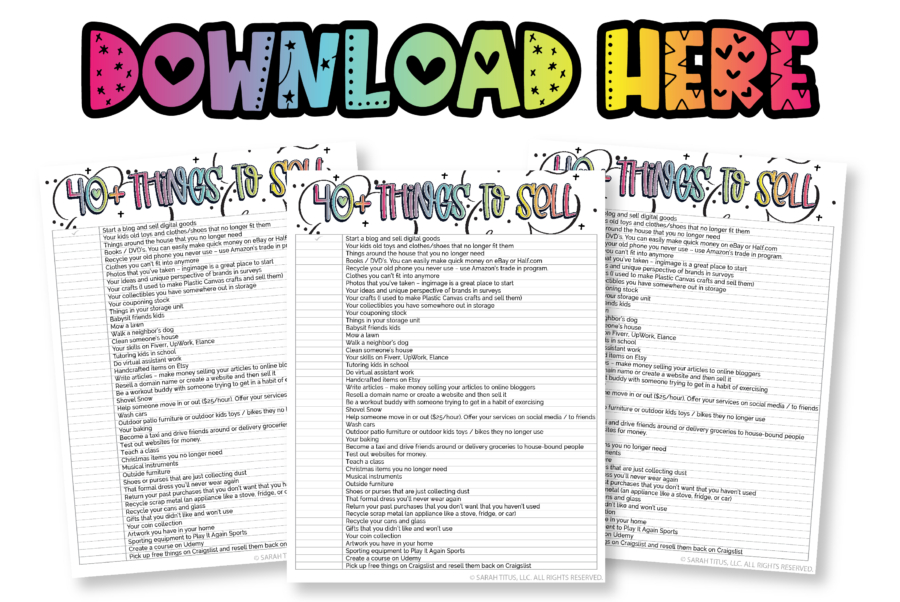
Whether it’s using your time or some creative tangible goods, here are 40+ things to sell right now to make money from home.
This was my FIRST step after getting out of the homeless shelter to rebuild my life, so I’m all for figuring out creative ways to be home with your family!
40+ Things To Sell Right Now to Make Money From Home in 2025
Sell printables
Creating and selling your own printables can be SUPER lucrative. It’s something that I stumbed upon many, many years ago and do really well in my Shopify store. The point is to build a newsletter list where you give something new and free each and every month (something really good). This keeps people on your email list and then you can sell them other things (think: courses, affiliate links, etc.) When you offer them something free, they also poke around in the shop and buy other things. They leave reviews and this helps other people buy who are coming directly to you store (from say Google or something). It’s a fantastic way to earn money. Definitely one of my favs!
Sell courses
This would be my other favorite way to make money online. Sell what you know! EVERYONE can start up a course and sell it. This is the digital age and everyone wants to learn something. I’d be willing to bet you know something that someone is willing to pay to learn. All you have to do is start creating your own courses site.
Your kids old toys and clothes/shoes that no longer fit them
Reselling kids stuff on places like Facebook Marketplace or Craigslist is an AWESOME way to make money. Kids grow so fast, who wants to pay brand new prices?!
Things around the house that you no longer need
I’d be willing to bet if you scout around your house, you can find a TON of things to sell. Go through your home and start organizing and decluttering. What would someone else be willing to pay for? You’ll not only make for a happier, cleaner more organized environment, but you’ll make some quick side cash while you’re at it!!!
Books / DVD’s / BluRay’s you have that you never watch or read
Media items can get you a lot of money. Think about things like that old Disney Infinity set your kids don’t play anymore. Each character is worth $10+ and some are a good $50! Check it out. Any games, gaming systems, books, DVD’s or BluRay’s (especially Disney) are always great to sell.
Recycle your old phone or docking station you never use
Upgraded to the new iPhone or iPad? Awesome! Resell your previous model!
Clothes you can’t fit into anymore
Come on, admit it…I KNOW you have clothes in your closet you’ll NEVER wear ever again. We all do, right?! The cool thing is, someone else CAN. Try to sell them in lots (making outfits is best) but individual lots too like 10 shirts and 10 pants types of things. People dig that! You can sell them on ebay, Craigslist, Facebook Marketplace, consignment shops, Poshmark, Tradesy, or ThredUP.
Photos that you’ve taken
Have you considered starting up your own Shopify store and selling your photography? Or maybe you want to add your photos to places like DepositPhotos, BigStock, 123RF, or Shutterstock. Those are all great places to make money with your photography, art, vectors, and more!
Your ideas and unique perspective of brands in surveys
Have you thought about taking surveys for extra cash? It’s something I did very successfully after I got out of the homeless shelter and really helped me get free stuff and make some side money. Here’s the top 25 best survey companies (that are LEGIT and won’t scam you!)
Your crafts
Like sewing? Love crocheting? Enjoy making stuff? You can create crafts and sell at bazaars, craft fairs, and even on Etsy.
Your collectibles you have somewhere out in storage
Maybe it’s that old tea set your mom left you that’s in the garage collecting junk. Or perhaps it’s that coin collection you have. Maybe when you were a kid, you collected postcards from around the world. Maybe your kids have a HUGE Littlest Pet Shop collection. All these things could be valuable to other collectors, so get out there and sell, sell, sell, babeee!
Your couponing stock
If you’re good at couponing, you have a couponing stock. You can resell the products you got for dirt cheap for around 50-75% off retail and make some money!
I was always taught that if you’re paying to store something, it’s not serving you. Don’t pay to store stuff. If you don’t have the room to keep it, sell it. Then at least you have the cash for it and someone else is putting it to good use.
Babysit friends kids
Maybe it’s a single mom down the street or something in your church that needs a babysitter. You can babysit children to make some side cash.
Mow a lawn
Know anyone in your neighborhood that needs their lawn mowed? You can put up door hangers in your neighborhood to get started. It’s a great way to make money. Right now, lawn companies charge $40-$80/week to mow, edge, and blow all the grass away (depending on the size of the lot). You could charge 25% lower and get the sale. Plus, if you offer to mow every OTHER week instead of every week like all lawn mowing companies require, it’ll save the owner money and grass doesn’t really need to be mowed every single week! Even if you charged the same amount as lawn companies but did it every other week instead of every week, you’d still save the homeowner money.
Walk a neighbor’s dog
Maybe a neighbor is going out of town or maybe you know someone who wants you to dog sit. Offer your services and have fun!
Clean someone’s house
Love to clean? Cleaning companies can charge an arm and a leg. I remember when I first moved to this house and I got a quote. They wanted $1,000/week to clean it. Are. you. out. of. your. dang. mind? No way. I mean, it was just way over the top. So, I have my daughter clean our house and I pay HER for it, and I DON’T pay her no $1k either! Good money, but not THAT good. Anyway, you can make some money cleaning other people’s homes. Check around at church, there are probably some ladies who’d hire you!
Your skills
What are you good at? What do you enjoy doing? Maybe you love to type. You can type reports for others and they will pay you to do it. Maybe you like to sew? You can sew for other people and do some light mending and repairs. Whatever you’re good at, figure out if there’s a way to make money from it.
Tutoring kids in school
Lots of kids need tutors, especially right now with homeschooling more prevalent in our society now. You can teach piano, math, social studies, English, ESL (English as a second language), all kinds of topics! There are a lot of local homeschooling groups on Facebook, so check there and offer your services!
Do virtual assistant work
Lots of bloggers need help running their blogs. We can’t do EVERYTHING, there’s just so many things to attend to. You can work for a blogger and gain experience and income! The best way to get involved is looking on Facebook groups and following your favorite bloggers. They sometimes will run an open call looking for help in their newsletters!
Handcrafted items on Etsy
What do you like to make? You can sell whatever it is you make on Etsy for some extra cash. I used to know a lady who made baby wipe covers. She’d sew them and emboidery the baby’s initials on it. It was SOOO cute. They went for around $20 at the time. Do some research about what sells on Etsy and what you think you could create.
Write articles
Facebook groups are great to find bloggers to write articles for. This is a good thing to get into if you love to write. Bloggers can pay anywhere from 3¢-8¢ per WORD. Imagine a 2,000 word post! You could make $60-$160! Imagine writing 15 posts a month! Now you’re talking $2,400!
Resell a domain name or create a website and then sell it
Blogging is not the easiest thing to start up, especially if you’re not technical. There are some good places you can go to create a website, set it all up, and resell it. This is something I’ve thought of doing because selling them, you can get like $30,000 believe it or not. Depending how much time you’ve put into it and how much traffic/stats/income it has. One of my friends sold her blog years ago for over $100,000! It’s a lot of work, for sure, but it’s not chump change. Here’s a couple places you can sell (and buy if you’re interested) a blog already set up: Niche Investor, Flippa, and Empire Flippers.
Be a workout buddy with someone trying to get in a habit of exercising
Shovel Snow
Help someone move in or out (you can get around $25/hour). Offer your services on social media and to friends.
Wash cars
Outdoor patio furniture or outdoor kids toys / bikes they no longer use
Your baking. You and your kids could make cookies to sell around your neighborhood
Become a taxi and drive friends around or delivery groceries to house-bound people
Test out websites for money.
Teach a class – chances are there’s SOMETHING that you can teach someone else that they’d be willing to pay to learn.
Christmas items you no longer need
Musical instruments
Outside furniture – things like a grill or patio set
Shoes or purses that are just collecting dust
That formal dress you’ll never wear again
Return your past purchases that you don’t want that you haven’t used
Recycle scrap metal, an appliance like a stove, fridge, or car
Recycle your cans and glass
Gifts that you didn’t like and won’t use
Your coin collection
Artwork you have in your home
Sporting equipment to Play It Again Sports
Create a course on Udemy
Pick up free things on Craigslist and resell them back on Craigslist
I’ve been making money from home for 21 years now. These are the things that make the MOST money from home that I’ve found. They do require a more long-term building strategy, but the amounts that you can make, are well worth the energy and time to build them up.
1) Sell printables
When I first started my blog, I was making pretty good money on ebay ($18k/year), enough to survive. But life isn’t JUST about money. I wanted my life to matter! So I started blogging to help people. That rolled into multi 7-figure businesses.
I love printables, as you can see from this blog. 🥰 They’ve organized my life like no other. It’s amazing how much one simple printable can do.
Each month, I give my audience a free binder or set of printables, and they leave reviews. Others come along from Google and social media and purchase the binders because they see so many love them and that’s how I make my money.
My audience also purchases my printables and with so much traffic and the nurtured, healthy email list that I’ve built over the years, it’s really a fantastic way to earn income.
That brings me to my second empire, something you can absolutely do as well!
2) Sell courses
I started selling courses on Teachable 9 months ago (now on Kajabi). Within my very first two weeks, I made $97k. I assure you, I thought it was a fluke. lol. But here I am, 9 months later and I feel like I’m just BARELY getting started and I’ve already hit, yep, you guessed it 7 figures. I don’t run any Facebook or paid-for advertising at this time (I hope to start soon, but haven’t as of yet). It’s all just my email list and word of mouth.
Listen, I love what I do, and I’m telling you right now that there’s a goldmine of income you can make online and you can do it in just about any way you want. I’ve been making money online for 24 years! I made money when I first started way back then, I make more money now. Point is, you can absolutely make money online.
Will it be easy? No. Anyone who says it’s easy, is a liar. Unfollow them.
It IS real work, but listen, I work less than part-time each week, and my assistants work 10 hours a week. I have my dream life and I love teaching others how to do it too. So I hope you stick around, because I have a wealth of knowledge inside me and each week, I’m pouring out my heart and life to help others do exactly what I’ve done over the years. <3
3) Do virtual assistant work
This is a really great one. In order to run my business (I’m a single mom here, I can’t do it all by myself!) 🙂 I need to have help. Currently, I have one girl who helps me proof articles, so I write all the posts like I’m doing now and then she comes in and proofs them and finds the spelling errors/grammar mistakes, etc. that I’m known to do. haha.
I have another girl do my Pinterest account. She’s really amazing and great at helping my account grow.
And I have another girl who helps me with a lot of random stuff + my emails. She’s FAN-TASTIC at keeping my emails at zero. Never seen anything like it before. It’s just so awesome knowing it’s all taken care of and relieves so much stress off of ME, so I can do what I’m BETTER at: writing.
The emails she can’t do or that need to be answered by me (mostly course stuff), I do them. It just works so brilliantly.
I pay my assistants $10/hour to start and give them great special perks and bonuses. I absolutely adore my team. Each person plays a vital role in my business.
YOU can BE THAT for someone else.
There’s a lot of Facebook groups that you can find a job as a virtual assistant in. Let me give you a few I know about that I’m a part of and are good:
You can create things like recipes, how to tutorials, printables, offer blog writing posts, create videos and all those sorts of things and offer them for sale in some Facebook groups.
You just create things like say a recipe and sell your pictures and recipe to bloggers for like $60! No kidding. It’s a really great way to make quick money.
Some time in my blogging career, I would create roundups (collections of posts with a collection picture) for other bloggers. I would gather 25 links and have a collage of pictures and sell it for $30. You can look into Facebook groups to see more of that, but I used to do that for a while, while I was getting my blogging income up.
It’s a fast and easy way to make money. Think about it. Bloggers can’t do it all. They NEED help. They NEED honest, genuine, loving people like you to help them and this is a perfect way.
4) Write articles
This is also something I did, again in the Facebook groups, but also to bloggers I knew, friends, or people who would ask me to write for them. At one point, I was putting out so many articles, that I had a writer for ME. haha.
I hired my mom and she’d write posts on things like gardening (stuff I know nothing about) and I’d sell it for her on the Facebook group. We’d split the profits or I’d pay her like $10 per article. I’d ask $25 but I’d do the picture for it too.
I also had an assistant helping me and she’d create roundups for me (again, those are a collection of posts all in one post) and there were too many to put on my own blog so I’d sell them. I paid her $10/hour and it took her one hour to do it. I’d sell the article for $25-$30 and make a profit.
As a business owner, those types of things are business expenses (people who work for you), so you don’t have to pay taxes on that money you pay. It’s the same thing when you buy something to resell it on ebay or something, like I did with Littlest Pet Shop toys. You don’t pay taxes on your expenses, which is cool.
So writing articles for bloggers can really help your income pretty quickly.
The one comment I hear a lot with this is that people think they might want to start their OWN blog and are afraid of giving out too much information and just GIVING it away.
I’ll tell you, from experience, just give it away if it makes you money and you’re starting blogging. Because listen, there’s so much inside you that you don’t even know and over the years, you’ll learn even MORE!
Your knowledge never stops and who cares even if there ARE two articles on the best ways to save money on food. Like, this is the internet. There’s nothing new under the sun. Somewhere, someone else has the same ideas and it’s fine. As long as you’re not copying anyone else.
Please note, if you ARE a scammer and copying other people’s work online and passing it off as your own, we know. Bloggers use a very inexpensive tool called CopyScape Plagiarism Checker to make sure there’s nothing scammy going on and to protect ourselves. 🙂
5) Resell a domain name or create a website and then sell it ($54,000)
One of my BEST FRIENDS is an online blogger and here recently, she got sick and is not able to blog anymore. She sold her blog for THREE TIMES her blogging YEARLY income. Yes, she’s had the blog like 8 years, but there is a lot of people who buy a domain name, fill it up or write a bunch of content and then flip the sites for sometimes, tens of thousands of dollars!
It can be pretty lucrative. I’ve been tempted to do this myself, but decided to just build my own platforms and that’s been the best route for me personally, however, again, it can make you a whole lotta money, so not anything to sneeze at.
10 >>EASIEST<< Ways to Make Money
If you want the absolute EASIEST ways on how to make extra money, you’ll want to check out this article here all about it!
Commercial real estate (CRE) financing is experiencing a cautious recovery, with transaction volumes showing signs of stabilization.
Sector-specific trends reveal varying levels of resilience, with industrial and multifamily properties leading the way in the recovery.
Regulatory changes and evolving market dynamics are influencing lending practices and investment strategies.
Introduction
The commercial real estate environment today is defined by rebalancing, strategic repositioning, and new growth opportunities. The sector has undergone notable shifts in lending sentiment and investment flows over the last several years, creating a market where careful and creative solutions prevail. As the connectivity between global financial conditions and local lending practices intensifies, both lenders and investors must remain vigilant to sudden changes in requirements and risk appetites. For those seeking access to tailored lending solutions, understanding the nuances of Commercial Mortgages is more crucial than ever.
Market recovery has spurred a gap between the most resilient property types and those facing prolonged headwinds. Government intervention, interest rate cycles, and sector fundamentals continue to shape the outlook, and the emerging consensus is that this era demands adaptability, transparency, and timely responses to economic disruptions.
Looking forward, the strategies and products shaping tomorrow’s CRE lending environment reflect a blend of innovation and caution. How these commercial property financing trends play out in different sectors will have profound impacts on asset performance, portfolio risk, and income opportunities for investors and property owners alike.
Stakeholders across the country are navigating unprecedented changes. The ability to respond to shifting commercial property financing trends and compliance requirements can be the difference between securing optimal funding and missing key opportunities. For a comprehensive look at sector-specific drivers and broader economic signals, trusted resources such as The Wall Street Journal Real Estate provide ongoing, in-depth coverage.
Stabilization in Transaction Volumes
Following several volatile quarters, recent data reveal encouraging signs of stabilization. In the U.S. market, transaction volumes reached $108.5 billion in Q4 2024, marking a robust 33.6% quarter-over-quarter increase. This recovery signals renewed investor confidence, driven by optimism around moderating interest rates and improving clarity on property values. Analysts note that the uptick is more than a short-term rebound – it could set the tone for a steady climb back to pre-pandemic performance levels.
Sector-Specific Lending Patterns
Not all commercial property types are moving in lockstep on the path to recovery. Lending appetite, transaction activity, and investment strategy are being shaped by clear distinctions:
Driven by the evolution of the supply chain and the growth of e-commerce, industrial assets have remained a favorite among lenders. In Q1 2025, the median transaction size increased by 14.1% year-over-year, with a focus on prime logistics hubs and flexible warehousing.
Urban and suburban multifamily projects continue to be highly sought after due to rent growth and resilient occupancy. The median deal size saw a 6.3% year-over-year increase, highlighting persistent demand for affordable and mid-market housing solutions.
While office properties once anchored CRE lending, their recovery lags due to remote work and evolving tenant preferences. With only 62 office property transactions per day in Q1 2025, well below historic averages, lenders are taking a highly selective approach to underwriting and risk assessment.
Regulatory Changes and Lending Practices
Regulatory adjustments are making waves throughout the industry. Fannie Mae and Freddie Mac have undertaken substantial tightening of lending standards, specifically for multifamily loans. New guidelines require stricter verification of borrower finances and greater transparency, aiming to curb fraud and ensure better loan quality. Additionally, lenders are increasingly incorporating sustainability and environmental, social, and governance (ESG) criteria into their decision-making, which creates new layers of diligence – but also mitigates risk in the face of heightened regulatory scrutiny.
Economic Factors Influencing Financing
Economic context is inseparable from CRE financing today. Moderating interest rates have helped thaw transaction activity, while a flood of maturing loans has brought urgency to refinancing conversations. The Mortgage Bankers Association projects a 26% increase in total borrowing and lending for commercial and multifamily mortgages in 2024, expecting the industry to hit $539 billion by year’s end. These figures reflect pent-up demand and suggest that fresh capital is available, especially for well-positioned borrowers.
Challenges in the Office Sector
Among all property types, offices continue to struggle with persistently high vacancy rates and mounting loan maturities, with U.S. regional banks being particularly vulnerable. Approximately $950 billion in CRE loans are due in 2024, with at least 10% tied to office assets. Lenders are responding by tightening underwriting standards, stressing contingency planning, and in some cases, encouraging adaptive reuse or conversions to residential or mixed-use developments. These measures signal a new era of sector discipline and risk assessment.
Innovative Financing Solutions
The dynamism is perhaps most evident in the realm of creative financing. The hospitality sector, for instance, is leveraging layered capital stacks and innovative approaches such as Subchapter V debt restructurings to address complex refinancing challenges. Across the board, borrowers and lenders are turning to preferred equity, mezzanine debt, and structured finance options to close funding gaps and maintain project momentum. As the market matures, ingenuity in deal-making and capital structuring will become increasingly central to achieving competitive advantage.
Conclusion
The commercial property financing landscape is uniquely complex but full of promise for forward-thinking stakeholders. Success in this environment hinges on a proactive approach to market signals, a nuanced understanding of sector dynamics, and a willingness to adapt to regulatory and financing innovations. Navigating these commercial property financing trends effectively will put investors, developers, and lenders in the best position to drive value and resilience through the next market cycle.
One of the things that fascinates me is doing in-depth studies of the attributes of God. When I first started studying this topic, I errantly thought that I’d be studying maybe 10 of God’s attributes.
Two years later, I’m STILL studying His attributes. They are vast and they are all there, recorded in the pages of Scripture for us to see and know.
God is not a God who hides. He does not keep His will from us, nor does He turn His back on us. He WANTS to be known. The more we learn about God, Jesus, and the Holy Spirit, the more peace we have in life because we learn to trust Him with everything.
These last few years of studying His attributes in depth have been one of the most amazing times in my life, where I’ve truly gotten to know my Father much more than I ever have in my entire life.
I would encourage EVERY Christian to hurriedly start with studying all His attributes and learning more about the God we call Savior. It will truly change your entire life!!! 💯
Want to zero in on a few key attributes for your kids, class, or church? Here are some fun activity packs — everything is already done for you! Bonus: right now, you can save 60% off with discount code: BFCM2025 (good through Dec 1).
In this post you’ll find 90+ attributes of God from A to Z, each with Bible verses so you can slow down, study them deeply, and use them in your personal Bible study, family devotions, Sunday school, or church Bible study groups.
Attributes of God That Starts With A – Z
Learning about God is truly one of the best things you can do in your Christian experience. Thankfully, we have a lot of material in the Bible to go on. Here you’ll find the attribute, followed by a passage or two where you can study it more in-depth.
You can make these into memory cards for kids, create a Bible study for your church group, study it on your own, and so much more!
Another great one is the Names of God memory cards. Use this for yourself or your kids in a fun and exciting way to learn more about God! 🙏
God is…
• Attributes of God that starts with A
Able (Ephesians 3:20; 2 Timothy 1:12) – He is able to do anything and is not bound by space, matter, or time.
Advocate (1 John 2:1; Revelation 12:10) – Jesus is our advocate who stands up for us as if a lawyer in a trial against Satan’s accusations and attacks.
Almighty (Genesis 17:1) – God is Almighty; there are none before Him nor will come after Him. He alone is the supreme one.
Anthropomorphic (Isaiah 63:15-19) – He has human characteristics.
Awe-inspiring (Psalm 66:5) – He is full of majesty and we are in awe of Him, desiring to pattern our lives after Him (1 Peter 2:21).
• Attributes of God that starts with B
Banner (Exodus 17:15) – The Lord is my banner. He is whom we do everything for. He is our King, our reason for existing.
Beautiful (Psalm 27:4) – He is beautiful, absolutely stunning. Everything He does is good and perfect.
Blessings (Psalm 16:11; Psalm 145:9; Psalm 84:12) – He is a blessing to His children (Genesis 12:2).
Bountiful (Philippians 4:19; Psalm 13:6) – Since He is the Creator of all things, He has and owns ALL things. Everything is His to give, according to His great riches in Heaven, on earth, and everything else in the galaxy.
• Attributes of God that starts with C
Cleanser (Psalm 51:10) – He cleanses us from unrighteousness and sin.
Comforter (2 Corinthians 1:3-4) – He comforts us when we are suffering, in trials, or in pain. He is always there for us as our loving Father. He cares for us like no other.
Commander (Joshua 5:13-15; Psalm 91:11) – He is the ultimate commander, leading myriads of angels, rescuing His children from sin and darkness, and upholding the whole earth and everything in it daily.
Compassionate (Isaiah 54:8; Isaiah 63:7) – God knows what we are going through and what we struggle with and is always there with compassion toward His people.
Cornerstone (Ephesians 2:20-21) – Jesus is the cornerstone, the rock on which we build. He is our foundation and everything results from Him.
Creator (Genesis 1:1) – God created everything. Nothing existed before Him.
• Attributes of God that starts with D
Defender (Psalm 46:1; Zechariah 9:15; Psalm 94:22) – When trials come and Satan accuses us (Revelation 12:10), the Lord is our defender (1 John 2:1).
Deliverer (Psalm 18:2; Psalm 34:4; Job 36:15) – We must learn to not count on others to deliver us, but our deliverance and salvation belong to the Lord God Almighty alone. He holds all things in His precious and very capable hands.
Dependable (Numbers 23:19; Job 42:2) – You can count on God; He will do what He says.
Divine (Revelation 22:13; 2 Peter 1:3; Isaiah 46:9; Psalm 46:10; Exodus 3:14) – God is God and there is no other above Him.
• Attributes of God that starts with E
Emmanuel (Matthew 1:23) – Emmanuel means ‘God with us’. God is always with us and when we say He is not (in any context), we are literally blaspheming against His very character!!!
Eternal (Isaiah 40:28) – He has no beginning or end.
• Attributes of God that starts with F
Fair (Psalm 7:11; Hebrews 6:10) – While things may not always be fair on earth, in the end, God will make ALL things fair due to His great righteousness.
Faithful (Lamentations 3:22-23; Deuteronomy 32:4) – He always keeps His promises and is faithful to His children.
Forbearing (Romans 2:4) – When we sin, God will convict us and show us how we are wrong and give us time to repent. If we don’t, He then shows us what will happen if we don’t turn from our sin. If we still do not repent, He gives us more time to come back to Him and works with us, through situations, circumstances, and trials in order to call us back to Him. If after all that, we are stubborn and still do not repent, He chastises us and punishes us for our sin (Psalm 7:12-13), all the while calling us back to Him. We rarely see this process as it’s happening, but this is exactly what’s going on with every sin we commit. He is incredibly forbearing, kind, and loving toward us.
Forever (Revelation 22:13) – God was in the beginning and will be there in the end. There is none who came before Him.
Forgiving (Psalm 130:4; 1 John 1:9; Psalm 103:12) – When we sin and mess up, isn’t it amazing that we have a great high priest to forgive us our sins, who paid our debt on the cross so that we can become free?!
Fortress (Psalm 18:2) – When David was fleeing for his life from Saul, he found refuge in the wilderness, a rock cave to hide in and called it his fortress because it represented God’s protecting love for him.
Fulfilling (Matthew 5:6; Philippians 4:19; Ephesians 3:14-19) – We were created to worship something and when we do not worship God, we worship other things, idols in our lives. But when we come back to Christ and worship HIM, we are fully satisfied (Psalm 145:16) and fulfilled in our souls.
• Attributes of God that starts with G
Gentle (2 Corinthians 10:1) – He shepherds the sheep, He comforts us when we are brokenhearted, He is gentle, kind, and loving to us always.
Glorious (Psalm 72:19; Isaiah 6:3) – He is beautiful and great.
Good (Psalm 145:8-9; Psalm 136:1) – He is full of kindness and goodness (Psalm 31:19).
Gracious (Psalm 145:8-9; Psalm 103:8-14) – He is full of grace, mercy, and love.
Great (Psalm 145:3) – He is awesome and worthy to be praised.
• Attributes of God that starts with H
Healer (Matthew 8:16) – God alone holds our lives and health in His hands (Luke 12:25). He alone has the power to heal our physical bodies, but also, our souls! He heals the brokenhearted, He heals us of pain, hurts, and injustices committed against us. He heals us of our sin. He is the great healer.
Holy (Exodus 15:11; Isaiah 6:3) – He is perfectly good and righteous.
• Attributes of God that starts with I
Immortal (Psalm 102:26) – He never dies or has an end.
Immutable (Malachi 3:6) – He never changes.
Impartial (Acts 10:34-35) – God doesn’t play favorites with us. He is a righteous and perfect judge (Psalm 7:11) who shows no partiality.
Incomparable (2 Samuel 7:22) – There is no one else like Him in comparison. He is the only God (1 Timothy 1:17).
Incomprehensible (Isaiah 55:8–9) – If God were to tell us everything He knows, our human minds would explode. We simply cannot handle all that knowledge and wisdom. God, the Father alone knows everything (Matthew 24:36) and is above all things.
Independent (Psalm 36:7-9) – He has no needs. He is self-sufficient and self-existing.
Infinite (Job 11:7-9) – He is not limited by time or space.
Intercessor (Romans 8:26-27; Hebrews 7:25) – Jesus and the Holy Spirit intercede with God on our behalf to help us. Think about that for a minute. God prays to God for us. It’s incredible!!!
• Attributes of God that starts with J
Jealous (Exodus 34:14) – God is a jealous God who lovingly fights for your attention. He will not allow you to have any other idols or deem anything else more important than He is.
Judge (Psalm 7:11; Acts 17:31) – God is the supreme judge who sits on high. There is no higher-ranking person above Him.
Just (Job 34:11-12) – He is always fair and just, and judges with righteous, supreme, and perfect judgment.
• Attributes of God that starts with K
Kind (Romans 2:4; 1 Corinthians 13:4; 1 John 4:8; Galatians 5:22-23) – God is loving, patient, gentle, and kind in all of His ways. Even in His judgments and punishments, He is very kind out of His great love for us.
King (1 Timothy 1:17; Psalm 24:7-10) – God is the ultimate King, there is none above Him.
Knowledgable (1 John 3:20; 1 Chronicles 28:9) – God’s wisdom transcends all time and matter. He knows absolutely everything since He alone created it all.
• Attributes of God that starts with L
Life (John 14:6) – God is our source of life.
Light (John 8:12; Psalm 119:105) – God is good, perfect, and a shining light to all.
Living water (John 7:37-39) – God compares Himself to Living water. Drink of Me and be satisfied, He, in essence, is saying.
Lord (Revelation 19:16; Jeremiah 31:35) – God is Lord above all. As Christians, we are created to serve and bow down to Him in all areas of our life.
Loving (1 John 4:8; Psalm 117:2) – He is, at all times (even when judging), loving and caring toward all people.
• Attributes of God that starts with M
Majestic (1 Chronicles 29:11) – He is full of majesty, wonder, and awe and should be greatly praised and revered.
Merciful (Psalm 145:8-9; Deuteronomy 4:31; 1 Peter 1:3) – He is full of compassion and goodness.
Messiah (John 1:41) – Messiah is translated as Christ, the anointed one, Savior. Jesus was anointed to carry out His task of going to the cross and paying a ransom for our debt. He humbly submitted Himself to God to go to the cross for us (Philippians 2:8; 1 Peter 2:22–25) and die a terrible death to pay for our sins, while He remained completely innocent and perfect.
• Attributes of God that starts with N
Name that is above every name (Philippians 2:5-11) – Because Jesus humbly submitted to God (a promise for us as well: James 4:10) to go to the cross for all mankind, God exalted Jesus and gave Him a name above every other name, that every knee on earth, under the earth, and in Heaven will bow to the name Jesus and confess that Jesus is Lord. Interestingly enough, the name “Jesus” means “Yahweh saves” or “Yahweh is salvation” (see Yahweh).
Near (Psalm 145:18; Psalm 34:18; James 4:8) – The Lord is near to all who call upon Him (even those who are unsaved) when we admit/agree with Him that He is the Lord God Almighty.
Nurturing (Ezekiel 34:12; Luke 13:34; Psalm 57:1) – The Lord is our Shepherd, He comforts us in times of distress and is our refuge and safe place. He tenderly leads, carries us when we are huring, and cares for us.
• Attributes of God that starts with O
Omnipotent (Jeremiah 10:12-13) – God has power over all things at all times.
Omnipresent (Jeremiah 23:24) – He is always everywhere.
Omniscient (Psalm 147:5; Proverbs 5:21) – He is all-knowing (Romans 11:34).
Overcomer (John 16:33) – All the schemes of the devil, all the pain, injustice, and suffering of his people, all the plans against God from fallen angels and Satan, God has and will overcome it all. Do not forget that Satan and his demons have no authority over God and must ask HIM permission to do anything!
• Attributes of God that starts with P
Patient (Psalm 86:15) – He bears all things and is patient and understanding toward us, even when we mess up and sin.
Peaceful (Philippians 4:7) – He is full of peace, not causing drama or unnecessary problems. He always strives to resolve conflicts (of others) harmoniously.
Perfect (Matthew 5:48) – He is completely perfect, without error, in all things.
Powerful (Job 42:2) – Nothing is too hard for Him (Jeremiah 32:17).
Protector (Psalm 18:30) – He protects and cares for His children.
Provider (Philippians 4:19; Matthew 6:31-33) – God provides for His children in all ways (spiritual, physical, financial, emotional), according to His great riches in Heaven.
• Attributes of God that starts with Q
Qualified (Psalm 18:30; 2 Timothy 3:16-17) – The Lord God Almighty is more than qualified to teach us, lead us, and perfect us in His infinite and amazing grace and love.
• Attributes of God that starts with R
Redeemer (Job 19:25) – The Lord God is our redeemer, the One who saves us out of sin (Romans 6:23; John 3:16), and upholds our life day by day (Hebrews 1:3).
Refuge (Psalm 46:1) – God is our refuge, the place and person to whom we can run to when things are not going well. He is our safe place.
Righteous (Romans 3:21-26; Isaiah 41:10) – He is always righteous and does what is right. He never does the wrong thing.
• Attributes of God that starts with S
Savior (Luke 2:11) – Only God can save us from our sin.
Shelter (Psalm 61:4) – God is our refuge and shelter, our safe place away from the storms and trials of life.
Shield (Psalm 84:11; Psalm 3:3; Psalm 7:10) – God is our shield, always protecting and loving us through everything.
Sinless (2 Corinthians 5:21) – God is perfect and without sin.
Sovereign (Romans 11:36; Psalm 95:3) – He is above all things and has power over all things.
Spirit (John 4:24; Galatians 5:22-23) – He is an invisible being (1 Timothy 1:17).
Strong (Psalm 28:7; Psalm 46:1) – God is the strongest being in existence. Nothing is stronger than Him. Thankfully, He shares His strength with us. He strengthens us by His grace as we need it.
• Attributes of God that starts with T
Triune (2 Corinthians 13:14) – God is God the Father, Jesus the Son, and the Holy Spirit.
Truthful (Numbers 23:19) – He hates lying and is always truthful. He never lies.
• Attributes of God that starts with U
Unchangeable (Psalm 102:26-28) – He never changes. His good will (Jeremiah 29:11) for us is predetermined from before the foundation of the world (Ephesians 1:3-6).
Unconquerable (Job 42:2) – Nothing and no one is greater than the Lord and nothing can therefore conquer Him or His purposes.
Understanding (Psalm 139:1-6) – Having been man, God understands everything we’ve gone through or will go through perfectly and is compassionate toward us.
• Attributes of God that starts with V
Victorious (1 Corinthians 15:57; Revelation 11:15) – Victory, whether on this earth, in heaven, or anywhere in between belongs to God alone. He shares that victory with us, His children, but it is ultimately because of Him we are victorious.
• Attributes of God that starts with W
Wise (1 Corinthians 1:20-25) – He is full of perfect wisdom and knows everything. His understanding is unsearchable (Isaiah 40:28).
Worthy (Revelation 5:12; Psalm 145:3) – God is perfect and loving at all times, worthy of our respect, admiration, and godly fear.
• Attributes of God that starts with X
eXalted (Philippians 2:9-11; Psalm 46:10; Revelation 4:8) – God is exalted, high above anyone or anything else, since He has created all things.
eXample (Matthew 5:48) – God is the perfect example for us to pattern our lives after for He alone is perfect and worthy to be praised.
Xristos (Luke 23:35) – Greek word that means Christ, Anointed One, or Messiah.
• Attributes of God that starts with Y
Yahweh (Exodus 6:2-3) – Hebrew name for God / The Lord. Yahweh (YHWH) has been interpreted to mean “I am,” “He that is,” or “He brings into existence”. In English, Yahweh is sometimes translated as “Jehovah”. His name was revealed to Moses as God revealed Himself to Moses more than Abraham, Isaac, or Jacob. This name is given to the trinity: God, the Father, Jesus, the Son, and the Holy Spirit. See “Name that is above every name”.
Yoke (Matthew 11:29-30) – God’s yoke, His plan for us to partner with Him, is easy and light. He does not overwork us but gives us steady, peaceful, happy work to do with Him for the purpose of others. He gives us plenty of rest and balances His kingdom work with pleasure and time spent with Him (Luke 10:38-42).
• Attributes of God that starts with Z
Zealous (Isaiah 9:7; Isaiah 37:32; Isaiah 42:13) – The Lord God is full of zeal. He is not lukewarm as He asks us not to be too (Revelation 3:15-16), but rather He is zealous for His people and His will to accomplish His purposes.
Personal Bible study – Pick one attribute each day or each week and read the verses, journal what you learn about God, and pray that God will show you more about that particular attribute in Himself.
Family devotions & homeschool – Let your kids pick a letter, read the attribute and verse together, then have them draw or write about what that attribute means.
Sunday school, Christian schools, and churches – Use this A to Z list as a framework for a lesson series on God’s character. Each week, focus on one or two attributes and pair it with your Attributes of God Bible Study Binder for the grown-ups or your kids activity packs for the children.
Memory & review – Turn the attributes into flashcards or memory cards to help kids and adults know more about God’s character in their hearts.
Be sure to check out my other Bible lists A-Z lists too for more fun when you’re done with this list! 🥳
Parents considering private education in Brooklyn face several prestigious options, each with distinct educational philosophies and approaches. Brooklyn Friends School, Packer Collegiate Institute, St. Ann’s School, and Berkeley Carroll School represent four of the borough’s most established independent institutions. Understanding how these Brooklyn Friends school and Brooklyn private schools differ helps families identify which environment best supports their child’s development.
Brooklyn Friends School grounds its approach in Quaker principles, emphasizing the belief that each person possesses an “inner light” deserving respect and cultivation. The school organizes its work around SPICES—Simplicity, Peace, Integrity, Community, Equality, and Stewardship—which inform everything from conflict resolution to curriculum design.
St. Ann’s School operates without grades or standardized testing. This Brooklyn private school allows juniors and seniors to design their own curriculum, creating an environment focused on “learning for the sake of learning.”
Berkeley Carroll School emphasizes “critical, ethical, and global thinking” combining methods across educational traditions while serving students from preschool through 12th grade.
Brooklyn Friends School stands apart through its coherent values system that extends beyond mission statements into daily practice. Weekly Meeting for Worship brings the entire community together for silent reflection, creating space for students to develop inner awareness alongside academic skills.
Leadership and Direction
Head of School Crissy Cáceres joined Brooklyn Friends School in 2019, bringing a distinctive “leadership walk” approach that emphasizes responsive engagement with community needs. “I am somebody who is malleable to the human energy that’s in front of me,” Cáceres explains, describing her philosophy as fluid rather than fixed.
Cáceres describes herself as a “way maker” who considers “what is it that my agency and my insight and my experience, and frankly also my power and positionality, allows for me to do in service to those needs that are present?”
Academic Programs and Curriculum
Brooklyn Friends School offers the International Baccalaureate Diploma Programme for 11th and 12th grade students, making it one of only two Brooklyn schools with this globally recognized curriculum. The IB program emphasizes critical thinking, international-mindedness, and community service through its core components: Theory of Knowledge, Extended Essay, and Creativity-Activity-Service.
Packer Collegiate provides college preparatory education with Advanced Placement courses. Berkeley Carroll offers an “academically challenging, college preparatory program, enriched with creative arts and athletics.”
Brooklyn Friends School maintains a 7:1 student-to-faculty ratio, enabling personalized attention throughout the educational journey. This ratio supports the school’s commitment to knowing each student as an individual.
Approach to Student Development
Brooklyn Friends School frames behavioral challenges as “mistake making” rather than occasions for punishment. Head of School Cáceres explains: “In order for bullying to occur, there had to be active intent, there had to be a connection to what you thought you gained from the bullying, there had to be a measure of trying to hide or omit yourself from the impact of that. And their frontal lobes have not fully developed enough for all of those three things to be true. So that is not bullying, that’s mistake making.”
When conflicts arise, teachers gather students in circles to discuss what happened, why it happened, and how to repair relationships. During Cáceres’ tenure, zero students have been counseled out for behavioral reasons.
Berkeley Carroll School uses restorative practices, viewing “conflict as an opportunity for growth and learning.” This Brooklyn private school coaches students “to think flexibly, use their voice, and consider the perspectives of others involved.”
After a conversation about inappropriate language, three seventh-grade students told Cáceres the meeting “wasn’t about what was happening at Brooklyn Friends School right there, that it was about our lives. That if we took seriously what we were about to have a conversation about, it would affect us for our whole lives.”
Community and Diversity
Brooklyn Friends School serves approximately 725 students from all five boroughs, with 39% identifying as students of color. One in four families receives tuition assistance, reflecting the school’s commitment to economic diversity.
Brooklyn Friends School offers families a specific combination: rigorous academics through the IB program, restorative practices grounded in developmental understanding, and a coherent values framework that guides daily decisions. The school’s 158-year history demonstrates sustained commitment to its founding principles while adapting educational methods to contemporary needs.
In the world of real estate and home-based businesses, the old adage was “location, location, location.” In 2025, that has shifted to “visualization, visualization, visualization.”
Whether you are a real estate investor looking to flip a fixer-upper, a host trying to boost Airbnb booking rates, or a business owner establishing a client-facing home office, your property’s exterior is your brand’s first handshake. A study by The Journal of Real Estate Finance and Economics suggests that curb appeal can increase a home’s value by up to 7%. Conversely, a neglected facade can deter clients before they even step through the door.
Historically, visualizing a renovation meant hiring an architect or 3D artist, costing anywhere from $500 to over $2,000 for a single static rendering. The turnaround time? Weeks. For a lean business, this friction is unacceptable.
Today, smart entrepreneurs are bypassing this bottleneck by utilizing AI house exterior design tools. These platforms allow you to upload a photo, apply a new style, and see the results in seconds-allowing you to test “risky” ideas (like painting brick or changing rooflines) without spending a dime on contractors.
But not all AI visualization tools are created equal. Some are merely toys for generating fantasy art, while others are robust planning platforms. We tested the market leaders to bring you the 5 best tools that offer genuine business ROI.
The Evaluation Criteria: What Matters for Business?
To rank these tools, we didn’t just look for “pretty pictures.” We analyzed them through the lens of a business owner who needs actionable results. Our rubric included:
Does the AI respect the actual geometry of the house (windows, doors, rooflines), or does it hallucinate new architecture?
Can you go from upload to result in under 2 minutes?
Does the tool bridge the gap between visualization and purchasing actual materials?
Can you tweak specific elements (like just the door or driveway) without regenerating the whole image?
Here are the top contenders for 2025.
1. Paintit.ai
Best For:
Total renovation workflow, realism, and “zero guesswork.”
Paintit.ai takes the top spot because it addresses the biggest pain point in AI design: the disconnect between inspiration and execution. While many tools stop at generating an image, Paintit.ai is built on the philosophy of a “Unified Design Ecosystem”1. It is designed to guide you from a rough idea to a shoppable plan.
Why It’s a Business Asset
For an investor or homeowner, the “flow state” is critical. You don’t want to fight with complex prompts. Paintit.ai excels with its EIS (Empathy, Intuitiveness, Seamlessness) core. You simply upload your exterior photo, and the system’s context-aware AI identifies architectural features automatically.
Its standout feature is the ability to perform Targeted Refinements. Unlike basic generators that wipe out the entire image if you want to change one detail, Paintit.ai lets you keep the facade but swap the driveway material, or change the siding color while preserving the landscaping. This “on-image” control mimics how a human designer works-iteratively and precisely.
Furthermore, Paintit.ai moves beyond pixels. It integrates real furniture and material recommendations with commerce intent. If the AI suggests a modern outdoor lighting fixture, it aims to show you a real product you can buy, not a fictional sci-fi lamp.
Pros:
Respects the structural “bones” of your property better than purely generative artistic models.
Offers a path to purchase materials, turning a mood board into a shopping list.
Highly accessible Weekly ($6.99) and Monthly ($24.99) plans with a money-back guarantee.
Cons:
The catalog of real-world materials is growing but may not yet cover every niche local supplier.
Verdict:
If you need a renovation plan that is grounded in reality and ready for a contractor, Paintit.ai is the professional choice.
2. HomeDesignsAI
Best For:
Exploring a massive variety of styles quickly.
HomeDesignsAI is a direct competitor that has gained traction for its sheer volume of features. It positions itself as a comprehensive AI visualization tool for interior, exterior, and garden design.
The Experience
The platform is robust, offering distinct modes for “Redesign” and landscaping. It allows users to mask out areas they want to change, similar to Paintit.ai.
However, where it sometimes struggles is the “human touch.” The interface can feel slightly more technical, requiring a bit more trial and error to get the lighting exactly right compared to Paintit’s auto-model selection. It is a powerful AI visualization tool, but it leans heavily on the user knowing exactly what they want to prompt.
Pros:
Large library of pre-set styles.
Offers gardening and landscaping specific modes.
Cons:
Can be more expensive depending on the tier.
The “AI look” can sometimes be too glossy or unrealistic for actual contractor references.
Verdict:
A strong runner-up for those who want to churn out dozens of variations quickly, though it may lack the seamless “idea-to-buy” flow of our top pick.
3. Midjourney
Best For:
Conceptual inspiration and high-art visualization.
Midjourney is arguably the most famous name in generative AI, known for creating breathtaking, award-winning imagery. However, for a business owner trying to renovate a specific building, it presents significant challenges.
The “Hallucination” Problem
Midjourney is an image generator, not a design tool. If you upload a photo of your office and ask for a “modern facade,” it might return a stunning image that completely changes the window placement, adds a second floor, or invents a mountain range in the background.
It lacks “structural integrity.” You cannot easily tell it to “keep the brick but change the door.” It requires complex prompt engineering skills to get usable results.
Pros:
Unmatched artistic quality and lighting.
Incredible for mood boards and abstract concepts.
Cons:
Zero structural control: It will change your house’s architecture without permission.
No material lists or shopping links.
Operates via Discord (for many users), which is a clunky interface for professional design work.
Verdict:
Use Midjourney to dream up a fantasy, but don’t hand the image to a builder unless you want them to laugh at the physics.
4. Planner 5D
Best For:
CAD enthusiasts and detailed floor planning.
Planner 5D is a legacy player in the market. It started as a traditional 2D/3D floor planner and has recently integrated AI features.
The Precision vs. Speed Trade-off
If you are willing to spend hours building your property from scratch-drawing walls, placing windows, and setting dimensions-Planner 5D offers incredible precision. It is a tool for those who want to control every millimeter.
However, for the entrepreneur who wants a “Type → See → Tweak” flow, Planner 5D feels slow. It is less about rapid AI visualization tools and more about digital drafting. Its AI features are often add-ons to the core manual modeling experience.
Pros:
Extremely accurate dimensions.
Great for new construction projects where no photo exists yet.
Cons:
Steep learning curve (high friction).
Time-consuming setup before you see any visuals.
Verdict:
Great for architects or serious DIYers with time to spare, but overkill for quick curb appeal decisions.
5. REimagineHome
Best For:
Virtual staging and quick cosmetic updates.
REimagineHome focuses heavily on the real estate agent market, specifically for virtual staging (adding furniture to empty rooms) and exterior updates.
Quick Fixes
The tool is straightforward. It identifies sky, grass, and building elements fairly well. It’s particularly good at “landscaping” updates-adding digital grass or virtual patio furniture to make a listing look more inviting.
However, its editing capabilities are somewhat limited compared to the “Whole-Image transforms” and specific object edits found in more advanced ecosystems. It often applies a generic “filter” look rather than a deeply calculated design renovation.
Pros:
Very simple interface.
Good specifically for real estate listing photos.
Cons:
Limited customization depth.
Can feel restrictive if you want to mix and match specific architectural styles.
Verdict:
A solid niche tool for realtors needing a quick fix, but less versatile for renovation planning.
Summary: Which Tool Fits Your Flow?
To help you decide, here is a quick comparison of how these AI visualization tools stack up for business use cases:
Feature
Paintit.ai
HomeDesignsAI
Midjourney
Planner 5D
Best Use Case
Renovation & Commerce
Style Variety
Art/Concept
CAD/Drafting
Structural Accuracy
High (Context-Aware)
Medium/High
Low
Very High
Ease of Use
High (Intuitive)
Medium
Low (Prompts)
Low (Complex)
Real Products
Yes (Commerce Intent)
Limited
No
No
Starting Price
~$7 / week
Subscription
Subscription
Free/Sub
Final Thoughts
In 2025, “guessing” is a business risk you don’t need to take. Tools like Paintit.ai have democratized high-end design, moving it from an expensive service to an accessible software solution.
By choosing a platform that prioritizes structural realism and commerce connection, you aren’t just playing with AI-you are de-risking your real estate assets and building a brand that stands out from the curb.
The latest innovation in workplace technology? Artificial Intelligence. AI via tools like ChatGPT has the power to transform the way teams work, collaborate, track, and analyze data. In Hive, we’ve recently added Buzz, a real-time AI assistant that can write content, plan projects, streamline your work, respond to emails and more.
This new technology is playing an increasingly large and powerful role in the way teams inside of Hive manage their projects, share updates, and more. Read on to learn about the impact of artificial intelligence in today’s workplace — and especially how AI is changing project management.
AI for Project Management
While we’re seeing the future of workplace AI take off, the idea of AI is not something new. In the late 1950s, scientists and mathematicians were obsessed with using and learning AI. They asked fundamental questions focused around if a “computer can be smart” or “perform more” than a human brain. Since that time, computers, big data, and the sheer volume of AI research have exponentially grown, and AI has been put to the test.
All the research and growth in the workplace AI field has created a perfect application for AI: project management. The ability for AI to monitor, assess and anticipate complex situations in real-time makes it an ideal addition to any project management toolkit. With AI, task automation is achievable at a level previously seen by traditional methods. This allows decision-makers and stakeholders to gain crucial insights quickly and act upon them faster.
Benefits of AI in Project Management
Project management (PM) guides your business or group to achieve its project goals within its unique six constraints. These constraints include the following:
Cost
Time
Scope
Quality
Benefit
Risk
With these six constraints, the key to successful project management is responding quickly and accurately to changing conditions or events. However, at any time in the project, internal and external factors are weighing down or trying to throw any constraint off at any second. It’s a delicate balance that requires so many moving parts that the introduction of AI in project management has been a lifesaver.
When AI is thrown into the mix of PM, it allows managers to make better decisions and respond faster than ever. Some of the key benefits of using AI in project management that can positively impact outcomes include:
Automation
Before digital project management platforms, projects were written on pen and paper or drawn out using charts and graphs. Schedules were handwritten in physical paper calendars on walls, and someone had to make any needed adjustments manually. Today, people can utilize all types of automation technology — whether it’s smart note-taking software, AI scheduling assistants or full-fledged workflow automation tools like Hive — to manage work smoother than ever. AI schedulers, for instance, can efficiently allocate tasks and resources, ensuring optimal scheduling and resource utilization.
Automation is important in business because it increases efficiency, productivity, and accuracy, while reducing costs and the chances of human errors. Automation tools can also help streamline marketing, customer service, and operations tasks, allowing businesses to free up resources, save time, and focus more on areas like growth and innovation.
Real-time insights
If you’re like me, you may have spent hours in the past pulling up data, cramming it into a spreadsheet, and trying to make sense of the data to your supervisor. While I still wake up in a cold sweat from thinking about those days, AI has removed that process from my life. Today, you can use AI to pull real-time data analytics and insights into project performance, giving you all the information you need right at your fingertips – nightmares not included.
Cost savings
Ever accidentally transposed data in your work setting? Or uploaded the wrong project deck to your computer and have to redo everything? Not only does that waste time, but it also wastes money. Using AI eliminates manual errors and reduces costs associated with labor hours spent fixing mistakes. While we may not all be working in finance and using AI to help budget our accounts, time is money, and any little bit helps if you stop wasting time manually inputting or fixing errors and let AI step in and do the work for you.
Since AI systems can automate tasks such as data analysis and transaction categorization, it eliminates the need for manual labor and can reduce overhead costs. It also lessens the need for manual data processing, which can result in significant cost savings.
Risk reduction
With its ability to monitor real-time data and your progress, you can use AI to check how you’re doing and reduce risk. AI can assist with monitoring trends and recognizing potential problems early on. For example, if you’re spending too much time on a specific part of your project or scope creepis starting to become a problem, your AI can alert you of any deviations in your six constraints.
AI is revolutionizing the project management landscape, and it’s only a matter of time before AI-driven solutions become even more commonplace. With its ability to automate tasks, provide real-time insights, save costs, and reduce risks, you should consider it if you have yet to begin using AI in your daily project management toolkit.
Bonus: Creative work and organization
AI is helpful for content creation because it can be used to automate parts of the process while reducing the amount of time needed to create content. AI tools like ChatGPT can be used to generate ideas, identify trends and optimize content structure. It can also be used to quickly analyze large amounts of data, helping content writers develop more detailed pieces using fewer resources.
Additionally, AI writing tools can help writers identify the most successful types of content in different formats and on different platforms, helping them create more effective and engaging content. Furthermore, AI introduces innovative solutions for enhancing visual content, including tools like an image upscaler. This technology enables the upscaling and refinement of images and graphics, making them suitable for a variety of platforms.
By ensuring both written and visual content are of exceptional quality, AI plays a significant role in the efficient creation of more compelling and engaging content, illustrating the evolving landscape of creative work in the digital age.
Project Management AI Software to Use: Buzz
Most project management platforms come with snippets of AI embedded in their code. We have already discussed some programs on the market today that use automation AI to speed up your workflow – but that’s not all AI can do anymore. AI can do more than assist with email templates, reoccurring tasks, and calendar planning, and with Buzz, that rings true.
Like we mentioned above, we’ve added Buzz to our platform, built off of OpenAI’s framework. This addition will help you anticipate what your team needs to accomplish next in their projects and can provide recommendations on optimizing workflows. Buzz also offers machine learning capabilities, so it can continuously improve its accuracy over time.
Using this AI platform makes project management faster and more efficient without inputting all the data manually. In addition, this AI tool can help teams quickly identify problems that could lead to complete project failure. Ultimately, it saves time and money for companies of all sizes. So if you’re looking for an AI-driven project management platform, Buzz has you covered!
The Next Steps For AI
I am genuinely thankful for the help that AI has provided me in project management. I can use this tool to help automate complex tasks and provide real-time insights into project performance, cost savings, and risk reduction – all at the click of a button.
AI is revolutionizing digital project management and changing the future of work, and I’m here for it. While it can be scary to adopt this new technology, it’s not going to go away anytime soon, and if anything, it will continue to get better and further dig into how we do business every day.
Have you used AI in your project management tasks? Comment below and let us know all about it!