How AI Is Transforming Franchise Development
A franchise inquiry that waits four hours for a response is usually gone.
Not officially. The candidate rarely withdraws. They just fill out three more forms on the same portal. The brand that calls back within ten minutes wins the conversation.
Everyone in franchise development knows this. Almost no pipeline is built for it.
That gap explains why AI has entered franchise development. The competitive pressure is real. The IFA’s 2026 Franchising Economic Outlook projects roughly 845,000 franchise establishments and $921.4 billion in output this year. The report states a clear theme: franchisors now recruit qualified operators instead of expanding at all costs. More brands compete for the same small pool of serious candidates. Meanwhile, McKinsey’s State of AI report puts regular AI use at 88% of organizations, up from 78% a year earlier. Franchisors no longer ask whether to use AI. They ask where AI improves franchise development without creating sales, legal, or brand risk.
We build AI systems for franchise organizations. So this is not a neutral survey. It reports what we saw work, what breaks, where automation should stop, and how teams roll it out safely.
Here is the short version. AI should not replace franchise sales. A candidate signs with people, not with an autoresponder. AI removes the work that blocks those conversations: slow response times, messy CRM records, manual follow-ups, and inconsistent messaging.
Read these two things first:
The “What to Automate First” table and the Franchise AI Readiness Scorecard below. Together, they show what to hand to AI, what to keep human, and whether your pipeline is ready.
What Franchise Development Really Means
Franchise development is the process a franchisor uses to attract, evaluate, and onboard new franchisees. It runs from lead generation and qualification through discovery calls, franchisee validation, Franchise Disclosure Document (FDD) review, franchise sales, territory planning, signing, and onboarding.
Get the language right first. Your AI system should mirror the real franchise funnel, not a generic sales process:
| Funnel Stage | What It Means | AI Role |
|---|---|---|
| Lead | A raw inquiry from a portal, ad, referral, event, or website form | Capture, tag, acknowledge, route |
| Prospect | A lead who engages: replies, books, or asks a serious question | Score, prioritize, summarize, follow up |
| Candidate | A qualified prospect moving through discovery and evaluation | Support reps, prepare notes, keep CRM clean |
| Franchisee | A signed operator entering onboarding | Trigger training, onboarding tasks, and operational handoff |
The distinction matters. AI can do a lot with leads and prospects. AI needs tight control once a person becomes a candidate. This matters most when conversations touch the FDD, Item 19, financial expectations, or territory rights.
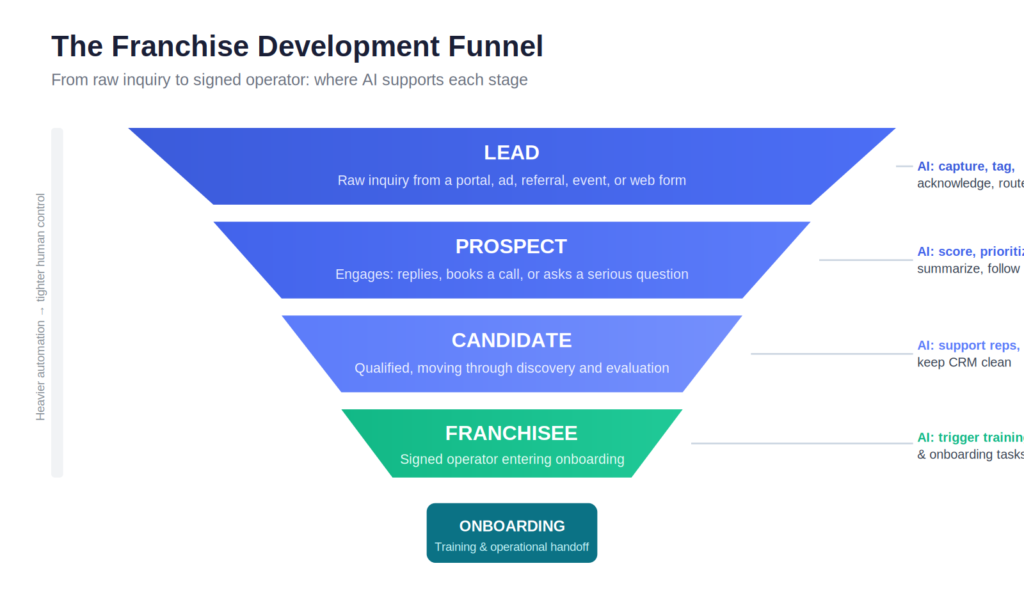
Figure 1: Franchise Development Funnel. Concept illustration of a franchise development funnel, from raw inquiry to signed franchisee and onboarding.
Where Franchise Development Funnels Actually Leak
We audit franchise pipelines. The same problems appear again and again.
Roughly 70% of inbound leads are unqualified or exploratory. Reps burn hours sorting low-fit inquiries. Better candidates wait in the same queue. Median first response time sits between 4 and 7 hours. After an expo or an ad spike, it stretches past a day. That delay hands the first conversation to a competing brand.
The data side is usually worse. Fewer than half of candidate interactions reach the CRM. Leadership loses pipeline visibility. Reps lose context between calls. Follow-up depends on rep memory, so warm prospects go cold. Different reps explain fees, territories, and timelines differently. That inconsistency erodes trust and raises compliance risk.
The problem is not effort. The problem is fragmentation. A rep keeps portal leads in one place, referral emails in another, discovery calls on Zoom, FDD notes in a folder, and territory questions in Slack. CRM updates wait until Friday. This setup survives low volume. It breaks when serious inquiry flow arrives.
Where AI Actually Helps
AI helps most when it removes repetitive work and leaves judgment to people. The best use cases are not flashy. They are practical.
1. Lead qualification and candidate scoring
This automation delivers the most leverage. An AI scoring layer reviews every inbound lead against your ideal candidate profile: financial indicators, stated experience, geography, lead source, and engagement behavior. It then routes the top tier to the right rep within minutes. AI does not decide who becomes a franchisee. AI makes sure the right people talk to the right candidates first.
We learned three things while building these systems.
First, trusted form fields often give weak signals. Candidates overstate their liquid capital about one-third of the time. Behavioral signals reveal more. Watch how fast a person replies. Watch whether they open the brochure twice. Watch whether they ask real territory questions. Watch whether they reference the FDD after they receive it.
Second, lead source changes everything, and most franchisors overlook the broker ecosystem. Many franchise deals flow through broker and consultant networks such as IFPG, FranNet, and the Franchise Brokers Association. A broker-referred candidate arrives pre-screened and financially verified. That candidate often talks to three brands at once. A cold portal lead behaves differently. Score both the same way, and you rank them wrong. Broker referrals need faster human contact and lighter automation. Portal leads need heavier triage. Your scoring model must know the difference.
Third, a volume floor exists. Below roughly 50 inquiries per month, a scoring model may not pay off. A disciplined shared inbox and a same-day response rule can be enough. AI lead scoring earns its place when manual triage slows the team down.
2. Instant acknowledgment and follow-up
This fix costs the least and pays back the fastest. Every lead receives a personalized acknowledgment within a minute. The message confirms the inquiry, explains the next step, shares a scheduling link, and promises a review. The message stays simple. It arrives instantly and consistently, even outside business hours.
Control is the key. AI should not free-write franchise sales emails. A safer approach uses approved templates and structured prompts. AI personalizes by location or stated interest. AI cannot invent claims about earnings, success rates, or payback periods. Teams that already run approval-based workflows can connect this with AI prompts for franchise marketing managers with approval rules.
3. Meeting summaries and CRM hygiene
Franchise reps lose hours each week to call notes, CRM updates, and recap emails. AI meeting assistants transcribe discovery calls. They extract the fields that matter: budget range, timeline, territory preference, objections, and next step. They draft the CRM update. The rep approves and saves it.
In our builds, about 1 in 10 extractions still needs a human correction. That accuracy removes most manual logging. It does not justify skipping review on high-stakes fields. Draft, review, then save. Keep that order.
4. Internal knowledge assistants
Reps should not ping a senior teammate for every routine question. Candidates ask whether a territory is open, what the franchise fee is in Texas, or what training follows signing. An internal assistant trained on approved documents answers instantly. It answers identically for every rep. This consistency matters most for multi-location businesses, where the same questions repeat across markets. The same approach powers customer-facing voice agents at the franchise location level. The investment compounds across development and operations.
5. Document workflow and onboarding
Not every win needs an “AI strategy.” Some of the best wins are plumbing. The system sends FDD packages when a candidate reaches the right stage. It schedules validation calls. It drafts territory agreement inputs for legal review. It assigns onboarding modules after signing. It flags missing documents before launch. This is how a franchise business scales without depending on one person’s memory.
6. Pipeline reporting and drop-off analysis
Most franchisors count their leads. Few know where qualified candidates drop off, or why. AI-assisted reporting shows which lead sources create qualified candidates, not just inquiries. It shows which reps follow up slowly. It shows which objections precede drop-off. That insight also feeds marketing, including multi-location ad performance and franchise location pages, once new units go live.
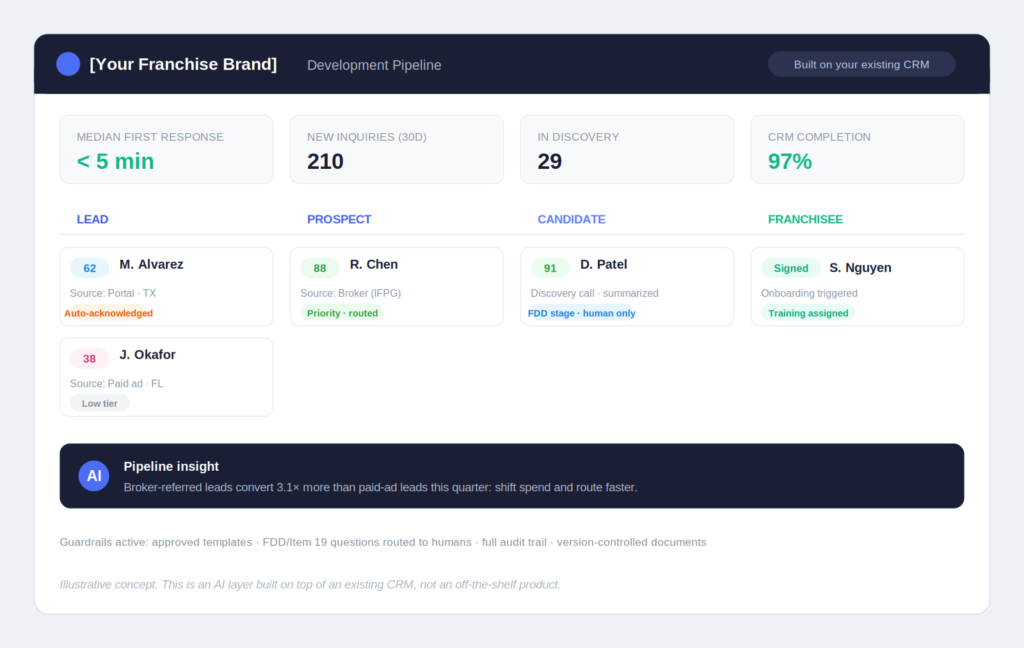
Figure 2: AI-Assisted CRM Pipeline. Concept illustration of an AI-assisted CRM layer showing lead scoring, candidate status, and pipeline movement. Systems like this are built on top of a franchisor’s existing CRM; they are not an off-the-shelf product.
Picture a 60-unit home services franchisor. It averages 210 portal inquiries per month. Two development reps handle them. The team runs a CRM, but they call it “a suggestion.” Median first response takes 6 hours. Nine percent of inquiries reach a discovery call. Each rep loses about 11 hours a week to triage, logging, and follow-up admin.
We automate three tasks and leave two alone. We automate instant scored acknowledgment on every inquiry. We automate behavioral lead scoring with tiered routing. We automate call-summary-to-CRM extraction with rep review. We keep two tasks human: final qualification decisions, and every conversation that touches the FDD, Item 19, financial expectations, or territory commitments.
| Metric | Before | After 90 Days |
|---|---|---|
| Median first response time | 6 hours | Under 5 minutes |
| Inquiry-to-discovery-call rate | 9% | 14% (roughly 55% more candidates in discovery) |
| Rep admin time | ~11 hrs/week per rep | ~3 hrs/week per rep (~16 hrs/week recovered across the team) |
| CRM records | Inconsistent | Standardized summaries and field updates |
| Candidate messaging | Rep-dependent | Approved message framework |
| Headcount | 2 reps | 2 reps |
Speed is not the number that matters most here. Consistency is. Both reps now say the same things. They use the same next steps. Leadership sees a clean view of the pipeline. That is where AI earns its place in franchise development. AI does not replace the sales team. AI gives the sales team a better operating system.
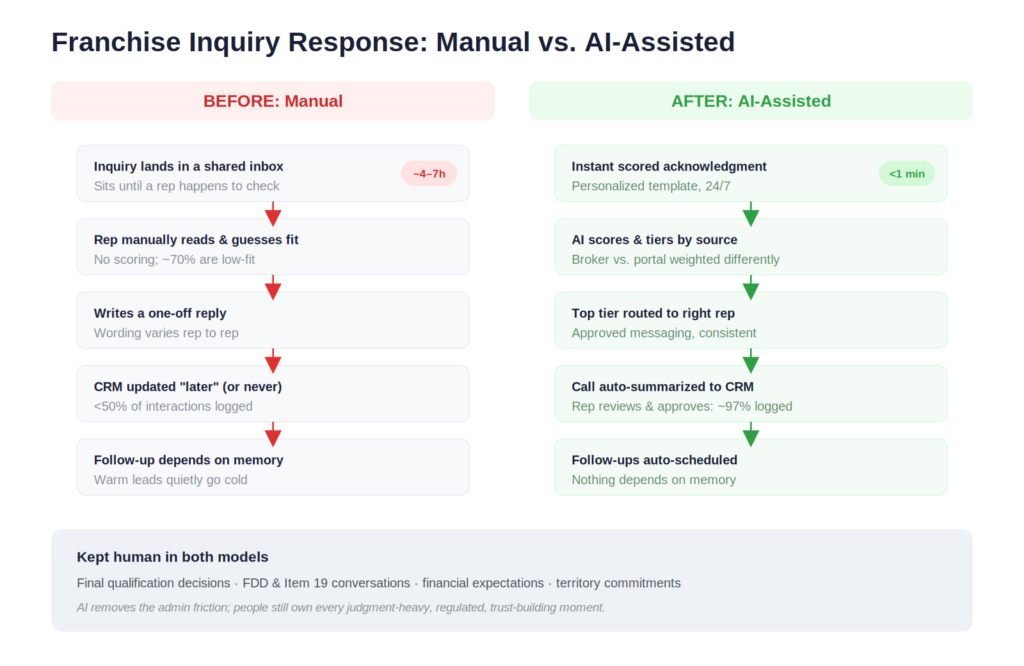
Figure 3: Before / After Response Workflow. Comparison of a manual franchise inquiry workflow versus an AI-assisted one.
Franchise AI Readiness Scorecard
Not every franchisor needs AI lead scoring today. Give yourself 1 point for every “yes.”
| Question | Yes / No |
|---|---|
| Do you receive 50+ franchise inquiries per month? | |
| Is your median first response time over 1 hour? | |
| Are less than 80% of candidate interactions logged in your CRM? | |
| Do reps manually write most follow-up emails? | |
| Do candidates ask the same questions repeatedly across reps? | |
| Do reps answer fee, territory, or FDD-related questions inconsistently? | |
| Do you lack clear reporting on why candidates drop off? | |
| Do you have multiple lead sources feeding into different systems? | |
| Does your team spend 5+ hours/week per rep on CRM updates or admin work? | |
| Are you planning to grow into new markets in the next 12 months? |
| Score | What It Means | Recommended Next Step |
|---|---|---|
| 0–2 | You may not need AI yet | Fix basic process, response time, and CRM discipline first |
| 3–5 | Ready for light automation | Start with instant response, CRM hygiene, and approved follow-ups |
| 6–8 | AI can create real leverage | Add lead scoring, routing, call summaries, and reporting |
| 9–10 | Ready for a full AI layer | Build a connected franchise development automation system |
The scorecard stays practical on purpose. AI should follow operational pain, not hype.
What to Automate First
Start with high-volume, low-risk tasks. We use this priority order in franchise AI audits:
| Task | Volume | Compliance Risk | Verdict |
|---|---|---|---|
| Initial inquiry acknowledgment | High | Low | Automate day one |
| Lead source tagging | High | Low | Automate day one |
| Lead scoring and routing | High | Low | Automate early if 50+ inquiries/month |
| CRM updates from calls/emails | High | Low | Automate with rep review |
| Follow-up reminders | Medium | Low | Automate early |
| Follow-up email sequences | Medium | Medium | Automate with approved templates only |
| Internal Q&A for reps | Medium | Low/Medium | Automate once docs are clean |
| Pipeline reporting | Medium | Low | Automate once CRM fields are reliable |
| Onboarding task assignment | Medium | Low | Automate after signing |
| FDD-related communication | Low | High | Keep human, always |
| Financial performance conversations | Low | High | Keep human, always |
| Final qualification decisions | Low | High | Keep human, always |
| Territory commitments | Low | High | Keep human, always |
The pattern is simple. Automate speed, organization, routing, and reporting. Keep people in charge of judgment, legal, financial, and trust-heavy conversations. A structured AI cost-saving audit maps this table onto your own mix of volume, risk, and CRM maturity.
A 30/60/90-Day Rollout Plan
Many teams try to automate the entire process at once. That is a mistake. A better approach builds in layers.
Days 1–30 cover audit and guardrails. Map every lead source, form, inbox, CRM field, and follow-up path. Baseline your metrics: response time, discovery-call rate, CRM completion, and drop-off points. A baseline lets you prove the automation worked. Define what AI can and cannot say about the FDD, Item 19, fees, and territories. Get your first-response and follow-up templates approved. Clean up duplicate CRM records and inconsistent lead stages. Assign clear ownership for approvals and exceptions. By day 30, you know where automation pays back fastest and where it should not touch anything yet.
Days 31–60 build the first automation layer. This layer handles low-risk, high-volume work. It covers instant inquiry acknowledgment, lead source tagging, basic scoring, and rep routing. It adds follow-up reminders and automated CRM activity capture. It ships a first dashboard for response time and pipeline movement. Most teams see their first measurable wins here.
Days 61–90 make the system smarter. Behavioral scoring replaces reliance on form fields. Call summaries feed structured CRM notes. An internal knowledge assistant answers rep questions. Drop-off reporting exposes weak stages. A compliance review loop catches risky messages before they become habits. A weekly leadership report closes the loop. The goal by day 90 is not a perfect AI system. The goal is a faster, safer, and more consistent process.
A Simple Architecture (Without Rebuilding Your Stack)
You do not need to replace your tech stack. Most franchisors need a connected layer around the tools they already run.
The inputs already exist in your business. You have lead sources such as portals, ads, referrals, and events. You have a CRM such as HubSpot, Salesforce, Zoho, or FranConnect. You have communication channels such as email, SMS, and call recordings. You have documents such as the FDD, territory maps, and playbooks. You also have calendars and marketing data.
The AI layer sits on top. It enriches and scores leads. It routes candidates. It drafts approved messages. It summarizes calls into CRM notes. It answers rep questions from approved documents. It finds patterns in drop-off and conversion.
Most teams skip the guardrail layer. In franchise development, that layer is not optional. Approved templates block risky free-form claims. Restricted topics stop the AI from answering FDD or Item 19 questions without review. Human approval keeps reps in control. An audit trail records what was sent and when. Version control keeps the AI on the latest FDD. Escalation rules route sensitive questions to a person. Guardrails separate useful automation from unnecessary risk.
The Part Most AI Vendors Won’t Tell You: Compliance
Regulators govern franchise sales. Under the FTC Franchise Rule (16 C.F.R. Part 436), the franchisor must deliver the FDD at least 14 calendar days before a prospect signs or pays. The rule also limits financial performance representations to what Item 19 discloses.
This rule creates a real AI risk. A general-purpose AI tool can write “most of our owners recoup their investment in 18 months.” That single sentence becomes an earnings claim your legal team never approved.
Ask these questions before any AI system talks to candidates. Can it make financial or performance claims, or does the system block that? Does every outbound template pass legal or brand approval? Does the system keep a full audit trail of every message? Does automation pause during the FDD review stage? Can it flag questions that need human review? Who owns the fix when the system sends something wrong? How fast can you pull a message?
Not legal advice. Franchise counsel should review any AI workflow that touches candidate communication, FDD conversations, financial performance, or franchise agreements. The implementation rule is simple: never let AI improvise in regulated parts of franchise sales.
Safe vs. unsafe AI use in practice
| Area | Safer AI Use | Risky AI Use |
|---|---|---|
| Initial response | Approved “we received your inquiry” message with next steps | Promising success, ROI, or fast payback |
| Lead scoring | Prioritizing leads for human review | Rejecting candidates automatically |
| FDD questions | Routing to a rep or legal-reviewed response | Summarizing FDD obligations freely |
| Financial expectations | Pointing candidates to the approved Item 19 process | Saying “owners usually earn X” |
| Territory questions | Flagging territory interest for rep review | Promising availability or exclusivity |
| Follow-up emails | Approved templates with limited personalization | Custom persuasive claims without review |
| CRM notes | Drafting notes for rep approval | Saving high-stakes fields without review |
| Internal Q&A | Answering from current approved documents | Using outdated FDDs or old sales decks |
| Onboarding | Assigning training tasks after signing | Interpreting legal or contractual terms |
The Mistakes Franchise Development Teams Should Avoid
A bad AI rollout rarely fails because the model is weak. It fails because the process around it is weak.
Automating before fixing the funnel. Messy lead stages and different definitions of “qualified” only speed up the mess. Fix the process first. Then automate.
Treating all lead sources the same. A portal lead, a broker referral, a paid ad click, and an expo scan behave differently. Broker-referred candidates arrive pre-screened and time-sensitive. Score by source, or you optimize for volume over fit.
Letting AI make qualification decisions. AI ranks and organizes. People decide who qualifies to buy a franchise.
Letting AI free-write candidate emails. Free-form emails are the fastest route to compliance risk. Use approved templates, restricted language, and clear review rules.
Training AI on outdated documents. An assistant that runs on last year’s FDD or an old territory map gives confident wrong answers. Wrong answers are worse than no answers.
Measuring only speed. Track more than response time. Measure discovery-call rate, qualified candidate rate, show rate, CRM completion, drop-off by stage, and compliance exceptions. A faster bad process is still a bad process.
Ignoring rep adoption. Reps who distrust the system work around it. Involve them early. Let them review AI summaries. Show them how scoring works. Make the tool useful enough that they want it.
Questions to Ask Before Buying Franchise AI Tools
A good demo is not enough. Ask these questions before you hire a vendor or buy a tool:
- Can the system structurally block financial performance claims?
- Can every automated message be approved before launch, and can we pause or pull one quickly?
- Does it keep a full audit trail of what was sent, when, and to whom?
- Can automation pause or change behavior during FDD review stages?
- Does it integrate with our existing CRM, or is it another disconnected system?
- Can we see how lead scores are calculated, and can different sources be scored differently?
- Can it route sensitive questions to humans instead of answering them?
- Does it support version control so it never answers from an outdated FDD?
- Who owns prompt updates and workflow changes, and what happens when the system is wrong?
- Can we export reports and audit logs for leadership and compliance review?
A vendor who cannot answer these questions is not ready for franchise development. The demo does not matter.
Beyond Sales: What the Same AI Layer Does for the Rest of the Business
Better franchise development is the first win. The value then compounds. Once the data, workflows, and guardrails exist, the same layer improves brand consistency. Every candidate gets the same approved next steps. Every internal answer comes from one source of truth. The layer supports faster expansion without more headcount. It also cleans up the sales-to-operations handoff. It triggers onboarding, training, and launch checklists the moment a candidate signs.
It also fixes the marketing feedback loop. Accurate lead-source tracking lets marketing target qualified candidates instead of cheap inquiries. That focus improves portal spend, paid campaigns, and location-level advertising. Leadership gains real visibility too: pipeline health, rep follow-up speed, territory demand, and drop-off. That view replaces a patchwork of private rep notes.
What Humans Should Still Own
People keep the judgment-heavy work: final qualification, discovery calls, FDD conversations, financial performance discussions, territory negotiations, franchisee validation, final approval, and conflict handling. These parts are regulated and trust-building. They stay human-led.
The best AI systems make reps more present, not less. They remove the admin work. Reps then spend more time in the conversations that move a candidate forward.
FAQ: AI in Franchise Development
What is franchise development?
Franchise development is the process a franchisor uses to attract, qualify, sell, and onboard new franchisees. It includes lead generation, candidate qualification, discovery calls, FDD review, franchise sales, territory planning, signing, and onboarding.
How can AI help franchise development teams?
AI helps with lead scoring, instant inquiry response, follow-up reminders, CRM updates, call summaries, internal knowledge search, onboarding workflows, and pipeline reporting. The biggest gains are faster response time, cleaner data, and more consistent candidate communication.
Can AI qualify franchise leads?
AI can prioritize and score franchise leads. AI should not make the final qualification decision. A human reviews candidate fit, financial readiness, experience, territory interest, and brand alignment.
Should AI communicate directly with franchise candidates?
AI can support candidate communication with approved templates, limited personalization, and clear guardrails. AI should not free-write messages about earnings, Item 19, territory commitments, FDD interpretation, or financial expectations.
What franchise development tasks should not be automated?
Do not fully automate FDD conversations, financial performance discussions, final qualification decisions, territory commitments, legal questions, or final franchisee approval. AI can support these workflows. Humans stay in control.
When is a franchisor too small for AI lead scoring?
A franchisor with fewer than roughly 50 inquiries per month may not need full AI lead scoring yet. At that stage, better response time, CRM discipline, and follow-up create stronger ROI.
How are broker-referred franchise leads different from portal leads?
Broker and consultant networks such as IFPG or FranNet send pre-screened, financially verified candidates. These candidates often evaluate several brands at once. They need faster human contact and lighter automation than cold portal leads. Scoring models should treat the two sources differently.
What CRM data is needed before using AI?
You need clean lead-source data, candidate stage, territory interest, contact history, follow-up status, discovery-call notes, qualification criteria, and outcome tracking. AI performs poorly on incomplete or inconsistent data.
How do franchisors reduce AI compliance risk?
Franchisors use approved templates, block restricted topics, keep an audit trail, and require human approval for sensitive messages. They train AI only on current approved documents. They ask franchise counsel to review any workflow that touches the FDD, Item 19, financial performance, or franchise agreements.
What is the best first AI automation for franchise development?
Start with instant inquiry acknowledgment, lead source tagging, and rep routing. This automation carries low risk, measures easily, and improves speed-to-lead.
The Bottom Line
A serious candidate does not choose a franchise because of an impressive autoresponder. They choose because they trust the brand, the model, the people, and the process. AI removes the friction that blocks that trust: the 4-hour response gaps, the missing CRM records, the memory-based follow-ups, and the messaging that drifts as the business grows into a true multi-location operation.
Start small and start at the top of the funnel. Measure your current response time. Count the candidate interactions missing from your CRM. Automate the low-risk, high-volume work first. Keep humans in charge of qualification, FDD conversations, financial expectations, and every final decision. AI works best as an operating layer, not a replacement. It lets your team spend more time with the candidates worth pursuing.
Want to know which automation pays back fastest in your pipeline? Our franchise AI audit answers exactly that.