Cracks are starting to form on fusion energy’s funding boom


It happens in every emerging industry: founders and investors push toward a common goal, until the money starts to roll in and that shared vision begins to diverge.

Cracks are emerging in the fusion power world, which I saw firsthand at The Economist’s Fusion Fest in London last week. It didn’t dampen the overall buoyant mood, lifted by fusion startups’ fundraising haul of $1.6 billion in the last 12 months. But people had differing opinions on two key questions: When should fusion startups go public? And are side businesses a distraction?

Going public was at the top of everyone’s minds. In the last four months, TAE Technologies and General Fusion have announced plans to merge with publicly traded companies. Both stand to receive hundreds of millions of dollars to keep their R&D efforts alive, and investors, some of whom have kept the faith for 20 years, finally see an opportunity to cash out.

Not everyone is in agreement. Most of those who I spoke to were worried these companies were going public far too early and that they hadn’t achieved key milestones that many view as vital in judging the progress of a fusion company.

First, a recap: TAE announced its merger with Trump Media & Technology Group in December. Though the deal isn’t yet completed, the fusion side of the business has already received $200 million of a potential $300 million in cash from the deal, giving it some runway to continue planning its power plant. (The remainder will reportedly land in its bank account once it files the S-4 form with the U.S. Securities and Exchange Commission.)

General Fusion said in January that it would go public via a reverse merger with a special purpose acquisition company. The deal could net the company $335 million and value the combined entity at $1 billion. 

Both companies could use the cash.

Techcrunch event

San Francisco, CA
|
October 13-15, 2026

Before the merger announcement, General Fusion was struggling to raise funds, and around this time last year it laid off 25% of its staff as CEO Greg Twinney posted a public letter pleading for investment. It received a brief reprieve in August when investors threw it a $22 million lifeline, but that sort of money doesn’t last long in the fusion world, where equipment, experiments, and employees don’t come cheap.

TAE’s position wasn’t quite as dire, but it still required some funds. Pre-merger, the company raised nearly $2 billion, which sounds like a lot, but keep in mind the company is nearly 30 years old. What’s more, its valuation pre-merger was $2 billion, according to PitchBook. Investors were breaking even at best.

Neither company has hit scientific breakeven, a key milestone that shows a reactor design has power plant potential. Many observers doubt they’ll hit that mark before other privately held startups do. One executive told me, if they were in those shoes, they’re not sure how they would fill time on quarterly earnings calls if the companies didn’t hit scientific breakeven soon.

If TAE or General Fusion doesn’t deliver results, several people feared the public markets would sour on the entire fusion industry.

Now, not all may be lost. TAE has already started marketing other products, including power electronics and radiation therapy for cancer. That could give the company some near-term revenue to placate shareholders. General Fusion, though, hasn’t revealed any such plans.

And therein lies another divide: fusion companies remain split on whether they should pursue revenue now or wait until they have a working power plant.

Some companies are embracing the opportunity to make money along the way. Not a bad strategy! Fusion is a long game, so why not improve your odds? Both Commonwealth Fusion Systems and Tokamak Energy have said they’ll be selling magnets. TAE and Shine Technologies are both in nuclear medicine.

Other startups are worried that side hustles could become a distraction. Inertia Enterprises, for example, told me that they’re laser-focused on their power plant. That jibes with what another investor told me months ago: — they were worried that fusion startups could get distracted by profitable, but tangential businesses and fall off the lead. 

There wasn’t consensus on the right time to go public either. I heard a few proposed milestones. Some believe startups should first reach that scientific breakeven milestone, in which a fusion reaction generates more energy than it needs to ignite. No startup has achieved that yet. The other possibilities are facility breakeven — when the reactor makes more energy than the entire site needs to operate — and commercial viability — when a reactor makes enough electrons to sell a meaningful amount to the grid.

We may have an answer to that question sooner than later. Commonwealth Fusion Systems expects it will hit scientific breakeven sometime next year, and some think the company might use that as an opportunity to go public.

Fusion startup Helion hits blistering temps as it races toward 2028 deadline


The Everett, Washington-based fusion energy startup Helion announced Friday that it has hit a key milestone in its quest for fusion power. Plasmas inside the company’s Polaris prototype reactor have reached 150 million degrees Celsius, three-quarters of the way toward what the company thinks it will need to operate a commercial fusion power plant.

“We’re obviously really excited to be able to get to this place,” David Kirtley, Helion’s co-founder and CEO, told TechCrunch.

Polaris is also operating using deuterium-tritium fuel — a mixture of two hydrogen isotopes — which Kirtley said makes Helion the first fusion company to do so. “We were able to see the fusion power output increase dramatically as expected in the form of heat,” he said.

The startup is locked in a race with several other companies that are seeking to commercialize fusion power, potentially unlimited source of clean energy.

That potential has investors rushing to bet on the technology. This week, Inertia Enterprises announced a $450 million Series A round that included Bessemer and GV. In January, Type One Energy told TechCrunch it was in the midst of raising $250 million, while last summer Commonwealth Fusion Systems raised $863 million from investors including Google and Nvidia. Helion itself raised $425 million last year from a group that included Sam Altman, Mithril, Lightspeed, and SoftBank.

While most other fusion startups are targeting the early 2030s to put electricity on the grid, Helion has a contract with Microsoft to sell it electricity starting in 2028, though that power would come from a larger commercial reactor called Orion that the company is currently building, not Polaris.

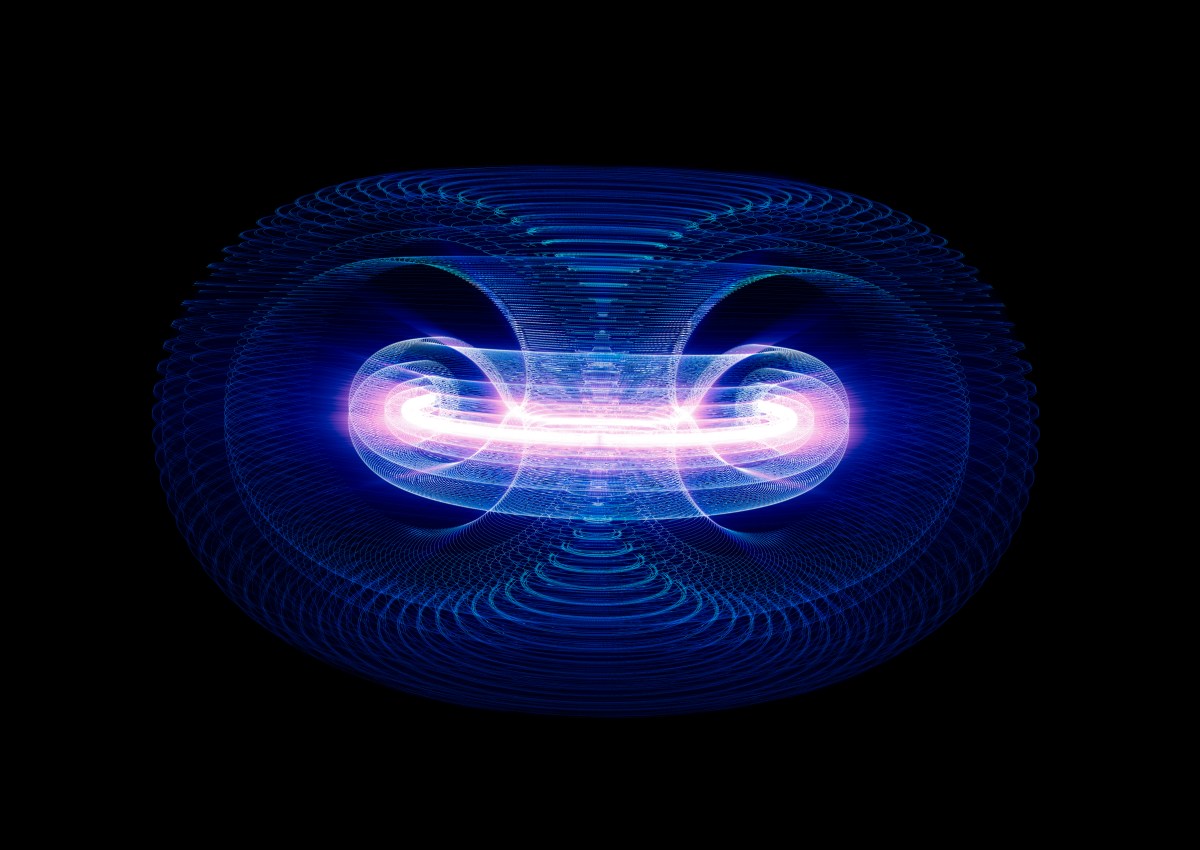
Every fusion startup has its own milestones based on the design of its reactor. Commonwealth Fusion Systems, for example, needs to heat its plasmas to more than 100 million degrees C inside of its tokamak, a doughnut-shaped device that uses powerful magnets to contain the plasma.

Techcrunch event

Boston, MA
|
June 23, 2026

Helion’s reactor is different, needing plasmas that are about twice as hot to function as intended. 

The company’s reactor design is what’s called a field-reversed configuration. The inside chamber looks like an hourglass, and at the wide ends, fuel gets injected and turned into plasmas. Magnets then accelerate the plasmas toward each other. When they first merge, they’re around 10 million to 20 million degrees C. Powerful magnets then compress the merged ball further, raising the temperature to 150 million degrees C. It all happens in less than a millisecond.

Instead of extracting energy from the fusion reactions in the form of heat, Helion uses the fusion reaction’s own magnetic field to generate electricity. Each pulse will push back against the reactor’s own magnets, inducing electrical current that can be harvested. By harvesting electricity directly from the fusion reactions, the company hopes to be more efficient than its competitors.

Over the last year, Kirtley said that Helion had refined some of the circuits in the reactor to boost how much electricity they recover.

While the company uses deuterium-tritium fuel today, down the road it plans to use deuterium-helium-3. Most fusion companies plan to use deuterium-tritium and extract energy as heat. Helion’s fuel choice, deuterium-helium-3, produces more charged particles, which push forcefully against the magnetic fields that confine the plasma, making it better suited for Helion’s approach of generating electricity directly.

Helion’s ultimate goal is to produce plasmas that hit 200 million degrees C, far higher than other companies’ targets, a function of its reactor design and fuel choice. “We believe that at 200 million degrees, that’s where you get into that optimal sweet spot of where you want to operate a power plant,” Kirtley said.

When asked whether Helion had reached scientific breakeven — the point where a fusion reaction generates more energy than it requires to start it — Kirtley demurred. “We focus on the electricity piece, making electricity, rather than the pure scientific milestones.”

Helium-3 is common on the Moon, but not here on Earth, so Helion must make its own fuel. To start, it’ll fuse deuterium nuclei to produce the first batches. In regular operation, while the main source of power will be deuterium-helium-3 fusion, some of the reactions will still be deuterium-on-deuterium, which will produce helium-3 that the company will purify and reuse.

Work is already underway to refine the fuel cycle. “It’s been a pleasant surprise in that a lot of that technology has been easier to do than maybe we expected,” Kirtley said. Helion has been able to produce helium-3 “at very high efficiencies in terms of both throughput and purity,” he added.

While Helion is currently the only fusion startup using helium-3 in its fuel, Kirtley said he thinks other companies will in the future, hinting that he’d be open to selling it to them. “Other folks — as they come along and recognize that they want to do this approach of direct electricity recovery and see the efficiency gains from it — will want to be using helium-3 fuel as well,” he said.

Alongside its experiments with Polaris, Helion is also building Orion, a 50-megawatt fusion reactor it needs to fulfill its Microsoft contract “Our ultimate goal is not to build and deliver Polaris,” Kirtley said. “That’s a step along the way towards scaled power plants.”

Struggling fusion power company General Fusion to go public via $1B reverse merger


Last year, fusion power startup General Fusion was struggling to raise funds, laying off at least 25% of its staff before receiving a $22 million lifeline investment while it figured out how to keep the company afloat.

Today, General Fusion revealed its survival plan: it will go public through a reverse merger with an special purpose acquisition company, Spring Valley III, combined with additional investment from institutional investors. It’s a significant change in fortunes for a company whose CEO wrote a public letter just last year pleading for funding.

If the deal closes as planned, General Fusion could receive up to $335 million from the transaction, more than double what it was reportedly seeking to raise last year before it landed the $22 million lifeline.

The transaction will value the combined company at about $1 billion, General Fusion said. Before the merger was announced. The fusion startup, which was founded in 2002, had previously raised over $440 million, according to PitchBook.

General Fusion plans to use the money to complete its demonstration reactor, Lawson Machine 26 (LM26). The device uses an approach called “inertial confinement,” which works by compressing a fuel pellet until its atoms fuse together, releasing energy in the process. The National Ignition Facility used inertial confinement in its successful fusion experiments, using lasers to bombard the fuel pellets to unleash the compressive force.

LM26 eschews the lasers, though. Instead, it uses steam-driven pistons that drive a wall of liquid lithium metal inward to compress the fuel pellet. That liquid lithium then circulates through a heat exchanger, which generates steam to spin a generator. By avoiding expensive lasers or superconducting magnets, which are required in other fusion reactor designs, General Fusion hopes to build a fusion power plant for less money. But first the company has to prove its approach is viable.

Last year, before it revealed its financial problems, General Fusion said that in 2026, LM26 would hit scientific breakeven, in which a fusion reaction generates more power than was required to start it. Scientific breakeven is a key milestone, though distinct from and easier to attain than commercial breakeven, in which fusion reactions release enough energy to export electricity to the grid. General Fusion did not reply to a request asking if its timeline had change.

Techcrunch event

San Francisco
|
October 13-15, 2026

The acquisition company, Spring Valley, is something of a specialist in reverser mergers with energy companies. It previously took NuScale Power, a small modular nuclear reactor company, public in a deal whose stock price has since fallen more than 50% from its peak last year. The firm is also in the midst of completing a merger with Eagle Energy Metals, a uranium mining company that’s also supposedly developing its own SMR.

General Fusion isn’t the first fusion company to go public. In December, TAE Technologies announced it would merge with Trump Media & Technology Group in a deal valuing the combined company at more than $6 billion.

The common thread connecting these deals is data centers, of course. They’re expected to consume nearly 300% more power by 2035, according to BloombergNEF, and General Fusion explicitly points to rising data center energy demand in its merger announcement

But the company also pointed to broader electrification trends, including EVs and electric heating, that could increase overall electricity demand by up to 50% by 2035. It’s a reminder that, while the Trump administration has cast doubts on an electrified future, other countries are charging ahead. While General Fusion may face technological challenges, trends in the energy world suggest that if it can deliver fusion power at a reasonable cost, it will find plenty of willing buyers.

Every fusion startup that has raised over $100M


Over the last several years, fusion power has gone from the butt of jokes — always a decade away! — to an increasingly tangible and tantalizing technology that has drawn investors off the sidelines.

The technology may be challenging to master and expensive to build today, but fusion promises to harness the nuclear reaction that powers the sun to generate nearly limitless energy here on Earth. If startups are able to complete commercially viable fusion power plants, then they have the potential to upend trillion-dollar markets.

The bullish wave buoying the fusion industry has been driven by three advances: more powerful computer chips, more sophisticated AI, and powerful high-temperature superconducting magnets. Together, they have helped deliver more sophisticated reactor designs, better simulations, and more complex control schemes.

It doesn’t hurt that, at the end of 2022, a U.S. Department of Energy lab announced that it had produced a controlled fusion reaction that produced more power than the lasers had imparted to the fuel pellet. The experiment had crossed what’s known as scientific breakeven, and while it’s still a long ways from commercial breakeven, where the reaction produces more than the entire facility consumes, it was a long-awaited step that proved the underlying science was sound.

Founders have built on that momentum in recent years, pushing the private fusion industry forward at a rapid pace.

Commonwealth Fusion Systems

Commonwealth Fusion Systems (CFS) has raised about a third of all private capital invested in fusion companies to date. Its latest round, which closed in August, added $863 million to its coffers, bringing its total raised near $3 billion.

CFS’s Series B2 came four years after its $1.8 billion Series B, which helped catapult the company into the pole position. Since then, the startup has been hard at work in Massachusetts building Sparc, its first-of-a-kind power plant intended to produce power at what it calls “commercially relevant” levels. 

Techcrunch event

San Francisco
|
October 27-29, 2025

Sparc’s reactor is a tokamak design, which resembles a doughnut. The D-shaped cross section is wound with high-temperature superconducting tape, which, when energized, generates a powerful magnetic field that will contain and compress the superheated plasma. Heat generated from the reaction is converted to steam to power a turbine. CFS designed its magnets in collaboration with MIT, where co-founder and CEO Bob Mumgaard worked as a researcher on fusion reactor designs and high-temperature superconductors.

The Massachusetts-based CFS expects to have Sparc operational in late 2026 or early 2027. Later this decade, the company says it will begin construction on Arc, its commercial power plant that will produce 400 megawatts of electricity. The facility will be built near Richmond, Virginia, and Google has agreed to buy half its output.

CFS is backed by a long list of investors, including Breakthrough Energy Ventures, The Engine, Bill Gates, and others.

TAE

Founded in 1998, TAE Technologies (formerly known as Tri Alpha Energy) was spun out of the University of California, Irvine by Norman Rostoker. It uses a field-reversed configuration, but with a twist: after the two plasma shots collide in the middle of the reactor, the company bombards the plasma with particle beams to keep it spinning in a cigar shape. That improves the stability of the plasma, allowing more time for fusion to occur and for more heat to be extracted to spin a turbine. 

The company raised $150 million in June from existing investors, including Google, Chevron, and New Enterprise. TAE has raised $1.79 billion in total, according to PitchBook.

Helion

Of all fusion startups, Helion has the most aggressive timeline. The company plans to produce electricity from its reactor in 2028. Its first customer? Microsoft.

Helion, based in Everett, Washington, uses a type of reactor called a field-reversed configuration, where magnets surround a reaction chamber that looks like an hourglass with a bulge at the point where the two sides come together. At each end of the hourglass, they spin the plasma into doughnut shapes that are shot toward each other at more than 1 million mph. When they collide in the middle, additional magnets help induce fusion. When fusion occurs, it boosts the plasma’s own magnetic field, which induces an electrical current inside the reactor’s magnetic coils. That electricity is then harvested directly from the machine.

The company raised $425 million in January 2025, around the same time that it turned on Polaris, a prototype reactor. Helion has raised $1.03 billion, according to PitchBook. Investors include Sam Altman, Reid Hoffman, KKR, BlackRock, Peter Thiel’s Mithril Capital Management, and Capricorn Investment Group.

Pacific Fusion

Pacific Fusion burst out of the gate with a $900 million Series A, a whopping sum even among well-funded fusion startups. The company will use inertial confinement to achieve fusion, but instead of lasers compressing the fuel, it will use coordinated electromagnetic pulses. The trick is in the timing: All 156 impedance-matched Marx generators need to produce 2 terawatts for 100 nanoseconds, and those pulses need to simultaneously converge on the target.

The company is led by CEO Eric Lander, the scientist who led the Human Genome Project, and president Will Regan. Pacific Fusion’s funding might be massive, but the startup hasn’t gotten it all at once. Rather, its investors will pay out in tranches when the company achieves specified milestones, an approach that’s common in biotech.

Shine Technologies

Shine Technologies is taking a cautious — and possibly pragmatic — approach to generating fusion power. Selling electrons from a fusion power plant is years off, so instead, it’s starting by selling neutron testing and medical isotopes. More recently, it has been developing a way to recycle radioactive waste. Shine hasn’t picked an approach for a future fusion reactor, instead saying that it’s developing necessary skills for when that time comes.

The company has raised a total of $778 million, according to PitchBook. Investors include Energy Ventures Group, Koch Disruptive Technologies, Nucleation Capital, and the Wisconsin Alumni Research Foundation.

General Fusion

Now its third decade, General Fusion has raised $462.53 million, according to PitchBook. The Richmond, British Columbia-based company was founded in 2002 by physicist Michel Laberge, who wanted to prove a different approach to fusion known as magnetized target fusion (MTF). Investors include Jeff Bezos, Temasek, BDC Capital, and Chrysalix Venture Capital.

In General Fusion’s reactor, a liquid metal wall surrounds a chamber in which plasma is injected. Pistons surrounding the wall push it inward, compressing the plasma inside and sparking a fusion reaction. The resulting neutrons heat the liquid metal, which can be circulated through a heat exchanger to generate steam to spin a turbine.

General Fusion hit a rough patch in spring 2025. The company ran short of cash as it was building LM26, its latest device that it hoped would hit breakeven in 2026. Just days after hitting a key milestone, it laid off 25% of its staff. CEO Greg Twinney penned an open letter pleading for funding from investors. 

In August, they delivered somewhat, injecting $22 million in an pay-to-play round that one investor called “the least amount of capital possible” to keep the General Fusion afloat.

Tokamak Energy

Tokamak Energy takes the usual tokamak design — the doughnut shape — and squeezes it, reducing its aspect ratio to the point where the outer bounds start resembling a sphere. Like many other tokamak-based startups, the company uses high-temperature superconducting magnets (of the rare earth barium copper oxide, or REBCO, variety). Since its design is more compact than a traditional tokamak, it requires less in the way of magnets, which should reduce costs. 

The Oxfordshire, U.K.-based startup’s ST40 prototype, which looks like a large, steampunk Fabergé egg, generated an ultra-hot, 100 million degree C plasma in 2022. Its next generation, Demo 4, is currently under construction and is intended to test the company’s magnets in “fusion power plant-relevant scenarios.” Tokamak Energy raised $125 million in November 2024 to continue its reactor design efforts and expand its magnet business.

In total, the company has raised $336 million from investors including Future Planet Capital, In-Q-Tel, Midven, and Capri-Sun founder Hans-Peter Wild, according to PitchBook.

Zap Energy

Zap Energy isn’t using high-temperature superconducting magnets or super-powerful lasers to keep its plasma confined. Rather, it zaps the plasma (get it?) with an electric current, which then generates its own magnetic field. The magnetic field compresses the plasma about 1 millimeter, at which point ignition occurs. The neutrons released by the fusion reaction bombard a liquid metal blanket that surrounds the reactor, heating it up. The liquid metal is then cycled through a heat exchanger, where it produces steam to drive a turbine.

Like Helion, Zap Energy is based in Everett, Washington, and the company has raised $327 million, according to PitchBook. Backers include Bill Gates’ Breakthrough Energy Ventures, DCVC, Lowercarbon, Energy Impact Partners, Chevron Technology Ventures, and Bill Gates as an angel.

Proxima Fusion

Most investors have favored large startups that are pursuing tokamak designs or some flavor of inertial confinement. But stellarators have shown great promise in scientific experiments, including the Wendelstein 7-X reactor in Germany.

Proxima Fusion is bucking the trend, though, having attracted a €130 million Series A that brings its total raised to more than €185 million. Investors include Balderton Capital and Cherry Ventures.

Stellarators are similar to tokamaks in that they confine plasma in a ring-like shape using powerful magnets. But they do it with a twist — literally. Rather than force plasma into a human-designed ring, stellarators twist and bulge to accommodate the plasma’s quirks. The result should be a plasma that remains stable for longer, increasing the chances of fusion reactions.

Marvel Fusion

Marvel Fusion follows the inertial confinement approach, the same basic technique that the National Ignition Facility used to prove that controlled nuclear fusion reactions could produce more power than was needed to kick them off. Marvel fires powerful lasers at a target embedded with silicon nanostructures that cascade under the bombardment, compressing the fuel to the point of ignition. Because the target is made using silicon, it should be relatively simple to manufacture, leaning on the semiconductor manufacturing industry’s decades of experience.

The inertial confinement fusion startup is building a demonstration facility in collaboration with Colorado State University, which it expects to have operational by 2027. Munich-based Marvel has raised a total of $161 million from investors including b2venture, Deutsche Telekom, Earlybird, HV Capital, and Taavet Hinrikus and Albert Wenger as angels.

First Light

First Light dropped its pursuit of fusion power in March 2025, pivoting instead to become a technology supplier to fusion startups and other companies. The startup had previously followed an approach known as inertial confinement, in which fusion fuel pellets are compressed until they ignite. 

First Light, which is based in Oxfordshire, U.K., has raised $140 million, according to PitchBook, from investors including Invesco, IP Group, and Tencent.

Xcimer

Though nothing about fusion can be described as simple, Xcimer takes a relatively straightforward approach: follow the basic science that’s behind the National Ignition Facility’s breakthrough net-positive experiment, and redesign the technology that underpins it from the ground up. The Colorado-based startup is aiming for a 10-megajoule laser system, five times more powerful than NIF’s setup that made history. Molten salt walls surround the reaction chamber, absorbing heat and protecting the first solid wall from damage.

Founded in January 2022, Xcimer has already raised $109 million, according to PitchBook, from investors including Hedosophia, Breakthrough Energy Ventures, Emerson Collective, Gigascale Capital, and Lowercarbon Capital.

This story was originally published in September 2024 and will be continually updated.