Every multi-location business leaks money in the same places. A one-star review sits unanswered at store 14 for a week. A caller hangs up after six rings at your busiest location and books with a competitor. A web lead lands in a shared inbox on Friday and gets a call back on Tuesday. HQ launches a promotion, and three weeks later nobody can say for certain which locations actually ran it.
None of these are strategy problems. They are handoff problems: the work falls into the gap between headquarters and the front line, and that gap widens with every location you add. This is where AI automation for multi-location businesses earns its place. The goal isn’t another chatbot. It’s connecting the inputs every location already produces (reviews, calls, lead forms, manager requests) to a defined action, a human approval step, and an outcome HQ can see.
Franchisor or multi-unit operator? The two feel these leaks differently. A franchisor’s risk is losing revenue and reputation through franchisees it doesn’t directly control. A multi-unit operator’s risk is distance: too many locations to see clearly from one office. Each workflow below is tagged with the audience it serves best.
1. Respond to Every Review Within Hours, Not Days
Best for: Franchisors and multi-unit operators
The leak: Reviews pile up across dozens of profiles, and the ones that most need a reply (the angry ones) are the ones managers put off. An unanswered one-star review keeps costing that location customers long after the underlying problem was fixed.
The fix: AI pulls reviews from every location into one queue, scores sentiment, and drafts a reply in your brand voice that references the specific visit. Positive reviews can go out with light-touch approval; anything negative or legally sensitive routes to the location manager before it posts.
Reviews now shape the decision before anyone calls. BrightLocal’s 2026 Local Consumer Review Survey found that 97% of consumers read reviews for local businesses, checking an average of six different review sites, so every location’s reputation is spread across several profiles at once. 85% are more likely to use a business after reading positive reviews, and 77% are put off by negative ones. Generic, copy-and-paste replies also make half of consumers less likely to choose a business, which is exactly why every AI draft should reference the specific visit and pass through a manager before it goes live.
2. Turn Missed Calls Into Booked Appointments
Best for: Multi-unit operators
The leak: Phones ring hardest when staff are busiest. During a lunch rush or a Saturday morning, calls go unanswered, and most callers don’t leave a voicemail. They call the next business on the list.
The fix: When a call goes unanswered, AI sends a text back within seconds (“Sorry we missed you, how can we help?”), handles common questions such as hours or availability, and either books the appointment or hands a qualified conversation to staff once they’re free. Every missed call becomes a tracked conversation instead of lost revenue.
3. Reach Every New Lead Before a Competitor Does
Best for: Franchisors and multi-unit operators
The leak: Web, ad and phone leads land in a central inbox, wait for someone at HQ to forward them, then wait again at the location. Each hour of that double handoff lowers the odds of a sale.
The fix: AI reads each incoming lead, detects intent and the right location (from ZIP code, form answers, or the ad that drove it), assigns it, and sends an immediate first response while alerting the local team to follow up.
The cost of waiting is well documented. In a study of 2,241 U.S. companies published in Harvard Business Review, firms that contacted a lead within an hour were nearly seven times as likely to qualify it as firms that waited even one hour longer, yet the average first response took 42 hours. The study is from 2011, but the gap it measured is exactly the one manual HQ-to-location handoffs create today.
Not sure which leak is costing you most? Weam runs a free workflow audit on one location: we map where reviews, calls and leads stall, and estimate what that’s worth each month. Book your free audit →
4. Qualify Franchise Development Leads Before Your Team Picks Up the Phone
Best for: Franchisors
The leak: Development teams spend hours on discovery calls with prospects who lack the liquid capital, the territory fit, or the timeline. Meanwhile, strong candidates wait for a reply and keep talking to competing brands.
The fix: AI scores each inquiry against your criteria (liquid capital, net worth, territory availability, operating experience, timeline), asks follow-up questions by email or text to fill the gaps, and books qualified candidates straight onto the development calendar. Unqualified inquiries get a polite, on-brand reply instead of silence.
5. Keep Every Google Business Profile Accurate
Best for: Franchisors and multi-unit operators
The leak: Holiday hours, a temporary closure, a new phone number, an updated menu. Across 50 profiles, something is always out of date, and a customer who drives to a locked door rarely gives that location a second chance.
The fix: AI audits every Google Business Profile and major directory listing against one source of truth, flags mismatched hours, addresses and categories, drafts corrections for approval, and reminds locations ahead of holidays. It can also draft localized profile posts so listings don’t go stale.
6. Launch One Campaign Across Every Location the Same Day
Best for: Franchisors
The leak: HQ builds a campaign, then waits weeks while each location adapts it, or doesn’t. By the time the last store posts, the promotion is half over, and several versions have drifted off-brand.
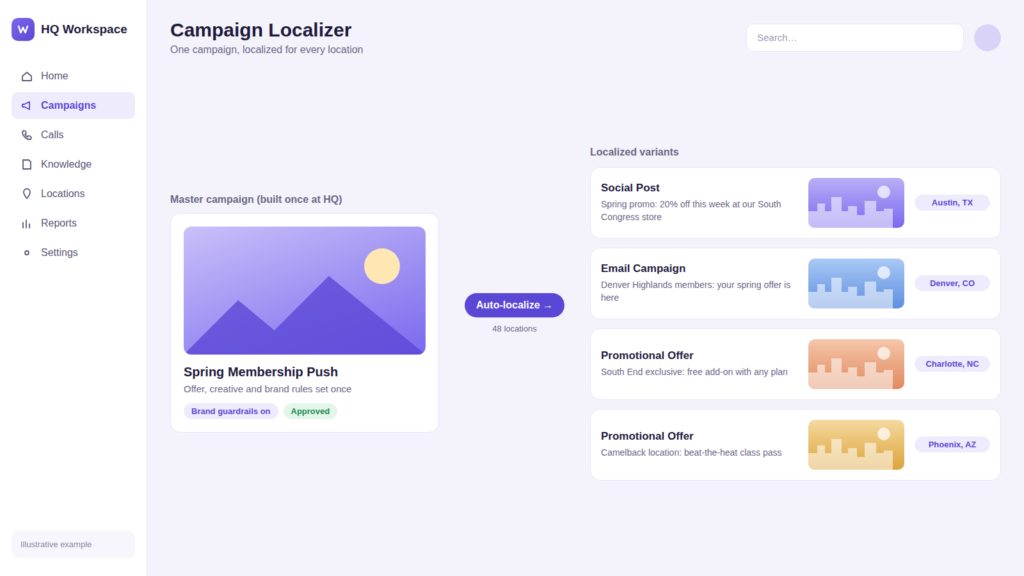
The fix: A campaign built once at HQ becomes dozens of localized social posts, emails and offers, each inside brand guardrails but reflecting the location’s address, team, local events or offer. This is the kind of AI system Weam builds for multi-location marketing teams, where campaigns go live network-wide on launch day.
7. Know Which Locations Actually Ran the Promotion
Best for: Franchisors
The leak: A price change or promotion that only 70% of locations implement leaves money on the table, creates customer complaints (“the ad said…”), and muddies the data HQ uses to judge whether the promotion worked.
The fix: AI checks rollout status against signals each location already produces (POS item codes, menu and pricing updates, social posts, manager confirmations) and flags the stragglers automatically. Regional managers get a short list of who to call instead of an audit to run. It’s the same HQ visibility problem Weam builds AI systems to solve for franchise and multi-unit teams.
8. Turn Every Customer Call Into a Coaching Moment
Best for: Multi-unit operators
The leak: Missed upsells, skipped scripts and unanswered questions happen on calls every day, but nobody has time to listen to recordings. Training stays generic, so the locations that most need help get the same refresher as everyone else.
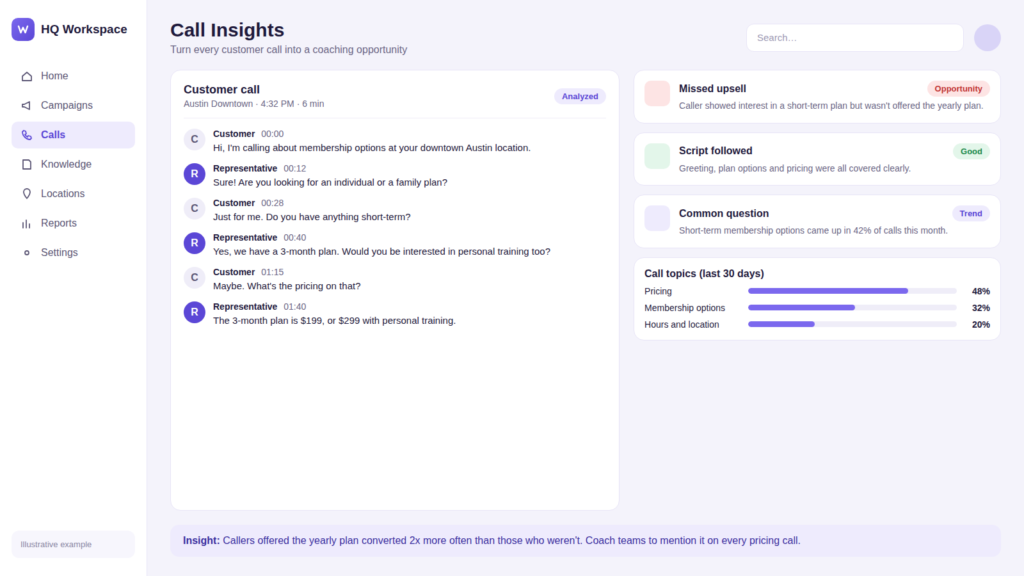
The fix: AI transcribes and analyzes calls to surface missed bookings and upsells, script deviations, and the questions customers ask most. The same data then drives coaching: a location that keeps missing upsells gets the upselling module, not a blanket retraining. It’s one of the five real AI automations Weam has built for franchisors and multi-location operators.
9. Give Every Employee the Right SOP Answer in Seconds
Best for: Franchisors and multi-unit operators
The leak: New hires ask the same questions repeatedly, regional managers answer them by text, and every location slowly drifts toward its own version of the process.
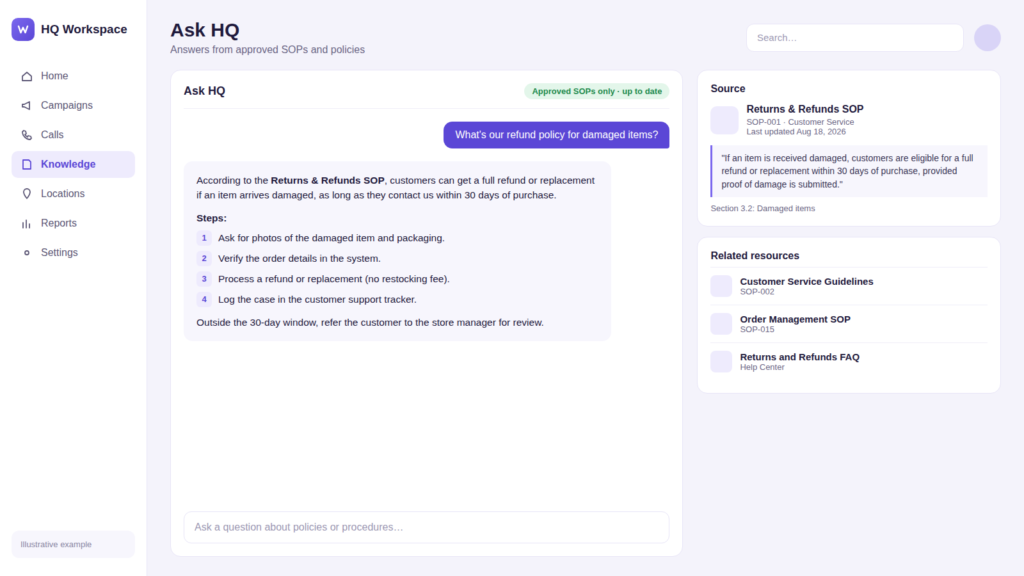
The fix: An internal assistant connected only to approved SOPs, training material and policy documents answers with the current version and cites the source section, with permissions controlling who sees what. One franchise operations team replaced its repeated SOP questions with an internal assistant that answers them instantly, freeing regional managers to spend their time in locations rather than in their inbox.
10. Replace the Weekly Report Roll-Up With One Live View
Best for: Multi-unit operators and franchisor leadership teams
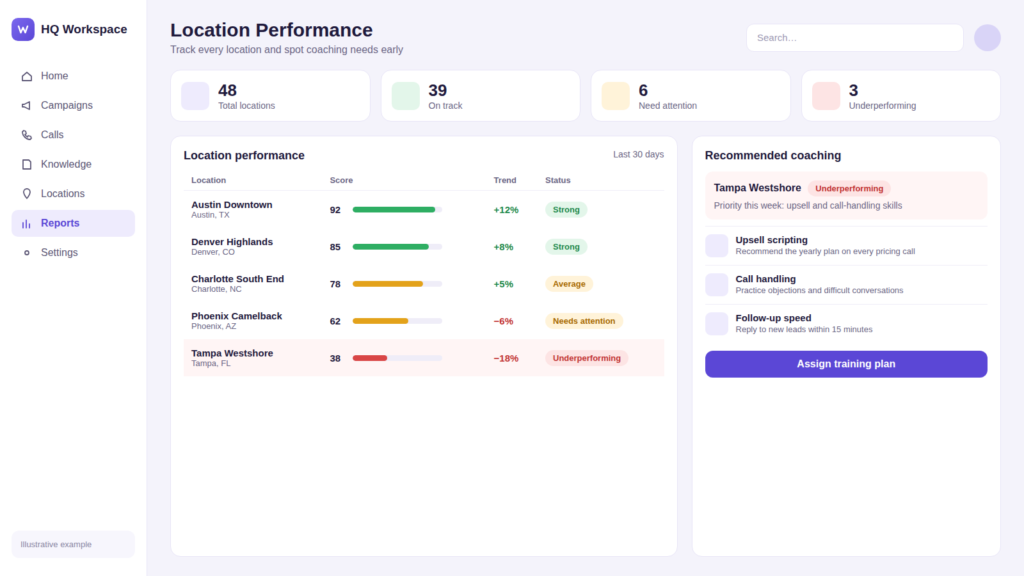
The leak: Someone spends hours each week pulling numbers from the CRM, POS, review platform and call logs, pasting them into a spreadsheet, and rolling them up by region. By the time executives read it, the data is a week old and the problem store has had another bad week.
The fix: AI combines every source into a single summary per location, highlights what changed and what’s off-trend, and rolls it up automatically into regional and executive views with a short list of action items. Store managers see their location, regional managers see their region, and leadership sees the whole network.
At a Glance: Which Workflow to Automate First
Use this table to pick a starting point. Low-complexity workflows with short time to value make the best pilots.
| Workflow | Data source | Complexity | Time to value | KPI to track |
|---|---|---|---|---|
| 1. Review responses | Google, Yelp, Facebook reviews | Low | 1–2 weeks | Response time, response rate, average rating |
| 2. Missed-call text-back | Phone system, call logs | Low | 1–2 weeks | Missed calls recovered, bookings |
| 3. Lead routing | Web forms, ads, CRM | Medium | 2–4 weeks | Time to first contact, lead-to-booking rate |
| 4. Franchise development leads | Inquiry forms, CRM | Medium | 3–4 weeks | Qualified discovery calls, hours saved |
| 5. Listing accuracy | Google Business Profile, directories | Low | 1–2 weeks | Listing accuracy, profile actions |
| 6. Localized campaigns | Campaign assets, brand guidelines | Medium | 2–4 weeks | Launch time, location adoption |
| 7. Rollout compliance | POS, menus, manager check-ins | Medium | 3–6 weeks | % of locations compliant, days to full rollout |
| 8. Call analysis and coaching | Call recordings | Medium | 3–6 weeks | Call conversion, upsell rate |
| 9. SOP assistant | SOPs, policies, training docs | Medium | 2–4 weeks | Questions answered, answer accuracy |
| 10. Network reporting | CRM, POS, reviews, calls | High | 4–8 weeks | Hours saved, time to insight |
How to Start: The 5-Step Workflow Loop
Don’t automate everything at once. Pick the leak that costs you most (review responses and missed-call text-back are usually the fastest wins) and run it as a simple loop: input, AI action, human approval, output, measurement.
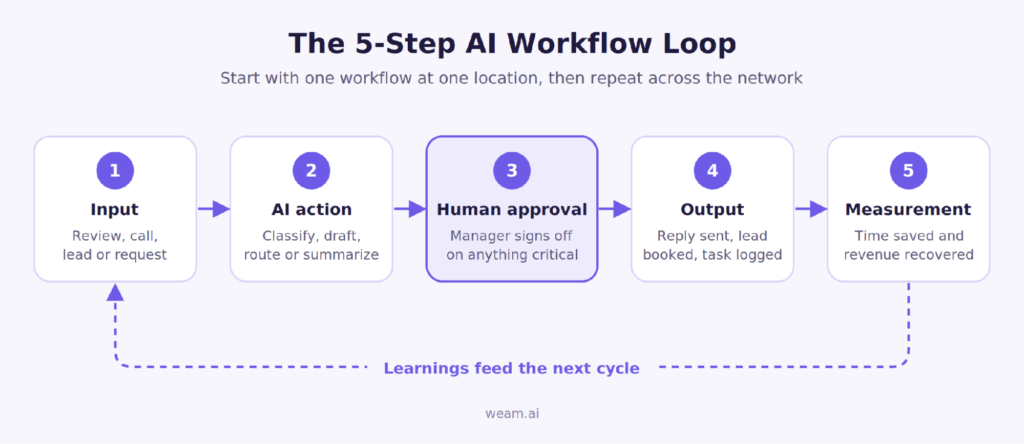
The approval step is what makes everything after it possible. Teams that build in visibility and sign-off from day one earn the trust to automate more; teams that try to go fully hands-off straight away tend to stall after the pilot.
Start with one location, the way other multi-unit networks have done before scaling network-wide. Measure time saved and revenue recovered against that location’s baseline, then extend the same workflow to the rest of the network.
Getting Franchisees and Store Managers to Actually Use It
Most HQ tools fail for a simple reason: they ask franchisees and store managers to log into one more system. They don’t, and the tool quietly dies.
The workflows that stick do the opposite. They meet locations where they already work: approvals arrive as a text or email with one-tap approve or edit, alerts land in the channel managers already check, and nothing needs a new login to keep running. Set the defaults so that doing nothing is safe (a review draft waits rather than posting; a lead still gets an instant first reply). Then make the benefit visible to the location, not just to HQ. When franchisees see their own review response rate or recovered missed calls each week, the system stops feeling like HQ oversight and starts feeling like something that helps them make money.
For franchisors, two things help further. Frame the rollout around brand standards franchisees have already agreed to, rather than as a new mandate. And pilot with a willing franchisee first: their results will persuade the rest of the system faster than any memo from HQ.
Risks to Plan For
Three failure modes come up in almost every multi-location rollout, and each has a simple guardrail.
Brand-voice drift. AI-drafted replies and posts can slowly stray from your voice, especially when every location edits them. Load a brand-voice guide and approved example replies into the system, and spot-check a sample each week.
Hallucinated answers. An SOP assistant that confidently invents a refund policy is worse than no assistant. Restrict it to approved documents, require it to cite the source section, and have it answer “I don’t know, check with your manager” when the answer isn’t in those documents.
Data access and permissions. In a franchise system, franchisees often own their own customer data, POS and phone accounts. Agree up front on what HQ can see, use role-based permissions so one location can’t view another’s data, and confirm data-sharing terms before connecting any franchisee-owned system.
Conclusion: Turn AI Into a Repeatable Operating System
The value of AI automation for multi-location businesses doesn’t come from one clever tool. It comes from plugging the same leaks at every location, every week: reviews that go unanswered, calls that ring out, leads that wait, promotions that never launch. Fix one leak at one location, prove the number, then roll it out. HQ gets visibility without slowing anyone down, and every location gets the speed to act on its own.
Get a free workflow audit for one location. Weam will map where reviews, calls and leads are leaking at one of your locations, estimate the monthly cost, and show you the first workflow we’d automate. Book your free audit →
Frequently Asked Questions
What is AI automation for multi-location businesses?
It connects the inputs every location produces (reviews, calls, lead forms, staff questions) to a defined action, a human approval step and a measurable outcome, so the same process runs consistently at every location while HQ keeps visibility.
Which workflow should a franchise automate first?
Start with the one that leaks the most revenue and is easiest to measure. For most networks that’s review responses, missed-call text-back or lead routing, because all three show results within weeks.
Do franchisees have to change how they work?
They shouldn’t have to. Good implementations deliver approvals and alerts through text, email or tools locations already use, so the workflow runs without anyone learning a new system.
How do you stop AI from posting off-brand or incorrect responses?
Keep a human approval step for anything sensitive, load brand-voice guidelines and approved examples, and limit internal assistants to approved documents that they must cite.
How is this different from a general automation tool like Zapier?
General tools connect apps. Multi-location automation adds brand-voice judgment, approval routing and location-level permissions designed for an HQ-and-locations structure.
How long does it take to see results?
Simple workflows such as review responses or missed-call text-back usually show results within a few weeks of a single-location pilot. Network-wide reporting takes longer because it depends on connecting several systems.