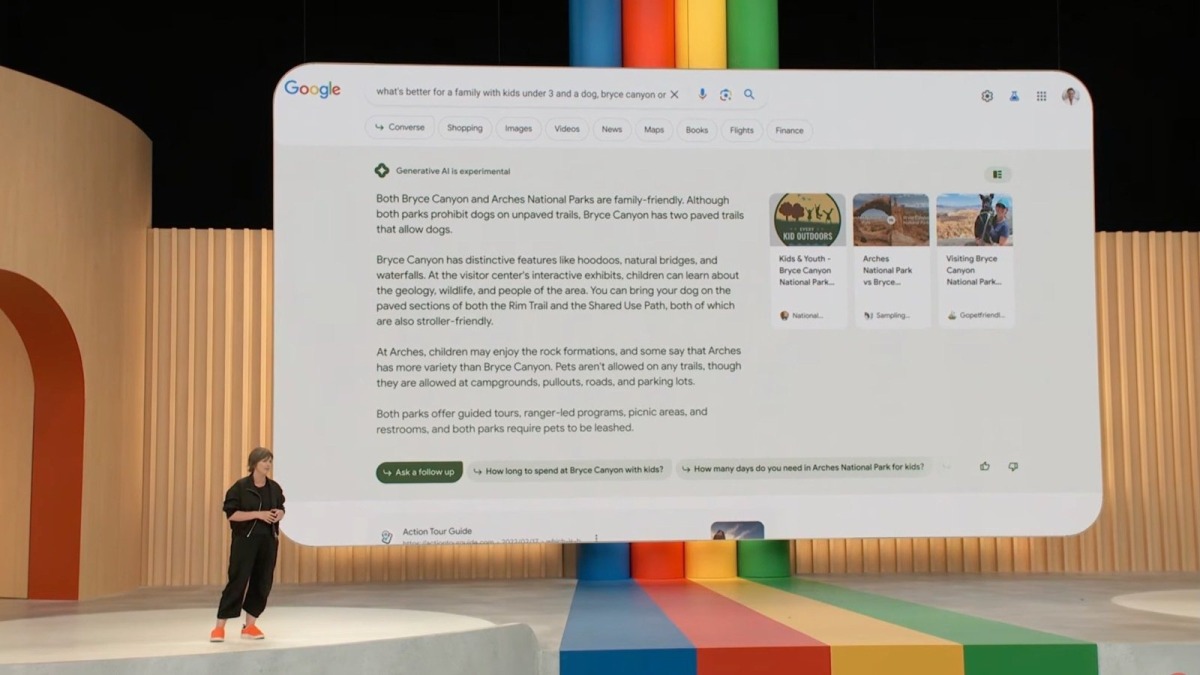
Earlier this year, Google debuted its so-called “Search Generative Experience” (SGE), an AI-generated summary of results from a typical Google search. The idea, Google said, was to prevent users from having to “piece together information” themselves; rather than clicking through a series of blog posts, articles, or social media posts, users could read a quick roundup at the top of the page. But the last week has shown that users of the world’s most ubiquitous search engine now have more puzzle pieces to work with than ever before. In response to fairly simple questions, Google’s AI has been telling users to eat rocks, glue cheese to their pizza, and smoke cigarettes during pregnancy, among other dangerous things.
Kris Kashtanova, a self-proclaimed “AI evangelist” at Adobe, shared Thursday via X that she had tested SGE by searching: “How many rocks shall I eat?” Citing an article from The Onion (which, strangely enough, was reposted on a site belonging to a simulation software for the oil and gas industry), Google summarized that as, “According to geologists at UC Berkeley, you should eat at least one small rock per day.” The SGE brief explained that rocks were a “vital source” of minerals and vitamins and that if users have a hard time eating “a serving of gravel, geodes, or pebbles” with each meal, they should try hiding rocks in ice cream or peanut butter.
This isn’t the only way Google’s SGE has missed the mark over the past several days. Ben Collins, The Onion’s new CEO, shared via Bluesky that SGE cited another Onion post claiming the CIA was fond of using black highlighters in its documents. A screenshot making the rounds on social media appears to condone smoking two to three cigarettes per day while pregnant. After asking Google how to prevent the cheese from sliding off their pizza, one X user was told to add non-toxic glue to their pizza sauce to “give it more tackiness.” SGE had seemingly pulled its advice from a joke comment on Reddit.
After tolerating a few days of online bullying, Google defended SGE. “The examples we’ve seen are generally very uncommon queries, and aren’t representative of most people’s experiences,” a Google spokesperson said. “The vast majority of AI Overviews provide high quality information, with links to dig deeper on the web. Where there have been violations of our policies, we’ve taken action—and we’re also using these isolated examples as we continue to refine our systems overall.”
However, not all SGE errors are as blatant or humorous as the “isolated” ones described above. In more subtle cases, its responses might be tricky to distinguish from the truth, thus contributing to the spread of misinformation. Melanie Mitchell, a machine learning professor at the Santa Fe Institute, shared Thursday that SGE incorrectly responded to the question “How many Muslim presidents has the US had?” with the response: “The United States has had one Muslim president, Barack Hussein Obama.” (President Obama is Christian.) SGE has also told users that staring at the Sun for 5 to 15 minutes is “generally safe” and provides abundant health benefits, when doing so can easily lead to long-term eye damage.
Once upon a time, Google would have encouraged users to verify its AI’s claims with a quick Google search. Ironically, this now only works if users click through results to check information against primary sources—the exact practice Google is trying to shift users away from.
In an industry where efficient data and relationship management are keys to thriving, real estate investors are increasingly turning to Customer Relationship Management (CRM) software. These systems are not just about keeping contacts organized; they’re about creating a backbone for business operations, from marketing to client retention and strategic planning. This article explores the multifaceted benefits of CRM for real estate investors and provides actionable advice on leveraging this technology to its fullest potential.
The Importance of CRM in Real Estate Investment
The intricate nature of the real estate market, with its countless transactions, client interactions, and endless data streams, calls for a tool that can bring order to chaos. CRM systems emerge as this tool, offering a way to consolidate data and interactions in one accessible place. More than a convenience, they’re a strategic asset that can dictate the efficiency and effectiveness of an investor’s operations. Integrating a CRM system into your real estate business isn’t just about tracking sales—it’s about creating a comprehensive ecosystem that nurtures client relationships and drives business growth.
At their core, CRM systems offer a detailed repository for client data, but their benefits extend far beyond this fundamental function. These platforms facilitate a seamless flow of information across an organization, ensuring that every team member has access to the data they need when they need it. This accessibility improves decision-making, enhances client communication, and enables personalized marketing strategies.
Selecting the Right CRM: A Strategic Decision
The journey to finding the perfect CRM for your real estate investment business is pivotal. It’s not just about the features; it’s about finding a platform that aligns with your business processes and growth ambitions. Consideration must be given to how the CRM will integrate with existing tools and systems, its scalability to support your business as it grows, and the level of customer support provided. The right CRM for real estate investors acts as a catalyst for business efficiency, streamlining processes, and enhancing team collaboration. It should not only fit your current needs but also have the capacity to evolve with your business.
Maximizing Your CRM Investment: Implementing Best Practices
To fully leverage the power of your Customer Relationship Management (CRM) system, adopting and implementing best practices is essential. These strategies ensure the system functions as a powerful instrument for business intelligence and user engagement.
Commitment to Data Hygiene: Regular maintenance and cleanup of CRM data prevent inaccuracies and ensure the system remains a trustworthy source for decision-making. This involves removing duplicate entries, updating outdated information, and verifying data accuracy, all of which contribute to the CRM’s effectiveness as a tool for business intelligence.
Engaging Team in Continuous Training: Encouraging regular training sessions for your team ensures they are up to date with the CRM’s latest features and best practices. This ongoing education helps in harnessing the full potential of CRM, fostering a workplace culture that values efficient utilization and mastery of the system.
Regular Review and Optimization of Workflows: Periodically evaluating and fine-tuning the CRM’s workflows can significantly enhance operational efficiency and customer satisfaction. This process identifies bottlenecks, optimizes processes, and ensures the CRM configuration aligns with current business objectives, directly influencing the bottom line.
Implementing these best practices transforms your CRM from a mere database into a dynamic tool that drives business growth and customer engagement. By maintaining data integrity, fostering a culture of continuous learning, and optimizing CRM workflows, you can maximize the return on your CRM investment and significantly impact your business’s success.
CRM and Customer Service: Enhancing Client Experiences
A robust CRM system is instrumental in delivering superior customer service. It enables real estate investors to track all client interactions, ensuring that every touchpoint is an opportunity to strengthen the relationship. This comprehensive view allows for more personalized service, anticipating client needs and addressing them proactively.
Moreover, the efficiency gained through CRM use can shorten response times to client inquiries, improving satisfaction and loyalty. In a competitive market, the quality of your customer service can distinguish your business, making a CRM an invaluable tool in cultivating a reputation for excellence.
Analytics and Reporting: Uncovering Insights for Strategic Growth
The analytics and reporting capabilities of CRM systems provide a goldmine of insights that can guide strategic decision-making. These tools offer a clear view of sales trends, campaign effectiveness, and customer behaviors, allowing for data-driven strategies that align with your business objectives. By regularly analyzing this data, real estate investors can identify opportunities for optimization, uncover new revenue streams, and make informed decisions that drive sustainable growth. This analytical approach ensures that investments in marketing, client engagement, and operational improvements are based on solid data, maximizing their impact and ROI.
The Future of CRM in Real Estate: Staying Ahead of Technological Advances
As technology continues to advance, the capabilities of CRM systems evolve, offering new opportunities for real estate investors to enhance their operations. Innovations in artificial intelligence, for example, are making CRMs smarter, enabling predictive analytics and personalized customer interactions at scale. Blockchain technology offers new ways to manage transactions and contracts securely.
Staying informed about these developments and understanding how they can be integrated into your CRM strategy is essential for maintaining a competitive edge. The future of CRM in real estate is about harnessing technology to create more efficient, personalized, and secure processes that drive business success.
Conclusion
Investing in a CRM system is more than a technological upgrade; it’s a strategic move that can redefine the success of a real estate investment business. By carefully selecting a CRM, implementing best practices, and staying abreast of technological advancements, investors can significantly enhance their operational efficiency, marketing effectiveness, and customer service quality. The right CRM system is a powerful tool that supports strategic decision-making, fosters business growth, and enhances competitiveness in the ever-changing real estate market.
Walmart Memorial Day Deals: Grab tech, beauty, outdoor, and home deals at Walmart for the holiday. Notable offers include $130 off an Apple iPad Air, a refurbished Dyson Airwrap for under $350, a 10-person tent for $114, and deals on Dyson vacuums. [Walmart]
The Walmart Memorial Day sale has deals on tech, beauty, vacuums, and outdoor goods. Check out our standout picks below:
UPDATE: May. 27, 2024, 8:52 a.m. EDT This article has been updated with the latest deals at Walmart heading into Memorial Day weekend.
Best Walmart Memorial Day deals 2024
We’ve finally made it to Memorial Day weekend, and plenty of deals are already live.
Walmart kicked off its Memorial Day sale early, offering rollbacks on Apple products, home deals, and outdoor deals. But we wouldn’t exactly call their sale extensive — several of the deals we’ve seen were placed at marked-up prices, have been on sale for weeks already, or are available from sketchy third-party sellers. What gives, Walmart?
With that in mind, we only selected deals that are actually worth your money. There aren’t as many options as we hoped for, but the ones we found are pretty solid. Here are the best Memorial Day deals from Walmart as of May 27. Be sure to check out our full list of Memorial Day deals across all retailers if these don’t do it for you.
Yes, the new iPad Air is finally here, but let’s not pretend like an M1 Air is suddenly outdated. In fact, opting for the M1 Air is a great way to get a tablet with heftier processing power without paying a hefty price, especially since Walmart has this tablet down to its lowest price ever (most of Amazon’s models are sold out, but the one that is available is $449).
If you style your hair regularly and are looking for a way to minimize heat damage, the Dyson Airwrap Multi-styler Complete might be worth considering. The Airwrap dries your hair quickly and styles it with minimal damage. You can curl in both directions with a single attachment (once you get the hang of it), and the variety of smoothing attachments allows for multiple styling options.
Mashable Deals
If you’re on the fence and aren’t ready to spend $600 on a brand-new Airwrap, Walmart is selling a refurbished version for $349.99 on Memorial Day.
More beauty tech Memorial Day deals
Best outdoors Memorial Day deals
Why we like it
Larger tents can easily run into $150+ territory, so using Memorial Day sales to pick some outdoor gear is a good idea. While Walmart’s selection didn’t exactly wow us, we did like this Ozark 10-person tent, that the brand claims can fit up to three queen-sized air mattresses, storage pockets for keeping your items off the floor, and a screen porch.
If you want your stick vacuum to really clean your floors — like pick up every last speck of dust to clean your floors — the laser attachment on the Dyson V12 will more than do the job. Even at full price, this Dyson vacuum is the lowest entry price for that laser tech, which is why we love seeing it go on sale. While this isn’t the lowest price we’ve ever seen the V12 hit, it’s still a pretty good one to grab this vac at.
Game Dev Tycoon was a bit of a phenomenon back in the day. Released in 2012, Greenheart Games’ first major title quickly achieved viral success due, in part, to being a neat little management game about the industry itself—making it a popular choice for YouTubers and streamers.
Over a decade later, the studio’s ready to put its next game out into the wild: Tavern Keeper, a game about, well, keeping taverns.
I had the chance to sit down with Patrick Klug, director and manager of Greenheart Games, and had an early peek into the game itself. At a glance, Tavern Keeper looks like a cosy little inn management game—and it is—but the more time I spent looking at it, the more little elements of craft revealed themselves to me.
In Tavern Keeper, you’re given run-down inns to manage as you progress through a small handful of key locations. Think Two Point Hospital, but you’re running a bar full of unruly patrons rather than a medical nightmare. To progress, you’ll need to accrue stars by fulfilling various objectives—hiring staff, designating and decorating rooms, and making sure your guests are happy with their ales and sundry.
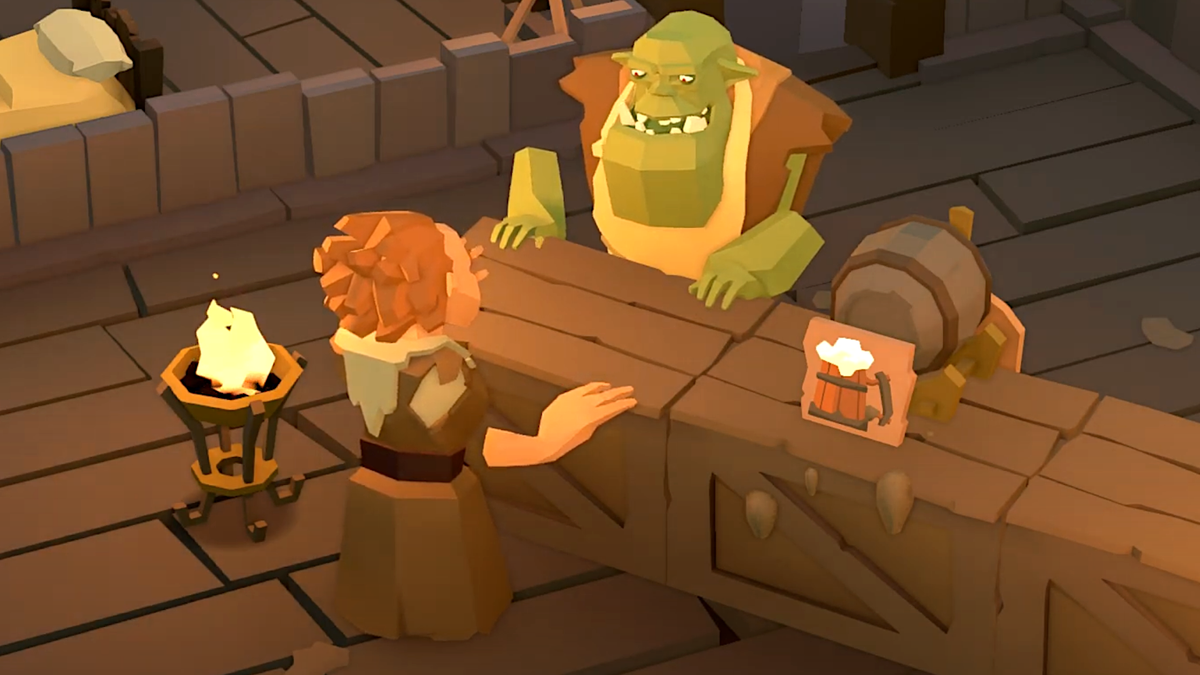
Your first fix’er upper is in a little muddy swamp called Riverbottom, and I’m immediately charmed when a lovingly-animated ogre paddles down the river to sell you casks of ale. The game’s clearly flooded with little touches like this—and while I think the cinematic trailer Greenheart Games showed back in Gamescom 2023 is cute, it doesn’t quite sell how nice everything looks in practice. Everything’s got this OSRS style low-poly look to it that’s like liquid nostalgia.
I was shown a hiring list as Klug made his first step towards building up his tavern—and there’s a lot of character injected into these funny little guys already. Your staff come with various traits and aptitude in different skills, as well as complicated histories: Consider Bron, who was let go from his past two taverns for “making patrons disappear” and “booby-trapping the tavern”, or Gavin, who hates riddles. Me too, Gavin.
It’s all very Discworld in nature, which is something Klug emphasises as a key inspiration: “I think it’s much more towards Discworld than Lord of the Rings. Our stories are not really about heroes and adventurers, it’s more like this anachronistic, quite modern kind of thing with a bit of heart and humour.”
Keep up to date with the most important stories and the best deals, as picked by the PC Gamer team.
As you continue to refit and rehome your inn, you’ll also be presented with “stories”, little choose-your-own adventure vignettes that can do everything from providing brief mechanical bonuses to giving you unique staff, such as a skeleton who got tired of guarding a dungeon and wants to pursue his dreams.
“There isn’t really a story where you ‘fail’,” Klug explains: “If you make stories too mechanical, then you get players not actually caring about the story—they care about the outcome, so they click through and get to what they want, like, ‘I want plus two food’.” If you’ve ever played Wildermyth (which I highly recommend), Tavern Keeper’s stories appear to work very similarly.
The more Klug plays, the more I get a sense for the level of detail at play—later in the game, players can toy with not only drinks, but food recipes too. Cut to a bespoke, fully-animated and rendered section of the menu where he hucks some swamp rats into a bowl with water, each ingredient having its own varying trait Potionomics-style. Neat, I think so far. This all looks like it’s had a lot of care gone into it.
Klug then selects a cabinet, goes into “detail mode”, and nonchalantly reveals to me that it comprises 114 pieces he can grab, scale and rotate at will. Excuse me?
(Image credit: Greenheart Games)
Tavern Keeper buries the lede a lot with its furniture customisation, which is about as granular as you can get. Players can create their own pieces for their tavern by clipping, rotating, and scaling various assets to their heart’s content. The same kind of ingenuity that can be found in MMO housing communities is also explicitly possible here.
Players can save templates they create in design mode (or grab a share code to allow other players to use them) and bring them into their next tavern. There’s even a debug-style grid map with every single asset loaded in that’s available to players, giving them carte blanche to tinker with infinite money.
Tavern Keeper will be heading into early access late this year—though Klug and his team plan to release a demo before then. I’m personally very impressed already by what Greenheart Games had to show off, and I hope that the full game will stand up to scrutiny once the general public gets their hands on it, especially since it’s been in the oven for so long.
Finite Element Analysis (FEA) services offer a platform of virtual simulations used for analyzing the effects of predictable forces on a design. The mathematical-based analysis visualizes when or how a design can fail, materials will deform, assemblies might disintegrate, and a structure can collapse. FEA is ideally implemented during the design phase of a fabricated product to discover rooms for improvement and modify it as necessary. While different industries resort to FEA for various specific purposes, they share the same goals of finding the perfect combination of performance, build quality, and cost.
Consumer goods
Product design companies and engineers in the consumer goods industry utilize FEA to predict components’ future performance and structural behavior before developing physical prototypes. Consumer goods might be built from various materials, such as aluminum, cast iron, steel, metal alloy, thermoplastics, fabrics, and leather, to name a few. FEA works for all materials as long as the user understands their physical properties and characteristics.
Many consumer products can be subjected to FEA simulation. For example, electronics need thorough analysis to determine waterproofing and thermal qualities; furniture pieces require repeated tests to see the load-bearing capacity; shoes and wearable items must meet ergonomic requirements; and children’s toys must be checked for durability and shock-resistance properties. Regardless of the products, FEA can determine whether their designs can withstand physical damage under regular use.
The design for additive manufacturing firms can make well-informed changes if the analysis demonstrates product failures under non-extraordinary loads. Virtual modeling and analysis processes help companies reduce production costs, shorten design cycles, and boost productivity while improving ROI. An FEA simulation of consumer goods is often inseparable from life sciences, especially if the products involve direct human engagement during usage. The simulation might include comfort, stress distribution, support, and fatigue models.
Example case: Foam Bed Optimization
A simulation of a foam bed in an FEA interface helps visualize how the product affects sleep quality. There are at least three variables to consider, including the user’s body measurement, foam material, and foam density. Detailed structural analysis is required to define the ideal thickness and firmness without diminishing comfort. The foam must support the body well enough but remain reasonably soft for a restful sleep. Because the body exerts pressure on the foam, the material must return to its original shape. Based on the design requirements, the manufacturer makes the necessary adjustments per FEA results.
Based on the same user-product interaction principle, design engineering services use advanced FEA software can also simulate the human body to see the effects of specific training programs on muscles and bones. The analysis might also include simulations to measure the effects of repetitive movements—under certain conditions—on soft tissues and joints.
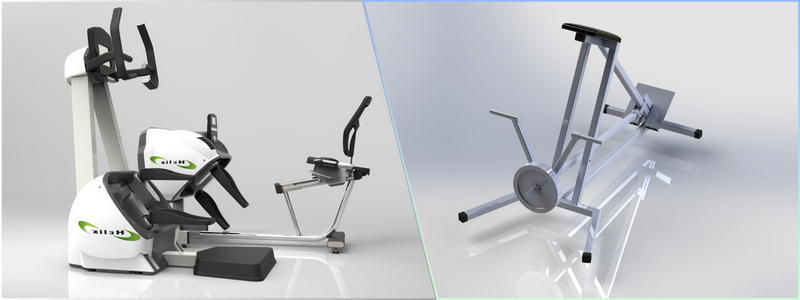
Example case: Elliptical Trainer Linkages Design
One of the main points of an elliptical trainer is to provide the same exercise routines as walking, running, and stair-climbing without the typical excessive pressure on the joints. That said, not every cross-trainer is created equal. Optimization in machine exercise should be based on how it impacts the human body during usage. Suppose a cross trainer is designed for people with knee injuries to stay fit. Unlike most machine exercises, the purpose-built training equipment must accommodate users’ disadvantages.
For instance, the engineering design services company may design better fluidity and lightweight rotational movement on the machine’s linkage. FEA helps determine the exact extent of pressure and force required to utilize the equipment properly without causing further harm to users.A similar method is possibly applied to applications like physiotherapy. FEA-based human body simulations might greatly assist doctors and physical trainers in planning an effective exercise routine to treat patients still recovering from injuries.
Although the design process of training equipment might be listed under the medical research category, they are intended for devices or products outside the human body. On the other hand, the following applications highlight the practicality and usefulness of FEA for designing models meant to replicate actual organs.
Example case: Knee Biomechanics
Direct interoperability with CAD software used by medical device design & development services allows FEA tools to analyze objects of any source, including models generated from a CT scanning process. A three-dimensional reconstruction of a CT-scanned image makes for a comprehensive reference to study the prosthesis design. For example, a reconstructed scanned model of an injured knee clearly visualizes the organ’s musculoskeletal biomechanics.
Surgeons can use FEA simulation to determine the correct motion range of the femoral component. If TKA (Total Knee Arthroplasty) surgery is deemed necessary following the simulation, the prosthesis can be designed for individual patients based on their activity level, weight, age, and general health.
In dentistry applications, FEA provides an in-depth look into dental implants’ surface structure and geometry. The simulation helps companies understand the material properties of an implant and how living bone tissues will respond to the applied mechanical force. Detailed geometrical analysis can predict adhesive strength and determine the optimum tightening torque to improve the success rate.
Example case: The Living Heart Project
In collaboration with the FDA, Dassault Systèmes and a massive group of leading cardiovascular researchers are on a shared mission to develop a simulated 3D heart model. The project is at the cutting edge of medical research, with a massive potential to deliver a groundbreaking study in developing new cardiovascular treatments and devices. A highly accurate simulation of a living heart aims to reduce the number of risky real-world clinical trials when designing a cardiovascular device while still ensuring efficacy and safety.
External medical devices’ design and manufacturing processes also benefit significantly from FEA. Such devices are much less sophisticated than implants or pacemakers but equally applicable to improve patients’ comfort during treatments and recoveries. Among the common examples include:
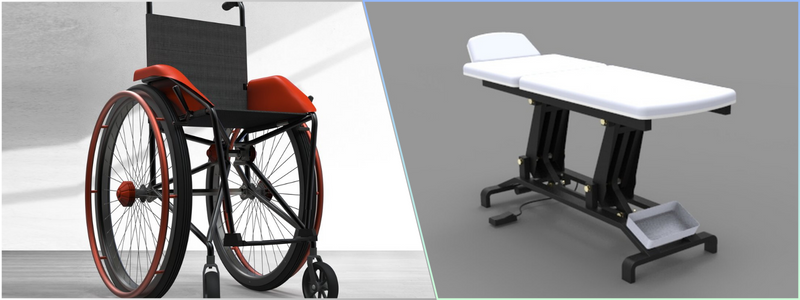
Wheelchairs
As simple as a wheelchair may seem, the equipment should be an over engineered design piece. The engineering design expert must keep in mind that it needs to be durable and comfortable, but also practical and easily maneuverable. Throughout its helpful lifetime, a hospital wheelchair is quite possibly used by hundreds of people with varying weights, heights, and health conditions. An FEA analysis of the material and mechanism will lead to a versatile and heavy-duty design.
FEA simulation of blood flow through a pipe assembly is used as the basis for the design of platelet separators or transfusion machines of all sorts. In a typical simulated analysis, engineers perform an A/B study to examine the mechanism of two pipe assemblies and determine the most effective configurations to prevent blood clots, undesired flow rates, and turbulence. In addition to structural analysis, the simulation involves the computation of fluid dynamics.
EMS cots
The primary design considerations for an emergency service cot are load-carrying capability and lightweight components. While materials like carbon fiber and titanium are known to have the two characteristics, they are still too expensive for most emergency services. A cot is not designed by finite element analysis experts to be carried or lifted but is intended to help transport patients from one point to another; apart from material considerations, the locking mechanism should also be easily deployed and released. FEA simulation is expected to lead to the development of a reliable, affordable solution.
In each case, virtual prototyping and simulated performance/usability tests open the doors for medical device manufacturers to design products that improve patients’ comfort and health. Thanks to CAD and FEA, minimum development costs may translate to affordable yet quality devices in the future.
Automotive industry
Automotive design & engineering services design a modern car to be equipped with numerous advanced electronics and moving components. It is also made of many materials constantly exerting forces on each other. Since every assembly requires a thorough assessment for reliability, performance, and quality in a cost-efficient fashion, FEA finds it one of the most significant applications in the automotive industry.
Solid and rigid materials deliver a durable design, whereas lightweight assembly can improve speed and performance. At the same time, the higher-performance engine often generates noise and vibration that might compromise comfort. Modern combustion engines rely heavily on liquid coolant and air to keep the temperatures within a safe range and maintain ideal working conditions. Nearly everything about FEA, from structural and thermal analysis to buckling and computational fluid dynamics, is fundamental in the development of a car design.
FEA also plays a vital role in determining a vehicle’s crashworthiness. A simulation of a crash—or impacts from multiple directions—can help engineers build a dependable safety system, including harnesses and airbags, to minimize the risk of injuries to occupants in the event of accidents.
Civil and architectural industries
Commercial & residential architects and engineers utilize 3D CAD modeling and FEA analysis to create building plans. In addition to ensuring a safe construction process, the simulation tells the architects and engineers whether the finished project can withstand various environmental conditions and topographical issues in the future. Detailed analysis can predict deterioration and the extent of damages to a building’s components under given conditions; based on the information, the building owner or management should be able to set a maintenance schedule to prevent expensive repairs.
Discover the intricacies and potential of Finite Element Analysis (FEA) as it redefines project management and outcomes in the industry. Delve deep into the transformative capabilities of FEA, reshaping how companies tackle complex projects and ensuring optimal results. Equip yourself for the future now and gain an edge over your competitors. Contact us for a free quote, and let Cad Crowd assist you in mastering FEA for your industry ventures.
A business has two options if they want to grow their data analytics capabilities: developing an in-house data analytics team or making use of managed analytics services. Multiple companies prefer the traditional first option, believing that growing an in-house team is a safe choice. Undoubtedly, this strategy can be powerful, still it’s associated with certain challenges. Having looked back at my practical experience, I’ve outlined a typical profile of a company growing their in-house analytics team and picked out 3 challenges such companies are likely to face in the process.
A typical profile of a company that is to grow their in-house analytics team
Meet Prod&Sell, a large manufacturer and retailer, which is currently present in 15 states. Although the company has a data analytics team, they lag behind Prod&Sell’s evolving analytics needs. While Prod&Sell’s C-suite and business units expect reliable and timely reporting, self-service and predictive analytics (to name a few things), the analytics team still collects data from disintegrated sources, cleans it and prepares reports manually.
To satisfy the company’s analytical needs, the C-suite opts for creating a business intelligence solution with embedded big data analytics and data science capabilities. Colin, the Head of Prod&Sell’s data analytics, is charged with the task to further develop his department to implement this ambitious project.
Challenges of developing an in-house data analytics team
Here are the challenges that are ahead of Prod&Sell and Colin:
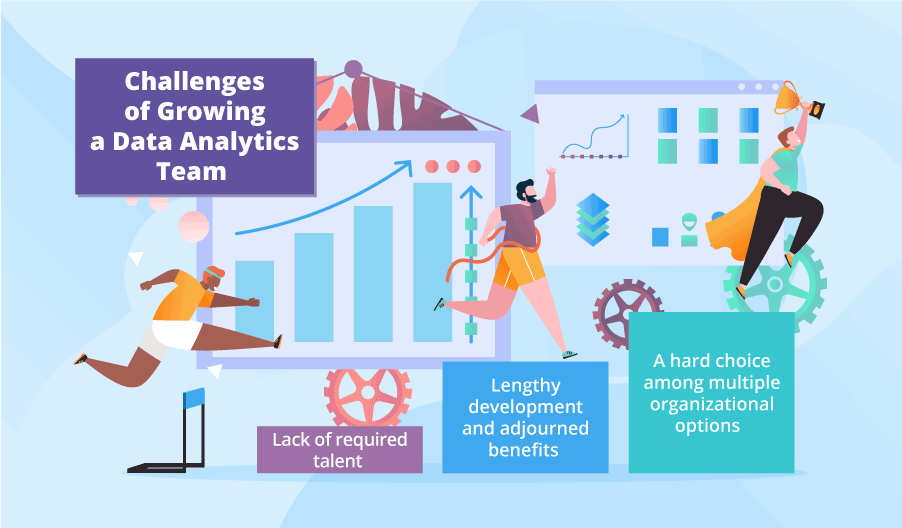
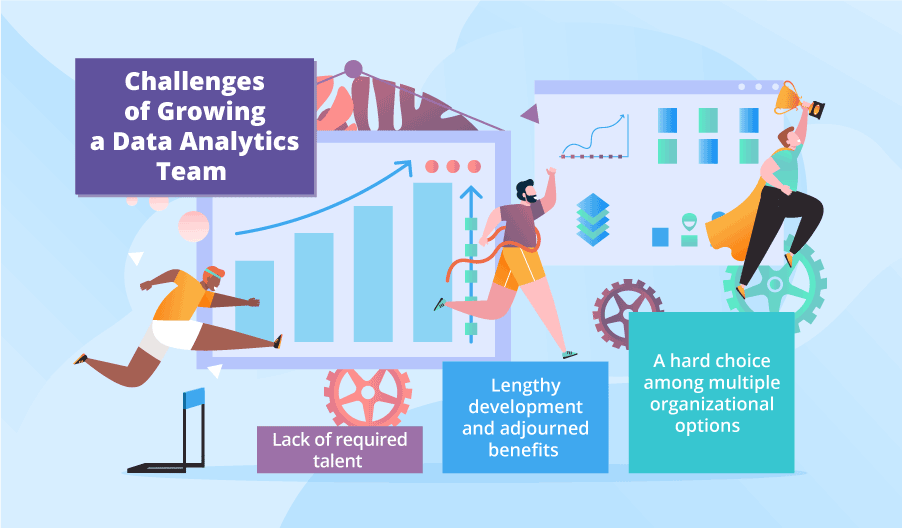
Lack of required talent
First, Colin has to build up a team with mastery in many domains:
BI and big data:to design and implement a data lake, a data warehouse, OLAP cubes, reports and dashboards, as well as administer the implemented solution on a daily basis.
Data science: to design machine learning models and tune their hyperparameters, train and retrain them, and deal with noise reduction.
Business analysis: to elicit the needs of different business units and departments.
Taking into account that big data and data science skills are in short supply, it will take Colin many months to find all the required roles to fill in the talent gaps.
Lengthy development and adjourned benefits
It may take Prod&Sell about 2 years to develop the solution with all the analytic capabilities they want. This presupposes a long transitional period when the data analytics team will have to split their efforts between continuing with the existing practices and elaborating on new ones. Even if Colin’s team smartly chooses among available software development life cycle models, they will be able just to shorten the transitional period, not to get rid of it. This means that routine tasks will anyway retard the achievement of strategic goals, which seems to make the efforts on the data analytics team development futile. As a result, the C-suite may eventually decide to abandon the idea of further growth.
A hard choice among multiple organizational options
Prod&Sell will have to decide whether their analytics will be centralized or decentralized and, correspondingly, what the place of the altered analytics department will be in the organizational structure (what structural units it should be subordinate to – finance, marketing and sales, or each strategic business unit). Making a strategic mistake at this stage can result in the need for further restructuring and refocusing the analytics department in the future.
But overall, things aren’t that bad
Though the situation the article describes is rather gloomy, by no means I’m trying to dissuade you from developing an in-house analytics team. My message is ‘Be prepared for challenges and elaborate on the ways to overcome them before they happen’. For example, you can invite consultants to cover talent gaps and transfer knowledge or outsource a part of analytics, which promises most of the problems.
Bloomberg’s Mark Gurman reports that AI-generated emojis may be one of the new features Apple shows off at WWDC next month. If the current emoji library weren’t overwhelming enough (let alone my increasingly growing sticker collection both on Messages and WhatsApp), Gurman writes that the company “is developing software that can create custom emojis on the fly, based on what users are texting.” Niche food emojis? Yes, please. :tunamayosandwich:
You can get these reports delivered daily direct to your inbox. Subscribe right here!
Color pages steal the show.
Engadget
The Clara Colour is a $150 ereader that taps into Kobo’s own book library (and local libraries), but augments the experience with color book covers. Yes, Kobo beat Kindle to the punch in getting a color ereader out the door. While Amazon is busy experimenting with everything else, ereader-wise, it’s safe to assume that a color Kindle will land at some point. For now, though, Kobo’s Clara Colour is the consumer-friendly color ereader to beat.
Of course, I love that Kobo spelled color with a ‘u’, but I’m not sure I can explain why.
Resident Evil 6 has sold surprisingly well on the Nintendo Switch since it was ported to the console in 2019, despite it being almost universally panned by fans. The game was just added to Capcom’s Platinum Titles list, meaning it’s crossed the threshold of one million units sold. Don’t do it to yourself, please. May I suggest the remade RE2 (or 3), or one of the myriad Resident Evil 4 remakes. Or if you feel like having a heart attack, any of the Resident Evil games made for VR.
A Flappy Bird tribute for the Playdate is now available to play, if you’re up for sideloading something onto your cute little crank console. Surprise: using the crank to control the bird makes it even harder.
Rokus continue to remain our favorite TV streaming devices. They’re super easy to use and offer a wide array of streaming channels. Their displays aren’t fancy, but they offer just what someone needs: quick, direct access to their favorite streaming services. However, figuring out which one to buy is not so easy.
There are currently four Roku streaming devices available, plus TVs, soundbars, and ones sold exclusively at certain retailers (not to mention older models still floating around places like Amazon). Rokus tend to have similar names and look nearly identical, with small changes happening every year or so, and it can be difficult to suss out the differences. We’re here to help. If you’re like us, you want the best Roku for the least amount of money. We’ve broken down the features on the ones we think you’ll actually want to own, starting with the most basic model.
Updated May 2024: We’ve updated this guide with the second-edition Voice Remote Pro and notes on some new devices.
Special offer for Gear readers: Get WIRED for just $5 ($25 off). This includes unlimited access to WIRED.com, full Gear coverage, and subscriber-only newsletters. Subscriptions help fund the work we do every day.
In somewhat rare news for a game of this genre, survival open world adventure Nightingale has now joined the ranks of games being playable without Internet access, with its recent addition of an offline mode (a feature we’d love more games to implement, in these uncertain times)
Aside from implementing an offline mode (which is being touted as “version 1” of the feature, so it’ll be improved over time, as it’s usually the case with Early Access games, in this case with the future introduction of character migration from online servers, cloud saves, and other niceties), Inflexion Games have also added other features in this update, such as a build-from-storage function to help streamline construction, and new tiered creatures that adapt their looks and drops to the player’s Realm difficulty. New questlines and an updated early game experience (which includes the option to skip the tutorial for less narratively minded players) are also live with the Version 0.3 patch.
Nightingale is a PVE open-world survival crafting game played solo or cooperatively with friends. Build, craft, fight and explore as you venture through mystical portals into a variety of amazing and fantastical realms.
You are stranded beyond our world, cut off by the collapse of the arcane portal network. This catastrophe has left you fighting to survive in a labyrinth of beautiful and dangerous Fae realms.
Your goal: become a skilled Realmwalker, and navigate the web of transdimensional portals. Only then can you discover your way to the magical city of Nightingale, the last known bastion of humanity.
Survive the Realms
Prepare to make your way through Faewild forests, harrowing swamps, and shimmering deserts as you unlock the portals leading deeper into the lands of Fae. Cook meals, build shelter and muster the spirit to persevere in the face of adversity.
Gather & Craft
Craft tools to harvest trees, ore, and plants, along with rarer resources found deep in the realms. Discover new schematics and assemble the equipment and weapons you need to survive. Using specialized ingredients and arcane technologies, you can enhance your gear with magical properties.
Build & Manage
Design and construct an impressive estate from a variety of styles and tilesets. Upgrade and customize your structures, and form communities to safely live off the land. You can even recruit NPC workers to help harvest resources as you work to expand your property.
Explore & Discover
Freely roam expansive realms, where stunning visuals will transport you into a mystical Gaslamp Fantasy world. Find the abandoned remnants of past Realmwalker expeditions, investigate mysterious Fae architecture, search shadowy subterranean caves, and scout derelict ruins. Through every new portal, beauty and danger await you in equal measure.
Co-op or Solo
Adventure solo, or play cooperatively with your friends in an online shared-world realmscape. Combine your strengths, skills, and resources to survive and thrive together. Work together to build communal estates, join up in uncovering the mysteries of the realms, and unite in facing the challenges of the Fae.
Deadly Encounters
Craft and wield a variety of melee weapons and firearms to confront the fearsome creatures that lurk in the portal network, including twisted Fae mimicries of humanity known only as the Bound. Gather your strength and join other players against colossal apex creatures found in the deepest reaches of the realms.
Endless Adventures
Assemble a miscellany of Realm Cards to reshape the landscape of your next destination. While each realm will feature new dangers, discoveries, and surprises, you have the power to influence its design, including prevalence of hostiles, abundance of resources, and even the environment itself.
Infamous is celebrating its 15-year anniversary today, May 26, 2024. Below, we look back at how its focus on traversal paved the way for modern AAA superhero games.
Soaring over a canyon in an Iron Man-like suit of metal armor in Anthem. Swinging through the financial district as a giant Sandman crushes cars below him in Spider-Man 2. Few mechanics in gaming feel as good as superhuman traversal. One of the most electrifying examples of superhero movement came 15 years ago when Sucker Punch launched Infamous.
Infamous–which was inspired by Batman Begins, Channel Zero, Shooting Wars, and other comic and comic adaptations–put you in control of the electrically powered superhuman Cole MacGrath. The city he fought to protect–or sometimes abuse if you chose that moral path–was also his source of power.
“We wanted to give you powers that worked well in a video game context, and video games are really good for shooting things, ranged combat,” Infamous game director Nate Fox said in a 2009 interview with Engadget. “So we figured we’d have a lot of that in the game, and electricity was a good marriage to that because shooting a lightning bolt into somebody’s face is something that everybody understands.”
Cole MacGrath, protagonist of the first two Infamous games.
Outside discharging bolts of electricity, Cole could grind on rails at accelerated speeds, float through the sky using propulsion from his hands, and navigate over nearly any building in Empire City. Infamous’s traversal wasn’t nearly as fast-paced as Insomniac’s later Spider-Man series, but it was also gripping and dynamic. A climbing system similar to the one found in Assassin’s Creed underlined everything Cole could do with his powers. It made it feel like every part of the city was scalable–and that’s exactly what Sucker Punch was aiming for.
“We quickly found that electrical powers were super fun and crazy beautiful,” Fox said. “After that, we had a ton of development work to do, both building a streaming world and creating a climbable city.”
Empire City was a playground in every way. Buildings were lined with pipes that players could grapple, a railway that Cole could grind ran throughout the city, and rooftops were surrounded by so many climbable objects–power lines, billboards, antennas–that there was never a shortage of routes to take as you flew through the city.
That achievement was special in 2009 as seamless open worlds weren’t nearly as spectacular as what we see in sandboxes today. They had been done before, but something of Infamous’s scale was technically impressive as an open-world sandbox that had no slowdown from end-to-end.
“The urban climbing in Infamous is spectacular,” said Sucker Punch co-founder and Infamous programming lead Bruce Oberg in a 2009 interview on the official PlayStation blog. “You can go anywhere you can see, and there are no loading screens. It’s truly an open-world sandbox.”
Combining rail grinding and Cole’s electrical floating ability was a wonderful way to connect the city and superhero gameplay. The electrical abilities were a natural extension of both the player and the world around them.
Much like every other major city set in a fictional comic universe, Empire City was loosely shaped to resemble New York City. This was not because of its iconic landmarks or deep history, but because of the influence that Grand Theft Auto 3 had on the team.
Fox has mentioned multiple times that swinging aimlessly around New York while looking for someone to help was a major point of inspiration for the team. DNA from both games can be seen in the free-flowing gameplay that made Infamous’s side missions and collectibles such a joy to complete.
“I think everybody fired up Grand Theft Auto 3 and thought, ‘This game is so cool. I wish I were a superhero in this city!'” Fox said. “I mean it’s kind of obvious, right? So, ta-da! That’s the game we started to look at and make.”
While Sucker Punch may have been a recognizable name in 2009, Infamous was new to the gaming world. The grungy, gray backdrop of Empire City could have fallen flat if it weren’t filled with incredible platforming that’s still incredibly fun to play 15 years later.
The team at Sucker Punch made a jump from making the Sly Cooper series to making a huge, sandbox-style comic-book adventure. Its roots developing a cartoonish and visually colorful platformer with incredibly sharp gameplay shine in how players get Cole McGrath moves around rooftops and highway underpasses.
Cole wreaks havoc.
“What we really [wanted] to do is come up with our equivalent, and I am not in any way likening our work to Miyamoto’s, but we need our Zelda to the Mario,” said Sucker Punch co-founder and Infamous producer Brian Fleming in an interview with AOL. “We need a title that works better earlier in the lifecycle of the game, of the platform, we need something that is a good complement, that brings out different skill sets that we have, but is similar enough that the technology you build and things could be brought forward into a Sly game someday.”
Little did Fleming, Fox, and Oberg know in 2009 that Infamous would go on to become a cornerstone of Sucker Punch much like Sly Cooper. Its sequels built on its amazing traversal mechanics and made Infamous a beloved name in open-world superhero game design–even if the last entry, Second Son, released in 2014. Fans have been clamoring for a new entry or remake every year since.
“We developed a bunch [of] different pitches and the idea of doing a superhero comic sort of universe,” Fleming said. “It kind of felt like a half step away from that, but still played off some of the strengths in terms of art, and presentation and all that, so you know, you start talking about it, and then we had a lot to learn about doing realism and character design, and play control with real people. It took a long time. It’s a journey.”
Traversal is the most important element in open-world game design and Infamous is one of the earliest games to make superhuman movement the core gameplay. Insomniac’s Spider-Man–one of the most celebrated superhero games of the last decade–shares DNA with Sucker Punch’s latest Infamous game, Second Son.
Iteration is a huge element in how the entire game industry–not just a single game or series–gets better. Infamous was one huge step in improving how it feels to control a superhuman in a sandbox. While Cole may not be as notable as Peter Parker or Bruce Wayne, he’s a big part of why it feels so good to swing, parkour, and fly around the big city in dozens of other games.