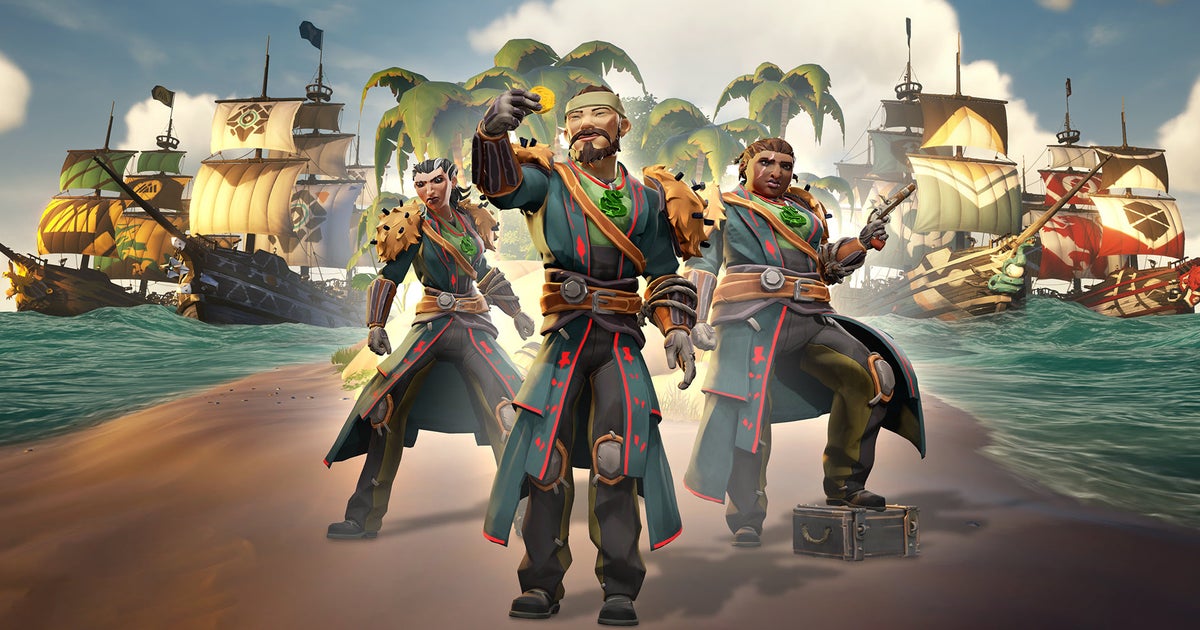
Everything is IP, all of the time, everywhere you look now, because big wigs in suits have got it in their heads that original, uniquely appealing content just can’t win over a combination of pixels that resemble something someone already likes. Sea of Thieves is no stranger to crossovers, with big, thematically relevant ones like Monkey Island and Pirates of the Caribbean, as well as some smaller ones like Halo and Banjo Kazooie. Today’s crossover is one of the smaller ones, this time with, uh… Destiny. The sci-fi, first-person shooter. Huh.
 private void AddLineAnnotation(ComboBox comboBox, List<Tuple<DateTime, DateTime>> waveList, bool isUpWave)
    {
        if (comboBox.SelectedItem == null) return;

        int selectedIndex = comboBox.SelectedIndex;
        if (selectedIndex < 0 || selectedIndex >= waveList.Count) return;

        var selectedWave = waveList[selectedIndex];
        var startCandlestick = candlestickList.FirstOrDefault(c => c.Date.Date == selectedWave.Item1.Date);
        var endCandlestick = candlestickList.FirstOrDefault(c => c.Date.Date == selectedWave.Item2.Date);

        if (startCandlestick != null && endCandlestick != null)
        {
            double startY = isUpWave ? startCandlestick.Low : startCandlestick.High;
            double endY = isUpWave ? endCandlestick.High : endCandlestick.Low;

            // Create line annotation
            var lineAnnotation = new LineAnnotation
            {
                AxisX = chart1.ChartAreas[0].AxisX,
                AxisY = chart1.ChartAreas[0].AxisY,
                X = startCandlestick.Date.ToOADate(),
                Y = startY,
                Width = endCandlestick.Date.ToOADate() - startCandlestick.Date.ToOADate(),
                Height = endY - startY,
                LineColor = isUpWave ? Color.Green : Color.Red,
                LineWidth = 2,
                LineDashStyle = ChartDashStyle.Solid,
                IsSizeAlwaysRelative = false,
                ClipToChartArea = chart1.ChartAreas[0].Name,
                Tag = "WaveLine" // add that if x and y are not numbers then use anchor x and anchor y, and it should be set to NAN
            };

            // Add the line annotation to the chart
            chart1.Annotations.Add(lineAnnotation);

            // Refresh the chart
            chart1.Invalidate();
        }
    } // this code is not working, help please
On Friday, the South Korean gaming company confirmed to TechCrunch that it has acquired a “north of 75% stake” in Nautilus, the gaming studio popular for its cricket enthusiast-focused Real Cricket franchise.
The Pune-based studio will continue to operate independently after the deal, which is expected to close by the end of the month, with all its 45 employees remaining on Nautilus’s payroll, Krafton told TechCrunch.
Founded in 2013, Nautilus has garnered millions of downloads for its Real Cricket franchise, which currently has five titles, including Real Cricket 24 and Real Cricket Premier League.
Real Cricket 24Image Credits:Nautilus Mobile
Krafton aims to strengthen Nautilus’s “core competence” in mobile cricket games — where demand is high in cricket-loving India — by refining its existing titles in the short term and exploring new genres in the long term, Sean Hyunil Sohn, CEO at Krafton India, said in an interview.
“Our development capability in Nautilus will help Krafton double down on its India gaming strategy, and together, we can probably build more games, more genres, both for the Indian market and global market going forward,” Nautilus CEO Anuj Mankar told TechCrunch.
Nautilus CEO Anuj Mankar Image Credits:Nautilus
The company plans to expand Nautilus’ presence to other geographies over time.
India’s mobile gaming market is growing steadily, driven by a large base of young smartphone users. Mobile games dominate the country’s overall gaming industry by spending, accounting for 77.9% of total revenue, per market intelligence firm Niko Partners. The firm also estimates that the country’s mobile gaming revenue will grow from $640 million in 2023 to $1.1 billion by 2028.
Krafton, which saw 119.3% year-over-year growth in its net profit last year to roughly $889 million (KRW 1.3 trillion), sees India as a promising and key market to continue its success. However, most of the growth from India has so far come from its flagship title for the local audience, Battlegrounds Mobile India (BGMI), which hit its highest-ever sales last year and surpassed 200 million downloads.
The company has other titles, including Bullet Echo India, Road To Valor, and CookieRun. However, they have not yet helped repeat the success story of the battle royale game, a localized version of PUBG.
The deal could help Krafton move beyond BGMI and explore new avenues of success, including cricket and other sports games, to attract new gamers.
Sean Hyunil Sohn, CEO, Krafton India,Image Credits:Krafton
Sohn told TechCrunch that while Nautilus’ potential was the reason for the initial investment, Krafton found its role as a minority stakeholder limiting in terms of supporting the studio’s content development. Gaining a controlling stake, he said, would allow for deeper collaboration and greater involvement in core development efforts with Nautilus.
“We strongly believe that cricket games have a lot of potential. And we want to work with Nautilus to make the best effort possible to really realize the potential of this market, not just in India, but in other cricket-playing nations and other countries, which are becoming more active in cricket,” said Nihansh Bhat, corporate lead development at Krafton India, told TechCrunch.
JetSynthesys will remain a “significant minority” investor in Nautilus Mobile and will continue to work with the studio on areas, including eSports. The company has already worked with the studio to help partner its Real Cricket game with cricket teams, including those associated with the Indian Premier League, the world’s most lucrative cricket tournament in India.
“We will, over a long period of time, want to look at, of course, increased revenue, increased user base, improved retention, all the usual things, and hopefully new deals as well,” Bhat said on the question of how Krafton would measure the deal’s success post its completion.
Until now, Krafton has invested over $200 million in India, excluding the Nautilus Mobile.
Krafton’s 20% investments in India have been in gaming and gaming-adjacent companies, though the company also invested in Indian startups, including the payments platform Cashfree, audio platform Kuku FM, and influencer marketing platform One Impression. It also backed funds, including gaming-focused Lumikai and IMM Investment’s first India fund.
“We are looking at the opportunity for acquisitions, moderate investments, and even business collaboration with notable players in the country,” Sohn said.
Nautilus will join the 14 other game studios Krafton operates in markets around the world.
During a special designer showcase at Shanghai’s Fashion week 2025, Disney put on a celebration of Toy Story designer duds to commemorate the Pixar movie turning 30. Yes, 30… we can’t believe it either. Also staggeringly out of this world are the looks that hit the runway inspired by the vintage toys featured in the film.
The Disney Style account on Instagram shared the showcase, offering a look at pieces that made us go “Whooooaaahhhh” many, many times. From elevated cosplay-inspired outfits to minimalist motifs and brazenly bold deconstructions, you have to see how your beloved Pixar pals have been reimagined.
Take a look at the gallery here featuring the works of Chinese designers and brands, including Bokh Xuesong, Chin Chin, JE CAI, LELALES, LI-NING, Manufacture, Nan Knits, PONDER.ER, Short Sentence, and ZOON9B00.
:
The Buzz Lightyear looks are definitely a slay in our io9 eyes, while the Western attire gets a little out there. The one with the glass case and Pixar logo beanie is giving Silicon Valley Al’s Online Toy Barn, if he were a tech bro toy flipper. It’s also fun to see the rest of the franchise get some love with pieces featuring Lotso, Forky, and Key and Peele’s Ducky and Bunny duo. Out of the outfits shown, I think I’d like to rock that Lightyear meets Clueless pleated shirt and jacket.
Here’s a video with even more ridiculously ambitious looks:
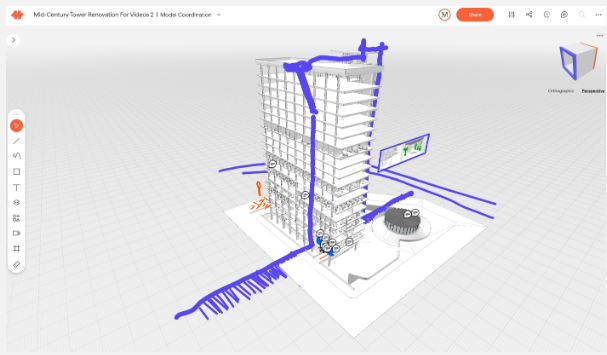
Motif a startup in the architecture, engineering, and construction (AEC) sector, has unveiled its innovative cloud-based platform to revolutionize design collaboration. This platform merges 2D and 3D workflows, offering a unified workspace for architects, engineers, and stakeholders to collaborate in real-time without the limitations of traditional tools.
Key Features of Motif:
Unified Collaboration Workspace: An infinite canvas integrating 2D drawings, 3D models, sketches, and specifications in one place.
Live Model Streaming & Integration: Real-time updates with Revit and Rhino, eliminating the need for manual re-uploads.
2D & 3D Sketching and Markups: Enables instant commenting and sketching, seamlessly syncing feedback across tools.
Smart Presentation Tools: Interactive presentations linked directly to live designs.
Web-Based Accessibility: Requires no software installation, ensuring inclusivity for all stakeholders, even those without CAD expertise.
Plugins for Revit, Rhino and other BIM/CAD apps allows access to the collaboration both in the native app where the design is done and in Motif.
This eliminates traditional barriers like disconnected tools, fragmented workflows, and accessibility issues, ensuring efficient design reviews and meaningful participation for all team members, architects, designers, engineers, owners, clients, etc.
Motif’s debut is more than a collaboration tool; it’s the foundation for an intelligent and connected future for Building Information Modeling (BIM). The company aims to enhance creativity, reduce friction, and harness AI to empower smarter design decisions.
“Today’s AEC workflows are burdened by fragmented data, rigid software, and disconnected collaboration tools that slow down decision-making,” says Amar Hanspal, CEO and Co-Founder of Motif. “Motif is redefining BIM with a focus on being open, intelligent, and collaborative, where BIM isn’t just about managing information—it’s about unlocking intelligence. We’re starting with intelligent collaboration—a platform that bridges gaps between teams, integrates with existing tools, and leverages AI to provide insights that drive better decisions. This is step one of many in building a smarter, more connected BIM future—one that removes friction, enhances creativity, and makes design intelligence truly accessible.”
“Motif simplifies how we collaborate across teams,” said Bill Carney, Design Technology Leader and Principal at DLR Group. “Instead of juggling screenshots, PDFs, and disconnected markups, everything is now in one place—live, structured, and effortless. Instead of creating work-arounds to collaborate we can focus on decisions and feedback in real time. Motif has made coordination faster and eliminated so many back-and-forths.”
About: Motif Systems, Inc. is building the next generation software platform for the modern built environment. Founded in 2023 by Amar Hanspal (former Co-CEO and Chief Product Officer at Autodesk) and Brian Mathews (former CTO at Autodesk), along with founding employees of Revit, Motif enables seamless, real-time collaboration for architecture, engineering, and construction professionals.
With early access now open, Motif invites teams of all sizes to experience the next era of design collaboration. Interested professionals can request a free trial at motif.io.
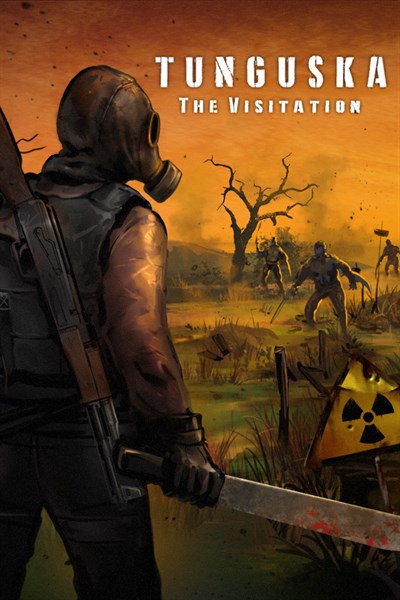
Live a fulfilling life in the Zone with crafting, farming, cooking, and tons of quests and stories.
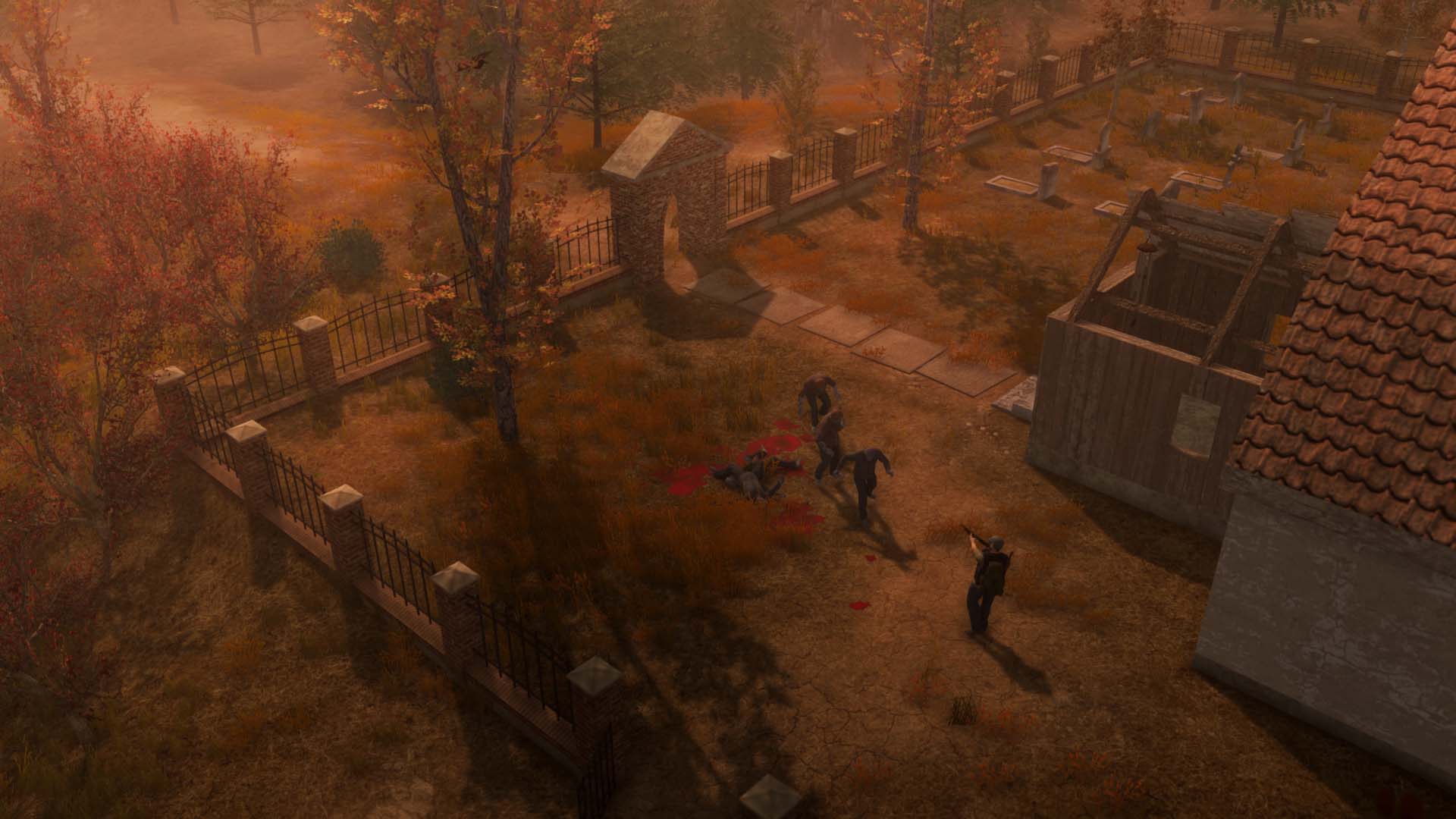
Attention, fellow Ghoul Hunters! Welcome to the Zone. Or shall I say: welcome to your final demise? Because according to my studies, only one in a hundred Ghoul Hunters will survive in the Zone! Deadly Distortions, dangerous mutants, heavily-armed bandits, and yes, the cursed Visitations! They are here to claim your life and your soul.
But fear not: the Cossacks are here to help! We’ll provide you with the best gears and training (for a small fee, of course), and we’ll always have your back. Now, if you can spare me a few minutes, I’m sure a few tips and tricks can get you started.
Don’t Get into Fights Unless You Have to
You may trust your grandpa’s Makarov and sawed-off double-barrel, but what are you up against? AK’s, sub-machine guns, AS-Val, SVD, oh and even RPD and PKM – bad guys armed to the teeth who don’t even bother to loot rookies like you!
So here’s my advice: stick to the shadows, sneak past your foes, and learn to take them down quietly with a garrote. But when you get a hold of those big toys, work on improving your skill level with each kind, and find weapon attachments to unleash their true power.
Take Good Care of Your Gears
Life in the Zone is not your dream vacation. Your armors will degrade. Your devices will run out of battery. Your guns will jam.
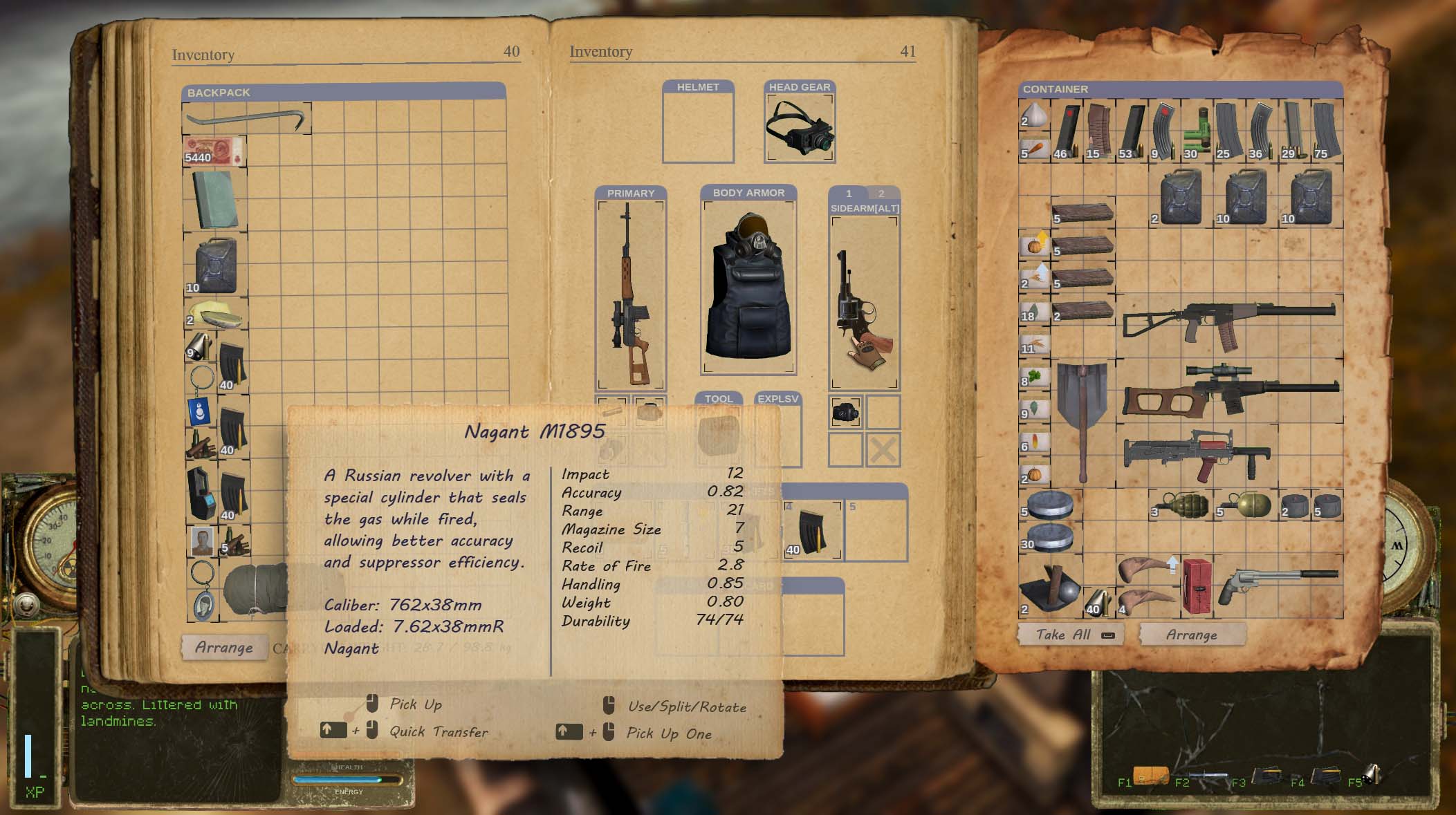
Remember, your life depends on your gears working flawlessly, so use a repair kit to maintain them after every battle! You can bring any worn-out weapon and armor to our workbench for repair – free of charge, as long as you know how to fix them.
Always Keep Your Eyes Peeled for More Loot
There are always supplies in every nook and cranny for you to find. Food, ammo, medicine, serums, ingredients, they are all crucial to your survival in the Zone. Especially iodide pills for radiation, and Vodka for Tunguska Syndrome – if you need more, come see our trader and we’ll cut you a good deal.
Don’t forget: you can craft almost everything you need in the Zone. Cooking, farming, loading bullets, brewing serum, and even distilling alcohol for the serum lab (and of course, for escaping from your troubles and sorrow!), you can essentially live a life here.
Finally, Bring All Your Spoils to The Cossacks
After all, you are here to be Ghoul Hunters, right? Remember: bullets don’t do you any good – they’ll just rip up all those mutated body parts that you’ll need to make money with. On the other hand, melee weapons give you the best chance to harvest high quality serum ingredients. Just bring them to us and we’ll make you rich, because the Cossacks make the best serums!
So join us now, and we’ll fight together, hunt together, and prosper together, only in Tunguska: The Visitation today on Xbox!
Tunguska: The Visitation – Complete Edition
Rotorist Workshop
☆☆☆☆☆
★★★★★
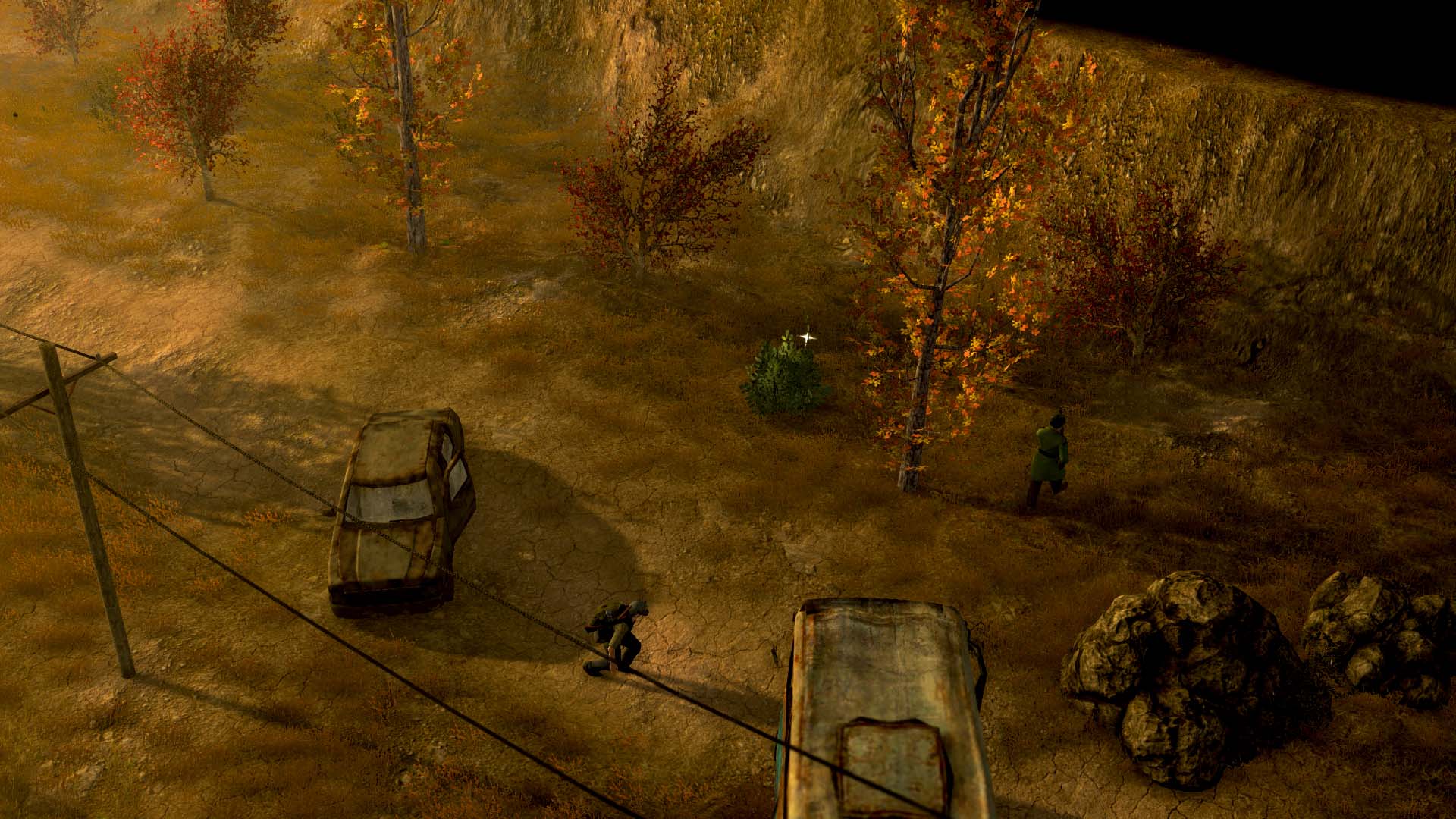
Seek fortune as a Ghoul Hunter in an abandoned Soviet Exclusion Zone. Use your grit and ingenuity to survive deadly radiation, mysterious anomalies, and poisonous mutants. Go in guns-blazing, or stay in the shadows – your choice.
Uncover the dark secrets of Tunguska from the Soviet era. Venture across desolate villages, abandoned facilities, toxic swamps, and ominous tunnels in this top-down adventure RPG, in a realm cursed by the mysterious Tunguska Event in 1908.
Inspired by the novel Roadside Picnic, Tunguska is one man’s vision and creation of a new post-Visitation zone: a place not just full of horror and danger, but also the freedom and opportunities sought after by many near the fall of the USSR.
SURVIVAL
Tunguska: The Visitation is 3D top-down action shooter, infused with moderate survival elements such as food, medicine, body energy, character stat buff, hazardous environments, and inventory management. The slow-paced, methodical gameplay inspires critical thinking and strategic planning.
A perk-based skill system lets you decide on how to build expertise – be it combat-heavy, stealthy, crafty, or just an all around survivor of the Zone.
COMBAT
Put your grit to the test with real time melee brawls and gunfights. With a large arsenal of weapons, you can be creative and come up with the best approach for each combat scenario. Stick to the shadows and use distractions, if being stealthy is up your alley.
CRAFTING
The Zone is not a barren place. Collect wild herbs, grow crops, and hunt for wild animals to collect ingredients for cooking and brewing. Use the workbench to craft ammunition and repair your gears.
COMPLETE EDITION
Includes: main game, Ravenwood Stories, Shadowmaster, New Game+, and Slaughterhouse.
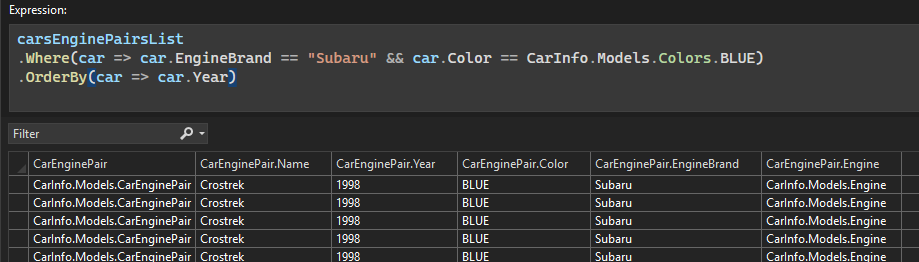
Are you tired of wrestling with complex LINQ queries during debugging? Visual Studio 2022 has introduced powerful new improvement, powered by AI, to simplify your workflow with its editable expression feature in the IEnumerable Visualizer. These added functionalities aim to make debugging more intuitive and efficient, helping you write and refine LINQ queries with ease.
Say goodbye to frustration and hello to efficiency with the new enhancement!
The Challenge: Crafting Complex and Desired LINQ Expressions
Generating and troubleshooting LINQ queries can be a tedious and intricate process, often demanding precise syntax knowledge and countless iterations. Developers could have spent excessive time refining queries, slowing down the debugging process. To solve this, Visual Studio introduces three major enhancements: Syntax Highlighting for editable expressions, Inline Chat for quick refinement, and GitHub Copilot Chat Integration for advanced assistance. These features streamline LINQ query writing, helping you debug your project dealing with large dataset with greater speed and accuracy.
Syntax Highlighting for Editable Expressions
To make queries more readable and easier to debug, Visual Studio 2022 now includes Syntax Highlighting in the IEnumerable Visualizer’s editable expression. Different elements of the query, such as keywords, classes, enums, and structures, are color-coded, making it easier to identify and understand their roles within the expression. This enhancement allows developers to quickly scan and pinpoint potential issues at a glance.
Customize syntax highlighting
Visual Studio allows you to customize the color scheme to suit your preferences. To personalize your colors:
Go to Tools > Options > Environment > Fonts and Colors.
Select Text Editor from the Show settings for dropdown.
Adjust each User Types item’s color to match your coding style.
Editable Expression Inline Copilot Chat
In addition to syntax highlighting, the IEnumerable Visualizer now features Inline Chat, allowing users to leverage AI directly within the visualizer to refine LINQ queries. With this feature, writing and modifying queries becomes more intuitive.
To bring up the Inline Chat, simply click the GitHub Copilot sparkle button located in the bottom-right corner of the editable expression text box. This will open a text box above the original editable expression, with a prompt that says, “Describe how you want to refine your current expression.”
GitHub Copilot will generate a LINQ query based on your input and automatically execute it by default. For immediate confirmation, look for the green checkmark , which indicates that the LINQ query generated by GitHub Copilot has been fully executed and applied. You can reuse the input field to describe how you’d like to modify your current expression using natural language. After entering your request, clicking the sent arrow on the right prompts Copilot to generate an optimized LINQ query.
Copilot Chat Integration for Deeper Debugging
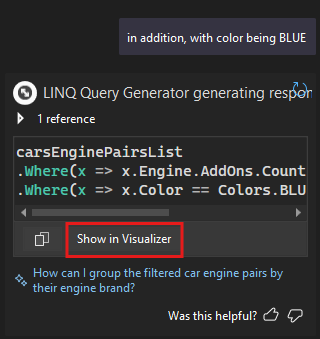
For those who need further refinement beyond inline edits, the Copilot Chat integration provides a more advanced debugging experience. Once the Inline Chat generates a LINQ query, a “Continue in Chat” option appears, allowing developers to engage in a deeper, interactive conversation about their query. Clicking this button opens the GitHub Copilot Chat Window, where users can refine the expression further, ask follow-up questions, or explore alternative approaches. This feature ensures that even the most complex queries can be fine-tuned with the power of AI while keeping developers in full control of their code.
This feature not only assists in generating LINQ queries but also provides immediate feedback and guidance, making it easier to create complex filters and transformations with confidence. When satisfied with the refinements, developers can seamlessly transition back to the visualizer using the “Show in Visualizer” button, which applies the optimized query directly within the debugging environment. The Inline Chat is perfect for quick adjustments, while the full Copilot Chat Integration supports deeper iterations, ensuring a smooth and efficient debugging workflow.
Many of these ideas stem from your feedback through customer interviews and Developer Community suggestions. Our goal is to reduce debugging time and enhance developer productivity. Whether you’re making minor syntax tweaks or optimizing complex queries, these improvements bring greater clarity and efficiency to debugging codebase working with large datasets.
Your continuous feedback is what drives us to improve Visual Studio. We are excited to see how the enhanced editable expression feature with AI assistance will transform your debugging experience. Keep sharing your insights and suggestions to help us make Visual Studio even better.
Best Buy’s Spring Sale may be over, but you can still claim one of the best headphone deals that I’ve seen all year. The Beats Studio Pro, a versatile pair of wireless headphones with active noise cancellation and up to 40 hours of battery life, are still chilling with a whopping 49% discount on the retailer’s site, knocking the price all the way down to $179.99. As if that wasn’t enough on its own, Best Buy will also give you three free months of Apple Music AND three free months of Apple Fitness Plus with your purchase, a combined value of over 60 bucks.
Like many of the best wireless headphones out there, the Beats Studio Pro are all about putting the listener into the driver’s seat. You get fancy features like active noise cancellation, head tracking, and spatial audio support straight out of the box, but the value really shines through the headphones’ potential for personalization. You get a ton of customizable EQ options through the companion Beats app, plus three pre-installed sound profiles — Beats Signature, Entertainment, and Conversation.
(Image credit: Beats by Dre)
Beats Signature is meant to provide the classic listening experience for audiophiles, utilizing the Studio Pro’s 40mm drivers and dynamic head tracking to deliver super-immersive sound, regardless of genre. The Entertainment profile, on the other hand, automatically adjusts to optimize the sound of movies, TV shows, and games, while the Conversation preset is meant for phone calls and meetings.
Now, I’ll be real with you: given the age of the Beats Studio Pro (the headphones dropped in 2023), I wouldn’t pay full price at this point. You could easily take that $350 and buy the Sony XM5 instead for a considerably better experience all around. But pair these noise-cancelling headphones with nearly 50% off AND three free months of Apple Music? That’s pretty much a no-brainer recommendation from me.
Ever wonder what the difference is between writing an article and writing a blog post? It’s a topic that comes up a lot when people first start asking how to become a freelance writer. Besides style and research, you might be surprised by one of the key differences between blogs and articles.
There’s a lot of confusion out there in the freelance-writing world about blog posts and articles. Also, about what each of those types of writing should pay.
A few years ago, I got a lot of response to my call for freelance writers to stop writing blog posts. Many writers were confused about just what the difference is.
So let’s discuss. Because things have changed. And understanding the differences between these two writing forms will help you earn more.
Writing an article vs. writing a blog post
For years, blog posts and nonfiction articles were distinctly different:
Blog Post
Article
Mostly your own opinion
Your opinion not allowed
No interviews or research
Has interviews and research from credible experts and research firms
Short
Longer than 300 words
Built around SEO keywords
Keywords not important
Good spelling and grammar optional
Spelling and grammar are impeccable
Casual writing style
More sophisticated writing style
No editor involved; self-published
An editor cleans it up for you; published by a print magazine
Freelance pay rates usually very low; much work in the $5-$20 per piece range
Pay rates from $0.10-$1 a word and up
Then something happened, and over the past few years, the lines became blurred.
Blog-article convergence
Over the years, blog posts started to get more like articles. As a bazillion blogs crowded the Internet, the bar began to raise.
Blog posts began to have more interviews. They presented interesting data. Posts got longer as bloggers sought to stand out and deliver more value, until 1,000 words has become fairly standard, and 2,000-word posts are not uncommon. SEO keywords’ value lessened as Google cracked down on keyword-stuffed content. Also, as blogs got more professional, many hired editors.
On the article-writing side, there was also movement. Many print magazines began posting copies of their articles online. Suddenly, magazine headlines needed to drive traffic, just like blog-post headlines, and headline styles evolved. They published more opinion-driven pieces from thought leaders. Some also put up blogs where they let writers hit the “publish” button on their own.
Wordcounts shortened for print, as ad revenue migrated online. Some magazines went online-only. Their style got breezier and more casual.
To sum up, the two types of writing began to merge into one. Definitions got squishy, and now there’s a lot of confusion.
Except about one thing: Blog posts tend to pay crap, and articles tend to pay better.
Client confusion
Uneducated clients who don’t really know these two forms have been busy muddying up the conversation about them for years. That’s made it hard for writers to define writing projects and bid them appropriately.
There are plenty of clients out there who call the 300-word quickie posts they want articles, but still want to pay $5 for them.
There are also many clients who’d like you to write 1,000-word blog posts with two interviews and a research stat, but they’d like to pay $20 because it’s a blog post.
Your job as a freelance writer is to cut through the bull and get to what the assignment really is, then, talk about what that assignment should really pay.
How writers can earn more writing an article or a blog post
The fact is, clients are always going to try to get things cheap. It’s up to writers to educate clients about what they’re asking for, and what’s fair pay for what they want you to write.
The good news is, the convergence of blog posts and articles should offer writers better pay opportunities. Blog posts are growing up, they’re increasingly not the ugly stepsister of articles. So they ought to pay more like the articles they often are.
But it’s up to the writer to take the steps to capitalize on this change in the marketplace.
Some suggested steps
Define it. When a client tells you they want articles, or they want blog posts, ask them to define what they mean. Are there interviews involved? How many? What’s the piece length?
Sway them. Sell them on the idea that what they want is considered an article by pro writers. It’ll instantly boost your rates. Make your case for why it’s an article and not a blog post
Sell articles. When you’re talking to clients who don’t quite know what they want, sell them on the idea that you should be writing an article for them, rather than a blog post, if they want their content marketing to be successful. Share the news of how Google is frowning on short keyword-driven posts
Sell blog upgrades. If they want posts for an existing blog, sell them on the value of taking their blog to the next level, to more of a reported-story, magazine-type feel, and what that could do for their reputation and visibility
Writing an article vs. writing a blog post: What to charge
Where most writers are lucky to get $100 a post for blog posts (and I recommend you try to make that your floor for blog writing) article rates are usually much better. I’ve written many at $300 to $500, and many more at $600 to $2,000, depending on length and complexity.
Many smaller daily papers pay in the $75 to $100 range for short articles, but have the advantage of giving you more impressive clips for your portfolio. You also get the bonus of learning to report a story, which lays the groundwork for getting better-paying articles in future, from businesses or magazines.
Getting the win
The fact is, articles and article-style blog posts convey more authority. They impress more of your client’s customers. The projects will be more successful, and those clients will be more likely to hire you back to write more. It’s a classic win-win: you can charge more at the start, and will likely end up getting more work from the client, too, because they’ll be happier with the results they get.
I have multiple Switches in my house, and a family account for everyone, too. Sharing games is incredibly annoying, at least for digital purchases: if someone has a different Nintendo Account, it means buying a new copy. But that’s changing, sort of, with Virtual Game Cards. The news, announced at a Nintendo Direct just a week before a streaming Switch 2 reveal on April 2, could be a big deal for my home, and probably yours, too.
Digital content’s already shared around my house. I share iTunes purchases with the family. We share Kindle books. Virtual Game Cards look like they’ll be managed as card-like icons that show up on your Switch and then can be sent locally between Switch systems, either to use or borrow.
According to Nintendo, two Switches can exchange a digital game via local connection (for the first setup, and then it looks like just an internet connection is needed for both Switches for the transfer), “ejecting” the game and loading it on the other system. This solves an annoying thing on current Switches where only one Switch can be made the “primary” device. Right now, for instance, I have several Switches with my Nintendo Account on them, but on only one can I play games offline. The others have to be online to authenticate the game. Nintendo’s getting rid of this, at least between two Switches.
The other part of Virtual Game Cards involves loaning out between members of the family. This feature looks like it works the same as far as locally transferring the digital came card file, but the game can only be borrowed for two weeks. After that, the file will be “returned” to the original Switch. Game save data isn’t lost, so the game could be re-loaned again to refresh the borrow.
The Virtual Game Card icons will generate for digital games you own, and be managed on a new part of the system software.
Nintendo
The whole development is welcome news, and it suggests a new approach to digital games ahead of the Switch 2 launch. But it doesn’t solve all my problems. I would have preferred a way to share games perpetually across all family members, or at least purchasing a lower-cost license to do that. The limited two-Switch limit on playing games offline on one account is better than before, but anyone with more Switches on one account will still have to juggle.
But it does show that Nintendo is trying to change the way new customers move over to the Switch 2. Previously, new console setups involved annoying redownloads and authorizations, including reassigning which Switch was “primary.” Virtual Game Card support arrives late April, ahead of the Switch 2, which should mean that setting up a Switch 2 and moving digital games over might be an easier process than it was before. I’m still curious how it all works, and what the limits truly feel like, but for that we may need to wait until the end of April to test.








 located in the bottom-right corner of the editable expression text box. This will open a text box above the original editable expression, with a prompt that says, “Describe how you want to refine your current expression.”
 , which indicates that the LINQ query generated by GitHub Copilot has been fully executed and applied. You can reuse the input field to describe how you’d like to modify your current expression using natural language. After entering your request, clicking the sent arrow on the right prompts Copilot to generate an optimized LINQ query.