Introduction
The AI landscape of 2026 is defined less by model training and more by how effectively we serve those models. The industry has learned that inference—the act of deploying a pre‑trained model—is the bottleneck for user experience and budget. The cost and energy footprint of AI is soaring; global data‑centre electricity demand is projected to double to 945 TWh by 2030, and by 2027 nearly 40 % of facilities may hit power limits. These constraints make efficiency and flexibility paramount.
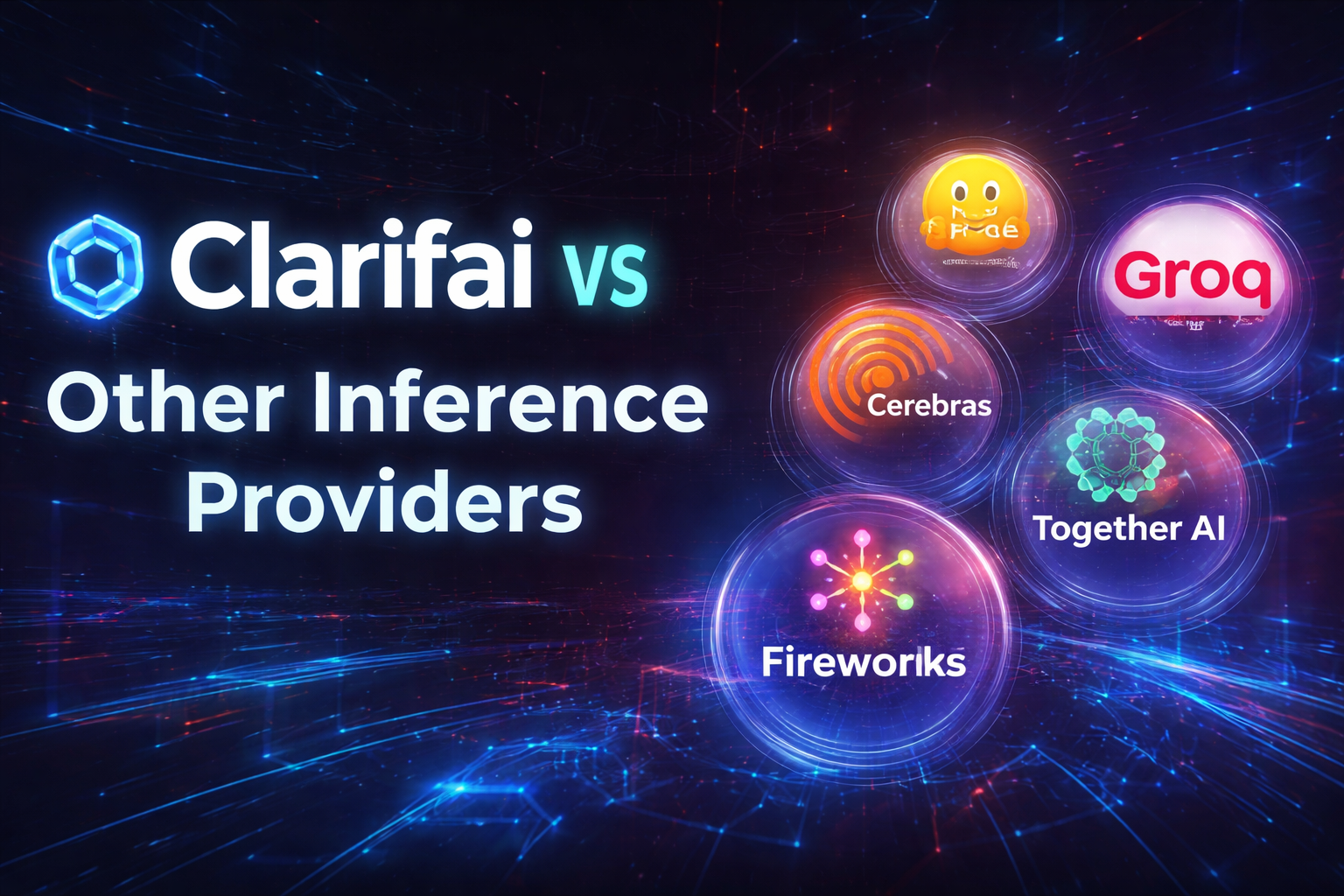
This article pivots the spotlight from a simple Groq vs. Clarifai debate to a broader comparison of leading inference providers, while placing Clarifai—a hardware‑agnostic orchestration platform—at the forefront. We examine how Clarifai’s unified control plane, compute orchestration, and Local Runners stack up against SiliconFlow, Hugging Face, Fireworks AI, Together AI, DeepInfra, Groq and Cerebras. Using metrics such as time‑to‑first‑token (TTFT), throughput and cost, along with decision frameworks like the Inference Metrics Triangle, Speed‑Flexibility Matrix, Scorecard, and Hybrid Inference Ladder, we guide you through the multifaceted choices.
Quick digest:
- Clarifai offers a hybrid, hardware‑agnostic platform with 313 TPS, 0.27 s latency and the lowest cost in its class. Its compute orchestration spans public cloud, private VPC and on‑prem, and Local Runners expose local models through the same API.
- SiliconFlow delivers up to 2.3× faster speeds and 32 % lower latency than leading AI clouds, unifying serverless and dedicated endpoints.
- Hugging Face provides the largest model library with over 500 000 open models, but performance varies by model and hosting configuration.
- Fireworks AI is engineered for ultra‑fast multimodal inference, offering ~747 TPS and 0.17 s latency at a mid‑range cost.
- Together AI balances speed (≈917 TPS) and cost with 0.78 s latency, focusing on reliability and scalability.
- DeepInfra prioritizes affordability, delivering 79–258 TPS with wide latency spread (0.23–1.27 s) and the lowest price.
- Groq remains the speed specialist with its custom LPU hardware, offering 456 TPS and 0.19 s latency but limited model selection.
- Cerebras pushes the envelope in wafer‑scale computing, achieving 2 988 TPS with 0.26 s latency for open models, at a higher entry cost.
We will explore why Clarifai stands out through its flexible deployment, cost efficiency and forward‑looking architecture, then compare how the other players suit different workloads.
Understanding inference provider categories
Why multiple categories exist
Inference providers fall into distinct categories because enterprises have varying priorities: some need the lowest possible latency, others need broad model support or strict data sovereignty, and many want the best cost‑performance ratio. The categories include:
- Hybrid orchestration platforms (e.g., Clarifai) that abstract infrastructure and deploy models across public cloud, private VPC, on‑prem and local hardware.
- Full‑stack AI clouds (SiliconFlow) that bundle inference with training and fine‑tuning, providing unified APIs and proprietary engines.
- Open‑source hubs (Hugging Face) that offer vast model libraries and community‑driven tools.
- Speed‑optimized platforms (Fireworks AI, Together AI) tuned for low latency and high throughput.
- Cost‑focused providers (DeepInfra) that sacrifice some performance for lower prices.
- Custom hardware pioneers (Groq, Cerebras) that design chips for deterministic or wafer‑scale inference.
Metrics that matter
To fairly assess these providers, focus on three primary metrics: TTFT (how quickly the first token streams back), throughput (tokens per second after streaming starts), and cost per million tokens. Visualize these metrics using the Inference Metrics Triangle, where each corner represents one metric. No provider excels at all three; the triangle forces trade‑offs between speed, cost and throughput.
Expert insight: In public benchmarks for GPT‑OSS‑120B, Clarifai posts 313 TPS with a 0.27 s latency at $0.16/M tokens. SiliconFlow achieves 2.3× faster inference and 32 % lower latency than leading AI clouds. Fireworks AI reaches 747 TPS with 0.17 s latency. Together AI delivers 917 TPS at 0.78 s latency, while DeepInfra trades performance for cost (79–258 TPS, 0.23–1.27 s). Groq’s LPUs provide 456 TPS with 0.19 s latency, and Cerebras leads throughput with 2 988 TPS.
Where benchmarks mislead
Benchmark charts can be deceiving. A platform may boast thousands of TPS but deliver sluggish TTFT if it prioritizes batching. Similarly, low TTFT alone doesn’t guarantee good user experience if throughput drops under concurrency. Hidden costs such as network egress, premium support, and vendor lock‑in also influence real‑world decisions. Energy per token is emerging as a metric: Groq consumes 1–3 J per token while GPUs consume 10–30 J—critical for energy‑constrained deployments.
Clarifai: Flexible orchestration and cost‑efficient performance
Platform overview
Clarifai positions itself as a hybrid AI orchestration platform that unifies inference across clouds, VPCs, on‑prem and local machines. Its compute orchestration abstracts containerisation, autoscaling and time slicing. A unique feature is the ability to run the same model via public cloud or through a Local Runner, exposing the model on your hardware via Clarifai’s API with a single command. This hardware‑agnostic approach means Clarifai can orchestrate NVIDIA, AMD, Intel or emerging accelerators.
Performance and pricing
Independent benchmarks show Clarifai’s hosted GPT‑OSS‑120B delivering 313 tokens/s throughput with a 0.27 s latency, at a cost of $0.16 per million tokens. While this is slower than specialized hardware providers, it is competitive among GPU platforms, particularly when combined with fractional GPU utilization and autoscaling. Clarifai’s compute orchestration automatically scales resources based on demand, ensuring smooth performance during traffic spikes.
Deployment options
Clarifai offers multiple deployment modes, allowing enterprises to tailor infrastructure to compliance and performance needs:
- Shared SaaS: Fully managed serverless environment for curated models.
- Dedicated SaaS: Isolated nodes with custom hardware and regional choice.
- Self‑managed VPC: Clarifai orchestrates inference inside your cloud account.
- Self‑managed on‑premises: Connect your own servers to Clarifai’s control plane.
- Multi‑site & full platform: Combine on‑prem and cloud nodes with health‑based routing and run the control plane locally for sovereign clouds.
This range ensures that models can move seamlessly from local prototypes to enterprise production without code changes.
Local Runners: bridging local and cloud
Local Runners enable developers to expose models running on local machines through Clarifai’s API. The process involves selecting a model, downloading weights and choosing a runtime; a single CLI command creates a secure tunnel and registers the model. Strengths include data control, cost savings and the ability to debug and iterate rapidly. Trade‑offs include limited autoscaling, concurrency constraints and the need to secure local infrastructure. Clarifai encourages starting locally and migrating to cloud clusters as traffic grows, forming a Local‑Cloud Decision Ladder:
- Data sensitivity: Keep inference local if data cannot leave your environment.
- Hardware availability: Use local GPUs if idle; otherwise lean on the cloud.
- Traffic predictability: Local suits stable traffic; cloud suits spiky loads.
- Latency tolerance: Local inference avoids network hops, reducing TTFT.
- Operational complexity: Cloud deployments offload hardware management.
Advanced scheduling & emerging techniques
Clarifai integrates cutting‑edge techniques such as speculative decoding, where a draft model proposes tokens that a larger model verifies, and disaggregated inference, which splits prefill and decode across devices. These innovations can reduce latency by 23 % and increase throughput by 32 %. Smart routing assigns requests to the smallest sufficient model, and caching strategies (exact match, semantic and prefix) cut compute by up to 90 %. Together, these features make Clarifai’s GPU stack rival some custom hardware solutions in cost‑performance.
Strengths, weaknesses and ideal use cases
Strengths:
- Flexibility & orchestration: Run the same model across SaaS, VPC, on‑prem and local environments with unified API and control plane.
- Cost efficiency: Low per‑token pricing ($0.16/M tokens) and autoscaling optimize spend.
- Hybrid deployment: Local Runners and multi‑site routing support privacy and sovereignty requirements.
- Evolving roadmap: Integration of speculative decoding, disaggregated inference and energy‑aware scheduling.
Weaknesses:
- Moderate latency: TTFT around 0.27 s means Clarifai may lag in ultra‑interactive experiences.
- No custom hardware: Performance depends on GPU advancements; doesn’t match specialized chips like Cerebras for throughput.
- Complexity for beginners: The breadth of deployment options and features may overwhelm new users.
Ideal for: Hybrid deployments, enterprise environments needing on‑prem/VPC compliance, developers seeking cost control and orchestration, and teams who want to scale from local prototyping to production seamlessly.
Quick summary
Clarifai stands out as a flexible orchestrator rather than a hardware manufacturer. It balances performance and cost, offers multiple deployment modes and empowers users to run models locally or in the cloud under a single interface. Advanced scheduling and speculative techniques keep its GPU stack competitive, while Local Runners address privacy and sovereignty.
Major contenders: strengths, weaknesses and target users
SiliconFlow: All‑in‑one AI cloud platform
Overview: SiliconFlow markets itself as an end‑to‑end AI platform with unified inference, fine‑tuning and deployment. In benchmarks, it delivers 2.3× faster inference speeds and 32 % lower latency than leading AI clouds. It offers serverless and dedicated endpoints and a unified OpenAI‑compatible API with smart routing.
Pros: Proprietary optimization engine, full‑stack integration and flexible deployment options. Cons: Learning curve for cloud infrastructure novices; reserved GPU pricing may require upfront commitments. Ideal for: Teams needing a turnkey platform with high speed and integrated fine‑tuning.
Hugging Face: Open‑source model hub
Overview: Hugging Face hosts over 500 000 pre‑trained models and provides APIs for inference, fine‑tuning and hosting. Its transformers library is ubiquitous among developers.
Pros: Massive model variety, active community and flexible hosting (Inference Endpoints and Spaces). Cons: Performance and cost vary widely depending on the selected model and hosting configuration. Ideal for: Researchers and developers needing diverse model choices and community support.
Fireworks AI: Speed‑optimized multimodal inference
Overview: Fireworks AI specialises in ultra‑fast multimodal deployment. The platform uses custom‑optimised hardware and proprietary engines to maintain low latency—around 0.17 s—with 747 TPS throughput. It supports text, image and audio models.
Pros: Industry‑leading inference speed, strong privacy options and multimodal support. Cons: Smaller model selection and higher price for dedicated capacity. Ideal for: Real‑time chatbots, interactive applications and privacy‑sensitive deployments.
Together AI: Balanced throughput and reliability
Overview: Together AI provides reliable GPU deployments for open models such as GPT‑OSS 120B. It emphasizes consistent uptime and predictable performance over pushing extremes.
Performance: In independent tests, Together AI achieved 917 TPS with 0.78 s latency at a cost of $0.26/M tokens.
Pros: Strong reliability, competitive pricing and high throughput. Cons: Latency is higher than specialized platforms; lacks hardware innovation. Ideal for: Production applications needing consistent performance, not necessarily the fastest TTFT.
DeepInfra: Cost‑efficient experiments
Overview: DeepInfra offers a simple, scalable API for large language models and charges $0.10/M tokens, making it the most budget‑friendly option. However, its performance varies: 79–258 TPS and 0.23–1.27 s latency.
Pros: Lowest price, supports streaming and OpenAI compatibility. Cons: Lower reliability (around 68–70 % observed), limited throughput and long tail latencies. Ideal for: Batch inference, prototyping and non‑critical workloads where cost matters more than speed.
Groq: Deterministic custom hardware
Overview: Groq’s Language Processing Unit (LPU) is designed for real‑time inference. It integrates high‑speed on‑chip SRAM and deterministic execution to minimize latency. For GPT‑OSS 120B, the LPU delivers 456 TPS with 0.19 s latency.
Pros: Ultra‑low latency, high throughput per chip, cost‑efficient at scale. Cons: Limited model catalog and proprietary hardware require lock‑in. Ideal for: Real‑time agents, voice assistants and interactive AI experiences requiring deterministic TTFT.
Cerebras: Wafer‑scale performance
Overview: Cerebras invented wafer‑scale computing with its WSE. This architecture enables 2 988 TPS throughput and 0.26 s latency for GPT‑OSS 120B.
Pros: Highest throughput, exceptional energy efficiency and ability to handle massive models. Cons: High entry cost and limited availability for small teams. Ideal for: Research institutions and enterprises with extreme scale requirements.
Comparative table (extended)
| Provider |
TTFT (s) |
Throughput (TPS) |
Cost (USD/M tokens) |
Model Variety |
Deployment Options |
Ideal For |
| Clarifai |
~0.27 |
313 |
0.16 |
High: hundreds of OSS models + orchestration |
SaaS, VPC, on‑prem, local |
Hybrid & enterprise deployments |
| SiliconFlow |
~0.20 (2.3× faster than baseline) |
n/a |
n/a |
Moderate |
Serverless, dedicated |
Teams needing integrated training & inference |
| Hugging Face |
Varies |
Varies |
Varies |
500 000+ models |
SaaS, spaces |
Researchers, community |
| Fireworks AI |
0.17 |
747 |
0.26 |
Moderate |
Cloud, dedicated |
Real‑time multimodal |
| Together AI |
0.78 |
917 |
0.26 |
High (open models) |
Cloud |
Reliable production |
| DeepInfra |
0.23–1.27 |
79–258 |
0.10 |
Moderate |
Cloud |
Cost‑sensitive batch |
| Groq |
0.19 |
456 |
0.26 |
Low (select open models) |
Cloud only |
Deterministic real‑time |
| Cerebras |
0.26 |
2 988 |
0.45 |
Low |
Cloud clusters |
Massive throughput |
Note: Some providers do not publicly disclose cost or latency; “n/a” indicates missing data. Actual performance depends on model size and concurrency.
Decision frameworks and reasoning
Speed‑Flexibility Matrix (expanded)
Plot each provider on a 2D plane: the x‑axis represents flexibility (model variety and deployment options), and the y‑axis represents speed (TTFT & throughput).
- Top‑right (high speed & flexibility): SiliconFlow (fast & integrated), Clarifai (flexible with moderate speed).
- Top‑left (high speed, low flexibility): Fireworks AI (ultra low latency) and Groq (deterministic custom chip).
- Mid‑right (moderate speed, high flexibility): Together AI (balanced) and Hugging Face (depending on chosen model).
- Bottom‑left (low speed & low flexibility): DeepInfra (budget option).
- Extreme throughput: Cerebras sits above the matrix due to its unmatched TPS but limited accessibility.
This visualization highlights that no provider dominates all dimensions. Providers specializing in speed compromise on model variety and deployment control; those offering high flexibility may sacrifice some speed.
Scorecard methodology
To select a provider, create a Scorecard with criteria such as speed, flexibility, cost, energy efficiency, model variety and deployment control. Weight each criterion according to your project’s priorities, then rate each provider. For example:
| Criterion |
Weight |
Clarifai |
SiliconFlow |
Fireworks AI |
Together AI |
DeepInfra |
Groq |
Cerebras |
| Speed (TTFT + TPS) |
10 |
6 |
9 |
9 |
7 |
3 |
8 |
10 |
| Flexibility (models + infra) |
8 |
9 |
6 |
6 |
8 |
5 |
3 |
2 |
| Cost efficiency |
7 |
8 |
6 |
5 |
7 |
10 |
5 |
3 |
| Energy efficiency |
6 |
6 |
7 |
6 |
5 |
5 |
9 |
8 |
| Model variety |
5 |
8 |
6 |
5 |
8 |
6 |
2 |
3 |
| Deployment control |
4 |
10 |
5 |
7 |
6 |
4 |
2 |
2 |
| |
|
|
|
|
|
|
|
|
| Weighted Score |
— |
226 |
210 |
203 |
214 |
178 |
174 |
171 |
In this hypothetical example, Clarifai scores high on flexibility, cost and deployment control, while SiliconFlow leads in speed. The choice depends on how you weight your criteria.
Five‑step decision framework (revisited)
- Define your workload: Determine latency requirements, throughput needs, concurrency and whether you need streaming. Include energy constraints and regulatory obligations.
- Identify must‑haves: List specific models, compliance requirements and deployment preferences. Clarifai offers VPC and on‑prem; DeepInfra may not.
- Benchmark real workloads: Test each provider with your actual prompts to measure TTFT, TPS and cost. Chart them on the Inference Metrics Triangle.
- Pilot and tune: Use features like smart routing and caching to optimize performance. Clarifai’s routing assigns requests to small or large models.
- Plan redundancy: Employ multi‑provider or multi‑site strategies. Health‑based routing can shift traffic when one provider fails.
Negative knowledge and cautionary tales
- Assume multi‑provider fallback: Even providers with high reliability suffer outages. Always plan for failover.
- Beware of egress fees: High throughput can incur significant network costs, especially when streaming results.
- Don’t ignore small models: Small language models can deliver sub‑100 ms latency and 11× cost savings. They often suffice for tasks like classification and summarization.
- Avoid vendor lock‑in: Proprietary chips and engines limit future model options. Clarifai and Together AI minimise lock‑in via standard APIs.
- Be realistic about concurrency: Benchmarks often assume single‑user scenarios. Ensure your provider scales gracefully under concurrent loads.
Emerging trends and forward outlook
Small models and energy efficiency
Small language models (SLMs) ranging from hundreds of millions to about 10 B parameters leverage quantization and selective activation to reduce memory and compute requirements. SLMs deliver sub‑100 ms latency and 11× cost savings. Distillation techniques narrow the reasoning gap between SLMs and larger models. Clarifai supports running SLMs on Local Runners, enabling on‑device inference where power budgets are limited. Energy efficiency is critical: specialized chips like Groq consume 1–3 J per token versus GPUs’ 10–30 J, and on‑device inference uses 15–45 W budgets typical for laptops.
Speculative and disaggregated inference
Speculative inference uses a fast draft model to generate candidate tokens that a larger model verifies, improving throughput and reducing latency. Disaggregated inference splits prefill and decode across different hardware, allowing the memory‑bound decode phase to run on low‑power devices. Experiments show up to 23 % latency reduction and 32 % throughput increase. Clarifai plans to support specifying draft models for speculative decoding, demonstrating its commitment to emerging techniques.
Agentic AI, retrieval and sovereignty
Agentic systems that autonomously call tools require fast inference and secure tool access. Clarifai’s Model Context Protocol (MCP) supports tool discovery and local vector store access. Hybrid deployments combining local storage and cloud inference will become standard. Sovereign clouds and stricter regulations will push more deployments to on‑prem and multi‑site architectures.
Future predictions
- Hybrid hardware: Expect chips blending deterministic cores with flexible GPU tiles—NVIDIA’s acquisition of Groq hints at such integration.
- Proliferation of mini models: Providers will release “mini” versions of frontier models by default, enabling on‑device AI.
- Energy‑aware scheduling: Schedulers will optimize for energy per token, routing traffic to the most power‑efficient hardware.
- Multimodal expansion: Inference platforms will increasingly support images, video and other modalities, demanding new hardware and software optimizations.
- Regulation & privacy: Data sovereignty laws will solidify the need for local and multi‑site deployments, making orchestration a key differentiator.
Conclusion
Choosing an inference provider in 2026 requires more nuance than picking the fastest hardware. Clarifai leads with an orchestration‑first approach, offering hybrid deployment, cost efficiency and evolving features like speculative inference. SiliconFlow impresses with proprietary speed and a full‑stack experience. Hugging Face remains unparalleled for model variety. Fireworks AI pushes the envelope on multimodal speed, while Together AI provides reliable, balanced performance. DeepInfra offers a budget option, and custom hardware players like Groq and Cerebras deliver deterministic and wafer‑scale speed at the cost of flexibility.
The Inference Metrics Triangle, Speed‑Flexibility Matrix, Scorecard, Hybrid Inference Ladder and Local‑Cloud Decision Ladder provide structured ways to map your requirements—speed, cost, flexibility, energy and deployment control—to the right provider. With energy constraints and regulatory demands shaping AI’s future, the ability to orchestrate models across diverse environments becomes as important as raw performance. Use the insights here to build robust, efficient and future‑proof AI systems.