160+ Juneteenth Words That Start with A – Z


I have to admit that when I first started this Juneteenth A-Z words post, I had no idea what Juneteenth was all about. I errantly thought it was about some school thing like 100th day of school or something like that.

Wow, was I wrong!! When I learned what it’s about, I am the MOST PROUD of THIS post than any of my A-Z words guides to date!!

I remember as a little girl, really latching onto the story of Rosa Parks and just loving what she did for history.

Segregation is wrong.

Abuse is wrong.

Slavery is wrong.

And to celebrate a day where there is freedom, justice, EQUALITY, I just want to cry right now. 🥹 I’m so happy I learned of this special occasion, I’m so happy we celebrate it, and I’m so happy for all people who were enslaved to finally be free!!! 🎉🎉🎉

Free from oppression, abuse, guilt, slavery. Free from it all.

Listen, I’ll be blunt…God made us ALLLLL equals. No matter what skin color we happen to have, what gender we are, or any other identifying attributes we carry as humans. God never condoned slavery in Scripture and within the pages of the Bible, we see the ugliness of man, the sinfulness of people. It was never okay.

Ah, I just love this day so much. 😍 I’m celebrating along with you on this amazing day with a fun Juneteenth A-Z words list!! 🙏

Juneteenth Vocabulary Words For Freedom, History, & Celebration

Juneteenth is such a meaningful holiday to learn about because it carries both deep history and joyful celebration. 🥳

It points back to June 19, 1865, when freedom was finally announced to enslaved people in Galveston, Texas, and it gives us a beautiful opportunity to talk about courage, hope, justice, family, community, and perseverance.

This Juneteenth A-Z list is a helpful way to build Juneteenth vocabulary words, spark conversations, create writing prompts, plan classroom lessons, or add meaningful words to printables, worksheets, bulletin boards, and holiday activities.

You’ll find words connected to history, freedom, food traditions, music, family gatherings, faith, education, and remembrance, all in one easy freedom day word list.

Use this Juneteenth word list as…

  • Juneteenth words for students
  • Words for Juneteenth vocabulary
  • A Juneteenth word bank
  • Juneteenth words for classrooms
  • Juneteenth learning resources
  • Juneteenth projects and printables
  • and more!

Be sure to check out my other A-Z lists for more fun! 🎉

Let’s dive in…

Juneteenth words that start with A

  • Abolish
  • Activist
  • African American History
  • Ancestors
  • Ancestry
  • Announcement
  • Army
  • Awareness

Juneteenth words that start with B

  • Banner
  • Belonging
  • Black History
  • Black Independence Day
  • Blessing
  • Brave
  • Breakthrough

Juneteenth words that start with C

  • Celebrate
  • Celebration
  • Ceremony
  • Change
  • Citizenship
  • Civil Rights
  • Civil War
  • Commemorate
  • Community
  • Constitution
  • Courage
  • Courageous
  • Cultural Heritage
  • Culture

Juneteenth words that start with D

  • Dancing
  • Declaration
  • Deliverance
  • Dignity
  • Dream

Juneteenth words that start with E

  • Educate
  • Education
  • Emancipated
  • Emancipation
  • Emancipation Proclamation
  • Empowerment
  • Endurance
  • Enslaved
  • Equality

Juneteenth words that start with F

  • Family Reunion
  • Federal Holiday
  • Festival
  • Finally
  • Flag
  • Free
  • Freedom
  • Freed People
  • Freedmen’s Bureau
  • Future

Juneteenth words that start with G

  • Galveston – the Texas city where the news of freedom was announced/enforced on June 19, 1865
  • Gather
  • Gathering
  • General Gordon Granger – the Union general who arrived in Galveston and issued the order
  • General Order Number 3 – the official order announcing that enslaved people in Texas were free
  • Generational Strength
  • Generations
  • Gratitude

Juneteenth words that start with H

  • Heard
  • Heritage
  • Hibiscus Tea
  • Historic Moment
  • History
  • Holiday
  • Honor
  • Honored Ancestors
  • Hope
  • Human Rights

Juneteenth words that start with I

  • Impact
  • Important
  • Independence
  • Inspirational

Juneteenth words that start with J

  • Joy
  • Joyful Celebration
  • Jubilee
  • June
  • Juneteenth
  • Justice 🎉

Juneteenth words that start with K

Juneteenth words that start with L

  • Learning
  • Legacy
  • Liberation
  • Liberty
  • Lincoln
  • Long Overdue

Juneteenth words that start with M

  • Marching Band
  • Memorial
  • Music

Juneteenth words that start with N

  • National Holiday
  • Nineteenth

Juneteenth words that start with O

  • Opal Lee – known as the Grandmother of Juneteenth, because she spent years advocating for Juneteenth to become a national holiday
  • Opportunity
  • Organize
  • Overcome

Juneteenth words that start with P

  • Parade
  • Peace
  • Perseverance
  • Persevere
  • Power
  • Prayer
  • Proclamation
  • Progress
  • Promise
  • Protection

Juneteenth words that start with Q

  • Quality – the fight for a better quality of life and equal rights
  • Quell – to end injustice and oppression
  • Quest for Freedom
  • Quiet Courage
  • Quiet Strength
  • Quietude – moments of reflection on historical significance

Juneteenth words that start with R

  • Recognize
  • Reconstruction
  • Red Foods – are part of many Juneteenth celebrations because red symbolizes sacrifice, resilience, power, and the bloodshed connected to the long fight for freedom
  • Red Punch
  • Red Soda
  • Red Velvet Cake
  • Reflection
  • Rejoice
  • Remembrance
  • Resilience
  • Resistance
  • Respect
  • Restore
  • Rights
  • Roots

Juneteenth words that start with S

  • Service
  • Shared History
  • Songs of Freedom
  • Storytelling
  • Strawberry Soda
  • Strength

Juneteenth words that start with T

  • Teach
  • Texas – Juneteenth happened because enslaved people in Texas were the last to receive the news that they were free, when General Gordon Granger arrived in Galveston, Texas on June 19, 1865
  • Togetherness
  • Tradition
  • Transition
  • Triumph
  • Truth

Juneteenth words that start with U

  • Unbroken
  • Union
  • Union Army
  • United Community
  • United States
  • Unity

Juneteenth words that start with V

  • Victory
  • Victory Song
  • Voices

Juneteenth words that start with W

  • Walk of Freedom
  • Watch Night
  • Wisdom Keepers
  • Worship

Juneteenth words that start with X

  • Xenogenesis – the birth of a new era of freedom
  • Xenophilia – appreciation and love for diverse cultures

Juneteenth words that start with Y

  • Yearly Celebration
  • Young Voices

Juneteenth words that start with Z

  • Zeal
  • Zenith – the peak of freedom and the highest point of achievement


What Is Juneteenth?

Juneteenth is a holiday that remembers June 19, 1865, when enslaved people in Galveston, Texas were told they were free.

Even though the Emancipation Proclamation had been issued earlier, the news had not reached everyone right away. General Gordon Granger arrived in Galveston and shared General Order Number 3, which announced freedom in Texas.

In today’s culture, Juneteenth is a time to remember history, honor freedom, celebrate community, and teach the next generation why this day matters so very much.

Ways To Use This Juneteenth A-Z Word List

This Juneteenth word list can be used in so many meaningful ways for learning, writing, and holiday activities.

You can use these words for:

  • Juneteenth writing prompts
  • Vocabulary lessons
  • Classroom bulletin boards
  • Word searches
  • Coloring pages
  • I-Spy games
  • History worksheets
  • Notebooking pages
  • Copywork practice
  • Discussion starters
  • Holiday activity packets
  • Homeschool lessons
  • Church or community celebration activities

It’s also a great starting point if you’re creating a Juneteenth printable, lesson plan, or simple educational activity and want strong, respectful words to include.

Looking for more…see all the A-Z lists here!

NYT Connections Sports Edition hints and answers for May 16: Tips to solve Connections #600


Today’s Connections: Sports Edition will require some sports and pop culture knowledge.

As we’ve shared in previous hints stories, this is a version of the popular New York Times word game that seeks to test the knowledge of sports fans.

Like the original Connections, the game is all about finding the “common threads between words.” And just like Wordle, Connections resets after midnight and each new set of words gets trickier and trickier — so we’ve served up some hints and tips to get you over the hurdle.

If you just want to be told today’s puzzle, you can jump to the end of this article for the latest Connections solution. But if you’d rather solve it yourself, keep reading for some clues, tips, and strategies to assist you.

What is Connections: Sports Edition?

The NYT‘s latest daily word game has launched in association with The Athletic, the New York Times property that provides the publication’s sports coverage. The sports Connections can be played on both web browsers and mobile devices and require players to group four words that share something in common.

Each puzzle features 16 words, and each grouping of words is split into four categories. These sets could comprise anything from book titles, software, country names, etc. Even though multiple words will seem like they fit together, there’s only one correct answer.

If a player gets all four words in a set correct, those words are removed from the board. Guess wrong and it counts as a mistake — players get up to four mistakes before the game ends.

Players can also rearrange and shuffle the board to make spotting connections easier. Additionally, each group is color-coded with yellow being the easiest, followed by green, blue, and purple. Like Wordle, you can share the results with your friends on social media.

Here’s a hint for today’s Connections: Sports Edition categories

Want a hint about the categories without being told the categories? Then give these a try:

Here are today’s Connections: Sports Edition categories

Need a little extra help? Today’s connections fall into the following categories:

Looking for Wordle today? Here’s the answer to today’s Wordle.

Ready for the answers? This is your last chance to turn back and solve today’s puzzle before we reveal the solutions.

Drumroll, please!

The solution to today’s Connections: Sports Edition #600 is…

What is the answer to Connections: Sports Edition today?

  • Boston Teams: BRUINS, PATRIOTS, RED SOX, REVOLUTION

  • Last Four NBA Champions: CELITCS, NUGGETS, THUNDER, WARRIORS

  • “Blue” Teams: BLUE DEVILS, BLUE JACKETS, BLUE JAYS, BLUES

  • “Green” Teams and Players: DRAYMOND GREEN, GREEN BAY, GREEN WAVE, MEAN GREEN

Don’t feel down if you didn’t manage to guess it this time. There will be new sports Connections for you to stretch your brain with tomorrow, and we’ll be back again to guide you with more helpful hints.

Are you also playing NYT Strands? See hints and answers for today’s Strands.

If you’re looking for more puzzles, Mashable’s got games now! Check out our games hub for Mahjong, Sudoku, free crossword, and more.

Not the day you’re after? Here’s the solution to yesterday’s Connections.


I’m waiting days between attempts to catch one fish in Final Fantasy 14 before it disappears for months, so don’t let anyone tell you raids are the ‘hardcore’ challenge


Final Fantasy 14 has sent my unintimidating, run-of-the-mill-looking cat girl on all manner of world-saving missions. She’s squared up with a dying god on the moon, fist fought an alien super weapon, and even confronted the literal embodiment of nihilism at the ends of the universe. My girl has been through a lot, but the MMO is pretty good at making me feel like there’s no challenge I can’t rise to meet.

Well, that is until you give her a fishing rod. For a cat person, my little Warrior of Light absolutely sucks with a rod and tackle box. You would think the hero of the universe could do a little black magic and complete her fishing log, but nah. I haven’t even caught fish that Final Fantasy 14 added over a decade ago. It’s that dire.

Fanatical's Capcom Classics Bundle Offers 8 DRM-Free PC Games For Cheap


Fanatical’s May 2026 Bundle Fest is still going strong, and one of the best ones to browse is the Capcom Classic Bundle: GOG Edition. If you’re a fan of retro games, this eight-game collection offers some of Capcom’s best, covering a few different genres like survival horror, fighting, and RPGs. Like with other build your own bundles through fanatical, you can start with choosing any three games for $8, or $3 each. Then if you get five or more games, they’re down to $2.80. If you want all eight titles, they’re each $2.75. That’s eight games for just $22 compared to the $96 full-price value.

One of the biggest draws here is the first three original Resident Evil games. These may have no aged the most gracefully, but it’s hard to deny the charms of the cheesy voice acting and the tense fixed camera angles. I know we all remember the first time the zombie dog crashed through the window in the Spencer mansion in the opening moments of Resident Evil, and Resident Evil 3: Nemesis’ Clocktower section is an iconic location that sadly wasn’t included in the 2020 remake. You can also pick up Dino Crisis and its sequel, which take the fixed camera, tank-controls, and other design sensibilities from Resident Evil and pits against new prehistoric threats.

Continue Reading at GameSpot

The Coding Harness Behind GitHub Copilot in VS Code


May 15, 2026 by Julia Kasper, Megan Rogge and Aaron Munger

With each new model release, the same conversation is reignited. Which model is the smartest? Which one is fastest? Which one should we use? Those are useful questions, but for a product like Visual Studio Code the model is only one part of the agentic coding experience. What developers actually interact with is the coding harness: the layer that assembles context, exposes tools, runs the agent loop, interprets tool calls, and turns a model’s output into something useful inside the editor. In this post, we’ll look at what that harness does, why it matters, and how we evaluate it as models and developer workflows evolve.

Diagram showing that an agent is made up of a model plus a harness. The harness includes the agent loop, tools, context management, and system prompt.

What is the coding harness?

Language models do not edit files, execute commands, or run tests by themselves. They can only produce text. The coding harness is the system that acts as a bridge between the code editor and the language model. It turns that text into action and feeds the results back so the model can decide what to do next.

In VS Code, the coding harness has three main responsibilities:

  1. Context assembly: Before any request reaches the model, the harness builds a prompt. That prompt includes a system message with behavioral instructions, the user’s query, workspace structure (languages, frameworks, open editors), conversation history from prior turns, tool results, custom instructions, and memory from earlier sessions. The harness decides what the model sees, and those decisions directly affect quality.

  2. Tool exposure: The harness declares the tools the model is allowed to call: reading files (read_file), editing code (replace_string_in_file or apply_patch), running terminal commands (run_in_terminal), searching the codebase (semantic_search), and many more. Each tool has a JSON schema the model must follow and a description the model uses to decide when to invoke it. The set of available tools can change per request. Some tools are only enabled for certain models, some require user confirmation before execution, users can toggle tools on and off in the tool picker, MCP servers and extensions can contribute entirely new tools that slot into the same loop, and custom agents (.agent.md) can restrict their tool set to a specific subset.

  3. Tool execution: When the model requests a tool to be run (using JSON like {"name": "run_in_terminal", "arguments": {"command": "npm test"}}), the harness is the one that validates the arguments, runs the tool, handles errors, formats the result, and feeds it back in the next iteration. For example, if the model asks to edit a file, the harness writes the diff. If the model asks to run a shell command, the harness is what spawns the process, captures output, and relays it.

None of these tasks can be directly achieved by the language model. However, this input determines the behavior and outcome of the model and what you experience in the code editor.

The logic that orchestrates these tasks, deciding when to continue or stop iterating and how to keep the conversation coherent across many rounds, is the agent loop.

The agent loop

At its core, when you use an agent in VS Code, a tool-calling loop happens: a “think → act → observe → think again” cycle. On each iteration, the agent harness builds the prompt (system instructions + context + history + all tool results so far), sends it to the model, and checks the response. If the response includes tool calls, the harness executes those tools, captures their results, and loops back. If there are no tool calls, the loop can finish and the assistant’s text becomes the final response.
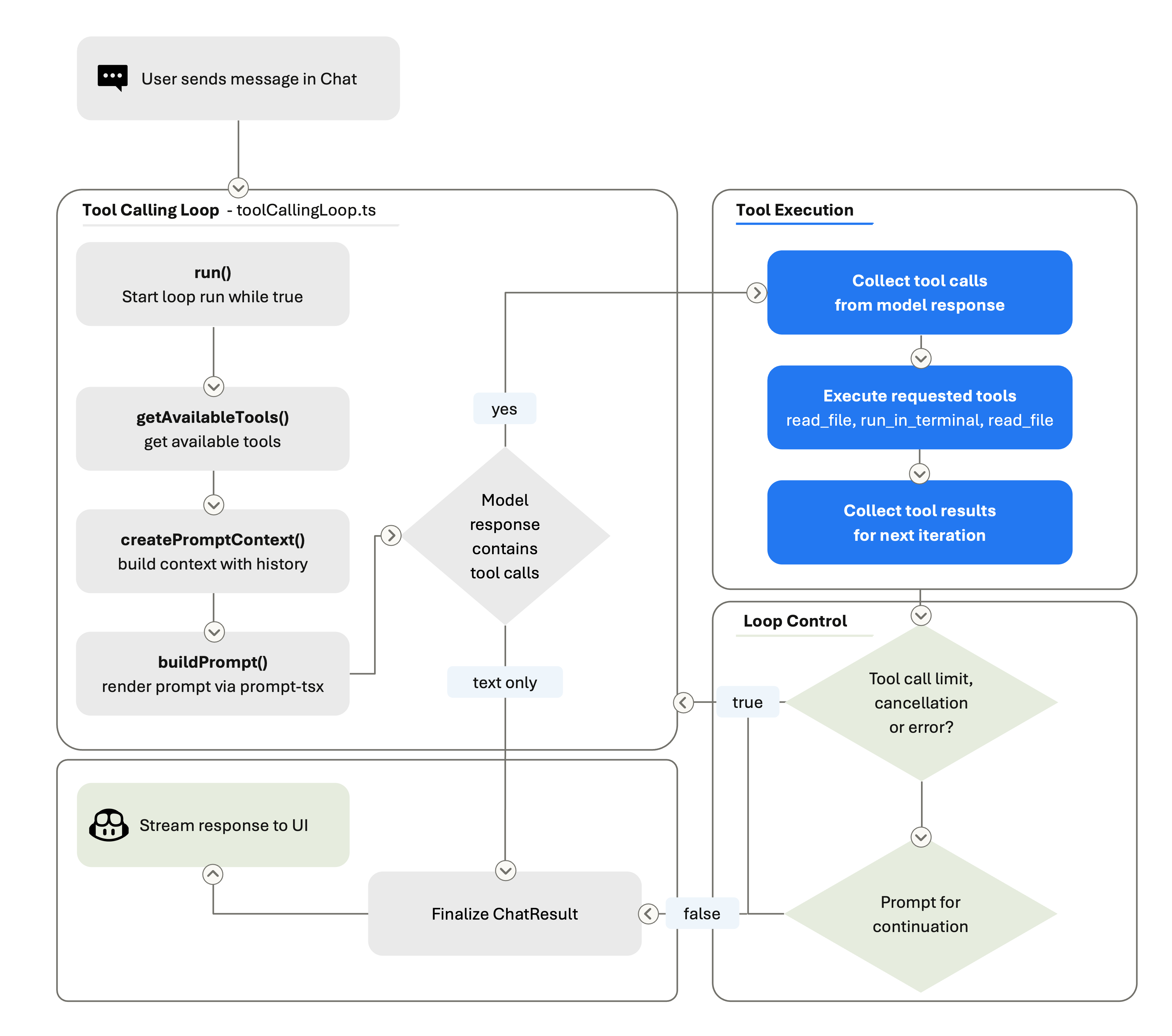
Simplified diagram of the VS Code agent loop: the user sends a chat message, the tool-calling loop builds a prompt, sends it to the model, executes requested tools, records results, checks loop-control conditions, and either continues or finalizes the chat result.

A turn is the user-visible chat exchange: you send one message, and the agent eventually produces a response. During that turn, the agent loop may perform many rounds. A round is one pass through the loop: build the prompt, call the model, receive text and/or tool calls, execute any tools, record the results, and decide whether to continue. The full execution of all those rounds is the loop’s run. A single user turn might trigger many rounds as the model searches files, reads code, edits files, runs tests, reads the output, and iterates on failures.

The tool-calling loop is bounded by loop-control checks. We enforce a tool-call limit, check for cancellation between rounds, and run stop hooks. Stop hooks are extension points that can inspect the agent state and either allow it to finish or push it to keep working. Within the loop, the prompt is rebuilt on every iteration. That means the model always sees the latest state of the workspace: if it edited a file three rounds ago, the current prompt reflects that edit. The harness also manages conversation summarization. When the accumulated history grows too large, it compresses earlier rounds into a summary so the model can keep working without hitting the context window ceiling.

Note:
Want to see the harness in action? You can explore the VS Code source code, use the Tools UI in Chat to review the tools available for a request, and open the Chat Debug View to inspect the prompts, tool calls, and results.

The harness is the product

When a new model ships, it needs to fit into an existing harness. The system prompt, the tool definitions, the loop logic, the context assembly, all of it was built and tuned over many months of real-world use. The model gets better at filling in the blanks, but the harness defines what the blanks are.

This matters even more because GitHub Copilot lets you use models from multiple model providers. And GitHub Copilot in VS Code supports a growing model ecosystem. Developers can switch between models, use auto-selection, bring their own keys, or install extra providers via extensions. This means that VS Code has to deal with a broad and continuously evolving ecosystem, not a single stable API.

The harness is what enables VS Code to handle this model flexibility without forcing developers to relearn the product every time. You should be able to switch models or try a new provider while keeping the core experience familiar: chat, sessions, tools, terminal output, debugging, and source control.

But integrating a new model is rarely just adding an extra option to the model picker. Providers differ in how they expose tool calling, structured outputs, reasoning controls, prompt caching, context limits, and error behavior. Some models are better at long planning. Some are better at terse edits. Each model has different strengths, and we work closely with model providers before each release to adapt the system prompt, tool descriptions, and loop behavior accordingly. Providers often grant us early access to new model checkpoints, which are pre-release snapshots of upcoming models, so we can start tuning the harness before the model is generally available.
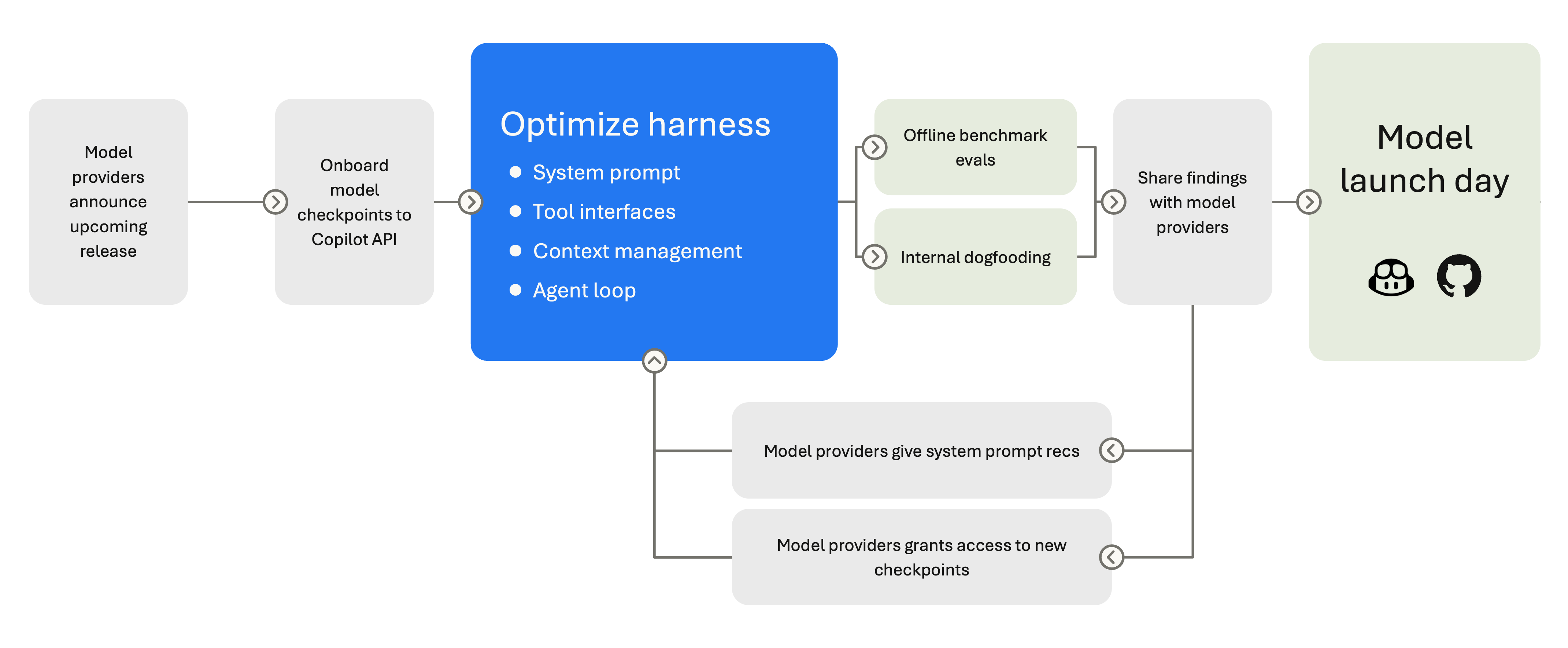
Flow diagram showing VS Code and model providers iterating from an upcoming model release through Copilot API onboarding, harness optimization, evaluation, provider feedback, and launch.

Different models need different harness behavior. Claude models use replace_string_in_file for edits; GPT models use apply_patch. Gemini needs reminders to use tool-calling instead of narrating it, and breaks on orphaned tool calls in history. Some models support extended thinking and need reasoning-effort controls. Some work best with a concise system prompt; others need verbose, structured instructions to stay on track. The harness selects different system prompts per model – Claude Sonnet 4 gets a different prompt than Claude 4.5, which gets a different one than Opus.

All these per-model differences aren’t trivial. They translate into per-model system prompts, per-model tool sets, and per-model conversation management. This means that when a new model ships, we can’t just flip a switch but we need to validate its behavior. We validate tool schemas, retune defaults, and re-run full agent sessions before anything ships. Beyond the model functioning correctly, the harder question is how can we verify that a new model actually gives better results.

Evaluation keeps the harness honest

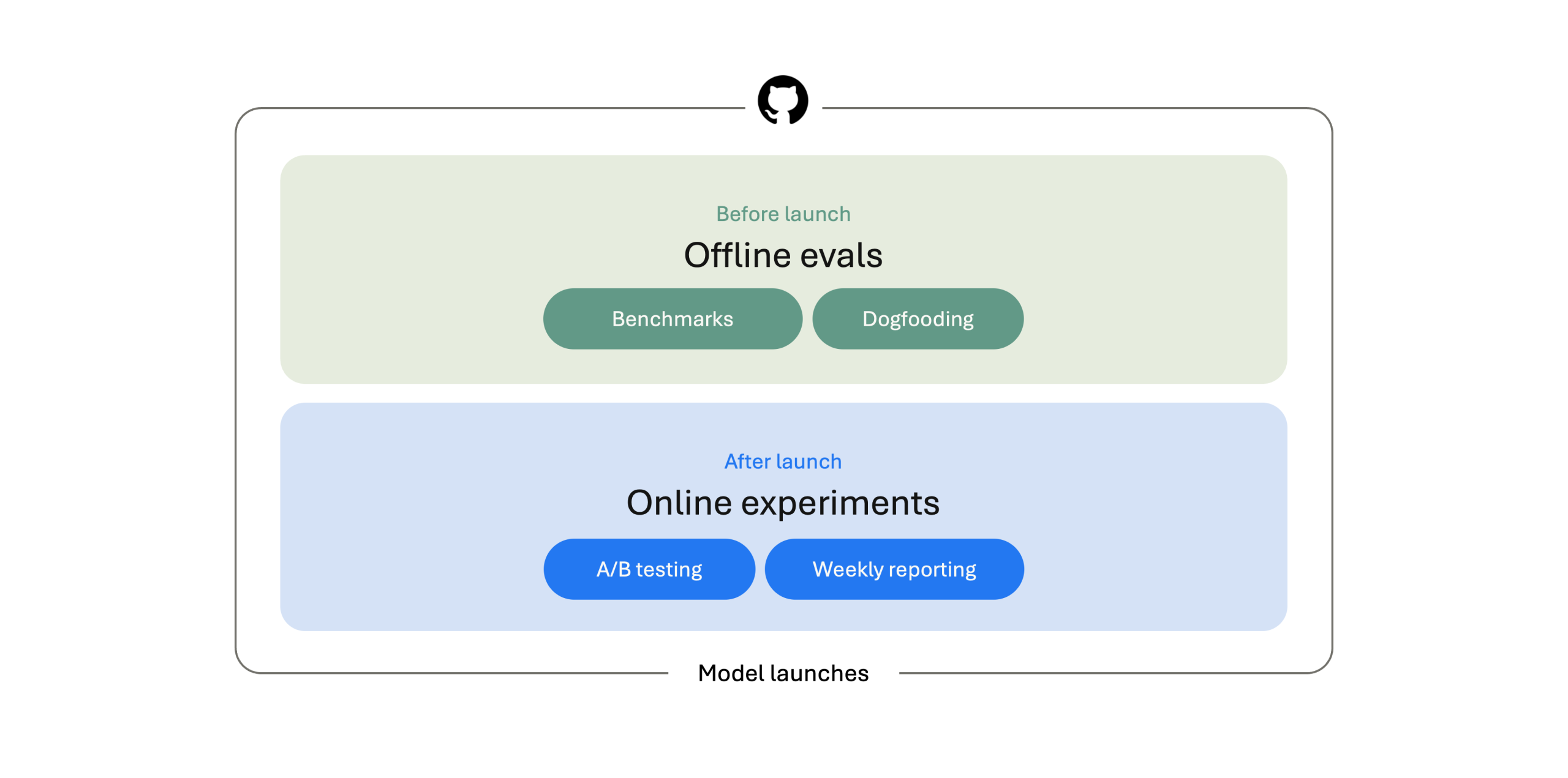
Just like you need to test a new feature before you ship it, models also need to be tested. That’s where model evaluation comes in. Before a model ships in VS Code, we evaluate it from multiple angles. We run offline benchmarks, test it internally, and compare it against the models already available in the product. After the model is live, we keep measuring: A/B tests, aggregate usage signals, and weekly reporting help us understand how the model behaves in real developer workflows.
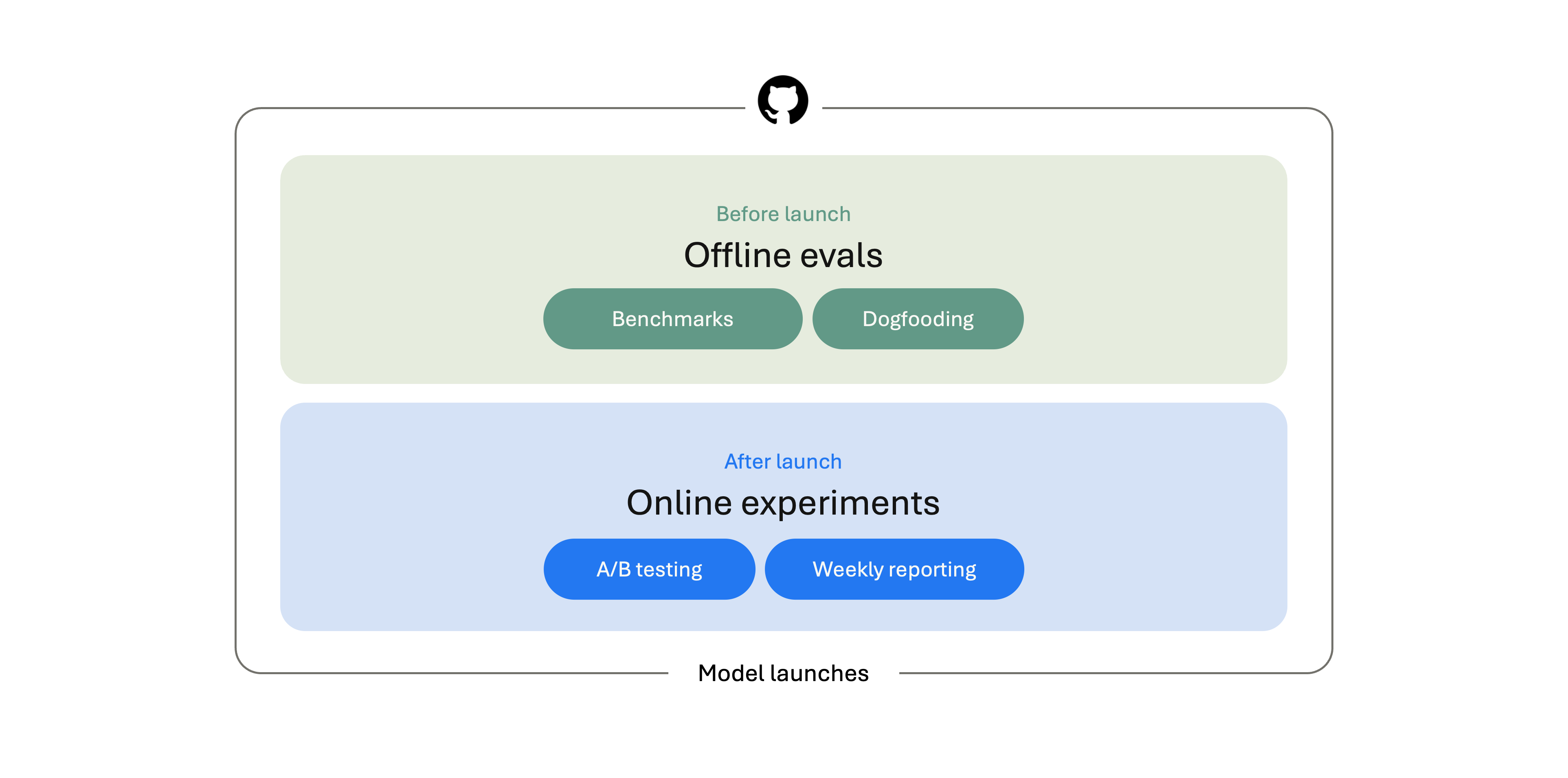
Diagram showing an overview of the VS Code evaluation pipeline.

There are multiple public model benchmarks, which are useful as a shared reference point. We use these benchmarks to compare against the broader model ecosystem and to catch obvious regressions. But at frontier levels, they are no longer sufficient as a quality indicator. OpenAI stopped reporting SWE-bench Verified results after finding that frontier models could sometimes reproduce gold patches from memory, making contamination harder to ignore.

Coverage is another limitation. SWE-bench is valuable, but it is still centered on public bug-fixing tasks. Terminal-Bench is useful for measuring command-line competence, but many tasks look more like isolated terminal puzzles than the kinds of workflows developers actually bring to an editor. Real-world coding agents need to do more than patch a known bug or solve a shell challenge. They need to scaffold projects, migrate codebases, refactor across files, follow instructions, and handle terminals and browsers.

We still run these benchmarks, but they are only a starting point. To decide which models are ready to ship in VS Code, we need something closer to the product we are actually building.

Building VSC-Bench

That’s why we built VSC-Bench, our offline evaluation suite for VS Code agent behavior. VSC-Bench focuses on VS Code-specific developer tasks that public benchmarks do not cover well: custom agent modes, extension workflows, MCP and tool use, terminal and browser interaction, multi-turn conversations, and multi-language coding tasks across TypeScript, Python, C++, and others.

We use VSC-Bench to measure model behavior across solution correctness, agent effort, token efficiency, and latency. The chart below focuses on resolution rate and token usage, but before a model becomes part of the VS Code experience, we evaluate the full set of dimensions. That trade-off matters before a model or reasoning setting becomes a default in the editor.
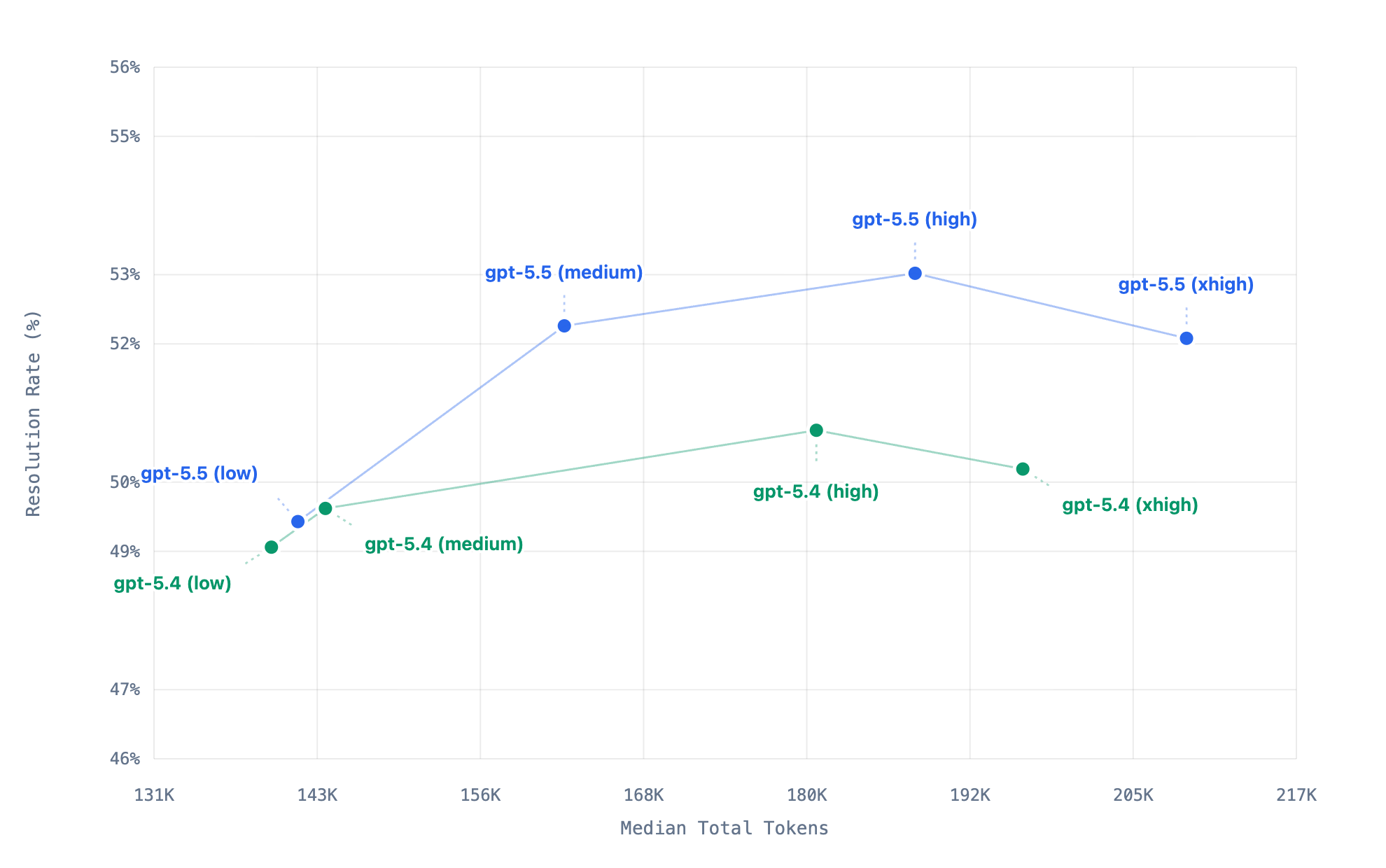
Scatter chart comparing VSC-Bench model resolution rate against median total tokens for different models and reasoning settings.
This chart summarizes 40 VSC-Bench runs across eight model-effort configurations. Each point represents one model-effort configuration, with higher points resolving more tasks and points farther to the right using more tokens. For these set of VSC-benchmark tasks, xhigh uses more tokens than high but resolves slightly fewer, which may indicate that it is past the useful effort sweet spot where extra thinking no longer converts into better outcomes.

Each VSC-Bench task runs in a reproducible, containerized workspace. The harness launches VS Code, opens the workspace, sends one or more user prompts to the agent, lets the agent respond with text and tool calls, and then evaluates what happened. That gives us a more realistic view of the full agent loop: not just whether the final code looks right, but whether the agent used the editor, terminal, language services, browser, and tools in ways that match the VS Code experience.

Together with public benchmarks, VSC-Bench gives us a more balanced signal: public evals tell us how a model compares to the field, while product-specific evals tell us whether it is ready for the experience developers expect inside VS Code.

How we benchmark agent changes before they merge

Benchmarks aren’t just for shipping models. They’re also how we vet harness changes before they land. If a PR touches a core tool, a system prompt, or anything else that could move agent behavior, we want benchmark numbers before it merges.

For those PRs, the VS Code team uses an automated eval assessment flow. Adding the ~requires-eval-assessment label to a PR kicks off the process: the PR is built, shipped as an eval agent, benchmarked, and the results are posted back on the PR:

  1. Build the PR. A webhook routes the label event into a workflow in vscode-engineering, which kicks off an Azure DevOps build against the PR’s merge ref. One automatic retry on failure; the PR gets a “queued 1 of 2” comment so reviewers can follow along.

  2. Publish an eval agent. On a successful build, a publish pipeline ships a versioned agent (0.0.0-dev.<sha>) to the vscode-evals npm feed on the dev tag. The PR comment flips to “queued 2 of 2”.

  3. File an evald issue. The publish pipeline fires a repository_dispatch back at vscode-engineering, which opens a model-evaluation issue on github/evald pinned to that exact published agent.

  4. Report back. evald runs the benchmark, monitors it, and produces an analysis comment. An Azure Logic App forwards just the comment URLs (not the analysis body — that stays private on evald) back as another repository_dispatch, which posts a link on the original VS Code PR.
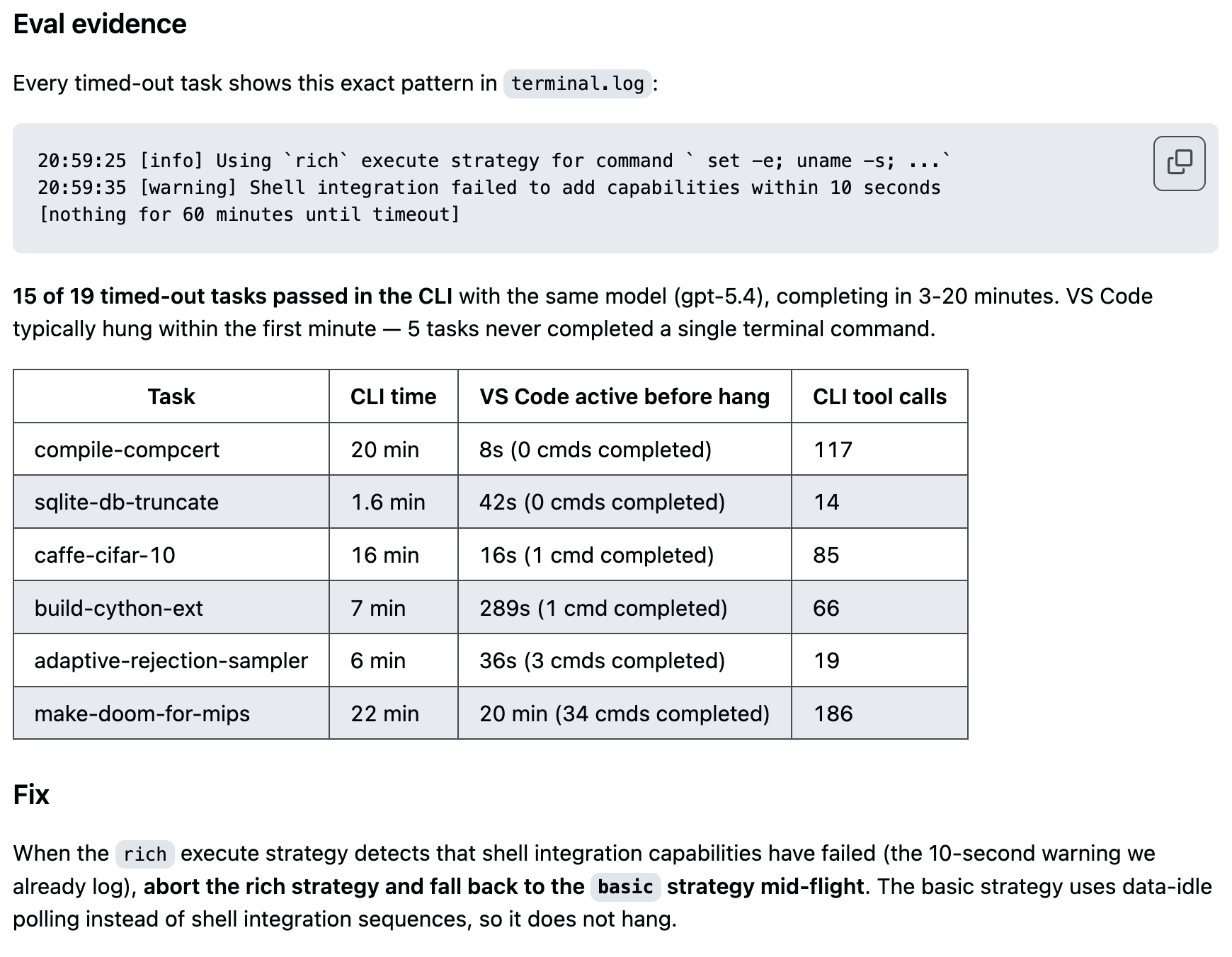
Screenshot of an eval assessment report showing eval evidence with terminal logs, a task comparison table, and the proposed fix.

The model is the engine. The harness is the car.

We started with a question developers ask every few months: which model is best? But for a coding agent, that question is a little like asking: which engine is best? The engine matters, but it’s not enough on its own. It’s the context the model sees, the tools it can reach, the loop that keeps it going, and the evaluation that makes sure it all works. That’s the harness, and it’s what we spend most of our engineering time on.

As models gain new capabilities like longer context, better planning, and native tool use, the harness evolves to take advantage of them. And as developers push agent mode into new workflows, we feed what we learn back into the loop, the tools, and the evaluations. Every VS Code release ships harness improvements alongside model updates.

If you’re curious about how the harness works, you can get hands-on with it today. Explore the VS Code source code, use the Tools UI in Chat to see which tools are available for a request, and open the Chat Debug View to inspect the prompts, tool calls, and results behind an agent run. Try switching models, add your own tools, and let us know what works — share your feedback in our GitHub repo.

Happy coding! 💙

RJ Scaringe has raised more than $12 billion across three startups and investors still want more


Investors can’t seem to get enough of RJ Scaringe or his ideas.

In less than a decade, the serial entrepreneur best known for his EV company Rivian, has raised more than $12.3 billion from venture capital firms, as well as strategic and institutional investors for his three — and counting — startups. If the latest $400 million raise for his new venture Mind Robotics is an indicator, investors are still happily piling in.

Outsized raises for newly minted startups have become more common in recent years. But those hundred-million-plus seed rounds have generally been reserved for buzzy defense tech startups or AI companies founded by former OpenAI or Anthropic employees.

Those supersized seeds certainly weren’t flowing toward something as niche as an electric micromobility startup. And yet in 2025, Scaringe raised $105 million for exactly that — a startup called Also, which he founded that same year. The total has since surpassed $300 million, with DoorDash among its backers.

Jiten Behl, partner at Eclipse and former chief growth officer at Rivian, has spent years watching and learning from Scaringe. His firm is now one of Scaringe’s biggest backers, leading rounds in both Also and Mind Robotics — Scaringe’s industrial AI and robotics startup that he also founded last year.

Storytelling and communication are one of his superpowers, according to Behl, who joined Rivian when the company had just a handful of employees.

“When RJ explains a certain issue, topic, opportunity, vision, he just has this very unique ability to communicate it so effectively, and it comes across so credible,” Behl said. “He’s not trying to undersell the difficulty or oversell the opportunity, and that’s an art.”

Scaringe isn’t the only serial entrepreneur to repeatedly attract massive amounts of capital, but founders who can raise billions across multiple ventures remain rare. The self-professed car enthusiast who earned his doctorate in mechanical engineering from MIT, joins a small cadre of entrepreneurs that includes Tesla CEO and SpaceX co-founder Elon Musk, OpenAI CEO Sam Altman, Anduril and Oculus founder Palmer Luckey, and Jack Dorsey, who founded Square (now called Block) and Twitter.

The difference, at least in the view of some investors TechCrunch spoke to, is that he is able to separate selling the idea from selling himself. “He is very comfortable and confident in his own personality, and he’s not trying to be an Elon,” Behl said, noting that many have tried to make the comparison over the years.

“It’s not about him,” another insider familiar with Scaringe’s companies told TechCrunch. “When you talk to him, he has enthusiasm about the product that is completely external.”

Of course, there is confidence and even a little ego, the same source mused, but “it doesn’t weigh on you.” The source also added that Scaringe also has a unique ability to make you feel like the most special person in the room — a sentiment others echoed.

Giving that kind of undivided attention to an investor, supplier, or exec at a manufacturer is a challenge at the scale Scaringe is attempting. He is running three companies, often traveling between Palo Alto, Irvine, Rivian’s factory in Normal, Illinois, and a second factory soon to open in Georgia. And then there is family — Scaringe has three sons with his ex-wife.

Joe Fath, another partner at Eclipse, credits his open-mindedness and collaborative nature for helping him attract investment and juggle these connected, yet disparate businesses.

He noted that Scaringe also “has the rare combination of being a truly great engineer while also having an exceptional instinct for product design,” said Fath, who previously worked at a major Rivian backer T.Rowe Price. “Very few founders can operate at that level technically while also understanding what resonates emotionally with customers — both consumers and commercial buyers. That combination is incredibly uncommon and has clearly been part of what makes Rivian’s products (and now ALSO and Mind’s) so differentiated.”

The pace of Scaringe’s fundraising over the past eight years is particularly notable, and doesn’t seem to be slowing.

More than $11 billion, and by far the largest slice of VC and strategic capital, went into Rivian — most of it between 2018 and its blockbuster IPO in 2021. That’s a startling timeline especially considering the company, initially called Mainstream Motors, had existed since 2009. For years, Rivian operated as a small, unknown entity until its breakout moment in late 2018 at the Los Angeles Auto Show, when it revealed prototypes of its all-electric R1T truck and R1S SUV.

The money soon flowed, and from every direction. In early 2019 and just a couple of months after that reveal, Rivian raised a $700 million funding round led by Amazon. U.S. automaker Ford would invest $500 million and make plans to collaborate on a since-scrapped future EV program. Cox Automotive contributed $350 million. Rivian would close out the year with a $1.3 billion round — its fourth in 2019 — led by funds and accounts advised by T. Rowe Price Associates, with additional participation from Amazon, Ford, and funds managed by BlackRock.

In July 2020, Rivian raised $2.5 billion and another $2.65 billion six months later. As whispers of an IPO got louder, Rivian closed another $2.5 billion private funding round led by Amazon’s Climate Pledge Fund, D1 Capital Partners, Ford Motor and funds and accounts advised by T. Rowe Price Associates Inc. Third Point, Fidelity Management and Research Company, Dragoneer Investment Group and Coatue also participated.

Then the IPO came. Rivian raised nearly $12 billion in gross proceeds after locking in $78 per share. Its market cap hit $100 billion when it debuted on Nasdaq in November 2021. Today, it stands at $18.2 billion today, a significant comedown that also reflects the broader struggles of the EV sector.

The ability to raise that much capital, despite those headwinds, is exceptional. But Scaringe didn’t stop with Rivian. If anything, the pace has accelerated. Also and Mind Robotics have together raised more than $1.3 billion so far, with Mind Robotics moving especially fast: $115 million in its first year, $500 million in March, and another $400 million just this week.

Rivian also continues to land notable backers through high-profile deals like the $5.8 billion joint venture with Volkswagen Group and a robotaxi partnership valued at up to $1.25 billion with Uber.

“Now, the big question is, how much can he do?” Behl said. “That’s a question [that] already assumes that he’s reaching his limit. The thing is, he doesn’t look at it that way. His perspective is that there is huge value to be created, there is huge impact to be created, and I just have to do it.”

When you purchase through links in our articles, we may earn a small commission. This doesn’t affect our editorial independence.

Wrapmate’s AI for Vehicle Wrap Online Design & Ordering Platform


AI Platform for Vehicle Wraps OnlineAI Platform for Vehicle Wraps Online

New website delivers the first fully self-serve experience for vehicle wrap customers, with free AI-powered design tools and instant pricing for 60+ years of vehicles

DENVER — May 13, 2026 — Wrapmate today announced the launch of its new website, introducing capabilities that have never existed in the vehicle wrap industry. Whether customers want to personalize their vehicle, change its color using vinyl, or wrap a fleet of business vehicles, Wrapmate’s AI can create a custom design in less than thirty seconds and provide pricing instantly — so they can decide to move forward on their own terms.

Wrapmate Introduces AI for Vehicle Wraps Online

Customers can create up to 12 designs completely free and see each one rendered in 3D on their exact vehicle. The platform delivers accurate pricing for any year, make, model, and trim spanning over 60 years of vehicle data — and for the first time in the industry, customers can start their project using AI for vehicle wraps online without talking to anyone. During the soft launch alone, customers created over 50,000 unique designs.

“For decades, getting a vehicle wrap meant calling around to local shops, waiting days for a quote, and hoping the design would turn out right. We’re eliminating every single one of those friction points. We’ve built the first self-service experience for vehicle wraps — the best way to experience and purchase vehicle wraps anywhere in the industry,” said Chris Loar, Founder and CEO of Wrapmate.

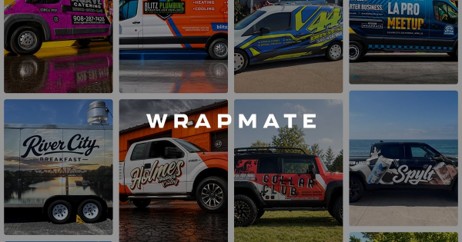
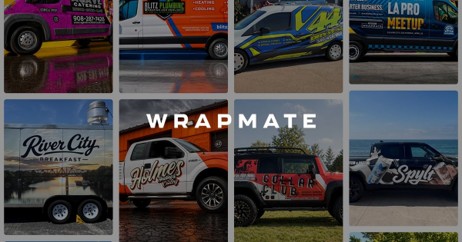
The new site also features the largest repository of completed vehicle wrap projects anywhere on the web, powered by AI for vehicle wraps online experiences. With tens of thousands of unique, individual one-off projects executed to date, Wrapmate has curated its most recent 1,000 into a searchable gallery spanning every vehicle size, shape, and design style imaginable. Wrapmate is building the largest vehicle wrap design and content repository on the internet — giving customers real proof of what’s possible before they commit.

The new platform serves the full spectrum — from individuals looking to change the color of their car, to small business owners branding a single van, to enterprise fleet operators managing thousands of vehicles. Wrapmate’s nationwide network of over 2,000 professional 3M-certified installers ensures consistent quality regardless of project size or location.

The new wrapmate.com is live now. All design tools, pricing, and self-service features are available immediately to customers nationwide.

About Wrapmate

Wrapmate is a technology-driven, full-service platform that reimagines the buy-and-sell experience in the vehicle graphics industry. With innovative customer experiences, efficient fulfillment, and a network of 2,000+ local installers, Wrapmate efficiently serves business owners, fleet managers, franchises, OEMs, advertisers, and consumers coast-to-coast. Learn more about Wrapmate’s vehicle wrap solutions at wrapmate.com.

Media Contact: Wrapmate Press, press@wrapmate.com

Find a Home-Based Business to Start-Up >>> Hundreds of Business Listings.

MTG Arena developers say profitable teams still faced layoffs and uncertainty


Employees and developers working on Magic: The Gathering Arena say they were hired with promises of remote flexibility, so they bought homes and built lives around those assurances. But they say they are now being told they may need to relocate to Washington state — or effectively lose their jobs.

Those concerns are a major reason why a supermajority of workers on the Arena team are attempting to unionize with the Communications Workers of America, under the banner United Wizards of the Coast. The group publicly launched its campaign on April 27, calling on Wizards of the Coast and parent company Hasbro to voluntarily recognize the union by May 1.

Instead, the company opted to proceed through a National Labor Relations Board election process now scheduled for June 2, during which eligible employees will vote on whether or not to form a union. With a simple majority, a unit will be formed. Wizards of the Coast has also retained outside counsel from Fisher Phillips, a prominent labor law firm that has represented employers in union campaigns and labor disputes across the tech and gaming industries. According to the NLRB filing, the proposed bargaining unit includes 97 eligible employees working on Arena.


union of the third path mtg


Magic: The Gathering Arena developers seek to unionize at Wizards of the Coast

More than 100 developers behind Arena are pushing for protections around layoffs, remote work, and AI

“We have received the filing and are reviewing it carefully,” Hasbro said in a statement provided after the union announcement. “Our employees are the lifeblood of what makes us great, and we are committed to fostering a workplace where every person feels heard, valued, and supported.”

Workers speaking with Polygon via video call said the decision to unionize stems from years of growing instability at a time when both Magic itself and Arena appear to be more successful than ever.

“The thing that really kicked off the union conversations were the 2023 layoffs, where Hasbro laid off about a thousand people,” said Xib Vaine, a producer on MTG Arena and member of the organizing effort. “Everybody I talked to couldn’t understand why Arena was hit by those layoffs. By every metric, we were succeeding.”

The broader Magic: The Gathering brand is estimated to be worth more than $1 billion. Arena has 13 million registered players. According to data from Sensor Tower, Arena was downloaded 80,000 times and generated $2 million in revenue in April alone.

hasbro mtg billion
An image from Hasbro’s website notes that Magic: The Gathering is the company’s first billion-dollar brand.
Image: Hasbro

Vaine said that five Arena employees were laid off in 2023, but there have also been continuous layoffs within Wizards since then that have affected departments the Arena team works closely with. In all instances, these layoffs deeply rattle morale across the studio, even among workers who remained employed.

“You walk in and somebody’s missing from over there, 20 people are missing from over there,” Vaine said. “You’re just watching the wave of layoffs get closer.”

Damien Wilson, a security engineer on Arena who joined Wizards of the Coast last year after more than a decade working in tech, said those experiences mirror a broader pattern across the industry.

“I’ve been laid off about eight times,” Wilson said. “If you work at these companies and you get a sense for how they work at the corporate leadership level, you come to learn that any mass layoff can never be well targeted. It’s not about finding whoever’s performing poorly. It’s about making the quarterly financials look good.”

Workers say conversations about organizing accelerated significantly in 2025 after Hasbro introduced a return-to-office mandate requiring employees to work from the office at least three days a week. According to organizers, many Arena employees were hired as remote workers in 2021 or 2022 — at the tail-end of the pandemic when remote work was the norm — and received assurances they could continue living outside Washington state.

“A lot of these people who are being forced to relocate are people who’ve never lived in Washington,” Wilson said. “They were given explicit assurances that if they started lives elsewhere, that it wouldn’t be yanked away from them.”

Vaine said many workers made major life decisions based on those expectations.

“Folks were asking, ‘Hey, I want to buy a house, but I can’t afford a house in Seattle. I’d like to move further away. Will I be forced to come back into the office?’” Vaine said. “They were told yes, it was okay. And then they bought a house and now suddenly the messaging was, ‘Just kidding.’”

United Wizards of the Coast logo imagery
Official logo for the United Wizards of the Coast.
Image: United Wizards of the Coast

According to the organizers, more than half of the Arena workforce now lives outside Washington or beyond what they consider a reasonable commuting distance. Arena itself has around 200 employees total, they said, with roughly 100 considered union-eligible.

The organizers also claim messaging around the return-to-office policy has been inconsistent and unclear, leaving workers unable to plan long-term. To date, there appears to be no firm deadline for employees to return to the office more regularly, yet internal messaging still positions it as a mandate.

“We do not feel like we can depend on any of the things we have been told until we get it in writing,” Wilson said.

Workers say relocation assistance is not guaranteed and may come with conditions requiring employees to remain at the company for years afterward, or risk having to repay the assistance if they leave or are laid off. Employees who decline relocation, organizers claim, may have their departures categorized as voluntary resignations, making them ineligible for severance.

Organizers say that uncertainty became a driving force in the push to unionize.

“The only recourse to fight this stuff is to organize,” Wilson said. “It is the only legal mechanism we have to get a seat at the table.”

The union’s public platform also cites concerns around layoffs, crunch, generative AI protections, career advancement, and ownership of employees’ creative work outside the company.

While Hasbro declined to voluntarily recognize the union before the group’s May 1 deadline, workers say they remain confident heading into the June election. According to Vaine, more than 75 percent of eligible Arena employees publicly signed onto the union effort before filing with the NLRB — more than enough needed to win the election.

“We have shown them through public support, through our voluntary recognition letter, that 75 percent of eligible Arena employees want a union,” Vaine said. “And yet the company is still delaying the opportunity for us to bargain for our working conditions.”

Even so, both organizers described the public response from Magic players and fellow game developers as overwhelmingly positive.

“We have gotten a tremendous amount of well-wishers and positive support,” Wilson said. “It has brought literal tears to people’s eyes to see some of the kind words people have sent our way.”

For workers behind one of gaming’s most successful digital card games, that support has become increasingly important as the union campaign moves toward its official vote next month. Both Vaine and Wilson ask that all supporters sign the group’s official petition.

“It’s going to be a stressful next few weeks for sure,” Vaine said. “But everybody, I think, wants Wizards and Hasbro to do the right thing. Now they just have to do it.”

The Friday Roundup – Incoherent Dialogue and B-roll Tips


Video viewer confused because of unclear dialogue.

Don’t Make Viewers Play Catch-Up

One of the great truths in making videos is that the most important part of video, is audio!

The vast majority of viewers will forgive substandard video quality but will switch off in a heartbeat when there is bad audio.

This rejection rate gets multiplied enormously when the audio we are referring to is dialogue.

Below is a great little #Short that explains exactly what is happening in the heads of your audience when your dialogue is muffled, garbled, unclear or drowned out by other audio assets in the sound track.


Turn One Camera Into a Multi-Cam Look

One of the most common suggestions for improving your videos is through the use of B-roll footage to add emphasis, context and a for range of other reasons.

That advice is actually quite solid in itself but in my experience there is a huge hole where the full information on how, why and when it should be used.

In the video below Gabriel covers (almost) everything you need to know about using B-roll but were afraid to ask.


Remove Objects, Noise & Backgrounds with AI – PowerDirector Tutorial (2026)

This is just a straightforward demonstration of the various “A.I. removal” modules currently available in CyberLink PowerDirector.

Of course there is a bunch of other A.I stuff in there but I find that these ones are the ones I tend to use on a regular basis.

The Noise removal tool is quite simple and very effective however the other two, Objects and Background need a little more TLC.

Easily the best results come from footage where there is clear separation between the subject and the background or the target object and that background.


How to use the Precut Tool in PowerDirector to Extract Good Footage

Ever since we all started using our phones for shooting videos and our video cameras started using memory cards instead of legacy media, a lack of footage has not really been a problem!

In fact if you take a look at the average family gathering these days, just about everyone walks away with a bunch of shots taken at random times of even more random events at that gathering!

I don’t know about you but usually I am the guy that ends up being assigned the task of somehow stitching it all together into some kind of coherent project.

Very often my go to program for that purpose is going to be PowerDirector because of the Precut tool mentioned in the title of the video below.

It is a great time saver for getting all that footage sorted so that the project itself can go way more smoothly.


Filmora 15.4 Update: Seedance 2.0, AI Tools & New Features Explained

In a move this week that surprised absolutely no-one… Filmora updated yet again!

From the outside it would seem that Filmora is doing nothing but adding A.I. features to the software and that’s all it now does… nothing could be further from the truth.

If you take a closer look at what is actually on offer inside Filmora these days from an A.I perspective you will notice one recurring theme.

The actual A.I. on offer is very closely designed to create short assets, enhance existing footage or audio as well as develop ideas towards a larger overall project.

For me this is very much how things should be.

After all, if you are devoted to having some kind of automation to the point where you (the human) do nothing… then what’s the point of you being there in the first place?!


Bring Your History to Life: Mixing AI Magic with Corel VideoStudio

This is a pretty cool tutorial from Gripps2211 for this week highlighting what I believe to be a sensible approach to A.I.

Right now apart from more extreme examples the available A.I. models for various video tasks are somewhat limited to short clips or specific tasks.

The marketing is suggesting (falsely promising?) that entire projects can be pulled of using A.I. but for the most part that’s not entirely true… yet!

For the average user the best use of A.I. is the sort of project he talking about here.

A.I. used to pull off certain tasks then the whole shebang pulled into any reasonably equipped video editor to be organized into a cohesive project.


3 Best Video Editing Apps For Android in 2026! (Free + Paid)

Well it must be that time of year again cos’ the boys at Primal Video are rounding up the video editing Apps for Android again!

Fair warning here, I never use smart phones for any video editing although I do use them for shooting on occasion.

At first I thought it was a “me” problem on the editing side but after having watched my wife yelling at her phone whilst trying to edit… perhaps not!

Anyhoo, if you are hell-bent on doing it, here’s a look at what’s available.


Frame Rates Explained – The Basics

There is a wealth of information floating around on the internet these days on all aspects of video shooting and editing.

In reality that all works as a bit of a double edged sword because to get the knowledge you need to absorb the data but to correctly evaluate that data… you need existing knowledge!

Something that has really worked for me over the years has been to first ignore what I need to know and focus on who would be a good source to learn that information from.

That’s why each week on the Friday Roundup there are regular sources added over and over again because I know they know what they are talking about!

As you make you way through this internet morass you will inevitably come across information that will give you pause and make you wonder if maybe you should (or should not) be doing that thing.

Of course your best defence is to have a good understanding of whatever the subject is so in the spirit of that, here’s everything you need to know about frame rates!


Fusion vs. Color Page: Which One to Choose for Masking? – DaVinci Resolve

One of the questions I get over and over regarding DaVinci Resolve is why is it so complicated!

The answer to that is quite simple really.

It was always designed and aimed at fully professional productions and as such the demands put on it have always been many and widely varied.

A good example of these differences can be seen in this #Short below from Daniel Batal.

It shows a pretty standard action of masking but depending on what the editor is actually doing, we have two totally different methods.


Key Takeaways

  • Audio quality is critical in video production; viewers tolerate poor visuals but reject bad audio.
  • B-roll footage enhances videos, but many creators lack guidance on its effective use.
  • AI tools in PowerDirector help remove noise and objects, though effectiveness depends on footage quality.
  • Filmora’s recent updates focus on AI features that enhance existing content rather than automating entire projects.
  • Frame rates and editing techniques need a solid understanding for effective video production.

Honor just gave us a clearer idea of when its Robot Phone is coming


What you need to know

  • Honor has officially confirmed that the Robot Phone will launch globally in Q3 2026.
  • The Robot Phone features a gimbal-like camera system that can automatically track movement.
  • Honor partnered with ARRI to bring more advanced cinema-style video features to the phone.

Honor’s Robot Phone, which ended up winning one of our best showcase awards at MWC 2026, finally has a launch window.

At MWC, Honor officially showcased the Robot Phone after first teasing it late last year as a concept. Back in Barcelona, the company only confirmed that the phone would launch in the second half of 2026, but it has now narrowed things down further, officially confirming a Q3 2026 launch window.

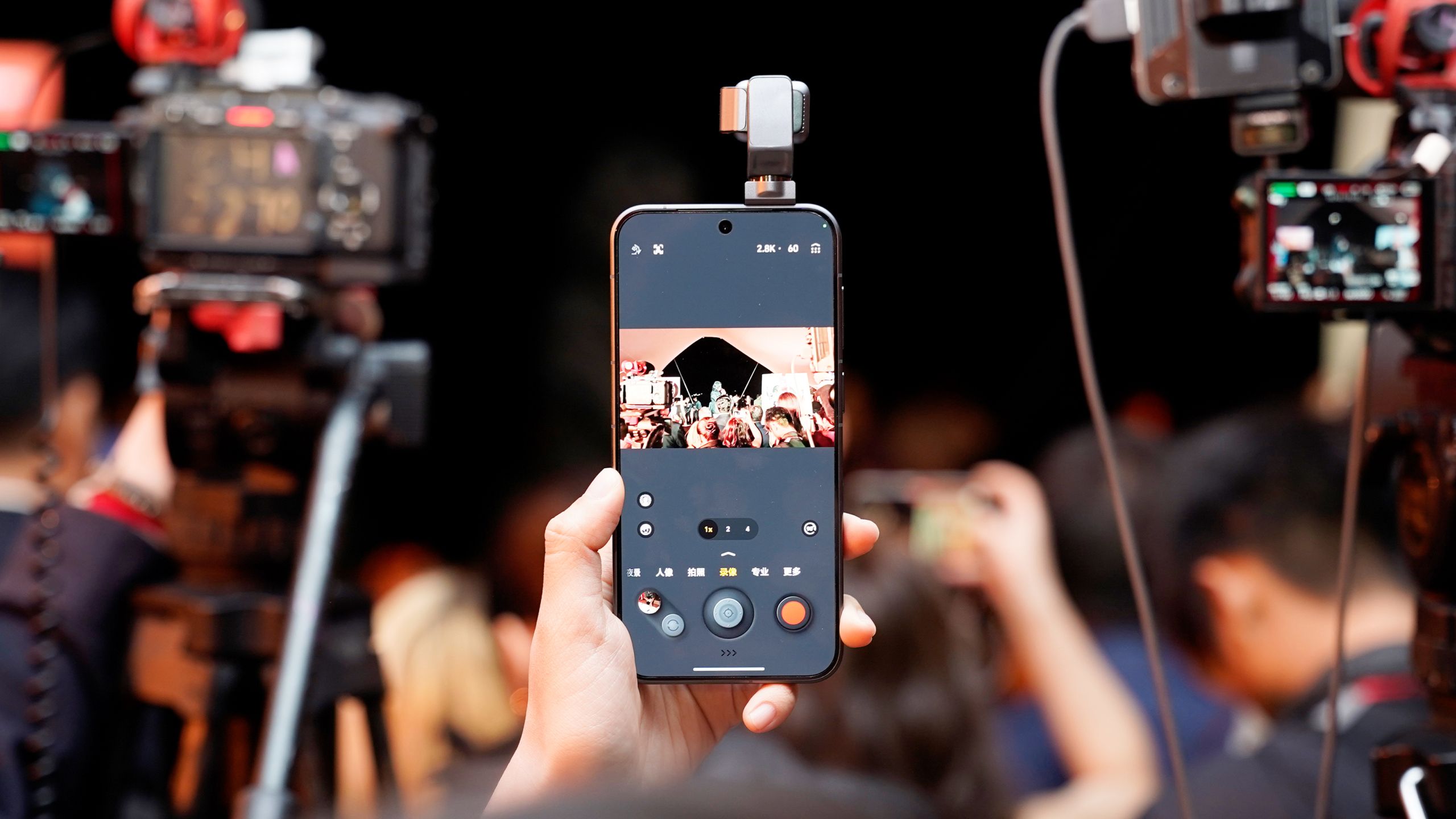
Honor has been heavily hyping up the Robot Phone ever since its first teaser. We also got to see it in person at MWC, and for those who don’t remember, the Robot Phone features a gimbal-style camera system on the back that can automatically track your movement. It’s almost like having a DJI Osmo Pocket built directly into a smartphone.

Latest Videos From

Honor Robot Phone demo

(Image credit: Sanuj Bhatia / Android Central)

In fact, Honor even took the Robot Phone to the Cannes Film Festival’s China Night event to showcase it again. During the event, the company also announced a partnership with ARRI, the German camera maker known for high-end cinema and motion picture equipment. That partnership could mean the Robot Phone ends up bringing some genuinely serious video capabilities.