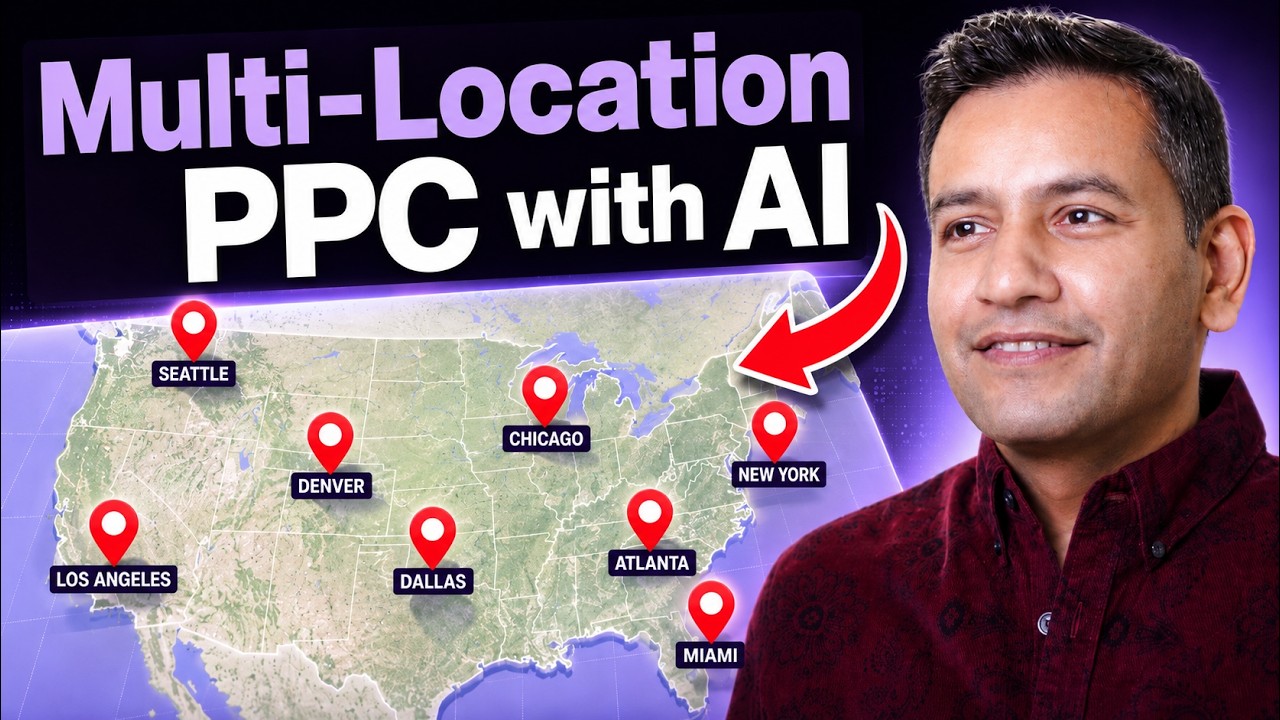
How To Improve Multi-Location Ads With AI And Clean Location Data


AI can help a lot with multi-location PPC, but only when it has the right data to work with.
A lot of franchisors and multi-location brands are already using AI in some form inside their Meta and Google ad campaigns. Their PPC teams may be using AI to write headlines, generate ad copy, come up with creative ideas, or speed up campaign planning.

That is useful, but it is only one small part of the opportunity.

The bigger opportunity in multi-location ads is not just using AI to create a few better headlines. The real opportunity is using AI to make campaigns smarter at the location level.

That matters because every location is different.

One location may have strong reviews.

Another location may have a missed call problem.

One location may need more first-time customers.

Another location may already be fully booked and should only focus on higher-value appointments.

One location may have a strong local offer.

Another location may need better lead quality, not just more leads.

This is where AI can become very useful for multi-location marketing. But only if the AI has clean location data first.

If you are a franchisor, multi-location brand, or a digital agency for franchisors, this is one of the most important things to understand before trying to use AI for paid ads.

The Problem: AI Cannot Create Smart Local Campaigns from Generic Inputs

Most people think about AI in PPC like this:

“Create me some ad copy.”

“Give me five headlines.”

“Write a Meta ad for this offer.”

“Create a Google Ads campaign for this service.”

That is fine for a basic use case.

But if you are managing ads across 10, 20, 50, or 100 locations, generic prompts will create generic output.

AI does not automatically know what is happening inside each location.

It does not know which location has the best reviews.

It does not know which location is missing calls.

It does not know which location has low booking capacity.

It does not know which location has a higher average ticket size.

It does not know which local offer is active in which market.

It does not know what your CRM is showing about lead quality.

It does not know whether the problem is the ad campaign or the local operation after the lead comes in.

So when the data is missing, AI usually creates the same type of ad for every location.

That is where multi-location PPC starts to break down.

You get the same messaging everywhere.

You use the same offer across different markets.

You do not use local proof from reviews.

You do not connect campaign ideas to actual reporting.

And over time, it becomes harder for the PPC team to remember what they were testing and why.

1 Pawpurespa

The Better Approach: Build a Location Intelligence Layer First

Before using AI to generate campaigns, multi-location brands need a clean location intelligence layer.

This is a structured profile for each location that gives AI the context it needs.

For example, if you are managing PPC for a dog grooming franchise, each location profile should include information like:

Location name

City and state

Location landing page

Google Business Profile rating

Review count

Review themes

Priority service

Local offer

Monthly ad budget

Average ticket size

Booking capacity

Lead volume

Booked appointments

Appointment show rate

Missed call rate

Current cost per acquisition

Business goal

Franchisee notes

This is not just “data for the sake of data.”

This is the information AI needs to create better campaign ideas.

If one location has reviews talking about “gentle staff” and “great with nervous dogs,” that can become an ad angle.

If another location has a high missed call rate, the campaign may need to push online booking instead of phone calls.

If another location has a high average ticket size, the campaign may focus on premium services instead of discounts.

If one location has low capacity, the goal may not be more leads. The goal may be better-quality appointments.

That is how AI becomes useful in multi-location marketing.

What Data Sources Should Feed the AI?

The data layer does not need to be complicated at first.

It can start with a structured sheet or a simple internal app.

The key is to bring the right data into one place.

Here are the main data sources that matter for multi-location ads.

1. Brand Website

The brand website gives AI the basic brand information.

2 brand site

This includes:

What the brand does

What services are offered

What tone the brand uses

What offers are approved

What claims are allowed

What the primary call to action should be

This helps AI stay on brand.

For example, if the brand tone is warm, simple, and trustworthy, the AI should not create aggressive or overly salesy ad copy

2. Location Landing Pages

Location landing pages are very important for multi-location PPC.

Each location may have different services, offers, booking links, or local messaging.

3 location landing page

For example:

Austin may promote first-time grooming appointments.

Dallas may promote online booking.

Denver may focus on premium grooming.

Tampa may focus on puppy grooming.

Scottsdale may focus on senior dogs or sensitive pets.

If AI can read and understand each location page, it can create ads that match what is actually true for that location.

3. Google Business Profile Reviews

Google Business Profile data can give AI local proof.

4 google business profile

This includes:

Average rating

Review count

Review keywords

Common review themes

Customer language

Local trust signals

This is one of the most useful sources for ad messaging.

Customers often describe the real reason they chose a business.

For example, a dog grooming location may have reviews mentioning:

“Gentle with nervous dogs”

“Easy online booking”

“Premium grooming”

“Great with puppies”

“Calm environment”

“Friendly staff”

Those words can become campaign angles.

Instead of creating generic copy, AI can use real local proof from that location.

4. CRM Data

5 crm

CRM data tells you what happened after the lead came in.

This is where PPC gets much smarter.

The CRM can help AI understand:

How many leads came in

How many became booked appointments

Which services people asked about

Which locations had stronger lead quality

Which campaigns produced better customers

What the show rate looked like

This matters because PPC should not only be judged by leads.

A campaign that generates cheap leads may not be the best campaign if those leads do not book, show up, or buy.

For multi-location marketing, CRM data helps connect ads to real business outcomes.

5. Call Tracking Data

6 call tracking

Call tracking is one of the most important data sources for local PPC.

Many multi-location businesses depend heavily on phone calls.

But sometimes the ad campaign is not the real problem.

The real problem may be that the location is missing too many calls.

For example, if a location has a 30% missed call rate, spending more on ads may only create more missed opportunities.

AI needs to know that.

Call tracking data can include:

Answered calls

Missed calls

Average call duration

Booked calls

Call source

Call quality

This gives AI better context before recommending more ad spend.

For example, if Dallas has a high missed call rate, the campaign may need to focus on online booking instead of phone calls.

That is a location-specific decision that AI can only make when it has clean data.

6. Ad Platform Data

7 ad platform

Ad platform data tells AI what has worked in the past.

This may come from Meta Ads, Google Ads, or a manual report upload.

Useful fields include:

Spend

Impressions

Clicks

CTR

Leads

Cost per lead

Booked appointments

Cost per booking

Conversion rate

Campaign angle

Location

This helps AI compare future campaigns against past performance.

It also helps the PPC team avoid starting from scratch every time.

7. Manual Inputs

Not all useful data lives inside software.

Some of it may need to be entered manually.

8 manual input

For example:

Monthly local budget

Average ticket size

Location capacity

Priority service

Local offer

Business goal

Franchisee notes

This is very common for franchisors and multi-location brands.

The important thing is not where the data comes from.

The important thing is that the AI can access it in a clean, structured way.

Example: A Dog Spa Franchise with 10 Locations

In the video, I use a fictional dog spa franchise called PawPure Spa.

The brand has 10 locations.

For the demo, we look at the first five:

Austin Downtown

Dallas North

Denver Cherry Creek

Tampa Bay

Scottsdale

Each location has a different PPC opportunity.

Austin Downtown

Austin has strong reviews around gentle handling and nervous dogs.

So the campaign angle is:

Gentle care for first-time grooming appointments.

The AI creates copy around trust, comfort, and calm care.

Dallas North

9 dallas north

Dallas has good lead volume, but a higher missed call rate.

So the campaign angle is different.

Instead of pushing phone calls, the campaign promotes online booking.

That is because the local data shows that phone-call-heavy messaging may not be the best move.

Denver Cherry Creek

10 Denver Cherry Creek

The copy is not focused on discounts.

It is focused on quality, trust, and a better grooming experience.

Tampa Bay

11 Tampa Bay

Tampa has a strong puppy grooming opportunity.

So the campaign focuses on a puppy’s first spa visit.

That matches the local customer segment and the review themes.

Scottsdale

12 Scottsdale

Scottsdale has high reviews and high average ticket size, but lower booking capacity.

So the campaign does not aggressively push volume.

Instead, it focuses on high-value appointments and gentle care for senior dogs or sensitive pets.

How AI Generates Better Campaigns from Clean Data

Once the location intelligence is ready, AI can help create better PPC campaigns.

The process looks something like this:

13 Campaigns

Choose the platform, such as Meta Ads or Google Ads.

Choose the campaign objective.

Select the locations.

Choose the AI strategy.

Review the brand rules.

Generate the campaign package.

In the demo, I choose Meta Ads and select appointment bookings as the objective.

Then I choose five locations.

The AI uses the data from each location to create a different campaign angle.

This is the important part.

AI is not just writing five versions of the same ad.

It is creating five different local campaign strategies.

Austin gets gentle care messaging.

Dallas gets online booking messaging.

Denver gets premium grooming messaging.

Tampa gets puppy grooming messaging.

Scottsdale gets senior dog comfort messaging.

That is what makes the campaign more useful.

Why the Campaign Hypothesis Matters

One of the biggest benefits of this approach is that AI does not just generate the ad.

It also stores the campaign hypothesis.

That means the system remembers what the campaign was trying to test.

14 ai generated meta campaign package

For example:

Austin hypothesis:

Reviews mention nervous dogs and gentle staff, so gentle care messaging should increase first-time grooming appointments.

Dallas hypothesis:

Missed call rate is high, so online booking should improve conversion.

Denver hypothesis:

High average ticket size and premium reviews mean premium grooming messaging should produce better revenue per booking.

Tampa hypothesis:

Puppy grooming reviews suggest a first puppy visit campaign may attract new customers.

Scottsdale hypothesis:

High-value customers and low capacity mean the campaign should focus on appointment quality, not volume.

This matters because most reporting only tells you what happened.

But when AI knows the hypothesis, it can help explain whether the campaign idea actually worked.

The PPC Manager Still Reviews and Launches the Campaign

15 PPC Manager Still Reviews

This is not about replacing the PPC manager.

The PPC manager still needs to review the campaign.

They need to check the messaging.

They need to verify the offers.

They need to make sure the landing pages are correct.

They need to review the budget, audience, and setup.

They need to launch or upload the campaign inside Meta Ads Manager or Google Ads.

AI helps prepare the campaign package.

The PPC manager still brings judgment.

This is the right balance.

AI creates speed and structure.

The PPC manager brings experience and control.

The Reporting Loop: Where AI Becomes Even More Useful

16 reporting insights

After the campaign runs, the PPC team can upload the performance report.

This could be a Meta Ads export, Google Ads export, or a combined reporting file.

Now AI can compare the results against the original campaign hypothesis.

That is where the system becomes more useful than a normal report.

Instead of only saying:

CTR went up.

CPA went down.

Spend increased.

Leads increased.

The AI can say:

This campaign angle worked.

This campaign angle did not work.

This location has an operations issue.

This location should not scale because capacity is low.

This location should be measured by revenue per booking, not only cost per lead.

This location needs a new offer.

This location should test a new creative angle.

That is much more useful for multi-location PPC.

Example Reporting Insights

17 Austin Reporting Insights

In the demo, the system shows that 3 out of 5 location hypotheses worked.

Austin worked well.

The gentle care angle created strong appointment volume and a low cost per booking.

Denver worked well.

The premium grooming campaign had lower lead volume, but better estimated revenue because the average ticket size was higher.

Scottsville worked well.

The campaign brought in high-value appointments, but the recommendation was not to scale too aggressively because booking capacity was low.

Dallas was mixed.

The campaign generated clicks and leads, but bookings were weaker than expected.

The reason was not just the ad.

The missed call rate was still high.

So the recommendation was to push online booking harder and fix call handling before increasing ad spend.

Tampa was also mixed.

The puppy grooming campaign got good engagement, but it did not turn into enough booked appointments.

So the next test could focus on stronger appointment urgency.

What This Means for Franchisors and Multi-Location Brands

For franchisors and multi-location businesses, the main takeaway is simple.

AI can help your PPC team, but only if the inputs are strong.

If you only ask AI to create ad copy, you will get basic ad copy.

But if you give AI clean location intelligence, it can help with much more.

It can help identify the right campaign angle by location.

It can create localized ad copy.

It can use local proof from reviews.

It can factor in CRM and call tracking data.

It can avoid pushing volume where capacity is low.

It can help PPC managers understand whether a campaign idea worked.

It can make the next campaign smarter.

This is where multi-location ads can become more strategic.

The goal is not just more ads.

The goal is better location-level decisions.

The First AI Project May Not Be Ad Generation

A lot of teams want to start with the exciting part.

They want AI to generate ads, creatives, and campaign ideas.

But for many multi-location brands, the first AI project should probably be something else.

The first project should be building the clean data layer.

Because once the location intelligence layer exists, many other AI use cases become easier.

Multi-location PPC becomes easier.

Multi-location marketing becomes easier.

Reporting becomes easier.

Campaign planning becomes easier.

Franchisee-level insights become easier.

And your PPC team has a much better foundation to work from.

This is especially important for any digital agency for franchisors that is managing paid media across many local markets.

The agency can move faster, but it can also make better decisions because the data is cleaner.

Final Thought

AI can improve multi-location PPC.

It can improve multi-location ads.

It can support better multi-location marketing.

But AI is not magic.

It needs clean inputs.

It needs location-level context.

It needs review data.

It needs CRM data.

It needs call tracking data.

It needs ad performance data.

It needs business goals.

It needs human approval.

When all of that comes together, AI becomes much more useful.

It is no longer just a tool that writes headlines.

It becomes a system that helps your PPC team understand each location, create better campaigns, track what they were testing, and make better decisions from the results.

That is the real opportunity.

At Weam, we help franchisors and multi-location businesses build custom AI tools for their own marketing and operations workflows.

If you are looking for a digital agency for franchisors or want to explore how AI can improve your multi-location marketing, visit weam.ai to learn more.

AI In Drug Discovery | Accelerating Pharmaceutical Research And Innovation


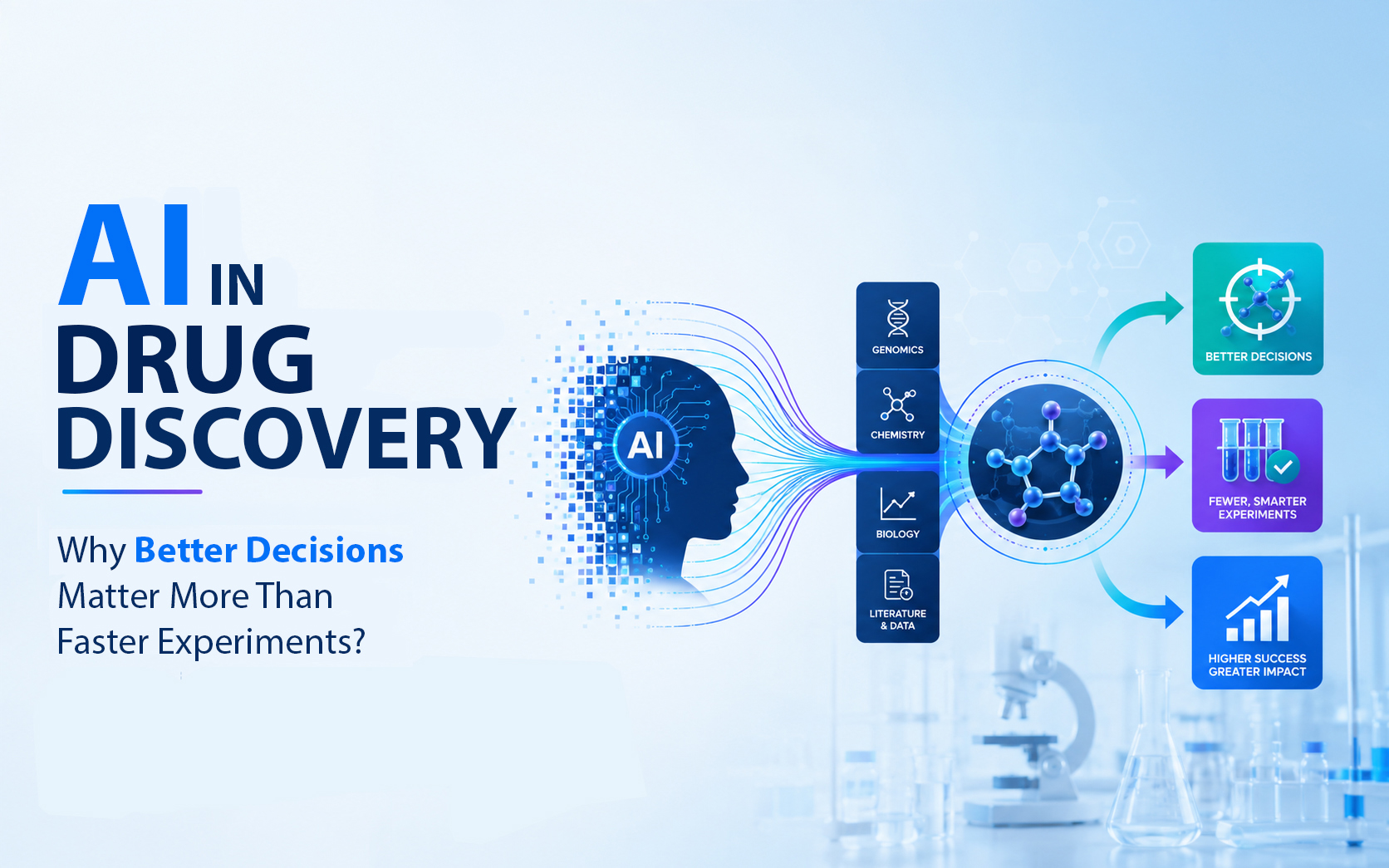
AI in Drug Discovery: Why Better Decisions Matter More Than Faster Experiments?

Drug discovery has always been a high-stakes function in pharma, but the pressure on R&D teams has grown significantly. Rising development costs, tighter patent windows, and increasing competition are forcing pharmaceutical leaders to rethink how innovation is delivered.

Improving pipeline productivity is no longer only about scientific progress. It is directly tied to business growth, speed to market, and long-term competitiveness. For many pharmaceutical organizations, the bigger challenge is not failed drugs but the cost of making the wrong decisions too late in the pipeline.

This is where Artificial Intelligence (AI) is creating real momentum. By improving how research teams analyze data, identify targets, evaluate molecules, and manage risk, AI is helping pharmaceutical organizations make faster and better decisions across the drug discovery lifecycle.

AI in Drug Discovery

McKinsey estimates that generative AI could contribute between $60 billion and $110 billion annually across pharma and medical products, with drug discovery representing one of the highest-value areas. For pharma leaders, the opportunity is becoming increasingly clear: better decisions earlier in the process can significantly improve outcomes across the entire pipeline.

How AI Is Reshaping the Drug Discovery Lifecycle?

AI is changing the way pharmaceutical organizations approach discovery by improving how data is analyzed, decisions are made, and risks are identified earlier in the pipeline. From target identification to clinical readiness, its role is expanding across every critical stage of drug development.

  1. The Discovery Bottleneck Begins with Data

Discovery Bottleneck Begins with DataEvery stage of pharmaceutical research starts with data. Genomics, biomarkers, molecular libraries, proteomics, and patient records have expanded the amount of information available to R&D teams at an unprecedented scale.

But data volume alone does not improve decision-making.

One of the biggest bottlenecks in modern drug discovery is identifying which data points deserve action. Delays at this stage often affect everything that follows, from target validation to candidate progression.

AI is helping solve this by improving how complex datasets are processed and interpreted. Machine learning models can identify biological patterns, protein interactions, and disease relationships faster than traditional analysis methods.

In practical use cases, this supports faster biomarker discovery, disease pathway mapping, and stronger hypothesis generation.

Recommended To read: How Generative AI Speeds Up Drug Discovery and Development?

  1. Strengthening Target Identification

Strengthening Target Identification

Once data is structured and understood, the next critical decision is target selection.

Target identification determines where scientific effort, budgets, and resources will be invested. Weak target selection often creates years of downstream inefficiency and unnecessary spend.

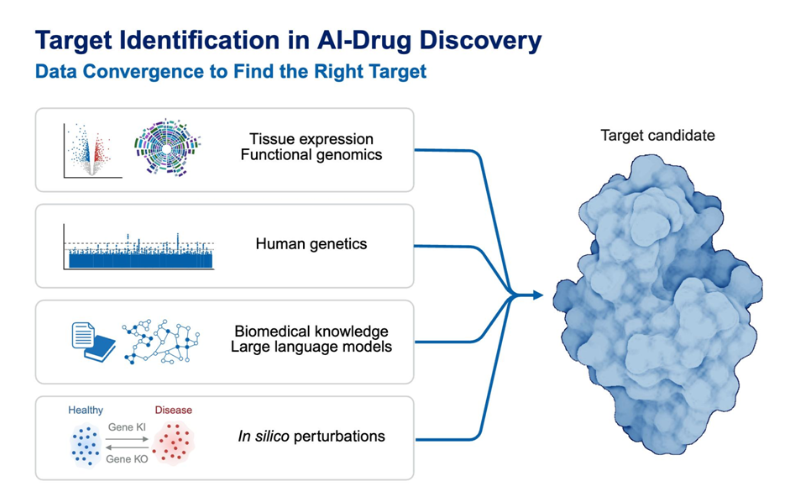
AI is helping improve this process by analyzing biological and historical datasets to identify high-potential targets faster.

Common applications include identifying novel oncology targets, prioritizing rare disease gene mutations, and mapping inflammatory pathway markers for therapeutic development.

For pharmaceutical leaders, stronger target confidence improves portfolio discipline and reduces investment in lower-probability programs.

In many pharma delivery engagements, stronger target quality early has consistently increased the efficiency of the broader pipeline.

  1. Accelerating Molecule Discovery and Lead Optimization 

Accelerating Molecule Discovery and Lead Optimization

After a target is selected, the next challenge is identifying molecules that can interact effectively with it. This phase has traditionally depended on repeated screening and refinement cycles, making it one of the most time-intensive and expensive parts of R&D.

AI is helping make this process more predictive, especially in therapeutic areas where molecular complexity makes traditional screening slower, more expensive, and harder to scale.

Generative models can evaluate thousands of molecular structures based on efficacy, stability, and binding affinity before physical testing begins.

This supports several important use cases:

  • Virtual screening of large compound libraries
  • Lead optimization for efficacy improvement
  • Drug repurposing analysis
  • Small molecule generation for complex disease targets

Deloitte has highlighted how AI is improving efficiency in discovery environments where repeated experimentation has historically slowed progress.

For leadership teams, this translates into faster candidate progression and more focused R&D investment.

  1. Reducing Development Risk with Predictive Toxicity

As candidates move deeper into development, the cost of failure increases significantly. Late-stage toxicity remains one of the most expensive risks in pharma. A candidate can progress for years before safety concerns emerge, affecting both budgets and pipeline strategy.

Predictive AI models are helping reduce this risk earlier. By analyzing historical toxicity datasets, AI can identify potential hepatotoxicity, cardiotoxicity, and broader compound safety concerns before preclinical testing begins. This gives pharmaceutical teams earlier visibility into candidate quality.

For business leaders, earlier risk detection improves capital efficiency and strengthens decision-making across active portfolios.

  1. Improving Clinical Trial Readiness


Improving Clinical Trial Readiness

Clinical trials remain one of the longest and most operationally complex stages in pharmaceutical development. Delays in patient recruitment, poor cohort alignment, and protocol inefficiencies can significantly extend development timelines.

AI is helping improve trial readiness by supporting more data-driven planning. By analyzing patient records, historical trial performance, and disease progression patterns, AI can improve cohort matching, predict enrollment bottlenecks, and optimize site selection.

These use cases improve trial preparation and reduce avoidable delays. For pharmaceutical leaders, stronger trial readiness directly affects time-to-market and the ability to maximize commercial opportunities.

As candidates move closer to commercialization, the focus begins to shift from scientific validation to regulatory readiness, where operational efficiency becomes equally important.

  1. Extending AI into Regulatory Workflows

AI’s role in pharma is expanding beyond discovery and trials. Regulatory workflows involve significant effort across documentation review, compliance checks, and submission preparation. These tasks often create operational slowdowns close to market entry.

AI is helping improve this through intelligent document processing. Key applications include:

  • Extracting structured data from clinical reports
  • Classifying regulatory documents
  • Identifying compliance gaps
  • Supporting submission readiness workflows

For pharmaceutical organizations, this reduces administrative burden and improves operational efficiency during critical submission stages.

From AI Experimentation to Enterprise Execution

The conversation around AI in pharma has shifted significantly in recent years. What started as isolated innovation projects is now becoming part of broader R&D strategy. Pharmaceutical companies are increasing AI investments because the business value is becoming clearer, from faster research cycles to stronger candidate quality and better risk visibility.

One of the biggest reasons AI initiatives stall in pharma is not model capability. It is fragmented research data and poor integration into scientist workflows.

This is where execution becomes critical.

In many AI-led pharma engagements supported by USM Business Systems, the focus has been on turning AI into practical solutions across drug discovery, from biomedical data intelligence to predictive modeling and workflow automation.

For pharma leaders, that shift from experimentation to execution is where long-term value starts to take shape.

What Pharma Leaders Should Prioritize Next?

The next phase of AI adoption in pharma will be shaped by practical execution. For some organizations, the priority may be improving data intelligence. For others, it may begin with target selection, toxicity prediction, or clinical trial optimization.

What matters most is identifying where inefficiencies exist today and understanding how AI can improve decision quality in those specific areas.

In pharma, speed matters. But better decisions matter more. The organizations combining scientific expertise with AI-driven decision intelligence will be the ones building stronger pipelines, reducing avoidable risk, and bringing therapies to market with greater confidence.

Where can AI create the biggest impact across your drug discovery pipeline today?

Connect with USM Business Systems to explore practical AI strategies aligned to your R&D goals.

What Every Franchise Location Page Must Include In 2026


Here’s a hard truth: Google doesn’t rank your brand it ranks your locations, one by one, on their own individual merits. A $500,000 website redesign won’t save you if your location pages aren’t built right.

According to 2026 research, 46% of all Google searches carry local intent and 76% of people who search for something nearby visit a business within 24 hours.

For franchise brands with dozens or hundreds of locations, every under-optimized location page is leaving foot traffic and revenue on the table every single day.

This guide breaks down exactly what every franchise location page needs in 2026 with real-world examples across healthcare, home services, fitness, education, and restaurants.

Why E-E-A-T Matters for Franchise Location Pages

This also connects directly to Google’s guidance on helpful, reliable, people-first content. Google asks publishers to show EEAT : experience, expertise, authoritativeness, and trustworthiness. For franchise location pages, that means proving real local knowledge instead of publishing a thin city-swap template.

At Weam, this is the lens used when reviewing multi-location content systems for franchise and location-based teams: the strongest pages connect website content, Google Business Profile data, reviews, local offers, and reporting into one reliable location-level source of truth.

1. Get the Technical Foundation Right First

URL Structure That Inherits Authority

The best-performing franchise location pages use a clean subdirectory structure:

yourbrand.com/locations/chicago-il/
yourbrand.com/locations/miami-fl/

Avoid subdomains (chicago.yourbrand.com) and separate domains (yourbrand-chicago.com). Both force each location to build SEO authority from near-zero, as subdomains are treated by Google as separate websites and do not inherit the equity built on the main domain.

Real-world example: Mr. Electric of Austin uses the shared Mr. Electric domain while still serving hyper-local content: an Austin address, service-area map, nearby areas served, local phone number, and city-specific copy such as “Keep Austin Wired.” That is the balance franchise pages need – central brand authority plus local proof.

Mr. Electric of Austin shows local NAP details, service-area coverage, map context, and local booking CTAs.

LocalBusiness Schema: Still a Competitive Edge

Only 31% of local business websites have properly implemented LocalBusiness schema (which means getting it right is still a genuine advantage.

Every location page should include schema covering:

• Business name, address, and phone (NAP)

• Operating hours (including holiday hours)

• Geographic coordinates

• Aggregate review rating

• Service types and price range

Full implementation guidance: Google’s official LocalBusiness documentation

2. Content That Actually Earns Local Rankings

No City-Swap Templates Ever

The most damaging mistake in franchise SEO is taking one template, swapping the city name, and publishing 50 identical pages. Google recognizes this immediately and devalues all those pages as duplicate content.

Each location page must include content that is genuinely useful and locally specific, referencing local landmarks, community context, and photos taken at that actual location.

Subway Washington, DC government-location page showing local naming, hours, and store-specific service context.
Subway 250 Tenth Avenue New York page showing pickup, delivery, catering, hours, address, and ordering CTAs for that exact store.

Real-world example: Subway uses store-specific details to avoid thin city-swap templates. Its 250 Tenth Avenue New York page highlights local hours, address, pickup, delivery, catering CTAs, and services like breakfast and mobile ordering. Its 2201 C Street NW Washington, DC page uses a different location name, hours, and service mix for a business-district audience. Same franchise system, but each page gives Google and customers distinct local evidence.

Location-Specific Offers and Seasonal Promotions

Generic calls-to-action don’t convert as well as market-specific offers .Anytime Fitness allows franchisees to run localized promotions at the city level. For example, the Washington, Michigan location runs a “Join & Get the Summer Free” banner to capture warm-weather sign-ups, while the Clayton, North Carolina location uses a “Join For $1” offer to drive immediate conversions in its market. The page structure stays familiar, but the offer adapts to local demand.

Anytime Fitness Washington, MI using a summer-specific local offer.
image6

Localized FAQs and Customer Reviews

FAQ sections serve two purposes: answering genuine customer questions and targeting long-tail, voice-search keywords. FAQs should cover:

• Local parking and transit options

• Geography-specific service questions (“Do you handle ice dam repairs?” for Minnesota; “Do you offer heat damage treatment?” for Texas)

• Location-specific hours and local holidays

Customer reviews are the #1 trust signal and in 2026, Google pays attention to review keywords as a top-tier ranking signal — the specific words customers use in their reviews directly help that location rank for those phrases. A review mentioning “best physical therapy in Austin” actively helps that Austin location rank for that phrase.

Real-world example: Orangetheory Fitness Chicago-River North shows how a franchise location page can combine precise local context with proof. The page references the studio’s corner of Wells and Ontario, nearby transit access, and neighborhood context, while the Google Business Profile adds reviews that mention coaches, workouts, and the specific studio experience.

Orangetheory Fitness Chicago-River North appears in local results with neighborhood-level context and review signals.

3. The Geographic and Seasonal Dimension

This is the section most franchise marketers overlook and arguably the most powerful differentiator available in 2026.

A franchise location page in Phoenix faces a completely different customer reality than one in Portland or Boston. The climate is different. The seasonal rhythm is different. The language customers use to search is different. Publishing identical pages for both markets costs both locations meaningful search rankings since Google is actively looking for location-level signals, not cloned corporate content.

This is what Google means by“genuinely useful, locally relevant information that a visitor in that market cannot get from a different location page.”

How Seasonal Conditions Shape Content Across Verticals

Home Services

A roof cleaning franchise in Tampa needs to address peak mold and algae season during summer humidity. The same brand’s Denver page needs content about freeze-thaw cycles and ice accumulation. Gulf Coast locations should shift emergency restoration content during hurricane season, because seasonal service needs are one of the clearest ways to prove local relevance.

Fitness

Gym franchises in Minnesota and Michigan see indoor membership surges in harsh winters. Those location pages should emphasize “escape the cold” from November through February. Orangetheory Fitness is a strong example of a franchise brand that customizes location pages by market, tailoring messaging based on what resonates with the local audience.

 Healthcare
Allergy treatment franchises in high-pollen regions (Southeast, Midwest in spring) should build location pages around seasonal allergy peaks. Physical therapy franchises near ski resorts should optimize for winter injury recovery content during ski season, then pivot to summer sports recovery in the off-season.

Seasonal Content Update Framework Quarterly

Google rewards pages that show regular activity over pages created once and abandoned.

Quarter Home Services Fitness Restaurant Healthcare
Q1 (Jan–Mar) Winter storm recovery, pipe thaw New Year resolutions, winter wellness Comfort food, hot beverages Cold/flu season, winter injuries
Q2 (Apr–Jun) Spring cleaning, AC prep Spring transformation, outdoor training Lighter menu, patio seating Allergy season, spring sports injuries
Q3 (Jul–Sep) AC maintenance, storm prep Summer momentum, fall prep Refreshing drinks, back-to-school Heat illness, summer sports recovery
Q4 (Oct–Dec) Heating checks, winterization Holiday commitment, year-end goals Holiday specials, gift cards Flu shots, year-end health checkups

Real-world example: Molly Maid’s Scottsdale, AZ holiday cleaning page leads with party cleanup and holiday hosting needs, while its spring cleaning service page shifts the angle toward refreshing homes after winter. Same brand, different seasonal intent. That is the level of variation franchise pages need when the weather, local routines, and customer urgency change by market.

Molly Maid Scottsdale holiday cleaning page matching the local seasonal need around hosting and post-party cleanup.
Molly Maid spring cleaning page shifting the angle to seasonal home refresh and spring readiness.

4. Local SEO Signals That Power Rankings

Google Business Profile: The 3-Pack Is Everything

Businesses appearing in the Google local 3-pack receive 126% more traffic and 93% more conversion-oriented actions than those ranking just below it.

Every franchise location needs a separately managed Google Business Profile with:

NAP data that exactly matches the corresponding location page

100+ photosbusinesses with 100+ photos receive 520% more calls, 2,717% more direction requests, and 1,065% more website clicks than average

Regular posts, photos, and review responses to keep the profile active and trustworthy

Accurate real-time hours / “Open Now” status, since Google recommends keeping regular and special hours updated to improve local visibility

From Weam’s work with multi-unit businesses and franchise teams, the ranking problem is rarely one missing keyword. It is usually a system problem: the page, Google Business Profile, reviews, photos, offers, and reporting are managed in different places, so each location sends mixed signals. Strong location pages fix that by making the website the source of truth for local operations.

Google Business Profile fields such as hours, photos, reviews, website link, and directions must match the corresponding location page.

NAP Consistency and Review Velocity

Name, Address, and Phone number consistency across all directories is non-negotiable. Even a suite-number discrepancy between your Google Business Profile and a single directory listing can create “signal pollution” that weakens local trust signals.

For reviews, target the benchmarks recommended in ClickTecs’ franchise local SEO checklist:

Minimum 50 total reviews before considering the profile optimized

3–5 new reviews per month to maintain velocity

100–200+ reviews in competitive markets

5. The 2026 Location Page Structure

Every high-performing franchise location page should follow this structure, top to bottom:

1. Location-specific H1 e.g., “Planet Fitness in Austin, TX Open 24 Hours, Judgment-Free Workouts”

2. Hero section actual photo of the physical location, local phone number (click-to-call), address with embedded Google Maps, real-time open/closed indicator

3. Local introductory paragraph (150–200 words) written specifically for this market, referencing the neighborhood and nearby landmarks

4. Location-specific CTA make it local (“Book your Austin appointment today”)

5. Services section only list services available at this location; highlight any location-only specialties

6. Seasonal/local offers current location-specific promotions or time-sensitive deals

7. Local testimonials + Google Reviews widget 3–5 curated reviews that mention the location and local context

8. Location-specific FAQs 6–10 questions covering parking, nearby neighborhoods, and geography/season-specific concerns

9. Staff or owner introduction locations with a named owner or team member see significantly higher conversion rates

10. Community involvement local sponsorships, charity partnerships, or events

11. Internal links to nearby location pages, the corporate homepage, core service/use-case pages, supporting local blog posts, and a related PPC/location-intelligence article when relevant

12. LocalBusiness schema full implementation in page source

13. Footer NAP exact match to Google Business Profile

2026 Franchise Location Page Checklist

✅ Technical Foundation

☐  Subdirectory URL structure: brand.com/locations/city-state/

☐  LocalBusiness schema with all required fields

☐  Mobile-optimized with click-to-call phone number

☐  Embedded Google Map

☐  Page load speed under 2.5 seconds (Core Web Vitals)

✅ Content Requirements

☐  Unique H1 with city name and primary service

☐  Locally-written intro paragraph (no city-swap templates)

☐  Location-specific services list

☐  Seasonal/local promotional offer

☐  3–5 local customer testimonials + live Google Reviews widget

☐  Location-specific FAQ section (6–10 questions)

☐  Staff or owner introduction

☐  Community involvement content

☐  Actual photos of the physical location (not stock)

✅ Local SEO Signals

☐  Fully optimized, separately managed Google Business Profile

☐  NAP data exactly matches GBP

☐  Minimum 50 Google reviews, 3–5 new per month

☐  Local citations updated and consistent across directories

☐  Internal links to/from the homepage, corporate service/use-case pages, nearby location pages, and supporting articles such as the multi-location PPC workflow

✅ Seasonal and Geographic Customization

☐  Content reflects local climate and seasonal service needs

☐  Offers and promotions updated quarterly

☐  Hero image reflects local environment or season

☐  FAQs include geography-specific questions

Want to apply the same location-level thinking to paid campaigns? Read Weam’s related guide on multi-location PPC workflows, which explains how clean location data can help teams make smarter ad decisions across markets. The same inputs that strengthen franchise location pages, including reviews, missed calls, local offers, booking capacity, market seasonality, and location-level demand, can also help PPC teams decide which locations to promote, which offers to test, and where budget should shift.

For franchise teams, the goal is not more copy. It is a repeatable system that keeps every page accurate, local, approved, and connected to performance. That is where Weam’s multi-unit workflow approach becomes relevant: it connects content, approvals, reporting, and location-level execution instead of treating each page or campaign as a one-off task.

The Location Page Is Your Front Door

In 2026, your franchise location page is not a digital brochure. It is the front door of every individual location the first thing a local customer encounters when they search for what you offer near them.

The franchises winning local search treat each location page as a standalone, genuinely local asset: rich with unique content, optimized for local intent, updated seasonally, and reflective of the geographic community it actually serves.

Whether your location sits in the humid South, the frozen North, the sun-baked Southwest, or the rain-soaked Pacific Northwest the services your customers need and the language they use to search are different. Your location page must be too.

Ready to scale this across hundreds of locations without duplicate content penalties? Review Weam’s approach for multi-unit businesses, start with a cost-saving audit to identify where your franchise team may be losing time or budget, then book a call to discuss how your team could manage location pages, approvals, and updates without turning the process into manual copy-paste work

Two Things Every B2B Marketer Should Be Doing With AI Now


Our 2026 State of AI for Business Report surveyed more than 2,100 business professionals, including nearly a third who are marketers and 84% who work for B2B organizations.

Respondents said 41% of their organizations describe their AI momentum as inconsistent or siloed. More than half of individual professionals have moved past experimentation, yet their organizations haven’t caught up. 
Continue reading “Two Things Every B2B Marketer Should Be Doing With AI Now”

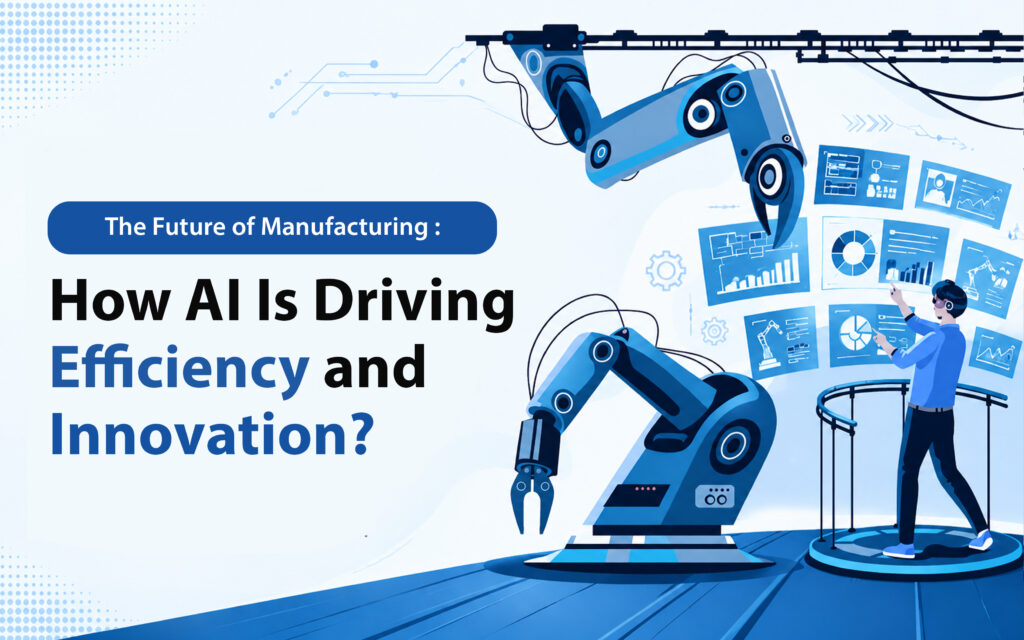
How AI Is Driving Efficiency And Innovation?


The Future of Manufacturing: How AI Is Driving Efficiency and Innovation?

Manufacturing is entering a new phase of digital transformation where Artificial Intelligence (AI) is becoming part of everyday operations. Global manufacturers are facing increasing pressure to improve productivity, reduce costs, manage supply chain disruptions, and maintain high product quality. Traditional approaches alone are no longer enough to keep pace with changing market demands.

According to Deloitte’s Smart Manufacturing Survey, manufacturers continue to increase investments in AI and smart factory technologies to improve predictive maintenance, product quality, and supply chain resilience.

AI is helping manufacturers address these challenges by turning operational data into actionable insights. AI solutions for manufacturing support predictive maintenance, quality inspection, intelligent document processing, and supply chain optimization across the manufacturing ecosystem.

Why Is AI Important in Manufacturing?

Organizations looking to accelerate digital transformation are increasingly investing in AI-powered manufacturing solutions that improve visibility across operations and support data-driven decision-making.

Modern manufacturing environments generate large volumes of data from machines, sensors, enterprise applications, maintenance records, supplier networks, and operational documents. Much of this information remains underutilized because it exists across disconnected systems.

AI helps organizations connect these data sources, identify patterns, and support faster decision-making. As a result, manufacturers can reduce downtime, improve resource utilization, and respond more effectively to operational changes.

Organizations that invest in AI are also building more resilient operations that can adapt to market fluctuations and customer expectations.

What Are the Benefits of AI in Manufacturing?

AI helps manufacturers improve productivity, reduce downtime, optimize supply chains, and automate business processes while enabling faster, data-driven decision-making.

Industry adoption continues to accelerate. According to Deloitte’s 2025 Smart Manufacturing Survey, manufacturers reported up to 20% improvement in production output, 20% improvement in employee productivity, and 15% unlocked operational capacity through smart manufacturing initiatives.

The same study found that 80% of manufacturing executives plan to invest at least 20% of their improvement budgets in smart manufacturing technologies over the next few years.

Manufacturers are using AI to:

  • Reduce equipment downtime
  • Improve product quality
  • Optimize inventory management
  • Strengthen supply chain visibility
  • Increase workforce productivity
  • Automate document-intensive processes
  • Lower operational costs
  • Support data-driven decisions

As AI adoption grows, manufacturers are moving beyond isolated pilot projects and integrating intelligent technologies across production, maintenance, supply chain, and enterprise operations. Organizations that build strong data and automation foundations today will be better positioned to compete in the future of smart manufacturing.

Top AI Use Cases in Manufacturing

1.     Predictive Maintenance

Manufacturers adopting AI use cases for predictive maintenance and equipment management can reduce unplanned downtime and improve asset reliability.

Unexpected equipment failures can disrupt production schedules and increase operational costs. AI models analyze machine performance data to detect early signs of wear and identify potential failures before they occur.

This allows maintenance teams to schedule repairs proactively, reduce unplanned downtime, and extend the life of critical assets.

2.     Intelligent Quality Control

Advanced computer vision solutions for manufacturing help organizations automate defect detection and strengthen quality assurance processes.

Manual quality inspections can be time-consuming and inconsistent, particularly in high-volume production environments.

AI-powered computer vision systems can analyze products in real time, identify defects, and maintain quality standards across production lines. Faster defect detection helps reduce waste and minimize costly rework.

3.     Supply Chain Optimization

Supply chain disruptions continue to challenge manufacturers across industries. AI-powered supply chain management can analyze demand patterns, supplier performance, inventory levels, and logistics data to support more accurate forecasting.

Better visibility across the supply chain helps organizations improve inventory management, reduce delays, and maintain business continuity. Many manufacturers are also adopting AI-powered supply chain solutions to improve forecasting and operational coordination.

4.     Production Planning and Workforce Management

AI can evaluate multiple production variables simultaneously, including workforce availability, machine capacity, inventory levels, and customer demand.

This enables manufacturers to optimize production schedules, improve workforce allocation, and reduce operational bottlenecks.

5.     Inventory and Facility Management

Manufacturers often struggle with excess inventory, stock shortages, and facility management challenges. AI can help organizations optimize inventory levels, monitor asset utilization, and improve operational planning across manufacturing facilities.

How Does AI Improve Manufacturing Documentation?

Operational efficiency depends on accurate and accessible information. Manufacturing organizations manage thousands of documents, including work orders, maintenance logs, inspection reports, compliance records, engineering drawings, supplier contracts, invoices, and standard operating procedures.

Managing these documents manually can slow down workflows and create information gaps.

At USM, we help manufacturers modernize document-intensive operations through AI-powered automation capabilities that include:

  • Intelligent document processing
  • Automated data extraction
  • AI-assisted document classification
  • Enterprise search and knowledge retrieval
  • Workflow automation for operational documentation
  • Integration with existing ERP and enterprise platforms

By reducing manual effort and improving access to information, organizations can accelerate decision-making and improve operational consistency.

How USM Supports AI-Driven Manufacturing?

USM works with manufacturing organizations to transform data-intensive and document-heavy business processes through practical AI solutions. Our expertise spans AI in Manufacturing, intelligent automation, predictive analytics, and connected factory initiatives.

Our manufacturing AI capabilities support use cases such as:

  • Predictive equipment maintenance
  • Intelligent supply chain management
  • AI-powered inventory optimization
  • Workforce management automation
  • Facility management solutions
  • Customer and operational analytics
  • Enterprise knowledge management
  • Agentic AI solutions for manufacturing operations

These capabilities help organizations reduce operational inefficiencies while improving visibility across business functions.

Conclusion: Building the Future of Manufacturing with AI

The future of manufacturing will be shaped by organizations that can combine operational expertise with intelligent technology.

As manufacturers continue to modernize their operations, AI will play an increasingly important role in improving productivity, reducing operational complexity, and enabling smarter business decisions.

At USM – best AI company in USA, we help manufacturers modernize document-heavy workflows, automate operational processes, and build AI-powered manufacturing ecosystems that improve visibility and reduce manual efforts. Our AI manufacturing solutions are designed to help organizations build more resilient, efficient, and future-ready operations.


Contact us to know more about How AI Is Driving Efficiency and Innovation? Book Executive AI Briefing →


Frequently Asked Questions

  • What Is AI in Manufacturing?

AI in manufacturing is the use of artificial intelligence technologies to automate processes, analyze operational data, improve production efficiency, predict equipment failures, and support better business decisions across the manufacturing lifecycle.

  • How does AI improve manufacturing efficiency?

AI improves efficiency by automating repetitive processes, predicting equipment failures, optimizing production schedules, improving inventory management, and helping organizations make faster decisions using operational data.

  • Can AI reduce manufacturing costs?

Yes. AI can help reduce costs by minimizing downtime, improving quality control, lowering maintenance expenses, reducing waste, and streamlining document-intensive workflows.

  • Is AI only for large manufacturers?

No. AI solutions are increasingly scalable and can be implemented across organizations of different sizes. Many manufacturers begin with targeted use cases and expand adoption as they realize business value.

  • What are the top AI use cases in manufacturing?

The most common AI use cases include predictive maintenance, quality inspection, supply chain optimization, inventory management, production planning, document automation, and workforce management.

  • Can AI integrate with ERP systems?

Yes. Modern AI platforms can integrate with ERP, MES, CRM, and other enterprise systems to automate workflows and improve operational visibility.

  • How does AI support smart factories?

AI supports smart factories by connecting machines, sensors, enterprise systems, and operational documents to provide real-time insights, improve productivity, and enable data-driven decisions.

  • How does USM help manufacturers adopt AI?

USM helps manufacturers implement AI solutions for predictive maintenance, document automation, intelligent supply chain management, enterprise knowledge management, and workflow optimization. Our AI capabilities integrate with existing enterprise systems to improve operational efficiency and support digital transformation initiatives.

AI In Logistics And Supply Chain


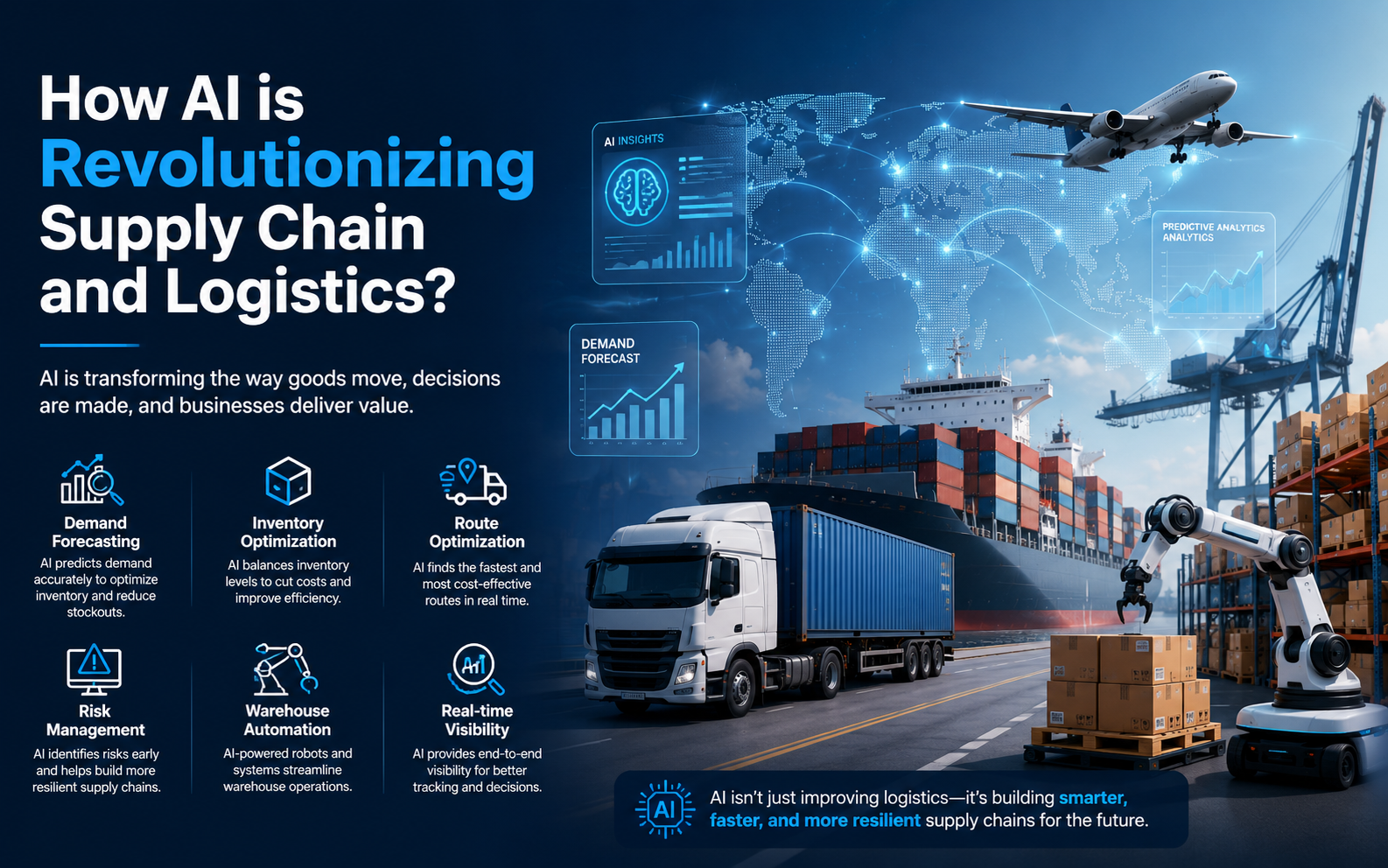
How AI is Revolutionizing Supply Chain and Logistics?

Artificial Intelligence is becoming highly explosive in terms of global AI in logistics and supply chain. Many logistics officials feel that these areas are likely to experience a great transformation.

It has the potential to disrupt the continuous development of advanced and digital technologies such as machine learning, artificial intelligence, natural language processing (NLP), etc. and promote advancements in these sectors.

Computers can deal with massive data at a time, it is difficult to take it physically in a single decision making procedure. Applying AI algorithms and utilizing various data sets, a machine will analyze unlimited prospects which lead to compelling planning.

Artificial Intelligence reduces the human errors and helps in doing tedious tasks. So, with the assistance of AI, operational effectiveness can be boosted and expenses can be limited.

The growth of AI has fundamentally changed many sectors of the logistics and supply chain industry. Whether it is logistics management, consumer support, or inventory management, the contribution of the new era, Artificial Intelligence-based solutions are undeniable.

According to the reports of McKinsey, AI technology in supply chain management is expected to reach 3.3 trillion dollars in the coming next 20 years.

Let’s discuss

Click on the link to learn the Definition of Artificial Intelligence? And what are the Examples of AI?

In this blog, we will be discussing how Artificial Intelligence is impacting the supply chain and logistics industry.
So, without late, let’s look into the

Top 7 Ways AI in logistics and supply chain Management

I think businesses cannot work properly without a well-maintained inventory. Both understocking and overstocking are really harmful. With a proper inventory management system, a company can focus on selling their products instead of managing its inventory.

A key requirement of AI technology in inventory management is the ability to assess demand, rather than the ability to ensure stock management. Algorithms can now study consumer demands across vast data and understand which materials will be in demand soon and which fail to generate enough sensation.

This is called ‘demand estimation’ and is widely used in and businesses across the globe. So instead of depending on real time demand, a company can be ready in advance and stock up accordingly. It is undoubtedly the best revolutionary aspect of Artificial Intelligence in logistics.

As facial recognition is becoming popular in AI, machine can handle security. It can be easily secured by tracking the customers who enter and exit the unmanned warehouse. In addition, machines can track the items kept on the product shelves and the customers leaving the warehouse after reading product barcode and then updating the inventory accordingly.

  • Shipping Process Optimization

The effect of Artificial Intelligence does not diminish when the product is left out of the list. It is also used to estimate the best possible shipping route. Intelligent Machines utilize graph theory to evaluate the fastest and most cost-effective shipping routes for business.

AI software can also handle peak hours and traffic conditions. These are the significant factors that badly affect the shipping time of a company. By ignoring peak hours and scheduling delivery during light traffic, their delivery boys can spend less waiting time on roads and deliver the products to customers as soon as possible. Thus, the impact, and in turn, the benefits are increased.

  • Supplier Relationship Management

I would certainly say that supplier is one of the significant aspects of any logistics businesses. Finding the perfect supplier and creating a list of each item is tailored to those suppliers. According to the demand, when refilling recalibrating product, the engagement with one’s suppliers is a major factor that describes how smoothly the transaction runs.

Artificial Intelligence can manage various supplier parameters including delivery speed, cost, and credit score and prepare a list of best suitable options for any circumstances. It indirectly says that business process runs effectively and the supplier relationship with them is friendly and loyal.

Also Read about AI in Supply Chain: Uses Cases of AI in Supply Chain Management

  • Transportation Management

It is common for many enterprises to contract with shipping firms to deliver their products. Some of the largest companies, like Alibaba, Amazon, and Flipkart have their own shipping department. As discussed earlier, Artificial Intelligence makes the whole experience very smooth when it comes to efficiency and time management for goods shipping.

Whenever drivers are in delivery vehicles, they have only limited time to reach the destination. Hiring multiple drivers for the same vehicle to cater the requirement for a 24*7*365 delivery system can be costly. In logistics, AI going to prove as a lifesaver soon by automating the entire driving function. You know? Amazon has shown confidence recently in automated delivery trucks.

Every country in the world has its own national language. As business is happening from around the globe, you should cater to a global audience. But, miss communication due to different languages is a major problem. Along with the miss-conversation between customers and business, understanding other countries market trends and goods can be a big problem.

Don’t worry! This barrier will not exist longer with AI technology. In addition, AI-powered chatbots and customer support systems are also very good at managing foreign consumers without the hassle of hiring many offshore support executives. All over, Artificial Intelligence makes the employment easier.

  • Reduced Customer Response Time

Ultimately, businesses are leveraging AI solutions to provide excellent customers support. Using AI Chatbots, businesses can reduce consumer response time and also decreased the need for customer service executives.

In addition to being polite and practical, chatbots are also beneficial when dealing with foreign customers who do not speak the languages ​​supported by the business locally. AI technology ensures very efficient and fast customer service.


Final Verdict

AI technology will continue the fantastic journey of digitization development and will definitely become a significant part of everyday business. In industries such as supply chain and logistics, Obtaining Artificial Intelligence from expertise in fields such as supply chain and logistics is a useful tool to find out critical issues. AI plays a vital role in paving the way for proactive, predictive and personalized opportunities for supply chain and logistics.

Choosing Right AI Solution for Your Business is the First Step towards Success

USM Business Systems is one of the leading AI Solutions providers in India, the USA and the UK.

With more than a decade of expertise in AI application development, we deliver intelligent solutions that help businesses optimize operations, accelerate growth, and gain a competitive edge.

Contact us to know more about How AI is Revolutionizing Supply Chain and Logistics? Book Executive AI Briefing →

Let’s discuss

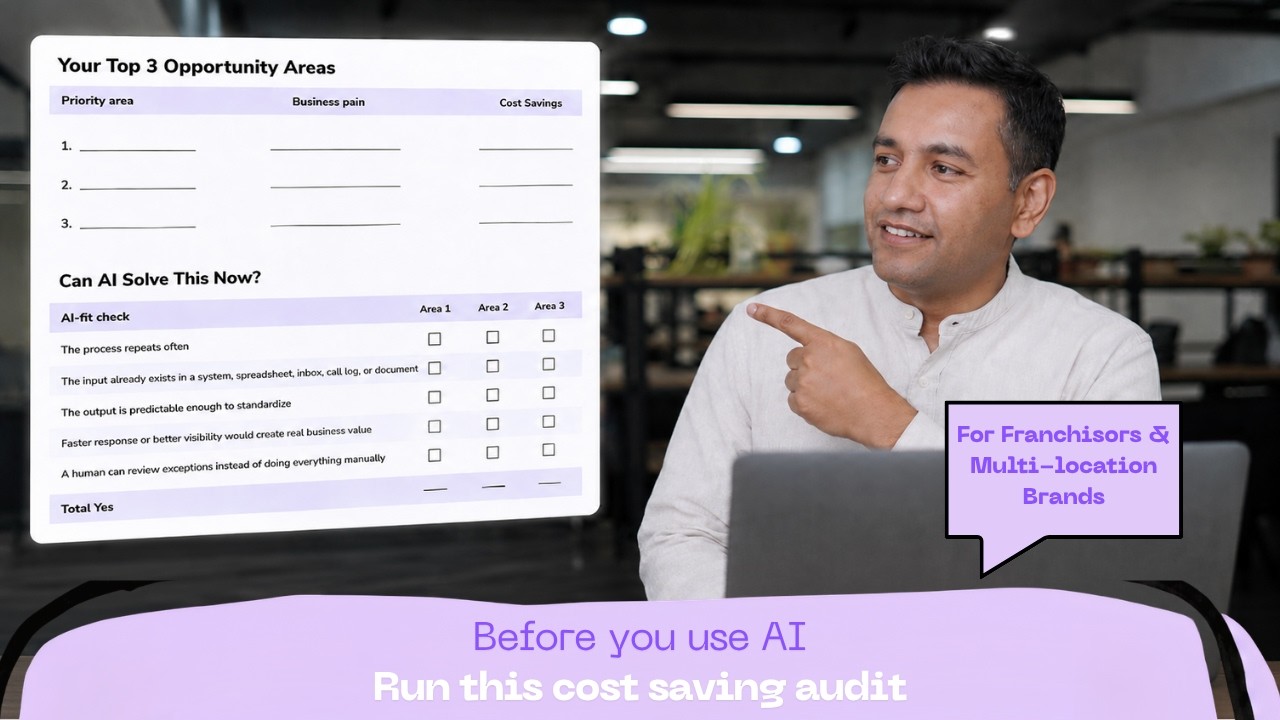
Before You Use AI, Run This Cost-Saving Audit For Your Franchise


There is a lot of talk right now about AI.

Every franchisor, multi-location brand, and business owner is hearing some version of the same thing:

“You should be using AI.”

But that is not the real question.

The real question is:

Where should AI start?

Because AI can help in a lot of places. It can help with reporting, marketing, customer support, operations, finance, admin work, and many other parts of the business.

But if you start in the wrong place, it becomes just another tool, another experiment, or another project that does not really move the business forward.

That is why I like starting with a simple audit.

Not a technical audit.

Not a complicated AI strategy session.

Just a practical business audit that helps you see where manual work, slow reporting, repeated tasks, and inconsistent execution are costing you time and money.

I call this the AI Cost-Saving Audit.

It is built for franchisors, multi-location brands, and location-based businesses.

The goal is simple:

Find the first few areas where AI can actually help reduce cost, save time, and improve execution across locations.

How the Audit Works

The audit looks at five business areas:

  1. Reporting & Visibility
  2. Marketing & Local Execution
  3. Operations & Admin
  4. Finance & Control
  5. Cross-Location Consistency

Each area has five questions.

how it works

For each question, you score your business from 0 to 2.

0 means this is not an issue.

1 means this is sometimes an issue.

2 means this is a clear issue.

Each section gives you a score out of 10.

The scoring guide is simple:

0 to 3 means it is probably not urgent.

4 to 6 means it is worth reviewing.

7 to 10 means there may be a strong AI opportunity.

The important part is to answer honestly.

Do not answer based on how you want your business to work.

Answer based on how your business works today.

If reporting is still manual, mark it.

If your team is chasing locations for updates, mark it.

If your marketing team is still manually adapting everything for each location, mark it.

This audit only works if you are honest about where the friction is.

Area 1: Reporting & Visibility

The first area is reporting and visibility.

For many franchise and multi-location businesses, this is one of the biggest hidden problems.

On paper, the business may have systems.

There may be a POS system, CRM, marketing tools, spreadsheets, review platforms, finance reports, and dashboards.

But when HQ needs a clear view across all locations, someone still has to pull data from different places and stitch it together.

Reporting & Visibility

So ask yourself:

Are managers or HQ still pulling reports manually from multiple systems?

Does it take more than one day to get a usable roll-up view across locations?

Are location issues usually spotted only after the damage is already visible in the results?

Do different teams use different versions of the same numbers?

Is benchmarking locations still more manual than it should be?

This is where AI can be very useful.

For example, if your team is spending hours every week pulling reports, cleaning spreadsheets, and summarizing what happened across locations, there may be an AI opportunity.

AI could help create reporting summaries, flag exceptions, show which locations need attention, or help leadership get a faster view of what is happening.

The goal is not always to replace your dashboard.

Sometimes the opportunity is simply helping your team understand the dashboard faster.

Area 2: Marketing & Local Execution

The second area is marketing and local execution.

This is a big one for franchise and multi-location brands because marketing is not just one campaign.

You may have a national campaign, but every location has its own local market, local reviews, local SEO, local offers, local events, and local customer behavior.

Marketing & Local Execution

So ask yourself:

Is local marketing inconsistent across locations?

Does your team spend too much time adapting content for each location?

Is marketing spend hard to connect to location-level outcomes?

Are reviews, local SEO, or local campaign responses too slow or too manual?

Does the brand team become a bottleneck when supporting many locations?

A simple example:

Your brand team creates one campaign.

Now that campaign needs to be adapted for 20, 50, or 100 locations.

The copy may need to change.

The offer may need to change.

The city name may need to change.

The local angle may need to change.

That type of work can become very manual very quickly.

AI can help here if the process is repeated and the brand guidelines are clear.

It can help create first drafts, local variations, review responses, campaign summaries, or local SEO updates.

The key is that a human still reviews and approves. AI does the first pass. Your team keeps control.

Area 3: Operations & Admin

The third area is operations and admin.

This is where a lot of hidden cost sits.

Most businesses do not lose time only on big strategic work.

They lose time on repeated small things.

The same questions.

The same follow-ups.

The same checklists.

The same weekly admin tasks.

The same “where do I find this?” messages from locations.

Operations & Admin

So ask yourself:

Do store or location teams repeat the same admin tasks every week?

Do support questions from locations consume too much HQ time?

Are SOPs, checklists, or internal answers hard to find quickly?

Do routine workflows depend too much on one experienced person?

Are delays caused more by follow-up and coordination than by the actual work?

This is one of the most practical areas for AI.

For example, maybe your location teams keep asking HQ the same questions:

Where is the SOP for this?

How do we handle this customer issue?

What is the process for this request?

Which checklist do we follow?

Who approves this?

If the answers already exist somewhere, AI can help make those answers easier to find.

That could become an internal support assistant trained on your SOPs, checklists, policies, and internal documents.

Again, the point is not to remove people from the process.

The point is to reduce repeated manual support so your HQ team can focus on higher-value work.

Area 4: Finance & Control

The fourth area is finance and control.

In a franchise or multi-location business, small finance issues can add up quickly.

One missed item may not seem like a big deal.

But if similar issues happen across many locations, it becomes real money.

Finance & Control

So ask yourself:

Are finance follow-ups, audits, or checks still heavily manual?

Is it difficult to compare profitability cleanly across locations?

Do leaders find out about margin issues too late?

Are exceptions, anomalies, or missed items hard to catch early?

Do recurring finance tasks require too much spreadsheet work?

This is not about handing your finance function over to AI.

That is not the point.

The better starting point is exception spotting.

For example:

Which location has unusual numbers?

Which report is missing something?

Which cost looks higher than expected?

Which sales number does not match the usual pattern?

Which item needs a human to review?

AI can help with the first pass.

It can summarize, compare, flag, and prepare.

Then the finance team reviews what matters.

That can save time and help the business catch issues earlier.

Area 5: Cross-Location Consistency

The fifth area is cross-location consistency.

This is one of the core challenges in franchise and multi-location businesses.

You may have the same brand, same playbook, same SOPs, and same process.

But in reality, locations may execute things differently.

Some locations follow the process well.

Some locations do their own thing.

Some are strong.

Some need help.

Some communicate clearly.

Some need repeated follow-up.

Cross-Location Consistency

So ask yourself:

Do locations execute the same process in different ways?

Is brand consistency difficult to maintain across the network?

Does HQ struggle to know which locations need attention first?

Do strong and weak locations look too different operationally?

Is communication from HQ to locations slower or less clear than it should be?

This is where AI can help HQ see patterns faster.

For example, AI could help compare location performance, summarize issues, identify which locations need support, or help monitor whether the same process is being followed across the network.

The value here is not just automation.

The value is visibility.

HQ cannot manually inspect everything across every location all the time.

AI can help bring the right things to the surface.

total score audit

Turning Scores Into Action

Once you score all five areas, you will have a score out of 10 for each one.

Now look at the highest scores.

Those are probably the areas where the pain is highest.

But this is important:

A high score does not automatically mean it should be your first AI project.

A high score only tells you there is business pain.

The next step is to turn that pain into a specific opportunity.

Pick your top three areas.

For each one, write down:

The priority area.

The business pain.

The possible cost saving or impact.

Turning Scores Into Action

For example:

Priority area: Operations & Admin

Business pain: Location teams keep asking the same questions, and HQ spends too much time answering them manually.

Cost saving: Reduce repeated HQ support time and give locations faster answers.

Or:

Priority area: Marketing & Local Execution

Business pain: The brand team spends too much time adapting campaigns for each location.

Cost saving: Reduce manual content work and help the team support more locations.

Or:

Priority area: Reporting & Visibility

Business pain: HQ spends too much time pulling weekly reports from multiple systems.

Cost saving: Reduce manual reporting time and catch location issues faster.

This step matters because “use AI for marketing” is too broad.

“Use AI to create first drafts of location-specific campaign content” is much better.

That is a real workflow.

And real workflows are where AI starts becoming useful.

Can AI Solve This Now?

After you identify your top three opportunity areas, the next question is:

Can AI actually solve this now?

Because not every painful problem is a good AI problem.

Some problems are painful, but the process is messy.

Some problems are painful, but the data is not available.

Some problems are painful, but every output is fully custom.

Can AI Solve This Now?

So for each of your top three areas, ask five questions:

Does the process repeat often?

Does the input already exist somewhere?

Is the output predictable enough to standardize?

Would faster response or better visibility create real business value?

Can a human review exceptions instead of doing everything manually?

If an area gets three or more Yes answers, it is usually a good candidate for an AI pilot.

Let’s say Operations & Admin gets four Yes answers.

The process repeats often.

The questions already exist.

The SOPs already exist.

The output is predictable.

And a human can review anything that needs judgment.

That could be a strong first AI pilot.

Now compare that with a problem where everything is custom, no data exists, no one owns the process, and the output is different every time.

That may still be an important problem.

But it may not be the first AI project.

And that is okay.

The point of this audit is not to force AI into every area.

The point is to find the first area where AI can realistically help.

What Makes a Good First AI Pilot?

A good first AI pilot is usually not the biggest idea.

It is usually the clearest repeated workflow.

Good first pilots usually look like:

Repeated weekly or daily work.

Slow roll-up reporting.

Repeated admin or support questions.

Location-by-location content adaptation.

Review responses.

Exception spotting.

Summaries and follow-up workflows.

The areas that are usually not the best first pilots are:

One-off strategic work.

Messy processes with no clear owner.

Tasks with no usable data source.

Work where every output is fully custom.

High-risk work with no human review step.

The best first AI pilot should be practical.

It should be narrow.

It should have clear inputs.

It should have a clear output.

And it should keep a human in control.

That is how AI becomes useful inside the business.

Not as a random tool.

Not as a chatbot experiment.

But as a way to reduce manual work, improve visibility, and help HQ support locations better.

Final Thought

The question should not be:

“How can we use AI?”

That question is too broad.

A better question is:

“Which repeated workflow is costing us time or margin, and is that workflow ready for AI?”

That is what this audit helps you answer.

good first ai pilots

By the end, you should know three things:

Your highest pain areas.

Your top three cost-saving opportunities.

Your best first AI pilot candidate.

That gives you a much better starting point.

And once you have that, AI becomes much more practical.

It is not about chasing the newest tool.

It is about finding the places where manual work is adding up across locations, and then building AI into those workflows in a way that actually helps the business.

This Is What B2B Marketers Need to Know About the Future of Work


The 2026 State of AI for Business Report surveyed more than 2,100 professionals, 84% of whom work at B2B organizations and about a third of whom are marketers. This makes this one of the most relevant datasets for B2B professionals trying to understand where AI is taking their profession.
Continue reading “This Is What B2B Marketers Need to Know About the Future of Work”

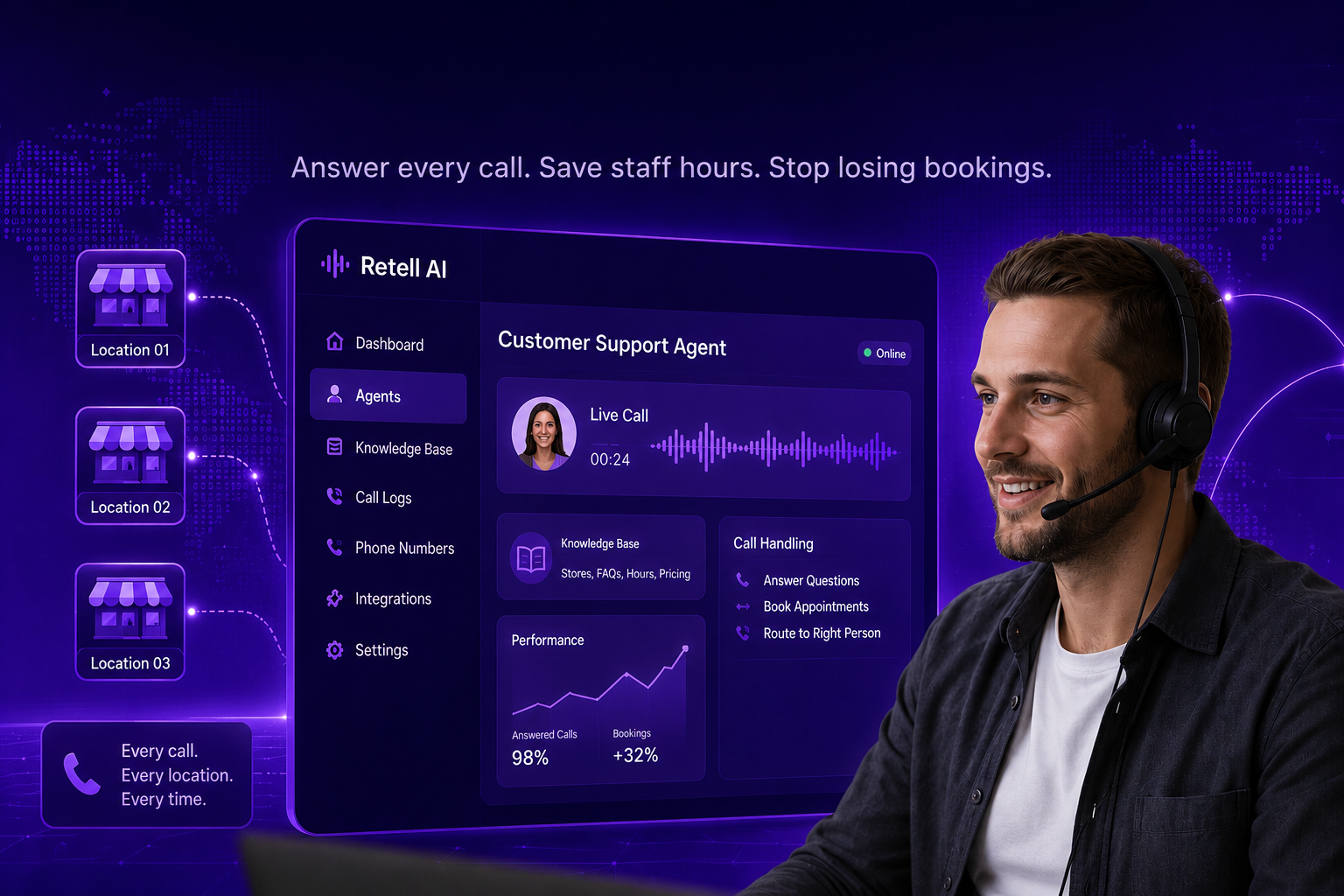
How To Set Up A Customer Support Voice Agent For Franchises


Your phones ring all day with the same questions. Hours, address, “are you open,” “can I book for Saturday.” Your staff stop serving the customer in front of them to pick up, or the call rolls to voicemail and the caller dials the store down the road.

A customer support voice agent answers every call on the first ring, at every location, day and night. It handles the routine questions and hands the rest to a person. This guide shows you how to set one up in Retell AI for a single location, in steps you can follow without a technical background.

Honest part first. It will not replace your team. It clears the repetitive calls so your staff can serve customers and close bookings. Plan for a couple of hours of setup and about a week of listening before it runs smoothly.

What a customer support voice agent handles
store hours, address, and directions

A voice agent does best on predictable calls:

  • store hours, address, and directions
  • whether a location is open that day
  • simple bookings and reservations
  • sending the caller to the right person or store

It is weak on judgment calls. Upset customers, refunds outside policy, and anything unusual belong with a person. Set that handoff from the start, and the agent earns its keep on the calls you were losing.

What you need before you start

  • A Retell AI account. Sign up at retellai.com. New accounts include a small amount of free usage, so you can test before you pay.
  • A list of the questions your locations get on the phone.
  • Your hours, address, and a plan for what the agent says when it cannot help.

Step 1: Create your account and open the dashboard

Sign up on the Retell website and log in. You land on the main screen where everything is managed. A menu runs down the left side. That menu is your map for this whole series

Retell AI dashboard home screen with the left-side navigation menu visible.

Step 2: Start a new phone assistant

Open the section for assistants, which Retell calls agents, and click to create a new one. Retell asks what type you want. For answering common questions, pick the basic option built for support. You can switch to a more advanced type later once you see how it behaves.

Retell create-new-agent screen showing the agent type options with the basic support option highlighted.

Step 3: Tell it how to behave

A box lets you write the agent’s instructions in plain English. You do not need clever wording. Cover four things:

  1. Who it is. “You answer the phone for [Your Business] in [Town].”
  2. What it should and should not do. “Answer questions about this location only. If you do not know, take a message or pass the caller to a person.”
  3. What a good call looks like. “Help the caller get an answer and book or reach the right person.”
  4. How it sounds. “Friendly, short, and clear. Repeat back details to confirm them.”

Add your hours, address, and after-hours line right here.

Retell agent instructions box filled in with the four points: who it is, rules, goal, and tone.

Tip: Always tell it what to do when it is stuck. A line like “If you cannot answer, offer a callback” stops it from guessing.

Step 4: Pick a voice

Retell gives you a list of voices, and you can play each one. Choose the voice that fits how you want your stores answered. Warmer for a salon or restaurant, steadier for a clinic or service brand.

Retell voice library with one voice selected and a play button to preview it.

Step 5: Leave the speaking settings alone for now

A panel controls fine details, such as how fast it replies and how it handles interruptions. The defaults work for a first build. Adjust them after you hear a real call, not before.

Retell speaking-settings panel showing default pause and interruption options.

Step 6: Give it your information

Rather than typing every detail into the instructions, give the agent a folder of information to read from. Retell calls this a knowledge base. Think of the training binder you hand a new front-desk hire. Add your FAQ, your prices, or a link to your website.

The next post in this series covers this in depth, including how to share one set of information across every location.

Retell knowledge base section inside the agent editor with a source being added.

Step 7: Test it before you connect a phone number

A button lets you talk to the agent from your computer before any real call comes in. Use it. Ask the real questions your stores get. Check three things. Does it answer correctly? Does it stay on topic? Does it handle “I do not know” without inventing an answer?

Retell test-call panel showing a sample conversation transcript.

Tip: Have two or three staff test it in their own words. People rarely ask the way you expect.

Step 8: Connect a phone number

Go to the phone numbers section. Buy a number through Retell or use one you already own. Set your new agent to answer that number.

Retell phone numbers section with the agent assigned to answer an inbound number.

Step 9: Call it yourself and confirm

Call the number. Run a few real situations: ask your hours, try to book, and ask one thing it should not know. Confirm it answers, sounds right, and handles the hard question the way you set up.

What this saves you

You now answer every call at one location, day or night, with no one tied to the phone. The calls you used to miss, the ones that quietly became a competitor’s customer, now get picked up. For a multi-unit operator, that gap repeats across every store, so the saving multiplies as you roll out.

Set up one location well, then use the rest of this series to route callers to the right store, keep every location’s answers correct, and make them all sound the same.

Next step: If you would rather skip the setup, Weam builds and runs customer support voice agents for franchise and multi-unit brands, plugged into the tools you already use. Book a cost-saving audit to see what it would save across your locations.