Which generative AI apps are most popular right now? Continue reading “The Top 100 Generative AI Tools”
Which generative AI apps are most popular right now? Continue reading “The Top 100 Generative AI Tools”
In AI, it pays to pay close attention to what leaders of major AI labs are saying in public interviews. Continue reading “AI Agent Hype “Justified 100%” Says Cohere CEO”
It’s that time of year again and as students head back to school, they’re not just packing pencils and notebooks anymore… they’re bringing AI.
Join our hosts, Paul Roetzer and Mike Kaput, as they discuss the complexities of AI in education as the new school year begins, the recent Grok 2 update from Elon Musk’s xAI, and the return of Google DeepMind’s popular podcast after a two-year hiatus. In our rapid-fire section, we will cover the power of AI innovation and creativity, Sakana AI’s latest, Hubspot’s AI Search Grader, AI employment risks and more. Continue reading “AI Is “Unreasonably Effective,” AI in Schools & Ex-Google CEO Says AI Can Steal IP”
Restaurant apps continue to drive the food industry and experience amplified demand from users. Convenient food ordering facilities and hassle-free ways to find nearby restaurants are helping users order on the go as well as experience excipient dining options. Yes, restaurant apps are now offering seamless ways to users in browsing menus, choosing food items, find nearby restaurants, book dining tables, and opt for convenient door delivery or flexible takeaway.
Moreover, real-time order tracking, personalized recommendations on their favourite items, exclusive discounts, and other loyalty programs are further increasing the demand for usage of restaurant apps.
On the other hand, restaurants too are reaping the benefits from mobile app investments. Improved customer experiences, extended brand reach and visibility, order efficiency, streamlined operations, more sales, and customer retention are a few of the significant benefits to restaurants offered by restaurant app development (Android/iOS).
The KFC app or KFS online ordering app is one such mobile application developed by multinational restaurant conglomerate KFC. Since its launch to the market, this app has generated over 10 million downloads and offers the fastest way to order delicious KFC food online conveniently. KFC was also been popularized as it allows users to find nearest KFC outlet and order food, ensuring quick door deliveries.
If you running a restaurant and executing only offline, then the time has arrived to create a mobile app for kickstarting your online presence. In this digital age, without a mobile app, it will be tough to extend brand awareness and generate cashflows.
In this article, we have discussed the must-have features and functionalities of the Indian biggest restaurant apps like KFC. You can also get cost information to create a KFC India online ordering app like a popular restaurant platform.
Here we go!
The features of the KFC app have significantly contributed to its business growth and app success in India. This largest food delivery app in India is now the first choice of techies to meet their KFC chicken cravings without reaching KFC outlets.
Delivery agent panel development needs to integrate features that streamline the process of order deliveries and ensure a superior level of communication between customers and delivery agents. Here are a few top features for making the delivery agent functionalities smooth and collaborative.
Integration of these friendly features into your KFC-like food delivery application ensures efficient delivery services, thereby benefiting the restaurant in terms of customer loyalty and end-customers in terms of reliable and quick deliveries.
Are you looking to know the cost of building an app like KFC? Here is the information you looking for:
The average cost of KFC food delivery app development will range from $20,000 to $40,000. However, the cost of KFC-like restaurant mobile app development will depend on many factors. Restaurant app development companies consider factors such as app size, features, design complexity, technology stack, app development platform, and many more to decide the cost of building an app like KFC.
Moreover, testing and QA, maintenance & support, and app promotional and post-launch maintenance all impact the estimated budget of mobile app development like KFC. From research, design, and development to update, maintenance, and promotion, every phase is significant and needs a budget. All factors will impact the estimated cost of building an app like KFC.
Let’s delve deep into the factors that impact the cost of building an app like KFC.
The choice of application development platform significantly affects the final app development costs. Your choice between native app development, hybrid app development, or cross-platform development that supports Android, iOS, and/or web OS impacts the code complexity, resource utilization, and investment of time.
If you choose native app development on either Android or iOS involves huge development costs as compared to hybrid and cross-platform application development. This is all because native apps are specific to the operating system and mobile app developers need to write separate codebases for ensuring efficient performance and nativity. It will increase the development costs.
Whereas code written for cross-platform applications using Flutter and React-native-like frameworks is portable and platform-independent. Hence, the mobile app development team can write code once and deploy it on multiple platforms, thereby reducing development costs. So, be smart in selecting a mobile app development platform and type.
The features and functionalities of either Android app iOS app or Web app play a significant role in deciding their development costs. The complexity of features will increase the development time and expertise required for mobile application development.
Adding advanced features and functionalities, such as real-time location tracking, restaurant finding, in-app AI customer support chatbot, voice-enabled search functionality, etc., need more time and incur higher development costs. Hence, the features and functionalities will contribute to variations in mobile application development costs. A set of complex features and advanced functionalities will increase the app’s size and price, but they improve the app’s uniqueness.
Top mobile app development companies like USM are experts in balancing the app’s requirements and your budget. Get a free quote for KFC-like food delivery app development.
The User Interface (UI) and User Experiences (UX) designs play a crucial role in determining apps’ appearance to the end-users and success rate. It directly deals with the user experiences. Market research of users’ preferences, proper planning, requirements analysis, and end-to-end collaboration between the development team and UI designers are mandatory to come up with an intuitive mobile app design. It will increase the front-end development costs of KFC-like software development.
The best mobile application development agency like USM with seasoned UI designers designs appealing UI/UX designs and ensures seamless user experiences, contributing to better user engagement. We balance the time, budget, and resource availability and provide cost-effective mobile app development services to clients across various industries.
The technology stack you select will also significantly impact the development cost of KFC a famous online food ordering and delivery application. The set of programming languages, UI frameworks, libraries you import, plugins, and databases you choose for storage, will all directly impact the development costs.
Moreover, to include AI-chatbot-like features, mobile app development companies will use Artificial Intelligence (AI) like cutting-edge technologies. Using such leading-edge technologies to create an app like KFC, needs expert AI developers. It will potentially increase the overall development cost of a KFC-like food app.
Moreover, when the application needs to be compatible with various other platforms, application scalability, and performance issues will also incur hidden costs. But, hiring USM-like a top mobile app development company in the USA will balance technologies and budget constraints. Understanding your application requirements, our top app developers choose the right technology stack to ensure flawless performance and reduce scalability issues.
The region of mobile app developers you hire will determine the cost of building an app like the KFC food delivery app. The hourly rate of mobile app development services will be different from region to region. For instance, if you hire top app developers from North America with higher cost-of-living regions, then the app development expenses will go beyond the estimated price.
In contrast, top mobile app development companies in India and other Asian markets will offer budget-friendly software development services to their clients. So, while hiring Android or iOS app developers, it is essential to balance their hourly rates of development teams with your budget limit to experience cost benefits.
The team size of mobile app developers impacts the final costs of KFC clone app development. To create a mobile application (Android or iOS), you should hire a company with a team of resources specialized in development, designing, testing, code debugging, and quality assurance experts. Hiring such an experienced team increases development costs, however, their expertise ensures faster development within fewer sprints.
USM, the best mobile application development company, determines your project complexity, timeframe, and your budget. Our expert software development team leverage their proven best practices in food delivery app development and ensure to deliver cost-effective and high-performance application within deadlines.
Integration of third-party Application Programming Interfaces (APIs) into your KFC clone app will impact on overall development costs of software. Significant licensing charges required for deployment and usage of external APIs contribute to extra costs. However, integration of APIs, such as secure payments APIs, will improve the application functionalities and enhance user experiences.
Mobile app developers should emphasize the significance of MVP development with key features for reducing the burden of extra development expenditures. Because ongoing maintenance and support to incorporate changes in features and external APIs will further impact long-term development costs. Regular updates to the software, bug-fixing. performance optimization, user feedback analysis, and support services will all incur extra costs.
Being a popular #software development firm USA and India, USM helps in the design and development of budget-friendly Android and iOS apps. We deploy highly functional, secure, and highly advanced mobile apps using leading-edge technologies.
We hope that this article has given information to companies across the food industry who have plans to create a mobile app. Starting from market research and user-friendly app design to integration of delivery agent features and functionalities, every module influences the development costs.
Do you have a restaurant app development idea?
Get in touch with USM to avail cost-effective application development services!
Elon Musk’s AI company, xAI, has just rolled out an early preview of Grok-2, and it’s causing quite a stir. Continue reading “Elon Musk’s Controversial Leap into AI-Generated Imagery”
After a two-year hiatus, the highly anticipated “Google DeepMind: The Podcast” has made its triumphant return. Continue reading “AI Is “Unreasonably Effective” Says Google DeepMind CEO”
As another academic year kicks off in the U.S., schools are once again grappling with a pressing issue: how to handle the growing presence of AI in education. Continue reading “The Urgent Need for AI Literacy in Education”
From revolutionizing marketing strategies to optimizing content creation, and enhancing customer experiences to streamlining operations, these 16 AI thought leaders are putting theory into practice. Continue reading “16 AI Thought Leaders Putting AI into Action”
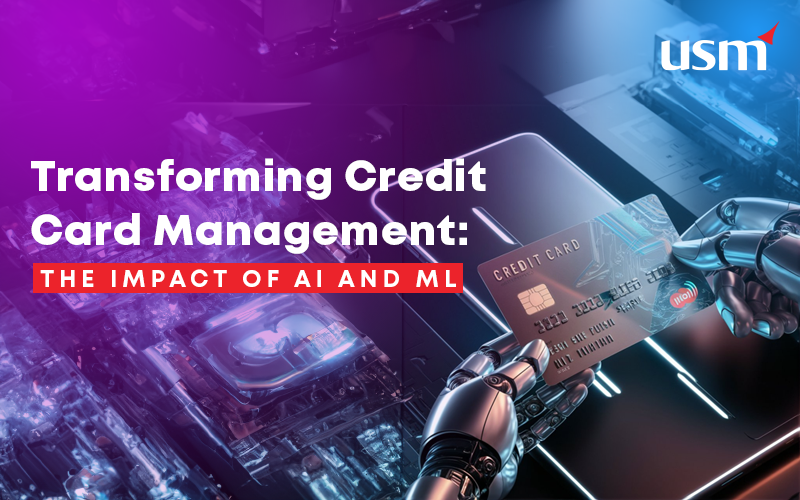
Credit-card fraud has been a prime challenge for customers and financial organizations in this digital age. Globally, more than $28 billion was lost last year from credit card fraud. It is going to rise in the future, and hence there is a need for robust risk management mechanisms.
Previously, risk in credit card portfolios was managed through a variety of manually developed procedures for fraud detection and prevention. However, traditional methods have become ineffective against today’s intelligent hacking methods.
Fortunately, the advent of AI and ML has transformed credit card risk management processes. These technologies process huge volumes of data and can effectively detect anomalies, mitigating threats. This technological shift shall create a better transaction security experience for customers through reduced false positives and smoother and safer transactions.
The article will discuss how AI and ML can solve traditional credit card risk management problems. We are also going to look into the different techniques used, the benefits of using AI and ML for credit card risk management, and some case studies with real-world examples.
It is the process of identifying, assessing, and mitigating the risks associated with credit card transactions. Therefore, this whole process can be regarded as paramount to protecting consumers and even financial institutions against fraudulent activities.
Traditionally, credit card risk management depended on rule-based systems and manual reviews. In the rule-based system, as the name implies, predefined criteria are used in the identification of risky transactions. For example, transactions exceeding a certain amount or originating from unusual locations raise red flags. While providing some form of security, these measures were typically inadequate to handle increasing volumes and sophistication in credit-card transactions.
This can often result in the generation of a lot of false positives by rule-based systems misinterpreting a legal transaction as fraud. This might anger customers and put additional workload on customer service. Further, fraudsters are continuously inventing new techniques that make it pretty hard for the static rule-based system to detect new threats.
AI and ML have transformed credit card risk management with much more accurate, efficient, and dynamic approaches toward fraud detection and mitigation. These technologies use large datasets and complex algorithms that enable identifying trends and outliers in real time. This approach opens up avenues for proactive threat detection and response.
AI and ML systems are very good at real-time fraud detection, for they continuously monitor transactions and user behavior. While traditional, rule-based approaches could not detect these newer styles of distributed fraud schemes, AI and ML adapt rapidly to new patterns of fraud once they appear. This will ensure that financial institutions are always one step ahead of fraudsters in the identification of suspicious activities before they can cause great damage.
The major strengths of AI and ML in risk management are their ability to identify complex patterns and detect anomalies indicative of fraudulent behavior. Such systems create baseline behaviors through the analysis of historical transaction data, user profiles, and contextual information. Deviations from these norms trigger alerts for further investigation. This level of precision helps in distinguishing genuine transactions from fraudulent ones, thus reducing the incidence of false positives.
These AI and ML models learn from new data continuously, which can only improve their fraud detection capabilities over time. As more transactions are processed and different fraud scenarios unfold, these models will fine-tune their algorithms to be more accurate and efficient. This is an ongoing spiral of improvement, ensuring the risk management system will change as the landscape of fraud evolves.
AI and ML can substantially reduce the need for reviews subject to risk management by automating a number of aspects involved in this particular area. Automated systems can process volumes of data at lengths and speeds inconceivable to any human analyst, allowing for effective fraud detection in a timely manner. This not only improves operational efficiency but also frees human resources to deal with more complex and risky cases that require nuanced decision-making.
AI and ML technologies can be combined with pre-existing frameworks of risk management, thereby delivering greater potential and effectiveness without requiring an overhaul in their entirety. Equally, this will give a financial institution a chance to utilize the current running infrastructure and receive all the benefits coming from advanced AI and ML-driven insights. The result is going to be an ultimately more solid, responsive system of risk management that is able to adapt itself to polished threats and challenges.
While AI and ML have huge potential in credit card transaction risk management, there are also a number of pitfalls and issues that arise with their implementation. Bringing solutions to these problems will be key to maximizing the effectiveness of the technologies and their ethical working.
Since AI and ML systems are data-driven, the door is also wide open to a number of potential data privacy and security issues. However, the financial institutions should be in a position to protect sensitive customer information and establish mechanisms of data collection, storage, and processing that consider applicable privacy regulations under GDPR and CCPA; this argues further that appropriate encryption methods, access controls for customers, and good anonymization techniques will be implemented accordingly.
One of the major challenges institutions face in implementing AI and ML is managing the complex landscape of financial regulations relevant to the use and processing of data. This requires stringent controls and the associated transparency expected by regulators. Hence, institutions will have to ensure compliance with these regulations, which may involve regular audits, documentation, and reporting of AI and ML models to regulatory authorities.
AI and ML technologies can be resource-intensive to adopt. Some of the common challenges faced while implementing AI and ML include:
Real-world examples will attest to how AI and ML find practical applications in credit card risk management. Case studies will illustrate how financial institutions have tapped into such technologies to frustrate fraud, enhance security, and improve customer satisfaction.
Many of the leading financial institutions have included AI and ML within the risk management framework with quite excellent results:
USM Business systems is also a pioneer in AI-powered mobile app development fraud detection. We help you keep your and yours esteemed customers data privacy and financial safety through developing high-quality advanced credit risks management apps.
AI/ML-powered mobile app development for fraud detection is the best option in this digital age. These technologies provide better accuracy, real-time processing, cost efficiency, and an improved customer experience.
At the same time, all the challenges and considerations involved do not overshadow the bright future awaiting AI and ML in risk management. Only those financial institutions that embrace these technologies will adapt to the ever-changing landscape of credit card fraud and ensure safe and satisfied customers.
It’s been a weird week at OpenAI… Continue reading “OpenAI Departures and the “Strawberry” Mystery: What’s Really Going On?”