
It’s been a weird week at OpenAI… Continue reading “OpenAI Departures and the “Strawberry” Mystery: What’s Really Going On?”
It’s been a weird week at OpenAI… Continue reading “OpenAI Departures and the “Strawberry” Mystery: What’s Really Going On?”
In a world where AI capabilities are evolving at breakneck speed, understanding the potential impact on jobs and careers has never been more critical. Continue reading “The AI Tool Assessing the Future of Work”
This blog post focuses on new features and improvements. For a comprehensive list, including bug fixes, please see the release notes.
Llama 3.1 is a collection of pre-trained and instruction-tuned large language models (LLMs) developed by Meta AI. It’s known for its open-source nature and impressive capabilities, such as being optimized for multilingual dialogue use cases, extended context length of 128K, advanced tool usage, and improved reasoning capabilities.
It is available in three model sizes:
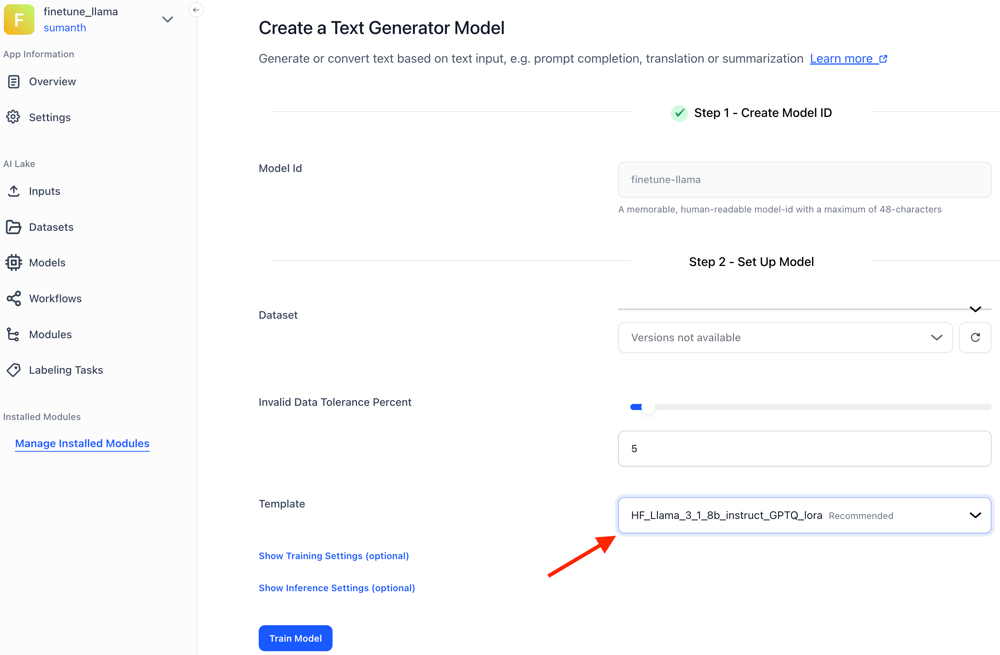
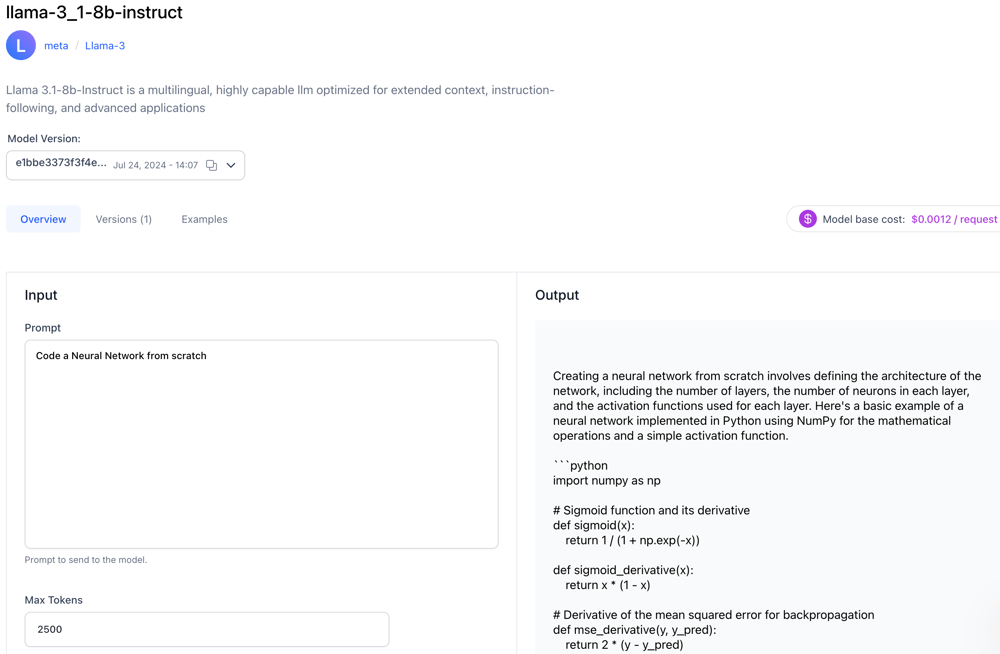
At Clarifai, we offer the 8 billion parameter version of Llama 3.1, which you can fine-tune using the Llama 3.1 training template within the Platform UI for extended context, instruction-following, or applications such as text generation and text classification tasks. We converted it into the Hugging Face Transformers format to enhance its compatibility with our platform and pipelines, ease its consumption, and optimize its deployment in various environments.
To get the most out of the Llama 3.1 8B model, we also quantized it using the GPTQ quantization method. Additionally, we employed the LoRA (Low-Rank Adaptation) method to achieve efficient and fast fine-tuning of the pre-trained Llama 3.1 8B model.
Fine-tuning Llama 3.1 is easy: Start by creating your Clarifai app and uploading the data you want to fine-tune. Next, add a new model within your app, and select the “Text-Generator” model type. Choose your uploaded data, customize the fine-tuning parameters, and train the model. You can even evaluate the model directly within the UI once the training is done.
Follow this guide to fine-tune the Llama 3.1 8b instruct model with your own data.
Patch operations have been introduced for apps, datasets, input annotations, and concepts. You can use the Python SDK to either merge, remove, or overwrite your input annotations, datasets, apps, and concepts. All three actions support overwriting by default but have special behavior for lists of objects.
The merge action will overwrite a key:value with key:new_value or append to an existing list of values, merging dictionaries that match by a corresponding id field.
The remove action will overwrite a key:value with key:new_value or delete anything in a list that matches the provided values’ IDs.
The overwrite action will replace the old object with the new object.
Below is an example of performing a patch operation on an App. This includes overwriting the base workflow, changing the app to an app template, and updating the app’s description, notes, default language, and image URL. Note that the ‘remove’ action is only used to remove the app’s image.
Below is an example of performing a patch operation on a dataset. Similar to the app, you can update the dataset’s description, notes, and image URL.
Below is an example of doing patch operation of Input Annotations. We have uploaded the image object along with the bounding box annotations and you can change that annotations using the patch operations or remove the annotation.
Below is an example of performing a patch operation on concepts. The only supported action currently is overwrite. You can use this to change the existing label names associated with an image.
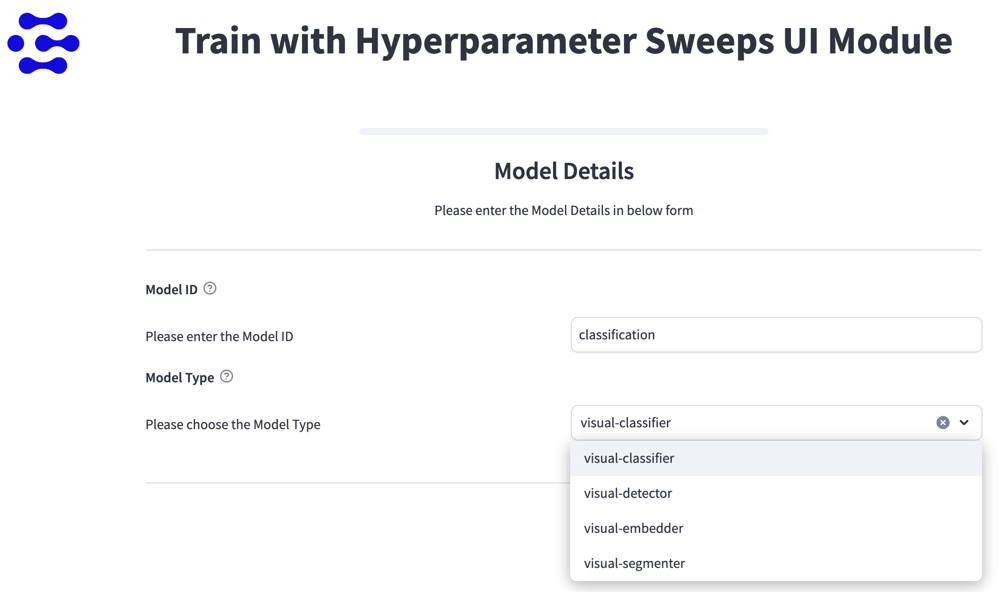
Finding the right hyperparameters for training a model can be tricky, requiring multiple iterations to get them just right. The Hyperparameter module simplifies this process by allowing you to test different values and combinations of hyperparameters.
You can now set a range of values for each hyperparameter and decide how much to adjust them with each step. Plus, you can mix and match different hyperparameters to see what works best. This way, you can quickly discover the optimal settings for your model without the need for constant manual adjustments.
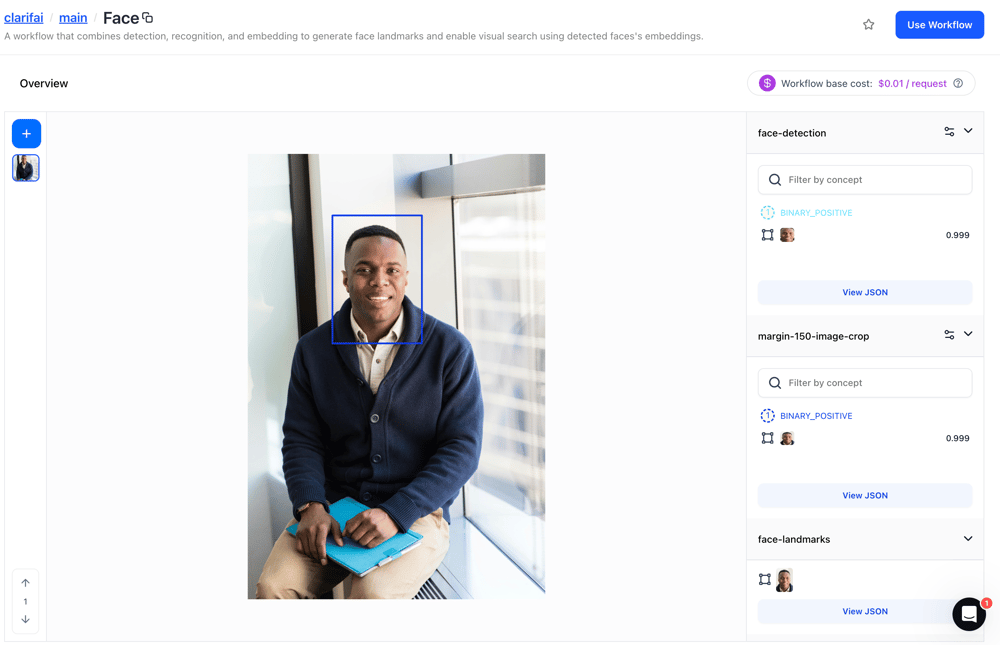
Workflows allows you to combine multiple models to carry out different operations on the Platform. The face workflow combines detection, recognition, and embedding models to generate face landmarks and enable visual search using detected faces’s embeddings.
When you upload an image, the workflow first detects the face and then crops it. Next, it identifies key facial landmarks, such as the eyes and mouth. The image is then aligned using these keypoints. After alignment, it is sent to the visual embedder model, which generates numerical vectors representing each face in the image or video. Finally, these embeddings are used by the face-clustering model to group visually similar faces.
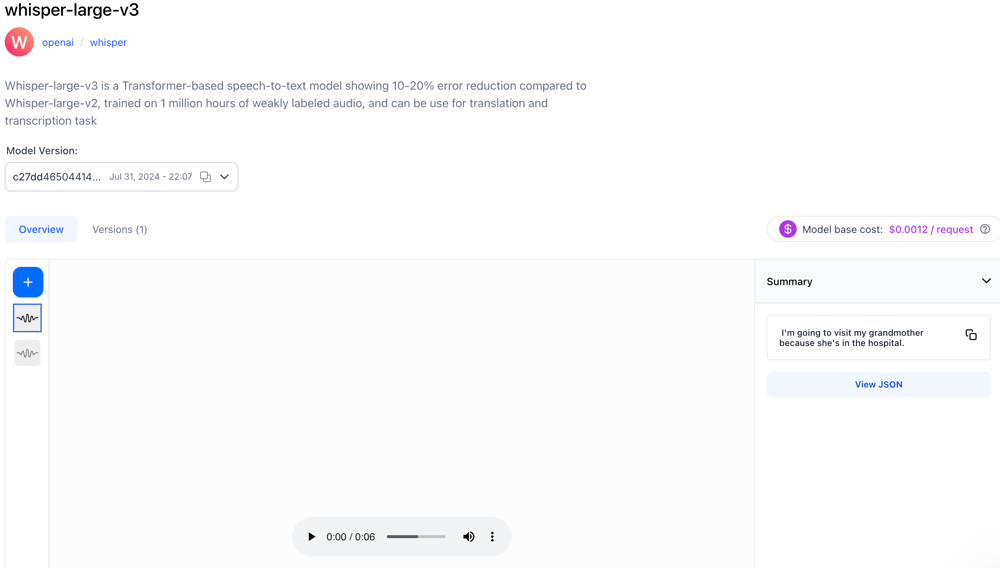
Fine-tuning LLMs allows you to tailor a pre-trained large language model to your organization’s unique needs and objectives. With our platform’s no-code experience, you can fine-tune LLMs effortlessly.
Explore our Quickstart tutorial for step-by-step guidance to fine-tune Llama 3.1. Sign up here to get started!
Thanks for reading, see you next time 👋!
OpenAI has pulled back the curtain on its safety work for GPT-4o, the company’s latest model, revealing a complex and sometimes unsettling picture of AI capabilities and risks. Continue reading “Just How Dangerous Is GPT-4o? What You Need to Know”

With the huge advancements happening in the field of large language models (LLMs), models that can process multimodal inputs have recently been coming to the forefront of the field. These models can take both text and images as input, and sometimes other modalities as well, such as video or speech.
Multimodal models present unique challenges in evaluation. In this blog post, we will take a look at a few multimodal datasets which can be used to assess the performance of such models, mostly ones focused on visual question answering (VQA), where a question needs to be answered using information from an image.
The landscape of multimodal datasets is large and ever growing, with benchmarks focusing on different perception and reasoning capabilities, data sources, and applications. The list of datasets here is by no means exhaustive. We will briefly describe the key features of ten multimodal datasets and benchmarks and outline a few key trends in the space.
There are different types of vision-language tasks that a generalist multimodal language model could be evaluated on. One such task is optical character recognition (OCR) and answering questions based on text present in an image. One dataset evaluating this type of abilities is TextVQA, a dataset released in 2019 by Singh et al.
Two examples from TextVQA (Singh et al., 2019)
As the dataset is focused on text present in images, a lot of images are of things like billboards, whiteboards, or traffic signs. In total, there are 28,408 images from the OpenImages dataset and 45,336 questions associated with them, which require reading and reasoning about text in the images. For each question, there are 10 ground truth answers provided by annotators.
Similarly to TextVQA, DocVQA deals with reasoning based on text in an image, but it is more specialized: in DocVQA, the images are of documents, which contain things such as tables, forms, and lists, and come from sources in e.g. chemical or fossil fuel industry. There are 12,767 images from 6,071 documents and 50,000 questions associated with these images. The authors also provide a random split of the data into train (80%), validation (10%), and test (10%) sets.
Example question-answer pairs from DocVQA (Mathew et al., 2020)
The two datasets mentioned above are far from the only ones available for OCR-related tasks. If one wishes to perform a comprehensive evaluation of a model, it may be expensive and time-consuming to run evaluation on all testing data available. Because of this, samples of several related datasets are sometimes combined into a single benchmark which is smaller than the combination of all individual datasets, and more diverse than any single source dataset.
For OCR-related tasks, one such dataset is OCRBench by Liu et al. It consists of 1,000 manually verified question-answer pairs from 18 datasets (including TextVQA and DocVQA described above). Five main tasks are covered by the benchmark: text recognition, scene text-centric VQA, document-oriented VQA, key information extraction, and handwritten mathematical expression recognition.
Examples of text recognition (a), handwritten mathematical expression recognition (b), and scene text-centric VQA (c) tasks in OCRBench (Liu et al., 2023)
There also exist compilations of multiple datasets for other specialized sets of tasks. For example, MathVista by Lu et al. is focused on mathematical reasoning. It includes 6,141 examples coming from 31 multimodal datasets which involve mathematical tasks (28 previously existing datasets and 3 newly created ones).
Examples from datasets annotated for MathVista (Lu et al., 2023)
The dataset is partitioned into two splits: testmini (1,000 examples) for evaluation with limited resources, and test (the remaining 5,141 examples). To combat model overfitting, answers for the test split are not publicly released.
Another relatively specialized capability that can be evaluated in multimodal LLMs is logical reasoning. One dataset that is intended to do this is the very recently released LogicVista by Xiao et al. It contains 448 multiple-choice questions covering 5 logical reasoning tasks and 9 capabilities. These examples are collected from licensed intelligence test sources and annotated. Two examples from the dataset are shown in the image below.
Examples from the LogicVista dataset (Xiao et al., 2024)
As opposed to narrowly defined tasks such as ones involving OCR or mathematics, some datasets cover broader and less restricted objectives and domains. For instance, RealWorldQA is a dataset of over 700 images from the real world, with a question for each image. Although most images come from vehicles and depict driving situations, some show more general scenes with multiple objects in them. Questions are of different types: some have multiple choice options, while others are open, with included instructions like “Please answer directly with a single word or number”.
Example image, question, and answer combinations from RealWorldQA
In a situation when different models are competing to have the best scores on fixed benchmarks, overfitting of models to benchmarks becomes a concern. When a model overfits, it means that it will show very good results on a certain dataset, even though this strong performance does not generalize to other data well enough. To battle this, there is a recent trend to only release the questions of a benchmark publicly, but not the answers. For example, the MMBench dataset is split into dev and test subsets, and while dev is released together with answers, test is not. This dataset consists of 3,217 multiple choice image-based questions covering 20 fine-grained abilities, which are defined by the authors as belonging to coarse groups of perception (e.g. object localization, image quality) and reasoning (e.g. future prediction, social relation).
Results of eight vision-language models on the 20 abilities defined in MMBench-test, as tested by Liu et al. (2023)
An interesting feature of the dataset is that, in contrast to most other datasets where all questions are in English, MMBench is bilingual, with English questions additionally translated into Chinese (the translations are done automatically using GPT-4 and then verified).
To verify the consistency of the models’ performance and reduce the chance of a model answering correctly by accident, the authors of MMBench ask the same question from the models several times with the order of multiple choice options shuffled.
Another benchmark for comprehensive evaluation of multimodal abilities is MME by Fu et al. This dataset covers 14 subtasks related to perception and cognition abilities. Some images in MME come from existing datasets, and some are novel and taken manually by the authors. MME differs from most datasets described here in the way its questions are posed. All questions require a “yes” or “no” answer. To better evaluate the models, two questions are designed for each image, such that the answer is to one of them is “yes” and to the other “no”, and a model is required to answer both correctly to get a “point” for the task. This dataset is intended only for academic research purposes.
Examples from the MME benchmark (Fu et al., 2023)
While most datasets described above evaluate multimodal models on tasks most humans could perform, some datasets focus on specialized expert knowledge instead. One such benchmark is MMMU by Yue et al.
Questions in MMMU require college-level subject knowledge and cover 6 main disciplines: Art & Design, Business, Science, Health & Medicine, Humanities & Social Science, and Tech & Engineering. In total, there are over 11,000 questions from college textbooks, quizzes, and exams. Image types include diagrams, maps, chemical structures, etc.
MMMU examples from two disciplines (Yue et al., 2023)
The benchmarks mentioned so far incorporate two data modalities: text and images. While this combination is the most widespread, it should be noted that more modalities, such as video or speech, are being incorporated into large multimodal models. To bring one example of a multimodal dataset that includes video, we can look at the TVQA dataset by Lei et al., which was created in 2018. In this dataset, a few questions are asked about 60-90 seconds long video clips from six popular TV shows. For some questions, using only the subtitles or only the video is enough, while others require using both modalities.
Examples from TVQA (Lei et al., 2018)
With the Clarifai platform, you can easily process multimodal inputs. In this example notebook, you can see how the Gemini Pro Vision model can be used to answer an image-based question from the RealWorldQA benchmark.
We have noticed a few trends related to multimodal benchmarks:
In this blog post, we briefly described a few datasets that can be used to evaluate multimodal abilities of vision-language models. It should be noted that many other existing benchmarks were not mentioned here. The variety of benchmarks is generally very broad: some datasets focus on a narrow task, such as OCR or math, while others aim to be more comprehensive and reflect the real world; some require general and some highly specialized knowledge; the questions may require a yes/no, a multiple choice, or an open answer.
We have had our minds on strawberry fields this week with all the latest happenings at OpenAI.
Join our hosts as they discuss OpenAI’s secret project “Strawberry” and OpenAI’s leadership changes, including Greg Brockman’s sabbatical and John Schulman’s move to Anthropic. They’ll also explore JobsGPT, Paul Roetzer’s tool for understanding AI’s impact on jobs and OpenAI’s GPT-4o System Card. In our rapid-fire section, we’ll touch on the latest legal disputes with OpenAI, Figure’s 02 Robot, ChatGPT watermarking, new AI image generator Flux, and more. Continue reading “OpenAI’s Secret Project “Strawberry” Mystery Grows, JobsGPT, GPT-4o Dangers, Groq Funding, Figure 02 Robot, YouTube AI Class Action Suit & Flux”

Large Language Models (LLMs) have become increasingly valuable for answering questions in specialized domains, such as medical or legal documents. To enhance their performance, it’s common to inject domain-specific knowledge into LLMs through techniques like Retrieval-Augmented Generation (RAG) or fine-tuning. In this blog post, we explore a fine-tuning technique known as Retrieval Augmented Fine-Tuning (RAFT) and evaluate its effectiveness in adapting pre-trained LLMs for RAG in specialized domains.
RAG is a method to enhance LLMs when dealing with knowledge that is not “baked-in” during the pretraining stage. This often involves specific domains or more up-to-date information. A common way to build a RAG system is to retrieve chunked documents from a vector store and directly inject them into the LLM prompt. For example, a common prompt for the LLM would look like this:
|
“Context information is below:\n{contexts}\nGiven the context information and not prior knowledge, answer the query.\nQuery: {question}\nAnswer: “ |
Check out our RAG in 4 lines of code guide.
While these systems are easy to build, there may still be room for extra performance to be squeezed out. The debate moves to whether RAG or fine-tuning is more preferable for a given use case. A recent paper called RAFT studies this problem and proposes a novel method to adapt a pre-trained LLM using fine-tuning with retrieval-augmented question answering (QA) data.
Retrieval Augmented Fine-Tuning (RAFT), introduced by Zhang et al, is a method designed to enhance the performance of LLMs in specific domains. RAFT enhances the quality of answers by leveraging generated Chain of Thought (CoT) responses from the provided data. Essentially, RAFT refines a model’s reasoning and answer-generation capabilities by utilizing large pre-trained models. The process involves generating answers with a large model and then fine-tuning these answers on a smaller, more specialized model. This approach helps create high-quality CoT answers, significantly boosting the model’s performance. In doing so, RAFT bridges the gap between general-purpose LLMs and the specialized knowledge required for specific domains.
Figure 1: Example LLM prompt to generate CoT answers with explanations given the relevant context along with a set of distractor documents.
One of RAFT’s main advantages is its ability to fine-tune chat or instruct models without needing to realign them for chat functionalities. This efficiency saves time and resources that would otherwise be spent on re-aligning the model for conversational purposes. By focusing on domain-specific fine-tuning, RAFT ensures that the LLM can generate more accurate and contextually relevant answers.
The original RAFT paper presents experiments using the Llama2-7B model, demonstrating its effectiveness in various specialized domains. In particular, while using RAG often improves QA performance over only using an LLM, fine-tuning and RAFT consistently outperforms RAG by a larger margin.
This raises the question: How does RAFT perform with newer models like Llama3-8B? By comparing these models, we can gain insights into the scalability and improvements offered by the latest advancements in LLMs.
The published code for RAFT is in this Github repository. We used all the default settings with some small changes:
For data, we used the HotpotQA dataset, specifically the dev set’s chunked contexts, to create the data points (i.e. questions, CoT answers). Direct questions and answers of the HotpotQA dataset are not included in generated data, so the model won’t memorize them. We created samples with only 100 chunks for the sake of time. The resultant dataset is available on hugging face.
Since our focus is on compute-constrained environments, we are interested in models around the 7-8B range or smaller. As such, we’ve selected Llama3 8B and Llama3.1 8B instruct models and their 4-bit quantized variants for our experiments.
We also compare the results using Llama2-7B-chat as a baseline. For training, we used the TRL SFT trainer. We used lm-evaluation-harness by EleutherAI and evaluated the fine-tuned models on HotpotQA’s validation set (1k samples) on a single NVIDIA A100-SXM4-40GB.
Figure 2 below shows the F1 scores of the fine-tuned and pretrained models. Indeed, we observe a significant boost in performance from fine-tuning on RAFT-style data for most tested models. Most notably performance increase was over 60% for Llama3 variants and up to over 100% for Llama2 7B. On the other hand, finetuning Llama3.1 8B yields a 16% increase in comparison.
By using 4-bit quantized variants of the Llama3 models, we were able to retain 91-94% of the performance while only using 25% of the GPU memory dedicated to the model weights.
For LoRA configurations, we’ve found that using “all-linear” as target modules to be more effective than using a subset of target modules. Also using a higher LoRA rank (64) we’re able to yield higher scores than using a lower LoRA rank (16). Here we report the best scores from tuning the hyperparameters.
Figure 2: F1 scores of fine-tuned (blue) and pretrained (orange) models evaluated on 1000 samples of HotpotQA dev set
Initial runs show that the CoT answers seem cutoff when max_new_tokens=512. By setting max_new_tokens=800, we observe that the models were able to generate complete CoT answers. This leads to almost 2x the performance from the lower setting, but on the other hand consumes more time and GPU memory.
Time and cost are also important factors of consideration. Generating the dataset (100 rows) takes ~30min. On the current inference pricing ($0.0012/request) the dataset costs $0.24 (2 calls/row). Once we have the dataset, finetuning the model on average takes ~10min. On the current deep training pricing ($4/hr), the training costs $0.67. The finetuned model costs less than $1 end-to-end! But of course, some datasets might require different training needs. Tuning the hyperparameters could also add to the cost as well.
We used Llama3-70B-instruct as the question-answer generator. There are higher-ranking models on the LMSYS Chatbot arena that may yield better quality questions and answers.
RAFT seems to be an effective method to adapt smaller LLMs to domain-specific data. From the context chunks, questions and CoT answers can be easily generated via RAFT to form a dataset for finetuning instruct models. This not only removes the need to align a finetuned base model, but also drastically reduces the amount of data needed for finetuning in general. If you want RAFT to be available on the Clarifai platform, send us a message in our Community Discord channel!
Super Benji is an AI-powered sales tool that the company says will do all your prospecting and research for sales outreach for you. Continue reading “How to Use AI to Do Better Sales Prospecting”
The world of businesses and individuals today relies heavily on mobile and web applications. Organizations are looking to develop more innovative applications to provide better services to their customers, whereas individuals are using intelligent mobile apps to meet their needs.
On the mobile app development front, mostly in every one hand, we can see a mobile or Smartphone. People are spending their time in browsing or downloading intelligent mobile applications based on their needs.

However, users change their preference f using apps based on the features of mobile applications. If an advanced version of the existing app is released in the market, it will try to download and make use of it.
If this is the case, the global mobile app developers have to remember that you should always launch an app with smart features that grab the user’s attention. Otherwise, you might lose the app development market grip soon.
Get A Free App Development Quote!

As we discussed in our every blog, Artificial Intelligence (AI) technology is a central and core technology to modify every industry, such as healthcare, logistics, finance, manufacturing, marketing, and advertising.
In the recent past, AI technology is also widely adopting by mobile app development companies to provide more advanced and personalized app services.
The intelligent mobile apps with their smart features will ensure strong revenues to the App development companies.
In this article, we put together a few companies that are developing AI-based mobile apps to remain competitive in this digital market.
Let’s Start!
Here is the best 13 AI App Development Companies List:
#1 FuGenX Technologies
FuGenX Technologies is at the forefront of providing the best mobile applications for various businesses. It is one of the top Artificial Intelligence companies in India and USA. The company has a highly skilled and experienced team of developers who develop unique AI apps using modern technology.
It has delivered 1000+ successful projects globally and received appreciations from its clients. Some of their top-notch services include AI development, Enterprise app development, web development, IoT app development, and mobile app development.
Being one of the #Top Artificial Intelligence Companies, FuGenX focused on building the best AI apps that give the best results for companies. FuGenX will deal with each AI development project with more eagerness, develop with more advanced features, and deliver high-level apps.
Contact FuGenX today to make your vision into reality.
#2 USM Business Systems
USM Business Systems is one of the most trusted and popular AI application development companies in India, the USA, and Europe. Founded in 1999, the organization has been offering robust, cost-effective, and customer-oriented applications to startups, enterprises, and big brands.
With the abundance and proper use of advanced technology, an efficient team of USM develops mobile applications that are tailored to the business needs and circumstances of those who make it. The firm is committed to working with honesty and loyalty, showing consistent productivity of the essence, and always being available.
If you want to develop the best AI apps for your business, please consult them
Click on the below links to learn how AI helps increase your business revenue.
#3 BR Softech
BR SoftTech has occupied space in the list of top AI app development companies with its reliable app development services. BR SoftTech, being the best Artificial intelligence development company, transforms clients’ businesses with intelligent AI-based app services. The company’s AI services and solutions create a path to boost productivity.
#4TechAhead
TechAhead is one of the top Artificial Intelligence app development companies USA and India. It is specialized in integrating artificial intelligence technology into mobile apps, websites, and intelligent bots to transform its customers’ business to the next level. Its experience in the design and development of innovative AI mobile platforms and dedication in delivering projects on time made it one of the top 10 AI companies 2022.
USM also acquired decades of experience in developing artificial intelligent mobile apps for various businesses. Our AI-enabled application development services or AI mobility solutions help your business to stay ahead of intensified competition in the app development industry.
#5 Prolitus Technology
Prolitus has occupied space in the top 10 AI companies 2022 with its 10+ years of industry experience in delivering industry-oriented and results-driven artificial intelligence services and solutions. Its AI-based mobility solutions help businesses automate business functions and let them stand ahead in the competition.
USM has such kind of innovative artificial intelligence and machine learning solutions.
We acquired a brand name as a leader in app development with our vast portfolio. With the dedication and commitment of our experienced AI team, we have successfully delivered marvelous mobile apps to wide industries.
#6 Sigma Data Systems
One of the leading mobile app development companies that integrate the power of AI and Machine Learning (ML) technologies. Being one of the best AI development services providers in 2022, Sigma Data Systems builds an AI platform that modernizes your traditional operating systems and drives business growth.
#7 SoluLab
SoluLab is a leading intelligent AI solution provider. It is specialized in developing mobile and web-based applications. In addition to AI, SoluLab uses machine learning, deep learning, Big data, and cloud technologies to fuel its client business with emerging technology solutions.
#8 RipenApps Technologies
RipenApps is a leading AI App development company that is renowned for leveraging advanced technologies to create high-speed and top-notch mobile applications. They hold expertise in creating applications for multiple platforms like Android, iOS, etc. With the experience of more than 7 years, their development team is skilled in integrating machine learning and NLP in AI App development. It uses various tools & SDKs for deploying advanced-scale reasoning abilities in the AI-based mobile app.
They add AI-based conversational UI for better customer service to help businesses maintain strong relationships with their customers. This company understands the need for data security and user privacy. Therefore, they create high-security apps equipped with intelligent and smart functions such as sensory recognition, voice recognition, facial recognition, and gesture control.
Get your free mobile app quote now!
#9 Quy Technology
Quy Technology is one of the biggest mobile app development companies in the USA and India. It uses artificial intelligence technology to deliver advanced AI mobile applications that ensure a successful path to service providers. It is occupied in the list of top AI app development companies with its portfolio of feature AI apps on app stores.
#10 ArStudioz
ArStudioz is the best AI development services providers in 2022. Being one of the top 10 AI companies 2022, the company is engaged in providing mobile app development services, AI services, IoT services, Augmented and virtual reality services, and web development services.
Using the power of AI technology, the company is delivering innovative mobile apps for both Android and iPhone with superior performance.
#11 Azilen Technologies
Azilen is one of the top Artificial Intelligence app development companies that offer advanced mobile app development services for the USA, Germany, Switzerland, and India.
Azilen technology, since its inception in 2009, has been focusing on converting customer ideas into valuable digital solutions. By leveraging the power of emerging technologies like artificial intelligence, ML, and speech recognition, the company has a strong footprint in delivering user-friendly and business-centric AI app development services solutions.
#12 Space-O Technologies
Space-O provides AI-based app development services, IoT, and augmented reality & virtual reality development services. It has been crowned with the Best AI Development Services Providers in 2022 due to its transparency and efficacy in delivering innovative tech applications to augment various fields of a business ranging from development and maintenance to marketing.
#13 Octal IT Solutions
Octal IT Solutions is one of the best 13 AI app development companies 2022. It is best at delivering innovative and result-driven technology solutions for diversified industries. It specialized in providing mobile and web app development services and software development services. Since its establishment in 2007, the company has acquired a strong brand name with its app development services. It has developed over 1,100 mobile and web applications using emerging and advanced technologies.
#14 Fusion Informatics
Fusion Informatics is the best AI Company and also specialized in providing Internet-Of-Things (IoT), Blockchain, and cloud-based solutions. Being one of the top Artificial Intelligence Companies, it aims to implement high-level AI technology services and solutions.
Based on industry experience, a successful app development portfolio, and many featured mobile apps, we have compiled this list of top AI app development companies 2022.
With the technological advancements in Artificial Intelligence, IoT, Cloud, and augmented reality and virtual reality like technologies, the demand for mobile apps that drive smartness and ensure hassle-free convenient services is growing exponentially. AI-powered mobile apps let you deliver more personalized services to your targeted audience.
Talk to our experts to bring your AI ideas into reality!
Hurry up! Technology is advancing, and makes sure your business is too advancing!
March 18th, 2024: Renowned filmmaker and producer Tyler Perry has put his $800 million expansion plans for his Atlanta studio on indefinite hold after witnessing the capabilities of OpenAI’s new text-to-video model, Sora.

The AI technology, which debuted on February 15, allows users to create video images from text prompts, potentially revolutionizing the filmmaking process.
In an interview with The Hollywood Reporter, Perry expressed his astonishment at Sora’s capabilities, stating, “Being told that it can do all of these things is one thing, but actually seeing the capabilities, it was mind-blowing.”
The planned expansion would have added 12 more sound stages to Perry’s 330-acre production facility, one of the largest in the United States.
Perry, known for his successful “Madea” film series, believes that Sora could significantly reduce the need for filming on location or building sets. “I no longer would have to travel to locations.
If I wanted to be in the snow in Colorado, it’s text,” he said. “If I wanted to write a scene on the moon, it’s text, and this AI can generate it like nothing.”
While acknowledging that Sora could enable filmmakers to produce movies and pilots at a fraction of the current cost, Perry expressed grave concerns about the potential impact on jobs in the entertainment industry.
“I am very, very concerned that in the near future, a lot of jobs are going to be lost,” he said. “It makes me worry so much about all of the people in the business. Because as I was looking at it, I immediately started thinking of everyone in the industry who would be affected by this, including actors and grip and electric and transportation and sound and editors, and looking at this, I’m thinking this will touch every corner of our industry.”
Perry admitted to using AI technology in two of his recent projects to avoid spending hours in aging makeup, but like other studios, he is still trying to navigate the implications of this rapidly evolving technology.
He emphasized the need for regulations to protect the industry and its workers, stating, “There’s got to be some sort of regulations in order to protect us. If not, I just don’t see how we survive.”
Looking beyond the entertainment industry, Perry called for a government approach to help everyone sustain employment in the age of AI.
“If you look at it across the world, how it’s changing so quickly, I’m hoping that there’s a whole government approach to help everyone be able to sustain,” he said.
As the entertainment industry grapples with the potential impact of AI technology on jobs and production processes, Tyler Perry’s decision to pause his studio expansion serves as a stark reminder of the challenges that lie ahead.


