Do LLMs Reign Supreme in Few-Shot NER? Part III


Do LLMs Reign Supreme in Few-Shot NER_ (1)

In our previous blog posts in the series, we have described traditional methods for few-shot named entity recognition (NER) and discussed how large language models (LLMs) are being used to solve the NER task. In this post, we close the gap between these two areas and apply an LLM-based method for few-shot NER.

As a reminder, NER is the task of finding and categorizing named entities in text, for example, names of people, organizations, locations, etc. In a few-shot scenario, there are only a handful of labeled examples available for training or adapting an NER system, in contrast to the vast amounts of data typically needed to train a deep learning model.

Example of a labeled NER sentence

Using LLMs for few-shot NER

While Transformer-based models, such as BERT, have been used as a backbone for models fine-tuned to NER for quite some time, recently there is increasing interest in understanding the effectiveness of prompting pre-trained decoder-only LLMs with few-shot examples for a variety of tasks.

GPT-NER is a method of prompting LLMs to perform NER proposed by Shuhe Wang et al. They prompt a language model to detect a class of named entities, showing a few input and output examples in the prompt, where in the output the entities are marked with special symbols (@@ marks the start and ## the end of a named entity).

A GPT-NER prompt. All event entities in the example outputs in the prompt are marked with “@@” (beginning of the named entity) and “##” (end of the named entity)

While Wang et al. evaluate their method in the low-resource setting, they imitate this scenario by selecting a random subset of a larger, general-purpose dataset (CoNLL-2003). They also put considerable emphasis on choosing the best possible few-shot examples to include in the prompt; however, in a truly few-shot scenario there is no wealth of examples to choose from.

To close this gap, we apply the prompting method in a true few-shot scenario, using a purposefully constructed dataset for few-shot NER, specifically, the Few-NERD dataset.

What is Few-NERD?

The task of few-shot NER has gained popularity in recent years, but there is not much benchmark data focused on this specific task. Often, data scarcity for the few-shot case is simulated by using a larger dataset and selecting a random subset of it to use for training. Few-NERD is one dataset that was designed specifically for the few-shot NER task. 

The few-shot dataset is organized in episodes. Each episode consists of a support set containing several few-shot examples (labeled sentences), and a query set for which labels need to be predicted using the information of the support set. The dataset has training, development, and test splits; however, as we are using a pre-trained LLM without any fine-tuning, we only use the test split in our experiments. The support sets serve as the few-shot examples provided in the prompt, and we predict the labels for the query sets.

Coarse- and fine-grained entity types in the Few-NERD dataset (Ding et al., 2021)

The types, or classes, of named entities in Few-NERD have two levels: coarse-grained (person, location, etc.) and fine-grained (e.g. actor is a subclass of person, island is a subclass of location, etc.). In our experiments described here, we only deal with the easier coarse-grained classification.

The full dataset includes a few tasks. There is a supervised task, which is not few-shot and is not organized in episodes: the data is split into train (70% of all data), development (10%), and test (20%) sets. The few-shot task organizes data in episodes. Moreover, there is a distinction between the inter and intra tasks. In the intra task, each coarse-grained entity type will only be labeled in one of the train, development, and test splits, and will be completely unseen in the other two. We use the second task, inter, where the same coarse-grained entity type may appear in all data splits (train, development, and test), but any fine-grained type will only be labeled in one of the splits. Furthermore, the dataset includes variants where either 5 or 10 entity types are present in an episode, and where either 1-2 or 5-10 examples per class are included in the support set of an episode.

How good are LLMs at few-shot NER?

In our experiments, we aimed to evaluate the GPT-NER prompting setup, but a) do that in a truly few-shot scenario using the Few-NERD dataset, and b) use LLMs from Llama 2 family, which are available on the Clarifai platform, instead of the closed models used by the GPT-NER authors. Our code can be found in this Github repository.

We aim to answer these questions:

  1. How can the prompting style of GPT-NER be applied to the truly few-shot NER setting?
  2. How do differently sized open LLMs compare to each other on this task?
  3. How does the number of examples affect few-shot performance?

Results

We compare the results along two dimensions: first, we compare the performance of different Llama 2 model sizes on the same dataset; then, we also compare the behavior of the models when a different number of few-shot input-output examples are shown in the prompt.

1) Model size

We compared the three different-sized Llama-2-chat models available on the Clarifai platform. As an example, let us look at the scores of 7B, 13B, and 70B models on the inter 5-way 1-2-shot Few-NERD test set.  

The largest, 70B model has the best F1 scores, but the 13B model is worse on this metric than the smallest 7B model. 

F1 scores of Llama 2 7B (blue), 13B (cyan), and 70B (black) models on the “inter” 5-way, 1~2-shot test set of Few-NERD

However, if we look at the precision and recall metrics which contribute to F1, the situation becomes even more nuanced. The 13B model turns out to have the best precision scores out of all three model sizes, and the 70B model is, in fact, the worst on precision for all classes.

Precision scores of Llama 2 7B (blue), 13B (cyan), and 70B (black) models on the “inter” 5-way, 1~2-shot test set of Few-NERD

This is compensated by recall, which is much higher for the 70B model than for the smaller ones. Thus, it seems that the largest model detects more named entities than the others, but the 13B model needs to be more certain about named entities to detect them. From these results, we can expect the 13B model to have the fewest false positives, and the 70B the fewest false negatives, while the smallest, 7B model falls somewhere in between on both types of errors.

Recall scores of Llama 2 7B (blue), 13B (cyan), and 70B (black) models on the “inter” 5-way, 1~2-shot test set of Few-NERD

2) Number of examples in prompt

We also compare differently sized Llama 2 models on datasets with different numbers of named entity examples in few-shot prompts: 1-2 or 5-10 examples per (fine-grained) class. 

As expected, all models do better when there are more few-shot examples in the prompt. At the same time, we notice that the difference in scores is much smaller for the 70B model than for the smaller ones, which suggests that the larger model can do well with fewer examples. The trend is not entirely consistent with model size though: for the medium-sized 13B model, the difference between seeing 1-2 or 5-10 examples in the prompt is the most drastic. 

F1 scores of Llama 2 7B (left), 13B (center), and 70B (right) models on the “inter” 5-way 1~2-shot (blue) and 5~10-shot (cyan) test sets of Few-NERD

Challenges with using LLMs for few-shot NER

A few issues need to be considered when we prompt LLMs to do NER in the GPT-NER style.

  1. The GPT-NER prompt template only uses one set of tags in the output, and the model is only asked to find one specific type of named entity at a time. This means that, if we need to identify a few different classes, we need to query the model several times, asking about a different named entity class every time. This may become resource-intensive and slow, especially as the number of different classes grows.

    A single sentence often contains more than one entity type, which means the LLM needs to be prompted separately for each type

  2. The next issue is also related to the fact that the LLM is queried for each entity type separately. A traditional token classification system would typically predict one set of class probabilities for each token. However, in our case, if we are using the LLM as a black box (only looking at its text output and not internal token probabilities), we only get yes/no answers, but several of them for each token (as many as there are possible classes). This means that, if the model’s prediction for the same token is positive for more than one class, there is no easy way to know which of those classes is more probable. This fact also makes it hard to calculate overall metrics for a test set, and we have to make do with per-class evaluation only.
  3. The model-generated output is also not always well-formed. Sometimes, the model will generate the opening tag for an entity (@@), but not the closing one (##), or some other invalid combination. As with many applications of LLMs to formalized tasks, this requires an extra step of verifying the validity of the model’s free-form output and parsing it into structured predictions.

    Sometimes, the model output is not well-formed: in output 1, there is the opening tag “@@”, but the closing tag “##” never appears; in output 2, the model used the opening tag instead of the closing one

  4. There are a few other issues related to the model’s way of generating output. For instance, it tends to over-generate: when asked to only tag one input sentence according to the given format, it does that, but then continues creating its own input-output examples, continuing the pattern of the prompt, and sometimes also tries to provide explanations. Due to this, we found it best to limit the maximum length of the model’s output to avoid unnecessary computation.

    After producing the output sentence, the LLM keeps inventing new input-output pairs

  5. Moreover, the LLM’s output sentence does not have to exactly replicate the input. For example, although the input sentences in GPT-NER are tokenized, the model outputs de-tokenized texts, probably because it has learned to produce exclusively (or almost exclusively) well-formed, de-tokenized text. While this adds another extra step of tokenizing the output text again to do evaluation later, that step is easy to do. A bigger problem may appear when the model does not actually use all the same tokens as were given in the input. We have seen, for example, that the model may translate foreign words into English, which makes it harder to match output tokens to input ones. These issues related to output could potentially be mitigated by more sophisticated prompt engineering.

    Sometimes the LLM may generate tokens which are different from those in the input, for example, translating foreign words into English


  6. As only some entity classes are labeled in each split of the Few-NERD episode data and annotations for all other classes are removed, the model will not have full information for coarse-grained classes by the nature of the data. Only the data for the supervised task contains full labels, and some extra processing needs to be done if we want to match those. For instance, in the example below only the character is labeled in the episode data, but the actors are not labeled. This may cause issues for both prompting and evaluation. This may be one of the reasons for the larger model’s low precision scores: if the LLM has enough prior knowledge to label all the person entities, some of them may be identified as false positives.


    Not all entities are labeled in the episode data of Few-NERD, only the supervised task contains full labels

  7. The authors of GPT-NER put considerable emphasis on selecting the most useful few-shot examples to include into the prompt given to the LLM. However, in a truly few-shot scenario we do not have the luxury of extra labeled examples to choose from. Thus, we slightly modified the setup and simply included all support examples of a given test episode in the prompt.
  8. Finally, even though the data in Few-NERD is human-annotated, the labeling is not always perfect and unambiguous, and some mistakes are present. But more importantly, Few-NERD is a rather hard dataset in general: for a human, it is not always easy to say what the correct class of some named entities should be!

The labels are not always obviously correct: for example, here the character Spider-Man is labeled as a painting, and a racehorse is labeled as a person

Future work

An important note is that in Few-NERD, the classes have two levels of granularity: for example, “person-actor”, where “person” is the coarse-grained, and “actor” the fine-grained class. For now, we only consider the broader coarse-grained classes, which are easier for the models to detect than the more specific fine-grained classes would be.

In the GPT-NER pre-print, there is some emphasis placed on the self-verification technique. After finding a named entity, the model is then prompted to reconsider its decision: given the sentence and the entity that the model found in that sentence, it has to answer whether that entity does indeed belong to the class in question. While we have replicated the basic GPT-NER setup with Few-NERD and Llama 2, we have not yet explored the self-verification technique in detail.

We focus on recreating the main setup of GPT-NER and use the prompts as shown in the pre-print. However, we think that the results could be improved and some of the issues described above could be fixed with more sophisticated prompt engineering. This is also something we leave for future experiments.

Finally, there are other exciting LLMs to experiment with, including the recently released Llama 3 models available on the Clarifai platform.

Summary

We applied the prompting approach of GPT-NER to the task of few-shot NER using the Few-NERD dataset and the Llama 2 models hosted by Clarifai. While there are a few issues to be considered, we have found that, as would be expected, the models do better when there are more few-shot examples shown in the prompt, but, less expectedly, the trends related to model sizes are varied. There is still a lot to be explored as well: better prompt engineering, more advanced techniques such as self-verification, how the models perform when detecting fine-grained instead of coarse-grained classes, and much more.

Try out one of the LLMs on the Clarifai platform today. Can’t find what you need? Consult our docs page or send us a message in our Community Discord channel.


Cutpro Passport | Best Passport Photo Tool 2024


Cutpro passport

Meet Apple Intelligence, the Major AI Announcement at WWDC


After much anticipation, Apple finally revealed its AI strategy at its Worldwide Developer Conference (WWDC).

In true Apple fashion, the AI announcements were impressive and controversial—even eliciting a furious response from Elon Musk. Continue reading “Meet Apple Intelligence, the Major AI Announcement at WWDC”

Clarifai 10.5: Gear Up Your AI: Fine-Tuning LLMs


1x5 Gear Up Your AI_ Fine-Tuning LLMs

This blog post focuses on new features and improvements. For a comprehensive list, including bug fixes, please see the release notes.

Fine-Tuning Large Language Models using the Clarifai Platform

Fine-tuning allows you to adapt foundational text-to-text models to specific tasks or domains, making them more suitable for particular applications. By training on task-specific data, you can improve model performance on those tasks.

Fine-tuning lets you take advantage of transfer learning and utilize the knowledge gained from a pre-trained text model to facilitate the learning process of a new model for a related problem.

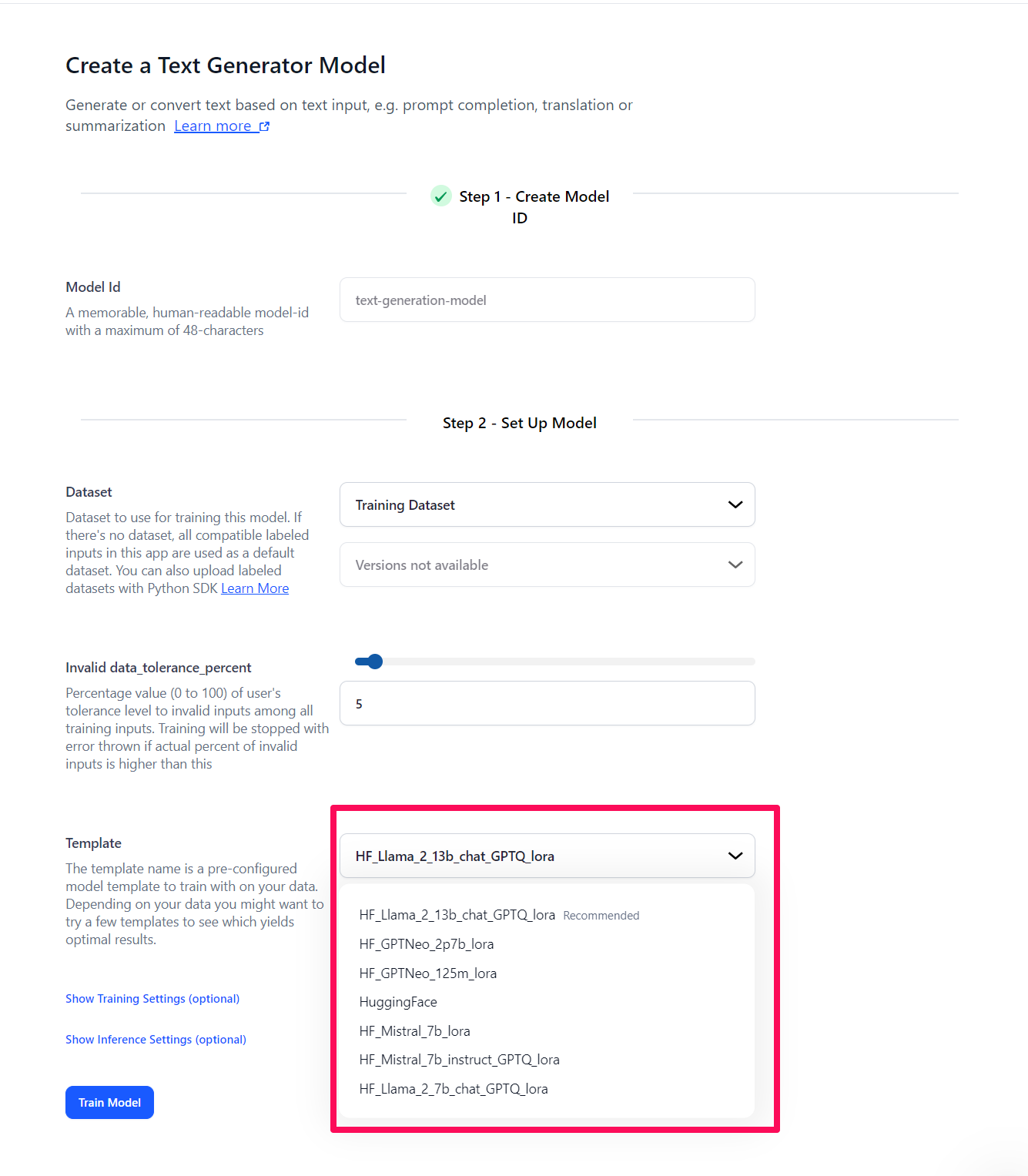
Select a pre-configured model template you want to use to train on your data. You can choose from the following templates:

  • Llama2 7/13B or Mistral models with GPTQ-Lora, featuring enhanced support for quantized/mixed-precision training techniques.
  • GPT-Neo model, either the 125 million parameters version or the 2.7 billion parameters version.

Optionally, you may configure the training and inference settings to enhance the performance of your model. Checkout the complete guide on Fine-tuning Large Language Models here.

model types

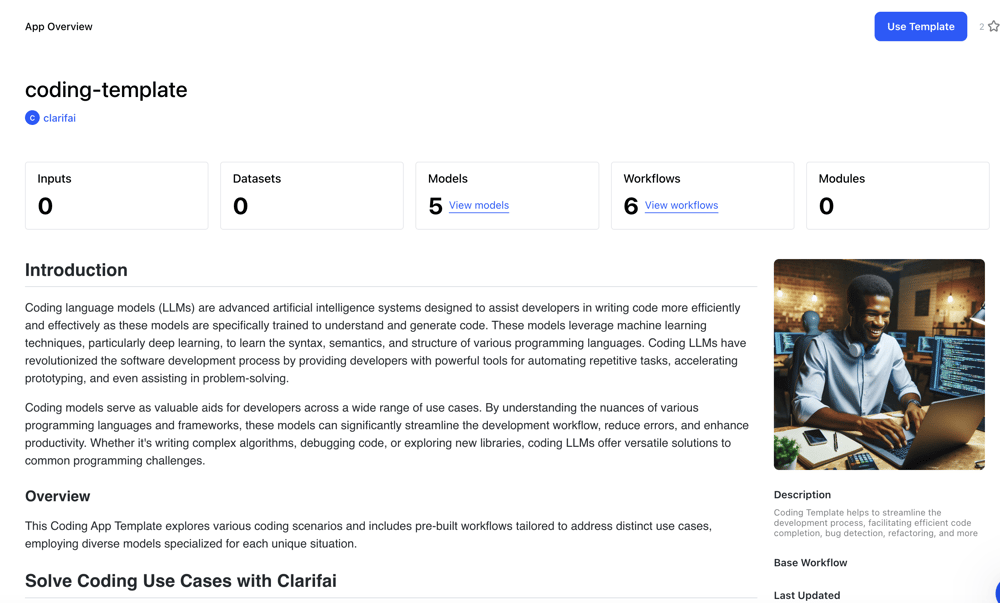
Published Coding Template, which helps to streamline the development process by facilitating efficient code completion, bug detection, refactoring, and more. App templates are pre-built, ready-to-use apps that streamline the app creation process, making it faster and more efficient. 

The Coding App template explores various coding scenarios and includes pre-built workflows tailored to address different coding use cases, employing diverse models specialized for each unique situation.

Screenshot 2024-06-12 at 8.21.44 AM

Integrated LiteLLM with Clarifai

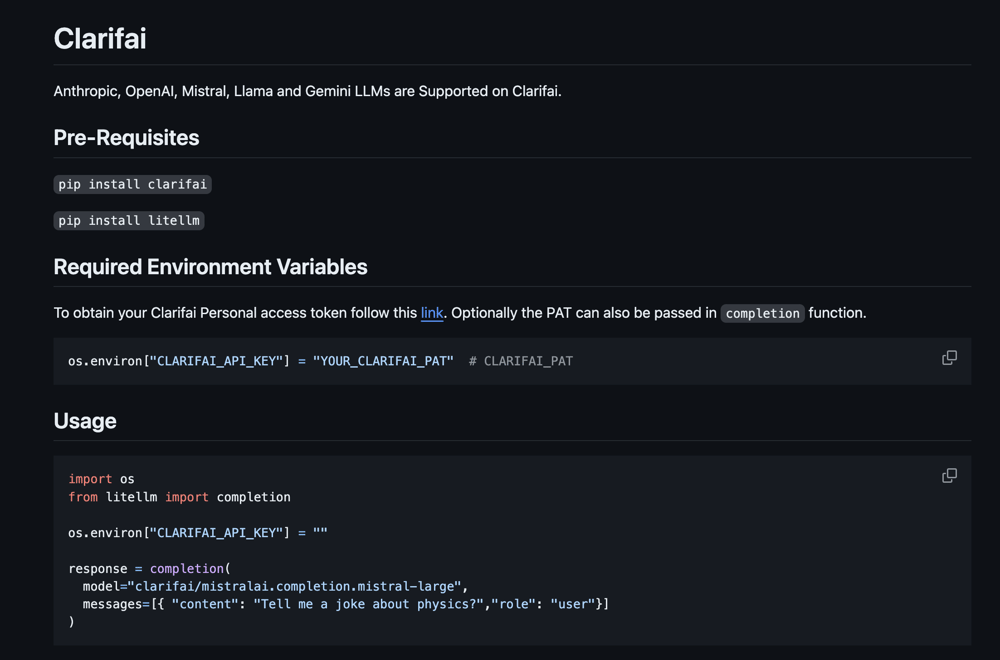
  • LiteLLM is an open-source Python library that provides a unified interface to call 100+ Large Language Models (LLMs) using the same Input/Output format. It allows you to seamlessly interact with LLM APIs using the standardized OpenAI format. This integration aims to provide users with more powerful, efficient, and versatile tools for their Natural Language Processing (NLP) tasks. Check out the usage here.
    Screenshot 2024-06-12 at 8.35.35 AM

Made improvements to deep fine-tuned templates

We made significant improvements to various deep fine-tuned templates, enhancing the capabilities available for training your models. The updates include:

  • MMClassification visual classification template: Updated from version 1.5.0 to 2.1.0, offering improved features and performance for visual classification tasks.
  • MMDetection visual detection template: Updated from version 2.24.1 to 3.3.0, providing advanced capabilities and optimizations for visual detection tasks.
  • YOLOX support added: We introduced support for YOLOX, a state-of-the-art object detection training template, further expanding the tools available for high-performance object detection.

Published new models

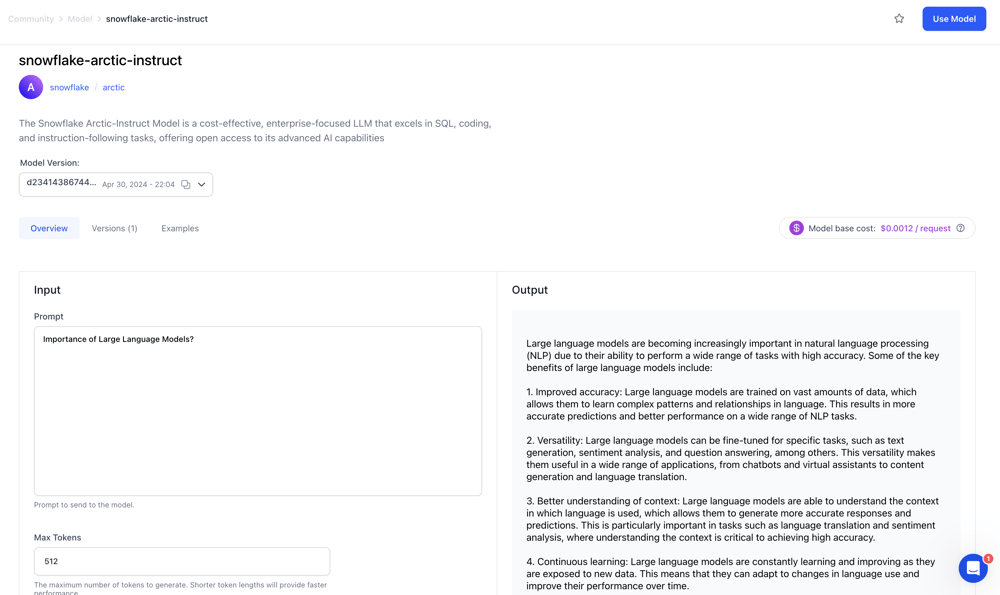
  • Wrapped Snowflake Arctic-Instruct model, a cost-effective, enterprise-focused Large Language Model (LLM) that excels in SQL, coding, and instruction-following tasks, offering open access to its advanced AI capabilities.

Screenshot 2024-06-12 at 9.22.15 AM

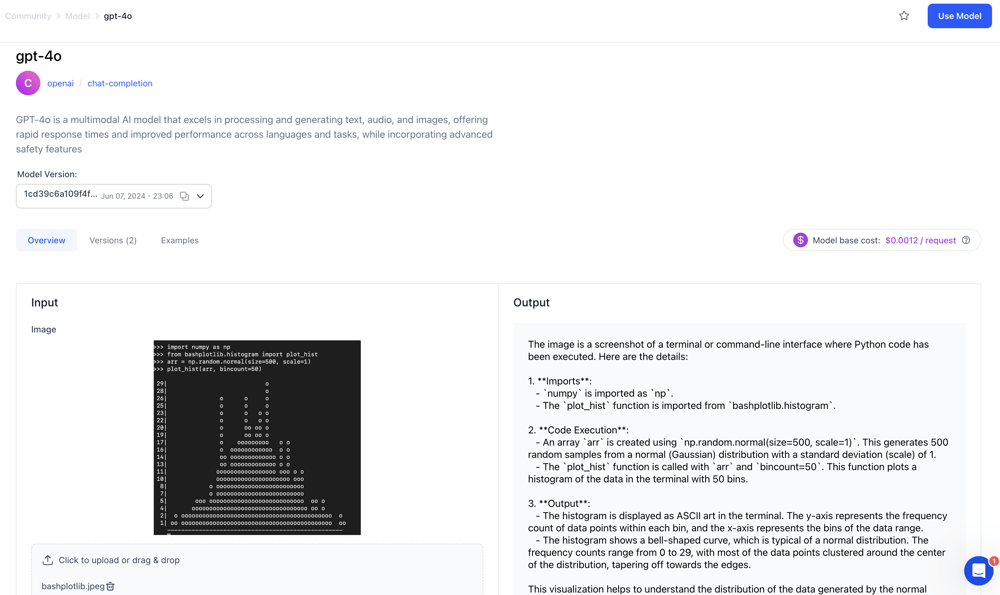
  • Wrapped GPT-4o, a multimodal AI model that excels in processing and generating text, audio, and images, offering rapid response times and improved performance across languages and tasks, while incorporating advanced safety features.

Screenshot 2024-06-12 at 9.15.39 AM

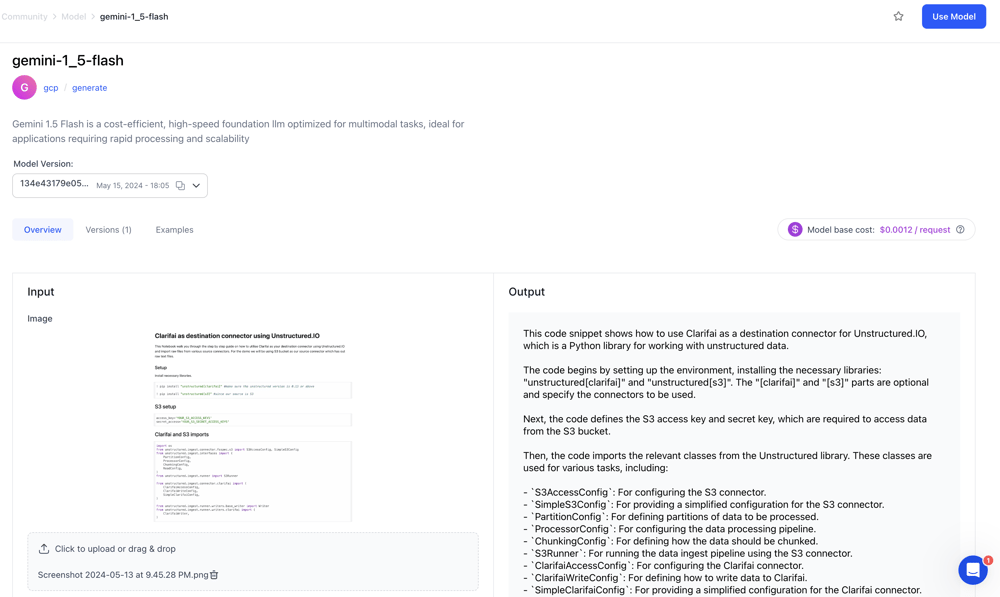
  • Wrapped Gemini 1.5 Flash, a cost-efficient, high-speed foundation LLM optimized for multimodal tasks, ideal for applications requiring rapid processing and scalability.

Screenshot 2024-06-12 at 9.20.06 AM

  • Clarifai-hosted Qwen-VL-Chat, a high-performing Large Vision Language Model (LVLM) by Alibaba Cloud for text-image dialogue tasks, excelling in zero-shot captioning, VQA, and referring expression comprehension while supporting multilingual dialogue.
  • Clarifai-hosted CogVLM-Chat, a state-of-the-art visual language model that excels in generating context-aware, conversational responses by integrating advanced visual and textual understanding.
  • Wrapped WizardLM-2 8x22B, a state-of-the-art open-source LLM, excelling in complex tasks like chat, reasoning, and multilingual understanding, competing closely with leading proprietary models.
  • Wrapped Qwen1.5-110B-Chat LLM, with over 100 billion parameters, demonstrates competitive performance in base language tasks, shows significant improvements in chatbot evaluations, and boasts of multilinguality.
  • Wrapped Mixtral-8x22B-Instruct, the latest and largest mixture of expert LLM from Mistral AI with state-of-the-art machine learning model using a mixture 8 of experts (MoE) 22b models.
  • Wrapped DeepSeek-V2-Chat, a high-performing, cost-effective 236 billion MoE LLM, excelling in diverse tasks such as chat, code generation, and math reasoning.
  • Clarifai-hosted MiniCPM-Llama3-V 2.5, a high-performance, efficient 8B parameter multimodal model excelling in OCR, multilingual support, and multimodal tasks.
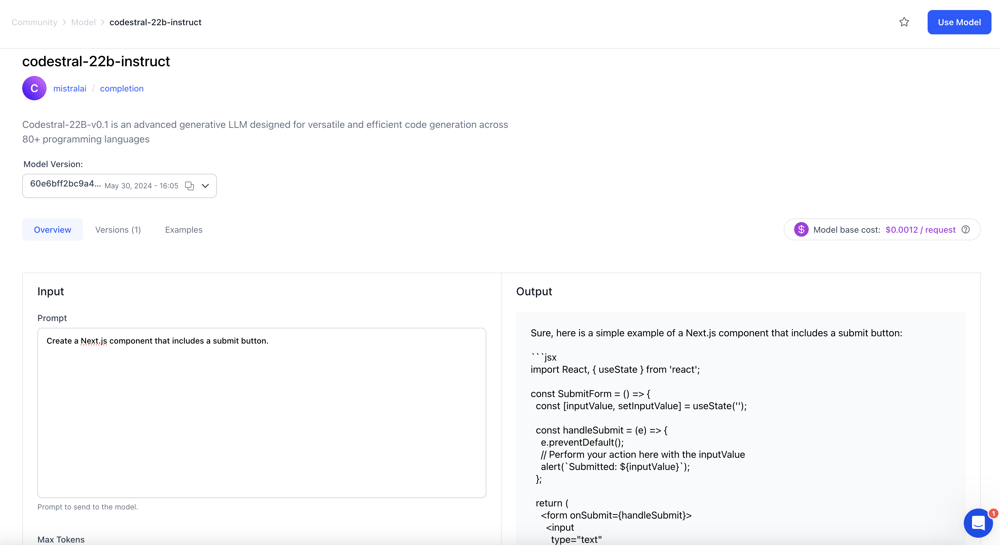
  • Wrapped Codestral-22B-v0.1, an advanced generative LLM designed for versatile and efficient code generation across 80+ programming languages.
    Screenshot 2024-06-12 at 9.25.42 AM
  • Clarifai-hosted Phi-3-Vision-128K-Instruct, a high-performance, cost-effective multimodal model for advanced text and image understanding tasks.
  • Clarifai-hosted Openchat-3.6-8b model, a high-performance, open-source LLM fine-tuned from Llama3-8b with C-RLFT, delivering ChatGPT-level performance across various tasks.

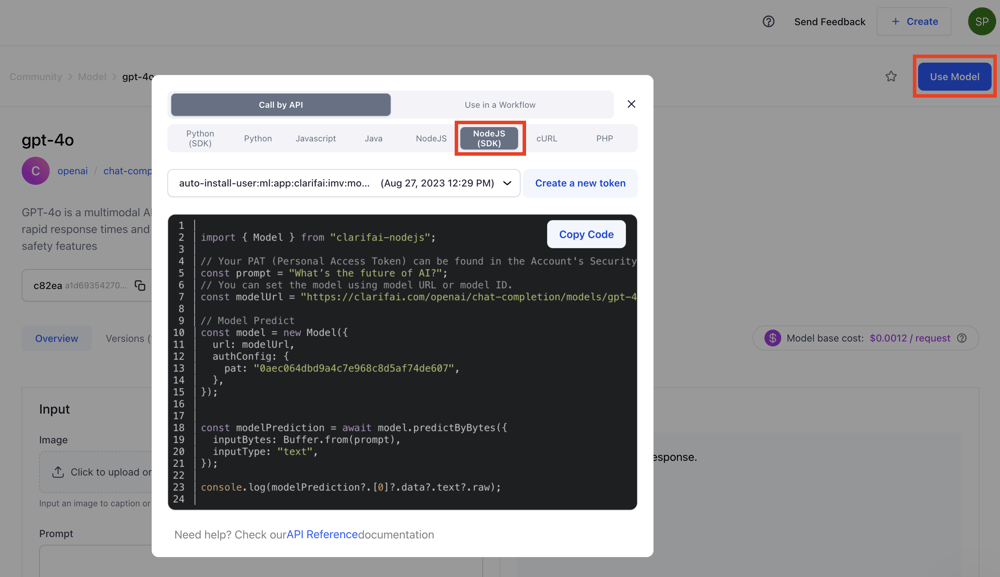
Added TypeScript (Node.js) SDK code snippets to the Use Model / Workflow modal window

If you want to use a model or a workflow for making API calls, you need to click the Use Model / Workflow button at the upper right corner of the individual page of a model or workflow. The modal that pops up has snippets in various programming languages, which you can copy and use.

  • We introduced TypeScript SDK code snippets as one of the tabs. Users can now conveniently access and copy the code snippets directly from the modal.
    Screenshot 2024-06-06 at 12.59.06 PM-1

Added a feature that redirects users to their previous page after logging in

  • If you are logged out, you will now be taken back to the page you were on after logging in.

Introduced the ability to add users who are not organization members to teams

  • This enhancement allows for greater flexibility in team composition and collaboration.

Redesigned the user activation form for new Clarifai accounts

  • After signing up, users receive a verification email. Clicking the link in the email redirects them to the Clarifai platform to complete their profile details.

Apps / Templates

Improved the handling of unauthenticated users

If a user is not logged in or lacks access to the app:

  • We hide the Inputs block and its values. So, the user cannot see the inputs details on the App Overview page.
  • We direct the user to available public resources (e.g. models) without prompting for a login.

Added a “Reindex” checkbox in the “Change Base Workflow” section

Made improvements in the app settings page

  • Removed extra spaces in the tables within the API Keys and Collaborators sections on the app settings page for a cleaner and more streamlined layout.

Expanded the list of available workflows when creating a new application

  • You can now choose from a broader selection of base workflows to better suit your needs.

Improved ability to select a version of a resource

  • We introduced a standardized version selection feature across the platform, now available on both the Model-Viewer and Dataset-Viewer pages. This feature allows you to select and view specific versions of your resources using truncated digits and dates for easy identification.

Fixed an issue with the left sidebar

  • We fixed an issue where the left sidebar on the Input-Manager and Input-Viewer was not scrollable. Previously, this made it difficult to access all sidebar content. With this improvement, the left sidebar is now scrollable, allowing you to easily bring all parts into view.


AI In Manufacturing – How AI Technology Is Redefining The Manufacturing Sector 2022


AI Technology Is Redefining the Manufacturing Sector

Best Ways AI Is Improving Manufacturing In 2024

Artificial Intelligence technology has the power to automate and revolutionizing the entire manufacturing ecosystem. From automating routine tasks, prototype designs and development, robot deployment and maintenance, and supply chain automation to facility remote monitoring, everything can be automated seamlessly by implementing AI in manufacturing.

To be competitive with other manufacturing companies, organizations need to accelerate with AI transformation and speed up smart manufacturing operations. While it may sound intimidating, Artificial Intelligence in manufacturing is also exciting, and it doesn’t go away.

The below figure depicts the market growth of AI technology in manufacturing industry for a period of 2015 to 2025.

ai in manufacturing market share region wise

Source: Markets and Markets

Top AI Applications In Manufacturing Industry
How AI transforms manufacturing?

Let’s continue reading to know where AI is being applied in the manufacturing sector and how AI works in manufacturing. All the below AI use cases in manufacturing will ensure the best business outcomes to the companies. Let’s take a look at How AI technology redefining the manufacturing industry?

1.AI Virtual Assistants Bots

It is one of the best use cases of AI in manufacturing industry. AI virtual assistants better communicates with workforce, solve queries, perform assigned tasks, and offer personalized recommendations, etc. Using Natural Language Processing capabilities, AI manufacturing applications deliver human-like responses and executes every task faster, efficient with 100% accuracy.

2. Predictive Maintenance and Analytics

The best answer is predictive maintenance. Yes. Adoption of AI technology in manufacturing industry will assist manufacturers in monitor and analyze the device performance and predict the need of overhaul or maintenance services. Such automated process will prevent the equipment breakdowns and ensure efficient productivity. It is one of the top benefits of AI in manufacturing industry.

Using Artificial intelligence in manufacturing industry, Manufacturers can tracks operational efficacy and derives accurate predictions into maintenance.

Hence, Artificial Intelligence solutions processes device data, learns from experiences, identifies patterns, and finds out the possibilities of damages before the product hauls. This kind of AI applications in manufacturing industry will improve productivity and ensures lower maintenance costs.

3.Process Automation 

Many routine tasks in a manufacturing plant will be automated with the trending AI. Intelligent AI applications in manufacturing industry will automate approximately 75% of routine tasks done by admins, managers, and operational department workforce.

From data entry, reports generation, employee monitoring, sales entries, order management, warehouse management, and inventory management to logistics and distribution operations data can be automated and virtually accessed through a centralized cloud platform. Hence, the importance of AI technology in manufacturing industry is paramount.

4. Facial Recognition Apps

Facial recognition is one of the core technology of AI. The use of AI in manufacturing industry for ensuring high-level security standards inside the production premises is on demand. In the manufacturing industry, AI applications with facial recognition capabilities can be used for quality and security purposes.

Facial Recognition
Facial Recognition System concept.

5. Fraud Detection

AI in manufacturing industry will be used for detecting fraudulent actions in the production, warehouse, and point of sales operations. Manufacturers can monitor identical anomalies to flag customer orders outside of normal patterns. The use of AI technology in manufacturing industry will also greatly helpful for organizations in monitoring the facilities and find irregular activities remotely.

These are the most popular and well-defined applications of AI in manufacturing. The future of artificial intelligence in manufacturing industries has bright scope and lets manufacturers grab the digital opportunities.


Also Recommended to Read: Use Cases of AI in Manufacturing

The Present State of AI Technology

Many industry scholars agree that AI has a big impact on all businesses, especially the manufacturing sector. IT service management company, Gartner said that by 2020, the number of users of advanced analytics platforms would be differentiated by increased data discovery capabilities, which will double the rate and double the business value”.

AI is embedded in several technologies, from networked supply chains using predictive analytics to ERP solutions with built-in-BI capabilities.

In a thought to give you a clear idea, here we are taking a reputed manufacturing company as an example, which has introduced AI to redefine manufacturing analytics.

Sight Machine Launched AI to Redefine Manufacturing Analytics

Sight Machine, a manufacturing Analytics Company, located in San Francisco, aims to disrupt the manufacturing industry by offering an Artificial intelligence-based manufacturing analytics platform that collects, improves and inspects information to acquire actionable insights and real-time visibility.

The company’s Factory TX platform provides manufacturers with the adaptability to obtain the data of machine from the cloud and production facilities. Their tool allows for quick deployment and centralized management of multiple industrial facility IoT data intake. Insights are generated in real-time and integrate device data, process quality data, and product data with installed Enterprise Resource Planning data and handled to produce important insights using Machine Learning and AI.

Benefits of Using AI in Sight Machine

The main advantage of AI in manufacturing is that it makes digital twin resources as well as procedures. Using AI, the plant management will track man, machine, material, and also process that drives ceaseless process development.

In addition, this platform helps in combining data from several manufacturers, historians, Enterprise Resource Planning, and other machines. Moreover, this platform helps improve quality, reduce time, increase the utilization of capacity, reduce scrap, measures and improves OEE and productivity, etc.
Artificial Intelligence will also play an important role in helping humans do their jobs. AI is just a tool, but not a replacement, for improving business insight and decision-making.

Impact Of AI In Manufacturing Industry

The term AI enables workers to visualize the future, where machines run themselves and robots are gradually welded and bolted to parts without human attention. As a large number of smart manufacturing companies grows, humans are still playing an important role in operations, and this is likely to continue for decades.

These false assumptions can lead to improvements and advanced applications. Employees may assume that AI technology coverts to reductions in the count of human jobs. Engineers, data scientists, and other technicians may mistakenly assume that the profession in manufacturing is short-lived and will soon be replaced by technology. Such fears could prevent the next generation of skilled professionals from even considering employment in the manufacturing industry.

Artificial Intelligence In Manufacturing
Recommended to Read: The Revolution of AI Technology

The lack of skilled professionals in manufacturing is one of the main concerns of industry; About 426,000 Manufacturing jobs in the USA are not filled because there are not enough skilled applicants to obtain those. Yet, 80% of companies lack the workforce needed to implement AI projects.

Therefore, a mystery is created. As skilled workers are in a dilemma that AI technology will eliminate jobs, they might not applied for vacant positions. But the lack of skilled employees makes it tough to implement those sophisticated technologies.

There is a high demand for employees who are skilled in AI technology, but hiring candidates is not so simple.  Hence, A few manufacturers are giving training to them to develop internal AI expertise. One of the practical ways to gain experience is turning to software providers and third-party resources.

Final Words

Leveraging new and trending technologies and updating processes like AI technology and Machine Learning are keys to remaining competitive and relevant in the manufacturing industry. Artificial Intelligence is one of the most effective and powerful platform that manufacturers can adopt. As Manufacturing firms need to focus on the future with utmost confidence, they will make active decisions.

If you are also planning to take advantage of Artificial Intelligence for your manufacturing company, contact us.
Our USM AI Professionals will provide you complete information.

Get in Touch!


OpenAI’s Ex-Board Strikes Back, AI Job Fears, and Big Updates from Perplexity, Anthropic, and Showrunner


Following a week filled with controversy, drama, and updates in the AI world, hosts Mike and Paul are ready to bring you up to speed on all the latest happenings. Join us in Episode 101 of The Artificial Intelligence Show where we explore OpenAI’s progress on GPT-5, the formation of its Safety and Security Committee, and criticism from former board members. This episode also explores the growing concerns about AI’s potential to displace workers, the latest AI tech updates, Apple’s AI Privacy plans and more. Continue reading “OpenAI’s Ex-Board Strikes Back, AI Job Fears, and Big Updates from Perplexity, Anthropic, and Showrunner”

Google Is Now Reducing AI in Search Results, According to New Research


BrightEdge, a leading AI-powered SEO platform for enterprises, has some new exclusive research on how Google’s AI Overviews—and AI in general—are impacting search.

I sat down with BrightEdge founder and executive chairman Jim Yu to learn more about how AI is shaking up search. Continue reading “Google Is Now Reducing AI in Search Results, According to New Research”