US offers $10 million for info on group behind Signal and WhatsApp hacking spree


Federal authorities are offering a reward of up to $10 million for information leading to the identification or location of a Russian state cyber group that has compromised thousands of Signal and WhatsApp accounts belonging to investigative reporters and US government employees.

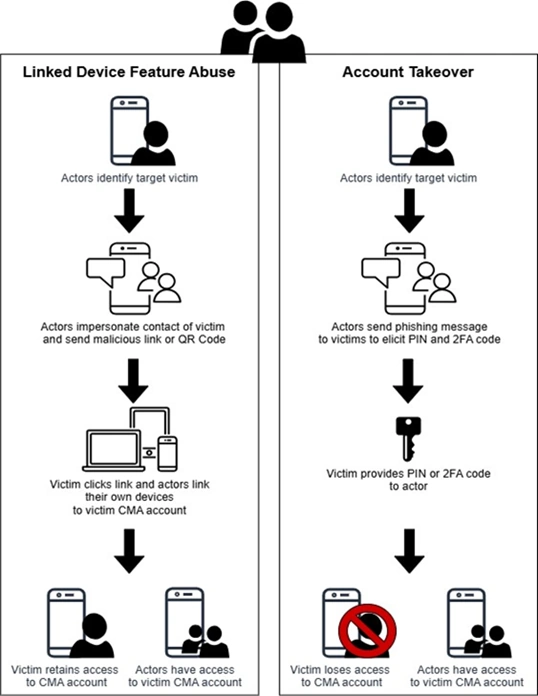
The operation has been active since at least March, when the FBI published an advisory warning of ongoing phishing campaigns targeting high-value targets by attackers associated with Russian intelligence services. Messages masquerading as automated support communications ask that users click a link or provide verification codes or account passcodes. In the event the user complies, they unknowingly link the attacker’s device to their account or have their account completely taken over and are locked out.

Thousands of accounts already compromised

With that, the attackers can read any new messages sent to the compromised account. A safety feature built into Signal, however, prevents the attackers from reading any previous conversations. The messages are sent to “individuals of high intelligence value, such as current and former US government officials, military personnel, political figures, and journalists.”

Last week, the FBI published an update that said the campaign had evolved. In addition to trying to post as support bots trying to trick recipients into linking their account to an attacker device, the messages also urge users to create a backup of all previous communications following the directions here. A follow-up message then instructs the targets to send the long passcode that’s used to encrypt backups stored on Signal servers. With that, the attackers have access to past Signal conversations. The update said two Russian government groups responsible were tracked as UNC5792 and UNC4221.

One message has text similar to this:

Signal is here

Recently, attempts to hack users of our messenger with the connection of third-party devices to the account have become more frequent.

An investigation conducted jointly with the US government and European partners revealed that the attacks on accounts were carried out by hackers from Iran and post-Soviet countries.

In this regard, Signal updates Terms of Service & Privacy Policy, and introduces Mandatory Two-factor Verification for users.

Not to lose your messages and media, set up your Signal Backup (Settings -> Backups -> Enable backups -> View recovery key -> Copy to clipboard -> Next -> Enter the recovery key -> Next -> Continue -> Choose your backup plan).

Click the “Accept” button in the pop-up and stay tuned for security updates on our messenger.

Stay safe and thank you for using the most secure messenger with end-to-end encryption.

If you have any questions, send /help

Other text looks like this:

Ex-Governors, Big Tech Launch Coalition To Help Workers ‘Navigate the AI Economy’


“Amid growing public anger over A.I. and a debate over how to regulate it, a group of employers, state governors and foundations has raised $500 million to try to answer some of those questions themselves,” reports the New York Times.

“Just how many jobs will AI upend?” asks the Wall Street Journal, reporting that the new coalition says it’s time to ready the U.S. workforce for a “major” disruption — no matter how large it turns out to be. The coalition “has so far raised more than $500 million — about half of its multiyear goal — from companies and nonprofit groups. It will initially work with state governments in Arkansas, Maryland, Utah and Connecticut. OpenAI and Anthropic are also involved, and academics including MIT economist David Autor sit on an advisory board.”

[The new “RAISE US” coalition] will be led by former Commerce Secretary Gina Raimondo, who served under former President Joe Biden, and former Indiana Gov. Eric Holcomb, a Republican. Its mandate, they said, isn’t just to build retraining programs but also to reconsider decades-old policies such as unemployment insurance and act as a working lab for testing the most effective ways to transition workers to new fields. The group will explore corporate incentives for employers to hold on to workers whose jobs are disrupted by AI and prep them for new roles… The mission of the group is to “pull all the levers at once,” Raimondo said. That means teaming up with employers to find ways to help workers gain skills or new roles and joining with educators to roll out different types of training. It also plans to propose policy changes such as tweaking unemployment benefits to let displaced workers continue to get them while they, for instance, start new businesses with AI… In Maryland, the group plans to expand a service-year option in the state to help people gain exposure to such growing fields as healthcare. An effort in Arkansas will focus on supporting “an AI-powered career navigation platform.”
More from New York Times:

The organization will work primarily with governors… The theory: States generally control their community college systems, which can translate work force policy through course offerings and industry partnerships. The bulk of the budget will fund pilot programs overseen by about 15 staff members and consultants. For example, Maryland will expand a “service year” for recent high school graduates to provide experience in fields where there are shortages, such as health care. In other states, Raise Us hopes to offer “wage insurance” for workers who take lower-paying jobs rather than dropping out of the work force entirely.

The group plans to furnish technical assistance for companies that want to retain workers as A.I. changes their roles, rather than eliminating them. Microsoft, one of the companies backing the organization, said it had already found a promising model: cross-training its entry-level lawyers in different parts of the organization and equipping them with A.I. skills in order for them to be repositioned as technology evolves. “You can think of doing that with almost any job we have,” said Brad Smith, vice chair and president at Microsoft. “It creates an opportunity to transfer people from jobs that are being eliminated to jobs that are being created….”

Ms. Raimondo and her colleagues are not fans of a universal basic income, an idea that has gained popularity in Silicon Valley as an answer to job disruption. They emphasize that work provides more than just wages, and plan to focus on helping people find pathways to new jobs. But it’s unclear whether A.I. will create jobs at the rate that it will destroy them. Jack Malde studied work force policy for the Bipartisan Policy Center and is now going to work for the Windfall Trust, another A.I.-focused think tank. He said long-term income support might be necessary, even if better models for transitioning workers were found. “The truth is, there’s still a lot of uncertainty,” Mr. Malde said. “What we think is resilient now might not be resilient later. We’re not going to get everything right, so we’re going to need those strong safety-net programs.”
Long-time Slashdot reader theodp writes:
If you think you’ve seen this movie before, prior to “partnering with governors, employers, and training partners to help the American workforce make a successful transition to an AI economy” with RAISE US, Raimondo and Holcomb partnered with governors, employers and training partners to help U.S. K-12 students make a successful transition to a CS economy with the Governors for Computer Science coalition.

Odin and Thor handhelds are getting another price hike


AYN Thor dual screen android handheld

TL;DR

  • AYN has announced that its Thor and Odin series handhelds are getting another price hike on Friday.
  • The Thor devices are now $10 to $30 more expensive, while the Odin 2 Portal and Odin 3 handhelds go up by $10.
  • The price increase goes into effect on Friday, so you still have a few days to act if you’re keen on these devices.

AYN is one of the more premium Android handheld brands out there, but it hasn’t been immune to the RAM crisis. The company previously announced price hikes early this year for some models, but it’s now revealed even more bad news.

AYN confirmed on Discord that the Thor, Odin 3, and Odin 2 Portal handhelds will all receive price increases on Friday (July 3). The firm explained that the Thor Lite, Base, Pro, and Max 512GB models will all receive $10 price hikes. Meanwhile, the Max 1TB model will go up by $30. Big oof. Check out the screenshot below for a look at current prices compared to the new prices.

A Discord message confirming price hikes for the Thor handhelds, as well as the Odin 2 Portal, and Odin 3 series.

This is at least the third time this year that AYN has increased the price of the Thor range. Most of these variants saw a $10 to $20 price hike back in January. The company then issued a $10 to $40 price increase in March. What’s particularly notable this time is that the $249 Lite model, which hadn’t received a price increase in 2026, has also seen a price hike.

The handheld maker isn’t stopping with its Thor devices, though. AYN says that pricing for all Odin 3 models and the Odin 2 Portal will increase by $10. This follows a $10 to $40 price hike for the Odin 3 series in March. The Odin 2 Portal increase is especially notable as it’s also managed to avoid higher prices this year.

This is a disappointing turn of events, but these price hikes are out of AYN’s control. AI companies have been buying up RAM and storage at a breakneck pace, resulting in supply shortages and skyrocketing component costs. So electronics manufacturers are forced to pass these higher costs on to consumers. At least AYN is giving a heads-up so anyone who really wants one of these handhelds can buy it at the cheaper price.

Thank you for being part of our community. Read our Comment Policy before posting.

California law targeting loud streaming ads takes effect on July 1


Streaming ads might be getting a lot quieter this week.

A California law banning streaming services from showing ads “louder than the video content” that they accompany is set to take effect on Wednesday, July 1. (Existing legislation already imposes similar volume restrictions on broadcast and cable TV commercials.) 

Ars Technica notes that streaming services have not shared additional details about how they plan to comply with the law. While the volume limitations only apply to California for now, it seems likely that any relevant changes would be deployed more broadly, especially with a similar bill set to take effect in Illinois next year.

When the law was passed in 2025, its sponsor, State Senator Thomas Umberg, said it was inspired by “every exhausted parent who’s finally gotten a baby to sleep, only to have a blaring streaming ad undo all that hard work.” 

Industry groups including the Motion Picture Association of America and the Streaming Innovation Alliance opposed the bill, claiming streamers were already working to address the issue, and noting that they have to deal with a variety of output devices, including TVs, tablets, and phones.

Jessica McCabe built ‘How to ADHD’ by solving her own biggest problem


Jessica McCabe started posting on YouTube because she knew she couldn’t lose it.

McCabe lost notebooks and phones and was even capable of losing “her own head,” according to her mother. So whenever she wanted to revisit helpful articles, research, or her own notes on strategies for living with her ADHD, McCabe didn’t have an organizational system that made it easier for her to find (or actually remember) the information. Then, she realized one already existed.

“Anytime I wanted to show people this one really funny video on YouTube, I could find it. So I was like, YouTube. I won’t lose YouTube,” she told Mashable.

Thus, How to ADHD was born. Now, about 10 years later, the mental health creator has 1.94 million subscribers on YouTube, 100,000 followers on TikTok, a book she wrote called How to ADHD, and a second book in progress. The day before we spoke at VidCon, she gave two presentations at the World Confederation of Cognitive Behavioral Therapists Congress alongside experts, including doctors and research fellows, in the fields of psychology and psychiatry.

So yes, McCabe is a mental health creator, but she’s also a verifiable force in the global mental health community. Mashable sat down with her to learn how her channel transitioned from a place to catalog her findings for herself to a full-fledged business, how she stays organized as a neurodivergent creator and mother, how she can care for yourself while connecting with her audience, and her hopes for the online mental health content creation space.

Tell us about the research process that goes into your videos, both when you first started and how it has evolved over time.

The research process has definitely evolved. It started out as me Googling things, like, “I have ADD. What does that mean?” And I was like, oh, a lot of articles say it’s not called ADD anymore. It’s apparently all ADHD now. And oh, it doesn’t just impact focus. It impacts executive function, too. I didn’t know that. Over time, as I was posting this information on the channel, people in the comments would be like, “Do you know about Google Scholar? Do you know about PubMed?” Or eventually it was, “Hey, I’m an ADHD researcher. Would you like help? I see you’re trying to disseminate good scientific information about ADHD.”

So I started working with researchers. And even then, it took a little bit. The first researcher that I worked with was very pedantic and wanted to use very technical language. And I was like, I’m trying to disseminate to a lay public. I need to simplify a bit. I need to do that without losing important nuance, but I do need to be able to restate it in words that anybody can understand.

The current researcher I work with is Dr. Patrick LaCount. He’s now our chief science officer, and he reviews everything on our channel. So if you see that we have the little badge on our channel that says, “We’re on the Health Shelf“, it means it’s a channel from a trusted provider. That’s because Dr. Patrick LaCount reviews everything that I put out before I put it out.

That’s not a given on every mental health channel. It’s amazing that you guys have that.

It’s really important to me to ensure the information we’re putting out is accurate. Especially the fast pace that you have to go to as a content creator, where you’re posting every week or maybe sometimes more often than that. It’s really easy for things to slip through the cracks. So it’s really important to me to have that review process of, is this accurate? Because if it’s not accurate, then what am I doing?

Before you had researchers working with you, how did you handle that while maintaining a consistent posting schedule?

I did have a consistent posting schedule, and I am a recovering perfectionist, but I gave my perfectionism a different target. I was like, “OK, you can get as perfectionistic about this as you want. You can read as many articles to make sure that everybody’s agreeing with you and that you’re getting the right information as you want, as long as you can get that video out on Tuesday. And that was non-negotiable for me. For a while, I was able to do that, but then, as the amount of information I was trying to include grew, the scripts and videos got longer, and it became harder and harder to hit that mark.

So we’re still trying to figure it out. What that means for me now is that I’m not researching a brand-new topic every week like I did in the beginning. I’ve played around with different ways of doing it. One was like, “For this month, I’m learning about this topic, and all the content will be about it.” Now it’s a lot of, “Oh, I already know this stuff. I’ve already researched this stuff. I can make another video about the same topic.” But at first, I was killing myself because it was a new topic every single week, and I had to research from scratch.

That’s intense.

I don’t recommend it, but I did learn a lot. And now I have a book as a result.

So tell me a little bit more about the workflow you developed and how it came about.

So the workflow evolved quite a bit, too. When I first started, I was planning to do it by trial and error, like, OK, I struggle with organization or cleaning my house, so I’m going to try this strategy for a week. I’m going to film it and then edit it. Then I quickly realized that’s not actually doable in a week. You can’t figure out the strategy once a week, try it for a week, then edit it.

Instead, what I did was, OK, let me learn about this thing. I had a format that I used every single time: introduce the problem, explain the problem, introduce the solution, and explain the solution. I just did it on a blue wall and added graphics afterward. That worked really well. What didn’t work well was me trying to do it off the cuff because I learned really quickly I’m very hard to edit. I’ve gotten better. Hopefully, this is not terrible.

So, quickly, my process went from “let me try and speak off the cuff about what I’ve learned” to “that’s not going to work, that’s going to be impossible to edit” to “what if I outline?” But then I would look at the outline, and my mind would go blank because there would be all this pressure to like say whatever it was that I meant when I had that bullet point written down. So then I was like, I need to script. I just need to script.

The problem is that as an actor, I didn’t do very well, partly because I had such a hard time memorizing lines. So very early in the process, I had a giant whiteboard, and I printed out every single word in giant, like 36-point font, and I just taped it to this whiteboard. I used what was my strength, which was I got really good at cold reading, but really bad at memorizing lines. Anytime I went into an audition as an actor, I was like, “Let me cold-read.” So I’d glance down, glance up, and say the line, glance down, glance up, and say the line. So some of it was happy accidents. Like our punch-in, punch-out style was to cover the fact that I had to look down between the lines.

For the part of your workflow that involves other people, at what point did you decide you needed to build out your team, and how did you approach that process?

That evolved over many, many years. At first, it was my boyfriend at the time, like, “Hey, you’re an editor. Can you throw a couple of graphics on this?” Once I edited it, I was like, here you go, make it pretty, and he would take like a few hours to punch it up.

Over time, it became clear that what I was doing was really meaningful to people and could turn into something, right? More than just a personal project. So he did more and more until I was like, OK, I’ve got to pay this guy. I actually ended up hiring him full-time before I was full-time.

I was still waiting tables, but I was like, I need an editor. I will work for free 24/7. He will not, understandably. Eventually, I was able to go full-time as well. Then, when that marriage fell apart, I had to hire a team. There were a couple of people that I actually met at VidCon who were like, “Oh yeah, we can do some editing for you, and we can do some animations.”

Digital organization was such a big struggle for me as someone with ADHD that I ended up hiring somebody literally to organize my shit. Our community manager had been volunteering on our Discord for a long time, and finally, after a couple of years, I was like, “We should hire you, though.” Basically, my whole strategy was that whenever I wanted to hire a new person, I brought one on. Now I have a pretty robust team.

What’s having a team like? Because content creation and running a team are very different skill sets.

It is a very different skill set. Also, moving from “I’m going to have people I know help me with this thing” to “oh, I am hiring for a position, and I need to vet that person” was interesting.

An ADHD creator friend of mine, Dani Donovan, recommended a recruiter that she had worked with because she was also in the same boat of hiring friends. So for the first time, we used a recruiter who found us our current producer, and I was like, this person is amazing.

If I could go back in time, I’d work with a recruiter. It’s really important as a creator to work with people. I made the mistake early on of prioritizing the hard skills. How good are you at animating? How good are you at editing? How good are you at these skills? And I didn’t prioritize the soft skills — how are you collaborating with the rest of the team? Are you an easy person to work with? Can you take feedback? Now I really prioritize soft skills.

I would love to talk about your relationship with your audience. I imagine it has grown, but I feel like, especially being a mental health creator, there’s an extra weight to that, and people come a lot with their personal experiences. So how do you navigate that?

It’s tough because I started out as a peer in my community. I was somebody who was learning about my ADHD for the first time; they were learning about theirs. We kind of came up together, and that was a really cool experience.

It also meant that if someone was struggling, it was almost like I was struggling too. We were in the same boat. And my boat was starting to float, and I didn’t want to let their’s to sink. I wanted to respond to every comment. I wanted to help everybody. As the channel grew, I couldn’t anymore. I would get to the point where I would be overwhelmed with taking on a lot of people’s pain and needs. I would need to step away for a little bit, but then I would come back, and there would be so many messages.

Facebook was really the first place where this was overwhelming for me, all of the direct messages that you would get. One day, I went to respond to a message, and by the time I got through like five messages, that person had already responded, so I was in a conversation with them. And I went — it’s not just that I’m procrastinating or avoiding or like not doing the right thing by not responding. I can no longer respond to people.

So that’s when I had to evolve it to let me read the comments and hear what people are saying. Then I need to make content that speaks to that struggle, content that will be for more than just that one person. That was a tough evolution for me in moving away from that one-to-one relationship.

I imagine there could have been some guilt there. Like, you’re letting a version of a relationship go.

It was painful moving into this parasocial space where I don’t know everybody in my community anymore. We don’t have regular conversations, but I still very much care and want to be there for people. I just can’t in the same way. So one of the things we’re doing now that I’m really excited about is that I’m going to start coaching people one-on-one.

I can get the one-on-one I really value, but then we put that content online so other people can benefit, too.

Since becoming a mom, do you feel that the way you approach the content itself, or the way you approach the work of creating the content, has changed?

It has changed. The first change is obviously having to take a break. As a content creator, you’re producing content week after week after week, maybe day after day after day. But maternity leave is a thing that is apparently important! So I had to figure out how to keep putting out content while I’m away and set my team up for success to do that.

Even then, it was really rough that first year to create content, because it felt like my brain had been hijacked by this new passion, this new child. My brain had literally been rewired. It also coincided with finishing my book and putting that out into the world. I finished my project of learning everything I could about my ADHD brain, putting it somewhere I could find it again, and making it available to other people, and I was embarking on a new one: motherhood.

And suddenly, my entire hyperfocus was on being a mom, and I did not have a channel for it. I don’t want a channel about being a mom. So most of what I was learning no longer made sense to share with my community. That was a big, big shift for me because I had to figure out how to keep making content for this community when that’s not where my head is at. So we changed up how we were doing content. I was no longer just a talking head on a blue wall. We also hired the wonderful new producer I was telling you about, and he’s local, so we were able to start filming skits in my house and doing wild projects like having Cas from Clutterbug come down and help me reorganize my entire house. We were able to do different kinds of content.

But it was very much an exploration of what kinds of content my brain can focus on. What kind of content do I want to make?

What are your hopes for the mental health content creation space going forward? And as a second part, who are the creators in that space now that you think more people should be watching?

Therapy in a Nutshell is great. Dr. Tracey Marks is great. Also, Daniel from The Aspie World. He’s great for anybody who’s dealing with autism. A lot of people who watch my channel are like, can you do this, but for autism? And I’m like, I don’t have autism. But my friend does!

There are a lot of great mental health creators. But what I’m hoping for in this space is that we get more people with lived experience connecting with people who have research-backed, evidence-based information, and then we disseminate that. There are many academic researchers speaking to it, and many speaking from personal experience. But I would love to see more people doing what I’m doing, which is speaking about their personal experience as a vehicle to share evidence-based information, so it’s not just, “This one thing worked for me.” It’s, “This is what works for a lot of people, and it worked for me. Maybe it would work for you, too.”


62 Last Minute Prime Day Weekend Deals: Up to 45% Off (2026)


These are the best-sounding open earbuds, with clear audio and instrumental detail. The rollable build offers a secure fit with minimal discomfort, but it may take a few tries to attach them correctly. Battery life lasts about seven and a half hours, and they have an IPX4 rating, meaning they’re resistant to splashes and light rain. Lastly, they’re equipped with some of Bose’s advanced features, including multipoint pairing, Bose Spatial Audio, and push-button controls for playback, calling, and volume adjustments. —Boutayna Chokrane

Our favorite Bluetooth speaker is on sale for Prime Day. Our reviewers say the JBL Flip 7 the perfect balance of portable design and sound quality, with surprisingly full sound in its compact package. The Flip 7 is plenty durable for the outdoors with a drop-tested design and water resistance, and it also supports Auracast to sync with other new JBL models. —Nena Farrell


Jump to Section: Best Tech Deals, Best Amazon Device Deals, Best Apple and Apple Accessory Deals, Best AV Deals, Best Home & Kitchen Deals, Best Beauty & Wellness Deals, Best Mobile & Wearable Deals


Best Home & Kitchen Deals

Google

Nest Cam Indoor (Wired, 3rd Gen)

Easily the smartest indoor security camera currently available, Google’s third-generation Nest Cam indoor kicks the resolution up to 2K at 30 fps, with HDR and night vision. There’s also two-way audio, enforced two-factor authentication, and accurate detection to alert you about people, animals, or vehicles. The Google Home Premium subscription is pricey at $10 per month ($100/year) for 30 days of event video history and familiar face alerts, but it covers all your Nest devices. —Simon Hill

Brad Bird’s Ready and Hoping for ‘Ray Gunn’ to Hit Theaters


As we wait for Netflix’s upcoming animated detective movie Ray Gunn to get a trailer, there’s one important question: will it come to theaters?

The answer currently appears to be “no,” but writer-director Brad Bird would love for that to change. At this week’s Annecy Animation Festival, he mentioned to Polygon he was “talking” to the streamer, but he doesn’t know “whether they’re listening.” Glad as he is that the film exists, he’d be even happier if it was on the big screen, he said, highlighting his membership in the exhibition trade organization Cinema United. “[They’re] all about theatrical,” said Bird, “and I believe it’s the best way to see this movie the first time you see it.”

Every once in a while, Netflix puts a movie in theaters for Oscar consideration. But in the past year, KPop Demon Hunters and the Stranger Things finale both came to theaters because they were big events that proved to be worth the effort. Next year, the streamer will let Greta Gerwig’s Chronicles of Narnia movie, The Magician’s Nephew, open in theaters first, then bring it to the platform after the reverse has been the standard for years.

Should Netflix decide Ray Gunn isn’t theater-worthy, Bird has a plan B for audiences: DIY a theatrical experience. “Find the biggest screen you can, even if it’s down the street at your neighbor’s place,” he suggested. “Barge right in there and say, ‘We’re seeing this movie, because you have a big screen and that’s the way it should be seen.’”

Ray Gunn is expected to hit Netflix on December 18.

Want more io9 news? Check out when to expect the latest Marvel, Star Wars, and Star Trek releases, what’s next for the DC Universe on film and TV, and everything you need to know about the future of Doctor Who.

Prediction Markets Let You Bet on Anything. That’s a Problem


In late May, federal authorities charged a Google software engineer with insider trading after he won $1.2 million on the prediction-market website Polymarket. The 36-year-old Michele Spagnuolo allegedly placed bets that musician D4vd and rapper Kendrick Lamar would top Google’s most-searched list. The bets paid off, prosecutors said, because Spagnuolo had access to confidential company data. 

The popularity of prediction markets, where you can bet on thousands of real-world outcomes across nearly every facet of modern life, is spreading faster than governments can keep up. Even Mark Zuckerberg, Meta’s chief executive, is reportedly developing a standalone prediction market app to compete with the most popular platforms, Kalshi and Polymarket

You may have even been tempted yourself to put down cash on your favorite pop-culture hunch. But the recent Google case highlights just one of the biggest concerns for a multibillion-dollar industry prone to abuse. Numerous insider trading cases have prompted federal regulators to intensify scrutiny, cracking down on the illegal use of classified information for betting. 

A New York Times investigation in May flagged more than 11,000 Polymarket accounts for suspicious, high-profit trading patterns, often involving perfectly timed bets on geopolitical events, and flawless, loss-free track records. And it’s not just corporate employees; it’s also military personnel and government officials manipulating classified information. 

blue image of polymarket

With Polymarket, users trade shares using cryptocurrency to bet on the outcomes of real-world events. 

Adobe Stock

A US Army special forces soldier allegedly received a payout of $400,000 by “predicting” the capture of Venezuelan president Nicolas Maduro. Former Congressman George Santos allegedly won tens of thousands of dollars by betting he wouldn’t be at Trump’s State of the Union address, despite posting on X that he would be.

Just last week, a Wall Street Journal investigation revealed that Polymarket ran a deceptive, secret marketing campaign by paying social media influencers to film fake trades and stage massive winnings on lookalike dummy websites to draw people in.

“This industry is growing fast and will continue to grow as long as courts and regulators allow it,” Columbia University professor of economics Rajiv Sethi told CNET.

People generally have strong opinions surrounding prediction markets, and many (like me) feel a bit icky about them. But how the industry shakes out will depend on several regulatory battlegrounds. Prediction markets are facing intense pushback from lawmakers over insider trading, highlighted by a congressional probe and a proposed bill to ban prediction-market bets by service members. Yet because no one can agree whether betting markets are legitimate financial tools or just a glorified form of gambling, they’re causing a massive headache at the state and federal levels. 

Kalshi logo displayed on phone with another phone behind it with stock lines

Kalshi lets users trade contracts on events ranging from politics and economic data to weather and sports. 

Adobe Stock

How prediction markets work

To any casual observer, Polymarket and Kalshi seem like virtual casinos, except you’re betting against other participants, not against “the house.” You can buy and sell contracts about anything: the weather, geopolitical events, election results, sports, entertainment awards, ad nauseam. 

Several high-profile predictions over the past several months involved the US attacking Iran, Michael B. Jordan winning the Oscar for Best Actor and bitcoin topping $125,000. You can even predict if someone is going to utter a certain word in a speech or news conference in what are called “mention markets.” 

With a mainstream boom in prediction market platforms over the last few years, other companies have joined the fray: Robinhood, PredictIt, Metaculus and even traditional sportsbooks FanDuel and DraftKings

These types of “idea futures” aren’t new, though. Informal information markets date back hundreds of years, as seen in the 1500s in Italy, where people predicted who the next pope would be.

Today’s prediction markets claim they aren’t technically gambling or akin to trading stocks, even though you’re risking money in hopes of a profit. In essence, you’re predicting something will or won’t happen. For every “share” you buy for that event outcome, you get $1 if you’re right and nothing if you aren’t. The markets don’t set the “odds,” and neither do the platforms — the traders do.

The amount of shares you’re able to buy for a certain outcome depends on how many shares are being sold for the opposite outcome by other traders. For example, if you wanted to buy 500 shares of a Yes outcome on France winning the World Cup, there would have to be 500 corresponding shares of No on France winning. 

Though the basic unit for prediction markets is only $1, business is booming for Kalshi and Polymarket, which collect transaction fees for each trade. Together, they’ve crossed $150 billion in lifetime trading volume.

Polymarket weather screenshot

Polymarket offers predictions on the weather and a lot else.

Polymarket/Screenshot by CNET

A personal look inside

I’m not a bettor. I suck at poker, I still can’t understand a Daily Racing Form, and don’t get me started about March Madness brackets. So, I’m not about to test my luck (yet) with Kalshi or Polymarket, but I did want to take a peek under the hood.

Kalshi and most other prediction markets are available for customers in all 50 states, but Polymarket, a cryptocurrency-based company, is restricted in the US and several other countries, at least for now. Some people try to bypass geographic restrictions using a VPN, even though Polymarket says it blocks VPN IP addresses.

Kalshi and Polymarket both offer a dizzying array of exchanges. Kalshi has basic event categories, from the California governor race to the price of a gallon of gas. It also has some rather off-the-wall ones, like the “Scary Tomatoes” score on Rotten Tomatoes and the US government’s disclosure of aliens. 

The mention markets on Kalshi were even stranger. Will someone say “road trip” or “meals for two” during the next Cracker Barrel earnings call? What will the hosts say during Love Island Aftersun? I’ll pass.

Columbia professor Sethi advises anyone interested in trading prediction markets to tread lightly at first.

“Most novice retail traders lose money, so my advice to those who want to experiment is to focus on events about which you know something about the topic, and keep bets small to begin with, until you get a feel for your likely performance,” Sethi told CNET.

The hard truth is that prediction market traders are far more likely to lose than to win. The Wall Street Journal reported in May that 0.1% of all Polymarket accounts won 67% of the profits. That translates to 2,000 top traders netting more than $500 million, while 1.1 million Polymarket customers didn’t make a profit.

Moreover, given the difficult task of preventing insider trading, I’d say “buyer beware” when trading in these speculative markets. 

Kalshi prediction market screenshot

There are thousands of events to predict on with Kalshi.

Kalshi/Screenshot by CNET

Social function or political tool

Another fundamental question I have is whether these markets serve a socially useful purpose. 

Better Markets, a nonprofit focused on financial and economic justice, argues that prediction markets lack real value. While traditional financial contracts help institutions manage risks, prediction markets do not. Unlike the stock market, they fail to fund businesses or help investors build long-term wealth.

Amanda Fischer, chief operating officer at Better Markets, said that bets around elections or war in Iran “serve no function but to degrade our democracy and encourage insider trading.” According to Fischer, prediction markets look more like gambling, especially since over 90% of bets on those platforms are related to sporting events. 

In response to scandals around insider trading, Kalshi says it is aggressively self-policing by tracking suspicious activity and requiring some of its users to disclose their employers. Kalshi also says its safeguards against politicians and athletes are stricter than those of traditional stock exchanges.

US President Donald Trump and Donald Trump Jr. walk on the south lawn toward the White House in Washington, DC

Donald Trump Jr. (left) holds official advisory roles at both Kalshi and Polymarket. 

Mandel Ngan/AFP/Getty Images

Meanwhile, Polymarket’s decision to maintain user anonymity has drawn heavy criticism from financial experts, who argue it leaves the platform vulnerable to fraud. Without strict identity verification, the platform allows insiders to exploit nonpublic information while enabling bad actors to “spoof” trades and trick ordinary people into following fake trends, according to Sethi, who wrote an opinion piece for the Financial Times titled “Polymarket Anonymity Must End.”

As prediction markets continue to face security concerns over fraud and insider trading, they have a powerful shield from the federal government and President Trump, who has aggressively pushed back against state-level restrictions. 

This political alignment is further complicated by the president’s son, Donald Trump Jr., who reportedly has an eight-figure investment in Polymarket and serves as an adviser to Kalshi. Although his involvement has sparked intense suspicion of a conflict of interest, Trump Jr. maintains that he does not trade on the platforms or lobby the government on their behalf.

A regulatory dilemma 

At its core, the regulatory mess stems from an identity crisis. Prediction markets are hard to classify, straddling the line between commodity contracts and security-based investments. This has triggered a massive turf war over jurisdiction, as the federal government attempts to override state and tribal gaming laws that view these markets as illegal sportsbooks trying to bypass local restrictions.

green kalshi advertisement on a train in DC says its rule is to ban insider trading

Kalshi says it strictly prohibits insider trading and actively screens users who trade on confidential data. 

Daniel Heuer/Bloomberg/Getty Images

Several US states and even private citizens have sued Kalshi, claiming the company has violated state gambling laws. Native American pueblos and a tribe in New Mexico have also sued Kalshi, alleging the company is violating gaming agreements and federal law.

Sandia Pueblo Gov. Stuart Paisano, one of the plaintiffs, in a statement, said, “The use of prediction markets for gambling purposes diverts essential revenue away from our governments, provides an end-run around regulation of gaming on our lands, and allows gaming by underage people.”

At the federal level, prediction markets are formally categorized as commodities and derivatives, placing them under the jurisdiction of the Commodity Futures Trading Commission, or CFTC. 

Kalshi CEO Tarek Mansour, who, along with fellow MIT graduate Luana Lopes, founded the company in 2018, says prediction markets aren’t traditional sportsbooks but more like open marketplaces. Mansour says Kalshi’s event contracts are financial derivatives, just like common futures, options and swaps, and should be appropriately regulated by the CFTC.

But some legal scholars and financial reform advocates argue that prediction markets should fall under the purview of the Securities and Exchange Commission, or SEC.

According to Better Markets’ Fischer, the CFTC has fewer tools to police insider trading in prediction markets. As an agency tasked with specifically overseeing agricultural and certain financial derivatives, it was only recently self-appointed as a gambling regulator. “As a result, there are some gaps and ambiguity in the CFTC’s legal framework,” she said. 

Fundamentally, the CFTC’s rules on insider trading are historically much weaker than the SEC’s. “The SEC has 90 years of law and legal precedent, which have created a robust set of rules around insider trading,” said Fischer. 

logo of Commodity Futures Trading Commission (CFTC) displayed on a smartphone in front of abstract background on phone screen.

The CFTC is supposed to act as the federal watchdog over Kalshi and take direct legal action against insider trading and market manipulation. 

Timon Schneider/SOPA Images/LightRocket/Getty Images

The CFTC is also chronically understaffed, according to Fischer. The agency has cut more than 20% of its staff during the second Trump administration.

Fischer said CFTC’s enforcement is a “drop in the bucket” compared with the enormous volume of trades being transacted at Kalshi. “The CFTC has only been able to identify and prosecute the most egregious cases, and in many other instances, has delegated enforcement to firms like Kalshi, whose only tool is to kick users off the platform,” Fischer said.

Do we really need this?

The danger of prediction markets is the financialization of our society at large, where “every opinion is a tradeable asset,” wrote Jathan Sadowski, associate professor at Monash University in Melbourne, Australia.

There’s also a risk if prediction markets define “truth” as simply a publicly verifiable consensus. If, as Sadowski noted, “the market is the ultimate arbiter of what’s valuable and true,” that leads to a “world that creates endless incentives for arbitrage, manipulation, collusion and exploitation in the pursuit of profit extraction.”

In an episode of Last Week Tonight on prediction markets, comedian John Oliver asked if we’ll be able to believe our eyes when future events occur. “When something unexpected happens in the world, it would be really nice not to have to automatically question whether it’s only because someone is trying to move a market.”

At the end of the day, I keep coming back to why these tools exist in the first place. Prediction markets shouldn’t just be a playground for day traders looking for their next fix. But to prove that it’s not just another corrupt form of speculative gambling, the industry has some massive hurdles to clear. 

CNET’s Laura Michelle Davis heavily contributed to and edited this story.


It’s A Dumb Time To Buy An Xbox, Even With The Coming Price Hike


In the immediate aftermath of Microsoft’s announcement that it was raising prices of the Xbox Series X and S for the third time this generation, a tiny trend broke out on our technology news feed. A smattering of stories appeared encouraging readers to run out and buy an Xbox console before the price hike goes into effect on August 1. Combine this deadline with the allure of active Prime Day deals on Xbox consoles, and the message from these articles is clear: The best and most fiscally responsible time to buy an Xbox is right now, so go do it.

Allow me to play devil’s advocate.

While it often makes sense to plan purchases around known price hikes, it’s a dumb time to buy an Xbox. Yes, even with discounts offering an Xbox Series S for $350 and an Xbox Series X for $573 — hell, especially at these prices. In 2020, the Xbox Series S launched at $300 and the Xbox Series X was $500. Over the past couple of years, I personally picked up a Series X for less than $400 and a Series S for $250. These consoles are now in their sixth year, and normally around this time in the generation, hardware prices would be dropping and we’d be getting cool colorways and bundles. Today’s discounted Xbox prices are obscene for a console entering its sixth year.

It’s worth noting that today’s marketplace is uniquely unmoored, fueled by a memory and storage shortage that’s driving up hardware prices across the tech industry. However, Microsoft is a core part of the problem here. The company is exacerbating the RAM shortage with massive investments in AI data centers, and its feigned ignorance around spiking Xbox console prices is laughable.

Corporate chicanery aside, it’s simply not a great time to buy into the Xbox ecosystem. You could say there’s never been a worse time, in fact. Microsoft is in disarray following years of layoffs and studio closures, falling console profits, and executive-level changes to the Xbox business in 2026. Just this month, news broke that Double Fine, Ninja Theory and Compulsion Games are in imminent danger of being shut down, while new Xbox CEO Asha Sharma and Chief Content Officer Matt Booty set the stage for more layoffs in July.

On the software side of things, Xbox doesn’t have a ton of exclusive games, as its first-party titles are widely available on PC. Its recent hits like Avowed, Indiana Jones and the Great Circle and Keeper are all available on Steam, and Xbox is legally obligated to distribute its largest first-party franchises (i.e., Call of Duty) across platforms. That’s not to mention the push to get its games on PlayStation and Switch, no matter how short-lived that may end up being. One of Microsoft’s loudest marketing points has been the fact that its games will work on subsequent consoles and eventually come to PC, and even if they’re not saying it out loud any more, the company is a leader in platform-agnostic cloud play. When everything is an Xbox and Xbox games are available anywhere, you don’t really need an Xbox at all.

There is zero reason to rush out right now and buy a six-year-old gaming console for more than its launch price, just because it’s going to become even more expensive soon. If you haven’t needed an Xbox before now, chances are, you still don’t need one. This might be rich coming from a consumer tech blog, but there is no real-world achievement for collecting every piece of contemporary gaming hardware — the closest we get is clout, but the returns on social media likes and comments are hollow and diminishing. Unlike Xbox prices, which are only rising. The actual smart move is to wait until the next generation hits — which is apparently very soon — and either pick that up or grab a Series console that will then be priced to clear.

This is nothing against the media outlets that’ve run stories encouraging people to take advantage of Prime Day Xbox console prices. Truthfully, there is a very small market for this advice and it’s fine to show these six people where the best deals are at the moment. But as general-audience advice, it sucks.

Besides, aren’t you saving up for a Steam Machine right now?

Best Amazon Prime Day tablet deals: Up to $300 off Samsung, Apple, and Microsoft


When is Amazon Prime Day?

Amazon Prime Day returns June 23-26 this year — a few weeks earlier than it has usually been scheduled. You can expect deals across all categories, as well as competing deals from retailers like Walmart, Best Buy, and Costco.

Are tablet deals really better during Prime Day?

For some big-name brands, Prime Day is one of the only sales events of the year during which flagship devices go on sale. It’s also the time of year that you’ll see the biggest discounts for popular devices like the iPad, Kindle, and more, so yes, it’s definitely a good time to snag a deal on a tablet. 

How did we choose these Amazon Prime Day deals?

ZDNET only writes about deals we want to buy — devices and products we desire, need, or would recommend. Our experts looked for deals that were at least 20% off (or are hardly ever on sale), using established price comparison tools and trackers to determine whether the deal is actually on sale and how frequently it drops. 

We also looked over customer reviews to find out what matters to real people who already own and use the deals we’re recommending. Our recommendations may also be based on our own testing — in addition to extensive research and comparison shopping. The goal is to deliver the most accurate advice to help you shop smarter. 

What are the best Prime Day deals so far?

ZDNET’s experts are searching through Prime Day sales to find the best discounts by category. These are the best deals we’ve found:

And the best deals from competing retailers: