Game name: Frostpunk 2
Release date: September 20, 2024
Price: US$44.99
Available on: Steam
Genre: Post-apocalyptic survival city builder
Developer: 11 bit Studios
Publisher: 11 bit Studios
Opencritic: Here
More than half a decade ago (how time flies!) developers 11 bit Studios unleashed upon the world a city builder survival game like no other, which focused not just on building a big city and meeting its inhabitants’ needs, but rather on what we were capable of excusing as we tried to steer a group of survivors away from being frozen and into a slightly warmer future around the Generator that powered our alternate history bastion of “civilization” in a world where the fires of Hell might be a better place than what the conditions on the surface of the Earth looked like. Since then, countless outposts have risen (or fell, depending on their Captain’s actions) but above all, players have always come out of the experience knowing a little bit more about themselves. But while such a work of art must have been undoubtedly exhausting for the team to create, the gaming industry demands more and more, and as a result, 11 bit is back at it again with a sequel, which may or may not be a completely different game from the original in some ways.
Starting up Frostpunk 2 we’ll pretty quickly come to realize that things may look similar from outside, but once we start digging in, there are some very apparent changes. For starters, we are now firmly working to expand one settlement, the aptly named New London. Its inhabitants have survived the initial apocalypse thanks to the Captain’s actions, but now it’s time to start thinking bigger and bigger, because why just survive when you can expand and reclaim some of this vast, frozen world? Obviously, these new ambitions don’t come alone, and the newborn city is home to different, often clashing, groups of people which must be negotiated with if we want to get anything done. Gone are the days of the single Captain ruling with an iron fist, for this is the age of the Stewart, and they will have to rule by consensus or risk getting replaced (which is not a fate you want to consider, trust me on that).

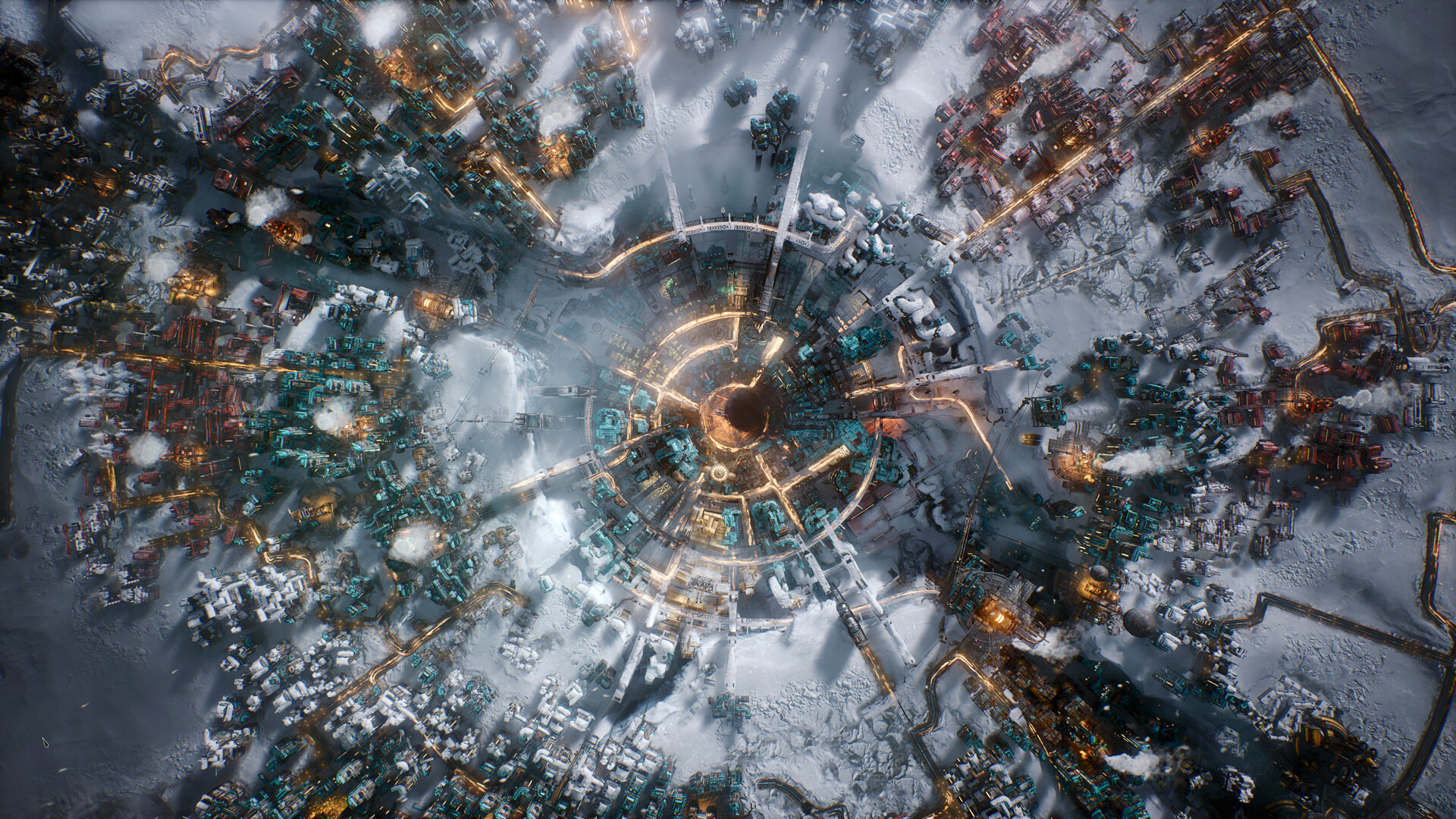
The system of government isn’t the only thing that has experienced a noticeable expansion. Where before we built things in a way smaller scale, with single buildings and small roads, now we create entire districts. This sense of scale comes at the cost of no longer seeing our individual citizens as they endlessly work for their survival (zooming in to particular districts will show you busy humans doing their jobs, but most of everything else, like the frostbreaking mechanic required to create new ground in which to build districts, is handled by huge machines). This doesn’t mean we don’t get to see the human cost of any and all actions we take or choose to not take, obviously. From vignettes that offer tantalizing choices or coldly lay out the results of an earlier decision, to the people’s murmurs, we are always in contact with the City.
Most of the micromanagement that made up the bulk of the first game is no longer as important with the sequel, as we are no longer assigning workers to buildings, or building roads. Instead, the bulk of that part of the gameplay is focused on frostbreaking (removing the icy layer from the terrain with the use of huge machines) towards resources and viable ground that can be used to build new districts. These districts will then require some thought (you can’t just plop down a housing district next to an industrial one and not expect negative repercussions, for instance), but at the same time, there are tradeoffs that are worth the cost in some cases, so it’s important to weigh our choices here. If that wasn’t enough, Frostland exploration makes its return, and is eventually required to keep going, as the resources found near our settlement won’t last forever, and that means sending out specialized Frostland Teams to chart territory and eventually build Trails so new outposts (and colonies, once we get there) can send their resources back to the metropolis.

Resources are once again key to the survival and eventual growth of the City. We want to accumulate enough food to survive Whiteouts (and to keep our population happy) but we also need Coal (and eventually Oil) to keep things chugging along. Materials enable building upkeep and provide part of what we need to create new stuff so those can never be overlooked. Without Shelter our people eventually freeze to death, but we also need to increase our Heat production to accommodate for that. And we can’t forget Heatstamps, which enable almost everything we do, from frostbreaking to district construction or building upgrades. Every resource must be weighed on the scales of our judgement so we must choose which areas to frostbreak first, or if this district needs its output increased, or if that one could be shut down momentarily, etc.
Returning to the government system, this is another area of the game where we see massive changes compared to the first Frostpunk. We need to pass laws and to decide on certain research paths in order to advance our society, and everyone is in agreement about that. Sadly, the competing factions have wildly different ideas on how to get to where we want to go, and as the Steward our job is to somehow manage to convince them to sometimes support things they clearly don’t believe in in exchange for future concessions and the like. It’s all classic politics-making but with a distinct 11 bit spin to the proceedings. Promises are important but sometimes they can’t be kept because life gets in the way. Our own personal ideas are once again placed on the scales, and how we act will affect the people’s trust in our ability to govern at every twist and turn. Promise too many things you don’t intend to actually do and next thing you know there’s a group of people holding a rally against you (and shutting down production, just in case that wasn’t enough). Unhappy with that? You can choose to work with the opposing faction to the one that just rebelled in order to change things, but eventually that may also get to a point where you don’t like what you see. What about trying to appease everyone, that worked for Chamberlain, right? Spoiler alert, it ends up the same way as it did in real life, with everything in shambles.

Thankfully there’s an area of the game where I didn’t really need to compromise much, and that’s both how it looks and how it runs. When I heard that Frostpunk 2 was going to run on Unreal Engine 5 I won’t deny I was somewhat concerned, as we’ve all seen the results when teams decide to go all in on the latest technology without considering the costs (and often without implementing key features such as a starting shader compilation step). Well, I’m glad to report that my concerns were completely unfounded, as Frostpunk 2 runs like a dream on my machine (Ryzen 5 5600x, 32GB RAM, Nvidia RTX 3070) which is far from top of the line nowadays. Stability-wise, I’m also quite happy to confirm that things are fairly smooth, even when playing on pre-release code. And I can’t fail to mention how hauntingly appropriate Piotr Musiał’s music is for a game like this one. At every moment I felt that the music was in perfect tune with the world, whether it was by bringing a little bit of warmth when it was most needed, or when it highlighted some of the coldest things mankind can do to itself in the name of survival or a misguided sense of progress.

But I’ve rambled enough about everything that I love about this game I think, and you must be tired, dear reader. What do I think about Frostpunk 2? It’s a sequel that may at first glance seem like it loses some of its intimacy and individuality in order to focus on scale, but in reality, it’s more intimate and human than ever. By placing the spotlight on the factional bickering of its post-apocalyptic cities, 11 bit carefully brings us closer to our subjects in a way that even the first Frostpunk couldn’t achieve.
10/10 – Excellent