The SEC Just Quietly Surrendered in Its Biggest Crypto Battle


The crypto world’s biggest and most consequential legal war is finally over. Ripple Labs, a fintech giant, has just closed the book on its nearly five-year battle with the U.S. Securities and Exchange Commission, ending a fight that had become a proxy for the future of cryptocurrency regulation in America.

The surprise settlement is being hailed as a landmark victory for the crypto industry and a significant blow to the SEC’s controversial “regulation by enforcement” strategy.

The “SEC announces joint stipulation to dismiss appeals, resolving civil enforcement action against Ripple and two of its executives,” the regulator said in a statement on July 7.

What Was the Fight About?

Ripple is a company that uses its cryptocurrency, XRP, to make international money transfers faster and cheaper than traditional banking systems. In 2020, the SEC sued Ripple, alleging that XRP was an unregistered security. In simple terms, a security is an investment contract, like a share of stock. If a crypto token is deemed a security, it must follow the same strict registration and disclosure rules, a standard most crypto projects have not met. An SEC victory could have effectively outlawed XRP in the U.S. and set a precedent to cripple hundreds of other tokens.

On August 7, the fight officially ended. The SEC announced a “joint stipulation to dismiss appeals, resolving civil enforcement action against Ripple,” while Ripple agreed to drop its cross-appeal. The final judgment from the lower court—including a $125 million penalty—will remain in effect, but the war is over.

While Ripple is paying a penalty—$50 million—, the company is walking away with a far more valuable prize: a game-changing legal precedent. A 2023 ruling from Judge Analisa Torres dealt the SEC a major blow by finding that Ripple’s sales of XRP on public exchanges—where buyers are anonymous and not dealing directly with the company—did not qualify as securities transactions. That part of the decision remains intact.

This is a huge deal. It creates a crucial distinction that other crypto projects can now use in their own legal battles, potentially shielding them from the SEC’s claim of blanket authority over the market. By choosing to settle rather than risk having this ruling upheld by a higher court, the SEC has shown the limits of its “regulation by enforcement” playbook: its strategy of creating rules through individual lawsuits instead of issuing clear guidelines for the industry.

As Ripple’s chief legal officer, Stuart Alderoty, wrote on X, it’s “the end… and now back to business.”

What It Means for Main Street

While both sides can claim partial victories, the biggest winner is arguably Main Street, or the everyday investors and developers who have been caught in the regulatory chaos for years. The brutal legal battle forced a court to confirm that not all digital assets are automatically securities, especially when traded by the public. This provides a clearer, though still incomplete, set of rules. For investors, it reduces the risk that their holdings could be declared illegal overnight. For innovators, it provides a slightly clearer path to building compliant projects in the U.S., moving the industry one step closer to mainstream legitimacy.

Our Take

The SEC has spent years trying to define the crypto industry through litigation. The Ripple case shows that strategy is losing steam. The agency’s decision to settle rather than risk another courtroom loss could embolden other crypto companies to fight back rather than agree to quick deals. This marks the start of a new chapter in the crypto-Washington standoff, one where legal and political pressure may finally be forcing a long-overdue rethink of how America regulates digital assets.


Computer engineer has a new idea to recover his $765M of buried Bitcoin


Buried in a garbage dump in Wales, U.K., is a hard drive containing Bitcoin worth a colossal $765 million, according to computer engineer James Howells.

Howells accidentally discarded the smartphone-sized drive in 2013, but his local council has repeatedly refused him permission to enter the landfill site and search for it, citing factors such as environmental concerns and arguments over who is the lawful owner of the device now that it’s part of the dump.

But there’s been a new twist in this long-running story, as Newport Council recently revealed that it’s planning to close down the site in the next 12 months so that it can transform it into a solar farm to power the council’s new garbage trucks. The decision to close it has given Howells a new idea for how he might be able to get hold of his much-missed hard drive.

“I would be potentially interested in purchasing the landfill site,” he said in comments reported by the BBC this week. “I have discussed this option recently with investment partners and it is very much on the table.”

The entire site is filled with more than 1.4 million tons of waste, and Howells thinks the hard drive is in an area containing around 100,000 tons of it.

To find the drive and its 8,000 Bitcoins, Howells said he would deploy a team of human sorters, robot dogs, and an AI-powered machine that’s capable of identifying a hard drive as it passes by on a conveyor belt. But if the drive has suffered damage, there’s a chance he won’t be able to ever recover his precious Bitcoins.

But if the endeavor succeeded, Howells has said he would keep around 30% of the Bitcoins for himself, with 30% going to the recovery team, 30% to investors, and the remainder shared among local causes and Newport residents.

Digital Trends reported on Howells’ lost hard drive in 2020, when the Bitcoin on it was valued at $75 million, around $700 million less than what it’s worth now.

Howells told Business Insider in 2022 that he tries not to think too much about what his share of the money will enable him to do if he ever recovers it, “otherwise you just drive yourself crazy.”


Donald Trump Backs ‘Strategic Bitcoin Stockpile’ in Speech to Crypto Faithful


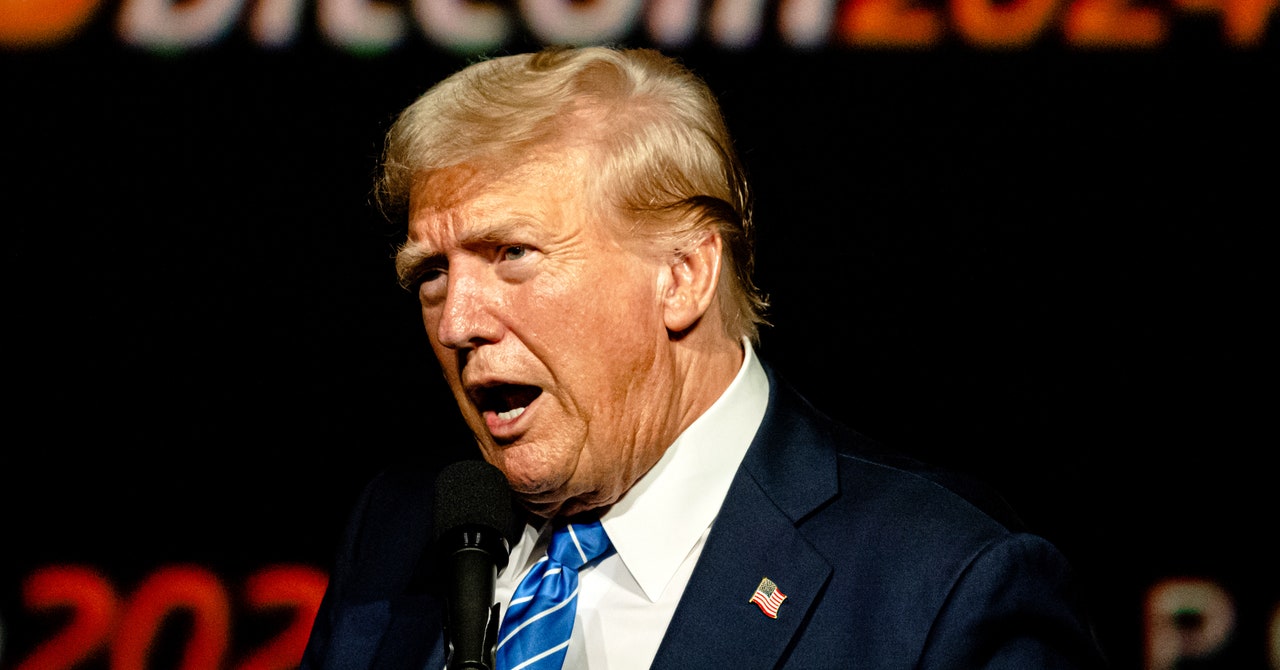
Former president Donald Trump outlined a plan to turbocharge crypto growth and make the US a crypto mining powerhouse in his keynote address to the 2024 Nashville Bitcoin Conference on Saturday.

Trump announced that if elected, he would create a strategic bitcoin reserve in the US. “It will be the policy of my administration to keep 100 percent of all bitcoin the US government currently holds or acquires in the future … as a core of the strategic national bitcoin stockpile,” he said.

Right now, the US government owns more than 210,000 bitcoins that were seized via illegal operations like the online dark market Silk Road and the ponzi scheme BitConnect. It’s worth approximately $14 billion at time of writing.

This move confirmed rumors spread by bitcoin enthusiasts who are hopeful that endorsement of a reserve from Trump could bolster the price of the cryptocurrency.

Trump also announced plans to appoint a bitcoin and crypto advisory council, whose task would be to “design transparent regulatory guidance to the benefit of your industry” in the first 100 days of his next presidency. He said he wanted the US to become the “crypto capital of the world.”

Trump also pledged to create a framework for ensuring the safe expansion of stablecoins, “allowing us to extend the dominance of the USD to other places around the world,” and doubled down on his vow to scrap any effort to create a Central Bank Digital Currency (CBDC) or digital dollar, saying “there will never be a CBDC while I’m president of the United States.”

“I will always defend the right to self-custody,” he told the exultant crowd. What got perhaps the biggest cheer was a day one promise to fire Securities and Exchange Commission chair Gary Gensler.

“The moment I am sworn in, the persecution stops and the weaponization against your industry ends,” he said, name-checking Democratic senator Elizabeth Warren of Massachusetts as the industry’s sworn enemy.

He promised to make regulations friendly to crypto mining operations in the US, so workers wouldn’t have to “move to China.” Trump promised, again, to free Ross Ulbricht, imprisoned for life for his involvement with online underground market Silk Road, where people could buy items like illegal drugs before it was shut down in 2013.

The crowd expected the bitcoin strategic reserve announcement. On July 22, Senator Cynthia Lummis of Wyoming posted “Big things … in store this week” on X, two days before Fox Business reported she would “announce legislation for a strategic bitcoin reserve” at the conference.

Lummis appeared before the crowd just after Trump walked off to announce a “present to President Donald Trump”: the bitcoin reserve bill she’d been drafting.

“This is our Louisiana Purchase moment,” she said, elaborating that the bill would take “the bitcoin President Trump just mentioned and pull it into the reserve—[and] that’s only the beginning.”

“Over five years, the United States will assemble 1 million bitcoin,” she added, “Five percent of the world’s bitcoin, and it will be held for a minimum of 20 years and can be used for one purpose—reduce our debt.”