FBI warns voters about inauthentic videos relating to election security


The FBI issued a statement on Saturday about deceptive videos circulating ahead of the election, saying it’s aware of two such videos “falsely claiming to be from the FBI relating to election security.” That includes one claiming the FBI had “apprehended three linked groups committing ballot fraud,” and one about Kamala Harris’ husband. Both depict false content, the FBI said.

Disinformation — including the spread of political deepfakes and other forms of misleading videos and imagery — has been a major concern in the leadup to the US presidential election. In its statement posted on X, the FBI added:

Election integrity is among our highest priorities, and the FBI is working closely with state and local law enforcement partners to respond to election threats and protect our communities as Americans exercise their right to vote. Attempts to deceive the public with false content about FBI operations undermines our democratic process and aims to erode trust in the electoral system.

To view this content, you’ll need to update your privacy settings. Please click here and view the “Content and social-media partners” setting to do so.

Just a day earlier, the along with the Office of the Director of National Intelligence (ODNI) and the Cybersecurity and Infrastructure Security Agency (CISA) said they’d traced two other videos back to “Russian influence actors,” including one “that falsely depicted individuals claiming to be from Haiti and voting illegally in multiple counties in Georgia.”

Cybercriminals Pose a Greater Threat of Disruptive US Election Hacks Than Russia or China


Russian, Chinese, and Iranian state-backed hackers have been active throughout the 2024 United States campaign season, compromising digital accounts associated with political campaigns, spreading disinformation, and probing election systems. But in a report from early October, the threat-sharing and coordination group known as the Election Infrastructure ISAC warned that cybercriminals like ransomware attackers pose a far greater risk of launching disruptive attacks than foreign espionage actors.

While state-backed actors were emboldened following Russia’s meddling in the 2016 US presidential election, the report points out that they favor intelligence-gathering and influence operations rather than disruptive attacks, which would be viewed as direct hostility against the US government. Ideologically and financially motivated actors, on the other hand, generally aim to cause disruption with hacks like ransomware or DDoS attacks.

The document was first obtained by the national security transparency nonprofit Property of the People and viewed by WIRED. The US Department of Homeland Security, which contributed to the report and distributed it, did not return WIRED’s requests for comment. The Center for Internet Security, which runs the Election Infrastructure ISAC, declined to comment.

“Since the 2022 midterm elections, financially and ideologically motivated cyber criminals have targeted US state and local government entity networks that manage or support election processes,” the alert states. “In some cases, successful ransomware attacks and a distributed denial-of-service (DDoS) attack on such infrastructure delayed election-related operations in the affected state or locality but did not compromise the integrity of voting processes … Nation-state-affiliated cyber actors have not attempted to disrupt US elections infrastructure, despite reconnaissance and occasionally acquiring access to non-voting infrastructure.”

According to DHS statistics highlighted in the report, 95 percent of “cyber threats to elections” were unsuccessful attempts by unknown actors. Two percent were unsuccessful attempts by known actors, and 3 percent were successful attempts “to gain access or cause disruption.” The report emphasizes that threat intelligence sharing and collaboration between local, state, and federal authorities help prevent breaches and mitigate the fallout of successful attacks.

In general, government-backed hackers may stoke geopolitical tension by conducting particularly aggressive digital espionage, but their activity isn’t inherently escalatory so long as they are abiding by espionage norms. Criminal hackers are bound by no such restrictions, though they can call too much attention to themselves if their attacks are too disruptive and risk a law enforcement crackdown.

Teens Say John McEntee, Trump’s Former Personal Aide and Project 2025 Higher-Up Made Them Uncomfortable in Chats


When Grace Carter heard from the Right Stuff’s account on Instagram, the person controlling the account introduced himself as John. He also offered a phone number with a Southern California area code—one a WIRED reporter has used in the past to contact McEntee.

There was no obvious reason why he would have reached out to her in particular. At the time he contacted her, Carter had about 17,000 followers on TikTok, she says, and still has only a modest 1,500 on Instagram. “I actually have no idea how he found me,” she says. “Based on the other accounts I follow and things I post, it’s very leftist. So I was surprised when he found me.”

Carter says she never used McEntee’s phone number, though she did accept his offer of a free branded hoodie. While messages viewed by WIRED indicate that Carter sparsely responded to McEntee, he repeatedly offered to fly her and a girlfriend to Los Angeles. “My treat,” he wrote.

“I remember I told my boyfriend about it and I was joking that he was going to be the other girl,” says Carter, who says that she continued to talk to McEntee as a kind of “trolling.” “I was like, I could use a free trip, that’s initially why I kept the conversation going.”

In messages seen by WIRED, McEntee says to Carter, “I think you’re a liberal,” but tells her, “As long as you’ll be fun I don’t care.” The conversation, she says, died out after Carter declined to visit McEntee over her winter break.

“I would have been uncomfortable with him in person,” she says.

Following the presidential debate on September 10, McEntee posted a video saying, “Can someone track down the women Kamala Harris says are bleeding out in parking lots because Roe v. Wade was overturned? Don’t hold your breath.” The comments section of that video were soon flooded with women across the country sharing their experiences.

It was this post that Carter says made her feel like it was important to share her experience. “That video he made about abortions really upset me,” she says. “And I was just like, it needs to be called out.” Carter posted a video on TikTok sharing her messages with McEntee, and says that she has received messages from several other young women who allege similar experiences.

One of those women, who spoke to WIRED and asked to remain anonymous because she’s concerned about her security, says that she connected with McEntee on the Right Stuff dating app before moving to texting him. The number provided matched the one given to Carter and the one used previously by a WIRED reporter; messages reviewed by WIRED also included selfies that clearly appear to be of McEntee. Like Carter, she was 18 at the time.

“I would label myself as semi-conservative,” the young woman says. Unlike Carter, she knew who McEntee was, and at first thought his profile on the app was an example for users, as opposed to his actual account. (Last year, a series of TikTok videos showed McEntee going on first dates with women he matched with on the app in various cities.) “I had seen him on TikTok. I’d see him on the news. My family is quite conservative, so I had seen him before.”


Donald Trump Backs ‘Strategic Bitcoin Stockpile’ in Speech to Crypto Faithful


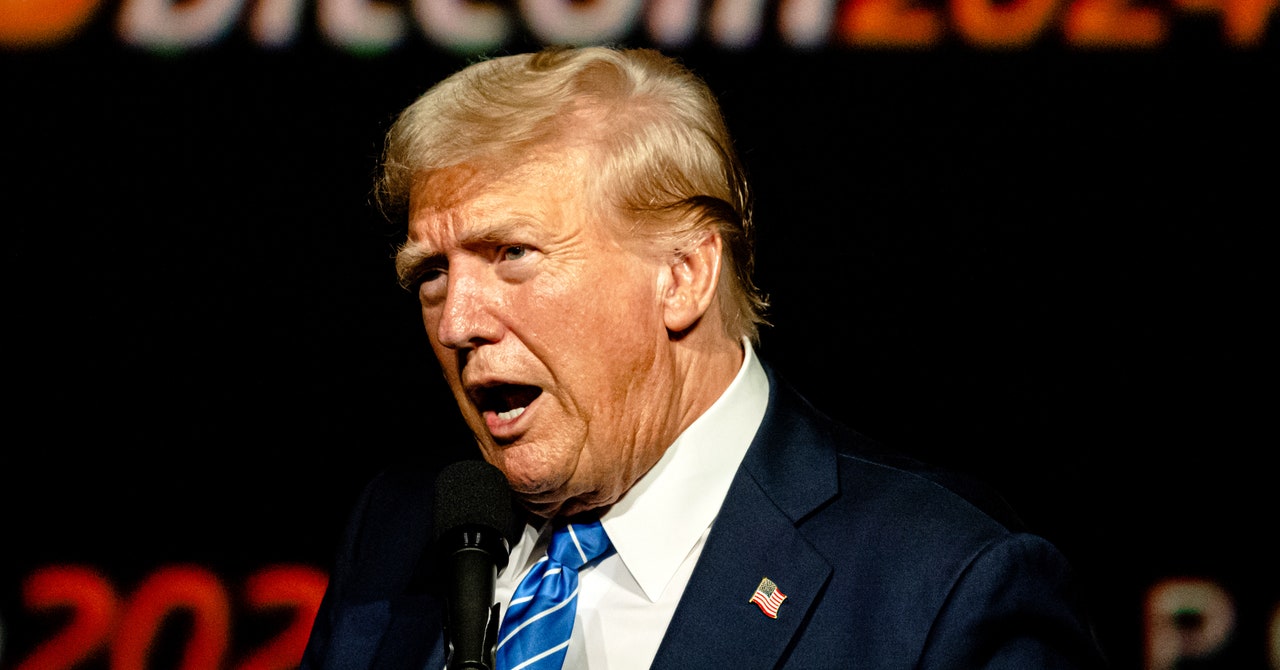
Former president Donald Trump outlined a plan to turbocharge crypto growth and make the US a crypto mining powerhouse in his keynote address to the 2024 Nashville Bitcoin Conference on Saturday.

Trump announced that if elected, he would create a strategic bitcoin reserve in the US. “It will be the policy of my administration to keep 100 percent of all bitcoin the US government currently holds or acquires in the future … as a core of the strategic national bitcoin stockpile,” he said.

Right now, the US government owns more than 210,000 bitcoins that were seized via illegal operations like the online dark market Silk Road and the ponzi scheme BitConnect. It’s worth approximately $14 billion at time of writing.

This move confirmed rumors spread by bitcoin enthusiasts who are hopeful that endorsement of a reserve from Trump could bolster the price of the cryptocurrency.

Trump also announced plans to appoint a bitcoin and crypto advisory council, whose task would be to “design transparent regulatory guidance to the benefit of your industry” in the first 100 days of his next presidency. He said he wanted the US to become the “crypto capital of the world.”

Trump also pledged to create a framework for ensuring the safe expansion of stablecoins, “allowing us to extend the dominance of the USD to other places around the world,” and doubled down on his vow to scrap any effort to create a Central Bank Digital Currency (CBDC) or digital dollar, saying “there will never be a CBDC while I’m president of the United States.”

“I will always defend the right to self-custody,” he told the exultant crowd. What got perhaps the biggest cheer was a day one promise to fire Securities and Exchange Commission chair Gary Gensler.

“The moment I am sworn in, the persecution stops and the weaponization against your industry ends,” he said, name-checking Democratic senator Elizabeth Warren of Massachusetts as the industry’s sworn enemy.

He promised to make regulations friendly to crypto mining operations in the US, so workers wouldn’t have to “move to China.” Trump promised, again, to free Ross Ulbricht, imprisoned for life for his involvement with online underground market Silk Road, where people could buy items like illegal drugs before it was shut down in 2013.

The crowd expected the bitcoin strategic reserve announcement. On July 22, Senator Cynthia Lummis of Wyoming posted “Big things … in store this week” on X, two days before Fox Business reported she would “announce legislation for a strategic bitcoin reserve” at the conference.

Lummis appeared before the crowd just after Trump walked off to announce a “present to President Donald Trump”: the bitcoin reserve bill she’d been drafting.

“This is our Louisiana Purchase moment,” she said, elaborating that the bill would take “the bitcoin President Trump just mentioned and pull it into the reserve—[and] that’s only the beginning.”

“Over five years, the United States will assemble 1 million bitcoin,” she added, “Five percent of the world’s bitcoin, and it will be held for a minimum of 20 years and can be used for one purpose—reduce our debt.”

AI Chatbots Are Running for Office Now


Victor Miller [Archival audio clip]: She’s asking what policies are most important to you, VIC?

VIC [Archival audio clip]: The most important policies to me focus on transparency, economic development, and innovation.

Leah Feiger: That is so bizarre. I got to ask, could VIC be exposed to other sources of information other than these public records? Say, email from a conspiracy theorist who wants VIC to do something not so good with elections that would not represent its constituents.

Vittoria Elliott: Great question. I asked Miller, “Hey, you’ve built this bot on top of ChatGPT. We know that sometimes there’s problems or biases in the data that go into training these models. Are you concerned that VIC could imbibe some of those biases or there could be problems?” He said, “No, I trust OpenAI. I believe in their product.” You’re right. He decided, because of what’s important to him as someone who cares a lot about Cheyenne’s governance, to feed this bot hundreds, and hundreds, and hundreds of pages of what are called supporting documents. The kind of documents that people will submit in a city council meeting. Whether that’s a complaint, or an email, or a zoning issue, or whatever. He fed that to VIC. But you’re right, these chatbots can be trained on other material. He said that he actually asked VIC, “What if someone tries to spam you? What if someone tries to trick you? Send you emails and stuff.” VIC apparently responded to him saying, “I’m pretty confident I could differentiate what’s an actual constituent concern and what’s spam, or what’s not real.”

Leah Feiger: I guess I would just say to that, one-third of Americans right now don’t believe that President Joe Biden legitimately won the 2020 election, but I’m so glad this robot is very, very confident in its ability to decipher dis and misinformation here.

Vittoria Elliott: Totally.

Leah Feiger: That was VIC in Wyoming. Tell us a little more about AI Steve in the UK. How is it different from VIC?

Vittoria Elliott: For one thing, AI Steve is actually the candidate.

Leah Feiger: What do you mean actually the candidate?

Vittoria Elliott: He’s on the ballot.

Leah Feiger: Oh, OK. There’s no meat puppet?

Vittoria Elliott: There is a meat puppet, and that Steve Endicott. He’s a Brighton based business man. He describes himself as being the person who will attend Parliament, do the human things.

Leah Feiger: Sure.

Vittoria Elliott: But people, when they go to vote next month in the UK, they actually have the ability not to vote for Steve Endicott, but to vote for AI Steve.

Leah Feiger: That’s incredible. Oh my God. How does that work?

Vittoria Elliott: The way they described it to me, Steve Endicott and Jeremy Smith, who is the developer of AI Steve, the way they’ve described this is as a big catchment for community feedback. On the backend, what happens is people can talk to or call into AI Steve, can have apparently 10,000 simultaneous conversations at any given point. They can say, “I want to know when trash collection is going to be different.” Or, “I’m upset about fiscal policy,” or whatever. Those conversations get transcribed by the AI and distilled into these are the policy positions that constituents care about. But to make sure that people aren’t spamming it basically and trying to trick it, what they’re going to do is they’re going to have what they call validators. Brighton is about an hour outside of London, a lot of people commute between the two cities. They’ve said, “What we want to do is we want to have people who are on their commute, we’re going to ask them to sign up to these emails to be validators.” They’ll go through and say, “These are the policies that people say that are important to AI Steve. Do you, regular person who’s actually commuting, find that to actually be valuable to you?” Anything that gets more than 50% interest, or approval, or whatever, that’s the stuff that real Steve, who will be in Parliament, will be voting on. They have this second level of checks to make sure that whatever people are saying as feedback to the AI is checked by real humans. They’re trying to make it a little harder for them to game the system.