Dell just made 240Hz gaming monitors shockingly cheap


High refresh rate gaming monitors have slowly become more affordable, but Dell’s latest launch takes that trend to a new extreme. The company has introduced two new 27-inch gaming monitors with 240Hz refresh rates starting at roughly $130, a price that would have seemed impossible for this spec just a few years ago.

The two models, the SE2726HG and SE2726HGS, focus on delivering fast, responsive gameplay at a budget-friendly price. Both displays are built around a 27-inch Full HD panel, a combination that prioritizes high frame rates and smooth motion over ultra-high resolution. For competitive gaming, that trade-off makes sense. Lower resolution reduces GPU strain and helps players reach the high frame rates needed to fully take advantage of a 240Hz refresh rate.

Speaking of which, the high refresh rate is also paired with 0.5ms response time, which is designed to minimize motion blur and input delay. For fast shooters and esports titles, this can translate into smoother tracking, clearer movement, and a more responsive feel overall. Add to that, there’s support for AMD FreeSync to help eliminate screen tearing and keep gameplay fluid when frame rates fluctuate.

Dell has also paid attention to everyday usability. The panels cover 99% of the sRGB color space, which means they are capable of delivering reasonably accurate colors for media consumption, casual content creation, and general desktop work. The only difference between the two monitors is mainly in ergonomics and design. The SE2726HGS includes an adjustable stand that allows height and tilt changes. The SE2726HG, meanwhile, sticks with a simpler stand to keep the design straightforward and accessible.

The bigger takeaway from these monitors is how much high-refresh displays have evolved. Not long ago, 240Hz screens were niche products aimed almost exclusively at professional esports players. Now, they are becoming part of the mainstream gaming conversation. Dell’s new models highlight how competitive gaming features are gradually moving into everyday setups. Smooth motion, low latency, and adaptive sync are no longer luxury upgrades but features that more players can realistically consider. For gamers building or upgrading a setup, this release signals a shift in expectations.
Dell is abandoning XPS, Inspiron, and its other classic brands


dell new branding

TL;DR

  • Dell is simplifying its lineup, removing XPS, Inspiron, and other classic brands from the mix.
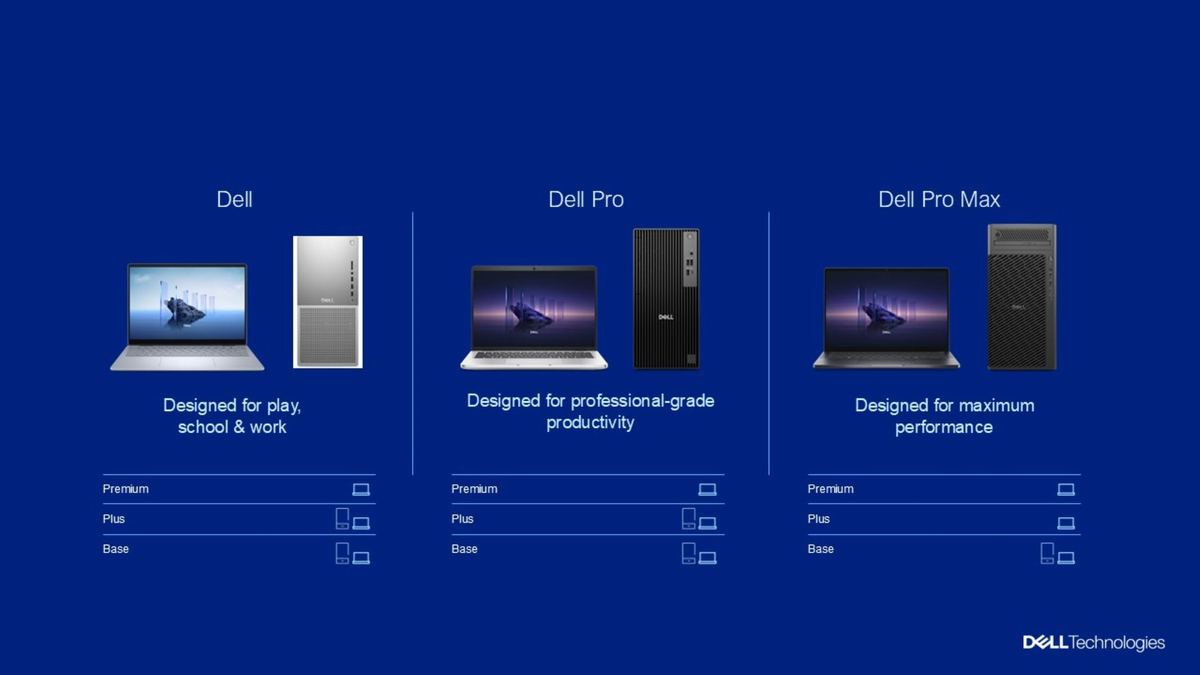
  • The new family is divided into Dell (entry), Dell Pro (mid-range), and Dell Pro Max (high-tier).
  • The new devices put a greater focus on AI with a new toolkit, NPU, and other extras for select models.

Dell has utilized the XPS and Inspiron brands since the 1990s, but all good things must come to an end. Today, Dell announced its brand-new lineup, which effectively replaces its older offerings with a more streamlined product line. Products that previously fell under the XPS and Inspiron families will now be branded simply as Dell devices, while Latitude-level devices will transition to the Dell Pro family. Finally, the higher-end Dell Precision family is being replaced by the Dell Pro Max family.

Let’s take a closer look at the reasoning behind this rebranding, as well as the new models being unveiled at CES 2025.

What the rebrand means for Dell going forward

The new branding signifies two key shifts for Dell. First, it underscores the company’s commitment to embracing AI PCs in a much bigger way, with on-device Copilot+ AI integrated into every Dell model and a stronger emphasis on AI-driven features overall with many models offering extras like a dedicated NPU or Dell’s new AI toolkit. Second, the new branding aims to simplify product selection by creating a uniform design and straightforward naming conventions.

  • Dell family: Best for family and school use.
  • Dell Pro: Tailored for professional-grade work.
  • Dell Pro Max: Designed for power users like professional content creators and 3D artists.

Dell will showcase a range of desktops and laptops across all three families at CES 2025, though only a few models will debut initially.

Dell 14 Plus and Dell 16 Plus are your entry-level options

dell 14 16 plus

The Dell 14 Plus and Dell 16 Plus are the most entry-level models in the new lineup, starting at $999 for both and launching on February 18.

  • Display: The key difference lies in screen size—14 inches for the Dell 14 Plus and 16 inches for the Dell 16 Plus.
  • Processors: Both offer Intel Core Ultra 5 to Ultra 9 options, depending on the variant.
  • Graphics: Integrated Intel Arc 130V (Ultra 5) or Arc 140V (Ultra 7/Ultra 9).
  • Memory and Storage: Choose between 16GB or 32GB of RAM and storage from 512GB to 2TB.

Both models include a full-size HDMI port, a USB Type-A port, a Thunderbolt 4 port, and a USB 3.2 Gen 1 Type-A port. They also come in 2-in-1 variants for those who prefer this form factor.

Dell Pro family has a lot more models to showcase

dell pro premium fam

Andrew Grush / Android Authority

The Dell Pro family offers a much wider range of options, but let’s start with what they have in common. Every model features a display ranging from 13.3 inches to 16 inches with a 16:10 aspect ratio, and the majority of models offer only FHD+ resolution, except for the Dell Pro 13 and 14 Premium, which have QHD+ variants.

Nearly every model includes storage options up to 2TB, but SOC-integrated RAM is the default choice initially, typically ranging from 16GB to 32GB. The good news is that a few models will eventually offer variants with single-channel and/or dual-channel RAM instead. The Dell Pro family also avoids NVIDIA or AMD graphics — at least for now — as every newly announced Dell Pro model uses Intel Arc graphics.

Dell is promising improved battery life across the entire Dell Pro line, as well as cutting-edge AI technology. This includes not only front-facing features like CoPilot Plus but also more advanced tools such as Dell Pro AI Studio, a comprehensive AI toolkit built with businesses in mind and exclusive to the Premium family.

The Dell Pro family is also adopting new modular USB-C ports designed for better durability and easier replacement. Personally, I haven’t run into USB-C port issues with my own laptop, but this addition is still a nice extra that enhances the device’s potential longevity.

As for what sets the product lines apart? Here’s a quick breakdown:

  • Dell Pro 13 and 14 Premium: At the top of the pack, the Premium family stands out as the thinnest and lightest option while offering plenty of power. These models support a variety of Core Ultra Series 2 (V) processors, including vPro. They also deliver excellent battery life thanks to mini-LED backlighting. The Dell Pro 14 Premium even offers an option with a Tandem OLED display, which is 24% more power-efficient and 49% lighter.
  • Dell Pro 13, 14, and 16 Plus: The Plus family will launch with Ultra Series 2 (V) processors, with Ultra Series 2 (U) models arriving later. All models include integrated graphics, and, at launch, RAM options are limited to 16GB or 32GB of SoC integrated memory. However, Dell plans to eventually roll out models with single-channel or dual-channel RAM ranging from 8GB to 64GB.
  • Dell Pro 14 and 16:  You’ll find Intel Core 13/14th gen or Ultra Series 2 (U) processors and memory options ranging from 8 to 64GB of RAM.

The Pro family will also consist of a variety of new desktop models in form factors that include micro, slim, and tower. All the newest models will have Intel Core Ultra Series 2 and AMD Ryzen processor options and will have built-in NPUs for better AI performance.

Pricing for the Dell Pro family has yet to be announced, but the Dell Pro 14 Plus and Dell Pro 16 Plus are expected to be available on January 6, followed by the Dell Pro 13 Plus on February 25. The rest of the family should arrive between March and April. Desktop availability details are still pending.

Dell Pro Max is the highest end of the spectrum

dell pro max
 While the Max family isn’t dramatically different from the Pro line, the standout feature is support for NVIDIA graphics. The Dell Pro Max 14 and 16 are largely identical, aside from the larger 16-inch display on the latter. Both models offer QHD+ resolution, 16:10 aspect ratios, and processor options up to the Intel Core Ultra 9, along with NVIDIA graphics.

Dell is also releasing Pro Max desktops that are scalable and tailored for various industry applications, including light AI workloads. These will be available in micro, slim, and tower form factors, with RTX and AMD graphics options.

The Dell Pro Max family is expected to launch in March or April 2025, but further details are yet to be confirmed.

Got a tip? Talk to us! Email our staff at news@androidauthority.com. You can stay anonymous or get credit for the info, it’s your choice.