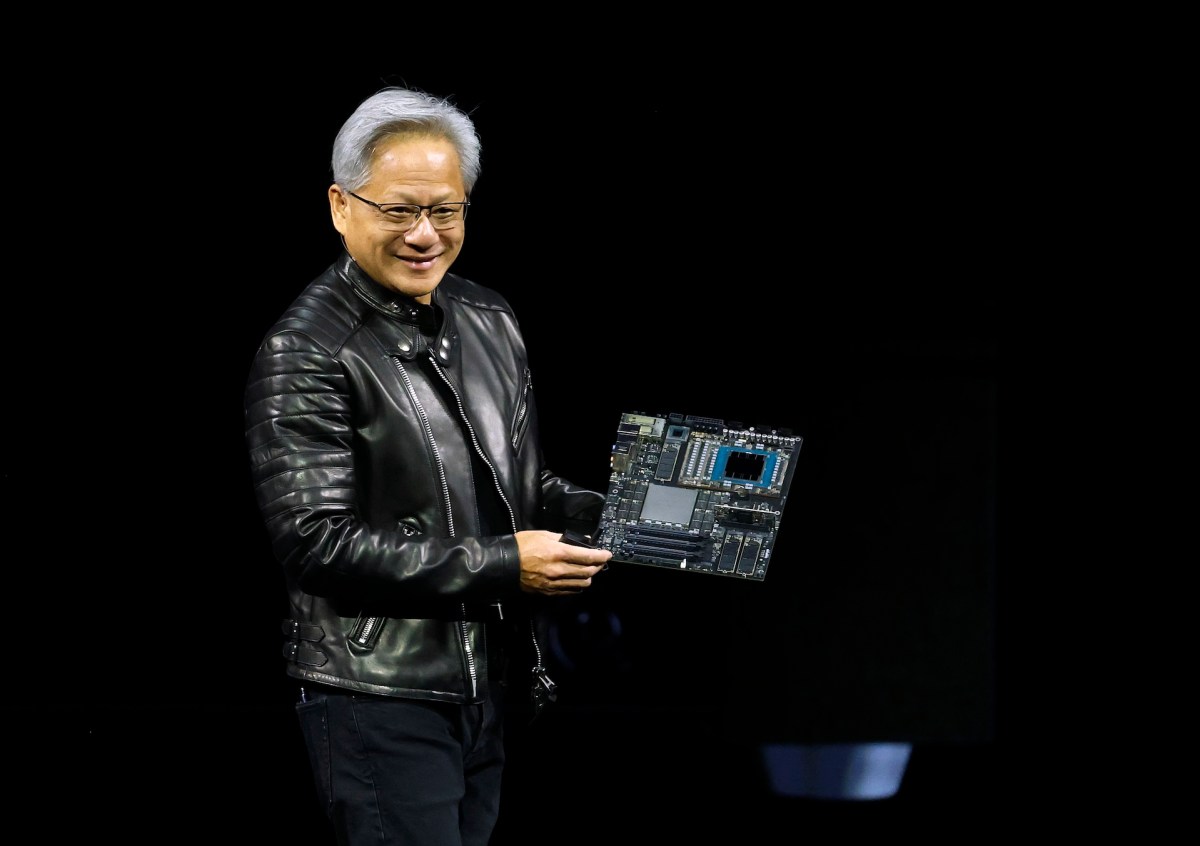
How to watch Jensen Huang’s Nvidia GTC 2026 keynote


Nvidia kicks off its annual GTC developer conference in San Jose, California, next week with CEO Jensen Huang’s keynote scheduled for Monday at 11am PT / 2pm ET.

GTC — which stands for GPU Technology Conference — is Nvidia’s flagship annual event, where the chipmaker typically uses the spotlight to announce new products, champion partnerships, and lay out its vision for the future of computing. Huang’s keynote will focus on Nvidia’s role in the future of computing and AI. You can watch the two-hour address in person at the SAP Center or livestream the talk on the event’s website.

The broader three-day event is focused on what’s coming next for AI across industries including healthcare, robotics, and autonomous vehicles, among others.

On the software side, it’s rumored that Nvidia will release an open source platform for enterprise AI agents, dubbed NemoClaw, as originally reported by Wired. The platform would give businesses a structured way to build and deploy AI agents (software that can carry out multi-step tasks autonomously) and would position Nvidia to mirror similar offerings from companies like OpenAI.

On the hardware side, the company is also rumored to be releasing a new chip designed to accelerate the AI inference process — the process by which an AI model applies what it has learned to generate responses or make decisions, as distinct from the initial training process, which requires far more computing power. Faster, cheaper inference is widely seen as one of the last bottlenecks to scaling AI applications broadly. The chip, if confirmed, would represent Nvidia’s latest bid to dominate not just the training market, where it already commands an estimated 80% share, but the inference market as well, where competition from custom chips built by Google, Amazon and others is fast intensifying.

Kevin Cook, a senior equity strategist at Zacks Investment Research, told TechCrunch that attendees should also expect to learn what the company plans to do with its relationship with Groq, the inference company Nvidia reportedly paid $20 billion late last year to license its technology. There’s a lot of curiosity around this tie-up, given that Jonathan Ross, Groq’s founder, Sunny Madra, Groq’s President, and other members of the Groq team agreed to join Nvidia to help advance and scale that licensed tech.

There will, of course, also be a range of partnership announcements and demonstrations showcasing Nvidia’s AI capabilities across industries.

Techcrunch event

San Francisco, CA
|
October 13-15, 2026

As Intel welcomes a new CEO, a look at where the company stands


Semiconductor giant Intel hired semiconductor veteran Lip-Bu Tan to be its new CEO. This news comes three months after Pat Gelsinger retired and stepped down from the company’s board, with Intel CFO David Zinsner and executive vice president of client relations Michelle Johnston Holthaus stepping in as co-CEOs.

Tan, who was most recently the CEO of Cadence Design Systems, is joining Intel — and rejoining the board — at an interesting time in the Silicon Valley company’s history. Intel has seen its fair share of ups and downs in the past few years — to put it mildly.

When Gelsinger took the helm in February 2021, Intel was already struggling and was falling far behind its peers in the semiconductor race. At the time, the company was likely still reeling from missing out on the smartphone revolution in addition to missteps when it came to chip fabrication.

It was also an interesting time for the semiconductor industry at large. The sector had seen a lot of recent consolidation in late 2020, including AMD acquiring Xilink for $35 billion and Analog buying Maxim for $21 billion, among others.

So how was Gelsinger’s most recent tenure at Intel? Let’s take a look.

Gelsinger got right to work when he started. He announced a modernization plan for the company, dubbed IDM, or integrated device manufacturing. The first part of the goal was a $20 billion investment to build two new chip manufacturing facilities in Arizona, with plans to boost chip production in the U.S. and beyond.

In 2022, the company announced the second part of this IDM plan, which involved a three-pronged approach to chip manufacturing: Intel’s fabs, third-party global manufacturers, and building out the company’s foundry services. As part of this plan, the company announced it would acquire Tower Semiconductor for $5.4 billion to help build out Intel’s custom foundry services.

That deal fell through, however, after facing regulatory hurdles. It was canceled in the summer of 2023. At the time, TechCrunch reported that the merger not going through would have a serious impact on the company’s modernization plans. In September 2024, Intel took steps to transition its chip foundry division, Intel Foundry, to an independent subsidiary.

The time leading up to Gelsinger’s retirement was particularly tumultuous for Intel. The company’s stock price plummeted about 50% from the beginning of 2024 to Gelsinger’s departure in December. Intel announced plans to lay off 15% of its workforce, around 15,000 people, in August after dismal second-quarter results. At that time, Gelsinger said the company had struggled to capitalize on the AI boom in the same way its rivals had, and that despite falling behind, Intel had overgrown headcount.

In the time since Gelsinger’s departure, the company has delayed the opening of its Ohio chip factory — again — and decided not to bring its Falcon Shores AI chips to market.

But as Tan takes the lead, things may be starting to head in the right direction. Intel finalized a deal with the U.S. Department of Commerce to receive a $7.865 billion grant for domestic semiconductor manufacturing through the U.S. Chips and Science Act; Intel has already received $2.2 billion of that grant money, according to its fourth-quarter earnings call. The company was also able to notch a win when it comes to the popularity of its Arc B580 graphics card, which sold out after positive early reviews.

As Cohere and Writer mine the ‘Live AI’ arena, Pathway joins the pack with a $10M round


As large enterprises grapple with how to incorporate AI into their platforms and processes, they have encountered a problem: Generative AI needs to have memory and its training data must be constantly updated for it to have any practical use. This area is now called ‘Live AI’ and a number of startups are working in the space, including Cohere and Writer. Another, Pathway, has just raised a $10 million Seed round to build live AI systems that, claims the company, think and learn in real-time as humans do. 

The round was led by TQ Ventures, with participation from Kadmos, Innovo, Market One Capital, Id4 and angel investors. Another investor in Pathway includes Lukasz Kaiser, the co-author of Transformers and a key researcher behind GPT o1 from OpenAI.

Pathway’s offering includes what it calls ‘infrastructure components’ that power live AI systems, feeding on structured and unstructured data, meaning that enterprise AI platforms can make decisions on up-to-date knowledge.  Customers so far include NATO and La Poste, the French post office. 

Zuzanna Stamirowska, Co-Founder and CEO of Pathway, told TechCrunch over a call: “The way deep learning and LLM assistants are working, is that you take the training data and then you train models. But the question is, how to deal with knowledge, how to deal with memory? Right now an LLM acts like a bit like a very smart intern on the first day of his job, being offered a book to read. But they can’t really memorize it. Plus, it’s not live, it’s stactic.”

To remedy this, she said Pathway “enables developers to build a pipeline where they can feed-in live data into the AI systems. Right now we do it during the prompting stage of when you build LLM applications or Gen AI applications.”

Stamirowska — who is moving to Menlo Park, California — has assembled an impressive, highly technical team to achieve the startup’s goals. Her co-founders are CSO Adrian Kosowski and CTO Jan Chorowski, who previously worked with recent physics Nobel Prize winner and the “Godfather of AI”, Geoff Hinton. Stamirowska herself is the author of a state-of-the-art forecasting model for a complex network that was in the maritime trade, published by the Academy of Sciences of the US. 

“The company started with an idea that popped up in my head on one sunny morning in Chicago,” she said. “I was there accompanying a friend to a scientific conference in theoretical computer science… We had a small disagreement, and I said I have to my start my own thing. So, I took out my laptop and started writing to people in my network about how to move this forward. I still remember the taste of the coffee at that moment.”

I asked her where she sees Pathway as against other startups in the space? “For use cases in GenAI engineering and knowledge management, Cohere and Writer appear beside us in the latest Gartner Quadrants,” she said. “Whereas in enterprise  deals, we often encounter Palantir for AI transformation tenders, although they are less product-oriented than we are.”

Commenting in a statement, Schuster Tanger, Co-Managing Partner and Co-founder at TQ Ventures, said: “Zuzanna and the team at Pathway possess bleeding-edge insights and expertise in one of the most exciting fields in modern business… Last and hardly least, the response from the developer community has been powerful.”

AI coding startup Poolside raises $500M from eBay, Nvidia and others


Poolside, the AI-powered software dev platform, has raised half a billion dollars in new capital.

The cash came in the form of a Series B led by Bain Capital Ventures, which also had participation from a who’s who of big tech firms including eBay (via eBay Ventures) and Nvidia. It brings Poolside’s total raised to $626 million; Bloomberg reports that the startup’s valuation now sits at $3 billion.

TechCrunch revealed this summer that Poolside was in the midst of raising substantial funding.

“We believe software development will be the first broad capability where AI will reach and surpass human-level intelligence,” Poolside CEO Jason Warner said in a press release. “Through our team, our applied research, and a powerful revenue engine, poolside will bring AI for software development so that anyone in the world can build.”

U.S.- and Europe-based Poolside was founded last year by Warner and Eiso Kant, both software engineers. Warner is the former CTO of GitHub, having also headed engineering orgs at Canonical and Heroku. Kant previously co-founded several dev-focused startups, including engineering analytics firm Athenian.

Warner, who incubated GitHub’s AI-powered Copilot tool, met Kant in 2017. Over the next six years, the pair plotted an AI-driven assistive tool suite for devs, which became Poolside.

Poolside develops its own AI models to help with tasks like autocompleting code and suggesting code possibly relevant to a particular context or codebase — much like rival AI assistive coding tools. The company’s customers are primarily Global 2000 companies and public-sector agencies; few have been publicly disclosed.

The Series B funding allowed Poolside to bring 10,000 Nvidia GPUs online to train future models, Warner said, and will bolster the company’s go-to-market and R&D efforts.

Despite the security, copyright and reliability concerns around AI-powered assistive coding tools, developers have shown enthusiasm for them, with the vast majority of respondents in GitHub’s latest poll saying that they’ve adopted AI tools in some form. GitHub reported in April that Copilot had over 1.8 million paying users and more than 50,000 business customers.

Encouraged by the adoption trend, VCs are pouring massive sums of cash into AI coding startups. Generative AI coding firm Magic landed $320 million in August — the same day GitHub Copilot competitor Codeium closed a $150 million fundraising round. Earlier in August, Cognition, best known for its viral coding assistant Devin, secured $175 million at a $2 billion valuation.

Polaris Research projects that the AI coding tools market could be worth $27 billion by 2032. At this rate, that doesn’t seem terribly far-fetched.

LG Technology Ventures, Felicis Ventures, Redpoint Ventures, Citi Ventures, Capital One Ventures, HSBC Ventures, DST Global, StepStone Group, Schroders Capital, Premji Invest, Dorsal Capital, BAM Elevate, Adams Street, and Fin Capital also invested in Poolside’s Series B.