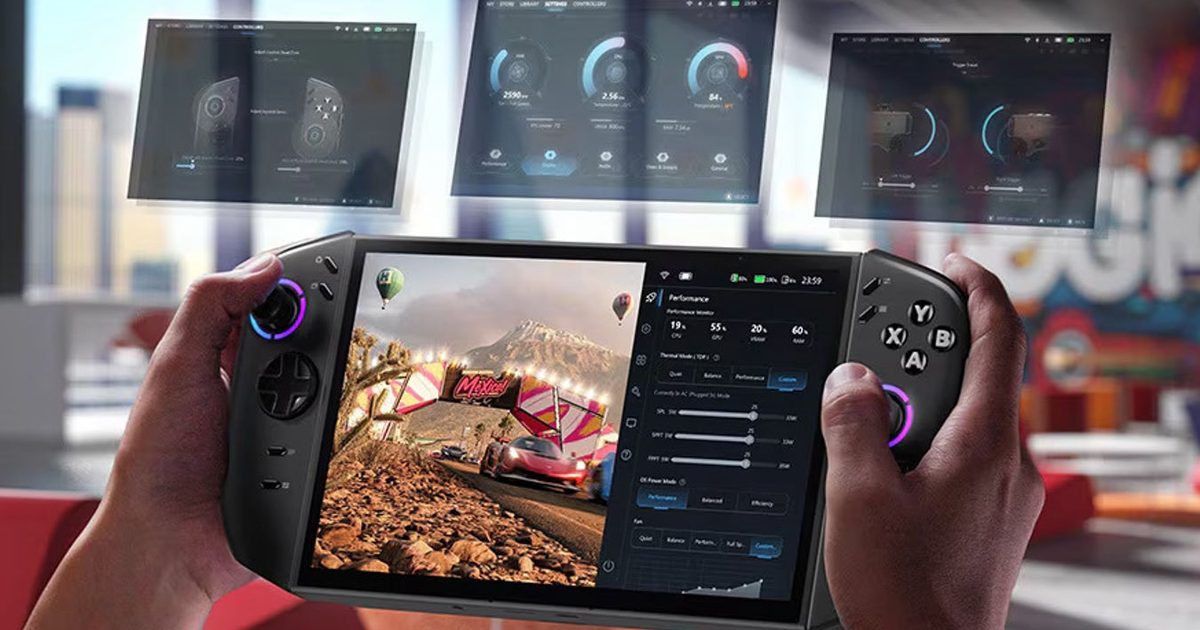
Lenovo is reportedly working on a bold new spin for its Legion Go series of handheld consoles, one where it turns into a Windows tablet with a foldable screen. Portable gaming rigs have been all the rage recently, and the Chinese brand might be looking to shake things up with an innovative new concept, one that doesn’t just fit in your hands but folds out into a larger screen to double as a PC-style device.
Blending portable handhelds with big foldable displays

According to leaked materials shared with WindowsLatest, Lenovo’s Legion Go Fold Concept will arrive as an 11.6-inch handheld with a foldable display that will be showcased at the major tech event in Barcelona. The highlight here is the flexible pOLED panel that expands from a compact 7.7-inch mode into a larger 11.6-inch screen. In essence, the design seems inspired by modern-day foldable smartphones. Owing to its new form factor, Lenovo’s concept could offer various modes:
- Standard Handheld Mode: When folded, it resembles a traditional portable gaming device with detachable controllers on either side.
- Vertical Split-Screen Mode: The screen can be split when unfolded upright that allows for gaming on one half and different tasks, like streaming or multitasking, on the other.
- Horizon Full Screen Mode: With the display unfolded horizontally and controllers attached, you get a large-screen handheld experience that rivals tablets.
- Expanded Desktop Mode: Pair the Legion Go Fold with a wireless keyboard to have it function as a laptop.
What to expect under the hood

The Legion Go Fold Concept wouldn’t just be a display showcase, as the leak suggests hardware suitable for on-the-go performance. Powering the handheld is Intel’s Core Ultra 7 258V processor (likely paired with Xe2 integrated graphics), 32GB of RAM, and a 48Wh cell. Like many Windows handhelds, battery life will be a challenge. The larger screen would burden the battery even more, but it would also offer a more immersive gameplay experience beyond what your typical handheld can deliver.
I see the vision here
The idea of a handheld that transforms into a desktop-like PC with expanded screen real estate is definitely compelling. You won’t be reaching for an external display, monitor, or a TV connection to enjoy your games, as Lenovo is offering versatility in how you play your games. Unfortunately, it is still just a concept at the end of the day, and we might not see a commercial release for such a hybrid handheld PC for at least another year or two.
