The offline desk gadget that actually got me to sit up straight


Working from home has its own perils. Pets can be demanding, your back aches from hours at a desk, or you simply forget to move. There are a few apps that nudge you to move around or indicate that you’re not sitting in an ideal position, but they’re easy to dismiss.

I’ve spent the better part of a decade at a home desk, iterating on the setup as I go — gaming chair, lumbar support, the works. None of it guarantees good posture.

Then I came across Isa, a desk device from German startup Deep Care that takes a different approach entirely. It tracks posture, hydration, light, sound, and movement. And it does all of it without a camera or an internet connection, which, in an era of always-on surveillance, is a meaningful differentiator.

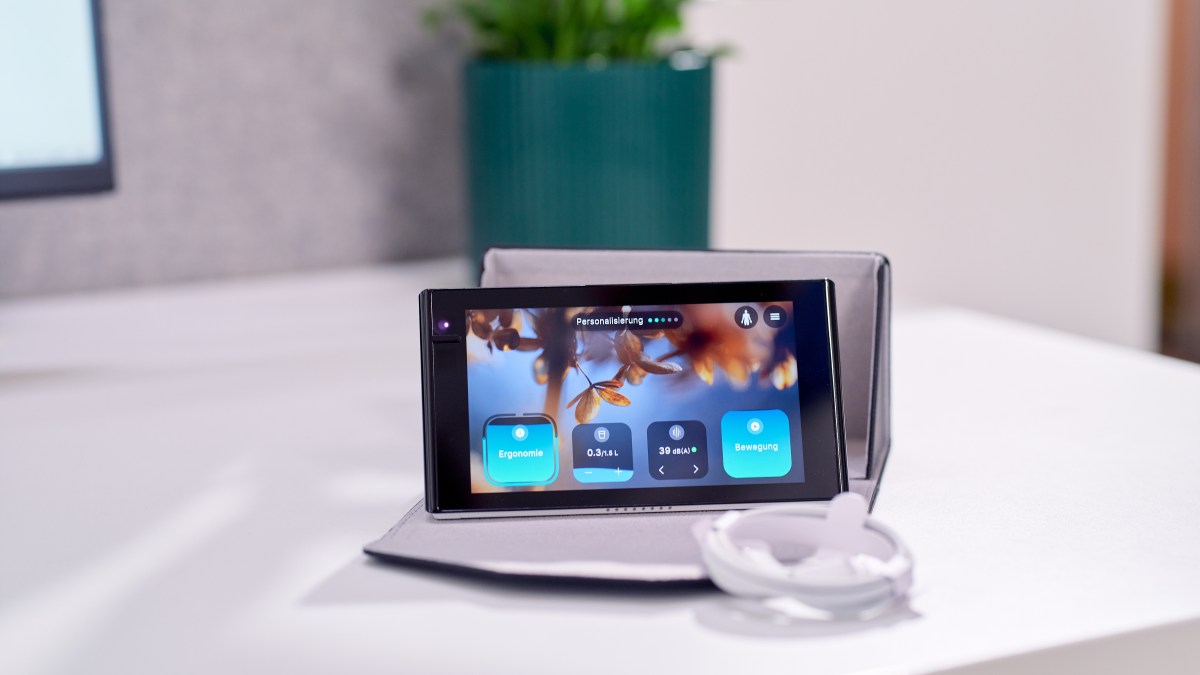
Here’s how it works and what’s inside. Isa has a 5.5-inch IPS HD screen and looks like a table clock. It is powered by USB-C; the company supplies a power unit with it, but you can use any of your existing chargers too, as it has a power consumption rating of roughly 2.45W.

The key sensor for the device is the Time-of-Flight (ToF) 3D depth sensor on the front — the same technology used in facial recognition and some smartphone cameras — that tracks posture and movement. It also enables beta features, such as counting the number of times you’ve had water or other liquids. The company said that the sensor works in the range of 0.15 meters to 1.8 meters. That means if the device is sitting on your desk, it can measure your movement, even when you stand up and move about. It also packs several other sensors: a ToF 1D sensor, a gyroscope, a barometer, a light sensor, a sound level sensor, a CO₂/VoC sensor, and a temperature and humidity sensor.

Image Credits: Deep CareImage Credits:Deepcare

Getting started is straightforward — the device asks for a few details about you and your work routine. I found it strange that there was no option to set the device to India time (or any other Asian time zone). The company said Isa currently supports only EU and US time zones. Fair enough for now — but broader time zone support, or even a simple world clock, feels like a basic expectation for a desk device.

On the screen, Isa displays your posture with a squircle (a rounded square) ring that fills or empties based on how well you’re sitting, while a water-tank-style widget tracks your drinking. If you are not sitting in the correct posture, the indicator will turn yellow. The Apple Watch-style ring is a surprisingly effective nudge — when I see yellow or red, I straighten up almost instinctively.

The device vibrates to alert you if you’ve been slouching for too long, and I’m okay with that kind of mild shaming. That alert also indicates if you are leaning far too forward or back and helps you correct your stance.

Image Credits: Ivan MehtaImage Credits:Ivan Mehta

A similar widget tracks movement, and if you have been stationary for a while, Isa suggests you get up, with on-device guided exercises to follow. When you return to your desk after a break, the movement tracker resets.

Deep Care chose not to include a cameras, which helps with privacy, but it comes with trade-offs.

Image Credits: Ivan MehtaImage Credits:Ivan Mehta

If a bottle or some other object sits between you and the sensor, it may read that as a person and log you as stationary. Pets or housemates passing by can trigger the sensor, too. Isa usually figures out that you’ve stepped away and goes to a digital clock display, but I would have liked a manual button to tell it I’m not at the desk so it stops tracking.

Because of the sensor-only approach, the device occasionally told me I’d been stationary for too long when I’d been sitting for under half an hour. These are minor inconveniences. On balance, the device made me check my posture more often than I used to, and the exercise suggestions are truly useful.

image Credit: Ivan MehtaImage Credits:Ivan Mehta

To process all these features, the device uses a quad-core 2 GHz processor. The device can connect to Wi-Fi for software updates, but you can turn it off at any time.

Deep Care was founded by three former Bosch employees and initially sold Isa directly to businesses. It recently expanded to consumers — a shift that signals confidence in the retail market for workplace wellness hardware, and a test of whether a subscription model layered onto premium hardware can find a mainstream audience.

Isa is priced at €299 ($354) with two subscription tiers. The core plan (€4.99 per month) gives you access to posture tracking, healthy sitting habit tracking, drinking habit detection, and its exercise library. The Pro plan(€7.99 per month) lets you track light, noise, and CO2 levels for a healthy working environment.

The company plans to use Isa’s sensor suite to venture into mental health-related tracking. It claims that by using signals like posture, head movement, and chest movement, the device can measure breathing patterns. Plus, paired with environmental data like noise, light levels, and CO2 level, the company wants to introduce a stress-related score.

Even if you skip the mental health features, Isa is a solid device for anyone serious about posture and movement. It isn’t cheap, and the subscription adds to the long-term cost. But if you or someone you know works from home and has been meaning to do something about their desk habits, it’s one of the more thoughtful options out there.

When you purchase through links in our articles, we may earn a small commission. This doesn’t affect our editorial independence.
Working from home isn’t going away, even if some CEOs wish it would


When I started working from home in the late 1980s as a freelance technical writer, I was clearly an outlier. Even contractors mostly went into the office in those days. Over time, though, that slowly changed, and the pandemic — along with generationally shifting views on work-life balance — accelerated worker sentiment away from going into a formal office every day, even if some CEOs wish it weren’t so.

Today, 14% of U.S. workers work at home full time (including me), and that number is expected to increase to 20% by next year, according to data published by USA Today. In total, 58% of white collar employees want flexibility in their work schedules to work at home a few days a week, per that same USA Today data. Yet, we are continually getting post-pandemic mixed messages about returning to the office.

Some companies like IBM and Amazon have been pushing hard to get people back to the office, with Amazon CEO Andy Jassy reportedly telling employees if they wanted to stay remote, it probably wouldn’t work out well for them. Wayfair, the Boston-based online furniture company, concentrated on remote workers over in-office folks in a layoff earlier this year, according to a WSJ report.

Big tech CEOs like Jassy and Elon Musk have been pushing back hard against remote work; Musk called it “morally wrong” for some people to work at home while service workers had to show up. Meanwhile Michael Bloomberg suggested remote workers weren’t actually working, but playing golf (which honestly sounds like projecting to me). Even Salesforce CEO Marc Benioff, whose company pushed the notion of a digital HQ during the pandemic, began preaching about a return to the office, blaming working from home for lack of productivity, especially among new employees.

That’s a lot of executive energy being directed against working from home and toward working in the office. Some have suggested that it’s because these companies have invested heavily in office buildings and need people to fill them. Maybe it’s just a need to have the employees in front of managers for control purposes, or they genuinely believe that workers are more productive in the office. Whatever the reason, they seem quite committed to getting back to the office.

Do they have a point? Will workers be more productive under the watchful eye of their managers sitting in cubicles instead of the comfort of their homes? Perhaps more importantly to results-driven CEOs, will their companies make more money? Research from the University of Pittsburgh Katz School of Business published earlier this year suggests not necessarily.

“Our findings are consistent with employees’ concerns that managers use RTO (return to office mandates) for power grabbing and blaming employees for poor performance. We provide evidence that RTO mandates hurt employee satisfaction but do not improve firm performance,” the report found.

Karen Mangia, president and chief strategy officer at the Engineered Innovation Group, who has studied and written extensively about remote work, says she was surprised to find that workers tended to value flexibility over place; it wasn’t so much where you needed to be, so much as your ability to control when you worked, to maintain a proper work-life balance.

“All of the research I’ve been looking at shows the same thing: that employees who have some degree of flexibility over where and when they work, are reporting higher levels of employee engagement. That is the group of people that is demonstrating to be more engaged and more productive,” she said.

What’s more, Mangia has found that those companies forcing employees to go back to the office are unsurprisingly having to deal with more employee burnout. “The argument so many times behind this return to office mandate is that employees will be more productive because we can collaborate in person and, and things get done. Well, being burnt out and sustaining a burnout level is the opposite of being more productive,” she said.

There are also good reasons to encourage hiring more remote employees, including access to a much broader and diverse employee base than you could get from one geographical location.

“I’ve had a big Midwestern consumer packaged goods company say ‘we’re finding all sorts of talent. Whereas before we insisted all employees must be local or must be in the city, now we’ve opened it up more broadly, and we got way better candidates. We don’t ever want to go back and we’re going to open that up permanently,’” said Dion Hinchcliffe, an analyst at Constellation Research, who has been watching this trend for a long time.

The next debate is how much, if any, time should employees be required to spend in the office and for what reasons. There are many tech companies that are leaving it up to their employees to decide where they want to work, and it seems to work quite well.

Gitlab is a prime example of a company that has been fully remote from the day it was founded a decade ago. Other tech companies with a flexible approach include Dropbox, Atlassian and Okta, none of which require a specific number of days in the office.

As for startups, anecdotally the vast majority of founders I speak to are remote first. Hinchcliffe says this is part of a shift to a decentralized workplace where startups in particular avoid the regular overhead of having an office. Instead they often rent space in the WeWork model to get together with customers, press and analysts, or each other, as needed.

Mangia says that the one worker demographic that does tend to struggle in all-virtual environments is new hires out of college, who benefit from being in an office. “When you have new-hire employees, especially early in their career, they do ramp up faster and report a better experience with a lower degree of burnout when they can come into a place where there are other people to help them,” she said, giving some credence to what Benioff was saying.

Even the most ardent work-from-home advocates understand there will be times when there is value in getting together for team building, to meet customers or to collaborate and brainstorm in person, but in spite of the cries from big CEOs, employees have tasted this flexibility, and it’s going to be hard to get the genie back in the bottle. For now, it continues to be a debate between labor and management about where and how work gets done.