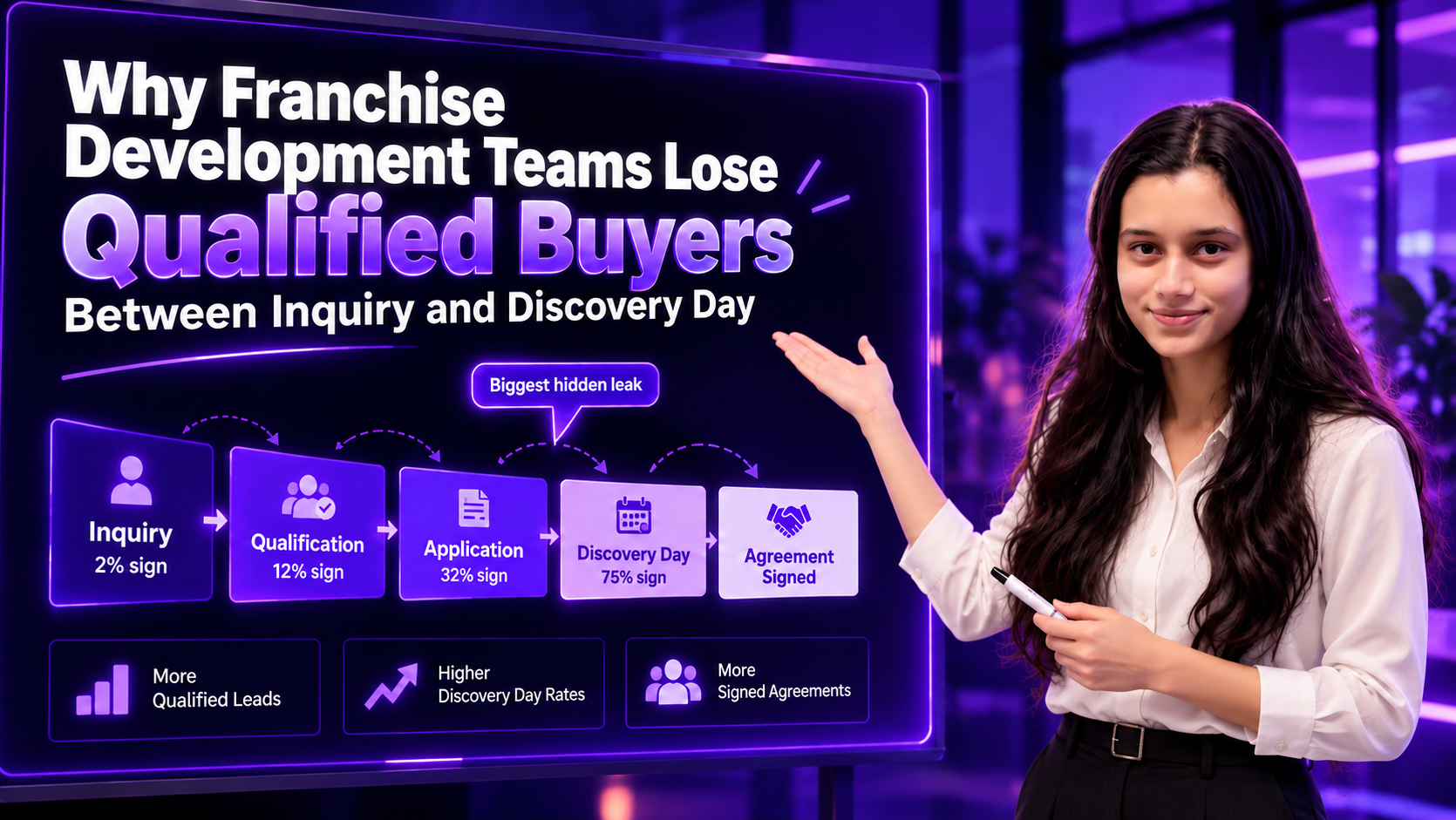
A prospective franchisee fills out your inquiry form on a Tuesday night. They have the liquid capital, they like the territory, and they ask smart questions about ownership. Two weeks later, they have stopped replying. They never reach Discovery Day.
Most franchise development teams file that candidate under “bad lead.” Often, that is the wrong diagnosis.
Here is why it matters. Franchise Update Media’s 2026 Annual Franchise Development Report (AFDR) found that 75% of Discovery Day attendees went on to sign in 2025, up from 65% the year before. When three out of four candidates who reach Discovery Day become franchisees, every qualified candidate you lose before that stage is close to a lost deal.
That is a franchise lead conversion problem, not a lead quality problem. So where exactly do franchisors lose qualified buyers between inquiry and Discovery Day, and how can they stop it?
The Hidden Conversion Gap in Franchise Development
Most franchise candidates move through five broad stages before they sign:
- Inquiry
- Qualification
- Application
- Discovery Day
- Agreement
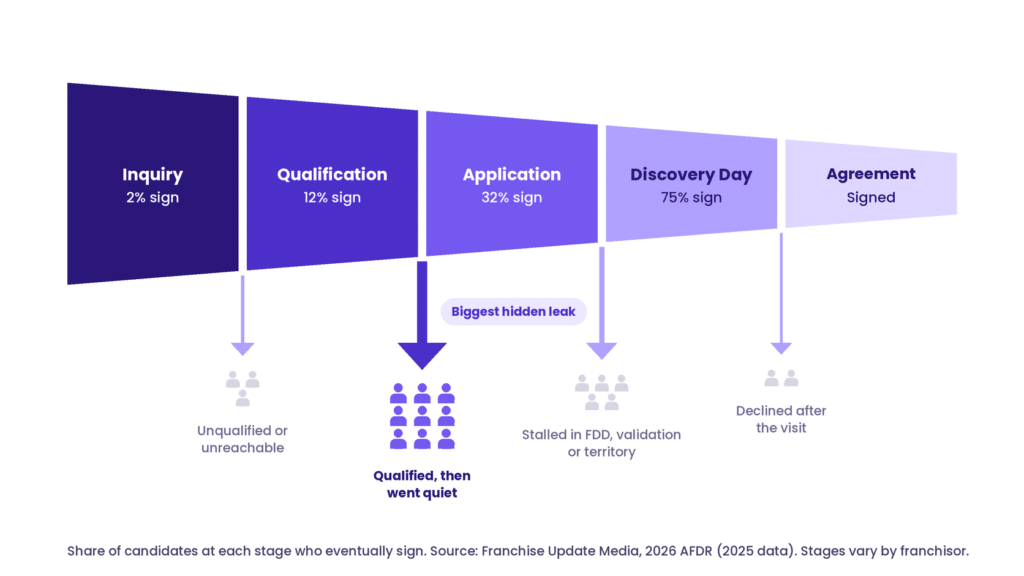
Close rates show the share of candidates at each stage who eventually sign. Source: 2026 AFDR (2025 data). Actual stages vary by franchisor.
The AFDR’s sales closing ratios show how sharply the odds change as a candidate moves deeper into the funnel:
- Leads to signed agreement: 2%, down slightly from 2.3% in 2024.
- Qualified leads to signed agreement: 12%, up from 10%.
- Applications to signed agreement: 32%, up from 28%.
- Discovery Day to signed agreement: 75%, up from 65%.
Read those numbers as a map of where value builds. A raw inquiry is worth little on its own. A candidate who reaches Discovery Day is most of the way to an agreement. The stretch between qualification and Discovery Day is where a candidate’s value rises fastest, and it is also where most development teams have the least visibility.
The road is long, too. The AFDR puts the average journey from first lead to signed agreement at 24 weeks. That is six months of follow-up, document review and decision-making in which a good candidate can quietly drift away.
Many teams still report one number to leadership: total inquiries. That number can look healthy while the pipeline leaks. Stage-by-stage measurement changes the question from “Do we need more leads?” to “Where do qualified candidates stall, and why?” Our guide on how AI is transforming franchise development covers the full funnel from inquiry to onboarding.
Franchise Lead Conversion Benchmarks: 2025 vs. 2024
Use this table as a starting point for your own funnel review. These are averages across franchisors surveyed for the AFDR, so your numbers will vary by industry, investment level and lead source.
| Stage or metric | 2025 | 2024 | What a problem looks like |
|---|---|---|---|
| Leads to signed agreement | 2% | 2.3% | Plenty of inquiries, few real conversations; first contact is slow or missing |
| Qualified leads to signed agreement | 12% | 10% | Candidates pass your criteria, then go quiet before applying |
| Applications to signed agreement | 32% | 28% | Applicants stall during FDD review, validation or territory talks |
| Discovery Day to signed agreement | 75% | 65% | Attendees decline after the visit because expectations were not set earlier |
| Cost per lead | $351 | $271 | Spend rises without a matching rise in qualified candidates |
| Cost per signed franchisee | $17,550 | $13,757 | Sales cost climbs faster than unit growth |
Source: Franchise Update Media, 2026 Annual Franchise Development Report (2025 data). The “What a problem looks like” column is our diagnostic guidance, not an AFDR finding.
Seven Reasons Qualified Franchise Buyers Drop Out
The first three failures show up in most sales pipelines. The last four are specific to franchising, and they sit right in the gap between qualification and Discovery Day.
1. Inquiries Arrive When Your Team Is Offline
Often the problem is not that your team is slow. It is that your team is asleep. Franchise Insights research on Franchise Ventures portal inquiries found that 60–70% of franchise lead inquiries arrive outside normal business hours. Its year-by-year analysis put the share at 67% in 2019 and 71% in 2020. The data is a few years old, but it is still the most detailed franchise-specific picture of when candidates reach out.
The same research found that only about half of prospects hear from every franchise they contacted within seven days, and about 20% routinely report no contact attempt at all. At $351 per lead, that adds up quickly. If one in five of your inquiries never gets a call, roughly $7,000 of every 100 leads you buy produces no conversation.
A candidate who submits a form on Friday night and hears nothing until Monday has spent the weekend reading about other brands. The fix is not asking representatives to work around the clock. It is making sure every inquiry gets a useful, approved acknowledgment and a clear next step the moment it arrives.
2. Follow-Ups That Don’t Answer Franchise Questions
A serious candidate wants specifics: total investment, territory availability, the owner’s day-to-day role, financing options and time to opening. Generic drip emails that repeat the brand story leave those questions unanswered. Effective franchise lead nurturing responds to what the candidate actually asked, within what your FDD allows you to say.
3. Inconsistent Qualification and Lost Handoffs
When each representative uses different criteria, similar candidates get very different treatment. The problem compounds at handoff. Marketing captures the inquiry, sales picks it up days later without context, and the candidate repeats answers they already gave. Broker-sourced candidates add another layer, since they often arrive with their own expectations about timelines and next steps. Shared qualification criteria and a required handoff note fix most of this.
4. The 14-Day FDD Pause Reads as Silence
Under the FTC’s Franchise Rule, franchisors must give candidates the Franchise Disclosure Document at least 14 calendar days before they sign or pay anything. That waiting period protects buyers, but many teams treat it as dead time. From the candidate’s side, two quiet weeks after receiving a long legal document can feel like the franchisor has lost interest.
Use the window instead. Schedule an FDD walkthrough call, share a clear timeline of what happens next, and encourage candidates to review the document with their own attorney and accountant.
5. Validation Calls Go Unsupported
Validation is when candidates call existing franchisees, usually from the list in Item 20 of the FDD, to hear what ownership is really like. It sits right between qualification and Discovery Day, and a single conversation can end a deal.
Franchisors cannot and should not script what franchisees say. They can keep the Item 20 contact list current, suggest useful questions to ask, track how many calls each candidate has completed, and follow up afterward to ask what they heard. A candidate who hears a concern and gets no follow-up often fills the silence with the worst interpretation. Keep franchise counsel involved in how you support validation, especially anything that touches earnings.
6. Territory Conflicts Surface After Emotional Commitment
Few things end a deal faster than a candidate falling for the brand, then learning their preferred territory is taken or restricted. When territory checks happen late, often after the candidate has told family and lined up financing, the disappointment usually ends the conversation. Confirm territory availability during qualification, before anyone is invited to Discovery Day.
7. Discovery Day Logistics Filter on Travel, Not Fit
Discovery Day often means flying to headquarters and taking time off work. For a candidate with a full-time job and a family, that is a real cost. When dates are hard to pin down and travel details arrive late, you end up filtering candidates by availability rather than fit. A clear agenda, early date options and, where it suits your brand, a virtual pre-Discovery Day session make the final step easier to take.
How to Measure the Cost of Lost Franchise Leads
You cannot fix what you do not measure, and many franchisors do not measure the basics. The AFDR found that 58% of franchisors tracked cost per lead in 2025, while fewer than half (49%) tracked cost per sale.
That gap matters because costs are climbing fast. The average cost per lead rose to $351 from $271 in 2024, and the cost to secure each new franchisee jumped to $17,550 from $13,757. Every qualified candidate who disappears before Discovery Day takes a share of that spend with them.
Start with four numbers:
- Inquiry-to-qualified-candidate rate: the share of inquiries that meet your qualification criteria.
- Qualified-candidate-to-Discovery-Day rate: the share of qualified buyers who actually attend.
- First-response time, split by business hours and after hours: how long candidates wait, and whether nights and weekends are worse.
- Cost per qualified candidate and cost per sale: what each step of progress really costs you.
The second number is where hidden losses usually sit. Here is a simple illustration.
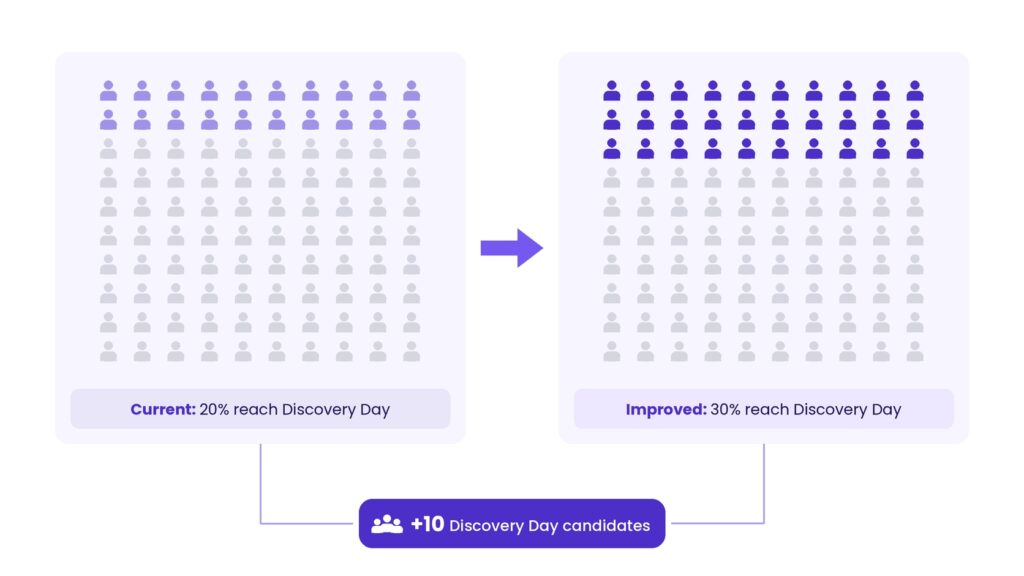
Imagine your team has 100 qualified candidates this quarter. At a 20% progression rate, 20 reach Discovery Day. If better follow-up lifts that rate to 30%, 30 reach Discovery Day. That is 10 additional serious candidates from the same lead volume.
Hypothetical example, not an industry benchmark or projected Weam result.
At the AFDR’s 75% Discovery Day close rate, those 10 extra attendees could mean seven or eight more signed agreements. That is an industry average, not a promise. Fit, financing and timing still decide each deal. But you cannot sign candidates who never get that far.
Where AI Can Improve Franchise Lead Conversion
AI will not replace franchise development representatives. Relationships and judgment still close deals. What AI can do is remove the operational gaps that let qualified buyers slip away.
The industry is already experimenting. The AFDR found that 52% of brands use AI tools in franchise development. Yet 68% say it is too soon to tell whether AI is driving more deals.
Look at where that AI goes. Email personalization (59%), chatbots (44%) and market analysis (44%) lead the list, while candidate screening sits at just 9%. In other words, the industry has put AI at the top of the funnel and almost nowhere in the qualification gap, which is exactly where qualified buyers are lost.
After-Hours First Response and Routing
If most inquiries arrive outside business hours, this is the highest-value place to start. An AI-assisted workflow can acknowledge every inquiry within minutes, answer common questions from approved content, flag high-fit candidates and book the first call with a representative. We outline a similar lead-routing workflow in 10 AI workflows that stop revenue leaks for multi-location businesses.
Relevant, Approved Candidate Communication
When AI drafts from approved messaging and the candidate’s own questions, follow-ups become specific rather than generic. A buyer who asked about territory gets a territory answer, and every message stays within guidelines your legal team has already signed off.
Visibility Into Stalled Candidates
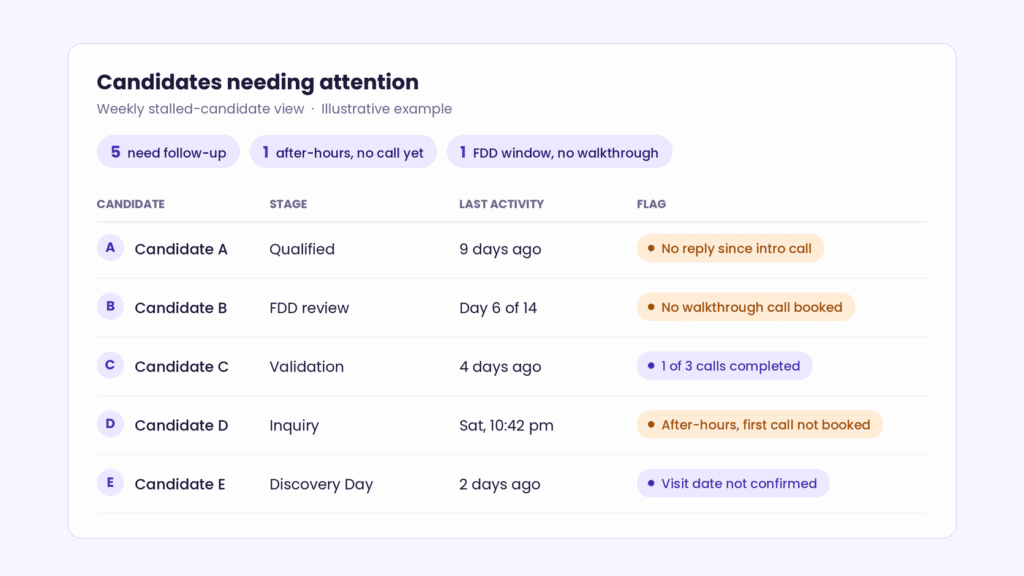
Illustrative example of a stalled-candidate view.
AI can surface candidates who have gone quiet, follow-ups that were missed, FDD windows with no walkthrough scheduled, and candidates who have not finished validation calls. That gives development leaders a weekly view of where the pipeline is leaking, instead of discovering it at quarter end.
Human Oversight for High-Stakes Decisions
Financial suitability, disclosure timing, earnings conversations and final candidate approval must stay with people. AI should support the 14-day FDD process, never shortcut it. Before any AI touches candidate communication, decide what it can and cannot say. Our guide to AI governance for franchisors shows how to set those guardrails without slowing your teams down.
This is where governed AI workflows matter. Weam works with franchise and multi-unit teams as an AI implementation partner, designing workflows with clear approval rules so automation handles the routine work while people keep control of the decisions that carry risk.
A Practical 30-Day Plan to Reduce Franchise Lead Drop-Off
You do not need a new platform to start. This plan works with the tools you already have.
- Week 1: Audit your funnel. Pull the last two quarters of candidates, count how many reached each stage, and compare your rates with the benchmark table above. Check how many inquiries arrived after hours and how long they waited.
- Week 2: Standardize qualification and response rules. Agree on shared qualification criteria, confirm territory availability during qualification, and set first-response targets for both business hours and after hours.
- Week 3: Fix the in-between stages. Build approved answers to the questions candidates ask most, add a walkthrough call to every FDD delivery, and set up a simple validation tracker with a follow-up call after each round.
- Week 4: Measure and listen. Compare stage conversion with your Week 1 baseline. Ask a few recent candidates, including those who dropped out, what slowed them down.
Repeat the cycle monthly. Small, consistent fixes compound faster than a single large overhaul. For a broader view of which workflows are ready for AI, see why franchise systems are structurally ahead on AI adoption.
Frequently Asked Questions
What is franchise lead conversion?
Franchise lead conversion is the rate at which franchise inquiries move to the next stage of the sales process, from inquiry to qualified candidate, application, Discovery Day and finally a signed agreement.
What’s a good franchise lead-to-Discovery-Day conversion rate?
The AFDR does not report this rate directly, but its close ratios allow a rough estimate. If 2% of all leads sign and 75% of Discovery Day attendees sign, roughly 2 to 3 of every 100 leads reach Discovery Day at the industry average. For qualified leads, the same math suggests about 1 in 6 reaches Discovery Day. Treat these as starting points and benchmark against your own history.
How fast should franchisors respond to franchise inquiries?
As fast as possible, including after hours. With 60–70% of inquiries arriving outside business hours, a next-business-day reply means most candidates wait overnight or over a weekend. A practical standard is an immediate, useful acknowledgment for every inquiry, followed by a personal call within the next business day. Measure business-hours and after-hours response times separately.
Why do qualified franchise candidates drop out before Discovery Day?
The most common causes are slow after-hours responses, generic follow-ups, inconsistent qualification, silence during the 14-day FDD window, unsupported validation calls, late territory conflicts and difficult Discovery Day logistics.
What is a franchise validation call?
A validation call is a conversation between a prospective franchisee and an existing franchisee, usually found through the contact list in Item 20 of the FDD. Candidates use these calls to check what ownership is really like before committing.
How can franchisors improve lead conversion without hiring more sales representatives?
Standardize qualification, set response-time targets for after-hours inquiries, prepare approved answers to common questions, and use governed AI workflows for routing, reminders and drafting. Representatives then spend their time on real conversations instead of admin.
Fix the Conversion Gap Before Increasing Lead Generation
More inquiries will not fix a leaky process. At $351 per lead, they only make the leak more expensive. FranConnect’s 2025 Franchise Sales Index found that referrals from existing franchisees convert at 21 times the rate of internet leads, a reminder that the strongest pipeline often starts with the people already in your system.
Strong franchise lead conversion comes from fast after-hours responses, consistent qualification, a well-used FDD window, supported validation, early territory checks and a clear path to Discovery Day. Start with the 30-day plan above. If you want to see where governed AI workflows could help your development team, book a demo call with Weam.