How AI Is Helping Small Businesses In This Digital Landscape?


How AI is Helping Small Businesses in this Digital Landscape?

In this ever-growing digital landscape, being competitive is quite a challenging task for even multinational brands. Many well-recognized organizations are still trying to flag their brand name on top of the list and struggling to maintain their market position. If this is the case, just imagine how a startup entrepreneur or a small business can compete in this competitive era.

Implementation of automation technologies and deployment of intelligent tools might help small businesses streamline operations and stay ahead in this digital world. Technologies like AI would help companies better organize their workflows, better utilize resources, and deliver best-in-class services to targeted audiences in a smart way.

Artificial Intelligence (AI), it’s not a new term to the technology industry. AI’s benefits are incredible for small businesses. Intelligent automation capabilities of AI and its sub-technologies, such as Machine Learning (ML), Natural Language Processing (NLP), and Predictive Analytics, will help small to mid-level companies enhance business efficiency, improve decision-making, personalize customer interactions, and encourage brand awareness in their niche.

In this article, we have compiled a list of the top benefits of AI for small businesses. If you are a small business and looking ahead to explore your brand name and acquired customer loyalty, these are the best ways to implement and benefit. Take a deep delve into the AI benefits for small businesses.

 How AI Can Be Useful For Small Businesses? 

Here are the top 5 ways small businesses can use AI and drive compelling growth.

  1. Automate back-office administrative tasks

Integration of AI into applications, systems, and devices will help companies automate their repetitive functions. This would help businesses streamline their operations and automate time-consuming tasks, they’re improving productivity, business efficiency, and reduced operational costs.

  1. Evolution of AI tools and applications

The evolution of AI innovations like ChatGPT, Jasper, recruitment automation tools, and many more will help small businesses as guides for creating business plans, getting knowledge on marketing and sales campaigns, and deriving ideas to better manage work processes, and drafting emails, creating web site content. Moreover, AI-powered recruitment and hiring applications are assisting the recruitment team in sourcing, shortlisting, and hiring candidates faster, thereby saving 30% of hiring costs.

  1. Automating Customer Service

It is one of the best ways where AI can be helpful for small businesses. Through AI-powered chatbot applications businesses can virtually resolve routine customer issues and provide them useful information that they are looking for. Such intelligent automation tools help companies keep their brand available 24*7 and improve customer loyalty.

On the other side, voice and speech recognition technologies are the other two crazy categories of AI. Top mobile app development companies are integrating AI-based voice recognition systems in AI apps to improve application accessibility and conversation efficiency.

  1. Analyzing Customer Preferences

Leveraging the power of Predictive analytics and machine learning, AI apps play a significant role in analyzing customer preferences, interests, and their purchasing history to derive insights into sales opportunities. Businesses can monitor customer purchase behavior and deliver personalized recommendations about services and products. It will assist companies in enhancing customer engagement and optimizing sales conversions.

  1. Predictive Analytics to Forecast Sales Trends

Predictive analytics belongs to the AI field and plays a key role in analyzing vast databases and forecasting valuable insights into market trends, sales opportunities, pricing strategies, business progress, and many more. Hence, using AI and predictive analytics, small businesses can improve the accuracy of sales forecasting and increase and stay on top of growth opportunities in this digital age.

  1. Enhanced Security Levels

AI-powered fraud detection algorithms can be helpful for businesses in detecting unethical accesses and protecting information systems and networks. For instance, AI can be useful and plays an important in banking and finance for monitoring transactions and preventing cyber threats.

  1. Supply Chain Management Efficiency

AI is a truly amazing technology for streamlining supply chain operations. AI applications can monitor inventories and give updates to warehouse management, thereby preventing overstocking and helping businesses keep required quantities to balance the market demand. Moreover, AI, coupled with the Internet of Things (IoT) would help companies track and monitor their supply chain operations, starting from production and warehouse shifting to logistics and distribution. Hence, AI will reduce operational costs and streamline workflows.

These are a few benefits of AI adoption for small businesses. Potential growth would be associated with AI app development for your business. This transformative technology would maximize your business benefits.

Are you looking to hire AI mobile app development company?

Let’s hire USM! Being a top AI consulting and development company, our AI developers will help you build flawless and user-friendly AI-powered mobile apps at attractive budget.


Let’s discuss your project and get a free quote for app development.

 

RB Design Brings Interiors to Life With AutoCAD | AutoCAD Blog


Based in Port Carling, Ontario, Canada with clients primarily in Muskoka and Toronto, RB Design has grown from a small interior design firm with a brick-and-mortar store to one now taking on major renovations and a recently expanded retail location. With AutoCAD, the team can design and deliver any number of projects—whether it’s renovating kitchens and bathrooms from top to bottom, a complete remodel of a lakeside cabin, or transforming a garage into a unique living space.

Sparking creativity—and accuracy—with AutoCAD

Once RB Design owner Amanda McLennan meets with clients to begin forming the design and style, she brings in designers and drafters Nicole Wilson and Marina Keola Ramalho Rodrigues to discuss the layouts and begin translating everything into AutoCAD with exact measurements.

“We may do a little hand sketching at first because there is just that connection I have personally and creatively with hand to paper,” McLennan says. “AutoCAD brings the professionalism and consistency. There is far less room for error. We can have the precision required to capture the details that can’t be sketched by hand.”

When the initial design is done, the team begins sharing it with the client for feedback. “Clients can change their minds so quickly,” Rodrigues says. “When you’re able to update those changes in AutoCAD right away, it makes everything easier and the company more successful.”

Taking on an entire lakeside cabin renovation

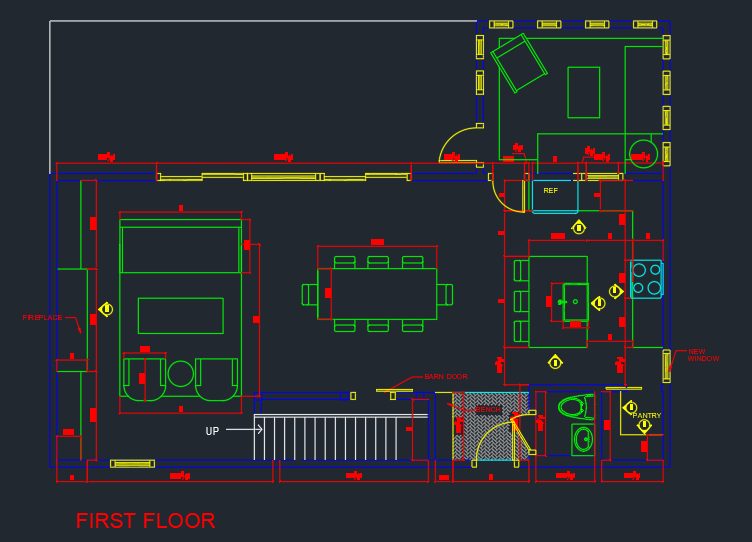
Recently, RB Design completed the renovation of an 1,800 square-foot lakeside cabin in Muskoka, transforming the home from three bedrooms to four bedrooms with an en suite bathroom. They removed wasted space from a laundry room and created an open space with the living room, dining room, and kitchen all flowing together. A new balcony delivers stunning views of the lake.

With AutoCAD, the team created custom touches throughout the design—from cabinet millwork to vanities, the pantry, and a small mudroom. To accommodate the client’s desire for additional sleeping arrangements, they designed custom bunk beds as well.

“As RB Design has grown, we could scale our use of AutoCAD right along with us. We’re now using it more for design-build and not just basic layouts with furniture plans. It’s great because AutoCAD has allowed us to grow into new, more complex projects.”

Amanda McLennan, Owner, RB Design

Learn More

Read more about RB Design and their approach to interior design with the help of AutoCAD.

How I Get Pull Ups & Diapers For Free


Diapers (nappies) can get really expensive for parents, especially for low income families and if you have more than one child in them at a time ! Let me share with you How I Get Pull Ups & Diapers For Free!

If you’ve read my other posts, you know that I am a huge Fred Meyer fan. Not only do I save money on my groceries and gas, get laser targeted coupons just for me on the products that I purchase, but I also receive a coupon in the mail good off any purchase!

This coupon is usually about $15 for me, and with it, I simply purchased my son’s pull ups.

rebaterebate

The stock of pull ups always lasts until I get my next coupon in the mail from them. It’s a great trick for me and I never have to budget them in. By the time my son was 5 and bedwetting stopped (find out how I achieved this in ONE day!), he didn’t go through as many. I also like get the Fred Meyer brand as I’ve found they are good quality and cheap, my favorite combination! 🙂

TikTok May Be Breaking App Store Rules by Avoiding Commissions on Tips


TikTok appears to be quietly showing some users an option to purchase “coins” on the web instead of through in-app purchases, circumventing the commission that Apple receives on digital purchases.

tiktok logo
As noted by David Tesler (via TechCrunch) TikTok has been offering a limited number of TikTok app users an option to purchase coins on TikTok.com instead of in the app. “Try recharging on tiktok.com to avoid in-app service fees,” reads the text. “You can save the service fee and get access to popular payment methods.”

Following through and opting to purchase from TikTok.com brings up an interface for using payment options such as PayPal or a credit/debit card. “Save around 25% with a lower third-party service fee,” the app suggests. The purchase workflow can be completed entirely in the TikTok app with no requirement to use in-app purchase.

TikTok’s coins are used as a way for users to provide “Gifts” to creators. Users pay real money for a certain number of coins, and those coins are used for little gift emoji that can be provided to creators. TikTok says that gifts are used to determine the number of “diamonds” awarded to content creators, and diamonds can be redeemed for money. A TikTok coin is worth about half a diamond, and 100 diamonds is worth 50 cents, so TikTok is collecting quite a bit of money during the conversion.

Apple requires in-app purchase to be used for digital goods and services, and TikTok’s “coins” presumably count as a digital good. If TikTok is indeed offering customers a way to purchase coins without in-app purchase as suggested by the screenshots from Tesler, then TikTok is breaking Apple’s App Store rules.

TikTok coins would likely be considered tips, and Apple has forced other major social networks like Facebook to use in-app purchase for a creator tipping feature. What TikTok is doing is actually similar to the direct purchase options that Epic Games added to the Fortnite app back in 2020, a move that ultimately led to the banning of the Fortnite app and a multi-year legal battle.

Most TikTok users are only able to purchase coins through the in-app purchase interface, and the option to purchase direct from TikTok with a credit or debit card is allegedly a feature showing up only for a small number of users. The option is perhaps being limited to those who have spent a lot of money on coins in the past.


Change attribute order of block in many CAD drawings


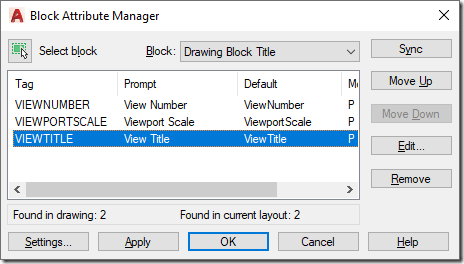
To change attribute tag order in one drawing use BATTORDER (AutoCAD) or BATTMAN (AutoCAD and BricsCAD). With it you can update the block definition of the block.

battman


Then wblock out the block to a separate DWG file. In the example below it us C:\temp\TITLEBLOCK.dwg

In below example the block is named TITLEBLOCK so you will need to modify the name and path (separate folders with double backslashes). Save the AutoLISP code to an LSP file.

; redefine block with or without attributes from an external DWG block

(setq blockname ” TITLEBLOCK”)

(setq fullpath “C:\\temp\\TITLEBLOCK.dwg”)

(if (tblsearch “block” blockname)

  (progn

    (command “_.-insert” (strcat blockname “=” fullpath) “_Y”)

    (command)

    (command “_.attsync” “_N” blockname)

  )

)

Then you can use JTB SmartBatch to update all drawings with this LSP. Specify the use of the LSP in JTB SmartBatch Settings > Script/lisp file. Now add all drawings to be updated and you’ll have all title blocks or other blocks of your choice updated.


Why You Don’t Have To Choose


Editor’s note: When you implement a big data solution, choosing the right storage is the first order of business. Read on to learn about the big data solution options and don’t hesitate to explore our approach delivering to big data services, if you need to back up your big data project.

When ScienceSoft’s clients need to design their big data solution, we offer them to structure it with two storage elements: a data lake and a big data warehouse, which we distinguish from a traditional enterprise data warehouse. Here, looking ahead, we should say that a big data warehouse, unlike a data lake, is an obligatory element of a full-scale big data analytical solution. But, first things first, let us show you how data lakes and big data warehouses are different from each other in terms of architecture and their functional purpose.

big data warehouse vs data lake

The differences between a data lake and a data warehouse

Data state

ScienceSoft’s big data experts employ data lakes for storing all kinds of data – structured, unstructured and semi-structured. As for a big data warehouse, we use it as a storage for structured data.

The approach to storing data

A big data warehouse stores data according to the schema-on-write approach: before loading into the big data warehouse, data needs to be transformed into a unified structure to be fit for the big data warehouse.

A data lake stores data according to the schema-on-read approach: raw data is loaded into the data lake as it is and applied to the schema only when it is read. Thus, storing data in a data lake requires less effort.

Architecture

When speaking of a data lake, its flexible architecture may involve three elements:

  • A landing zone – a transient area, where data undergoes preliminary filtering.
  • A staging zone – a storage repository.
  • An analytics sandbox – the area where data analysts perform experiments for exploratory data analytics.

When developing a data lake solution, our experts consider the staging zone the only obligatory element. If you want to learn more about the data lake zones and why we consider the landing zone and the analytical sandbox optional, study this article, here our data analytics researcher, Irene Mikhailouskaya, dwells on the data lake architecture.

As concerns the big data warehouse, it has a rigid architecture. Its elements are highly structured and obligatory as they are tied to business processes for the big data warehouse to correctly analyze and report data.

Storage costs

Drawing on our experience in rendering big data services, we have to admit that storing data in a big data warehouse is costly as you cannot load data unless it is of the required structure. And such a preparatory process is rather time- and resource-consuming. Thereby, we usually recommend our clients to consider integrating a data lake into the big data warehouse architecture as a cost-effective alternative: storing data in the data lake involves minimum or no data structuring before being loaded.

Users

Big data warehouses cater to the needs of business users and data analysts who use big data strategically to improve the decision-making process. Data lakes are mainly used as temporary storage of big data and the zone for data scientists and analysts to drive experiments.

Technologies

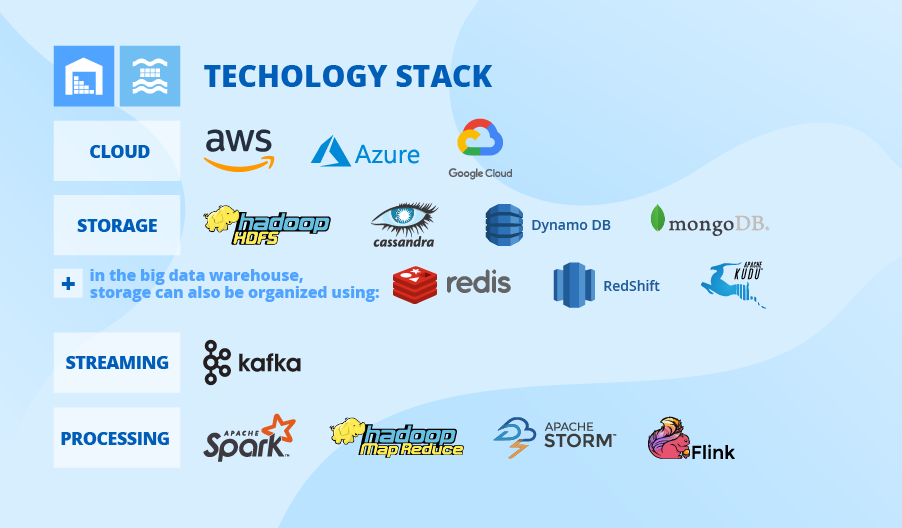
As both the big data warehouse and the data lake deal with big data, there is no difference in the technology stack to employ for storing, streaming and processing data:

big data technologies
Security

The use of big data is associated with certain security challenges. When developing big data solutions, ScienceSoft’s experts pay special attention to the high granularity of access control, when users’ access is limited depending on their roles. This measure prevents sensitive data leakage.

As opposed to big data warehouses, data lakes lack security focus due to the nature of stored data and its functional purpose. As only a limited number of users are granted the access, a data lake is protected as a whole, following the “all-or-nothing” approach.

Don’t know how your big data solution should look?

ScienceSoft’s team is ready to advise you on how to leverage big data potential with a tailor-made solution.

The synergy of the data lake and the big data warehouse

Many big data project sponsors we talk to wonder if they can use a data lake or a big data warehouse alone in a data analytics solution. Our answer is it’s not an either-or choice: a data lake alone is never enough to design a full-scale big data analytics solution. We often recommend having the synergy of both. This is the case of businesses who need to both store large amounts of raw data to conduct experiments, and deliver intelligence to decision-makers. One of the telling examples when both elements function in sync within the one big data solution is an IoT solution, where the initial sensor data is stored in its raw format in the data lake, and then it undergoes the ETL\ELT process to be stored in the big data warehouse for further analysis. Such an alliance allows leveraging big data potential time- and cost-effectively.

How to start your big data journey?

Now, that you know your options, you need to decide whether your big data solution’s architecture will involve a big data warehouse and a data lake, or just a big data warehouse. To choose which way to go, you need to define:

  • For what purposes your data will be used.
  • What your requirements to data quality, speed of the data flow and the need for analytical experiments are.
  • Who will use the data.

There are many factors to take into account and balance when deciding on the high-level big data architecture. We saw how long-drawn-out architectural decisions delayed actual big data implementation for years. And, unfortunately, we’ve witnessed how a wrong decision may result in massive rework later. ScienceSoft’s big data team would be happy to help with consulting or architecture design.


Big data is another step to your business success. We will help you to adopt an advanced approach to big data to unleash its full potential.

SEA.AI Navigates the Future With AI at the Helm


Talk about commitment. When startup SEA.AI, an NVIDIA Metropolis partner, set out to create a system that would use AI to scan the seas to enhance maritime safety, entrepreneur Raphael Biancale wasn’t afraid to take the plunge. He donned a lifejacket and jumped into the ocean.

It’s a move that demonstrates Biancale’s commitment and pioneering approach. The startup, founded in 2018 and based in Linz, Austria, with subsidiaries in France, Portugal and the US, had to build its first-of-its-kind training data from scratch in order to train an AI to help oceangoers of all kinds scan the seas.

And to do that, the company needed photos of what a person in the water looked like. That’s when Biancale, now the company’s head of research, walked the plank.

The company has come a long way since then, with a full product line powered by NVIDIA AI technology that lets commercial and recreational sailors detect objects on the seas, whether potential hazards or people needing rescue.

It’s an effort inspired by Biancale’s experience on a night sail. The lack of visibility and situational awareness illuminated the pressing need for advanced safety technologies in the maritime world that AI is bringing to the automotive industry.

AI, of course, is finding its way into all things aquatic. Startup Saildrone’s autonomous sailing vessels can help conduct data-gathering for science, fisheries, weather forecasting, ocean mapping and maritime security. Other researchers are using AI to interpret whale songs and even protect beachgoers from dangerous rip currents.

SEA.AI, however, promises to make the seas safer for everyone who steps aboard a boat. First introduced for ocean racing sailboats, SEA.AI’s system has quickly evolved into an AI-powered situational awareness system that can be deployed on everything from recreational sail and powerboats to commercial shipping vessels.

SEA.AI directly addresses one of the most significant risks for all these vessels: collisions. Thanks to SEA.AI, commercial and recreational oceangoers worldwide can travel with more confidence.

How SEA.AI Works

At the heart of SEA.AI’s approach is a proprietary database of over 9 million annotated marine objects which is growing constantly.

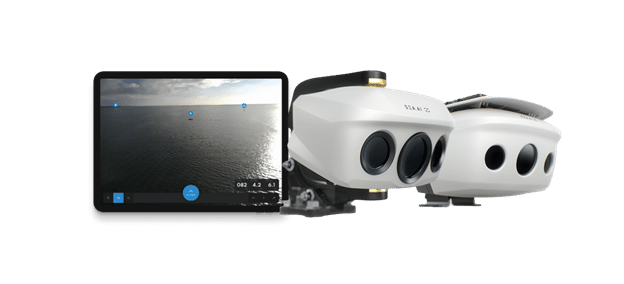
When combined with high-tech optical sensors and the latest AI technology from NVIDIA, SEA.AI’s systems can recognize and classify objects in real-time, significantly improving maritime safety.

SEA.AI technology can detect a person in water up to 700 meters — almost half a mile — away, a dinghy up to 3,000 meters, and motorboats up to 7,500 meters.

This capability ensures maritime operators can identify hazards before they pose a threat. It complements older marine safety systems that rely on radar and satellite signals.

SEA.AI solutions integrate with central marine display units from industry-leading manufacturers like Raymarine, B&G, Garmin and Furuno as well as Android and iOS-based mobile devices. This provides broad applicability across the maritime sector, from recreational vessels to commercial and government ships.

The NVIDIA Jetson edge AI platform is integral to SEA.AI’s success. The platform for robotics and embedded computing applications enables SEA.AI products to achieve unparalleled processing power and efficiency, setting a new standard in maritime safety by quickly detecting, analyzing and alerting operators to objects.

AI Integration and Real-Time Object Detection

SEA.AI uses NVIDIA’s AI and machine vision technology to offer real-time object detection and classification, providing maritime operators with immediate identification of potential hazards.

SEA.AI is bringing its approach to oceangoers of all kinds with three product lines.

One, SEA.AI Sentry, provides 360-degree situational awareness for commercial vessels and motor yachts with features like collision avoidance, object tracking and perimeter surveillance.

Another, SEA.AI Offshore,  provides bluewater sailors with high-tech safety and convenience with simplified installation across several editions that can suit different detection and technical needs.

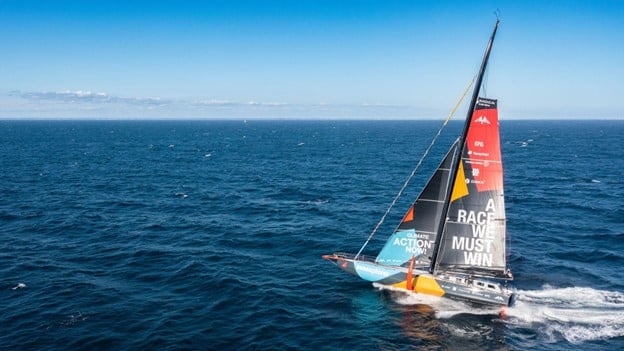
The third, SEA.AI Competition, offers reliable object detection for ocean racing and performance yacht sailors. Its ultra-lightweight design ensures maximum performance when navigating at high speeds.

With a growing team of more than 60 and a distribution network spanning over 40 countries, SEA.AI is charting a course to help ensure every journey on the waves is safer.

Absen Direct View LED Video Walls for Worship: Illuminating the Future


Explore the transformative potential of Direct View LED technology in enhancing the illumination of sacred spaces while preserving their cultural and spiritual significance. Discover how modern innovation harmonizes seamlessly with timeless aesthetics, enriching the sacred ambiance and deepening the connection to these revered environments.

Understanding Sacred Spaces:
Sacred spaces hold profound cultural and spiritual importance, transcending their physical structures to become pillars of community identity and unity. Direct View LED technology offers unparalleled clarity and brilliance, respecting the sanctity of these environments while providing customizable lighting solutions tailored to their unique needs.

Harmonizing Tradition and Technology:
Integrating advanced lighting technology into sacred spaces requires a delicate balance between honoring tradition and embracing innovation. Explore how subtle lighting enhancements can add depth to spiritual experiences, fostering a harmonious blend of tradition and modernity.

Collaborative Solutions for Respectful Integration:
Collaboration between religious leaders, cultural experts, and technical specialists ensures that lighting solutions seamlessly integrate into the physical and spiritual fabric of sacred spaces, respecting their sanctity while enhancing their visual allure.

The Future of Lighting in Sacred Spaces:
Looking ahead, advancements in LED technology will continue to expand the role of technology in sacred spaces, offering new possibilities for respectful and transformative lighting solutions. Our commitment to treating these spaces with reverence remains steadfast, preserving them as symbols of cultural heritage and spiritual sanctity.

Read the full article from Commercial Integrator HERE

visual studio – What Data.SqlClient can be used with .net 8


I am trying to create a new project using VS 2022 community – c# class library.
The project is using Microsoft.Data.SqlClient. NuGet recommended to get version 5.8.2.
This did not work when using the DLL of the class library from a Console application c# targeting .net6. I was receiving an error

Microsoft.Data.SqlClient is not supported on this platform  

I then tried to lower the versions of Microsoft.Data.SqlClient to 4.0.5 and when calling this class from a Console application I receive

ystem.IO.FileNotFoundException
  HResult=0x80070002
  Message=Could not load file or assembly 'System.Runtime, Version=8.0.0.0, Culture=neutral, PublicKeyToken=b03f5f7f11d50a3a'. The system cannot find the file specified.

Can anyone suggest what combination of Tragert Frameword and Microsoft.DataSqlClient can work?
Thanks