ChatGPT could get more expensive to use in coming years.
The New York Times, citing internal OpenAI docs, reports that OpenAI is planning to raise the price of individual ChatGPT subscriptions from $20 per month to $22 per month by the end of the year. A steeper increase will come over the next five years; by 2029, OpenAI expects it’ll charge $44 per month for ChatGPT Plus.
The aggressive moves reflect pressure on OpenAI from investors to narrow its losses. While the company’s monthly revenue reached $300 million in August, according to the New York Times, OpenAI expects to lose roughly $5 billion this year. Expenditures like staffing, office rent, and AI training infrastructure are to blame. ChatGPT alone was at one point reportedly costing OpenAI $700,000 per day.
OpenAI could face a blowback if it increases prices too quickly. While ChatGPT has roughly 10 million paying users today, surveys suggest that many believe the current $20-per-month price is too high.
We’re falling into fall, and in the tech world, that means we’ve seen lots of new product launches, announcements, and best of all, deals. Case in point: right now, the M2 Apple MacBook Air is on sale for just $799 at Amazon. That’s 20% off and the lowest price we’ve seen for this laptop since Best Buy offered it for the same rate back in July.
With new Apple products recently launched and the holiday season on the horizon, it’s no surprise we’re seeing such competitive sales, but this one deserves particular mention. Plus, this deal is already hot, even several days ahead of October Prime Day.
2022’s version of the lightweight powerhouse is still a solid machine two years later, with competitive specs that go up against much newer laptops on the market right now. In fact, this laptop was ZDNET’s product of the year when it was released in 2022, punching well above its weight in terms of performance and quickly becoming a favorite for professionals looking for power and portability.
The 13.6-inch M2 MacBook Air has an 8- and 10-core GPU and an impressive 18 hours of battery life. The 8GB or 16GB of RAM can also be paired with up to 1TB of storage, to future-proof the machine.
Apple’s MacBook Air series are also perhaps one of the most popular ultraportable laptop families among consumers (and our pick for best overall ultraportable), having set an entirely new bar for performance with the introduction of Apple’s Silicon chips in 2020, and only improving since then. If you’re looking for a secondary laptop you can take with you for travel or on the go, it doesn’t get much lighter than the M2 MacBook Air.
Apple released its M3 MacBook Air lineup only nine months after the 15-inch M2 version was first announced in June 2023, marking what is likely to be a rapid succession of upgrades in the industry as a whole within the next few years.
This makes now a great time to spring for a new MacBook Air. Thinner yet with a larger screen than previous versions, the 2022 13.6-inch M2 MacBook Air also comes with a vibrant screen with up to 500-nits of brightness and a 60Hz refresh rate, a 1080p FaceTime webcam, two USB-C Thunderbolt ports, and the coveted 3.5mm headphone jack. It also comes in four iconic color tones: Midnight, Silver, Space Gray, and Starlight.
AI-powered laptops are the future, and right now, manufacturers are putting their attention into developing cutting-edge tech that harnesses these capabilities into new machines.
Many folks don’t need top-of-the-line AI integration just yet. The reality is that day-to-day workflows for most people are still reliant on powerful, reliable laptops that can tackle whatever you throw at it, and the M2 MacBook Air is a machine that fulfills exactly that need, while being light as air.
Deals are subject to sell-out or expire at any time, though ZDNET remains committed to finding, sharing, and updating the best product deals for you to score the best savings. Our team of experts regularly checks in on the deals we share to ensure they are still live and obtainable. We’re sorry if you’ve missed out on this deal, but don’t fret — we’re constantly finding new chances to score savings and sharing them with you at ZDNET.com.
I love my Nintendo Switch—I’m a PC gamer first and foremost, but the hybrid console created this entirely new niche in my play habits and rekindled an appreciation for Nintendo games I hadn’t really felt since the GameCube/Game Boy Advance era. Sometimes though, I look at wee Paper Mario running across the screen, this sweet totem of my childhood, and think: “Damn, the company that made this ruined a guy’s life over 3DS piracy.”
Nintendo casting itself as the games industry’s own legal Terminator doesn’t seem to have impacted its fortunes—it’s enjoying one of the greatest hardware successes in its long history with the Switch—but these aggressive legal tactics may hurt the company in time, damaging its reputation in the name of questionable, difficult to quantify ends. Worse, it’s hurting videogames in general.
Bad for the Industry
I’m no fan of Palworld’s attempt at a survival game with Poké characteristics, but I find it hard to see Nintendo’s patent lawsuit as being anything but bad for competition and creativity in the industry. Warner Bros famously trademarked the nemesis system from its Mordor games and then sat on it, the system’s promised use in an upcoming Wonder Woman game having yet to materialize. God forbid an independent developer attempt something similar.
In a medium built on imitation and iteration—FPSes were once called “Doom clones”—a high-profile legal effort to punish that behavior strikes me as short-sighted, and bad for gamers. What if Nintendo had patented Wario Land’s level escape mechanic, and brought it to bear against Pizza Tower, which refined and expanded the concept? Palworld is clearly derivative, maybe even to the point of being tasteless, but in making an example of it, Nintendo’s actions may scare off other, worthier games in the future.
We recently saw a helpful example of the knock-on effect videogame publishers’ litigiousness can have on our gaming lives: Modder iArtoriasUA removed their popular PlayStation Network log in-removing hack from the God of War Ragnarök Nexus, entirely in anticipation of legal action from Sony. Similarly, artists and fan game makers have learned to dread achieving the amount of attention and publicity that could draw Nintendo’s eye.
Bad for Nintendo
(Image credit: Pocketpair)
Burnishing the reputation of ‘Nintendo, the life-ruining legal entity’ inherently comes at the cost of ‘Nintendo, the lovable toymaker.’
An analysis of Nintendo’s history of IP lawsuits shows a pattern of absurd, overwhelming force brought to bear against smaller actors: The ugly case of Gary Bowser—sent to prison and now working off a $14.5 million debt while experiencing chronic pain from the effects of elephantiasis, all over the sale of piracy-enabling 3DS hardware—or mass copyright-striking YouTubers over soundtrack music. But even in the case of direct piracy like Bowser engaged in, has the company’s bottom line really benefited from going after marginal players with such aggression? How much of Nintendo’s estimated $65 billion market cap can seriously be attributed to its legendary litigiousness?
Palworld is even less of a direct threat to Nintendo’s interests than pirates, a surprisingly successful imitator that the company seems compelled to punish solely to save face. The whole “Pokémon with guns” reputation and use of Pokéball-like “Pal Spheres” (potentially the crux of Nintendo’s patent case) read as parody to me, an impish skewering of the globally-recognized Pokémon brand, and far from an existential threat to Nintendo’s precious IP. Further, Palworld occupies a genre and audience (survival crafting on PC) Nintendo has never seemed particularly interested in.
Keep up to date with the most important stories and the best deals, as picked by the PC Gamer team.
The timing is particularly baffling: Nintendo did not strike when the iron was hot and everyone was talking about Palworld and Pokémon, and at this late date, why bother? The greatest heights of Palworld’s success were clearly driven by the memetic catchiness of its Pokémon parody, now it’s just another survival crafting game with a stable enough core community—see also Valheim or Sons of the Forest. Palword has faded into the background, a brief curiosity overshadowed by 2024’s far more enduring megahit, Helldivers 2. Just in time for everyone to have largely forgotten about Palworld and moved on, Nintendo has swooped in to announce: “In case you’ve forgotten, they’re the little guy, and we are huge, awful bullies.”
Palworld was never a threat to Nintendo’s profits or market share, but the publisher is bringing the hammer down regardless, seemingly compelled to remind us of its insecurity as an industry-leading, globally recognized company, an insecurity that runs so deep it just can’t help itself from calling in all the artillery it can muster on a largely unrelated, not-even-rival.
Burnishing the reputation of “Nintendo, the life-ruining legal entity” inherently comes at the cost of “Nintendo, the lovable toymaker.” It’s a tension that I think will one day affect the company’s bottom line: I’m certainly considering disengaging from Nintendo products, even as rumors fly about the upcoming Switch 2. And even if its profits are secure for now, it’s hurting fans, game developers, and gaming in general, which can’t be good for anyone, Nintendo included.
While trying to deploy a new version of a WinForms application written in VB.NET, I noticed that all forms in the application have been resized and are now too large to be used on a Full HD monitor. Unfortunately, it seems like Visual Studio / the designer has automatically modified the .Designer.cs and also the .resx files when the project was opened on a computer with a 1440p monitor. For example, many controls are now larger than before and the ClientSize of the main form has changed from System.Drawing.Size(1558, 796) to System.Drawing.Size(2337, 1194)
Many changes have been implemented in the project since this happened, because the developer did not realize that the project was automatically modified in the background. Therefore, it is not trivial to revert those changes anymore.
Is there any simple solution to “re-scale” the project back to what it was before this change, or do we now have to manually revert this change for every single form and control?
Consider a game on your phone that is installed but you do not play it every day. You may not have played this particular one recently but you haven’t uninstalled it yet. Why? Maybe because you might find yourself stranded in a no Wi-Fi zone with time to kill at some point in the future hence the importance of being able to play it without downloading again.The same goes for every other app.
Antivirus doesn’t necessarily prevent every phishing attempt ever, and even a streaming service app is not something that you have the time to use every day. It’s still good to have them installed on your phone.
Well, a VPN is another such app. Here are the top five reasons why you want to keep it installed on your phone, even if you don’t have immediate intentions of using it.
1. You may decide to go on a rant online
We’ve all been there: an online discussion turns intense, and before you know it, you’re fully engaged in a heated debate. In the heat of the moment, it’s easy to forget that your digital footprint can be traced back to you. A VPN adds an extra layer of privacy, just in case.
It’s no secret that some people don’t take criticism well, especially on the internet. A harmless rant can lead to retaliation, from harassment to more severe actions like doxing. A VPN helps anonymize your location and identity, making it harder for vindictive individuals to track you down.
One cannot underestimate the dangers of the internet. Going to extremes when using the internet could result in serious problems. The use of VPNs can make it very difficult for someone to track you down with your personal details and take actions such as swatting or doxing against you.
Why take the risk when you can protect yourself with just a few taps on your phone? A quick search for a top mobile VPN can save you from a world of trouble. It’s a small investment of time that pays off by keeping your online identity and activities secure.
2. Access region-locked content anytime
Have you ever tried watching your favorite show while traveling, only to find it’s not available in that country? Different content libraries are found on your location by streaming services quite often. You can use VPN services to switch your virtual location so that you can watch any of your favorite TV shows and movies wherever you are.
Certain websites or online services are restricted in specific countries, which can be frustrating when you need access to them. Whether it’s social media, news, or work-related platforms, a VPN lets you bypass these restrictions by making it appear as if you’re browsing from a different location.
A VPN gives you the freedom to browse without borders. By connecting to a server in another country, you can easily bypass regional restrictions and access content that would otherwise be unavailable. It’s a simple solution to a common problem, ensuring you’re never locked out of your favorite sites.
Whether you’re traveling for work or vacation, there’s no need to leave your favorite shows and websites behind. A VPN ensures you can enjoy the same online experience you have at home, regardless of your physical location. It’s your key to unrestricted, global internet access.
Protect your data on public Wi-Fi
Knowing to be careful with your Wi-Fi should always be added to the list of basic security principles in a digital environment.
Using public Wi-Fi at a cafe or airport might seem convenient, but it’s often a security nightmare. These networks are usually not encrypted, making them prime targets for hackers. A VPN secures your connection, so even if the network is compromised, your data remains safe and inaccessible.
Public Wi-Fi is a hacker’s playground. With the right tools, they can easily intercept the data you send over the network, like passwords, emails, or credit card numbers. A VPN encrypts this data, turning it into gibberish that’s useless to anyone trying to steal it.
It may seem as easy as just scrolling through pages or dashing your timeline when using public Wi-Fi, but it is not the case; such actions could be detrimental due to the exposure of your personal details. In fact, everyone can trace everything that you do whenever you are using the internet. This software prevents you from exposure when you need it most.
Encryption is the key to staying safe on public Wi-Fi. When you use a VPN, it encrypts all the data you send and receives, making it virtually impossible for anyone to intercept or decipher it. It’s like having a personal security guard for your internet connection.
Stop targeted ads from following you
Every click, search, and website visit is tracked by advertisers who use this data to show you targeted ads. It’s not just annoying; it can actually feel like an invasion of privacy. A VPN can help by masking your IP address, making it harder for advertisers to track your online behavior.
Did you ever try to look for something through the Internet but after found that everywhere you go there are ads regarding that particular thing? Although individualized form of advertising may be beneficial, in most cases the act feels like encroaching. Whereas VPN can prevent advertisers from linking your searches to your own identity hence protecting it.
Your Internet Protocol (IP) address acts as an online fingerprint used by advertising companies to trace your activities on the internet. Through VPN, your actual IP address is hidden by one from elsewhere making it difficult for businesses to monitor where you browse and create a customer profile.
Detailed profiles concerning you, are done by ad networks on the basis of your online behavior they use it in sending you ads. Profiling technology applied by ad networks can seem to be invading and even eerie. A VPN can break this chain whereby your internet actions cannot be openly associated with you personally so as to maintain privacy.
Keep your browsing habits private
Everything you do online can be monitored by the internet service provider (ISP) ranging from the websites you visit to the type of content consumed although for some people this is not an issue that might worry them but for others it’s a big privacy concern. A VPN encrypts your browsing data, keeping it hidden from your ISP and maintaining your privacy.
In some countries, government agencies monitor citizens’ online activities, tracking the websites they visit and the content they consume. Even in less restrictive countries, this is still a possibility. A VPN helps keep your browsing habits private by encrypting your data, making it much harder for anyone to track you.
The internet today is home to all sort of spies, such as hackers and governmental bodies. When you use VPN, your data is encrypted and spying is totally put to an end. This therefore means that when browsing you do not have to fear anyone who might be seeing what you are doing or even following up on your work online.
Citizen journalism, also referred to as collaborative media or grassroots journalism, is a form of journalism where citizens are involved in the collection, reporting, analyzation (and so on) of news.
With so many people accessing information from smartphones, on social media, or the Internet, people have more ways than ever to instantly share their local stories and experience.
Technology has changed the landscape when it comes to journalism and how people stay on top of their local news.
What is citizen journalism?
Citizen journalism is a type of journalism where the general public is involved in telling the news.
Journalists cannot be everywhere at once, so having local people report on stories and breaking news can make a huge difference.
Citizen journalism has always been a channel of journalism, but with smartphones and social media so easily accessible, everyone can now become a reporter.
CNN even had a great article (you can read it here) on why citizen journalism matters and helps the world know what’s going on.
Why citizen journalism matters
Citizen journalism is incredibly important for a society to keep reporting accurate and in real time.
It also helps people in a community feel like they have a voice and can share their concerns. This form of journalism also includes public debates, submitting their expert opinion to local papers, or sharing their thoughts online.
It gives citizens the rights to be involved in how news is created and shared, which gives power back to people to be involved in news.
Many people feel that the big media companies should not have all the say on which stories are told and what information is included, so citizen journalism gives people the power to be deeply involved.
When citizens can be involved in their own news, it also gives them a reason to care more about what is going on around them and in their world.
There are also times where journalists and the media cannot get to a location in time and real-time reporting on the ground must be done. That is when citizen journalism becomes critical.
However, the traditional journalism path is not for everyone, which is why some people choose to get into citizen journalism. They want to share news and work in media, but they are not looking to go back to school or do internships to get their foot in the door.
You will still need to study the principles and rules around journalism to make sure you are sharing news that is factual, correct, and within the correct guidelines of news.
For the most part, you are have to accept that you are going to be fact-checking and on the ground to get information.
Decide your core issues
First, you will need to take the time to think about the topics you want to cover.
Do you want to report on your local neighborhood? Get involved in a topic you are passionate about, such as sports or the environment?
For the most part, journalists pick a topic they care about deeply to keep reporting on and can stay involved with.
You might also want to become a news curator, where you share news from a certain topic, go through it all, and share the most important stories in a certain area. This is technically outside traditional “citizen journalism,” but it is something for you to keep in mind when you explore career options in this industry.
Decide how you will get involved
Once you know the topics you want to stay involved with and want to care about, you should outline how you want to get involved and what works for you to be able to do so.
Keep in mind, a lot of citizens are naturally brought into journalism as they can be sources or people who share their expertise and experiences, without becoming completely involved in citizen journalism.
You can be involved in multiple ways, if that fits your schedule and your desire to be involved deeply in issues. Since you are taking matters into your own hands, you can do it in any way that fits.
Get involved
Now that you know what kind of issues you want to stay involved in and know how you want to take action, it is time to put some boots on the ground and get active.
Whether that means actually taking photos and talking to people to gather the news, reaching out and staying in touch with reporters, or being involved in groups and websites online, you will need to play an active role.
It may take a while to get the ball rolling in this new option for you, but once you get started and figure out what works for you, it will become easier.
Whether or not you choose to pursue journalism full time, you will be involved in issues you care about and will know more about what is going on in your community, which is always a good thing.
Examples of citizen journalism
Here are some real-world examples of citizen journalism so you can see how it works.
Keep in mind these are famous moments that changed discourse as we know it. Not all stories will have this level of impact! However, they are prime examples of how citizens can report on the news.
This is one of the more famous cases of citizen journalism, since Abraham Zapruder was one of the people to film a home movie that captured the assassination of President John F. Kennedy.
While there were a lot of cameras and photographers that day, his was one of the most clear videos of it happening and it was a video that sent shockwaves around the world. He had no idea just filming that day would be such an important matter.
George Holliday was a Los Angeles plumber who happened to film the Rodney King beating in 1991. He was a concerned citizen who saw what was happening, filmed it, and sent it to a local news station.
What to do next
Are you looking to become a professional writer? Not sure of the various career paths that are available to you?
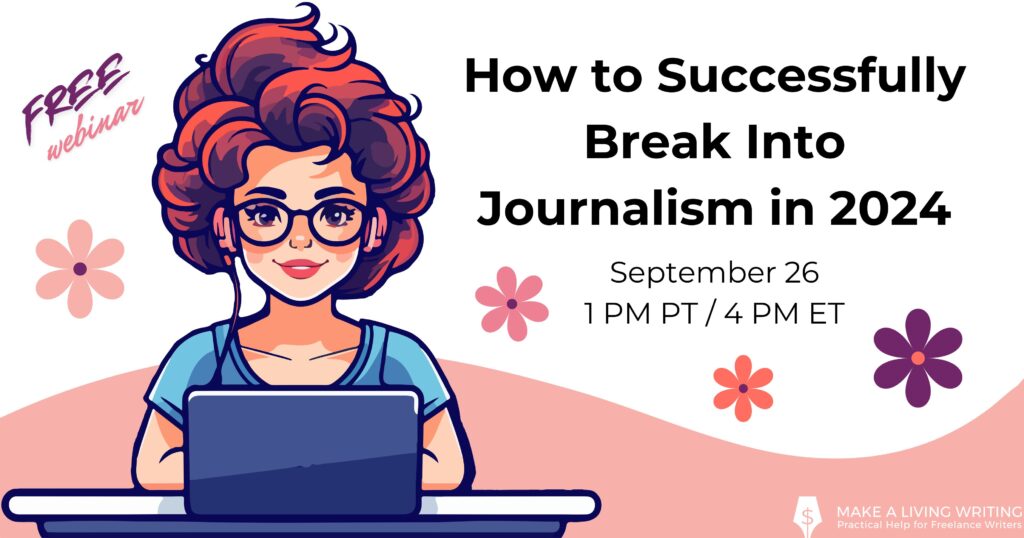
If you’re wondering what opportunities exist for freelance writers in 2024 (hint: there are plenty!) then make sure to register for the free webinar coming up on September 26, 2024 called How to Successfully Break Into Journalism in 2024! You’ll learn about the different types of journalism and what you may best be suited for, and the top skills successful journalists need and what it can lead to.
Apple just launched the iPhone 16 line, and it’s been quite an upgrade this year. Though the base models got some nice updates, like the A18 chip and some of the best colors I’ve seen from Apple in years, I’m still all about the Pro models. Once you go with 1TB storage and 120Hz ProMotion displays, it’s hard to go back.
This year, things are a little different. Ever since Apple introduced a Pro model, I’ve always gone for the smaller variant. After one year with a Plus model phone, I learned that I simply don’t care for large phones, so I never tried out a Pro Max. I’ve always just gawked at how humongous the size is, and this year, Apple went ahead and made it even bigger with a 6.9-inch display instead of 6.7 inches.
I have been spending some time with an iPhone 16 Pro Max, and while there’s one thing about it I love, another part of me can’t stand it.
Big phones are not meant for small hands
Christine Romero-Chan / Digital Trends
I’ve had every generation of iPhone so far, and one of my favorite models was the iPhone 5. For me, that 4-inch display was the perfect size for single-handed use, as I have petite hands. That’s why the first iPhone SE was a great compact phone, but the sequels that followed weren’t quite as perfect with the larger 4.7-inch display size.
Then, Apple moved to the 5.8-inch size with the iPhone X for a couple of years. I learned to manage one-handed use with that size, though it still required some finger gymnastics, but I put up with it. I was happy that Apple seemed to recognize the need for small phones when it introduced the mini size with the iPhone 12 and 13, but it sold so poorly that Apple replaced it with a large “Plus” model.
Apple eventually moved on to 6.1 inches as the standard “small” size while having a 6.7-inch display for the Plus and Pro Max. This year, the Pro Max got bumped up to 6.9 inches, which isn’t that big of a difference from the previous size.
But still, for someone like me with tiny hands, this is a behemoth of a phone, and I absolutely cannot use this one-handed at all unless I’m only scrolling through an app. When I hold the phone with one hand (typically from the bottom), the tip of my thumb barely reaches the middle of the bottom half of the screen. Reaching the top corners is impossible without two hands. And the phone’s weight causes fatigue in my hands (especially if my pinkie supports it from the bottom).
I can see why large phones like the iPhone 16 Pro Max appeal to those who are the opposite of me and have large hands, whereas the regular iPhone 16 Pro could be “too small.” But after spending time with an iPhone 16 Pro Max, my very first Pro Max model after all these years, I learned that I was right — it’s simply too big for me.
The battery life is great, though
Christine Romero-Chan / Digital Trends
I have to give credit where credit is due. The battery life on the iPhone 16 Pro Max has been fantastic. Out of the entire iPhone 16 line, the iPhone 16 Pro Max has the most battery, followed by the iPhone 16 Plus.
As someone who has been using the smaller Pro models for the past several years, I can definitely appreciate having a battery that can make it through the day and then some. It’s the same feeling I had when I went from an Apple Watch Series 5 to an Apple Watch Ultra.
My old iPhone 15 Pro, which I have had since launch day, already has a degraded battery that fell below the 90% threshold. That means I’ve been having to charge it up at some point in the middle of the day. I also have the regular iPhone 16 Pro, which appears to have better stamina with the battery, but the iPhone 16 Pro Max takes it to a whole different level. It’s like some of the larger Android phones I’ve tried, like the OnePlus 12 or Samsung Galaxy S24 Ultra.
Perhaps if I didn’t have trouble with such a large phone, the iPhone 16 Pro Max would be my personal device. The battery really is that good.
The Camera Control placement is wrong
The Camera Control button on the iPhone 16 Pro.Joe Maring / Digital Trends
One of the big selling points for the entire iPhone 16 lineup is the new Camera Control button, which is located at the bottom right of the frame on all models. A single press opens the Camera app (but you can change it if you want), another click captures your photo or starts recording, and you can do light presses and slide gestures to adjust various settings. The Camera Control button makes your iPhone 16 feel more like a standalone camera.
While I’ve tried using it on both the iPhone 16 Pro and the iPhone 16 Pro Max, the placement of the button itself is not practical. It’s even more of an issue with the Pro Max because of its larger size.
Christine Romero-Chan / Digital Trends
If Apple had just put the Camera Control a smidge lower on the frame, closer to the rounded corner, it would have felt more comfortable for landscape photos. When I use the camera in landscape orientation, my index finger is wrapped around the side. But with the current position of the Camera Control, I can’t reach it that way and need to obstruct part of the screen/viewfinder to press it.
Again, this issue isn’t just for the Pro Max model; it’s not great on the smaller Pro either. But the larger size of the iPhone 16 Pro Max just exacerbates the issue.
A powerful iPhone, but not for everyone
Joe Maring / Digital Trends
This is the first time I’ve used Apple’s large-size phone since the Plus versions, and while I love that extra battery life and seeing more on the display at once, the size just isn’t for me. Props to those who like the big size of the Pro Max, though! It’s just impossible for me to use it comfortably.
I am glad that Apple at least gives us a choice with the iPhone lineup. This year, there’s feature parity with both the iPhone 16 Pro and iPhone 16 Pro Max. That means those who prefer the smaller size aren’t missing out on major features, unlike last year. Now, the choice just comes down to whether or not you want a big phone or a small phone — and that’s how it should be.
Ubisoft is on a roll this week when it comes to Steam news, it seems. Hot on the heels of Assassin’s Creed Shadows‘ day 1 Steam launch, the French behemoth has also revealed that Star Wars Outlaws is coming to Steam on November 21st, alongside the Wild Card story pack.
The developers over at Massive Entertainment also shared plans to update the game with optimization passes and much requested changes to both combat and stealth gameplay, which have been criticized for being fairly buggy from what I’ve seen. Hopefully things will improve enough so the company can finally deliver the open world Star Wars experience fans were expecting.
Star Wars Outlaws
Experience the first-ever open world Star Wars™ action-adventure game and explore distinct locations across the galaxy, both iconic and new. Risk it all as scoundrel Kay Vess, seeking freedom and the means to start a new life. Fight, steal, and outwit your way through the galaxy’s crime syndicates as you join the galaxy’s most wanted.
If you’re willing to take the risk, the galaxy is full of opportunity.
DISCOVER A GALAXY OF OPPORTUNITY
Explore distinct locations with bustling cities and cantinas. Race across sprawling outdoor landscapes on your speeder. Each location brings new adventures, unique challenges, and enticing rewards if you’re willing to take the risk.
EXPERIENCE AN ORIGINAL SCOUNDREL STORY
Live the high-stakes lifestyle of an outlaw. Turn any situation to your advantage with Nix by your side: fight with your blaster, overcome enemies with stealth and gadgets, or find the right moments to distract enemies and gain the upper hand.
EMBARK ON HIGH-STAKES MISSIONS
Take on high-risk, high-reward missions from the galaxy’s crime syndicates. Steal valuable goods, infiltrate secret locations, and outwit enemies as one of the galaxy’s most wanted. Every choice you make influences your ever-changing reputation.
JUMP INTO THE PILOT SEAT
Pilot your ship, the Trailblazer, as you engage in thrilling dogfights with the Empire and other foes. Find the right opportunities to chase, evade, and attack to get the upper hand.
After major conferences from Salesforce and HubSpot this week, it’s clear that major companies are getting on board with AI agents. Join Mike and Paul as they chat about the ups and downs of these AI agents and what they mean for the future of work. And that’s not all—our hosts also talk about Runway’s latest partnership with Lionsgate, Sam Altman’s “Goal 3,” LinkedIn’s training on user data, and more. Continue reading “Salesforce and HubSpot AI Launches, Enterprise AI Agents & First Major Hollywood Studio Embraces AI”
Are you one of those users who don’t utilize Quick Properties in AutoCAD because the pop-up palette “gets in the way?” Or maybe you don’t use them because they don’t contain the object information that’s useful to you. Maybe you don’t even know they exist. These are all valid reasons, but as a firm believer in keeping your eyes on what you’re working on, you may be missing out on a key piece of your overall efficiency by not using them.
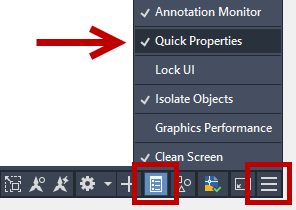
In today’s post, I’ll address each of the reasons I listed, starting with the last. You may not know they exist because the icon in the status bar isn’t displayed by default. So, first things first, let’s make sure it’s turned on. Click on the three-horizontal bar “customize” icon in the corner. Find Quick Properties, a few entries up, and click on it. Its icon will appear in the status bar, as shown below. Click it to turn it a light blue, indicating it is now enabled.
Customize Your Displayed Quick Properties
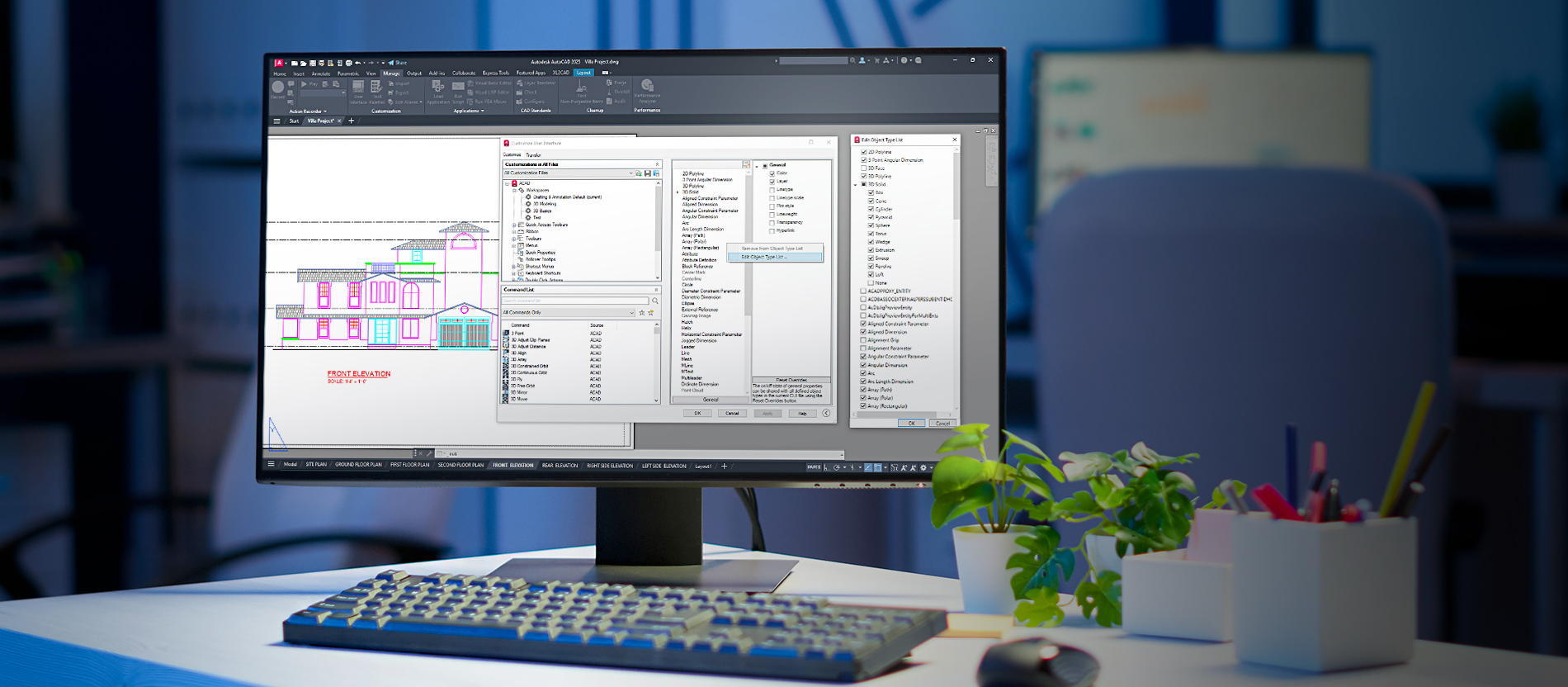
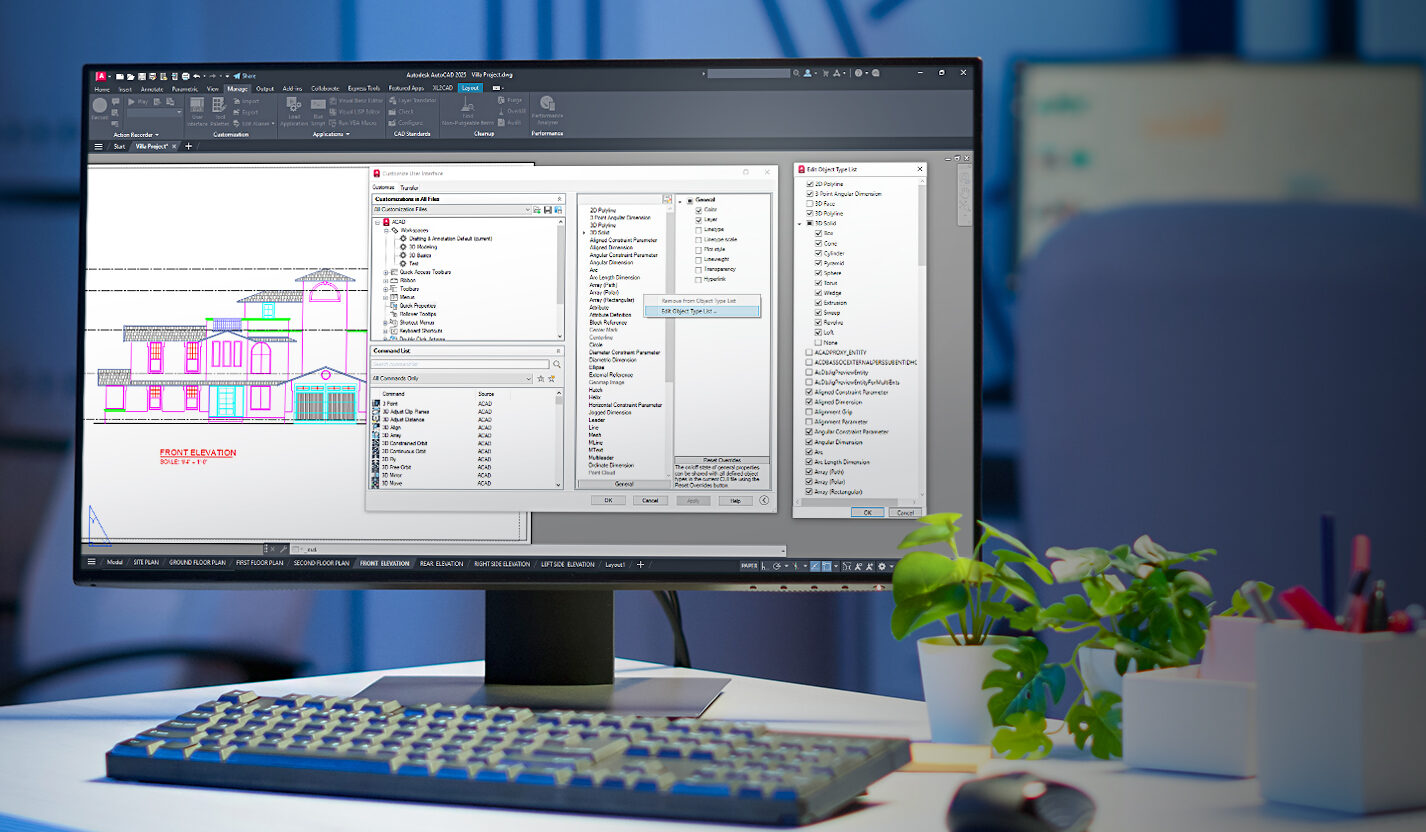
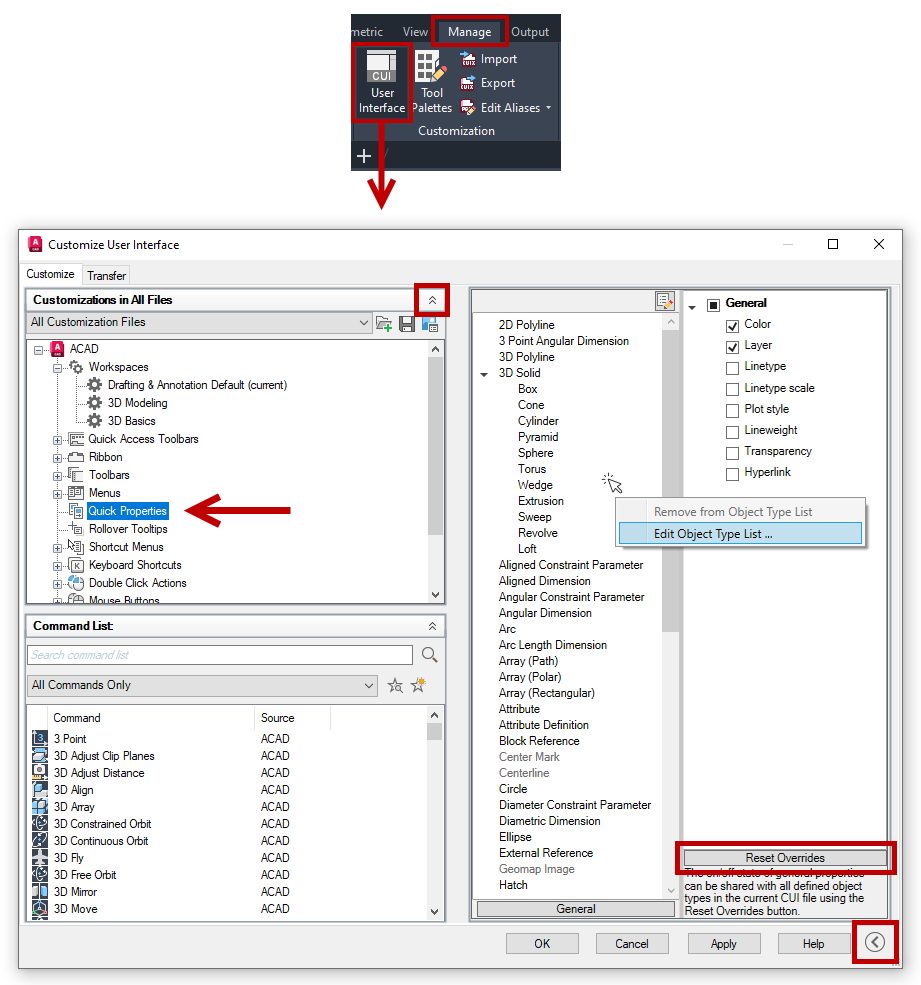
The second reason I mentioned for not using Quick Properties in AutoCAD is that they don’t contain the object information that’s useful to you. OK. Let’s fix that. You’ll need to open the CUI Editor to customize your Quick Props. From the Manage tab of the Ribbon, click on CUI User Interface in the Customization panel or just type in CUI on the Command Line.
Your CUI dialog may not look like mine in the image below. Way back in 2018 (in my fifth-ever Tuesday Tip blog), I wrote about the little things in the AutoCAD interface. This is yet another case at that point. Draw your attention to the two small red squares. You may need to click one or both to expand the panels as shown.
The first thing to learn about Quick Properties is that there are two parts to the info they display. There are “General” properties, which display for every type of object, and there are properties that apply only for a specific object. First, let’s look at the steps to change the General properties displayed.
In the Customize tab, click on Quick Properties in the Customize in All Files panel. The list of available objects will appear in the right side edit panel. The general properties are to the right and common to all objects.
Adding or removing an object from this list will affect all objects. Click on the Reset Overrides button to save any changes.
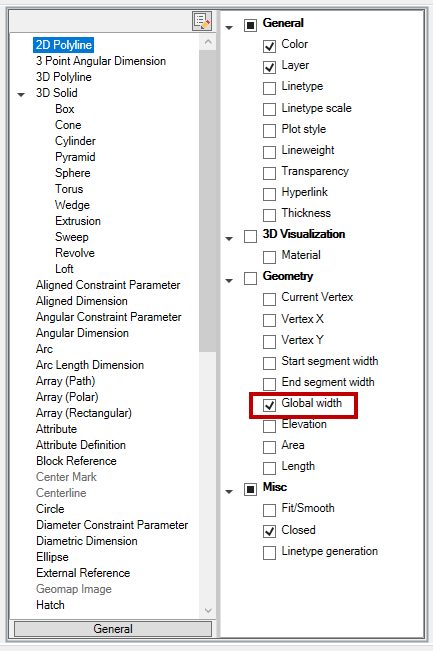
Back to the information that’s useful to you. Let’s say your workflow requires you to pay attention to the global width of your polylines. If that showed up, you’d be more likely to use QuickProps. Click on 2D Polyline in the left panel, and all of its available properties will be added to the right side. Select Global Width, click OK to save and exit.
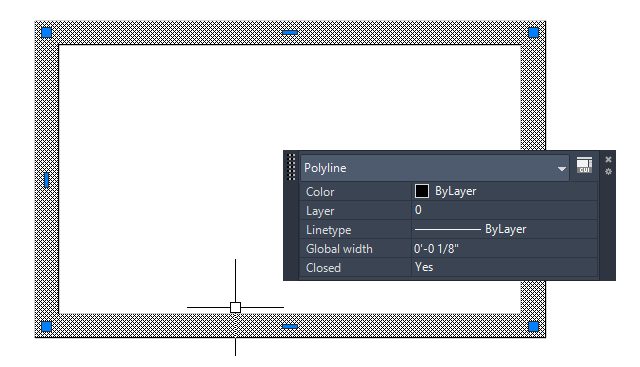
Now, click on a 2D Polyine to get a QuickProps palette that also displays the Global Width. You can do the same with any object type listed. Select it and make it your own by selecting other properties to display.
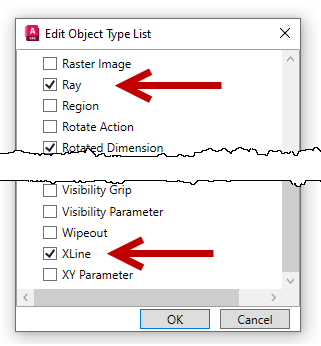
Maybe the object type you’re interested in isn’t in the default list. No worries. Let’s say you use Rays and Xlines a lot. Right click in the objects panel and select Edit Object Type List. You’ll get a dialog box similar to the image below. Find Ray and XLine, check them, and click OK. Now you’re on your way to getting Quick Properties set up just for you.
But It’s Still in the Way!
Consider the image two back, where the QuickProps palette overlaps the object. We’re all the way back to my first excuse for not using it: The palette gets in the way and obscures your workflow. OK, so let’s customize how and where it displays.
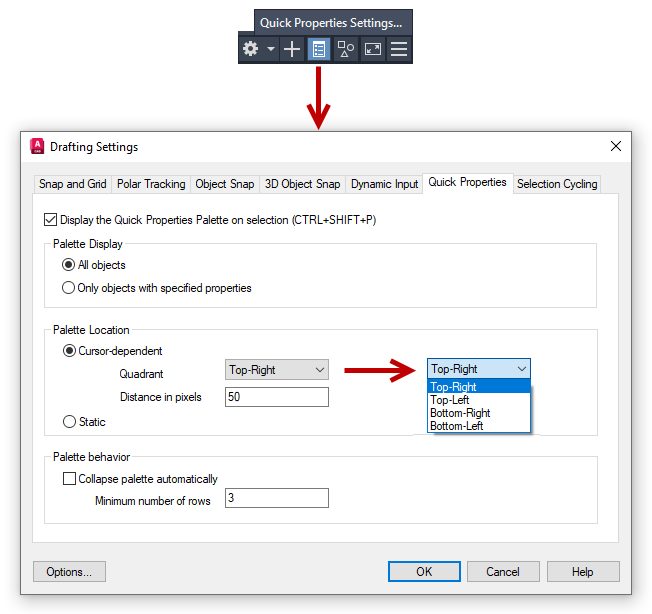
You’ll need to access the Quick Properties tab in the Drafting Settings dialog. You can get there by right-clicking on the QuickProps status bar icon and selecting the popup menu item. There are several controls you can choose from. The top panel will allow you to limit the display of QuickProps to only objects that have specified properties.
The middle area defines the location of the palette. By default, it appears 50 pixels to the top-right of your cursor location. If you’re someone who selects the left side of objects by habit, it can certainly get in your way. Change it to one of the other quadrants and/or alter the distance from your cursor (0 to 400).
The other option is to use a static location. Here’s the good part: you define where it displays. When in static mode, just drag the QuickProps palette to where you want it to appear, and it will always display in that location.
Finally, no matter how many object properties you have selected to display in the palette, you can specify that it displays collapsed down to the number of rows you specify. Just roll over the edge of the palette to expand it fully.
That’s All Folks
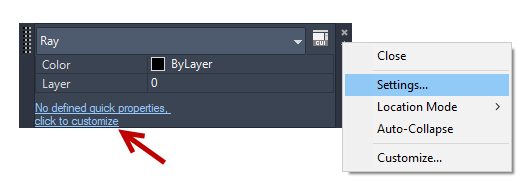
How’s that for a lot of flexibility? I’ve got a little more for you. You can also access all the settings I’ve discussed via the palette itself by clicking on the Options icon on the sidebar. If it only shows the general properties, you’ll get a link that will take you to the CUI dialog.
I have a bit of a different ending than normal for this post. Earlier, I referenced my fifth-ever Tuesday Tip. That was back in 2018. It’s hard to believe, but today’s tip is my 100th in this series. It’s quite a personal milestone.
I remember how excited I was being asked to fill some mighty big shoes, but I also had the opportunity to share my experiences with a much larger audience than I thought I ever could.
So, it seems appropriate to thank my friends on the AutoCAD team for continuing to give me this opportunity, my various contacts there over the years (you’re all tied for the best), and most of all, to you, my dear readers, without whom this amazing ride wouldn’t exist.
Here’s to the next 100.
More Tuesday Tips
Check out our whole Tuesday Tips series for ideas on how to make AutoCAD work for you. Do you have any favorite AutoCAD tips? Tell us in the comments!