In this weekly column, Android Central Wearables Editor Michael Hicks talks about the world of wearables, apps, and fitness tech related to running and health, in his quest to get faster and more fit.
The Garmin Forerunner 570 and 970 are more expensive than their predecessors. Other 2025 Garmin watches skimped on new features to keep prices low, so I’m happy Garmin didn’t hold back on its Forerunners. But it’s also become clearer that Garmin doesn’t feel a need to compete with other brands’ features — only against itself.
The jump between the $599 Forerunner 965 and $749 Forerunner 970 is significant. You get the newest Elevate v5 generation for better HR accuracy, ECGs and skin temperature readings, flashlight, mic & speaker for calling and commands, sapphire crystal protection, and new metrics like running tolerance.
Or if you’re weighing the $549 Forerunner 270 against the $449 Forerunner 265, you also get the gen5 HR accuracy boost, doubled screen brightness on a larger display, the same mic & speaker, and skin temperature with heat acclimation.
The Instinct 3 and Vivoactive 6 stuck to last-gen HR sensors, treading water on hardware so that Garmin could keep them in their fixed price ranges. I feared Garmin would do the same with its Forerunners, making us wait until 2027 for real changes.
That’s why I’m excited for the Forerunner 970, but also feeling frustrated at how Garmin holds back mid-tier watches like the Forerunner 570.
As prices rise, held-back features are harder to accept
(Image credit: Michael Hicks / Android Central)
The $499 Instinct 3 didn’t have offline maps despite being an “adventure” watch, while cheaper rival watches like the $349 COROS PACE Pro and Suunto Race S did. I complained at the time, but Garmin hadn’t given it storage space for maps, prioritizing a lightweight CPU for battery life.
The $549 Forerunner 570 does have storage space for maps, and no need to hold back the processor. There’s no logistical reason it shouldn’t support maps; even if they’re not pre-downloaded like on the 970, Garmin could let you download a specific region’s topo data, at least.
Get the latest news from Android Central, your trusted companion in the world of Android
The only real explanation is that their absence makes people more likely to pay for the 970.
(Image credit: Michael Hicks / Android Central)
The same applies to the 570 health sensors. I obviously appreciate the enhanced HR accuracy and skin temperature. But every other gen5 watch has ECGs, including the $449 Venu 3. And outside of Garmin, ECGs are the norm, from mainstream watches to fitness rivals like the COROS APEX and Polar Vantage series.
But Garmin ignores the context of its rivals; the only competitor that matters is the Forerunner 970. That needs to stand out, so the 570 misses out. Heart health warnings become a $750 bargaining chip.
It’s a common-enough strategy for Garmin. With the excellent Forerunner 165, you can’t see your training load even though it clearly calculates load in the background to determine your VO2 Max, recovery time, and daily suggested workouts with anaerobic or low aerobic focuses. Blocking that data upsells you to the Forerunner 265.
I accepted that artificial feature block because the 165 costs $249, and training load is still fairly niche. But Garmin watch prices keep creeping up. It’s harder to swallow blocked features when these mid-tier models cost much more than a Galaxy or Apple Watch.
With Garmin watches, every component has a price tag
(Image credit: Garmin)
Smartwatch “tiers” are common enough these days, and every company wants to upsell you. But they’re also selective about which features are price-locked because they know it’ll look bad if a competitor offers something for much less.
You obviously pay more for steel or titanium casing, or other hardware boosts like better battery life. But otherwise, they squeeze most features into the mainline model while sticking to the same pricing every year (aside from the occasional inflationary boost).
With Garmin, every new feature to modernize its watches comes with a price bump. MIP-to-AMOLED display swaps for the Forerunner and Instinct lineups cost tacked on another $50–100 to the usual price. On the Fenix 8, collectively adding AMOLED, better sensors, and a mic & speaker added $200 to the price.
You won’t find dual-band GPS on any watch $300 or less, nor offline maps on any sub-$600 watch. And even though Garmin’s Gen5 HR sensors came out in 2023, it will keep using the Gen4 sensors on “cheaper” models like the $500 Instinct 3 today.
I don’t know how much the components cost Garmin, but it wants us to know that it’ll pass that cost onto us.
(Image credit: Garmin)
Other factors like tariff concerns bump up pricing, too. But Garmin’s 2025 strategy establishes a clear Garmin precedent: Once a watch costs a certain price, you shouldn’t expect new hardware at that price, nor features already established at the flagship tier.
The next version will either cost the same but make minimal upgrades, or add new tools and cost much more.
Garmin treats any new feature as an opportunity to ask athletes for more money in exchange for more value. And it can do this because it doesn’t feel as much pressure to price its fitness watches competitively as other brands.
Garmin users like its ecosystem too much — or are too invested in it — to leave. And so Garmin accepts the negative press around Connect+ paywalled features and price-locks the coolest new features because its loyal customers will pay $750 or more for them, even if they grumble about it.
If you think the Forerunner 970 and 570 are too expensive, then at least you know the last-gen Garmin watches are still available — and discounted for Memorial Day, so a Forerunner 965 costs $50 less than the 570.
Otherwise, we have to accept this new normal with new Garmin watches.
By Margot Adams, Co-Founder and Head of Marketing and Sales at Luxeire
When my mom, Gina Kuyers, and I launched Luxeire, we knew we weren’t interested in building a typical fashion brand. From day one, we chose to keep 100% of our garments manufacturing in-house in New York City—not as a marketing angle, but as a core part of our business strategy. In a world dominated by fast fashion and global outsourcing, we’ve found that staying local gives us a distinct advantage in quality, agility, and sustainability.
Keeping production and manufacturing in-house gives us control most brands dream of. We’re able to produce in smaller, more intentional runs, which is not only financially smarter but also helps us avoid overproduction and waste. It’s allowed us to scale at a pace that prioritizes product integrity and customer demand over unnecessary inventory.
As a small, hands-on team, producing locally is essential to staying nimble. Our factory is literally across the hall from our office. That proximity means we’re involved in every step of the process from fittings, adjustments, and final inspections. We can move fast, spot issues early, and make real-time decisions without the delays and disconnects that come with overseas manufacturing. Our customers come to us for pieces that are as functional as they are polished. We use luxurious Italian technical fabrics that are breathable, stretchy, and sustainable. These garments feel like activewear but look like tailored classics.
Keeping our manufacturing in-house and production close to home means we can iterate quickly, maintain consistent fit and quality, and meet demand without the long lead times of offshore manufacturing. It’s also allowed us to respond faster to what’s happening in real time. When something sells out or we spot a trend, we can restock or launch within weeks, not months. That speed-to-market advantage has been a game changer, especially in today’s unpredictable retail environment. More than that, producing in New York means we know exactly who is making our garments. It’s a collaborative, transparent process, and we have confidence in the ethics and craftsmanship behind every piece. That matters to us and to our customers.
Being a mother-daughter team, we’ve always approached this business with a personal lens. We’re not chasing scale for scale’s sake. We care about doing things right which means minimizing waste, paying fairly, and delivering products we’re genuinely proud of. Local production has taught us that quality isn’t just about materials. It’s about process, alignment, and values.
At Luxeire, “Made in New York” isn’t a tagline. It’s a reflection of who we are and how we operate with intention, responsibility, and a whole lot of pride.
In that sense, the vulgar Vader situation creates a touchy dilemma for Epic Games and Disney, which likely invested substantially in this high-profile collaboration. While Epic acted swiftly in response, maintaining the feature while preventing further Jedi mind tricks from players presents ongoing technical challenges for interactive AI speech of any kind.
An AI language model like the one used for constructing responses for Vader (Google’s Gemini 2.0 Flash in this case, according to Epic) are fairly easy to trick with exploits like prompt injections and jailbreaks, and that has limited their usefulness in some applications. Imagine a truly ChatGPT-like Siri or Alexa, for example, that could be tricked into saying racist things on behalf of Apple or Amazon.
David Prowse as Darth Vader and Carrie Fisher as Princess Leia filming the original Star Wars.
Credit:
Sunset Boulevard/Corbis via Getty Images
Beyond language models, the AI voice technology behind the AI Darth Vader voice in Fortnite comes from ElevenLabs’ Flash v2.5 model, trained on examples of speech from James Earl Jones so it can synthesize new speech in the same style.
Previously, Lucasfilm worked with a Ukrainian startup we covered in 2022 on Obi-Wan Kenobi to recreate Darth Vader’s voice performance using a different AI voice model called Respeecher, which isn’t used in Fortnite.
According to Variety, Jones’ family supported the new Fortnite collaboration, stating: “James Earl felt that the voice of Darth Vader was inseparable from the story of Star Wars, and he always wanted fans of all ages to continue to experience it. We hope that this collaboration with Fortnite will allow both longtime fans of Darth Vader and newer generations to share in the enjoyment of this iconic character.”
This article was updated on May 16, 2025 at 4:25 PM to include information about an email sent out from Epic Games to parents. This Article was updated again on May 17, 2025 at 10:10 AM to correctly attribute ElevenLabs Flash v2.5 as the source of the Darth Vader audio model in Fortnite. The article previously incorrectly stated that Respeecher had been used for the game.
Step into an ordinary house these days and you can’t help but wonder whether you’ve stepped into a scene from a science fiction film or a spread from a high-fashion magazine. Transparent solar panels, moving walls dependent on your emotions, a living room that appears more like a participatory piece of art? Architectural design experts no longer just design buildings — they are building experiences. And what fuels all this imaginative energy? Innovation.
Architects who belong to the industry-leading platform Cad Crowd, who were once seen as meticulous sketchers of blueprints and lovers of rulers, are now technologists, collaborators, and boundary-pushers. Whether they’re working with cutting-edge materials, harnessing AI to streamline planning, or rethinking the very nature of a “room,” these visionaries are reshaping our expectations of what a home can be — and they’re doing it in partnership with forward-thinking companies that encourage and support experimentation.
Let’s go on an entertaining, behind-the-scenes adventure into the thoughts of these building design visionaries and find out how they’re combining functionality, aesthetics, and forward-thinking concepts into contemporary home design services today.
The era of collaboration: Architects + firms = Innovation exponentiated
It was once that architects operated independently — a bit isolated in studios or client sessions. No longer. Today, architectural design firms are partnering with other industries that focus on engineering, smart technology, sustainability, and manufacturing to create innovation hubs.
Require a kinetic facade that responds to sunlight? Dial up the tech company. Desire to discover biophilic interiors with intelligent lighting that simulates the sun’s cycle? There’s a startup for that. This cross-pollination of talent has turned the architect’s toolbox into something more akin to a NASA control panel — full of tools, wisdom, and potential far beyond the drafting board.
Architecture firms and businesses are developing symbiotic environments where materials researchers, sustainability consultants, and digital modelers collaborate to advance the design process. It’s a bit like a jazz band — everybody’s improvising, but in harmony.
Remember when homes used to look like boxes stacked on boxes? Well, those days are long gone. Parametric design is the architectural equivalent of giving geometry a double shot of espresso.
With algorithms and data-driven modeling, design and drafting services can today create complex, frequently curvilinear forms in response to environmental, spatial, and client data inputs. Think of it like a formula set in motion, which produces shapes that are stunning and smart. Need a building that directs wind through its shape or modifies overhangs by the path of the sun? Parametric design can do just that — in style.
Design tools such as Grasshopper or Revit, combined with plugins and AI-based analytics, enable companies to model real-world conditions during the design process. That translates into improved energy efficiency, improved air flow, and improved balance between the house and the environment — all without compromising on aesthetics.
Virtual reality & augmented reality: Walking inside the dream
We’ve all been there: trying to picture how a 2D floor plan will feel in real life. Spoiler: most of us aren’t great at it. That’s where VR and AR come in — not just as cool tech, but as critical storytelling tools for architects and the companies they work with.
With virtual reality headsets, clients are able to tour a computerized version of their new home. Open the front door, look into the kitchen, peer out a virtual window, and notice how the sun reflects off the living room at 7 AM. Want to swap out the marble countertop for concrete during the tour? Easy. This experiential process not only decreases revisions (since clients understand exactly what they’re receiving), but it also creates enthusiasm and emotional buy-in.
AR takes it one step further by superimposing design elements on real-world locations. With only a tablet or smartphone, architects can demonstrate how a new addition would fit in with the existing residence, or how landscaping design services modifications would impact curb appeal. It’s half wizardry, half project management — and completely transformative.
Smart homes start with smart architecture
“Smart home” used to mean a clunky wall panel that flipped switches on and off. Today, homes can identify your voice, sense your preferences, and even prompt you to water your plants — or simply do it for you.
But here’s the thing: a really smart home design services begins with intelligent architecture. And that’s where innovation truly stretches its muscles.
Today’s architects are collaborating with firms that focus on IoT (Internet of Things), embedded sensors, and building automation systems. This implies that the home itself is designed to host the tech — not retrofitting a smart thermostat onto an older duct system.
From placing sensors in concrete for live structural health monitoring to creating layouts that enable maximum WiFi coverage and tech placement without clutter, architects are making homes smart partners instead of mere passive environments. Even furniture design services is joining the party, with charging stations, modular designs, and adaptive lighting capabilities.
Sustainability: More than just solar panels
The green revolution in architecture is not simply a matter of putting some solar panels on the roof and voila. Architects today are going all the way with sustainability — from where they get their materials to the life cycle of the building itself.
Savvy architecture companies now specify reclaimed wood, carbon-positive bricks, mycelium insulation, and plant paints. And they’re building homes that breathe — literally. With high-tech ventilation systems, living walls, and passive solar design, the house is transformed into an ecosystem and not a mere building.
Architects are also looking into net-zero homes — buildings that generate as much energy as they use — through close collaboration with energy consultants and engineering design firms. Rainwater collection, greywater reuse, and rooftop gardens are no longer frills; they’re part of the home from the beginning.
One especially thrilling innovation? Transparent solar glass — picture your windows powering your home without obscuring your view. Sounds sci-fi, but architects are already incorporating this technology into luxury residential developments.
If you thought a home had to be constructed of concrete, steel, or wood — think again. Materials these days are more like something from a Marvel blockbuster. Self-repairing concrete that heals its own cracks? Check. Phase-change materials that capture and release heat to modulate indoor temperatures? Yup. Engineered bamboo that’s stronger than steel? You bet.
Architects designing for progressive firms are continually pushing and implementing these new materials not only for their novelty, but also for their performance, environmental footprint, and aesthetics. Cross-laminated timber (CLT), for instance, is becoming increasingly popular as a greener option for conventional steel framing — with the added advantage of seismic resistance and speedy installation.
And then there are 3D-printed parts. Whole houses are now being partly built through 3D printing design services, lowering construction waste and labor by half and providing stunning design freedom.
Flexible spaces for flexible living
Life evolves — and quickly. Architects are embracing this fact by creating houses that evolve over time. That spare bedroom? It’s also a home office. The garage? It doubles as a yoga studio. The sliding wall in the kitchen? It converts the room into an open-plan party space or a snug nook for one.
Through the use of modular design and reconfigurable layouts, architects design spaces that adapt to the changing needs of their occupants. This trend accompanies the emergence of work-from-home culture, multi-generational households, and the need for multifunctional spaces.
Those firms that produce prefabricated or modular building parts facilitate these visions for architects, allowing rapid customization without the time-consuming construction delays of traditional methods.
Emotional architecture: Designing for well-being
In addition to functionality and style, architects are now focused on the emotional experience of home. How do you feel about a room? Is it invigorating? Soothing? Does it promote connection or isolation?
To determine this, architects are drawing on neuroscience, psychology, and even smell design. They’re bringing together natural light patterns through lighting design services, organic forms, and sound control to design spaces that promote mental health and emotional well-being.
Partnerships with wellness-centric companies like those developing circadian lighting systems or air purification technology further enrich this integrated design philosophy. The outcome is architecture that not only caters to your requirements but also nourishes your soul.
A glimpse into the future: AI, robotics, and beyond
Innovation is never going to slow down — no, not at all. Rather, it’s just warming up. Architects are now leveraging artificial intelligence to design floor plans of options according to client patterns of behavior. Construction arms powered by robots are in the experimental stage for placing bricks or extruding walls onsite. And digital twins — virtual replicas of a building — are utilized to track wear and tear in real time.
Imagine telling your architect: “I want a house that adjusts to my morning routine, waters my garden automatically, blocks street noise, and glows like a lantern at night.” It’s no longer a pipe dream. With the right team and tech, it’s entirely possible — and architects are at the heart of making it happen.
Architecture as a living, breathing innovation lab
Home is no longer where the heart is — it’s where the future lives, breathes, and grows. Thanks to visionary architects and the firms that back them, the previously stagnant realm of residential design has become a sandbox of creativity.
Whether it’s using AI to map ideal sunlight, VR to test emotional flow, or mushrooms to insulate your attic (for real), architects are embracing a future where design is smarter, more sustainable, and incredibly human. And the homes they’re building? They’re not just homes — they’re homes to flourish.
So the next time you visit an “advanced” home, have a closer peek. You could be looking for a tale of teamwork, ingenuity, and a bit of architectural magic contained within the walls. Call us at Cad Crowd today and let us provide you with a complimentary quote for your creative home plan.
MacKenzie Brown is the founder and CEO of Cad Crowd. With over 18 years of experience in launching and scaling platforms specializing in CAD services, product design, manufacturing, hardware, and software development, MacKenzie is a recognized authority in the engineering industry. Under his leadership, Cad Crowd serves esteemed clients like NASA, JPL, the U.S. Navy, and Fortune 500 companies, empowering innovators with access to high-quality design and engineering talent.
These easy Strawberry Mousse Parfaits are the perfect dessert when you want something sweet and refreshing but not super heavy. They’re made with fresh, juicy strawberries and have a smooth, creamy texture that’s light and fluffy.
This post may contain affiliate links. Please refer to the terms page for more information.
Top off these parfaits with some extra strawberries and a little whipped cream, and you’ve got an awesome no-bake treat that’s perfect for any time!
Jump to:
Ingredients
Just a few simple ingredients to are needed make these Strawberry Mousse Parfaits:
Strawberries – use the freshest, reddest fruit you can find. The strawberries are used both in the mousse and to top off the parfaits.
Powdered gelatin and cold water – be sure to use cold water so the gelatin sets correctly
Granulated sugar
Heavy cream
Lemon juice
Optional topping ingredients – powdered sugar and heavy cream
See recipe card for quantities.
Instructions
This recipe for Strawberry Mousse Parfaits takes a few hours to finish because the mousse needs time to set, but each step takes only a few minutes. Follow the directions below, and you’ll have a sweet, refreshing dessert ready to enjoy.
Prepare strawberry puree
1 – Sprinkle gelatin over cold water. Set aside and allow to gel.
2 – Remove stems and slice strawberries into ¼” slices. Place strawberries, granulated sugar and lemon juice in a food processor. Blend until smooth.
3 – Place strawberry mixture in a heavy duty saucepan. Heat mixture over medium heat and bring to a simmer, stirring often (note: do not bring to a boil). Continue to heat until it begins to thicken (approximately 8 minutes).
4 – Remove pan from heat and add the set gelatin. Stir until gelatin dissolves completely. Optional: pour the strawberry mixture through a mesh strainer place over a large bowl to remove any large pieces
Assemble parfaits
5 – Place a tablespoon of strawberry puree into the bottom of each parfait glass (use four 8-ounce dishes or six 6-ounce dishes). Place glasses in refrigerator. Set remaining puree aside to cool to room temperature – approximately 20 minutes (note – do not place in refrigerator as the mixture will begin to set up too quickly).
6 – Place heavy cream in a mixing bowl. Using the whisk attachment on a hand- or stand mixture, begin whipping cream on medium speed. Continue whipping until medium peaks are reached. Medium whipping peaks hold their shape with tips that curl slightly when the beaters are lifted.
7 – Add a few tablespoons of whipped cream to the cooled strawberry mixture and stir.
8 – Add remaining whipped cream to strawberry mixture and fold gently until no white streaks remain. Do not overfold else you will deflate the mousse.
9 – Remove parfait glasses from the refrigerator and divide the mousse evenly among them, either by spooning it in or piping with a pastry bag.
10 – Jiggle each parfait glass to create a smooth layer of mousse. Place parfaits in refrigerator for 2 hours or until mousse is set.
11 – Dice strawberries into ¼” cubes and place in a bowl. Sprinkle granulated sugar over strawberries. Cover bowl and set aside for 1 hour to allow strawberries to soften and release juices.
12 – Remove parfaits from refrigerator. Place a few tablespoons of the strawberries on top of the mousse, reserving a few to add over cream topping. Whip heavy cream and powdered sugar to medium peaks. Transfer cream to a pastry bag and pipe swirls of cream over each parfait. Alternatively, scoop dollops of cream into each parfait glass. Add strawberries and drizzle juice over top of cream.
Serving strawberry mousse parfaits
For the freshest taste, these parfaits are best served the day they’re made.
Equipment
Gather the following equipment before starting this recipe:
4 Eight ounces parfait dishes or 6 six ounce parfait dishes
Storage
Keep your strawberry mousse parfaits stored in the refrigerator until you’re ready to serve them; they will stay fresh for up to two days.
FAQ
Why do we call these dessert ‘parfaits?’
The word parfait comes from French, and it literally means “perfect.” When the idea came to the U.S., parfaits evolved into layered desserts, usually made with things like whipped cream, yogurt, fruit, and sometimes granola or cake. But the name stuck because it still sounded fancy and delicious — and honestly, perfect fits pretty well!
More dessert recipes with strawberries
Love anything strawberry and looking for more dessert recipes? Try these:
I hope you enjoy these easy strawberry mousseparfaits as much as my family and friends have over the years!
📋 Recipe
Strawberry Mousse Parfaits
These easy Strawberry Mousse Parfaits are the perfect dessert when you want something sweet and refreshing but not super heavy. They’re made with fresh, juicy strawberries and have a smooth, creamy texture that’s light and fluffy.
Prep Time 20 minutesmins
Cook Time 8 minutesmins
Resting and assembly 2 hourshrs30 minutesmins
Total Time 2 hourshrs58 minutesmins
Course Dessert
Cuisine American
Servings 48 ounce glasses
Calories 450kcal
Equipment
Hand or stand mixer
Bowls, measuring cups and spoons
Heavy Duty Saucepan
Spatulas
Pastry bags and piping tip optional
4 Eight ounces parfait dishes or 6 six ounce parfait dishes
Sprinkle gelatin over cold water. Set aside and allow to gel.
½ teaspoon Powdered gelatin, 2 teaspoons Water
Prepare strawberries
Remove stems and slice strawberries into ¼” slices.
12 Ounces Strawberries
Place strawberries, granulated sugar and lemon juice in a food processor. Blend until smooth.
3 Tablespoons Granulated sugar, 2 teaspoons lemon juice
Place strawberry mixture in a heavy duty saucepan.
Heat the strawberry mixture over medium heat and bring to a simmer, stirring often (note: do not bring to a boil). Continue to heat until it begins to thicken (approximately 8 minutes).
Remove pan from heat and add the set gelatin. Stir until gelatin dissolves completely.
Optional: pour through a mesh strainer place over a large bowl to remove any large pieces
Place a tablespoon of strawberry puree into the bottom of each parfait glass. Place in refrigerator.
Set remaining puree aside to cool to room temperature – approximately 20 minutes (note – do not place in refrigerator as the mixture will begin to set up too quickly).
Add cream
Place heavy cream in a mixing bowl. Using the whisk attachment on a hand- or stand mixture, begin whipping cream on medium speed. Continue whipping until medium peaks are reached. Medium whipping peaks hold their shape with tips that curl slightly when the beaters are lifted.
1¼ Cup Heavy cream
Add a few tablespoons of whipped cream to the cooled strawberry mixture and stir.
Add remaining whipped cream to strawberry mixture and fold gently until no white streaks remain. Do not overfold else you will deflate the mousse.
Assemble strawberry mousse parfaits
Remove parfait glasses from the refrigerator and divide the mousse evenly among them, either by spooning it in or piping with a pastry bag.
Jiggle each parfait glass to create a smooth layer of mousse.
Place parfaits in refrigerator for 2 hours or until mousse is set.
Optional – topping
Dice strawberries into ¼” cubes and place in a bowl. Sprinkle granulated sugar over strawberries.
Cover bowl and set aside for 1 hour to allow strawberries to soften and release juices.
Remove strawberry mousse parfaits from refrigerator. Divide strawberries evenly between each glass, reserving a few to add over cream topping.
Whip heavy cream and powdered to medium peaks. Transfer cream to a pastry bag and pipe swirls of cream over each parfait. Alternatively, scoop dollops of cream into each parfait glass.
½ Cup Heavy cream, 2 Tablespoons Powdered sugar
Add strawberries and drizzle juice over top of cream.
Video
Notes
Keep strawberry mousse parfaits in refrigerator until ready to serve (up to two days). For the freshest taste, these parfaits are best served the day they’re made.
Save yourself from any alphabet-twisting worries with our Wordle help. A quick run through our general tips might help you find a new path—especially if you pair that knowledge with our hint for today’s game too. And if Sunday’s puzzle is still causing you trouble, the May 18 (1429) answer is never more than an easy, puzzle-winning click away.
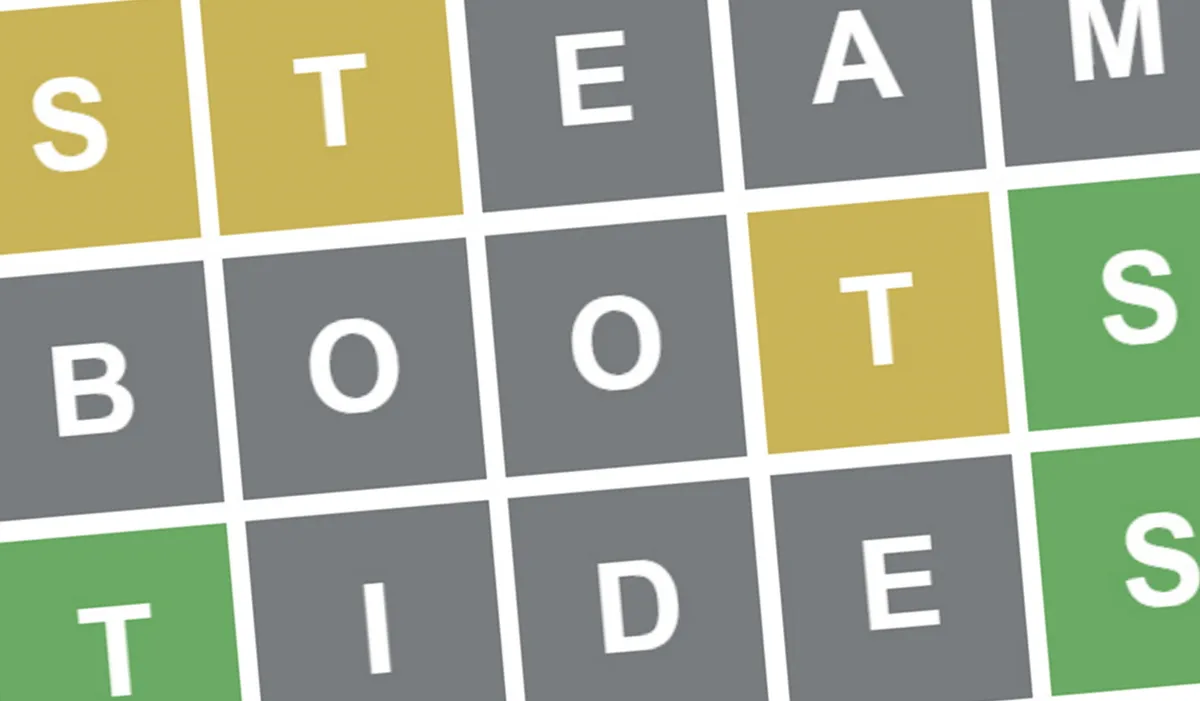
Ah, the perfect Sunday Wordle. A treat of a first row to start me off with, an extremely weird second line that was all wrong in all the right ways, and a third guess that revealed nothing but green letters. I love it when the alphabet behaves for me like that. Make sure you pay today’s hint a quick visit if it doesn’t look like your game’s going so well, it’ll soon turn those greys and yellows green.
Wordle today: A hint
(Image credit: Josh Wardle)
Wordle today: A hint for Sunday, May 18
If you were not just angry but furious, truly fuming over something, you’d be this.
Is there a double letter in Wordle today?
Yes, there is a double letter in today’s puzzle.
Wordle help: 3 tips for beating Wordle every day
If you’ve decided to play Wordle but you’re not sure where to start, I’ll help set you on the path to your first winning streak. Make all your guesses count and become a Wordle winner with these quick tips:
A good opener has a mix of common vowels and consonants.
The answer could contain the same letter, repeated.
Avoid words that include letters you’ve already eliminated.
You’re not racing against the clock so there’s no reason to rush. In fact, it’s not a bad idea to treat the game like a casual newspaper crossword and come back to it later if you’re coming up blank. Sometimes stepping away for a while means you can come back with a fresh perspective.
Today’s Wordle answer
(Image credit: Future)
What is today’s Wordle answer?
Another weekend win. The answer to the May 18 (1429) Wordle is LIVID.
Keep up to date with the most important stories and the best deals, as picked by the PC Gamer team.
Previous Wordle answers
The last 10 Wordle answers
Previous Wordle solutions can help to eliminate guesses for today’s Wordle, as the answer isn’t likely to be repeated. They can also give you some solid ideas for starting words that keep your daily puzzle-solving fresh.
Here are some recent Wordle answers:
May 17: GROWN
May 16: FIFTH
May 15: EAGER
May 14: BONGO
May 13: AWARE
May 12: BICEP
May 11: DOWEL
May 10: YEAST
May 9: TRIPE
May 8: BALMY
Learn more about Wordle
(Image credit: Nurphoto via Getty)
There are six rows of five boxes presented to you by Wordle each day, and you’ll need to work out which five-letter word is hiding among them to win the daily puzzle.
Start with a strong word like ALIVE—or any other word with a good mix of common consonants and multiple vowels. You should also avoid starting words with repeating letters, so you don’t waste the chance to confirm or eliminate an extra letter. Once you’ve typed your guess and hit Enter, you’ll see which letters you’ve got right or wrong. If a box turns ⬛️, it means that letter isn’t in the secret word at all. 🟨 means the letter is in the word, but not in that position. 🟩 means you’ve got the right letter in the right spot.
Your second guess should compliment the first, using another “good” word to cover any common letters you might have missed on the first row—just don’t forget to avoid any letter you now know for a fact isn’t present in today’s answer. After that, it’s just a case of using what you’ve learned to narrow your guesses down to the correct word. You have six tries in total and can only use real words and don’t forget letters can repeat too (eg: BOOKS).
If you need any further advice feel free to check out our Wordle tips, and if you’d like to find out which words have already been used you can scroll to the relevant section above.
Originally, Wordle was dreamed up by software engineer Josh Wardle, as a surprise for his partner who loves word games. From there it spread to his family, and finally got released to the public. The word puzzle game has since inspired tons of games like Wordle, refocusing the daily gimmick around music or math or geography. It wasn’t long before Wordle became so popular it was sold to the New York Times for seven figures. Surely it’s only a matter of time before we all solely communicate in tricolor boxes.
The faster an AI system can produce tokens, a unit of data used to string together outputs, the greater its impact. That’s why AI factories are key, providing the most efficient path from “time to first token” to “time to first value.”
AI factories are redefining the economics of modern infrastructure. They produce intelligence by transforming data into valuable outputs — whether tokens, predictions, images, proteins or other forms — at massive scale.
They help enhance three key aspects of the AI journey — data ingestion, model training and high-volume inference. AI factories are being built to generate tokens faster and more accurately, using three critical technology stacks: AI models, accelerated computing infrastructure and enterprise-grade software.
Read on to learn how AI factories are helping enterprises and organizations around the world convert the most valuable digital commodity — data — into revenue potential.
From Inference Economics to Value Creation
Before building an AI factory, it’s important to understand the economics of inference — how to balance costs, energy efficiency and an increasing demand for AI.
Throughput refers to the volume of tokens that a model can produce. Latency is the amount of tokens that the model can output in a specific amount of time, which is often measured in time to first token — how long it takes before the first output appears — and time per output token, or how fast each additional token comes out. Goodput is a newer metric, measuring how much useful output a system can deliver while hitting key latency targets.
User experience is key for any software application, and the same goes for AI factories. High throughput means smarter AI, and lower latency ensures timely responses. When both of these measures are balanced properly, AI factories can provide engaging user experiences by quickly delivering helpful outputs.
For example, an AI-powered customer service agent that responds in half a second is far more engaging and valuable than one that responds in five seconds, even if both ultimately generate the same number of tokens in the answer.
Companies can take the opportunity to place competitive prices on their inference output, resulting in more revenue potential per token.
Measuring and visualizing this balance can be difficult — which is where the concept of a Pareto frontier comes in.
AI Factory Output: The Value of Efficient Tokens
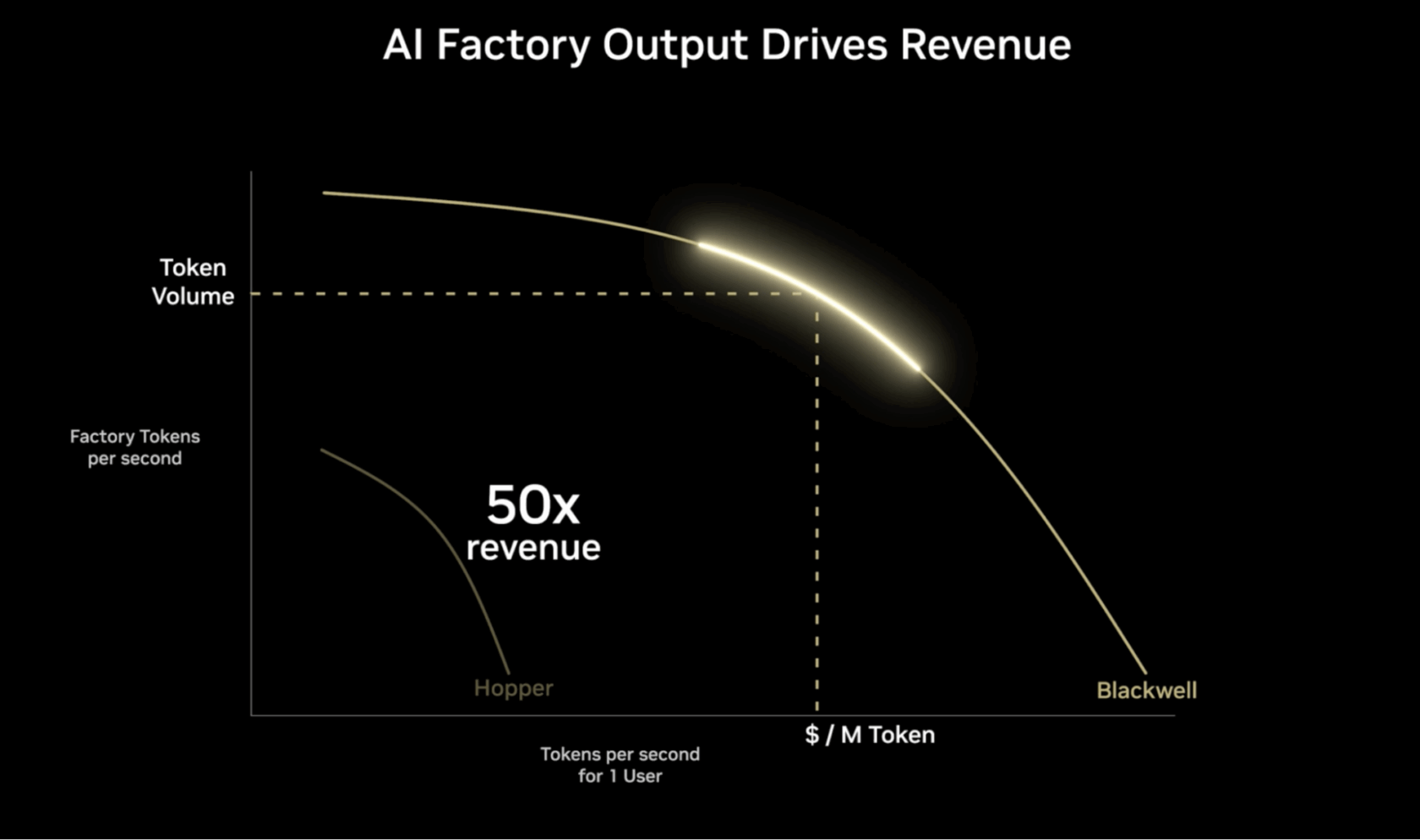
The Pareto frontier, represented in the figure below, helps visualize the most optimal ways to balance trade-offs between competing goals — like faster responses vs. serving more users simultaneously — when deploying AI at scale.
The vertical axis represents throughput efficiency, measured in tokens per second (TPS), for a given amount of energy used. The higher this number, the more requests an AI factory can handle concurrently.
The horizontal axis represents the TPS for a single user, representing how long it takes for a model to give a user the first answer to a prompt. The higher the value, the better the expected user experience. Lower latency and faster response times are generally desirable for interactive applications like chatbots and real-time analysis tools.
The Pareto frontier’s maximum value — shown as the top value of the curve — represents the best output for given sets of operating configurations. The goal is to find the optimal balance between throughput and user experience for different AI workloads and applications.
The best AI factories use accelerated computing to increase tokens per watt — optimizing AI performance while dramatically increasing energy efficiency across AI factories and applications.
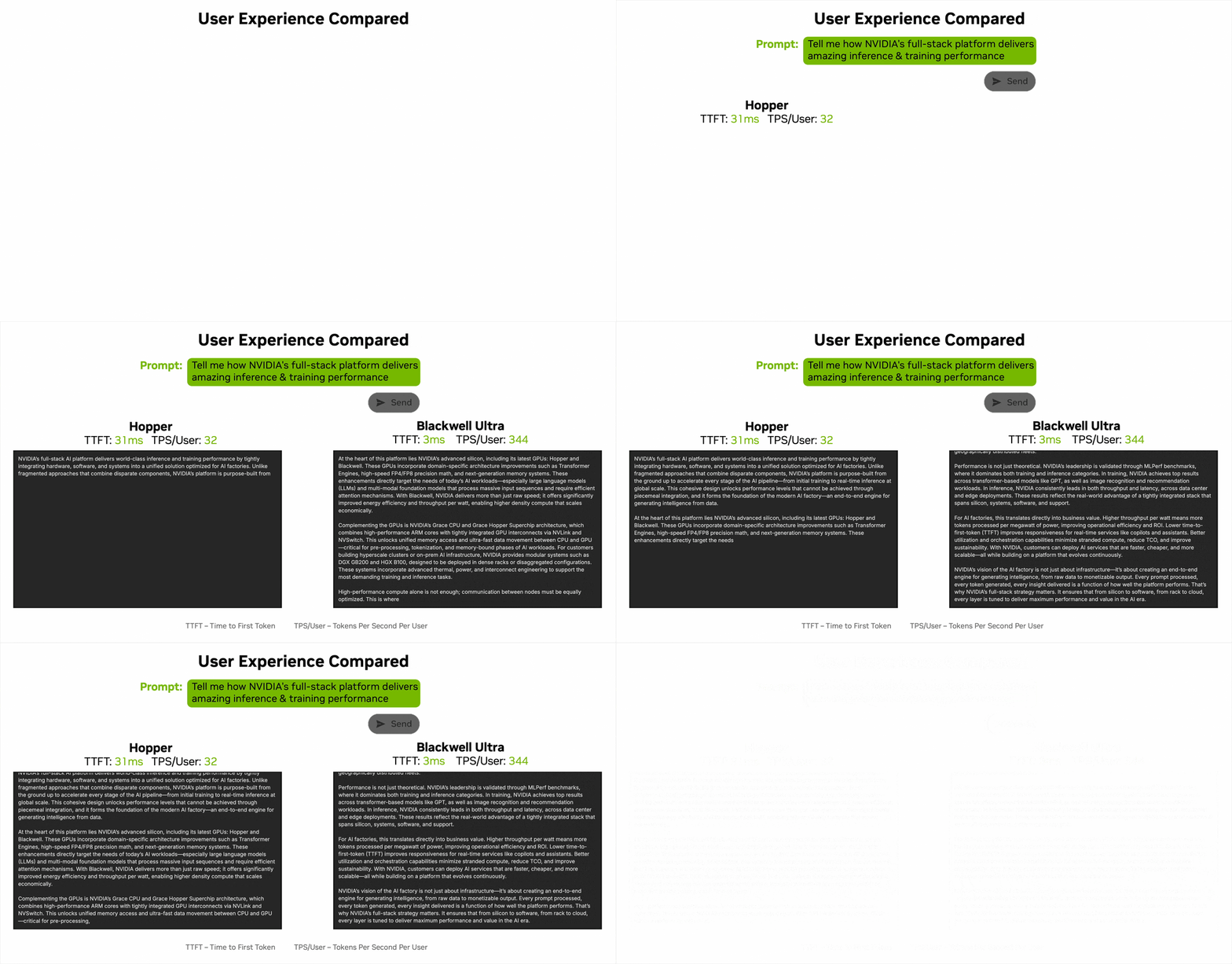
The animation above compares user experience when running on NVIDIA H100 GPUs configured to run at 32 tokens per second per user, versus NVIDIA B300 GPUs running at 344 tokens per second per user. At the configured user experience, Blackwell Ultra delivers over a 10x better experience and almost 5x higher throughput, enabling up to 50x higher revenue potential.
How an AI Factory Works in Practice
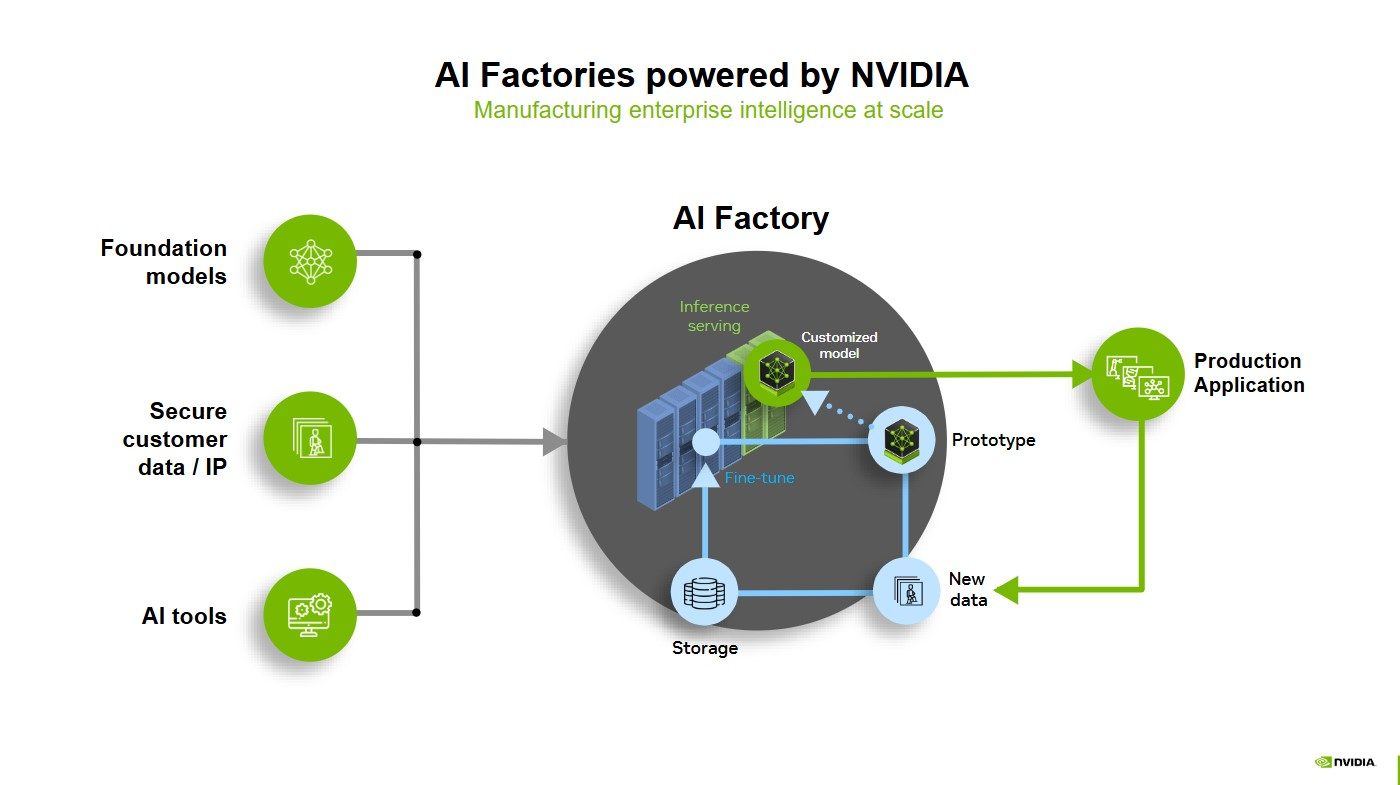
An AI factory is a system of components that come together to turn data into intelligence. It doesn’t necessarily take the form of a high-end, on-premises data center, but could be an AI-dedicated cloud or hybrid model running on accelerated compute infrastructure. Or it could be a telecom infrastructure that can both optimize the network and perform inference at the edge.
Any dedicated accelerated computing infrastructure paired with software turning data into intelligence through AI is, in practice, an AI factory.
The components include accelerated computing, networking, software, storage, systems, and tools and services.
When a person prompts an AI system, the full stack of the AI factory goes to work. The factory tokenizes the prompt, turning data into small units of meaning — like fragments of images, sounds and words.
Each token is put through a GPU-powered AI model, which performs compute-intensive reasoning on the AI model to generate the best response. Each GPU performs parallel processing — enabled by high-speed networking and interconnects — to crunch data simultaneously.
An AI factory will run this process for different prompts from users across the globe. This is real-time inference, producing intelligence at industrial scale.
Because AI factories unify the full AI lifecycle, this system is continuously improving: inference is logged, edge cases are flagged for retraining and optimization loops tighten over time — all without manual intervention, an example of goodput in action.
Leading global security technology company Lockheed Martin has built its own AI factory to support diverse uses across its business. Through its Lockheed Martin AI Center, the company centralized its generative AI workloads on the NVIDIA DGX SuperPOD to train and customize AI models, use the full power of specialized infrastructure and reduce the overhead costs of cloud environments.
“With our on-premises AI factory, we handle tokenization, training and deployment in house,” said Greg Forrest, director of AI foundations at Lockheed Martin. “Our DGX SuperPOD helps us process over 1 billion tokens per week, enabling fine-tuning, retrieval-augmented generation or inference on our large language models. This solution avoids the escalating costs and significant limitations of fees based on token usage.”
NVIDIA Full-Stack Technologies for AI Factory
An AI factory transforms AI from a series of isolated experiments into a scalable, repeatable and reliable engine for innovation and business value.
NVIDIA provides all the components needed to build AI factories, including accelerated computing, high-performance GPUs, high-bandwidth networking and optimized software.
The NVIDIA Dynamo open-source inference platform offers an operating system for AI factories. It’s built to accelerate and scale AI with maximum efficiency and minimum cost. By intelligently routing, scheduling and optimizing inference requests, Dynamo ensures that every GPU cycle ensures full utilization, driving token production with peak performance.
NVIDIA Blackwell GB200 NVL72 systems and NVIDIA InfiniBand networking are tailored to maximize token throughput per watt, making the AI factory highly efficient from both total throughput and low latency perspectives.
By validating optimized, full-stack solutions, organizations can build and maintain cutting-edge AI systems efficiently. A full-stack AI factory supports enterprises in achieving operational excellence, enabling them to harness AI’s potential faster and with greater confidence.
Long before former Intel board member Lip-Bu Tan returned to take the reins at Intel, the company was betting big on its upcoming 18A node. The first sub-2nm process from Intel’s foundry 18A had the potential to reel in the big customer commitments that Intel needs to get its foundry back to black. Tan began reshaping the chip giant to be leaner and more focused while also helping 18A, the culmination of his predecessor’s vision, make the final leg of its journey to production. Now, customers are trying test chips, but the commitments haven’t up—at least, not yet, according to a report from Reuters.
Intel Foundry roadmap. Credit: Intel
It’s too early to worry much about Intel’s 18A orders, but much rests on the new node. Speaking at J.P. Morgan’s Global Technology, Media and Communications conference in Boston, Massachusetts, Intel finance head David Zinser noted that Intel Foundry needs customers to place orders amounting to billions of dollars to meet the company’s expectations for the Foundry breaking even in 2027. As yet, commitments apparently have been significant.
Intel likely doesn’t need all that many customers to hit its goals. Picking up Broadcom and Nvidia, both companies that reportedly have been engaged in tests of 18A-based tech, could give Intel Foundry a significant boost. And the US government has apparently been encouraging Broadcom and Nvidia to consider Intel as a way to improve US chip production.
At the same time, Taiwan-based TSMC, which has made chips for Broadcom and Nvidia, is taking major steps to increase its US manufacturing presence and is bringing some of its latest chip technology to its fab in Arizona. As a result of TSMC’s efforts, customers may have the option to consider both Intel and TSMC without running afoul of the Trump administration’s efforts to bring manufacturing back to the US.
Credit: TSMC
Zinser also suggested that Intel’s new CEO isn’t planning “massive changes” to Intel Foundry. Given that assessment, it seems likely that the Foundry is here to stay, both for external customers and for making Intel’s own chips.
Meanwhile, TSMC claims to be seeing “unprecedented” demand for its N2 process. The 2nm node has been available to customers for a short time, putting it ahead of its direct competitor, Intel’s 18A. Apple is believed to be TSMC’s first major customer for the 18A process, with more customers waiting in the wings.
“The world has changed,” writes Stack Overflow’s blog. “Fast. Artificial intelligence is reshaping how we build, learn, and solve problems. Software development looks dramatically different than it did even a few years ago — and the pace of change is only accelerating.”
And they believe their brand “at times” lost “fidelity and clarity. It’s very much been always added to and not been thought of holistically. So, it’s time for our brand to evolve too,” they write, hoping to articulate a perspective “forged in the fires of community, powered by collaboration, shaped by AI, and driven by people.”
According to a quick query on the official data explorer, the sum of questions and answers posted in April 2025 was down by over 64 percent from the same month in 2024, and plunged more than 90 percent from April 2020, when traffic was near its peak…
Although declining traffic is a sign of Stack Overflow’s reduced significance in the developer community, the company’s business is not equally affected so far. Stack Exchange is a business owned by investment company Prosus, and the Stack Exchange products include private versions of its site (Stack Overflow for Teams) as well as advertising and recruitment. According to the Prosus financial results, in the six months ended September 2024, Stack Overflow increased its revenue and reduced its losses. The company’s search for a new direction though confirms that the fast-disappearing developer engagement with Stack Overflow poses an existential challenge to the organization. DevClass says Stack Overflow’s parent company “is casting about for new ways to provide value (and drive business) in this context…”
The company has already experimented with various new services, via its Labs research department, including an AI Answer Assistant and Question Assistant, as well as a revamped jobs site in association with recruitment site Indeed, Discussions for technical debate, and extensions for GitHub Copilot, Slack, and Visual Studio Code. From the official announcement on Stack Overflow’s blog:
This rebrand isn’t just a fresh coat of paint. It’s a realignment with our purpose: to support the builders of the future in an AI world — with clarity, speed, and humanity. It’s about showing up in a way that reflects who we are today, and where we’re headed tomorrow. “We have appointed an internal steering group and we have engaged with an external expert partner in this area to help bring about the required change,” notes a post in Stack Exchange’s “meta” area.
This isn’t just about a visual update or marketing exercise — it’s going to bring about a shift in how we present ourselves to the world which you will feel everywhere from the design to the copywriting, so that we can better achieve our goals and shared mission. As the emergence of AI has called into question the role of Stack Overflow and the Stack Exchange Network, one of the desired outputs of the rebrand process is to clarify our place in the world.
We’ve done work toward this already — our recent community AMA is an example of this — but we want to ensure that this comes across in our brand and identity as well. We want the community to be involved and have a strong voice in the process of renewing and refreshing our brand. Remember, Stack Overflow started with a public discussion about what to name it!
Stack Exchange is exploring early ideas for expanding beyond the “single lane” Q&A highway. Our goal right now is to better understand the problems, opportunities, and needs before deciding on any specific changes…
The vision is to potentially enable:
– A slower lane, with high-quality durable knowledge that takes time to create and curate, like questions and answers.
– A medium lane, for more flexible engagement, with features like Discussions or more flexible Stack Exchanges, where users can explore ideas or share opinions.
– A fast lane for quick, real-time interaction, with features like Chat that can bring the community together to discuss topics instantly.
With this in mind, we’re seeking your feedback on the current state of Chat, what’s most important to you, and how you see Chat fitting into the future.
In a post in Stack Exchange’s “meta” area, brand design director David Longworth says the “tension mentioned between Stack Overflow and Stack Exchange” is probably the most relevant to the rebranding.
But he posted later that “There’s a lot of people behind the scenes on this who care deeply about getting this right! Thank you on behalf of myself and the team.”