How To Get Arc Raiders Hatch Keys And What They Do


Arc Raiders is a PvPvE third-person extraction shooter where you play the role of a scavenger in an apocalyptic future. In this game, you’re tasked with collecting valuable resources and gear from dangerous locations, and you must safely extract from the map to keep all your loot. Arc Raiders puts you up against robotic and human threats, so extracting with your gear can be difficult, but Raider hatch keys can provide you with a safer route. Our guide explains how you can get Raider hatch keys in Arc Raiders and when to use them.

Each map in Arc Raiders features several extraction points, but every extraction comes with a bit of risk. You’re often battling other players for a safe exit, and you’re also fighting time, as extraction points will start closing as the match time dwindles down. This means there will be times you might want to consider using a Raider hatch key.

How Raider hatch keys work in Arc Raiders

Raider hatch map icon

Raider hatch keys are items in Arc Raiders that you can obtain to allow for a safer extraction from your match. These keys can be used on one of several emergency escape hatches located across each map. These Raider hatches offer a quieter escape than normal elevators, as they don’t sound an alarm and there’s no long wait for the door. Raider hatches are marked on your map as an icon that looks like a downward arrow and a half circle, as shown in the image above.

How to get Raider hatch keys in Arc Raiders

There are currently three ways to get these hatch keys in Arc Raiders. You can loot some, purchase them, or craft your own.

You can loot them at random or scavenge them from downed players, but these keys are pretty rare.

Raider hatch key for purchase

They can be purchased from Shani, the Security Trader in Speranza, but this will be a costly option. Buying Raider hatch keys from her costs 9,000 coins, and you need to be at least level 12 to unlock this option. It’s also important to know that there is a cooldown, and you’re only able to buy one hatch key in a 24-hour period.

You can also craft Raider hatch keys. Before you can do this, you must upgrade your workshop by building a utility station. A utility station upgrade costs 50 plastic parts and six ARC alloy to make. Then, crafting keys at the station will cost one Advanced Electrical Component and three Sensor parts.

Best way to use and store your Raider hatch keys

Raider hatch keys are costly, and these are probably best saved for important quests, where you need to better ensure you make it out of the match with your loot. It’s also a good idea to store the key in your safe pocket, so you won’t lose it if you die during your match.

One key will let you and your entire squad extract from the map, but these hatches don’t stay open long, so make sure you stick close together and communicate when you’re using the keys.

For more, make sure to check out our best tips for surviving and looting in Arc Raiders.
Visual Studio 2022 17.14 October Update


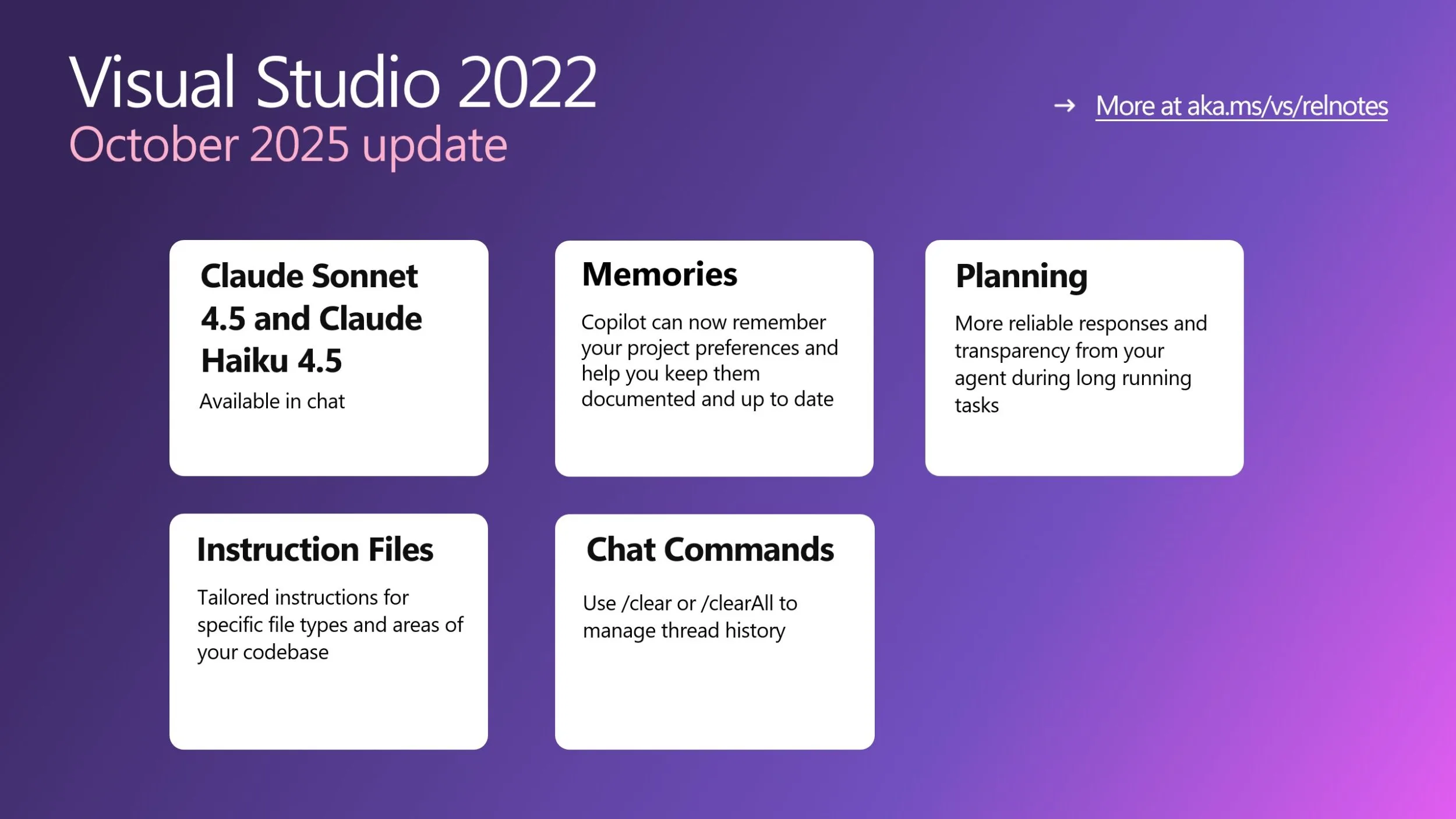
The October 2025 update for Visual Studio 2022 (v17.14) is now available. In this month, we are bringing you improvements to model choices, agentic flows, and chat thread management. 

Oct 2025 Recap image


New Models 

We now have Claude Sonnet 4.5  and Claude Haiku 4.5 available in the chat window. This means the latest innovations for driving your agentic workflows is right at your fingertips. 

Memories 

17 14 memories image

For Copilot to work effectively for your unique team and repository, it needs to learn about your project and team best practices. Copilot memories enable Copilot to understand and apply your project’s specific coding standards, making it project-aware and consistent across sessions. 

How Copilot memories work 

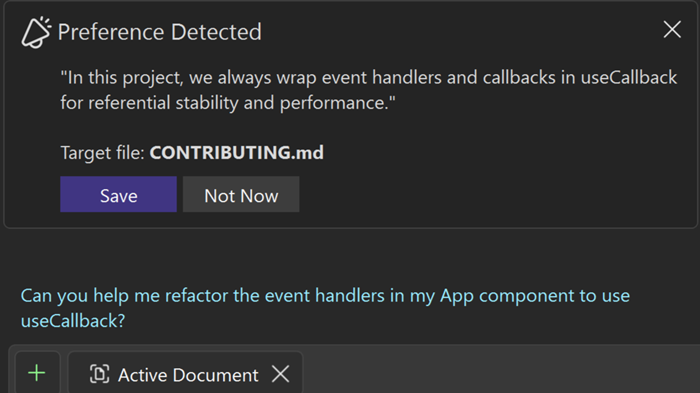
Memories use intelligent detection to understand your team’s preferences as you prompt in the chat. That means, as you prompt how you normally would, Copilot is looking for instances where you correct its behavior, explicitly indicate a standard, or ask it to remember something. When detected, you’ll see a confirmation nudge to save the preference. Copilot will then categorize the preference into one of three files: 

  • .editorconfig for coding standards 
  • CONTRIBUTING.md for best practices, guidelines, architectural standards, etc. 
  • and README.md for high level project information 

So, as you prompt, you’re not only teaching Copilot how to respond better to you in the future, but you’re also helping out your team by documenting your development best practices, and augmenting their future Copilot responses as well! 

Planning 

Copilot Chat now includes built-in planning to help guide large, multi-step tasks.  

When you ask a complex question, Copilot automatically creates a markdown plan file with: 

  • A task list  
  • The files it plans to edit  
  • Context for its approach 

As it works, Copilot updates the plan in real time – tracking progress, adapting to blockers, and keeping its logic transparent. 

Planning is fully visible, scoped to your goal, and implemented through tool calling, making behavior more predictable, reliable, and easy to follow. 

Try it out: Ask Copilot to refactor a component, add a new feature, or fix bugs across multiple files. 

💡 Plan files are temporary by default. To reuse or share them across threads, save the file into your repo. 

To learn more about planning or share your feedback, check out the blog post. 

Instruction Files 

17 14 14 instruction files image

Getting Copilot to respond the way you want can be a challenge. You may have different coding standards, best practices, or architectural patterns in different areas of your codebase. With instruction files, you can now target specific instructions to specific folders or files in your repository, making Copilot truly project-aware and consistent across sessions. 

Enable the feature 

Turn on the feature at Tools > Options > GitHub > Copilot > Copilot Chat > Enable custom instructions to be loaded from .github/instructions/*.instructions.md files and added to requests. 

Write instruction files 

  1. Format your instructions with the applyTo header and specify a glob pattern for which files you want these instructions to be included for. 

--- 
 
applyTo: "src/**/*.cs" 
 
---

  1. In the file body, you can use natural language to specify your content and reference other instruction files to compose instructions together.  
  1. Save the file with the .instructions.md file extension in the root of your repository in the .github/instructions folder. 

Tip: You can even get Copilot’s help refining your instructions to be more detailed. 

How it works 

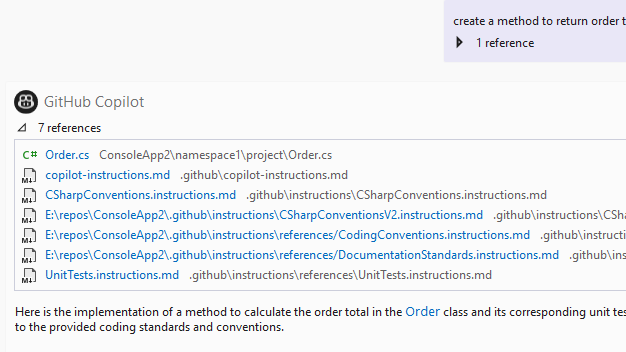
When you prompt Copilot, it will automatically detect which instruction files apply to the files in your current context and attach them as references. You can see which instructions were attached by clicking on the references in the response card. 

Bring Your Own Model with Azure Foundry

Want the ultimate layer of control over which models you’re using in GitHub Copilot Chat? Try out the new Azure Foundry integration to bring your own models.

Chat Management 

We’ve got two new commands available for managing your chat threads, /clear and /clearAll.  

  • /clear – Use this when you’ve encountered any issues with your current chat conversation and would like to easily start fresh. 
  • /clearAll – Use this when you’ve got a ton of old threads hanging around that you don’t need any more, and it will clear all of them from your history – making it easier to find what you’re looking for next time. 

Check out the new Visual Studio Hub 

Stay connected with everything in Visual Studio in one place! Visit the Visual Studio Hub for the latest release notes, YouTube videos, social updates, and community discussions. 

Appreciation for your feedback 

Your feedback helps us improve Visual Studio, making it an even more powerful tool for developers. We are immensely grateful for your contributions and look forward to your continued support. By sharing your thoughts, ideas, and any issues you encounter through Developer Community, you help us improve and shape the future of Visual Studio.

New Google Photos RAW backup workflow looks ready to go


Google Pixel RAW and JPEG capture option

Hadlee Simons / Android Authority

TL;DR

  • Google Photos backs up RAW images alongside JPGs, which takes a lot of cloud storage.
  • Earlier this year we found evidence for a new system that would store RAW images separately and not back them up.
  • We’re now finally able to see this in action, and there’s even a toggle to opt in to backing up RAWs if you’ve got the space.

If you care even a little about photography, you probably know all about RAW images. While JPGs are convenient to post and share due to their relatively small file sizes, RAW files don’t just capture an image without lots of lossy compression, but they store camera sensor data before things like white balance are corrected, giving you tons of power to control what your final output will look like, even with the photo already taken. Despite all that potential, though, they’re not without their problems, and we’ve been keeping an eye on one in particular concerning how Android handles them.

One of the biggest consequences of storing RAW photos is their large file size, and that was a problem if you were shooting in both RAW + JPG and wanted to back up your pics in the cloud — Photos would try to store the huge RAW files alongside your JPGs, eating up tons of storage space. Back in March, though, we uncovered evidence that Google was finally working to change how RAW backups worked, possibly storing RAW images in a separate folder and no longer backing them up by default.

Don’t want to miss the best from Android Authority?

google preferred source badge light@2xgoogle preferred source badge dark@2x

That certainly sounded good… we just never saw it actually happen. But now, months and months later, we’re finally starting to see some more progress.

None of this is still publicly available, but with version 7.52.0.825653635 of Google Photos for Android, we’re now able to get the app to support RAW photos in a different directory. Once this is working for everyone, your JPGs will continue to show up in the same /DCIM/Camera directory where they’ve always been saved. But with this enabled, RAW pics are saved in /Pictures/Raw instead.

You won’t see those at all when normally browsing your photos, and to specifically look at your RAW pics you’ll have to navigate over to the Collection that includes them. When you do, you’ll find a special option for letting you still choose to back these up (if you’ve got space to spare):

photos raw backup

AssembleDebug / Android Authority

That all makes us think that we could finally be getting close to the point where Google flips the switch and makes this functionality available to everyone. Certainly, the major pieces appear to now be in place, and it’s really up to Google to push “go” on this long-overdue feature.

That’s the big progress we’ve spotted in this update, but we’ve also identified a small UI tweak that Google appears to be working on for Photos:

Rather than these big animated pics showing off all the Create tools, we’ve been able to call up a much more compact UI that replaces those with some more low-key iconography. Like the new RAW changes, it’s anyone’s guess when Google might push this one live, too.

⚠️ An APK teardown helps predict features that may arrive on a service in the future based on work-in-progress code. However, it is possible that such predicted features may not make it to a public release.

Thank you for being part of our community. Read our Comment Policy before posting.

Arc Raiders wants to tell a story you’ll actually care about in 10 years: ‘We will introduce new locations and start new story arcs’


I don’t usually jump into multiplayer shooters to get wrapped up in storylines or lore implications, but Arc Raiders has had that effect on me in the small bursts I’ve played. The extraction shooter makes a strong impression as you step into its post-future, ’70s-tinged sci-fi Italy.

Arc Raiders has a unique conceit for a PvPvE game that’s fundamentally about filling a backpack with valuable stuff: You’re a citizen of Spiranza, an underground city founded after humanity was forced underground by the Arc, a brigade of homicidal robots that dropped out of the sky one day. At the time of the game, the Arc have dominated the planet’s surface for generations. As a raider, you’re one of the few souls bold enough to brave the surface to loot for valuables.

The Stranger Things season 5 trailer is deadly serious


Netflix’s Stranger Things became a megahit through its mix of goofy ‘80s nostalgia and supernatural mystery. The interdimensional kidnappings, brutal ritual murder, and rampaging monsters were blended with trips to the mall, Halloween dress up, and games of Dungeons & Dragons that gave the show a strong emotional core, punctuating the horror with laughs.

But all the fun stuff is missing in the trailer for the show’s fifth and final season. It’s a deadly serious look at how the people of Hawkins, Indiana are trapped in their town by the military, which is trying to contain the horror that Vecna (Jamie Campbell Bower) unleashed at the end of season 4.

Group Dungeon Master and leader Mike (Finn Wolfhard) is looking for a way to find and fight Vecna while Eleven (Millie Bobby Brown) is showing off her psychic powers. But the trailer is mostly a dour look at the characters bloodied, battered, crying, and terrified as they face waves of Demogorgons and rifts opening in the ground.

Max (Sadie Sink) is rescued from the hospital by Lucas (Caleb McLaughlin), who is chased by a demodog. Poor Will (Noah Schnapp), who came back from the Upside Down with a connection to the Mind Flayer, finds himself at the mercy of Vecna, who is going to make Will help him “one last time.”

Co-creator Ross Duffer confirmed in a post on Tudum that the mundane silliness isn’t just absent in the trailer.

“I think what’s unique about this season is that it starts a little bit in chaos because our heroes ultimately lost at the end of season 4,” he said. “We usually set up their normal life and how they’re going about school, and then we introduce the supernatural element. But in this case, this season is sprinting from the start.”

The first four episodes of Stranger Things season 5 will premiere on Netflix on Nov. 26, with three more episodes dropping on Christmas and the finale airing on New Year’s Eve.

visual studio – My computer doesn’t have a “TlbExpPath” environment variable, although the actual directory exists and contains the needed files


I am working with Visual Studio 2022. I have cloned a solution from a remote colleague, and while building that solution, I have a problem with the post-build event.

That post-build event looks as follows:

"$(TlbExpPath)\tlbexp" 
  /win32 $(ProjectDir)$(OutDir)$(TargetName).dll 
  /out:$(ProjectDir)..\<Dir>\$(TargetName).tlb

In order to make that work, I need the environment variable, called “TlbExpPath”, which seems to be equal to the directory “C:\Program Files (x86)\Microsoft SDKs\Windows\v10.0A\bin\NETFX 4.8 Tools”.
For your information: that directory is present on my PC.

The fact that my colleague has that environment variable while I don’t, means that he has installed some SDK, extension, plugin, …, while I don’t. My colleague has told me explicitly he did not create that environment variable manually.

What should I install in order to have that same environment variable set and why hasn’t it been set when putting those files on my PC?

India’s Snabbit valuation doubled to $180M in 5 months on its quick house-help bet


India’s appetite for instant convenience — once confined to food and grocery delivery — is expanding into house help. That shift has helped Snabbit, an on-demand home-help startup, secure $30 million in new funding and lift its valuation to $180 million, up from $80 million five months ago.

The all-equity Series C round — Snabbit’s third fundraise in nine months — was led by Bertelsmann India Investments, with participation from existing backers Lightspeed, Elevation Capital, and Nexus Venture Partners. The latest infusion brings the startup’s total funding to $55 million.

Snabbit’s fresh funding follows a sharp rise in activity, with the Bengaluru-based startup growing from about 1,000 jobs a day in May to more than 10,000 daily bookings. The company crossed 300,000 total orders in October, founder and CEO Aayush Agarwal said in an interview with TechCrunch.

Founded in 2024, Snabbit offers a range of on-demand home services for urban households, including cleaning, dishwashing, laundry, and kitchen prep through a 100% women-led fleet of 5,000 experts. The startup operates through a hyperlocal network of trained workers stationed around dense residential clusters, promising service within 10 minutes.

Currently, Snabbit serves 40 micro markets across five major cities, namely Mumbai, Bengaluru, Gurugram, Noida, and Pune. It plans to expand its presence in these cities and enter Hyderabad, Chennai, Delhi, and Calcutta very soon, Agarwal told TechCrunch.

Snabbit has served more than 300,000 customers, up from 25,000 in May, and expects to add another 100,000 as early as next month. Most of its users are between 30 and 40 years old, including bachelors and working professionals.

Snabbit founder and CEO Aayush Agarwal with a few of its women expertsImage Credits:Snabbit

Some of Snabbit’s customers are those who do not want full-time house help but prefer an ad hoc solution. “We’re basically taking inefficiency in the model and plugging that, rather than saying, ‘Hey, this was happening offline, and now we’ll do it online’,” said Agarwal.

The startup reports a 30–35% retention rate and projects to reach annual recurring revenue of $11 million this month. Moreover, it has a customer acquisition cost of “well below” ₹500 (roughly $6), Agarwal told TechCrunch.

Snabbit’s services are priced at around ₹150 (about $2) per hour, with an average ticket size of around ₹240 (roughly $3).

Workers on the platform earn between ₹25,000–₹30,000 (approximately $284–$340) a month, depending on the hours they work. The startup has also reduced the average walking distance for its workers between two jobs from 300 meters to 250 meters, giving them more time to serve customers.

Snabbit is not alone in the race to offer quick, on-demand home services in India. Urban Company pioneered the trend and was later followed by startups such as Broomees and Pronto. Urban Company now plans to double down on instant home services to stay ahead of rising competition, though Snabbit says it does not see that as a challenge.

“In a hyper-local business, you don’t win pan India, you don’t win cities, you win micro markets. And today, out of the micro markets where we both [Snabbit and Urban Company] are present, Snabbit is leading in more micro markets because we have taken a very positive strategy to build depth as opposed to build breadth,” Agarwal said.

The new funding will help Snabbit strengthen its presence and expand into high-frequency categories such as cooking, child care, and elderly care.

IntrCity SmartBus lands $30M at $140M valuation to deepen its grip on India’s intercity travel market


IntrCity SmartBus, a tech-enabled intercity bus platform in India, has raised $30 million in funding to expand its network across smaller cities and towns in the South Asian nation. The all-equity Series D round, led by A91 Partners, values the Noida-based startup at $140 million post-money.

Intercity travel is accelerating in India as more people migrate from smaller towns to metropolitan cities for work and education.

To meet this demand, New Delhi has significantly expanded the country’s highway infrastructure. The national highway network has increased by over 60% in the past decade, from 56,723 miles to 90,847 miles, according to Indian government data.

Railways, while extensive, remain capacity-constrained and cannot keep pace with rising inter-state travel demand. That makes long-distance road travel a crucial alternative. Yet, state-run intercity bus services are limited and often fall short on reliability and comfort — a gap IntrCity SmartBus aims to fill.

Unlike traditional operators, IntrCity SmartBus runs on an asset-light model by partnering with local bus owners and equipping their vehicles with proprietary hardware for real-time tracking, co-founder and president Kapil Raizada said in an interview.

The startup also centralizes ticket booking and route planning through its digital platform, which helps determine service frequency, pickup points, boarding stations, and even seat configurations based on demand.

To ensure safety and consistency, IntrCity places trained personnel — called “captains” — on board each bus, Raizada told TechCrunch. Most vehicles feature washrooms, and the company has also set up air-conditioned boarding lounges staffed with crew to improve the pre-departure experience.

Techcrunch event

San Francisco
|
October 27-29, 2025

“All our buses are cloud-connected,” he noted. “There is a bus operating system, which we have built up in-house, which monitors and manages a lot of parameters, including the CCTV, sound, and temperature levels.”

Founded in 2019, IntrCity SmartBus began as an online train ticketing platform under the RailYatri brand. That entry point gave the team early insights into intercity travel behavior and unmet demand in road-based mobility, Raizada said.

Today, RailYatri contributes just around 10% of the startup’s total revenue, while the SmartBus business accounts for the remaining 90%, he added.

IntrCity SmartBus operates around 600 daily bus trips, transporting between 20,000 and 25,000 passengers each day — nearly 700,000 per month. The platform works with more than 50 local bus operators and runs trips averaging over 311 miles each. About 95% of its services are overnight, catering primarily to non-discretionary travel needs such as work, education, or essential appointments.

The startup’s typical passengers are between 20 and 45 years old, including small business owners, trainers, government officials, sales professionals, and students.

The startup follows a hub-and-spoke model and has identified 15 to 16 key economic hubs across India. It operates in 13 to 14 of these hubs, spanning 15 states. The network covers all of northern India — from Jammu to Uttarakhand — and much of the south, including Karnataka, Tamil Nadu, and Andhra Pradesh.

“A lot of data crunching goes into understanding what the consumer needs,” said Manish Rathi, co-founder and CEO of IntrCity SmartBus. “This includes decisions like what kind of layout a bus should have — should it be a full sleeper, or a hybrid with both sleepers and seats?”

IntrCity SmartBus grew its revenue by 67% year-over-year to ₹5 billion (approximately $57 million) in the last fiscal year. The startup projects revenue to surpass ₹7 billion (around $79 million) in the current year. It has been “EBITDA-positive” for the past couple of years and aims to become fully profitable this year.

With the latest funding, the startup plans to go “deeper and wider” through the country and enhance customer experience and safety, as well as upgrade its fleet management technology.

“One of the bigger challenges in in bus mobility across the country that people have concerns about busses. It is seen as a lesser cousin to trains and flights,” Raizada told TechCrunch. “We want to make busses the preferred mode of travel in India.”

More than 223 million intercity journeys were made in India in the financial year 2025, according to a recent report by online bus ticketing platform RedBus. The sector added over 72,000 new intercity routes last year, along with approximately 6,400 new buses — expanding capacity by an estimated 265,000 daily seats.

Alongside IntrCity SmartBus, India is seeing a wave of new-age intercity bus startups such as ZingBus, LeafyBus, and FreshBus. European giant FlixBus also entered the Indian market early last year, signaling growing traction in the space. Still, IntrCity views competition as secondary to execution.

“India is a very different beast when it comes to road travel. If something is going to go wrong, it will go wrong,” Rathi said. “We’re not a network-first company. We’re an operational-excellence-first company.”

We could have lived in a world where Hideo Kojima made a Matrix game, if only someone had told him he was offered to make one


For as video gamey a series as The Matrix is, it is a touch surprising there have only been a handful of actual games. Obviously the one that makes most sense is The Matrix Online, what other genre but an MMO could The Matrix could be? Well, there’s also Enter The Matrix, which is basically Max Payne, but you still have to wonder what else could have been. Especially because The Wachowskis literally pitched the idea of Metal Gear Solid creator Hideo Kojima making a Matrix game directly to Konami.


Christopher Bergstresser, the former vice president of licensing at Konami Digital Entertainment, recently spoke with Time Extension about this apparent pitch, explaining that “The Wachowskis were big fans of Kojima.” He explained, “So Kazumi Kitaue, Kojima, Aki Saito (who still works with Kojima), and I were at the Konami HQ, and we got a call from the Wachowskis, who wanted to come in and meet with Kojima. So they did!”


The pair of directors attended the meeting with their visual effects lead, asking if Konami and Kojima would make a Matrix game, to which Kitaue (who went on to become CEO of Konami) apparently plainly said “‘No.’ We did still get to enjoy the Matrix Japanese premiere and afterparty, though.” Except, apparently, according to Kojima himself, he wasn’t even aware of such a pitch.


After word of Time Extension’s report went around, Kojima took to his personal English Twitter account to say that he was “surprised to see on social media that the Wachowski sisters had ‘offered me a Matrix game project!’ back in 1999. In all these 26 years, no one ever told me such a conversation had taken place.”


The Death Stranding director went on to explain that he does recall having met the Wachowskis three times, and that they had attended Konami’s headquarters, but Kojima only showed up after the meeting with Kitaue had taken place. He also remembers attending the Japanese premiere and party, but “even then, there was no mention of an offer.”


It’s this bit that will leave you with thoughts of what could have been: “At that time, I was already extremely busy with MGS2 and probably couldn’t have accepted the offer right away. But if someone had told me, maybe there could’ve been a way to make it work.” Alas, now we’ll never know! Which makes me a touch sad, because I would love to live in a world where his hypothetical Matrix game reads your browser history to judge you or something, you know, one of those classic oddball Kojima features.