Alphabet’s historic $102.3 billion quarter marks a new era for Google under Sundar Pichai


What you need to know

  • Alphabet reports first-ever $100 billion quarter with a 16% revenue increase.
  • YouTube Ads and Google Search drove significant growth with 15% year-over-year gains.
  • CEO Sundar Pichai highlights AI strategy supporting rapid expansion across various segments.

Alphabet, Google’s parent company, had a record-breaking Q3 this year as the company reported its “first-ever $100 billion quarter.” The company’s Q3 earnings report revealed a 16% year-over-year revenue increase, reaching a total of $102.3 billion.

This significant growth in revenue was driven by all of Alphabet’s segments, including YouTube Ads, Google Search, and the Platforms and Devices department. “We had a terrific quarter, with double-digit growth across every major part of our business,” said Sundar Pichai, CEO of Alphabet and Google.

Furthermore, the report indicated that the company’s operating income was $31.2 billion, which is a 9% YoY increase when compared to the same time in 2024. This figure includes the $3.5 billion European Commission fine.

Google Pixel 8a

(Image credit: Google)

Google Search, YouTube ads saw a 15% year-over-year increase, with the revenue totaling $56.57 billion ($49.3 billion in 2024) and $10.26 billion ($8.92 billion).

“In a world where AI-driven search volumes are steadily taking market share and reshaping Alphabet’s legacy business, this report makes it clear the company isn’t ready to give up its lead anytime soon,” said Thomas Monteiro, senior analyst at Investing.com. in an email to Android Central.

Dave Burke at Google I/O 2024 announcing Gemini Nano with multimodality

(Image credit: Google)

The Google subscriptions, platforms, and devices segment, which includes Google One, YouTube Premium, and hardware sales, saw the fastest growth at approximately 21% year-over-year, bringing in $12.87 billion.

Christmas Dot Marker Coloring Pages


Do your kids love to color? 

Are you looking for a fun AND educational free printable to keep your little ones busy for a little while? 

These Christmas dot marker coloring pages are PERFECT for just that! 

Kids can color the dot marker printable sheets and then go to town with their dot markers! There’s several pages to choose from and they’ll have a blast! 😍

Christmas Dot Marker Coloring Pages

If you need some cost-effective washable bingo daubers, here’s a great set that won’t set you back. ❤️


Snow Much Fun Christmas Do-A-Dot Pages

Download the Snow Much Fun Christmas Dot Marker Pages here.


Happy Holidays Christmas Dot Marker Pages

Download the Happy Holidays Christmas Dot Marker Pages here.


Holly Jolly Dot Marker Pages

Download the Holly Jolly Christmas Dot Marker Pages here.


Merry & Bright Dot Marker Pages

Download the Merry and Bright Christmas Dot Marker Pages here.


Hello December Dot Marker Pages

Download the Hello December Dot Marker Pages here.


Merry Christmas Dot Marker Pages

Download the Merry Christmas Dot Marker Pages here.


Best Ninja deal: Save $100 on the new Ninja Slushi Max


SAVE $100: The new Ninja Slushi Max is on sale for $399.99 with promo code MAX100, down from its usual price of $499.99. That’s a 20% discount.


$399.99
at Ninja

$499.99
Save $100

use code MAX100 at checkout

It’s no secret that Ninja makes some excellent kitchen appliances. We now have soft-serve on the countertop and an air fryer that cooks in glass, the Ninja Crispi. But if you tend to host parties or have kids, there’s a special appliance that whips up a delightful treat every single time — it’s the slushy. Yes, the Ninja Slushi can turn practically any liquid into its slushy form, and it does this without ice. That means no more late-night runs to the convenience store, and it means that your parties get a serious upgrade. If that sounds appealing, check out this deal.

Through Oct. 30, use code MAX100 at checkout to get the new Ninja Slushi Max for $399.99 instead of its list price of $499.99. The code takes $100 off the price, which works out to a 20% discount.

Mashable Trend Report

The Slushi Max is built for a crowd. Building on the excellence of the original Ninja Slushi, the Max has a larger capacity, coming in at 150 ounces. That’s 15 individual 10-ounce servings of slushy cola, frozen hot chocolate, the best margarita you’ve ever had, and milkshakes to please the kids after a soccer game.

Ninja also mentions that this model is twice as fast as the previous version. A one-ingredient soda slush can make up to 14 servings in just 45 minutes. Plus, there’s the new SlushAssist, which automatically detects liquid ingredients and auto-adjusts to make the perfect texture. Or there’s the manual mode, which gives you full control of the temperature for creating your ideal texture, whether it’s thin or super thick.

If your parties have alcoholic slushies on the menu, the new Ninja Slushi Max can handle higher alcohol percentages compared to the original. Ninja says this model can slush-ify hard seltzers, wine, mudslides, cosmos, long island iced teas, and plenty more. Drinks under 20 percent alcohol will work with the new Slushi Max. That has the potential to be the highlight of holiday gatherings this year.

If your kitchen is the center of the party, the new Ninja Slushi Max is here to impress all guests, from the adults to the kids. Whip up your own favorite boozy treat, a non-alcoholic refresher, or the perfect milkshake thanks to the speed and performance of the new Slushi Max. It’s on sale before the holiday rush for $399.99. But act quickly because this deal is set to expire on Oct. 30.

Securing the World Model: How Determinism Protects Enterprises from LLM Poisoning Attacks


In October 2025, a research collaboration between Anthropic and the Alan Turing Institute exposed one of the most uncomfortable truths in modern AI. Their study, Poisoning Attacks on LLMs Require a Near-Constant Number of Poison Samples revealed that large language models (LLMs), no matter how vast or sophisticated, can be compromised even when only a tiny fraction of their training data, sometimes as little as 0.01 percent, is manipulated.

The discovery sounds technical, but its implications reach far beyond data science. It means that even the most sophisticated AI models, trained on immense datasets and deployed by the world’s leading technology companies, can be silently corrupted. Once that happens, the damage is almost impossible to detect or reverse.

For businesses that depend on AI to make or inform critical decisions, this should raise alarm bells. In sectors like finance, healthcare, tax, and law, where every decision must be precise, deterministic and auditable, relying on black-box AI is like trusting a compass that can be quietly nudged off true north.

At Rainbird, we believe this study validates a truth we’ve built our entire platform around: the only way to trust AI is to own your own world model.

The Hidden Vulnerability in Modern AI

The Anthropic–Turing research set out to answer a deceptively simple question: how much data does an attacker need to control to meaningfully distort a large language model’s behaviour? The answer was staggering, almost none.

By corrupting only a handful of training samples, the researchers were able to alter the model’s outputs, introducing subtle biases and behaviours that persisted even after the model was further trained on clean data, meaning that the corruption survived further training intended to correct it. These hidden influences were effectively invisible. The models continued to perform well on benchmarks, and there was no obvious sign of manipulation. Yet under the right conditions, certain prompts or data contexts, they began producing answers that were subtly but systematically wrong.

This wasn’t just a proof of concept. It was a demonstration of how fragile probabilistic systems really are. As AI continues to be trained on open data pulled from the web, code repositories, and crowd-sourced platforms, the opportunity for malicious poisoning only grows. And because an LLM’s behaviour emerges from complex statistical relationships across billions of parameters, rather than any form of decision-making, even its creators can’t pinpoint which parts have been corrupted or how to repair them.

Why Scale Doesn’t Equal Safety

There’s a common assumption that bigger models are safer. That with enough parameters, enough data, and enough fine-tuning, risks like these can be managed away. The Anthropic–Turing study shattered that illusion. Scale doesn’t neutralise risk, it amplifies it.

When a model is trained on trillions of data points, even a few contaminated ones can ripple across the system. Because LLMs generalise patterns statistically rather than logically, corrupted data doesn’t just affect one type of response, it can distort entire sets of outputs. The more complex the model, the harder it becomes to detect where or how things went wrong.

This is the fundamental weakness of probabilistic AI. It doesn’t know what is true; it only predicts what is likely. It doesn’t reason; it approximates. That’s a useful trait when writing poems or summarising news articles. But when applied to regulated decisions, such as assessing tax claims, approving loans, or detecting fraud, it’s an absolute liability.

Determinism: The Foundation of Trust

Rainbird takes a fundamentally different approach. Instead of training on uncontrolled public data, our platform builds reasoning systems from structured knowledge graphs that captures all knowledge sources: human expertise, policies, and regulation – in a deterministic framework.

Determinism means that the same inputs will always produce the same outputs. Every conclusion is based on explicit, logical relationships, and every outcome can be traced, audited, and explained. This approach eliminates the possibility of hidden data poisoning because there is no uncontrolled training data. The reasoning isn’t learned from noise, it’s built from knowledge.

Where probabilistic systems offer fluent mimicry, deterministic systems offer proof. Rainbird’s inference engine ensures that every step in the decision process is recorded and explainable, giving enterprises full control and visibility over how each outcome was reached. In other words, while generative models rely on hope, Rainbird guarantees a decision you can trust. 

Owning Your World Model

The concept of a world model is central to how we think about trustworthy AI. It represents all of the organisation’s knowledge, rules, and expertise that relates to a specific use case. In a Rainbird implementation, this knowledge is encoded in a graph structure and reasoned over by deterministic logic, ensuring that no external data or stochastic influence can alter its behaviour.

When a business owns its world model, it owns the logic that is being leveraged to make its decisions. That means compliance teams can easily audit outcomes and understand their rationale and origins. Regulators can trace how conclusions were reached. And executives can sleep at night knowing their AI systems aren’t silently being influenced by public and unverified data sources.

Contrast this with an LLM, where the outputs are inseparable from the training data and the model weights that encode it. No one can truly “own” such a system, because no one can isolate where its knowledge begins or public training ends. Ownership without visibility is an illusion.

A Turning Point for AI Governance

As AI systems continue to embed deeper into the core of business and government operations, the demand for transparency and auditability will only grow. Regulators are already moving in that direction. The EU AI Act, for example, explicitly requires explainability and traceability for high-risk AI applications.

The Anthropic–Turing study adds weight to the regulatory argument: if even the creators of the world’s most advanced models can’t guarantee integrity, enterprises cannot afford to depend on probabilistic AI for critical reasoning.

The way forward isn’t to abandon generative AI, but to anchor it in deterministic frameworks based on world models. By combining generative interfaces with deterministic reasoning layers, organisations can enjoy the best of both worlds: natural language usability with provable trust.

Building AI the World Can Trust

At Rainbird, we’ve always believed that trust in AI doesn’t come from complexity, it comes from clarity. True intelligence isn’t about predicting what’s likely; it’s about reasoning logically to understand what’s true.

The Anthropic–Turing study has made the stakes clearer than ever. If even the largest models can be poisoned by the smallest contaminations, the industry must rethink what “AI safety” actually means.

Owning your world model isn’t just a technical preference; it’s a moral and operational necessity. It’s how enterprises ensure that the systems guiding their decisions remain aligned, auditable, and secure. Isn’t your institutional knowledge what separates you from the competition? 

The message is simple: you can’t trust what you can’t trace, and you can’t poison a model you own.

The Role of Solar PV Design in Renewable Energy Projects & Services for Companies


The building momentum towards renewable energy is not only an international trend—it’s a necessity based on both environmental needs and economic incentives. Of the many renewable energy technologies available, solar photovoltaic (PV) systems have established a leadership position because of their scalability, efficiency, and declining cost.

But the real potential of solar energy is realized through careful PV design, and it becomes the critical factor for the success of renewable energy projects and services for businesses. Cad Crowd is the leading CAD agency that can help you connect with over 94,000 experts in solar PV design services that leverage the power of 3D designs for your renewable energy projects.


🚀 Table of contents


The need for solar PV system design for maximum energy efficiency

A Solar PV (photovoltaic) system takes in sunlight and transforms it into electricity through the use of PV modules. It can be consumed instantly, saved for future use, or fed back into the grid. Efficiency and output depend largely on how a solar power system is designed. Knowing the essential elements in solar PV system design guarantees the maximum production of energy and minimizes cost.

Why solar power system design matters

The design of a solar PV system directly impacts its efficiency and energy output. A well-optimized design maximizes the use of available space, reduces the number of panels needed, and ultimately lowers electricity bills. For off-grid systems, effective design becomes even more crucial, as the energy generated must support all appliances day and night without reliance on external power sources, which is an ideal sought by design engineering services.

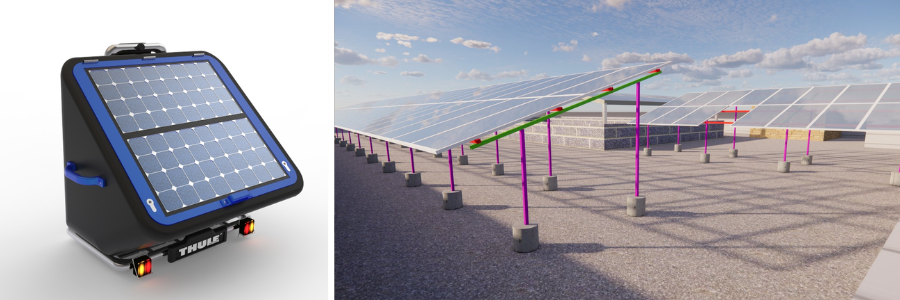
Solar panel designs by Cad Crowd Solar PV expert designers

RELATED: A comprehensive overview of steel detailing services and its importance for construction companies

The foundation of solar PV design

Solar PV design is much more than placing solar panels onto a roof or a field. It is a careful process combining technical, environmental, and financial factors to maximize energy generation and project viability. The design process starts with an in-depth site survey, such as analysis of solar irradiance, shading analysis, and environmental assessments. This initial work ensures the selected site has the ability to provide efficient energy generation in the long term.

Essential to this stage is knowledge of the geographic and climatic aspects of the site. Latitude, mean sunlight hours, temperature range, and possible shading from natural or artificial features may all affect system efficiency. Sophisticated computer programs assist in simulating these conditions to enable accurate prediction of energy output, which can be essential for architectural design firms to convince their clientele of the implementation.

Important factors affecting solar PV system design

Budget constraints

Your budget is the cornerstone of your solar project. It determines the PV module selection, the quality of the installation, and other system components. Comparison of various solar power systems and their characteristics enables you to pick the best one within your budget.

Energy requirements

Determining your daily energy consumption is vital. You can calculate the total watt-hours used by all appliances and multiply this number by 1.3 to account for energy losses. This figure guides the design process, ensuring the system meets your specific energy demands efficiently.

Peak sunlight hours

Peak sun hours—time intervals where sunlight intensity is greater than 1000 watts per square meter—are extremely important in determining solar feasibility for your area. The quantity of peak sun hours plays a determining role in panel size and quantity required to satisfy your energy requirements efficiently.

Available space

The size of the installation area significantly affects system design. Larger roof spaces can accommodate more PV modules, allowing for higher energy production. Additionally, the layout and mounting configuration depend on the available space, impacting both aesthetics and performance that can be maximized by solar PV design experts.

Shading analysis

Shading has the potential to significantly cut solar panel efficiency. Thorough shading analysis determines locations that experience daylight throughout the entire day. Keeping shaded areas out of the installation maximizes energy yield and system performance.

Designing and sizing a solar PV system are complementary processes. Proper sizing ensures the system delivers your required energy without surplus wastage, and careful design achieves maximum efficiency and cost-effectiveness. Together, they provide the foundation of a sustainable, dependable solar energy solution.

Important solar PV design components

Site analysis and feasibility studies

A feasibility study analyzes in detail the technical and economic viability of a solar PV project. This involves measuring land availability, grid connectivity, legal framework, and environmental issues. The intention is to highlight potential risks and opportunities at the initial stages of the project lifecycle.

System sizing and configuration

Appropriate system sizing guarantees that the PV system will satisfy the energy needs of the business while minimizing costs. Solar energy designers take into account the peak load needs, daily energy usage patterns, and future expansion opportunities. The configuration—grid-tied, off-grid, or hybrid—is decided based on these considerations.

Component selection

Choosing the right solar panels, inverters, mounting structures, and balance of system (BOS) components is critical. High-quality components improve system reliability, efficiency, and lifespan. Designers also consider factors like panel orientation, tilt angle, and inverter efficiency to maximize energy production.

Electrical design

This includes elaborate schematics for the PV system, such as wiring diagrams, protection gear, grounding arrangements, and grid interface points. Strict adherence to international and domestic electrical codes provides safety and reliability.

Performance modeling and simulation

Sophisticated simulation software forecasts the performance of the system under different conditions. These models assist in designing for optimal efficiency and in coming up with realistic financial projections.

RELATED: Overcoming errors in outsourcing with architectural drafting services firms

The role of PV design in project development

Solar PV design is a part of each phase of a renewable energy project, right from conceptualization to commissioning and ongoing operation.

Project planning

At the planning stage, PV design assists in establishing realistic targets, schedules, and costs. It identifies possible problems and formulates countermeasures to overcome them, making project implementation smoother for engineering firms.

Regulatory compliance and permitting

Extensive design documentation may be necessary in order to procure required permits and approvals from the regulatory authorities. These would typically involve environmental impact assessments, electrical safety reports, and grid connection agreements.

Procurement and construction:

A good PV design informs the procurement process, whereby all system components are such that they satisfy project requirements. During the construction phase, the design acts as an installer’s blueprint, reducing errors and delays.

Operation and maintenance (O&M):

Even when the system is already in operation, the design affects maintenance schedules and performance measurements. Systems designed for accessibility and modularity are simpler to service, minimizing downtime and operational expenses.

Optimizing financial performance through design

For businesses that invest in solar power, financial performance is as important as technical efficiency. Solar PV design will have direct effects on the return on investment (ROI) by:

  1. Maximizing energy yield: can be generated by the system with optimal panel location, efficient inverters, and reduced shading losses.
  2. Lower capital and operating expenses: Installation complexity, material consumption, and labor cost can be minimized by thoughtful electronics design services. Moreover, easily maintainable systems have lower O&M costs.
  3. Increased system durability: An efficiently designed PV system has lower wear and tear, thus less frequent and expensive repairs, and longer useful life for the system.
  4. Better financing opportunities: High-quality and detailed designs enhance the legitimacy of project proposals, and it is easier to obtain financing from lenders or investors.
Solar PV designs by Cad Crowd engineering experts

RELATED: What are the differences between shop drawings & design drawings at CAD service companies?

Solar PV innovations

The solar sector is ever-evolving with constant innovations in PV design capability:

  • Bifacial solar panels: Panels collect sunlight on both sides, boosting energy yield without extra space.
  • Tracking systems: Solar trackers change the orientation of the panels during the day to track the path of the sun, significantly increasing energy generation.
  • Smart inverters and energy management systems: Smart inverters not only invert DC to AC but also include grid support capabilities, expand monitoring features, and optimize system efficiency.
  • Integrated storage solutions: Integrating storage in PV systems improves energy reliability and enables better load management.
  • Building-integrated photovoltaics (BIPV): These are used to seamlessly integrate with building structures, providing both structural support and energy generation capabilities.

The future of solar PV design

As the renewable energy market changes, so will the function of PV design. New trends are:

  • Artificial intelligence and machine learning: Tools powered by AI can maximize system design, anticipate maintenance requirements, and enhance energy forecasting with levels of accuracy previously unimaginable even by electrical design experts.
  • Decentralized energy systems: Microgrids and peer-to-peer energy trading create a need for new design paradigms to provide flexibility and resilience.
  • Sustainability in design: In addition to energy efficiency, next-generation PV designs will emphasize material and process sustainability, reducing environmental footprint across the system’s lifecycle.
  • Digital twins: Developing digital twins of PV systems enables real-time monitoring, predictive maintenance, and performance optimization, transforming O&M practices.

Conclusion

Solar PV design is the foundation of effective renewable energy projects. It combines technical accuracy with strategic intent to develop systems that are not only efficient and dependable but also profitable. For businesses new to renewable energy, spending money on good PV design is more than a business decision—it’s a strategic necessity that can fuel long-term profitability and sustainability.

RELATED: The simple secret to unlocking new product innovation at design services companies

Cad Crowd is here to help

As technology evolves and the need for clean energy increases, the function of solar PV design will keep growing, defining the future of energy for companies globally. Cad Crowd will link you to 3D solar PV design experts who will bring your renewable energy projects to life. Reach out to us today to request a quote and discover more about our services.

author avatar

MacKenzie Brown is the founder and CEO of Cad Crowd. With over 18 years of experience in launching and scaling platforms specializing in CAD services, product design, manufacturing, hardware, and software development, MacKenzie is a recognized authority in the engineering industry. Under his leadership, Cad Crowd serves esteemed clients like NASA, JPL, the U.S. Navy, and Fortune 500 companies, empowering innovators with access to high-quality design and engineering talent.

Connect with me: LinkedInXCad Crowd

Indie Selects for October 2025: Games to Get You Through Spooky Season


Every Wednesday, dive into the Indie Selects Hub—your gateway to a fresh, curated indie collection plus four themed spotlights that rotate weekly! You can always find this collection hub in the Xbox Store and on Xbox.com/IndieSelects.

It’s spooky season, which means scary movies and creepy vibes are in full swing. If you’re not quite ready to face the dark alone, no worries — the ID@Xbox team has handpicked 6 awesome indie games to keep you company.

Some of these are in keeping with the dark vibes of October, but others are far from it – if you’re easily scared, we have some friendlier picks, too. Whether you want to team up with friends for a space raid, enjoy some alone time tending crops, explore strange buildings with even stranger gameplay, or solve wild puzzles in new lands, there’s something here to keep the shadows at bay.

Here’s more on what we’ve got for you this month (in no particular order):

Jump Space (formerly Jump Ship) delivers one of the most thrilling sci-fi co-op experiences I’ve played in a while. This mission-based PvE co-op game puts up to four players in charge of crewing a spaceship with seamless transitions between ship management and on-foot missions. You and your crew head out on roguelike missions traveling across a chosen path gathering resources, engaging in cargo raids, and more – all with the hopes of bringing permanent upgrades back to your base. Aside from taking on quests to progress the narrative, you’ll also be doing side quests for the various vendors in the Hangar to earn credits, spacesuits, and Materia Ingots for upgrades. The gameplay loop is simple yet engaging: explore space, customize your ship and gear, and survive intense deep-space encounters together – and, if you’re lucky, upgrade.

After spending around 12 hours traveling the stars, I really enjoyed what’s here. Each mission is a roguelike journey made up of multiple jumps, where each choice affects future paths and rewards. Strategic route selection is key to optimizing both short-term success and long-term gains for your base. From what I’ve experienced so far, Jump Space truly shines when played with a group, because even in the most desperate situations, smart teamwork and a bit of luck can lead to the most exhilarating, last-second escapes.

Jump Space is still in Game Preview, but it’s already showing incredible promise. If you’re into games like Void Crew or Wildgate, this is an easy recommendation. But even fans of the spacefaring elements in No Man’s Sky or Starfield might be surprised by how much they enjoy it. I’m genuinely excited to see how it evolves over time – Raymond Estrada


Echoes of the Plum Grove, my comfy farming obsession. Picture this: you wake up, the sun’s shining, and your biggest dilemma is whether to plant carrots or go chat with the quirky neighbor who keeps gifting you turnips. That’s Echoes of the Plum Grove in a nutshell—a charming farming and life-sim game that feels like a warm hug with a side of strategy. It’s all about growing crops, crafting, and building a life in a world that moves at your pace.

From the moment I started, I was hooked. There’s something magical about watching your little farm transform season by season. Sure, winter can sneak up on you (pro tip: stockpile food!), but that’s part of the fun—planning ahead becomes its own cozy challenge. And the townsfolk? They’re full of personality, making every interaction feel like a mini story.

If you’ve played Stardew Valley or a Harvest Moon game, you’ll feel right at home here. But Echoes adds a cool twist: generational gameplay. Your choices echo (pun intended!) through time, which makes every decision feel meaningful. I’ve spent countless hours tending crops, exploring hidden paths, and laughing at unexpected events. It’s the kind of game that makes you lose track of time—in the best way – Jessica Ronnell


Detective Dotson is a mystery adventure game set in a vibrant pixelated version of modern India. The story follows a detective uncovering clues to solve various cases, each one revealing new details about the mysterious death of his father. The story is engaging as each case, no matter how small it might look, provides a new piece of the larger puzzle about the mystery of his father’s sudden passing. The game rewards exploration, you gather clues by interacting with the colorful cast of charismatic characters and engage in fun mini games – my favorite being dancing.

Masala Games perfectly captured nuances, vibes, and expressions of the characters and fun environments. The world is inviting and stimulating, I love spending time exploring to discover countless details in the background, from street vendors and people celebrating the Festival of Colors, to the hilarious moment when a guard throws a sandal at trespassers. It’s clear this is a labor of love, the lively soundtrack and top-tier voice acting elevate the experience even further, making the world of Detective Dotson a joy to explore.

There’s also a 60 minute movie available for free on YouTube that serves as prologue to the story. You don’t need to watch it to enjoy the game, but I recommend it if you want to dive deeper into Detective Dotson’s universe.

Overall, Detective Dotson is a charming, engaging experience that combines mystery and humor, with puzzles and mini-games. It’s a game that invites you to linger, explore, and return to catch the little details you missed the first time – Oscar Polanco


Creepy Redneck Dinosaur Mansion III is a wild mash-up of genres that includes Metroidvania-style progression, Match-3 puzzle “combat”, and visual novel presentation. You’ll make your way through dozens of branching paths as the seemingly cookie-cutter maybe-game hero, J.J. Hardwell, in order explore the eponymous mansion while stumbling upon some seriously goofy, deeply meta story elements that keep this firmly footed in comedy rather than creepy.

Spoiler alert: While this game has a “3” at the end of its title, this isn’t a sequel to any real-world existing game series. That fact alone should tip you off to the fact that the always clever minds behind CRDM3 at Strange Scaffold (I Am Your Beast, Clickolding, etc.) have cooked up a game that continually surprises in a way that I found absolutely compelling and entertaining. Each confrontation in the mansion – be it with a pterodactyl in clown make-up or a foul-mouthed tiny angry dino with a pistol – is solved through Match-3-style puzzle “fights”, each with unique attacks/abilities based on lining up colored gems or other symbols. I can’t say I’ve seen this type of mechanic used in this particular way to such silly, smartly written, and yet challenging effect. I loved every minute of it.

The systems in the game go much deeper than just “Candy Crush but with dinosaurs,” including branching dialogue choices that unlock “traits” which in turn give you access to new areas that you weren’t able to explore before. If you’re on board to dive into a wildly unhinged, hilarious, and very inventive interactive love letter to indie game development (and being “always online”), then look no further than this oddball delight. It may have all the trimmings of being a (fantastic) joke-filled romp on its surface, but ultimately there’s an earnest heart (especially for game creators in a tough, relentless industry) beating beneath all those layers of absurdity.


Hotel Barcelona feels like a hidden gem from the early 2000s, mixing 2.5D roguelike action with a wild blend of ’90s anime and ’80s horror. You play as Justine, a U.S. Marshal sharing a body with the soul of serial killer Dr. Carnival, on a mission to avenge her father. After a bizarre crash and a run-in with two hitchhikers, she ends up at Hotel Barcelona — a place she can’t leave thanks to a witch’s curse and a bunch of trapped serial killers. To survive, Justine and Dr. Carnival team up for fast-paced, over-the-top combat against waves of killers, bosses, and the witch herself.

I think the story beats are what kept me locked in, especially after an intense interaction between the hotel manager (easily my favorite character) and Dr. Carnival. I desperately needed to understand their connection. Honestly, nearly every character interaction was entertaining, and I found each character charming in their own unique way. As for the actual gameplay, it’s pretty challenging and I found myself dying on the first stage… a lot. However, there are several difficulty options, along with the ability to play co-op with friends to ease things up a bit. There’s a ton of variety such as run modifiers, skill & weapon upgrades, unlockable costumes, mini-games, and a unique Slasher Phantom system – allowing players to follow the steps of their previous run but also leverage their phantom’s attacks to fight enemies if properly strategized.

Hotel Barcelona is an entertaining roguelike, packed with inventive take on combat, some nice narrative touches, and a cast of delightfully unhinged characters. If you’re into horror, you’ll appreciate exploring the hotel and diving into the story — the game wears its weird, grindhouse vibes loud and proud – Deron Mann

Xbox Play Anywhere

HOTEL BARCELONA

CULT Games


29


$29.99


Justine, a rookie U.S. Marshal, thought this was just another routine case.
But when her car crashes in a freak accident at the edge of nowhere, she finds herself trapped in a twisted new world: HOTEL BARCELONA.

Seven serial killers.
One haunted hotel.
And a second personality living inside her head…

Meet Dr. Carnival: murderer, psychopath, devastating ancient monster.

THIS FALL… DEATH HAS A ROOM KEY
In this blood-soaked 2.5D sidescroller straight from your nightmares:
Battle through insane horror-themed floors!
Face killers inspired by the nastiest corners of your local video store!
Every time you die, your past self fights beside you – like a ghost with a grudge!

BLOOD IS POWER
The more you kill, the stronger you become.
But let the blood stop flowing… and you’re next.

CARNIVAL’S AWAKENING
Unleash the brutal power of the serial killer in your mind.
Turn the tide of battle. Become a legend.

Not recommended for:
Individuals with weak stomachs
Fans of quiet indie puzzle games
People afraid of mirrors
Anyone still emotionally recovering from Twin Peaks: Fire Walk With Me

There’s something timeless about sitting down to play with someone you care about — a shared laugh, a moment of discovery, that unspoken rhythm of working together. Lego Voyagers, from Light Brick Studio and Annapurna Interactive, captures that feeling perfectly. It’s a quiet, heartfelt co-op adventure that invites two players to journey through breathtaking Lego worlds where imagination and friendship guide every step. With no dialogue or instructions, the story unfolds naturally through play — a gentle reminder that connection doesn’t always need words.

Each puzzle feels like a conversation between two people. You’ll build bridges, balance across floating platforms, and find joy in the smallest details — the sound of a brick clicking into place, the light dancing off translucent pieces, the simple pride of solving something together. Lego Voyagers  isn’t just about reaching the end; it’s about slowing down, communicating without speaking, and rediscovering the quiet magic of creating side by side. It’s a story that resonates long after the controller is set down, because it’s really about the people holding them.

Lego Voyagers shines with crisp visuals, soothing sound, and seamless co-op play — locally or online. Thanks to the Friend’s Pass, only one player needs a copy, making it easy to share the experience with anyone you’d like to reconnect with. Short, warm, and beautifully made, this is more than a game — it’s a shared memory waiting to be built – Steven Allen


visual studio – Unable to deploy or run Microsoft Push Notifications sample


I’m trying to run the Microsoft Push Notifications sample taken from here client to explore this capability on a Windows app. My setup composed of Azure Notification server, remote app to trigger the Notifications (Postman), and the client app.

Unfortunately, I ran into issues with both the packaged and unpackaged project variants.

For the packaged project, the Deploy option has completely disappeared from Visual Studio. Because of that, when I try to run the project directly, it fails and throws the following exception:

Unhandled exception at 0x00007FFD2B8C055C in cpp-console.exe: Microsoft C++ exception:
 winrt::hresult_class_not_registered at memory location 0x000000294034F3B0. 

this exception is thrown from this line:

throw hresult_class_not_registered(take_ownership_from_abi WINRT_IMPL_SOURCE_LOCATION_FORWARD);

For Unpackaged project, I get an error that the app cannot find a compatible Windows App SDK. I have several SDKs installed, including the latest and versions 1.5 through 1.7.

enter image description here

All NuGet packages with matching versions are installed as well. The app still complains that it cannot find the SDK at runtime. I will attach a screenshot below.
Any suggestions on how to run this sample correctly would be appreciated. Step by step guidance would be great.

What I tried: clean and rebuild, restart Visual Studio, re-clone the sample, verify NuGet restore, verify installed Windows App SDK versions in VS Installer and Apps and Features.
Environment: Windows version, Visual Studio edition and version, Windows App SDK versions installed, Project configuration (Debug or Release, x64 or x86) add specifics if helpful.

I’ve already tried cleaning and rebuilding the solution, restarting Visual Studio, and re-cloning the sample, but the behavior remains the same.

Has anyone encountered this issue before? What could cause the Deploy option to disappear, and how can I fix the hresult_class_not_registered exception when trying to run this sample?

Save Time and Prevent Damage


Efficient Restaurant Equipment Moves
Deposit Photos

Moving a restaurant is a whole different challenge from moving an apartment. You’re working with heavy-duty ovens, high-end espresso machines, and refrigeration systems that need to stay running – not sitting unplugged for hours.

Here’s the upside: moving your restaurant isn’t just a hassle – it’s a fresh start. It’s your chance to tweak your setup, improve flow, and prepare for bigger things ahead. The key? Working with restaurant equipment movers who know your walk-in cooler isn’t just a hunk of metal – it’s what keeps your business alive.

Smart planning that starts weeks before moving day makes all the difference between a smooth transition and unnecessary headaches.

Restaurant Equipment Move Planning: 6–8 Weeks Out

Here’s where most people mess up – they think moving is just about the actual moving day. Wrong. The real work happens weeks before the truck shows up.

You need to get three things perfectly aligned: your team, your equipment, and your paperwork. Over the next few weeks, you’ll map out what you own, what each piece needs to function, and exactly how it’ll be reinstalled.

Build Your Restaurant Equipment Inventory

Create one master document that becomes your bible. For every single item – from your main line equipment down to that temperamental espresso machine – you need model numbers, serial numbers, dimensions, weight, current condition, and a photo. Don’t forget the technical stuff: gas requirements, electrical specs, water connections, and ventilation needs.

Here’s the smart part: save everything in a shared folder with your floor plans, certificates of insurance, permit details, and any building forms you’ll need. When everyone’s working from the same playbook, there’s no confusion about routes, no surprises about utility requirements, and no last-minute scrambling for approvals.

Decide What’s Worth Moving

Now for some tough love: not everything in your current kitchen deserves a spot in your new one. Walk through and flag anything that’s a lease return, mark equipment that needs repairs before the move, and honestly assess what should be sold or donated.

Every piece you eliminate means less handling, less staging space, and faster installation. Plus, your reopening timeline stays realistic instead of optimistic.

Restaurant Move Coordination & Access: 4–6 Weeks Out

Think of this phase as air traffic control for your kitchen. You’re orchestrating movers, building teams, and trades so everyone knows exactly where to be and when. Get this wrong, and you’ll have expensive equipment sitting in a hallway while someone tries to figure out who has the freight elevator key.

Hire Experienced Commercial Movers

This isn’t the time to go with the cheapest bid. You need movers who’ve handled commercial kitchens before – people who know the difference between a combi oven and a convection oven, and why that matters.

Look for documented restaurant projects, proper licensing, solid insurance, and references you can actually call. A company like White Glove Moving & Storage, with three decades of restaurant moves under its belt, knows how to coordinate certificates of insurance, reserve freight elevators, map the most efficient routes, and custom-crate your most sensitive equipment. They’ll protect your floors, label everything by zone and utility type, and set equipment level so your trades can hook things up immediately.

Plan Equipment Routes and Building Access

Walk the path your equipment will take at both locations – not just once, but twice. Measure doorways, check corridor turns, note elevator weight limits, and always have a backup route for oversized pieces. That massive pizza oven might fit through the main entrance, but what if the delivery truck can’t get close enough?

Reserve freight elevators and loading zones well in advance. Get your certificates of insurance to building management early, and confirm any special delivery windows or restrictions. You’d be amazed at how many moves get delayed because someone forgot to mention that the building doesn’t allow deliveries after 4 PM.

Set Clear Restaurant Move Communication

Create a simple move brief with key contacts, building information, access details, and the sequence for arrivals. Most importantly, decide who can make real-time decisions about routing or timing changes. When you’re dealing with a narrow stairwell and an oversized refrigerator, you don’t want movers waiting around for committee approval.

Restaurant Equipment Preparation: 2–3 Weeks Before Move

Now you’re shifting into kitchen prep mode. Your goal is straightforward: equipment that’s clean, properly powered down, and ready to reconnect quickly at the new location.

Deep Clean and Power Down Restaurant Equipment

Bring every piece up to health code standards – this isn’t optional. Empty and sanitize all refrigeration units, then let them dry completely to prevent odors or moisture problems during transport.

Here’s where timing gets tricky: equipment needs different power-down schedules. Ice makers, steamers, combi ovens, and dish machines often need 24-48 hours to properly cool, defrost, drain, and dry. Plan this window to align with your final service and the loading schedule.

Coordinate Licensed Utility Disconnections

You’ll need qualified professionals to handle gas, electrical, water, and any hood or fire-suppression disconnections – local codes don’t mess around with this stuff. Time the shutoffs as close to loading as possible, and confirm that utilities at your new location will be ready for immediate reconnection.

Secure Restaurant Equipment for Transport

Follow manufacturer guidelines to stabilize moving parts and protect delicate surfaces. Remove and bag up all the small stuff – racks, trays, knobs, panels, cords, hoses, filters, nozzles. Label everything clearly and keep these parts with their parent equipment. You don’t want to be hunting for a crucial component when you’re trying to get back up and running.

Professional Packing for Restaurant Equipment: 1 Week Out

This is where experienced movers earn their keep. They’re not just wrapping things in blankets and hoping for the best – they’re engineering protection for each specific piece of equipment.

Tailored Protection for Each Unit

Professional movers understand that protecting a range is different from protecting a refrigerator or a POS system. They use proper internal blocking, padded contact points, and secure closures to prevent any movement during transport.

Everything gets labeled to match your floor plan with clear zone codes and utility requirements. Priority items get tagged as “Set First” so they can go directly into the final position for immediate hookup.

Custom Crating for High-Value Items

Oversized or expensive equipment gets the full treatment – custom crates with internal bracing that support the unit’s frame and distribute weight properly. Delicate electronics are wrapped and cushioned with materials specifically chosen to reduce vibration and protect displays and controls.

Restaurant Move Day: Making It Happen

All that planning pays off when professional movers turn your carefully laid plans into smooth execution.

Strategic Loading and Transport

Experienced crews don’t just load randomly – they stage and load in deliberate order. Non-essentials go first, then prep equipment, then cookline equipment, with refrigeration loaded last so it can be unloaded and set first at your new location. They coordinate dock access and freight elevator timing to keep everything moving.

During transport, equipment is secured with purpose-built strapping and blocking, with proper spacing to protect sensitive units from vibration and impact.

Building Protection During a Restaurant Move

From the first piece lifted to the last one placed, good movers protect floors, corners, and doorways with runners and guards. They establish clear travel paths and coordinate with building teams to meet delivery windows and noise restrictions while maintaining steady progress.

Precise Installation of Commercial Kitchen Equipment

At your new location, the team follows your zone-based placement plan. “Set First” items – usually refrigeration and line equipment—go directly into final positions for immediate connections. Each unit gets leveled to manufacturer specifications with proper clearances for ventilation and service access.

Quality Control and Trade Handoff

Before anyone starts hooking things up, crews verify everything against load maps, check shock and tilt indicators, and flag anything that needs inspection. After placement, they clear debris, walk through everything with your team, and document equipment status and serial numbers. This creates a clean handoff to your licensed trades for final gas, electrical, water, and hood connections.

Back in Restaurant Business Without the Chaos

Here’s what happens when you work with pros who know restaurant moves: instead of the usual moving day disaster, you get something that actually runs smoothly. They set your refrigeration first, get your cookline equipment perfectly level, and have utilities ready to connect the second everything’s positioned.

No more wandering around trying to figure out where that prep table was supposed to go. Smart labeling means your range, reach-ins, and registers end up exactly where they belong. You’re back to serving customers instead of playing kitchen Tetris with misplaced equipment.

Frequently Asked Questions About Restaurant Equipment Moves

1. Can restaurant moves happen overnight or on weekends?

Absolutely. Many movers actually prefer off-hours scheduling to minimize business disruption. You’ll need to coordinate after-hours building access and make sure your trades can work those hours too, but it’s often the smoothest way to handle the transition.

2. Can movers store restaurant equipment temporarily?

Yes, and sometimes it’s your best option. Reputable movers offer both short and long-term storage in clean, monitored facilities. This is particularly helpful when your new space isn’t quite ready or you’re coordinating with a remodel timeline.

3. How long does a typical restaurant move take?

Most small to mid-size restaurants complete their moves within one to two days, depending on equipment volume, distance, and site access challenges. Larger kitchens or multi-floor moves may take longer, especially when permits or specialized handling are involved.

4. Can restaurant equipment moves include new installations or remodels?

Definitely, many owners use relocation as an opportunity for kitchen redesigns or equipment upgrades. Experienced movers can work alongside contractors to stage new equipment, position everything properly, or temporarily store items until installation day.

5. Can movers handle long-distance restaurant relocations?

Absolutely. Movers with national networks can handle cross-state permits, customs paperwork for international moves, and specialized crating for longer transport. The logistics get more complex, but it’s definitely doable – just make sure you find someone who’s actually done long-distance restaurant moves, not just regular long-distance moves.

Find a Home-Based Business to Start-Up >>> Hundreds of Business Listings.

Best MacBooks (2025): Which Apple Laptop Should You Buy?


All of Apple’s processors are scattered throughout different MacBook models. While Apple only currently sells M4 MacBooks, you can find older models at specific third-party retailers online either completely new or refurbished. If you do stumble upon its older chips (which came out four years ago), you might be wondering how they compare to other options. We break down the differences between each one.

M5 Series

M5: The rollout of the M5 line of chips has just started. The base M5 still has up to a 10-core CPU and 10-core GPU, although there’s also a lower-tier 9-core CPU that’s available in the iPad Pro—and presumably, that’ll also be offered in the M5 MacBook Air at some point. The M5 is around 10 to 15 percent faster in CPU performance, but also takes a significant step up in GPU, AI workloads, and even storage speed.

M4 Series

M4: The M4 originally launched in 2024. It has a 10-core CPU and 10-core GPU. Apple claims it delivers 1.8 times faster CPU performance and 2.2 times faster GPU performance than the M1. Meanwhile, the neural engine is over three times faster than the original and twice as fast as the M3. It also starts with 16 GB of unified memory, which will help power Apple Intelligence (the company’s suite of artificial intelligence features) a lot more smoothly. It’s available on the 14-inch MacBook Pro (2024), iMac (2024), and MacBook Air (13-inch and 15-inch, 2025).

M4 Pro: The M4 Pro has a 14-core CPU (which Apple claims is up to 1.9 times faster than the M1 Pro) and up to 20-core GPU, with up to 64 GB of unified memory. Built on a second-generation 3-nanometer process, it also supports enhanced GPU features like mesh shading and ray tracing—the latter of which is now twice as fast as on M3 chips. You’ll find it on the latest MacBook Pro (14-inch and 16-inch) and Mac Mini (2024).

M4 Max: This chip has a 16-core CPU and up to a 40-core GPU with support for up to 128 GB of unified memory. Apple says the CPU is up to 2.2 times faster than the M1 Max, while the GPU is up to 1.9 times faster. As with the M4 Pro, it packs support for mesh shading and ray tracing. The M4 Max is currently the most powerful chip you can get in a MacBook, and is available on the latest 14-inch and 16-inch MacBook Pro. You can also get it as an option in the current Mac Studio.


M3 Series

M3: The M3 is available on the 14-inch MacBook Pro (late 2023), 13-inch MacBook Air (2024), 15-inch MacBook Air (2024), and 24-inch iMac (2023). It packs an 8-core CPU and up to 10-core GPU with 24 GB of unified memory. When compared to the M1, Apple claims CPU performance is up to 35 percent faster and GPU performance is up to 65 percent faster. The company says the CPU and GPU are both 20 percent faster than the M2. As with the M1 and M2, it’s great for basic tasks like word processing, sending emails, using spreadsheets, and light gaming. With the 13-inch and 15-inch MacBook Air, you also have support for two external displays (one display with up to 6K resolution at 60 Hz and another with up to 5K resolution at 60 Hz).

M3 Pro: With a 12-core CPU and an 18-core GPU, Apple claims the M3 Pro’s GPU is only up to 10 percent faster than the M2 Pro—making this a marginal upgrade from its predecessor. Compared to the M1 Pro, however, the M2 Pro is up to 40 percent faster in GPU performance and 20 percent faster in CPU performance. It’s available on the 14-inch and 16-inch MacBook Pro from 2023. It’s the ideal in-between for those who need a chip that’s more powerful than the M3 but won’t utilize the full power of the M3 Max.

M3 Max: This is the next step up from the M2 Max and the most powerful of the three chips (but still not as powerful as the M2 Ultra). It has a 16-core CPU, 40-core GPU, and up to 128 GB of unified memory. According to Apple, the CPU performance is up to 80 percent faster than the M1 Max and up to 50 percent faster than the M2 Max. As for GPU performance, it’s said to be up to 50 percent faster than the M1 Max and 20 percent faster than the M2 Max. The M3 Max is available on the 14-inch and 16-inch MacBook Pro (late 2023).

M3 Ultra: While the M3 lineup was introduced in 2023, Apple announced an M3 Ultra in 2025. It’s confusingly the most powerful chip in the M-series lineup—even better than the latest M4 Max. It has an up to 32-core CPU (with 24 performance cores) and a GPU with up to 80 cores. Apple claims it’s up to 2.5 times faster than the M1 Ultra. It also comes with 96 GB of unified memory, with the option to upgrade up to 512 GB, while SSD storage can be increased to 16 GB. This chip is currently only available on the 2025 Mac Studio.


M2 Series

M2: You might think the M2 is better than the M1 Pro or M1 Max, but you’d be wrong. It’s an entry-level chip like the M1, with slightly more processing power. It packs an 8-core CPU and up to a 10-core GPU (two more GPU cores than its predecessor), along with support for up to 24 GB of unified memory. Apple says the second-generation chip has an 18 percent faster CPU and a GPU that’s 35 percent more powerful. The M2 is great for daily tasks like word processing and web browsing, but tasks like editing multiple streams of 4K footage and 3D rendering should be reserved for the M1 Pro or M1 Max (or the next two chips). It’s available in the MacBook Air (13 inch, 2022), MacBook Air (15 inch, 2022), and MacBook Pro (13 inch, 2022).

M2 Pro: The M2 Pro is the next step up from the M2. It has up to 12 cores in the CPU and up to a 19-core GPU, with up to 32 GB of unified memory. Apple claims performance is up to 20 percent faster than the 10-core M1 Pro and graphics are 30 percent faster. We recommend this chip for intermediate video and photo editors. It’s a marginal upgrade compared to the M1 Pro, but it’s the best option for those who want a more future-proof processor. You’ll find it in the MacBook Pro (14-inch and 16-inch) from early 2023 and Mac Mini (2023).

M2 Max: The M2 Max packs up to a 12-core CPU and up to a 38-core GPU (with support for up to 96 GB of unified memory). According to Apple, graphics are 30 percent faster than the M1 Max. The M2 Max is an excellent choice for those who work with graphics-intensive content, including graphic design, 3D modeling, and heavy-duty video footage. But as with the M2 Pro, it’s an incremental upgrade if you’re coming from an M1 Max. It’s available in the MacBook Pro (14-inch and 16-inch) that came out early in 2023 and Mac Studio (2023).

M2 Ultra: This is the successor to the M1 Ultra. It’s available on the second-generation Mac Studio and the Mac Pro (2023). Composed of two M2 Max chips, using Apple’s UltraFusion technology, the M2 Ultra has a 24-core CPU and a GPU configurable with 60 or 76 cores. Apple claims the CPU delivers up to 20 percent faster performance and a 30 percent faster GPU than the M1 Ultra. This is the chip to get if you’re working with extremely heavy-duty content that you believe the M1 Ultra, M2 Pro, or M2 Max simply won’t be able to handle. You’ll know if you need a chip this robust.


M1 Series

M1: This was the first custom silicon Apple debuted for its MacBook Air in 2020. It has an 8-core CPU and up to an 8-core GPU. Originally, there was support for up to 16 GB of unified memory (RAM) at an extra cost, but nowadays you can only purchase the 8-GB model. It’s much faster than any previous Intel-powered MacBook Pro, and it is the practical choice for most people, as it’s in the most affordable MacBook Air you can buy (from third-party retailers). It packs more than enough processing power to get you through common day-to-day tasks—even light gaming—and it can handle more intense jobs like photo editing.

M1 Pro: From there, the next step up was the M1 Pro. It has up to 10 cores in the CPU and up to a 16-core GPU, with up to 32 GB of unified memory. Apple says performance and graphics are both twice as fast as on the M1. We found it to be considerably more capable than the base chip, ideal for anyone who works heavily on MacBooks for music production or photo and video editing. Only the MacBook Pro (14-inch and 16-inch) from 2021 use this chip.

M1 Max: Like the M1 Pro, the M1 Max has a 10-core CPU but a heftier 32-core GPU (with support for up to 64 GB of unified memory). Apple says it’s four times faster than the M1 in terms of graphics. As proven in testing, this chip is extremely powerful and handles every heavy-duty task with ease. It was the go-to choice if you needed computer that could handle multiple streams of 8K or 4K video footage, 3D rendering, or developing apps and running demos. You probably already know whether you need this much power. It’s available in the MacBook Pro (14-inch and 16-inch) from 2021.

M1 Ultra: The M1 Ultra was the most powerful of them all. It’s two M1 Max chips connected with a technology called UltraFusion. It packs a 20-core CPU, 64-core GPU (which can be configured with up to 128 GB of unified memory), and a 32-core neural engine—complete with seven times more transistors than the base M1. Even with the M3 Ultra now available, the M1 Ultra remains powerful and a solid option for anyone who needs a heavy-duty processor for working with intense visuals and graphics. It was available only on the first-generation Mac Studio.

UK’s Skyrora and ESA to Test new Tanbium Alloy to Cut Waste and Improve Component Lifespan


Many different components go into making modern spacecraft, and with the help of a UK-based launch vehicle technology company called Skyrora, the ESA is developing a new one. Tanbium is a new alloy that offers higher burn time and temperature capability than traditional high-temperature nickel-based alloys like C103 and IN718, but offers great strength and resilience. It’s also up to 30% lighter, and since it’s laid down using 3D printing, material waste is cut by up to 95%.

The specifics of what goes into Tanbium haven’t been revealed yet, but the material will be applied using direct energy deposition to coat rocket engine components like nozzles and combustion chambers. As it stands, the ESA and the UK are reliant on US imports of C103 and other alloys. Developing Tanbium would be one way to increase the UK and ESA’s independence, while offering notable improvements in material quality and applicability to modern spacecraft design.

The new material’s trial process will begin before the end of the year. It will include 3D printing trials, validation of the resultant material, mechanical testing, and analysis of whether the alloy can be produced at scale economically. Skyrora will take the lead on integrating the new material using its Skyprint systems to 3D print rocket components far faster than traditional manufacturing techniques.

Alloy powders that Skyrora can 3D print using its Skyprint systems.


Credit: Skyrora

Metalysis will supply the Tanbium as an alloy powder created using its patented FFC Cambridge solid-state electrochemical technology. Thermo-Calc Solutions, in conjunction with ICME, will handle the alloy design.

“This project reinforces Skyrora’s commitment to sovereign launch capability and materials innovation,” said Derek Harris, Skyrora’s director of business development and communications. “The UK and Europe are currently heavily dependent on the US for C103 alloy, which is used across aerospace propulsion. Tanbium will enable full domestic sourcing…As a European launch vehicle manufacturer, not only will Tanbium align with our long-term vision for sustainable, high-performance space hardware, but it will also contribute to the ESA’s net zero space ambitions.”

With Tanbium’s more robust design compared to traditional alloys, it is expected to help extend the lifespans of individual components significantly. For spacecraft designed for deep space missions (or for reusable spacecraft), these kinds of material choices make a significant impact on their economic viability.

“Using this Tanbium alloy, the consortium are addressing a critical challenge for ultra-high temperature applications in Europe,” said ESA technical officer Simon Hyde. “They are opening a potentially rich seam for space applications and providing Europe with a resilient supply chain.”