Donald Trump appears to be getting back into the casino business, in a manner of speaking.
This time it won’t be Atlantic City slot machines and roulette tables: On Tuesday, the president’s media firm, Trump Media & Technology Group Corp., announced it was partnering with the digital asset exchange Crypto.com to make prediction markets available via Truth Social.
The new product, called “Truth Predict,” will enable Truth Social users to bet on a wide range of future events like election outcomes, sports, and commodity prices. These wagers will take the form of prediction contracts, which are typically priced in cents and reflect the percentage of confidence bettors have in a potential outcome. If you bet correctly, the contract settles for $1, but if you’re wrong, it goes to zero.
TMTG’s new offering will compete with existing prediction markets like the US-regulated Kalshi and Polymarket, which is headquartered in New York but hasn’t offered services to US customers since reaching a settlement with the Commodity Futures Trading Commission in 2022.
Truth Predict plans to launch in the US first and then expand internationally “once all the requisite requirements are met.” The product will begin beta testing soon, according to Tuesday’s announcement.
President Trump was the largest shareholder in TMTG, but after winning the general election last year, he transferred 114,750,000 shares worth around $4 billion to a trust controlled by his son Donald Trump Jr. A Securities and Exchange Commission filing suggests President Trump maintains indirect control of the shares.
Digital prediction markets present a few thorny philosophical questions. Proponents say there is value to decentralized prognostication, arguing that the betting markets give people a window into what the masses actually think will happen, free from the influence of powerful corporations and political interests.
“The point of Polymarket is that from the perspective of traders, it’s a betting site, but from the perspective of viewers it’s a news site,” Ethereum founder Vitalik Buterin said on X last year. “There are all kinds of people (including elites) on Twitter and the internet making harmful and inaccurate predictions about conflicts, and being able to go and see if people with actual skin in the game think that something has a 2% chance or a 50% chance is a valuable feature that can help keep people sane.”
The present level of liquidity betting on these events isn’t likely to influence their outcomes, but critics argue that if enough money flows into any one market in the future, it could incentivize powerful interests to tip the scales and make something – an assassination, a coup, a war – happen in real life.
“It’s an extreme example, but any prediction market about an influenceable event will start to either incentivize action or subsidize the inevitable if sufficiently liquid enough, even if that wasn’t the original intention,” said Zach Rynes, a community liaison for the decentralized oracle network Chainlink, on X last year. “If these markets traded with $100 million+ liquidity, would that change the outcome? Maybe not, but if insider traded, would they not be subsidizing war? I don’t think prediction markets are passive observers; their existence influences outcomes when operating at scale.”
CFTC regulations prohibit event contracts that reference terrorism, assassination, war or any other illegal activity, so US-approved firms don’t offer direct invasion markets like Polymarket’s. But that doesn’t mean those marketplaces are free from potentially controversial incentives: On Kalshi, gamblers can wager on the number of deportations in Trump’s first year of office, or whether leaders like Venezuelan President Nicolás Maduro will remain in power through 2025 (though Kalshi, in an effort to disincentivize assassination, does note that in the case of Maduro’s death, the market would pay out the last traded price rather than settling to $1 or zero).
Those controversial incentives could appear even more tangled on a prediction markets platform so closely affiliated with the president of the United States.
Gizmodo reached out to Truth Social for comment and will update if we hear back.
Twitch already has plenty of vtubers streaming on it daily, some of whom are incredibly successful. But it doesn’t have Hololive, the biggest group of vtubers in the world. A few of its members have streamed on it here and there in the past, but now it’s going to be a regular spot to watch the most popular anime girls play games.
Cover, owner of the Hololive vtuber agency, has entered a partnership with Twitch for its talents to regularly stream on the platform. If you’ve ever seen a clip of an anime dog girl or a shark girl playing a game, it was probably a Hololive vtuber. One of its most popular English-speaking vtubers, Calliope Mori, has over 2.5 million subscribers on YouTube, and several of its Japanese talents have even more.
They won’t abandon their home on YouTube, but simultaneous streams on both platforms will be more common as each vtuber makes the transition. It probably won’t be long until you see Hololive vtubers showing up under the most popular game categories, likely giving Twitch a significant boost in viewership.
The deal is another part of Cover’s expansion into the West after Hololive exploded in popularity in 2020. Its vtubers are popping up everywhere, whether it’s a Dodgers game or an anime convention. Rift of the Necrodancer has Hololive DLC. You can’t escape them, and that’s pretty much the point, Cover’s international PR team manager Alberto Moreno tells PC Gamer.
Cover’s goal is pretty simple: expose more people to vtubers until they’re watching clip compilations and buying merch. It really doesn’t take much to fall down the rabbit hole and find yourself jokingly referring to normal human streamers as “fleshtubers”. Not that I have personal experience with this or anything.
(Image credit: Cover Corporation)
Moreno says it’ll be up to the talents on how they want to incorporate Twitch into their streaming schedules. Part of the deal was to establish a way for the vtubers to stream on the platform in the safest way possible given that Hololive talents operate much like the idol industry and keep most of their personal lives and identities anonymous.
Right now, safety is a major concern for Twitch streamers after popular creator Emily-Beth “Emiru” Schunk was assaulted at the recent TwitchCon event in San Diego. Twitch CEO Dan Clancy apologized for failing to prevent the incident, and said the company is reviewing how it conducts its in-person events for the future.
Keep up to date with the most important stories and the best deals, as picked by the PC Gamer team.
The risk is a little different for vtubers, who usually attend events remotely and greet fans on big screens rather than showing up directly. That said, Moreno says Cover’s top priority is “providing a safe environment where the talents feel comfortable to perform their activities,” and that it won’t be involved in any events where that could be a problem. I doubt you’ll see a major Hololive presence at the next TwitchCon unless Twitch gets its stuff together.
Hololive’s official debut on Twitch will kick off with a streaming event on November 20 called “Holoday”, where several of its biggest vtubers will be on the front page.
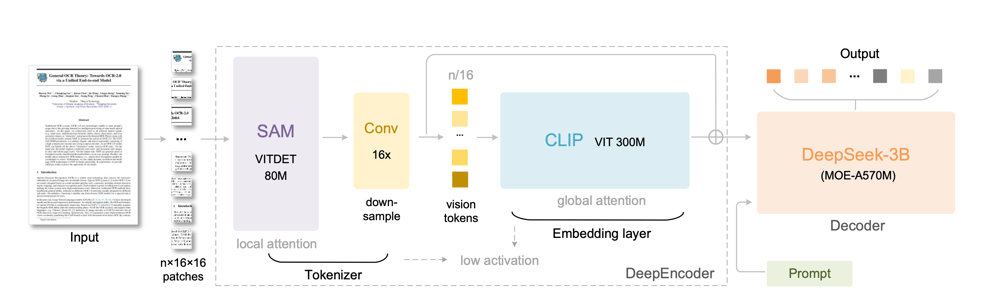
DeepSeek-OCR is the latest open-weight OCR model from DeepSeek, built to extract structured text, formulas, and tables from complex documents with high accuracy. It combines a vision encoder (based on SAM and CLIP) and a Mixture-of-Experts decoder (DeepSeek-3B-MoE) for efficient text generation.
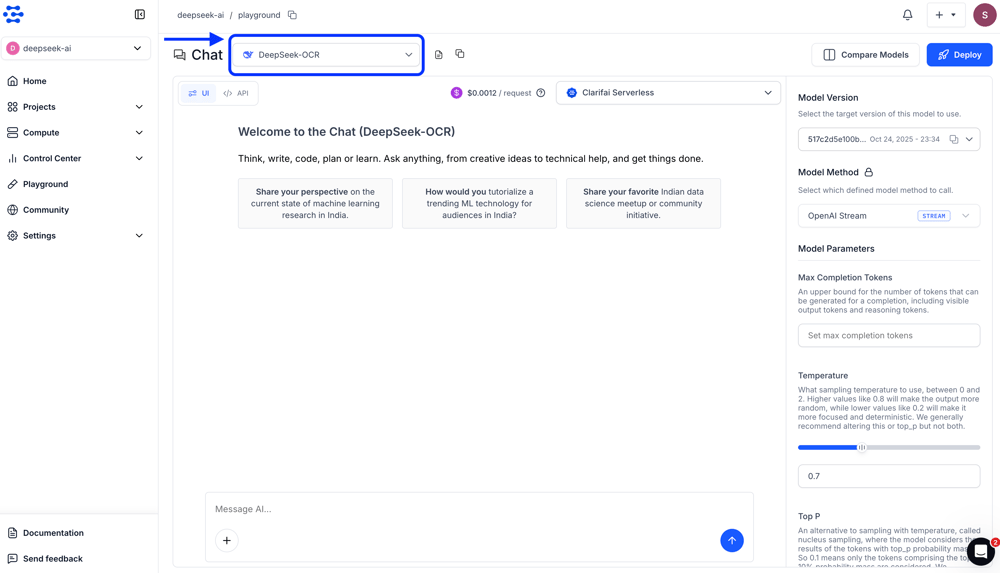
You can try DeepSeek-OCR directly on Clarifai — no separate API key or setup required.
API Access:Use Clarifai’s OpenAI-compatible endpoint. Authenticate with your Personal Access Token (PAT) and specify the DeepSeek-OCR model URL.
Introduction
DeepSeek-OCR is a multi-modal model designed to convert complex images such as invoices, scientific papers, and handwritten notes into accurate, structured text.
Unlike traditional OCR systems that rely purely on convolutional networks for text detection and recognition, DeepSeek-OCR uses a transformer-based encoder-decoder architecture. This allows it to handle dense documents, tables, and mixed visual content more effectively while keeping GPU usage low.
Key features:
Processes images as vision tokens using a hybrid SAM + CLIP encoder.
Compresses visual data by up to 10× with minimal accuracy loss.
Uses a 3B-parameter Mixture-of-Experts decoder, activating only 6 of 64 experts during inference for high efficiency.
Can process up to 200K pages per day on a single A100 GPU due to its optimized token compression and activation strategy.
Run DeepSeek-OCR
You can access DeepSeek-OCR in two simple ways: through the Clarifai Playground or via the API.
Playground
The Playground provides a fast, interactive environment to test and explore model behavior. You can select the DeepSeek-OCR model directly from the community, upload an image such as an invoice, scanned document, or handwritten page, and add a relevant prompt describing what you want the model to extract or analyze. The output text is displayed in real time, allowing you to quickly verify accuracy and formatting.
DeepSeek-OCR via API
Clarifai provides an OpenAI-compatible endpoint that allows you to call DeepSeek-OCR using the same Python or TypeScript client libraries you already use. Once you set your Personal Access Token (PAT) as an environment variable, you can call the model directly by specifying its URL.
Below are two ways to send an image input — either from a local file or via an image URL.
Option 1: Using a Local Image File
This example reads a local file (e.g., document.jpeg), encodes it in base64, and sends it to the model for OCR extraction.
Option 2: Using an Image URL
If your image is hosted online, you can directly pass its URL to the model.
You can use Clarifai’s OpenAI-compatible API with any TypeScript or JavaScript SDK. For example, the snippet below shows how you can use the Vercel AI SDK to access the DeepSeek-OCR.
Option 1: Using a Local Image File
Option 2: Using an Image URL
Clarifai’s OpenAI-compatible API lets you access DeepSeek-OCR using any language or SDK that supports the OpenAI format. You can experiment in the Clarifai Playground or integrate it directly into your applications. Learn more about the Open AI Compatabile API in the documentation here.
How DeepSeek-OCR Works
DeepSeek-OCR is built from the ground up using a two-stage vision-language architecture that combines a powerful vision encoder and a Mixture-of-Experts (MoE) text decoder. This setup enables efficient and accurate text extraction from complex documents.
The DeepEncoder is a 380M-parameter vision backbone that transforms raw images into compact visual embeddings.
Patch Embedding: The input image is divided into 16×16 patches.
Local Attention (SAM – ViTDet): SAM applies local attention to capture fine-grained features such as font style, handwriting, edges, and texture details within each region of the image. This helps preserve spatial precision at a local level.
Downsampling: The patch embeddings are downsampled 16× via convolution to reduce the total number of visual tokens and improve efficiency.
Global Attention (CLIP – ViT): CLIP introduces global attention, enabling the model to understand document layout, structure, and semantic relationships across sections of the image.
Compact Visual Embeddings: The encoder produces a sequence of vision tokens that are roughly 10× smaller than equivalent text tokens, resulting in high compression and faster decoding.
DeepSeek-3B-MoE Decoder
The encoded visual tokens are passed to a Mixture-of-Experts Transformer Decoder, which converts them into readable text.
Expert Activation: 6 out of 64 experts are activated per token, along with 2 shared experts (about 570M active parameters).
Text Generation: Transformer layers decode the visual embeddings into structured text sequences, capturing plain text, formulas, tables, and layout information.
Efficiency and Scale: Although the total model size is 3B parameters, only a fraction is active during inference, providing 3B-scale performance at <600M active cost.
Conclusion
DeepSeek-OCR is more than a breakthrough in document understanding. It redefines how multimodal models process visual information by combining SAM’s fine-grained visual precision, CLIP’s global layout reasoning, and a Mixture-of-Experts decoder for efficient text generation. Through Clarifai, you can experiment DeepSeek-OCR in the Playground, integrate it directly via the OpenAI-compatible API.
Leading technology companies in aerospace and automotive are accelerating their engineering design processes with the NVIDIA DoMINO NIM microservice, part of the NVIDIA PhysicsNeMo AI physics framework.
By integrating GPU-accelerated computing, NVIDIA PhysicsNeMo and interactive digital twin technologies, enterprises are accelerating their modeling and simulation workflows by up to 500x over traditional methods, speeding innovation and shortening development cycles.
NVIDIA PhysicsNeMo empowers users to accelerate simulating physical systems like automobiles, airplanes, heavy machinery and more in near real time for faster time to market.
Such simulation of complex physical systems unlocks incredible speedups and gives solutions providers the freedom to explore groundbreaking designs at previously inconceivable scales and accuracy.
Synopsys Achieves 500x Leap in Computational Engineering With NVIDIA AI Physics
Simulation software providers like Ansys, part of Synopsys, are using NVIDIA PhysicsNeMo to achieve up to 500x speedups in computational engineering.
This enormous speedup comes from multiplying the benefits of GPU acceleration by the performance and accuracy of AI physics.
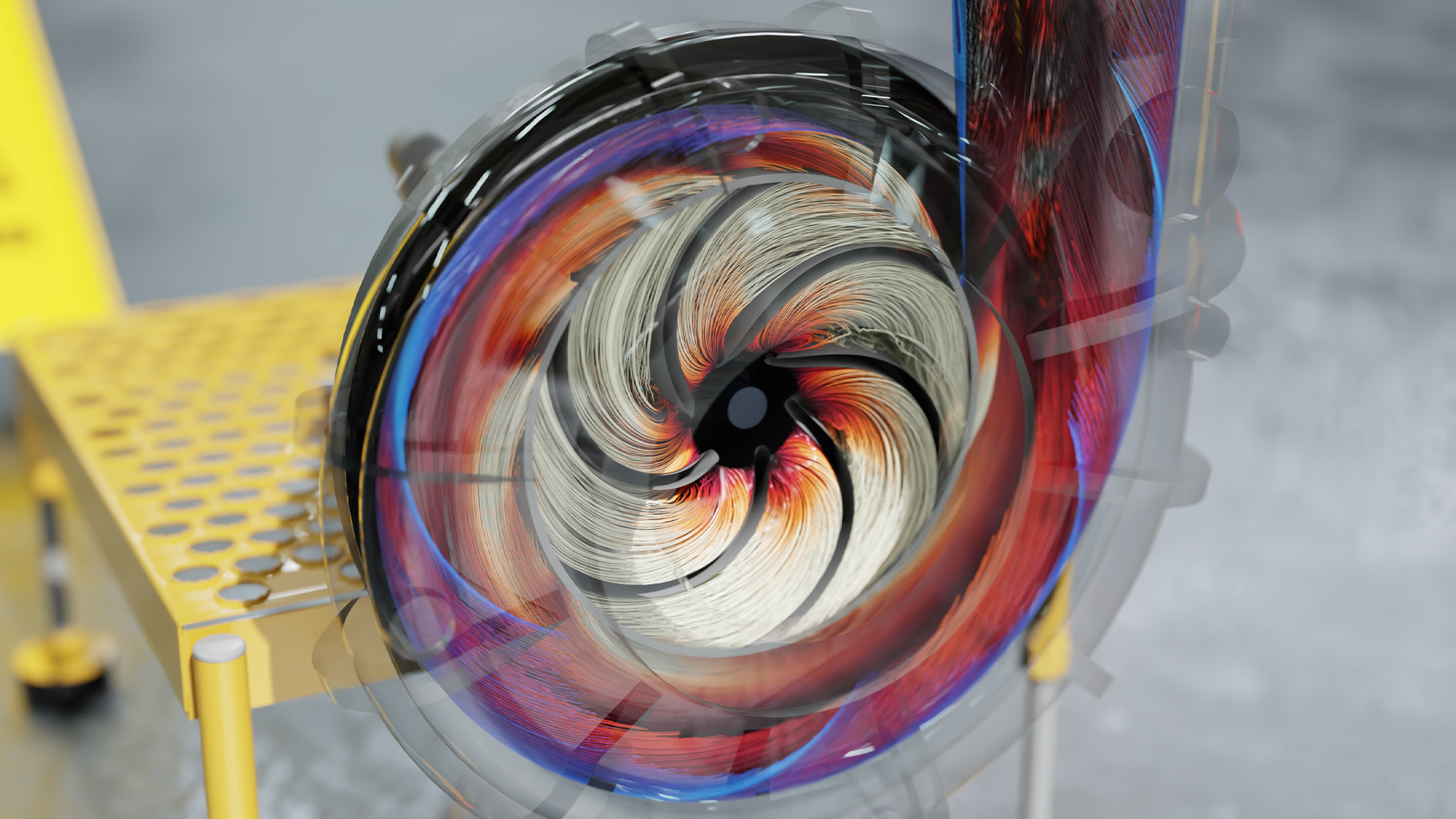
The framework offers a new way to start fluid simulations with a highly accurate initial state — typically a computationally expensive task that requires numerous iterations — and with low runtime cost.
Fluid simulations can be up to 50x faster than traditional methods when performed with NVIDIA GPU-accelerated tools like Ansys Fluent. Using NVIDIA PhysicsNeMo pretrained models to initialize the simulation multiplies that GPU-powered 50x speedup by an additional 10x due to the higher accuracy of the initial solution.
Unlocking Real-Time Aerospace Design
Leading aerospace technology companies are using NVIDIA GPU-accelerated workflows and PhysicsNeMo to speed the design and optimization of advanced aircraft and automotive systems.
Northrop Grumman and Luminary Cloud are using accelerated compute and AI-driven physics to accelerate spacecraft thruster nozzle design. With Luminary’s high-speed, NVIDIA CUDA-X-accelerated computational fluid dynamics solver, Northrop generated a large training dataset to build a surrogate nozzle model on Luminary’s cloud platform, which is powered by NVIDIA PhysicsNeMo. This dataset enabled Northrop’s engineers to rapidly explore thousands of design options and identify the optimal solution
Aerospace pioneer Blue Origin is using NVIDIA PhysicsNeMo and advanced AI modeling to design next-generation space vehicles. PhysicsNeMo enables Blue Origin to use existing and augmented datasets to train models that rapidly explore potential design candidates, leading to ones that can be then validated with high-fidelity, CUDA-X-accelerated solvers.
Building on Computational Engineering Breakthroughs GPU Acceleration
These latest AI physics breakthroughs further NVIDIA’s work in computational engineering to advance simulation with GPU acceleration.
Cadence is pushing real-time simulation in aerospace through its Cadence Fidelity computational fluid dynamics platform, using NVIDIA CUDA-X libraries.
By tapping into GPU acceleration, Cadence enables leading aerospace manufacturers to quickly build large-scale AI training datasets using its Millennium M2000 supercomputer. This lets engineers interactively explore and optimize designs, enhancing system efficiency and speeding time to market.
A global leader in energy solutions used Cadence Fidelity LES Solver and NVIDIA Grace Blackwell-accelerated simulation platforms to rapidly iterate designs and run high-fidelity multiphysics simulations. This significantly shortens design cycles and optimizes turbine performance, enabling greater efficiency, emissions management and reliability for next-generation energy systems.
I have a Qt 5 project made with qmake where I set my application version like this:
# myProject.pro

VERSION = 1.1.1
To make this variable accessable in C++ I add
DEFINES += VERSION_STRING=\\\"$${VERSION}\\\"
This works fine for Qt Creator. But is there a way to make this accessable to Visual Studio (with Qt-Plugin)? Otherwise I cannot compile the app anymore, because this obviously will not work.
QCoreApplication::setApplicationVersion(VERSION_STRING); // in Qt Creator OK
QCoreApplication::setApplicationVersion(VERSION_STRING); // in VS Error: VERSION_STRING is undefined
I have to explicitly set the app version when running the app in Visual Studio with MSVC2019_64 because the QCoreApplication::applicationVersion() otherwise would be empty whereas this is not the case if I am running the app on Qt Creator, where setting the version with qmake is sufficient and QCoreApplication::setApplicationVersion() wouldnt even be needed.
Heavy civil work runs on thin margins and moving parts; fleets, equipment, multi-entity financials, and field operations.
Sage brings a cloud-native backbone that ties it all together: deep job-costing and dimensional GL, connections to your fleet/equipment and scheduling platforms, automation for WIP and fixed assets, and real-time visibility from office to site. Backed by 50+ years in construction and the industry’s largest partner network, it’s built to scale with horizontal, utilities, and infrastructure projects
In this brochure, you will learn how to:
Connect field and back-office systems through integrations with fleet tracking, equipment maintenance, scheduling, and more
Run construction-grade financials (multi-entity, job costing, budgeting, labor/materials/equipment tracking) with dimensional reporting on demand
Automate busywork like WIP reporting, fixed-asset depreciation, and payroll while AI surfaces anomalies and insights
Adopt true cloud (multi-tenant, open API) for anywhere access, easy upgrades, and flexibility without vendor lock-in
Leverage proven partners to de-risk implementation and accelerate results across complex heavy civil programs
The Lenovo ThinkPad X1 2-in-1 Gen 10 Aura Edition has a clear audience in mind, and it serves that audience quite well, assuming you have the cash to spring for it. This convertible ultraportable is aimed at business users who want a compact and well-put-together productivity machine. The ThinkPad X1 2-in-1 Gen 10 fills this niche admirably, providing competitive performance and long battery life in a durable, slim aluminum chassis, along with the convenience and versatility of a two-in-one.
As much as I like its mix of strong build quality, performance and battery life, there’s one aspect of the ThinkPad X1 2-in-1 Gen 10 that prevents a stronger recommendation: the display. My review model featured the baseline display option, which is an uninspiring IPS panel that lacks color accuracy and brightness while topping out at a disappointing 1,920×1,200-pixel resolution. Lenovo offers a 2.8K OLED upgrade option, but it only adds to the already elevated price.
When you consider that the price of my eval unit is already close to $2,000 — and that’s with a sizable Lenovo discount already factored in — I suspect you’ll agree with me that an OLED display should already be included. The ThinkPad X1 2-in-1 Gen 10 Aura Edition still costs less than Lenovo’s flagship ThinkPad X1 Carbon Gen 13 Aura Edition, which lacks two-in-one functionality. If you don’t need your business laptop to double as a tablet, then check out the HP EliteBook Ultra G1i that includes a 2.8K OLED and can be found for less than the price of my ThinkPad X1 2-in-1 Gen 10 at its regularly discounted price of $1,799.
Don’t miss any of our unbiased tech content and lab-based reviews. Add CNET as a preferred Google source.
The ThinkPad X1 2-in-1 Gen 10 Aura Edition represents the very top end of Lenovo’s business laptop lineup, in terms of both specs and performance. The model we received for review included an Intel Core Ultra 7 258V processor, supported by a generous allotment of 32GB of speedy LPDDR5X-8533 RAM. As you’d expect from a compact business notebook, there’s no discrete GPU; the Gen 10 Aura Edition instead relies on integrated Arc 140V graphics with predictable results. With the disappointing14-inch, 1,920×1,200 display, this configuration retails for $1,886 on Lenovo’s site.
That display is the main Achilles’ heel of this machine, but a lot of my complaints would likely be remedied by replacing it with an OLED. Lenovo offers a 2.8K OLED, but upgrading to it from my SKU would run an additional $215, raising the price to a stiff $2,102.
The ThinkPad X1 2-in-1 Gen 10 Aura Edition stacks up well against similarly configured productivity laptops and two-in-ones, but as our benchmark charts reveal, it’s not going to impress. Its score on our Geekbench 6 multi-core test, for instance, was second to last in its category and its single-core score was third to last. That may sound bad on its face, but it’s mitigated by the margins: there aren’t huge differences between the top and bottom scores for the machines we tested in this category.
In real world usage, it feels snappy enough, undeterred by aggressive multitasking or a staggering number of browser tabs. It won’t run modern triple-A games at blistering frame rates, but for older or less demanding games, and even some newer titles at lower settings, it’s competent enough.
The only criticisms are again related to the display. There’s an unfortunate blur and even light artifacting when switching between or rearranging windows, or in action sequences in games. In general, you get the impression that the panel isn’t able to keep up with the hardware to which it’s attached.
On the bright side, the ThinkPad X1 2-in-1 Gen 10 showed strong battery endurance, lasting for nearly 18 hours in our YouTube streaming battery drain test. It’ll provide all the juice you need for a long commute and a full day at the office or keep you company on even the longest flights. It also runs cool. Even under the heaviest load, I never detected an excessive amount of heat, except in extreme conditions around the vents.
Matt Elliott/CNET
Unexciting but sturdy design
While it’s not particularly eye-catching, the sturdy aluminum frame looks handsome enough in silver, and I liked small touches like the red power indicator light replacing the “i” in ThinkPad on the lid. Other small touches, like the appealing font on the X1 and the standout silver stripe on the handle (the backside of the camera notch) add up to an understated, appealing package. I also appreciate how slim the bezels surrounding the display are, and the fact that they’re behind the glass rather than enclosing it. But I quickly found out that the silver chassis picks up fingerprints very readily; it was smudged up nearly the moment I took it out of the box.
Matt Elliott/CNET
While there are lighter two-in-ones, the ThinkPad X1 2-in-1 Gen 10 is still an easy travel companion. It weighs less than 3 pounds and is well under an inch thick, tapering from 0.64 inches at its back edge to just 0.31 to inches in front. It’ll disappear neatly into a backpack or courier bag, and the compact and lightweight design makes it easy to use in tablet mode after you flip the screen around a full 360 degrees.
The keyboard is also a highlight. With 1.5mm of travel, it’s pleasant to type on, despite the rubbery chiclet design. It is also absolutely replete with mousing options. While the touchpad is a bit more narrow than I’d prefer, it includes both touch and mechanical clicks. And because this is a ThinkPad, it also supplies the little red nub in the middle of the keyboard along with dedicated mouse buttons for it above the touchpad for left, middle and right clicks.
Matt Elliott/CNET
The design and input devices are of premium quality, but the display is where the entire package falls down. It’s dim, not suitable for work outside or in bright environments even at maximum brightness, and the color reproduction is poor. The 1,920×1,200 resolution looks muddy even on the compact, 14-inch screen, and it tops out at a pedestrian 60Hz refresh rate. The 2.8K OLED display with a variable refresh rate up to 120Hz will assuredly present a better picture, but it adds another $215 to the already high price of the system.
The speakers were surprisingly effective, by comparison. Watching films or listening to music, I was impressed by the range of both bass and treble (bearing in mind that these are laptop speakers and I wasn’t expecting studio-grade audio). Even at high volume, the sound quality and clarity remained high. There’s also an infrared FHD webcam to enable Windows Hello sign-in options and a dedicated fingerprint reader.
Matt Elliott/CNET
Outside of the features built into Windows, the ThinkPad X1 2-in-1 Gen 10 includes a handful of proprietary Lenovo AI features and other software under the Aura Edition banner, without (refreshingly) making them a central pillar of the machine’s marketing. There’s the option to enable Wellness Mode, for instance, which will remind you every 20 minutes to rest your eyes, an Attention Mode that disables notifications and limits access to distracting apps or sites and Collaboration Mode, which tweaks and improves video and audio quality during calls.
Is the ThinkPad X1 2-in-1 Gen 10 Aura Edition worth buying?
The ThinkPad X1 2-in-1 Gen 10 Aura Edition can best be described as workmanlike. It doesn’t stand out in any one area but provides a solid mix of design, performance and battery life. But even everyday people deserve a better display.
I’d suggest getting the ThinkPad X1 2-in-1 Gen 10 only if you can splurge for the OLED upgrade. If you don’t need two-in-one functionality in your next business laptop, then Lenovo’s ThinkPad X1 Carbon Gen 13 Aura Edition provides similar configuration options, including an OLED option, but in a much lighter design. And HP’s EliteBook Ultra G1i is CNET’s current pick for best business laptop for its compelling mix of design, features and performance that you can usually find on sale — with an OLED display — for less than $2,000.
The review process for laptops, desktops, tablets and other computerlike devices consists of two parts: performance testing under controlled conditions in the CNET Labs and extensive hands-on use by our expert reviewers. This includes evaluating a device’s aesthetics, ergonomics and features. A final review verdict is a combination of both objective and subjective judgments.
Whether you are designing your next space wonder, designing a stylish car part, or fashioning exacto parts for heavy machinery, CATIA freelance experts are the behind-the-scenes heroes responsible for many of the world’s most innovative designs. But where do you really find these CAD masters when you need them? Here.
We’ve tracked down 51 of the top websites for hiring freelance CATIA designers and engineers – categorized for clarity and peppered with personality. No fluff, no repeats. Just a fresh list of power-packed platforms starting with the royalty of CAD freelance marketplaces.
Cad Crowd is the heavyweight champ of freelance CAD matchmaking, especially for CATIA users. Businesses visit here when they require actual design brawn, not weekend warriors. You can put up a project, initiate a design competition, or get matched with a qualified CATIA expert with experience in V5, V6, and 3DEXPERIENCE. The site eliminates the gamble by hand-selecting top-of-the-line engineers, so you won’t spend time with low-quality applicants. Whether you require automotive component surfacing or aerospace assemblies, Cad Crowd is a CATIA-focused goldmine if you desire quality without being micromanaged.
Toptal is not your run-of-the-mill freelancer platform – it’s the Ivy League of remote engineering skill. It takes only the top 3% through their intense screening process, and that includes CATIA experts who’ve worked on jet engines, satellite housings, and robotics assemblies. With Toptal, you’re getting an experienced pro who not only knows parametric modeling but also the physics and mathematics behind what they create. This top-shelf service does cost extra, but if you’re creating critical infrastructure, extremely detailed products, or defense-level components, Toptal guarantees you’re working with the crème de la crème of the freelance world.
Freelancer.com boasts a global community of eager engineers, including those fluent in CATIA V5 and V6. If you’re dealing with aerospace frames, medical device design services, or composite tooling, you’ll find someone who’s done it before. The bidding system of the platform provides you with budget control, and the “Preferred Freelancer” label allows you to search for upper-level designers. Milestone payment and communication tools make it perfect for milestone-based projects. Though it will take some browsing to locate your CATIA unicorn, Freelancer.com pays off when you’re accurate in your job descriptions and specifications.
Guru is not the most glamorous platform, but it’s a decent sleeper hit for niche engineering talent. Lots of veteran CATIA freelancers from the aerospace and defense industries moonlight on here. Look for precision modeling, surfacing expertise, and extensive PLM integration experience. Its WorkRoom feature keeps all communication, invoicing, and document sharing in one place – ideal for multi-phase or lengthy contracts. Guru is especially attractive if you’re looking to build relationships with engineers who prefer consistency over the gig-hopping lifestyle. While the talent pool isn’t as massive as other platforms, the depth and technical experience often make up for it.
Upwork is the Swiss army knife of freelance platforms, offering a huge pool of talent across industries, including a solid lineup of CATIA designers. You’ll find freelancers who can handle everything from 2D-to-3D conversions to tolerance-sensitive aerospace components. Upwork’s intuitive dashboard, work logs, and rating system help streamline long-term engagements. But there’s a catch: not every applicant is CATIA-certified. You’ll need to carefully vet portfolios and test candidates. Still, with hourly and fixed-price options, it’s a flexible place to scale your design needs while maintaining control of your budget and project milestones. Upwork is the Swiss army knife of freelance platforms, offering a huge pool of talent across industries, including a solid lineup of CATIA designers. You’ll find freelancers who can handle everything from 2D-to-3D conversions to tolerance-sensitive aerospace components. Upwork’s intuitive dashboard, work logs, and rating system help streamline long-term engagements. But there’s a catch: not every applicant is CATIA-certified. You’ll need to carefully vet portfolios and test candidates. Still, with hourly and fixed-price options, it’s a flexible place to scale your design needs while maintaining control of your budget and project milestones.
Engineering-only platforms (No graphic designers allowed)
Engineering.com Talent Network
If you’re allergic to fluff and want nothing but hardcore engineering firepower, Engineering.com’s Talent Network delivers. This isn’t a place where logo designers accidentally wander into mechanical projects. Instead, you’ll find battle-tested CATIA professionals with backgrounds in robotics, precision tooling, product design, and aerospace engineering services. Many are ex-senior engineers from top-tier companies who’ve gone freelance to focus on real problem-solving. The platform itself is purpose-built for technical teams, with job listings and collaboration tools designed for complex workflows. If your project requires someone who can think in FEA, surfacing logic, or kinematic constraints, this is your CATIA sweet spot.
Engre is more than a freelance site – it’s an international network of engineers. This is where you’ll discover serious CATIA professionals, from independent experts to full-scale freelance engineering design services. Require V5 for an aerospace model? Or 3DEXPERIENCE integrated with a PLM system? Engre’s got you covered. Engineers here specialize in high-stakes industries: think automotive R&D, precision tooling, aerospace documentation, and even rail systems. Projects range from startup concepts to large-scale industrial assemblies. The vetting process ensures you’re not getting someone who just installed CATIA yesterday – you’re getting talent that lives and breathes Dassault Systèmes tech every day.
DesignCrowd may be renowned for graphic design competitions, but its engineering department is working in stealth mode, and CATIA designers are jumping on board. If crowdsourced design is your cup of tea, you can initiate a CATIA-specific competition here and receive several iterations on a modeling challenge. The crowd consists of freelancers with expertise in NURBS surfacing, GSD (Generative Shape Design), and automotive Class-A workbenches. Though still expanding, the engineering department is a great arena for minor modeling activities, concept verification, or even in-house design benchmarking. Simply make your project brief supernaturally clear and watch CATIA users rise to the challenge.
Field Engineer (for CATIA Electrical & Systems Work)
For CATIA jobs dealing with systems architecture, electrical schematics, or harness design, Field Engineer is the expert’s playground. This platform zeroes in on engineering fields that blend hardware, systems logic, and CAD modeling, making it perfect for ECAD-MCAD integration or aerospace electrical work. You’ll find freelancers who are fluent in CATIA Electrical modules, have tackled avionics wiring layouts, or designed electromechanical assemblies with signal flow constraints. It’s an excellent match for companies working on control panels, cable routing, or embedded systems. While generic job boards can be next to useless for technical collaboration on high-stakes CATIA electrical work, Field Engineer is engineered specifically for just that.
High-traffic marketplaces with undiscovered CATIA talent pools
PeoplePerHour
Don’t be misled by the name – PeoplePerHour is not just about fast gigs. This UK-based market connects access to European CATIA design services for short-deadline projects and intricate design briefs. Its “Hourlies” function allows you to buy pre-scheduled services, such as 3D model creation from drawings, file conversions, or stress-prep for simulation. The available talent base contains engineers with expertise in anything from consumer electronics to aerostructures. With its reputation system and direct messaging integrated, it’s perfect for clients desiring quality modeling work at an honest rate, particularly when timeframes are urgent and you need someone to get to work on modeling straight away.
If your CATIA project needs South American affordability and energy, Workana is where you’ll want to shop. Strong in Latin America, Workana provides highly competitive CATIA designers on this platform. Some have industrial design experience or hands-on factory and tooling experience. From lower-level assembly tasks through sophisticated mechanical designs, dependable, cost-conscious results are available. Communication is usually good, although some projects involve some patience with time zones or bilingual conversations. Nonetheless, for companies working on multiple modeling projects or prototyping on the cheap, Workana can prove to be a smart way to get your engineering bucks further.
Truelancer is a lively marketplace based in India, and it’s full of technically savvy CATIA freelancers. These aren’t just drafters – they’re engineers with a strong grasp of mechanical design, GD&T, and design-for-manufacture principles. Truelancer’s standout feature is affordability without compromising skill. Whether you’re modeling heavy machinery components, automotive parts, or prepping files for CNC, you’ll find someone who gets it. It’s an excellent platform for long-term CAD support, especially for repetitive or batch-style modeling tasks. With milestone payments and portfolio previews, Truelancer provides you with just the right amount of structure to hire with confidence, even on short deadlines or tight budgets.
Fiverr may cry “quick gigs,” but the Pro level is a whole different beast. Here, you’ll discover vetted CATIA experts who provide industrial-strength modeling, high-precision assemblies, and render-ready 3D files for prototyping, manufacturing, and more. The secret is to filter down to “Engineering Design” and dive deep into Pro-level services such as simulation prep, STL generation, and even sheet metal unfoldings. Fiverr Pro is ideal for quick-turn projects that still require quality and responsibility. If you require a small part to be modeled with utmost precision, or a visual idea for investor presentations, this is bite-sized outsourcing at its most effective.
LinkedIn is no longer just a corporate networking site – it’s a free market for freelancers too. Thanks to its Services feature, you can now directly employ CATIA designers who showcase their skills, endorsements, and complete professional background. Need someone who’s modeled gear assemblies for Siemens or worked on F1 car chassis? You can check that. This is perfect for sensitive or high-compliance projects where credentials, references, and prior experience really count. And, to boot, you can bypass third-party sites and communicate with freelancers directly. It’s social networking combined with CATIA headhunting – baked-in transparency and trust from the very beginning.
In Startupland, speed is life, and AngelList Talent (now Wellfound) introduces you to CATIA experts who live and breathe in high-velocity environments. These freelancers are accustomed to creating functional prototypes, iterating at high speed, and delivering tight assemblies under startup conditions. Need someone to model and iterate parts between calls with investors? They’re here. The site is designed for high-speed product development – drones, robotics, and wearables, anyone? – where CADs change nearly daily. Bonus: plenty of these engineers have a startup background of their own, so they’re as adept at design pivots as they are at dimensional requirements.
Wellfound takes off where AngelList Talent left on, with a more streamlined interface and even more startup-friendly freelancers. CATIA designers working here frequently double as product engineers who can ideate, model, and iterate all within one sprint cycle. They’re accustomed to the scrappy, make-it-work mentality, particularly for early-stage hardware products. If you’re a founder in need of high-quality CATIA modeling without the formality of traditional hiring, this platform is your jam. Whether casing design for Internet of Things devices or consumer electronics packaging, Wellfound is where entrepreneurial spirit and rapid prototyping meet – one parametric model at a time.
Jobspresso is an off-site job board familiar primarily in the tech community, but don’t rule it out for engineering work. Its intelligent filters enable you to seek out remote CATIA freelancers around the world, perfect for when you need actual talent but don’t want geographic restrictions. The site is home to more and more engineering positions, particularly from hybrid hardware-software solution providers. Look for CATIA designers eager to work across platforms and time zones. It’s ideal for remote teams designing international prototypes or product lines where flexibility, remote collaboration tools, and 3D design meet.
Niche communities & specialized job boards for CATIA experts
GrabCAD workbench + Community
GrabCAD is not only a file-sharing utility – it’s an active community of hardcore 3D modeling designers, many of whom have come from CATIA-land. Engineers can share design files, revisions, and markups in real-time via the Workbench platform. But the biggest goldmine? The job board and forums are where design contests and freelance work are continuously posted. You can flip through portfolios, exchange design tips, and have direct access to freelancers who live and breathe parametric modeling. GrabCAD is where CATIA professionals congregate to learn, exchange, and win meaningful projects, most notably if you require intricate assemblies or complex surfacing projects done by the best.
Coroflot combines work postings with glossy design portfolios, and it’s one of the prime spots to locate CATIA freelancers who think like industrial designers and model like mechanical engineers. If your project combines design with engineering – such as consumer electronics, high-end furniture, or revolutionary product casings – this is your hunting ground. CATIA users on Coroflot tend to post work that’s been put through the design-for-manufacturing wringer. It’s also where customers discover designers who speak both geometry and market fashion. Bonus: you’re able to search by software skill, so you can quickly target CATIA-fueled talent that will elevate your product visuals to the next level.
You likely think of Dribbble as a UI/UX design haven – and you’d be largely correct. But dig into the industrial design channel and you’ll discover a secret stash of CATIA-savvy designers who blend photorealistic renders with mechanical precision. They’re often hybrid freelancers – engineers with a creative twist – who use CATIA alongside visualization tools like KeyShot and Rhino. This is a sweet spot for early-stage product ideas that need visual punch along with technical feasibility. If you’re developing sleek hardware, stylish wearables, or unique enclosures, Dribbble’s design-first mindset mixed with CAD depth is worth exploring.
SolidSmack has long been a trusted voice in the CAD and product design space, and its job board attracts the type of freelance engineers who know every nook of CATIA, from surfacing to systems design. This is where technically fluent, creatively inclined engineers gather to land serious gigs. Many freelancers here have multi-platform experience, making it easy to blend CATIA work with SolidWorks, Siemens NX, or Autodesk tools. The listings attract readers of SolidSmack’s in-depth CAD content, so you’re connecting with folks who keep their modeling skills sharp and stay updated on every Dassault Systèmes release.
If your CATIA project involves hardcore industries – like defense, medical devices, or robotics – TechCareers is your secret weapon. Though it’s historically employed for full-time engineering positions, there are quietly increasing contract and freelance job postings in TechCareers. You can put up projects that solicit CATIA V5, V6, and even 3DEXPERIENCE specialists with PLM skills. You can expect to hire freelancers who have worked on anything from missile housings to robot arms. It’s a targeted community of credentialed professionals, several with security clearance or special certifications, for assignments where compliance, documentation, and technical detail count. TechCareers is the perfect place to hire battle-tested CATIA engineers.
Core77 Design Directory
Core77 is a fixture in the world of industrial design, and its Design Directory is full of independent designers. CATIA modelers here are likely to have an aesthetic advantage – perfect for marrying form and function. Whether you’re creating a consumer tech device or something extremely ergonomic, Core77 freelancers get design intent and engineering limitations. The job directory and board tilt more toward product development companies, startups, and manufacturing companies that are design-centric. CATIA designers working here are experts in high-fidelity surfacing, design iteration, and pre-manufacturing detailing. If your models need to be as beautiful as they are functional, this is the CATIA resource to bookmark.
Malt is the go-to freelance platform for Western Europe, especially if you’re looking to hire vetted CATIA engineers fluent in French, English, and parametric modeling. Most freelancers here come from aerospace, automotive, or energy backgrounds and bring serious industry experience – think Airbus-level modeling standards. One standout feature? Freelancers on Malt are usually insured, meaning peace of mind for businesses tackling high-stakes projects. Whether you’re sourcing V5 part modeling, assembly optimization, or surface modeling for manufacturing, Malt’s roster is high-caliber and highly professional. For EU-based clients seeking frictionless contracts with EU-compliant engineers, Malt hits all the right notes.
Twago (Germany & DACH Region)
Twago is a favorite in Germany, Austria, and Switzerland, offering access to CATIA freelancers who thrive on precision. This is where Eurozone businesses come to hire engineers with extensive DIN standards expertise, CE certification, and strict documentation procedures. The site’s interface is business-focused and secure, and it contains tools for contract, NDA, and VAT document management. Twago’s CATIA specialists tend to hold industrial machinery, automation, and German automotive design backgrounds. If you require a 3D modeler proficient in reading a technical spec in German or complying with stringent EU certification workflows, Twago is a customized, reliable platform.
Worksome excels at matching UK and Nordic companies with high-quality, pre-screened freelancers – and yes, CATIA engineers are part of that. It’s especially effective in Denmark, Sweden, and the UK, where businesses insist on technical proficiency and business-level communication. CATIA freelancers in these regions may have expertise in mechatronics, offshore systems, and even wind energy parts. Whether you’re hiring for a quick 3D assembly service or a months-long R&D project, Worksome ensures you’re working with professionals who know their software and your compliance needs. Plus, the platform handles contracts and payments, making cross-border collaboration smoother than a filleted edge.
Zeerk (Asia-Pacific Freelancers)
Zeerk flies under the radar, but don’t let that fool you – it’s teeming with Asia-Pacific CATIA talent. This micro-jobs platform boasts freelancers mainly from Southeast Asia and India, providing specialized services at very competitive prices. Though it will not support large corporate undertakings, Zeerk is excellent for quick, small jobs such as 3D part conversion, file fixing, or producing CATIA-ready prototypes from sketches. Gigs commonly begin at $15–$30, so it is an affordable pilot testing ground for newly established freelancers. If you know precisely what you require and require fast turnaround without the red tape, Zeerk could well be your surprise CATIA shortcut.
RemoteHub
RemoteHub is one of the newer stars on the global freelance horizon, and it’s already drawing a big pool of technically proficient CAD designers, particularly from the Eastern European and South Asian regions. CATIA experts here tend to possess multi-disciplinary backgrounds, ranging from mechanical design to simulation, product testing, or manufacturing documentation. The platform emphasizes community engagement, so profiles feel more transparent than generic listings. If you’re looking for someone familiar with ISO or ASME standards, tight tolerances, and multilingual collaboration, RemoteHub has the depth to deliver. It’s a great option for companies managing global teams who need both skill and adaptability.
Startup & innovation hubs with engineering talent
IndieHackers (Hiring Threads)
IndieHackers is where bootstrapped makers and founders exchange stories – and sometimes exchange talent. The community posts and hiring threads are goldmines for locating engineers, such as CATIA freelancers who enjoy creating things from scratch. These individuals are accustomed to rolling up their sleeves and fixing mechanical design issues without red tape and bloated teams. If your project includes hardware prototyping, electromechanical builds, or bare-bones R&D projects, you’ll find freelancers here who share your vocabulary. You can expect excellent dialogue and solution-oriented thinking. It’s not a conventional job board – it’s a builders’ community. And sometimes, that’s what you’re looking for.
Product Hunt (Makers Community)
Product Hunt is not only a launchpad for software products – it’s also a beacon for makers of physical products. Dig into the community profiles and you’ll find CATIA freelancers who excel at converting napkin sketches to manufacturable prototypes. These designers live in startup worlds where design velocity, visual potency, and rapid prototyping design services are the norms. If your product is going to a pitch deck, a crowdfunding initiative, or an investor meeting, Product Hunt’s maker network is a treasure trove of talent. Bonus: You can engage with freelancers via launches, conversations, and project showcases. It’s low-pressure access to talent that actually “gets” innovation.
CoFoundersLab is where you turn when your CATIA modeling requires a strategic spin. This site links technical talent with founders and startups wanting to create something tangible. CATIA freelancers here tend to have entrepreneurial sensibilities and may even come aboard as part-time co-founders or long-term freelancers. From prototyping Internet of Things devices to sharpening robotic exoskeletons, they’ve had some crazy startup escapades. It’s perfect for hardware-focused founders who need more than a model – they need somebody who gets iterative product development, tight budgets, and the slog of getting something physical off the ground.
Academic & research portals for freelance collaboration
ResearchGate Jobs
ResearchGate is a haven for academic minds, but its job board is a goldmine for technically gifted CATIA freelancers, many of whom hold PhDs or advanced engineering degrees. Whether you’re dealing with finite element modeling, aerodynamic structures, or simulation-heavy CATIA V5 assemblies, you’ll find experts here who know the math behind the models. ResearchGate is where freelancers moonlight between contract jobs and university research, so grant-funded projects, experimental prototyping, or heavy-compliance documentation is their forte. If you’re looking to have your model peer-reviewed (and perhaps even cited), this is where rocket scientists and biomechanical wizards moonlight.
Although it’s not a gigantic freelance site, Academia.edu operates in the background with job posting features for academic and institutional work – the ideal way to reach out to CATIA users steeped in research communities. There are freelance engineers who develop for laboratory configurations, wind tunnel testing, medical instruments, and high-end manufacturing prototypes. These individuals think inside simulation parameters, comprehend stress testing at the molecular scale, and handle their 3D models like published articles. It’s particularly handy for scholarly partnerships or technology firms developing university-contracted grants. To enable theory-and-CAD integration, this specialty portal can successfully conjure ultra-specialized endeavors into being.
Kolabtree is where researchers and design engineering services work as consultants on the side, so it’s a great place to locate CATIA freelancers packing heavy scholarly ammunition. Consider biomedical engineers creating orthopedic implants or aerospace PhDs engineering drone components to precision aerodynamic specifications. Most of the freelancers here are postgraduate holders and are accustomed to delivering intricate, regulated, or research-based projects. Whether your job entails simulation, compliance, or hardcore data integration with 3D models, Kolabtree has the brains to support it. It’s perfect for organizations in need of precision modeling with a scientific background – and perhaps even a white paper included for kicks.
3D printing & manufacturing platforms with CATIA experts
Treatstock
Treatstock is famous for its on-demand 3D printing marketplace, yet in the background, there exists a silent army of freelance CATIA designers willing to prepare your files for production. Whether you deal with SLA, FDM, or CNC, Treatstock links you to engineers who know how to optimize your models, set print tolerances, wall thicknesses, and convert files. Require CATIA files tidied up for DfAM (Design for Additive Manufacturing)? You’re at the right location. You can view designer portfolios, look at reviews, and ask for customized quotes prior to committing. It’s ideal for companies that want to close the loop from design, model, and manufacture without having to leave the site.
Hubs – previously 3D Hubs and now part of Protolabs – connects CAD and manufacturing in a way that few others do. Though most famous for instant quoting and part fulfillment, Hubs also provides direct access to professional freelancers to optimize and design. That means a stable network of CATIA engineers who know how to prepare models for CNC machining, injection molding, and additive manufacturing. These experts speak the language of manufacturability – your designs won’t just look great on the screen, but they’ll be easy to make too. If you’re producing a sophisticated part and require CATIA skills infused into the early process, Hubs does the trick.
MakeXYZ couples local production with freelance CAD design services – and that means skilled CATIA operators too. This site allows you to hire engineers who specialize in turning raw concepts into production parts. CATIA freelancers working through MakeXYZ tend to specialize in design-for-manufacture, which is the ability to model to draft angles, shell structures, and tooling constraints. Whether you’re preparing files for 3D printing or honing a concept for metal manufacturing, this is a site that combines hands-on skills with CAD accuracy. It’s perfect for small businesses and entrepreneurs wanting to turn a physical product from drawing to prototype with the aid of CATIA-informed brains.
Xometry’s instant quote system is the stuff of legend, but their Experts Marketplace is where you encounter the minds behind the models. CATIA freelancers here aren’t just CAD jockeys – they’re manufacturing-savvy engineers who know how to model parts that play well with CNC, DMLS, and molding processes. Expect professionals who can optimize your CATIA files for everything from tight tolerances to part consolidation. Bonus: Many freelancers have already worked with Xometry customers, so they know what kind of file quality and documentation you’ll need to meet specs. It’s plug-and-play accuracy for anyone in need of production-level design output.
CloudDevs isn’t a typical gig site – it’s an invite-only talent collective for high-quality freelancers. And although it’s stacked with full-stack developers, it also has elite engineers who part-time moonlight in mechanical design and product development. That means CATIA experts with expertise in robotics, consumer hardware, and smart devices. What distinguishes CloudDevs? Cross-functional collaboration. You’ll find freelancers who can design a product in CATIA, sync it with embedded systems, and even prep it for smart manufacturing. This is the platform for startups or product teams needing high-caliber modeling talent that can operate alongside electronics engineers and software developers.
Braintrust flips the script on freelance platforms – it’s owned by its talent network, not investors. That is, no middlemen charging a commission of your CATIA freelancer’s fee, which keeps prices competitive and relationships clear. The engineers here tend to have Fortune 500 experience and understand complicated modeling, assembly logic, and digital twin workflows. Braintrust is great for long-term projects or enterprise projects where commitment and quality are essential. Bonus: many of their CATIA gurus also speak PLM platforms and remote engineering tools, so cross-team integration is easy. It’s trust-first, bureaucracy-last – and that’s a breath of fresh air.
Most famous for its coding contests, Topcoder also features intense competitions for 3D design and mechanical engineering services – and yes, that means CATIA modeling too. If you need unorthodox design solutions or wish to try out several different design concepts, creating a CAD challenge on Topcoder might surprise you with unexpectedly innovative solutions. The international community consists of engineers with excellent modeling skills and a competitive spirit that powers speed and quality. Whether you want a complex case modeled or want ideas crowdsourced on a new mechanism, Topcoder produces innovation through community-driven hustle. It’s a CAD gameified, and that’s half the fun.
The Flock is a nascent freelance group with strong roots in Latin America, providing bilingual, highly communicative talent, and CATIA engineers are part of it. What distinguishes this platform is its boutique nature: they screen every freelancer and allocate work carefully, pairing skillsets with your particular design objectives. CATIA experts at The Flock tend to be seasoned in industrial design, mechatronics, or manufacturing processes and have previously worked for international clients. Their excellent English proficiency and team-oriented culture render them particularly well-suited for distributed teams requiring engineers in different time zones. Professional, polished, and actually human.
Final 9: Best-Kept Secrets, CATIA-Dedicated Niche & Community-Centric Freelance Sites
FlexJobs
FlexJobs is freelance heaven – each posting is pre-vetted for legitimacy, including contract jobs for CATIA experts. Not flashy like some others, but great for clients who value professionalism, flexibility, and scam-free hiring. There are CATIA specialists standing by to take on part modeling, assembly optimization, or technical documentation, all within the limits of flexible remote employment. Most of them originally worked in corporate settings and now enjoy freedom based on projects. Whether you need help on a part-time basis for a few hours a week or a multi-month marathon, FlexJobs provides a no-frills, extremely secure setting for CAD-intensive work.
SimplyHired may be regarded as a job aggregator, yet it contains a treasure trove of freelance CATIA skills – if you know the right way to sift through. Make use of the contract/freelance switches, and before long, you’re surfing listings for product development engineers, part designers, and manufacturing design consultants who know CATIA V5 and V6. The platform scouts several sources, so you tend to find listings that slip through other job boards. It’s especially helpful for North American and Indian clients, where demand for senior-to-mid-level CAD talent is high. SimplyHired isn’t flashy – it’s a broad net that sometimes catches just the expert you require.
If you’re building an async-friendly design team remotely and need CATIA freelancers accustomed to async work, We Work Remotely is a deep dive worth your time. The site is favored by digital nomads and technology-driven professionals, with more mechanical engineers joining their ranks. Their engineering design category features freelancers with expertise in 3D modeling, technical writing, and cross-functional work. Most of these engineers are already part of distributed teams and understand how to meet deadlines without requiring micromanaging. Perk: The job board acts as a magnet for worldwide talent, which makes it simpler to recruit talented CATIA users who fit your ideal time zone and project approach.
Remote OK is sort of the hip coffee shop of remote job listings – relaxed, international, and full of individuals who are productive. Though it’s famous for software jobs, it also quietly lists a growing number of freelance engineering positions, such as mechanical designers well-versed in CATIA. Freelancers are often very self-sufficient and accustomed to Slack-based communication, cloud file collaboration, and having their own productivity techniques. CATIA specialists on Remote OK tend to be product-focused and work best in startup cultures or dev teams that are agile. It’s a fantastic platform to find designers who are able to model smartly, work quickly, and pivot without skipping a beat.
ADP-owned WorkMarket applies big-company polish to the freelance hiring space. It’s designed to assist businesses with managing dispersed workforces, making it an awesome choice if you have to onboard CATIA contractors securely and at scale. The independent contractors here tend to come with Fortune 500 resumes and are accustomed to working on precise modeling assignments, BOM management, and compliance-ready documentation. WorkMarket takes care of tax forms, worker classification, and milestone tracking, so you can devote your attention to the CAD work, not the HR tape. It’s corporate-level control with freelancer agility – ideal for businesses with quality, budget, and compliance to balance.
Contra is a new star in the freelance platform field with a clean design, rich freelancer profiles, and in-line collaboration tools – all commission-free. It’s ideal for today’s CATIA freelancers who also play with visual storytelling, technical illustration, or 3D product animation services. The website focuses on portfolios, so you can view every engineer’s previous work and even bundle offers (such as a CATIA model + render). Contra appeals to multidisciplinary designers who excel at combining form and function, perfect for startups or design-driven companies creating their next-generation product line. If you’re looking for substance and style in a CATIA-aware bundle, this is where it’s at.
Moonlight is a selective community of developers and designers, but nestled between them are mechanical engineers and product experts who work on prototyping and R&D with CATIA. Here, the platform emphasizes close-knit collaboration, so projects are less transactional and more like long-term relationships. The freelancers here who work in CATIA are usually experienced in hardware development, med-tech design, and iterative modeling processes. It’s best for teams that want to establish a relationship with a single devoted engineer instead of switching between several gigs. Messages are exchanged via profiles and common objectives – ideal for design studios or founders creating real things using real tools.
Work Style is a new but promising player in the freelance space, bringing top-notch technical and creative talent with a boutique flavor. Whereas the pool of talent is expanding, it already consists of CATIA professionals with hybrid capabilities, such as mechanical engineers, part-time prototyping aesthetically, or doing visual design. The platform prioritizes quality over quantity, so anticipate refined portfolios and concise deliverables. This is perfect for firms that don’t need to sift through dozens of generic resumes and instead want to be matched with two or three high-match professionals. For niche CATIA jobs, Work Style offers a personalized, high-signal approach.
IndieByChoice is more than a freelance platform – it’s a community built around independent creators and innovators. While it leans toward the creative side, you’ll find CATIA designers here with strong crossover skills, like industrial design services, product branding, or UX for hardware. It’s particularly well-suited for boutique design shops or startups in their early stages searching for visionaries, rather than simply modeling talent. You won’t see thousands of CATIA users, but the ones on IndieByChoice have gutsy ideas, a design collaborative approach, and can help create products with character. Perfect for test-and-try or design-driven projects with soul.
Closing thoughts: Why this list matters for your CATIA projects
It’s not merely about hiring someone to work with CATIA. It’s hiring a collaborator who knows the mechanics, the expectations of the industry, and the nuance of how design intent and manufacturability intersect. Whatever you’re creating – parts for aerospace, automotive, consumer goods, or medical devices – this list provides you with 51 sites where actual talent resides.
For serious technical work (simulation-ready components, tolerance-critical modeling): Begin with Cad Crowd, the best platform there is for such skilled work, or you can also explore Toptal or Engineering.com. Look at Truelancer, Workana, or Zeerk for budget-conscious prototyping. For design-related product design + CATIA: Don’t rule out Dribbble, Core77, or Coroflot. For qualified, long-term freelance recruits, Braintrust, Contra, or Malt are good bets.
One last tip: Always review portfolios, test with a trial task, and check if your CATIA freelancer knows your preferred version (V5, V6, or 3DEXPERIENCE). These little things can make or break your project timeline. And now you’re armed with 51 fantastic places to find your next freelance CATIA engineer. Good luck building that next big thing, whether it’s flying, floating, folding, or fully 3D printed. Get a free quote today.
MacKenzie Brown is the founder and CEO of Cad Crowd. With over 18 years of experience in launching and scaling platforms specializing in CAD services, product design, manufacturing, hardware, and software development, MacKenzie is a recognized authority in the engineering industry. Under his leadership, Cad Crowd serves esteemed clients like NASA, JPL, the U.S. Navy, and Fortune 500 companies, empowering innovators with access to high-quality design and engineering talent.
Ensure your daily Wordle goes smoothly with our fantastic selection of hints and clues written especially for the October 28 (1592) puzzle, designed to give you a little something extra to work with, while still giving you the chance to have all the fun. And if you just need someone to tell you the answer to today’s Wordle before you ruin your win streak, we can help with that too. Lucky!
A clue for today’s Wordle
Stuck on today’s Wordle? Here’s a clue that pertains to the meaning of the word.
If you’re still just as stuck after our clue, scroll down for further hints.
Hints for the October 28 (#1592) Wordle
Our Wordle hints will start vague so as to just give you a bit of a nudge in the right direction at first.
As you scroll down, they’ll offer more and more help towards figuring out today’s word without fully giving it away.
Are there any repeated letters in today’s Wordle?
There’s a repeated letter in here, so watch you for that.
How many vowels are in today’s Wordle?
One vowel is hiding in today’s Wordle.
Keep up to date with the most important stories and the best deals, as picked by the PC Gamer team.
What letter does today’s Wordle begin with?
Open with a “H” to win.
Easy game? Tough game? Let’s make sure it’s a winning game.
The October 28 (#1592) Wordle answer is…
(Image credit: Future)
This is it. No turning back now!
The solution to today’s Wordle puzzle is…
The meaning behind today’s Wordle answer
Bright red berries, deep green leaves… and painful spikes. Holly’s best appreciated from a respectable distance.
Previous Wordle answers
Past Wordle answers can give you some excellent ideas for fun starting words that keep your daily puzzle-solving fresh. They are also a good way to eliminate guesses for today’s Wordle, as the answer is unlikely to be repeated.
Here are the last 10 Wordle answers:
October 18: HAVEN
October 19: IDEAL
October 20: LIMBO
October 21: DETOX
October 22: STUNT
October 23: DRILL
October 24: TUBER
October 25: GAUGE
October 26: PLUMP
October 27: FETID
Learn more about Wordle
(Image credit: Future)
How to play Wordle
Wordle’s a daily guessing game, where the goal is to correctly uncover today’s five letter word in six goes or less. An incorrect letter shows up as a grey box. A correct letter in the wrong space turns up yellow. And the correct letter in the right place shows up as green. There’s no time limit to worry about, and don’t forget that some letters might be used more than once.
What’s the best Wordle starting word?
Generally you want to pick something with a good mix of common consonants and vowels in it as your Wordle opener, as this is most likely to return some early green and yellow letters. Words like SLATE, CHIME, and REACT all work, but feel free to find your own favourite.
Is Wordle getting harder?
(Image credit: Valve)
Wordle is not getting harder!
There will always be the occasional day where the answer is the name of a body part, has a sneaky double vowel, or a word obscure enough to send everyone rushing off to a dictionary. But the daily answers, edited by Tracy Bennett, are still a good mix of common terms and tougher challenges.
Remember that if you’re craving more of a challenge, you can enable Hard Mode under the ⚙️ options menu. This option doesn’t make the words themselves harder, but it requires that “any revealed hints must be used in subsequent guesses.”
How did Wordle begin?
Wordle is the creation of Josh Wardle, and began life as a small personal project before its public release in 2021. From there it’s gone on to become a global phenomenon, attracting a dedicated daily audience, billions of plays, a whole host of competitors, and even a seven-figure sale to the New York Times where it’s become a mainstay of daily games alongside the crosswords and Connections.