Bethesda could have made a Fallout movie or TV show a decade ago, but “credit to Todd Howard,” they refused Hollywood’s offers until they found “the right partner”


Hollywood had been asking Bethesda to make a Fallout movie or TV show for a decade before the hit Prime Video TV show adaptation, according to studio veteran Emil Pagliarulo, but the developer continually refused until they found the right people to run the show.

In an interview with our pals at PC Gamer, Pagliarulo explained why Bethesda kept rejecting pitches from Hollywood. Apparently, it’s all thanks to the face of the studio, Todd Howard.

The Friday Roundup – 2026 Camera Apps plus Zoom Tips


Nervous guy worried about zooming in.

Best Camera App for Android 2026 Top 2 Free Picks

Well it’s been a minute since the guys at Primal Video did an update on Android camera apps… so here we are!

If you have been using your phone to shoot videos, having just that little more control over how the camera behaves is a good thing.

I sometimes still use my wife’s Samsung phone to get footage on the fly and whilst it actually captures very good looking shots, it definitely has a mind of its own!

The automatic functions and settings tend to take over especially when it comes to lighting, white balance and focus.

Don’t get me wrong here, it is designed to do those things and it does them very well but often I actually don’t want that.

I nearly always go into the settings and disable those auto functions then control them myself manually.

That way I don’t get slightly varying white balance or lighting as I shoot.

Anyway, if you are looking to take the next step in getting you shots how you want them, check out this video.


3 Zoom Techniques to Level-Up Your Videos – PowerDirector

Using zooms as an effect is one of those editing actions that most try out a little but end up dropping due to the cheesy results they get!

There is a reason for that because if you look at pro edited movies or TV shows you will see zooms used regularly.

That reason is that like cuts and transitions, there are times when it can add to the action and be a great effect and there times when it is best left on the shelf.

Here’s a video from PowerDirector University explaining exactly what a zoom does and when it may or may not be useful.


How to Create Social-Ready Videos Faster with AI (2026 Workflow)

It’s all very well to be talking about A.I. models and features within video editing software but that often leads to either disappointment… or some pretty crappy videos!

The reason for that is that the marketing of A.I. tools goes mainly for that wow factor rather than actual reality.

Here’s a very good video from the folks at CyberLink that is a real walkthrough start to finish for the type of project A.I. best lends itself to.

Well that’s a pretty long title for a tutorial in manipulating what is basically the “Picture in Picture” effect but who am I to judge!

Few years back you could do this on consumer level editing software but these days you have all the tools.

Essentially this is an exercise in overlaying videos, resizing them on the screen and using keyframes to manipulate that resizing and positioning.

Worth taking a look at because those tools can be applied in all sorts of ways once you are familiar with them.


Place 4 videos on Screen with Each Expanding One at a Time

Well that’s a pretty long title for a tutorial in manipulating what is basically the “Picture in Picture” effect but who am I to judge!

A few years back you couldn’t do this on consumer level editing software but these days you have all the tools.

Essentially this is an exercise in overlaying videos, resizing them on the screen and using keyframes to manipulate that resizing and positioning.

Worth taking a look at because those tools can be applied in all sorts of ways once you are familiar with them.


Video Editing Basics for Beginners – Step-by-Step Editing Workflow

It has actually been quite a while since anyone posted a start to finish editing tutorial in Filmora so this one is well worth the watch.

There have been enormous changes and developments in Filmora over the past few years so this one is overdue.

Very often when you have been working with the same editing software for a long period of time you tend to incorporate new developments into your existing workflow.

That’s actually OK for a while but after some time you my discover that your original workflow could be improved.

What I mean by that is that often the improvements and added features are in themselves designed with improved workflow in mind.

If you keep banging on the same old way then you may possibly be missing out on those advantages.

So if you are new to Filmora or have been using it for some time, a “back to basics” tutorial can often be a good thing.


How to Share Filmora 15 Project with other People

This is a quick tutorial from Jacky for this week and to be honest, rather niche!

If you edit projects on a collaborative basis in that you share the work with another or other people, most editing software has a way of doing that easily.

Some offer cloud services or space for the project to be uploaded so that others can access it whilst other software allows you to “package” the project and all assets so that it can be sent to someone else for editing.

In this video you can see how to do that using Filmora.


How to Edit Videos Faster and Easier

Another “back to basics” tutorial but this time from the folks at Movavi.

If there is one thing I have learned over the years it is the concept of developing a workflow and regardless of what happens… STICKING TO IT!

Every time I have skipped the asset organization step at the beginning of a project, it has come back to bite me in the butt at a later point every single time.


Proper Audio Levels for Video Editors – Dialogue, Music & SFX Explained in Any Video Editor

One thing that will absolutely kill audience interest in any video you produce is bad audio.

It doesn’t matter what platform you are publishing on or how you are distributing your videos, bad audio is a killer to audience attention.

If the music is too loud compared to the dialogue or if your video is way too quiet compared to the one the viewer just watched on YouTube, that person will click away almost without fail.

There are actually standards for all these scenarios and they are surprisingly simple to stick to once you know how.

The video below is a demo of all of this done in DaVinci Resolve but applies to any video editing or audio software.


How to Build Your Own Transitions in DaVinci Resolve – No Templates Needed

So this one from Daniel Batal for this week is very near and dear to my heart!

For a long time now I have been banging on about learning to avoid pre-packaged transitions as a video editor.

The quality and customizability of those transitions you get inside your average video editing software has certainly improved, they still look pre-made to some degree.

The professional editors I know wouldn’t be caught dead using such a thing!

Every cut they make is either an exercise in simplicity like a straight cut, or a transition that is specifically created for that shot change.

Conversely, let’s face it, creating transitions can be time consuming exercise that not all of us are prepared to remain patient enough to get done!

OK, I am talking about myself here!

So in light of that here are some examples of creating effective transitions in DaVinci Resolve with not too much faffing around!


Discover more from The DIY Video Editor

Subscribe to get the latest posts sent to your email.

Former Sequoia partner’s new startup uses AI to negotiate your calendar for you


Kais Khimji has spent most of his professional career as a venture investor, including six years as a partner at the prominent VC firm Sequoia Capital.

But just like several other former Sequoia partners — including David Vélez, who founded the Brazilian digital bank Nubank — Khimji (pictured left) has always wanted to be a startup founder. On Thursday, he announced that he has revived an idea he began working on as a student at Harvard about 10 years ago, turning it into the AI calendar-scheduling company Blockit. In a major vote of confidence, Khimji’s former employer, Sequoia, led the company’s $5 million seed round.

“Blockit has a chance to become a $1Bn+ revenue business, and Kais will make sure it gets there,” Pat Grady, Sequoia’s general partner and co-steward who led the investment, wrote in a blog post.

While many startups have tried to automate scheduling in the past, Khimji believes that thanks to advances in LLMs, Blockit’s AI agents can handle scheduling more seamlessly and efficiently than many of its predecessors, including now-defunct startups Clara Labs and x.ai. (Yes, that domain name ended up with Elon Musk’s AI company.)

Unlike the current category leader Calendly, which was last valued at $3 billion and relies on users sharing links to find availability, Blockit is betting that its AI agents can master the nuance required to handle the entire scheduling process without human involvement.

With Blockit, Khimji and co-founder John Hahn — who previously worked on calendar products, including Timeful, Google Calendar, and Clockwise — are building what is essentially an AI social network for people’s time.

“It always felt very odd. I have a time database — my calendar. You have a time database — your calendar, and our databases just can’t talk to each other,” Khimji told TechCrunch.

Techcrunch event

San Francisco
|
October 13-15, 2026

Khimji says that Blockit can finally solve this disconnection. When two users need to meet, their respective AI agents communicate directly to negotiate a time, bypassing the typical back-and-forth emails entirely.

Users can invoke the Blockit agent by copying it on an email or messaging it in Slack about a meeting. The bot then takes over the logistics, negotiating a mutually convenient time and location that fits the preferences of all participants.

Khimji said that Blockit can work as seamlessly as a human executive assistant. Users simply need to provide the system with specific instructions about their preferences, such as which meetings are nonnegotiable and which are “movable” based on daily needs. “Sometimes my calendar is crazy, so I need to skip lunch, and the agent needs to know that it’s okay to skip lunch,” he said.

The system can even be trained to prioritize meetings based on the tone of an email. For instance, a user might instruct the agent that a meeting request signed with a formal “Best regards” should take precedence over a casual interaction ending with “Cheers.”

By learning the preferences of its users, Blockit appears to be capitalizing on what venture firm Foundation Capital’s partners Jaya Gupta and Ashu Garg call “context graphs.” In a widely shared essay, the investors describe a multibillion-dollar opportunity for AI agents to capture the “why” behind every business decision by relying on the hidden logic that previously only existed in a person’s head.

Blockit is already being used by more than 200 companies, including AI startup Together.ai, the newly acquired fintech company Brex, and robotics startup Rogo, as well as venture firms a16z, Accel, and Index. The app is available for free for 30 days. After that, it costs $1,000 annually for individual users and $5,000 annually for a team license with support for multiple users, Khimji said.

Android 14 is finally about to hit these TCL TV models


TCL X11L SQD Mini LED TV (1 of 3)

C. Scott Brown / Android Authority

TL;DR

  • TCL is reportedly preparing to roll out a major firmware update for newer Google TV models.
  • The update will upgrade select models from Android 12 to Android 14.
  • The update could also add support for HDMI 2.1 QMS, “Super Resolution” upscaling, and more.

If you own a TCL TV, be on the lookout for a new update. The company appears to be preparing to release a firmware update that will take its newer Google TV models from Android 12 to Android 14.

Don’t want to miss the best from Android Authority?

google preferred source badge light@2xgoogle preferred source badge dark@2x

According to FlatPanelsHD, TCL is readying firmware version 590 (v313 in the US) for its Google TV models with a MediaTek Pentonic 700 chip sitting inside. This affects the following models: C8K, QM8K, C7K, QM7K, C6K, QM6K, C855, C845, QM851G, C805, QM751G, and TCL NXTVISION. It appears that the firmware currently exists as a manual update file, but it will soon be rolled out through the TVs’ built-in update feature.

This update will upgrade TCL’s last-generation TVs from Android 12 to Android 14. Right on time to get these models up-to-date before the company launches its 2026 devices, which will have Android 14 pre-installed.

User reports (1, 2, 3) claim that this update brings more than just Android 14. It appears that we can expect a few new features, like support for HDMI 2.1 quick media switching (QMS). If you’re unfamiliar with QMS, it improves the refresh rate switching between HDMI devices. This feature can help you avoid seeing a black screen when an HDMI device adjusts its refresh rate to match the content’s frame rate.

In addition to HDMI 2.1 QMS, the update may bring support for “Super Resolution” upscaling. This is a feature that uses AI-powered algorithms to add pixels and details to a picture, making lower-resolution content look better. Android 14 also adds support for energy modes, picture-in-picture, performance boosts, and more.

At the moment, TCL has not officially announced the rollout of this firmware. The company has also not yet published the release notes for the update.

Thank you for being part of our community. Read our Comment Policy before posting.

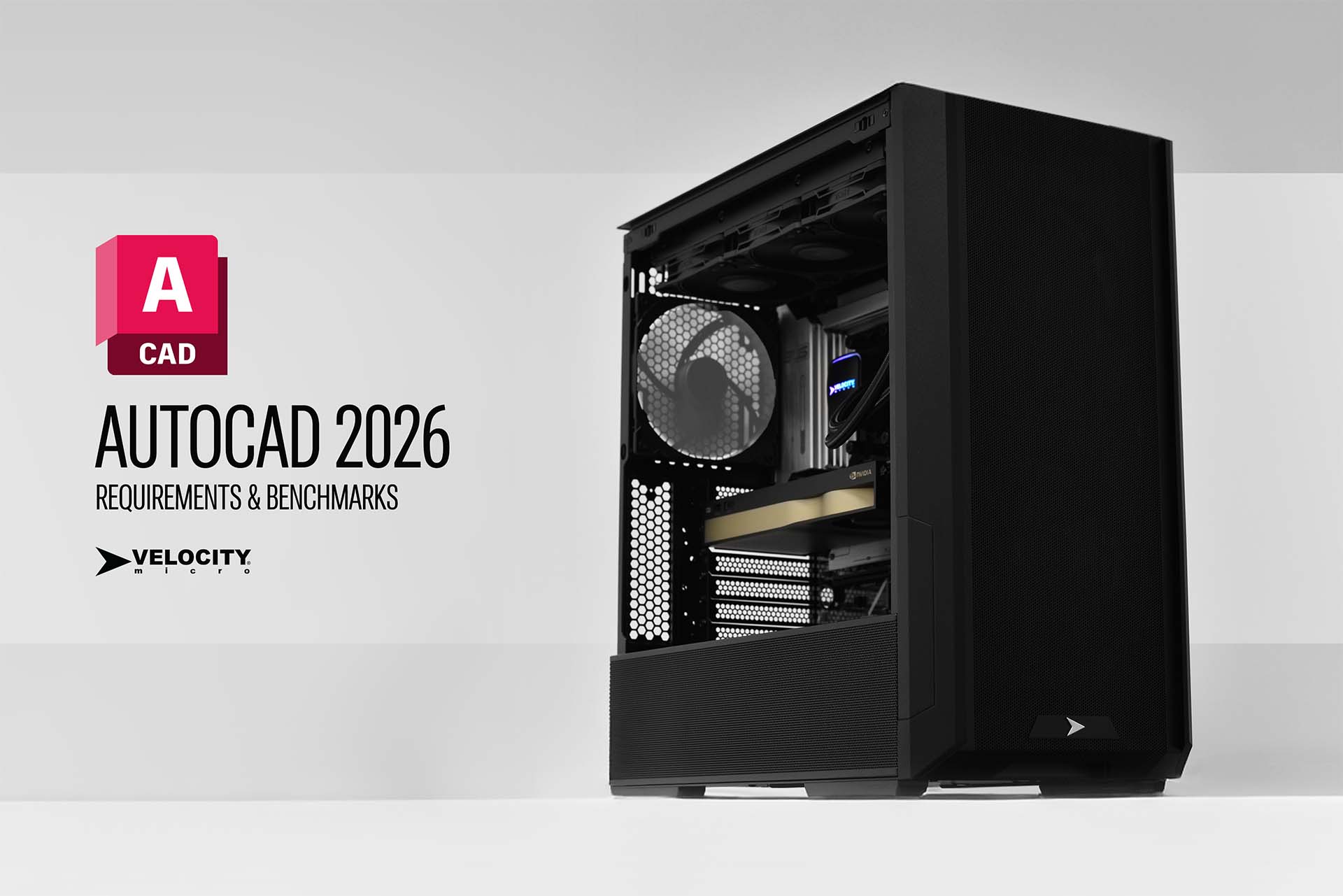
AutoCAD 2026 System Requirements and Empirical Benchmarks


AutoCAD 2026 System Requirements and Empirical Benchmarks

Defining the Hardware Bottleneck

Regarding AutoCAD 2026 system requirements, the software’s efficiency is often constrained not by the sheer number of processing cores, but by the sequential execution of geometric instructions. AutoCAD 2026 remains, at its core, a frequency-bound application. For the data-driven professional, selecting hardware is an exercise in identifying and eliminating architectural bottlenecks.

This report provides a granular analysis of hardware components—Central Processing Units (CPU), Graphics Processing Units (GPU), Random Access Memory (RAM), and Storage—to optimize the AutoCAD environment for both 2D drafting and complex 3D modeling.

CPU: Frequency vs. Core Count

Autodesk AutoCAD 2026 is primarily a single-threaded application. Critical tasks—such as regenerating drawings, calculating geometric constraints, and manipulating 2D vectors—scale with clock speed rather than core count.

Empirical Data Analysis:

Our testing indicates that a CPU with a higher “Turbo” frequency consistently outperforms a workstation-class CPU with high core counts (e.g., Intel Xeon or AMD Threadripper) in standard CAD workflows.

  • Primary Recommendation: Intel Core Ultra 9 285k or AMD Ryzen 9 9950X. These chips offer the highest single-core instructions-per-clock (IPC) and frequency.
  • Secondary Recommendation: Intel Core Ultra 7 265k. This represents the “sweet spot” for price-to-performance, providing 95% of the Ultra 9’s efficiency in 2D workflows.
Component Tier Recommended Model Max Turbo Clock Performance Index (Single Core)
Ultra High-End Intel Core Ultra 9 285k 5.7 GHz 100% (Baseline)
High-End AMD Ryzen 9 9950X 5.7 GHz 98%
Balanced Intel Core Ultra 7 265k 5.5 GHz 94%

GPU: Precision and Driver Stability

While AutoCAD utilizes the GPU for 2D wireframe acceleration and 3D shading, it is not as GPU-intensive as real-time rendering engines like Lumion or V-Ray. The primary decision factor is the choice between “Professional” (NVIDIA RTX Pro/Quadro) and “Consumer” (GeForce RTX) cards.

  1. Workstation Pro GPUs (formerly Quadro): These are ISV-certified by Autodesk. They offer higher bit-depth precision, ECC RAM, and “Enterprise” drivers designed for 24/7 stability.
  2. Consumer GPUs (NVIDIA GeForce RTX 50-Series): These offer superior raw compute power per dollar. For 2D-heavy workflows, a GeForce card is often more than sufficient for AutoCAD.

Recommendation: For large-scale 3D modeling, we recommend 8GB+ of VRAM to ensure the framebuffer can handle complex textures and 3D geometry without spilling into much slower system RAM.

RAM: Capacity for Multitasking

AutoCAD’s memory footprint is relatively modest for small projects, but it expands exponentially when working with XREFs (External References) and large point clouds.

  • 16GB: Minimum threshold for 2D drafting.
  • 32GB: The professional standard. Allows for AutoCAD to run alongside Excel, Outlook, and web browsers without paging to the disk.
  • 64GB+: Recommended only for users integrating LiDAR point clouds or massive 3D civil engineering projects.

Storage: Throughput Analysis

The transition from SATA SSDs to NVMe Gen4/Gen5 has significantly reduced “File Open” and “AutoSave” latency. We recommend a dual-drive configuration to separate the Operating System/Applications from the Project Data.

  • Primary Drive (OS/Apps): 1TB NVMe M.2 (Gen4 or Gen5).
  • Secondary Drive (Active Projects): 2TB+ NVMe M.2 (Gen4).

Performance Benchmarks for AutoCAD 2026

Comparative Performance Benchmarks (2026 Hardware)

The following benchmark represents a composite score derived from common AutoCAD operations: Opening large DWG files, 2D Zoom/Pan, 3D Orbit, and PDF Export.

AutoCAD Performance Index (Higher is Better)

System Configuration Score Color Map
Ultra 9 285k / RTX 5080 / 64GB DDR5 1240 🟦🟦🟦🟦🟦🟦🟦🟦🟦🟦 (Top Tier)
Ryzen 9 9950X / RTX 4000 Pro / 32GB DDR5 1215 🟦🟦🟦🟦🟦🟦🟦🟦🟦🟨 (High-End)
Ultra 7 265K / RTX 5070 / 32GB DDR5 1160 🟦🟦🟦🟦🟦🟦🟦🟦🟨🟨 (Recommended)
Ultra 5 245K / RTX 5060 / 16GB DDR5 980 🟦🟦🟦🟦🟦🟦🟨🟨🟨🟨 (Mid-Range)
Laptop: Ultra 9 275HX / RTX 5070 Mobile 1050 🟦🟦🟦🟦🟦🟦🟦🟨🟨🟨 (Mobile High)

Visual Key: [🟦 = Optimal] [🟨 = Acceptable] [🟥 = Bottleneck]

Hardware Configuration Summary

The Max Spec Build (Maximum Efficiency) – ProMagix HD80

  • CPU: Intel Core Ultra 9 285k (Max Single-Core performance).
  • Cooler: 360mm AIO Liquid Cooler (Required to prevent thermal throttling).
  • Motherboard: Z890 Chipset with DDR5 support.
  • RAM: 64GB DDR5-6000MHz.
  • GPU: NVIDIA RTX 4000 Pro Blackwell (24GB VRAM) for ISV-certified stability.
  • Storage: Samsung 9100 Pro 2TB NVMe Gen5.

The “Optimized Professional” Build (Price/Performance) – ProMagix HD60

  • CPU: Intel Core Ultra 7 265K.
  • Cooler: 360mm AIO Liquid Cooler (Required to prevent thermal throttling).
  • RAM: 32GB DDR5-5600MHz or 5200MHz.
  • GPU: NVIDIA GeForce RTX 5070 (12GB VRAM).
  • Storage: Kingston NV3 1TB M.2 SSD.

AutoCAD 2026 System Requirements: Final Conclusion

For the AutoCAD environment, the data indicates that single-core clock frequency is the single most important metric for user experience. While it is tempting to invest in high-core count workstation CPUs, a high-frequency consumer/enthusiast CPU (Ultra 9/7 or Ryzen 9) paired with 32GB of high-speed DDR5 memory provides the most efficient path to reducing computational latency in CAD workflows.

Explore all CAD Workstation options.

The following two tabs change content below.

This content was written by the expert Velocity Micro staff.


David Ellison extends deadline for Warner Bros. Discovery takeover offer


Paramount Skydance CEO David Ellison is apparently still hopeful that investors will approve his $108.4 billion hostile takeover of Warner Bros. Discovery. Paramount Skydance announced Thursday that it’s extending its all-cash offer to acquire the storied studio, and giving investors until February 20, 2026 to accept. The company’s previous offer expired on January 21, but with a lawsuit in the works and a revised Netflix deal to compete with, Paramount Skydance wants to stay in the conversation.

Netflix and Warner Bros. Discovery originally announced their $82.7 billion acquisition agreement in December 2025. Netflix’s deal is for a significant portion, but notably not all, of Warner Bros. Discovery as it exists today. If approved, the streaming service would acquire Warner Bros. film studios, New Line Cinema, HBO, HBO Max, the company’s theme parks, game studios and select linear channels like TNT, but not the collection of reality TV and news programming that Warner Bros. Discovery calls “Global Networks.”

Paramount Skydance made its competing offer of $108.4 billion for all of Warner Bros. Discovery a few days later in December, with the recommendation that shareholders reject the Netflix deal. To add pressure, Paramount Skydance also sued Warner Bros. Discovery in January alleging that the company had not provided adequate information about why it favored Netflix over Paramount. Beyond offering more money, Paramount contends its deal is more likely to be approved by regulators because owning Warner Bros. doesn’t “entrench Netflix’s market dominance.” Warner Bros. Discovery claims that funding for Paramount’s deal “remains inadequate” and that the company is uncertain Paramount Skydance will actually be able to complete the deal.

David Ellison was previously able to merge Skydance with Paramount using the financial backing of his billionaire father Larry Ellison, and the Ellison family’s friendly relationship with the Trump administration. Promising to make sure that CBS News represents “a diversity of viewpoints” via a newly appointed ombudsman, and that the merged Paramount Skydance won’t create any diversity, equity and inclusion programs was enough to get the FCC to approve the merger. Ellison might have thought acquiring Warner Bros. Discovery would be equally easy, but at least so far that hasn’t worked out as planned.

.net – How to prevent SSDT/DACPAC publish with DropObjectsNotInSource=True from dropping Azure Functions az_func runtime tables


I’m deploying a SQL Server/Azure SQL database using an SSDT .sqlproj (DACPAC) and SqlPackage.exe (DacFx publish). For local dev we require DropObjectsNotInSource=True so schema drift/renames are cleaned up automatically when running the solution (F5 triggers a PowerShell script that runs SqlPackage /Action:Publish).

Problem: Azure Functions (SQL triggers / runtime integration) creates and manages objects in a schema called az_func, e.g.:

Those objects are not in our SSDT project. When we publish with DropObjectsNotInSource=True, DacFx includes drop statements for az_func objects because they’re “not in source”. This breaks running Functions and loses the runtime state (the runtime recreates the schema later, but state/data is lost).

What I’ve tried:

  • Pre/post-deployment scripts: doesn’t help, because drops happen before post-deploy runs.

  • DoNotDropObjectTypes=Schema: not valid / doesn’t solve dropping tables anyway.

  • Custom tool that backs up az_func then restores it: works but feels brittle/overengineered (and can race if functions are active).

What I’m looking for:

  • Best practice way to keep DropObjectsNotInSource=True for our own schemas, but ensure nothing in schema az_func is dropped or altered during publish — including runtime tables with random suffixes (i don’t know the names ahead of time).

Questions:

  1. Is there a supported way in DacFx/SqlPackage to exclude a schema (or object set) from “drop not in source”?

  2. If not, is the right approach a DacFx deployment contributor / plan modifier that filters out any deployment plan steps touching schema az_func? If yes, can someone show a minimal example and how to wire it up to SqlPackage (properties/arguments)?

  3. Is using contributors viable (yes or no) i.e. DropObjectsNotInSource=True, with Azure SQL / Functions runtime objects created dynamically

(If it matters: local dev workflow is SqlPackage.exe /Action:Publish /SourceFile:*.dacpac /TargetConnectionString:... /p:DropObjectsNotInSource=True and we want the same approach to work in Azure DevOps too.)

Thanks in advance

Free Printable Cleaning Coloring Stickers (Super Cute Kawaii Laundry And Dishes Sticker Sheet)


Do you love to clean?

Me neither! 😆

But I figured these super cute, ADOR-able cleaning coloring stickers would help inspire me and encourage me to do the things I hate in life…like cleaning.

If you love to clean, hey, more power to you. 🎉 That’s awesome, but for me, I need a little help to encourage myself. 😊

This cleaning stickers printable does just the trick. It turns everyday chores into a tiny little encouragement! You can use them in your planners, as stickers on chore charts, use them as rewards for tasks done for you and your family, and so much more! ❤️

And if you’d like a super way to streamline your cleaning routine, be sure to grab my FREE Cleaning Binder here.

Free Printable Cleaning Coloring Stickers

This cleaning sticker coloring page is packed with kawaii household icons and mini characters, all in a sticker style you can color however you want.

In this cleaning planner stickers set, you’ll see things like…

  • Washing machine
  • Dish soap
  • Spray bottle
  • Mop
  • Broom
  • Sponge
  • Lint roller
  • Laundry basket
  • Recycling bins
  • Girl vacuuming
  • Girl dusting
  • Boy mopping
  • Girl ironing
  • Girl doing laundry
  • Boy doing dishes

Kawaii Cleaning Sticker Coloring Page With Mop Broom Spray Bottle Washing Machine And Dish SoapKawaii Cleaning Sticker Coloring Page With Mop Broom Spray Bottle Washing Machine And Dish Soap

Download the free printable colorable cleaning stickers PDF here


Ways To Use This Kawaii Cleaning Coloring Page Stickers Sheet

You can keep this cute cleaning sticker sheet fun and easy, or you can make it part of a whole cozy routine. Here are a few ideas that feel realistic, not overwhelming. ❤️

  • Color while listening to Christian music or a sermon
  • Cut out the stickers for a planner or journal
  • Use the stickers for your kids to tell them thank you for cleaning something in particular (example: if they dusted, give them the sticker of the little girl dusting with a thank you note)
  • Make a cute cleaning tracker page
  • Add a sticker to a love note for your kids
  • Use them as tiny rewards for yourself or your family
  • Create a cozy cleaning routine or chart
  • Use the cute household chores coloring as a coloring page for kids to inspire them to do their chores

Is this printable free to download?

Yes! Except for some large binders, all printables on the blog are 100% free for personal use. I make these because I genuinely want you to have something cute and helpful right now without having to spend a dime. You deserve a life that feels more peaceful, more organized, and more you, and if a simple printable can make your day feel lighter, I am so happy to give that to you.

Can I use these printables for my classroom or church group?

Absolutely! You’re welcome to print as many copies as you need for your own students or church groups. I only ask that you do not edit them in any way (leaving the full copyright line in tact) or sell them or host the digital files on other websites. Please always link back to this post to share with others.

What is the best way to print these high-quality printables?

For best results, I recommend printing on 8.5″x11″ white paper. These are professionally designed as high-resolution PDFs so they will stay crisp and clear, making them perfect for any printer.

Struggling fusion power company General Fusion to go public via $1B reverse merger


Last year, fusion power startup General Fusion was struggling to raise funds, laying off at least 25% of its staff before receiving a $22 million lifeline investment while it figured out how to keep the company afloat.

Today, General Fusion revealed its survival plan: it will go public through a reverse merger with an special purpose acquisition company, Spring Valley III, combined with additional investment from institutional investors. It’s a significant change in fortunes for a company whose CEO wrote a public letter just last year pleading for funding.

If the deal closes as planned, General Fusion could receive up to $335 million from the transaction, more than double what it was reportedly seeking to raise last year before it landed the $22 million lifeline.

The transaction will value the combined company at about $1 billion, General Fusion said. Before the merger was announced. The fusion startup, which was founded in 2002, had previously raised over $440 million, according to PitchBook.

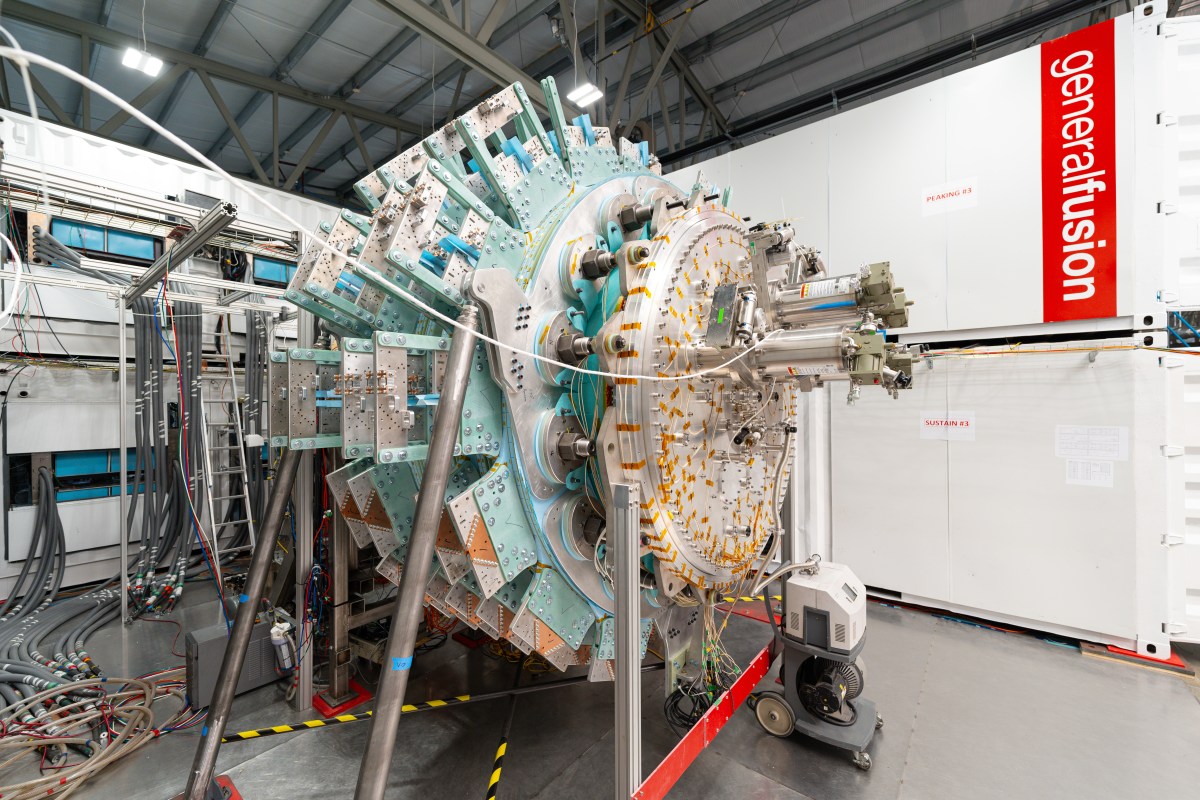
General Fusion plans to use the money to complete its demonstration reactor, Lawson Machine 26 (LM26). The device uses an approach called “inertial confinement,” which works by compressing a fuel pellet until its atoms fuse together, releasing energy in the process. The National Ignition Facility used inertial confinement in its successful fusion experiments, using lasers to bombard the fuel pellets to unleash the compressive force.

LM26 eschews the lasers, though. Instead, it uses steam-driven pistons that drive a wall of liquid lithium metal inward to compress the fuel pellet. That liquid lithium then circulates through a heat exchanger, which generates steam to spin a generator. By avoiding expensive lasers or superconducting magnets, which are required in other fusion reactor designs, General Fusion hopes to build a fusion power plant for less money. But first the company has to prove its approach is viable.

Last year, before it revealed its financial problems, General Fusion said that in 2026, LM26 would hit scientific breakeven, in which a fusion reaction generates more power than was required to start it. Scientific breakeven is a key milestone, though distinct from and easier to attain than commercial breakeven, in which fusion reactions release enough energy to export electricity to the grid. General Fusion did not reply to a request asking if its timeline had change.

Techcrunch event

San Francisco
|
October 13-15, 2026

The acquisition company, Spring Valley, is something of a specialist in reverser mergers with energy companies. It previously took NuScale Power, a small modular nuclear reactor company, public in a deal whose stock price has since fallen more than 50% from its peak last year. The firm is also in the midst of completing a merger with Eagle Energy Metals, a uranium mining company that’s also supposedly developing its own SMR.

General Fusion isn’t the first fusion company to go public. In December, TAE Technologies announced it would merge with Trump Media & Technology Group in a deal valuing the combined company at more than $6 billion.

The common thread connecting these deals is data centers, of course. They’re expected to consume nearly 300% more power by 2035, according to BloombergNEF, and General Fusion explicitly points to rising data center energy demand in its merger announcement

But the company also pointed to broader electrification trends, including EVs and electric heating, that could increase overall electricity demand by up to 50% by 2035. It’s a reminder that, while the Trump administration has cast doubts on an electrified future, other countries are charging ahead. While General Fusion may face technological challenges, trends in the energy world suggest that if it can deliver fusion power at a reasonable cost, it will find plenty of willing buyers.

Use Cases, Models, Benchmarks & AI Scale


Introduction

The rapid growth of large language models (LLMs), multi‑modal architectures and generative AI has created an insatiable demand for compute. NVIDIA’s Blackwell B200 GPU sits at the heart of this new era. Announced at GTC 2024, this dual‑die accelerator packs 208 billion transistors, 192 GB of HBM3e memory and a 1 TB/s on‑package interconnect. It introduces fifth‑generation Tensor Cores supporting FP4, FP6 and FP8 precision with two‑times the throughput of Hopper for dense matrix operations. Combined with NVLink 5 providing 1.8 TB/s of inter‑GPU bandwidth, the B200 delivers a step change in performance—up to 4× faster training and 30× faster inference compared with H100 for long‑context models. Jensen Huang described Blackwell as “the world’s most powerful chip”, and early benchmarks show it offers 42 % better energy efficiency than its predecessor.

Quick Digest

Key question

AI overview answer

What is the NVIDIA B200?

The B200 is NVIDIA’s flagship Blackwell GPU with dual chiplets, 208 billion transistors and 192 GB HBM3e memory. It introduces FP4 tensor cores, second‑generation Transformer Engine and NVLink 5 interconnect.

Why does it matter for AI?

It delivers 4× faster training and 30× faster inference vs H100, enabling LLMs with longer context windows and mixture‑of‑experts (MoE) architectures. Its FP4 precision reduces energy consumption and memory footprint.

Who needs it?

Anyone building or fine‑tuning large language models, multi‑modal AI, computer vision, scientific simulations or demanding inference workloads. It’s ideal for research labs, AI companies and enterprises adopting generative AI.

How to access it?

Through on‑prem servers, GPU clouds and compute platforms such as Clarifai’s compute orchestration—which offers pay‑as‑you‑go access, model inference and local runners for building AI workflows.

The sections below break down the B200’s architecture, real‑world use cases, model recommendations and procurement strategies. Each section includes expert insights summarizing opinions from GPU architects, researchers and industry leaders, and Clarifai tips on how to harness the hardware effectively.

B200 Architecture & Innovations

How does the Blackwell B200 differ from previous GPUs?

Answer: The B200 uses a dual‑chiplet design where two reticle‑limited dies are connected by a 10 TB/s chip‑to‑chip interconnect. This effectively doubles the compute density within the SXM5 socket. Its 5th‑generation Tensor Cores add support for FP4, a low‑precision format that cuts memory usage by up to 3.5× and improves energy efficiency 25‑50×. Shared Memory clusters offer 228 KB per streaming multiprocessor (SM) with 64 concurrent warps to increase utilization. A second‑generation Transformer Engine introduces tensor memory for fast micro‑scheduling, CTA pairs for efficient pipelining and a decompression engine to accelerate I/O.

Expert Insights:

  • NVIDIA engineers note that FP4 triples throughput while retaining accuracy for LLM inference; energy per token drops from 12 J on Hopper to 0.4 J on Blackwell.
  • Microbenchmark studies show the B200 delivers 1.56× higher mixed‑precision throughput and 42 % better energy efficiency than the H200.
  • The Next Platform highlights that the B200’s 1.8 TB/s NVLink 5 ports scale nearly linearly across multiple GPUs, enabling multi‑GPU servers like HGX B200 and GB200 NVL72.
  • Roadmap commentary notes that future B300 (Blackwell Ultra) GPUs will boost memory to 288 GB HBM3e and deliver 50 % more FP4 performance—an important signpost for planning deployments.

Architecture details and new features

The B200’s architecture introduces several innovations:

  • Dual‑Chiplet Package: Two GPU dies are connected via a 10 TB/s interconnect, effectively doubling compute density while staying within reticle limits.
  • 208 billion transistors: One of the largest chips ever manufactured.
  • 192 GB HBM3e with 8 TB/s bandwidth: Eight stacks of HBM3e memory deliver eight terabytes per second of bandwidth. This bandwidth is critical for feeding large matrix multiplications and attention mechanisms.
  • 5th‑Generation Tensor Cores: Support FP4, FP6 and FP8 formats. FP4 cuts memory usage by up to 3.5× and offers 25–50× energy efficiency improvements.
  • NVLink 5: Provides 1.8 TB/s per GPU for peer‑to‑peer communication.
  • Second‑Generation Transformer Engine: Introduces tensor memory, CTA pairs and decompression engines, enabling dynamic scheduling and reducing memory access overhead.
  • L2 cache and shared memory: Each SM features 228 KB of shared memory and 64 concurrent warps, improving thread‑level parallelism.
  • Optional ray‑tracing cores: Provide hardware acceleration for 3D rendering when needed.

Creative Example: Imagine training a 70B‑parameter language model. On Hopper, the model would require multiple GPUs with 80 GB each, saturating memory and incurring heavy recomputation. The B200’s 192 GB HBM3e means the model fits into fewer GPUs. Combined with FP4 precision, memory footprints drop further, enabling more tokens per batch and faster training. This illustrates how architecture innovations directly translate to developer productivity.

Use Cases for NVIDIA B200

What AI workloads benefit most from the B200?

Answer: The B200 excels in training and fine‑tuning large language models, reinforcement learning, retrieval‑augmented generation (RAG), multi‑modal models, and high‑performance computing (HPC).

Pre‑training and fine‑tuning

  • Massive transformer models: The B200 reduces pre‑training time by compared with H100. Its memory allows long context windows (e.g., 128k‑tokens) without offloading.
  • Fine‑tuning & RLHF: FP4 precision and improved throughput accelerate parameter‑efficient fine‑tuning and reinforcement learning from human feedback. In experiments, B200 delivered 2.2× faster fine‑tuning of LLaMA‑70B compared with H200.

Inference & RAG

  • Long‑context inference: The B200’s dual‑die memory enables 30× faster inference for long context windows. This speeds up chatbots and retrieval‑augmented generation tasks.
  • MoE models: In mixture‑of‑experts architectures, each expert can run concurrently; NVLink 5 ensures low‑latency routing. A MoE model running on the GB200 NVL72 rack achieved 10× faster inference and one‑tenth the cost per token.

Multi‑modal & computer vision

  • Vision transformers (ViT), diffusion models and generative video require large memory and bandwidth. The B200’s 8 TB/s bandwidth keeps pipelines saturated.
  • Ray tracing for 3D generative AI: B200’s optional RT cores accelerate photorealistic rendering, enabling generative simulation and robotics.

High‑Performance Computing (HPC)

  • Scientific simulation: B200 achieves 90 TFLOPS of FP64 performance, making it suitable for molecular dynamics, climate modeling and quantum chemistry.
  • Mixed AI/HPC workloads: NVLink and NVSwitch networks create a coherent memory pool across GPUs for unified programming.

Expert Insights:

  • DeepMind & OpenAI researchers have noted that scaling context length requires both memory and bandwidth; the B200’s architecture solves memory bottlenecks.
  • AI cloud providers observed that a single B200 can replace two H100s in many inference scenarios.

Clarifai Perspective

Clarifai’s Reasoning Engine leverages B200 GPUs to run complex multi‑model pipelines. Customers can perform Retrieval‑Augmented Generation by pairing Clarifai’s vector search with B200‑powered LLMs. Clarifai’s compute orchestration automatically assigns B200s for training jobs and scales down to cost‑efficient A100s for inference, maximizing resource utilization.

Recommended Models & Frameworks for B200

Which models best exploit B200 capabilities?

Answer: Models with large parameter counts, long context windows or mixture‑of‑experts architectures gain the most from the B200. Popular open‑source models include LLaMA 3 70B, DeepSeek‑R1, GPT‑OSS 120B, Kimi K2 and Mistral Large 3. These models often support 128k‑token contexts, require >100 GB of GPU memory and benefit from FP4 inference.

  • DeepSeek‑R1: An MoE language model requiring eight experts. On B200, DeepSeek‑R1 achieved world‑record inference speeds, delivering 30 k tokens/s on a DGX system.
  • Mistral Large 3 & Kimi K2: MoE models that achieved 10× speed‑ups and one‑tenth cost per token when run on GB200 NVL72 racks.
  • LLaMA 3 70B and GPT‑OSS 120B: Dense transformer models requiring high bandwidth. B200’s FP4 support enables higher batch sizes and throughput.
  • Vision Transformers: Large ViT and diffusion models (e.g., Stable Diffusion XL) benefit from the B200’s memory and ray‑tracing cores.

Which frameworks and libraries should I use?

  • TensorRT‑LLM & vLLM: These libraries implement speculative decoding, paged attention and memory optimization. They harness FP4 and FP8 tensor cores to maximize throughput. vLLM runs inference on B200 with low latency, while TensorRT‑LLM accelerates high‑throughput servers.
  • SGLang: A declarative language for building inference pipelines and function calling. It integrates with vLLM and B200 for efficient RAG workflows.
  • Open source libraries: Flash‑Attention 2, xFormers, and Fused optimizers support B200’s compute patterns.

Clarifai Integration

Clarifai’s Model Zoo includes pre‑optimized versions of major LLMs that run out‑of‑the‑box on B200. Through the compute orchestration API, developers can deploy vLLM or SGLang servers backed by B200 or automatically fall back to H100/A100 depending on availability. Clarifai also provides serverless containers for custom models so you can scale inference without worrying about GPU management. Local Runners allow you to fine‑tune models locally using smaller GPUs and then scale to B200 for full‑scale training.

Expert Insights:

  • Engineers at major AI labs highlight that libraries like vLLM reduce memory fragmentation and exploit asynchronous streaming, offering up to 40 % performance uplift on B200 compared with generic PyTorch pipelines.
  • Clarifai’s engineers note that hooking models into the Reasoning Engine automatically selects the right tensor precision, balancing cost and accuracy.

Comparison: B200 vs H100, H200 and Competitors

How does B200 compare with H100, H200 and competitor GPUs?

The B200 offers the most memory, bandwidth and energy efficiency among current Nvidia GPUs, with performance advantages even when compared with competitor accelerators like AMD MI300X. The table below summarizes the key differences.

Metric

H100

H200

B200

AMD MI300X

FP4/FP8 performance (dense)

NA / 4.7 PF

4.7 PF

9 PF

~7 PF

Memory

80 GB HBM3

141 GB HBM3e

192 GB HBM3e

192 GB HBM3e

Bandwidth

3.35 TB/s

4.8 TB/s

8 TB/s

5.3 TB/s

NVLink bandwidth per GPU

900 GB/s

1.6 TB/s

1.8 TB/s

N/A

Thermal Design Power (TDP)

700 W

700 W

1,000 W

700 W

Pricing (cloud cost)

~$2.4/hr

~$3.1/hr

~$5.9/hr

~$5.2/hr

Availability (2025)

Widespread

mid‑2024

limited 2025

available 2024

Key takeaways:

  • Memory & bandwidth: The B200’s 192 GB HBM3e and 8 TB/s bandwidth dwarfs both H100 and H200. Only AMD’s MI300X matches memory capacity but at lower bandwidth.
  • Compute performance: FP4 throughput is double the H200 and H100, enabling 4× faster training. Mixed precision and FP16/FP8 performance also scale proportionally.
  • Energy efficiency: FP4 reduces energy per token by 25–50×; microbenchmark data show 42 % energy reduction vs H200.
  • Compatibility & software: H200 is a drop‑in replacement for H100, whereas B200 requires updated boards and CUDA 12.4+. Clarifai automatically manages these dependencies through its orchestration.
  • Competitor comparison: AMD’s MI300X has similar memory but lower FP4 throughput and limited software support. Upcoming MI350/MI400 chips may narrow the gap, but NVLink and software ecosystem keep B200 ahead.

Expert Insights:

  • Analysts note that B200 pricing is roughly 25 % higher than H200. For cost‑constrained tasks, H200 may suffice, especially where memory rather than compute is bottlenecked.
  • Benchmarkers highlight that B200’s performance scales linearly across multi‑GPU clusters due to NVLink 5 and NVSwitch.

Creative example comparing H200 and B200

Suppose you’re running a chatbot using a 70 B‑parameter model with a 64k‑token context. On an H200, the model barely fits into 141 GB of memory, requiring off‑chip memory paging and resulting in 2 tokens per second. On a single B200 with 192 GB memory and FP4 quantization, you process 60 k tokens per second. With Clarifai’s compute orchestration, you can launch multiple B200 instances and achieve interactive, low‑latency conversations.

Getting Access to the B200

How can you procure B200 GPUs?

Answer: There are several ways to access B200 hardware:

  1. On‑premises servers: Companies can purchase HGX B200 or DGX GB200 NVL72 systems. The GB200 NVL72 integrates 72 B200 GPUs with 36 Grace CPUs and offers rack‑scale liquid cooling. However, these systems consume 70–80 kW and require specialized cooling infrastructure.
  2. GPU Cloud providers: Many GPU cloud platforms offer B200 instances on a pay‑as‑you‑go basis. Early pricing is around $5.9/hr, though supply is limited. Expect waitlists and quotas due to high demand.
  3. Compute marketplaces: GPU marketplaces allow short‑term rentals and per‑minute billing. Consider reserved instances for long training runs to secure capacity.
  4. Clarifai’s compute orchestration: Clarifai provides B200 access through its platform. Users sign up, choose a model or upload their own container, and Clarifai orchestrates B200 resources behind the scenes. The platform offers automatic scaling and cost optimization—e.g., falling back to H100 or A100 for less‑demanding inference. Clarifai also supports local runners for on‑prem inference so you can test models locally before scaling up.

Expert Insights:

  • Data center engineers caution that B200’s 1 kW TDP demands liquid cooling; thus colocation facilities may charge higher fees【640427914440666†L120-L134】.
  • Cloud providers emphasize the importance of GPU quotas; booking ahead and using reserved capacity ensures continuity for long training jobs.

Clarifai onboarding tip

Signing up with Clarifai is straightforward:

  1. Create an account and verify your email.
  2. Choose Compute Orchestration > Create Job, select B200 as the GPU type, and upload your training script or choose a model from Clarifai’s Model Zoo.
  3. Clarifai automatically sets appropriate CUDA and cuDNN versions and allocates B200 nodes.
  4. Monitor metrics in the dashboard; you can schedule auto‑scale rules, e.g., downscale to H100 during idle periods.

GPU Selection Guide

How should you decide between B200, H200 and B100?

Answer: Use the following decision framework:

  1. Model size & context length: For models >70 B parameters or contexts >128k tokens, the B200 is essential. If your models fit in <141 GB and context <64k, H200 may suffice. H100 handles models <40 B or fine‑tuning tasks.
  2. Latency requirements: If you need sub‑second latency or tokens/sec beyond 50 k, choose B200. For moderate latency (10–20 k tokens/s), H200 provides a good trade‑off.
  3. Budget considerations: Evaluate cost per FLOP. B200 is about 25 % more expensive than H200; therefore, cost‑sensitive teams may use H200 for training and B200 for inference time‑critical tasks.
  4. Software & compatibility: B200 requires CUDA 12.4+, while H200 runs on CUDA 12.2+. Ensure your software stack supports the necessary kernels. Clarifai’s orchestration abstracts these details.
  5. Power & cooling: B200’s 1 kW TDP demands proper cooling infrastructure. If your facility cannot support this, consider H200 or A100.
  6. Future proofing: If your roadmap includes mixture‑of‑experts or generative simulation, B200’s NVLink 5 will deliver better scaling. For smaller workloads, H100/A100 remain cost‑effective.

Expert Insights:

  • AI researchers often prototype on A100 or H100 due to availability, then migrate to B200 for final training. Tools like Clarifai’s simulation allow you to test memory usage across GPU types before committing.
  • Data center planners recommend measuring power draw and adding 20 % headroom for cooling when deploying B200 clusters.

Case Studies & Real‑World Examples

How have organizations used the B200 to accelerate AI?

DeepSeek‑R1 world‑record inference

DeepSeek‑R1 is a mixture‑of‑experts model with eight experts. Running on a DGX with eight B200 GPUs, it achieved 30 k tokens per second and enabled training in half the time of H100. The model leveraged FP4 and NVLink 5 for expert routing, reducing cost per token by 90 %. This performance would have been impossible on previous architectures.

Mistral Large 3 & Kimi K2

These models use dynamic sparsity and long context windows. Running on GB200 NVL72 racks, they delivered 10× faster inference and one‑tenth cost per token compared with H100 clusters. The mixture‑of‑experts design allowed scaling to 15 or more experts, each mapped to a GPU. The B200’s memory ensured that each expert’s parameters remained local, avoiding cross‑device communication.

Scientific simulation

Researchers in climate modeling used B200 GPUs to run 1 km‑resolution global climate simulations previously limited by memory. The 8 TB/s memory bandwidth allowed them to compute 1,024 time steps per hour, more than doubling throughput relative to H100. Similarly, computational chemists reported a 1.5× reduction in time‑to‑solution for ab‑initio molecular dynamics due to increased FP64 performance.

Clarifai customer success

An e‑commerce company used Clarifai’s Reasoning Engine to build a product recommendation chatbot. By migrating from H100 to B200, the company cut response times from 2 seconds to 80 milliseconds and reduced GPU hours by 55 % through FP4 quantization. Clarifai’s compute orchestration automatically scaled B200 instances during traffic spikes and shifted to cheaper A100 nodes during off‑peak hours, saving cost without sacrificing quality.

Creative example illustrating power & cooling

Think of the B200 cluster as an AI furnace. Each GPU draws 1 kW, equivalent to a toaster oven. A 72‑GPU rack therefore emits roughly 72 kW—like running dozens of ovens in a single room. Without liquid cooling, components overheat quickly. Clarifai’s hosted solutions hide this complexity from developers; they maintain liquid‑cooled data centers, letting you harness B200 power without building your own furnace.

Emerging Trends & Future Outlook

What’s next after the B200?

Answer: The B200 is the first of the Blackwell family, and NVIDIA’s roadmap includes B300 (Blackwell Ultra) and future Vera/Rubin GPUs, promising even more memory, bandwidth and compute.

B300 (Blackwell Ultra)

The upcoming B300 boosts per‑GPU memory to 288 GB HBM3e—a 50 % increase over B200—by using twelve‑high stacks of DRAM. It also provides 50 % more FP4 performance (~15 PFLOPS). Although NVLink bandwidth remains 1.8 TB/s, the extra memory and clock speed improvements make B300 ideal for planetary‑scale models. However, it raises TDP to 1,100 W, demanding even more robust cooling.

Future Vera & Rubin GPUs

NVIDIA’s roadmap extends beyond Blackwell. The “Vera” CPU will double NVLink C2C bandwidth to 1.8 TB/s, and Rubin GPUs (likely 2026–27) will feature 288 GB of HBM4 with 13 TB/s bandwidth. The Rubin Ultra GPU may integrate four chiplets in an SXM8 socket with 100 PFLOPS FP4 performance and 1 TB of HBM4E. Rack‑scale VR300 NVL576 systems could deliver 3.6 exaflops of FP4 inference and 1.2 exaflops of FP8 training. These systems will require 3.6 TB/s NVLink 7 interconnects.

Software advances

  • Speculative decoding & cascaded generation: New decoding strategies like speculative decoding and multi‑stage cascaded models cut inference latency. Libraries like vLLM implement these techniques for Blackwell GPUs.
  • Mixture‑of‑Experts scaling: MoE models are becoming mainstream. B200 and future GPUs will support hundreds of experts per rack, enabling trillion‑parameter models at acceptable cost.
  • Sustainability & Green AI: Energy use remains a concern. FP4 and future FP3/FP2 formats will reduce power consumption further; data centers are investing in liquid immersion cooling and renewable energy.

Expert Insights:

  • The Next Platform emphasizes that B300 and Rubin are not just memory upgrades; they deliver proportional increases in FP4 performance and highlight the need for NVLink 6/7 to scale to exascale.
  • Industry analysts predict that AI chips will drive more than half of all semiconductor revenue by the end of the decade, underscoring the importance of planning for future architectures.

Clarifai’s roadmap

Clarifai is building support for B300 and future GPUs. Their platform automatically adapts to new architectures; when B300 becomes available, Clarifai users will enjoy larger context windows and faster training without code changes. The Reasoning Engine will also integrate Vera/Rubin chips to accelerate multi‑model pipelines.

FAQs

Q1: Can I run my existing H100/H200 workflows on a B200?

A: Yes—provided your code uses CUDA‑standard APIs. However, you must upgrade to CUDA 12.4+ and cuDNN 9. Libraries like PyTorch and TensorFlow already support B200. Clarifai abstracts these requirements through its orchestration.

Q2: Does B200 support single‑GPU multi‑instance GPU (MIG)?

A: No. Unlike A100, the B200 does not implement MIG partitioning due to its dual‑die design. Multi‑tenancy is instead achieved at the rack level via NVSwitch and virtualization.

Q3: What about power consumption?

A: Each B200 has a 1 kW TDP. You must provide liquid cooling to maintain safe operating temperatures. Clarifai handles this at the data center level.

Q4: Where can I rent B200 GPUs?

A: Specialized GPU clouds, compute marketplaces and Clarifai all offer B200 access. Due to demand, supply may be limited; Clarifai’s reserved tier ensures capacity for long‑term projects.

Q5: How does Clarifai’s Reasoning Engine enhance B200 usage?

A: The Reasoning Engine connects LLMs, vision models and data sources. It uses B200 GPUs to run inference and training pipelines, orchestrating compute, memory and tasks automatically. This eliminates manual provisioning and ensures models run on the optimal GPU type. It also integrates vector search, workflow orchestration and prompt engineering tools.

Q6: Should I wait for the B300 before deploying?

A: If your workloads demand >192 GB of memory or maximum FP4 performance, waiting for B300 may be worthwhile. However, the B300’s increased power consumption and limited early supply mean many users will adopt B200 now and upgrade later. Clarifai’s platform lets you transition seamlessly as new GPUs become available.

Conclusion

The NVIDIA B200 marks a pivotal step in the evolution of AI hardware. Its dual‑chiplet architecture, FP4 Tensor Cores and massive memory bandwidth deliver unprecedented performance, enabling 4× faster training and 30× faster inference compared with prior generations. Real‑world deployments—from DeepSeek‑R1 to Mistral Large 3 and scientific simulations—showcase tangible productivity gains.

Looking ahead, the B300 and future Rubin GPUs promise even larger memory pools and exascale performance. Staying current with this hardware requires careful planning around power, cooling and software compatibility, but compute orchestration platforms like Clarifai abstract much of this complexity. By leveraging Clarifai’s Reasoning Engine, developers can focus on innovating with models rather than managing infrastructure. With the B200 and its successors, the horizon for generative AI and reasoning engines is expanding faster than ever.