I’m thrilled to share that Esophaguys v1.2: The Neckening Update is now live on Xbox. After a few months of listening to your feedback, squashing bugs, and polishing every pixel, we’ve put together an update that takes everything you love about Esophaguys and cranks it up to eleven. Whether you’re a speedrunning madman, a cooperative chaos enthusiast, or someone just discovering the joy of esophagus elongation, there’s something here for you.
Nothing but Neck with Online Leaderboards
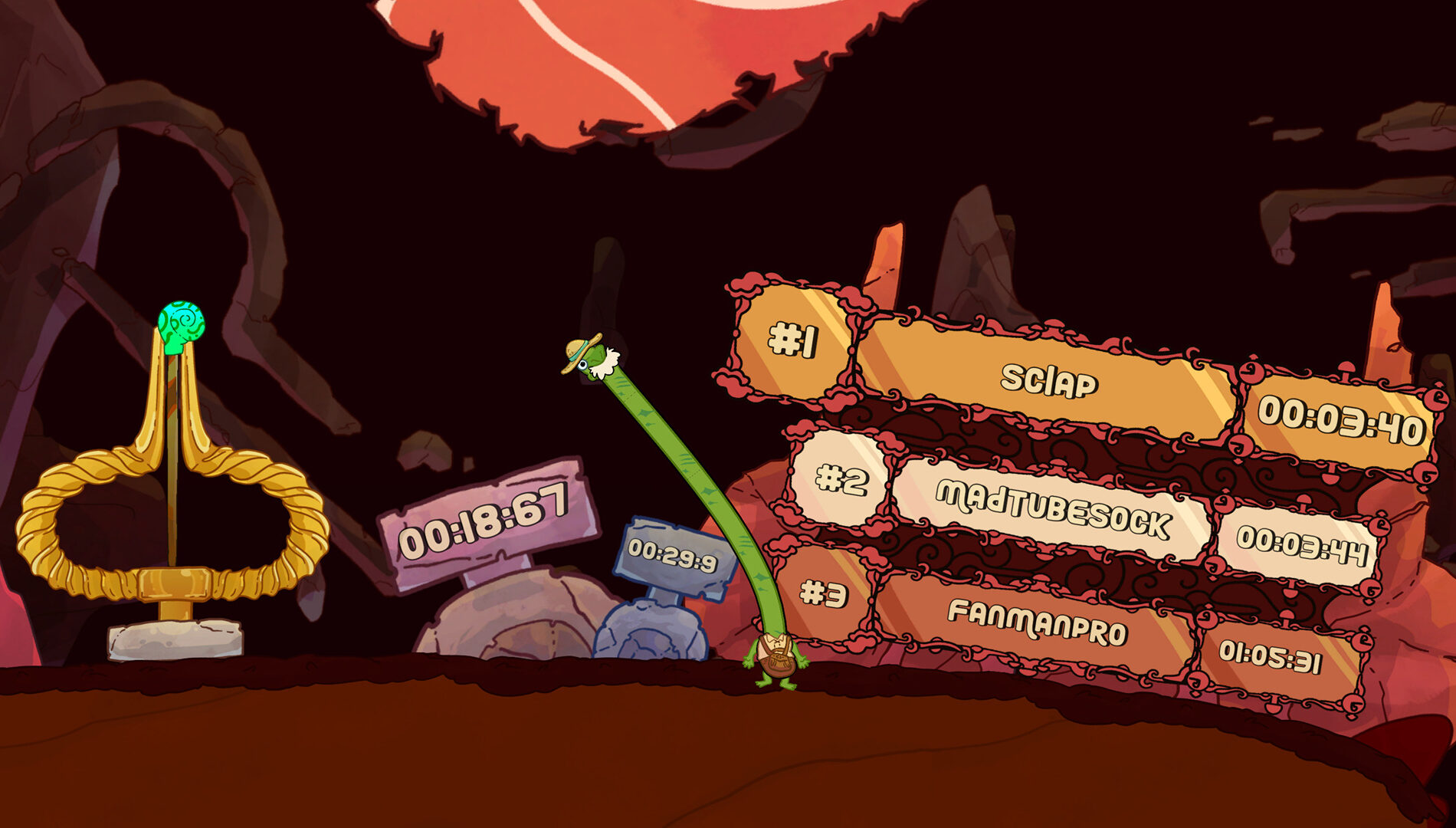
The solo hardcore Masochist mode just got amped up. We’re launching a new online leaderboard system that lets you race for the fastest speedruns and compete globally with other players. Whether you’re chasing world records or just trying to beat your friends, the leaderboard gives you a clear target and the bragging rights that come with it. Every run counts, and your skills will be on display for all to see.
Jump into Four-Player Co-op Chaos
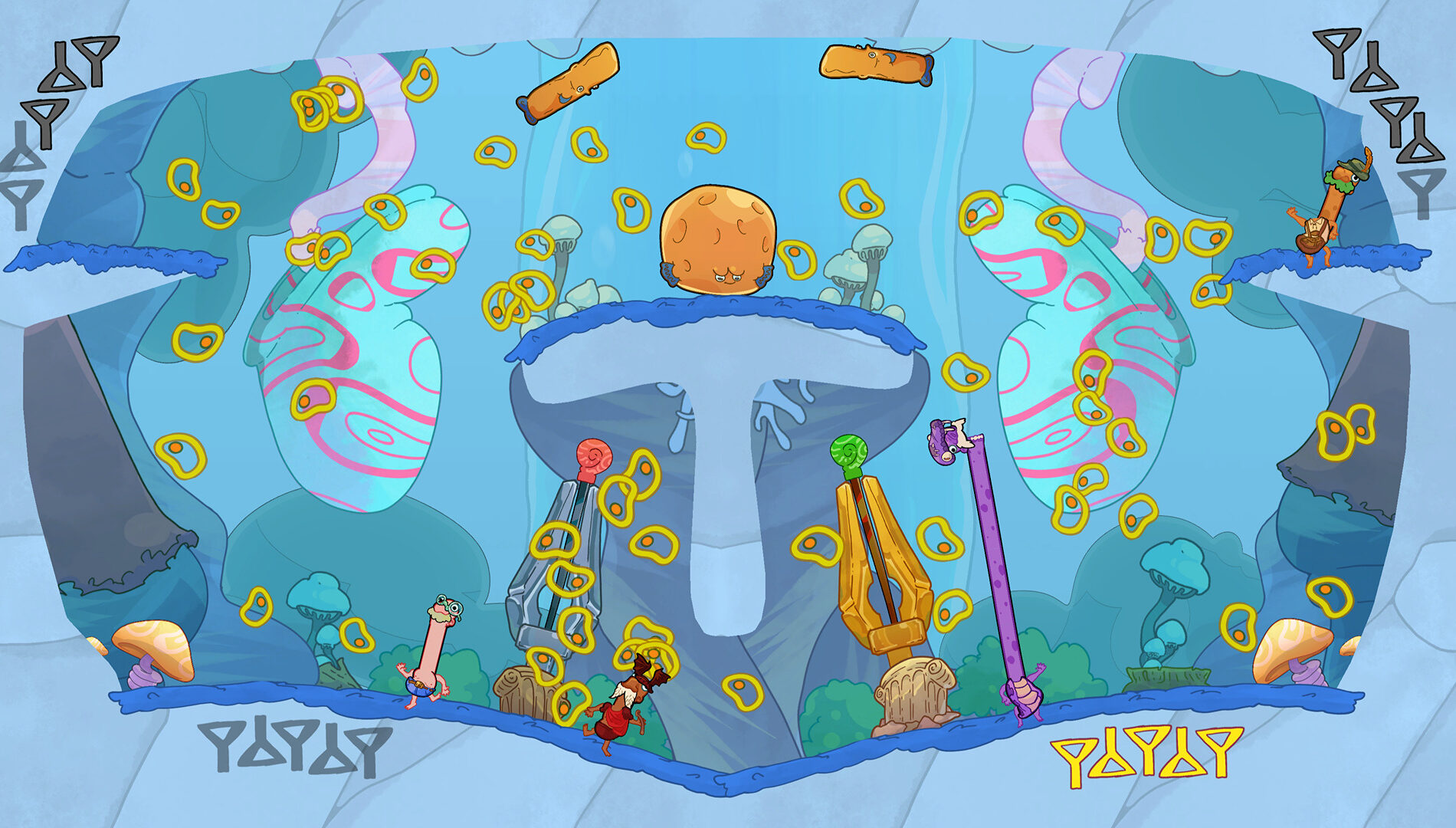
The four-player co-op section, Block 3, is now unlocked and ready for mayhem. You can now experience four-player cooperative chaos from the start, perfect for those party sessions. These levels have been specifically designed to generate abundant laughter when you’ve got a full squad. Expect synchronized awkwardness, shared victories, and plenty of opportunities to both help and hinder each other.
Fresh Emotes and Essential Help
I’ve added a collection of new and updated emotes so you can express yourselves in all the jiggly ways. Beyond that, we’ve introduced a dedicated help menu that walks new players through the basics. No more confusion about game mechanics; if you’ve got a question, the help menu has the answer.
We’ve also added a variable neck length feature, that corresponds to fine-tuned control to precise neck size. All necks are created equal.
Visuals Juiced
The visual improvements in this update are substantial. We’ve overhauled the entire camera system to eliminate jitter and deliver buttery-smooth gameplay. The geckos now animate dynamically with hungry grace, making every encounter feel more alive. Minigame scoring now comes with satisfying confetti effects, hub orb deposits have juicy new VFX, gnome deposit animations have been completely reworked, and I’ve added a helpful friend to identify secret areas you might otherwise miss.
Grunts and Twangs Forever
The unique audio in Esophaguys now feels more cohesive and polished. The game is now approaching 4500 personally-recorded, mouth-originated sound effects. Just when I thought I couldn’t make any more strange noises, I whipped out new quips for various mechanics – gnomes, whales, chickens, Travneck, and hub harp orbs. As the first game to feature traditional jews-harp music, new mixes have been added to the competitive minigame levels, showing off the banjo and jews-harp combo that is as twangy as it gets. I’ve additionally leveled volumes and smoothed spikes for seamless transitions across the game.
Fixes and Refinements Across the Board
This is where the rubber meets the road: we’ve eliminated a swarm of bugs, from gnats to fruit flies to cockroaches to rolly-pollies. Gnomes no longer get stuck or run in the wrong direction after spawning. Pre-biting a fly no longer breaks its logic. Puzzles now open doors correctly without being too easy or frustratingly hard.
We’ve fixed issues where you couldn’t contest minigame weapons and resolved the flickering that occurred when switching between TravNeck and electric neck modes. Level design metrics have been reviewed and adjusted throughout, with special attention to Block 3 based on community feedback. Layering issues with art have been corrected, progress-critical objects now always work and respawn reliably, and bite disconnection issues have been resolved.
Chained player mechanics work as intended, and we’ve added the build number to the menu so you always know which version you’re running. Individual levels are now numbered for clarity in the hub world.
What’s Next?
The Neckening Update represents our commitment to listening to our community. Every fix, every feature, and every visual improvement came from your feedback. We’re grateful for your bug reports and your enthusiasm for Esophaguys.
Esophaguys is available now on Xbox Series X|S and Xbox One. Download The Neckening Updatetoday and experience necks-generation gaming on Xbox!
Esophaguys
Esophaguys Team
☆☆☆☆☆ 10
★★★★★
$14.99
You are the Esophaguys, old folks with elongating necks! Stretch, bite, and swing yourself around in 1-4 player guttural mayhem: co-op, competitive, and solo. Progress across each mode, reuniting your lost kin!
Co-op Mode (2-4 players):
Stretch, bite, and swing together, traversing and solving puzzles as you search to reactivate the forgotten monuments of your diasporic people.
Minigame Mode (2-4 players):
In team-based sports, free-for-all arena, and traversal trials, compete, neck-to-neck, to determine who has the greatest gullet.
Story Mode (1-4 players):
Accompanied by poignant narration, embark on a mythical journey to understand the past and shape the future. Will you uncover the true nature of the neck?
Masochist Mode (1-4 players):
No land. No checkouts. Nothing but neck. Subject yourself to grueling challenges in a hellish atmosphere ripe for speedrunning.
Hub World Progression:
Reconstruct the ancient monument of your people as you progress through each mode, reuniting and unlocking the garb of your lost lengthy kin.
Twanging Tones and Elderly Grunts:
Lose yourself in a soundscape all its own. The first video game dedicated to one of mankind’s oldest instruments, the jews-harp. Experience the ancient sound from a variety of world traditions combined with bold experimentations. Reconstructing centuries old tradition from archival material, classic twangs from America, Austria, the British Isles, India, Norway, Kyrgyzstan, and Yakutia will delight your ears with every jugular jiggle. Accompanied with over 4000+ personally-recorded, mouth-originated SFX, prepare your cochleas to be tickled to the extreme.
How to Design a Background That Actually Builds a Personal Brand
If you are going to be shooting the type of video that could be described as talking head video for things like tutorials then the technicalities are pretty easy to nail down.
A reasonable lighting setup, some form of decent audio recording system and an “OK” camera or smartphone and with a little tweaking you are probably good to go.
As I say, that’s the “technical” part of it and these days, pretty easy to get under control given that the subject being captured is in a relatively fixed postion.
The real problems start when it comes to what is called in the industry, “set design.”
What the viewer sees in the background has an enormous effect on how that viewer is going to perceive both the subject and the information they may be relating.
In this video from Video School they cover a few choices they made for their own set design with a good explanation as to why those choices were what they were.
Best AI Tools for YouTubers
OK, so the guys at Think Media are pretty prolific in the sheer amount of content they produce so I think their opinion on the current batch of useful A.I. tools is relevant to us all.
The current sate of A.I. tools for video is that there really is no current state other than a constant state of flux!
It is just evolving so fast with new applications of A.I. to video related problems coming and going almost on a daily basis.
So for what it’s worth and given that by next month it may all have been replaced, here’s their take on the current batch of tools that can actually make your video creation easier.
Utilizing the power of Media Libraries in PowerDirector
I have a friend who has been an editor for a very long time now but the difference between us is pretty vast!
I cut, dice and splice little YouTube videos whereas he works at the Hollywood blockbuster end of the scale.
Over the years he has shared a mountain of tips and tricks with me but starting out there was one that really stuck with me.
At the beginning of a new project he may spend up to a month full time organizing and naming all the assets available to him for that project.
A lot of that time may be spent with the director present and basically what they are doing is mapping out every step they will be engaging in before they start.
The point he was making to me was that no matter how complex or simple a project is, unless you have all your ducks in a row organizationally, you will sink faster than the Titanic in a sea of “where did I put that thing!”
Here are some more advanced organisational tips for use in PowerDirector.
How to Make a New Year Countdown with Timer Effects – PowerDirector
Obviously this tutorial was aimed at being used for a New Year Countdown but that’s selling it a little short I think.
There are numerous situations where you may need or want some kind of countdown effect so this how you can do it in PowerDirector.
Cheap Video Gear for Beginners
When I first started helping my wife shoot videos at home for her YouTube channel I had already been video editing for quite some time.
So for the editing I was fine but as far as shooting went, I had pretty much no idea what I was supposed to be doing!
We started off using a Samsung phone for video and were kind of lucky because that phone was pretty forgiving as far as quality went.
However it was obvious that the overall quality needed to be raised.
That was the beginning of a journey in search of the equipment we really needed to achieve the standard we felt acceptable.
These days we use a good Sony camera, a Hollyland Lark lavalier mic setup, some good quality lighting and a dedicated space to shoot in.
We didn’t get to this point in one go. It was a process of slowly upgrading and improving and one thing we did learn was that going for an expensive item more often than not, was just wasting money.
Here’s a great guide through the process from the guys at Movavi on getting only what you need at a budget price.
Filmora 15 AI Features Full Guide – Text to Video, AI Enhancer & VEO 3.1
Filmora, like just about every other consumer level video editing software at the moment, has certainly dived into the deep end of integrating the latest in A.I. features.
Personally I think some of these new features are pretty cool, some I think are pretty useless and some quite handy to have up your sleeve.
For me the bottom line of any feature in video editing software A.I. or not is whether I would actually use it.
The danger with A.I. video features is that they are often presented as “total” solutions to video creation.
What I mean by that is that the user is coaxed into believing that the A.I. is going to create your video or completely edit your video… none of which is true.
Any A.I. functionality has to be viewed as a tool rather than an end unto to itself although that’s kind of hard when you don’t really know what it can do!
In light of that here is a pretty complete run through of the current A.I. features in Filmora, what they can do and a few examples of how they can be used.
You’re Underusing the Edit Page in DaVinci Resolve (Here’s How to Fix That)
This is a particularly long livestream video from Daniel Batal for this week so be warned!
It goes for about one hour and forty-five minutes but the reality is that it is full of great information if you are using DaVinci Resolve as your primary editor.
The reason this one is so good in my opinion is that is solely concentrates on the Edit Page in Resolve and covers just about everything you can do in that Page.
The tendency with most Resolve users is to jump around the various pages to carry out actions that one would logically think belong in that Page.
That’s fine in itself but there has been a fundamental change in the way Resolve has been developed over the past year or so.
What has slowly been happening is that access to a number of settings and tools has been added to the Edit Page based on user data.
That data was showing what I just described with people jumping from the Edit Page to another, completing a task then returning to the Edit Page.
To improve workflow efficiency the folks at Resolve have been identifying tasks that could be made accessible on the Edit Page and making it so.
In light of that, this run through of the Edit Page from Daniel Batal is a great way to get a total grip on what you can do without having move around from Page to Page.
Export Transparent Video in DaVinci Resolve – Alpha Channel Explained
If you are working with DaVinci Resolve, pretty much the answer to most questions relating to being able to perform some action is, yes!
Of course that where the fun begins because with all of that awesome technical ability comes an interface that has to cover a million different things!
Sometimes even the simplest of action can be a bit of a task to unravel although once you work it out, it then makes perfect sense.
Here’s a tutorial from Jason Yadlovski covering one such seemingly simple actions, creating a transparent video with and alpha channel.
Discover more from The DIY Video Editor
Subscribe to get the latest posts sent to your email.
Healthcare organizations are facing an unprecedented staffing crisis. With 18% of the healthcare workforce expected to leave by 2026 and recruiting costs skyrocketing to $35,000+ per nurse, retention has become a financial imperative. This infographic by Cengage reveals how healthcare employers are using education benefits to turn the tide, creating pathways that transform retention challenges into competitive advantages.
In this infographic, you will learn:
The true cost of healthcare turnover and why traditional retention strategies are falling short in today’s market
How to leverage education benefits as a strategic retention tool that addresses both career development needs and organizational stability
Why 65% of healthcare workers would stay longer with an employer offering tuition assistance programs
How to implement practical approaches to educational pathways that keep your clinical staff engaged and growing within your organization
How to position your healthcare system as an employer of choice in an increasingly competitive talent landscape
Microsoft said it has steadily worked over the past decade to deprecate RC4, but that the task wasn’t easy.
No salt, no iteration? Really?
“The problem though is that it’s hard to kill off a cryptographic algorithm that is present in every OS that’s shipped for the last 25 years and was the default algorithm for so long, Steve Syfuhs, who runs Microsoft’s Windows Authentication team, wrote on Bluesky. “See,” he continued, “the problem is not that the algorithm exists. The problem is how the algorithm is chosen, and the rules governing that spanned 20 years of code changes.”
Over those two decades, developers discovered a raft of critical RC4 vulnerabilities that required “surgical” fixes. Microsoft considered deprecating RC4 by this year, but ultimately “punted” after discovering vulnerabilities that required still more fixes. During that time Microsoft introduced some “minor improvements” that favored the use of AES, and as a result, usage dropped by “orders of magnitude.”
“Within a year we had observed RC4 usage drop to basically nil. This is not a bad thing and in fact gave us a lot more flexibility to kill it outright because we knew it genuinely wasn’t going to break folks, because folks weren’t using it.”
Syfuhs went on to document additional challenges Microsoft encountered and the approach it took to solving them.
While RC4 has known cipher weaknesses that make it insecure, Kerberoasting exploits a separate weakness. As implemented in Active Directory authentication, it uses no cryptographic salt and a single round of the MD4 hashing function. Salt is a technique that adds random input to each password before it is hashed. That requires hackers to invest considerable time and resources into cracking the hash. MD4, meanwhile, is a fast algorithm that requires modest resources. Microsoft’s implementation of AES-SHA1 is much slower and iterates the hash to further slow down cracking efforts. Taken together, AES-Sha1-hashed passwords require about 1,000 times the time and resources to be cracked.
Windows admins would do well to audit their networks for any usage of RC4. Given its wide adoption and continued use industry-wide, it may still be active, much to the surprise and chagrin of those charged with defending against hackers.
Baba is You is about as cool as puzzle games get, and PC Gamer contributor Philippa Warr agreed, scoring the game an exceptional 90% back when it released. But like most puzzle games, I binged it once with no plans to return until my withering hippocampus had fully lost all the puzzle solutions. To my elation, 2026 is starting with a delightful surprise: a major update to Baba Is You with all sorts of new words, objects and modding tools.
The update is detailed in a Steam community blog post, which reasons “This will most probably be the final large update for BIY.” It seems to be primarily targeted at modders, but contains five new words for use in custom levels: become, facedby, hold, happy, and angry.
If you’ve never played Baba is You, words change the way a given level works as you construct condition-altering sentences. For instance, Baba is Happy would theoretically make the player character happy… what effect that would have on a puzzle, I’m not sure.
There’s also a bunch of new sprites, including a fox, a bean, a hot dog, a cactus, and so on. This is all tailor-made for Baba’s detailed (and cross-platform!) level editor, which was released back in 2021. If you haven’t revisited Baba since then, players have made all sorts of custom levels in the meantime—some of the best ones are accessible from the “featured” section of the game’s main menu. Given how mind-bending some of the base game’s puzzles are, it’s hard to imagine what sort of shenanigans fans have cooked up.
And that’s not even mentioning mods, which also got a boost with the new update. The patch notes feature a lot of technical jargon experienced modders will have more luck parsing, but they come with a few dozen bugfixes and tweaks that should make for a more polished experience in general.
It’s not stuffed with new levels like some previous free updates for the game—at least, as far as I can tell—but it’s nice to see the game introducing new toys to mess around with so many years after its initial release. Baba is You might sear my neurons with its hardest puzzles, but over half a decade on, I’ve still never played anything quite like it. That’s worth celebrating, even in 2026.
Keep up to date with the most important stories and the best deals, as picked by the PC Gamer team.
What role do interior design and 3D rendering services play in transforming Institutional spaces? Nowadays, institutions globally are realizing that design isn’t just decoration; it’s an experience. It tells people how they will feel or act, or interact with space. Be it the student who has to sit through long lectures, a patient waiting to see the doctor, or even an employee who has to spend hours behind the desk, space makes all the difference.
That’s where platforms like Cad Crowd come in: they match you with top freelance interior designers and 3D rendering experts who can even make the most uninteresting institutional space alive. From conceptual sketches to photorealistic visualizations that blow your mind, these creatives will have just the right way to bring your ideas into being before the first wall is touched.
The institutional design challenge
While it is one thing to design a café or a flat, designing a hospital or university is quite another. Institutional spaces have to be practical and aesthetic, durable and comfortable, uniform but with personality-that is a tall order. Institutions are meant to be used by the masses: hundreds, even thousands, use them daily. For this reason, a designer has to take into consideration not just style but also safety, flow, accessibility, and maintenance.
Hospitals do represent the same challenges, but on completely different emotional levels: reducing stress, aiding in healing, while at the same time guiding staff and visitors with ease. It’s no longer acceptable that being in a hospital needs to feel cold and sterile; patients are human beings, and design now plays an active role in their well-being. So, how do 3D designers and architects make that all happen? They start with a vision, but to clearly and convincingly communicate that vision, they need the help of 3D rendering.
If interior design were an art, then 3D rendering would be its translator. It takes what the designer has envisioned and makes realistic visualizations that any person can understand. What was once a simple sketch is now a digital walkthrough of space thanks to 3D architectural rendering firms. This lets clients, investors, and decision-makers see exactly how a design will look and feel before it’s built. It revolutionized the presentation and approval of design projects for institutions and brought an end to the days of blueprints and 2D drawings that only a professional could understand.
Realistic renderings create such an effect that even a layperson, with no experience in design, is able to envision in his mind just what the final result is going to look like. That would be like standing in front of a university board, describing how the redesign of a student lounge would look: sun coming from big windows, students chattering amidst bright furniture, and the greenery adding that extra warm glow to the space. At that moment, it no longer feels like some proposal; this is something that could be very real quite soon.
Added to that, several of the many reasons why 3D rendering services are in demand involve clear and emotive communication: they avoid misunderstandings, reduce expensive revisions, and speed up approvals. Whether your project needs the expertise of an accomplished freelancer skilled in using rendering software like SketchUp, Blender, or 3ds Max, finding the right professional to do your project has never been easier.
The core of institutional interior design is to help improve how people experience space. It’s so much more than aesthetics; it is about function and purpose. A well-designed interior makes space easier to navigate, much more pleasant to live in, and therefore more efficient to use. Take the public library, for instance. What used to be block after block of shelving and row upon row of wooden chairs started to become so much more: a collaboration and learning center. 3D architectural designers encourage longer, more engaging visits by incorporating adaptable layouts, comfortable seating, and inviting lighting into designs.
Think of universities, where campus design today fosters both community and imagination. Gone are stark classrooms; open lounges predominate. Cold fluorescents have given way to natural light. Bold colors and textures leave students energized, not fatigued. Students who most enjoy being in a space perform better academically and socially. 3D rendering helps designers experiment with these decisions in advance; they are able to test virtually which materials could work, different light scenarios, furniture arrangements, and so on. They are thus able to compare a number of versions of a space with confidence in their decisions, rather than relying on imagination.
Sustainability and smart design
The concept of sustainability has also been embraced in the sphere of institutional design. Sustainability is not just a word; it is itself a responsibility. In institutional design, sustainability has become important as institutions require a great amount of energy and resources. Nowadays, different interior design companies combine natural lighting, energy-efficient systems, recycled materials, and green walls in their work. All these eco-friendly concepts are effectively visualized with the help of 3D rendering. It’s able to show how natural light will interact with space at different times of day, or how the plant installations can help clean the air and add to the aesthetic value at the same time.
A government building might want to show its sustainable commitment. The photorealistic renderings will help the design team communicate all details regarding solar panels, smart lighting systems, and eco-friendly materials. It helps the decision-makers understand how those options meet the set goals for the environment but also satisfy the criteria for design appeal. By adding Cad Crowd freelance 3D artists to your team, institutions will make sure their ideas of sustainability are not only technical but also visually inspiring. Freelancers bring fresh creative energy and a set of global design perspectives that could take any project beyond the ordinary.
The affective value of design
While much of institutional design necessarily focuses on function, its emotional impact can never be underestimated. Human beings respond deeply to their surroundings: a dimly lit corridor can feel oppressive, while one that is bright and well-designed can convey a sense of safety and welcome. Then, of course, there’s color psychology. Soft blues and greens offer comfort to both patients and caregivers in healthcare settings, while earthy tones may provide a more engaging learning environment. Even less obvious things, like the texture of a wall or where natural light emanates from, affect how people feel within the space.
3D interior rendering firms can make the testing and refining of those emotive elements much easier. It shows the designers how different lighting setups or color schemes alter the mood. They are able to present multiple moods to the clients; for example, one version might be warm and intimate, another bright and energizing. All this flexibility in design thus creates confidence that the finished product will meet not only functional goals but also emotionally connect with the people who are going to use it. The beauty in marrying creativity and technology is that interior design and 3D rendering, at their best, complement each other in building spaces that connect with people on functional and emotive levels.
Every great institutional project starts with collaboration. There’s creative vision from the designer, practical needs and goals from the client, and the visualization of all those ideas by the 3D renderer. When all those roles come together in sync, the results can be amazing. First, the designer may brainstorm a conceptual, shared space at the university that’s modern and inclusive; the client may need it to fit within accessibility standards or seating capacities. The renderer bridges those two worlds by crafting a visual model in which each can analyze and refine. That’s the beauty of 3D rendering: it simplifies communication.
Rather than long, wordy explanations or a sketch that would perhaps lead to misunderstandings, teams are able to view a photorealistic model together and share what works and what does not. Probably the most important collaborators in this process are 3D architectural visualization freelancers from Cad Crowd, introducing flexibility, specialized expertise, and often a global perspective into institutional projects. Most of them have experience working on large-scale renderings for hospitals, schools, or civic buildings and understand the delicate balance between design vision and real-world practicality.
Technology that brings ideas to life. In case of renovation, for example, a virtual walkthrough through a hospital would show the ways staff and patients make their way through hallways and waiting rooms. Designs are adjusted with the aim of bettering such layouts in pursuit of either accessibility or efficiency. Such VR previews as how students will interact with learning zones, lounges, or digital labs at educational institutions help visualize. Capabilities of such technology reduce expensive mistakes and speed up approval processes.
The teams do not have to wait for physical models or multiple design drafts, but can immediately make adjustments based on precise visual data. That kind of precision is priceless, especially in work dealing with public budgets or very tight schedules. Generally, freelance rendering and 3D visualization experts use updated software and hardware. Outsourcing with Cad Crowd can expose an institution to a talent pool of professionals that can help achieve high-quality work without the long-term costs of hiring these teams in-house.
Real-world transformations
Thoughtful design has proved to be powerful, evident all over the world in newly redesigned institutional spaces. For example, schools that once felt dull and crowded have been remade into vibrant centers of creativity. Libraries moved from silent study zones into vibrant community hubs. And hospitals moved from cold and sterile to warm and reassuring. Consider how health facilities use color, lighting, and texture to improve the experience of their patients. An intentionally designed reception space can diffuse anxiety with its configuration and lighting alone.
In education, universities have found that when natural light, open space, and flexible furniture are part of an intentionally designed campus, students are more engaged and better satisfied. But there is indeed one common thread running through these changes: interior design has less to do with opulence and more with the human experience. From where a window should go to how a particular wall will be shaded, each decision can affect the way people will feel and function inside that space. 3D commercial rendering services help bring clarity and confidence when such choices must be made.
At the center of such evolution will be 3D rendering. With improvements in AI and real-time rendering tools, designers will be capable of testing and perfecting their ideas at previously unparalleled speeds. Institutions will not just digitally visualize their spaces but will practically be able to interact with them before breaking ground. This opens up opportunities for architectural design freelancing professionals resources such as Cad Crowd, organizations can source highly qualified freelancers from anywhere in the world who understand both the creative and technical sides of design. This is a low-cost, innovative way to assemble agile, specialized, and deeply collaborative design teams.
A final word
Most of us hardly ever realize how institutional spaces shape everyday life, where spaces are created for learning, places for healing, and places for coming together. The rapid combination of interior design and 3D rendering is turning such spaces from being merely functional into inspirational and nourishing ones. It is the mixture of creativity and technology with collaboration that makes something different from just a building.
How Cad Crowd can help
If you want to transform any ideas quickly and wiser, just hire any skilled freelancers. They are also capable of modifying any of your plans, such as school, pool or hospital. Your answer is right in front of you. Message Cad Crowd for a wide variety of interior designs. Contact us for a free quote.
MacKenzie Brown is the founder and CEO of Cad Crowd. With over 18 years of experience in launching and scaling platforms specializing in CAD services, product design, manufacturing, hardware, and software development, MacKenzie is a recognized authority in the engineering industry. Under his leadership, Cad Crowd serves esteemed clients like NASA, JPL, the U.S. Navy, and Fortune 500 companies, empowering innovators with access to high-quality design and engineering talent.
The following article originally appeared on Medium and is being republished here with the author’s permission.
This post is a follow-up to a post from last week on the progress of logging. A colleague pushed back on the idea that we’d soon be running code we don’t fully understand. He was skeptical: “We’ll still be the ones writing the code, right? You can only support the code if you wrote it, right?…right?”
That’s the assumption—but it’s already slipping.
You Don’t Have to Write (or Even Read) Every Line Anymore
I gave him a simple example. I needed drag-and-drop ordering in a form. I’ve built it before, but this time I asked Cursor: “Take this React component, make the rows draggable, persist the order, and generate tests.”
It did. I ran the tests, and everything passed; I then shipped the feature without ever opening the code. Not because I couldn’t but because I didn’t have to. That doesn’t mean I always ship this way. Most of the time, I still review, but it’s becoming more common that I don’t need to.
And this isn’t malpractice or vibe coding. The trust comes from two things: I know I can debug and fix if something goes wrong, and I have enough validation to know when the output is solid. If the code works, passes tests, and delivers the feature, I don’t need to micromanage every line of code. That shift is already here—and it’s only accelerating.
Already Comfortable Ceding Control
Which brings me back to site reliability. Production systems are on the same trajectory. We’re walking into a world where the software is watching itself, anticipating failures, and quietly fixing them before a human would ever notice. Consider how Airbus advises pilots to keep the autopilot on during turbulence. Computers don’t panic or overcorrect; they ride it out smoothly. That’s what’s coming for operations—systems that absorb the bumps without asking you to grab the controls.
This shift doesn’t eliminate humans, but it does change the work. We won’t be staring at charts all day, because the essential decisions won’t be visible in dashboards. Vendors like Elastic, Grafana, and Splunk won’t vanish, but they’ll need to reinvent their value in a world where the software is diagnosing and correcting itself before alerts even fire.
And this happens faster than you think. Not because the technology matures slowly and predictably, but because the incentives are brutal: The first companies to eliminate downtime and pager duty will have an unassailable advantage, and everyone else will scramble to follow. Within a couple of years (sorry, I meant weeks), the default assumption will be that you’re building for an MCP—the standard machine control plane that consumes your logs, interprets your signals, and acts on your behalf. If you’re not writing for it, you’ll be left behind.
More Powerful Primitives (We May Not Fully Understand)
I’ll end with this. I majored in computer engineering. I know how to design an 8-bit microprocessor on FPGAs. . .in the late 1990s. Do you think I fully understand the Apple M4 chip in the laptop I’m writing on? Conceptually, yes—I understand the principles. But I don’t know everything it’s doing, instruction by instruction. And that’s fine.
Code generation is about to redefine that building block again. It’s not just another abstraction layer; it’s a new “atom” for how we think about software. Once that shift takes hold, we’ll start leveling up—not because we know less but because we’ll be working with more powerful primitives.
New Blood immersive sim Gloomwood—Thief with guns, if you’re nasty—is still a ways off from full release, but it’s already well worth your time even in early access. Every update has adorned the in-progress build with wild new zones and features, from cutting-edge rat AI to player-morphing monster juice. This time around, New Blood is promising the game’s biggest explorable area yet, which means it’s a great time to try all those spooky new toys.
The Hightown Update comes after a short delay, but dropped just in time for a New Year’s Day celebration. The release trailer shows off some of the new areas and a new weapon: a revolver with a rifle stock and a scope slapped on.
Gloomwood – The Hightown District – OUT NOW – YouTube
A teaser blog post on Steam said the new patch contains both “largest, most vertical open area” and “the most sophisticated, lethal and complex enemy force” yet seen in Gloomwood, and shows off more of the new areas, which look suitably gothic and dismal. Back when the patch was delayed around Christmas, developer Dillon Rogers said on X that the new revolver-rifle would help players “tackle those pesky constable snipers.”
My experience with Gloomwood is limited, but I do love a stealth game with winding, open spaces to skulk around. Players on Reddit are noticing that Hightown is pretty familiar to the areas used in the demo, and after seeing a side-by-side comparison, it’s remarkable how far the game has come since that demo released in 2020. It’s also the first time I’ve internalized that 2020 was six years ago, which as I’m writing it, doesn’t feel like it can possibly be true. And yet, here we are.
If the Hightown Update has piqued your interest, Gloomwood is available to buy on Steam.
Keep up to date with the most important stories and the best deals, as picked by the PC Gamer team.
I do not understand why but I can’t debugging.
I tried to attach, build with the debugger attached and nothing.
The only thing I succeed was to break on a line while the editor was loading.
I tried delete intermediaire/saved/binaries and rebuild from ground. I disabled live coding.
I’ve selected DebugGame Editor / Win64 / MyGame + F5
I have log that confirm that the code is executed.
Anyone have this issue ?
I tried 5.7 and 5.7.1 (from launcher and github) with same result. Is this a known issue on these versions ?
I’ve already reinstall everything from the ground following step by step the documentation.
Europe’s banking sector is about to get a tough lesson about efficiency. According to a new Morgan Stanley analysis reported by the Financial Times, more than 200,000 European banking jobs could vanish by 2030 as lenders lean into AI and shutter physical branches. That’s roughly 10% of the workforce at 35 major banks.
The bloodletting will hit hardest in back-office operations, risk management, and compliance, the unglamorous guts of banking where algorithms are believed capable of tearing through spreadsheets faster and more effectively than humans. Banks are salivating over projected efficiency gains of 30%, according to the Morgan Stanley report.
The downsizing isn’t confined to Europe. Goldman Sachs had warned U.S. employees in October of job cuts and a hiring freeze through the end of 2025 as part of an AI push dubbed “OneGS 3.0” that’s targeting everything from client onboarding to regulatory reporting.
Some institutions are already swinging the axe. Dutch lender ABN Amro plans to cut a fifth of its staff by 2028, while Société Générale’s CEO has declared “nothing is sacred.” Still, some European banking leaders are urging caution, with a JPMorgan Chase exec telling the FT that if junior bankers never learn the fundamentals, it could come back to haunt the industry.