The 2011 detective game LA Noire, which was published by GTA company Rockstar Games, starred Mad Men actor Aaron Staton as the lead character, Cole Phelps. A writer on the game has now revealed that a different Mad Men actor, Jon Hamm, was considered for the role as well. Staton portrayed Ken Cosgrove on Mad Men, with Hamm playing the show’s leading role, Don Draper.
Daniel McMahon told IGN that Mad Men and LA Noire had the same casting director, and that Hamm was “discussed as a possibility for the role of Cole Phelps.”
“It was never said at the time, but now, I understand the vision which was Jon Hamm is a wonderful actor, but he’s not Cole Phelps,” McMahon said.
Aaron Staton as Cole Phelps in LA Noire.
McMahon went on to say that Staton was “much better at portraying Cole’s fragility.”
“He’s very smart, but he’s also young, not very experienced, and he’s just trying his best. So, I think Jon Hamm would’ve been incredible, but expensive, and probably, in the end, not as good casting for that character as Aaron Staton was,” he explained.
LA Noire was developed by Team Bondi, and it never got a sequel. Earlier this year, Take-Two boss Strauss Zelnick said the company is considering future projects for all of its franchises, and that includes LA Noire.
LA Noire was developed by Team Bondi and released in 2011 for PS3, Xbox 360, and PC, with Rockstar publishing it. The game takes place in 1947 Los Angeles, with players taking on the role of the detective Cole Phelps, who is played by Mad Men’s Aaron Staton. The game came to Switch, PS4, and Xbox One in 2017. A VR edition called The Case Files came out in 2019.
Back in 2012, Rockstar said a sequel to LA Noire was a “possibility.” At the time, the developer said, “We don’t always rush to make sequels, but that does not mean we won’t get to them eventually. We have so many games we want to make and the issue is always one of bandwidth and timing.”
If a sequel comes to market, it wouldn’t be from Team Bondi, as the studio shut down amid a flurry of controversy, after accusations of hostile working conditions prompted the International Game Developers Association to launch an investigation into the developer. Additionally, when the developer shut down, it reportedly was $1.4 million in debt. The studio’s assets, including its next project, Whore of the Orient, were acquired by film production company Kennedy Miller Mitchell.
One of the best parts of a Visual Studio Subscription is discovering benefits that can make your day-to-day development work easier and more cost effective. One benefit that deserves more attention is Azure Dev/Test pricing. In fact, it’s one of the most valuable benefits included with a Visual Studio Subscription.
If you’re building cloud applications, testing new ideas, or maintaining multiple development environments, cloud costs can sometimes influence how often you experiment or how closely your development environment matches production. Azure Dev/Test pricing helps remove that barrier by giving eligible Visual Studio subscribers access to discounted Azure pricing for non-production workloads.
Whether you’re an individual developer exploring a new idea or part of a team building complex cloud applications, this benefit gives you the flexibility to experiment, validate, and iterate without letting cloud costs slow you down.
Why developers should care
Developers thrive when they have the freedom to experiment.
Whether you’re evaluating a new architecture, validating performance, testing deployment pipelines, or exploring AI and cloud services, you shouldn’t have to second guess spinning up the resources you need. Azure Dev/Test pricing makes it easier to create, test, and tear down environments without worrying about unnecessary development costs.
Imagine your team is preparing a major feature release. Instead of sharing a single test environment or delaying validation because of cloud costs, developers can quickly provision a dedicated Azure environment, run performance and integration tests, gather feedback, and remove the resources when testing is complete. That faster feedback cycle helps teams identify issues earlier and move confidently toward production.
This flexibility helps teams iterate faster, shorten feedback loops, and support agile DevOps practices while keeping non-production environments cost effective.
Build and test with production-like Azure services
One of the biggest advantages of Azure Dev/Test pricing is that you’re working with the same Azure services you’ll use in production, rather than a limited sandbox environment.
That means you can:
Test application performance and behavior in environments that closely resemble production.
Create temporary environments for feature development, testing, and validation.
Shut down idle resources when they’re no longer needed and avoid overprovisioning.
Experiment with new Azure capabilities without unnecessary cost concerns.
Support continuous integration and delivery workflows with realistic testing environments.
This is where the benefit really stands out. You’re not just reducing costs. You’re giving your team the flexibility to learn, experiment, and build with greater confidence before deploying to production.
It’s important to note that Azure Dev/Test pricing is designed specifically for development and testing workloads, not production environments. Using separate environments both helps organizations take advantage of Dev/Test pricing and supports sound engineering practices for more predictable deployments.
Choose the Dev/Test option that’s right for your organization
Visual Studio subscribers can take advantage of Azure Dev/Test pricing through three purchasing options, depending on how their organization purchases Azure.
Designed for organizations using an Enterprise Agreement (EA), this option provides centralized billing and comprehensive management capabilities for teams running multiple non-production environments.
Available for organizations using a Microsoft Customer Agreement (MCA), Azure Plan for Dev/Test offers modern billing flexibility as customers transition from legacy purchasing agreements.
Ideal for individual developers and smaller teams with Visual Studio Professional or Enterprise Subscriptions who are not covered by an Enterprise Agreement, this option provides an easy way to access Dev/Test pricing while maintaining billing flexibility.
Start using Azure Dev/Test pricing today
If you’re a Visual Studio Professional or Enterprise subscriber, sign in to my.visualstudio.com to learn more about Azure Dev/Test pricing and choose the option that best fits your organization.
It’s an easy way to reduce development cost friction, accelerate your projects, and get even more value from your Visual Studio Subscription.
A huge demographic change is occurring in the segments of premium hospitality and entertainment. Up until recently, the concept of premium loyalty programs was developed based on traditionally male preferences for golf and cigars. Today, wealthy and independent women represent one of the forces behind such changes, forcing organizations to reconsider and adapt their products to meet the new requirements of female consumers in luxury entertainment.
Traditionally, when it comes to the marketing of luxury resorts and gambling venues, the primary target audience would be male-oriented with privileges such as golf packages, luxury cigars, and exclusive steakhouse dining dominating the scene. Modern times have changed everything dramatically since corporate data proves the fact that women are currently among the most engaged in loyalty programs and are the ones who participate in them most actively. This new segment of the audience is represented by wealthy independent clients who require leisure differently which means that the whole strategy has to be reconsidered and redesigned.
One of the best examples of rethinking of the reward strategy lies in virtual gaming platforms providing access to luxury benefits. Corporate data proves the fact that the active use of various lifestyle rewards and conversion of virtual achievements on the premier Borgata Online Casino app which guarantees privacy and safe payment process takes place among female players. Developers create an app which works smoothly together with built-in iOS security measures.
A good mobile game should be enjoyable in any condition. It is necessary for developers to create simple and minimalistic interfaces that will work correctly even on a small screen. An interface overloaded with various buttons and menus is not comfortable to use on a phone. Now, the minimalist approach dominates; developers leave only necessary data and nothing more to make sure that your view is free and you see all the beauty of the visual art and gameplay itself without any distracting elements occupying space on your screen.
Another thing that developers need to consider is the support of one-handed gameplay. Nowadays people are playing mobile games while performing various actions. For example, when commuting by train, you might need to hold a handrail and you still want to spend your time enjoying your favorite mobile game and that’s why games that can be played comfortably in portrait mode using just one hand are very popular among gamers.
Centralized Self-Exclusion and Support
Given the fast pace of mobile games, there will be no patience for waiting for anything. Loading screens and slow menu systems will result in the player quickly giving up on the game. It is necessary to develop modern mobile games in such a way that they will start immediately after tapping the icon. In order to do that, it is necessary to have good coding and an excellent backend system that will be able to send information instantly.
This is particularly important when it comes to multiplayer games. Having a solid connection with low latency is needed in order to create a fair environment for the competition. The player expects his action to be performed precisely at the moment he taps. Even a small delay will spoil the whole experience. By emphasizing performance and instant play features, developers can provide players with smooth gameplay without any delays. This is what makes professional software stand out from the amateurs’.
Local Protection vs Offshore Risk
Female economic strength serves as one of the main factors in the development of the luxury hospitality industry. Nowadays, women own a substantial part of the private wealth and make a lot of independent purchases. In the case of the leisure travel segment, females are often the main decision-makers responsible for selecting destinations and hotels as well as spending the budget for the vacations. Thus, the economic strength of the target audience has made companies take women as one of the core customers whose needs must be considered at all levels.
Due to such economic importance of the targeted segment, female loyalty becomes an important issue for luxury brands. Companies that are unable to adjust their reward programs to cater to the needs of such customers have a huge risk of losing a considerable market share. At the same time, those who can create flexible, wellness-oriented reward networks demonstrate impressive financial results.
Final Thoughts
The rising impact of the economic power of Female consumers on the luxury entertainment industry is transforming this sector. As they shift away from male-centered benefits and adopt wellness and curation along with seamless virtual and physical integration, today’s networks manage to capture this segment efficiently. Brands that learn to appreciate and reward entertainment expenditure by providing a complete luxurious experience to women will rule the hospitality industry in the coming years.
If you’ve ever tried chatbots in multiple languages, you already know the languages have slightly different personalities. As part of a new report on behavior inconsistencies published on Monday, Anthropic researchers acknowledged this quirk.
Rather unsettlingly, they note that due to differences in the attributes of texts the models are trained on, the differences might run deeper than just tone, and might actually change the model’s priorities. These “imbalances in quantity and composition could lead Claude to express different values in different languages,” Anthropic’s researchers write.
But if you’re looking for any specific examples of the models showing, say, inconsistent moral reasoning across languages, nothing of the sort is in this paper. That might involve scrutinizing direct quotes from potentially unsuspecting people.
Instead, Anthropic analyzed 309,815 chatbot conversations with the Sonnet 4.6, Opus 4.6, and Opus 4.7 models. These involved “subjective” tasks, meaning less “What’s the capital of France?” and more “How can I tell if my cat hates me?” These were anonymized, in theory, using Anthropic’s “privacy-preserving analysis tool,” and then processed (in part using Claude itself) to rate responses on a “values axis.”
There are actually four such axes, and they mostly relate to what’s commonly known as sycophancy:
Deference or Caution: In other words whether it will value obedience over pushing back to prevent possible harm.
Warmth or Rigor: Should the chatbot be concerned about your feelings, or should it be exact?
Depth or Brevity: This one is self-explanatory.
Candor or Execution: The choice between casting doubt about its own reliability, or just plowing ahead.
It makes for a somewhat limited exploration of the model’s values. Nonetheless, here are the language-based differences in values Anthropic says it found in Claude:
In Arabic it was the most deferential.
In English it was the most cautious.
It was warmest in Hindi and Arabic, “characterized by polite language, humor and playfulness, and affirmations of a person’s ideas and work.”
In English and Russian it was more rigorous and truth seeking at the cost of warmth.
It errs on the side of “depth” (or perhaps just long-windedness?) in English.
It’s briefer in Arabic.
It’s candid about its flaws in Dutch.
In Indonesian it’s less candid, and instead just plows ahead trying to execute whatever was asked for.
Obviously linguistic customs are all different, so the researchers say they “aren’t yet sure how much of this variation is desirable.”
This should also be food for thought for anyone who read Anthropic’s recent paper on global workspace theory, which left lots of room for the supposed possibility that Claude is sentient. If there’s a consciousness in that black box thinking and experiencing things, it seems to be a consciousness whose “values” are still pretty easily swayed by the patterns in its training data.
A young girl, whose blood is claimed to have miraculous healing powers, kneels battered and beaten before the lord of the land. In the village where she was born, she was worshiped as the daughter of God. And now, the lord holds his sword high in the air, moments away from beheading her.
“You’re a damned witch wearing a saint’s skin!”
But before he can swing his blade down, a young man interferes, saving the girl.
So begins the first “happy” chapter of the young girl’s life. And so begins the first act of a tragedy that would come to span nearly a millennium.
Screenshots
SystemRequirements
Minimum
OS *: Windows Vista and newer
Processor: Pentium III 800 MHz
Memory: 128 MB RAM
Graphics: 800×600
DirectX: Version 9.0
Storage: 500 MB available space
Support the game developers by purchasing the game on Steam
InstallationGuide
TurnOff Your Antivirus Before Installing Any Game
1 :: Download Game 2 :: Extract Game 3 :: Launch The Game 4 :: Have Fun 🙂
Enterprises have discovered that generative AI can do almost everything except the one thing that matters most in regulated industries: make a decision they can defend. Rainbird exists to close that gap. It converts an organisation’s regulations, policies and human expertise into knowledge graphs, reasons over them deterministically, and attaches a complete evidential proof to every outcome. The same inputs produce the same decision, every time, with the working shown.
This article explains why that capability, a contrarian bet when Rainbird was founded in 2013, has become the missing layer of the enterprise AI stack. As agents proliferate and regulators sharpen their expectations, the question facing every bank, insurer and professional services firm is no longer whether AI can act, but whether its decisions are admissible: provable, repeatable and auditable against the rules the institution is bound by. Rainbird is the infrastructure that makes them so.
1. The problem: the last mile of enterprise AI
In banking, insurance, tax, audit and healthcare, the unit of value is a decision. Approve the account or refer it. Pay the claim or investigate it. Certify the filing or qualify it. These judgements are governed by dense webs of regulation and institutional policy, and the organisations that make them are accountable for every single one, individually, often years after the fact.
Large language models transformed what software can read, draft and summarise, and enterprises responded with an extraordinary wave of experimentation. Very little of it has reached production where it counts. Research from MIT in 2025 found that around 95% of enterprise generative AI pilots were delivering no measurable return, and Gartner has forecast that over 40% of agentic AI projects will be cancelled before the end of 2027. The pattern is now familiar enough to have a name: pilot purgatory.
The cause is not weak models. It is a category error about what they are. LLMs are probabilistic instruments: superb at language, inherently variable in judgement. They can produce different answers to identical questions, they cannot guarantee fidelity to a written policy, and they cannot logically justify a conclusion after the event. Enterprises have tried to patch this with human-in-the-loop review, but automation bias means reviewers systematically defer to machine output, and a human skimming a hundred AI-drafted decisions an hour is oversight in name only. Generality, it turns out, is the enemy of precision. High-stakes decisioning does not need a model that is usually right; it needs an architecture that is provably right against the institution’s own rules every time.
2. What Rainbird is
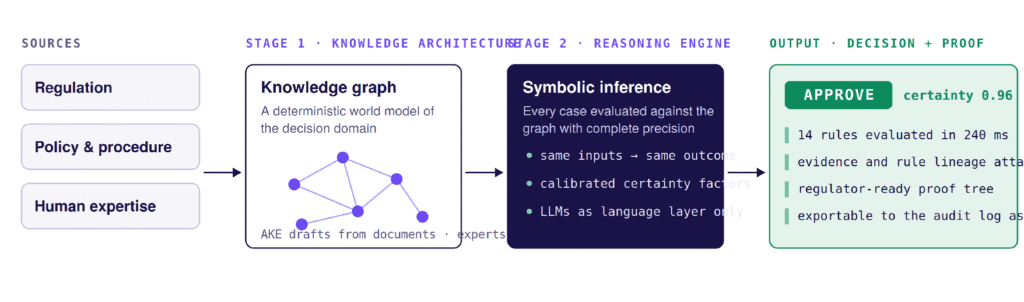
Rainbird is a decision automation platform built on symbolic reasoning, the branch of AI concerned with logic rather than statistics. It operates as a pipeline of three stages.
Knowledge Architecture. The regulations, policies and expert judgement that govern a decision are modelled as a unique type of graph representation: a deterministic world model of the domain. Historically this authorship was manual; Rainbird’s Automated Knowledge Engineering pipeline now drafts graphs directly from source documents using generative AI, with the organisation’s own experts verifying it before it is admitted. The result is institutional knowledge captured as an inspectable, versionable asset the enterprise owns.
The Reasoning Engine. At runtime, a symbolic inference engine evaluates each case against the graph with complete precision. Where evidence is incomplete or uncertain, calibrated certainty factors allow the engine to weigh it the way a skilled practitioner would, without ever leaving the bounds of the codified logic. Identical inputs yield identical outcomes. There is no temperature, no drift, and no hallucination. Although the model can handle different levels of certainty associated with both data and rules, there is no statistical generation in the decision path.
Evidence and audit. Every outcome ships with a proof tree: which rules fired, on what evidence, with which data, with what certainty, in what order. It is human-readable, regulator-ready and exportable to the audit log as is. Oversight stops being a hopeful review of behaviour and becomes an inspection of logic.
Figure 1. The Rainbird pipeline: from sources of authority to a proven decision.
3. The neurosymbolic division of labour
Rainbird’s architecture is deliberately hybrid. Generative models are employed where variance is acceptable and language is the task: understanding a customer’s message, extracting facts from documents, drafting the explanation of an outcome, and accelerating the authorship of knowledge Into a verifiable knowledge architecture that, once built, has no dependency on the LLM that was used to build it. The symbolic engine is employed where variance is unacceptable: the judgement. LLMs remain the language layer and they are never the judge.
This is what allows Rainbird to make a claim no purely generative system can make: zero hallucinated decisions, rather than fewer of them. It is also what makes Rainbird complementary to, rather than competitive with, the platforms enterprises are already committed to. Agents built in any framework can gather context, orchestrate workflows and converse with customers, then call Rainbird, over API or as tools exposed through an MCP server, at the moment a governed decision must be made. In the emerging enterprise stack, Rainbird sits as a distinct layer between the agents that interact and the systems that record.
Figure 2. The decision layer: deterministic judgement between probabilistic interaction and systems of record.
4. Why it matters now
Three forces have converged to turn a decade-long conviction into a market moment.
The agentic wave needs a governor. Enterprises are moving from copilots that suggest, to agents that act, and an agent that acts must make a decision. Handing that step to a probabilistic model multiplies risk at machine speed. A deterministic decision layer resolves the dilemma: agents gain the authority to complete regulated processes end to end precisely because the judgement within them is provably correct. The decision layer is what converts agentic ambition into deployable systems.
Regulation is arriving with teeth. The EU AI Act’s obligations for high-risk systems phase in through 2026 and 2027, and supervisors in financial services on both sides of the Atlantic increasingly expect firms to explain individual automated decisions, not model behaviour in aggregate. Post-hoc rationalisations of a neural network do not meet that bar. A proof tree does. Rainbird’s outputs are admissible by construction: the compliance artefact is not an add-on but the natural exhaust of how the system reasons.
The economics of expertise have shifted. Every regulated institution runs on scarce senior judgement applied to high volumes of routine cases. Rainbird digitises that judgement once and applies it consistently at any scale, freeing experts for the genuinely exceptional cases. What was previously a knowledge management aspiration has become an operating leverage strategy, and Rainbird’s knowledge engineering pipeline has collapsed the cost of getting there from months of manual modelling to a supervised drafting exercise.
5. Proof in production
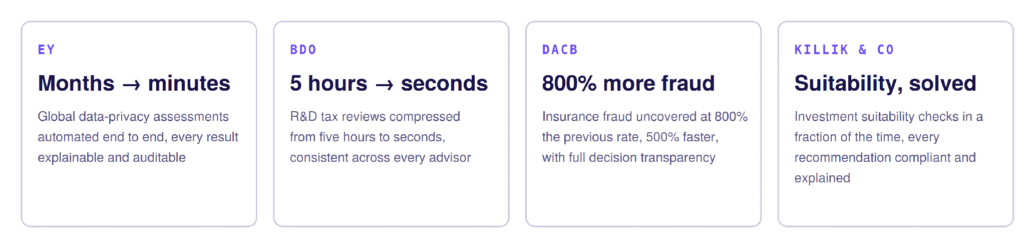
Rainbird’s importance is not prospective. Global enterprises have run mission-critical decisions on the platform for years, at scale, under audit. EY automated data-privacy assessments that previously took months into minutes, with every result fully explainable. BDO compressed R&D tax reviews from five hours to seconds while making outcomes consistent across every advisor. The law firm DAC Beachcroft uncovered 800% more insurance fraud, 500% faster, with complete transparency into each determination. Killik & Co reduced investment suitability checks to a fraction of their previous time, with every recommendation compliant and explained. These are audited production outcomes, not pilots, and they share a signature: dramatic compression of expert time with an increase, not a sacrifice, in consistency and defensibility.
Figure 3. Production outcomes across professional services, law and wealth management.
6. The strategic significance
Every era of enterprise computing has produced an indispensable layer: the relational database made data trustworthy, the ERP made process trustworthy, and the identity layer made access trustworthy. The agentic era requires a layer that makes automated judgement trustworthy, and that layer must be deterministic, explainable and auditable by construction, because those properties cannot be retrofitted onto statistical systems.
Rainbird has spent thirteen years building exactly that, against the grain of fashion, and now finds the industry converging on its position. Its platform graphs turn regulation and expertise into owned, inspectable assets; its reasoning engine gives agents access to that judgement through a reasoning layer that cannot hallucinate. Its resulting proof trees turn compliance from a brake on automation into its absolute enabler.
The importance of Rainbird, then, is simple to state. It is the difference between AI that impresses in a demonstration and AI that an enterprise, its customers and its regulator can trust with the decisions that define it. In regulated markets, that difference is the whole game.
The calendar of upcoming game releases is absolutely stacked with major launches leading up to GTA 6, but my list of most anticipated games just got a new addition: Transport Fever 3 from Urban Games. I’ve spent a lot of time in simulators over the last few years, though I admit I had no idea about this third Transport Fever game’s existence until its most recent features trailer landed in my inbox. It might not be a full city builder like Cities: Skylines or even a hybrid like Workers and Resources: Soviet Republic, but Transport Fever 3 is digging into the management aspects and quality-of-life improvements I’ve been wanting from city builders for a long time.
Transport Fever is technically a tycoon sim and a logistics management puzzle first, city builder second, but it looks like developer Urban Games is leaning a bit more into the city management aspect this time. Like in previous games, the big idea is building a transport network that supports enough trade for your settlement to grow from a squalid little village to a magnificent metropolis. If traffic lanes are unclogged and passengers get to their destination on time, everyone’s happy, and the city grows.
That growth requirement is still largely true for Transport Fever 3, but Urban Games is making happiness more complicated. Now, in addition to making sure industries have the goods they need and folks aren’t stuck in traffic, you have to consider things like noise and environmental pollution levels. Cities: Skylines factors those into health and happiness too, but you can get around it by building the right kind of road or just having a medical center near polluted areas or a cemetery for when nature, aided by your negligence, takes its course. Mitigating factors in Transport Fever 3 are less easy to come by.
Outside the obvious things like industrial areas causing pollution and trains making noise, you have to consider the effects your infrastructure placement have outside the city. Putting a depot or airport in the rural countryside may seem like an attractive option, but folks won’t be happy you’ve despoiled their bucolic idyll. You’ve also got upgrades to contend with. Your mid-sized city might be doing just fine, but once its needs grow and you have to start expanding and improving your road networks, the problems, Urban Games promises, can pile on. Which is exactly the kind of friction I want. Too often, I find myself just letting established districts in Skylines do their own thing once I’ve optimized them, as they require little or no attention from then on.
Image: Urban Games/Paradox Interactive
One other thing that piqued my interest is how much attention Transport Fever 3 seems to pay to the smaller details. You’ll pick road and rail track types based on the kind of industry that can best utilize them and what the cargo’s expected delivery date is. Food items need reliably fast transport; fuel and non-essentials, not so much. (And, of course, each road type has its pros and cons. There is no perfect city — just a way of balancing problems so most people are satisfied.)
You can make an intersection just by intersecting roads, which sounds simple, but for anything more complicated than a standard four-lane intersection, both Skylines games still make you use pre-made intersections that take up a ton of space. It’s not intuitive or enjoyable to use. And for busy intersections, you’ll even have control over traffic light patterns and traffic flow, even down to designating which lanes are turn lanes.
Transport Fever 3 is expanding industries as well, making new and different ones appear depending on location and demand. You can also “prospect” to sound out locations and potential demand for new industries. Cities: Skylines‘s industries DLC is one of my favorite parts of the game, the way it alters your production plans and opens new possibilities for additional industries and settlements, so this is something I’ll be keeping a close eye on. I’m less keen on the “greenification” prospect in Transport Fever 3, though. It seems like less of a strategic option and more a “click button, spend money, problem solved” scenario, which seems a bit shallow compared to everything else I’ve seen so far.
The features trailer only showed brief highlights, so perhaps there’s more depth to making your transport networks eco-friendly. Regardless, I’m now eagerly waiting for Urban Games to announce Transport Fever 3‘s release date. Please, just don’t do it in September like everyone else.
The dedicated fanbase of K-pop sensation BTS, Army, is all too familiar with this routine: arriving at the merch booth hours before the stadium gates open and waiting in line all day, in all types of weather, just for the hopes of snagging a city or member-specific jersey for the band’s Arirang world tour. Am I speaking from experience? Well, yes. Will I do it again and again? Duh.
If you missed out on the tour merch of your dreams, there is another collectible opportunity incoming, and it doesn’t involve a merch booth: McDonald’s is bringing a limited-time lineup of BT21 characters to Happy Meals.
Starting July 14 at participating McDonald’s restaurants, you can find and collect 10 unique, space-themed BT21 toys. There is a toy for each of the seven members of the group, along with three others: Van (a character representing Army), a toy with all of the characters on a spaceship and a poster with stickers. The characters are designed with a ring clip to be attached to bags or clothing.
This marks the third collaboration between BTS and the fast food chain.
In September 2025, McDonald’s launched TinyTAN Happy Meals that included mini figurines of the BTS members in animated cartoon forms. And in May 2021, it unveiled a BTS meal that came with South Korean-inspired dipping sauces, sweet chili and cajun.
A big year for BTS
BTS’s Arirang world tour spans North America, Latin America, Europe, Asia and beyond. The band also partnered with Oreo to release a limited-edition cookie with a brown-sugar pancake filling inspired by a popular Korean street food.
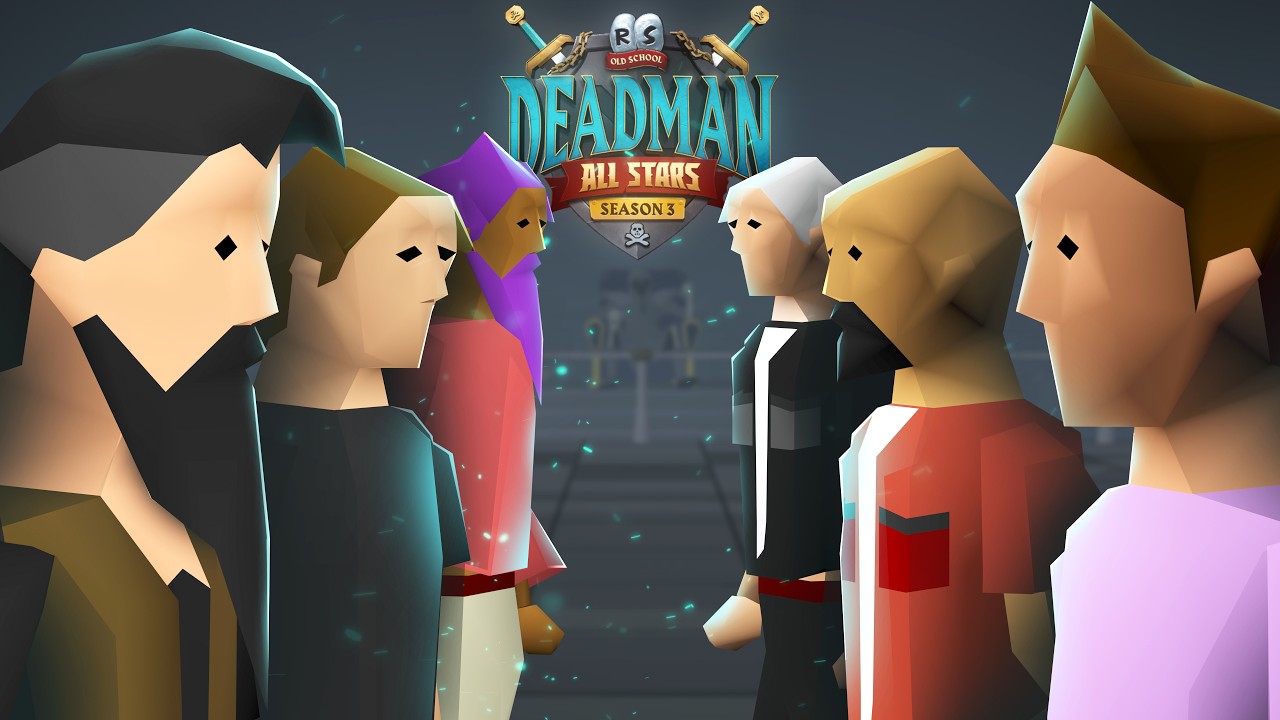
On Saturday, June 20, something weird happened here in Chicago: 4,000 people gathered in person (and over one million tuned in to the stream) to watch Deadman All Stars, a PvP tournament of Old School RuneScape. Even with my only RuneScape experience having been getting cyberbullied in it by half of a pair of evil blonde twins at my middle school circa 2006, the good vibes were infectious.
Old School is hot and, by almost any metric, in a new golden age surpassing its original run in the aughts. But MMO PvP as a live esports event? It shouldn’t work, but it did, and I got to talk to Old School RuneScape creative director Kieren Charles about how Deadman All Stars came together, as well as the logistical challenges of bashing a 25-year-old MMO into shape for it.
But first, glory to the victors, Team Dino Nuggets, consisting of the eponymous Dino, as well as B0aty, 61M, Sick Nerd, and MMORPG. Well played to runners up the Odablock Warriors, Framed Friends, Westham Weasels, Rhys Rhinos, and Purpp Rebels. My personal favorite player handle at the tournament belonged to Skiddler on the Rebels.
Latest Videos From
Tourney Hero
RuneScape has a rock-paper-scissors sort of combat system, where every method of attack has strengths and vulnerabilities. So high-level RuneScape PvP involves a lot of item switching, inventory management, and fast inputs. Combat is based around classic RPG dice rolls, and two players in end game gear will tend to miss most of their attacks, furiously swapping armor and weapons until one slips up or the RNG delivers a hit.
Jagex senior communications manager Danni Amos told me that the players mostly brought their own kit—mice, keyboards, etc.—to ensure maximum comfort and that their muscle memory was on point. Much like how high-level Counter-Strike players sometimes opt for a low-res, 4:3 view to maximize performance and focus their aim, I was delighted to see the tournament players were all rocking with a tiny, 640×480 window on their massive, curved gaming monitors.
DEADMAN ALLSTARS S3 OFFICIAL HIGHLIGHTS – THE FINALE – YouTube
Amos told me that serves to limit the distance their mouse has to travel between the inventory menu and the play field, but I also find it rhymes with how you might have illicitly played RuneScape in a school computer lab or on the family computer back in the day.
“We actually started experimenting in competitive e-sports over 10 years ago now,” said creative director Charles. “We’ve done mini events like this in the past in the UK, but it was 50 people.” He attributed the Deadman format to prominent Old School RuneScape video maker and official Jagex collaborator, Solo Mission.
Keep up to date with the most important stories and the best deals, as picked by the PC Gamer team.
Matches are set up like a fighting game crew battle, or maybe a Pokémon fight with no substitutions. Each team’s first guy goes out to duel: Team A’s first player wins, so he stays out and keeps fighting until he runs out of health and healing items as Team B’s second member tries to take him down, repeat until one team’s roster is depleted. It’s a great format, pairing the purity of 1v1 with a layer of strategy and teamwork. There were a lot of hero moments, players sticking it out way longer than they had any right, or managing stunning upsets.
There’s also an added wrinkle with Deadman’s prep stage: All the players had to start from scratch with fresh accounts, with a 120-hour playtime limit over nine days to level and gear up. But the tournament itself did not occur in OSRS’ live game: Jagex had a special instance of the MMO running right there at the theater.
Logistics win wars
(Image credit: Ted Litchfield)
“RuneScape was definitely not built to have a LAN setup at all, so it’s actually been a really interesting challenge for the tech team to work out how we make it a LAN event,” Charles told me. “It was no small undertaking. We were doubting at times whether we actually can pull it off, because [with] a lot of the setup, the code expects to communicate with this server, speak to that server, and all of a sudden it’s not really a thing.”
After everyone was geared up and ready to go, they sent their save files to Jagex to load onto this special, instanced version of the game, with the offline Old School RuneScape server whirring away in a back room of the Rosemont Theater.
“There’s so many advantages to doing it. A lot of these online events, they have the risk of DDoS and network attacks—you’ve got to mitigate that,” said Charles. “But also it’s ping, it’s reaction [time] for the players. The smaller the ping, the better they will play.
“So the fact the server is right there next to where they’re playing, they’re playing in perfect conditions in a way they’ve never played before. But now that we’ve done it, I imagine this is the sort of thing we could do when we do similar events in future.”
And there seems to be a high likelihood of that: Deadman All Stars was Jagex’s first time hosting an event in North America, yet it was also its biggest, surpassing even RuneFest in the UK. And at a time when much of the games industry is struggling, it’s heartening to see a game and community thrive like this.
A prospective franchisee rarely calls a franchise development team first anymore. They ask an AI chatbot. What that chatbot says back is a question of AI search visibility, and this report is about what determines it.
~9,000 franchise brands compete in the U.S. across roughly 845,000 locations
58% of consumers now use AI tools to research products before buying (ChannelEngine, 2026)
90% of brands got zero mentions in one cross-industry study (177 brands, no franchises)
1% → 53.5% AI citation rate jump with even a few reviews, in cross-industry data likely applicable to franchises
1. Same Question, Three Different Answers
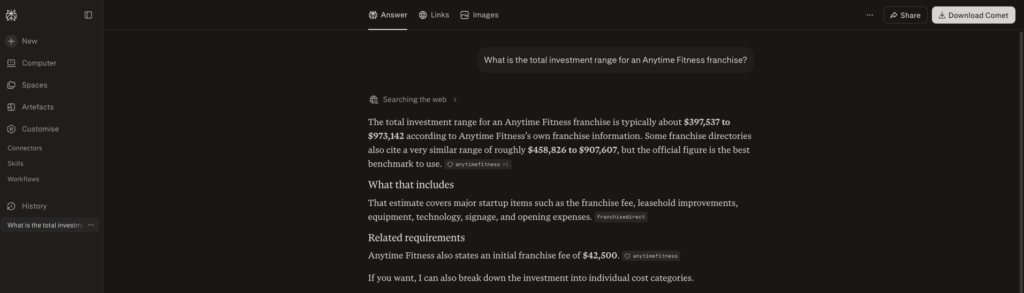
Here is what happens when the exact same question about a franchise brand goes to all three platforms. The screenshots below show real answers gathered for an Anytime Fitness franchise in July 2026.
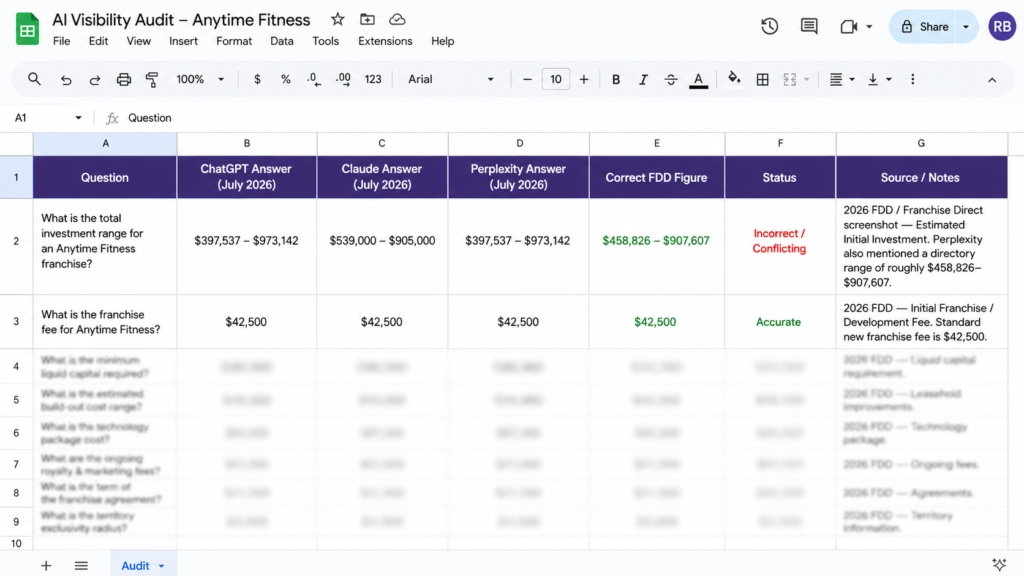
The same question about an Anytime Fitness franchise produced different answers across AI platforms, illustrating why franchise brands should regularly audit how they are represented in AI search.
2. What Is AI Search Visibility
Ranking on Google no longer guarantees a brand gets mentioned in an AI answer. AI systems synthesize a response instead of listing links, so a brand can be invisible to ChatGPT while sitting on page one of search. AI search visibility comes down to three things that decide whether a brand shows up at all. Improving these three factors is the core work of Generative Engine Optimization (GEO), the emerging discipline that treats AI-generated answers, not blue links, as the surface franchise brands now need to win.
Mention Rate How often a brand’s name comes up at all for a category question like “best pet care franchises under $150,000.”
Share of Voice How a brand’s mentions compare to competitors mentioned for the same questions.
Citation Accuracy When a brand is mentioned, whether the fee, unit count, or territory info attached to it is actually correct.
Franchise teams already experimenting with ChatGPT, Perplexity, and Gemini for content creation run into this daily: three tools, three different answers, for reasons that come down to where each one looks for information. Traditional AI search rankings once meant a fairly predictable order of blue links; a franchise brand now has to earn a mention three separate times, in three separate ways, just to show up at all.
ChatGPT SOURCE Training data, plus live web search by default for most factual queries FRESHNESS Usually current on searched queries; training data alone can lag CITATIONS Shown when a search was used to answer
Gemini SOURCE Google’s search index, Business Profiles, Shopping data FRESHNESS Refreshes often CITATIONS Occasionally linked
Perplexity SOURCE Live web retrieval on every single query FRESHNESS Reflects the web right now CITATIONS Listed under every answer
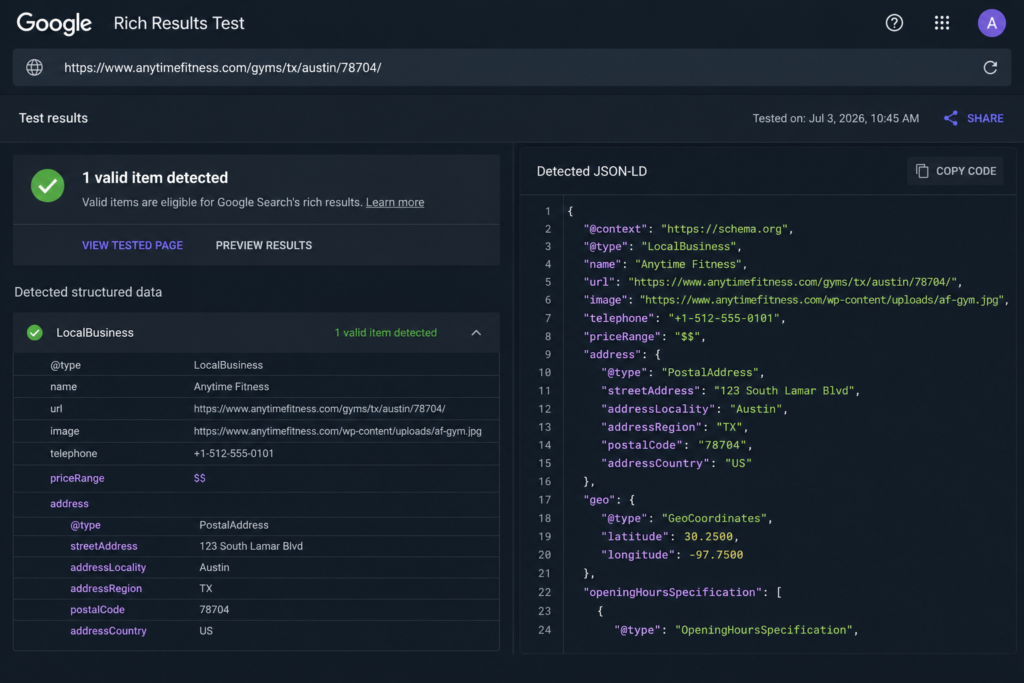
Perplexity’s response confirmed that Anytime Fitness is offering franchise opportunities in Texas, but the result still required verification against current official franchisor sources.
4. Where Franchise Facts Break Down
Outdated Numbers Franchise fees and investment ranges change every year with the FDD. Old training data quotes the old number.
Brand Mix Ups Similar names, categories, or past spin offs get blended into one answer.
Wrong Territory Info A chatbot says a state is unavailable or lists a unit count from a past year.
Third Party Fill In Thin brand websites get replaced by whatever directory or forum post is available, right or wrong.
An analysis of 177 brands across healthcare, SaaS, and financial services found that 90 percent had zero mentions in AI generated search results at all. Smaller franchise brands are likely in the same boat: not misquoted, just invisible, which is its own kind of AI brand visibility problem.
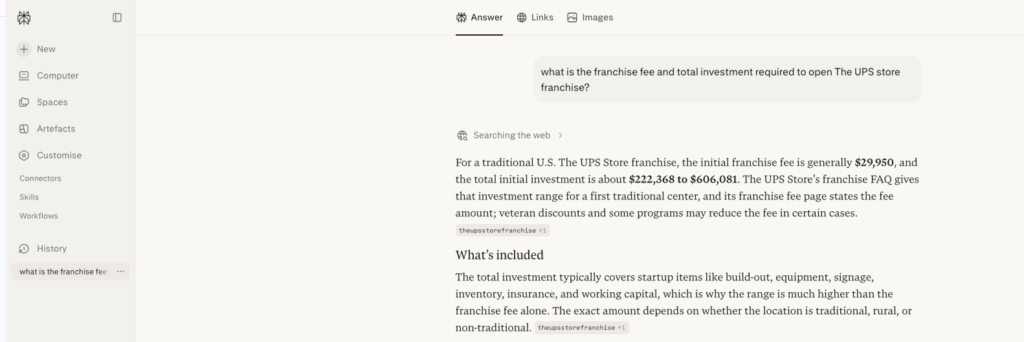
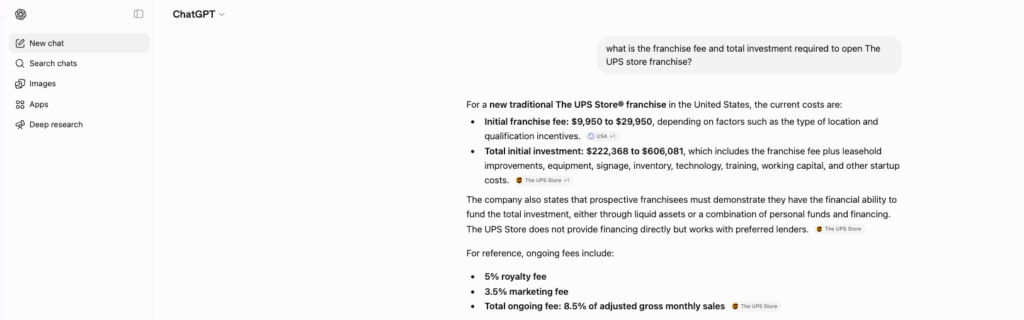
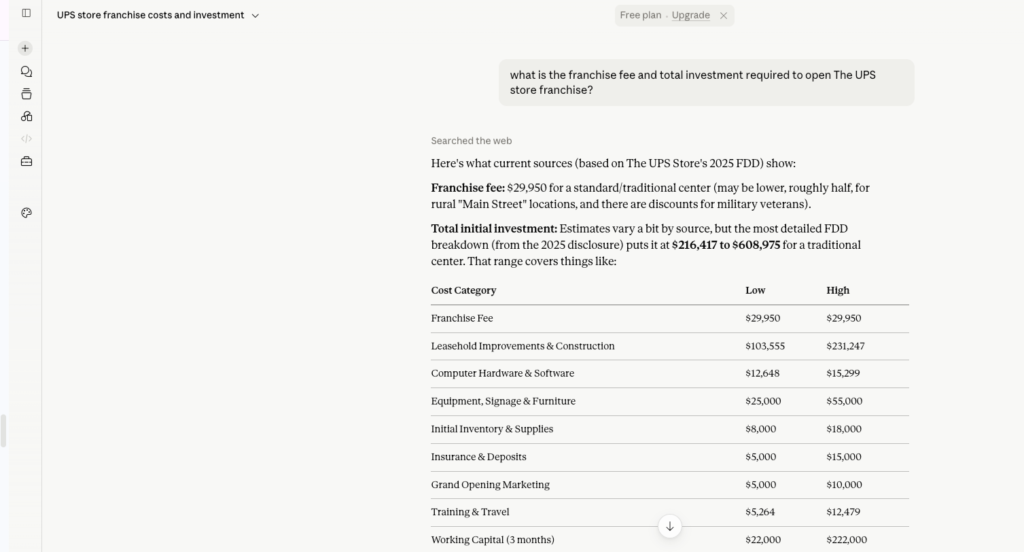
The same question about The UPS Store franchise produced different investment ranges and supporting details across AI platforms. Each system relied on different sources and levels of web freshness, illustrating why franchise brands should regularly audit how they are represented in AI search.
Not sure how your own franchise brand actually shows up in AI search? Take the free AI Cost-Saving Audit to see where AI is getting your brand wrong, and which fix to prioritize first. It takes a few minutes.
Bottom Line
An AI-generated answer is often the first impression a brand makes on a prospective franchisee, which is exactly why AI search visibility deserves regular attention. Strong AI brand visibility across ChatGPT, Claude, Gemini, and Perplexity does not happen by accident; it comes from maintaining accurate franchise information, consistent location data, reliable third-party references, and regular Generative Engine Optimization audits.
Running this audit every quarter can reveal outdated fees, incorrect investment figures, weak citations, missing brand mentions, and inconsistent territory information before prospective franchisees rely on them.
Want to see how accurately AI platforms describe your franchise brand? Book a call with WEAM.AIto review your AI search visibility and identify which issues should be fixed first.