More than 27.6 billion SaaS security events reveal a growing challenge for IT teams.
SaaS environments now run on a web of trusted users, apps, shared files and automated workflows. As those connections multiply, so do the blind spots attackers can exploit.
Discover the SaaS security shifts that will be critical to improving visibility, reducing exposure and protecting trusted business connections in 2026.
In this report, you’ll learn:
Why guest accounts, OAuth integrations and external file sharing are expanding the SaaS attack surface
How attackers are using trusted accounts, infrastructure and workflows to hide inside normal business activity
Which defensive shifts can help IT teams improve identity visibility, reduce alert noise and respond faster
Selling supplements on Amazon looks simple from the outside.
Pick a product, source a manufacturer, list it, and let Amazon’s traffic do the rest. Thousands of home-based entrepreneurs have built real businesses exactly this way.
The category is genuinely massive. U.S. supplement industry sales grew 5.5% in 2025 to reach $72.9 billion, and most of that buying now happens online.
But once you’re actually in the category, a handful of problems show up fast. They don’t go away just because your product works. Here are the five that catch new supplement sellers off guard most often.
Extremely Saturated Categories
Supplements are one of the most crowded categories on Amazon, full stop.
The supplements category on Amazon alone now generates more than $8 billion annually in the U.S. Overall supplement industry sales grew more than 11% in the twelve months ending February 2026. That kind of growth pulls in new sellers constantly, and the competition at the top only keeps getting more crowded.
Walk into almost any subcategory, magnesium, iron, collagen, multivitamins, probiotics, and you’ll find dozens of nearly identical listings competing for the same handful of keywords. New sellers often assume a good formula is enough to stand out. It isn’t.
Branding, packaging, and search visibility now matter as much as what’s actually in the bottle, because shoppers rarely scroll past the first page.
This is where a lot of home-based supplement businesses stall before they even get going. Entering a broad category like “magnesium gummies” with no differentiation means competing directly against companies with seven-figure ad budgets. The sellers who actually break through tend to find a narrower angle: a specific ingredient form, a specific audience, a specific problem, rather than trying to out-market the category leaders head-on.
Margin Pressure
Even when a listing sells well, profit is far from guaranteed.
Supplement keywords carry some of the steepest pay-per-click costs on Amazon, since every competitor is bidding for the same limited pool of high-intent shoppers. Add in Amazon’s referral fees, FBA storage and fulfillment costs, and the price of third-party lab testing now required under Amazon’s updated supplement compliance rules, and the math gets tight quickly.
Price wars make this worse. When five brands sell a nearly identical product, undercutting on price is often the only lever new sellers know how to pull. That pressure compounds over time.
What starts as a healthy margin on paper can shrink to almost nothing once advertising spend, returns, and compliance costs are factored in.
The sellers who protect their margins treat advertising as a precision tool, not a blunt one: tracking ACoS closely, building organic ranking through genuine repeat customers, and resisting the urge to compete purely on price. It’s slower. But it’s the difference between a supplement business that survives its second year and one that doesn’t.
Health Fads
Supplements are unusually exposed to trend cycles, and social media has made those cycles faster and more volatile.
Vitamins and supplements are now the single largest health and beauty category on TikTok Shop, and that channel has been growing at more than 71% year over year. That’s a pace fast enough that a single viral moment can send demand for an obscure ingredient soaring almost overnight, only to collapse just as fast once the next trend takes over.
That volatility creates a real inventory problem. Order too much stock chasing a trending ingredient, and a brand can be sitting on unsellable inventory within a few months. Order too little, and it misses the window entirely.
Health fads also tend to invite a wave of low-quality copycat listings the moment something starts trending. That floods the category and drags down trust for everyone selling in that space, fad-chasers and legitimate brands alike.
The more durable approach, and the one reflected in where the broader industry is heading, is building around ingredients with a genuine, lasting evidence base rather than whatever is peaking on social media this month. Some family-owned supplement brands have leaned specifically into well-established, foundational nutrients like magnesium, iron, zinc, and vitamin D, rather than chasing whatever ingredient is trending, precisely because fad-driven demand is such an unstable foundation to build a business on.
Review Manipulation
Reviews carry enormous weight in supplement purchasing decisions, which is exactly why the category has become a magnet for review manipulation.
Industry estimates suggest that roughly 30% of top-selling supplement listings on Amazon have used fake or manipulated reviews at some point. The practice has drawn serious regulatory attention as a result.
The consequences are not hypothetical. In 2023, the FTC charged Bountiful Company, the maker of Nature’s Bounty and Sundown, with hijacking ratings and reviews on other product listings to inflate its own Amazon pages. The company paid $600,000 to settle the charges.
Amazon has responded with its own aggressive enforcement, now blocking over 250 million suspected fake reviews annually and pursuing legal action against review-selling networks directly.
For honest sellers who sell supplements on Amazon, this creates a frustrating bind. Competing against listings with artificially inflated ratings is discouraging, and the temptation to cut corners is real. But the risk has grown sharply: manipulated reviews can now trigger suppressed listings, withheld funds, and permanent account bans, on top of the legal exposure.
Building review volume the legitimate way, through genuine product quality and consistent customer follow-up, takes longer. But it’s the only version of review growth that doesn’t come with a ticking clock attached.
Consumer Skepticism
The final challenge is the hardest to fix with tactics alone: shoppers are getting warier of supplement marketing in general.
A 2025 industry survey on health and wellness consumers found that 55% of people who bought a wellness product because of social media marketing later felt it wasn’t worth the money. A third were openly skeptical of the efficacy claims behind what they’d purchased.
Interestingly, the same research points to what still works: 85% of consumers said they trust recommendations from medical professionals over influencer content, and shoppers are increasingly cross-checking ingredient claims before buying rather than taking a five-star rating at face value.
For supplement sellers, that shift is actually good news for anyone building honestly. Clear labeling, real third-party testing, and straightforward claims are becoming a genuine competitive advantage, not just a compliance checkbox.
The brands most likely to struggle going forward are the ones that built their entire strategy around hype rather than substance. That’s precisely the kind of marketing today’s more skeptical shopper has learned to see through.
The Bigger Picture
Selling supplements on Amazon still offers real opportunity for home-based entrepreneurs, but it rewards patience over speed.
The sellers who last tend to be the ones who treat saturation, margins, fads, reviews, and skepticism as ongoing realities to manage, not obstacles to power through once and forget about.
Earlier this month, Google announced multiple new devices at its Made by Google event, including Pixel 11 phones and the Pixel Watch 5. Back in May, the company also released its screenless Fitbit Air health tracker.
But we still haven’t heard anything about the new mystery product that’s appeared in recent Google ads.
A Reddit thread posted on Saturday revealed a Google Pixel ad on YouTube featuring the new Pixel 11 series, the Pixel Watch 5 and an unknown wearable that looks like a cross between the Fitbit Charge 6 and the Watch 5, standing out with its oblong screen with rounded edges in fog white. Sponsored by Google Australia, the ad’s caption reads: “The ultimate power trio for your wrist, ears and hands. Preorder Pixel devices now.”
Some speculate that the product may be the Fitbit Charge 7 or a rebranded Pixel Watch series. Or maybe it’s an entirely new fitness tracker?
A Google representative didn’t immediately respond to a request for comment.
That wasn’t the only Google Australia ad featuring the surprise device. The mystery wearable appears in another ad displaying the Pixel 11 phones, Watch 5, Pixel Buds Pro 2, Pixelsnap phone cases and Watch loop bands in the new olive green color.
Real or fake?
Some Reddit commenters wondered whether this mystery product was a mistake caused by an AI hallucination — an error caused by generative artificial intelligence.
But this also wouldn’t be the first time Google sneaked an unreleased product into its promotional content. Back in March, two months before its release, the Fitbit Air was spotted in a paid partnership video with NBA star Steph Curry, who is also a Google performance adviser.
It would seem that Google is releasing a new wearable, potentially as part of its Pixel line, in both fog and olive colors. If the time between these ad leaks and the device’s release follows the same pattern as the Fitbit Air’s appearance in Curry’s video, we should know more in the coming weeks.
Anna Gragert
Senior Editor, Health and Home
Anna Gragert (she/her/hers) was previously the lifestyle editor at HelloGiggles, the deputy editor at So Yummy and the senior lifestyle editor at Hunker. Over the past 12 years, Anna has also written for the LA Times, Elle, Bust Magazine, Dazed, Apartment Therapy, Well+Good and more. At CNET, she’s a senior editor on the Healthy Home team, and her coverage includes health, wellness tech, meal kits and home and kitchen tech with a focus on the technology that aims to help us live our healthiest, happiest lives.
See full bio
Smart glasses have become a recurring accessory amid the immigration crackdown.
Karissa Bell for Engadget
Immigrations and Customs Enforcement (ICE) has reportedly told employees that they are not permitted to wear Meta glasses while they work. A memo sent to staff said that “the use of Meta Glasses or similar devices could unintentionally capture, record, or transmit sensitive information, potentially compromising privacy and legal protections,” The New York Timesreported.
The policy apparently covers all employees of the agency, not just agents in the field. A Department of Homeland Security spokesperson told The NYT that workers have “always” been barred from using “personally owned body-worn cameras.” While the memo may be more of a clarification of an existing policy, the fact that ICE sent such a memo underscores how Meta’s smart glasses have become increasingly visible amid the broader immigration crackdown in the US.
ICE and Customs and Border Patrol (CBP) agents have repeatedly been spotted wearing Meta’s smart glasses over the last several months. In one case, reported by404 Media, a CBP agent was spotted recording with his glasses despite the policy. In another instance, a member of Border Patrol wore a pair to an immigration raid. There have been similar sightings in at least six states, according to an investigation conducted byThe Independent.
But while DHS is now advising staff to not use smart glasses while they work, the agency is reportedly interested in pursuing an official version of the technology. Budget documents reported by independent journalist Ken Klippenstein indicate ICE is hoping to equip its officers with bespoke smart glasses that have “biometric identification capabilities” by next year.
While Meta hasn’t publicly weighed in on whether its product is well-suited to law enforcement, an association with ICE isn’t likely to win over any new fans. The company is facing an intensifying backlash against the product. An unreleased facial recognition created by Meta has increased fears about how the device could potentially be used for surveillance. The glasses’ supposedly privacy-protecting LED has also proved to be easy to bypass.
How AI Consulting Can Help You Identify Opportunities for Automation?
With the age of fast-paced technology development and decision-making based on data, automation is arguably the most essential driver of operational scalability, efficiency, and innovation. Figuring out what to automate and how to do it right requires skills that most organizations may not have. It is where AI consulting shines through.
AI consultants offer not only technology recommendations but also strategic recommendations on how artificial intelligence can be leveraged to automate, reduce costs, and generate new revenue streams. In this article, we will describe how AI development companies allow organizations to unlock unseen opportunities in automation, how it is done by AI consultants, and what real benefits are achieved.
What Is AI Consulting and What It Covers?
AI consulting assists organizations in assessing, designing, and implementing artificial intelligence technology suitable for their requirements. It would typically involve
The AI consulting companies typically employ data scientists, Machine Learning engineers, business analysts, and process optimization experts who collaborate to deliver customized automation solutions.
Why Businesses Struggle to Identify Automation Opportunities?
Prior to proceeding with what an AI development company does, it is important to know why companies often overlook automation opportunities:
Insufficiency of AI talent: Most organizations are deficient in-house AI talent.
Limited visibility: Teams are often separated and ignorant of duplicate manual tasks.
Fear of disruption: People are afraid to disturb existing processes.
Cost issues: Companies feel that AI is too costly or difficult to adopt.
But, AI development companies can bridge the gaps by bringing in an outside-in perspective and the capability to discover the hidden inefficiencies.
How AI Consulting Identifies Automation Opportunities?
The below is a step-by-step process on how AI consultants establish where automation will be of greatest benefit:
Business Process Evaluation
AI app development companies start with a thorough examination of your existing procedures. Consultants trace flows to trace:
Repetitive work
Low-complexity, high-frequency tasks
Inefficient hand movements
With the help of stakeholder interviews and process mining software, they can view where automation will provide the most ROI
Data Audit and Readiness Check
AI automation depends on information. AI consultants consider
Availability and nature of unstructured and structured data
A readiness audit ensures the business is prepared to automate efficiently and safely.
Use Case Identification
From facts, there are specific applications where automation is preferable in terms of cost, speed, and accuracy. Common locations are
Customer service bots
Invoice processing
Inventory control
Predictive maintenance
HR onboarding
Targeted marketing
All the application areas are prioritized based on impact and feasibility. This helps AI application development companies analyze your industry and build tailored solutions.
Technology Recommendation
AI software development consultants evaluate and suggest the most suitable tool and platform. They can be:
This process guarantees that chosen technologies are in line with business goals and meets IT infrastructure automation needs.
Proof of Concept (PoC) and Pilots
AI solution experts create pilot rollouts, or PoCs, prior to mass rollout, ensuring the project meets industry standards as well as ensures security and innovation across organization. Experts assist companies to:
Test pilots in a low-risk environment
Report on KPIs
Gain internal stakeholders’ support.
It is an important stage of risk management and strategy formulation prior to mass rollouts.
Change Management and Training
Change management in IT is common. AI development companies build solutions that can scale with your future business needs. Automating is not a technology revolution it’s culture. Consultants help company businesses:
Employed sentiment analysis for angry customer labelling
Outcome: 40% reduction in response time and 30% fewer support tickets.
Accounts Payable Automation
The accounts receivable of a manufacturing firm can be automated with AI software solutions. Manufacturing units can reduce invoice processing by 70% and achieve accuracy up to 90% with AI automation. AI applications in manufacturing are
Digitalized and scanned paper bills
Imported relevant domains through ML
Used by ERP to facilitate automated approval cycles
HR and Recruitment Optimization
AI recruitment solutions help organizations completely automate hiring processes, from resume screening to interview scheduling and grade analysis.
Implementation of an AI-powered recruitment platform and HR processes automating solutions can decrease 50% of process times and improve operational efficiencies of the departments. AI can automate:
Parsing of resumes by NLP.
List the candidates’ work availability in order
Bot is scheduling interviews
Top Benefits of AI Consulting for Automation
AI consultants offer a fresh perspective that identifies inefficiencies that homegrown teams might miss.
Concentrating on high-impact opportunities through automation offers quicker value realization.
AI development companies in India and USA can create automation plans tailored to your business, company size, and objectives, ensuring that the custom AI solutions meet your future needs.
They stay up to date with all the new trends, hardware, and platforms that AI is using in an attempt to provide the best possible suggestions that they can.
With rollouts sequenced and pilots to showcase applications, implementation risk decreases by consultants.
How to Choose the Right AI Consulting Firm?
To achieve the best possible automation, choose AI consultancy services that:
Is solidly based in your field
Provides turnkey solutions from design to installation
acquainted with business processes and AI technologies
Provides training and change management assistance
Departmental and geographic scalability solutions
Verify AI partner environment (i.e., Microsoft, AWS, Google Cloud), customer success stories, and case studies.
Future-Proofing Your Business Through AI Automation
AI automation is no longer about saving human effort it’s a question of business model transformation, customer experience, and competitiveness. Your best guides on this transformation are AI consultants, who will guide you to unlock and capitalize on AI opportunities that help you drive automation and innovation across processes. Whether you are just starting to explore test automation or need to accelerate what you are already doing, AI consulting firmsprovides you with the strategy, tools, and confidence to make the transition.
What Could Be The cost of AI development in 2026?
The cost of AI developmentdepends on the project’s size, complexity, and specific technology and integration requirements. Basic projects, such as AI chatbots or simple automation tools that use standard AI models and limited integration, typically range from $10,000 to $50,000.
On the other side, mid-level AI projects, like fraud detection systems or AI recommendation engines, cost between $50,000 and $250,000. These AI initiatives involve more sophisticated algorithms, data, cloud deployment, and multiple integrations.
Enterprise-level AI solutions, such as generative AI models, large-scale predictive analytics, or computer vision systems, can cost anywhere from $250,000 to over $2 million. Because, these AI projects needs custom development, data infrastructure, and continuous monitoring and updates.
Other factors that influence overall costs include data acquisition and cleaning, the use of cloud platforms like AWS or Azure, the availability and cost of experienced AI developers and data scientists, regulatory compliance needs, and long-term maintenance and model retraining.
AI consulting helps organizations identify where automation will have the greatest impact by combining process analysis, data readiness assessment, and technology recommendations. Rather than starting with a tool, consultants start by auditing existing workflows and data pipelines to find repetitive, rule-based tasks that are good automation candidates.
Why businesses miss automation opportunities on their own:
Lack of in-house AI talent
Siloed teams unaware of duplicate manual work across departments
Fear of disrupting existing processes
Perception that AI is too costly or complex to adopt
How AI consultants identify opportunities — a typical process:
Business process evaluation — mapping workflows to find repetitive, high-frequency, low-complexity tasks
Data audit and readiness check — assessing data quality, system integrations, and governance/privacy requirements
Use case identification — prioritizing candidates like customer service bots, invoice processing, inventory control, predictive maintenance, and HR onboarding by impact and feasibility
Technology recommendation — matching use cases to RPA, NLP, machine learning, or computer vision as appropriate
Proof of concept and pilots — testing in a low-risk environment before full rollout
Change management and training — preparing staff and addressing concerns about job impact
Example outcomes cited: a 40% cut in response time and 30% fewer support tickets from AI-driven customer support; up to 70% faster invoice processing with 90% accuracy in accounts payable automation; and roughly 50% faster hiring cycles through AI-assisted recruitment.
Typical costs (2026): basic automation projects run $10K–$50K; mid-complexity projects (e.g., fraud detection, recommendation engines) run $50K–$250K; enterprise-scale AI (generative AI, large predictive systems) can exceed $250K–$2M+.
Conclusion
Artificial intelligence–based automation is changing how companies operate but unlocking its full value is about something more than tech. It is a thoughtful, evidence-based response that AI consultantsare best placed to give. Through identifying the appropriate opportunities, developing intelligent workflows, and pushing organizational change, AI consulting allows you not only to improve operations but also to build enduring strategic value.
AI factories are the defining infrastructure of the AI era — where compute transforms energy and data into intelligence that powers every business, industry and country.
In the AI economy, compute is revenue.
AI factories require a full stack of critical resources: advanced chips, packaging, memory, and networking — as well as land, power and shell.
Just as NVIDIA has used its scale, long-term visibility and supply-chain partnerships to secure critical semiconductor resources, we are now applying that same discipline to secure LPS capacity exclusively for NVIDIA AI factories.
Today, we are partnering with SB Energy to secure LPS capacity at the exceptional PORTS-Pike Technology Campus in Portsmouth, Ohio, to host NVIDIA compute. OpenAI will be the tenant.
LPS: The Next Strategic Resource
For the vast majority of NVIDIA customers, securing LPS has long been a part of their infrastructure strategy.
The world’s largest cloud service providers and investment-grade enterprises have balance sheets, infrastructure expertise, and long-term contracts to secure LPS independently. They build and operate AI factories using NVIDIA accelerated computing, networking, systems and software.
This model will continue to represent most of NVIDIA’s business.
But frontier AI labs are different.
Frontier AI labs have extraordinary demand for training and inference compute, but many are growing faster than their balance sheets and long-term credit profiles can support. They may have strong customer demand and rapidly growing revenue yet still lack the decades-long infrastructure contracts and investment-grade financing capacity needed to secure the AI factory infrastructure independently.
Their growth is increasingly constrained not by algorithms or customer demand, but by the availability of compute.
For these companies, more compute means more intelligence, more products, more users and more revenue. NVIDIA is helping provide the infrastructure that powers this flywheel.
PORTS-Pike: A Site for Generations of NVIDIA Compute
OpenAI will build and operate a world-class AI factory at PORTS-Pike. The AI factory will use NVIDIA’s full-stack DSX AI factory platform, including GPUs, CPUs, networking, and infrastructure software.
The initial deployment is expected to provide 4.25 gigawatts of AI factory capacity. Each generation of NVIDIA AI factory systems deployed at PORTS-Pike could represent approximately 1.5 million NVIDIA GPUs, or approximately $150 billion to $200 billion in NVIDIA revenue. Over 20 years, the site can support multiple upgrade cycles.
This is the essential economic point: the LPS commitment secures a long-lived AI factory site, while the NVIDIA compute inside can be upgraded repeatedly. Each new generation can deliver greater production, more intelligence and better economics.
NVIDIA may also choose to extend the arrangement at PORTS-Pike beyond the initial 4.25 gigawatts to secure the remaining capacity of 3.75 gigawatts.
OpenAI and NVIDIA Expanding Compute Opportunity
More broadly, OpenAI has committed to substantial deployments of NVIDIA AI infrastructure through 2030. OpenAI’s existing and planned commitments represent approximately 12 gigawatts of NVIDIA compute, with an opportunity to expand to approximately 16 gigawatts if NVIDIA extends the PORTS-Pike arrangement beyond the initial 4.25 gigawatts.
At these levels, the opportunity represents roughly $600 billion of NVIDIA compute through 2030.
The Important Questions
What is NVIDIA guaranteeing, and for how long?
NVIDIA is supporting the LPS infrastructure at PORTS-Pike for approximately 4 gigawatts over a 20-year term, securing a site on which NVIDIA compute will be exclusively deployed.
Our support is limited to defined portions of lease and power payments, along with a specified residual-value commitment — not the full cost of the site or all of the tenant’s obligations.
The guarantee will become effective in phases as data centers are placed in service between 2028 and 2030. As OpenAI makes lease payments and capacity comes online, NVIDIA’s remaining exposure declines.
Why is NVIDIA guaranteeing PORTS-Pike?
LPS has become a critical constraint on AI factory deployment. NVIDIA is selectively securing exceptional sites where we can host multiple generations of NVIDIA compute and serve durable customer demand.
The productive life of the site extends through multiple generations of NVIDIA systems, each capable of producing more intelligence and more revenue than the generation before.
Is this circular financing?
No. OpenAI will pay the lease.
NVIDIA uses its scale and long-term visibility to secure PORTS-Pike to host NVIDIA compute. This is the same discipline we apply to supply-chain management: we secure critical inputs when we have visibility into customer demand and when doing so enables long-term productive capacity.
What happens to PORTS-Pike if OpenAI does not use the site in the future?
NVIDIA compute is versatile, fungible and broadly adopted. The capacity can be resold to another qualified tenant across NVIDIA’s global ecosystem of cloud service providers, enterprises, AI labs and startups.
CUDA makes NVIDIA compute more than hardware. It gives developers and NVIDIA engineers a common platform to continually improve installed systems.
CUDA makes NVIDIA compute versatile. Versatility makes it fungible. Fungibility drives utilization and durability — making NVIDIA compute a productive asset: rentable and financeable.
The value of an exceptional site, like PORTS-Pike, is not limited to one customer or one generation of compute. NVIDIA’s standardized platform, broad developer ecosystem and large market of potential users support the ability to redeploy productive capacity over time.
How much LPS will NVIDIA secure?
It will be strategic and disciplined.
Most NVIDIA customers will continue to secure their own LPS. The vast majority of LPS hosting NVIDIA compute will continue to be secured directly by CSPs, enterprises, sovereign AI builders and other customers.
NVIDIA will focus selectively on exceptional sites where visible, durable demand can support multiple generations of NVIDIA compute.
The Infrastructure of Intelligence
PORTS-Pike represents the next step in NVIDIA’s journey.
We began by building accelerated computing chips. We then expanded to systems, networking, CUDA and full-stack AI factories. Today, we are helping secure the critical infrastructure required to build these factories.
NVIDIA is the full-stack AI infrastructure platform.
We are investing in the long-lived foundations of AI factories so our customers can deploy the most productive compute platform in the world, generation after generation.
By securing the critical resources needed to host NVIDIA compute, we can help the world’s most innovative companies build the AI factories that will power the age of intelligence.
Companies are still grappling with exactly how software development should work in the AI area, but one early answer is the so-called software factory. Essentially an agent loop that’s built around the traditional stages of software development, the software factory approach has become a popular way for companies to remake their engineering organizations for the AI era.
Now, a system from Warp could make that transition a lot easier. On Tuesday, the AI coding company introduced Warp Factories, a new system designed to make building and operating AI software factories as easy as possible.
Operating as an infrastructure layer, Warp Factories gives companies a simple environment for deploying agents and a roadmap for how to use them.
To be clear, many companies are already having success with the factory model without any help from Warp. Stripe has been particularly public about its technical progress, developing a “minions” system to automate development within its own codebase. Ramp has made similar progress, developing a background agent that can monitor its own code after it is deployed.
An analytics screen from Warp FactoriesImage Credits:Warp Factories
As Warp CEO Zach Lloyd sees it, the target market for Warp Factories will be smaller companies without the resources to develop a system from the ground up.
“[If you look at] things like running your agents in the cloud and steering those agents as they run, or bringing the work that they’re doing into your local environment, or setting up memory that goes across those agents, or setting up evals that go across those agents — it’s actually a huge infrastructure undertaking to do this right,” Lloyd told TechCrunch.
In Warp Factories, the architecture is already built out of the box, with many of the most difficult decisions already made. Warp’s system is based on the standard phases of software development (triage, specification, implementation, review, and verification) but the agentic approach means any of those steps can be automated.
Users can choose their own coding model and harnesses as necessary; the system works as well with Codex as Claude Code. It also integrates with ticketing systems like Linear and Jira, and messaging systems like Slack and Teams, in an effort to plug in seamlessly to existing workflows.
Beyond just shipping code, Warp Factories will also give managers the tools to track how well the factory is performing. With all the agents running in the same environment, it’s easy to compare performance metrics for different configurations, and to keep an eye on the overall token spend. Warp Factory also allows for self-improvement loops to optimize the overall system, automating management of the process itself.
Even so, Warp Factories is not built to completely replace software engineers — just give them an easier way to collaborate with the new agentic workforce. In Lloyd’s own experience, there are still a lot of tasks that require a human at the wheel.
“We automate like 30% of our tasks, 30 to 35% on a weekly basis,” Lloyd told TechCrunch, “and as models improve, as the context improves, as the harness improves, I think that that number is going to go up over time.”
When you purchase through links in our articles, we may earn a small commission. This doesn’t affect our editorial independence.
Among the bugs are ones that could trigger compromises or crashes.
No flaw has been exploited in the wild yet, but you should still update.
Though iOS 27 is expected to launch next month, Apple continues to update iOS 26 to address the latest security bugs.
On Monday, the company released iOS 26.6.1 (as well as iPadOS 26.6.1 and MacOS 26.6.2) with fixes for 29 vulnerabilities. None of them is reported as having been exploited by hackers. But you’ll still want to update your device to keep it safe and secure, especially now that the flaws are public knowledge.
For older devices that don’t support iOS 26, Apple also released iOS 18.7.10 and iPadOS 18.7.10 with the same security fixes as well as patches for a variety of other flaws.
On your iPhone or iPad, head to Settings, select General, tap Software Update, and let the latest update download and install. On a Mac, go to System Settings and then follow the same steps.
As for the bugs, one that affects the audio on your device indicates that an app may leak sensitive information. Three affect the operating system kernel, warning that a remote attacker or a malicious app could terminate the system or corrupt memory.
But most of the vulnerabilities impact Apple’s WebKit, the browser engine that renders web pages, runs HTML and JavaScript, and displays web content in Safari and other browsers. With most of these, Apple says that the malicious web content could crash Safari or corrupt memory.
And there’s one more that’s also serious.
“iOS 26.6.1’s standout fix is CVE-2026-65346, an integer overflow in ImageIO,” said Adam Boynton, Senior Enterprise Strategy Manager for Apple device management provider Jamf. “This is Apple’s system framework for decoding images and exploiting it could allow an attacker to write memory where they shouldn’t and gain code execution.”
Boynton also offered insight on the patches for older iPhones.
“The bigger point for anyone still running an iPhone XS-era device is that exploit research consistently shows attackers reusing known vulnerabilities against older software long after current hardware is patched, which makes installing 18.7.10 promptly important.”
The final update before iOS 27?
Apple credited the discovery of nine of the flaws to OpenAI’s Codex Security, which employs AI to help companies identify and resolve security vulnerabilities. Vendors like Apple and Microsoft have increasingly turned to AI models to track down bugs in their code and products, leading to more patches and more frequent security updates.
(Disclosure: Ziff Davis, ZDNET’s parent company, filed an April 2025 lawsuit against OpenAI, alleging it infringed Ziff Davis copyrights in training and operating its AI systems.)
With iOS 27 only a month away, this should be the final update to iOS 26 — but we could always see one more sneak in. With AI finding more and more security holes, Apple has been on a roll squashing bugs. Released in late July, iOS 26.6 clobbered a whopping 91 vulnerabilities. In late June, iOS 25.2 patched 29 flaws. The battle against bugs never ends.
Mortal Shell II is a standalone sequel to Mortal Shell that significantly expands on the original with unrestricted, adrenaline-charged combat, extensive weapon upgrades, and free exploration. The forgotten Shells of eight lost warriors are scattered throughout Mortal Shell II’s ravaged world. Seek and possess these Shells, unleash their innate abilities, and discover the story of each by unravelling their secrets. Ruins of Dawn
Mortal Shell II offers a clean, agile and grounded combat system, with options to think strategically about upgrading melee and ranged weapons. Unrestricted by stamina, players exploit multiple tactics to shatter enemy posture and strike critically. Mortal Shell II’s open world is compact, tightly interconnected and immersive. It is designed with respect for the player’s time. Those who wander from the golden path can discover new Shells, weaponry, upgrades, curiosities and more.
Screenshots
SystemRequirements
Minimum
OS: Windows 10 / 11
Processor: Intel Core i7-10700K @ 3.8 GHz or better or AMD Ryzen 5 3600 @ 3.6 GHz or better
Memory: 16 GB RAM
Graphics: NVIDIA GeForce RTX 2060 SUPER 8 GB or AMD Radeon RX 6600 8 GB
DirectX: Version 12
Storage: 70 GB available space
Support the game developers by purchasing the game on Steam
InstallationGuide
TurnOff Your Antivirus Before Installing Any Game
1 :: Download Game 2 :: Extract Game 3 :: Launch The Game 4 :: Have Fun 🙂
The project’s outcome can be determined at the briefing stage. Its success is not on the designer’s skills but on how clear the starting information is. When the designer receives defined deliverables, complete and clear files and specifications, they can produce better outputs with fewer revisions.
Vague briefs with missing information could lead to ambiguity and guesswork. The cost of back-and-forth clarification and rework can be high. This guide covers the necessary files and specifications needed for a successful CAD project. Once ready to start your project, CAD Crowd can connect you to vetted CAD designers who can help with project success.
🚀 Table of contents
Your design intent and project brief
A clear project description
To start, a clear project description is one of the most important aspects of aCAD project. It indicates what it is about and explains its purpose. It provides designers with context and background of the project, making them informed of the things to consider. With a clear briefing and a clear description of the context, designers can make the right technical decisions and anticipate the project flow. This reduces the need to guess the design intent, which could lead to misunderstandings and revisions.
A clear request means a clear deliverable. The key to success is allowing the designers to understand key information about the materials, manufacturing processes, and deliverable outcomes to make sure they are choosing the right approach.
One of the most overlooked yet important details in a project brief is how the final output will be used. Knowing this lets the designers understand how the model has to be built, what level of detail is needed, and which file formats it has to be exported. Each usage requires design decisions. This means that every model has its intended and proper workflows to ensure efficiency.
When the end use is not clear, the designers may produce a model that could fail in real-world environments. There could be problems in manufacturing or production. Or a supposedly marketing use couldn’t be done because of file formats.
Target industry or application
A strong brief includes a clear industry or application it belongs to. This means that the field it serves has to be identified. This is because CAD standards are not universal. It changes depending on the field and end use. One application is how architectural drawings follow different rules and conventions from mechanical drawings.
Oil and gas projects use ANSI/ISA for their P&ID diagrams. Structural steel design works follow AISC standards. Each discipline and industry has its own specific symbols, styling, and tolerances they follow. When the industry is not clearly stated, the designers may opt to use their default standards, which may lead to a mismatch in project requirements.
Often, the clients forget during the project brief how many design options they prefer. It is important to define the number of options required as it could impact the project timeline and cost. A single-direction project is a more straightforward approach. The designers would just develop one concept and improve it thereafter.
While a multi-variant project would require the designer to create several options, the client can choose one for further development. Considering several options could mean spending more time creating different designs instead of focusing on just one. That’s why mentioning it beforehand would properly set expectations.
Quality standards and certification requirements
Some CAD projects involve more than just producing an accurate set of drawings. There are regulated industries that follow specific quality standards, certification, and documentation compliance. This affects how the work is reviewed and executed.
The requirements are more than just knowing the final CAD file. It also determines the naming convention, tracking system, documentation, and approval workflow. That is why it is critical to include any regulatory or certification requirements in the project brief. Failure to do so would lead to rework and incur additional costs.
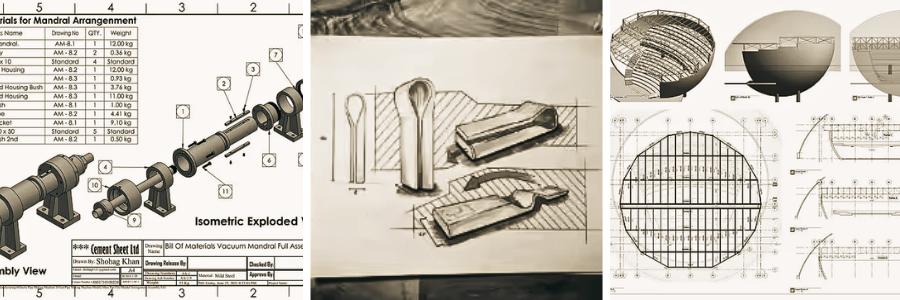
One of the most useful references in general is a dimensioned sketch or an engineering drawing. It does not have to look polished or professionally drafted. It could be a rough sketch, but it has clear shapes, size, relationship, and dimensions. A simple sketch with annotations can help designers understand the model.
Missing dimensional information can cause delays and revisions. Designers would have to assume or ask questions just to make up for the missing data. This back-and-forth process can be avoided if only the reference data were complete and clear.
PDF or scanned drawings (existing documentation)
There are projects based on existing designs or older sets of drawings. For these kinds of projects, it is very helpful to provide reference drawings or documentation. For instance, a renovation project has to be done. The existing drawings are helpful in determining the overall placement of structural,architectural, and MEFP elements. It helps designers understand the design intent and imagine how the renovation will be done. It gives them an accurate foundation of information.
Providing multiple references helps designers cross-check information and dimensions. This way, it helps in reducing inconsistencies and assumptions. A complete set of plan views, elevations, sections, and detail drawings is appreciated to create a more accurate deliverable.
Physical measurements and callout sheets
A physical callout sheet consists of photos or sketches of objects with clear dimensions and feature locations. The measurements include its overall length, height, and the spacing or thickness of its components. A callout sheet is more reliable when it’s organized and complete, helping designers develop an accurate model.
The accuracy of measurements relies on the tools used. It could be taken with tape measures or vernier calipers. In the architectural and structural fields, laser distance and measuring tape are used.
Reference images and photographs
One of the most important references in CAD projects is images and photographs. Dimensions do not fully explain and interpret the design. To better communicate the model’s overall appearance, proportions, and physical attributes, reference images and photos are needed.
It is especially useful and applicable for product design and reverse engineering work. The photos provided should be clear enough and taken from multiple angles. These help designers avoid assumptions and focus more accurately on digitalizing it.
Existing CAD files (native or neutral)
Although not always available, if there’s an existing CAD file, even though it’s old or just a similar type, it is helpful to share it with the designers. The existing files help designers avoid starting from scratch. With these, they’d have a base model to work on and modify, saving them more time.
Even when the files are old or outdated, they can still show the structure. Native CAD files such as SOLIDWORKS (.sldprt), Revit (.rvt), or AutoCAD (.dwg) formats are recommended to be provided, as they preserve parametric features. This makes them editable and easier to modify.
Technical specifications
Material specifications
One of the most critical files needed in a project is the material specifications. This documentation consists of important information such as how a part is designed, manufactured, and documented. Materials have unique attributes, leading to different manufacturing limitations and design requirements. The designer needs this information in order to make efficient and effective design decisions.
The material specification provided should contain enough information and description for it to be reliable. It is not enough to just say “plastic” or “stainless steel”. It has to be more detailed and specific since each material behaves differently in a real-world setting.
Manufacturing process
Another important piece of information is the manufacturing process. This technical detail helps in understanding the model to be built. Every manufacturing process differs in methods, limitations, and design rules. The designers need to know which one is set in order for them to make informed decisions.
When the manufacturing process is not defined, the final design model may be difficult to build or expensive. This may result in a redesign, costing more time and money. Knowing the manufacturing process allows designers to anticipate potential issues, enabling them to address them early.
Tolerances and fit requirements
Tolerances define the accuracy of a manufactured part of the model. It states how much variation is allowed from the exact dimensions in the design model. It varies depending on how critical the part is. This is important since tolerances impact how the parts fit together.
If the tolerance value is not yet defined, another solution is to describe how the part functions. An experienced designer can analyze and recommend an appropriate fit and tolerances suited for the manufacturing method. A clear and defined tolerance and fit requirements reduce errors and costly rework.
Surface finish requirements
A surface finish refers to the overall texture attributes of a part’s surface. It defines how smooth and rough the surface is. Knowing this helps designers understand how it looks and functions. While sometimes overlooked, this detail is important in manufacturing quality and product performance.
Surface finish impacts the level of precision it requires. It ensures that the final product matches the intended look and durability. A clear definition of surface finish requirements enables designers to align the model with client expectations, ensuring design consistency and functional accuracy.
Thread and fastener specifications
In manufacturing, one of the most encountered problems is a mismatch in threaded holes and fasteners. This could be caused by incorrect specifications or a lack of information provided. It is important that the designer receives complete specifications to ensure accuracy in assembly. The specifications should also include the fit tolerances, size, and compatibility of the threaded feature. The thread standard, such as Metric, Unified, or BSPT, should be clearly defined.
For bolts and other hardware like screws, specifications should include details such as proper clearance holes, tapped holes, and countersinks. Knowing fastener information lessens the problems it may face during the manufacturing process.
Assembly context and interface geometry
Most projects done in CAD are part of an assembly. It’s mostly parts that work with other components and not as a standalone project. Because of this, the designers need to understand the whole assembly context to know the relationship between the parts, their connections, and how much space is available around them. They have to accurately have an image of how the part interacts with its neighboring parts. This is called interface geometry.
Knowing interface geometry helps designers to create accurate connections and clearances. It reduces possible misalignment during production. Interface geometry can be provided by sharing the CAD models of surrounding components.
Weight and dimensional envelope constraints
There are CAD projects that have strict weight requirements. These are called dimensional envelope and weight constraints. In these types of projects, every small change is critical due to strict constraints. This is mostly applied in aerospace field expert.
The designers should know of the constraints that are set at the start of the project. They have to be informed and aware of the limitations in order to consider them in their design. It is critical to set required clearances and weight limitations for the designers to make efficient and smart decisions. It allows them to carefully analyze the best optimization approach to account for constraints.
Regulatory and standards compliance requirements
There are projects that follow specific industry codes and standards. The standards define how the drawings will be developed, annotated, documented, and reviewed. It is critical that these requirements are briefed before the start of the project. Doing so can help avoid the possibility of costly rework and delay.
Compliance requirements may change the project’s scope. This is because there are standards that would require a drawing or technical documentation. For example, a drawing may require a Professional Engineer review and stamping, or a certain model needs to be more detailed and validated to comply with the standards.
File format and deliverable requirements
CAD file format: native vs. neutral
One of the most important pieces of information during the project brief is specifying what file format is expected for the final deliverable. CAD files can either fall under native or neutral formats. Each serves a significant purpose. The right file format generally depends on file usage and application.
Native formats are parametric and editable original files produced by CAD software. It includes file formats such as .dwg (AutoCAD), .rvt (Revit), and .sldprt/.sldasm (SOLIDWORKS). These file types are suitable for editing and updating base models. Neutral formats are file types that are designed to be compatible with other CAD programs. Most of the time, these files are not editable. It includes file types such as stp (STEP), igs (IGES), and .sat (SAT).
2D drawing format: DWG, DXF, or PDF
The most common deliverables for 2D CAD are DWG, DXF, and PDF file. Each of these formats serves different purposes and depends on the requested output by the client. This is why it is important to set up an expected file format for the deliverables to ensure proper alignment.
When the output is for review, printing, and approval, a PDF is usually used. It is a fixed file format that can be viewed on almost all devices. DWG and DXF files are editable and can be useful, especially when the design is expected to be edited, revised, or updated. Most of the time, PDF is used as a final issue, so it can’t be edited or modified.
3D visualization and rendering formats
Visualization and 3D rendering deliverables may come with different file formats as specified in the project brief. Most of the static deliverables have file formats TIFF, PNG, and JPEG. TIFF and PNG are high-quality formats best for printing materials, while JPEG is of lesser quality and is best for online catalogs or websites.
If the render is to be printed, it is important that the image size and resolution are specified. For instance, a large-format poster needs a resolution of more than 300 DPI. For interactive 3D content, file formats vary depending on the platform. GLB and GLTF are used for web-based 3D viewers, FBX and OBJ are for animation software and VR workflows. MP4 is used for video walkthroughs.
BIM model LOD and data requirements
BIM projects have a certain required Level of Development or LOD. It is important that it is clearly defined and specified during the project brief. LOD covers how detailed the BIM model needs to be, either visually or technically.
A low LOD level is for concept or early-stage planning. High LOD is for coordination, fabrication, and construction. For instance, LOD 100 represents basic conceptual massing, and LOD 200 is for approximate geometry. In LOD 300, it contains even more accurate dimensions and details for construction coordination. It progresses along with how rich information is needed.
Drawing sheet size
In the project brief, it is important to specify the required sheet size for the CAD project. This is important because it affects the way the drawings are organized, printed, and reviewed. The sheet size could vary depending on the region and preferred format.
In the US, the most common engineering drawing sheet sizes are A (8.5×11), B (11×17), C (17×22), D (22×34), and E (34×44). While for international projects, ISO paper sizes such as A4-A0 are used. Some firms prefer customized layouts as well. It is important that this is discussed in order to keep workflows aligned.
Title block requirements
Title blocks contain important information in the project. It is best to specify in the project brief what information they prefer to show. It could include drawing title, drawing number, revision logs, scale, issued date, company, and project details. Most of the time, the company has already established a title block template. The designer can request access to it to keep drawings consistent.
The title block simplifies document control. It helps in ensuring all drawings are tracked and stored in a way that keeps them secure. Providing a title block to the designers allows deliverables to be consistent with the internal standards, ready for printing.
Layer and file organization standards
For large CAD projects, proper version management and file organization are essential to keep them consistent and easier to handle. When the files are properly organized, coordination is smoother and seamless. Revisions can be done simply and help future designers or members to understand the background of the project.
Every industry follows a certain standard. For instance, in US architectural projects, the NCS or National CAD Standard layer naming convention is used. The UK, on the other hand, uses and follows BS 1192 or ISO 19650 standards. For Mechanical CAD projects, simple layer structures can be used.
It is important to clearly set standards and guidelines required at the start of the project to ensure it matches the internal system. It could include layer names, colors, line weights and styles, text styling, and file naming.
Most projects undergo multiple revision cycles before the final output is approved. It requires numerous back-and-forth of discussion and approval. To ensure that everything is documented and tracked, a clear version control process is important to avoid confusion. This is done so that the changes made are tracked throughout the project.
Most large construction projects have an established document control system. It often includes revision history tables, with approved signatures, issued dates, and changes made. This is done to ensure that future revisions can be done, or that the team that will handle it next can easily understand the history of the project.
File naming conventions
One of the most overlooked details, but is actually impactful, is having a clear and consistent naming convention. It is easy to name a project just based on its name and description. However, when there are a lot of versions and revisions, it would be hard to track and trace. A proper naming system allows seamless and simple tracking, helping designers be organized in their work.
It could be put like this. A file name like “New_Final_Finalfinal_USE THIS” is confusing, unlike a structured name like “US Project 01_RevB_20260615”. The latter is easier to understand and track as it immediately shows important details of the drawing version.
Before putting up a freelancing job listing on Cad Crowd hiring platform, it helps to prepare a checklist and organize it. This is useful for a clear project brief. The designer would be able to follow through with what the project needs or requires them to do. This reduces confusion and assumptions that could result in delay.
The checklist could include, but not be limited to:
1. Dimensioned sketches, photos, reference drawings and models
2. Material specifications/Technical specifications
3. Manufacturing processes/Production processes
4. Required deliverable formats
5. Naming conventions
6. Regulatory standards if required
7. Timeline expectation
8. NDA
9. Point of contact/correspondence
10. Payment terms and conditions
How Cad Crowd uses your files to match you with the right designer
Cad Crowd is known for its tailored matching process. It uses the information included in the project brief, reference files, and technical requirements to connect businesses to the right designer or freelancer. This helps clients and businesses save time in filtering candidates who are fitted for the required deliverables.
The accuracy of the matching process depends on how detailed and complete the project brief is. This is why it is important to ensure that all information is provided, including software process, standards, and a timeline. Clear briefs mean clear deliverables. Cad Crowd can help in connecting with the right freelancers in a more efficient way.
Common mistakes that derail CAD projects
Several projects experience delays, extra costs, and revisions because of preventable mistakes during a project brief. Communication is one of them. It is important that the designer and the client have clearly communicated to each other the scope and deliverables of the project. Another is a lack of references, such as drawings and photos. To better align with the expected geometry, it is best to provide technical references.
Another avoidable mistake is undefined file format requirements and drawing standards. Specifying this firsthand can help in reducing time-consuming rework or file conversions. There are still other avoidable mistakes that are overlooked, but a clear checklist can resolve them.
Conclusion
The success of a CAD project depends on how well-prepared and clear the project brief is. When all information is provided and defined, designers can accurately deliver the tasks expected. The more complete the information is, the less misunderstanding and confusion there is. A structured brief also makes it easier to come up with an accurate quotation and realistic timelines. Cad Crowd can help in efficiently connecting businesses with screened designers, tailored to their project needs.
How Cad Crowd can help
A successful CAD project starts with a clear project brief and complete technical documentation. Cad Crowd connects businesses with experienced CAD designers and engineering professionals who can turn your project requirements into accurate, high-quality deliverables. Whether you need 2D drafting, 3D CAD modeling, engineering drawings, BIM models, or product design support, our vetted experts can help streamline the design process, minimize revisions, and deliver reliable results. Contact Cad Crowd today for a free quote.
MacKenzie Brown is the founder and CEO of Cad Crowd. With over 18 years of experience in launching and scaling platforms specializing in CAD services, product design, manufacturing, hardware, and software development, MacKenzie is a recognized authority in the engineering industry. Under his leadership, Cad Crowd serves esteemed clients like NASA, JPL, the U.S. Navy, and Fortune 500 companies, empowering innovators with access to high-quality design and engineering talent.











![Mortal Shell II Free Download [Build-24772279+ALL DLCs] PC Game](https://worldofpcgames.com/wp-content/uploads/2026/08/capsule_616x353_alt_assets_3-1.jpg)