3D Product Rendering: How Photorealistic Renders Are Made, Priced, and Used to Sell


Customers often use their phone to search for a product online before they get to touch it. Their first impression comes always from the images they have seen, whether they are buying or reviewing a catalog. The use of high quality visuals can be influenced whether someone explores or moves to another product. 3D product rendering services are a crucial part of modern product development and marketing. These rendering offers to help the businesses evaluate and validate their designs, attract investors, and create marketing before the production takes place. 

What Is 3D product rendering?

3D product rendering is a way of making realistic digital images or animations from a three dimensional model. It has a rendering software that can specialize in simulating a real world light, materials, reflections, shadows, to create an image that resembles a professional product photography. 3D rendering does not make use of a physical product unlike traditional photography. Every detail can be modified with the use of digitals; the utilization of rendering can offer a flexibility rather than using traditional photography. As when a product is still in a CAD model, 3D modeling designers can be able to visualize them, which makes it possible to:

  • Start advertising campaigns before production
  • Examine various materials and colors
  • Present the ideas to investors
  • Try the branding and packaging
  • Make configurators for the products
  • Create and produce catalogs and advertisements
  • Generate images for e-commerce 

RELATED: How Over-Engineering Products Hurts Per-Unit Profit Margins for New Concept Designs

The four-stage product rendering pipeline

Structured workflow is used when having a photorealistic rendering. Various stages are done to have a quality image. 

Stage 1: Creating the 3D model

This stage is the ideal scenario to take as it all starts with a digital model. A quality of an underlying geometry has a great influence on the final output of the render. 3D artists can obtain a model in two ways:

Option 1: Using Existing CAD Files

This option is the fastest and cost effective approach to use as the rendering artist can directly import their files. If products exist and have been designed in software it will be easier and the artists can save up time in rebuilding it. 

The following are the software that can be used to design a product:

  • SolidWorks
  • Fusion 360 
  • CATIA 
  • Creo
  • Siemens NX 
  • Rhino 
  • Inventor

The benefits of using the option of using existing CAD files includes having a higher dimensional accuracy as measurements are consistent with the engineering design, faster turnaround, lower costs since fewer hours are spent doing modeling, easier and accessible revisions as updated CAD files can easily replace the older and existing versions. For the businesses that are collaborating with the mechanical engineers or product designers having CAD files is the most effective and efficient way to have to lower the rendering costs

Option 2: Building the model from photos or drawings

Not every business has an existing CAD file available. Some of the products have been hand made, reverse engineered, acquired from another manufacturer, or have been produced for a long time already. In these situations, an artist needs to manually recreate the product using reference photographs, sketches, measurements, and technical drawings. With the utilization of these references, the artist can rebuild the product in a 3D software. 

It can be time consuming for a product to turn into a 3D model, because it needs to be meticulously and carefully made, especially every feature needs to be made by hand. A curved handle, or a texture grip may require careful measurements and multiple revisions. On the other hand, even the most intricate parts such as the complex consumer electronics or machinery, the manual modeling can account for the largest portion of the project’s budget. This addresses why rendering projects that begin with engineering CAD files are usually much less expensive than those that begin with photos.

RELATED: Top 35 Sites for Freelance 3D Product Rendering Jobs & Remote Visualization Work Projects

product development designers

Stage 2: Materials and texturing – making the model look real

The product may appear unrealistic even if it has the correct and right shape after modeling.Since there are no material properties assigned, the models can look like smooth gray objects. The next step of the process is to add materials and textures. Some may think that choosing color is easy and as simple as it is, but a professional material creation is much more complex. Rendering software often simulates the way various materials react with light. For instance:

  • The chrome may generate sharp reflections
  • Through the brushed aluminum light is scattered producing a gentle linear reflections
  • More light is absorbed by the matte plastic, which creates a delicate highlight
  • Rubber looks soft and reflects very little light
  • The glass bends and reflects light while allowing it to flow through
  • Smooth plastic scatters light differently than leather, which has tiny surface flaws.

To be able to recreate these characteristics, the 3D rendering artists can adjust the numerous properties of materials, which includes the following parameters :

  • Base color 
  • Roughness 
  • Metallic value 
  • Reflectivity 
  • Transparency 
  • Bump maps 
  • Normal maps 
  • Displacement maps

These settings will determine how a light behaves when it strikes the surface. An example of this is when two smartphones have an identical shape. The one has a glossy black glass with polished aluminum edges, while the other one utilizes a matte plastic and a textured rubber. Even if the geometry is identical, it will produce a different impression. A premium and high end one, as well as with the other one it will feel rugged and affordable. This depicts that the materials have a crucial role to play in interacting with the product’s quality. 

Stage 3: Lighting and camera setup – photographing a digital product

A product that is modeled and appears flawless with realistic materials, the poor lighting can make it look artificial. Lighting is considered as one of the factors that distinguishes work between professional photorealistic rendering services and amateur renders. Expert rendering artists have a photographic mindset. They put virtual lights inside a digital environment rather than real lights in a studio. It is set to highlight the product’s best qualities rather than lighting it up.It is best for the artists to select the lighting style that best suits the intended use especially to a product.

RELATED: Why Design Engineering Won’t be Enough to Develop & Deliver Successful Products at Startups

The following are some of the lighting styles:

  • Studio lighting – This is the most common set up that is utilized for e-commerce images. It utilizes soft, evenly distributed light to minimize the harsh shadows while making sure that the products are still visible. This is best to use for the customers that prefer to have precise, unambiguous product representations over artistic effects, which makes this setup especially effective for online retailers.
  • Dramatic lighting – This type of style is commonly best to use by the 3D design artists who want to draw attention to the product’s key design feature. This method is widely used especially in the luxury watches, smartphones, sports gear, and automobiles as it produces a high end look.
  • Lifestyle lighting – To have an impression that the product is used in daily life, some of the renders put the products in a location such living rooms, offices, or in an outdoor environment. The artists replicate the natural lighting by using artificial light. With the use of having the product in an authentic setting, lifestyle scenes aid consumers in developing a connection with it.

Choosing the right and best camera

The use of lighting alone is insufficient, therefore, selecting the appropriate camera is crucial. The virtual camera also influences customers’ perceptions of the product. 3D product design artists pick carefully the viewing angle, camera height, focal length, depth of field, and lastly the image composition. For instance, a close up shot showcases fine detail and craftsmanship, while the low camera angle can make the product appear larger and more powerful. Camera placement affects the perception of a consumer towards the product as similar with the professional product photography. 
consumer product design firm

Stage 4: Rendering and post-production – producing the final image

Once the model, materials, lighting, and the camera have been prepared, the rendering process begins. This phase is where the software calculates how every ray of light interacts with every surface in the scene. This includes a lot of calculations as the software determines where the shadow falls, how reflections behave, how the light passes through the transparent materials, how metals reflect to their surroundings, and lastly, how indirect the light bounces between the surfaces. Rendering takes longer as these calculations become more realistic.

A highly detailed marketing scene with glass, water, reflections, and intricate lighting may take several hours or it may even take overnight rendering to produce and generate a single high resolution image, while a straightforward white background product image might be completed in a matter of minutes. After the rendering is completed, the product rendering artist can perform the postproduction. This phase is the same with editing professional photographs. 

RELATED: 10 Costly Errors that Engineers Make for New Product Design at Development Firms

With the use of software such as Adobe Photoshop, images are fine tuned through correcting colors, improving contrast, reducing digital noise, enhancing reflections, sharpening important details, adjusting brightness and replacing backgrounds when necessary. When all of the four stages are completed successfully, the final image becomes indistinguishable from a real product photograph. A lot of cases where a customer cannot easily identify whether they are looking at an actual photograph or into a computer generated photo, which exactly is the goal of having a high quality photorealistic rendering. 

Types of product renders and their business uses

Every product rendered has its own function. A business that is introducing a new product may require a different kind of render than one that sells goods on Amazon. A new product design startup that is looking to impress investors has different visualization needs than a manufacturer that produces an assembly guide. Having to choose the right type of render makes it easier for the businesses to communicate effectively with the target market. There are different goals that a render aims such as focusing on providing accurate product information, or creating excitement, telling a story, or demonstrating how a product works. 

The following are the most common types of product renders and the best time to use each one:

White-background e-commerce renders

When browsing online marketplaces such eBay, and Amazon, a customer can notice that the product images have one thing in common which is that the products are featured in a clean white background. This is known as a white-background e-commerce render, and it is the most used type of product visualization. Distractions are eliminated and the customer’s focus is maintained on the product itself with a simple white background. Most of the e-commerce platforms require several product images rather than only using one. The business often creates a complete image set which includes the front view, back view, side view, top and bottom angles, close up shots of key features, packaging images, and images that show the accessories or the components. 

Marketing hero shots

Hero shots usually focus on emotion. A hero shot acts as the main promotional image for a product. It shows up on a business’s homepage, in commercials, on social media, or when a new product is introduced. Rather than recording every detail, it generates excitement and enhances the reputation of the brand. A product development artist makes use of dramatic lighting, camera angles, and a premium looking background to make the product stand out. A hero shot allows the company to strengthen its identity. A luxury brand might employ tasteful lighting and straightforward compositions, whereas an outdoor equipment company might highlight harsh settings that highlight toughness and adventure.

RELATED: How to Find the Right Industrial Design Company for Successful Product Development

Lifestyle renders

A customer does not buy the products alone but they buy the experiences. Lifestyle renders makes customers imagine how a product fits to their daily lives by having it in a realistic environment rather than in an isolated studio setting. An example of this is a desk lamp inside a stylish home office, and a sofa that is a part of a designed living room. A Lifestyle render provides a visual response to the question of how a product will appear in a customer’s home, office, or workplace. It also conveys an important detail about scale, size, and purpose.

lifestyle rendering services

360-Degree product spins

When in a physical store, customers pick up products, rotate them, and examine them from every angle, and an online shopper cannot easily do it unless a business gives an interactive product experience. This is where 3D 360 degree panorama rendering services are invaluable. A 360 degree product spin allows the customer to rotate a product on their smartphones rather than viewing in one or two static images. 

360-Degree Product Spins provide a customer a better understanding of the shape and design of the products and have trust by giving details that might remain hidden in a standard photograph. As well as, the customers can know exactly what to expect before making a purchase, reducing the chance to return the product. A company that makes use of 360 degree product spins is usually seen in products such footwear, sporting goods, automotive accessories, where visual inspection plays a crucial role in buying decisions. 

Product animations

Product animations solve a problem by showing a movement. Rather than displaying a simple image, animations demonstrate how a product works, how the components fit together, and how a customer should use it. Businesses usually use animations to show the moving components, present exploded views, explain assembly instructions, and create promotional launch videos. 

RELATED: How 3D Animation Helps Deliver Immersive Marketing Campaigns & Company Services

AR-ready models

One of the applications for 3D product visualization that is expanding the fastest is augmented reality (AR) rendering services. Businesses can benefit a lot from the AR ready models such that customers are able to assess a product’s size, appearance, and a placement before making a purchase, which gives them greater confidence. Higher customer satisfaction and fewer returns are frequently the results of this.

Understanding 3D product rendering costs

Before rendering a project a business first question is “How much will it cost?” The answer to it depends on a lot of factors, which includes the product’s complexity, number or images required, the level of realism, and if the 3D rendering artist must start from scratch when creating the 3D model. A simple render requires less time than a detailed visualization of an industrial machine. Rather than thinking of rendering as a fixed price service, it is important to think of it as a combination of tasks. In every project it can include a lot of modeling, lighting, material creation, revisions, and the postproduction. The more in depth a product works in every stage, the more it becomes costly. 

Typical 3D product rendering price ranges

Project Type Typical Price Range Best For
Simple White-background Product stills $50–$300 per image Amazon listings, Shopify stores, catalogs, technical documentation
Mid-range Commercial Renders $300–$1,000 per image Marketing materials, websites, brochures, crowdfunding campaigns
High-end Photorealistic Renders $1,000–$5,000+ per image Luxury products, advertising campaigns, complex machinery, premium branding
Product Animations Typically priced per second of finished animation Product demonstrations, feature videos, trade shows, promotional campaigns

A small consumer product with simple materials is more inexpensive than a complex device. Rather than choosing the lowest quote, the businesses should evaluate the artist’s portfolio, technical expertise, and the ability to understand both the data and marketing goals. 

RELATED: How 3D Product Animations Boost Sales When Hiring Design Studios & Freelancers

Two simple ways to reduce rendering costs

Provide clean CAD files

The easiest way to lower the rendering costs is to provide clean and organized CAD files. By providing a clean CAD files offers benefits such as it reduces a modeling time, preserves the product’s engineering accuracy, lowers the overall labor costs, shortens the project timelines, and makes the future design revisions easier. 

Batch multiple views from one model

Once the product designer has finished building the model, it becomes much more efficient to generate an additional view. Rather than having to repeat the entire process, they simply alter the camera angle, lighting, or environment to produce new images. An example of this is one product model can generate a hero shot for advertisement, close up an image that highlights the important features, white background images for the e-commerce listings.

interior rendering designers

How AI is changing product rendering

Artificial intelligence has become a part of the product visualization workflow. It enhances the existing 3D models, and generates product images in a short span of time. 

Sketch-to-render

It converts the hand drawn concepts or the digital sketches into polished product images. It is often used in the early stages of product development to visualize styling ideas before having a 3D model. 

Model-to-render

Model-to-render tools to enhance lighting, materials, backgrounds, and overall realism from an existing 3D model use AI. Rather than using a manual style of adjusting the visual elements, a 3D modeler can produce concept images in a short period of time. When a team wants to compare the various visual styles before committing to intricate rendering work, these tools can save time.

RELATED: Pros & Cons of AI for 3D Modeling Services and Your Cost Savings at Companies in 2026

Where AI still falls short

AI can accelerate the development but it has its limitation that is to control the revision. As artists work with editable 3D scenes, these revisions are simple when using traditional rendering software. However, whenever users make even a minor alteration, AI-generated images frequently regenerate significant portions of the image. It also struggles with dimensional accuracy. AI generated images can distort the proportions, and the features. It can be problematic when a business needs to have accurate marketing visuals for the final manufactured product. 

Why work with Cad Crowd?

Photorealistic 3D product rendering services are an essential part of modern product development and marketing. By understanding the rendering process, it makes it easier for the businesses to make smarter decisions. By having a CAD Crowd, it would be easier to have realistic and compelling visuals that creates confidence, and helps the innovative product designs into a commercial success.

Cad Crowd allows to connect and partner with companies to skilled industrial designers, CAD specialists, and 3D rendering experts who can turn technical models into an eye catching marketing materials. Whether you may need a clean commerce images, or a premium hero shots. Cad Crowd matches every project needs with experts that have the knowledge and experience in doing it. 

A lot of Cad Crowd’s CAD design professionals have the knowledge to understand engineering and product development work. They have the ability to deliver visuals that represent the final product as well as have manufacturing ready CAD files. Businesses can streamline collaboration, cut down on revisions, and confidently launch products easily. Contact us for a quote today.

author avatar

MacKenzie Brown is the founder and CEO of Cad Crowd. With over 18 years of experience in launching and scaling platforms specializing in CAD services, product design, manufacturing, hardware, and software development, MacKenzie is a recognized authority in the engineering industry. Under his leadership, Cad Crowd serves esteemed clients like NASA, JPL, the U.S. Navy, and Fortune 500 companies, empowering innovators with access to high-quality design and engineering talent.

Connect with me: LinkedIn ✦ X ✦ Cad Crowd

Alleged WoW: Forever Survey Teases 11 New Classes, Including Some Deep Cuts


World of Warcraft: Forever’s new take on classic Azeroth is opening the door to all kinds of new ideas in the old-school version of Blizzard’s MMORPG, and new classes look to be one of them.

Blizzard, of course, has added a total of four new classes over the last two decades to the modern version of WoW: Death Knight, Monk, Demon Hunter, and Evoker. But an alleged leaked survey pushed to select WoW players via Blizzard’s Battle.net launcher is now asking about potential new classes for WoW: Forever, the recently revealed third version of the MMO that will introduce new quests, zones, and content to the “vanilla” version of WoW. 

It’s not the first time Blizzard has conducted a survey this way, and while Blizzard asks participants not to disclose the survey’s details, their contents almost always find their way online. That’s the case here, as players were quick to share information about 11 potential new classes listed in the survey, and content creators like Bellular have gone as far as to provide a full breakdown. Information contained about each of these potential classes includes basic lore, what types of weapons they would be able to use, the armor class they would wear, the resources they would use, what roles they would fill, and even signature abilities. The classes listed in the survery are:

  • Bard
  • Death Knight
  • Demon Hunter
  • Illusionist
  • Monk
  • Necromancer
  • Metalborn/Runemaster/Runeknight
  • San’layn
  • Tinker
  • Warden
  • Witch

Three of the new classes would essentially be “new,” old-school versions of existing WoW classes like Demon Hunter, Monk, and Death Knight. Considering how fast-paced classes like Monk and Demon Hunter are in the modern version of the game, their Forever counterparts would likely feel significantly different.

It’s the eight “new” classes that are the most exciting, however. Some of these are ideas that have existed in WoW lore for ages or ones that Blizzard even originally toyed with during the game’s early development. The Tinker, for example, is a class many expect to come to the modern version of WoW at some point but is listed in the survey. They would be the ultimate engineer, capable of using mech suits and gadgets to tank, deal damage, and support other players. 

Another potential class, the Necromancer, was an idea Blizzard originally had planned for vanilla WoW, only for it to eventually be scrapped. In Forever, Blizzard is proposing a version of the class that seems like it’s taking some inspiration from Diablo 2’s class of the same name, with abilities like Bone Spear and Corpse Explosion. The survey additionally lists the San’layn, a group of vampires who broke free of the Lich King’s domination. This class seems like it would lean fully into the vampire fantasy, with a number of blood-based abilities that could make them similar to retail WoW’s Blood Death Knight specialization.

Two other classes steeped in WoW lore proposed in the survey are the Warden and Runemaster. Wardens are the iconic Night Elf faction famous for hunting down and imprisoning Azeroth’s greatest threats. How exactly that would work when it comes to Horde players is unclear, but the survey notes that the Wardens would open their ranks “out of necessity” in order to deal with greater threats.

Runemasters, on the other hand, are beings infused with power by the Titans who use a rune system that sounds similar to that of modern WoW’s Death Knights to heal and fight. That rune system itself was originally for an early version of the Runemaster class that was later scrapped and its core mechanic repurposed. This class appears to have been listed by multiple different names in various versions of the survey, also appearing by the name Metalborn and Runeknight.

Other classes seem almost entirely new. The survey lists classes like Bard, Witch, and Illusionist among potential additions. The Bard sounds about like what you would expect, a healer and support class capable of buffing allies, while the Witch and Illusionists are two new flavors of spellcasters. Illusionists would summon and conjure creatures and objects to aid them in battle, while the Witch uses dark powers like blood rituals and even the power of the old gods to buff allies and destroy their foes. 

Whether or not any or all of these potential new classes will eventually make their way into Forever remains to be seen, but Blizzard does have, well, forever to make them a reality. In the meantime there’s plenty new for WoW: Forever players to discover, including over 1,000 new quests, four new zones, an account-wide Legacy perk system, and more. WoW: Forever’s beta is currently live until October 21, with Forever’s full launch set for November 4.

Solos gives its smart glasses a physical privacy kill switch


What you need to know

  • Solos launched its $79 Privacy Kit for AirGo V2 smart glasses, replacing digital toggles with physical camera barriers and clear frame temples.
  • The ClearView Temple is a non-powered, transparent frame arm available in four patterns (Ocean Arrow, Amber Net, Mint Check, Teal Web) that visually proves no electronics are inside.
  • The Clip-On Bundle includes a full-cover shield to physically block the camera, plus a polarized sun lens available in Dark Green, Dark Grey, or Gradient Brown.

Solos is providing AirGo V2 owners with a more obvious way to tell when their smart glasses are not using their cameras. The company’s new Privacy Kit is now available online, combining a transparent replacement temple with clip-on accessories designed to physically block the glasses’ cameras.

Typically, smart eyewear relies on tiny LED lights or software toggles to signal when you are recording, but those methods rarely ease public paranoia. Solos, a company spun out of Kopin Corporation by engineers trained at MIT, is taking the low-tech, no-nonsense approach. Co-founder Kenneth Fan calls this “privacy by design,” replacing pinky-promise policies with real barriers.

Nothing Headphone (1) Pro release: Price, specs, first impressions


Table of Contents

The retro aesthetic audio brand Nothing released its first pair of over-ear headphones just over a year ago, and already, they’re back with improvements.

The brand announced its latest flagship product, the Nothing Headphone (1) Pro, on Sept. 28. This will be the second over-ear headphones release from Nothing this year, following March’s budget-friendly Nothing Headphone (a), which I found to be a more well-rounded and better value pair of headphones than the initial launch.

The Headphone (1) Pro, though, show some serious potential. Though I’ve only spent a few days with the headphones so far, I have some initial thoughts, alongside everything else to know about Nothing’s newest release.

Nothing Headphone (1) Pro: Price and specs

The Nothing Headphone (1) Pro cost $399, putting them $100 over the asking price of the Headphone (1) upon launch. The specs are as follows:

  • Drivers: Bass dynamic driver, precision dynamic driver, and xMEMS driver

  • Active noise cancellation: Adaptive, powered by 10 microphones

  • Battery life: 30 hours with ANC on, 68 hours with ANC off

  • Quick charge: Two hours of listening from a five-minute charge

  • Spatial audio: Yes, five modes of dynamic spatial audio (standard, Studio B by Metropolis Studios, live house, club, concert hall)

  • IP rating: IP52

  • Multipoint: Yes

  • Connection: Bluetooth 6.1, Google Fast Pair, Microsoft Swift Pair

  • Colors: Black and white

Nothing Headphone (1) Pro vs. Nothing Headphone (1)

While the Nothing Headphone (1) Pro retain the same distinctive retro-rectangular look of the Headphone (1), the brand brought some updates that separate the newer model as the premium one. For instance, the transparent part of the ear cup is made of shatter- and scratch-resistant glass, while a combination of titanium and aluminum provides for a lighter overall product.

silver nothing headphone (1) on desk

Last year’s Nothing Headphone (1) are similar in appearances, but the brand made key changes for the update model.
Credit: Bethany Allard / Mashable

Nothing also claims to have upped the noise cancellation power by 40 percent, thanks to the 10-microphone system with more optimally placed mics. Unlike the older headphones, all the microphones are placed inward on the ear cup, meaning less interference from wind and airflow.

The headline with these headphones, however, likely lies with the broad listening experience. The triple driver architecture isn’t one too common on headphones, but it’s designed to provide the most robust listening experience. In the companion app, you have the option in the equalizer to tune the main drivers or the precision driver specifically.

In addition to the drivers, Nothing included five different modes of dynamic spatial audio, optimized for different genres of music.

If you’re into audio editing, music mixing, or any aspect of audio production, Nothing also included a Flat EQ mode, which is designed to provide the most faithful reproduction of the original audio as possible. The headphones also feature an on-ear switch for this mode on the interior of the left ear cup.

Speaking of on-ear switches, it’s worth noting that something that hasn’t really changed between the two headphones is the excellent on-ear controls.

Nothing Headphone (1) Pro: First impressions

black nothing headphone (1) on desk

The improved comfort on this design is a huge plus.
Credit: Bethany Allard / Mashable

Though I haven’t had much time with these headphones so far, immediately I could tell they were more comfortable than the Headphone (1), which I could not wear comfortably for more than an hour. Nothing claims the Pro headphones have 50 percent softer ear cushions and an overall lighter frame, both of which feel accurate and make the experience of using these headphones significantly more pleasant.

I’ve yet to put them through the wringer on the ANC front, but claims of improvements there also feel accurate so far — even the standard sounds of my apartment, like my own typing and the AC running, are basically impossible to hear when I’m streaming audio with the ANC on.

What I’m really looking forward to testing extensively is the robust sound profile. These headphones offer an impressive amount of customization, from the custom equalizer, presets, spatial audio options, and flat EQ mode. As a freelance podcast producer and editor, I’m particularly interested in trying out that last mode against my usual editing headphones.

Ultimately, I’m struggling to come up with critiques in my first days of testing, which I didn’t experience with the Headphone (1) — we’ll see how that develops over the rest of my testing period.

Nothing Headphone (1) Pro: Where to buy

The Nothing Headphone (1) are available to purchase for $399 at Nothing’s website, Amazon, and Best Buy.

Where to buy the Nothing Headphone (1) Pro


Nothing Headphone (1) Pro


black nothing headphone(1) pro


Nothing Headphone (1) Pro

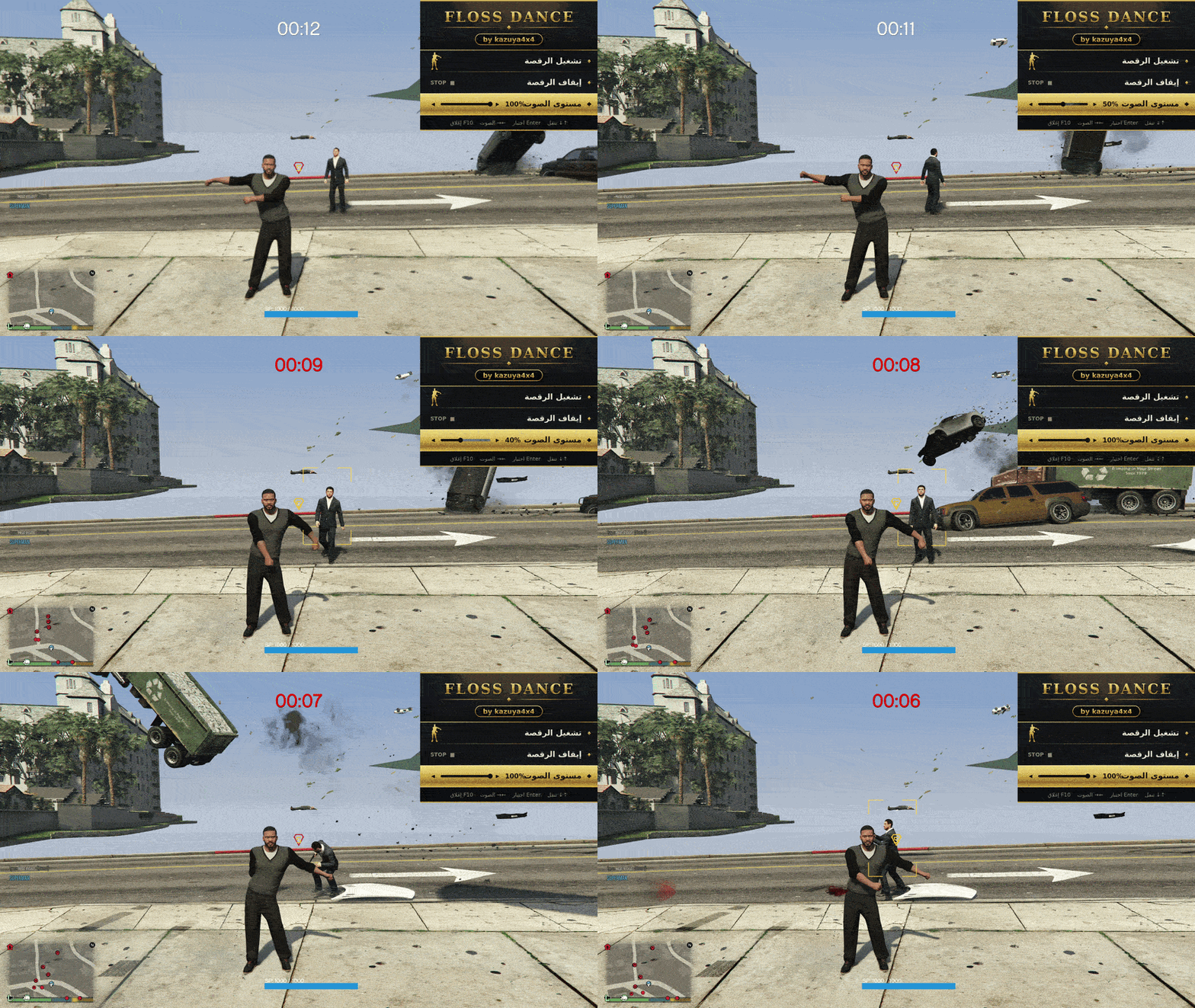
My GTA 5 install has a death wish but I have soothed it with flossing


Los Santos Customs

I’m modding GTA 5 every day in a quest to either transform it into a PC version of GTA 6 or break it entirely. Come back tomorrow to find out what new horrible thing I’ve done to Rockstar’s baby, or check out what I got up to earlier.

There is an anxiety to my movements now. The stench of death lingers about Grand Theft Auto 5 like petrichor after hard, hot rain, and I am nervous that any addition will finally nudge it over the edge.

As we’ve previously established, the game now only launches properly in windowed mode, and once it churns through all the modifications I have burdened it with, it deposits me in an empty void where Franklin Clinton’s house used to be, sending him tumbling through the abyss. Every time I load GTA 5, Franklin screams.

Fortune’s Weave Is the Rare RPG that Tackles Religion Correctly


The way RPGs handle religion is something of a meme. Are bad things happening? Might want to see what the local bishop is getting up to. An evil organization is oppressing the masses? It’s probably the church. You should go kill god while you’re saving the world, just to be on the safe side. Bandai Namco’s Tales series, Breath of Fire, sometimes Falcom’s Trails series — these and a whole lot more use religion as an easy caricature for villainy, liberally borrowing iconography and concepts from real-world doctrine to lend a sense of legitimacy to their stories.

The connection between religion and JRPGs is a bit of a trope by now, and not a great one. So I was surprised to see how seriously Fire Emblem: Fortune’s Weave tackled religious topics — and how effectively it implemented real-world ideas to make a strong narrative point.

[Ed note: This piece contains mild spoilers for parts of Dietrich’s path and tones of Part 3 in Fire Emblem: Fortune’s Weave.]

Developer Intelligent Systems has toyed with religious and mythological symbols in Fire Emblem over the years, mostly the latter and typically just when something needed a cool-sounding name. Three Houses‘ Church of Seiros was an exception, a hierarchical religion that relied on ritual, liturgy, and faith — and abused its position — to maintain order. It’s not a bad setup, and Seiros is a wonderfully complex villain. But you could swap her and her church for any oppressive institution and get the same outcome: an oppressive institution that Edelgard wants dead and buried.

I realized Fortune’s Weave was doing something much different toward the end of Dietrich’s route (which you really should play if you haven’t yet). The incident is brief and happens when Fabio, a key ally of Dietrich, explains the origin and workings of Crest Stones. Those are the items from Fire Emblem: Three Houses that conferred supernatural powers on whoever had them, power that eventually drove the bearer to madness and turned them into monsters.

Maybe it was remiss of me, but I never felt the need to know how Crest Stones worked. It’s a magic dragon rock. That’s kind of an explanation in itself, and video game logic operates on rules similar to those espoused by philosophers in Terry Pratchett’s Discworld books: Things just happen; what the hell.

Well, Intelligent Systems decided this thing needed a proper explanation and went all out.

Fabio discussing Crest Stones in Fire Emblem Fortune's Weave Image: Intelligent Systems/Nintendo via Polygon

“The very structure of the Crest Stones is truly shocking,” Fabio says. “They contain a conduit to hyperspace.”

This is a lot to take in. The magic dragon god rocks are actually scientific space rocks, a slightly niche reference to a small note from Three Houses about Sothis having descended on the world from outer space. But there’s more, which is where things get interesting.

“A conduit for the transfer of matter making up a dragon’s body and the energy to animate it,” Fabio adds.

Get Polygon’s Wishlister newsletter

A weekly cheat sheet to what you’ll eventually love to play. No buying, no
commitment — just saving for later.


Sign up free

Free. Unsubscribe anytime.

In other words, the Crest Stone takes divine energy from outer space and transforms it into something that elevates the humans it touches into something beyond their base natural condition. Maybe it’s just me, but that sounds a whole lot like the Roman Catholic doctrine of transubstantiation. It’s a belief that priests conducting mass have the power to transform bread and wine into the body and blood of Christ, melding the divine and the human in an act of communion.

It’s not a 1:1 parallel, of course. My dad’s parents are devout Roman Catholics, and they’ve yet to turn into magical monsters just from taking Mass, the way Crest Stones eventually corrupt humans. Tempting as it may be to view Fabio’s comment as another, slightly more specific, off-the-cuff reference to real-world things, Intelligent Systems is being very intentional with its references.

Look at the situation with the People of the White Egg, how Dagda brutally murdered thousands of them out of fear, and how it loosely resembles Rome’s brutal conflicts with the Carthaginians in the second and third centuries BCE. Historians then and now regard those unnecessarily punitive as a turning point in the history of Rome’s collective moral character. In Fortune’s Weave, the Dagdan pantheon regards the genocide against the People of the White Egg as a turning point toward paranoia and cruelty in Dagda the Great’s rule over the country of Dagsion. If you doubt the connection there, there’s a Grand Megalith, one of those high-tech underground you visit in Dietrich’s route named Hannibal, who rides an elephant. In real life, the Carthaginian general Hannibal was famous for leading an army of elephant riders over the Alps to attack Rome. These aren’t just cool-sounding names and neat ideas. Intelligent Systems has a purpose for them.

Fabio criticizing humans in Fire Emblem Fortune's Weave Image: Intelligent Systems/Nintendo via Polygon

This draconic version of transubstantiation mirrors the real-world belief in a way that supports Fabio’s faith the same as communion supports Catholic faith. Granted, Fabio’s version of it would be blasphemy in real life, but still He despises the gods like a good Agarthan, but he’s not too happy with his own people, either. Humans wanted the power of the gods to better themselves. Agarthans gave them the power of the gods as an act of vengeance. Neither path sits right with Fabio anymore.

He and, as you eventually learn, the less psychotic members of the Dagdan pantheon, want a world where people aren’t dependent on gods, where they don’t define themselves based on their relationship with the divine. It’s the same conclusion the wandering drunk monk Yang Jie arrived at after years of devotion and doubt, which makes him joining Dietrich’s crew as the automatic recruit a nice little touch. For them and even the gods, faith and heresy aren’t the defining factors of a future worth fighting for. Such a future leaves no room for those concepts, or the past will just keep repeating (as we see it does in Three Houses).

Self-sufficiency is hardly an original message. The thematic unity and the thoughtful use of religion to underscore a point is highly unexpected, though, particularly in a medium too scared to acknowledge religion or too shallow to do anything worthwhile with it. It’s a rare and welcome step forward — for the series, and for the genre.

Uplift Promo Codes: $300 Off


Upgrading your home office can feel like going down a rabbit hole. A simple search for a basic new desk can quickly turn into hours down the drain and leave endless tabs open on your computer, with every option blurring together. Uplift has a loyal following for its highly customizable desks, smart (and creative—under-desk hammock, anyone?) accessories, and solid build quality that makes long workdays more manageable.

We’ve explored the perks of a standing desk, and the takeaway is clear: even if it won’t magically fix everything, the right standing desk setup can make all the difference in how you work. If you’re ready to make the leap into the standing desk space, starting with an Uplift coupon code is a smart move.

Get $20 Off When You Sign Up for Uplift Emails

Like many other brands, Uplift rewards its loyal customers. When you sign up for Uplift emails, which include product drops and restock alerts, you can save $20 on your order over $199. Not only will you get exclusive discounts, but you’ll also get email-only deals, early sale access, and special promotions with this Uplift newsletter sign-up. Plus, you’ll get $20 off your next purchase.

Score Free Shipping on all Orders This Month

Who can say no to free shipping, especially for a major furniture item like a standing desk? Right now, Uplift is offering free, fast shipping on all orders, with no Uplift desk coupon code required. And timing can work in your favor: most orders placed before 3 pm CST ship the same business day, so you’re not stuck refreshing the tracking page for a week. Whether you’re in the middle of an office refresh (or just impatient with deliveries), this is a major perk.

Claim up to 5 Free Accessories With Your Standing Desk Purchase

A built-in bonus when you buy an Uplift standing desk is that you get up to five free accessories included with the purchase. You can choose from a catalog of over 400 add-ons to go with the desk (honestly, I was overwhelmed at first). Options range from practical to fun, including cable management kits and desk organizer sets, as well as a desk-mounted cup holder and an under-desk hammock. There are even some branded extras, like a stainless steel tumbler and a T-shirt, depending on your vibe.

Image may contain: Computer, Electronics, Pc, Furniture, Table, Laptop, Desk, Computer Hardware, and Computer Keyboard

Photograph: Nicole Kinning

Use Your FSA Dollars to Get the Most Out of Your Desk

Uplift desks may qualify for reimbursement through your HSA or FSA, allowing you to pay for part of your desk setup with pre-tax dollars. That can add up to significant savings, especially when combined with an Uplift promo code.

The process is simple: Place your order as usual—there’s no need to use your HSA/FSA card upfront—then complete a brief health survey through Uplift’s partner program. You’ll find it on your confirmation screen or in your email receipt. If you qualify, a licensed provider will issue a Letter of Medical Necessity, which you can submit for reimbursement. It takes a few extra steps, but the savings may be worthwhile, especially if you’re considering a larger purchase.

Share the Joy With an Uplift Gift Card

Not sure what to get for the new grad heading to college or for your loved one who works from home? An Uplift desk gift card is a great way to help with these big purchases without making the weighty decision on someone else’s behalf. Uplift gift cards are valid for five years from the purchase date and are available in increments from $50 to $5,000.

Unlock Uplift for Your Business

Uplift standing desks aren’t just for individuals; they’re also a great way to get the whole office healthier this year. Uplift Desk offers a wide variety of office furniture that’s great for commercial offices, along with free 3D space planning so you can fully transform your team office. This means you’ll get the previously mentioned expert consultation and space planning to define your needs and get the assistance you need for your business. You’ll also receive fast shipping, with same-day shipping on qualifying orders and 1 to 4 business days transit across the USA. Plus, you can opt for white glove delivery with on-site installation.

CD Projekt release full updated Witcher 3: Wild Hunt Remastered system specs, including ray-tracing and path-tracing requirements


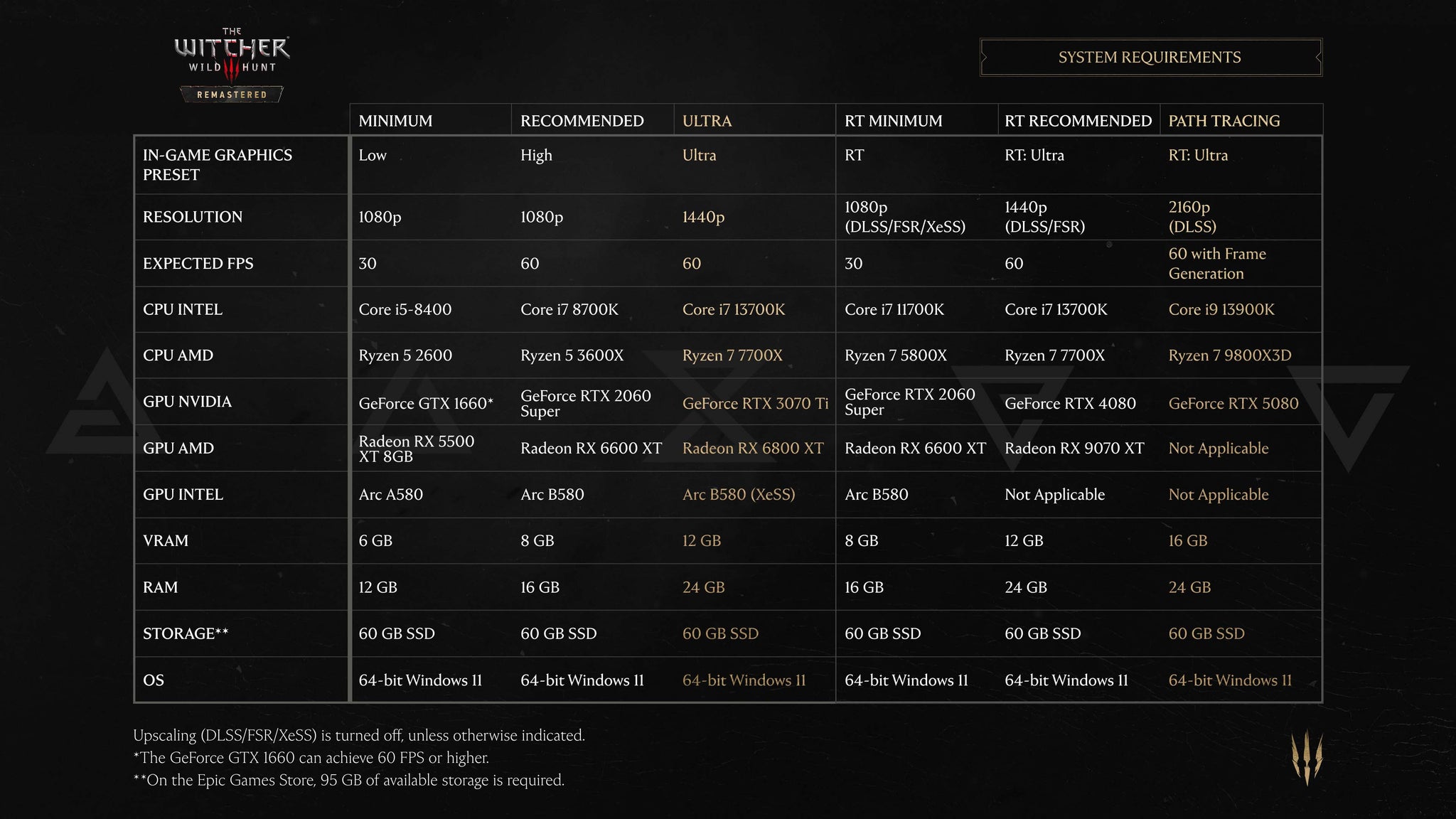
CD Projekt have released the full list of PC system requirements for The Witcher 3: Wild Hunt – Remastered, a free upgrade for the base edition of the grizzled and cantankerous fantasy action-RPG. This covers both the previously announced minimum PC specs and the recommended, ultra, ray-tracing minimum, ray-tracing recommended, and path tracing configurations.

The Remastered edition itself launches tomorrow, Tuesday 29th September, so if you’re reading this on a Casio desktop organiser from the 90s, there’s just enough time to rush out and spring for a $2000+ mega-PC so that you can subject Geralt’s pitifully scarred mug to a bombardment of faithfully modelled pseudo-photons. Here’s a table with all the settings dissected in full.


A table of minimum and recommended PC system requirements for The Witcher 3: Wild Hunt - Remastered.
Image credit: CD Projekt

The table comes from this blog post, in which CD Projekt go into slightly more detail about how they benchmarked the thing. “The expected FPS targets in the table above are based on our QA tests,” they caution. “Occasional frame rate fluctuations may occur depending on the scene and gameplay.”

The devs also talk a bit about the new SSD requirement and the ending of support for Windows 10. “That doesn’t mean that the game will stop running on Windows 10 with the next game update,” they note. “However, we no longer develop or test on this system, so we cannot guarantee compatibility or performance going forward. Additionally, we only support components that continue to receive official updates from their manufacturers.”

James was reasonably impressed by The Witcher 3: Wild Hunt – Remastered when he saw both it and the forthcoming Songs of the Past expansion at Gamescom, calling attention to some slicker combat animations and camerawork. You can read more about the visual flourishes, together with various tweaks for the enemy AI, ledge climbing, the Photo mode and more besides, in CD Projekt’s latest changelog.

All that notwithstanding, I’ve read some mixed reactions among returning players to side-by-side visual comparisons. The more obvious reason to take issue is that you can’t afford a hardware upgrade. If you’re among those who’d rather steer clear, it may cool your jets to read that “depending on your platform, it is possible to revert to an earlier version of the game (1.32, listed as Classic),” as CD Projekt explain. “Upon the release of The Witcher 3: Wild Hunt – Remastered, it will be also possible to revert to the 4.04 version.” For context, the 4.04 version is the previous “next gen” remaster update, initially released in 2022.

Our resident Witcherphile Mark is possibly even less sure about the Songs of the Past expansion, which will launch in 2027, paving the way for The Witcher 4 in 2028. He feels The Witcher 3 already has a perfect ending in the Blood and Wine expansion.

Brand New Day’ May Be Re-Released With New Footage


Spider-Man is about to pull an Avengers. Fresh off the wildly successful re-release of Avengers: Endgame, word is that Sony is preparing to do a similar re-release of its record-breaking film, Spider-Man: Brand New Day. And, like Endgame, the re-release will include new footage to entice fans back to the theater, such as, potentially, Rosario Dawson’s deleted scenes as Claire Temple.

The news comes from Deadline, and though there is no release date yet for the film, there is plenty of precedent. For example, back in 2022, Sony re-released Spider-Man: No Way Home as the “More Fun Stuff Edition,” which added 11 minutes to the film. That hit theaters about eight months after No Way Home first came out, so we’d imagine the wait for the new version of Brand New Day could be similar. And, if so, that would put the re-release directly between this December’s release of Avengers: Doomsday and next December’s release of Avengers: Secret Wars. Could Tom Holland, maybe, film a little extra tease for fans? Could Sony grab some footage from the Russo brothers?

There’s also the box office angle. Spider-Man: Brand New Day recently became the highest-grossing film in domestic history, passing the previous record held by Star Wars: The Force Awakens. Even the Endgame re-release probably won’t challenge that, but it could. Plus, as of publication, Brand New Day is only about $50 million from becoming the first film in history to ever gross $1 billion in the U.S. alone. A re-release would go a long way toward that.

Deadline’s piece only mentions the Dawson scenes (which she detailed in recent interviews) as likely additions, though there could be “more surprises as well.” If the film does come out between Avengers: Doomsday and Avengers: Secret Wars, that sure seems like a thread they could pull at. Maybe Spider-Man gets “collected” by Doctor Doom, or we see the other Peters?

We’ll let you know when there’s more information available on this, but for now, feel free to speculate wildly about what you’d like to see added below.

Want more io9 news? Check out the best movies and TV shows to stream this month and all the upcoming sci-fi, fantasy, and horror books that should be on your radar.