Apple CEO John Ternus did an interview with Canal+ talk show Clique following Apple’s September event. He discussed the iPhone Duo‘s design, difficulties Apple ran into when developing it, his plans for Apple, and more.
On the design of the iPhone Duo, Ternus explained why Apple went with an iPad-like shape when the device is unfolded.
I think it’s something new and unique, right? But I think we didn’t want to just do what we’d seen other people do, which is sort of take two phone shapes and stick them together and then you get this weird square thing. We came at it from we want to build a large screen experience that feels right to us. And obviously we’ve been doing that for a long time with iPad. And so we knew kind of the shape, you know, we came up with this new aspect ratio.
Ternus said that when developing the iPhone Duo, there were “so many problems” to solve, but a foldable was an opportunity for Apple employees to “be really clever” and “come up with entirely new things.” He said some of the hardware engineering problems Apple had to address involved the design of the hinge and the display, and making them reliable.
When asked to share his favorite iPhone Duo trick, Ternus showed off the device’s opening animation. “I mean, this is really fun, you know, the animation that you get as you open it across from one side to the other. It’s just sort of whimsical and fun. And it brings a smile to your face.”
Ternus reiterated Apple’s stance on AI companions, saying that Siri AI is “not designed to be your friend,” which is something we heard earlier this year from Craig Federighi. Ternus said Apple doesn’t want to replace human relationships. “They’re how we learn, they’re how we grow, they’re how we find joy and happiness,” he said.
Then-CEO Tim Cook and Apple’s board asked Ternus if he wanted to be the next Apple CEO. Ternus didn’t say when he was approached, but he said the question came as a surprise. “When Tim asked me if it was something I would consider, I would say the good news is I was sitting down, because I never in a million years would have imagined that happening,” said Ternus.
As Apple’s CEO, Ternus said he doesn’t have plans for a radical change. He was asked if Apple was going back to its roots under his leadership, with more of a focus on engineering products.
I don’t think anything’s really changed. Sure, I’m new in this job, but the focus on innovation, the focus on products, the focus most importantly on our customers, that has never changed. That’s been here from the beginning.
I am super passionate about products. I love building things. That’s why I’ve been here so long. That’s why I love what I do. And so I’m excited to continue doing that. But I don’t think of it as some radical change.
Ternus said it was “amazing” to be able to say “one more thing” on stage at Apple’s September event. “I’ve seen Steve say it, and I’ve seen Tim say it,” he said. “And so having the opportunity for me to say it was pretty magical. Kind of goosebumps.”
The full interview includes Ternus’ thoughts on Tim Cook, the AI race, Apple’s environmental goals, the Vision Pro, the new parental controls added in iOS 27, and more.
Fire Emblem: Fortune’s Weave‘s deadline for getting new characters on your side might loom ominously on the horizon, but the game is more flexible than it lets on. There are a few points of no return, but only one of them is irreversible: the one at the start of Act 3. The game doesn’t outright tell you that there’s no going back, though it does ask you to be quite sure you want to proceed before moving on. There’s a good reason for that. The second deadline is inflexible, and there’s no going back afterward.
Below, we break down when you won’t be able to backtrack and the cutoff for recruiting new characters in Fire Emblem: Fortune’s Weave
When is the point of no return and recruitment cutoff in Fire Emblem: Fortune’s Weave?
Image: Intelligent Systems/Nintendo via Polygon
The first deadline you’ll encounter is November 27. This is when each Flame Lord’s first part ends, and you have until the moment you start the final quest that day to recruit other characters. However, it’s not a firm deadline like in Three Houses. After you clear that act, you can go back and replay any chapter in it. Replaying is helpful for recruiting other characters, training them differently, or completing paralogues, and there’s no limit on how many times you can replay a chapter.
There is a catch, though. For the changes you make in your Act 1 replay to show up in later acts, you have to complete the rest of that Act 1 again. It’s a bit tedious. If your goal is recruiting a character you missed, and you’re going to play a second (or third or fourth) route anyway, we don’t recommend replaying a chapter just to recruit someone. Instead, pick them up on whoever’s route you play next.
The really big, irreversible deadline is the start of Act 3. When you approach the Door of Destiny and try to go through it whether you’ve completed or skipped the War Arc, the game shows you which Flame Lords will accompany your avatar character. This is the last chance you have to go back and recruit more Flame Lords or any other character, either by completing paralogues or clearing someone else’s Act 1. You can bring Dietrich, Theodora, Leda, and Cai to Act 3 by completing their respective paralogues if you don’t want to do their full acts, though they will show up as guest characters. That means you have no control over their classes and inventory. For other characters, if you don’t recruit them, they don’t show up in Act 3.
You can leave Act 3 and merge character data from different paths, but that does not mean you can recruit new characters. Merging only works if you recruited the same character on different paths. Then, you spend Karma Shards (the same currency you use for Boons of Salvation) to merge their stats from different paths and get an even more powerful version of that character.
Mobile proxies route requests through real carrier IP addresses rather than data centers or home routers. This fact determines the position of mobile proxies in the market. Datacenter IP addresses face bulk fingerprinting and blacklisting, while residential IP addresses are increasingly vulnerable as detection companies map ISP ASN ranges. Mobile IP addresses still pass many anti-fraud checks because mobile carriers assign addresses in a unique way. This is why mobile proxies are more expensive than the other two types of proxies.
A review of the best mobile proxy services in 2026 compares them based on factors that matter, such as price per GB or per month, pool size, supported protocols, and how rotation behaves in practice rather than on paper.
Why Mobile IPs Behave Differently from Residential or Datacenter Proxies
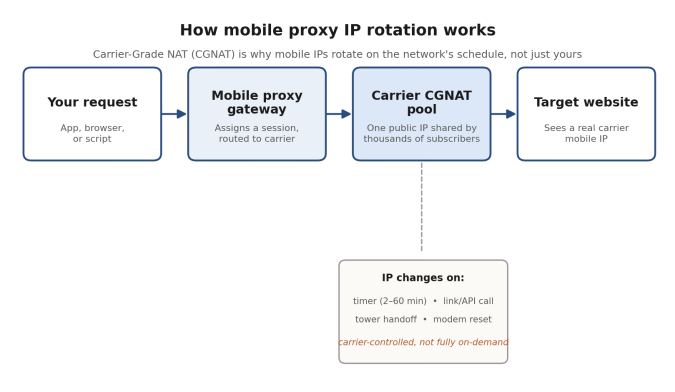
The reason mobile proxies do not get banned as easily is Carrier-Grade NAT (CGNAT). IPv4 addresses became scarce a long time ago. Mobile operators have never had enough public IP addresses for all subscribers, which is why CGNAT allows multiple mobile phones to share a single IP address.
This means that blocking one malicious party through CGNAT can also result in blocking all subscribers sharing the same address at that moment. Most anti-fraud systems are aware of this and therefore treat carrier IP ranges differently from server or fixed IP addresses.
However, there is a downside: rotation does not work the same way as it does with a datacenter proxy. When you request a new IP address from a datacenter proxy, you can usually get it instantly. With a mobile proxy, the IP change takes place only after the network connection is refreshed. This can happen because of a tower handover, a modem reboot, or a timeout.
IPRoyal warns users that “if IPs change more frequently than it is specified in the contract, it is caused by ISP’s own rotation which is beyond our control.”
Fig. 1 – Rotation on a mobile proxy is triggered by the carrier network as often as by the user.
Top mobile proxy providers in 2026, compared
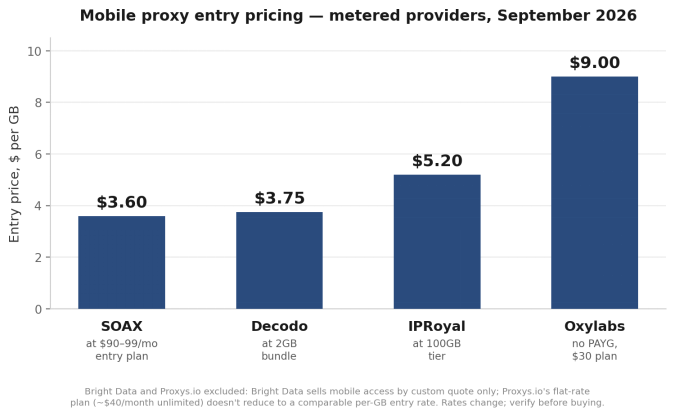
Six names cover most of the mobile proxy market by reputation and published volume: Proxys.io, Bright Data, Oxylabs, Decodo (the April 2025 rebrand of Smartproxy), IPRoyal, and SOAX. The table below lists entry pricing for six mobile proxy providers as published in September 2026; per-GB rates drop substantially at volume for every metered provider here, and proxy pricing pages change often enough that it’s worth confirming current numbers before buying.
Provider
Entry price (mobile)
Billing model
Mobile proxy coverage
Protocols
Proxys.io
~$40/mo flat, or pay-per-GB
Flat-rate (Personal tier) or metered
15 countries; ~2,000–5,000 IPs per geo+carrier
HTTP, SOCKS5
Bright Data
Custom quote only
Metered, KYC required
195 countries claimed
HTTP, HTTPS, SOCKS5
Oxylabs
$9.00/GB
Metered, plans from $30
195 countries; city/ASN/coordinate targeting
HTTP, HTTPS, SOCKS5
Decodo (Smartproxy)
$3.75/GB
Metered, bundles from $7.50
195+ locations (combined network)
HTTP, HTTPS, SOCKS5
IPRoyal
$5.20/GB (100GB tier)
Metered, or dedicated device from $130/mo
4.5M+ mobile IPs; ~6-min rotation
HTTP, HTTPS, SOCKS5
SOAX
$3.60/GB
Metered, plans from $90/mo
~8.5M IPs; city/ISP/carrier targeting
HTTP, HTTPS, SOCKS5
Fig. 2 – Entry per-GB rates among the metered providers. Bright Data and Proxys.io aren’t shown; see notes below the chart.
Fig. 2 – Entry per-GB rates among the metered providers. Bright Data and Proxys.io aren’t shown; see notes below the chart.
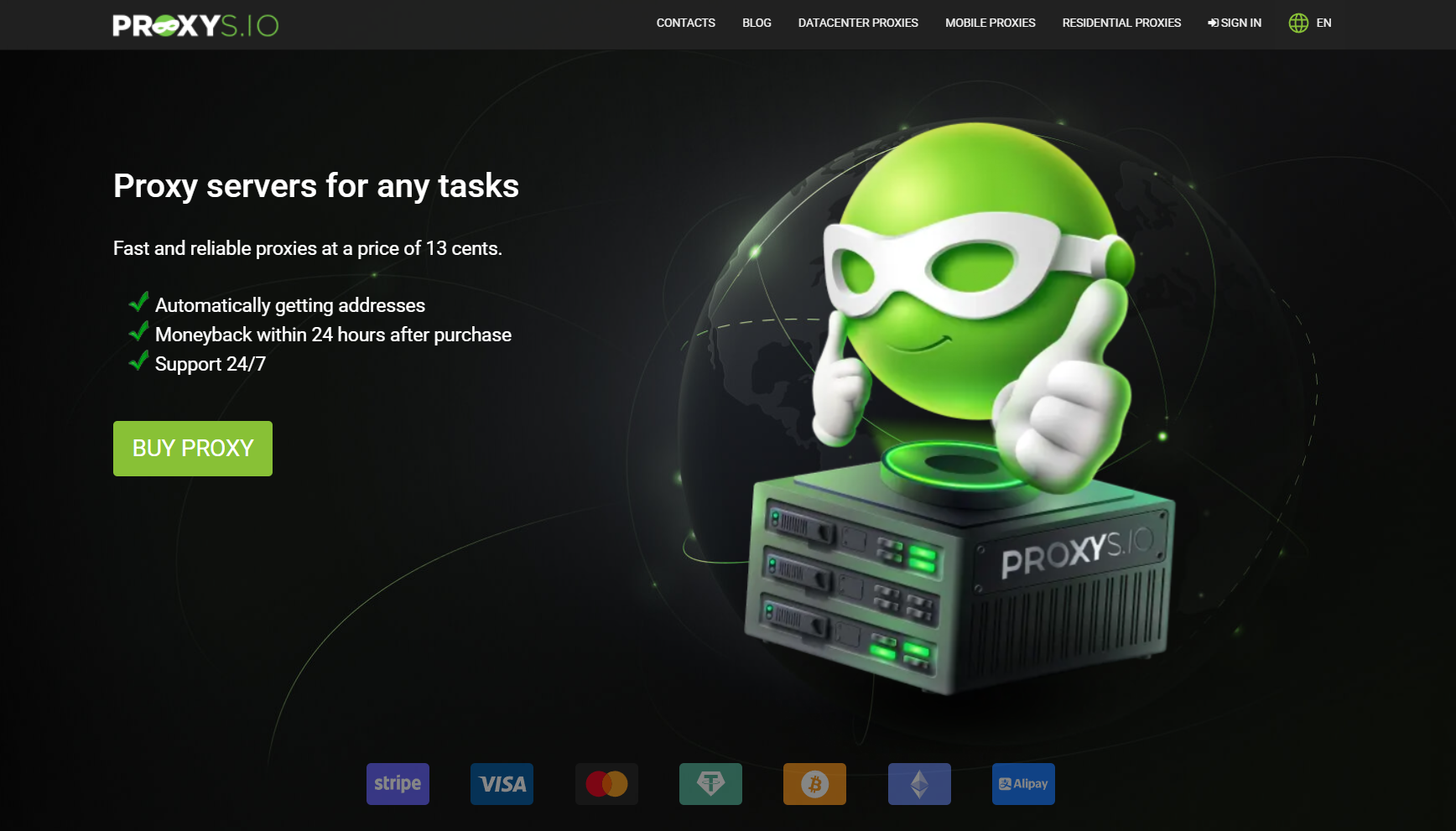
Proxys.io
Proxys.io provides four different types of its 4G mobile proxy services which are – Individual, Shared, and Premium along with one other pay-per-gigabyte option for users with unpredictable usage. The Personal option is different from the rest due to its flat fee for unlimited use. Users will have the option of having a private channel with guaranteed periods of IP rotation. However, because it will cost about $40 a month, this flat fee option is limited geographically as the countries users will have access to only include 15 markets as opposed to 195 markets provided by the competitors mentioned above. However, it is important to note that users of all tiers will be able to use either HTTP or SOCKS5 right away with no stage of set up involved.
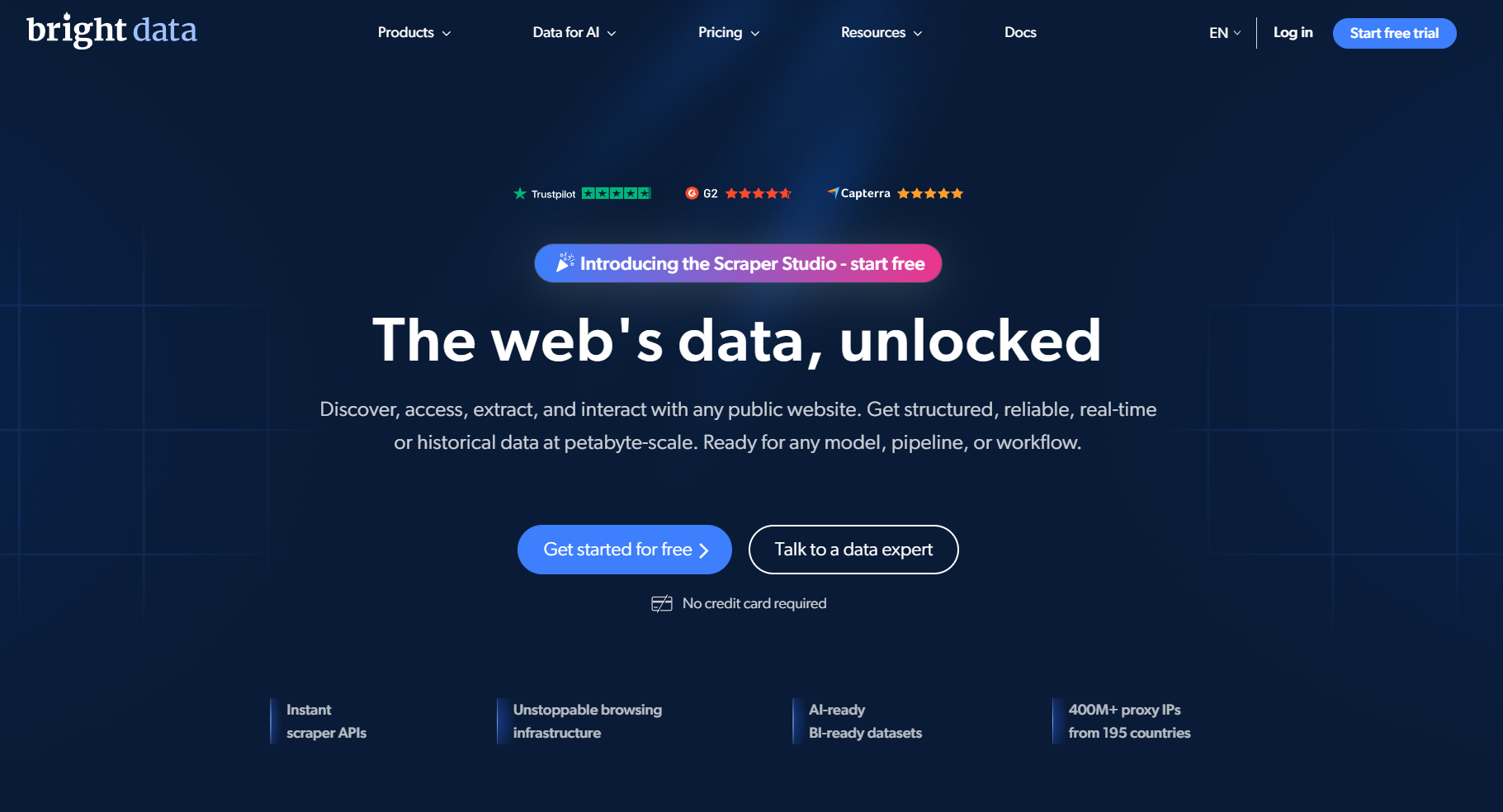
Bright Data
Bright Data is arguably one of the most well-known names in the proxy industry, yet its mobile product seems to have disappeared from the self-service pricing site. It still is mentioned as one of the four types of IP networks in its guides, but obtaining it necessitates undergoing the same Know Your Customer process as residential proxies. This step requires verification, which has varying waiting times depending on the type of account, as evidenced by several 2026 reviews. Nonetheless, the mobile prices have not been published so far. The company advertises residential proxies as being $8 per GB pay-as-you-go (which is $4 as per the current promotion) or $499-$1,999 monthly for committed plans. In the meantime, it seems that mobile proxies are subject to the same sales process as the other types of proxy instead of being available for self-checkout. This is a fair compromise for a big compliance-dependent buyer, but a long wait for a small team needing to use the card and start.
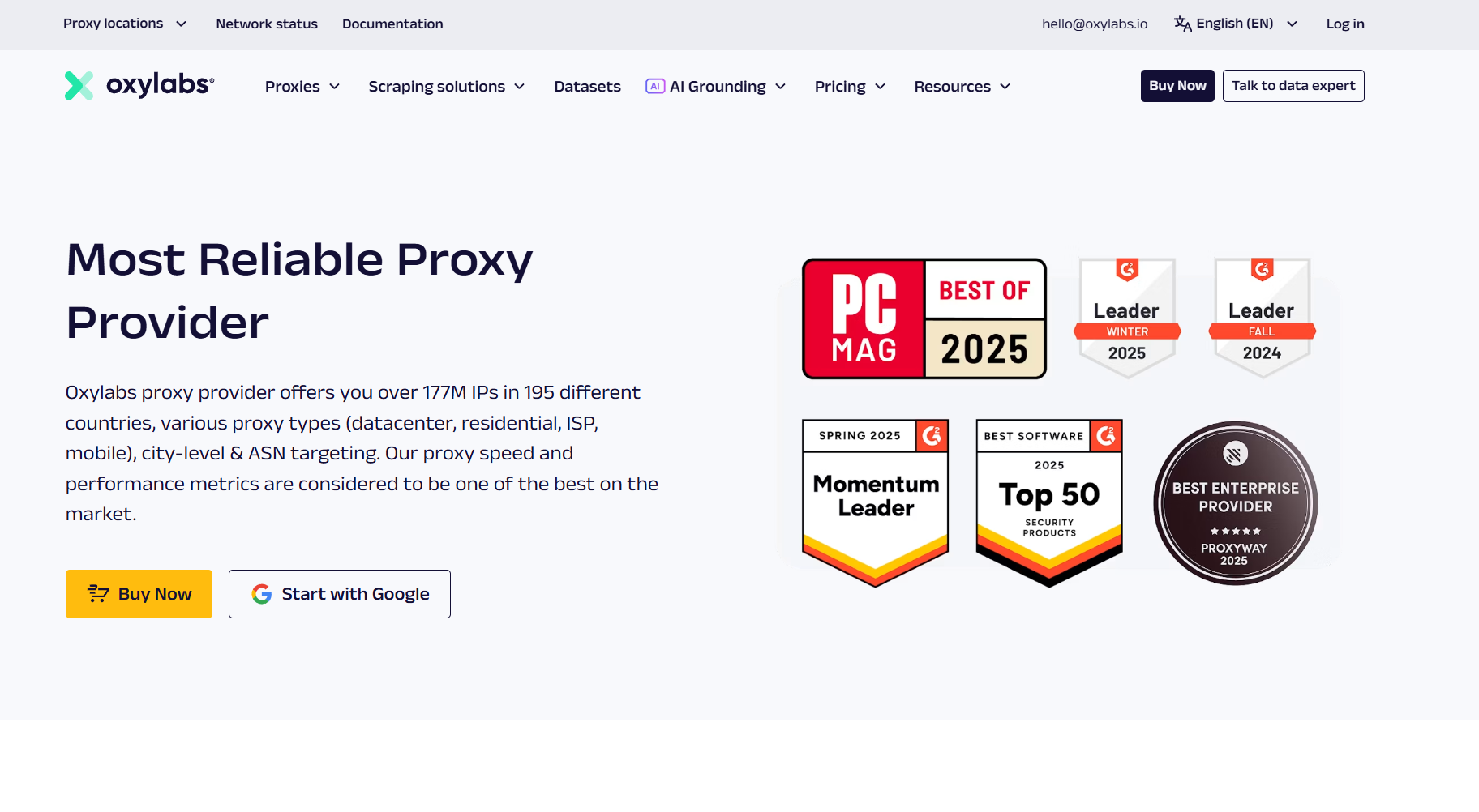
Oxylabs
At Oxylabs, the cost of mobile proxies starts at $9.00 per GB, and there is currently no pay-as-you-go model available since it was eliminated in March 2026. Thus, the available entry-tier package starts from $30. When it comes to volume levels, the price decreases to approximately $3.50-$3.90 for the highest tiers; the prices are reduced even further in case an enterprise package is negotiated. The targeting capabilities of Oxylabs allow it to reach even country, state, city, ASN, and coordinate levels, and as far as compliance goes, Oxylabs has both SOC 2 Type II and ISO 27001 certifications. One of the key considerations here is that Oxylabs has positioned itself in the market for teams which are willing to accept premium pricing and are not looking for an opportunity to test their idea at a $10 price point.
Decodo (Smartproxy)
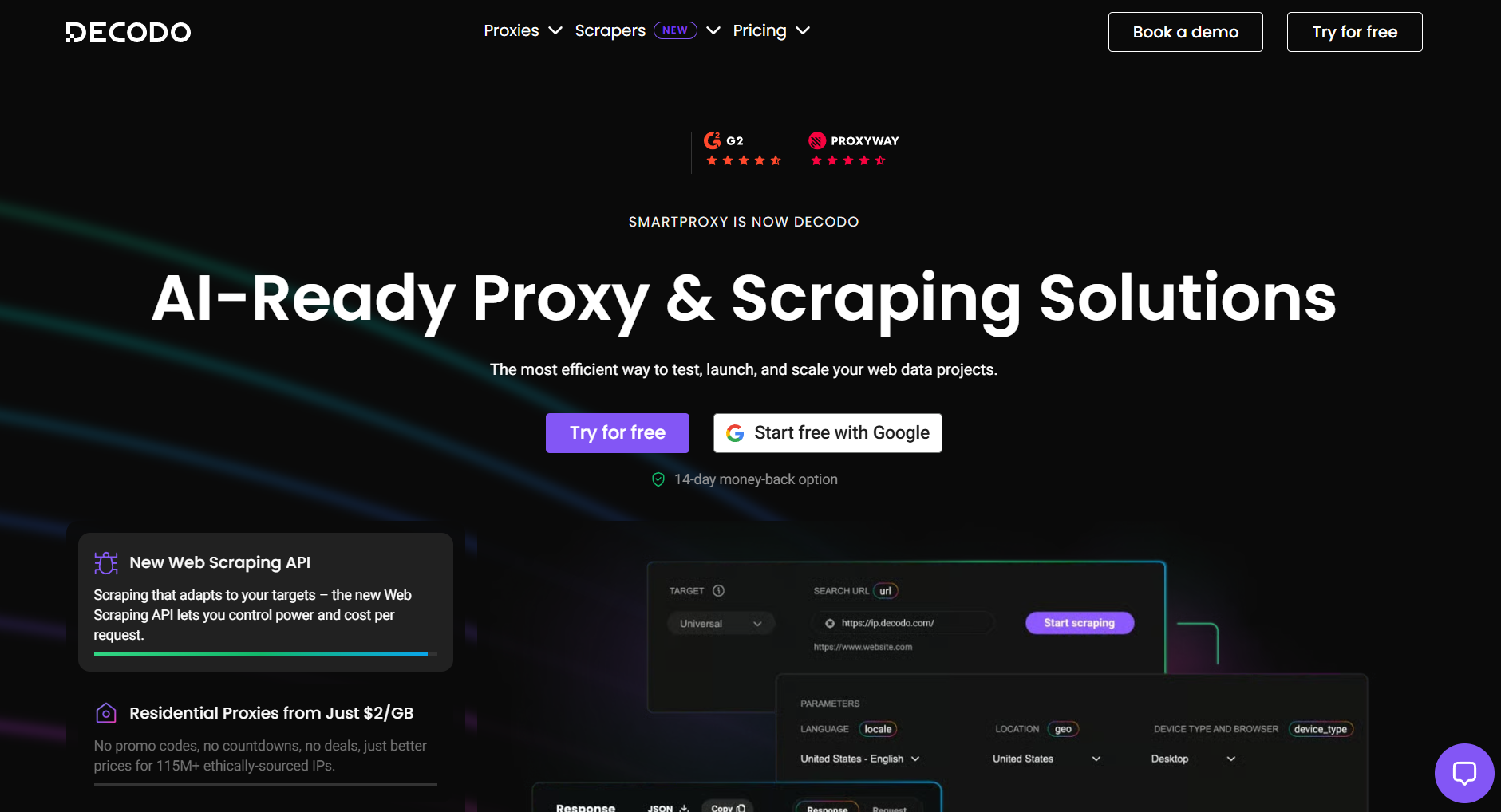
Homepage for Decodo
Following its rebranding in April 2025, Decodo (the new name of Smartproxy), continues to offer its products and services without any changes in terms of pricing with mobile proxies starting at about $3.75/GB, and going down to $2.75/GB for larger amounts of mobile proxy bandwidth. The entrance cost of the service into the market makes it the cheapest among the competitors available in this analysis but it should be noted that the network of Decodo combines both residential, datacenter, ISP, and mobile IPs totaling over 125 million rather than just mobile IPs. The small minimum purchase is ideal for the team, which is only planning on trying mobile proxy solutions first before using their budget for it.
IPRoyal
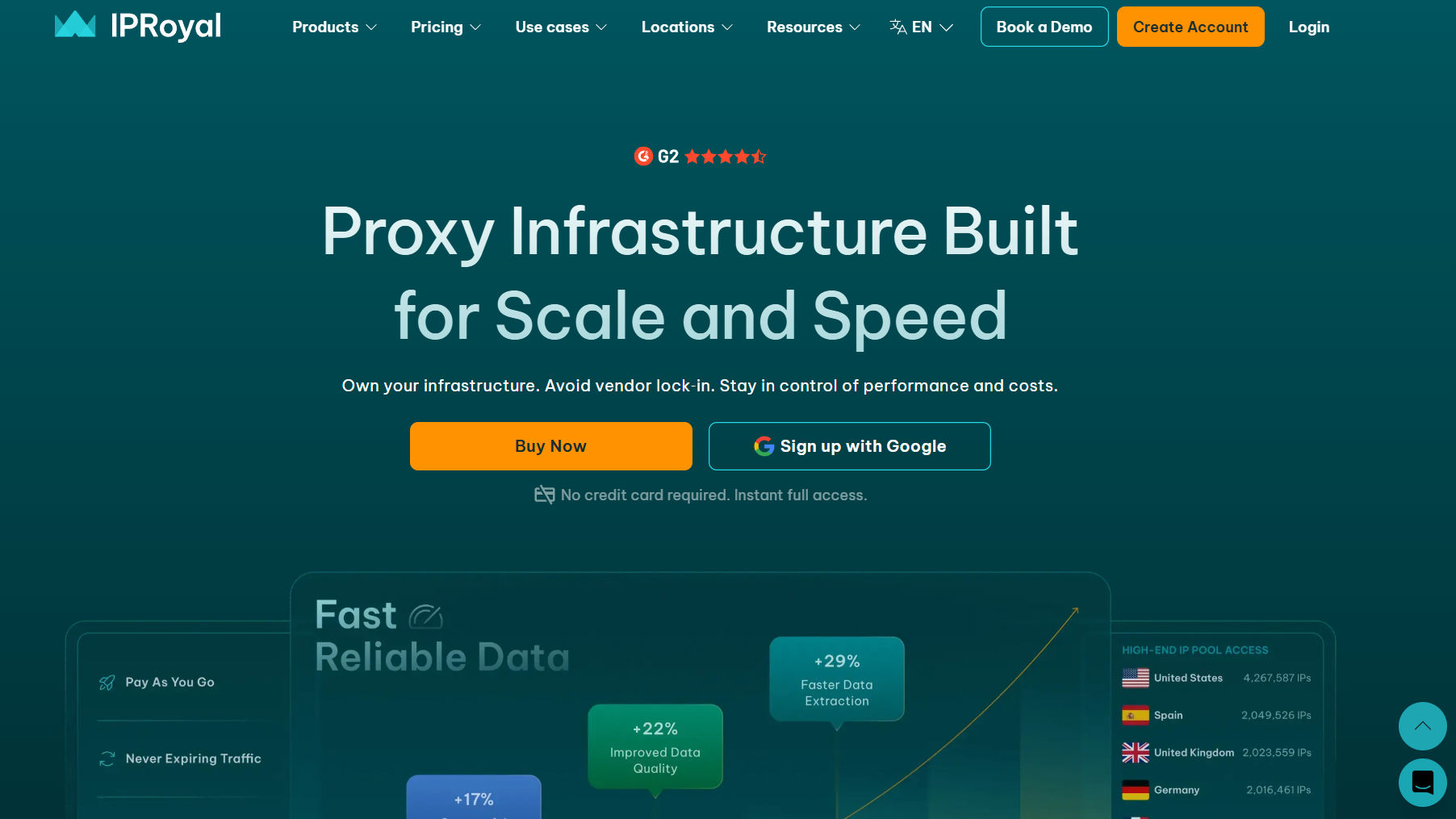
The IPRoyal system comprises over 4.5 million mobile internet connections on the network types of third-generation, fourth-generation, and fifth-generation, and its operation is designed with auto-rotation in the range of six minutes with no limitations on the amount of data transmitted or duration of use. The pricing policy is about $5.20 per 1GB of utilization volume within the plan of 100GB of bandwidth and around $130 for the package operated with only one device for 30 days. Users of IPRoyal can be assured that their bandwidth is not affected by time constraints, which is especially helpful for those with sporadic usage of communication resources. Importantly for potential users of IPRoyal system, the operator underlines one of the threats that take place in the perspective of mobile proxy users, i.e. the fact that mobile proxy providers have no control over rotation timing which is set by carriers and that is why connection might be interrupted at any moment without any notice for the user.
SOAX
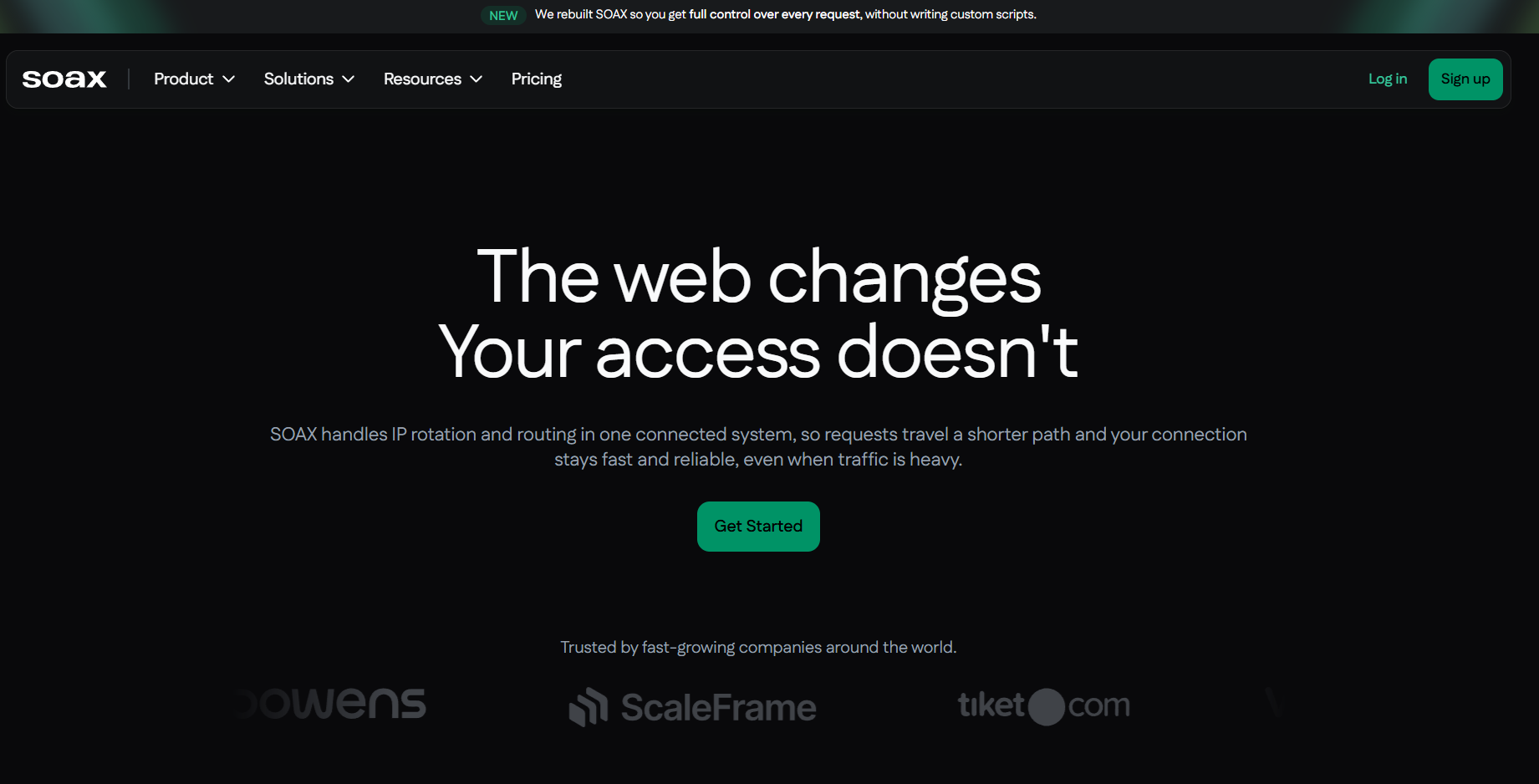
SOAX’s pricing structure for mobile proxies is similar to that of residential proxies. For example, the cost starts around $3.60 per GB and can go down to around $2 per GB, offered in plans that start at $90-99 per month. In fact, enterprise pricing can be as low as $0.32/GB for companies who use SOAX services in bulk. The unique selling proposition that SOAX has above other providers is city, ISP, and carrier-level targeting. SOAX has received very positive feedback regarding geo-targeting ability, surpassing other companies if we look at geo-targeting capability as opposed to pool size, which is currently at about 8.5 million IPs, which is significantly smaller in number when compared to other companies like Bright Data and Oxylabs. But in case your work requires targeting IPs in certain carriers or cities – SOAX does provide a great return on investment.
Where mobile proxies fall short in real-world applications
Although sales pages provide high figures on uptime and pool size, they do not provide details about the issues faced by customers six weeks after using the mobile proxies. Most of these problems fall into a few patterns that are considered common.
Symptom
Likely cause
Fix
Requests fail across a stable IP with no code changes
Carrier-side CGNAT refresh reassigned the address mid-session
Treat sessions as time-boxed; re-authenticate on failure instead of retrying the same session
Success rate drops on one specific platform only
Target site fingerprints the ASN, not just the IP, and has flagged the whole carrier range
Rotate across carriers/ASNs if the provider supports it, not just IPs within one carrier
“Unlimited” plan gets throttled after heavy daily use
Fair-use ceiling on flat-rate plans, commonly 20–30GB/day per proxy
Split volume across multiple proxies instead of running it all through one connection
Rotation happens more or less often than configured
Rotation interval is carrier-controlled at the network layer; the provider’s timer is advisory
Design retry logic around “the IP may change at any time,” not a fixed clock
Geo-targeted requests land in the wrong region
Carrier ASN pool doesn’t align with the requested city, or the provider only offers country-level targeting
Confirm city- or ASN-level targeting is actually supported before buying, not just country-level
Proxy works in testing but fails in the live pipeline
TLS/HTTP client fingerprint doesn’t match a real mobile browser, even though the IP does
Pair the mobile IP with a matching user-agent and TLS stack, not just the network layer
The row regarding ASN fingerprinting is worth revisiting, since this is one of the most commonly overlooked elements by teams. Rotating your IP address on a mobile proxy isn’t going to work if the website sees the entire carrier range rather than an individual address. A website that knows a certain ASN belonging to a mobile operator is being abused will block every IP in that ASN, regardless of whether it has been rotated. To avoid problems with ASN fingerprinting, it’s important to check with the provider before making a deal whether their infrastructure allows traffic to be sent through several ASNs in the country or whether it offers the range of a particular carrier for sale under various marketing names.
Testing Before Purchasing a Mobile Proxy
Demo stats are not going to mean anything when you want to use proxies for a different website. Prior to investing your budget in mobile proxies, it’s important to go through the following checklist:
Carry out a paid trial against the required target, not the provider’s standard testing site. A sample URL would not tell you what kind of anti-fraud rules are imposed by the required site.
Find out whether your provider offers real-time rotation through a link or API, or whether it claims that rotation is performed through a timer. Some services allow you to rotate only this way, which severely restricts the possibilities during a session.
If the stack requires it, check for SOCKS5 support. Playwright, Scrapy, and other dedicated browsers expect it, while some entry-level plans provide only HTTP.
Make sure there is a documented definition of what constitutes fair use for an “unlimited” mobile proxy plan. For example, IPRoyal claims that there is a limit of 30 GB a day per SIM before the provider starts throttling SIM usage; flat-rate competitors also usually have the same limit, even if this is not public information.
Use any WHOIS or ASN lookup tool to make sure that the IP address you have checked belongs to a mobile carrier and is not simply a fixed hosting range that has been labeled as mobile.
Flat Rate Versus Metered: Matching the Price to the Workload
There are two types of billing in the industry. Oxylabs, Decodo, IPRoyal, and SOAX bill their clients by the gigabyte, so the price reflects the cost of one GB of traffic. This makes the service inexpensive for low-use cases, whereas it can be highly expensive for high-volume workloads, such as hundreds of gigabytes per month for a heavy scraping or ad-verification project.
Proxys.io’s Personal plan takes the opposite approach. With this plan, you pay a flat rate for exclusive, unlimited channels, making it easy for teams with continuous traffic (ad-verification monitoring checks, constant checks of mobile apps, etc.) to work.
Current mobile proxy plans and country coverage are listed on Proxys.io’s mobile proxy page.Of course, the trade-off is coverage. Having only 15 countries available within the flat-rate plan is a serious restriction if you need to cover 40 countries. Consequently, you may need to select a metered plan with wider country coverage, even at a higher blended per-gigabyte cost. However, per-gigabyte billing can still be the best choice for one-off tasks such as competitive analysis or quarterly audits, since flat-fee plans will remain unused for a greater part of the month.
When to Change the Mobile Proxy Service
In most cases, there are some signs that can help you understand when it makes sense to look for a new provider.
The ban rate increases even for codes and targets that have not changed, which indicates that the problem is caused by the deterioration of the IP pool’s reputation rather than a software issue.
Technical support does not respond to tickets related to unexpected session changes for days, whereas such tickets are usually answered within hours.
An incoherent billing model means that you are paying per GB for constant traffic or paying a flat rate for occasional bursts.
Using SOCKS5 and country-based (rather than city- or ASN-based) targeting appears to be a significant limitation after the account has already been activated.
Any friction during the onboarding process, e.g., KYC verification and monthly minimum payments, turns out to be much greater than the actual volume of account usage.
For those who are going to take their first steps in setting up a mobile proxy in a browser or anantidetect tool, it is highly recommended to read the Proxys.io browser extension set up guide, which provides detailed information about creating a connection.
Make sure to adjust the payment model to the mobile proxy traffic profile before comparing different payment plans. For example, if a $3.75-per-GB plan and a $40-per-month flat-rate plan are compared, the cost will be about the same when 10–11 GB of traffic is consumed daily.
“You guys should understand that we pulled off the biggest supplychain [sic] maybe ever recorded in modern history,” one TeamPCP member wrote in the leaked chats.
Michael Fletcher, a former AFP analyst who now works in the threat research division of an Australian telecom firm, says he approached Larsen around that time about methods for monitoring the group’s members and activities. He says that Larsen responded by asking Fletcher to approach the hackers with caution because one of them was a “friendly,” Fletcher remembers. “I thought, damn, you all have been inside this early,” he says.
Google’s undercover analyst, Larsen says, gained access to a server where TeamPCP was storing its trove of credentials stolen from its many victims: the usernames, passwords, and access tokens it had obtained through its hacking and seemingly planned to use to extort target companies. So Google’s team decided to take action to warn victims and prevent TeamPCP’s ransom scheme. “My thought was: How can we, as quickly as possible, disrupt their campaign before more compromises can happen?” Larsen says. “Let’s go mess up what they’re doing. That was my goal.”
Rather than focus on alerting the owners of the stolen credentials at victim companies directly, which Larsen says would have taken too long given the sheer number of breached companies, Google first reached out to providers where those credentials could be used, like Amazon Web Services and Microsoft, to have the credentials revoked and prevent the hackers from exploiting them. Larsen and his team sent out hundreds of notification emails to those providers and then to victims, many of which got immediate responses.
Around the same time, Larsen says, Google’s visibility into the TeamPCP internal chat also allowed it to learn that someone within the group’s core circle was, distinct from the group’s supply-chain hacking, using an AI tool to develop a zero-day exploit in a widely used piece of login software that would allow the hackers to bypass its two-factor authentication. Google’s team got a copy of the exploit code, tested it out, and found that, with a few tweaks, it worked—a rare instance of an in-the-wild AI-created hacking technique that took advantage of a previously unknown software vulnerability. Google warned the software’s developer, who was able to patch its security flaw. (The incident was described in a case study Google released in May, but without naming TeamPCP or detailing how Google learned about the exploit.)
A new reality materializes. You find yourself on a solitary island, floating on a sea of liquid void and starlight, ringed by impassable mountains. This world is a mysterious place, yet strangely familiar. The Walking Dead: Streets of Survival
Welcome to Nightwater, where you must master a new reality. Transform raw resources from simple sticks and stones into an industrial factory. Progress your technology through the ages, from primitive tools to modern machines and beyond. Expand the island by manifesting new biomes into existence to harvest their unique resources. Master multiple minigames to unlock powerful buildings and receive strong buffs.
All your efforts serve a single purpose: to reach the Lighthouse and uncover its secrets. Nightwater is a game about gathering, collecting, and managing resources. There are multiple unique biomes, each with its own resources and secrets to unveil. Every resource features its own progression: gather by hand or automate with machines to hit each resource’s milestone goals and unlock new buildings, crafts, and powerful buffs. Explore every biome to discover 20+ resources and gain access to 100+ buildings, crafts, and buffs.
It’s fun to gather resources yourself, but it’s even more fun to build machines that do the work for you! Choose from 60+ buildings to construct farmers, assemblers, and storage units, link them with pipes, and automate every part of your production chain. You can build as many machines as you want and move or deconstruct them at any time without losing items. Automate all resources and their crafts, and unlock powerful late game buildings to make your factories faster, more efficient, and even bigger!
Screenshots
SystemRequirements
Minimum Requires a 64-bit processor and operating system
OS: Windows 10 or later (64-Bit)
Processor: i5-3570 3.4 GHz 4 Core
Memory: 8 GB RAM
Graphics: Nvidia GTX 1650/GTX 1050-ti, or AMD RX 470/RX 570, or equivalent performance & VRAM
Storage: 10 GB available space
Support the game developers by purchasing the game on Steam
InstallationGuide
TurnOff Your Antivirus Before Installing Any Game
1 :: Download Game 2 :: Extract Game 3 :: Launch The Game 4 :: Have Fun 🙂
Having launched though the same system of reservations and waitlists as the Steam Machine, the Steam Frame is still navigating that inscrutable void betixt “on sale” and “actually out.” Nevertheless, it’s had its first software update, SteamOS 0.3.0, which brings – among other technical tidbits – a microphone bug fix, smoother controller tracking, and “substantially faster” charging to the VR headset. Yeah, nice one Valve. Would have been useful to have that last one when reviewing the thing on a deadline but whatever.
Gmail now shows a Copy Code button when an OTP or verification code arrives directly in your email inbox.
The shortcut can appear inside the email and directly in the main Gmail inbox alongside the message preview.
Google’s new verification code shortcut is rolling out through the Gmail app on both Android and iOS.
Gmail now offers an easier way to copy verification codes directly from the app.
Android already makes it pretty easy to copy OTPs and verification codes when they arrive through the Messages app. But now, Google is bringing similar functionality to verification codes that land directly in your Gmail inbox.
The company is rolling out a new integration for the Gmail app on both Android and iOS that adds a small Copy Code shortcut whenever an OTP or verification code arrives.
Now, when an OTP lands in your inbox, Gmail shows a small card at the top of the email (below the subject line) containing the verification code alongside a Copy Code button. You can simply tap the button and paste the code wherever you need it, instead of manually typing it out or selecting and copying it from the email.
(Image credit: Future)
In addition to showing the shortcut inside the email, Gmail has also started displaying the Copy Code button directly in the main inbox alongside the email preview. That implementation doesn’t seem to work every time just yet, but I’ve found the shortcut inside emails containing verification codes to appear much more consistently.
The feature has already started rolling out with the latest Gmail update on both Android and iOS. If you don’t see it yet, it’s worth updating the Gmail app to the latest available version.
Unlike the Messages app, though, Gmail’s implementation doesn’t directly integrate with Gboard for now, so you’ll still need to open Gmail and manually copy the code. Nonetheless, it’s a useful little upgrade that makes dealing with verification codes arriving through email much quicker.
Get the latest news from Android Central, your trusted companion in the world of Android
What is it? A single-player psychological horror game which takes place on an isolated Scottish island. The protagonist Simon Ordell has to solve puzzles, fight monsters, and figure out what the hell is going on. Release date September 24, 2026 Expect to pay $50 / £45 Developer Screen Burn Publisher Konami Reviewed on RTX 3070, Core AMD Ryzen 5 5600G, 16GB RAM Multiplayer No Steam Deck Unknown Link Steam
Walking up to the old town of St Amelia for the first time in Silent Hill: Townfall, I was greeted by that familiar thick fog and eerie quiet—an omen of the horrors to come. I know what kind of monsters are waiting for me beyond the fog and I am painfully aware of just how unprepared I am for it—with no flashlight, healing items, or weapon on hand. But weirdly enough none of that matters, because for the first time in a Silent Hill game I feel content.
St Amelia is a fictional town, but as I’m sure many players based in the UK will soon discover, developer Screen Burn breathes so much life into this sleepy fishing village that I could’ve sworn I’d been here before. It’s certainly a strange feeling to have in a game like this, but with Konami opening Silent Hill up to the world it’s now the UK’s turn to have our sense of home toyed with.
Here to suffer
(Image credit: Konami)
The story follows Simon Ordell, a man unknown to us and himself. The only sense of person he has comes from a medical bracelet with his name, date of birth, and blood type written on it. I watched as he dragged himself up from the waves of the North Sea, onto the docks, and headed into St Amelia seeking help and answers as to why he’s here on this cold foggy island.
Latest Videos FromPC Gamer
A Silent Hill game is nothing without its setting and St Amelia delivers. I spent more time than I’d care to admit reading info boards about the history of fishing on the island and peeping over fences to see how the locals had done up their gardens. The more I explored, the better sense I got of the kind of people who lived in this town and what had happened to them.
Simon also sees more than just the old town as he ventures to a hospital, a corporate office, your classic Silent Hill supernatural ‘other place’, and, brace yourself, some new builds. My time in St Amelia flew by rather quickly, with just 13 hours spent in total, but that was more than enough to be rewarded with heaps of brilliant visual storytelling and the usual gift of stressful encounters.
Image 1 of 3
(Image credit: Konami)
(Image credit: Konami)
(Image credit: Konami)
St Amelia has its fair share of gut-wrenching horrors lurking around each corner, though—you don’t spend a grand total of 35 minutes and five seconds hiding in lockers unless there’s something pretty bad waiting for you on the other side. But even still, I found myself drawn to exploring the fog because my curiosity outweighed my fear.
But the further I progressed the less content I became. Not because there were more faceless and bound monsters stumbling around (although that didn’t help), but because there was more to the island than St Amelia’s historic old town. There was a side that was painfully familiar—cobblestone streets shifted into tarmac roads and cottages were turned into flats for better efficiency. The island changed as Simon moved away from the heart of St Amelia and towards the parasite which had latched onto it.
Keep up to date with the most important stories and the best deals, as picked by the PC Gamer team.
The town itself felt alive more than just lived in, and if that doesn’t tick all the boxes for a world-class Silent Hill setting, I don’t know what does.
Try to B positive
(Image credit: Konami)
A good rule of thumb in Silent Hill is to approach its puzzles with lateral thinking, and Townfall is no different. They start fairly easy, coaching you in the art of taking in absolutely everything from your surroundings, digesting it, and then stitching together an answer from what has been gathered. It’s the classic case of finding the combination to a lock by sifting through letters conveniently left scattered around the near vicinity.
But as I spent more time in St Amelia, my brain gradually got the hang of looking at things from a Silent Hill perspective. And although the puzzles got harder it didn’t feel like a noticeable difference. Hell, the first thing I thought when stumbling across a bunch of blood types scribbled across the wall was “This is a puzzle and it wants me to figure out how to create blood type A+”. If it weren’t for the 7+ hours I’d already spent in Townfall I doubt that would have been my default response.
There were a few exceptions towards the very end of the game, however, I think a fresh brain would have had far less issues. Take the dreaded pipe room for example, where I had to use what looked to be morse code to twist a room full of levers in the right direction. After bashing my head against my desk my synapses sparked, a thought was formed, and I figured it out—I wish you all the best of luck with that one.
(Image credit: Konami)
The puzzles aren’t the only smart design features in Townfall, though, with the best and brightest being the handheld CRTV. This quickly became my closest companion as it allowed me to see the creepies through any wall or obstacle. It may seem like a bit of a cheat code getting to know where the monsters are but there are some limitations.
The CRTV may be the most creative, fun, and useful puzzle solving tool I’ve ever had the pleasure of playing with.
It’s not always crystal clear where the monsters were, sometimes the CRTV could be a smidge off or it wouldn’t relay that a monster is actually further away than it first seemed. It also can’t show multiple enemies on one frequency, which means I had to toggle between several to see all the monsters that were close.
I wouldn’t say I’m much of a pacifist but I opted to forgo the planks of wood, pipes, and firearms for most of the game, instead favouring the CRTV as my weapon against the monsters to help me stealth around them. I played on the normal difficulty and I didn’t have a run in with a monster until quite far into the latter stages of the game. They’re not blind, I was just able to move around them with some ease if I used the CRTV correctly and was cautiously optimistic about how fast Simon could run.
Even with all its finicky buttons the CRTV may be the most creative, fun, and useful puzzle solving tool I’ve ever had the pleasure of playing with. It turned navigating Townfall into one big scary puzzle, which is exactly what I look for in Silent Hill.
You can’t change
(Image credit: Konami)
But all of these amazing puzzles and fantastic world building would be for nought if Townfall hadn’t also been able to pull off the kind of beautiful and psychologically jarring storytelling we’ve come to expect from the Silent Hill series.
But the fact that there’s something off about Simon isn’t what interests me—the fun part is finding out what he did.
To say there’s something wrong with Simon would be to state the obvious. We’re in a Silent Hill game after all, and no one in their sound mind would hallucinate grotesque faceless monsters which shoot needles out from their abdomens. But the fact that there’s something off about Simon isn’t what interests me—the fun part is finding out what he did to end up like this. It’s clear that people in the town are angry, that some awful disaster happened on this island which rocked its community to its core. What’s unclear, however, is why it involves some seemingly random American dude with induced amnesia.
But Simon’s not on his own. There are two other characters who also inhabit this liminal space with him—Zoe and Richard. At first I just thought these to be your typical filler characters but as it turns out these two are perhaps the most interesting characters to have ever fallen into the fog.
Zoe and Richard portray different sides of the same disaster that Simon’s caught in the middle of, with one being wrongfully guilty and the other willfully ignorant. Both have their own playable segments within the game in which their characters are explored in depth alongside the roles they played in the catastrophe, and through this I began to piece together Simon’s story.
(Image credit: Konami)
My favourite sequence in all of Townfall was actually Zoe’s part. In this she relives the aftermath of the disaster as a nurse and a first responder to the victims as she tries to save the life of an unknown patient.
I am not a trained nurse so taking the patient’s readings, running tests, and ultimately medicating them was probably one of the more stressful experiences I’ve had in a horror game. But it was worth it because through the stress I understood her guilt and trauma with painful clarity. It also made it clear why she’s found herself wrapped up in this mess.
Then there’s Richard who is an opposite to Zoe in every sense of the word. He’s not blameless or caring; he’s an asshole. But boy, is he an interesting character study. I won’t go into too much detail concerning Richard as his story is one that is better experienced firsthand. But, like with Zoe, after playing through his sequence it became clear to me what this game’s curse is. While the answer seemed simple at first examining the curse through the lens of three different characters adds enough diversity for an incredibly rewarding story and analysis of its characters.
Image 1 of 1
(Image credit: Konami)
My only issue with Townfall was that I didn’t get to spend more time with Zoe and Richard, because in comparison Simon is just a little boring. His role as a blank template for players to print themselves onto worked wonders for immersion but ultimately his character suffered for it. I found myself drawn more to Zoe and Richard, two characters who had more invested in this community from the get go.
That’s not to say I dislike Simon. He’s a fantastic character who comes into his own during the latter stages of the story and is someone who will grow on me the more time I spend mulling Townfall over.
After all was said and done and I’d finally reached the end of Townfall’s brilliant story, my overwhelming feeling was one of relief. Like Silent Hill f before it, Townfall had some monumental expectations to live up to and the unenviable task of proving that yet again the mystique of Silent Hill is not limited to one mountainous town. But it’s now clear that Screen Burn absolutely understands what makes a great Silent Hill game and the series is better off for it.
The design of an industrial building is supposed to be defined first and foremost by its intended purposes. You start designing with the notions of what the building is for, who will be using it, and how it will be used. As you become more familiar with the basics, you’ll also learn about the specific industrial operation the building facilitates and therefore how to put together the right design for it. Take, for example, the design of a logistics building or a warehouse. In order to make an effective design optimized for all sorts of activities associated with warehousing, you need to be aware of the systems that support the activities, the type of goods that move through the space, and the workflow. This knowledge is pivotal to understanding the building’s operational logic and to the way you craft its design and layout.
A warehouse might not be the most complex building in the bigger scheme of supply management – the manufacturing facility takes the throne. Even if it’s not as elaborate and sophisticated, designing a logistics building isn’t the simplest of tasks either. You must take into account such crucial factors as safety, operational efficiency, environmental impacts, and future growth, to name a few. To improve the chances of coming up with a refined design that brings about all those good things, architects and engineers are turning to CGI visualization with 3D modeling and rendering, often using a combination of Building Information Modeling (BIM) services and Warehouse Management Systems (WMS) services integrated into the design process.
Cad Crowd is a massive freelancer hub filled with thousands upon thousands of AEC (Architecture, Engineering, and Construction) experts from all around the world. It’s where you can assemble an all-star multidisciplinary team to handle even the most challenging warehouse construction project, whether live-environment upgrades, expansion, or new builds. We connect you with the most talented architects, engineers, and designers to craft the perfect plan for efficient warehouse design through 3D visualization.
The biggest advantage of CGI for warehouse design work is the ability to create a realistic visual representation of the structure before construction begins. Photorealism enables stakeholders to review the proposed plan in a much more effective manner, because they actually see what the design looks like in 3D, as opposed to a flat technical drawing. Even if the stakeholders have never seen an architectural plan before, they should be able to get a good grasp of the warehouse layout from the 3D rendering. This, in turn, encourages them to provide constructive feedback and make informed decisions.
Within the context of a construction project, a 3D rendering services isn’t just a visual treatment to please the eyes. For the rendering to be of any practical use, it has to be an accurate representation of the design. Building a warehouse is a high-stakes project where construction precision, clever budgeting, tight scheduling, and team coordination are unnegotiable. You don’t want to take any chances. There’s just too much to lose for even a little bit of sloppiness in planning. The only correct way to handle a project of such scale is to bring on board the truly qualified professionals, specializing in the design and construction of industrial buildings, with a proven track record to boot.
A conventional blueprint can be confusing. Unless you’re trained as an architect, engineer, or draftsperson, the flat-style drawing seems too daunting to understand. 3D rendering offers a much friendlier perspective (quite literally) on an architectural plan. A three-dimensional model appears more natural to the human eye, giving you a better understanding of the spatial relationship between objects. You can view the model from all angles to take a close look at the details, assess feasibility, compare options, and ultimately make the right design decisions. Problems such as inaccuracy or incompatibility are more easily identified using clash detection software to minimize chances of costly rework. In essence, 3D rendering for warehouse construction helps remove guesswork and gets the design 100% correct before construction.
The actual 3D modeling and rendering tasks are pretty much the same for any structure. In a 3D visualization workflow, we create the 3D assets of said structure (exterior, interior, equipment, etc.) to represent real-world objects, arrange them in their correct positions, and render the final model into a photorealistic visualization services. The journey to get there, however, is entirely dependent on the type and function of the building in question. In the case of a warehouse design visualization, here’s a glimpse of what the professionals at Cad Crowd typically do.
Warehouse mapping
The main idea behind creating a digital map of a warehouse is to gain a clear overview of the flow of operations in the building. For example, the finished goods inventory doesn’t just exist; the goods have to come from somewhere and get distributed to a specific location inside the warehouse in a well-organized manner. Mapping tells you how the journey takes place. It draws the relations between different locations in terms of distance, routes, and the equipment involved in the distribution.
3D visualization design services of a warehouse captures not only the physical structure where this operation is run, but also the movement logic. And there can be a lot of different operations to be mapped. At the end of this process, you should get a detailed layout (in 3D) along with the path model. The visualization tells you all that exists in the warehouse and how everything moves and affects each other, hence spatial understanding. A properly done warehouse mapping contains at least the following information.
The amount of available space in the warehouse
Obviously, not every square foot of a warehouse will be used for storing goods. You’ll need a lot of empty spaces for the staging area, the pathways for vehicle traffic, access in between the aisles, and so forth. The important thing is that even the unpopulated areas are supposed to serve specific functions. Warehouse mapping also tells you the shape of the building and locations of all the permanent fixtures (security cameras, HVAC engineering services, washroom, sprinkler system, loading dock equipment, mezzanines bolted to the floor, electrical distribution panels, and so on). Basically, if something has anything to do with how the warehouse operates, it needs to be on the map.
Aisle or storage layout
Many different things have to work together in a well-coordinated fashion inside the warehouse for optimum efficiency, and most of them revolve around the aisle configuration. Whether you use pallets, racks, shelves, or any combination of those, the most important thing is that the aisle must be organized for both safety and efficiency. The layout must allow easy access to any specific points/areas of the aisle without compromising workers’ safety. A clear organizational system (such as with labeling) on individual shelves is mandatory so workers can quickly and correctly pick the goods for further processing. Based on the amount of available space, you determine how many aisles you get to fit into the building and how big each of them is.
Based on the volume and the kind of goods that flow inside the warehouse, you determine what equipment to use and where to put it. Suppose the facility is meant as a warehouse for processed foods such as bagged greens, condiments, cereal, pasteurized milk, canned tuna or salmon, and frozen meals. In this case, you’ll likely need cold storage to keep the goods fresh until you move them to the next facility in line across the supply chain. A separate dry storage might be necessary.
The flow of order fulfillment
A warehouse is often described as simply a large building for storing things. In real-world scenarios, a warehouse is often a very busy order fulfillment station. This is why the design or layout has to be made in such a way to facilitate efficient picking, packing, and shipping of the stored goods. A warehouse, especially within the context of commerce, facilitates a transition between sellers and buyers. Some warehouses are for storing materials (from suppliers) to be used for product manufacturing design services in a factory. Warehouse mapping services must demonstrate this flow or order fulfillment by pointing out major sections including the receiving, packing, and staging areas.
The receiving area is where the goods enter the warehouse, but before they’re palletized and sent to storage. When the orders come, the goods are picked up from the storage and brought to the packing area so they can be prepared for shipping. The staging area is the last checkpoint before the goods leave the warehouse as they’re loaded onto carts and delivery vehicles headed to the customers. And then there is, of course, the storage area itself where the goods technically sit in a transitory period, waiting to be moved around. Because goods have to move on demand and fast, all those areas need to be conveniently positioned to ensure order fulfillment efficiency.
Safety and health measures
All information you need to know about warehouse design safety is publicly accessible from the OSHA (Occupational Safety and Health Administration) website, specifically on the “Warehousing” section. This goes without saying that every warehouse has to comply with the safety regulations, which definitely affect the building’s layout itself. Even the basic safety measures such as appropriate ventilation, temperature control, and lighting requirements will play a role in how the layout is designed. For instance, warehouse mapping needs to show exactly where all the fire extinguishers are located, the emergency exit routes, fall protection systems, and the lot.
With all of that in mind, a well-made warehouse map is essentially a 3D visualization design firms of the building layout that showcases this data:
Physical geometry (of the building) – detailed outline of structures, the aisles, racks, bays, shelves, and equipment, including permanent fixtures and safety gear.
Travel paths – routes between storage aisles with paths showing the flow of the goods through the receiving, packing, and staging areas.
Movement logic – the rules that govern how people, vehicles, equipment, and goods move in and around the warehouse. Movement logic must include information about turn restrictions, emergency exit paths, one-way aisles, and so forth. Different equipment or vehicles can follow different sets of rules depending on where they’re located and how they operate.
All three sets of data are combined into a coherent layout drawn as a 3D visualization. The design team will then use the visualization to build an interactive model that demonstrates how the warehouse operates. Simulation tools can replicate real-world operation scenarios on screen to test routing efficiency, measure travel distances, and detect potential congestion patterns. If changes are necessary, the team can modify the model or change the layout on the screen right away. Since everything at this point only happens in the virtual world before construction, revisions are quick and much less expensive. You’re essentially tinkering with the plan, not the actual building, because it is yet to be constructed.
Integration with VDC and WMS
3D visualization alone can’t recreate the real-world scenarios of how the warehouse is operating with all the goods, people, vehicles, and equipment inside. It won’t even be able to demonstrate (virtually) how the construction happens. For those, you need to integrate the finished 3D modeling serviceswith VDC (Virtual Design and Construction) and WMS (Warehouse Management System). We’ll talk about each very briefly indeed, pertaining to how they relate to the warehouse rendering.
If you’re familiar or at least have heard of BIM (Building Information Modeling) before, VDC isn’t entirely different from that. BIM is all about creating data-rich models, so that VDC can use that model to visualize various aspects of a construction project such as schedules, budgets, and processes. Think of VDC as a tool to extract data from a BIM file and translate the information into a project plan. With VDC, we’ll be able to create a 3D model of installation sequence, logistics flow, and equipment operation. This is how the final rendering shows how the construction happens milestone by milestone and whether the installed warehouse equipment operates in an efficient way.
WMS is a separate tool, but it can be integrated into a 3D model to bridge the gap between real-life warehouse operation and the digital environment. It serves two purposes. First, to double-check if all the modeled areas, equipment, vehicles, cranes, racks, and the rest of them correspond with the identifiers in the WMS software. And second, to verify if the proposed layout meets the efficiency goal.
Although WMS has little to do with 3D modeling, its ability to organize and track the movement of goods inside the warehouse offers valuable operational insights. Among the most useful data generated from the integration of those systems include congestion analysis, allowing the designers to identify waiting times or excessive travel distances. You’ll also be able to improve capacity planning because the inventory movement data from WMS can help visualize area utilization. The integration can even show whether there’s any safety regulation violation. In general, VDC and WMS combine the geometric representation of a warehouse design with the building’s operational data.
When it’s all said and done, the 3D rendering services we create becomes an intelligent map that transforms an otherwise static and confusing layout into an understandable visualization. The fact that you can simulate warehouse operations leaves the doors wide open to improvement and optimization.
What you see in the virtual simulations should offer some clear hints at how every square foot of the warehouse is utilized. There’s no guarantee that the first simulations, even with all the data from WMS and VDC integrated into the model, demonstrate optimizations. They tell you how the space is utilized, not whether the space is actually optimized for purpose. It might take a few attempts at simulations with some refinements, big and small in between, until you arrive at an ideal and optimized layout. You might need to move the aisle a little bit to the left or right, extend the railing for the overhead crane, reroute the forklift path, and perhaps relocate an entire area. But that’s the essence of 3D modeling a design. If you have to change something, change it while you’re still in the planning stage. Think of it as virtual prototyping where you can tinker with the design and revise identified flaws on a screen without even touching the physical product.
Obviously, 3D rendering is the last step in the entire planning stage. Only when you’re absolutely sure that the design is correct and meets all the safety regulations, and only with your approval do we proceed to the rendering part. At Cad Crowd, we have a habit of welcoming every client in the design and decision-making portions of the job. You’ll be involved in the process right from the start to the very end, reviewing the design and providing feedback along the way to get every detail correct. We do the heavy lifting, and you’ll be on the receiving end of every deliverable, milestone, and progress.
Photorealistic interior or exterior renderings for planning and stakeholder presentations.
Detailed warehouse 3D modeling
$2,500–$8,000
Creates accurate 3D warehouse models with storage systems, equipment, and layouts.
CGI animation & walkthrough
$3,000–$12,000
Produces animated walkthroughs to visualize warehouse operations and workflows.
BIM modeling services
$5,000–$25,000+
Develops data-rich BIM models for design coordination and construction planning.
Warehouse layout & space optimization
$2,000–$10,000
Optimizes storage capacity, aisle layouts, and operational efficiency.
VDC & WMS integration
$5,000–$20,000+
Integrates warehouse models with VDC and WMS for simulation and workflow analysis.
Complete warehouse visualization package
$10,000–$50,000+
Comprehensive solution including 3D modeling, BIM, CGI rendering, and operational simulations.
How Cad Crowd can help
Cad Crowd has what it takes to assemble a multidisciplinary team of professionals filled with architects, engineers, designers, digital artists, and logisticians to handle the entire scope of work. That being said, nothing we can do without your input. We start by listening and take time to understand the warehouse operation you want. With good communication throughout the project, we have the utmost confidence in our capabilities to foster collaborative partnership and get the job done with flying colors. Contact Cad Crowd today for a free quote.
MacKenzie Brown is the founder and CEO of Cad Crowd. With over 18 years of experience in launching and scaling platforms specializing in CAD services, product design, manufacturing, hardware, and software development, MacKenzie is a recognized authority in the engineering industry. Under his leadership, Cad Crowd serves esteemed clients like NASA, JPL, the U.S. Navy, and Fortune 500 companies, empowering innovators with access to high-quality design and engineering talent.
The EA Sports FC 27 10-hour EA Play trial is now available on XBOX Series X|S, XBOX One, and XBOX on PC for Game Pass Ultimate and PC Game Pass members. If members decide to buy, their progress carries over to the full game, so they can pick up the season right where they left off.
Members can also save up to 10% on the full game, FC Points, and other EA digital purchases. Plus, lock in recurring member rewards like Ultimate Team Draft Tokens and more.
Experience unrivaled authenticity and feel greater control in every mode as community-driven innovations deliver more true-to-football gameplay. Score in-game rewards like Ultimate Team Draft Tokens and more. Discover community-inspired gameplay improvements and greater control in every match. Welcome to The World’s Game.
What’s new in FC 27?
A New Way to Play – The Grounds (XBOX Series X|S only) invites you to meet, play, and recruit new Club members while competing across a variety of football activities, from fast-paced Kickabouts to small-sided 2v2 matches and Clubs-only 11v11 stadium tournaments. Explore three distinct districts shaped by football culture, build relationships with renowned football mentors, and develop your game on and off the pitch.
Community Driven Gameplay – Attack with greater fluidity through improved spatial awareness and intelligent curved runs as teammates better recognize space and passing intent. New off-balance dribbling maintains momentum through physical challenges, rewarding skillful control in one-on-one situations. Redesigned set pieces offer real-time control over positioning and attacking intent, while a new two-player header system delivers more competitive aerial battles.
Football Ultimate Team Gallery – Immortalize your dream club in Football Ultimate Team with the all-new Gallery. Curate and grade Sets of past and present Player Items across clubs, leagues, nations, and FUT campaigns to increase your Gallery Level, earn rewards, and build your Club’s identity throughout the season.
Rebuilt Transfer Market (Career) – Sign your next star in Manager Career with a fully rebuilt Transfer Market that’s faster, smarter, and more dynamic than ever. Player values are influenced by club buying power, player potential, ratings, and form to deliver greater realism.
Members can get 2 new items for The Grounds in EA Sports FC 27
There’s a fresh look waiting in The Grounds (XBOX Series X|S only). Jump in and hit the streets before Dec 1 to claim your EA Play member reward.
To learn more about EA Play, check out X and Instagram, or visit here. For more details on all the EA Play member benefits this month, visit the EA Play Member Benefits site. Conditions, limitations and exclusions apply. See EA Play Terms for details.
Members can experience the world of EA with unlimited access to a collection of top titles, trials of select new games, in-game member rewards, 10% on EA digital purchases and more.
EA SPORTS FC™ 27 Ultimate Edition XBOX One & XBOX Series X|S
Electronic Arts
☆☆☆☆☆ 334
★★★★★
$99.99
$89.99
Pre-order‡ EA SPORTS FC™ 27 Ultimate Edition to get:
– Up to 7 days Early Access
– Season 1 Premium Pass
– FUT™ 93+ OVR ICON Player Item (untradeable) for FC 26 (sold separately)
– FUT™ Player Dribbling Evo for FC 26 (sold separately)
– Career Dynamic OVR Pre-season Boost
Ultimate Edition also features:
– 6,000 FC Points over 3 months††
– FUT™ Player Evo slot
– 5 Manager Live Challenge Creation Slots
– 5-Star Senior Scout in Manager Career
Plus all Standard Edition Career and The Grounds‡‡ content.
†† You must complete the steps to obtain the initial FC Points distribution by August 1, 2027 to receive all 6,000 FC Points. If you redeem after September 26, 2027, you will not receive any FC Points.
EA SPORTS FC™ 27 includes XBOX One & XBOX Series X|S versions.
Welcome to The World’s Game in EA SPORTS FC™ 27.
Step into The Grounds‡‡, a social football playground where the streets meet the stadium. From Kickabouts and 1v1s to teaming up with friends in Clubs, connect with renowned football mentors, improve your abilities, and express yourself on and off the pitch.
Feel greater control in every game mode with more fluid, true-to-life gameplay, featuring dynamic corners, enhanced attacking awareness, player-focused defending tailored for competitive play, and more community-driven innovations.
Sign your next star in Manager Career through a rebuilt Transfer Market with realistic player values and active club bidding. Master new negotiation tactics, including performance and buy-back clauses, as Dynamic OVRs reflect player form, morale, and fitness across every club.
Immortalise your dream club in Football Ultimate Team™ with the brand-new FUT Gallery. Curate your favourite Player Items to grow your Gallery Level, earn rewards, and build your Club’s identity throughout the new football season.
Experience unrivalled authenticity in EA SPORTS FC™ 27, with match data from the world’s top leagues powering 21,000+ licensed players.
‡‡The Grounds mode, including Clubs, only available on Xbox Series X|S version.
This game includes optional in-game purchases of virtual currency that can be used to acquire virtual in-game items, including a random selection of virtual in-game items.
‡ Conditions & restrictions apply. See ea.com/games/ea-sports-fc/fc-27/game-disclaimers for details.
Conditions & restrictions apply. See ea.com/legal/legal-disclosures for details.
FC Points purchase & Ultimate Edition are not available in Belgium and South Korea.
Audio commentary for languages other than English and the console-settings language requires a separate download.
EA SPORTS FC™ 27 Standard Edition XBOX One & XBOX Series X|S
Electronic Arts
☆☆☆☆☆ 319
★★★★★
$69.99
$62.99
Pre-order‡ EA SPORTS FC™ 27 Standard Edition to get:
– Football Ultimate Team™ 92+ OVR ICON Player Item (untradeable) for EA SPORTS FC™ 26 (sold separately)
The Grounds content ‡‡:
– The Grounds Signature Sweatsuit
– Tier 3 Amp inspired by Mbappe
– 2 Double AXP for 10 Matches Consumables
Career content:
– Pre-order Challenges
– 3 ICONs/Heroes
– 5-Star Coach available for hire in Manager Career
– 5-Star Youth Scout available for hire in Manager Career
Welcome to The World’s Game in EA SPORTS FC™ 27.
Step into The Grounds‡‡, a social football playground where the streets meet the stadium. From Kickabouts and 1v1s to teaming up with friends in Clubs, connect with renowned football mentors, improve your abilities, and express yourself on and off the pitch.
Feel greater control in every game mode with more fluid, true-to-life gameplay, featuring dynamic corners, enhanced attacking awareness, player-focused defending tailored for competitive play, and more community-driven innovations.
Sign your next star in Manager Career through a rebuilt Transfer Market with realistic player values and active club bidding. Master new negotiation tactics, including performance and buy-back clauses, as Dynamic OVRs reflect player form, morale, and fitness across every club.
Immortalise your dream club in Football Ultimate Team™ with the brand-new FUT Gallery. Curate your favourite Player Items to grow your Gallery Level, earn rewards, and build your Club’s identity throughout the new football season.
Experience unrivalled authenticity in EA SPORTS FC™ 27, with match data from the world’s top leagues powering 21,000+ licensed players.
‡‡The Grounds mode, including Clubs, only available on Xbox Series X|S version.
This game includes optional in-game purchases of virtual currency that can be used to acquire virtual in-game items, including a random selection of virtual in-game items.
Conditions & restrictions apply. See ea.com/legal/legal-disclosures for details.
‡Conditions & restrictions apply. See ea.com/games/ea-sports-fc/fc-27/game-disclaimers for details.
FC Points purchase is not available in Belgium and South Korea.
Audio commentary for languages other than English and the console-settings language requires a separate download.





 Proxys.io provides four different types of its 4G mobile proxy services which are – Individual, Shared, and Premium along with one other pay-per-gigabyte option for users with unpredictable usage. The Personal option is different from the rest due to its flat fee for unlimited use. Users will have the option of having a private channel with guaranteed periods of IP rotation. However, because it will cost about $40 a month, this flat fee option is limited geographically as the countries users will have access to only include 15 markets as opposed to 195 markets provided by the competitors mentioned above. However, it is important to note that users of all tiers will be able to use either HTTP or SOCKS5 right away with no stage of set up involved.
 At Oxylabs, the cost of mobile proxies starts at $9.00 per GB, and there is currently no pay-as-you-go model available since it was eliminated in March 2026. Thus, the available entry-tier package starts from $30. When it comes to
 SOAX’s pricing structure for mobile proxies is similar to that of residential proxies. For example, the cost starts around $3.60 per GB and can go down to around $2 per GB, offered in plans that start at $90-99 per month. In fact, enterprise pricing can be as low as $0.32/GB for companies who use SOAX services in bulk. The unique selling proposition that SOAX has above other providers is city, ISP, and carrier-level targeting. SOAX has received very positive feedback regarding geo-targeting ability, surpassing other companies if we look at geo-targeting capability as opposed to pool size, which is currently at about 8.5 million IPs, which is significantly smaller in number when compared to other companies like Bright Data and Oxylabs. But in case your work requires targeting IPs in certain carriers or cities – SOAX does provide a great return on investment.