The infamous, tough-as-nails platformer comes to Steam with a playable Head Crab character
Super Meat Boy is a tough as nails platformer where you play as an animated cube of meat who’s trying to save his girlfriend (who happens to be made of bandages) from an evilfetus in a jar wearing a tux.
Our meaty hero will leap from walls, over seas of buzz saws, through crumbling caves and pools of old needles. Sacrificing his own well being to save his damsel in distress. Super Meat Boy brings the old school difficulty of classic NES titles like Mega Man 2, Ghost and Goblins and Super Mario Bros. 2 (The Japanese one) and stream lines them down to the essential no BS straight forward twitch reflex platforming.
Ramping up in difficulty from hard to soul crushing SMB will drag Meat boy though haunted hospitals, salt factories and even hell itself. And if 300+ single player levels weren’t enough SMB also throws in epic boss fights, a level editor and tons of unlock able secrets, warp zones and hidden characters. Ukrainian Warfare: Gostomel Heroes
Story mode, featuring over 300 levels spanning 5+ chapters
Play as a Head Crab! (Steam Exclusive)
33 legitimate Achievements
Warp zones that will warp you into other games
Over 16 unlockable able and playable characters from popular indie titles such as, Minecraft,
Bit.Trip, VVVVVV and Machinarium
Epic Boss fights
Full Level Editor and Level Portal (January 2011)
A story so moving you will cry yourself to sleep for the rest of your life
I’m currently down in Disney World with my wife and kids for their spring break, fully in “dad mode,” riding rides, eating way too much, fitting in a margarita/beer when I can and trying to stay off my phone as much as possible.
But… real life still happens.
I had a project back at the office that needed a quick check-in. Normally, that could turn into a bit of a headache; emails, video review check-ins, screenshots, back-and-forth messages, trying to figure out what’s been done, who’s doing what and what’s been missed.
Within a few minutes, using their cloud collaboration, I was able to:
Review the latest drawings
See all markups and comments from PMs
Assign a few items to junior drafters
Confirm what was completed
All from another country and timezone.
Then I closed my laptop and went right back to vacation mode.
That’s the kind of workflow upgrade that doesn’t just save time but removes friction entirely.
Quick Tip: Speed Up Your Checkplots
If you’re not already doing this, here’s a simple workflow upgrade:
When reviewing your PDFs alongside AutoCAD:
Use Revus PDF Compare to instantly spot changes between versions
I Keep Bluebeam open while working in AutoCAD
As you complete markups, highlight or check them off in Bluebeam
Personally, I like using the highlighter tool on completed markups, it gives a super quick visual of what’s done vs what’s left, plus it makes tracking easy.
It sounds simple, but when you’re working through dozens (or hundreds) of redlines, this makes a huge difference in staying organized and efficient.
Big thanks to Bluebeam for sponsoring this weeks video!
Honestly, this is one of the easiest and most natural partnerships I’ve done, because I already use Bluebeam daily.
If you’re an engineer, designer, drafter, or architect and you’re not using Bluebeam Revu yet…
You’re making your life harder than it needs to be.
👉 Check it out and grab a 14-day free trial to see what you’ve been missing.
Remember, before anything goes out, whether it’s to a PM or a client, checkplot your drawings.
Always.
A quick PDF review can catch:
Missed dimensions
Incorrect text
Plotting issues
Coordination mistakes
It’s one of the simplest habits that separates good drawings from great ones.
That’s it for this week!
Are you using Bluebeam? If not give it a try and let me know what you think. Also, if you happen to be in Disney World and see me in a park, don’t forget to say hey 🙂
Cheers and happy drafting, Brandon
P.S. If you want CAD Tips, News, Tutorials and AI/Software Reviews right in your inbox, make sure you signup to the weekly newsletter here to never miss a post: https://cadintentions.substack.com/
The following two tabs change content below.
Brandon is a Civil Designer, Aspiring Blogger/Creator, Husband, Father to two Amazing Kids and Tech Aficionado from a small town in Canada. He has been obsessed with design and technology since he can remember and working as a Civil Designer for nearly as long. Brandon’s blog and Youtube channel, CADIntentions.com has been his outlet and excuse for keeping up with new tech and trends in the CAD design world for the last 10 years growing to more than 60,000 subscribers and over 15,000,000 views, while also being the source of many great friendships and unique opportunities.
If you would like to Sponsor CAD Intentions or Work together in some way, Please visit my About Page and send me an email: http://cadintentions.com/about-me/
Open models are driving a new wave of on-device AI, extending innovation beyond the cloud to everyday devices. As these models advance, their value increasingly depends on access to local, real-time context that can turn meaningful insights into action.
Designed for this shift, Google’s latest additions to the Gemma 4 family introduce a class of small, fast and omni-capable models built for efficient local execution across a wide range of devices.
Google and NVIDIA have collaborated to optimize Gemma 4for NVIDIA GPUs, enabling efficient performance across a range of systems — from data center deployments to NVIDIA RTX-powered PCs and workstations, the NVIDIA DGX Spark personal AI supercomputer and NVIDIA Jetson Orin Nano edge AI modules.
Gemma 4: Compact Models Optimized for NVIDIA GPUs
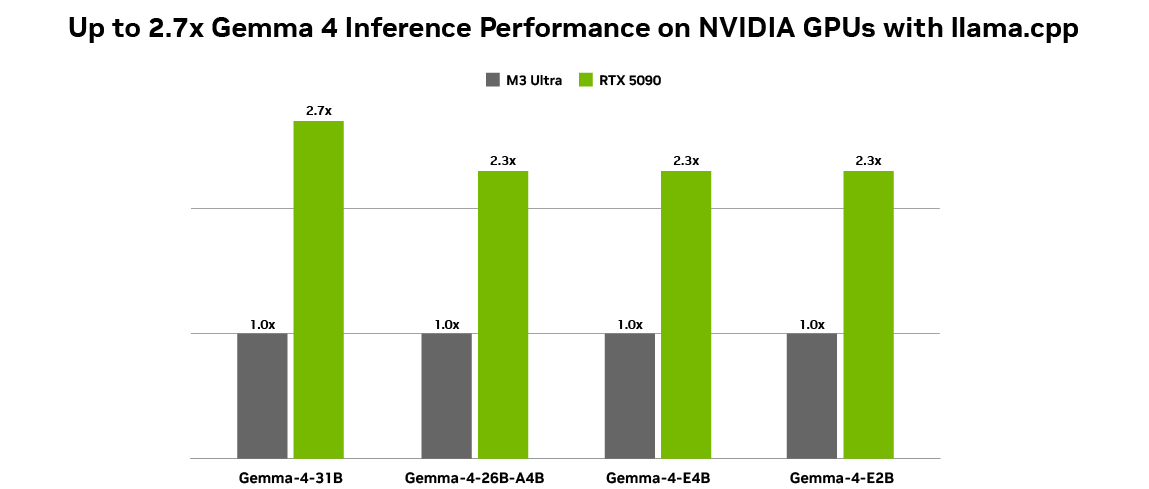
The latest additions to the Gemma 4 family of open models— spanning E2B, E4B, 26B and 31B variants — are designed for efficient deployment from edge devices to high-performance GPUs.
All configurations measured using Q4_K_M quantizations BS = 1, ISL = 4096 and OSL = 128 on NVIDIA GeForce RTX 5090 and Mac M3 Ultra desktops. Token generation throughput measured on llama.cpp b7789, using the llama-bench tool.
This new generation of compact models supports a range of tasks, including:
Reasoning: Strong performance on complex problem-solving tasks.
Coding: Code generation and debugging for developer workflows.
Agents: Native support for structured tool use (function calling).
Vision, Video and Audio Capabilities: Enables rich multimodal interactions for object recognition, automated speech recognition, and document or video intelligence.
Interleaved Multimodal Input: Mix text and images in any order within a single prompt.
Multilingual: Out-of-the-box support for 35+ languages, pretrained on 140+ languages.
The E2B and E4B models are built for ultraefficient, low-latency inference at the edge, running completely offline with near-zero latency across many devices including Jetson Nano modules.
The 26B and 31B modelsare designed for high-performance reasoning and developer-centric workflows, making them well suited for agentic AI. Optimized to deliver state-of-the-art, accessible reasoning, these models run efficiently on NVIDIA RTX GPUs and DGX Spark — powering development environments, coding assistants and agent-driven workflows.
As local agentic AI continues to gain momentum, applications like OpenClaw are enabling always-on AI assistants on RTX PCs, workstations and DGX Spark. The latest Gemma 4 models are compatible with OpenClaw, allowing users to build capable local agents that draw context from personal files, applications and workflows to automate tasks. Learn how to run OpenClaw for free on RTX GPUs and DGX Spark or using the DGX Spark OpenClaw playbook.
Getting Started: Gemma 4 on RTX GPUs and DGX Spark
NVIDIA has collaborated with Ollama and llama.cpp to provide the best local deployment experience for each of the Gemma 4 models.
To use Gemma 4 locally, users can download Ollama to run Gemma 4 models or install llama.cpp and pair it with the Gemma 4 GGUF Hugging Face checkpoint. Additionally, Unsloth provides day-one support with optimized and quantized models for efficient local fine-tuning and deployment via Unsloth Studio. Start running and fine-tuning Gemma 4 in Unsloth Studio today.
Running open models like the Gemma 4 family on NVIDIA GPUs achieves optimal performance because NVIDIA Tensor Cores accelerate AI inference workloads to deliver higher throughput and lower latency for local execution. Plus, the CUDA software stack ensures broad compatibility across leading frameworks and tools, enabling new models to run efficiently from day one.
This combination allows open models like Gemma 4 to scale across a wide range of systems — from Jetson Orin Nano at the edge to RTX PCs, workstations and DGX Spark — without requiring extensive optimization.
Check out the NVIDIA technical blogfor more details on how to get started with Gemma 4 on NVIDIA GPUs and learn more about NVIDIA’s work on open models.
#ICYMI: The Latest Updates for RTX AI PCs
✨ Catch up on RTX AI Garage blogs for a host of agentic AI announcements from NVIDIA GTC, such as new open models for local agents. These models include NVIDIA Nemotron 3 Nano 4B and Nemotron 3 Super 120B, and optimizations for Qwen 3.5 and Mistral Small 4.
NVIDIA recently introduced NVIDIA NemoClaw, an open source stack that optimizes OpenClaw experiences on NVIDIA devices by increasing security and supporting local models.
🚀Accomplish.ai announced Accomplish FREE, a no-cost version of its open source desktop AI agent with built-in models. It harnesses NVIDIA GPUs to run open weight models locally, while a hybrid router dynamically balances workloads between local RTX hardware and the cloud — enabling fast, private, zero-configuration execution without requiring an application programming interface key.
Shot composition is another of those seemingly “unseen” factors that determines how your audience will respond to your videos.
When I say “unseen,” I mean unseen by the audience although possibly unseen by you the creator as well!
Your audience will not be thinking to themselves that your video has poor composition!
In fact they will probably be thinking nothing at all apart from having a strange sense of something not being quite right about what they are looking at and an urge to click away.
It is your job to take away that feeling by composing correctly and as appropriate for what it is that you are shooting and trying to achieve with your video.
Stable Diffusion vs FLUX vs Nano Banana vs GPT Image vs Z-Image Turbo: Text-to-Image Comparison
Like most of the video editing software programs these days PowerDirector is providing access to various A.I. models through the user interface.
Although the marketing tends to suggest that the software “has A.I.,” the truth is that the software is connected to exterior A.I. engines and that is actually where the work is being done.
The basic problem with this is that unless you know exactly what the purpose is of each of these models is or know their respective strengths and weaknesses are… it’s a bit of a crap shoot!
Fortunately CyberLink have have started to address this problem with some tutorial videos outlining why you would choose to work with one model for a projects over another.
This week they are covering Text-to-Image and in the video below you can get a concise rundown on each and what projects they are more suited to.
For a look at a similar comparison on the Image-to-Video models on offer you can see it in a recent Friday Roundup HERE. https://diyvideoeditor.com/the-friday-roundup-gear-envy-and-speed-ramping-tips/
AI Video Rescue in Filmora: Fix Bad Audio, Remove Objects & Save Your Footage
One thing I really can get onboard with as far as A.I. goes is the ever expanding range of correction tools that are becoming available to the average user.
I would like to say that I am always well prepared to shoot all my videos perfectly with every contingency anticipated and compensated for.
As I say, I would like to say that but it would be an outright lie!
Sometimes I don’t notice that dog taking a poop in the background or that the distant building site is creating sound that my mics are going to pick up!
Here’s a few of the tools I use in Filmora to get things back on track and make it look like I had it under control the whole time.
Convert Horizontal Video to Vertical in Seconds
Well I guess Movavi is a little late to this party but as they say, better late than never!
Movavi have just added an “Auto Crop” module to their video editing software and after testing it out for myself it works very, very well.
It can take horizontally shot video and automatically convert it to vertical video completely automatically.
Just as a little tip from me as well, if you know you are going to convert something ahead of shooting then do this.
Work out your intended framing so that you are quite generous about the space to are leaving in the original 16;9 footage.
That way when it comes time for cropping programs like Movavi have greater leeway for adjusting the cropped frame to convert to vertical.
Creating the Back to the Future Hoverboard Effect
I am not really convinced anyone reading this blog is actually going to go out and replicate what’s shown in this video!
However there is an important point to note about the post production side of things after the original footage was captured.
You will notice in the video the results on an almost no budget shoot are very good and the reason for that is only a couple of little things done in editing.
The actual separation of the final objects is something any of us can do with a reasonable consumer level video editor.
You could use masking, green screen or even A.I to get that done cleanly.
The second point is the addition of subtle shadows in the shots he gets.
It is a tiny detail that really sells the effect and again, you and i have those tools.
What To Do When Your Content Feels Repetitive (Live Channel Review)
If you are starting up or have already started a YouTube channel then there should be at least one undeniable fact that you are aware of.
That fact is that your channel must have a relatively tightly focused subject that you are making videos on.
If you don’t do that then YouTube has so much difficulty finding an audience for you that ultimately it gives up.
So given that a channel has a focus subject and an audience is building or had been built, that channel will hit the next big problem.
That problem is that you simple can’t keep producing content on and on forever without it ultimately starting to get repetitive.
Not only will your audience begin to notice but let’s face it, it will start slowly sucking the life out of you over time.
The question to be answered here is how to pivot to another subject to breathe life into the channel and you without alienating your existing audience.
It’s a fine line and in the video below a couple of guys with proven track records on the platform cover this subject in depth.
Appeal Video for Reused Content Demonetization on YouTube (How to)
There are a number of YouTube video genres that involve re-working, commenting or somehow making use of existing YouTube content.
Most of those types of video are perfectly acceptable in YouTube’s eyes BUT!!!
In order to examine the vast amounts of footage that is uploaded to YouTube every day, they rely heavily on A.I. driven bots to complete that task.
The real data those crawlers are trying to determine is whether or not the content is just someone re-using someone else’s content or if it is a legitimate reuse such as a reaction video or commentary.
Unfortunately when it comes to A.I in certain scenarios there seems to be a lot of artificial and not quite so much intelligence!
The result of that is many users getting “Reused Content Demonetization” strikes that are not actually accurate.
Here’s a run-through on how to deal with that situation.
Create a Pro Audio Visualizer Effect in DaVinci Resolve (No Plugins Needed)
I always try to add any tutorial I find each week that somehow involves the Fusion Page of DaVinci Resolve.
This one of the most powerful modules within the overall Resolve toolkit… BUT!
Let’s face it, this is pro level compositing and special effects all wrapped up in an interface that makes the space shuttles control deck look like a kids toy!
So unlocking all that power whilst being desirable, is not exactly an easy process.
What I like to do is find simple tutorial like the one below to learn Fusion even though I may not actually be wanting to create that effect for anything.
Top 5 AI Filmmaking Tools 2026
Since the first A.I. services started to appear I have always held the view that A.I for video editing was a good thing provided it was treated only one way.
That “way” is that A.I is a tool. It is not some kind of replacement for content creation or video making.
So over the past year or so there has been an explosion of different A.I models claiming to do all sorts of things and from what I can see, most of them are pretty naff.
There are however a few really good models that can go a long way in helping video creators save time and effort to add to their projects in a meaningful way.
I have my own preferences but here’s a list of current services that I can pretty much get onboard with.
Stop Shooting Like This… Please!
This is a really good “hands on” walkthrough of setting up good lighting for video with minimal pro equipment.
When I look back at the early stuff I was shooting it is because of the things in this video that I had such a hard time correcting the color and getting it to look decent.
Even then the results were pretty mediocre because a universal truth in video is that you can’t polish a turd!
Discover more from The DIY Video Editor
Subscribe to get the latest posts sent to your email.
It’s been looming for weeks, but now the end is near: Just a few hundred Tesla Model S and Model X vehicles remain unsold. Tesla CEO Elon Musk confirmed this week in a post on X that custom orders of the Model S sedan and Model X SUV are over. “All that’s left are some in inventory,” he wrote.
Musk first announced Tesla’s plan to end Model S and Model X production back in January. And the data helps explain why.
Sales of the Tesla Model X and Model S have fallen steadily over the years as the company’s high volume and cheaper entries — the Model 3 and Model Y — took over. Tesla doesn’t separate S and X sales, instead combining them under “other models,” a category that now includes the Cybertruck. And those combined figures show S and X sales peaking in 2017 at 101,312 vehicles before declining to 50,850 vehicles (including Cybertruck) in 2025 — a fraction of the 1.63 million vehicles it delivered globally last year.
In other words, their deaths were inevitable. What comes next is a bit more complicated.
Musk isn’t filling the void left by the Model X and Model S with a traditional EV; he ditched plans to produce a lower-cost EV that was expected to be priced around $25,000. Instead, Musk is placing his bets on the Optimus robot, which has yet to go into production, and the Cybercab, an all-electric two-seater autonomous vehicle that was first shown as a concept in 2024.
Tesla plans to build Optimus robots at its Fremont, California, factory once production of the Model S and Model X end, which could be any day now that final orders have been taken. Musk has said Tesla will begin producing the Cybercab this month at its factory in Austin, Texas.
A look back
The Model S and X EVs have taken a backseat to the more affordable Model 3 and Model Y vehicles. But their debuts, and initial sales, marked two critical moments in Tesla’s colorful and often volatile history. The Model S launched in 2012 as its first volume EV. Its popularity not only changed how consumers viewed EVs, it prompted legacy automakers — long dismissive of the value of electric vehicles — to take notice.
Techcrunch event
San Francisco, CA | October 13-15, 2026
The Model X followed in fall 2015 and was famously described by Musk as the faberge egg of EVs.
“I think we got more carried away with the X,” Musk said in a September 2015 press interview attended by this reporter just an hour before Tesla’s Model X delivery event began. “I’m not sure anyone should make this car.”
The Model X was often delayed, and initially criticized for its complexity. But it ultimately introduced the company to a new market: women.
The Model X raised Tesla’s profile, and it set the company up for its next big move: an affordable mass produced EV. The Model 3 had a difficult start, but it ended up catapulting Tesla into the mainstream. The Model Y clinched its status, helping Tesla widen the gap as the top-selling EV producer globally until China’s BYD took over that top global EV sales spot in 2025 when it delivered 2.26 million EVs.
Tesla continues to sell thousands of Model 3 and Model Y, but its growth has stalled, and even reversed. The company reported in January that it sold 1.69 million vehicles in 2025, a decrease for the second year in a row. Its efforts to boost sales with cheaper, stripped-down versions of the Model 3 and Model Y that were introduced in October have had a modicum of success, according to first-quarter 2026 figures that were reported April 2.
Tesla delivered 358,023 EVs globally in the first three months of the year, about 6% more than the same period in 2025, which also happened to be the company’s worst quarter in years. The figure was below analysts’ expectations of around 368,000.
But never mind that. In Musk’s view — one which he is well compensated for — Tesla isn’t an automaker or a sustainable energy company, as he has described it before. Tesla is an AI company and his new gambit goes all in on that mission.
Cybercab risks
The Optimus robot is one part of the Tesla AI effort. But its perhaps the Cybercab that best embodies, and exposes the risks of, the company’s AI-first campaign.
The Cybercab was designed to be used as an autonomous vehicle without traditional controls like a steering wheel or pedals — meaning once it launches it will be without the initial backup of human safety operator.
The first Cybercab rolled off the Tesla factory assembly line in February and is supposed to go into mass production this month. Although that date could slip, as so many have in Tesla’s history.
Unlike Tesla’s previous vehicles, the challenges aren’t in its production (who can forget the production hell of the Model 3). Instead, it faces a major regulatory hurdle before it can ever hit the road. Federal motor vehicle safety standards place requirements on vehicles such as having a steering wheel and pedals. There is no evidence that Tesla has applied for an exemption, according to publicly available files with the Federal Register and the National Highway Traffic Safety Administration.
The vehicles will also rely on Tesla’s Full Self-Driving software to navigate public streets and safely shuttle passengers to their destination. Despite improvements to FSD and limited driverless robotaxi tests in Austin, Tesla has not yet demonstrated that its software can operate reliably at scale.
And that piece requires more than technical mastery. Robotaxi operations are also tricky. And in states like California, they also require permit to deploy and charge for rides in driverless vehicles.
Zoox, the autonomous vehicle company owned by Jeff Bezos’ Amazon, may end up clearing a path for Tesla and its Cybercab. Zoox received an exemption from the National Highway Traffic Safety Administration that allows the company to demonstrate its custom-built robotaxis, which lack pedals or a steering wheel, on public roads. Zoox is now going through a public process to have that exemption extended to commercial operations.
Musk tried to sell shareholders on why the risk was worth it during the company’s earnings call in January.
“The vast majority of miles traveled will be autonomous in the future,” Musk said at the time, later noting that the CyberCab is super optimized for minimum cost per mile and also for a much higher duty cycle. “I would say probably less than I’m just guessing, but probably less than 5% of miles driven will be where somebody’s actually driving the car themselves in the future, maybe as low as 1%.”
The latest mcdonalds big announcement today has sparked widespread attention across customers, industry experts, and social media platforms. As one of the world’s largest fast-food chains, McDonald’s rarely makes changes without significant impact—and today’s update is no exception.
From menu changes and pricing strategies to digital innovation and global expansion, McDonald’s announcements often influence the entire quick-service restaurant (QSR) industry. In this article, we break down what was announced, why it matters, and how customers are reacting in real time. Whether you’re a consumer, investor, or industry observer, this comprehensive guide provides everything you need to know.
Quick Answer: What Is McDonald’s Big Announcement Today?
McDo in menu offeringsnald’s big announcement today centers around strategic updates, pricing, and digital experience improvements, aiming to enhance customer convenience and brand competitiveness. Initial customer reactions are mixed, with excitement about innovation but concerns over pricing and value.
Key Takeaways
McDonald’s announced updates impacting menu, pricing, and technology
Customer reactions are mixed across social media platforms
Digital ordering and app features are a major focus
Pricing changes are a key discussion point among consumers
The announcement reflects broader fast-food industry trends
What Did McDonald’s Announce?
Major Highlights
McDonald’s focused on several key areas in its latest announcement:
Introduction of updated or limited-time menu items
Enhancements to mobile app and digital ordering systems
Adjustments in pricing strategy in select markets
Continued investment in delivery and drive-thru efficiency
These updates aim to improve customer experience while maintaining competitive positioning.
Why This Announcement Matters
Impact on Customers
The announcement directly affects how customers interact with McDonald’s, especially through:
Faster ordering experiences
More personalized app-based offers
Potential changes in meal pricing
For regular customers, these changes can significantly alter convenience and value perception.
Industry-Wide Influence
As a global leader, McDonald’s often sets trends followed by other brands. Competitors in the QSR space closely watch such announcements to adjust their own strategies.
This move reflects a broader shift toward digital-first customer experiences in the fast-food industry.
Customer Reactions: What People Are Saying
Positive Reactions
Many customers have responded positively, highlighting:
Improved app usability
Excitement about new menu items
Faster service expectations
Social media users appreciate innovations that reduce wait times and enhance convenience.
Negative Feedback
However, not all reactions are positive. Common concerns include:
Rising menu prices
Reduced portion value
Over-reliance on app-based ordering
Some customers feel that affordability—a core strength of McDonald’s—is being challenged.
Social Media Trends
Platforms like Twitter, Reddit, and TikTok are actively discussing the mcdonalds big announcement today.
Trending themes include:
Value vs convenience debate
Comparisons with competitors
Viral reviews of new menu items
Comparison Table: Before vs After Announcement
Feature
Before Announcement
After Announcement
Ordering Experience
Standard
Enhanced digital focus
Pricing Strategy
Stable
Adjusted in some markets
Menu Options
Regular
Updated / new items added
Customer Engagement
Moderate
Increased via app features
Service Speed
Efficient
Further optimized
Step-by-Step Breakdown of Changes
Step 1: Digital Expansion
McDonald’s continues to invest heavily in mobile ordering, improving app performance and personalization.
Step 2: Menu Innovation
New items or limited-time offerings are introduced to maintain customer interest.
Step 3: Pricing Adjustments
Changes reflect inflation, supply chain costs, and market conditions.
Pricing strategies are evolving due to inflation and demand shifts
These trends highlight why McDonald’s is focusing on digital transformation.
FAQ Section
1. What is McDonald’s big announcement today?
McDonald’s announced updates related to menu items, pricing, and digital ordering systems. The focus is on improving customer convenience and adapting to modern technology trends. These changes aim to enhance both service speed and user experience.
2. Why are customers reacting strongly?
Customers are reacting due to changes in pricing and ordering methods. While some appreciate the improved convenience, others are concerned about rising costs. This mix of benefits and concerns has created strong reactions online.
3. Are menu prices increasing?
In some locations, prices may increase due to economic factors like inflation and supply costs. However, McDonald’s often balances this with app-based deals and promotions. The impact varies depending on the region.
4. What new features were introduced?
New features mainly focus on digital improvements, including better app functionality and personalized offers. These updates aim to make ordering faster and more efficient. Some locations may also introduce new menu items.
5. Is this announcement global?
Not all changes apply globally at the same time. McDonald’s often rolls out updates region by region. Customers may see differences depending on their location.
6. How does this affect regular customers?
Regular customers may experience faster service and more digital deals. However, they might also notice pricing adjustments. Overall, the goal is to improve convenience while maintaining value.
7. Should customers be concerned?
There is no major reason for concern, as these updates are part of normal business strategy. Customers can adapt by using deals and staying informed. The changes are aimed at improving long-term experience.
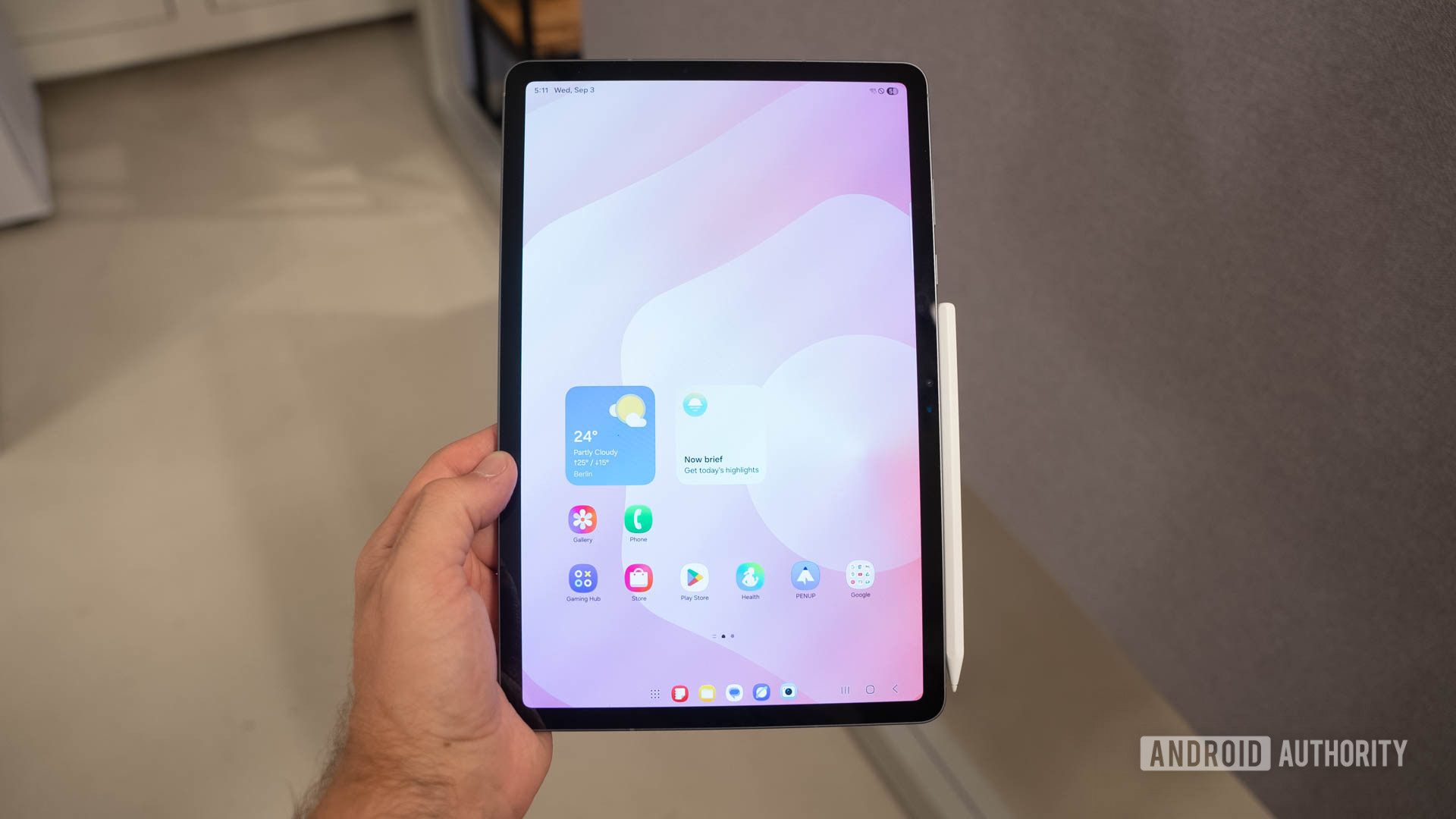
Right now, Samsung is knocking $150 off every Galaxy Tab S11 storage tier. That drops the 128GB model to $649.99 from $799.99, the 256GB model to $709.99 from $859.99, and the 512GB model to $829.99 from $979.99. You can also save up to $500 with a tablet trade-in, though that offer unfortunately doesn’t stack with the instant savings.
Just because it isn’t the top-spec device in the family, you’re still getting a lot for your money. The Tab S11 offers an 11-inch Dynamic AMOLED 2X display with a 2560 x 1600 resolution, 12GB of RAM on the base model, microSD support up to 2TB, and S Pen support. Samsung is also pushing the Galaxy AI side of things, with Note Assist for organizing, summarizing, and translating your notes, plus Drawing Assist for cleaning up your rough sketches.
The Samsung Galaxy Tab S11 is a 11-inch tablet with a high-resolution, 120Hz display, 8,400mAh battery, and large storage options. This MediaTek-powered tablet has a good selection of AI tools baked in.
The rest of the package is equally solid. The Tab S11 is 5.5mm thick, weighs 469g, packs an 8,400mAh battery, and has an IP68 rating for water- and dust-resistance. You also get Wi-Fi 6E, Bluetooth 5.4, a 13MP rear camera, a 12MP front camera, and security updates well into the 2030s.
Ready to upgrade your tablet game? The widget above takes you to the deals.
Thank you for being part of our community. Read our Comment Policy before posting.
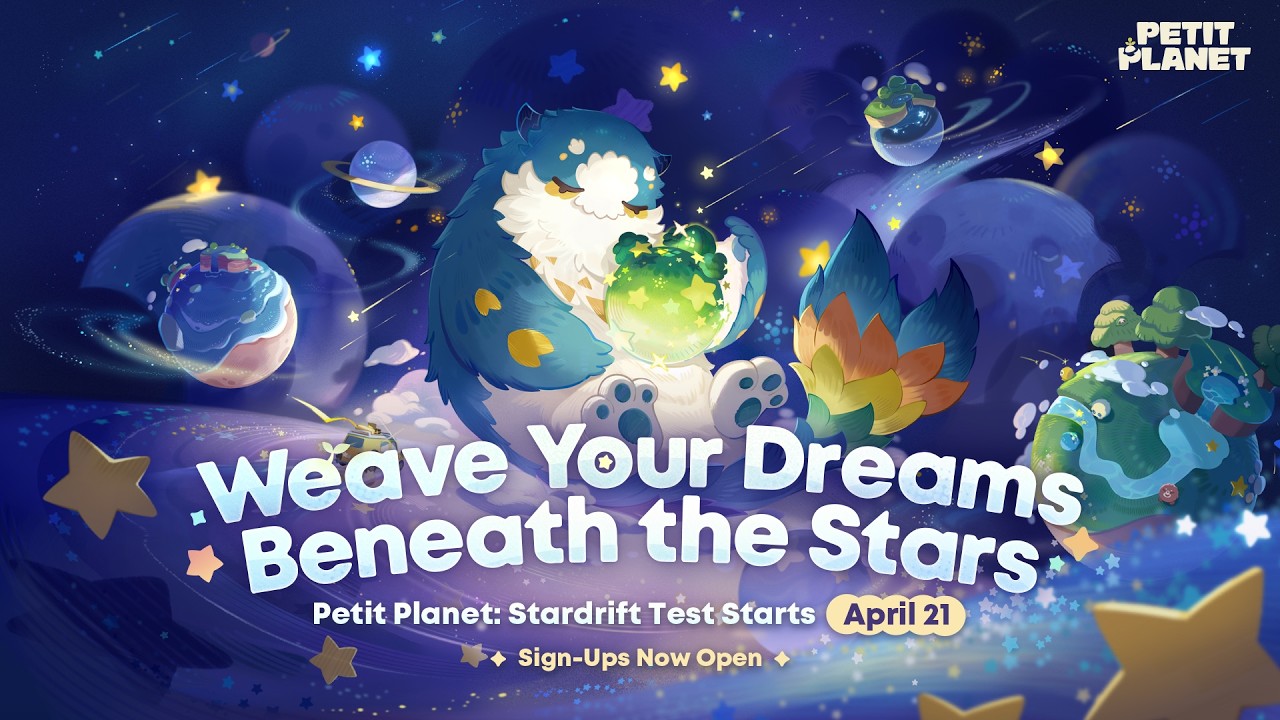
If you’re looking for something to do in about three weeks’ time, HoYoVerse is now taking signups for a round of closed beta testing for its next game, Petit Planet, that’s set to begin on April 21.
Petit Planet puts players in charge of an entire world, contained within the vast Starsea, where they can farm, fish, cook, hang out on the beach, make friends, form galaxies, and just generally live the cozy cosmic life.
“Spend relaxed and fulfilling days on your planet alongside your fuzzy Neighbors, and let your imagination run wild as you decorate your home or shape your own stylish landscapes,” HoYoVerse explained. “You can also explore the Starsea and forge connections with people and things at the ever-bustling Galactic Bazaar.
Article continues below
“Each bond you form with Neighbors and the world around you weaves into an ever-growing web of connections that keeps the universe flourishing. As these bonds deepen and planets thrive, Luca, the vitality that flows through all things, shapes new landscapes and brings wondrous changes to your world.”
Yeah, that sounds awfully cozy, alright. Lest there be any doubt, watch this:
Petit Planet: Stardrift Test Trailer | Stardrift Test Begins April 21! – YouTube
The Stardrift Test, as HoYoVerse is calling it, will introduce new Neighbors, offer “enhanced Starsea Voyage experiences,” and add additional activities at the Galactic Bazaar. If you’d like a shot at access, you can sign up at planet.hoyoverse.com—HoYoVerse said “a selection” of people who sign up will get in, but pre-registering will also unlock “exclusive rewards” that I will assume will become available when the game launches.
Petit Planet does not currently have a release date, but HoYoVerse leaker Ubatcha said in February that the game was “entering its final stages of development,” so if this round of beta testing goes well, we may be hearing something on that front fairly soon.
Keep up to date with the most important stories and the best deals, as picked by the PC Gamer team.
Before a career second act at Nightdive Studios, the recently-retired Larry Kuperman‘s big project was Impulse. It was to be GameStop’s answer to Steam, but it went the way of the dodo in 2014. Kuperman went into his personal history building up Impulse’s catalogue when we spoke at this year’s Game Developers Conference.
Kuperman came to the games industry about halfway through his professional career, with both his story and that of Impulse beginning at Stardock, a software company that was branching out into games. Stardock’s management was thinking in terms of digital distribution early—Kuperman started in 2001—and the company was laying the groundwork for its own service.
“We reserved the rights to electronically sell the game,” Kuperman recalled of his first game with Stardock, economics sim The Corporate Machine. “It was part of the contract negotiation that we could sell the game electronically. I’m sure the lawyer at Take Two [was thinking], ‘It’s electronic distribution. Who cares about that?’ That moment was kind of pivotal.”
Article continues below
The first iteration of this online store was a website called Drengin—its archived form is a real hoot, with a throwback layout advertising the hottest games coming in 2004. “Back in those days, it was not the same game experience,” recalled Kuperman. “You got this thing to download and the serial number that came in your email.”
Around 2004 to 2005, when the Canadian publisher Strategy First (Jagged Alliance, O.R.B: Off-World Research Base) collapsed while working with Stardock, the software company walked away with electronic distribution rights to Strategy First’s games. “That launched what would become Impulse, which was a Steam competitor from Stardock. It was a similar platform,” said Kuperman.
Impulse first launched in 2008, and was then sold to GameStop in 2011. “I joined GameStop for two years as their head of electronic distribution on the PC side,” recalled Kuperman.”I thought that was going to be my forever job. Ironically, that didn’t work out.
“I guess, back in that time, [it was] completely different management than is at GameStop now, but GameStop thought that electronic distribution was just a passing phase, and brick and mortar was going to come back strong: ‘I’ve seen the future, it looks just like the 1950s.’ But that really didn’t happen.”
Keep up to date with the most important stories and the best deals, as picked by the PC Gamer team.
The rest, as they say, is history. GameStop seems to have reached an equilibrium after years of turmoil: “Meme” stock manipulation, layoffs and store closures, even the untimely demise of GameInformer—though that last bit does have a happy ending, at least.
It’s a bit of brick-and-mortar hubris reminiscent of Blockbuster refusing to buy Netflix in 2000. Though Kuperman had no illusions of Impulse having true Steam-killer potential, the company giving up on digital distribution altogether was clearly the wrong move in hindsight.
Samsung is rolling out a free update that brings native Google Cast support to select smart TVs.
The update is arriving on some 2023 and 2024 Samsung TVs, expanding beyond 2026 models.
Users can cast from Android devices and Chrome without needing a Chromecast.
Samsung is rolling out a free upgrade for its smart TVs that finally brings Google Cast support.
While Samsung makes some of the best smart TVs on the market, one limitation has been its use of the company’s own Tizen OS. While you still get access to most major apps, running Tizen OS (or One UI Tizen on newer Samsung TVs) means you miss out on one of Google TV’s most useful features: Google Cast.
Thankfully, that is changing now, as Samsung has started rolling out updates for its older smart TVs from 2023 and 2024 that bring support for Google Cast. The feature was already confirmed for 2026 models, but it’s now making its way to older TVs as well.
Article continues below
Android Central’s take
This feels long overdue. Not having Google Cast on Samsung TVs never made sense, especially when cheaper Android TVs had it for years. Good to see Samsung finally fixing one of its biggest ecosystem gaps.
A Reddit user reported that their S90D OLED TV showed a new ‘Continuity’ screen indicating Google Cast support (via SamMobile). Samsung hasn’t officially announced the rollout yet, so it appears to be happening quietly. It’s also unclear which models are supported so far.
(Image credit: Reddit u/helios_csgo)
Once the update reaches your Samsung TV, you’ll be able to cast content directly from your Android phone, tablet, or even the Chrome browser on your laptop without needing a separate device like a Chromecast or Google TV Streamer. You’ll be able to cast apps like YouTube, Google Photos, and more straight to your TV when they’re on the same Wi-Fi network.
We haven’t seen the update arrive on our Samsung TV just yet, but it may take a few weeks, depending on your region or specific TV model, to roll out to your device.
Get the latest news from Android Central, your trusted companion in the world of Android