Leading Publishers Bring Blockbuster PC Games and Technology to NVIDIA RTX Spark


NVIDIA is bringing the next wave of RTX gaming to the Gamescom conference running this week in Cologne, Germany, with support for new games, anti-cheat technologies and increased visual quality. 

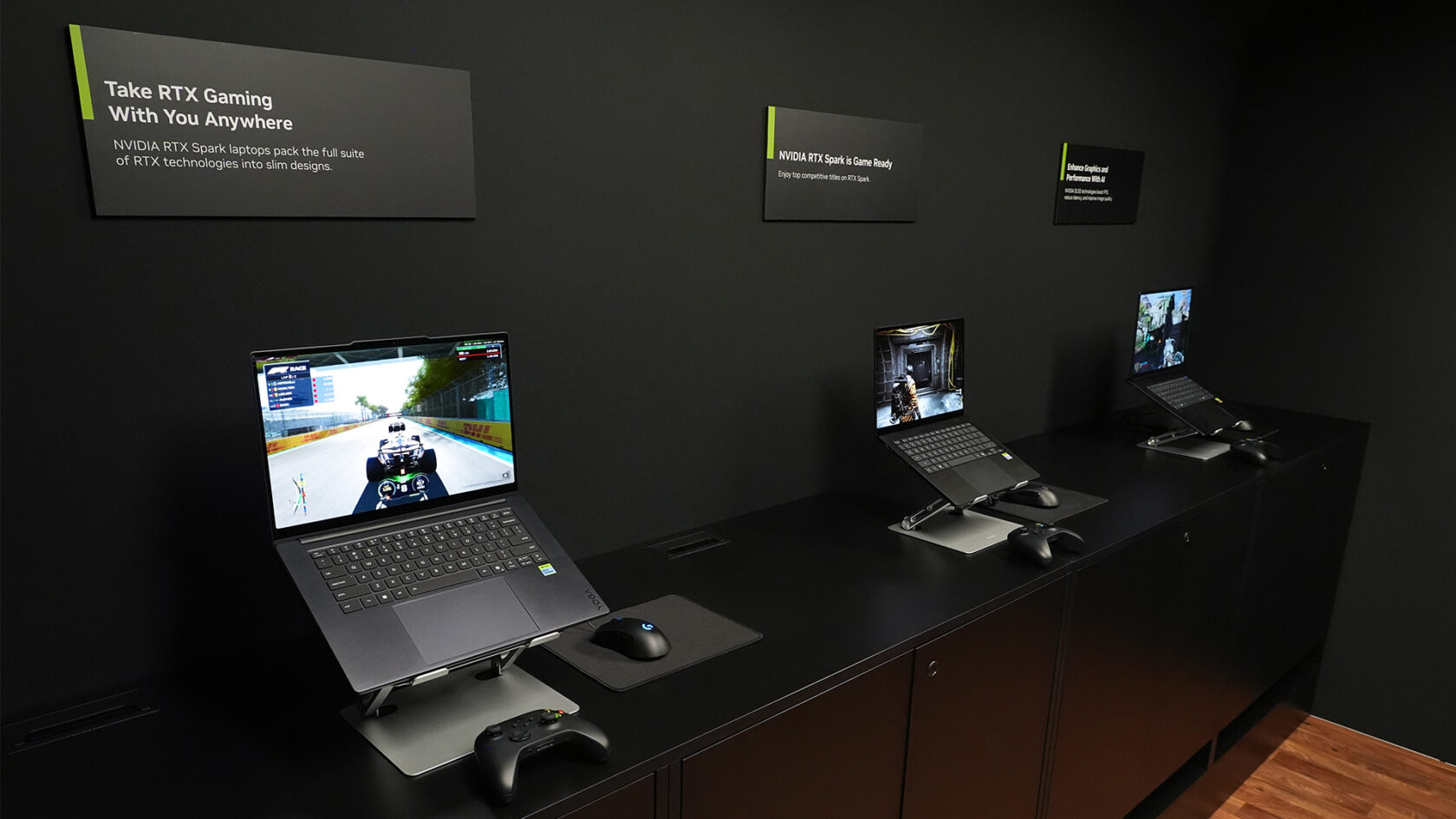
Electronic Arts, Embark and Ubisoft are among the latest game publishers and developers bringing their blockbuster titles to NVIDIA RTX Spark ahead of its launch this fall. They join the publishers that announced RTX Spark support at COMPUTEX in May, including KRAFTON, NetEase, Riot Games and XBOX. 

NVIDIA is working closely with game developers and ecosystem partners to ensure today’s top PC games — including EA’s EA SPORTS F1 25 and Apex Legends, Ubisoft’s Anno 117: Pax Romana and Embark Studios’ ARC Raiders and THE FINALS — run seamlessly on RTX Spark devices.

We’re excited to bring Anno 117: Pax Romana to a new generation of RTX-powered PCs,” said Stéphane Jankowski, Ubisoft executive producer of Anno 117 : Pax Romana. “Our teams build the game to be seen wide: full districts, long sightlines, thousands of details at once. Seeing RTX Spark hold that level of fidelity from a single chip is genuinely impressive.”

RTX Spark reinvents personal computing, bringing personal AI agents, advanced content creation and high-performance gaming together in a platform engineered from the ground up for the next wave of Windows PCs. For gamers, RTX Spark combines Windows devices with NVIDIA RTX technologies, including DLSS and Reflex

Bringing Anti-Cheat to RTX Spark

Supporting modern PC gaming goes beyond running the game itself. Many of today’s biggest online games rely on sophisticated anti-cheat technologies, to enable fair play across the multiple platforms these games run on.  

NVIDIA has been working with EA to bring native EA Javelin Anticheat support to RTX Spark, including for EA’s biggest multiplayer games, such as EA SPORTS F1 25. RTX Spark launches this fall. 

RTX Delivers Next-Generation Gaming

RTX Spark is just one part of NVIDIA’s lineup of gaming announcements at Gamescom, including:

  • DLSS 4.5 Ray Reconstruction is available now, featuring NVIDIA’s latest second-generation transformer model to deliver even higher image quality in ray- and path-traced content. It replaces traditional denoisers with an NVIDIA supercomputer-trained AI network to reconstruct higher-quality pixels in the parts of a ray-traced frame where rays were not sampled.
  • Path tracing comes to CONTROL Resonant and 007 First Light to deliver new levels of visual fidelity. 
  • NVIDIA ACE technologies are coming to Aniimo in early 2027, letting players naturally interact with their creatures.
  • Gears of War: E-Day includes RTX Mega Geometry integration, advancing image quality on GeForce RTX GPUs, alongside ray tracing and DLSS 4.5.
  • RTX Remix keeps remastering PC classics, with a major Painkiller RTX mod update available now and The Elder Scrolls III: Morrowind RTX coming soon.
  • GeForce NOW gives members more ways to play with new DLSS 4.5 controls, expanded support for Steam Machine and other devices and platforms, plus blockbuster PC games including CONTROL Resonant, Gears of War: E-Day and more coming to the cloud at launch.

Find more on NVIDIA’s announcements at Gamescom in this GeForce article

RTX to Spark: Gemma 4 Accelerated for Agentic AI


Open models are driving a new wave of on-device AI, extending innovation beyond the cloud to everyday devices. As these models advance, their value increasingly depends on access to local, real-time context that can turn meaningful insights into action. 

Designed for this shift, Google’s latest additions to the Gemma 4 family introduce a class of small, fast and omni-capable models built for efficient local execution across a wide range of devices.  

Google and NVIDIA have collaborated to optimize Gemma 4 for NVIDIA GPUs, enabling efficient performance across a range of systems — from data center deployments to NVIDIA RTX-powered PCs and workstations, the NVIDIA DGX Spark personal AI supercomputer and NVIDIA Jetson Orin Nano edge AI modules.

Gemma 4: Compact Models Optimized for NVIDIA GPUs 

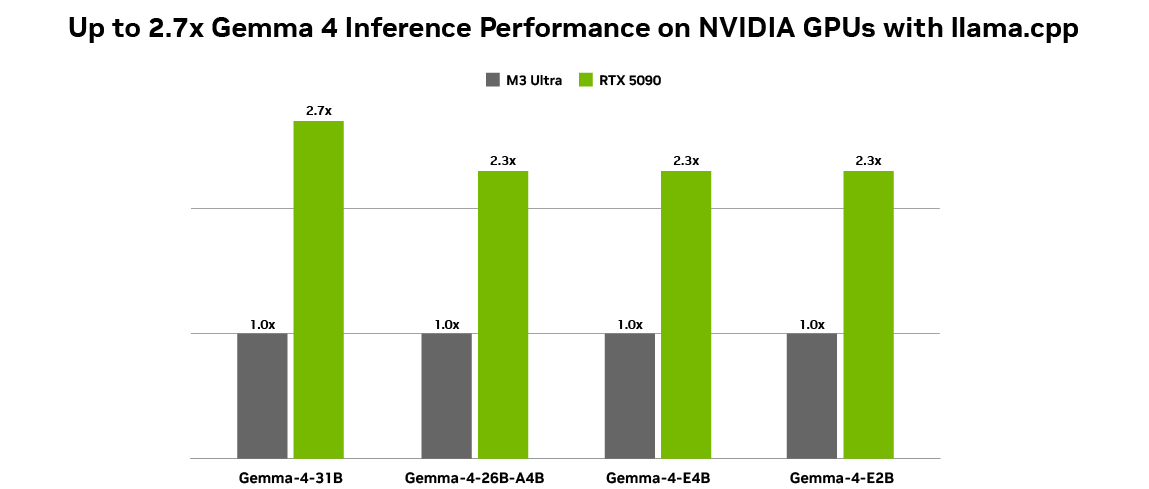
The latest additions to the Gemma 4 family of open models spanning E2B, E4B, 26B and 31B variants  are designed for efficient deployment from edge devices to high-performance GPUs.  

All configurations measured using Q4_K_M quantizations BS = 1, ISL = 4096 and OSL = 128 on NVIDIA GeForce RTX 5090 and Mac M3 Ultra desktops. Token generation throughput measured on llama.cpp b7789, using the llama-bench tool.

This new generation of compact models supports a range of tasks, including: 

  • Reasoning: Strong performance on complex problem-solving tasks.  
  • Coding: Code generation and debugging for developer workflows.   
  • Agents: Native support for structured tool use (function calling).  
  • Vision, Video and Audio Capabilities: Enables rich multimodal interactions for object recognition, automated speech recognition, and document or video intelligence. 
  • Interleaved Multimodal Input: Mix text and images in any order within a single prompt.  
  • Multilingual: Out-of-the-box support for 35+ languages, pretrained on 140+ languages. 

The E2B and E4B models are built for ultraefficient, low-latency inference at the edge, running completely offline with near-zero latency across many devices including Jetson Nano modules. 

The 26B and 31B modelsare designed for high-performance reasoning and developer-centric workflows, making them well suited for agentic AI. Optimized to deliver state-of-the-art, accessible reasoning, these models run efficiently on NVIDIA RTX GPUs and DGX Spark — powering development environments, coding assistants and agent-driven workflows.  

As local agentic AI continues to gain momentum, applications like OpenClaw are enabling always-on AI assistants on RTX PCs, workstations and DGX Spark. The latest Gemma 4 models are compatible with OpenClaw, allowing users to build capable local agents that draw context from personal files, applications and workflows to automate tasks. Learn how to run OpenClaw for free on RTX GPUs and DGX Spark or using the DGX Spark OpenClaw playbook. 

Getting Started: Gemma 4 on RTX GPUs and DGX Spark 

NVIDIA has collaborated with Ollama and llama.cpp to provide the best local deployment experience for each of the Gemma 4 models.    

To use Gemma 4 locally, users can download Ollama to run Gemma 4 models or install llama.cpp and pair it with the Gemma 4 GGUF Hugging Face checkpoint. Additionally, Unsloth provides day-one support with optimized and quantized models for efficient local fine-tuning and deployment via Unsloth Studio. Start running and fine-tuning Gemma 4 in Unsloth Studio today. 

Running open models like the Gemma 4 family on NVIDIA GPUs achieves optimal performance because NVIDIA Tensor Cores accelerate AI inference workloads to deliver higher throughput and lower latency for local execution. Plus, the CUDA software stack ensures broad compatibility across leading frameworks and tools, enabling new models to run efficiently from day one.  

This combination allows open models like Gemma 4 to scale across a wide range of systems — from Jetson Orin Nano at the edge to RTX PCs, workstations and DGX Spark — without requiring extensive optimization. 

Check out the NVIDIA technical blog for more details on how to get started with Gemma 4 on NVIDIA GPUs and learn more about NVIDIA’s work on open models. 

#ICYMI: The Latest Updates for RTX AI PCs 

✨ Catch up on RTX AI Garage blogs for a host of agentic AI announcements from NVIDIA GTC, such as new open models for local agents. These models include NVIDIA Nemotron 3 Nano 4B and Nemotron 3 Super 120B, and optimizations for Qwen 3.5 and Mistral Small 4. 

 NVIDIA recently introduced NVIDIA NemoClaw, an open source stack that optimizes OpenClaw experiences on NVIDIA devices by increasing security and supporting local models.  

🚀 Accomplish.ai announced Accomplish FREE, a no-cost version of its open source desktop AI agent with built-in models. It harnesses NVIDIA GPUs to run open weight models locally, while a hybrid router dynamically balances workloads between local RTX hardware and the cloud — enabling fast, private, zero-configuration execution without requiring an application programming interface key. 

Plug in to NVIDIA AI PC on FacebookInstagramTikTok and X — and stay informed by subscribing to the RTX AI PC newsletter. 

Follow NVIDIA Workstation on LinkedIn and X 


You can now apply for the ‘opportunity to purchase’ an RTX 5090 or 5080 from NVIDIA


While graphics cards have been getting almost ludicrously over the years, it’s also been increasingly difficult to actually . In an effort to address this problem, NVIDIA has introduced a plan it’s calling Verified Priority Access for its recently released GeForce RTX 50 series of GPUs. Verified Priority Access offers an unspecified number of people the chance to buy either a GeForce RTX 5090 or RTX 5080 Founders Edition graphics card direct from the company.

This “opportunity” will only be available to US customers with an NVIDIA account that was created on or before January 30 at 9AM ET/6AM PT. Interested parties can on a form and invites will be sent starting next week.

NVIDIA took a similar approach to dealing with shortages of its , although that was an invite-only pilot. This system could help keep more of the products away from scalpers or crypto operations in favor of legitimate customers. But considering how long GPU access , it would be nice to see more robust responses coming from the manufacturers.