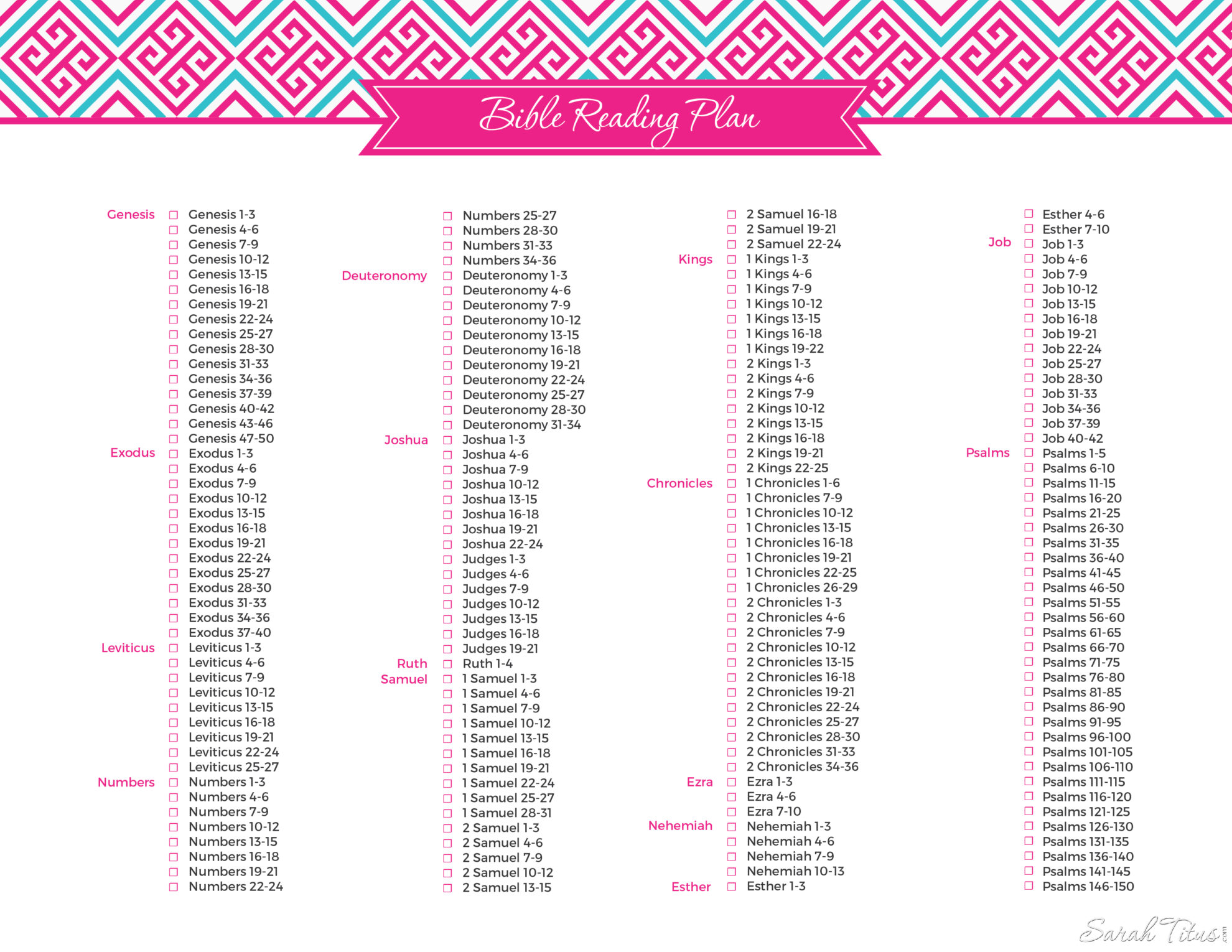
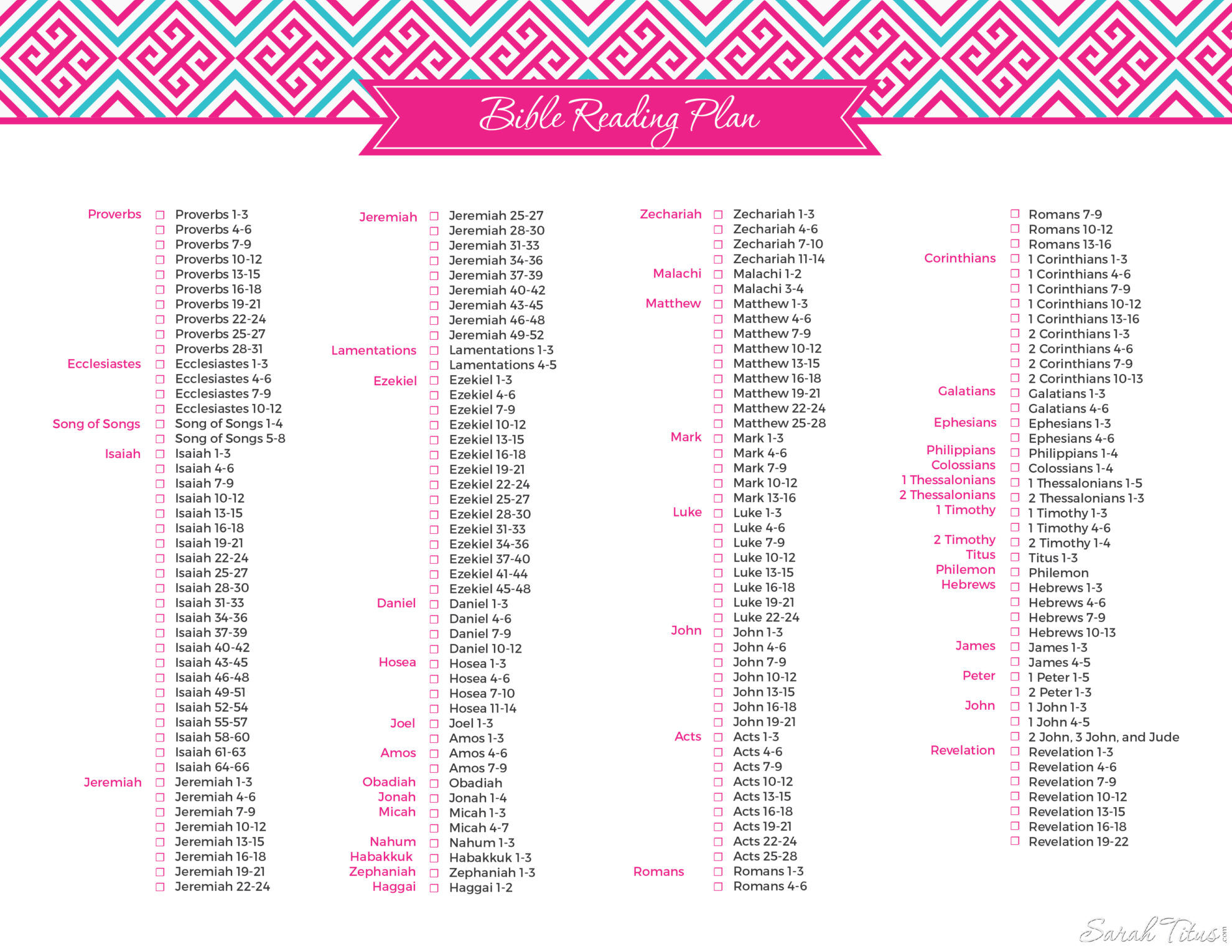
Have you ever tried to read the Bible in a year and just fail miserably? You have great intentions and you start out well, but then LIFE happens, you fall behind, and before you know it, you’re too overwhelmed to try to catch up?
This Bible Study Reading Plan is different!
It doesn’t go by months or have any dates or anything like that in it. So, if you fall behind it’s okay.
To be honest, it doesn’t really matter if you read the Bible in a year or 5 years, the point is that YOU READ IT. Because when you’re overwhelmed, you’re not reading it, right?! You give up.
This is the system that I personally use and really love it!
At the time that I’m writing this, I’ve been saved seven years now and this is my third pass through of reading the entire Bible. I’ve not read the entire Bible every year, but I AM reading it. I’m consistent and whenever I read a large passage or short book of the Bible, I make sure to check mark the appropriate box. I keep the plan in my Bible, so it’s easily accessible and I see it often.
It’s a lot more laid-back, less stressed way of getting the Word into your heart and soul. And best of all, you can print it out as many times as you want! I hope you like it and I hope this Bible verse reading plan works well for you.
Looking for more Bible reading plans? Want a different design? Check out all the options here.
What sets your printables apart?
• Other printables are either functional OR cute. I bridge the gap between the two. Since I’m a single mom and don’t have time to mess around and am a kid at heart, I love something that actually propels me forward and gets the job done quickly, while still having that super cute vibe I’m known for. • I’m a graphic designer FIRST. This means my printables, whether free or paid for, will always be of the highest quality and print crisp and clear on any printer. • I love what I do and I do the work myself. I’m not hiring these out. This is my life, my hobby, my passion, my heart. • My fans are obsessed with my work. To date, I’ve made over $23M on printables alone (organically) in the past 8 years.
Is this printable free to download?
Yes! Except for some large binders, all printables on the blog are 100% free for personal use. I make these because I genuinely want you to have something cute and helpful right now without having to spend a dime. You deserve a life that feels more peaceful, more organized, and more you, and if a simple printable can make your day feel lighter, I am so happy to give that to you.
All printables are for personal use only.
Printables, graphics, backgrounds, SVGs, fonts, and design elements on this site are for personal use only. You may not alter them or redistribute them for free or monetary gain without written consent from the author, Sarah Titus. If you want to share these resources with others, please share the link to the blog post. Teachers & Churches: You may share these with your classes, colleagues, and congregation as long as they are not edited in any way.
Can I use these printables for my classroom or church group?
Absolutely! You’re welcome to print as many copies as you need for your own students or church groups. I only ask that you do not edit them in any way (leaving the full copyright line in tact) or sell them or host the digital files on other websites. Please always link back to this post to share with others.
What’s the best way to print these high-quality printables?
• For best results, I recommend using standard 8.5″x11″ white paper. Since these are professionally designed as high-resolution PDFs, they’ll stay crisp and clear on any printer. To print, simply download the PDF to your device and open your printer settings. Select “Fit to Page” to ensure the printable looks perfect. • If you’re printing stickers, I have a tutorial here.
As we wait for Netflix’s upcoming animated detective movie Ray Gunn to get a trailer, there’s one important question: will it come to theaters?
The answer currently appears to be “no,” but writer-director Brad Bird would love for that to change. At this week’s Annecy Animation Festival, he mentioned to Polygon he was “talking” to the streamer, but he doesn’t know “whether they’re listening.” Glad as he is that the film exists, he’d be even happier if it was on the big screen, he said, highlighting his membership in the exhibition trade organization Cinema United. “[They’re] all about theatrical,” said Bird, “and I believe it’s the best way to see this movie the first time you see it.”
Every once in a while, Netflix puts a movie in theaters for Oscar consideration. But in the past year, KPop Demon Huntersand the Stranger Things finale both came to theaters because they were big events that proved to be worth the effort. Next year, the streamer will let Greta Gerwig’s Chronicles of Narnia movie, The Magician’sNephew, open in theaters first, then bring it to the platform after the reverse has been the standard for years.
Should Netflix decide Ray Gunn isn’t theater-worthy, Bird has a plan B for audiences: DIY a theatrical experience. “Find the biggest screen you can, even if it’s down the street at your neighbor’s place,” he suggested. “Barge right in there and say, ‘We’re seeing this movie, because you have a big screen and that’s the way it should be seen.’”
Ray Gunn is expected to hit Netflix on December 18.
Today’s post highlights the 50 websites to hire new product design freelancers for product prototype services. Back in the old days, before all the rage about AI and web and mobile applications hit their peak, the term “product design” almost exclusively referred to the development of physical or hardware goods such as appliances, electronics, furniture, clothing, jewelry, vehicles, and so forth. Things have changed now that people who develop apps, software, and all sorts of digital products also regard their professions as product designers, app developers, and engineers.
What this change means to employers is that they now have to be much more diligent when hiring freelance or remote professionals because of the layer of ambiguity that’s sometimes not clearly defined by the candidates themselves. We’ve arrived at a point where if people say they’re product designers, it’s safe to assume that they mainly make digital products (such as the front-end and back-end of a computer program), unless otherwise noted. This is pretty much the usual practice nowadays, especially when you’re hiring (physical) product designers on online talent marketplaces.
Even many that claim to be “design-specialized” or “tech-focused” platforms don’t always make clear the distinction between physical and digital product designers. One of the few exceptions is Cad Crowd, where all the freelancers’ skills and services are grouped into specific categories, making it almost impossible to hire the wrong professionals, regardless of how complex your products and prototypes might be. More about Cad Crowd and all the other alternative platforms are listed below.
Specialized platforms for product designs and prototyping
The following platforms focus on providing access to talents specializing in product designs and related skills, including but not limited to mechanical engineering, electrical/electronic engineering, packaging design, CAD applications, 3D visualizations, and prototyping.
1. Cad Crowd
A massive highlight of Cad Crowd comes from how the platform neatly categorizes all the services it offers into dozens of subsections, so that clients can find the right product concept design freelancers quickly and easily without having to go through a lot of unnecessary clicks. It might seem simple enough at a glance, but the clever interface does have a big impact on overall site usability. For example, the “Product Design” category is filled with such services as:
Open Innovation
Concept Design
Custom Cast Urethane Molding
Product Engineering
3D Product Demo
Internet of Things
Design for Assembly
Industrial Design
Prototyping
Cad Crowd has a separate “Consumer Products” category, where you’ll find design services for products like homeware, furniture, toys & games, wearables, fashion, electronics, etc. You can also purchase additional packages to complement your product design projects, such as IP protection (mainly through trademarks and copyright registration, licensing, patents, and NDA) and manufacturing-related services, including DFM services and injection molding design.
It is simply an all-in-one freelance hub for design and engineering projects, backed by more than 100,000 pre-vetted and pre-qualified professionals from all over the world. As far as talent-finding goes, Cad Crowd gives you the option to either hire an expert freelancer recommended by the platform based on your project requirement, launch a public contest and provide a financial reward to the winning design, or purchase an hourly on-demand service. Cad Crowd is based out of California, United States, and Alberta, Canada.
While not a direct alternative to Cad Crowd in terms of range of services and hiring options, Coroflot is nonetheless an effective platform to connect with creative professionals, including product designers and fabricators. It’s primarily a job board with a pretty comprehensive Design Employment Network that encompasses reputable platforms like IxDA, Yanko Design, Core77, Design Observer, and iDSA, among others. This means when you post a job to Coroflot, the project is distributed throughout the network to attract more candidates. A job post on Coroflot costs $295, and it will remain online for 90 days. Discounts are available for multiple posts. But unlike typical job boards, the platform actually allows you to browse for available freelancers, sort the profiles based on types of services (product design, prototyping, consumer goods, industrial, etc.), and contact them through the built-in messaging feature.
You probably won’t get ready-to-manufacture CAD files when working with professionals from Design Match, because the main focus here is on design consultancy rather than actual design work. Design Match is unlike most design-specialized freelancing platforms out there, where you can hire a talent to develop your idea into a viable product. Every talent on the platform acts as a consultant to advise you on a product development roadmap and clear workflows based on design constraints (budget, complexity, etc.) and market research. The consultancy itself is done remotely, and Design Match promises that you’ll have a clear overview of the project within 90 minutes of the session. A single session costs $499, and that’s just for the initial discussion.
When browsing for 3D product design freelancers on Behance, use the filtering option on the left-hand side of the screen and make sure to check the “Industrial Design” option. The platform grew big as a repository of graphic design assets where members share their projects and showcase their creative works in general. Behance currently has more than 50 million members, and more importantly, you have full access to all the registered freelancers on the site. You can browse their profiles (or “creatives” as Behance calls them), contact them directly, and invite them to work on your next project. There’s also a “Services” search feature in case you want to purchase pre-planned project packages. The usual job posting option is still available, too.
Think of DesignCrowd as a smaller-scale Behance. For a platform that’s almost entirely revolving around graphic design projects, it’s a pleasant surprise to see how it still offers physical product design and prototyping services. Mind you, the types of products are very much limited to apparel, stationery, product catalogues, or marketing merchandise. The platform works in a crowdsourcing model, meaning you post a contest and pick a winning design or the best prototype, depending on the project, at the end of the period.
Running in the same vein as crowdsourcing as DesignCrowd, the priority projects in 99Designs are graphic designs. Both DesignCrowd and 99Designs might not be the product design freelancing platforms for everyone, but if what you need is something along the lines of business cards, tote bags, stickers, or product packaging design services, you probably don’t need a more complex platform in the first place. Mind you that the prototypes will be in the forms of CAD files, images, illustrations, or even PDF documents. If you want to skip the public contest part, 99Designs allows you to pick/invite a designer or two to work on your design project.
If you’re fond of crowdsourcing-based design projects, Crowdspring can make for a viable alternative platform. The platform promises that any design you receive (in digital format, of course) is original and editable. Posting a design contest costs at least $299, for which you should receive up to 60 original designs. The price already includes a $200 award for the winning design. Crowdspring promises to deliver dozens of original designs within 7 days or less, and there’s a full money-back guarantee, too.
All the names listed in this category aren’t exactly freelancing platforms, but businesses offering product design and prototyping services on a per-project or contractual basis. And if you think about it, these are essentially freelancers; they work for you as external employees, although most of them are composed of teams rather than one-person business entities like many freelancers are. Direct services might, in fact, be some of the best choices for product development thanks to their in-house design expertise and prototyping capabilities. But at the same time, direct services are often much more expensive than hiring freelancers for the same projects.
7. Kickr Design
Like a lot of product design and prototype design firms, Kickr Design offers turnkey product development services as a freelance partner. It takes rough sketches, or even a mere idea of a product, and develops it further through CAD modeling, design analysis, virtual prototyping, and physical prototyping. There’s no fixed price for any of the services, which makes sense because the cost always depends on product complexity. It can be either pretty affordable for a simple mechanical product or extensively pricey for a sophisticated device. Kickr Design guarantees the confidentiality of all your conversations about product ideas with the company through an NDA, and that you get to keep 100% of the IP throughout the process. Kickr Design is based in Atlanta, Georgia.
The main design services from CADmore include all the major steps in product development: research, ideation, physical mockups, three-dimensional visualization, and prototyping. CADmore can work with just about every product category, even electronics. If you already have a CAD file generated, they re-analyze everything to make sure that the design is indeed ready for prototyping and production. As for the prototyping, the company will first produce initial models for testing and evaluation before moving on to low-volume production intended for pilot runs. It even offers post-launch support to help you address any issues that may arise once the product enters the market.
Custom manufacturing is the only service Fictiv provides. This includes 3D printing, injection molding, compression molding, die casting, urethane casting, sheet metal, and CNC machining. It all sounds business as usual, until you realize that Fictiv has no minimum order quantity, meaning you can have any physical product design prototyped without having to pay the full price of low-volume manufacturing. Fictiv doesn’t generate CAD or offer design services of any sort, but it can connect you with professional engineers and industrial designers in case you need design help.
There isn’t much of a difference between Fictiv and Protolabs Network, as both are primarily prototyping services that offer limited assistance in product design. In essence, they don’t generate the CAD file or work on the design from the ground up on your behalf. You have to provide a ready-to-fabricate design in the first place, but they may recommend minor changes to streamline the workflow for efficiency. Protolabs Network has a DFM tool to help analyze your design and optimize it for manufacturing purposes. The idea is to retain the intended design features and function while minimizing production cost as much as possible. In addition, the platform makes sure that at every stage of the prototyping or manufacturing process, you always have access to a team of mechanical engineers and technicians in case you need project-related advice.
A design-to-manufacture company, SyBridge takes your product ideas and runs them through a whole series of optimization processes, all the way to production and quality control. Parts of this optimization include simulation analysis (such as computational fluid dynamics and finite element analysis), DFM approach, and prototyping. The company doesn’t specify in detail the extent of its product design capabilities, but you can book a consultation with their in-house expert to get assistance in matters related to your design, materials, or manufacturing. Whether SyBridge considers this part of the prototyping workflow or a separate service isn’t explicitly mentioned. The scope of services covers such product categories as consumer goods, health and beauty, industrial, life sciences, and aerospace.
Among the few differences between Star Rapid and SyBridge is that the former also caters to the agricultural industry (although this might be covered in the latter’s Life Science category). Everything else is just about the same. Both are mainly prototyping or low-volume manufacturing companies that also offer an assortment of additional services, such as surface finishing or light assembly, to refine the final prototype. Star Rapid also doesn’t provide a stand-alone product design service, but it does offer DFM (Design for Manufacturing) reviews to optimize the CAD file and improve manufacturability. Star Rapid is based in Guangdong, China, so you can probably get cheaper prices for plastic injection and CNC-machined parts compared to suppliers in North America or Europe.
More Design and Prototyping Firms You Might Want to Check Out:
13. IDEO
With more than 40 years of experience, IDEO has now positioned itself as a top product development and prototyping firm that specializes in industrial design and mechanical engineering. One of the firm’s biggest strengths is the ability to quickly produce prototypes and blaze through the entire iterative process while ensuring manufacturability.
A global product design firm, Frog Design, has its studios located in major cities all across the United States, Europe, Asia, and Australia. Most (if not all) projects are handled with a true adaptive approach by implementing client-specific development methodologies that work best for your products, your business, and your customers. Frog Design is known for its tendency to test product design early on in the process, often involving real users, as a guide to implement iterative improvements over the original idea.
Based in Silicon Valley among dozens of well-established tech companies, Speck Design specializes in the product development of consumer electronics and medical devices. It provides an end-to-end service including industrial design, mechanical engineering, prototyping, and manufacturing support. Speck Design has been around for more than 25 years, collaborating with clients from all backgrounds, including startups and Fortune 500 companies alike.
A multidisciplinary design firm with over 55 years of experience in the business, Delve has so far earned 200 design awards and, along with them, 1,500 patents to its name. It offers turnkey product development services, which include a whole range of prototyping processes done inside a massive 7,000 square feet facility filled with a fleet of the latest manufacturing tools.
It’s a pretty modest 3D design firm powered by no less than 35 professional engineers and designers. Design 1st specializes in the development of consumer electronics, especially those that require advanced sensor technologies and wireless connectivity features. Over the last 25 years, the firm has managed to transform at least 1,000 ideas into manufacture-ready products, partly thanks to its state-of-the-art rapid prototyping techniques.
Now part of the TriMech Group, MAKO Design + Invent remains a reliable option to handle your product development project. It also maintains a full suite of services, including industrial design, mechanical engineering, electrical engineering, prototyping, and manufacturing liaison. It’s good to know that the firm still retains its business focus on collaborating with inventors and startups rather than with big corporations.
Here’s something a little bit different. Product Ventures doesn’t actually develop physical products of any kind, but it designs product packaging. If your product is categorized under food and beverage, household goods, personal care items, cleaning supplies, or basically consumables of any sort, the packaging is just as important as what’s inside. While the design process might not sound as complicated as the development of wearable devices or consumer electronics, it still takes a great deal of market insight and engineering to create innovative and effective packaging. Product Ventures especially focuses on creating sustainable packaging solutions.
Every product development firm is supposed to excel at CAD implementation, and Beyond Design is no exception. The firm highlights its expertise in SolidWorks and PTC Creo, more specifically in their Design for Manufacturing (DFM) applications, Finite Element Analysis (FEA), and Computational Fluid Dynamics (CFD). All those software tools are among the best to help engineers determine material selection, design simulation, test environments for the products, and optimize performance in general. Beyond Design also has an in-house rapid prototyping facility for 3D printing and CNC machining purposes.
Starting out in 1980, Smart Design has now completed more than 1,000 successful projects. The vast majority of those projects are physical product developments, but the firm is no stranger to digital designs as well. Much of their product development process emphasizes in-depth research, engineering design services, and rapid prototyping.
If you’ve been keeping up with the news from the design world for the last several decades or so, the name Gadi Amit should probably ring a bell. Regarded as a “Master of Design” by Fast Company Magazine, he’s the person behind the designs of Fitbit, PalmOne Zire 21, and Netgear Platinum II, among others. Gadi Amit, who received a National Design Award in 2013, is currently the President and Principal Designer of NewDealDesign.
Every product development project in the hands of RKS Design is handled with a “Psycho-Aesthetics” approach. In essence, the principle revolves around the idea of understanding how a design affects human emotion and perception to the point where it doesn’t just attract consumers, but also fosters trust and long-term adoption. According to RKS design, the method also minimizes the risk of loss throughout the product development process.
An all-encompassing design firm, Porticos provides new product development services that include post-production support. As part of the package, the firm also delivers failure analysis, cost engineering, design review, and even component obsolescence. It collaborates with Porticos Asia to source any custom part and subassembly (in case your product needs them).
The integrated design services from Teague span from initial concept development and prototyping to virtual design simulations and final production. Teague caters to the development of physical products as well as transformative digital services, or a hybrid design that integrates both forms. Over the course of its long history, Teague has partnered with such major brands as Kodak, Texaco, Microsoft, Boeing, and even NASA to develop a broad range of innovative, sophisticated design solutions.
The recipient of the Cooper Hewitt National Design Award for Product Design in 2016, Ammunition developed a range of notable designs, such as the Polaroid Cube, UNICEF’s Kid Power Band, and Beats by Dr. Dre, among others. You can find more samples of the firm’s designs on their Behance page. Ammunition is best known for its creative ways to connect with clients and innovative methods to develop meaningful products.
The first thing you need to know about Karten Design is that it specializes in medical device design & development services and digital health solutions. Unless your product has anything to do with the health industry or medical application of any sort, look elsewhere. On the other hand, if the product in question can be categorized as a medical device, Karten Design should be one of the first firms you need to consider.
An appealing aspect of Nectar is that it always prioritizes cost-efficiency when creating a design meant to be mass-produced. This is not because the design firm skimps on quality assurance, but thanks to its ability to implement a DFM approach while expertly navigating the supply chain intricacies. Nectar’s facility is situated in Long Beach, California, and equipped with cutting-edge rapid prototyping technologies, including laser cutting tools, 3D printers, and CNC machines.
The NYC-based design firm has so far accumulated more than 100 design awards to its name as a testament to its professionalism and quality. PENSA is composed of an integrated team of engineers, researchers, and designers with a combined expertise to assist you with mechanical engineering, electrical engineering, design for manufacturing and assembly, manufacturing strategy, and design analysis.
For more than a decade now, the team at Brash Inc. has helped startups, inventors, entrepreneurs, and even established companies develop physical products, especially IoT devices and consumer electronics. The design firm currently has more than 40 patents registered in its name. Its fields of expertise include mechanical design, part analysis, PCB layout and schematics, component sourcing, rapid prototyping, and product certification.
The team behind AJProTech is composed of 45 full-time engineers, who have so far executed 55 projects with a 100% success rate. Known for its IoT designs, the firm excels at developing consumer electronics, including wearable devices, audio equipment, and electric vehicles. In 2025, the firm is recognized as a Top Product Design Company and a Top IoT Company by Clutch. AJProTech is situated in Calabasas, California.
A turnkey product development firm, Synapse provides such expert services as industrial design, mechanical engineering, electrical engineering, software for embedded systems, and manufacturing support. It has been around for more than 20 years with over 1,500 completed projects in its portfolio. The firm is based out of Seattle, Washington, and San Francisco, California.
Most job boards do not specialize in any type of profession or skill set. They only provide a space for employers to post projects and allow job seekers to apply for the required roles. That said, the job boards below focus on tech and creative talents, albeit broadly, and may include product designers.
34. The Dots
A point of highlight for The Dots is how it claims to maintain a database of more than 750,000 candidates from diverse professional backgrounds, all related to the creative and tech industries. But posting a job here isn’t free. A single job post costs £195 (around $265), for which the post remains active for 30 days. You can extend the post afterward, but then you have to pay the same amount for it. Almost all other features, such as advanced profiles search and filtering, direct messaging, custom shortlist, and availability view, are part of the premium subscription package that costs £75 (slightly more than $100) per month.
You can tell by the name that Archinect is a platform that focuses on the architectural industry. It brings you news about the latest developments in the field of study, architectural competitions, events, and emerging trends. Archinect also has a job board, although nearly every feature is locked behind a paywall. And you should only consider this option if your product ideas are architecture-related, for example, 3D furniture rendering services, home fixtures, HVAC equipment, and so forth. Posting a job on the platform costs $125 per project; it will remain online until a maximum of 90 days, after which you must renew the listing. The “Talent Finder” feature is available only to subscribed members, but it doesn’t clearly say how much the subscription fee is, at least without logging in.
It’s a digital publisher whose main site is filled with news of the latest advances in the world of manufacturing and product innovations. The “Communities” section hosts a few links leading to other forums for design and electrical/electronic professionals; one of those links takes you to the “Engineering Jobs” page. Registered users are welcome to post a job to the site, although it’s unclear whether the feature is available for free. Based on the currently available listing, it might serve you well to be very specific about the role you seek when posting a job. Instead of using the terms “product designer” and “prototype fabricator,” try some other relevant keywords like mechanical engineer, electrical/electronic engineer, industrial designer, or even engineering manager, depending on the type of product you’re making.
Posting a job to the GrabCAD Community doesn’t cost any money. It’s a free and open forum, frequented by professional engineers, STEM students, manufacturers, and designers to share CAD files, take part in design challenges, post tutorials, and essentially build their online networks. Unfortunately, the “Jobs and Career Opportunities” section doesn’t have separate sections for job posts by clients looking to hire CAD design freelancers and threads by members promoting their services. But it isn’t all that bad, considering the fact that everything is free, and you get to collaborate with the freelancers directly without having to worry about service and commission fees at all.
As far as talent diversity and availability are concerned, general freelancing platforms almost always have someone in their database willing to take your project. And you can probably say the same thing about job boards. One of the biggest concerns about many (but not all) of these general talent marketplaces is the low barrier to entry, meaning anyone can register as a freelancer and apply to your projects.
While it’s not actually a problem because you can always review their profiles and portfolios before you make the hiring decision, the fact that the platform offers very little assistance in screening the candidates isn’t best for employers. Some platforms, especially the premium ones, promise to only approve the most qualified, experienced, and skillful freelancers with proven track records. Among the most popular general freelancing platforms and job boards are as follows.
38. Toptal
A big selling point of Toptal is the claim that it only accepts fewer than the top 3% of the thousands of talents registering on the platform every month. This ensures that regardless of whom you end up hiring, you get some of the best available freelancers specializing in the skills you need. It currently focuses on six different profession categories, including new product designers, Product Managers, Project Managers, Marketing Experts, Developers, and Management Consultants. As of 2023 (the latest available data from the platform itself), Toptal had more than 2.7 million talents in its database. It’s not a free platform; you need to pay a flat monthly subscription of $79 to gain full access to the talent search feature. And that’s only for the search, excluding the pay rate charged by the freelancer if you end up hiring one from the platform. But there’s a refund offer in the event you can’t find the talent you need from the database.
Nearly all freelancers in Kolabtree have a PhD in their respective fields of expertise. While the platform largely focuses on scientific research and writing in the medical industry, it also has a respectable number of experts on product designs and prototyping who offer their services for relatively affordable prices. Most freelancers charge an hourly rate. Apart from that, Kolabtree works pretty much the same way as any typical freelancing platform. You can post a project and wait for the freelancers to apply to the job, or invite individual freelancers to provide quotes.
For every project, there’s a dedicated account manager to help you throughout the process. Kolabtree says you will get guaranteed quotes within 24 hours of posting the job on the platform. As for the candidate screening process, you can ask the platform to conduct a profile verification before you hire any freelancer for a project. Everything sounds like a premium feature, but Kolabtree is actually a free platform for employers. It doesn’t even charge you a payment processing fee when the project is done.
There are more than 82.5 million clients and freelancers registered on the platform. The number of jobs posted to the site thus far has reached over 24 million. It certainly is a massive talent marketplace, but with a fairly low usage fee. For every project done through the platform, there’s a processing fee of 3% or $3 (whichever is greater) on every payment to the freelancer, and that’s about it. All other features are available free of charge. This means you can post jobs, receive bids from freelancers, and review their portfolios at zero cost. Freelancer (the platform) also provides a Live Chat feature to help you communicate directly with freelancers, and a mobile app to manage your projects on the go.
All communications between clients and product modeling freelancers on the platform are manageable from the “Workflow” dashboard. This is where you post projects, receive bids or proposals from freelancers, review freelancers’ profiles, and monitor progress. Truelancer is free to use, but it charges a processing fee of anywhere from 2% to 3.9% on payments you send to freelancers. If you’re using a bank transfer in USD currency, the platform waives this fee.
One of the world’s largest general freelancing platforms, Upwork offers access to a massive talent database containing millions of freelancers’ profiles from a broad range of skill categories. While there’s no monthly subscription fee, the platform takes a commission fee of anywhere from 3% to 10% on every payment to the freelancers. Upwork also charges a contract initiation fee of $0.99 to $14.99 for every project valued under $100. There are two basic client account options, including Marketplace and Business Plus; the former allows you to send up to 30 invites per project post, whereas the latter comes with 60 invites that you can send to freelancers to bid on your project.
Only if you opt for the Enterprise account with a custom pricing structure will you get all the premium features, zero commission, and no contract initiation fee. You also get to purchase pre-planned service packages directly from product concept development freelancers, allowing you to hire them without going through the back and forth between bidding, proposal reviewing, and screening processes.
As mentioned earlier, many general talent marketplaces operate in a similar fashion to each other. Here are some additional platforms you might want to consider.
43. Guru
Yet another alternative in the general freelancing platform category, Guru operates in a largely the same business model as Truelancer. You get to post an unlimited number of jobs and receive quotes from freelancers at no cost at all. There’s a 2.9% processing fee, but you’ll receive a full refund of the fee if you’re using a wire transfer or an eCheck.
You’ll find a lot of similarities between Guru and PeoplePerHour. Both are general freelancing platforms, connecting clients with freelancers from all over the world to collaborate on projects of any category, including product designs and prototyping. Even the hiring workflow is pretty much the same, in which you post a project and choose a freelancer based on the incoming proposals/bids.
You’d probably think of RemoteHub as just another job board where you can post a project and expect 3D product rendering freelancers to apply for it within the next few days. RemoteHub does provide all the features you can expect from a typical job board, but it also allows you to purchase services directly from freelancers. The basic membership plan is free.
It’s a job board that operates more like a staffing agency. Once you post a job and receive applications from job seekers, you have the option to “only” shortlist the candidates and ask All Remote to step in for the pre-screening process. The platform works together with you to prepare the technical assessment based on the project requirements and questions for the candidates’ interview. All Remote can also help you negotiate salary with the candidates.
The entirety of Worksome encompasses a pretty comprehensive talent management platform. Among all the solutions it offers, the “Omni-Channel Sourcing” is the one that works most similarly to a job board. It allows you to post a job and distribute it to a range of talent marketplaces, including staffing agencies, from a single central place. The feature (or rather the app) comes with advanced skill filtering and a built-in messaging system to communicate with the candidates in real-time.
The most notable distinguishing factor of Fiverr is that the platform doesn’t actually let you post a project. It doesn’t allow freelancers to send bids, but they can offer pre-planned service packages. Clients browse for freelancers’ profiles (of gigs) and purchase any package for a fixed price. However, you can contact a freelancer and ask for a custom offer (like a proposal filled with the scope of work and price). The standard service fee is 5.5% of the project purchase price and an additional $3.5 for projects or orders under $100; all billed to the client.
You might want to try searching for industrial designers (instead of product designers) in Contra for the reason mentioned in the very first part of this list. You can post a project on the platform or browse and hire freelancers directly via the built-in messaging feature. Posting a job is free, but there is an optional $199 boost feature to highlight your project on the platform.
An international job board visited by 90 million job seekers every month, Jooble makes for a nice alternative to help spread the word about your hunt for qualified product designers and prototype makers. While direct job posting isn’t available for businesses based in the US, you can share the XML link (of the original job post) to the platform.
Physical Product designers and prototype makers are highly specialized fields of expertise that require multidisciplinary skills, including industrial design, mechanical engineering, electrical engineering, embedded software, design analysis with CAD applications, and prototyping experience. Certain products, for example, medical devices and consumer electronics, might also need safety certification support. Direct services are always good options, especially if you have the budget to cover the typically high price tag.
This is part of the reason why specialized platforms like Cad Crowd remain the most recommended option to source the right talent for your product development projects. Not only does it provide access to pre-vetted design talents, but it also offers complementary services, including IP protection, certification assistance, and manufacturing support at a relatively affordable rate. Get a quote today!
MacKenzie Brown is the founder and CEO of Cad Crowd. With over 18 years of experience in launching and scaling platforms specializing in CAD services, product design, manufacturing, hardware, and software development, MacKenzie is a recognized authority in the engineering industry. Under his leadership, Cad Crowd serves esteemed clients like NASA, JPL, the U.S. Navy, and Fortune 500 companies, empowering innovators with access to high-quality design and engineering talent.
Summer savings are heating up. From the Steam Summer Sale to GeForce NOW membership discounts, this week’s GFN Thursday delivers double the deals and more ways to get the most value from cloud gaming.
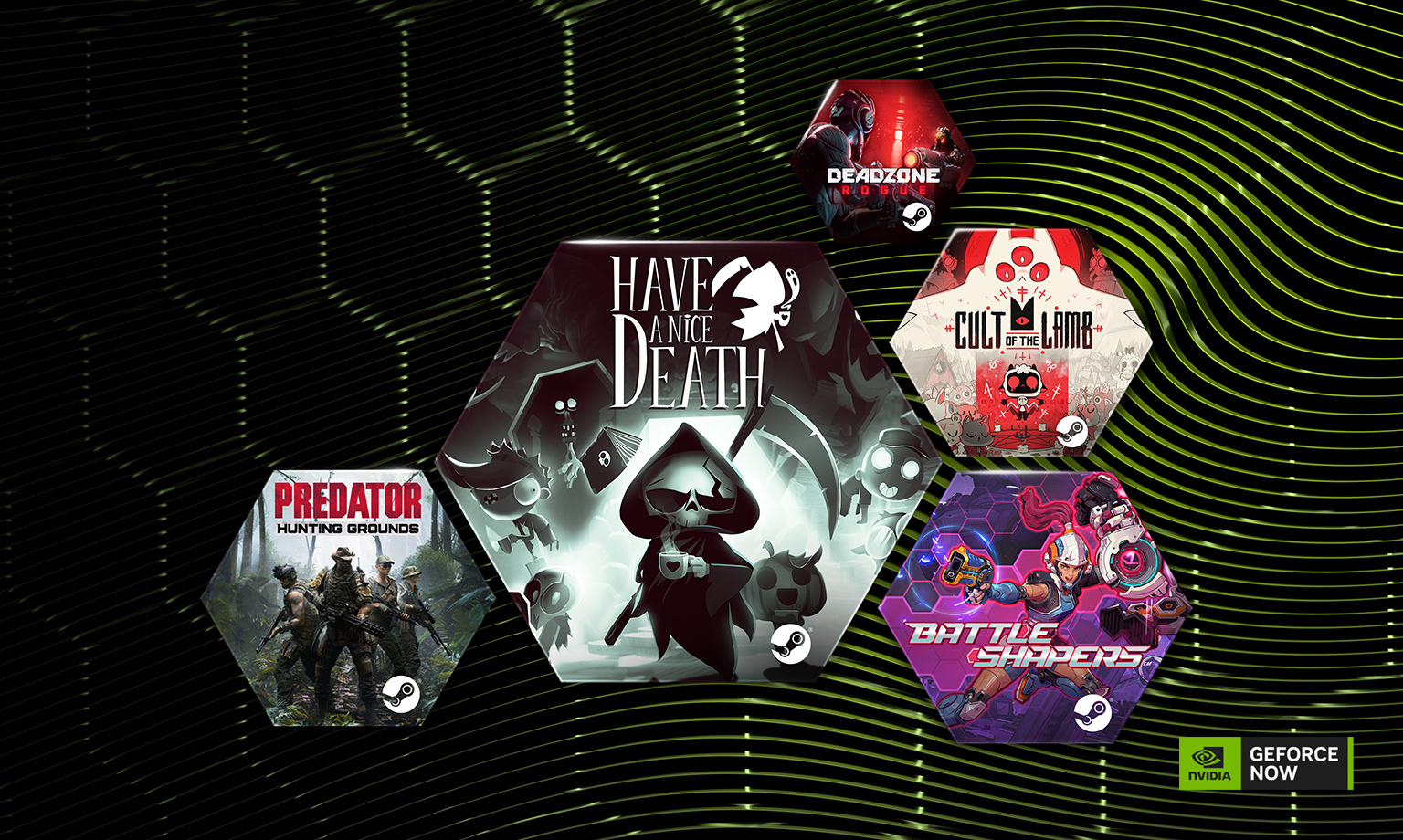
Plus, Dark Scrolls joins the growing Devolver lineup, alongside Square Enix’s The Adventures of Elliot: The Millennium Tales. They lead the charge for six new games joining the GeForce NOW library this week.
Steam Dreams Are Made of These
Add to cart, not to storage.
The Steam Summer Sale is here, bringing discounts across thousands of PC games as one of the year’s biggest opportunities to grow a gaming library.
Supported Steam games can be streamed across devices with GeForce NOW, making it easy to buy a game once, keep progress synced and pick up where the gameplay left off on PCs, Macs, handheld devices, phones, TVs and more.
In other words, the Steam Summer Sale brings the deals; GeForce NOW adds the flexibility.
As new titles expand collections, storage demands and hardware requirements expand with them. GeForce NOW helps remove those barriers by streaming supported games from powerful GeForce RTX servers in the cloud, allowing members to enjoy today’s biggest games on devices they already own. Since downloads and installs are handled in the cloud, games can be added to the cart without being added to storage.
Check out the “Sales & Special Offers” row in the GeForce NOW app to discover the discounts today.
The Ultimate Upgrade to Level Up for Less
The upgrade every game deserves.
The deals don’t stop there. Pair GeForce NOW’s summer sale with the Steam Summer Sale to spend less time waiting on downloads, managing storage or needing pricey hardware upgrades — and more time gaming.
Get $70 off a 12-month Ultimate membership or $35 off a 12-month Performance membership and experience GeForce RTX-powered gaming in the cloud across devices.
The Ultimate membership unlocks GeForce RTX 4080- and 5080-class performance in the cloud with up to 4K resolution, up to 120 frames per second (fps) and advanced technologies like NVIDIA DLSS, ray tracing and NVIDIA Reflex.
Dig Into Devolver
Written in chaos.
Dark Scrolls, the kinetic action roguelite from Devolver Digital, arrives on GeForce NOW with its blend of fast combat, evolving builds and unapologetic chaos. Set in a warped fantasy world that doesn’t take itself too seriously, players battle through shifting arenas packed with enemies, hazards and power-ups that can turn a run from fragile to unstoppable in seconds.
Stack abilities, experiment with wild combinations and adapt on the fly as the game constantly raises the stakes — rewarding bold play as much as careful movement.
On GeForce NOW, Dark Scrolls is ready the moment players are, streaming across devices with no downloads or setup required. It joins a growing lineup of Devolver Digital titles on the service — Cult of the Lamb, Hotline Miami, Hotline Miami 2: Wrong Number, Inscryption, Enter the Gungeon and Ball x Pit — each delivering that distinct mix of style, surprise and controlled chaos, and just a click away with GeForce NOW.
A Storybook Across Centuries
The Adventures of Elliot: The Millennium Tales arrives on GeForce NOW, delivering a charming, narrative-driven adventure filled with mystery and discovery. With a hand-crafted world and a focus on exploration, it blends classic adventure gameplay with modern, character-driven storytelling.
Follow Elliot — a curious traveler bound to a mysterious Millennium Core — as he’s pulled across eras in a journey that spans neon skylines, forgotten ruins and quiet villages on the edge of legend. Each era has its own rules and rhythms, with Elliot’s reactions and scribbled journal notes giving the story a warm, personal touch.
Stream the cinematic-quality visuals and responsive gameplay with GeForce RTX power in the cloud for Ultimate members. Experience Elliot’s time-twisting journey in sharp detail across supported devices — no high-end rig, patches or paradox prep required. Just jump in and pick up from wherever the last chapter left off.
In addition, members can look for the following:
Dark Scrolls (New release on Steam, available June 22)
SAND: Raiders of Sophie (New release on Steam, available June 22)
Deer & Boy (New release on Steam, available June 23)
Leaving the last word to the Community Corner, one GeForce NOW member recently shared being “so impressed” by GeForce NOW. They gave the service a spin because of affordable pricing and took a lower-end PC from 20-30 fps on low settings to 60+ fps with settings maxed out — really putting the WoW in their World of Warcraft.
What are you planning to play this weekend? Maybe even more importantly, what device are you planning to play on? Let us know on X or in the comments below.
The Roland V-1-4K is a compact yet powerful 4K video switcher designed for content creators, corporate AV, education, houses of worship, and live event production. It delivers professional-grade video and audio capabilities without the complexity of traditional broadcast systems, making it an excellent choice for both experienced operators and first-time users.
Five HDMI inputs with built-in scalers allow you to connect cameras, laptops, presentation systems, and other video sources without worrying about matching resolutions or frame rates. Five HDMI outputs—including dedicated Program, Preview, and Multiview outputs—plus two independently scaled outputs provide the flexibility to connect monitors, projectors, recorders, and external displays with ease.
As a leader in professional audio, Roland equips the V-1-4K with XLR microphone inputs, embedded HDMI audio support, RCA outputs, and a dedicated headphone output for monitoring. This integrated audio workflow helps simplify live productions and livestreams while maintaining professional sound quality.
One of the V-1-4K‘s most impressive features is Region of Interest (ROI) cropping. Using a single 4K camera, you can create up to four independent HD camera angles, giving your production a dynamic multi-camera look while reducing equipment costs and simplifying setup.
For graphics, Roland’s free Graphics Presenter software makes it easy to add lower thirds, titles, logos, and images directly into your production. When it’s time to stream, simply connect the USB-C output to your computer and the V-1-4K appears as a webcam source for OBS, Zoom, Microsoft Teams, and other popular streaming platforms—no additional capture device required.
With dedicated hardware controls, physical buttons, and Roland’s signature T-bar transitions, the Roland V-1-4K provides a fast, reliable, and intuitive production experience for professional 4K video switching and livestreaming.
Learn more about the Roland V-1-4K and find the right live production solution at Videoguys.
Customer expectations are changing fast, and the companies winning today aren’t just reacting, they’re transforming how they serve customers from the ground up. The Customer Service Transformation Report from Fin explores how modern teams are using AI, automation, and smarter workflows to deliver faster, more personal, and more scalable customer experiences, without burning out their teams.
In this report, you will learn how to:
Shift from reactive support to proactive, customer-first engagement
Use AI and automation to resolve more customer queries without losing the human touch
Scale customer support and success teams without scaling costs at the same pace
Break down data silos to get a clearer, real-time view of customer needs
Build customer experiences that drive long-term loyalty, not just quick resolutions
Most owners can tell you the exact moment things got bad. Maybe it was a walk that turned into a barking, lunging scene in the middle of the street. Maybe it was a snap at a guest, or a growl that seemed to come out of nowhere.
But here’s the thing: aggression almost never shows up overnight.
Long before the lunging and barking start, dogs are already talking. They look away. They tense up. They freeze. They fixate on something and won’t let go. And most of the time, those quieter signals get ignored, misread, or just plain missed.
So the dog learns something else that works better. A bigger reaction gets results. The stranger backs off. The other dog leaves. The scary thing goes away.
That’s why aggression usually isn’t about the behavior itself. It’s about what that behavior gets the dog.
“Training isn’t about teaching dogs our language. It’s about learning theirs,” says Savanna Tolley, professional dog trainer and owner of multiple The Dog Wizard locations. “When owners start recognizing what their dog is trying to communicate, everything changes. They stop reacting to the explosion and start addressing what causes it.”
Once aggression becomes part of the routine, every outing can feel like a gamble. Every visitor. Every unexpected encounter. All of it starts to feel like a problem waiting to happen.
The First Thing We Teach Isn’t What Most Owners Expect
When people call a trainer about aggression, they usually want one thing: a quick fix. Stop the barking. Stop the lunging. Let them walk their dog again without bracing for disaster.
So it surprises a lot of owners when the first step has nothing to do with the aggression itself.
Training usually starts with plain old obedience that helps aggressive dogs.
Not because “sit” and “stay” magically cure aggression. They don’t. But obedience gives dogs something a lot of aggressive dogs are missing: clarity.
Think about it. A dog that reacts to everything is making too many decisions on its own. Every passing dog, every stranger, every weird noise becomes the dog’s problem to solve. That’s a lot to carry around all day.
Commands like place, heel, sit, and down give a dog a different job. Instead of scanning the street for threats, the dog starts paying attention to the person on the other end of the leash. The dog learns somebody else has this handled.
And that shift is bigger than it sounds.
I’ve watched owners brush off obedience work as too basic for “real” behavior problems. Then those same basics turn out to be exactly what gets them through the hard moments later.
Why Structure Changes Everything
Dogs like clarity, plain and simple.
That doesn’t mean every minute of the day has to run on a schedule. But dogs do better when they know what’s coming. They want to know what’s expected of them. They want a clear way to succeed.
Aggressive dogs aren’t any different.
A lot of aggression cases come down to a dog that can’t handle uncertainty. The world feels unpredictable, so the dog tries to control it. Bark first. React first. Push the threat away before it gets too close.
From the outside, that can look like confidence. It usually isn’t.
A genuinely confident dog doesn’t feel the need to make a scene every time something unfamiliar shows up. The dogs throwing the biggest fits are often the ones who feel the most unsafe.
This is where structured obedience earns its keep. Not because it shuts behavior down, but because it gives the dog a framework. Instead of guessing what to do, the dog already knows.
The dog that used to charge the front door learns to go to place.
The dog that used to drag its owner down the sidewalk learns to walk in heel.
The dog that used to obsess over every little distraction learns to lock onto the person holding the leash.
None of that happens overnight. But it starts building a new pattern, one rep at a time.
The Real Goal Isn’t Perfect Obedience
Here’s a misconception that trips a lot of people up: they think the goal is a robot dog, one that follows every command without fail.
That’s not realistic. And honestly, it’s not even the point.
The real goal is decision-making.
Every aggressive dog hits moments where emotion takes over. Fear. Frustration. Anxiety. Excitement. The emotion changes, but the result is usually the same: the dog stops thinking and starts reacting.
Instead of exploding straight into a reaction, the dog learns to pause. That pause might only last a second or two at first. But it matters. It’s the difference between an impulsive decision and a chosen one.
That pause is where the real progress lives.
Savanna Tolley reminds owners that success isn’t about perfection.
“It’s easy to focus on what still needs work,” she says. “But when a dog that used to react every single time starts checking in with their owner before making a decision, that’s a huge win. Those small changes are often the beginning of lasting transformation.”
Why Owners Matter More Than They Think
A lot of people assume the trainer’s job is to fix the dog, period.
Ask any experienced trainer, and they’ll tell you that’s not how it works.
The trainer hands over the guidance, the education, the plan. But the owner is the one living with the dog every single day.
The real progress happens between sessions: on morning walks, when guests show up at the door, in the moments when the owner picks consistency over convenience.
And here’s something worth noting. The families who see the biggest changes usually aren’t the ones with the easiest dogs. They’re the ones who put in the work and follow through. They understand that obedience training helps aggressive dogs, but that training isn’t a one-hour appointment once a week. It lives in the everyday stuff.
That goes double for aggression cases.
Dogs learn by repeating things. Every good interaction builds a new habit. Every calm response makes that pattern a little stronger. Bit by bit, those new patterns start replacing the old ones that once felt impossible to break.
A Better Future Starts With Better Communication
Aggression can feel like too much when you’re in the thick of it. It messes with your routines, your relationships, your confidence. Some owners just start avoiding situations altogether, because managing the behavior feels easier than fixing it.
But avoidance doesn’t teach a dog anything. Training does.
Obedience training won’t erase a dog’s past, its personality, or its emotional wiring. What it can do is hand owners a way forward. Obedience training helps aggressive dogs develop the skills to handle hard situations better, and it gives owners the tools to guide them through the stuff that once felt impossible.
The best part of aggression rehab isn’t watching a dog nail a command. It’s watching a dog that used to feel completely out of control start making better choices on its own. It’s owners getting their confidence back. It’s a relationship that started in frustration turning into one built on trust.
For dogs working through aggression, that change rarely starts with punishment. It starts with communication, structure, and a clear path forward.
In late May, federal authorities charged a Google software engineer with insider trading after he won $1.2 million on the prediction-market website Polymarket. The 36-year-old Michele Spagnuolo allegedly placed bets that musician D4vd and rapper Kendrick Lamar would top Google’s most-searched list. The bets paid off, prosecutors said, because Spagnuolo had access to confidential company data.
The popularity of prediction markets, where you can bet on thousands of real-world outcomes across nearly every facet of modern life, is spreading faster than governments can keep up. Even Mark Zuckerberg, Meta’s chief executive, is reportedly developing a standalone prediction market app to compete with the most popular platforms, Kalshi and Polymarket.
You may have even been tempted yourself to put down cash on your favorite pop-culture hunch. But the recent Google case highlights just one of the biggest concerns for a multibillion-dollar industry prone to abuse. Numerous insider trading cases have prompted federal regulators to intensify scrutiny, cracking down on the illegal use of classified information for betting.
A New York Times investigation in May flagged more than 11,000 Polymarket accounts for suspicious, high-profit trading patterns, often involving perfectly timed bets on geopolitical events, and flawless, loss-free track records. And it’s not just corporate employees; it’s also military personnel and government officials manipulating classified information.
With Polymarket, users trade shares using cryptocurrency to bet on the outcomes of real-world events.
Just last week, a Wall Street Journal investigation revealed that Polymarket ran a deceptive, secret marketing campaign by paying social media influencers to film fake trades and stage massive winnings on lookalike dummy websites to draw people in.
“This industry is growing fast and will continue to grow as long as courts and regulators allow it,” Columbia University professor of economics Rajiv Sethi told CNET.
People generally have strong opinions surrounding prediction markets, and many (like me) feel a bit icky about them. But how the industry shakes out will depend on several regulatory battlegrounds. Prediction markets are facing intense pushback from lawmakers over insider trading, highlighted by a congressional probe and a proposed bill to ban prediction-market bets by service members. Yet because no one can agree whether betting markets are legitimate financial tools or just a glorified form of gambling, they’re causing a massive headache at the state and federal levels.
Kalshi lets users trade contracts on events ranging from politics and economic data to weather and sports.
Adobe Stock
How prediction markets work
To any casual observer, Polymarket and Kalshi seem like virtual casinos, except you’re betting against other participants, not against “the house.” You can buy and sell contracts about anything: the weather, geopolitical events, election results, sports, entertainment awards, ad nauseam.
Several high-profile predictions over the past several months involved the US attacking Iran, Michael B. Jordan winning the Oscar for Best Actor and bitcoin topping $125,000. You can even predict if someone is going to utter a certain word in a speech or news conference in what are called “mention markets.”
With a mainstream boom in prediction market platforms over the last few years, other companies have joined the fray: Robinhood, PredictIt, Metaculus and even traditional sportsbooks FanDuel and DraftKings.
These types of “idea futures” aren’t new, though. Informal information markets date back hundreds of years, as seen in the 1500s in Italy, where people predicted who the next pope would be.
Today’s prediction markets claim they aren’t technically gambling or akin to trading stocks, even though you’re risking money in hopes of a profit. In essence, you’re predicting something will or won’t happen. For every “share” you buy for that event outcome, you get $1 if you’re right and nothing if you aren’t. The markets don’t set the “odds,” and neither do the platforms — the traders do.
The amount of shares you’re able to buy for a certain outcome depends on how many shares are being sold for the opposite outcome by other traders. For example, if you wanted to buy 500 shares of a Yes outcome on France winning the World Cup, there would have to be 500 corresponding shares of No on France winning.
Though the basic unit for prediction markets is only $1, business is booming for Kalshi and Polymarket, which collect transaction fees for each trade. Together, they’ve crossed $150 billion in lifetime trading volume.
Polymarket offers predictions on the weather and a lot else.
Polymarket/Screenshot by CNET
A personal look inside
I’m not a bettor. I suck at poker, I still can’t understand a Daily Racing Form, and don’t get me started about March Madness brackets. So, I’m not about to test my luck (yet) with Kalshi or Polymarket, but I did want to take a peek under the hood.
Kalshi and most other prediction markets are available for customers in all 50 states, but Polymarket, a cryptocurrency-based company, is restricted in the US and several other countries, at least for now. Some people try to bypass geographic restrictions using a VPN, even though Polymarket says it blocks VPN IP addresses.
Kalshi and Polymarket both offer a dizzying array of exchanges. Kalshi has basic event categories, from the California governor race to the price of a gallon of gas. It also has some rather off-the-wall ones, like the “Scary Tomatoes” score on Rotten Tomatoes and the US government’s disclosure of aliens.
Columbia professor Sethi advises anyone interested in trading prediction markets to tread lightly at first.
“Most novice retail traders lose money, so my advice to those who want to experiment is to focus on events about which you know something about the topic, and keep bets small to begin with, until you get a feel for your likely performance,” Sethi told CNET.
The hard truth is that prediction market traders are far more likely to lose than to win. The Wall Street Journal reported in May that 0.1% of all Polymarket accounts won 67% of the profits. That translates to 2,000 top traders netting more than $500 million, while 1.1 million Polymarket customers didn’t make a profit.
There are thousands of events to predict on with Kalshi.
Kalshi/Screenshot by CNET
Social function or political tool
Another fundamental question I have is whether these markets serve a socially useful purpose.
Better Markets, a nonprofit focused on financial and economic justice, argues that prediction markets lack real value. While traditional financial contracts help institutions manage risks, prediction markets do not. Unlike the stock market, they fail to fund businesses or help investors build long-term wealth.
Amanda Fischer, chief operating officer at Better Markets, said that bets around elections or war in Iran “serve no function but to degrade our democracy and encourage insider trading.” According to Fischer, prediction markets look more like gambling, especially since over 90% of bets on those platforms are related to sporting events.
In response to scandals around insider trading, Kalshi says it is aggressively self-policing by tracking suspicious activity and requiring some of its users to disclose their employers. Kalshi also says its safeguards against politicians and athletes are stricter than those of traditional stock exchanges.
Donald Trump Jr. (left) holds official advisory roles at both Kalshi and Polymarket.
Mandel Ngan/AFP/Getty Images
Meanwhile, Polymarket’s decision to maintain user anonymity has drawn heavy criticism from financial experts, who argue it leaves the platform vulnerable to fraud. Without strict identity verification, the platform allows insiders to exploit nonpublic information while enabling bad actors to “spoof” trades and trick ordinary people into following fake trends, according to Sethi, who wrote an opinion piece for the Financial Times titled “Polymarket Anonymity Must End.”
As prediction markets continue to face security concerns over fraud and insider trading, they have a powerful shield from the federal government and President Trump, who has aggressively pushed back against state-level restrictions.
This political alignment is further complicated by the president’s son, Donald Trump Jr., who reportedly has an eight-figure investment in Polymarket and serves as an adviser to Kalshi. Although his involvement has sparked intense suspicion of a conflict of interest, Trump Jr. maintains that he does not trade on the platforms or lobby the government on their behalf.
A regulatory dilemma
At its core, the regulatory mess stems from an identity crisis. Prediction markets are hard to classify, straddling the line between commodity contracts and security-based investments. This has triggered a massive turf war over jurisdiction, as the federal government attempts to override state and tribal gaming laws that view these markets as illegal sportsbooks trying to bypass local restrictions.
Kalshi says it strictly prohibits insider trading and actively screens users who trade on confidential data.
Sandia Pueblo Gov. Stuart Paisano, one of the plaintiffs, in a statement, said, “The use of prediction markets for gambling purposes diverts essential revenue away from our governments, provides an end-run around regulation of gaming on our lands, and allows gaming by underage people.”
At the federal level, prediction markets are formally categorized as commodities and derivatives, placing them under the jurisdiction of the Commodity Futures Trading Commission, or CFTC.
Kalshi CEO Tarek Mansour, who, along with fellow MIT graduate Luana Lopes, founded the company in 2018, says prediction markets aren’t traditional sportsbooks but more like open marketplaces. Mansour says Kalshi’s event contracts are financial derivatives, just like common futures, options and swaps, and should be appropriately regulated by the CFTC.
But some legal scholars and financial reform advocates argue that prediction markets should fall under the purview of the Securities and Exchange Commission, or SEC.
According to Better Markets’ Fischer, the CFTC has fewer tools to police insider trading in prediction markets. As an agency tasked with specifically overseeing agricultural and certain financial derivatives, it was only recently self-appointed as a gambling regulator. “As a result, there are some gaps and ambiguity in the CFTC’s legal framework,” she said.
Fundamentally, the CFTC’s rules on insider trading are historically much weaker than the SEC’s. “The SEC has 90 years of law and legal precedent, which have created a robust set of rules around insider trading,” said Fischer.
The CFTC is supposed to act as the federal watchdog over Kalshi and take direct legal action against insider trading and market manipulation.
The CFTC is also chronically understaffed, according to Fischer. The agency has cut more than 20% of its staff during the second Trump administration.
Fischer said CFTC’s enforcement is a “drop in the bucket” compared with the enormous volume of trades being transacted at Kalshi. “The CFTC has only been able to identify and prosecute the most egregious cases, and in many other instances, has delegated enforcement to firms like Kalshi, whose only tool is to kick users off the platform,” Fischer said.
Do we really need this?
The danger of prediction markets is the financialization of our society at large, where “every opinion is a tradeable asset,” wrote Jathan Sadowski, associate professor at Monash University in Melbourne, Australia.
There’s also a risk if prediction markets define “truth” as simply a publicly verifiable consensus. If, as Sadowski noted, “the market is the ultimate arbiter of what’s valuable and true,” that leads to a “world that creates endless incentives for arbitrage, manipulation, collusion and exploitation in the pursuit of profit extraction.”
In an episode of Last Week Tonight on prediction markets, comedian John Oliver asked if we’ll be able to believe our eyes when future events occur. “When something unexpected happens in the world, it would be really nice not to have to automatically question whether it’s only because someone is trying to move a market.”
At the end of the day, I keep coming back to why these tools exist in the first place. Prediction markets shouldn’t just be a playground for day traders looking for their next fix. But to prove that it’s not just another corrupt form of speculative gambling, the industry has some massive hurdles to clear.
CNET’s Laura Michelle Davis heavily contributed to and edited this story.
AI can help a lot with multi-location PPC, but only when it has the right data to work with. A lot of franchisors and multi-location brands are already using AI in some form inside their Meta and Google ad campaigns. Their PPC teams may be using AI to write headlines, generate ad copy, come up with creative ideas, or speed up campaign planning.
That is useful, but it is only one small part of the opportunity.
The bigger opportunity in multi-location ads is not just using AI to create a few better headlines. The real opportunity is using AI to make campaigns smarter at the location level.
That matters because every location is different.
One location may have strong reviews.
Another location may have a missed call problem.
One location may need more first-time customers.
Another location may already be fully booked and should only focus on higher-value appointments.
One location may have a strong local offer.
Another location may need better lead quality, not just more leads.
This is where AI can become very useful for multi-location marketing. But only if the AI has clean location data first.
If you are a franchisor, multi-location brand, or a digital agency for franchisors, this is one of the most important things to understand before trying to use AI for paid ads.
The Problem: AI Cannot Create Smart Local Campaigns from Generic Inputs
Most people think about AI in PPC like this:
“Create me some ad copy.”
“Give me five headlines.”
“Write a Meta ad for this offer.”
“Create a Google Ads campaign for this service.”
That is fine for a basic use case.
But if you are managing ads across 10, 20, 50, or 100 locations, generic prompts will create generic output.
AI does not automatically know what is happening inside each location.
It does not know which location has the best reviews.
It does not know which location is missing calls.
It does not know which location has low booking capacity.
It does not know which location has a higher average ticket size.
It does not know which local offer is active in which market.
It does not know what your CRM is showing about lead quality.
It does not know whether the problem is the ad campaign or the local operation after the lead comes in.
So when the data is missing, AI usually creates the same type of ad for every location.
That is where multi-location PPC starts to break down.
You get the same messaging everywhere.
You use the same offer across different markets.
You do not use local proof from reviews.
You do not connect campaign ideas to actual reporting.
And over time, it becomes harder for the PPC team to remember what they were testing and why.
The Better Approach: Build a Location Intelligence Layer First
Before using AI to generate campaigns, multi-location brands need a clean location intelligence layer.
This is a structured profile for each location that gives AI the context it needs.
For example, if you are managing PPC for a dog grooming franchise, each location profile should include information like:
Location name
City and state
Location landing page
Google Business Profile rating
Review count
Review themes
Priority service
Local offer
Monthly ad budget
Average ticket size
Booking capacity
Lead volume
Booked appointments
Appointment show rate
Missed call rate
Current cost per acquisition
Business goal
Franchisee notes
This is not just “data for the sake of data.”
This is the information AI needs to create better campaign ideas.
If one location has reviews talking about “gentle staff” and “great with nervous dogs,” that can become an ad angle.
If another location has a high missed call rate, the campaign may need to push online booking instead of phone calls.
If another location has a high average ticket size, the campaign may focus on premium services instead of discounts.
If one location has low capacity, the goal may not be more leads. The goal may be better-quality appointments.
That is how AI becomes useful in multi-location marketing.
What Data Sources Should Feed the AI?
The data layer does not need to be complicated at first.
It can start with a structured sheet or a simple internal app.
The key is to bring the right data into one place.
Here are the main data sources that matter for multi-location ads.
1. Brand Website
The brand website gives AI the basic brand information.
This includes:
What the brand does
What services are offered
What tone the brand uses
What offers are approved
What claims are allowed
What the primary call to action should be
This helps AI stay on brand.
For example, if the brand tone is warm, simple, and trustworthy, the AI should not create aggressive or overly salesy ad copy
2. Location Landing Pages
Location landing pages are very important for multi-location PPC.
Each location may have different services, offers, booking links, or local messaging.
For example:
Austin may promote first-time grooming appointments.
Dallas may promote online booking.
Denver may focus on premium grooming.
Tampa may focus on puppy grooming.
Scottsdale may focus on senior dogs or sensitive pets.
If AI can read and understand each location page, it can create ads that match what is actually true for that location.
3. Google Business Profile Reviews
Google Business Profile data can give AI local proof.
This includes:
Average rating
Review count
Review keywords
Common review themes
Customer language
Local trust signals
This is one of the most useful sources for ad messaging.
Customers often describe the real reason they chose a business.
For example, a dog grooming location may have reviews mentioning:
“Gentle with nervous dogs”
“Easy online booking”
“Premium grooming”
“Great with puppies”
“Calm environment”
“Friendly staff”
Those words can become campaign angles.
Instead of creating generic copy, AI can use real local proof from that location.
4. CRM Data
CRM data tells you what happened after the lead came in.
This is where PPC gets much smarter.
The CRM can help AI understand:
How many leads came in
How many became booked appointments
Which services people asked about
Which locations had stronger lead quality
Which campaigns produced better customers
What the show rate looked like
This matters because PPC should not only be judged by leads.
A campaign that generates cheap leads may not be the best campaign if those leads do not book, show up, or buy.
For multi-location marketing, CRM data helps connect ads to real business outcomes.
5. Call Tracking Data
Call tracking is one of the most important data sources for local PPC.
Many multi-location businesses depend heavily on phone calls.
But sometimes the ad campaign is not the real problem.
The real problem may be that the location is missing too many calls.
For example, if a location has a 30% missed call rate, spending more on ads may only create more missed opportunities.
AI needs to know that.
Call tracking data can include:
Answered calls
Missed calls
Average call duration
Booked calls
Call source
Call quality
This gives AI better context before recommending more ad spend.
For example, if Dallas has a high missed call rate, the campaign may need to focus on online booking instead of phone calls.
That is a location-specific decision that AI can only make when it has clean data.
6. Ad Platform Data
Ad platform data tells AI what has worked in the past.
This may come from Meta Ads, Google Ads, or a manual report upload.
Useful fields include:
Spend
Impressions
Clicks
CTR
Leads
Cost per lead
Booked appointments
Cost per booking
Conversion rate
Campaign angle
Location
This helps AI compare future campaigns against past performance.
It also helps the PPC team avoid starting from scratch every time.
7. Manual Inputs
Not all useful data lives inside software.
Some of it may need to be entered manually.
For example:
Monthly local budget
Average ticket size
Location capacity
Priority service
Local offer
Business goal
Franchisee notes
This is very common for franchisors and multi-location brands.
The important thing is not where the data comes from.
The important thing is that the AI can access it in a clean, structured way.
Example: A Dog Spa Franchise with 10 Locations
In the video, I use a fictional dog spa franchise called PawPure Spa.
The brand has 10 locations.
For the demo, we look at the first five:
Austin Downtown
Dallas North
Denver Cherry Creek
Tampa Bay
Scottsdale
Each location has a different PPC opportunity.
Austin Downtown
Austin has strong reviews around gentle handling and nervous dogs.
So the campaign angle is:
Gentle care for first-time grooming appointments.
The AI creates copy around trust, comfort, and calm care.
Dallas North
Dallas has good lead volume, but a higher missed call rate.
So the campaign angle is different.
Instead of pushing phone calls, the campaign promotes online booking.
That is because the local data shows that phone-call-heavy messaging may not be the best move.
Denver Cherry Creek
The copy is not focused on discounts.
It is focused on quality, trust, and a better grooming experience.
Tampa Bay
Tampa has a strong puppy grooming opportunity.
So the campaign focuses on a puppy’s first spa visit.
That matches the local customer segment and the review themes.
Scottsdale
Scottsdale has high reviews and high average ticket size, but lower booking capacity.
So the campaign does not aggressively push volume.
Instead, it focuses on high-value appointments and gentle care for senior dogs or sensitive pets.
How AI Generates Better Campaigns from Clean Data
Once the location intelligence is ready, AI can help create better PPC campaigns.
The process looks something like this:
Choose the platform, such as Meta Ads or Google Ads.
Choose the campaign objective.
Select the locations.
Choose the AI strategy.
Review the brand rules.
Generate the campaign package.
In the demo, I choose Meta Ads and select appointment bookings as the objective.
Then I choose five locations.
The AI uses the data from each location to create a different campaign angle.
This is the important part.
AI is not just writing five versions of the same ad.
It is creating five different local campaign strategies.
Austin gets gentle care messaging.
Dallas gets online booking messaging.
Denver gets premium grooming messaging.
Tampa gets puppy grooming messaging.
Scottsdale gets senior dog comfort messaging.
That is what makes the campaign more useful.
Why the Campaign Hypothesis Matters
One of the biggest benefits of this approach is that AI does not just generate the ad.
It also stores the campaign hypothesis.
That means the system remembers what the campaign was trying to test.
For example:
Austin hypothesis:
Reviews mention nervous dogs and gentle staff, so gentle care messaging should increase first-time grooming appointments.
Dallas hypothesis:
Missed call rate is high, so online booking should improve conversion.
Denver hypothesis:
High average ticket size and premium reviews mean premium grooming messaging should produce better revenue per booking.
Tampa hypothesis:
Puppy grooming reviews suggest a first puppy visit campaign may attract new customers.
Scottsdale hypothesis:
High-value customers and low capacity mean the campaign should focus on appointment quality, not volume.
This matters because most reporting only tells you what happened.
But when AI knows the hypothesis, it can help explain whether the campaign idea actually worked.
The PPC Manager Still Reviews and Launches the Campaign
This is not about replacing the PPC manager.
The PPC manager still needs to review the campaign.
They need to check the messaging.
They need to verify the offers.
They need to make sure the landing pages are correct.
They need to review the budget, audience, and setup.
They need to launch or upload the campaign inside Meta Ads Manager or Google Ads.
AI helps prepare the campaign package.
The PPC manager still brings judgment.
This is the right balance.
AI creates speed and structure.
The PPC manager brings experience and control.
The Reporting Loop: Where AI Becomes Even More Useful
After the campaign runs, the PPC team can upload the performance report.
This could be a Meta Ads export, Google Ads export, or a combined reporting file.
Now AI can compare the results against the original campaign hypothesis.
That is where the system becomes more useful than a normal report.
Instead of only saying:
CTR went up.
CPA went down.
Spend increased.
Leads increased.
The AI can say:
This campaign angle worked.
This campaign angle did not work.
This location has an operations issue.
This location should not scale because capacity is low.
This location should be measured by revenue per booking, not only cost per lead.
This location needs a new offer.
This location should test a new creative angle.
That is much more useful for multi-location PPC.
Example Reporting Insights
In the demo, the system shows that 3 out of 5 location hypotheses worked.
Austin worked well.
The gentle care angle created strong appointment volume and a low cost per booking.
Denver worked well.
The premium grooming campaign had lower lead volume, but better estimated revenue because the average ticket size was higher.
Scottsville worked well.
The campaign brought in high-value appointments, but the recommendation was not to scale too aggressively because booking capacity was low.
Dallas was mixed.
The campaign generated clicks and leads, but bookings were weaker than expected.
The reason was not just the ad.
The missed call rate was still high.
So the recommendation was to push online booking harder and fix call handling before increasing ad spend.
Tampa was also mixed.
The puppy grooming campaign got good engagement, but it did not turn into enough booked appointments.
So the next test could focus on stronger appointment urgency.
What This Means for Franchisors and Multi-Location Brands
For franchisors and multi-location businesses, the main takeaway is simple.
AI can help your PPC team, but only if the inputs are strong.
If you only ask AI to create ad copy, you will get basic ad copy.
But if you give AI clean location intelligence, it can help with much more.
It can help identify the right campaign angle by location.
It can create localized ad copy.
It can use local proof from reviews.
It can factor in CRM and call tracking data.
It can avoid pushing volume where capacity is low.
It can help PPC managers understand whether a campaign idea worked.
It can make the next campaign smarter.
This is where multi-location ads can become more strategic.
The goal is not just more ads.
The goal is better location-level decisions.
The First AI Project May Not Be Ad Generation
A lot of teams want to start with the exciting part.
They want AI to generate ads, creatives, and campaign ideas.
But for many multi-location brands, the first AI project should probably be something else.
The first project should be building the clean data layer.
Because once the location intelligence layer exists, many other AI use cases become easier.
Multi-location PPC becomes easier.
Multi-location marketing becomes easier.
Reporting becomes easier.
Campaign planning becomes easier.
Franchisee-level insights become easier.
And your PPC team has a much better foundation to work from.
This is especially important for any digital agency for franchisors that is managing paid media across many local markets.
The agency can move faster, but it can also make better decisions because the data is cleaner.
Final Thought
AI can improve multi-location PPC.
It can improve multi-location ads.
It can support better multi-location marketing.
But AI is not magic.
It needs clean inputs.
It needs location-level context.
It needs review data.
It needs CRM data.
It needs call tracking data.
It needs ad performance data.
It needs business goals.
It needs human approval.
When all of that comes together, AI becomes much more useful.
It is no longer just a tool that writes headlines.
It becomes a system that helps your PPC team understand each location, create better campaigns, track what they were testing, and make better decisions from the results.
That is the real opportunity.
At Weam, we help franchisors and multi-location businesses build custom AI tools for their own marketing and operations workflows.
If you are looking for a digital agency for franchisors or want to explore how AI can improve your multi-location marketing, visit weam.ai to learn more.
Good news if you’re one of the die-hards still clinging to Windows 10: Microsoft has added another year to its Extended Security Updates, meaning the axe won’t fall until October 2027.
Microsoft announced in 2024 that support for Windows 10 would be wrapped up in October 2025, bringing an effective end to one of the good Windows and not-so-gently nudging us all onto one of the sucky ones.
But then a reprieve was granted: For $30, or free if you’re lucky, those who wanted to stay with a good Windows could purchase “Extended Security Updates,” which keeps security updates from Microsoft flowing for another year. Feature updates are dead and done either way, but the ESU program at least ensures that Windows 10 PCs are protected from malware, ransomware, and other such headaches that exist in the online world.
Latest Videos From
The ESU program was set to last for a year from the end of Windows 10 support—so, October 2026—but as noticed by Windows Central, the ESU page has now been updated and indicates that the program will run until October 2027. Those who are already enrolled in the program will get the by default, and—if you had to pay for the ESU—at no extra charge.
That’s pretty fantastic news. There are still a lot of Windows 10 users out there: The Steam Hardware and Software Survey reports that 24% of respondents are still rocking with Win10 64 bit, and that’s a substantial audience.
Nor are people just being difficult about it: Windows 10 is objectively better than Windows 11, sure, but Win11’s more demanding hardware requirements mean it won’t install on some older hardware, or that owners of said rigs have to rely on external tools like Rufus to make it happen.
The obvious solution to that problem when the 2026 deadline was set was “it’s time for a new PC,” but then the Rampocalypse happened and suddenly we were all left with the grim knowledge that we’re probably gonna be riding this pony for a lot longer than we’d expected. And, rather like motherboard makers deciding it’s time for a DDR3 comeback, Microsoft may have concluded that forcing people into an ultra-expensive upgrade they don’t want to make is trouble it doesn’t need—especially since Microsoft bears no small amount of responsibility for making hardware upgrades so damned expensive in the first place.
Keep up to date with the most important stories and the best deals, as picked by the PC Gamer team.