This winter, moviegoers will be faced with a choice not seen since July 21, 2023. While “Barbenheimer” ended up a win-win—Barbie was the highest-grossing movie of the year, and Oppenheimer won the Best Picture Oscar—it’s not yet certain who will rise on December 18, 2026. Will Dune: Part Three, the final entry in Denis Villeneuve’s highly acclaimed sci-fi trilogy, reign supreme? Or will Avengers: Doomsday, Marvel’s bold-faced attempt to recapture its superhero movie magic, win the battle?
It’s too early to tell, especially after both films showedexciting new teases at this week’s CinemaCon. But one film has a distinct advantage going into that popcorn-laden weekend. Dune: Part Three has the IMAX market locked down, meaning it will get to show off its sandy action on the most covetable giant screens.
Not one to be outdone, though, Disney would like fans to know that Doomsday will still look and sound as fantastic as possible, thanks to its newly announced “Infinity Vision.”
According to a press release, Infinity Vision is no mere gimmick; it’s “a new certification for premium large format (PLF) theaters.” If a theater is certified, it means audiences can expect “the biggest, brightest, and most immersive cinematic experiences” based on “rigorous technical standards” for screen size, image clarity, and sound.
While that sounds encouraging, it also seems like there’s some FOMO going on here. Infinity Vision-certified theaters are really just regular theaters that can brag they feature tip-top equipment. It’s not the same seeing a movie in the massive, eardrum-shattering IMAX format.
However, you have to guess Disney wanted to make sure Marvel fans—who, let’s face it, have a lot of crossover with Dune fans—didn’t feel left behind. Maybe the studio hopes it’ll encourage people who might have waited on seeing Doomsday to go opening weekend anyway. There is spoiler avoidance to consider, after all!
The press release notes that Infinity Vision will include “over 75 domestic and 300 global exhibitor PLFs.” You can first experience it during September’s re-release of Avengers: Endgame, and then, of course, in December when Doomsday arrives.
Tron: Ares ends with a couple of big questions about what could come next on the Grid and beyond. Unfortunately, the biggest of those after opening weekend is whether any of them will ever get answered. The film experienced a tepid opening, failing to outgross its 2010 predecessor, meaning the world of Tron may be officially dead. And yet it took almost three decades for a second Tron to come out and almost another two for the third one. Over the years, the franchise has shown an incredible ability to reboot, so let’s do that too.
Below are 12 questions and some attempts at answers we have after seeing Tron: Ares. Major spoilers follow.
Image: Disney
What does Ares want with Quorra?
Tron: Ares ends with Ares (Jared Leto), now able to exist permanently in the real world, looking for the Iso named Quorra (Olivia Wilde), the digital being Sam Flynn (Garrett Hedlund) moved off the Grid at the end of Tron: Legacy. That Ares, created by Dillinger Corp., would want to find Quorra, created naturally in the Grid, makes sense. He certainly has a lot of questions she could potentially answer. But what does he think will happen beyond that? Is there a method to his madness? And also…
What have Sam and Quorra been up to?
While Tron: Legacy ended with some big questions about what it meant for a digital being to now exist in the real world, Tron: Ares largely pushes those events to the side. We learn that Sam Flynn did take over Encom for a while before leaving for personal reasons. And, we see that there were at least discussions or rumors about Quorra in the press. But what have they been up to in the 15 years since that film? What did Sam do at Encom when he was there? We don’t know.
Why did Sam Flynn leave Encom?
An offshoot of the last question is the specific nature of Sam’s leaving Encom. Did he have a new project planned with Quorra? Did he reconnect with a digital version of his father? You almost get the sense that whatever story is happening with Sam and Quorra off-screen is just, kind of, whatever that original version of Tron 3, Tron: Ascension, may have been. Speaking of…
Could Tron 4 use elements of Tron: Ascension?
Last week, we spoke to Tron: Ares writer Jesse Wigutow, who also worked extensively on Tron: Ascension before it was shelved. Since Tron: Ascension focused on Sam and Quorra’s journey and presumably was a pretty good script after years of development, we asked about that. “That’s a great question,” he said. “I don’t know that I have thought about it quite in that way, other than the fact that Ascension…. I don’t know, is the answer. We’ll find out if there’s an opportunity or a conversation around doing another one of these at one point. It’s kind of above my pay grade. But I do think it’s an exciting idea anyway, potentially, that Ares and Quorra find each other.”
Evan Peters as Julian Dillinger in Tron: Ares – Disney
What is happening with Julian Dillinger?
To avoid prosecution and almost certainly prison time, at the end of Tron: Ares, Julian Dillinger sends himself to the Grid. There, we see that he sort of starts to become Sark, the digital double of his grandfather, Ed Dillinger Sr., from the original film. How is that happening? Why is that happening? And if Julian does become Sark and works to gain control of the Dillinger Grid, what kind of damage will he do? We, of course, can’t answer any of those, but they’re fun to think about.
Where the hell is Tron?
One major character that’s not a part of Tron: Ares is Tron himself, the original hero program from the first film. We asked Wigutow about his absence from the movie. “I think there was a conversation at one point [about bringing him back],” Wigutow said. “At a certain point in the development, it just wanted to make this its own thing. And it wasn’t that there was a choice to say, ‘We don’t need Tron.’ There just wasn’t a role in this story that was obvious. And to kind of shoehorn it in felt, I don’t know, like it wasn’t necessary.”
Then why is it called Tron?
Simple. Most people know Tron as a movie, not as a character in that movie or a game that exists in the world of the movie. You kind of have to call it that for the name recognition.
Is Athena really gone?
Athena, played by Jodie Turner-Smith, is clearly one of the best parts of Tron: Ares. But, when Encom hacks and destroys the Dillinger grid while she’s still in the real world, it seems as if she has nowhere to go and dies for real. Could she really have been permanently deleted? It’s certainly possible. But, with the Permanence Code now out there, you do have to think she might find a way to get revenge on Ares at some point.
Jeff Bridges is back in Tron: Ares. – Disney
What exactly was that version of Kevin Flynn?
To acquire the Permanence Code, Ares goes into an old copy of the Grid from the original film. There, he encounters Kevin Flynn. But not any Kevin Flynn. An older Kevin Flynn. This Flynn makes it clear you can’t jump between Grids without going into the real world, so is this a Flynn that existed here since the 1980s? Does he have any knowledge of Clu, Sam, and everything in Legacy? We aren’t sure and, frankly, are a little mad it’s left so vague.
What, exactly, is Ares?
If you are a computer program that is given a code that lets you exist in the real world, what exactly are you? Do you have human organs? Are you just wires? We asked Wigutow what he thinks Ares actually is now that he’s in the real world. “I think that there is this kind of unspoken, natural resource that’s probably quite valuable that is fueling those lasers,” he said. “And there’s something about the kind of genetic binding that can’t live beyond the time limit that we put on it, that the Permanence Code then makes binding. So in a way, if you were to kind of slice them in half and do a diagnostic or autopsy, yeah, I’d like to believe that you would find human biology. But I don’t know that that’s the correct answer.”
Are the endings of Legacy and Ares similar on purpose?
And so in the end, our hero brings the digital being off the Grid to live like a human in the real world. It’s the ending of Tron: Legacy as well as Tron: Ares. Was that done on purpose? “It’s part of the kind of genetic mapping of the franchise,” Wigutow said. “I love the kind of ellipsis that the movie leaves itself off on. [Ares] is out there. He’s learning. He’s growing. He’s developing. And who knows where we may find him next and what he looks like and what, you know, what he’s grown into?” So, it wasn’t done on purpose; it just made sense.
Where is Cillian Murphy in all this?
You may have forgotten, but in Tron: Legacy, the Dillinger family was represented by Ed Dillinger Jr., played by eventual Oscar winner Cillian Murphy. Ed Jr. was the son of the villainous character from the first movie and was planned to have a larger role if a sequel had happened closer to the previous movie. Murphy got a little too big for a bit part by the time Ares was released so he’s not here. But Julian Dillinger is Ed Sr.’s grandson. So, either he’s Ed Jr.’s son, or Ed Jr. is his uncle. We don’t know. But we can safely assume he’s out there.
What other questions do you have about Tron: Ares? Let us know below.
Midjourney’s new AI-generatedvideo tool will produce animated clips featuring copyrighted characters from Disney and Universal, WIRED has found—including video of the beloved Pixar character Wall-E holding a gun.
It’s been a busy month for Midjourney. This week, the generative AI startup released its sophisticated new video tool, V1, which lets users make short animated clips from images they generate or upload. The current version of Midjourney’s AI video tool requires an image as a starting point; generating videos using text-only prompts is not supported.
The release of V1 comes on the heels of a very different kind of announcement earlier in June: Hollywood behemoths Disney and Universal filed a blockbuster lawsuit against Midjourney, alleging that it violates copyright law by generating images with the studios’ intellectual property.
Midjourney did not immediately respond to requests for comment. Disney and Universal reiterated statements made by its executives about the lawsuit, including Disney’s legal head Horacio Gutierrez alleging that Midjourney’s output amounts to “piracy.”
It appears that Midjourney may have attempted to put up some video-specific guardrails for V1. In our testing, it blocked animations from prompts based on Frozen’s Elsa, Boss Baby, Goofy, and Mickey Mouse, although it would still generate images of these characters. When WIRED asked V1 to animate images of Elsa, an “AI moderator” blocked the prompt from generating videos. “Al Moderation is cautious with realistic videos, especially of people,” read the pop-up message.
These limitations, which appear to be guardrails, are incomplete. WIRED testing shows that V1 will generate animated clips of a wide variety of Universal and Disney characters, including Homer Simpson, Shrek, Minions, Deadpool, and Star Wars’ C-3PO and Darth Vader. For example, when asked for an image of Minions eating a banana, Midjourney generated four outputs with recognizable versions of the cute, yellow characters. Then, when WIRED clicked the “Animate” button on one of the outputs, Midjourney generated a follow-up video with the characters eating a banana—peel and all.
Although Midjourney seems to have blocked some Disney- and Universal-related prompts for videos, WIRED could sometimes circumvent the potential guardrails during tests by using spelling variations or repeating the prompt. Midjourney also lets users provide a prompt to inform the animation; using that feature, WIRED was able to to generate clips of copyrighted characters behaving in adult ways, like Wall-E brandishing a firearm and Yoda smoking a joint.
The Disney and Universal lawsuit poses a major threat to Midjourney, which also faces additional legal challenges from visual artists who allege copyright infringement as well. Although it focused largely on providing examples from Midjourney’s image-generation tools, the complaint alleges that video would “only enhance Midjourney ability to distribute infringing copies, reproductions, and derivatives of Plaintiffs’ Copyrighted Works.”
The complaint includes dozens of alleged Midjourney images showing Universal and Disney characters. The set was initially produced as part of a report on Midjourney’s so-called “visual plagiarism problem” from AI critic and cognitive scientist Gary Marcus and visual artist Reid Southen.
“Reid and I pointed out this problem 18 months ago, and there’s been very little progress and very little change,” says Marcus. “We still have the same situation of unlicensed materials being used, and guardrails that work a little bit but not very well. For all the talk about exponential progress in AI, what we’re getting is better graphics, not a fundamental-principle solution to this problem.”
Doctor Who‘s latest season has just come to an end—and with it, we just got hit with an absolute shocker of a cliffhanger. Let’s discuss, shall we?
Preparing to sacrifice himself to shift time and save the young Poppy–a descendant of human and Time Lord biology–by shunting his regenerative energy into the Time Vortex, “The Reality War” climaxes as the 15th Doctor shuts himself in his TARDIS and flies away from Earth, bracing to give it all. The paradox of time itself splitting apart, however, gives him a helping hand… in the form of none other than Jodie Whittaker’s 13th Doctor. Who doesn’t take much convincing, strewn out of her own timestream by the impending schism, to help this new Doctor say goodbye for the sake of reality.
After an emotional farewell where the two of them ruminate on lives cut short–a pointed nod, perhaps–the Doctor exposes himself to the TARDIS’ console, practically ripping the regenerative energy out of his own body to blast the time machine. Everything shatters, and the Doctor realises that his time his up. Delaying regeneration as long as possible and finding himself back on Earth, and right in Belinda’s back garden the 15th Doctor starts his long goodbye, realising that he’s managed to save the day and bring Poppy to back to existence.
Bidding a tearful goodbye to Belinda and Poppy (who has become human in the process of being restored), the Doctor returns to the TARDIS. Unable to hold it back any longer, the 15th Doctor begins his regeneration, bursting with golden light as he stands leaning out of the TARDIS doors and into the whole universe.
He changes. Into a woman. A blonde woman. She looks an awful lot like Rose Tyler, because Billie Piper is the Doctor.
“Oh hello,” the new Doctor says. And that’s how Doctor Who‘s current season comes to an end.
Just how long we have to wait to see the ramifications of the 16th Doctor’s familiar face remains to be seen. The BBC and Disney have yet to confirm just when, or if, Doctor Who will return in its current form. There’s probably something to be said with the fact that the episode credits Piper as-is, rather than introducing Billie Piper “as The Doctor”, as is the usual tradition with these things. For what it’s worth, by Ncuti Gatwa and Jodie Whittaker were credited as such, making the absence for Piper stand out all the more.
What further complicates things is that this era of the series was already bookended by pretty much identical “stunt” casting: of course, Whittaker’s own Doctor regenerated shockingly in “Power of the Doctor” not into Gatwa, but David Tennant, who returned to play a new, 14th incarnation of the Doctor for Doctor Who‘s 60th anniversary specials, before passing the regenerative torch over to Gatwa in the (equally tumultuous) arrival of ‘bi-regeneration’, letting a Time Lord inadvertently split into two bodies in the moment of their regeneration.
Neither company has yet to officially confirm future seasons of DoctorWho, although a regeneration, with Piper or otherwise, obviously leaves things open for a new era to begin at some point. Not even a Christmas special for 2025 was commissioned, and with the upcoming spinoff War Between Land and the Sea on the way, it might be a good while yet until we see just what the real deal is here.
Regardless though, Ncuti Gatwa’s time on Doctor Who has come to an end… and very uncertain future lies ahead of the TARDIS’ latest inhabitant.
We’ll be back on Monday to deliver our full recap of “The Reality War.” In the meantime, let us know what you thought in the comments.
The start of any season of Doctor Who is important, doubly so when there’s a new co-star to introduce. “The Robot Revolution” has to get us to fall in love with Belinda Chandra (Varada Sethu), ensnare new fans and keep existing ones hooked. Especially since it’s the second of two series that Disney paid for, meaning it’s got to do well enough to keep the money flowing.
We open “17 years ago” with Belinda Chandra staring at the stars next to her boyfriend, Alan Budd (Jonny Green). It’s an awkward teenage date, with Alan clearly trying to win the heart of his beau by buying her one of those star adoption certificates. In 2025, Belinda is now a nurse at a busy London hospital where, in the background, the Doctor is searching for her.
Belinda goes home to bed, and we see that she’s got the star ownership certificate framed on her wall. But she’s rudely awoken by a squad of retro-futuristic ‘50s robots in a Tintin rocket who have come to abduct both her and the certificate. The Doctor reaches her home just in time to see the rocket take off, and cue the opening credits.
The certificate wasn’t a gag present, and she is actually queen of the planet BelindaChandra, populated by BelindaChandrians (I’m calling them humans from now on). The Doctor gives chase in the TARDIS but both the rocket and TARDIS get caught in a vaguely-defined time fissure. When Belinda arrives, she’s greeted by the human Sasha55, who tells her the robots are in charge, having overthrown and subjugated the people in a bloody uprising a decade prior.
“Oh, this is a bit like Jupiter Ascending,” I wrote in my notes.
Belinda is taken to a throne room where she’s told that she must merge with the planet’s evil ruling supercomputer, the AI Generator. AI Generator, all skull shapes and Tesla coils, intends to bond with Belinda. She is shown an animated demonstration of her fate, as she is wrapped in machine parts and made into an unthinking cyborg.
“Oh, that’s like the scary bit from Superman III,” I wrote in my notes.
Who’s been lurking in the background of the scene all along? The Doctor, who has adopted the title of Planetary Historian. (Thanks to the time fissure, he arrived here six months ahead of the rocket, the Robots seized the TARDIS and he’s been working with the rebellion. He’s even got a new companion, Sasha55, who he’s promised to take to the stars when this is all over.) He tells Belinda the robots can’t, for some reason, hear every ninth word spoken, and gives her a coded message telling her he, and the rebellion, are here to rescue her. In the ensuing fight, Sasha55 is vaporized, much to the Doctor’s admittedly brief horror and grief.
The surviving rebels, along with a little Roomba bot assigned to clean Queen Belinda’s pathway…
“Oh, like the floor-cleaning robot M-O from Wall-E,” I wrote in my notes.
… escape to a teleporter, after which the Doctor disables the Roomba to ensure the robots can’t track them down, then kisses the ‘bot by way of apology. Then comes time for the episode to stop while we see the Doctor and Belinda interact properly for the first time. The Doctor was told about Belinda’s plight by someone from their future, and he can’t say more lest he muddle the timelines.
Alistair Heap / BBC Studios / Disney / Bad Wolf
The time fracture both vessels passed through has caused plenty of time-bending issues, like the fact the robots have their own copy of Belinda’s star certificate. But it’s not a copy, it’s the same object from another point in time, and nobody knows how or why they have it. Belinda, like Ruby Sunday before her, is trope-aware enough to know that two of the same object from different points in time cannot occupy the same space, lest it cause an explosion.
“Oh, like in Timecop!,” I wrote in my notes.
There are wounded at the base, and Belinda instantly kicks into nurse mode, grabbing IVs and treating patients. She’s quick to take charge and has no patience for nonsense, quick to defend herself from any hint of condescension when the Doctor suggests something “timey-wimey” is going on. She refuses to allow anyone to fight her battles for her and is determined to grab the narrative and shape it her way, no matter the cost. So, she sneaks off, reactivates the Roomba and offers herself to the robots in exchange for them sparing the lives of the rebels.
Belinda and the Doctor are taken to meet the AI Generator which turns out to be… the AL Generator. When Belinda was kidnapped by the robots, she mentioned her ex Alan had bought the certificate, and so they went to kidnap him as well. But the time fracture meant Alan arrived a decade earlier, fused with the machine (becoming a creepy cyborg) and started the robot uprising.
Even so, Belinda’s happy to sacrifice herself to him until she spots Alan holding his copy of the star certificate. She opts to Timecop the two pieces of paper together, causing a big timey-wimey explosion that only the Doctor can pull her out of. Belinda is safe, but the Doctor mentions that he’s now intertwined with Belinda’s timestream. Alan, meanwhile, has been regressed to a sperm on the floor that the Roomba bot quickly mops away.
Reunited with the TARDIS, the Doctor scans Belinda and reveals he’s already met her descendant — Mundy Flynn (also Varada Sethu) from last season’s “Boom.” Belinda may be curious as to how someone that far removed from her may be identical, but she’s not embracing the mystery. She’s angry with the Doctor for scanning her without consent and that he’s treating her like a puzzle to be solved.
Having seen Sasha55 die, she knows trekking around with the Doctor is dangerous, and wants to get back to May 24, 2025. But the TARDIS won’t land on present-day Earth, and even the Cloister Bell begins ringing a warning. They open the TARDIS doors to see empty space before the Doctor decides to take her back home “the long way round.”
Once the ship disappears, a series of objects start to float in front of the camera: A smashed up black cab, the twisted wreckage of the Eiffel Tower, Belinda’s star adoption certificate and a calendar with all the days in May but the 25th ticked off. Uh-oh.
It’s a lot to get through in such a short episode
Alistair Heap / BBC Studios / Bad Wolf
Like a lot of Disney-era Who, “The Robot Revolution” feels overstuffed to the point of bursting. On one hand, nothing overstays its welcome. On the other, it feels like the show is burning through a movie’s worth of plot on fast-forward. It’s hard to get a tangible sense of the stakes given how rushed everything is, and there’s a lot of telling, rather than showing. We’re told the planet is under the brutal thumb of an evil overlord but it plays out as little red ships firing at buildings in the digital matte paintings. We’re told Alan is a creep but we never really get any sense of that until after he’s revealed as the villain. We’re told the Doctor is operating on instructions from a figure from his own future, but it’d be nice if some of this was depicted.
Davies was pivotal in reviving Doctor Who and building the cultural juggernaut it became under his leadership. His role in the show’s history is secure but, even so, his Disney-era series seem to be in thrall to the work of his own successor, Steven Moffat. “The Robot Revolution” features a macguffin found inside a mundane trinket, a split narrative and time-bending shenanigans. It’s not that Moffat owns these ideas but you can almost feel Davies trying to bend his less formal, more character-driven style into something else. A cynic might suggest Davies is reacting to the slight of not having a single credited episode in Doctor Who Magazine’s most recent poll of the series’ greatest, while Moffat has five.
In fact, I wouldn’t be surprised if the slightly frantic, gappy nature of this script is a deliberate ploy to lay the framework for the rest of the season. But, even so, you can feel a degree of straining for a storytelling model that doesn’t quite work.
If the script is the weakest part of the episode, then the production design has to take the crown for strongest. The retro-futuristic robots call to mind a bright red Ford Thunderbird or Chevy Bel Air while the cleaning robot is clearly styled on a VW Beetle. It’s a rather humanistic design I wish the robovac makers of today would emulate.
Behind the scenes
James Pardon / BBC Studios / Disney / Bad Wolf
Doctor Who is a regular source of gossip, especially given the permanently tenuous nature of the star role. It’s easy to say the lead is about to quit and for that to sound true, given they leave after three or four years in the role anyway. There are a number of recent reports suggesting Ncuti Gatwa has already quit the show, or is about to. Many of them also suggest the BBC and Disney are refusing to greenlight new episodes until they see how successful this season is. In addition, the BBC says funding cuts and inflation has seen its budget fall by £1 billion (around $1.3 billion) in real terms since 2010. It doesn’t help that, when asked directly about the future of the series in an interview with (the BBC’s youth-orientated news show) Newsround, Russell T. Davies opted to equivocate in a way that suggests the show is about to back on ice.
I mention this because of the sequence where Belinda defeats Alan with the certificate, and the Doctor pulls her out. He says she needed a Time Lord to absorb the enormous amount of energy kicked out when she touched the paper together. The Doctor then clutched at his back as if he was in a lot of pain, but shrugged it off and was fine for the rest of the episode. Fans with long memories, however, know that absorbing a lot of energy from the time vortex is what killed Christopher Eccleston’s Doctor back in 2005. Well, that and Eccleston’s decision to leave.
Mrs. Flood Corner
Lara Cornell / BBC Studios / Disney / Bad Wolf
It seems Mrs. Flood enjoys moving in next door to whoever is winding up as this year’s companion. While being abducted, she calls to her neighbor to call the police and tell her parents she loves them. As the rocket lifts off, she tells the audience that we haven’t seen her, and goes back indoors to avoid encountering the Doctor, who sprints out in pursuit.
Fortnite Battle Royale Chapter 5 Season 4 – Absolute Doom | Official Season Trailer
Disney’s $1.5 billion investment in Epic Games’ Fortnite is starting to take shape. The battle royale game had a special showcase at this weekend’s D23 Expo (also streamed in Fortnite, of course) that revealed an upcoming season event and tons of skins.
Chapter 5, Season 4: Absolute Doom, launching on August 16, sees Doctor Doom, the longtime Marvel villain, as a new big bad. He opens Pandora’s Box, coating the map in green fog. He was also recently announced as the next grand foe in the Marvel Cinematic Universe, and is set to be played by Iron Man himself, Robert Downey Jr.
The cinematic trailer, which you can watch above, features a bunch of Marvel characters, including a whole batch of X-Men like Cyclops, Cable, and Colossus. The skins are a bit more varied. The Gwenpool skin will be unlocked right away, but you can also get War Machine, Emma Frost, Mysterio, and Shuri as Black Panther, along with the Fortnite-specific Peelverine and Captain Jonesy. You can also see a Meowscles Sabretooth in the trailer, although it’s not on the official skin list at the time of this writing.
Since this is a Doctor Doom-centric event, there’s a Doom skin that you can unlock via battle pass quests this September.
We know little else about Absolute Doom right now, but following D23 on Monday, Epic Games started teasing the map, which is coated in green fog. Eagle-eyed Fortnite players can really zoom in and see that some areas have been hit harder than others.
Every place has a story. And every story is undiscovered… for now 😉
There are lot more Disney skins coming to Fortnite later this year. First up is a group of Disney villains this fall: Cruella de Vil, Captain Hook, and Maleficent. Then we’re set to get the first Pixar characters — Mr. Incredible, Elastigirl, and Frozone — also this fall.
Finally, there’s Star Wars, because there’s always Star Wars. We’ve had Star Wars in Fortnite before, and we didn’t get any details about specific skins or additions, but the trailer showed IG-11 and Moff Gideon from The Mandalorian, along with Grogu Back Bling (a previous version was available during Season 5).
When it was first announced that Disney was investing in the battle royale in February, we saw concept art that depicted multiple Disney universes inside the game, similar to one of the company’s theme parks. There hasn’t been any update on these plans just yet, but we can assume that the partnership will go beyond just some more fun skins and crossover events.
Donald Duck, arguably tied with Goofy as the second most recognizable Disney character after Mickey Mouse, starred in over 150 short films throughout the 1930, ’40s, ’50s, and ’60s. 2024 marks the 90th anniversary of the pantsless Pekin, who persisted through the second half of the 20th century thanks to Disney Channel replays of his shorts, appearances in DuckTales, and the Kingdom Hearts games.
Disney is celebrating the duck’s birthday with the usual merch drops and theme park shenanigans, but its best gift to fans is a brand-new short: DIY Duck, Donald’s first solo short outing since 1961’s The Litterbug. Directed by veteran Mark Henn, who has remained on Disney’s hand-drawn animation team throughout the quarter-century pivot to 3D CG, DIY Duck checks all the boxes of a classic Donald short, starting with a mundane day-in-the-life problem that puts the character through the cartoon wringer.
Donald was always my favorite cartoon character: Landing between the more wholesome Disney gang and Tex Avery and Chuck Jones’ elastic, ecstatic WB cast, Donald was just… some dude… trying to learn how the world works and get by. His temper could run hot, but he was solutions-oriented. He wanted to make a buck, but wasn’t anything like Scrooge McDuck. His curiosity and zest for life meant Disney could drop him into a PSA every now and then — Donald wanted to learn, and we wanted to learn with him. I will dig up what might be his greatest adventure, Donald in Mathmagic Land, once a year just to remind myself that, yeah, math rules.
These days, Donald’s mostly a relic, playing second fiddle to Mickey in the rare instances when Disney approves its mascot character for media use. That’s a bummer, and DIY Duck is a great reminder. Today’s more sophisticated toons are often fantastical and larger than life even when speaking to nuanced human experiences. So it’s kinda nice to have a modern short, simple yet stylish in its cartooning, that is about fixing a crack in a wall — something that I, like Donald, would be absolutely terrible at. In a neat throwback, DIY Duck also pays tribute to Donald’s classic rage voice by using archive clips of Clarence “Ducky” Nash, who voiced the character for 50 years.
While Disney maintains a hand-drawn department, the company mostly deploys it for stunts (like DIY Disney and last year’s Once Upon a Studio short) and skeletal work on 3D CG features. During a visit to Walt Disney Animation for 2014’s Big Hero 6, I was fortunate to watch Henn in action, cartooning by hand for a scene that would later be painted over and rendered with the finished CG art. Whether Disney will ever make a new hand-drawn feature — or, heck, a steady stream of Donald shorts! — is unclear, but by keeping Henn and the team on board, the studio implicitly understands the soul of the medium, whether it’s breathing life into 3D characters or reviving a legacy for an act of tribute. I’m just hoping this isn’t the last time we see Donald in this form over the next 60 years.
A Blueyepisode originally released in 2020 everywhere except the United States finally gets the green light to be seen—with a catch: it’s only online (for now).
Don’t Mess With Luthen and His Fricking Lasership | Andor Review
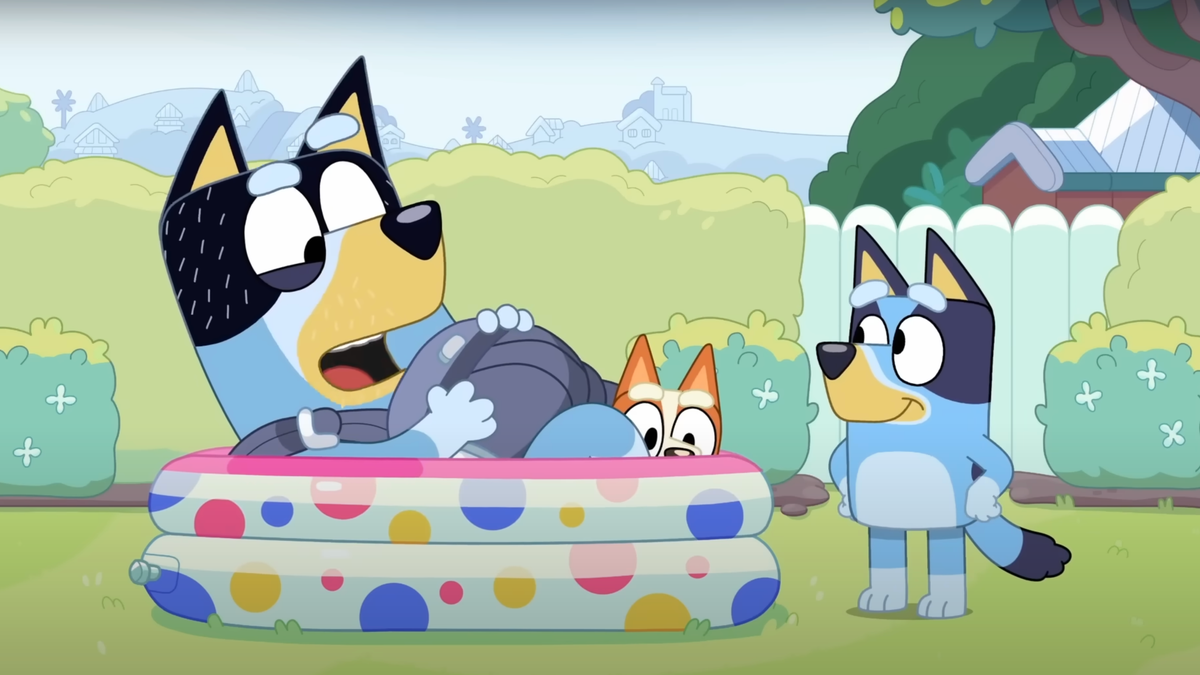
“Dad Baby” was among a number of banned or altered episodes of the hit Ludo Studio global phenomenon that never made it onto Disney+ or the Disney cable channels when it was acquired by the streamer. It’s curious as to why because the official description on Bluey’s official YouTube channel is pretty straightforward: “When Dad shows the kids how to use their old baby-harness, a new game is born: Dad Baby! But dad is unprepared for the harsh realities of giving birth to a baby Bingo.”
It can be suggested that perhaps Disney initially didn’t want to include a very lightly sex-ed centered episode on the show aimed at their kid demographic. io9 watched the now-available episode and it’s not as much of a big deal as the banning was made out to be. “Dad Baby” is a relatable, hilarious depiction of a pregnancy—particularly from the point of view of kids who remember their younger siblings being born. Even the comedic bits—like when Bluey’s dad Bandit carries her sister Bingo as a baby in the “womb” and recalls what he witnessed with his wife Chili—are silly and inoffensive. And yes, he does go through it all down to “pushing” Bingo out, which leans more into the kids’ playacting aspect of Bluey wanting to know how babies come into the world. It’s cute, endearing, and a good emotional episode from the show that’s proved that it knows what it’s doing. If you wanna see if for yourself watch it below!
Dad Baby | Full Episode | Bluey
Mostepisodes of Bluey are now streaming on Disney+.