How Is 5G Technology Impacting Mobile App Development?


How is 5G Technology Impacting Mobile App Development?

As the reach of 5G technology starts to expand globally, businesses in all sectors realize the evolutionary benefits and implications thereof. For mobile app developers, 5G means more than just speed. It represents a completely new level for app planning and building and experiencing.

With this technology, apps will be able to deliver smoother experiences with responsiveness to end-users, especially for real-time communication applications, games, and mobile applications relying on the Internet of Things.

In this article, we will take a view of how 5G has implications on mobile app development and why it is essential to remain ahead of the curve for success. 

5G Technology India

What is 5G Technology?

5G is the fifth-generation technology related to the mobile network, planned to offer faster data throughput, lower latency, and improved connectivity. It is faster than 4G and ensures download rates at a speed up to 100 times than other previous generations. Its capacity to send data in real-time with low delay, handle more connected devices, and deliver more bandwidth transforms mobile apps. These characteristics are particularly crucial for app developers working with technologies such as augmented reality (AR), virtual reality (VR), and the Internet of Things. 

How Does 5G Technology Impact Mobile App Development? 

  1. Faster Speed

The ultimate standout of 5G technology is its unmatched speed-a clear advancement compared with the already outstanding 4G. With the potential for data transfer speeds at as high as 10 Gbps, mobile applications will be able to perform operations and distribute material much better. Apps will load faster, seamlessly update, and give a much more fluid user experience and this will be so even for data-intensive applications.

For mobile gaming, streaming platforms, and multimedia-rich apps, 5G’s speed transforms how users interact with content. Games with high-definition graphics or complex multiplayer environments can run without lag, and video streaming apps can deliver ultra-high-definition (UHD) videos with virtually no buffering. This also enhances interactive aspects to assure more fluid engagement with comments in social media, live streaming, and gaming apps.

As compared to earlier networks, 5G offers more speed. Due to this, mobile application developers can provide more innovative and dynamic experiences.

faster speed

  1.  Minimal Latency

Ultra-low latency is one of the greatest innovations in 5G technology. Compared to 4G networks, 5G networks could even provide a latency as low as 1 millisecond whereas, on most 4G networks, the latency is found to take from 30 up to 50 milliseconds.

Augmented and virtual reality applications require low latency. For example, for smooth and interesting streaming, AR applications need data to be sent in quickness. Similarly, low latency ensures there will not be any kind of lag or motion sickness in VR applications hence it becomes helpful in entertainment as well as educational sectors.

With 5G’s low latency, these apps can deliver high-quality video and voice calls with minimal delay, making remote meetings and consultations more fluid and reliable.

For businesses, the ultra-low latency of 5G opens up new possibilities for developing apps that offer seamless real-time experiences, whether it’s live collaboration, gaming, or AR/VR applications.

  1. Expansion of IoT-Connected Mobile Apps

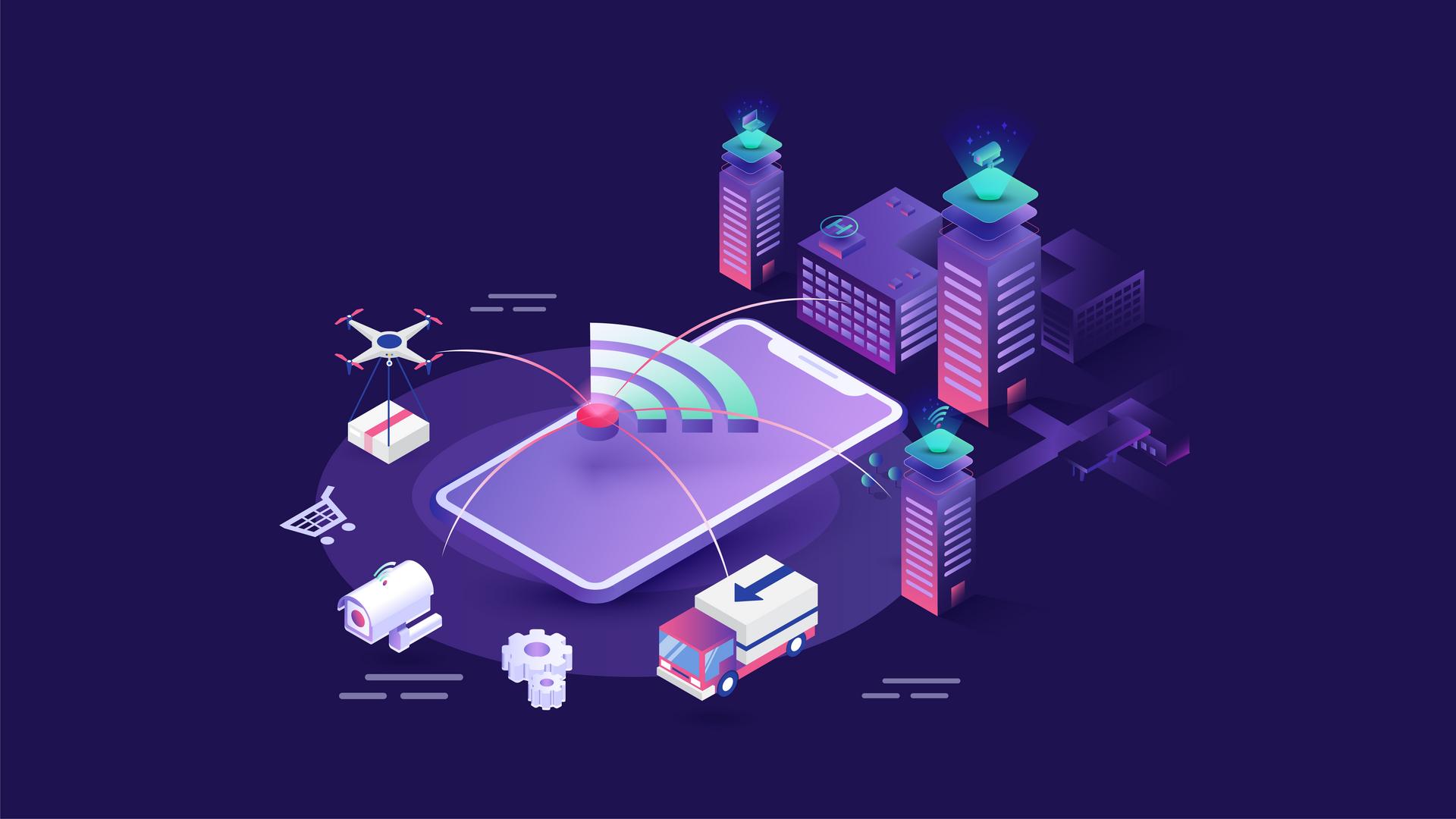
5G supports a large number of devices at once, which makes it perfect for the Internet of Things (IoT). While 4G struggles with multiple connections, 5G can handle them smoothly. This means IoT apps will run better, with fewer delays or interruptions.

Mobile apps can now easily connect with smart devices like home appliances, wearables, and industrial tools. For example, smart home apps can control things like lights and security in real time. Wearable devices, such as fitness trackers, can give instant updates on health data because of 5G’s fast processing.
Cost To IoT Mobile App Development

  1.  Improves cloud-based mobile applications

Cloud-based mobile applications benefit the most from 5G technology. Its speed and low delay let the apps run smoothly while relying on the cloud for data storage and processing. With 5G, apps can access data from the cloud faster, leading to better performance and less waiting time for the users.

This is especially crucial for businesses that use apps for data-heavy tasks. For example, companies that use real-time collaboration tools or apps that need large amounts of data, like video editing or graphic design platforms, will see improvements. It allows users to upload, download, and access files much quicker, even when working with high-quality content.

Additionally, 5G supports edge computing, where data is processed closer to the source instead of in a distant cloud server. This reduces the time it takes for apps to respond, making them more efficient. For industries like healthcare or logistics, where quick access to data is critical, this improvement can be a big advantage.

USM Cloud Support

  1.  Security and Privacy of Mobile Apps

Security has become a major issue as 5G connects more devices. As more data moves between apps and networks, hackers now have more opportunities as a result. To secure apps developed for 5G, developers must take additional precautions. The main challenge is the increased data traffic. With 5G’s fast speeds, hackers can quickly steal large amounts of data if security measures are weak. Encryption becomes more important to protect sensitive information. Developers should also focus on securing communication between multiple devices, especially in IoT apps.

The increased quantity of attack points is further cause for concern. Since 5G links more devices, every one of them becomes a possible target. The network’s developers are responsible for ensuring the security of each device. This means implementing strong authentication procedures and routinely upgrading the guidelines.

App developers can create more secure and safe apps for the 5G era by keeping these issues in mind. Security needs to be the main concern as more businesses and consumers use 5G-enabled apps.

AI can do cybersecurity blo2


The Future of 5G in Mobile Application Development

Although 5G is still in its early stages, it has enormous potential. As more organizations and industries adopt 5G, mobile apps are expected to evolve. Developers can design complex apps that run faster, interact in real-time, and perform more efficiently. This opens up new opportunities for apps in sectors such as healthcare, gaming, and education.

We will also see an increase in AI-powered applications requiring real-time data processing. Because of 5G’s low latency, apps may provide instant feedback and predictive analytics, allowing businesses to make more informed decisions. AR and VR apps will prosper, offering more immersive experiences.

Businesses should remain ahead of the curve by implementing 5G technology now. Those who adopt it early on can develop apps that provide better services and get a competitive advantage in the market.

As 5G becomes the mainstream, it will change what people expect from mobile apps, requiring developers to create quicker, smarter, and more imaginative solutions.

Conclusion

5G is more than just a high-speed network, as it represents a fundamental transformation in how mobile apps are created and utilized. With its fast speeds, low latency, and capacity to connect more devices, 5G is creating new opportunities for mobile app developers and enterprises. 5G is transforming the future of mobile technology by enhancing real-time experiences and performances of cloud-based and IoT apps. Businesses using 5G can develop innovative apps, improve user experiences, and remain ahead of the competition.

As 5G expands globally, its impact on mobile app development will only rise, opening up new avenues for innovation and growth. To truly benefit from everything 5G technology has to offer, developers and businesses must embrace it and reconsider their app strategy.


Why True AI Trust Requires Deterministic Reasoning


Amazon recently announced that they have extended their automated reasoning checks in Bedrock Guardrails. This acknowledges what we at Rainbird have long advocated — the critical importance of moving beyond pure probabilistic AI to achieve true reliability and trust in AI systems.

AWS’s move demonstrates the increasing market demands for more rigorous AI validation, although it’s crucial to understand the distinction between implementing guardrails and achieving truly deterministic AI reasoning. 

Let’s explore why this all matters.

Understanding the Evolution: AWS’s Approach vs True Reasoning

AWS’s approach focuses on validating LLM outputs against predefined rules and policies through what they call “Automated Reasoning policies.” These policies can be extracted from a simple policy document and can operate on a set of variables and logical rules that are translated into natural language for accessibility.

However, there are several key distinctions between AWS’s validation approach and true deterministic reasoning:

Static Validation vs Dynamic Reasoning

AWS Bedrock Guardrails implements an “allow-all” approach with selective validation. This means the system attempts to “catch” hallucinations post LLM where explicit policies are defined. 

In contrast, Rainbird reasons over a world model that you get to design and control, captured in a knowledge graph. Decisions are explicitly derived from the graph, not via a probabilistic LLM, so no predicted outputs, just reasoned answers. 

This amounts to a ‘deny all’ approach, with only verifiable decisions being created – a fundamental difference is crucial for applications where determinism, precision and completeness are non-negotiable.

Limited vs Complete Reasoning Chain

Whilst AWS’s solution can validate final outputs, it fundamentally operates as a validation layer on top of probabilistic LLM outputs. An LLM predicts an answer based on a distribution of probabilities, and then a rule checks if that prediction matches predefined criteria. This approach can catch obvious errors, but it cannot provide insight into how conclusions were reached or validate the reasoning process itself. 

In contrast, Rainbird’s knowledge graphs enable true causal reasoning from first principles. Rather than validating probabilistic outputs after the fact, our system builds deterministic logic chains that can explain not just what decision was made, but precisely how and why each step in the reasoning process was taken. This delivers complete visibility and validation of the entire decision-making process, not just its conclusion.

This distinction becomes particularly important in complex decision-making scenarios where multiple policies or rules interact. 

While a validation approach can check individual rules, it cannot understand or reason about their relationships and dependencies. For example, when evaluating eligibility for a financial product, multiple qualifying conditions might interact in subtle ways — income thresholds might vary based on employment status, which in turn could be affected by residency requirements. 

A validation-only system can check each rule in isolation but struggles to handle these interconnected relationships.

In contrast, a true reasoning system built on knowledge graphs can navigate these complex relationships naturally. Because the knowledge is explicitly modelled as an interconnected graph rather than a list of validation rules, the system can trace multiple paths through the knowledge, understand how different conditions influence each other, and arrive at conclusions that respect the full complexity of the domain. 

This means not just more accurate decisions, but also the ability to explain precisely how different factors influenced the outcome and why alternative paths weren’t taken.

The Rainbird Difference: Beyond Validation to True Reasoning

Whilst guardrails can help prevent errors that can be pre-determined, Rainbird’s approach fundamentally transforms how AI makes decisions. Our technology doesn’t just validate outputs – it represents rules as weighted knowledge graphs that unlock true causal reasoning. This means:

  1. Deterministic by Design: Rather than attempting to constrain probabilistic outputs, our systems are inherently deterministic. Every decision follows explicit, traceable logic paths.
  1. Complete Causal Chains: Instead of simply checking if outputs match predefined rules, Rainbird provides complete causal proof for every decision, showing exactly how each conclusion was reached.
  1. Knowledge-First Architecture: Our approach begins with structured knowledge representation, enabling organisations to represent regulations, policy and operating procedures as precise models that can reason, rather than attempting to retrofit precision onto probabilistic models.

The Power of Neurosymbolic AI

What truly sets Rainbird apart is a neurosymbolic approach, combining the best of symbolic reasoning with modern machine learning. This hybrid architecture:

  • Enables precise reasoning over complex knowledge domains
  • Provides complete auditability of decision processes
  • Maintains deterministic outputs whilst handling natural language inputs
  • Eliminates hallucinations through structured knowledge representation

Looking Forward: Noesis and the Future of Trusted AI

With our new Noesis platform, we’re taking this proven approach even further. Noesis will enable developers to:

  • Automatically convert unstructured documents into executable knowledge graphs
  • Deploy deterministic reasoning capabilities through simple API calls
  • Integrate trusted AI capabilities into existing ML pipelines
  • Generate complete audit trails for every decision

The Broader Implications

AWS’s move into automated reasoning validation demonstrates growing market recognition of what Rainbird has been delivering for years: the need for more reliable, explainable AI in enterprise settings. 

However, true trust in AI requires more than guardrails – it demands systems built on deterministic reasoning from the ground up.

As organisations increasingly rely on AI for critical decisions, the ability to provide not just guardrails but complete causal reasoning is becoming more critical. This is where Rainbird’s decade of experience in delivering deterministic AI solutions to major enterprises has proven invaluable.

Whilst we welcome AWS’s recognition of the importance of automated reasoning in AI systems, the future demands more than validation layers. It requires AI systems that are inherently precise, deterministic, and explainable. This is the foundation Rainbird has built upon, and with Noesis, we’re making these capabilities accessible to developers everywhere.

The race to trustworthy AI isn’t just about constraining what AI can do wrong – it’s about building systems that do things right from the start. 

That’s the Rainbird difference.

Want to learn more about how Rainbird can bring deterministic AI to your organisation? Register for early access to Noesis and see the future of trusted AI in action.

The Case for Deterministic Agents in Agentic AI


The re-emergence of agentic AI—intelligent agents capable of autonomously planning, making decisions, taking actions, and continuously adapting to their environment—marks a significant shift in AI. Yet, with this shift comes a crucial challenge: how do we ensure that these autonomous agents are truly trustworthy and reliably aligned with organisational goals?

At Rainbird, we’ve developed a distinct type of AI agent that complements probabilistic agents in these existing systems. Our agents are built for deterministic reasoning, delivering precise and explainable decisions that are guaranteed to be justifiable. As organisations deploy various forms of AI agents, Rainbird’s deterministic agents provide a critical capability: the ability to make decisions where accuracy and transparency cannot be compromised.

The Crisis of Trust in AI Systems

Most sectors are facing unprecedented change due to AI, and nowhere is this more prominent than in professional services where the risks are considered by many to be existential. For centuries, the professional services business model has rested on twin pillars: the billable hour and unwavering trust. While AI promises to dramatically reduce the cost and time needed for complex tasks—from legal document review to financial audits—its probabilistic and non-deterministic nature simultaneously threatens the foundation of trust these firms have spent generations building. As AI drives the cost of time-based work towards zero, firms must confront an uncomfortable reality: their future value will depend almost entirely on their ability to be trusted advisors.

Yet here lies a critical contradiction for professional services firms: while embracing probabilistic AI models is necessary to remain competitive, this approach risks introducing subtle errors that can silently propagate through their work. Such risks are not hypothetical—an incident where fabricated legal authorities generated by an AI system, such as ChatGPT, were presented in a tax tribunal highlights the dangers of relying on unverified AI outputs. The internet is full of reports of such problems. When errors slip past both AI and human checks, the damage extends beyond financial losses; it undermines the client relationship and strikes at the heart of the profession’s centuries-old commitment to accuracy and reliability.

The Dangerous Fallacy of Human Oversight

The common defence that ‘humans will verify AI outputs’ overlooks a crucial paradox in human psychology. Research into automation bias reveals a troubling pattern: the more reliable an AI system appears to be, the less likely humans are to thoroughly check its outputs. This creates a dangerous feedback loop where increased accuracy actually amplifies risk. As AI systems become more sophisticated and generate consistently reliable results, human operators naturally develop a sense of trust and complacency.

This erosion of vigilance means that when errors do occur—particularly in edge cases or novel situations—they’re more likely to slip through unnoticed. The irony is stark: the very success that makes AI systems valuable in reducing human workload simultaneously increases the potential impact of any undetected errors. This psychological blind spot makes human oversight an unreliable safeguard, particularly in high-stakes domains where a single missed error could have significant consequences.

Beyond Language Models: The Critical Gap in AI Decision Making

Recent advances in large language model (LLM) tooling have enabled AI agents to plan, interact with users, orchestrate tasks, and respond to complex queries. Yet even as these agentic systems become more sophisticated, a reliance on probabilistic outputs remains a significant shortcoming. Without a layer of deterministic reasoning, agents struggle to validate their conclusions, explain their actions, or demonstrate a causal logic chain from inputs to decisions.

Rainbird provides this missing link. Instead of simply generating predicted outputs, our platform empowers AI agents to operate over a structured model of the world, captured in knowledge graphs. This transforms agentic AI from a ‘guess and hope’ approach to one in which every outcome can be traced back to its logical foundations.

Why Deterministic Reasoning Matters for Agentic AI

To understand why deterministic reasoning is indispensable, we must examine the nature of agentic AI itself. Intelligent agents do more than answer questions: they take actions that may have real-world consequences. Whether it is automating complex workflows, researching tax treaties, or issuing financial recommendations, the stakes are high. In such scenarios, “good enough” may not be enough. Certainly, the market needs decision-making processes that can be fully understood, vetted, and trusted. At the very least, an agentic approach should allow developers to use “good enough” agents where appropriate and precise and deterministic agents when it really matters. 

By building decisions from explicitly modelled knowledge, Rainbird ensures that agents do not merely predict outcomes but instead derive logically rigorous conclusions from authoritative world models that were deliberately designed and approved. Whereas probabilistic systems will produce results with no clear justification—in most cases influenced by training that is based on the public internet—Rainbird shows exactly why each conclusion follows from the knowledge at hand. For enterprises that must meet rigorous compliance or regulatory standards, this is not just beneficial, it’s essential.

Mastering Contextual Complexity

Real-world applications often involve intricate interactions between multiple variables. Take healthcare scenarios evaluating treatment eligibility or insurance underwriting tasks that must consider risk factors, eligibility criteria, and multi-jurisdictional compliance; these challenges require sophisticated navigation of interconnected rules and relationships.

Rainbird’s knowledge graph approach captures these complexities explicitly, enabling agents to:

  • Reason causally about interconnected conditions
  • Understand how changes in one variable affect others
  • Provide detailed justifications for decisions
  • Maintain consistency across complex rule sets
  • Process natural language inputs while maintaining deterministic outputs
  • Transform human-readable policies into machine-executable logic
  • Eliminate hallucinations through grounded reasoning
  • Bridge the gap between human understanding and machine inference

Introducing Noesis: Accelerating Deterministic AI Development

The challenge of building deterministic AI agents has traditionally been the time and expertise required to create comprehensive knowledge graphs. Our new Noesis platform transforms this process, automatically converting organisational documentation and expertise into executable knowledge graphs in minutes rather than weeks. 

Noesis represents a step-change in the sophistication of deterministic AI agents, and how quickly organisations can deploy them. It automatically processes policy documents, procedures, and regulatory texts, transforming them into precise knowledge graphs while maintaining the rigorous logical structure that deterministic reasoning demands. This automated conversion of knowledge—from written and unstructured form to computable deterministic model—preserves the critical relationships and rules within that documentation while eliminating the manual effort traditionally required for knowledge graph creation.

The same technology is being used to automatically design interviews with domain experts, to elicit and encode layers of tacit knowledge into graphs that already understand a base level of regulation and policy.

Key capabilities include:

  • Automated extraction of decision logic from existing documentation
  • Built-in validation to ensure knowledge graph consistency
  • Developer-friendly APIs and SDKs for seamless integration
  • Comprehensive audit trails and explanation facilities
  • Enterprise-grade security and compliance features

For developers, this means being able to rapidly create deterministic AI agents that can be trusted with critical decisions. 

Building the Future of Trusted AI

As AI agents become increasingly autonomous, the focus must shift from controlling unpredictable AI outputs to building inherently reliable AI agents. Rainbird’s decade-long experience in delivering deterministic AI reasoning to major enterprises demonstrates that trust and transparency aren’t optional extras—they’re fundamental requirements.

The future of AI lies not in probabilistic models constrained by guardrails, but in systems that think clearly and consistently from the outset. Through deterministic logic, comprehensive knowledge modelling, and explainable reasoning chains, Rainbird is making this future a reality.

Apple Just Signaled the End of Traditional Search. Here’s What That Means


Apple may be preparing to dismantle one of the most profitable arrangements in tech history: its $20 billion-a-year deal to make Google the default search engine in Safari. Continue reading “Apple Just Signaled the End of Traditional Search. Here’s What That Means”

The Key to Safe AI in Financial Services


As financial institutions increasingly adopt Large Language Models (LLMs) to enhance customer experiences and streamline operations, a critical challenge has emerged: how can these powerful but inherently probabilistic systems be deployed safely in a highly regulated environment?

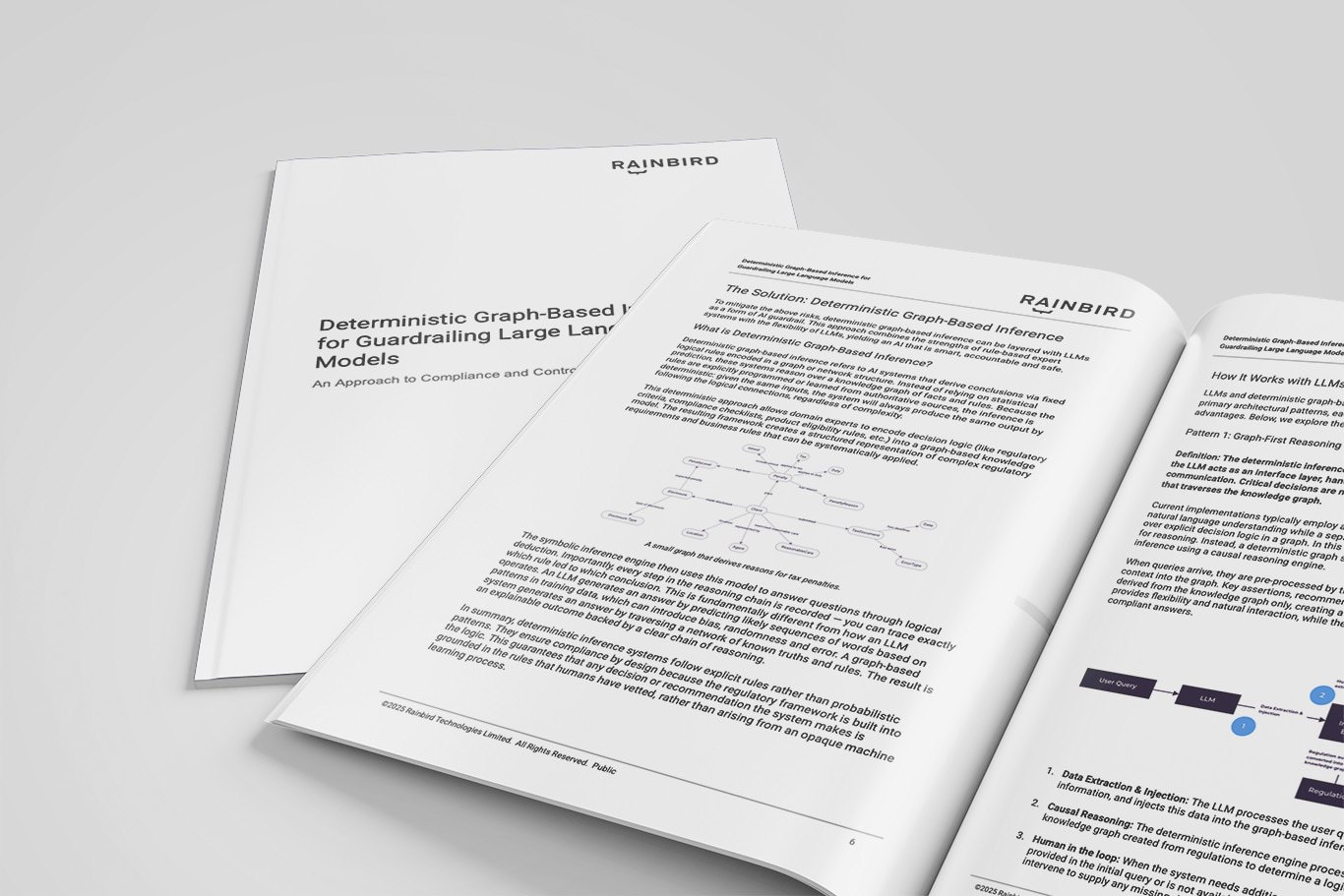
Today, we’re pleased to announce the publication of our latest white paper, “Deterministic Graph-Based Inference for Guardrailing Large Language Models: An Approach to Compliance and Control in Financial AI“, which addresses this exact challenge.

The Problem with LLMs in Financial Services

While LLMs like Claude and GPT bring unprecedented language capabilities to financial services, they come with significant limitations that pose real risks:

  • Lack of determinism: The same query can yield different results at different times
  • Hallucinations: LLMs can confidently generate entirely false information
  • Limited explainability: The “black box” nature makes regulatory compliance difficult
  • Vulnerability to prompt injection: Specially crafted inputs can manipulate model behavior

In financial contexts where precision, consistency, and regulatory compliance are non-negotiable, these limitations create substantial barriers to adoption.

The Solution: A Hybrid Approach

This white paper explores how deterministic graph-based inference systems can be integrated with LLMs to create AI solutions that are both powerful and predictable. This hybrid approach combines:

  • The linguistic fluency and generative capabilities of LLMs
  • The precision, consistency, and explainability of rule-based systems encoded in knowledge graphs

We detail two architectural patterns for implementation:

  1. Graph-First Reasoning: Where the deterministic inference engine serves as the primary decision-maker while the LLM acts as an interface layer
  2. Post-Generation Validation: Where the LLM generates responses that are subsequently verified and potentially corrected by the symbolic inference engine

The Benefits for Financial Institutions

Financial institutions implementing this hybrid approach can expect:

  • Complete transparency and auditability of AI decisions
  • Elimination of hallucinations and non-compliant information
  • Regulatory compliance by design rather than by hope
  • Consistent and reliable responses that build customer trust

Implementation with Rainbird

The paper concludes with a detailed implementation framework leveraging Rainbird’s enterprise-grade knowledge graph reasoning platform. Our approach enables financial institutions to transform complex regulatory frameworks into executable, deterministic systems that can effectively guardrail LLM implementations at scale.

Major banks and financial services firms are already deploying Rainbird to address the critical compliance challenges outlined in this paper, encoding regulatory expertise into verifiable knowledge graphs that ensure AI-generated content remains fully compliant with intricate financial regulations.

Download the White Paper

Ready to explore how your institution can safely harness the power of LLMs while maintaining regulatory compliance? Download our white paper to learn how deterministic graph-based inference can transform your AI strategy.

Courtesy or Notebook LLM there is also a podcast based on this white paper here.

For more information on implementing these solutions in your organisation, contact our team for a consultation.

Faster Model Deployment & Inference with Python SDK


11.4_blog_herov2

This blog post focuses on new features and improvements. For a comprehensive list, including bug fixes, please see the release notes.

A new Python-based method for model uploading and inference

We have completely revamped the way models are uploaded and used for inference with a new Python-based method that prioritizes simplicity, speed, and developer experience.

Built with a Python-first, user-centric design, this flexible approach simplifies the process of working with models. It allows users to focus more on building and iterating, and less on navigating API mechanics. The new method streamlines inference, accelerates development, and significantly improves overall usability.

Model Upload

The Clarifai Python SDK now makes it even easier to upload custom models. Whether you’re using a pre-trained model from Hugging Face or OpenAI, or one you’ve developed from scratch, integration is seamless. Once uploaded, your model can immediately take advantage of Clarifai’s robust platform features.

After import, your model is automatically deployed and ready for use. You can evaluate it, connect it with other models and agent operators in a workflow, or serve inference requests directly.

As part of this release, we’ve significantly simplified how you define the model.py file for custom model uploads. The new ModelClass pattern allows you to implement predict, generate, and streaming methods without the need for extra abstraction or boilerplate. You can get started in just a few lines of code.

Here’s a quick example: a simple method that appends “Hello World” to any input text, with built-in support for different types of streaming responses. Check out the full documentation here.

Inference

The new inference approach offers an efficient, scalable, and simplified way to run predictions with your models.

Designed with a Python-first, developer-friendly focus, it reduces complexity so you can spend more time building and iterating, and less time dealing with low-level API details.

Below is an example of how to make a client-side predict call that corresponds to the predict method defined in the previous section. Checkout the docs here.


New Published Models

  • Published Llama-4-Scout-17B-16E-Instruct, a powerful model in the Llama 4 series featuring 17 billion parameters and 16 experts for advanced instruction tuning. It supports a native 10 million-token context window (currently 8k supported on Clarifai), making it ideal for multi-document analysis, complex codebase understanding, and personalized, intelligent workflows.
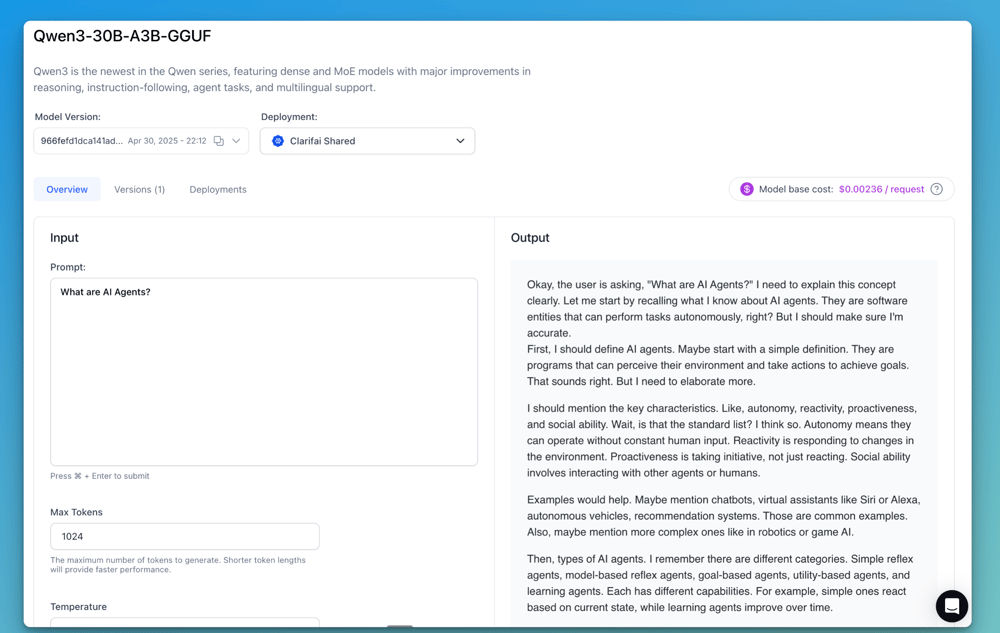
  • Published Qwen3-30B-A3B-GGUF, the latest addition to the Qwen series. This new release features both dense and mixture-of-experts (MoE) models, with significant improvements in reasoning, instruction-following, agent-based tasks, and multilingual capabilities. The Qwen3-30B-A3B outperforms larger models like QwQ-32B, leveraging fewer active parameters while maintaining strong performance across coding and reasoning benchmarks.

Screenshot 2025-05-12 at 8.46.41 AM

  • Published OpenAI’s latest o3 model, a powerful and well-rounded LLM that sets a new standard for performance across math, science, coding, and visual reasoning tasks. It is built for complex, multi-step thinking and excels at technical problem-solving, interpreting visual data such as charts and diagrams, high-stakes decision-making, and creative ideation.
  • Published o4-mini, a smaller model optimized for fast, cost-efficient reasoning. Despite its compact size, o4-mini delivers impressive accuracy on math and coding benchmarks like AIME 2025. It is ideal for use cases that require strong reasoning capabilities while keeping latency and cost low. Both the models are also available on the Playground, Try them out here.

Enhanced the Playground experience

  • Added automatic mode detection based on the selected model — now intelligently switches between Chat and Vision modes for predictions.
  • Improved model search and identification for a faster, more accurate selection experience.
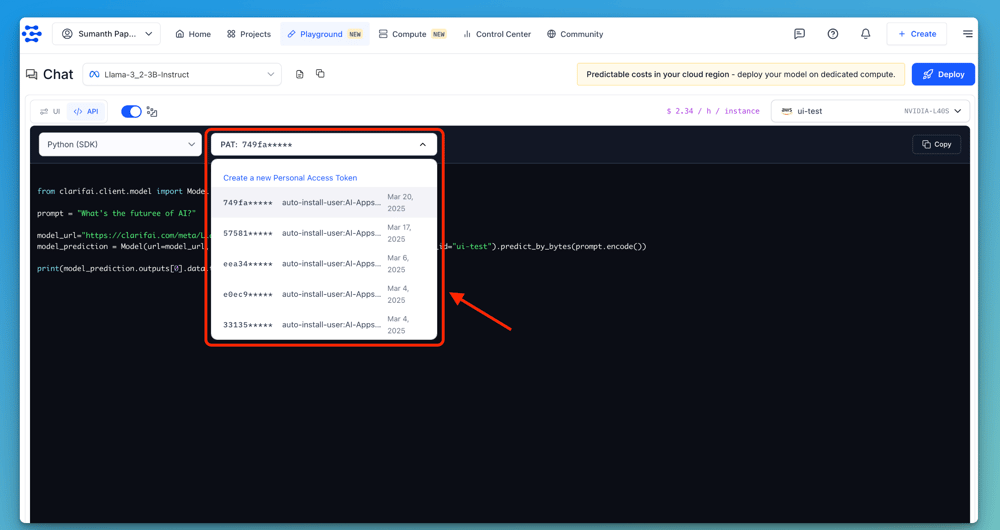
  • Introduced a Personal Access Token (PAT) dropdown, enabling users to easily insert their PAT keys into code snippets.

Screenshot 2025-05-12 at 8.57.59 AM

  • Implemented dynamic pricing display that updates based on the selected deployment.
  • The selected deployment ID is now automatically injected into the inference code.

Enhanced the Control Center

Improved the Community platform

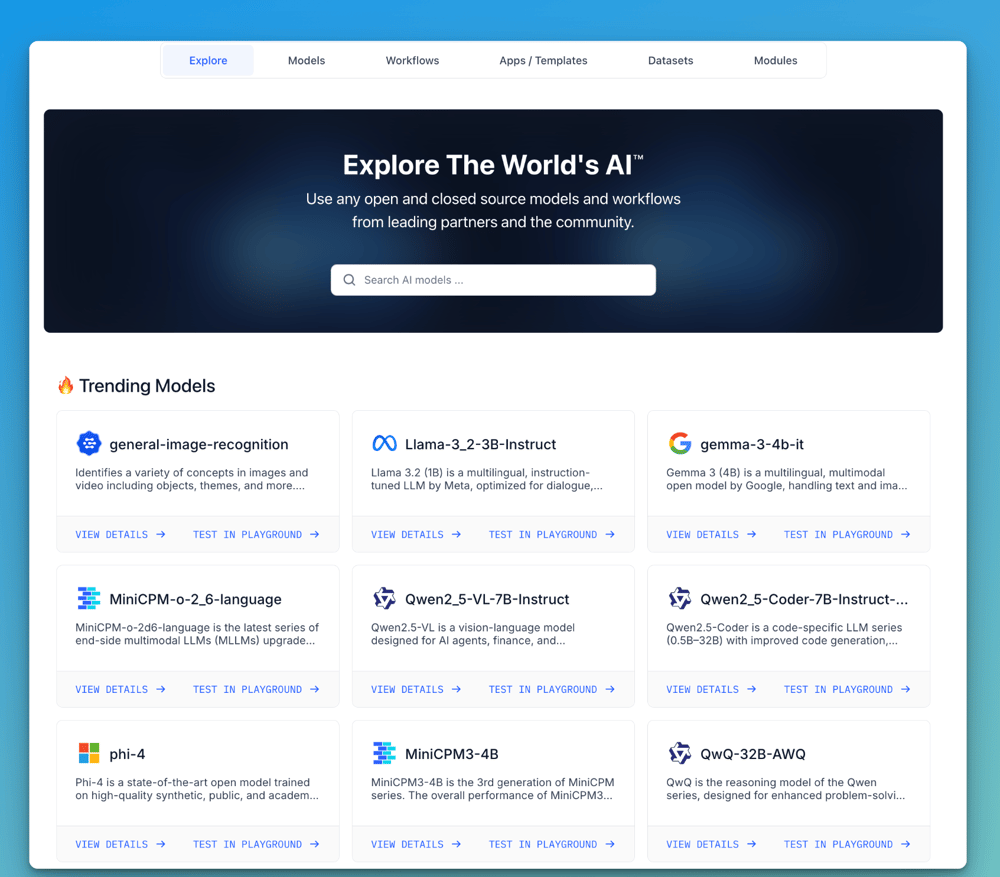
  • Revamped the Explore page with refreshed visual designs, a featured models showcase, and categorized use cases such as LLMs and VLMs.
  • Updated the individual model viewer page with an improved UI, direct access to the Playground, deployment listings, and additional enhancements.

Screenshot 2025-05-12 at 1.38.32 PM

Additional Changes

  • The Home page is now accessible to all users, with sections requiring login automatically hidden for non-logged-in users. A new “Recent Activity” section shows users their most recent actions and operations. We also made improvements to usability, performance, and overall user experience.
  • New organization accounts now start on the Community plan by default, instead of inheriting the user’s personal plan. This change applies to users on the Community, Essential, and Professional plans. Enterprise users are not affected. The “Member Since” column now shows when a member joined the organization, and Settings pages are hidden from users without the required permissions.
  • The billing section has been redesigned for a more intuitive credit card management experience. We’ve added validation to prevent duplicate card entries and support for setting or changing the default credit card.
  • The Python SDK now supports Pythonic models for a more native experience. We fixed failing tests to improve stability. The CLI is now ~20x faster for most operations, includes config contexts, improved error messages, and corrected return arguments in the model builder. Learn more here.

Ready to start building?

With this Python-first release, uploading and running inference on your custom models is now faster, simpler, and more intuitive than ever. Whether you’re integrating a pre-trained model or deploying one you’ve built from scratch, the Clarifai Python SDK gives you the tools to move from prototype to production with minimal overhead.

Explore the documentation and start building today.


The AI Cheating Crisis in Higher Education Is Worse Than Anyone Expected


A bombshell report from New York Magazine has ignited a fierce debate in academia—and it’s shining an uncomfortable spotlight on the growing crisis of AI-powered cheating in colleges and universities. Continue reading “The AI Cheating Crisis in Higher Education Is Worse Than Anyone Expected”

AI Vs Automation: Understanding The Key Differences


AI vs Automation: Understanding the Key Differences and Their Impact

In our high-speed era of a fast and furious digital lifestyle, the terms “automation” and “Artificial Intelligence (AI)” are drivers. While at first glance they appear to speak of the same things robots doing things with little human intervention, they are actually distinct technologies and have different jobs and impacts.

Knowing the main differences between automation and AI is vital, particularly with businesses and society becoming more reliant on them. This article discusses the difference between automation and artificial intelligence, challenges, and applications on industries and employees.

What is Automation? 

Automation means applying technology to perform tasks with little or no human intervention. The overall goal of automation is to create efficiency, consistency, and speed. Through automation, we can definite procedures, rules, or processes, which are performed by equipment without having to “think” or “learn.”

Automation

Types of Automation 

  1. Fixed or Hard Automation: Applied in manufacturing, it is extremely structured, repetitive work with minimal variation.
  2. Programmable Automation: Applied to batch production, the machines are reprogrammed to perform many different tasks.
  3. Flexible or Soft Automation: Provides more flexibility, usually in robots or machines switched from task to task with little setup.
  4. Business Process Automation (BPA): Used in the cyber world to perform repetitive tasks such as data entry, scheduling, and system monitoring.  

What is Artificial Intelligence?

Artificial intelligence, however, is the simulation of human intelligence on machines. AI allows systems to learn through experience, adapt, and make decisions based on sophisticated algorithms instead of pre-programmed rules.

Artificial Intelligence

Core Capabilities of AI 

  1. Machine Learning (ML): Allows systems to learn over time from experience.
  2. Natural Language Processing (NLP): Allows machines to read and write natural languages.
  3. Computer Vision: Allows machines to read and react to visual input.
  4. RPA (Robotic Process Automation): Allows rule-based autonomous operations and choice in the physical world.

While automation only gets to do things according to the rule, AI gets to handle uncertainty, solve issues, and even mimic such high-level thinking as learning and solving problems.

Real-World Applications of AI and Automation 

Automation in Practice 

  • Manufacturing: Robot arms, automated conveyor belts, and quality checks.
  • Finance: Automated fraud detection and transaction processing.
  • Retail: Automatic restocking and checkout software.
  • IT Operations: Server monitoring, backup infrastructure, and software deployment. 

AI in Practice 

  • Healthcare: Predictive patient care insights, AI-based diagnostic tools.
  • Finance: Customer sentiment analysis, credit risk models, algorithmic trading.
  • Marketing: Recommendations, advertisement targeting, customer segmentation.
  • Transportation: Autonomous cars and AI-based logistical planning. 

Automation Vs AI: Impact on Industries

Manufacturing 

  • Automation Impact: Increased productivity and reduced labor costs because of optimized production lines.
  • AI Impact: Predictive maintenance, computer vision-based quality control, and optimized supply chains. 

Healthcare 

  • Automation Impact: Automated scheduling of appointments, billing, and automatic updating of patient records.
  • AI Impact: Diagnostic imaging, virtual health assistants, personalized treatment plans. 

Retail

  • Automation Impact: Inventory, checkout.
  • AI Impact: Dynamic pricing, customer behavior analysis, virtual shopping assistants.

Challenges of AI and Automation Adoption 

  1. Fear Of Employment Replacement

With automation and AI doing the repetitive jobs, many of the jobs, especially those in sectors like manufacturing and retail, are disappearing. This is supporting more stress on low-skilled workers and can widen the gap between the poor and rich.

  1. Surveillance and Data Privacy

AI needs large amounts of data to operate optimally, but getting all that data is a direct threat to privacy. Tools like facial recognition can track people without their permission, overstepping on basic rights and freedoms if unregulated.

  1. Transparency and Accountability

AI decides on black processes, but even to those who create it. However, when something goes wrong, like an incorrect medical diagnosis, it is unclear who is responsible.

  1. Security and Safety Risks

As deals with data, AI systems can be hacked with disastrous effects. For instance, autonomous vehicles might be tricked by bogus information, or AI might be employed in cyberattacks. Strong defenses must be constructed to make these systems safe and secure.

  1. Overdependence and Loss of Skills

As we increasingly depend on AI to make routine decisions, there’s a chance we’ll begin losing our own capabilities. If we let the machines do all the thinking for us, we’ll be forgetting how to make decisions, solve problems, or even perform our work efficiently without them.

The Future: Synergy, Not Substitution 

True potential is not either-or, automation vs. AI, but mastering how to use them together. Used correctly:

  • Automation can handle repetitive, routine work.
  • AI can bring in intelligence and responsiveness.
  • Human beings can focus on strategy, creativity, and empathy work.

These companies that capitalize on this synergy will be able to innovate, compete, and build strong futures. 

The Cost of AI Development 

The expense of building AI can be prohibitive, here are some reasons why it is so costly:

1. Research and Development

It is expensive to recruit skilled AI researchers, data scientists, and engineers. They are in-demand individuals and get compensated well. The finest AI talent usually comes from academia or leading tech companies, so it is competitive and usually pricey to recruit them.

2. Data Collection and Labeling

AI models need huge amounts of high-quality data to learn from, especially for healthcare applications, where data must be carefully curated and anonymized. Collecting, cleaning, and labeling such data is labor-intensive, which reduces costs.

3. Computational Resources


Training advanced AI models like large language models or computer vision requires enormous computational resources. That entails high-end GPUs or TPUs, which are extremely costly to buy or rent from cloud providers. The power consumption also commands a significant portion of ongoing operational costs.

4. Infrastructure and Maintenance

Building and maintaining AI infrastructure, including servers, storage, networking, and monitoring software, requires long-term investment.

5. Testing and Safety Measures

AI development involves a lot of testing, including model verification, bias identification, and safety checks. For self-driving cars or medical diagnostics, this testing must be highly specific, sometimes to the extent of requiring real-world tests and regulatory approval, and both are expensive.

6. Legal and Compliance Costs

AI development must meet regulatory requirements and adherence to law in data protection (e.g., GDPR) saves costs significantly.

7. Deployment and Scaling

Migrating an AI model means adaptation and interfacing with other systems. Scaling AI to numerous regions, languages, or platforms adds additional expense.

Also Read: How Much Does Artificial Intelligence Cost?

Conclusion

AI and automation are change drivers with inherent strengths and potential. Where automation works by speed through inflexible, fixed principles, AI is gifted with learning, growth, and decision abilities. Rather than setting the two against each other as new technologies, they are better placed to be put side by side as complementary technologies. They revolutionize the way of living, working, and existing with the world entirely together.

Connect with USM Business Systems, the best AI development company, to bring your dreams into reality.


Why Human Oversight Fails AI


The Illusion of the Human Safety Net

As AI systems rapidly evolve from passive tools to autonomous agents, a dangerous assumption persists throughout the industry: that human oversight provides an adequate safety net for AI errors. This belief, that a person monitoring an AI’s decisions will reliably catch and correct mistakes, has become the default guardrail in many AI governance frameworks. Yet this approach fundamentally misunderstands both human psychology and the nature of modern AI systems.

The uncomfortable truth is that humans make exceptionally poor guardians for agentic, probabilistic AI. Our human cognitive architecture, evolved for a different world entirely, is ill-equipped to monitor complex AI decision-making. This mismatch creates a perfect storm where AI errors consistently slip through human oversight, sometimes with catastrophic consequences.

Why Human Oversight Fails

The limitations of human supervision extend far beyond mere inattention. Multiple factors conspire to make us unreliable guardians.

Automation bias renders objective oversight impossible. Humans exhibit an inherent tendency to trust computer-generated information over our own judgment. This isn’t simply laziness; it’s a deeply ingrained cognitive bias. When presented with AI recommendations or actions, humans consistently demonstrate an alarming propensity to defer to the machine, especially when it presents information with confidence and authority.

The tragic 2018 Uber self-driving car fatality in Arizona starkly illustrates this reality. The safety driver, meant to intervene if the AI faltered, had become complacent and distracted. This wasn’t an anomaly; it’s an inevitable result of how our brains respond to automation over time.

The opacity of modern AI creates an unbridgeable comprehension gap. Large language models and neural networks operate as “black boxes” that produce outputs through processes largely inaccessible to human understanding. How can a supervisor effectively evaluate a decision they fundamentally cannot understand? When an AI generates content that sounds plausible but contains subtle errors or fabrications, even expert reviewers may miss the problem entirely, as witnessed in embarrassing legal cases where lawyers have submitted entirely fictitious AI-generated case citations to courts.

The speed and volume of AI decisions overwhelm human capacity. As AI becomes more deeply integrated into business processes, the number of decisions requiring review exponentially increases. In domains like algorithmic trading, financial systems make thousands of micro-decisions per second, far beyond what any human could meaningfully monitor. By the time humans recognise a problem, significant damage may already be done.

From Linear Rules to Sophisticated Guardrails

If human oversight is inadequate, what’s the alternative? The answer lies not in simple linear rules, but in sophisticated deterministic guardrails; engineered constraints that reliably prevent AI systems from taking undesirable actions through a network of interconnected logical relationships.

Unlike the linear rule systems of the past that quickly became unmanageable and brittle, modern deterministic guardrails utilise graph-based knowledge structures that can represent complex regulatory frameworks and other knowledge-based processes with nuance and flexibility. These sophisticated structures encode complex causal relationships as formal, traceable networks of probabilities, weights and rules.

The power of graph-based deterministic inference is that it can handle the complexity and interconnectedness of real-world regulatory systems without sacrificing reliability. Unlike probabilistic AI models that produce varied, sometimes unpredictable outputs, deterministic graph systems follow explicit logical pathways with guaranteed outcomes that are entirely repeatable.

This approach creates a comprehensive safety system capable of understanding, for instance, that a financial product recommendation must simultaneously satisfy multiple interrelated regulatory requirements suitability for the client’s risk profile, all verifiable through traceable logical pathways.

This sophisticated graph-based approach can be deployed in two distinct architectural patterns: either as a validation layer to verify and correct LLM outputs, or as the primary reasoning engine with the LLM serving only as a natural language interface layer.

Pure Determinism: The Ultimate Safety Architecture

While validation of LLM outputs offers significant safety improvements, the most powerful configuration for high-stakes domains removes LLMs from the reasoning process entirely. In this pure deterministic architecture, graph-based inference systems handle all critical decisions independently, while LLMs serve solely as the interface layer, managing natural language understanding and communication. 

Most organisations operating in regulated environments would gladly sacrifice the general-purpose nature of LLMs (which, while impressive, is precisely what makes them prone to hallucination) for solutions that are narrower, domain-specific, 100% grounded in verified context, and utterly reliable. After all, why would a credit decisioning engine need to know about sports? Or a financial sanctions compliance system need to generate poetry? The flexibility to answer any question becomes far less valuable than the certainty of answering specific questions correctly every time—particularly when errors could trigger regulatory violations, financial losses, or reputational damage.

This approach completely removes the probabilistic element from the decision-making process itself. The LLM never makes substantive determinations, it simply translates between human language and the deterministic system. All core reasoning—eligibility determinations, compliance verdicts, risk assessments—occurs within the deterministic graph engine that traverses a knowledge network with logical precision.

This stands in contrast to the validation approach, where an LLM generates initial answers that are subsequently verified against the knowledge graph. In a pure deterministic configuration, the decision-making authority never resides with the probabilistic system. Instead, the inference engine and the graph becomes the authoritative reasoning component rather than just a guardrail.

The advantages of this “pure determinism” approach are profound:

  • Total elimination of hallucinations for critical decisions
  • Perfect repeatability across identical scenarios
  • Complete traceability of every decision to specific rules
  • True causal reasoning that follows explicit logical pathways
  • Independence from training data biases that affect LLMs

Consider a high-stakes financial services scenario, to determine whether a transaction requires additional anti-money laundering scrutiny. With a pure deterministic approach, the LLM may help extract relevant transaction details from unstructured sources, but the actual determination comes exclusively from the graph-based inference engine traversing a precisely encoded network of regulatory requirements, or other proprietary knowledge. This creates a system that is simultaneously conversational but also absolutely reliable in its core reasoning functionality.

Accelerating Knowledge Graph Development

While graph building was historically a significant bottleneck requiring months of manual knowledge engineering, recent breakthroughs have transformed this process. 

Specialised LLMs—fine-tuned on all classes of human reasoning, knowledge engineering patterns and a cross section of domain problems—have unlocked the ability to programmatically generate sophisticated knowledge graphs at unprecedented speed. They can extract structured knowledge from regulatory documents, policies, and even domain expertise, and build accurate and computable knowledge graphs—and maintain them. This eliminates what historically was months of manual work, compressing it into days or even hours. 

This capability fundamentally changes the economic equation for implementing a sophisticated knowledge management layer in the enterprise.

Creating Safe Agentic Systems

Looking ahead, the most sophisticated AI applications will likely involve autonomous agents—AI systems that can independently perform complex tasks without continuous human direction. This evolution from passive tools to active agents magnifies all the risks already discussed and introduces new ones around the delegation of authority in multi-step decision processes.

The development of safe agentic systems demands more than ad hoc guardrails or human monitoring; it requires a comprehensive architecture where deterministic graph-based inference serves as the logical foundation for all critical decisions. Such systems can reliably constrain agent behavior within carefully defined operational boundaries while still allowing for the flexibility and generative capabilities that make AI valuable.

Unlike post-hoc human oversight, which attempts to catch problems after they occur, deterministic guardrails prevent problems by design. The system simply cannot act outside its defined parameters, just as a well-designed electrical system has circuit breakers that automatically prevent dangerous overloads without requiring human intervention.

For organisations seeking to deploy agentic systems, this approach offers a pathway to production without rework, significantly lowering risk. Agents can operate while sophisticated deterministic guardrails act as the compliance officer within, ensuring that outcomes adhere to regulatory, ethical, and safety boundaries. This unlocks a future where AI systems can act independently while maintaining the precision and reliability that high-stakes domains demand.

The Implementation Question

For organisations looking to adopt this approach, there are several key considerations. The graph-based guardrails must be designed with sufficient sophistication to capture the nuance and complexity of regulatory frameworks without becoming unmanageable. This requires specialised tooling. 

The integration between deterministic systems and LLMs must be carefully architected to ensure clear separation of responsibilities. In pure deterministic configurations, the LLM should have no authority to override or modify the determinations of the graph-based inference engine; it should simply be constrained to translating logical outputs into natural language.

Testing must be rigorous and scenario-based, focusing particularly on edge cases. Unlike probabilistic systems that can only be evaluated statistically, deterministic systems can be verified through automated testing of logical pathways.

The Rainbird Approach

Rainbird has pioneered the application of deterministic graph-based inference as sophisticated guardrails for AI systems. The Rainbird platform is an ecosystem that enables organisations to transform complex regulatory frameworks and domain expertise into executable, deterministic knowledge graphs that can govern AI behavior with precision and reliability.

Rather than relying on brittle linear rules or unreliable human oversight, Rainbird’s approach uses programmatically-generated, sophisticated knowledge graphs to represent complex interrelationships between concepts, rules, and data. This creates guardrails that are simultaneously robust and flexible—capable of addressing complex regulatory requirements while adapting to evolving business needs.

For organisations deploying agentic AI, Rainbird’s newest capability, Noesis, provides a revolutionary approach to knowledge engineering. Noesis is a developer-first approach and automates the extraction and structuring of knowledge from regulatory documents and policies, transforming dense text into verifiable knowledge graphs with minimal human intervention. The result is sophisticated deterministic guardrails that scale with the complexity of the regulatory environment.

By encoding regulatory expertise into verifiable knowledge graphs, organisations can ensure that AI-generated content and decisions remain fully compliant with intricate regulations while providing the complete traceability and explainability demanded by regulators and stakeholders.

The future of AI governance isn’t about choosing between innovation and safety—it’s about taking a hybrid, neurosymbolic approach that enables both. By implementing deterministic graph-based inference as the logical foundation for agentic AI, organisations can build systems that operate in high-stakes environments, without sacrificing reliability, compliance, or trust.

For more information on implementing these solutions in your organisation, contact our team for a consultation.