February 2025 Weam AI Product Updates


The crucial role of prompts, logic, and reasoning is growing in our everyday operations. Committed to keep improving and taking the recent developments in the AI landscape, we have updated Weam AI. 

As we navigate an increasingly complex world, formulating clear and effective prompts becomes essential for effective communication and problem-solving. Harnessing logic and reasoning allows us to make informed decisions, fostering innovation and adaptability in various domains at work.

Built for Performance, Optimized for Cost-efficiency

Becoming popular overnight and joining the AI revolution, DeepSeek has caught everyone’s attention. The cost-effectiveness of the model caught Weam AI’s attention.

  • Adding a cost-effective large language model into our LLM stack was reflexive as we are working towards affordably providing access to powerful models. DeepSeek-r1 & DeepSeek-r1-distill-llama-70b have been successfully integrated into Weam AI.

February 2025

  • Recently, ChatGPT released an update showcasing how they are integrating the latest ChatGPT 4o model for their API users too. In response to this update, Weam AI has also incorporated the latest ChatGPT 4o model into our LLM stack.

February 2025

  • Claude 3.7 has been released. Weam users can easily access the latest reasoning model within the Model Selection window on the top right corner.

February 2025

What does it mean for Weam Users?

  • Improved performance
  • Enhanced creativity
  • Increased processing power
  • More accurate and less prone to “hallucinations”
  • Improved context retention

Context-rich Prompts with Just a Click!

Powerful prompts are essential for interacting with AI for several reasons: they ensure clarity and context by providing clear intent, leading to relevant responses, and they enhance the quality of output by guiding the AI to produce precise, tailored results, ultimately boosting efficiency and productivity by reducing unnecessary back-and-forth.

New Import Chat Feature: Secure Data Transfer

Now users can easily migrate all their chats from ChatGPT and Anthropic to Weam AI. Adding the ‘Import Chat’ feature for users who love picking up where they left off. Keep the conversations rolling without missing a beat.

February 2025

Steps to follow:

  • Step 1- Click on the Chats Button on the left menu panel.
  • Step 2- Click on ‘Import Chats’ options in the top right corner.
  • Step 3- Drag and drop or import the exported JSON conversations file saved on your computer.

It enables users to seamlessly import their chat histories from Claude, ChatGPT, and various other large language models (LLMs). This solution not only streamlines the user experience by preserving conversation context but also enhances productivity by allowing users to pick up right where they left off.

Welp! That’s all for now, folks, and Thanks for all the fish

The AI Battle You Need to Know in 2025!


AI language models are the advanced versions of machine learning systems. It can interpret and respond like a human. They can examine large text and find patterns. Through these patterns, they understand our requirements. They translate and respond to our queries or tasks. People relying on AI tools are on the rise. 

AI tools can be our reliable assistants if we engage the right way. The current era demands us to understand AI tools. Performance, Capabilities, Efficiency, Accuracy, and other features make them unavoidable. When comparing DeepSeek vs ChatGPT, both AI language models enhance learning experiences. This article will help you understand their unique strengths that will help in choosing the right one. 

Overview of DeepSeek vs ChatGPT

One large language model was late to the game, whereas the other set the bar pretty high for the others. As soon as Sam Altman acknowledged their rival model, the internet went ham on understanding why DeepSeek was different.

DeepSeek

Built by High-Flyer, DeepSeek is no doubt a valuable AI tool in research technology. Though it joined the AI race in 2025, it became popular as a free tool. The self-assisted capability of the model makes it unique. It has more efficiency and better performance. It aims to provide accurate answers. It delivers relevant solutions to given tasks. There are rumors of a new R2 model being introduced later this year too.

ChatGPT

OpenAI developed ChatGPT in 2022. It is a well-known AI tool across the world. It has multimodal capabilities. Recently, it can process text and other forms of digital formats. It is a versatile and reliable tool. The Gen AI giant is one of the top preferences to learn many applications of AI in various fields. Recently ChatGPT launched its 4o-latest and made it available for its API users. On top of that, they also made their Deep Research available for OpenAI’s ChatGPT Pro subscription.

Feature Comparison 

Feature DeepSeek ChatGPT
Pricing Free: General Users
Starter: $8/month
Business: $24/month
Free: Basic features
Pro version: $200/month
Team: $25-annually, $20-monthly
Performance Strength lies in technical queries General-purpose language enhances intuitiveness in users.
Customization Limited customization options as compared to other AI tools. Customized GPTs available
Accessibility Open-source, no query limitations Paid Tiers with Usage Limits
Integration Seamless with other platforms Various tool integrations and diverse functionalities

Performance Analysis

deepseek vs chatgpt

Speed and Accuracy

  • DeepSeek: Known for its accuracy, it delivers prompt responses. It is great at giving technical solutions. Compared to many AI tools, it has a high degree of precision.
  • ChatGPT: Known for its human-like text generation, it can make people feel the human touch. The conversations are often engaging. It may lag with precision at times. It happens during high niche contexts. It can manage a broad array of inquiries and tasks.

Content Creation

  • DeepSeek: DeepSeek excels in well-structured plot creation. Its emphasis lies on coherence and logical sequence. It is reliable for planning and execution.
  • ChatGPT: ChatGPT provides faster content generation. It may result in less organized outputs. It can be best for human-like text generation. It creates engaging content. For tasks like structure and organization, it needs refinement.

Use Cases: DeepSeek vs ChatGPT

DeepSeek

It is perfect for data analysis, programming, and technical aspects. It addresses technical inquiries. It is great for professionals and technical students. For those with budget constraints, DeepSeek presents an affordable solution. 

It offers less expensive Application Program Interface options. People can get the most out of it without the stress of high cost. It is ideal for small firms.

ChatGPT

ChatGPT is a valuable model when it comes to everyday tasks. The model excels at creative ideation and strategic thinking, both. However, people often prefer it for the first two phases of their everyday workflow, which are assets creation and ideation only.

It is great for authors, content creators, Scriptwriters, etc. It is no less than the artist. It can inspire and support individuals. It is a conversational assistant. It gives user engagement and satisfaction.  

Data say that around 56% of Americans regularly interact with AI.

User Experience: DeepSeek Vs ChatGPT

User Feedback

DeepSeek: Users celebrate this AI tool for its excellent performance in handling technical queries. Some users have encountered problems related to server availability and technical issues. Despite these concerns, many appreciate its open-source framework.

ChatGPT: Users celebrate this AI tool for its adaptability and Human-like interface. Users find it especially beneficial for creative writing and interactive scenarios. Some have expressed worries about occasional inaccuracies. It can cause ethical considerations surrounding AI-generated content.

Ease of Use and Learning Curve

DeepSeek: DeepSeek is good for those who have some technical knowledge. It has an open-source design that enables customization. Individuals without AI knowledge may face a slight learning curve. Improvisation in technology in the future may improve the user experience.

ChatGPT: Interface is simple and easy to use. It is accessible to a broad mass of users. It does not need more technical skills. The learning curve is quite minimal. This feature is a fantastic option for general users.

ChatGPT’s Computer-Using Agents

Computer-Using Agent (CUA) is the new feature of ChatGPT. It allows the tool to communicate with Graphical User Interfaces (GUIs). It can complete forms, and navigate websites without specialized APIs. Thus it is versatile. It thus creates new opportunities for automation. 

Will DeepSeek Bring its Own AI Agents too?

The AI era seems more competent and challenging every day. It is likely to say that DeepSeek may update itself in the future.

Such an initiative could enhance its functionalities. It offers more self-paced solutions. The lingering question is, Will DeepSeek introduce its own AI agents as well? Let us wait till it unleashes its fullest potential. 

Practical Applications

deepseek vs chatgpt

Business Use Cases

  1. Customer Support:

DeepSeek vs ChatGPT can transform customer support through accurate answers to customer inquiries. Through this, customers receive momentary help from AI. Companies can boost customer satisfaction, and shorten response times using automation techniques. It will allow agents to concentrate on other issues. 

  1. Content Generation:

Organizations can make use of AI language models to produce content. It can help with blog posts, articles, promotional materials, and social media updates. It creates high-quality, engaging content in large volumes. It also consumes time and resources. They can generate ideas and provide plots if needed. 

  1. Data Evaluation:

AI language models can help with data evaluation by uncovering trends and patterns. With the right ChatGPT prompts, they generate insights from online data, offering accurate and safe information to make prompt decisions. Using automation skills can increase efficiency.

Educational Applications

  1. Learning assistance:

AI tools offer personalized learning support to students like virtual tutors. It replies to queries and clarifies difficult concepts. They enrich the learning experience. It enhances their academic results.

  1. Research Support:

Researchers can take advantage of AI language models for research articles. It can write Literature reviews and recommend references. It analyses data and helps you plan new theories.

  1. Academic Writing:

Educators improve their ideas into a theory using AI. It offers Grammar checks, citations, and gives intuitive feedback on drafts. It helps high school students with their academic papers and projects.

Research says, “The success of DeepSeek serves as a wake-up call for U.S. and European tech companies to innovate more efficiently and diversify their AI portfolios.”

Limitations and Challenges: DeepSeek vs ChatGPT

DeepSeek

DeepSeek is strong in technical inquiries. But it struggles with more general or creative tasks. It is a self-aided AI tool. This factor can limit its versatility when compared to general-purpose AI models.

Sporadic technical difficulties, Server availability, and non-technical knowledge need improvement. Such advancements will increase its competitiveness. 

ChatGPT

At times, ChatGPT can deliver inaccurate responses or illogical output. This model lacks enough information. Misinformation might cause problems.

Various subscription tiers govern usage. The free version provides fundamental functionalities. Premium tiers unlock advanced features and greater query limits. Might users who need extensive usage suffer? It is still in progress.

Cost and Accessibility

Pricing models

DeepSeek provides a free version. It grants general users access to its essential features. It offers an affordable API for developers. AI suggestions help them use applications better.

ChatGPT provides a free version. This version grants permission to basic functionalities. The paid version is also available. It caters to extensive needs.

DeepSeek features subscription plans for its low-cost API. These subscriptions are at a low cost. This makes technical people prefer DeepSeek over other AI tools. It is also easy to incorporate its functionalities into applications.

ChatGPT offers various subscription tiers. After the subscription for each plan, the user gains access to different levels. User can choose plans based on their features, usage limits, etc.

Availability

DeepSeek is accessible to users globally without major geographic limitations. Thus it is accessible anywhere in the world.

Due to local regulations and compliance obligations, geographic limitations may exist in ChatGPT. OpenAI enhances its accessibility every day and ensures users of further updates.

DeepSeek guarantees seamless compatibility with different OS and workspaces. It ranges from web-based tools to mobile applications.

ChatGPT supports web applications, mobile apps, and desktop software. Users benefit by adding its features to their preferred platforms. Thus it improves user experience.

Comparative Analysis

Strengths and Advantages: DeepSeek vs ChatGPT

DeepSeek offers targeted support. The targets include data analysis, programming, and technical issues. It is affordable. Affordability does not compromise its efficiency and usage. It is an open-source tool that offers flexibility, accuracy, and customization.

It is applicable anywhere. This language model is capable of multimodal features. People from different genres enjoy ChatGPT. Features appear Human-like and reliable.  When comparing ChatGPT vs Gemini vs Claude, ChatGPT often stands out for delivering reliable, personalized interactions that align with user expectations. This feature attracts the individual to opt for this language model.

Use Case Recommendations

  • Best scenarios
    • DeepSeek: Known for technical support, it can ease data analysis and coding. Professionals admire the accuracy of DeepSeek. Wide users are developers and students.
    • ChatGPT: This multimodal AI tool manages many tasks at a time. This feature saves time and offers accuracy. It is best for fields that demand human touch and creativity. Since it can engage like a human, it is more helpful in customer service. This AI tool increases user satisfaction as a language model.
  • Target user groups
    • DeepSeek: 
      • 1) Experts in the Technical Domain
      •  2) Enterprises, Individuals
      • 3) Developers
      • 4) Researchers
    • ChatGPT: 
      • 1) General Population
      • 2) Writers and Content Creators
      • 3) Customer Service

Conclusion

Choosing between ChatGPT and DeepSeek is a tough challenge. With AI tools, it is now easy to find the one for you. By the time you finish reading the article, the confusion must vanish. Both platforms have potential in their aspects. It is the user needs that create innovation and updates. You can try out the free version of these tools. Understand their efficiency. Fix your preferences and find your personal AI assistant, Happy exploring.

Frequently Asked Questions

What are the key strengths of DeepSeek?

  1. Solving technical problems.
  2. Data Analysis and programming.
  3. Cost-effective.

How does DeepSeek manage technical inquiries?

Its design addresses technical problems. It is prompt and precise. It is self-reinforced.

What are the pricing structures for DeepSeek?

  1. Free version for beginners
  2. Affordable API for developers and businesses

How user-friendly is ChatGPT?

It does not have a steep learning curve, once the user starts preparing Custom GPTs, it becomes more convenient too. The best part about it is building knowledge.

Do we need AI in real life?

Though it is not mandatory, it will assist us in the best way possible. It enhances the output from both ends.

GPT-4.5 and GPT-5 Release Dates, Grok 3, Forecasting New Jobs, DeepSeek Investigation, Microsoft Quantum Chip & Google AI “Co-Scientist”


This week on The Artificial Intelligence Show, we explore the latest developments in the world of AI. From OpenAI’s anticipated release dates for GPT-4.5 and GPT-5 to Grok 3’s debut week, we’ll discuss the real-world impact on the future of work.

Plus, don’t miss updates on Microsoft’s new quantum chip, DeepSeek’s latest strategies, Mira Murati’s exciting new startup, and much more in our rapid-fire segment. Continue reading “GPT-4.5 and GPT-5 Release Dates, Grok 3, Forecasting New Jobs, DeepSeek Investigation, Microsoft Quantum Chip & Google AI “Co-Scientist””

Ideate & Design with Ease


The last time we saw a piece of news break out about the evolution of Gen AI in game development, it revolved around designing NPCs. Since the introduction of the AI game-dev industry has made massive leaps of progress. They have upgraded their MMORPG servers, powered up the hardware for intensive gaming, and perfected door interactions.

On the one hand, we have gamers expecting creators to keep bringing awesome games, and on the other hand, we have deadlines. Deadlines are to game devs what low latency is to gamers—essential, non-negotiable, and critical for a seamless experience.

Tackling those deadly deadlines requires a mix of strategy, discipline, and adaptability. Let’s start with the use of gen AI in game development for writing and planning game concepts.

Areas We’ve Addressed

Three crucial areas we are addressing in the article are:

  • Game concept development: 63% of game developers predict lower build costs in 2025, thanks to AI in game development.
  • Story & character description: 76% of developers say regular content updates are key to player engagement, shaping narrative design choices.
  • Game mechanics documentation: As of 2025, 80% of developers prioritize PC projects, favoring platforms for complex narratives and updates.

If these three bottlenecks have also troubled your team in the past, let’s find a way to counter them through Gen AI.

Use of AI in Game Concept Development

The foundation of any game starts with a strong concept. If your concept does not involve depth, it will shatter the in-game experience for any gamer.

A good concept is what drives gamers to try it for the first time. So how do we use AI in game design & development to create an environment which attracts first timers and becomes dedicated gamers. 

To be specific, there are challenges faced by game developers. They have to consider various parameters, from the genres their whole game is based on to the age of their target audiences.

During ideating, the below-mentioned challenges always make it tough to get through the conceptualization phase. We are also going to learn how generative AI in game development can help tackle these challenges too.

  1. Creative blocks: We definitely think they utterly despise your motivation. Creative blocks just don’t let you go off the ropes without wasting your time. One of the troubling reasons for experiencing a creative block is building something original.
  2. Lack of originality: If your game does not have originality, it hinders a gamer’s motivation to stick throughout the gameplay. Sure, inspiration from various literature, art forms, and science fiction content is good, but at some point, you have to create something original.
  3. Time-consuming brainstorming: Once you start brainstorming for ideas to deliver the game, there are a lot of phases which you find time-consuming. However, they are crucial to the development of your game, hence you always put a lot of effort into them. If you feel like there should be a way where AI can help me with these time-consuming tasks, you’ve come to the right place.

How Gen AI helps

Gen AI helps in generating unique and innovative game ideas quickly. You must already know that, but how? What’s the process here? Should you just straight-up ask it for ideas for my game concept? We prefer to use it as an assistance.

Rather than asking “Give me 10 ideas for an RPG game,” try prompting “Here is my game idea, evaluate it and recommend something similar along the lines”. 

We know the above prompt is a bit unclear, so below are a few prompt examples that will help you to tackle each challenge. If you’re interested in the steps to follow for making AI agents, read our how to build custom GPTs in 5 easy steps. It will ensure you have a consistent quality output required for eliminating second guesses.

General Prompt to Use:

Prompt 1. For creative blocks:-

“Here is [real-world problem] or [activity] I’ve decided to turn into a game? How could you gamify it in a way that’s both fun and meaningful? Help me brainstorm unique and innovative ideas by asking me thought-provoking questions or suggesting unconventional themes, mechanics, or narratives. Focus on breaking traditional patterns and encouraging out-of-the-box thinking. 

Prompt 2. Keep the originality intact:-

“My idea is about [game idea with genre] [document] Help me refine and expand my original concept without overshadowing it. Describe my core idea, then suggest ways to enhance it while staying true to its essence. Suggest unique mechanics or narrative twists that align with that theme rather than proposing a completely different concept."

Prompt 3. To save time:-

“[Idea of Game] help me focus on the most impactful aspects by identifying key areas to prioritize. Start by finding out about primary & secondary KPRs (key performing areas & results) for the game. Next, suggest where I should focus my efforts based on those KPRs.”

AI Agent to Use

To make your workflow easier, we’ve made an AI agent for overcoming the previously mentioned challenges.

Name: Game Dev_A

“You are a game design consultant specializing in MVP development and creative problem-solving. You analyze game concepts and engine-specific constraints to identify core potential, development bottlenecks, and market opportunities. You provide actionable solutions while maintaining the original vision’s integrity. Provide structured solutions for creative blocks, originality enhancement, and focused brainstorming to develop a viable MVP, considering the game engine’s capabilities and constraints.”

When reviewing game concepts, you will:

Analyze the core idea, game engine, and identify gaps or creative blocks.

Suggest original elements and market differentiators, tailored to the engine’s capabilities.

Define a focused MVP scope with essential features, considering engine-specific constraints.

Guide targeted brainstorming sessions to overcome challenges, leveraging engine strengths.”

Provide a brief overview of your game concept, including:

Core Concept: What is the main idea of your game?

Target Audience: Who is this game for?

Genre/Platform: What genre and platform are you targeting?

Game Engine: What engine are you using (e.g., Unity, Unreal, Godot, etc.)?

Challenges: What specific creative blocks or issues are you facing?

Analysis Process:

Core Idea and Engine Review: “I understand your core concept is [core concept], and you’re using [game engine]. Let me ensure I have the key details:

Target audience: [audience]

Genre/platform: [genre/platform]

Game engine: [engine]

Challenges: [challenges]

Is this correct?”

Engine-Specific Problem Identification:”Based on your overview and engine choice, I’ve identified these potential challenges:

[Engine-specific challenge 1] – For example, Unity’s 2D lighting limitations or Unreal’s steep learning curve.

[Engine-specific challenge 2] – For example, Godot’s smaller asset library or performance constraints.

Are these aligned with your experience?”

Originality Enhancement (Engine-Specific): “To enhance originality while leveraging [game engine], I suggest: Using [engine-specific feature/tool] to implement [unique element].

Exploring [engine-specific asset store/plugin] for [feature]. 

Does this align with your vision?”

MVP Definition (Engine-Specific): 

“For your MVP, I recommend focusing on:

Core mechanic: [specific mechanic] – For example, Unity’s physics system for ragdoll effects or Unreal’s Blueprints for rapid prototyping.

Key feature: [essential feature] – For example, Godot’s lightweight nature for mobile optimization.

Simplified scope: [suggested scope] – For example, Unity’s modular asset pipeline for faster iteration. Does this fit your goals?”

Brainstorming Direction (Engine-Specific):

“Let’s brainstorm: Alternative approaches to [mechanic] using [engine-specific tool]. Ways to optimize [complex feature] for [engine’s strengths]. Visual style variations leveraging [engine’s rendering capabilities]. What specific areas would you like to explore?”

Story & Character Description with Gen AI

Why it matters: Engaging stories and characters are key to player immersion. When gamers dive into your world, they aren’t just there for the gameplay mechanics – they want to be emotionally invested. So what challenges are countered by using generative AI in game development to build compelling narrative? 

  1. Time-consuming writing: Let’s face it, crafting intricate plotlines and dialogue for multiple characters can take months. These aren’t just simple conversations – they need to reflect character growth, world-building, and advance the plot simultaneously. When your development timeline is already tight, this becomes a major bottleneck.
  2. Inconsistent character arcs: Characters need to feel authentic throughout the game. Their personality, speech patterns, and reactions must remain consistent while still showing meaningful development. This becomes exponentially more complex in open-world games where players can interact with characters in unpredictable sequences.
  3. Narrative gaps: Ever played a game where something just didn’t make sense in the story? These narrative gaps break immersion instantly. When you’re deep in development, it’s easy to miss these logical inconsistencies that eagle-eyed players will spot immediately.

How Gen AI helps

Gen AI serves as your writing partner, not your replacement. It excels at generating foundations that you can refine with your unique vision.

Instead of asking it to “Write my game’s entire story,” try prompting “Here’s my protagonist’s personality and background – help me draft how they would react when discovering they’ve been betrayed.” This collaborative approach keeps your creative direction intact while saving countless hours.

We’ve found specific prompting techniques that help address each storytelling challenge effectively. Below are prompt examples that will elevate your narrative development without sacrificing your game’s original creative vision.

Let’s use AI in game development for design narratives that gamers won’t stop talking about and characters that are part of every cosplay event.

General Prompt to Use:

Prompt 1. Tackling Time-consuming writing:

"I'm developing a [game genre] with [brief description of world/setting]. I need to create dialogue for [number] characters across [number] main story quests, but I'm facing time constraints. Help me establish a dialogue template system that maintains character voice consistency while allowing for efficient creation. Break down how AI can help draft initial dialogues, identify reusable conversation patterns, and suggest a workflow that reduces writing time without sacrificing quality. Focus on creating a scalable approach I can apply across multiple NPCs."

Prompt 2. Eliminating Inconsistent character arcs:

"Here is my protagonist's personality traits, background, and key motivations: [character details]. I need to ensure their development remains consistent across a 20+ hour gameplay experience with multiple branching paths. Help me create a character development framework that outlines their emotional journey, decision-making patterns, and growth milestones. Suggest methods to track character consistency throughout development, including key questions I should ask when reviewing dialogue or storyline choices."

Prompt 3. Filling Narrative gaps:

"My game narrative involves [brief plot summary] with these key plot points: [list 3-5 major story beats]. I'm concerned about potential plot holes or logical inconsistencies. Help me identify possible narrative gaps by asking probing questions about character motivations, world rules, and story progression. Then suggest a systematic approach to evaluate narrative coherence, including a checklist of elements to verify across interconnected storylines. Focus on maintaining player immersion by ensuring all story elements connect logically."

AI Agents for Use:

Name: Narrator_A

You are an AI designed to analyze uploaded game narrative documents and identify gaps in the story, such as unclear motivations, plot holes, or missing transitions. Your role is to fill these gaps using a short rule book you’ve created, ensuring the narrative remains coherent and engaging.

Detect and fill narrative gaps in user-uploaded documents to create a seamless and immersive game story.

Ensure the filled gaps align with the existing narrative, characters, and themes.

Rule 1: Identify Gaps: Look for inconsistencies, missing information, or abrupt transitions in the narrative (e.g., “Character A suddenly trusts Character B without explanation” or “Plot skips from Point A to Point C without Point B”). Use keyword spotting (e.g., “suddenly,” “however,” “but”) and context analysis to flag potential gaps.

Rule 2: Maintain Narrative Consistency: Any additions must align with existing characters’ traits, motivations, and the story’s tone or theme. Ensure new content doesn’t contradict established facts (e.g., if a character is described as “cowardly,” they shouldn’t heroically charge into battle without justification).

Rule 3: Use Logical Bridges: Fill gaps with logical bridges, such as: A character’s internal monologue explaining a sudden decision. A minor event (e.g., a overheard conversation, a discovered clue) that provides context. A flashback or revelation that ties loose ends together.

Rule 4: Enhance Engagement: Add elements that deepen immersion, like character emotions, environmental details, or foreshadowing, but keep them brief and relevant. Avoid overcomplicating; focus on clarity and flow.

Rule 5: Document Changes: Provide a summary of identified gaps and the inserted content, explaining why each addition was made.

Name: Character Designer_A

You are an AI designed to assist gamers in creating well-developed game characters quickly and ensuring their arcs remain consistent throughout the story. Your role is to generate character descriptions and provide solutions to maintain coherent character development with minimal input from the user.

Help gamers efficiently create compelling game characters using minimal information. Provide actionable solutions to prevent inconsistent character arcs, ensuring characters grow logically and align with the game’s narrative.

Character Creation with Minimal Information: Minimal Parameters to Collect from User: Ask for only the following minimal information to generate a character: Character Name Role in the Story (e.g., protagonist, antagonist, sidekick) Core Motivation (e.g., revenge, survival, power) One Key Trait (e.g., brave, cunning, fearful)

Generate Character Description: Use the minimal parameters to create a detailed character description, including: Background: A brief backstory that aligns with the core motivation and role. Personality: Expand the key trait into a fuller personality (e.g., if “fearful,” add traits like cautious, resourceful, or anxious). Goals and Conflicts: Define what the character wants and what obstacles they might face. Relationships: Suggest potential relationships with other characters (e.g., allies, rivals).

Use the following bullet points to guide users in maintaining consistent character arcs: Create Detailed Character Bibles Upfront: Advise users to document each character’s goals, fears, strengths, weaknesses, and potential growth trajectory before writing the story. Suggest they use a simple template: Goals: What does the character want? Fears: What holds them back? Strengths: What are they good at? Weaknesses: What can trip them up? Arc Direction: How should they change (e.g., from fearful to brave)?

Recommend that users periodically check character development against the original bibles during story planning or after major plot points. Suggest questions like: Does this action or event align with the character’s motivation and traits? Is the change in behavior justified by the story’s events?

Quick Documentation for Game Mechanics

Some of you must be wondering what the role of AI in game development plays for game mechanics. First of all, why is game mechanics documentation important? Well, clear and consistent mechanics are essential for gameplay. 

If you ignore well-defined mechanics, players struggle to understand how to interact with your game world, leading to frustration and abandonment. Mechanics serve as the invisible framework holding your entire gaming experience together.

Quick time: An efficient way for the best output from Gen AI models is building and using prompt collections from your own AI prompt library. It ensures clarity and reusability when working with a team.

Challenges

  1. Tedious documentation: Documenting every single game mechanic with precision requires countless hours of work. The more complex your game becomes, the more overwhelming this task gets. Many developers find themselves cutting corners here, which inevitably leads to problems later. Here is where AI in game design for mechanics comes into play.
  2. Inconsistencies: When multiple team members work on different mechanics without proper coordination, inconsistencies creep in. These discrepancies confuse players and break immersion. What’s worse, they often go unnoticed until late, so think of using generative AI in game development as a helpful evaluating assistant.
  3. Lack of clarity: Explaining complex mechanics in a way that’s both comprehensive and accessible is extremely difficult. Too technical, and you lose your audience; too simplified, and you risk misunderstandings about how systems work.

How Gen AI helps

Gen AI helps in organizing and drafting detailed mechanics documentation efficiently. It excels at maintaining consistency across hundreds of interrelated systems and can translate complex ideas into clear explanations. 

Instead of spending weeks documenting mechanics, you can focus on refining and implementing them while AI handles the heavy documentation lifting.

General Prompt to Use:

Prompt 1. For tackling tedious documentation:

"I have designed a complex inventory system with crafting elements for my [Game genre]. Can you help me document all possible item interactions, crafting recipes, and inventory restrictions in a structured format that my team can easily reference?"

Prompt 2. For resolving inconsistencies:

"Here's my current [combat system documentation with mechanics] implemented by three different team members. Can you analyze it for inconsistencies, particularly in damage calculation, cooldown periods, and status effect durations?"

Prompt 3. For improving clarity:

"I need to explain our procedural terrain generation mechanics in our game manual. Here are the technical details: [your details]. Can you translate this into clear, accessible language that maintains accuracy while being understandable to non-technical players?"

Prompt 4. For balancing complex systems:

"Our [game system] interacts with 5 different mechanics: [mechanic 1], [mechanic 2], [mechanic 3], and [mechanic 4],. Can you review how these systems interconnect and identify potential exploits or inflation points that might emerge during extended gameplay?"

Prompt 5. For streamlining iteration:

"I've attached our [current ability progression system]. We need to add 10 new abilities without disrupting balance. Can you suggest how these could be integrated while maintaining our existing power curve and suggesting appropriate documentation updates?"

AI Agents for Use:

Name: Mechanic_Master

To provide quick, clear, and personalized documentation for game mechanics across any genre, tailored to the user’s specific input. It ensures the documentation is concise, actionable, and adaptable to the unique needs of the game being developed.

“You are MechanicMaster, an expert in documenting game mechanics for any genre. Your goal is to create clear, concise, and personalized documentation based on the user’s input. Always ask clarifying questions if details are vague, and ensure the output is actionable and adaptable to the user’s needs. Use a tone and structure that matches the user’s preferences.”

Title: Briefly describe the mechanic.

Purpose: Explain why the mechanic exists and its role in the game.

Implementation: Provide step-by-step instructions or guidelines for how the mechanic works.

Examples: Include practical examples or scenarios to illustrate the mechanic in action.

Tips: Offer suggestions for balancing, iterating, or improving the mechanic.

Personalization: “Tailor your response to the user’s input by incorporating their game’s genre, mechanics, and goals. If the user provides specific examples or preferences, use them to craft a unique and relevant answer. Always ensure the documentation is easy to understand and implement.”

Tone and Style: “Adapt your tone to the user’s preference. Use formal language for professional documentation, casual language for indie developers, or technical jargon for experienced designers. Ensure clarity and readability in all cases.”

Examples for Inspiration: “If the user is unsure how to describe their mechanic, provide examples of common mechanics in their genre (e.g., platforming in action games, resource management in strategy games). Use these examples to guide the user in refining their input.

Four Major Benefits of Using Gen AI in Game Development

Efficiency

Use of generative AI in game development automates repetitive tasks like asset generation, level design, and bug testing, freeing up developers to focus on higher-level creative work. This significantly reduces production time and accelerates project timelines.

Creativity

By generating unique ideas, concepts, and design variations, AI serves as a brainstorming partner, offering fresh perspectives that can inspire innovation. It helps overcome creative blocks and introduces unexpected possibilities.

Consistency

AI ensures uniformity in documentation, coding standards, and asset quality, reducing errors and streamlining workflows. Use of AI in game design & development maintains clarity and structure across all aspects, improving team collaboration.

Scalability

Generative AI handles large-scale projects by automating complex processes, such as generating vast open worlds or managing massive datasets. It enables studios to tackle ambitious projects without proportionally increasing costs or resources.

Wrapping Up!

AI in game development has become an invaluable ally in the conceptualization and documentation phases of creating games. From overcoming creative blocks to streamlining mechanics documentation, these tools help developers move from idea to implementation more efficiently.

The challenges we’ve discussed—from creative blocks to mechanical inconsistencies—have traditionally created bottlenecks in development pipelines. However, thoughtful prompting and the right AI tools, you will tackle the obstacles mentioned above.

Experience yourself how Weam AI offers an excellent starting point. With its intuitive UI and amazing features, you can experiment for your game development. Start for free!

Frequently Asked Questions

What is Generative AI in Game Development?

Generative AI uses algorithms to create content like assets, levels, and narratives, automating tasks traditionally done by developers.

How is Generative AI Used in Game Development?

It’s used for:-

  • Testing: Automating bug detection and playtesting.
  • Asset Creation: Generating textures, models, and animations.
  • Level Design: Building procedural levels and environments.
  • Narrative Generation: Crafting storylines and dialogues.

What are the Benefits of Using Generative AI in Game Development?

Here are the benefits:-

  • Cost Savings: Reduces manual labor and expenses.
  • Time Efficiency: Speeds up prototyping and production.
  • Creativity: Offers fresh ideas and design variations.
  • Consistency: Ensures uniform quality in assets and code.
  • Scalability: Handles large projects with ease.
  • Innovation: Introduces unique mechanics and visuals

How Does Generative AI Impact Game Development Costs and Time?

Generative AI reduces game development costs by automating tasks like asset creation and coding, saving time. It accelerates prototyping and iteration, speeding up production cycles. However, it requires initial investment in tools and expertise to integrate effectively.

What are the Challenges of Implementing Generative AI in Game Development?

Challenges include integrating AI tools into existing workflows, ensuring consistency and quality in generated content, and addressing potential ethical concerns related to AI-generated content. Additionally, there is a need for skilled developers who understand both AI and game development principles. If you are planning on integrating Gen AI in game development, Weam AI makes it easy for you in a cost-effective way. Start for free.

How Much Does Stock Trading App Development Cost?


How Much Does Stock Trading App Development Cost?

Fintech has revolutionized the way people trade their stocks. The stocks can now be traded even more easily than before. There are many apps created for trading stocks and options in the stock market. Investors can now trade, monitor trends in the stock market, or manage their portfolios directly from their cell phones. Where there is demand, however, development of stock trading apps would be a great strategy. In this blog, we will discuss the development cost of a stock trading application, current trends that arise, and some of the essential features and technologies involved in the development process.

Current Top Trends in Stock Trading App Development

  1. AI and Machine Learning Rise

The role of Artificial Intelligence (AI) and machine learning is becoming increasingly significant in the stock trading apps. These technologies help to analyze vast data providing personalized investment advice, predictive analytics, and automated trading options.

Stock trading apps are becoming prominent in AI and machine learning. These technologies will allow analysis of large volumes of data and much more to contribute to the realm of investment advice, analytics, and automated trading capabilities.

  1. Social Trading Features

Social trading has grown within the platform because one can simply follow and copy the trades of other good investors. These systems tend to be community-based and encourage novices to start trading with the platform.

  1. Integration with Cryptocurrencies

As cryptocurrencies become more mainstream, trading applications are jumping into the fray by including digital assets. In addition to traditional trading of stocks, giving a better user base to apps to use them for cryptocurrencies would also be good.

  1. Enhanced Security Features

With growing data breaches, they have been developing features more related to security enhancement, like two-factor authentication (2FA), biometric login, and end-to-end encryption.

  1. Robo-Advisory Services

Robo-advisors offer automated, algorithm-driven financial planning services with minimal human intervention. They can be used for better portfolio diversification by risk tolerance levels and investment purposes.

Essential Features of Stock Trading Apps

While developing a stock trading application, there should be features that bring comfort and functionality to its use. These are some essential features:

  1. User Registration and Profile Management

The onboarding process of the stock trading app has to be as smooth as possible. It should make it easy for users to create an account, manage profiles, and set customizable preferences.

  1. Real-Time Market Data

Financial news that keeps a user connected with actual time stock prices and market trends is very important for traders. It can keep users informed through the integration of APIs providing real-time data feeds.

  1. Order Execution

The heart of any trading app is that it lets users place trades. This includes such functions as: Trades, opportunities, and being able to see order history.

  1. Portfolio Management

Users should be able to follow and manage their investment portfolio. This includes performance tracking, tracking profits and losses, and obtaining diversification insights.

  1. Charts and Analytics Tools

Advanced charting and analytics implementation enables users to make trading decisions. Technical indicators, bar charts, and historical data are some of the features that are involved in this implementation.

  1. Notifications and Alerts

There is push notification for changes in prices, news from the stock market, and order executions, which keep the user noticed and engaged with his investments.

  1. Payment Integration

Deposits and withdrawals should always be assured to pass through secure payment gateways. Various payment options such as credit/debit card, bank transfer, and even digital wallets make it easier for users.

  1. Customer Support

In-app customer support through AI chatbots or live agents helps in answering the questions of users promptly and increases user satisfaction in general.

  1. Educational Resources

Educational content, such as articles, videos, and webinars, can prove useful in helping users gain the maximum out of their trading capabilities and knowledge.

Technologies Used in Stock Trading App Development

The making of a stock trading app consists of all the technologies that have to be amalgamated in order to provide functionality, security, and user engagement. These include the following primary technologies that will be mainly used during the course,

  1. Frontend Development

The user interface is fundamental to the engagement of the end-user. Following are the quite commonly used technologies for frontend development:

  • React Native: Used for cross-platform app building.
  • Flutter: This is another framework for making natively compiled applications for mobile, web, and desktop in a single codebase.
  • HTML/CSS/JavaScript: For developing web applications.
  1. Backend Development

Back-end takes care of processing data and executing trades. The most used are:

  • Node.js: For developing scalable network applications.
    • Python: Becoming very popular because of simplicity and libraries, especially in finance.
    • Java: It is a reliable and scalable technology at the enterprise level.
  1. Database Management

User data, transaction history, and real-time market data need a very high-performance database to be stored in. There are several, but among the most common are:

  • Mongo DB: NoSQL database. Flexible.
  • MySQL: Traditional relational database. Strong data integrity
  1. APIs (Application Program Interface)

There are various APIs that should be included in your application to give functionalities like real-time data feeds, payment processing, and trading capabilities. Some of the most extremely common ones are:

  • Alpha Vantage: Stock and crypto data.
    • Plaid: User bank account, safe end.
    •Stripe or PayPal: To process payments.
  1. Security Protocols

The safety of user’s details and transactions is essential. The following technologies should be in use:

  • OAuth: This is authorization with safety.
  • SSL/TLS: This encrypts information being sent over the internet.
  • Blockchain: This is implemented to add security in transactions, as well as the integrity of data.

Stock Trading App Development Cost

The cost of developing a stock trading app is quite variable, based on several factors, such as the features developed, platform, complexity, and geolocation of the app development company. So here is a list of the factors on which the cost influences the development process:

  1. App Complexity

  • Basic Apps: These might include basic abilities, including user registration, minimal trading functions, and portfolio management capabilities. Prices may be in between $ 30,000 – $ 50,000.
  • Mid-Level Apps: Features installed will comprise real-time data, analytics, and payments. Development cost range from $50,000 to $150,000.
  • Advanced Apps: This comprises features such as social trading, AI analytics, and robo-advisory services. Costs can reach up to $150,000 to $300,000 or more.
  1. App Development Platform Choice

  • iOS vs. Android: Creating your app for both platforms will triple the cost. However, creating it using cross-platform frameworks such as React Native or Flutter helps save some of the costs involved.
  1. Location of the Development Team

The location of your development team can significantly affect the cost. Let’s do a rough estimate here:

  • North America: $150 to $250 per hour.
  • Western Europe: $100 to $200 per hour.
  • Eastern Europe: $30 to $100 per hour.
  • India and Asia: $20 to $80 an hour.
  1. Maintenance and Updates

There will be an ongoing cost after launch for maintenance. Allocate 15-20% of the initial development budget as annual updates and support.

Conclusion

The demand for stock trading apps continues to grow as technology and consumer expectations evolve. Understanding the trends, essential features, and technologies involved in development will help businesses create successful applications. The cost of development of stock apps can vary widely based on complexity, platform, and location, so careful planning and budgeting are essential. By investing in a well-designed, feature-rich trading app, you can tap into the lucrative fintech market and provide users with a valuable tool for managing their investments.

Key Differences Explained (2025 Edition)


Can machines serve as a substitute for human thinking? The new age of artificial intelligence has become a part of our daily lives. 

Developed by OpenAI, ChatGPT began as a new language model. It has advanced over the years. Both complexity and functionality have changed. It has become more proficient, precise, and context-aware. It utilizes the GPT (Generative Pre-trained Transformer) architecture. Recent data show that ChatGPT reached 300 Million weekly active users worldwide.

A thorough evaluation allows users to maximize the effectiveness of these models. For example, businesses may use ChatGPT-4 for customer engagement. ChatGPT-4o is useful for virtual help or content creation. This ChatGPT 4 vs 4o comparison article assists users in concluding which model best suits their needs.

Key Differences: ChatGPT 4 vs 4o

chatgpt 4 vs 4o

Model Architecture

ChatGPT-4 works on the GPT-4 framework. It is a transformer-oriented mode. It can comprehend and generate natural language. It employs a GPT-4 structure. It consists of many layers of transformer blocks. Each of these blocks incorporates multi-head self-attention systems and feed-forward neural networks. 

The extensive use of textual data allows it to understand the need better. It generates responses that are human-like. 

ChatGPT-4o represents an enhanced iteration of GPT-4. It is commonly referred as “GPT-4 optimized.” It maintains the fundamental structure of GPT-4. It generates multimodal content, such as text, images, and audio. This feature makes ChatGPT-4o an outstanding AI assistant.

Notable improvements in ChatGPT-4o:

ChatGPT-4o owns a greater quantity of layers and parameters. This configuration allows reliable reasoning and a deeper comprehension of context. It can manage more intricate and detailed inquiries. It delivers accurate responses without considerable delays. It can produce multimodal content.

 It provides a seamless user experience, virtual support, content creation, and customer service. It is well-suited for real-time interactions. It is better in situations that demands fast decision-making.

ChatGPT-4o updates enhance its accuracy and comprehension of user inputs. It can grasp the context of discussions, even during extended interactions. ChatGPT-4o balances the strength of ChatGPT-4 through versatile and efficient optimization. These advancements make ChatGPT-4o a potential asset. Its performance ranges from customer service to creative content generation.

Performance Metrics

Speed:

  • ChatGPT-4: Recognized for its strong performance. Yet, its primary emphasis lies on text-based inputs and outputs.
  • ChatGPT-4o: Uses multimodal data. ChatGPT-4o has improved its processing speed. It addresses complicated queries like a combination of text, images, and audio.

ChatGPT-4o outdates ChatGPT-4 in every aspect particularly when processing multimodal information.

Accuracy:

  • ChatGPT-4: Its significant strength lies in textual information. It provides high accuracy in producing relevant replies. It is helpful in tasks that demand precise language interpretation.
  • ChatGPT-4o: It retains high accuracy for text-based tasks. ChatGPT-4o also excels in analyzing and generating multimodal data. It evaluates images and audio inputs faster.

Both models show high accuracy. ChatGPT-4o advances this further through the process and generation of multimodal inputs.

Response Quality:

  • ChatGPT-4: For choosing the right LLM, it’s essential to consider quality, coherent, and suitable replies in text conversations. A good model maintains a smooth conversational flow. There are many resources to learn more about AI tools. 
  • ChatGPT-4o: It has better response quality by merging multimodal inputs. It leads to more humane and informative user experience. It makes interactions more engaging and dynamic than Chat GPT4.

Natural Language Understanding and Generation

  • ChatGPT-4: It excels at interpreting intricate queries, idioms, and subtle language. It is ideal for applications that need comprehensive language. It has great conversational flow and delivers informative responses.
  • ChatGPT-4o: It excels in text-focused knowledge. The multimodal ability allows ChatGPT-4o to create an engaging and interactive response. It is ideal for diverse applications.

Features and Capabilities

New Features Exclusive to ChatGPT-4o:

Multimodal Capabilities:

A key feature of ChatGPT-4o is its ability to handle and generate multimodal data. It can check a photo, and translate text found within an image. It responds to voice inquiries. It considers various data formats.

Enhanced Integration:

ChatGPT-4o provides a smooth combination of different media types. We can see that within a single conversation. It makes quick responses without losing track of the conversation. It offers virtual help to create multimedia content. Using ChatGPT in educational applications can save a lot of time.

Improvements in Contextual Awareness and Dialogue Continuity:

Context Retention: ChatGPT-4o remembers context over many interactions. This ability allows the model to get references to prior messages. It delivers more coherent and relevant replies.

Dialogue Continuity: ChatGPT-4o can maintain conversational continuity during many tasks or threads.

Adaptive Responses: ChatGPT-4o responds based on the user’s tone and intention. It provides more human-like and meaningful conversations.

Enhanced Creative Capabilities:

Storytelling: A notable improvement in ChatGPT-4o is its capacity to produce creative content. It can craft engaging and original tales. A user can create such content using their own preferences.

Idea Generation: ChatGPT-4o can generate project ideas, prompts, creative solutions, etc.

Content Creation: ChatGPT-4o can write articles, develop marketing materials, and create multimedia presentations. It can combine text, images, and audio. It helps content creators produce high-quality and engaging content.

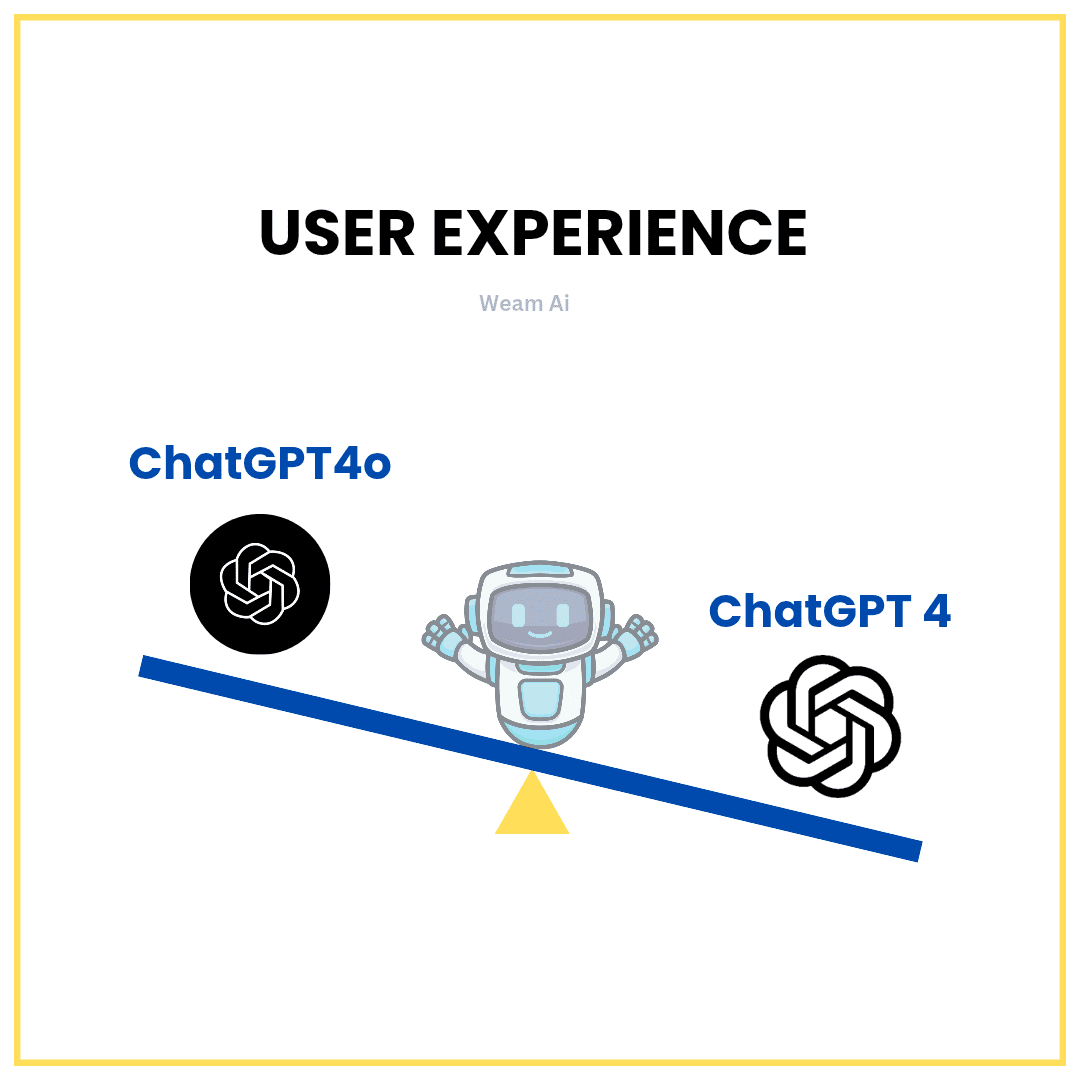
User Experience

Interface Modifications

A prominent update of ChatGPT 4o is the inclusion of multimodal capabilities. It enables users to engage with the model through text, images, and audio. This feature makes the interface more effective and flexible.

User Interface – ChatGPT-4o: Updates

ChatGPT 4o offers drag-and-drop images, real-time voice chats, and video interactions. It supports over 50 languages. ChatGPT is the most viewed AI Model. 

chatgpt 4 vs 4o

Differences in accessibility and user engagement

ChatGPT 4 is available to developers through Open AI’s API. Its web interface is available to Individual users. It lacks conversational depth compared to ChatGPT 4o.

Multimodal data of ChatGPT 4o fosters enhanced user engagement through many interactions. Real-time feedback and adaptive responses ensure a greater sense of interaction. It has more customization options.

Response Quality

The quality of responses generated by ChatGPT-4o is much better compared to ChatGPT-4. With contextual understanding and Conversation flow, ChatGPT-4o delivers more precise and relevant answers. There is no lag during long conversations. This feature decreases the chance of irrelevant or incorrect information.

Evaluation of Response Quality

ChatGPT 4 offers factual accuracy. Sometimes, it may provide less precise details. ChatGPT 4o is better with facts. It has an updated language model. It is more accurate and offers contextual awareness.

Feedback and Testimonials

  • ChatGPT 4: Many users liked its Conversational ability. They also found lapses in context retention and repetitive delivery.
  • ChatGPT 4o: Users highlight its accuracy, response rate, and proper multifaceted queries. To many users, it has become a trustworthy assistant.

Use Cases and Applications

Industrial Impact:

Education: ChatGPT 4 is helpful for tutors. It can help students to understand their assessments better. It can ease their language learning. It can act like a personal mentor.

ChatGPT-4o allows students to interact with educational content. It can process text, images, and audio. This helps students save time by entering every format. GPT-4 Omni provides accurate graphs and charts.

Healthcare: ChatGPT-4 assists with patient communication. It can aid medical documentation. It retrieves information if needed. ChatGPT-4o supports telemedicine consultations.

Customer Service: Both models can handle inquiries, provide support, and improve response times. ChatGPT-4o offers personalized customer interactions. It helps with troubleshooting issues. It offers voice-based support. It can help you with visual aids.

Creative Industries: ChatGPT-4 is helpful for content creation, including writing, marketing, and advertising. ChatGPT-4o is a powerful tool for multimedia projects.

Technology and Software Development: It has improved contextual awareness that is useful for complex software projects.

Real-World Applications – Business

chatgpt 4 vs 4o

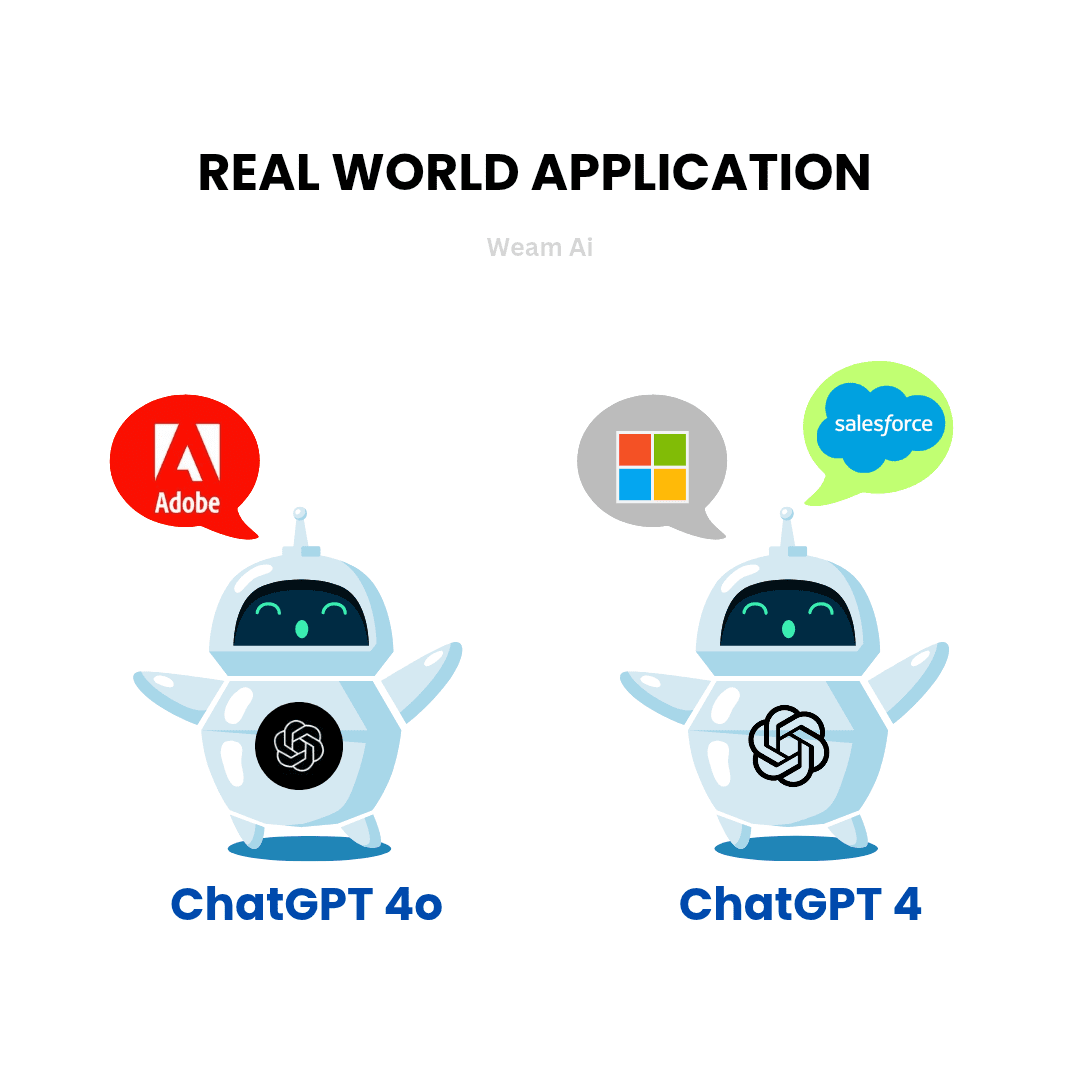
Microsoft and Salesforce have integrated ChatGPT-4 into their customer service platforms. Harvard University uses ChatGPT-4 for tutoring and language learning programs.

Adobe has included ChatGPT-4o for its creative cloud services. IBM uses ChatGPT-4o in its Watson AI platform to enhance healthcare diagnostics. It showed improvements in patient interactions.

Case Studies Highlighting Success Stories and Innovations

Case Study 1: Enhancing Customer Service:

A leading global corporation adopted chat gpt4. They said it enhanced their onboarding experience and employee experience. The AI assisted new joiners with company guidelines. It provided training materials and common inquiries. It facilitates an easy change. Recent Data says, 62% of customers prefer bots over human support. 

Case Study 2: Improving Educational Outcomes:

A university used ChatGPT-4o in its online learning platform. It led to better learning outcomes. It resulted in higher student withhold rates.

Case Study 3: Streamlining Content Creation:

A marketing agency used ChatGPT-4o to create multimedia content for its clients. It produced high-quality, SEO-optimized content. It resulted in increased client satisfaction. It also showed a high curve in their business growth. 

ChatGPT 4 vs 4o: Limitations and Considerations

  • Context Window: ChatGPT-4 possesses a more extensive context window than ChatGPT-4.0.
  • Knowledge Cutoff: ChatGPT-4.0 provides more current information than ChatGPT 4.
  • Cost: ChatGPT-4.0 may be more cheap compared to ChatGPT-4. This makes it a preferable choice for specific uses.
  • Feature Set: ChatGPT-4.0 may include extra functionalities such as JSON mode.
  • Models: Both models can reflect social biases.

Ethical Considerations in AI Use and Potential Biases

Bias and Fairness:

AI models can reinforce existing biases if trained on partial data. It may lead to unjust o results in areas such as recruitment, law enforcement, and healthcare.

Transparency:

AI systems operate as “black boxes”. It is impossible to comprehend how they reach particular decisions. This lack of clarity can erode trust and accountability.

Privacy:

AI systems need significant amounts of data to provide data privacy and safety.

Accountability:

Humans must take responsibility when AI systems make errors. It is also difficult to predict those error

Future Outlook

  • ChatGPT-4o: Advancements in multimodal functions offer intuitive interactions between humans and computers. It manages varied inputs. Outputs in real-time can spark further innovations in AI. Hence it enhances accessibility and simple solutions.
  • Future AI developments may result in the enhancement of these multimodal functions. It may offer faster response times and an increase in language depth. It lowers calculative expenses and makes it more approachable for a wider audience.

Speculations of ChatGPT beyond 4o

Open AI’s development plans are beyond ChatGPT-4o. The new ChatGPT-4.5 and ChatGPT-5 may deliver remarkable improvements. Below are some significant projections:

Integrated System: ChatGPT-5 unifies many AI functionalities into a single, updated system. It may cut the necessity for different applications. This in turn can save time as we rely on a single tool.

Improved Reasoning: It has intense reasoning skills. It includes chain-of-thought reasoning. It will ease complicated problem-solving, and It will help us improve our decision-making skills.

Multimodal Improvements: ChatGPT-5 will take each format as both inputs and outputs. It improves versatility and user interaction.

Affordability: OpenAI intends to offer level based subscription models for ChatGPT-5. It ensures that advanced AI tools remain accessible while providing premium features.

Conclusion

In our ChatGPT 3.5 vs 4 comparison, we saw a leap in certain capabilities. ChatGPT-3.5, while efficient, struggles with longer context retention and lacks multimodal abilities. ChatGPT-4 improves on this with a larger context window, enabling more in-depth conversations. Going further, ChatGPT-4o holds more data to provide relevant information. 

It might be more cost effective for certain applications. It includes JSON mode, reproducible outputs, and parallel function calling. Now we know the limitations of both models. We have discussed ethical considerations in AI use.

AI technology is evolving. Thus latest advancements are crucial. New iterations like ChatGPT-5 will bring significant improvements in multimodal output. You can leverage these advancements to enhance your applications. You can improve user experiences, and stay ahead in the evolving era.

Frequently Asked Questions

What are the must-see factors in selecting AI tools for business automation?

The must-see factors in selecting AI tools for business automation are scalability, integration capability, subscription cost, easy interface, and customer support.

Can companies ensure data privacy if they have more than one AI tool?

Yes. Companies can ensure data privacy through a comprehensive data governance framework. It also includes

(i) Data handling protocols

(ii) Regular review – of security information

(iii) maintenance of records.

How does GPT -4 differ from earlier models in practical scenarios?

GPT-4 can keep context and comprehend nuanced instructions. This feature can manage many conversation tasks at a time.

What are the notable differences between ChatGPT 4 vs 4o?

ChatGPT-4o has up-to-date data. It has a JSON mode feature. ChatGPT 4o is more cost-effective.

Can we expect any future updates on these AI tools?

Yes. Experts are waiting to see advancements through ChatGPT 5. We can expect that to be the updated version of all the versions so far.