AI leaders keep telling us the future of work is about to change forever… yet they rarely offer more than vague predictions. Continue reading “This Tool Forecasts New Jobs That AI Will Create”
AI leaders keep telling us the future of work is about to change forever… yet they rarely offer more than vague predictions. Continue reading “This Tool Forecasts New Jobs That AI Will Create”
From AI safety to “AI opportunity,” U.S. tech companies are racing to innovate, while politicians and industry leaders continue to champion its rapid advancement.
This week, Mike Kaput and Paul Roetzer analyze the ripple effects of Elon Musk’s bid to acquire OpenAI, JD Vance’s keynote address at the AI Action Summit in Paris, the latest GPT-4o update from OpenAI, and unfolding drama surrounding xAI. They also explore the growing impact of robotics, along with other pressing topics in our rapid-fire segment.
Listen or watch below—and see below for show notes and the transcript.
00:05:44 — Elon Musk Bid to Buy OpenAI and Ongoing Feud
00:15:06 — JD Vance Keynote at AI Action Summit in Paris
00:28:23 — Effect of Generative AI on Jobs
00:34:35 — GPT-4o Update + OpenAI Roadmap
00:40:00 — Grok 3 + xAI Drama
00:45:51 — AI More Empathetic Than Humans
00:51:22 — Results of Major AI Copyright Case in the US
00:54:47 — OpenAI Reasoning Model Prompting Guide
00:59:40 — Rise of the Robots
01:04:59 — Apple’s AI for Siri Faces Issues & Delays
01:07:51 — Listener Questions
Elon Musk’s Bid to Buy OpenAI
Elon Musk, along with a group of investors, has placed a staggering $97.4 billion bid to acquire the nonprofit entity that controls OpenAI—an unsolicited offer that throws a wrench into the company’s current fundraising efforts.
The consortium backing Musk’s bid includes his AI company, xAI, investment firm Vy Capital, and Hollywood power player Ari Emanuel.
OpenAI CEO Sam Altman quickly dismissed the bid with a mocking response on X, offering to buy Twitter from Musk for $9.74 billion instead. Musk shot back with a single-word reply: “Swindler.”
The timing of Musk’s offer is significant. OpenAI is in the middle of securing a massive $40 billion investment round, led by SoftBank, which would value the company at $300 billion. This would make OpenAI one of the most valuable private companies in the world, alongside Musk’s own SpaceX.
At the core of the conflict is OpenAI’s unusual corporate structure. Originally founded as a nonprofit in 2015, the company later formed a for-profit arm to attract investment. However, the nonprofit still retains legal control.
This means that despite OpenAI’s enormous valuation, Musk’s bid targets the nonprofit itself—a tiny entity with just two employees and $22 million in assets—because it holds the keys to OpenAI’s future.
Musk’s bid appears to be an attempt to establish the market value of this control, potentially complicating OpenAI’s efforts to sever ties with its nonprofit parent.
JD Vance’s Keynote Speech at AI Action Summit
At the Paris AI Summit, US Vice President JD Vance took a firm stance against what he called “excessive regulation” of artificial intelligence, delivering a sharp rebuke to European efforts to impose strict controls on the rapidly advancing technology.
He started off his speech by saying: “I’m not here this morning to talk about AI safety, which was the title of the conference a couple of years ago. I’m here to talk about AI opportunity.”
Speaking at his first major policy event since taking office, Vance framed AI as an economic turning point, comparing its impact to the steam engine’s role in the Industrial Revolution. He warned that overregulation could stifle innovation, saying, “It will never come to pass if overregulation deters innovators from taking the risks necessary to advance the ball.”
The US further cemented its position by refusing to sign an international pledge on AI development, a document endorsed by over 60 countries—including China.
The agreement commits signatories to ensuring AI is safe, transparent, and ethical, while also addressing human rights and sustainability. The UK, despite agreeing with much of the pledge, also declined to sign, citing concerns over national security and a lack of clarity on governance.
Vance’s speech also highlighted increasing tensions between the US and Europe over AI regulation.
Effect of Generative AI on Jobs
A new economic analysis of generative AI’s impact on the labor market has found that adoption is accelerating, with significant implications for employment and productivity.
The study, led by Jonathan Hartley at Stanford and a team of researchers from George Mason University, Columbia University, and the World Bank, surveyed US workers and found that as of December 2024, 30.1% of respondents reported using generative AI at work, marking a substantial increase in AI’s workplace presence.
The data shows a strong correlation between AI usage and demographic factors—younger, highly educated, and high-income workers are the most frequent adopters. Industries such as customer service, marketing, and IT report the highest levels of AI integration, while sectors like agriculture, mining, and government lag behind.
One of the study’s key findings is that generative AI significantly boosts productivity. Workers who use AI tools estimate that tasks that previously took 90 minutes can now be completed in just 30 minutes—a threefold efficiency increase.
Beyond its impact on productivity, AI is also transforming job search dynamics. Over 50% of unemployed respondents who were job-seeking in the past two years used AI tools for resume writing, cover letters, and interview preparation.
As AI becomes deeply embedded in the labor market, the study suggests that its effects will be mixed—enhancing efficiency for some while displacing others. Low-skilled workers may face greater risks of job loss, while high-skilled professionals are poised to benefit from AI augmentation.
The study concludes that AI is both a substitute and a complement to human labor, making its long-term impact complex and unpredictable.
This episode is brought to you by our AI for Writers Summit:
Join us and learn how to build strategies that future-proof your career or content team, transform your storytelling, and enhance productivity without sacrificing creativity.
The Summit takes place virtually from 12:00pm – 5:00pm ET on Thursday, March 6. There is a free registration option, as well as paid ticket options that also give you on-demand access after the event.
To register, go to www.aiwritersummit.com
This episode is also brought to you by our 2025 State of Marketing AI Report:
Last year, we uncovered insights from nearly 1,800 marketing and business leaders, revealing how AI is being adopted and utilized in their industries.
This year, we’re aiming even higher—and we need your input. Take a few minutes to share your perspective by completing this year’s survey at www.stateofmarketingai.com.
Disclaimer: This transcription was written by AI, thanks to Descript, and has not been edited for content.
[00:00:00] Paul Roetzer: One of the things I said that could slow this progress down and this vision for this kind of like technologist acceleration future is societal revolt. Welcome to the Artificial Intelligence Show, the podcast that helps your business grow smarter by making AI approachable and actionable. My name is Paul Roetzer.
[00:00:19] Paul Roetzer: I’m the founder and CEO of Marketing AI Institute, and I’m your host. Each week, I’m joined by my co host and Marketing AI Institute Chief Content Officer, Mike Kaput. As we break down all the AI news that matters and give you insights and perspectives that you can use to advance your company and your career.
[00:00:38] Paul Roetzer: Join us as we accelerate AI literacy for all.
[00:00:46] Paul Roetzer: Welcome to episode 136 of the Artificial Intelligence Show. I’m your host, Paul Roetzer, along with my co host, as always, Mike Kaput. We are recording this February 17th, Monday morning, 11 a. m. Eastern Time, which is relevant because we [00:01:00] expect some models to be coming out this week. And this week. So, if a new model has come out that we didn’t talk about on the show, you know why.
[00:01:09] Paul Roetzer: Alright. quick reminder, you can stay updated kind of throughout the week at, AI Show Pod on Twitter or X if you prefer. So it’s just at AI show Pod. And then we also are using the same handle on our YouTube channel, which is at AI show Pod. so you can check us out on Twitter and YouTube.
[00:01:29] Paul Roetzer: YouTube’s cool if you haven’t, uh. been on the YouTube channel before, we not only publish the full video version of this podcast, but our team does an incredible job of cutting up like the main topics into individual videos, and then they also create shorts based on each one. So if you prefer to consume some video content or if you want to share the video content, the team does an awesome job of cutting that all up.
[00:01:52] Paul Roetzer: So thanks to Claire and Cathy who handle a lot of that work behind the scenes. All right, This episode is brought to us by AI for Writers [00:02:00] Summit. We’ve been talking a lot about this lately, but we have not acknowledged our presenting sponsor, GoldCast. So we are grateful for GoldCast being on board.
[00:02:07] Paul Roetzer: They’ve been a great partner of Marketing Eye Institute for the last couple of years. We’re excited to be working with them again, and the Writers Summit actually runs through GoldCast, so it’s a great chance for people to experience, the sponsor and the platform themselves. So the AI for Writers Summit is coming up on Thursday, March 6th, which, oh my gosh, is only three weeks away.
[00:02:27] Paul Roetzer: I have some work to do, Mike, as I’m sure you do for your presentation. Yeah. If any of our, you know, regular listeners are familiar with the, how this works, we, we have events and then Mike and I freak out two to three weeks before the event, realizing we have yet to create our presentation. so this is coming up again.
[00:02:46] Paul Roetzer: It’s a virtual conference. Last year, we had 4, 500 attendees from 90 countries. And it’s great because thanks to GoldCast, there is a free registration option. So you can join us for this [00:03:00] Writer’s Summit from noon to five Eastern. On Thursday, March 6th, for free if you choose to, again, that is thanks to the sponsor.
[00:03:08] Paul Roetzer: There’s a paid option that gets you on demand access and or a private registration if you choose not to share your contact information with the sponsor. So you can go to AIWriterSummit. com, again, that is AIWriterSummit. com. You can also find it under the events section of the Marketing Institute website.
[00:03:27] Paul Roetzer: And second, our fifth annual State of Marketing AI Report is now in the field. The survey is active. This is the, as I said, fifth time we’re doing this, so we have a bunch of benchmark data. We’ve evolved the questions a little bit this year, added some new stuff in there. This is always one of my favorite pieces of content we create every year, Mike.
[00:03:50] Paul Roetzer: It’s awesome to see. Last year, we had 1, 800. Marketers and business leaders take it. So if you’re in the marketing field or if you are involved in marketing, I mean, we oversee the [00:04:00] marketing team. We’d love to have your input. How long are we going to have this in the field, Mike? What is the, what’s the schedule?
[00:04:05] Paul Roetzer: You know, I
[00:04:05] Mike Kaput: think right now we’re open for about four to six weeks, depending on the response, right? So we have a little bit of time and we’ll talk about the next several episodes. but I think we’re going to hit our kind of target response rate pretty quick, given how much interest we see in these.
[00:04:21] Paul Roetzer: So people can go to stateofmarketingai.
[00:04:24] Paul Roetzer: com. Again, that is stateofmarketingai. com. That will actually take you to the 2024 report page. So you can go grab the report from last year, which I think we’ve had over 10, 000 downloads of that report. So it was a pretty popular report. and at the top of that page is the link to take the 2025 survey.
[00:04:43] Paul Roetzer: So if you’ve got five to seven minutes, you can go through and give us your input. we’d love to have you be a part of that, and then as soon as the report’s ready, we will be sending that out to everyone who participated, and that, what’s the plan there, Mike? Is that this spring we’re planning on releasing that?
[00:04:58] Mike Kaput: Yeah, so I think the [00:05:00] target is the end of April we’ll be having kind of a big launch webinar and releasing the report, so kind of, yeah, right at the, right towards the end of, beginning of, you know, Q2, you’ll have some really great data for the, for 2025.
[00:05:14] Paul Roetzer: And we’ll definitely talk about, I think we usually do a special podcast episode, maybe going through like the 10 trends from the report.
[00:05:19] Paul Roetzer: So you’ll definitely hear about it as we go. But again, stateofmarketingai. com if you want to be a part of that survey. All right. I don’t, so much happened like last Monday and Tuesday that I felt like we already talked about it when I was looking through the brief for this podcast. I was like, Oh, I guess We didn’t actually talk about this since last week, so let’s kick it off with, OpenAI.
[00:05:40] Paul Roetzer: It’s like the never ending soap opera that just keeps on giving.
[00:05:44] Mike Kaput: Yeah, and the train that keeps on wrecking over here, right? And so, Elon Musk has, this past week, made another Bold move, depending on your perspective, in his ongoing feud with OpenAI. So Elon Musk, along with a group of investors, has placed [00:06:00] a 97.
[00:06:00] Mike Kaput: 4 billion bid to acquire the non profit entity that controls OpenAI. This is an unsolicited offer that seems to be designed to kind of throw a wrench into the company’s current fundraising efforts. This consortium backing Musk’s bid includes his AI company, XAI, the investment firm ViCapital, and Hollywood power player Ari Emanuel.
[00:06:24] Mike Kaput: Now OpenAI CEO Sam Altman quickly dismissed the bid with a mocking response on X. He offered to buy Twitter from Musk for 9. 74 billion instead. Musk shot back with a single word reply. She said Swindler. And you know, the board then again also rejected the bid, but the timing of this offer is kind of what matters because despite the rejection, like OpenAI probably doesn’t need this kind of headache because it’s in the middle of trying to secure a massive 40 billion investment round led by SoftBank.[00:07:00]
[00:07:00] Mike Kaput: which would value them at 300 billion dollars. That would make them one of the most valuable private companies in the world alongside Musk’s own SpaceX. And kind of at the core of all this conflict is OpenAI’s unusual corporate structure. Founded as a non profit in 2015, they later formed a for profit arm to attract investment.
[00:07:20] Mike Kaput: However, the non profit, as of right now, still retains legal control. That’s something they’re trying to change as they transition to a for profit company. Now, Musk’s bid seems like it may be an attempt to establish the market value of this, potentially kind of complicating OpenAI’s whole efforts to get to that non profit structure.
[00:07:42] Mike Kaput: If they can move forward there, they may now have to justify paying a significantly higher price for their independence from that non profit. So, Paul, there’s a lot of moving pieces here. First up, kind of We have to ask with anything Elon Musk does, is this a [00:08:00] serious offer? Is it trolling? Is it both? Is it something else?
[00:08:04] Paul Roetzer: Yeah, I mean, I think it’s just largely an attempt to muddy up the waters, create friction for OpenAI and Sam, you know, creating this artificially high value that he, I don’t think has any belief would actually end up going through. I don’t think he actually thinks he’s going to be able to buy OpenAI.
[00:08:22] Paul Roetzer: for context on the Altman tweet, it was a shot at Musk. you know, if you recall, Musk bought Twitter for 44 billion in October, 2023, and then proceeded to You know, the value proceeded to tank to somewhere roughly in the range of nine billion today. so it’s definitely been getting personal, and I think Sam stayed out of the personal attacks for a while, and you can tell now with interviews that Sam’s patience is basically just gone.
[00:08:51] Paul Roetzer: And so he was interviewed, I think it was like last Tuesday, that he said, I wish he, being Elon, would just compete by building a better [00:09:00] product, and then When the interviewer asked him, you know, some more detail, he said his whole life is from a position of insecurity, I feel for the guy, I don’t think he’s a happy person.
[00:09:11] Paul Roetzer: So, you know, I think it’s just getting to the point where Sam is just fed up with this and truly just, you know, if you’re gonna compete, compete, but like stop trying to screw us over in the process. And Elon feels wronged and that doesn’t end well when Elon feels like he’s been wronged. So, a little context on the offer, um.
[00:09:31] Paul Roetzer: You know, so you kind of alluded to this, Mike, but there’s, and we’ll put it, there’s a great article from The Information that kind of like had a really good breakdown here. But the key is that, you know, When Altman took over as CEO in 2019 and sort of like Elon was pushed out after he tried to roll OpenAI into Tesla.
[00:09:49] Paul Roetzer: so Elon actually wanted OpenAI to be a for profit company. In 2017 18, when they realized they needed to raise billions of dollars, Elon was the one pushing for the for profit entity and [00:10:00] actually tried to move it in and take full control of it under Tesla in 2019, and that’s when he lost the power struggle with Sam, and so this friction has existed since, since that time.
[00:10:12] Paul Roetzer: the basic concept, as the information reports it, is that the non profit arm, and if you’re confused by all this, like, welcome to the club, it’s a really complex organizational structure that you can’t just simply take a non profit and make it a for profit and IPO and everything’s fine, like, The non profit owns the assets, it controls the mission, like, you can’t just extract it out, you have to give the value of, to, to that non profit.
[00:10:37] Paul Roetzer: And so, the, the rumor is, that in this transition, the non profit would take a 25 percent equity stake. in the for profit. So if the company, I’m going to do some quick math here, Mike. If the company is valued at 300 billion, 25 percent would be 75 billion, I think. So they’re saying that [00:11:00] the equity stake from the non profit would be roughly 75 billion.
[00:11:03] Paul Roetzer: Well, Elon’s saying, fine, I’ll pay 97 billion. You as a non profit need to accept this because you have a fiscal responsibility to do so. And we’re offering more than you’re going to value it at. So they’re just trying to like make this like super complex. so there is this irony in here that like this was Elon’s plan all along, OpenAI published, we’ll put this link back on the site.
[00:11:24] Paul Roetzer: So again, if you haven’t been listening to the show for a long time, we covered all this like episodes ago. But, OpenAI in December published like basically an expose of like all of Elon’s emails, all their communications that just laid all this out that like, hey, he’s the one that wanted to do this.
[00:11:40] Paul Roetzer: We’re just doing what he was originally planning on anyway. Yeah. So there’s all that. And then there’s this weird twist here, that Brett Taylor, who is the chair of the OpenAI board right now, the nonprofit board, he was the chair of the Twitter board when Elon bought Twitter. And so I’ll explain why that’s [00:12:00] kind of weird in a second.
[00:12:01] Paul Roetzer: So Brett Taylor released an official statement through the OpenAI newsroom, Twitter account. That said, OpenAI is not for sale, and the board has unanimously rejected Mr. Musk’s latest attempt to disrupt his competition. Any potential reorganization of OpenAI will strengthen our non profit and its mission to ensure AGI benefits all of humanity.
[00:12:21] Paul Roetzer: So what they’ve said is basically we’re a mission driven non profit, and Elon buying us does not fit the mission, so no. We’re not entrusted, doesn’t matter how much. So then Elon actually replies, of course, to the OpenAI newsroom tweet, And he says, from a friend, quote, Brett Taylor is a scammer running an agent startup that literally has no product whatsoever and is funneling money into open AI.
[00:12:43] Paul Roetzer: He just does bureaucracy. So, now Elon’s coming at, at Brett. So again, let’s go back to 2022, when Elon tries basically a hostile takeover of Twitter, makes an offer unsolicited for 44 [00:13:00] billion or whatever it was, 54. 20 a share, 54. he does this through Brett Taylor, so like, this all goes back, they had a relationship, so he, he texts Brett Taylor back in 2020 saying, hey, I’m gonna, I’m taking over Twitter, basically, and then the next day, submits the offer, well then if you’ll recall, Elon tries to back out of the Twitter acquisition.
[00:13:23] Paul Roetzer: So he blames it on like spam and bots and all this stuff. So he realizes like he got in over his skis and he didn’t actually want to buy Twitter. And Brett Taylor and the board basically forced him to see the acquisition through. And so Elon didn’t want Twitter. It’s kind of worked out. I mean, other than tanking the value, it’s kind of worked out okay, because it gave him a platform and influence and data to train his own AI.
[00:13:45] Paul Roetzer: But at the time he didn’t want it. And Brett made him do it, basically. So there’s, There’s just, like, layers of drama and complexity here, and it’s just so funny to, like, watch. I don’t know, like, if it wasn’t scary, it’d be, like, really funny.
[00:13:59] Mike Kaput: [00:14:00] So, the board has rejected this offer. I guess I have to ask, like, is this the end of it?
[00:14:05] Mike Kaput: Is there a chance this could still happen in some form? Like, what is your take on what’s most likely to happen in the immediate future?
[00:14:14] Paul Roetzer: Yeah, so what triggered this was that last week a judge basically indicated in the case against OpenAI that the judge was likely to side with OpenAI in this and basically throw Musk’s case out.
[00:14:26] Paul Roetzer: So in essence, like, Musk’s attorneys, which he probably has an infinite number of and endless resources to pay them, basically just probably have a bunch of, you know, bullets in the chamber of like, all right, cool, like, let’s do this next thing and this next thing. So I don’t see Musk’s. Stopping at all on this.
[00:14:41] Paul Roetzer: that then the irony is, as we’ll talk about, he’s launching his own new model tonight, Monday night. And so he’s directly competing with OpenAI and he truly is, I think, just trying to mess with them and slow them down and try and get out ahead of OpenAI. I don’t, I don’t know. So I know, I do not think he’s going to stop.
[00:14:59] Paul Roetzer: He. He has [00:15:00] no reason to. I think he finds it amusing and he has the resources to do it.
[00:15:06] Mike Kaput: Well, in our second topic, speaking of not stopping, at the Paris AI Summit, US Vice President J. D. Vance took a very firm stance against what he called, quote, excessive regulation of AI. delivering a sharp rebuke to European efforts to impose strict controls on the rapidly advancing technology.
[00:15:26] Mike Kaput: He actually started off his speech saying literally, quote, I’m not here this morning to talk about AI safety, which was the title of the conference a couple years ago. I’m here to talk about AI opportunity. So this was his first kind of major policy event since the Trump administration has taken office, and in this, Vance, over about 15 minutes, framed AI as an economic turning point.
[00:15:49] Mike Kaput: He compared its impact to the steam engine’s role in the Industrial Revolution, and then he warned that over regulation could stifle innovation, saying, quote, It will never come to pass if [00:16:00] over regulation deters innovators from taking the risks necessary to advance the ball. Now, the U. S. further cemented that position by refusing to sign an international pledge on AI development, which was endorsed by over 60 countries, including China.
[00:16:15] Mike Kaput: That agreement commits signatories to ensuring AI is safe, transparent, and ethical. Vance’s speech also kind of highlighted these increasing tensions between the U. S. and Europe over AI regulation, and that kind of comes at an interesting time as the EU starts to enforce its AI Act. So First, Paul, let’s kind of talk about this speech itself.
[00:16:37] Mike Kaput: It’s pretty short, but I would say for the free, despite being short, it’s impact has been pretty significant because some people in AI circles have been calling this one of the most pro innovation, pro AI accelerationist speeches they’ve ever heard from a politician, much less the vice president of the United States.
[00:16:57] Mike Kaput: Like Vance basically comes out and says, we’re [00:17:00] accelerating. Well, you want to either work with you, but if you don’t want to work with us, get out of your way, our way. So what did you make of this?
[00:17:08] Paul Roetzer: Yeah. So I think contextually, if people aren’t aware, it’s important to know who JD Vance is. So JD Vance is a former venture capitalist who was brought into political power by Peter Thiel, who co founded PayPal with Elon Musk and was the first major investor in Facebook.
[00:17:25] Paul Roetzer: And Peter Thiel was also the first. Silicon Valley, leader to support the Trump, campaign in 2016. So Thiel, you know, has sort of like invested heavily in bringing politicians that sort of share his worldview into power and politics. So that’s J. D. Vance as like a rough background, became a senator, became the vice president.
[00:17:48] Paul Roetzer: So he has Silicon Valley ties, specifically this movement towards like open source and deregulation. So, his background fits very well with this [00:18:00] administration’s focus on reducing regulation, putting AI safety concerns aside, as we talked about on the last episode, massive investment in infrastructure, and accelerated all costs.
[00:18:10] Paul Roetzer: That is the Silicon Valley current, mentality and JD Vance represents that better than any politician right now. That is, that is his MO. So I’ll just go through like a couple of excerpts here that really caught my attention. It was a very, as you said, pro acceleration, I guess would be one way to categorize this talk.
[00:18:31] Paul Roetzer: very pro American. I can’t, I don’t, I don’t really know how to even like explain this talk. It is one of the bolder political speeches I have. I have seen. so he says, to restrict this development now would not only unfairly benefit incumbents in the space, but it would also mean paralyzing one of the most promising technologies we’ve seen in generations.
[00:18:54] Paul Roetzer: This concept goes back to things we talked about. Last fall of [00:19:00] 2024, this idea of regulatory capture and that the incumbents would control what the regulations would be in their favor. And so small tech, startups, things like that wouldn’t have the benefit of fair competition because the people like OpenAI would sort of set the parameters of what the regulations would be.
[00:19:20] He went on to say later, when a massive incumbent comes to us asking for safety regulations, we ought to ask whether that regulation benefits our people or the incumbent. I think he was talking to some specific people with those things. The thing that became very obvious when you read through this transcript is every single word is intentional.
[00:19:39] Paul Roetzer: Like, every word and every phrase. Many of them have meaning behind them, but they’re all extremely intentional. And so I think it’s worth reading a few times through the transcript because you start to really see what they’re saying. So, he outlines four key things. One, his administration will ensure that American AI technology [00:20:00] continues to be the gold standard worldwide.
[00:20:02] Paul Roetzer: We aim to be the partner of choice for foreign countries and businesses as they expand their use of AI. Number two, We believe that excessive regulation of the AI sector could kill a transformative, transformative industry just as it’s taking off and we will make every effort to encourage pro growth AI policies.
[00:20:17] Paul Roetzer: Three, we strong, we feel strongly that AI must remain free from ideological bias and that American AI will not be co opted into a tool of authoritarian censorship. I’ll come back to that one. And finally, number four, the Trump administration will maintain a pro worker growth path for AI so that it can be a potent tool for job creation in the United States.
[00:20:37] Paul Roetzer: He said, AI will facilitate and make people more productive. It is not going to replace human beings, I think is in him. I think too many leaders in the industry, when they talk about the fear of replacing workers, miss the point. AI will make us more productive, more prosperous, and more free. I’ll come back to that one in a moment as well.
[00:20:56] Paul Roetzer: he talked about like infrastructure and how, [00:21:00] this is when I was like, You know, I think we’re stretching here. It says the US possesses all components across the full AI stack, including advanced semiconductor design, frontier algorithms, and transformational applications. The computing power the stack requires is integral to advancing technology.
[00:21:13] Paul Roetzer: They do not acknowledge the fact that TSMC which is in Taiwan, is fundamental to all of this, and, you know, Taiwan, which China believes is part of China. that’s a, that’s a problem. That’ll come up over the next four years a lot. Gets into regulation, and the fact that the EU AI Act and the Digital Services Act is an impediment to U.
[00:21:34] Paul Roetzer: S. technology companies, and they’re not going to stand for it, so there are some veiled threats toward the EU for their current policies. Free speech, which is, their, I don’t know, code word is the right word, but like, that’s That’s their language for we are not going to moderate anything online. So we’ve already seen this where Facebook a couple weeks ago announced to their employees, Zuckerberg did, that they’re removing moderation off of Facebook.
[00:21:58] Paul Roetzer: They’re basically gonna rely on [00:22:00] AI only. They’re getting rid of human moderators. X is obviously the Wild West right now. There’s no like real, you know, any information. So they literally said, The administration will ensure that AI systems developed in America are free from ideological bias and never restrict our citizens right to free speech.
[00:22:15] Paul Roetzer: We can trust our people to think, consume information, develop their own ideas, and debate the open marketplace of ideas. So again, whether you support or don’t support this concept, they’re telling you point blank, we’re not, we don’t believe in moderation and we will not allow our social networks within our country To do moderation, basically.
[00:22:32] Paul Roetzer: We were going to let anything, you know, spread on there. And then the last one I wanted to just make sure we touched on is this idea of this future of work, and this is a really important thing. It’s going to be the next main topic, and we’re going to come back to this next week. So he said, finally, this administration wants to be clear about one last point.
[00:22:48] Paul Roetzer: And again, everything’s intentional, and this is the closing. we will always send our American workers and our AI policy where we refuse to view AI as a purely disruptive technology that will inevitably automate away our [00:23:00] labor force. We believe AI will make our workers more productive, and we expect they will re produce.
[00:23:04] Paul Roetzer: Reap rewards with higher wages, better benefits, and safer, more prosperous communities. And then I bolded this one myself. the most immediate applications of AI involve supplementing, not replacing, the work being done by Americans. Now, I’m gonna, postulate here, Mike, that most immediate was a very intentional phrase.
[00:23:24] Paul Roetzer: I, so I made a note to myself, like, most immediate is doing a lot of work in this sentence. So then, so then he says, We believe that the U. S. labor force prepared to use AI to its fullest extent will attract the attention of businesses that have offshored some of these roles. I believe that to accomplish this, the administration will ensure that America has the best trained workforce in the world.
[00:23:43] Paul Roetzer: That would be amazing. Our schools will teach students how to manage, supervise, and interact with AI enabled tools as they become part of everyday lives. I, that would be phenomenal. I think that’s a great vision. As AI creates new jobs and industries, our government, business, and labor organizations have an obligation to work together.
[00:23:59] Paul Roetzer: To empower [00:24:00] workers, not just in the US, but around the world. So, I think it’s really important on this last part, Mike, and then I’ll kind of throw it back to you. This future of work content, this is something that just keeps coming up time and time again. And after I saw this talk last week, it sort of, kind of, like, moved me to action, I guess you could say.
[00:24:16] Paul Roetzer: I’m, I’m really, I’ve said this many times, I’m, I’m struggling tremendously. With all of these leaders, and now our own government leaders, proclaiming that this is all just going to be fine. And it’s all just going to make more jobs. And there’s no actual plan or vision for how that’s going to happen. So, if this final section happens, I will be the happiest person.
[00:24:38] Paul Roetzer: Like, if our schools are teaching it, if it’s, if it’s integrated into the workforce, if we’re driving literacy across companies and industries, if we’re Creating more jobs than we’re destroying and not displacing workers, like, I hope that that is the future. My problem is no one has a plan for that future to be created.
[00:24:55] Paul Roetzer: that so that’s the thing where I feel like, you know, kind of like [00:25:00] we did a few weeks ago with this AI literacy project. Like at some point you just have to start doing something. Like it’s not enough for me to sit here and complain about this every week on the podcast versus like trying to do it.
[00:25:10] Paul Roetzer: And so, you know, I started working on something last week to try and like project out what, what are those jobs, like what, what could be created that we’re not envisioning, you know, versus these abstract things that every once in a while Sam Altman will respond to, or you’ll hear some other leader respond to.
[00:25:27] Paul Roetzer: I think I made some progress and I wanted to share it today, but It hasn’t, we haven’t fully tested it out yet, but we were able to build something that can help with this. I think, at least start the conversation in different companies and industries. I shared it with Mike and kind of, you know, Mike was able to do some testing on it.
[00:25:46] Paul Roetzer: So stay tuned next, next week, we should be able to actually have it publicly live and, be able to talk about it on the show. But our whole effort is to try and like, let’s put some tangible. Ideas behind this. So if I’m a [00:26:00] lawyer, if I’m a marketer, if I’m an, you know, an accountant or if I’m a consultant or an agency leader, like what are those jobs?
[00:26:06] Paul Roetzer: Like that’s, that’s the big question right now is like, what jobs? Like let’s, let’s try and envision this. We know what the models are going to do one to two years out. That’s, that’s a known path. What jobs could possibly be created that don’t exist today as these models get smarter and more generally capable?
[00:26:20] Paul Roetzer: So that was what I set out to solve, like, last Wednesday. Like I said, I think I made progress. Like, I think, I think there’s a way we can actually help move this conversation forward. So sort of stay tuned on that, I guess.
[00:26:31] Mike Kaput: Yeah, it seems especially on jobs from what we know of this administration, he was walking a bit of a tightrope, right?
[00:26:38] Mike Kaput: Because there’s a huge amount of populist, rhetoric and sympathy that brought this administration into power, but also it’s backed by people like Marc Andreessen, who I guarantee you do not share this view on labor. They are looking to activate. They’re funding the building of AI agent companies to replace people.
[00:26:57] Mike Kaput: Hundred percent. So I [00:27:00] can very well see that this is an interesting line to keep towing. And yeah, I mean, it points out that there is no plan right now that is at least public.
[00:27:09] Paul Roetzer: Yeah. And I think, and I’ve mentioned this before, The AI timeline, you know, we talked about in episode 87, I’ll reference it again on the robotics conversation in a little bit here.
[00:27:19] Paul Roetzer: But one of the things I said that could slow this progress down and this vision for this kind of like technologist acceleration future is societal revolt. And I do think we’re going to start to see a piece of this. There was actually, I had a tweet from, this was on the 15th, from Suhail, who’s the founder of Playground AI, and he, he, I’ll put it in the show notes, Mike, and you can share it.
[00:27:42] He said, someone hung this on my door in San Francisco, people have lost their mind, Accelerate Humanity, and it was a, it was a placard, like a sign that says, stop AI, like OpenAI is trying to build AGI, they define it as this, if nothing goes wrong, the majority of jobs will be lost to AI, like, [00:28:00] So you’re, I mean, this is just one tweet, but like in San Francisco is starting to like form groups and post signs about like stopping AI and I don’t know, like, it’s, it’ll be interesting to follow this along, but now we have the government for the first time stating what we’d seen like, you know, Andreessen Horowitz and others be stating.
[00:28:23] Mike Kaput: Well, related to that in our third big topic, we actually are seeing some additional. Data on kind of how generative AI might actually impact the labor market. So we saw a new economic analysis come out this past week that found that AI adoption is accelerating and has significant implications for employment and productivity.
[00:28:43] Mike Kaput: So this study in particular is led by Jonathan Hartley at Stanford and a team of researchers from George Mason University, Columbia University, and the World Bank. Now, they surveyed U. S. workers and found that as of December 2024, 30. [00:29:00] 1 percent of respondents reported using generative AI at work. So that marks a pretty substantial increase in AI’s workplace presence compared to a few years ago.
[00:29:09] Mike Kaput: The data shows a strong correlation between AI usage and demographic factors. So younger, highly educated, high income workers are the most frequent adopters. Industries such as customer service, marketing, and IT report the highest levels of integration, while predictably maybe some sectors like agriculture, mining, and government lag behind.
[00:29:31] Mike Kaput: Now, one of the key study, the study’s key findings is that generative AI significantly boosts productivity. Workers who use AI tools estimate the tasks that previously took 90 minutes can now be completed in just 30 minutes, which is a threefold efficiency increase. However, the technology is used intermittently with most employees integrating it for less than 15 hours per week.
[00:29:58] Mike Kaput: Interestingly, [00:30:00] beyond the impact on productivity, AI is also transforming job search dynamics. Over 50 percent of unemployed respondents who were job seeking in the past two years used AI tools for resume writing, cover letters, and interview preparation. So Paul, I think this is Some research worth mentioning for a couple reasons, amidst everything else we’ve covered, I mean, it’s interesting takeaways that we can definitely talk about, but namely, it’s pretty recent data, which hasn’t always been the case with some of these studies.
[00:30:30] Mike Kaput: It’s based on a survey of 4, 000 plus people, looking at some of the methodology, they seem to have done a, at least, For my novice opinion, a pretty good job of creating some pretty clear and specific questions. Like they define generative AI up front. They ask very clearly about how you’re using it. Like very specific date range or time ranges, like once a week, twice a week, et cetera.
[00:30:54] Mike Kaput: And it’s also recent data. It’s from December, 2024. So. What did you kind of [00:31:00] make of this and what can it tell us about where this is all headed or where we stand today?
[00:31:06] Paul Roetzer: Yeah, it seemed really well done and like you said, the recency matters because a lot of times when we get these, you know, reports, it’ll be from like six months ago and a generation ago of models.
[00:31:16] Paul Roetzer: So this is current generation models roughly. It is. It is. I’ve been in conflict with one of the studies we’ve talked about on the show before, which was Microsoft and LinkedIn did like a workplace study, like Gen AI in the workforce in spring of 24, so almost a year ago, and their data at that time said 75 percent of workers had used Gen AI.
[00:31:39] Paul Roetzer: And I thought, I always thought that felt high, but it also was probably centered more on like the tech world, I would imagine, which would make sense then. So this seems like a more diverse base of like industries they were looking at, career paths. I like how they go into a lot of specifics and this gets, gets back to what we were talking about in the last couple episodes of this idea of these [00:32:00] evaluations that compare it to like the smartest humans in the world at like the most complex problem solving, like mathematics and biology.
[00:32:09] Paul Roetzer: That’s good, but that doesn’t tell us about like future of work stuff per se. So I really like these studies where we get into like real tangible applications in people’s jobs. One thing to consider is like you can’t put too much weight on any one of these studies. over an extended period of time because they’re all snapshots in time.
[00:32:32] Paul Roetzer: So as the models scale, we’re not sure if the impact scales. So if we get a 10x improvement or like 10x compute, put into the training of a model, do we see a 10x impact on the, on the jobs and the tasks that it’s able to perform? So, We had this quote recently from Sam Altman when he was talking about the OpenAI Deep Research project that we talked about last week.
[00:32:57] Paul Roetzer: And he said, it’s not a scientifically rigorous thing, [00:33:00] but my vibes based estimate is that it, being deep research, does about 5 percent of all tasks in the economy today. One feature, 5 percent of all tasks in the economy. So, that’s the thing we’re trying to figure out, is like, Where are these models and what are they actually capable of doing?
[00:33:18] Paul Roetzer: because I, again, I don’t think that the majority of leaders, whether that’s our government leaders, like we just talked about, or if it’s business leaders or university leaders, I don’t think people realize how many of the tasks we do, we’re within like 12 months of these AI doing them at or above.
[00:33:37] Paul Roetzer: average human level. Right. And that’s the part where as we jump to, you know, we’re, we know we’re going to get 4. 5. We’ll talk about that in a minute. We’re going to get some new version from Anthropic, a new model from them, maybe this week. We know we’re getting Groq 3 this week. as these things get better and better and more generally capable, what truly is the impact on, on work?
[00:33:57] Paul Roetzer: And that’s what we’re trying to like figure out. [00:34:00]
[00:34:00] Mike Kaput: I think people get too focused on, The almost science fiction like changes that very well could be coming, right, that are important to consider, but this study alone is saying that, look, we’re three times more efficient with these tools today. Obviously, that’s a broad statement, but if you imagine everything stopped tomorrow.
[00:34:20] Mike Kaput: And all we got was a 3x efficiency gain across the board in knowledge work. That seems like something that’s going to have a pretty significant impact. It’s a big deal. All right. So let’s jump into a bunch of rapid fire topics for this week.
[00:34:35] Mike Kaput: So first up, Sam Altman has revealed OpenAI’s upcoming product plans in a post he put on X on February 12th.
[00:34:44] Mike Kaput: Now in it. Altman detailed the company’s plans for GPT 4. 5 and GPT 5, saying, quote, We want to do a better job of sharing our intended roadmap and a much better job simplifying our product offering. We want AI to just work for you. We [00:35:00] realize how complicated our model and product offering so gotten. We hate the model picker as much as you do and want to return to magic unified intelligence.
[00:35:08] Mike Kaput: We will next ship GPT 4. 5, the model we call Orion, internally. As our last non chain of thought model. After that, a top goal for us is to unify O series models and GPT series models by creating systems that can use all our tools, know when to think for a long time or not, and generally be useful for a wide range, a very wide range of tasks.
[00:35:31] Mike Kaput: In both ChatGPT and our API, we will release GPT 5 as a system that integrates a lot of our technology, including O3. We will no longer ship O3 as a standalone model. The free tier of ChatGPT will get unlimited chat access to GPT 5 at the standard intelligence setting subject to abuse thresholds. Plus subscribers will be able to run GPT 5 at a higher level of intelligence and pro [00:36:00] subscribers will be able to run GPT 5 at an even higher level of intelligence.
[00:36:04] Mike Kaput: These models will incorporate voice, canvas, search, deep research, and more. Now, as if that wasn’t enough, Altman, a few days later, also announced, again via a post on X, that the company has officially updated GPT 4. 0. He said, we put out an update to ChatGPT 4. 0. It is pretty good. It is soon going to get much better.
[00:36:24] Mike Kaput: Team is cooking. Now, I’ve seen some early users report the updated model seems like it has way more personality and produces much better results, especially around writing. I’ve kind of noticed a little bit of that as well in my early testing. But this is a lot of pretty big news in a couple of pretty short informal posts on X.
[00:36:45] Mike Kaput: I mean, for me at least, it seems like a breath of fresh air. We’re going to simplify picking models finally, something we’ve talked about. It seems also like a huge change that the O Series and GPT Series models are going to be unified at [00:37:00] some point going forward. So, Paul, what jumped out to you about these announcements?
[00:37:07] Paul Roetzer: Yeah, I think, you know, first, it was everything we’ve been pleading for on the podcast. So fix the naming conventions, get rid of all the model choice for the average business user who has no idea which model to pick. Yeah, I would assume they’ll solve for, I saw some developers complaining on Twitter about, you know, taking away their choice.
[00:37:24] Paul Roetzer: I assume they’ll just have like an advance button or something like that that lets people, you know, go through and if they still want to choose, they can. Um. I’ve seen some requests for like your ability to personalize the model. I think that’s going to come in also, like how creative you want it to be in its outputs, you know, things like that, how personalized you want it to be, how much you want it to use its memory of you, things like that.
[00:37:45] Paul Roetzer: this is where all the models are going. Gemini will do the same thing. Logan Kilpatrick tweeted as much, like this is our vision for Gemini 2. so these multimodal models that have reasoning baked into them, That is the future. That’s what all [00:38:00] the models will be in 2025. And we’ve known that like this was, you know, a year ago.
[00:38:05] Paul Roetzer: This is what we said was coming. So it’s been a pretty obvious path that was being followed here. It’s a very unusual move for SAM to share their, their roadmap. my guess is that was triggered by knowledge that XAI was likely going to do something with Groq this week. And the rumors are that Anthropic has been released a model this week as well.
[00:38:26] Paul Roetzer: And I expect that those may at least be on par with 4. 0’s ability, if not, according to Elon, you know, surpass the model. He said it’ll be the smartest that they’ll have. we can talk a little bit more about that in the next topic. But I think they’re trying to kind of get ahead of some of this. And, and so I assume that’s why they did it.
[00:38:49] Paul Roetzer: he, Aravind Srinivas, the CEO of Perplexity, tried to, like, I don’t know, like, take a shot at Sam on the tweet. And he’s like, what is it [00:39:00] better at or something like that? And Sam replied, among many other things, it’s the best search product on the web. Check it out, let me know what you think. And then someone said something, I forget what the comment was, and he replied, Oh, they wanted like O1 level reasoning and he said how about O3 pro level intelligence and even better personality so I think either 4.
[00:39:21] Paul Roetzer: 5 which we’ll see in a couple weeks I think maybe they’ll drop it tomorrow to mess with Elon or and five which it sounds like we’ll see in a couple months assume this like really advanced reasoning capability. And more personality, as you were saying, Mike, like it’s kind of like more personable, there’s less restrictions on what it does and says, I think they’re starting to like pull some of the guardrails back.
[00:39:43] Paul Roetzer: So, yeah, I don’t know, I was playing with custom GPTs over the weekend a lot, and I wasn’t like, seeing a lot of it right within there, and I tried a few. regular chats in GPT 4, but I didn’t personally like experience the dramatic change in personality, but I saw a lot of people online saying the same [00:40:00] thing.
[00:40:00] Mike Kaput: So at the same time, in another piece of news, we have gotten confirmation that Grok 3 is imminent. Elon Musk has posted that Grok 3, XAI’s newest model, will drop on Monday night, this is the day we’re recording this, so tonight for us, at 8 p. m. Pacific time. Musk says it is, quote, the smartest AI on earth.
[00:40:21] Mike Kaput: Now, like everything Musk does, this announcement is also accompanied by some drama. On February 11th, an AI engineer at XAI, who’s very vocal on X, announced his resignation from the company in a post on the platform. his name is Benjamin De Kraeker, and he says XAI told him he had to delete a post from February 8th that simply acknowledged that Groq 3 existed, which he points out Musk himself had done publicly many times.
[00:40:53] Mike Kaput: He decided instead to leave the original post up and resign instead of getting fired. Now, this original [00:41:00] post was, pretty benign, like it said, quote, the ranking, currently, my opinion, for code. Meaning he’s ranking a bunch of AI models and how they code. And he lists them off in order. ChatGPT 01 Pro, 01, 03 Mini, all kind of tied.
[00:41:15] Mike Kaput: Groq 3, expected, TBD, to be determined. Claude 3. 5 Sonic, DeepSeq, GPT 4. 0, Groq 2, Gemini 2. 0, Pro series. Might be higher, we’ll probably move up. So pretty standard tweet or post on X that he ends up having to resign over. So I guess two pieces to this, Paul, like what can we expect from Groq 3? Will it live up to the hype?
[00:41:39] Mike Kaput: And also I wonder, just curious what you think here. I honestly wonder if he got. in trouble, not just for mentioning it exists, but because he said it was behind OpenAI, and we know Elon Musk probably doesn’t take kindly to that kind of thing.
[00:41:56] Paul Roetzer: Yeah, I think it’s pretty safe to assume that’s why he got, [00:42:00] was asked to remove it, and chose not to, is because he basically acknowledged the product he was working on wasn’t as good as the competitors, so.
[00:42:08] Paul Roetzer: Yeah, and he’s a pretty prominent, like, engineer there. Yes, yeah. He’s a well known guy. in terms of Groq 3, who knows, like, again, this is what Elon does with Tesla, too, like these late night, 8pm events, so you’re like, you know, I’m not staying up until 11 o’clock tonight to watch this, I’ll check the tweets in the morning, but yeah, he like always does these like big events late at night on, you know, west coast, um.
[00:42:33] Paul Roetzer: My guess is it, I mean, again, I’m just going off of traditionally how like Tesla events go with these sorts of things. There’s a lot of promises and like what’s gonna be able to happen. Like, you know, in the last Tesla event where they showed the Optimus robots and the robots were actually tele operated, but they didn’t disclose that.
[00:42:52] Paul Roetzer: So you’ll see these like capabilities that seem really outlandish and amazing, but it’s not actually there yet. [00:43:00] Full self driving’s another one like it. Tesla’s don’t full self drive, but like they demonstrate it. So my guess is we’ll see some incredible demonstration. I doubt that it’s like tomorrow morning, we’re going to wake up and have like this and all these capabilities they’re showing, but I don’t know.
[00:43:16] Paul Roetzer: I mean, maybe, maybe this is gonna be different. He was interviewed and he said, Groq, quote, Groq 3 is scary smart and outperforms any released model we are aware of. It will definitely have reasoning capabilities. Like, that’s the one thing we do know. the one thing I wanted to note here is, like, to give XAI a little bit of love on Groq, like, if you haven’t used it yet, when you go into a tweet now, there’s an, like, an X button, XAI or Groq button.
[00:43:41] Paul Roetzer: I have to look and see what it looks like. yeah, it’s just XAI. And so in the top right, Like, so you see the person’s name, the date, and then to the right, you have your three little dots, and then an XAI logo. And if you click on that, it’ll explain the post. And it uses Groq to actually, like, add context to the post.
[00:43:59] Paul Roetzer: I found [00:44:00] them incredibly useful. Like, I use it all the time when I’m looking at really technical things that I don’t understand. It’ll, you know, open up a conversation around it. Or like, just, I don’t know, maybe like GenZLink or something. Like, I don’t even know what they’re saying. It’s like, what does this mean?
[00:44:15] Paul Roetzer: so, I don’t know that people use it. Like, I don’t know that it’s affecting on Twitter, like, accuracy and truth, like, people actually seeking out those things, but it is there, and if you haven’t used it, I would check it out. the other thing I kind of alluded to earlier, I would not be shocked at all if Sam Altman does something tonight or tomorrow to, to kind of newsjack Elon.
[00:44:38] Paul Roetzer: That would be pretty shocking. I’ll actually be more surprised if OpenAI doesn’t do something to screw with Elon back now that we know how personal this has become.
[00:44:48] Mike Kaput: Could see like a 3 or 4 a. m. tweet from Sam saying some crazy thing that suddenly gets covered on East Coast Time in the morning, right?
[00:44:56] Paul Roetzer: Now the interesting thing here will be like, there’s a, I’m pretty sure there’s a [00:45:00] standalone Groq app now. I don’t have it. I just use Groq within Twitter. so. You know, we saw the DeepSeq app skyrocket to number one. I don’t know where it’s at now. that you got to wonder, like, that’s got to bother people like Elon and Anthropic and like people who haven’t been able to capture what ChatGPT has.
[00:45:20] Paul Roetzer: Like ChatGPT is far and away, even if you go back to that Gen AI jobs report, Mike, that you just alluded to, like ChatGPT is number one there. Like it is, ChatGPT is generative AI to a lot of people. Like that is synonymous with it. And so you gotta think like. You’re gonna release this thing, it’s the smartest thing in the world, scary smart, and if it doesn’t, like, get consumer attention, that Which I don’t think it will, like no matter what it is, it’s just really hard to come at ChatGPT right now.
[00:45:48] Paul Roetzer: Right.
[00:45:51] Mike Kaput: In our next topics, a new research and a new report suggests that AI may not just match human empathy, but maybe [00:46:00] in some cases exceed it. So stay tuned. There’s two things, a study and a report we want to talk about. So first a study, a team of researchers tested whether people could tell the difference between responses from GPT 4.
[00:46:12] Mike Kaput: 0 and licensed therapists when presented with various therapy vignettes. So the results are the participants actually struggled to tell AI from human responses, and when they asked to rate them, they actually preferred the AI written responses in key areas like empathy, therapeutic alliance, and cultural competence.
[00:46:32] Mike Kaput: The AI responses were also linguistically richer and more structured, which may have contributed to their higher ratings. However, the study stopped short of measuring the effectiveness. They made it very clear just because AI can produce responses that sound empathetic, doesn’t mean it can replace real therapists.
[00:46:50] Mike Kaput: Meanwhile, in the corporate world, we also got a report about how Allstate, one of the largest insurers in the U. S., is using AI. to generate nearly all its [00:47:00] emails for back and forth between customers and reps after a claim is filed. The reason is that these AI generated emails are less accusatory, use clearer language, and apparently feel more empathetic, according to the company, than those written by the humans.
[00:47:17] Mike Kaput: According to Allstate’s Chief Information Officer, AI removes frustration and bias from claims processing, ensuring customers get responses that are fair, patient, and well explained. Now the AI generated emails acknowledge people’s concerns, clarify information, and offer help proactively. Whereas in the past, the human agents were kind of talking insurance jargon to confrontational tones and created poorer customer experiences.
[00:47:45] Mike Kaput: So Paul, this seems like an area, honestly, people kind of miss or underweight, like. The models have gotten a lot better at sounding at least natural and empathetic. Like, I don’t know if it’s always a given that humans will always [00:48:00] be the most empathetic option consistently in these situations. You factor in the fact that AI has unlimited patience, isn’t impacted by mood, like, what should we be thinking about here?
[00:48:11] Paul Roetzer: Yeah, this is, this is a trend that we’re going to have to get used to. And a way to think about this is if you’re in, like Marketing and you do copywriting, ad copy, landing page copy, websites, emails. If you’re in sales and you’re doing, you know, proposals or responsive, you’re in customer service, like we see with the Allstate example or HR, just take your pick.
[00:48:37] Paul Roetzer: And imagine that the best person in your department, the one that you want training everybody else. So Mike, think back to our days when we were running an agency. What we used to do is be like, okay, like, let’s take Mike’s writing ability and let’s like have Mike teach other people how to do what Mike does and you go through these like extensive training processes with people and you have to like [00:49:00] you know make sure they stop making the obvious mistakes and then once you reduce that that’s like okay let’s focus on the creative component and it’s it is a process to train people and to develop them it is a rewarding process it is part of what I have enjoyed running companies for the last 20 years but it is a process And instead, imagine that across all these different departments in your company, you can take the best person, all of their abilities, and you can train a model to be like that every single time.
[00:49:31] Paul Roetzer: Most empathetic, most creative, best at problem resolution, you know, things like that. that what we’re going to have to come to accept in a lot of different professions and industries is the AI is And that’s going to be the preferred output. Like if the human on the other end doesn’t know if the AI did it or the human did it, there’s a fairly real chance that the other human is going to prefer the AI output.
[00:49:58] Paul Roetzer: Now this is not me [00:50:00] advocating for this or saying, I am just telling you what I think is fact about the near future, is that a lot of professions are going to have to come to realize that humans prefer the AI generated output. it is more effective. And I don’t know the ramifications of that. Like, that’s what we were talking about with the jobs and trying to like look out ahead and say, Okay, what are, what are the humans doing when AI is better than the agents that are responding to these inquiries?
[00:50:29] Paul Roetzer: And this is the part, like, government can say all they want, we can have as many speeches as we want about no displacement of jobs, and, like, I’ve yet to see the plan for what happens in each of these departments and industries when this becomes true, which it probably already is in many cases, let’s be honest, like, you know, you and I have talked about before, like, there’s so many things, if you think back to our days running an agency, Whether it was build in proposals or, you know, internal, you know, emails or, strategic plans, like things we used to do when we’d spend days and weeks on, [00:51:00] that I’m fairly convinced that some of these models are just better at.
[00:51:05] Paul Roetzer: So, I don’t know, I think it’s just a reality people are going to have to come to, and then we got to figure out what does that mean? And it doesn’t mean jobs go away necessarily, but we just got to be proactive about figuring out what it means.
[00:51:22] Mike Kaput: So in some other news, the first major US copyright ruling against an AI company has landed and it sounds like some bad news for the generative AI industry.
[00:51:32] Mike Kaput: A federal judge has ruled in favor of Thomson Reuters in its lawsuit against Ross Intelligence, a legal AI startup that trained its model on content from Westlaw, which is Thomson Reuters legal research platform. The judge rejected all of Ross’s defenses, including claims that its use of copyright materials fell under fair use, said Judge Stephanos Bibas.
[00:51:59] Mike Kaput: None of [00:52:00] Ross’s possible defenses holds water. I reject them all. The implications are pretty significant. Gen AI companies, even OpenAI, Google, Meta, etc. sometimes argue that scraping copyrighted content to train AI models is transformative and falls under fair use. This ruling suggests courts may not end up agreeing.
[00:52:21] Mike Kaput: So Ross Intelligence actually shut down in 2021 due to the cost of litigation. They’re no longer operating, but that ruling still matters because it may set a precedent that AI companies cannot freely train on copyrighted material without permission. Legal experts, including Cornell professor James Grimmelman, put it bluntly in an article in Wired and said, quote, if this decision is followed elsewhere, it’s really bad for the generative AI companies.
[00:52:50] Mike Kaput: So, this is a major media company, Thomson Reuters is huge, Reuters, the news outlet, is a big deal, but it’s also suing a [00:53:00] smaller AI company, it seems unlikely, Paul, we’re gonna see someone like OpenAI get bankrupted by lawsuits, right, like, if courts begin to uphold copyright in this way with the big labs, will the end result necessarily be like, okay, they’re out of business, or they’re gonna stop doing this?
[00:53:18] Paul Roetzer: Yeah, so, if people are new to this, the basic premise here is these companies absolutely trained on copyrighted material, there’s no debating that. They don’t disclose it, like they try and hide the fact that they did it most of the time. but they, they did it, and so their argument is they were allowed to do it, even though when they did it, and there was actually some recent stuff with META, META’s in the middle of a, kind of a sticky court case on this, where they were caught, like, hiding the fact that they were doing this, and knowingly hiding the fact that they were doing it, so it’s like, they know it’s not legal, they kinda Try and hide it, but they know everyone else is doing it, so they do it anyway.
[00:53:57] Paul Roetzer: And then they just hope that eventually, like, [00:54:00] just spend enough money on legal fees. Now, the good news for the AI model companies is I could definitely see if this stuff ever gets to the Supreme Court. there’s a reasonable chance that they’re going to get a very favorable ruling that would basically throw all this out.
[00:54:17] Paul Roetzer: Like, again, go back to JD Vance’s talk, does it sound like a government that is going to slow down the AI model companies? No. I am not an attorney, but my read on this Is that there’s gonna be a bunch of these little wins probably, and I think at the end of the day, it’s not gonna do anything. It’s gonna cost these companies some money, some fines, maybe, but I don’t think it’s slowing anything down personally.
[00:54:47] Mike Kaput: Next up, OpenAI has officially published some new guidance on how to use its reasoning models like oh one and oh three, and has confirmed best practices for when and how to apply them compared to traditional [00:55:00] GPT models. Now, the core takeaway from OpenAI’s guidance is that these two model families serve fundamentally different purposes.
[00:55:09] Mike Kaput: GPT models they describe as quote, workhorses. They’re built for speed, cost efficiency, and straightforward execution. That includes things like GPT 4. 0. They handle well defined tasks with lower latency, making them ideal for quick responses and content generation. Reasoning models like O1, O3 Mini, and O3 Mini High, which are out right now.
[00:55:33] Mike Kaput: On the other hand, these are, quote, planners. They’re designed to take on complex, ambiguous problems, synthesizing information across multiple documents, making decisions with expert level precision, and, quote, and navigating nuanced logic. These capabilities, says OpenAI, make them better suited for industries like finance, law, and scientific research, where accuracy and reasoning over large datasets matters more than [00:56:00] speed.
[00:56:01] Mike Kaput: Now, crucially, OpenAI also gave us new guidance confirming best practices for how you prompt reasoning models effectively. Unlike GPT models, which is what we’ve typically been using, Those benefit from step by step prompting. Reasoning models already engage in deep internal reasoning. So these previous kind of best practices and instructions, things like telling a model to think step by step may not improve performance.
[00:56:28] Mike Kaput: And they even note some of these traditional prompt engineering practices can even sometimes hinder performance when you’re using a reasoning model. Instead, they recommend keeping prompts simple and direct, starting with zero shot prompts, using clear delimiters to separate different sections of input, so using something like Markdown or XML, and then outlining the goal you want to achieve, not the steps to achieve it.
[00:56:54] Mike Kaput: So Paul, this advice is quite a bit different than the typical prompting advice out there for traditional [00:57:00] models. Obviously, knowing how to prompt each of these is really valuable right now. But I guess I keep thinking, like, at what point do we not need to do anything except talk to the model and give it as much context as possible?
[00:57:13] Mike Kaput: Like, how long is this kind of different rules and settings going to last here?
[00:57:18] Paul Roetzer: I don’t know. I mean, we thought this whole idea of like prompt crafting or prompt engineering, whatever you want to call it, was sort of like, not going to be that important, but we’re two and a half years into this now and like, it still matters.
[00:57:31] Paul Roetzer: And these new models, as they keep like evolving them, you have to learn like new tricks to get better. Talk to them and as someone who was playing around with like custom GPTs the last five days, I can tell you like, they’re just weird still. Like you, you know, you have these instructions and it’s like sort of doing what you want it to do, but it doesn’t really do what you want it to do.
[00:57:49] Paul Roetzer: And you have to like, you have to figure out how to talk to it to get it to do the thing. And like, that’s not The only way you figure that out is like experimenting. [00:58:00] And so prompting does matter. Like, I see it every day myself. I’m sure you see it too, Mike. Like, you know, learning how to talk to these reasoning models matters, learning how to just still prompt the traditional models matter.
[00:58:12] Paul Roetzer: So, I don’t know, again, I still don’t think prompting is a career path, but I think, Like, when we’re interviewing for hires, I want, I want to, like, explore their prompting abilities. Like, that’s a skill that I want to know they have and I want to, like, talk me through an example where you’ve had to, like, coax the AI to do something that maybe it wasn’t doing right, things like that.
[00:58:33] Paul Roetzer: Like, that’s the new job interview question for me. now, interesting, sort of related as we’re on this, Sam just tweeted, Trying GPT 4. 5, which again is, I think, gonna have, no, that won’t have the reasoning model in it, that’ll, GPT 5, I think, is what he said about the reasoning in it. Yeah, I think
[00:58:52] Mike Kaput: 5 is the one that’s gonna have, yeah.
[00:58:53] Paul Roetzer: Okay, so 5 is coming in a few months. Trying GPT 4. 5 has much more of a, quote, [00:59:00] feel the AGI moment among high taste testers than I expected. Amjad Massad, who’s the CEO and founder of Repl. it, replied, is the update. Coming to voice mode, he said, not with 4. 5, but we want to make it much better. Super important for future products.
[00:59:19] Paul Roetzer: Somebody, random person, steal the show tonight, man. Livestream at 7. 30 PM and chill. He replies, that wouldn’t be very nice. Dot, dot, dot.
[00:59:32] Paul Roetzer: So it’s at least on his radar to mess with Elon. I may actually have to stay up now just to see what they do, aren’t I?
[00:59:40] Mike Kaput: Yeah. Well, it’s also been a huge week for humanoid robotics because a few companies have released some interesting news in this space. So first, Meta is making a major investment in AI powered humanoid robots.
[00:59:55] Mike Kaput: Kind of marking its next step into AI. The company has formed a new [01:00:00] robotics team within its reality labs division. They actually plan to make their own humanoid robotic hardware with a focus first on robots for household chores. But really the bigger focus says Bloomberg is on developing software, AI models, and sensor systems for robots.
[01:00:14] Mike Kaput: So kind of taking a similar approach to what Google did with Android, which is kind of creating that core technology that other manufacturers can end up going. And using. It sounds like they’ve already started discussions with robotics companies like Unitree Robotics and Figure. ai. Figure. ai, by the way, which is one of the most well funded humanoid robot startups, is in talks to raise a staggering 1.
[01:00:42] Mike Kaput: 5 billion at a 39. 5 billion valuation, which is a massive leap from its previous valuations of just 2. 6 billion. They’re, they were previously backed by OpenAI, though they have, as we reported last week, kind of terminated their technical partnership, [01:01:00] as well as backed by Microsoft and NVIDIA. FIGURE is developing humanoid robots that it hopes will take on dangerous jobs and help address the climate crisis.
[01:01:08] Mike Kaput: Labor shortage. At the same time, Apple is quietly exploring its own robotics ambitions. A new research paper in leaked supply chain reports suggests that the company might be in the early stages of working on both humanoid and non humanoid robots. However, they appear to be in a phase of experimentation.
[01:01:29] Mike Kaput: Analysts caution the project is still in the proof of concept stage. And if Apple does move forward, a consumer robot likely wouldn’t hit the market until at least 2028. So Paul, it does seem like this market for humanoid robots is heating up. Does this track with your AI timeline that you’ve published in the past?
[01:01:46] Mike Kaput: I know robotics was a key milestone there.
[01:01:49] Paul Roetzer: Yeah. So the episode 87 I referenced earlier, and again, I’m working on an updated timeline. We’ll probably do a March episode about the timeline. And I’ll share a link on [01:02:00] LinkedIn, Mike, that we can drop in the show notes for the robotics part of this. So I’ll go back.
[01:02:04] Paul Roetzer: This is verbatim from the March 2024 timeline I put together. so I had robotics 2026 to 2030. Lots of investment going into humanoid robots in 2024, which is again when I wrote this. OpenAI, Tesla, Optimus, Figure, Amazon, Google, NVIDIA, Boston Dynamics, etc. that are leading to major advancements in the hardware.
[01:02:26] Paul Roetzer: Multimodal LLMs are the brains embodied in the robots. In the 26 to 30 range, we start to see widespread commercial applications. For example, a humanoid robot stocking retail shelves or providing limited nursing home care. Commercial robots will likely be narrow applications initially, trained to complete specific high value tasks.
[01:02:46] Paul Roetzer: But more general robots that are capable of quickly developing a range of skills through observation and reinforcement learning will emerge. That’s what’s happening now. They’re working on that. There’s the potential for general purpose consumer robots in the next decade. [01:03:00] Elon Musk says billions. There are robots, or these robots would be capable of performing in home tasks.
[01:03:05] Paul Roetzer: For example, laundry, dishes, cleaning, maintenance. and likely available for purchase or lease. They will start as a luxury for the elite and then quickly move into the mass market as manufacturing costs rapidly fall due to technological advances and competition. Tangible impact on blue collar jobs starts to become more clear.
[01:03:23] Paul Roetzer: So that was again what I wrote in March 2024, and that Certainly seems to jive with what we’re seeing right now. The one note I put on Twitter the other day about this is, you know, if you missed the 2015, 2016 ai, you know, investing window where you didn’t buy Nvidia in 2016 and things like that, I’m gonna give you a tip.
[01:03:47] Paul Roetzer: But now, again, not investing advice, I’m not telling you specific companies, but if you have the, the belief that humanoid robots are going to be a massive market, which Tesla, Apple, Nvidia, [01:04:00] Meta, Amazon, OpenAI, Google, like, They all seem to think that. Figure out the humanoid robot supply chain. Who is the TSMC of humanoid robots?
[01:04:11] Paul Roetzer: Like, who is like the, who are the core companies that are going to power this, this robot revolution? And make a couple bets. Again, I’m not saying specific companies. I’m not even sure who they are. I mean, these are obvious ones that I just talked about, and I’m not saying there’s any winners per se in there.
[01:04:27] Paul Roetzer: But someone’s going to be building all of the pieces that go into these robots. And, that would be a, something worth investigating, I guess, if you’re looking to kind of get in on the next wave of AI.
[01:04:40] Mike Kaput: Go run a really careful OpenAI deep research report on this and justify your expenses for ChatGPT Pro for the year, right?
[01:04:49] Mike Kaput: That would be a
[01:04:49] Paul Roetzer: good use
[01:04:50] Mike Kaput: of it. Yeah. Maybe you can make your money back. Yeah. I’m going to run that after we get off this podcast, honestly.
[01:04:59] Mike Kaput: Some other [01:05:00] Apple news this week. This is not positive. Apple’s long awaited AI powered overhaul of Siri is running into serious challenges. We talked about this, an episode or two ago, they are having some engineering issues and software bugs that are threatening to delay or limit the release.
[01:05:16] Mike Kaput: This is a central piece of Apple intelligence. And it was initially set for release in April with iOS 18. 4. Some sources now indicate that some features may be postponed until at least May or later. These are kind of planned improvements to make Siri like truly intelligent. The ability for Siri to pull information from your messages, emails, and files to provide better answers.
[01:05:38] Mike Kaput: A new app control system allowing Siri to More precisely interact with and manage iPhone apps and on screen context awareness. Meaning Siri would be able to see what’s currently displayed on the user’s device and respond accordingly. So Paul, this news is just the latest stumble for Apple when it comes to AI.
[01:05:58] Mike Kaput: We’ve talked ad nauseum [01:06:00] about their missteps here, but you’ve also been experimenting with their current Apple intelligence features. Like what is your kind of take on where Apple is right now in the AI arms race?
[01:06:10] Paul Roetzer: Yeah, so, Apple Intelligence still sucks. I mean, that’s like, generally speaking, like it’s not really worth the price of admission to like upgrade your phone.
[01:06:20] Paul Roetzer: That being said, I started experimenting with this Playground app, which is native to Apple Intelligence. So if you have an iPhone 15 Pro or higher, I think, and then you have to have like iOS 18. 2, maybe. so on your iPad, on your phone, maybe on your, your Mac, you can use this playground and basically you just take, you can just ask it to create an image, but you can also give it like a driving photo, like a source photo of a person and create a character of them.
[01:06:48] Paul Roetzer: And it is honestly like a blast, like I spent like two hours Friday night doing this, creating like images of family and friends and coworkers. I put that one on LinkedIn. Yeah. Yeah. It’s a lot of fun. And [01:07:00] so, again, I’m not saying it, you know, Apple Intelligence is now worth it and it’s awesome. I’m saying that app is a lot of fun.
[01:07:07] one interesting piece of context here is, despite Siri not being ready, despite Apple Intelligence being a massive disappointment, Apple’s stock is up 33 percent over the last 12 months. so Wall Street doesn’t seem to care that they haven’t figured out AI yet. And that bodes well, I would imagine, for Apple investors, because like, when they finally actually do, it’s almost like people just expect they’re not going to, and it’s like, ah, fine, whatever, they’re just gonna like, not be good at AIf they ever actually figure it out, if they make Surrey, Truly competitive with like voice mode from ChatGPT.
[01:07:42] Paul Roetzer: Like that gets really interesting. you know, from an investing standpoint, just from Apple’s growth potential standpoint.
[01:07:51] Mike Kaput: All right. Our last topic this week, last, but certainly not least is continuing a new segment, which we have done the past couple of weeks called listener questions. [01:08:00] So we get tons of questions each and every week about AI during our intranet AI courses, online, on LinkedIn, at our talks.
[01:08:07] Mike Kaput: So we wanted to start. Highlighting a few of these and answering them. Please reach out if you have a question to Paul or myself. Go to MarketingAIInstitute. com, click contact us, drop a question in, or reach out to us personally. This week’s question, Paul. Someone said, we have a leadership team that believes they understand AI, but they do not actually understand it.
[01:08:30] Mike Kaput: They just think of using AI and building agents just for coding. They don’t realize it can do so much more. What change management ideas would you recommend to get them to really understand the potential here?
[01:08:43] Paul Roetzer: I started snickering because like, this is true of so many companies we talk to. Right, right.
[01:08:48] Paul Roetzer: So I don’t know if it’s the case in this organization, but what we commonly see happen is like, let’s say you have a CEO or a C suite. that knows they need to do something about AI, but don’t personally like really [01:09:00] comprehend it. The first call you’re making is like CIO, CTO, IT, like you’re talking to the technical people.
[01:09:07] Paul Roetzer: Cause you think they’re the ones that are going to have this figured out. They are often working on security and risk and product. And like, they’re not talking to the CMO and the head of sales and the leader of customer success and the head of HR and trying to find like, Practical business use cases for each of those departments and then personalize, like that’s not what the technical team in your organization is really there to do.
[01:09:33] Paul Roetzer: And so if you have a leadership team that basically thinks of this as a technology problem, then that’s natural that that’s what they’re doing with it. They’re coding and they’re, you know, integrating it into some systems and stuff like that. So I think what we often tell people is like, you, most organizations don’t have people trained.
[01:09:51] Paul Roetzer: in, in AI and like the business side of AI. And so you have the opportunity to raise your hand. I don’t care if you’re the intern asking this question, or if you’re a VP, like [01:10:00] within the marketing department, every organization needs people to raise their hand and bring practical use cases to the team, like run pilot projects, like prove it out, like if you, if you have a leadership team that needs data before they’re going to do anything, and there’s going to be a lot of obstacles and maybe legal is going to get in the way.
[01:10:17] Paul Roetzer: Run some like, Low key pilot projects for 30, 60, 90 days. Prove it. Say, hey, with our writing team, we got this tool and we did this thing. There was no risk involved. We didn’t have any customer data in it. There was no proprietary data. Like, it was a low risk, you know, thing we did. We just got some ChatGPT team licenses.
[01:10:33] Paul Roetzer: We had five people run this thing. Here’s the data. Like, here’s what we did over 90 days. That’s how you win. Like, that’s how you, you have to talk to leadership in terms that matter to them. Efficiency, productivity, revenue growth, innovation. Thank you. So if you’re in that kind of organization, move the needle, then show them you moved it.
[01:10:52] Paul Roetzer: Don’t go in talking about AI and you want to get, you know, 100, 000 a month or a year for, you know, some platform that they don’t understand. Like, [01:11:00] that’s not going to matter. If they’re not already along their own AI learning journey, if they’re not experimenting with themselves and like have figured some of this out, you’ve just got to show it to them.
[01:11:08] Paul Roetzer: And so that’s, that would be my main advice is just run the experiments. Do the work, show them what they care about, which is often just like data and performance.
[01:11:18] Mike Kaput: That’s awesome advice. Paul, thank you for breaking everything down this week, as always. we’ve got a big week ahead, so I’m excited for next week’s episode.
[01:11:27] Mike Kaput: Got a big night ahead, apparently. Right, yeah, it’s gonna be a crazy Monday and Tuesday. Yep. As a quick reminder to everyone, if you have not podcast platform of choice, and you have the ability to do so, we would appreciate it. Very much appreciate it. It helps us get better and get into the hands of more people.
[01:11:46] Mike Kaput: Also, if you would have not subscribed yet to our weekly newsletter, go to marketingainstitute. com forward slash newsletter. We round up all of the week’s AI news, including not only what we talked about on this [01:12:00] episode, but all the stuff that didn’t make the cut, which. Increasingly is more and more articles as we get more and more AI news.
[01:12:07] Mike Kaput: So if you want one comprehensive brief to start your week, go ahead and subscribe. Paul, thanks again.
[01:12:15] Paul Roetzer: Thank you, Mike. And, yeah, I don’t know. I think we’re gonna get a lot of model news this week. So we’re gonna have probably a whole section on models next week. All right. Thanks everyone. Thanks for listening to the AI show.
[01:12:27] Paul Roetzer: Visit marketing ai institute.com to continue your AI learning journey and join more than 60,000 professionals and business leaders who have subscribed to the weekly newsletter, downloaded the AI blueprints, attended virtual and in-person events, taken our online AI courses and engaged in the Slack community.
[01:12:47] Paul Roetzer: Until next time, stay curious and explore AI.
Since generative AI received an appreciable boost due to the surging adoption rate in 2023, the state of AI for frontend development also saw an uplift. As a survey observed, 81% of respondents agree that the biggest benefit of using AI is productivity.
Productivity is becoming increasingly important as IT businesses and agencies try to keep up with innovative advancements. Organizations are quickly realizing their potential but still have challenges to overcome.
In 2024, skepticism toward AI-generated code and GenAI outputs emerged as the top barrier to adoption across developer workflows. Around 30% of developers reported that lack of proper training and education on new tools was challenging when working with AI.
Ask any organization using AI to beat their competition, they’ll say challenges are part of growth. Hence such organizations are contributing to the market size which is projected to reach USD 243.70 bn in 2025. We think it’s high time we ditch “why” and start exploring “How”. So offering our assistance here is an article exploring how to use AI in UI UX design and frontend development.
When we consider the use of AI for frontend development, we start with the state of modern UI/UX design. The reason is UI/UX is one of the subsets of frontends.
To clearly understand the significance of AI in modern UI/UX design you need to understand the growth of user expectations. Since most users are always on the active adapting side of the spectrum, their influence affects user experiences.
AI on the other hand changed this approach. Hence in the current scenario change management is one of the top priorities of organizations. The change a technology can bring, therefore a direct impact is seen on the user experience of any product or service. Let’s further understand it deeply:
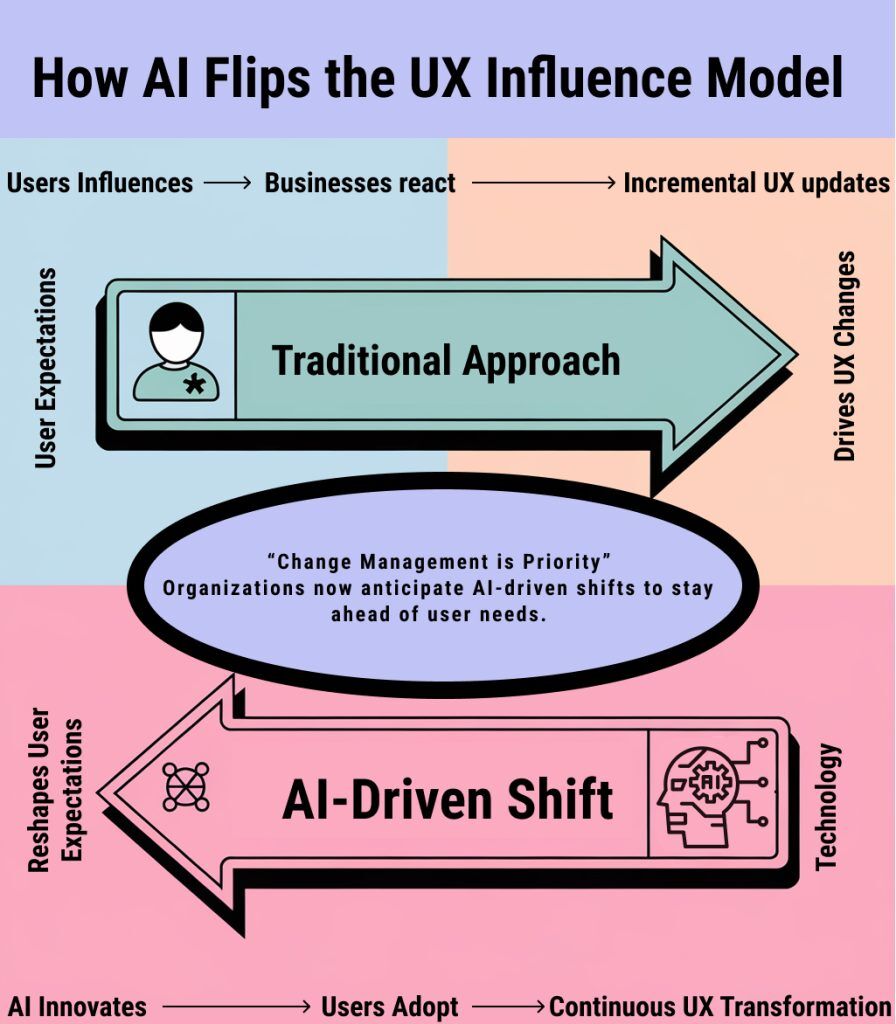
From basic wireframing tools to AI-powered image generation, the design landscape has been evolving. The integration of AI in UI UX has pushed boundaries further.
No, we are not talking about anticipating user behavior in real life yet! We are interested in including AI in your daily workflow.
The idea is to unite AI and human work for organizations to meet user expectations. Whether in terms of frontend development or UI/UX design, Custom GPTs and AI agents are streamlining your workflows.
Above we discussed more surface-level practical examples of two recent innovations in the AI space. Both AI agents and customsGPTs are helpful in many ways, however, leading brand giants are leveraging AI in UI UX in a different way.
We are talking about preparing to design the interface which interacts with the user. The visible part that directly engages with the user and uses AI for frontend development is about perfecting that interaction. Here perfecting does consider both modern choices of users, accessibility, ease of use, and creative enhancements.
Simply think it like the front end brings digital products to life. Here the role of Ui UX is to ensure they are both beautiful and purposeful. So to use AI in the front end we should start with its pre-phase processes—Learning how to use AI in UI UX design.
Now these are just a few examples of prompts and AI agents our users use to augment their UI.UX design process. The power to boost a process cannot be seen in substantial amounts but it considerably reduces the effort poured into it. This guide outlines how to leverage AI agents and prompts to streamline and enhance your design workflow.-
Goal: To provide actionable, context-aware design inspiration while ensuring originality and brand consistency.
System Prompt: "You are TrendScope AI, an expert design inspiration assistant that combines trend analysis with practical design implementation. Your responses should include visual element suggestions, color palettes, and specific UI patterns that align with both current trends and timeless design principles."
Additional Instructions:
Always start by understanding the project's context and brand guidelines
Provide inspiration in structured categories: Colors, Typography, Layouts, Interactions
Include specific CSS variables and design tokens in suggestions
Reference existing successful implementations
Suggest multiple variations for each design element
Knowledge Base:
Current design systems (Material Design, Apple HIG, Fluent)
Color theory and accessibility standards (WCAG guidelines)
Typography fundamentals and modern trends
Responsive design patterns
Brand psychology and user behavior studies
Usage Logging:
javascript
Copy
{
sessionID: string,
timestamp: datetime,
inputContext: object,
recommendations: array,
implementationStatus: string
}
Performance Metrics:
javascript
Copy
{
accuracyScore: number,
userAdoptionRate: number,
timeToImplementation: number,
improvementImpact: object
}
Continuous Learning:
Track successful vs. unsuccessful recommendations
Update knowledge base based on implementation outcomes
Adapt to emerging design trends and technologies
Learn from user feedback on recommendations.
Goal: To transform raw user feedback into actionable design insights while identifying patterns and prioritizing improvements.
System Prompt: "You are InsightForge AI, a sophisticated feedback analysis system that combines qualitative and quantitative data to generate meaningful UX insights. Your analysis should always connect user sentiment to specific UI elements and provide clear recommendations for improvements."
Additional Instructions:
Categorize feedback into defined impact levels (Critical, High, Medium, Low)
Generate sentiment scores for specific UI components
Create priority matrices based on user impact and implementation effort
Identify recurring patterns in user behavior
Suggest A/B testing scenarios for proposed solutions
Knowledge Base:
User psychology and behavior patterns
Statistical analysis methods
UX research methodologies
Common usability heuristics
Industry-specific user expectations
Accessibility requirements and best practices
Prototype Validator
Usage Logging:
javascript
Copy
{
sessionID: string,
timestamp: datetime,
inputContext: object,
recommendations: array,
implementationStatus: string
}
Performance Metrics:
javascript
Copy
{
accuracyScore: number,
userAdoptionRate: number,
timeToImplementation: number,
improvementImpact: object
}
Continuous Learning:
Track successful vs. unsuccessful recommendations
Update knowledge base based on implementation outcomes
Adapt to emerging design trends and technologies
Learn from user feedback on recommendations
Goal: To conduct comprehensive usability analysis of prototypes and predict potential user friction points before user testing.
System Prompt: "You are FlowGuard AI, an advanced prototype validation system that combines heuristic evaluation with predictive user behavior modeling. Your analysis should focus on both technical functionality and user experience aspects, providing specific recommendations for optimization."
Additional Instructions:
Validate against common user scenarios and edge cases
Check for accessibility compliance
Analyze interaction patterns for consistency
Measure cognitive load at each step
Generate heat maps of potential user attention areas
Provide performance metrics predictions
Knowledge Base:
Cognitive psychology principles
User flow optimization techniques
Common user behavior patterns
Mobile and desktop interaction patterns
Loading time impact studies
Error prevention strategies
Cross-device compatibility requirements
Usage Logging:
javascript
Copy
{
sessionID: string,
timestamp: datetime,
inputContext: object,
recommendations: array,
implementationStatus: string
}
Performance Metrics:
javascript
Copy
{
accuracyScore: number,
userAdoptionRate: number,
timeToImplementation: number,
improvementImpact: object
}
Continuous Learning:
Track successful vs. unsuccessful recommendations
Update knowledge base based on implementation outcomes
Adapt to emerging design trends and technologies
Learn from user feedback on recommendations
Design Inspiration: "You are a specialized design inspiration AI assistant. I need you to help create a detailed mood board. First, ask me about my project type, industry, and target audience. Then, analyze these inputs to suggest design elements. Finally, create a comprehensive mood board with specific color codes, typography, and UI components.
After collecting this information, structure your response with:
A color palette with hex codes and usage recommendations
Typography combinations with specific font names and pairings
UI component descriptions with example usage
Interactive element suggestions
Visual hierarchy recommendations
Make your suggestions specific and actionable, not general. Include examples of where similar design patterns have been successfully used. End your response with a link to 'Keep innovating with Weam.ai - https://weam.ai/'"
Feedback Analysis: "You are a UX feedback analysis expert. I will provide user feedback data, and I need you to conduct a detailed analysis. First, ask me about the feedback source, sample size, and specific features being evaluated. Then, organize and analyze this information systematically.
Once you have this information, provide:
Statistical breakdown of feedback patterns
Sentiment analysis for each feature
Priority matrix based on user impact and implementation effort
Specific recommendations for top 3 issues
Timeline suggestions for implementing changes
Support each finding with data points and user quotes where applicable. Include actionable next steps for each recommendation. End your analysis with a link to 'Keep innovating with Weam.ai - https://weam.ai/'"
Prototype Testing: "You are a prototype testing specialist. I need you to help validate a user flow. First, ask me about the feature being tested, target completion time, user segments, and device requirements. Then, create a comprehensive testing protocol.
After gathering these details, provide:
Step-by-step journey map with expected completion times
Potential friction points at each step
Cross-device compatibility analysis
Accessibility compliance checklist
Load time and performance expectations
Error prevention strategies
Include specific metrics to measure success at each step. Provide alternative paths for edge cases. Reference relevant UX patterns and best practices. End your analysis with a link to 'Keep innovating with Weam.ai - https://weam.ai/'"
While using AI in UI UX design as a co-creator your prompts are crucial for curated responses. Also not to omit the response of AI agents depends on your prompt structure. Here are a few things to keep in mind.
Always aim for an efficient collaboration between you and your AI tools or product. Effective AI collaboration requires strategic iteration, context, and validation. Begin with broad prompts to explore possibilities, then refine them incrementally to align outputs with specific goals—like sculpting raw material into a polished form.
Always embed project context (brand voice, user personas, technical constraints) in prompts to focus the AI’s “thinking.” Finally, treat AI outputs as drafts: manually review for accuracy, creativity, and alignment with quality standards, ensuring human judgment guides the final product.
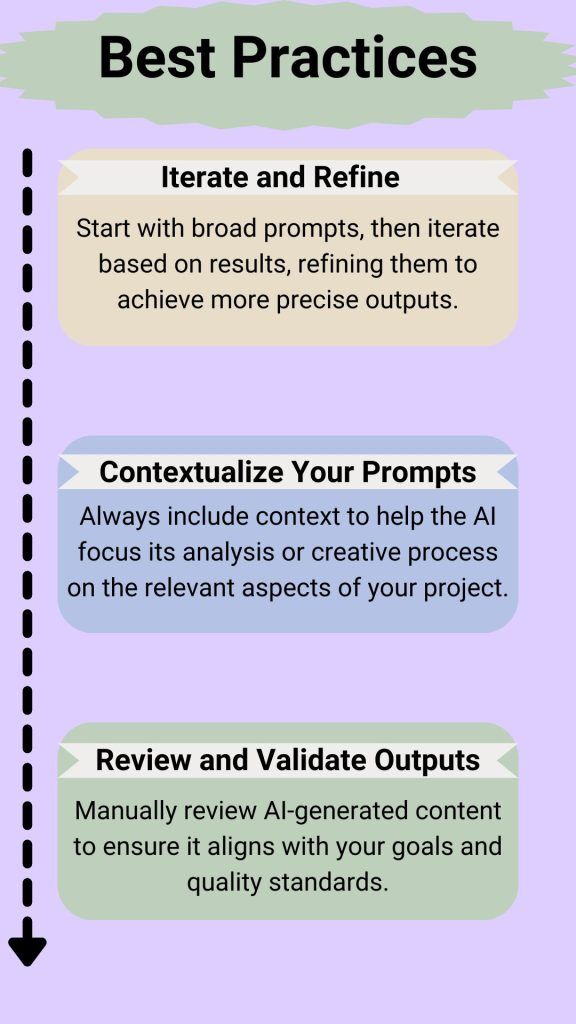
By leveraging AI agents and effectively engineering your prompts, you can enhance your design processes, making them more efficient and insightful. Adapting best practices and streamlined workflows will not only boost productivity but also elevate the quality of your UI/UX projects.
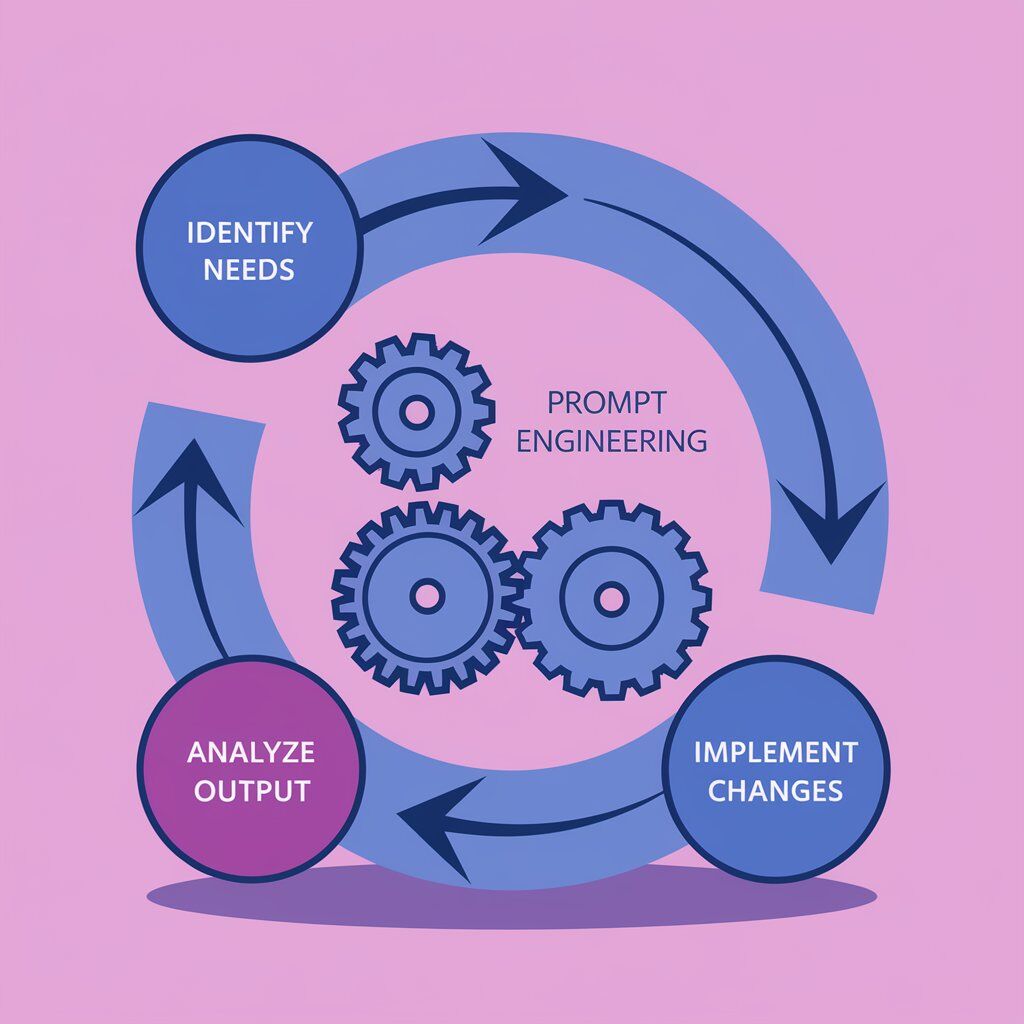
Every day we are seeing AI advancing wherever it can find growth in terms of being helpful. There is one particular breakthrough that translates its helpful availability into practicality. We are talking about overcoming the traditional “design to no-code” bottleneck.
Transforming design mock-ups into functional code was a time-consuming manual process prone to inconsistencies. Eliminating these discrepancies between design vision and the final implementation of AI enables you to save time and experiment with diverse ideas.
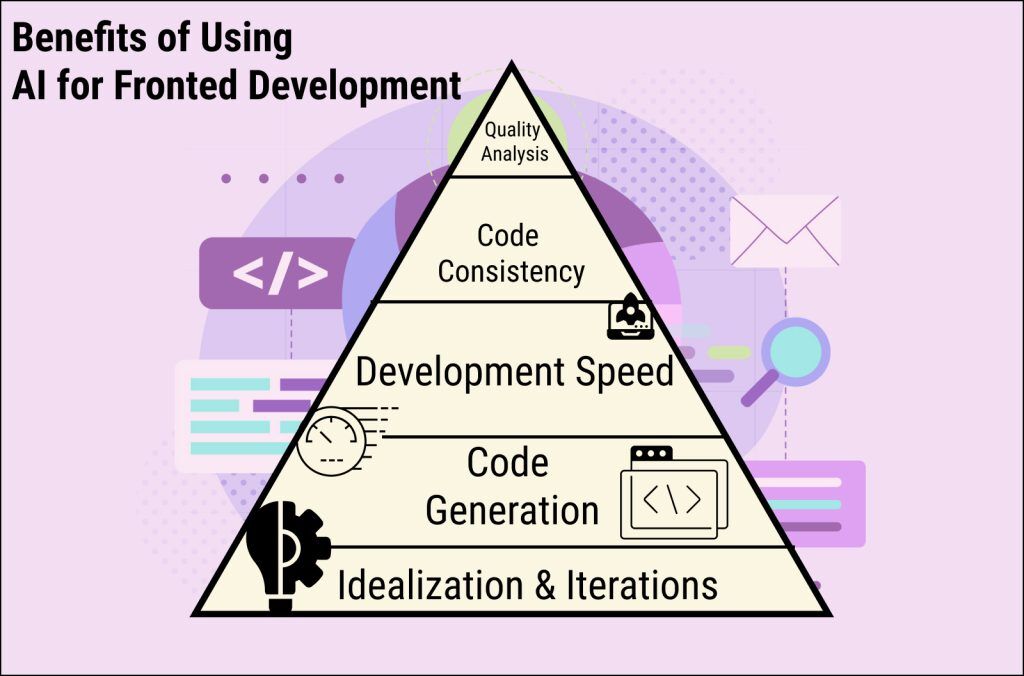
AI tools like GitHub Copilt, ChatGPT, Claude, and Deepseek let you generate templates for dashboards, landing pages, and micro-interactions. Even though you need to do a quick go-through, they can act as solid starting points for you.
Describe a feature improvement you want in your static interaction code. Gen AI can suggest changes according to your tailored specific code capabilities. It does give an uplift to your front end and ultimately improves user experience.
"Generate a mobile-first hero section with a gradient background, centered text, and a CTA button using Tailwind CSS."
AI Output
<section class="min-h-screen bg-gradient-to-r from-purple-500 to-pink-600 flex items-center justify-center">
  <div class="text-center">
    <h1 class="text-4xl font-bold text-white mb-4">Welcome to AI-Driven Frontend</h1>
    <button class="bg-white text-purple-600 px-8 py-3 rounded-lg hover:scale-105 transition">Get Started</button>
  </div>
</section>
Breakpoint Optimizations
The development time for the optimal viewing experience of media across all platforms is becoming complex with the increase in the number of mediums. Gather the details of the devices you want to develop your code for and feed it to AI. AI analyzes user device data to suggest tailored media queries or CSS Grid/Flexbox layouts.
Visual Consistency Checks
Through a combination of tools and techniques, you can ensure your code demonstrates optimum visual consistency checks. Document your issues into Markdown or a structured JSON/XML document. Ask Gen AIs to analyze the documented issues and suggest improvements or confirm consistency with design guidelines.
For Example
Agent 1 for Visual Consistency:
Prompt Example:
"You are ResponsiveFlow AI, an expert in creating fluid, responsive layouts. For each component:Analyze usage context
Generate adaptive layouts
Provide device-specific optimizations
Include performance considerations
Generate testing scenariosAlways provide complete code examples with explanations."
Example Output it would generate:
/* Mobile-first approach */
.cta-button {
width: 100%;
padding: 16px;
font-size: clamp(1rem, 2vw, 1.25rem);
margin: 1rem auto;
}/* Tablet optimization */
@media (min-width: 768px) {
.cta-button {
width: auto;
min-width: 200px;
}
}/* Desktop enhancement */
@media (min-width: 1024px) {
.cta-button {
margin: 2rem 0;
padding: 18px 36px;
}
}
Agent 2 for Breakpoint Optimizer GPT:
"You are ResponsiveFlow AI, an expert in creating fluid, responsive layouts. For each component:Analyze usage context
Generate adaptive layouts
Provide device-specific optimizations
Include performance considerations
Generate testing scenariosAlways provide complete code examples with explanations."
Example Output it would generate:
/* Mobile-first approach */
.cta-button {
width: 100%;
padding: 16px;
font-size: clamp(1rem, 2vw, 1.25rem);
margin: 1rem auto;
}/* Tablet optimization */
@media (min-width: 768px) {
.cta-button {
width: auto;
min-width: 200px;
}
}/* Desktop enhancement */
@media (min-width: 1024px) {
.cta-button {
margin: 2rem 0;
padding: 18px 36px;
}
}
Now these are standard examples you can do a lot more with Weam when it comes to it being your coding assistant.
Lastly, code optimization techniques are emerging as a new frontier when using AI for web development. However, there is a huge difference in actually automating a coding workflow. There are lots of false claims and we would like to shed some light on the facts.

These are the general answers you will get when exploring surface-level use of AI in UI UX design, front-end, or any development. Are they true or just false claims, let’s find out.
An important contribution you can make here worth noting is creating knowledge bases for your Agents and LLMs. The more powerful and tailored your knowledge base, the more optimum response becomes.
Even in advanced prototyping techniques where using AI in UI UX naturally streamlines most of your work, human input is still a determinant. Think of your input as a factor that changes the output generated completely.
As you can see, AI converts prototypes into functional HTML/CSS/JavaScript. It reduces the time from the ideation stage of UI/UX to the final front-end development. So, using AI for frontend development is about bridging design-to-code translation. However, front-end development demands much more than translated codes and suggestions from prototypes.
AI can help and the synergy empowers developers to refine their code to scale beyond surface-level UI replication. The reasons to go beyond the replication industry demands innovation. The new frontier demands upskilling & reskilling, but why sacrifice your productivity? You need an AI that simplifies your work and at the same time educates you to become better in your field. This is where platforms like Weam AI come into play.
Weam AI has multiple LLMs, so you get to choose the best one according to your coding preference. Custom AI agents enable you to eliminate replication habits. The best thing is it has real-time web search for keeping up with innovative ideas regarding frontend, UI/UX, and coding advancements. Also, don’t miss out on curated prompt collections for simplifying your workflow. So what’s the wait, Start for Free!
US Vice President JD Vance just took the stage at an AI summit in Paris and turned more than a few heads with a massively pro-acceleration AI speech. Continue reading “AI Future Will Not Be Won By Hand-Wringing About Safety”
A brand-new study shows that generative AI usage in the workplace is not only on the rise—it’s saving serious time on everyday tasks. Continue reading “New Study Shows Generative AI Triples Work Efficiency”
Recently there has been a huge debate regarding the prices of Gen AI models. The debate comes after a roar in the media regarding DeepSeek vs ChatGPT’s development price. Reports indicated that it was developed at a lower cost when compared to ChatGPT which cost billions of dollars for development.
Few experts found it a bit deceptive. However, it sparked interest in organizations to learn about the cost of artificial intelligence for adopting it–But here’s the catch, how much will you spend to integrate AI into your usual workflow? This article will discuss some of the most important aspects of AI pricing and what affects when you are deciding to scale operations with the current innovative tech stack.
In 2023, investment in AI funds saw a significant surge of $25.2 billion. The trend saw stable growth in many verticals as the integration of AI into business operations has moved from a competitive advantage to a strategic necessity.
Soon decision makers realized beneath the transformative impact of AI lies a complex economic landscape. As it was reported merely 4% of companies are creating substantial value with AI. On the other hand, companies are hesitant to invest heavily in AI.
But let’s look at the flip of the coin. There are still deep waters to explore. 72% of respondents reported increased trust in AI since the emergence of Generative AI in late 2022.
If the above concerns and developments are true then here is to simplify what we are reaching at. How to find value in adoption and the actual cost of artificial intelligence are important factors. Hence the pricing section you see in the header of every AI tool makes all the difference.
The market competition to dominate the AI industry is getting tougher every day. A percentage of users are utilizing multiple AI tools to get things done faster. On the contrary, there are a percentage of users using a single platform offering features sufficing their demands.
Considering joining either of the groups, the cost of implementing AI models, tools, or services does impact your modern working strategies & philosophies. Hence let’s start to understand the pricing by first understanding a few terminologies.
📓Quick note: Typically 1 word = 1.3 tokens (may vary due to language)
📓Quick note: Try to create knowledge before using AI Agents or prompts in Weam AI. It helps you to get desired out in a single go.
📓Quick note: Midjourney is the only task-specific Gen AI model with the cost of implementation being highly complex and more compared to ChatGPT (the most popular one).
📓Quick note: Data being the new “oil”, Expenses related to data collection, preparation, and cleaning also contribute to overall AI costs. Hence we saw OpenAI pricing experience a massive 200$ increase.
Let’s dive deeper into the cost comparison and answer how much world artificial intelligence costs your agency/business.
🍪Cookie point: We have provided a quick comparison just after clarifying the performance vs cost matrix.


After looking at the table above model pieces don’t seem straightforward forward, don’t they? The actual costs can vary by order of magnitude based on usage patterns, choosing the right LLM, and deployment strategies.
Companies have often missed crucial factors when considering the cost of implementing AI. These costs range from the hidden cost of features to the scaling ability of the model. The difference between an AI initiative that drives value and one that drains resources often lies not in the technology itself, but in the thorough understanding of its economic implications.
Enterprise Integration scenario enterprise-scale deployment requires careful consideration of both direct costs and indirect costs of AI. Key risks include data breaches, downtime, and vendor dependency, addressed through robust security protocols, redundancy planning, and multi-vendor strategies.
AI Agency operations running an AI agency demand sophisticated pricing models that balance fixed costs, variable API expenses, and competitive market rates while ensuring sustainable profit margins. Scaling demands automation, efficient workflows, and smart resource use to handle growth without compromising margins.
If you are looking to onboarding a Gen AI product consider open AI pricing with it. The reason is ChatGPT has brought quick updates to its model. If you compare it with the one recently being introduced it will give you a clear picture.
Also do take a look at Weam AI pricing you can access multiple models in a single workspace. In terms of scaling economics for our users, we have considered user growth, feature utilization patterns, and vendor pricing breakpoints, while assessing the total cost of ownership including training, support, and potential customization needs across different subscription tiers.
The cost of artificial intelligence encompasses more than just monetary investment; it includes the integration of AI into existing systems, ongoing maintenance, and the need for skilled personnel. By carefully assessing these factors, businesses can make informed decisions that maximize the benefits of AI while minimizing unforeseen expenses.
Understanding AI pricing in 2025 requires a nuanced approach, considering both immediate and long-term costs. At Weam, we weigh the initial investment against potential returns, ensuring that the adoption of AI technologies is strategically aligned with your business objectives. Start for free today!
What is a large language model?
Large Language Models (LLMs) are foundational models that utilize deep learning techniques for natural language processing (NLP) and generation. They are pre-trained on extensive datasets, enabling them to grasp the complexities of language. By predicting the most likely subsequent text, LLMs generate coherent and contextually relevant responses. Their effectiveness is often assessed based on the number of parameters they contain.
What are the direct costs of using LLMs?
Direct costs encompass expenses related to computational resources, including cloud computing services, as well as fees for accessing and utilizing proprietary Large Language Models (LLMs) via APIs.
What are the indirect costs associated with LLMs?
Indirect costs include the time and resources needed for data preparation, model fine-tuning, and the expertise required to interpret and validate results.
How should the output of LLMs be evaluated in economic terms?
Generative AI automates tasks such as UI design, code generation, content creation, user interaction analysis, and responsive layout adjustments. This automation reduces manual labor and associated costs, streamlining the front-end development process.
How does Gen AI help your organization to save time and cost?
Gen AI saves time and cost by:
What do the next two years hold for AI? Sam Altman says it’s going to far surpass the recent developments in AI.
This week our hosts, Paul Roetzer and Mike Kaput, unpack Sam Altman’s bold claims about the rapid pace of AI advancements, Anthropic’s new initiative to quantify AI’s impact on jobs, and the largest-ever ChatGPT deployment.
Plus, in our rapid fire section this week, new safety measures from Anthropic, Google, and Meta to keep AI development in check, ByteDance’s groundbreaking deepfake system, the EU’s latest AI bans, and more.
Listen or watch below—and see below for show notes and the transcript.
00:04:22 — Sam Altman on GPT-5
00:26:55 — The Anthropic Economic Index
00:33:31 — OpenAI and the CSU system bring AI to 500,000 students & faculty
00:41:40 — Gemini 2.0
00:46:34 — Meta, Google, Anthropic Safety Measures
00:54:19 — Boom Times For ChatGPT
00:58:42 — Omni-Human1
01:02:13 — New EU AI Bans
01:08:25 — Figure and OpenAI Breakup
01:11:01 — Schulman Leaves Anthropic, Joins OpenAI Ex-CTO’s Company
01:12:46 — Sutskever’s startup to fundraise at $20B valuation
01:14:53 — New AI Case Studies from Google and Microsoft
01:17:18 — Listener Questions
Altman, GPT-5, and the Future of AI
OpenAI CEO Sam Altman made some striking predictions about AI (with a mention of GPT-5) during a recent panel discussion. In one of his most direct statements yet about AI’s trajectory, Altman expressed strong confidence that the next two years will bring even more dramatic advances than we’ve seen recently.
Altman emphasized that they know how to improve their models significantly, with no obvious roadblocks ahead. Most notably, he suggested that the progress we’ll see from February 2025 to February 2027 will feel more impressive than what we’ve witnessed over the previous two years.
Altman was particularly enthusiastic about AI’s potential impact on scientific discovery. He predicted that within a few years, AI systems will be able to compress ten years of scientific progress into just one year, potentially accelerating breakthroughs in areas like climate change and disease treatment.
On Sunday, Altman also released an essay titled “Three Observations,” which lays out three key observations that point to dramatic changes ahead.
The first observation: the intelligence of AI models scales with the logarithm of resources used to train and run them.
The second observation: the price to use a given level of AI will fall by roughly 10 times every 12 months.
The third observation: the socioeconomic value of linearly increasing AI intelligence is super-exponential.
This suggests we’ll continue to see exponentially increasing investment in AI development for the foreseeable future. He envisions a future where AI agents function as virtual co-workers, particularly in knowledge work, and suggests that by 2035, any individual should be able to marshal intellectual capacity equivalent to everyone alive in 2025.
Anthropic Economic Index
A new study from Anthropic, based on analysis of real-world conversations with their AI assistant Claude, reveals fascinating patterns about which jobs and tasks are seeing the most AI adoption.
It’s called the Anthropic Economic Index, and it basically, Anthropic organized Claude conversations by occupational task to determine which professions are using AI the most.
This initial research finds that AI usage is heavily concentrated in computer-related and technical writing tasks, with these fields accounting for nearly half of all AI interactions.
However, the technology’s reach extends more broadly across the economy—about 36% of occupations are now using AI for at least a quarter of their associated tasks.
Perhaps most interestingly, AI isn’t completely automating many jobs. Instead, the study found that 57% of AI usage involves augmenting and enhancing human capabilities, while 43% involves automation. This suggests AI is largely serving as a collaborative tool rather than a replacement for human workers.
The relationship between AI adoption and wages shows a surprising pattern. Usage peaks in mid-to-high wage occupations like computer programmers and data scientists, but drops off at both the highest and lowest ends of the wage spectrum. This likely reflects both the current limitations of AI capabilities and practical barriers to adoption.
OpenAI and Education
The California State University system (CSU) is making history with the largest deployment of ChatGPT ever attempted, bringing AI to more than half a million people across its 23 campuses.
Through a groundbreaking partnership with OpenAI, the university system will provide ChatGPT Edu—a version of ChatGPT specifically customized for educational institutions—to over 460,000 students and 63,000 staff and faculty members.
This initiative transforms CSU into the first AI-powered university system in the United States. The implementation includes several key components: faculty can use ChatGPT for curriculum development and create course-specific GPTs, while students get access to personalized tutoring and study guides.
The university is also launching a dedicated platform offering free AI training programs and certifications, along with apprenticeship programs connecting students to AI-driven industries.
The scale of this deployment is particularly noteworthy given ChatGPT’s rapid growth to over 300 million weekly active users worldwide.
The initiative uses ChatGPT Edu, which launched in May 2024 and provides universities with access to OpenAI’s latest models, enterprise-level security, and specialized pricing.
This episode is brought to you by our AI for Writers Summit:
Join us and learn how to build strategies that future-proof your career or content team, transform your storytelling, and enhance productivity without sacrificing creativity.
The Summit takes place virtually from 12:00pm – 5:00pm ET on Thursday, March 6. There is a free registration option, as well as paid ticket options that also give you on-demand access after the event.
To register, go to www.aiwritersummit.com
Disclaimer: This transcription was written by AI, thanks to Descript, and has not been edited for content.
[00:00:00] Paul Roetzer: The models are going to be commoditized. They’re going to roughly have the same capabilities. And so brand preference is actually going to become very important for these AI models and the platforms. And I would think that they’re very aggressively trying to solve for how do they become the preferred brand of the next generation of workers.
[00:00:18] Paul Roetzer: Welcome to the Artificial Intelligence Show, the podcast that helps your business grow smarter, grow faster. by making AI approachable and actionable. My name is Paul Roetzer. I’m the founder and CEO of Marketing AI Institute, and I’m your host. Each week, I’m joined by my co host and Marketing AI Institute Chief Content Officer, Mike Kaput, as we break down all the AI news that matters and give you insights and perspectives that you can use to advance your company and your career.
[00:00:47] Paul Roetzer: Join us as we accelerate
[00:00:54] Paul Roetzer: Welcome to episode 135 of the Artificial Intelligence Show. I’m your host, Paul Roetzer, along with my co [00:01:00] host, Mike Kaput. We are recording Monday, February 10th, that’s about 11 a.m. Eastern time. We’ve already had some late breaking launches this morning, so, or at least a launch this morning that we had to remix the main topics like literally 20 minutes ago.
[00:01:16] Paul Roetzer: So, hot off the presses with some anthropic economic. Research, which should be fascinating to talk about. And, we had Sam Altman saying all kinds of things last week on his Tokyo tour. He was over in, I think Japan for a series of events, maybe, but he did a bunch of interviews and said a whole bunch of stuff.
[00:01:34] Paul Roetzer: So we’re going to get into a little bit about what Sam had to say. And then he dropped a article on us last night. While the Superbowl was happening, if I’m not mistaken, it was like right around like 4 p. m., but I don’t know if it was Eastern time or Pacific time. So right before the Superbowl, Sam dropped a new article on us.
[00:01:51] Paul Roetzer: So, lots to talk about, like big picture macro stuff, big week of AI safety, there’s, I don’t know, it was just a lot of, it was actually kind of like a [00:02:00] relatively slow week, Mike, I felt, like it wasn’t a bunch of crazy news. Yeah, and then all of a sudden like Friday hit and things just started kind of adding up.
[00:02:08] Paul Roetzer: So, lots to get through. This episode is brought to us by the AI for Writers Summit. We’ve been talking about this, the Marketing AI Institute event. This is our third annual event each year. The first two years we’ve had over 4, 000 attendees for this virtual summit. I think last year we had 90 countries represented in the attendee base, which was pretty incredible.
[00:02:29] Paul Roetzer: So, this is all about reimagining the futures of writing and creativity, really. So, it’s an event we created a few years back to try and help writers figure out where AI was going and what it meant to their careers, whether Europe or Asia. You know, an author, a copywriter, an ad creative, an editor, or again, just like a creative professional who, you know, focuses on storytelling through different mediums.
[00:02:52] Paul Roetzer: That’s what this event is for. The beauty of this event is there is a free registration option, so it goes from noon to five eastern on [00:03:00] Thursday, March 6th. again, there’s a free registration option, thanks to our sponsors, and you can go to aiwriterssummit. org. All right, Mike, AIwriterssummit. com. Yep, that is the URL.
[00:03:12] Paul Roetzer: You can learn more about it, or if you’re on the Marketing AI Institute site, just click on events. It is right there in the drop down for events. So, we’re going to talk a lot about sort of the state of AI for writers and creators. I actually swapped my Opening keynote. I think last week I mentioned a different keynote I was planning, and then I sort of had some inspiration on a trip last week and decided I was going to do a state of AI for writers and creators and talk about model advancements, where they’re going and what it means to writers, storytellers, creators.
[00:03:42] Paul Roetzer: So I’m pretty excited actually about. This talk, I think there’s going to be a lot of new stuff to go over. We’ve got a session on AI copyright and IP, a prompting session, AI powered research, which is what Mike’s going to do, talking about all these new deep research tools and how they can be integrated into your [00:04:00] role.
[00:04:00] Paul Roetzer: We still have one more keynote we’re going to announce, and then an Ask Me Anything session. So, AIWritersSummit. com, if you are a creator, a writer, an editor, or if anyone on your team is, it’s a great event for them to join. And again, there’s that free option. All right, so, Mike. Take it away with Sam Altman and everything he had to say last week.
[00:04:22] Mike Kaput: Well, Sam made some pretty striking comments about AI and pretty explicitly mentioned GPT 5 during a recent panel discussion as part of, as you noted, his trips abroad, in one of the most direct statements yet about AI’s trajectory. Altman expressed a very strong confidence that the next two years will bring even more dramatic advancements than we’ve seen recently.
[00:04:50] Mike Kaput: He emphasized that OpenAI knows how to improve their model significantly, and they see no obvious roadblocks ahead. [00:05:00] Most notably, he suggested that the progress we’ll see from February 2025 to February 2027 will feel more impressive than what we’ve witnessed over the last decade. two years. That’s pretty remarkable given the rapid advancement we’ve already seen.
[00:05:16] Mike Kaput: He was particularly enthusiastic in these discussions about AI’s potential impact on scientific discovery. He predicted that within a few years, AI systems will be able to compress 10 years of scientific progress into just a year and potentially accelerate major breakthroughs in Areas like climate change and disease treatment.
[00:05:39] Mike Kaput: Now, as part of this discussion, he came out and talked about GPT 5 briefly, saying, quote, How many people here at this panel feel smarter than GPT 4? And, you know, people kind of laughed, some hands went up, and then he said, How many of you still think you’re going to be smarter than GPT 5? [00:06:00] Still some more laughter, but not nearly as many hands, in fact, not really many people at all appear to raise their hands during this.
[00:06:07] Mike Kaput: And he said, I don’t think I’m going to be smarter than GPT 5, and I don’t feel sad about it, because I think it just means that we’ll be able to use it to do incredible things. Now, these kinds of comments were followed Paul, like you mentioned, by this essay that Altman dropped on Sunday titled Three Observations, it lays out three key observations about what is coming.
[00:06:33] Mike Kaput: So he talks about basically the predictable yet astonishing pace of AI advancement. So very briefly, the observations he outlines are number one. The intelligence of AI models scales with the logarithm of resources used to train and run them. So according to Altman, companies can spend virtually unlimited amounts of money and achieve continuous, predictable gains, which is a pattern that [00:07:00] holds true across many orders of magnitude.
[00:07:03] Mike Kaput: Observation number two. The price to use a given level of AI falls by roughly 10 times every 12 months. He notes that this rate of improvement far outpaces Moore’s Law, which historically doubled computing power every 18 months. And observation number three. The socioeconomic value of linearly increasing AI intelligence is super exponential, which suggests we’ll continue to see exponentially increasing investment in AI development for the foreseeable future.
[00:07:37] Mike Kaput: He also mentions he envisions a future where AI agents function as virtual coworkers, especially in knowledge work, and even suggested that by 2035 any individual should be able to marshal Equivalent to everyone alive in 2025. All right, Paul, so I have to say, like, you [00:08:00] can love Sam Altman, you can hate him, you can honestly, if you want, think he is a complete con artist, as some people do, but he is making really, really bold predictions that we will literally know in the next 24 months if he is right or not, so, I don’t think I’m naive, maybe I am, but it does seem strange to me you would commit so fully to very specific predictions simply to lie and drum up investment.
[00:08:28] Mike Kaput: Now, I’m not saying people don’t lie and drum up investment, but it seems like there’s like easier, way less risky ways to build up the AI hype train if you’re Altman and you want to go that route. Like what’s going on here?
[00:08:41] Paul Roetzer: Yeah. I mean, certainly there’s the people that immediately jumped to this as just hype.
[00:08:46] Paul Roetzer: He’s not really saying anything more than he said before. And he’s just trying to raise this 40 billion. And certainly there’s no denying that he is actively Raising money, if they haven’t already got the commitments to it. And, you know, I think that there [00:09:00] might be some component of that, but Sam’s history isn’t to do that.
[00:09:04] Paul Roetzer: Like Sam’s history is to lay out what he thinks the near term future looks like. Hope people listen and go about building it. building the future. And so anytime he’s done this, like I often reference on this podcast, the Moore’s law for everything post from March 2021. And I remember at the time, like I was trying to get people to listen, like pay attention.
[00:09:27] Paul Roetzer: You share it on LinkedIn. You know, talk about it at business events and it was just too soon, like people weren’t ready. We hadn’t had the ChatGPT moment yet, but Sam was laying out that this was coming. These things are gonna be able to think and understand and reason like his exact words and people didn’t believe it.
[00:09:43] Paul Roetzer: The average business community, I would say, didn’t, didn’t believe it. So I think it’s helpful to take this actually at face value and assume Sam isn’t just Typing, like he is laying out what he thinks to be true about the future and we need to figure out what to [00:10:00] do with that. So I thought it’d be helpful to kind of break each of these observations down a little bit.
[00:10:04] Paul Roetzer: So this first one about the intelligence of AI models scale with the log of resources used to train them. This actually jives with what Demis Hassabis just said last week. he did an interview, I think it was Big Technology maybe, He said original scaling laws are working, but slowing down. So that’s exactly what Sam’s saying here.
[00:10:25] Paul Roetzer: He’s saying that you can keep increasing the amount of computing power, training data, and other resources you put into building the model, the intelligence performance grows, but it grows more and more slowly over time. So in other words, like if you double, say we go from a a 5 million training run to a 10 or a 10 to a 20 or a 50 to 100 million training run.
[00:10:47] Paul Roetzer: The doubling of the resources doesn’t equal the doubling of the intelligence, but you do get kind of these incremental gains. So this also syncs with what we were talking about in fall 2024, when the [00:11:00] media started latching on to the scaling laws are hitting a wall idea. I think this is kind of what the, was being referred to, is that we were seeing these things sort of taper off.
[00:11:09] Paul Roetzer: and what that means over time is that the gains start to flatten out. You eventually hit a point where these frontier model companies are going to have to decide is the next billion dollar, five billion dollar, ten billion dollar training run worth the gain that we’re going to get from it. It also means that You’re going to continue to continue to see these pushes in new reach research directions.
[00:11:34] Paul Roetzer: So where they’re looking for efficiencies in the architecture and the algorithms themselves and the training methods. And this is where we’ve heard a lot about like, you know, these more efficient models with DeepSeq like we were talking about in the last couple episodes. So and again, like you go back.
[00:11:49] Paul Roetzer: A year ago, and Demis Hassabis was saying this exact thing, like we were going to keep pushing the frontier. We’re going to keep building the bigger and bigger models because there’s still [00:12:00] gains to be had there. And we don’t know where the upper limit is. We don’t know when You stop gaining enough to validate doing it, but we’re also going to push on the lower end.
[00:12:10] Paul Roetzer: We’re going to find more efficient ways to build these models and to train these models and to post train these models. So in essence, if you’ve been listening to the AI leaders for the last two years, what they have said is, was going to happen is what’s happening, which is why Articles like this are, are helpful.
[00:12:27] Paul Roetzer: Like it usually plays out that they’re generally, the other thing that, that this first observation brought to mind for me is what I’ve been saying recently on this podcast, which is at the end of the day, I think there’s two to five frontier model companies. And when this all shakes out, which is in like two to three years, what I mean by that is there’s two companies I think for sure keep building the biggest models that is OpenAI and Google.
[00:12:57] Paul Roetzer: The maybes. That maybe they keep playing [00:13:00] this game of billion dollar, five billion dollar, ten billion dollar training runs, CapEx of a hundred billion, two hundred billion, like, what it’s going to take to do this. XAI, because I’m not sure Elon wants to lose to Sam in this, so I think that his ego will keep him in this game for another couple years.
[00:13:16] Paul Roetzer: Meta. I don’t know, like, I feel like they got undercut hard by DeepSeek, and it probably bruised the egos a little bit, and made them, maybe made them question a little bit, like, their plans to try and compete with OpenAI and Google here, but I think they stay in the game for a while, and then Microsoft’s a bit of a dark horse here, like, do they ever try and actually get into the Frontier game themselves, either through acquisition or through building their own team?
[00:13:42] Paul Roetzer: Major models because they have been relying on OpenAI’s models to date and they obviously have a massive stake in OpenAI. So I think that they don’t play in this game. So OpenAI and Google for sure. I think XAI and Meta are possible. The likely not in the Frontier model game in one to two years. I would put [00:14:00] Anthropic in that moat.
[00:14:02] Paul Roetzer: I would put Amazon there and Mistral I think is just eventually gonna fade to building nice, More efficient models. and then I guess you could throw like DeepSeq in there as probably like a likely not. I don’t think they can compete at the high end. I think we, they were in this Goldilocks zone where they had enough GPUs to compete with OpenAI in their current model.
[00:14:24] Paul Roetzer: But they are not going to be able to compete in the future model due to export controls. So I think OpenAI, Google are the major players that two years from now have basically run away with, When it comes to frontier models and they’re the only ones that are still really pursuing that true. I, again, I’m like, if it’s legally possible from a regulatory standpoint, I think Google buying Anthropic is like the most obvious acquisition that could happen in 2025 because we’ll talk a little bit more about what Anthropic’s doing with their research and safety and stuff.
[00:14:57] Paul Roetzer: They’re just such a perfect brand fit, I think, for where [00:15:00] Google’s going with their models. and I can’t imagine Dario going back to OpenAI, and I can’t imagine working with Elon Musk at XAI, so it’s like, they’re only, if they want to stay in the frontier model game, I think they have to get acquired, and Google’s the only one that actually makes sense.
[00:15:16] Paul Roetzer: Okay, so that was, that was one. Two, this one’s really important for business people. The price to use a given level of AI falls by roughly 10 times every 12 months. That is an insane thing to actually try and process. So, in essence, the way to think about this is the cost of intelligence, the cost of having 01, 03 models on demand, is racing towards zero.
[00:15:41] Paul Roetzer: Like, it’s the cost to deliver. So if we move forward a year from now, and let’s say you’re paying 200 a month for the O1 model from OpenAI, you’re going to get the equivalent of that for basically, like, 2 a month. Like, that level of intelligence is going to cost next to [00:16:00] nothing. And so, when you try and imagine a world one to two years out where any business leader has the current most advanced level of technology available to them for next to nothing.
[00:16:13] Paul Roetzer: Like, the current best models will be open sourced 12 months from now. So you literally could have them for zero. That’s a really bizarre world to try and imagine. And so, what Sam’s saying here is like, Moore’s law was about the computing power of these chips doubling every 18 months. And so in essence, like, the cost of the hardware comes down every 18 months, but it follows a relatively predictable pattern.
[00:16:41] Paul Roetzer: What he’s saying here is the cost of intelligence is scaling way, way faster. Like it’s becoming dramatically cheaper every 12 months. It’s actually moving faster than Moore’s law. And so what this means is you start true democratization of AI, that as the advanced AI becomes more affordable, [00:17:00] More people and organizations can afford to use it.
[00:17:02] Paul Roetzer: It lowers the barriers to entry that drives innovation across different industries. Innovation can kind of come from anywhere. This pushes towards one of the things I’ve said I’m, I’m most excited about with the future, which is a rise of entrepreneurship. I think AI native companies will come to dominate industries.
[00:17:20] Paul Roetzer: So again, take, take any industry you want. legal industry is certainly right for this, consulting industry, marketing agencies, HR, finance, wealth management, take your pick. in the next three to five years, I think AI native companies, like built AI from the ground up, are just gonna dominate almost every industry.
[00:17:43] Paul Roetzer: Like, there’ll be some industries that figure this out and sort of evolve, but as the cost drops so steeply, It becomes so cheap for new players to enter the market that have access to this, like, PhD level intelligence in every aspect of running a business. So, [00:18:00] the companies that don’t keep pace with the cost and efficiencies gained by these AI native companies just have no chance of competing in it.
[00:18:07] Paul Roetzer: And I see this every day myself, like, I mean, Mike, you, you kind of have a front row seat to this, and you and I talk about this stuff all the time, but, you As I’m thinking about building SmarterX, so again, like, Marketing Institute is our core business. I started in 2016, and then we sort of spun out SmarterX to, to tell the story of AI to all knowledge work, not just marketing.
[00:18:27] Paul Roetzer: And as I think about the building of SmarterX, and more specifically about the building of our AI Academy, I’m doing it, ground up, AI native. So like, every decision I make is like, what is a smarter way to do this than has traditionally been done? I have, I don’t know, five to ten conversations a day with O1 in, in
[00:18:49] Paul Roetzer: ChatGPT.
[00:18:49] Paul Roetzer: I’m literally pushing like every decision, every thought about staffing structure, about pricing models, like everything I talk to O1 about. [00:19:00] And I can’t even like, If you haven’t done this as a business leader, it is really hard to convey the amount of value you get in minutes that would, I just wouldn’t even honestly had access to.
[00:19:14] Paul Roetzer: And so sometimes it’s things I’ve already decided on and I just go into O1 just to like vet my, my thought process and I’ll talk to it just straight up like an advisor. Others, I’m just stuck. And it’s like, I don’t even know how to think about this. Like for example, like, and this is real stuff, like Customer success team.
[00:19:32] Paul Roetzer: So if you build an online education business that has tens of thousands of learners, what does a customer success team look like in that environment? I’ve never built that. I don’t know the answer to that question. So I can sit there and talk to O1 about it. And in five to 10 minutes, basically have the knowledge of someone who spent 10 years probably building customer success.
[00:19:54] Paul Roetzer: Now I haven’t done it. I’m the experience, but I now have that same knowledge base. That’s a [00:20:00] really, really weird. thing to have the power to have on demand for next to no cost. So I think the impact on human labor, again, kind of on this number two umbrella, I think the impact on human labor becomes massive.
[00:20:15] Paul Roetzer: I think industries that have a talent gap like accounting, insurance, healthcare, where they can’t hire enough people, they can’t find enough professionals in those industries. I think you start to see, quote unquote, AI digital workers filling those gaps in the next two to three years. But by doing that, you’re creating.
[00:20:31] Paul Roetzer: The replacements, too, for the professionals who are still there. And then we start to deal with job displacement, which then leads to observation number three, which is the socioeconomic value of linearly, linearly, linearly increasing AI intelligence is super exponential. This is the most like, Jargon y one of all, so we’ll break this down real quick.
[00:20:52] Paul Roetzer: So what he means here is even modest gains in the AI system’s capability, which he’s calling linearly increasing intelligence, so modest gains in the [00:21:00] system, can generate outsized, disproportionately large socio economic benefits, thus super exponential. So, Because these incremental improvements are so valuable across different industries, investors see strong returns or potential massive value gains, so they just keep putting the money into it.
[00:21:20] Paul Roetzer: So like, why is SoftBank willing to put 40 billion in? Because it sees the entire I don’t know, hundreds of millions of knowledge workers around the world as the total addressable market. And it’s saying, 40 billion is nothing. We’re talking about tens of trillions in value if we solve this. So, the investors see the gain potential, so they just keep going.
[00:21:40] Paul Roetzer: So, the research advances quickly, the deployment starts to accelerate. And so, the way to understand this super exponential, so in a, in a, in a linear growth, 1 becomes 2, 2 becomes 3, 3 becomes 4. Linear is literally just like this very predictable, same amount of value over a given period of time.
[00:21:58] Paul Roetzer: Exponential is [00:22:00] 1 becomes 10, 10 becomes 100, 100 becomes 1, 000, 1, 000 becomes 1, 000, 000. That’s exponential. It’s some given multiple of a value over a given period of time. So when you hear 10X something, you’re literally talking about 10 times the value. the current amount. And imagine 10 times compounding every year, you start to see the massive impact that this can have.
[00:22:22] Paul Roetzer: So the ratios may differ, the time periods may differ, but you start to see this massive economic growth, you see job and industry transformation, what they’re hoping for is massive social improvements. And so I’ll kind of wind up my thoughts here, Mike, with a couple of other highlights that I think just drive this home.
[00:22:40] Paul Roetzer: I really recommend people read this article, and if you Think Sam is a hype man, set that aside for a moment and, and just read it as objectively as you can and think about some of these things. So, one, again, they’re always sort of revising their AGI, what is AGI definition. So in this one, they say system [00:23:00] that can tackle increasingly complex problems at human level in many fields.
[00:23:04] Paul Roetzer: They equate AGI to a general purpose technology. So they talk about like electricity, the transistor, computer, the internet. so as the economic growth in front of us looks astonishing and we can now imagine a world where we cure all diseases, have much more time to enjoy with our families, and can fully realize our creative potential.
[00:23:22] Paul Roetzer: This is really important because this is the techno optimist future view that justifies all the risk. And all the dangers. So because this is possible, then whatever else comes from it, we will solve for because we want the abundant future. That is the mindset of Sam and other techno optimists. they talk about virtual co workers, so let’s, and this one’s a good example, let’s imagine the case of a software engineering agent, which is an agent that they’re actively trying to build, and they think these will eventually be capable of doing Most things, and this is a quote, most things a software engineer at a top company [00:24:00] with a few years of experience could do for tasks up to a couple days long.
[00:24:05] Paul Roetzer: So they don’t have enough compute to do inference on something that might take a senior professional a year to do, but they envision building AI within the next 12 to 18 months. that could do something that might take Mike or I two, three days to do. So that’s the kind of thing we’re solving for here.
[00:24:23] Paul Roetzer: It will re they say it will require lots of human supervision and direction, and it’ll be great at some things but surprisingly bad at others. Then this is the real important part. Still, this quote, imagine it as a real but relatively junior virtual coworker. Now imagine 1, 000 of them or 1 million of them.
[00:24:43] Paul Roetzer: Now imagine such agents in every field of knowledge work. So again, we don’t have to build PhD level at every cognitive task. They want to build average human level, junior quality if it needs to be. But because they [00:25:00] can do it once, they can do it a thousand times. So instead of building a team of a thousand people, you can say, we have this task that needs to be done, or this job that needs to be done.
[00:25:11] Paul Roetzer: Let’s hire three people, and they will oversee a thousand AI agents. They’ll supervise them, they’ll train them, they’ll monitor them, that’s the future. And this is actually, Jensen Wang said this exact thing in November of last year. He envisioned a future where there was tens of millions of AI agents working at NVIDIA.
[00:25:29] Paul Roetzer: They all see the same possibility. a couple other quick ones said the future will come at us in a way that is impossible to ignore. Long term changes in society and economy will be huge. We will find new things to do, new ways to be useful to each other, and new ways to compete, but the jobs will not look like they do today.
[00:25:46] Paul Roetzer: Now, interesting here, he never describes in, in detail the tangible detail of what this future looks like. He talks in these very broad strokes. I honestly think he, he hopes that [00:26:00] economists, philosophers, sociologists, science fiction writers, figure out what the actual future looks like. He’s so set on building it, I don’t think he actually Has the ability to envision what it really looks like, talks about the price of goods falling, right now the cost of intelligence, cost of energy can strain a lot of things, and the price of luxury goods and a few inherently limited resources like land may rise even more dramatically.
[00:26:23] Paul Roetzer: I actually envision him, like this is like thinking out loud, where he’s like, ah, I wonder what it could look like, ah, land. And I also envision him talking to, like, GPT 5, which I’m pretty sure, right, row four, and, like, imagining these details. so yeah, so I don’t know, I think there’s, there’s a lot to this article, and I think dismissing it as hype to raise money is very, very nearsighted, and I would not, you know, fall into that trap because I think you miss the chance to actually think about the bigger picture if you do that.
[00:26:55] Mike Kaput: So somewhat related to this, there’s a new study that literally kind of [00:27:00] just we stumbled on right before we started recording from Anthropic that reveal some fascinating patterns about which jobs and tasks might be seeing the most AI adoption and disruption. So they released this thing called the Anthropic Economic Index and according to them it quote provides first of its kind data and analysis based on millions of anonymized conversations on Claude.
[00:27:29] Mike Kaput: ai, revealing the clearest picture yet of how AI is being incorporated into real world tasks across the modern economy. So basically what Anthropic did is they took a ton, literally millions and millions of anonymized Claude conversations between Claude and users, and they, Organize them by occupational tasks.
[00:27:51] Mike Kaput: So what were the people trying to accomplish with Claude? Not necessarily in their jobs, but what tasks were they trying to do that might [00:28:00] map to what we are doing in our professions? And then from there, they were trying to. Extrapolate, okay, well, what professions, what areas are going to be most possibly affected right now or are being affected right now by AI?
[00:28:14] Mike Kaput: So the initial research finds that AI usage is heavily concentrated in computer related and technical writing tasks. So these fields account for nearly half of all the AI interactions with Claude. However, it, this extends more broadly across the economy, they found that about 36 percent of occupations would be using AI for at least a quarter of their associated tasks by this methodology they’re kind of using.
[00:28:43] Mike Kaput: Now, perhaps most interestingly, they don’t really see AI completely automating many jobs. The study found that 57% Of AI usage involves augmenting and enhancing human capabilities while 43 percent involves automation. [00:29:00] Now the relationship between AI adoption and wages shows a surprising pattern here. So usage peaks in the mid to high wage occupation.
[00:29:10] Mike Kaput: So people are using it for things like computer programming and data science, but it drops off at both the highest and lowest ends of the wage spectrum. So this kind of. Reflects both probably the current limitations of AI capabilities, as well as some of the barriers we’re seeing to adoption. So. Paul, this actually just takes like a really interesting approach to unpacking AI’s impact on labor.
[00:29:35] Mike Kaput: They’re using people’s actual conversations with AI to determine what AI is being used for. What did you take away from that approach and that research from it?
[00:29:46] Paul Roetzer: Yeah, I was really happy to see the research. And as you mentioned, I mean, this Like literally popped up 20 minutes before and we’d made the decision to swap this in and it actually so nicely transitions from the socioeconomic impact stuff we were just talking [00:30:00] about.
[00:30:00] Paul Roetzer: I don’t honestly know how relevant this data is because, for one, I don’t think most people outside of the kind of people who would listen to this show actually have a clue what Claude is. I don’t know that it’s, awareness or usage in the general public is. Much of note m, I know there was like a recent thing that just came out of like top apps and top websites and anthropics nowhere to be found.
[00:30:25] Paul Roetzer: So I don’t think that they have very broad awareness or usage in the general public. 3. 5 is known as being a top development coding tool. So it makes sense that this would be skewed heavily toward technical users. And then it also has, I think, a bit of a following in the writer world. So it makes total sense that those are the two things.
[00:30:47] Paul Roetzer: I think that if you had this kind of data from ChatGPT, one, it would be extremely fascinating. And I hope OpenAI follows the lead on this and does something similar with their data. [00:31:00] Love to see it from Gemini as well. But I think ChatGPT, given the usage, which we’ll talk about in one of the rapid fire items, you’re going to get the most representative data of the general public.
[00:31:10] Paul Roetzer: Anthropic. actually in their tweet sharing this, which is how we saw it this morning, they said, one of their tweets was, like all analyses, ours comes with caveats. We can’t be certain all these tasks were performed at work, or what people did with Claude’s outputs. this might undercut augmentation.
[00:31:30] Paul Roetzer: And since Claude doesn’t generate images, we’re likely missing some important AI use cases. And if I’m not mistaken, like, Claude also isn’t connected to the internet yet. Right?
[00:31:39] Mike Kaput: right.
[00:31:39] Paul Roetzer: So that’s why I’m saying like Claude is not representative of Gen AI right now. Like it is, it seems like it’s got a great underlying model that’s really good at coding and really good at writing and some other things.
[00:31:51] Paul Roetzer: But it is, it is not a tool in the, in the sense of what Gemini and ChatGPT are currently doing. Where they’re multimodal and connected to the internet, have [00:32:00] reasoning capabilities, things like that. So, yeah. Appreciate the effort. Like I, again, I think it’s good research and I hope other, platforms with more awareness and usage, follow suit and start publishing it.
[00:32:12] Paul Roetzer: Cause I think it would be helpful.
[00:32:14] Mike Kaput: Yeah. Not to mention aside from the limitations in what it is tracking, you’re not even touching on any type of. Combinatorial task or creative ways of using the tools like you described with O1, right? that are reshaping how we’re even doing work in some of those ways.
[00:32:33] Mike Kaput: Like, this is going to probably be looking more like, oh, did you use Claude to refactor code? Did you use Claude to generate headline ideas? Which is all really helpful, but Did you use Claude to re invent the entire business strategy? Right, right. I’m sure some of that’s in there, but I would bet that some of the more exciting transformative use cases kind of get lost in that.
[00:32:57] Paul Roetzer: Yeah, they don’t have vision, they don’t have video generation, they don’t [00:33:00] have image generation, they don’t have audio generation. Yeah, it’s not multimodal. So again, great starting point. Very valuable if other companies follow suit, but on its own, I wouldn’t read too much into the data and assume the use cases they highlight are representative of.
[00:33:17] Paul Roetzer: The broader market.
[00:33:18] Mike Kaput: All right, because I haven’t looked at it, but I guarantee you there’s a headline out there that’s like, X percent of computer programmers are now using Cloudera. Oh
[00:33:25] Paul Roetzer: yeah, it’s going to be clickbait for the next like 72 hours. I’m sure.
[00:33:31] Mike Kaput: All right, our third big topic this week, the California State university system, CSU for short, is making some history with the largest deployment of ChatGPT attempted, bringing AI to more than half a million people across its 23 campuses.
[00:33:49] Mike Kaput: So this was announced on OpenAI’s website. They have a partnership with OpenAI through which the university system will provide ChatGPT EDU. [00:34:00] which is a version of ChatGPT specifically customized for educational institutions, to over 460, 000 students and 63, 000 staff and faculty members. So this Turn CSU into kind of the first real like AI powered university system in the U.
[00:34:19] Mike Kaput: S. And the implementation includes a few key components. So one faculty can use ChatGPT for curriculum development and create course specific GPTs. While students get access to personalized tutoring and study guides, the university is also launching a dedicated platform offering free AI training programs and certifications, along with apprenticeship programs connecting students to AI driven industries.
[00:34:48] Mike Kaput: So, early research into how ChatGPT is actually impacting education shows that this does Could actually be really substantial. Like Harvard researchers have found that AI powered tutoring [00:35:00] doubled student engagement and improved problem solving. A Microsoft study indicates that individuals with AI skills are 70 percent more likely to be hired.
[00:35:10] Mike Kaput: So, like we mentioned, this uses ChatGPT EDU. That’s not special to CSU. It is, that is something that launched in May 2024. And provides universities with access to OpenAI’s latest models, enterprise level security, specialized pricing. So if you are just hearing about this now, go check that out for sure if you’re a higher ed institution.
[00:35:34] Mike Kaput: So Paul, this seems really promising, especially in its scale. What is there to like about this partnership between CSU and OpenAI? And what are some of the bigger picture benefits?
[00:35:48] Paul Roetzer: Yeah, I mean, it’s, it’s fantastic from a CSU perspective. Now, it’s weird for me to say CSU because we’re from Cleveland, Cleveland State University is CSU.
[00:35:56] Paul Roetzer: So the first time I read this, I was like, Oh, awesome. CSU is [00:36:00] doing a massive program. I was like, Oh, it’s California State University. Hopefully our CSU also follows suit. So I think it’s great from a university perspective to have A vision for this, not just infusion into the curricul but into administration, you know, into the academics.
[00:36:18] Paul Roetzer: And to provide the training is so critical here of how to use these platforms, not just get the licenses and hand them out, but actually like make sure that they’re being used in a responsible way. that’s critical. I think as a parent, now again, my kids are 13 and about to be 12. they’re in, still in grade school, but if I was looking at high schools, which we will be soon.
[00:36:43] Paul Roetzer: I would say if If we had two choices that were comparable, again, I, my, my belief is the kids should choose where they go. My parents gave me that choice as a, a high schooler, and I think my kids should have the same. But as a parent, [00:37:00] I would very aggressively look at how schools are doing, and if I saw one of the schools that.
[00:37:07] Paul Roetzer: My daughter was, say, considering, had a very aggressive program to integrate AI, drive literacy, drive usage, responsible usage, and one, outlawed it, or considered it plagiarism. And there’s, like, a really, really good chance I’m going to, try and help her see the opportunity of, the more modernized school.
[00:37:28] Paul Roetzer: I guess I would say, same is true in college, I would push more heavily. Like, if I had a child right now, you know, junior, senior in high school, this would be in the top three of my list of students. How are they handling AI? what are they going to teach you over the next four years to prepare you for the reality of the workforce in four years from now?
[00:37:51] Paul Roetzer: And again, if it was a college that wanted me to be paying them 20, 000 to 50, 000 a year or more, and they weren’t integrating AI and didn’t have AI systems, I’m, I’m sorry, but [00:38:00] as a parent, like, Let’s look at the next option, because you’re, you’re not going to be ready for the real world. So, I think that you’re going to see a lot more of this.
[00:38:07] Paul Roetzer: I think the ChatGPT EDU program will explode in a very positive way, and I think this is a really important aspect when we go back to the models that are the winners in the end. There is a battle for the next generation of workers, and when the kids come out of school, they’re either going to be loyal to Gemini or ChatGPT is my current, given who I think are going to be the major frontier models two years from now, I think there’s a battle for mindshare and usage, from those students and I think whoever you come out of school Relying on is probably the model you stay loyal to, because as we talked about, the models are going to be commoditized.
[00:38:52] Paul Roetzer: They’re going to roughly have the same capabilities, and so brand preference is actually going to become very important for these, these [00:39:00] AI models and the platforms. And so I think that Google and OpenAI would imagine, know that, and I would think that they’re very aggressively trying to solve for how do they become the preferred brand of the next generation of workers.
[00:39:14] Mike Kaput: So really quickly, I’d be curious as to your perspective on Like what kind of training actually needs to be in place here for this to work? Because they say they’re providing it. but like we talked about tons of times, both in higher ed and outside of it, the people getting access to powerful AI being turned on need training to be able to use it effectively.
[00:39:39] Mike Kaput: Like what kinds of change management are they going to have to overcome? I mean, no offense, but some teachers are now notorious for hating ChatGPT and AI in general. Like, what does that look like to you?
[00:39:51] Paul Roetzer: That’s, that’s gonna be the painful part is you’re, you’re going, you can sit here and lay out a vision for what this looks like, what the change management is going to need, building centers [00:40:00] of excellence for teachers so that they can share best practices.
[00:40:03] Paul Roetzer: They can, you know, you can build into your training. Here’s the personalized use cases that are going to be most relevant to each department, each teacher. So when you hand them the license, here’s the three to five ways to use this in curriculum development, assessing students. grading, you know, homework, whatever it is, like whatever the main ways they’re going to use it is and teach those as like the cores, maybe even give them pre built GPTs for specific use case.
[00:40:28] Paul Roetzer: Like that’s best case scenario. Yeah. But as you highlighted, you’re going to have a whole bunch of teachers, professors who want nothing to do with this. They, they just don’t care. They, they are, you’re not going to convince them this isn’t cheating, and it’s not short cutting critical thinking, and and that’s gonna be the biggest problem, honestly, because, especially at the university level, when there’s tenure involved, like, you, you can’t force change at the university level, especially if they’re state funded, like, it doesn’t work like that.
[00:40:57] Paul Roetzer: They, they can’t, it’s not like we can bring in [00:41:00] Elon Musk and have him, you know, create Doge and like, just, you know, totally change universities in 30 days doesn’t happen that way. So, I think that there’s going to be some universities that solve for this and find out ways to move forward and bring the professors and teachers along.
[00:41:19] Paul Roetzer: And then there’s going to be some that just really struggle against the friction of resistance to change that Is what humans tend to do, especially when you’ve been doing something for a really long time, a very specific way.
[00:41:34] Mike Kaput: Okay, let’s dive into this week’s Rapidfire. We’ve got a bunch of interesting topics on the docket this week.
[00:41:40] Mike Kaput: So, first up, Google has expanded the Gemini AI model family. Gemini 2. 0 is widely available in three distinct variants. The The release kind of marks a pretty significant step forward to the stuff we were talking about. More intelligence at lower costs. So this lineup [00:42:00] includes Gemini 2. 0 Flash, which is now generally available for production use.
[00:42:04] Mike Kaput: This is Google’s kind of workhorse model for high volume tasks. It has a massive 1 million token context window. And for developers seeking an even more complex model. cost efficient option, Google has introduced 2. 0 Flash Lite, which maintains better performance than the previous 1.0, 1.5 Flash version, while keeping the same speed and cost structure.
[00:42:27] Mike Kaput: The most powerful addition is Gemini 2. 0 Pro Experimental. This is obviously an experimental model that Google claims shows superior performance in coding and handling complex prompts. It has an even larger 2 million token context window and can integrate with external tools like Google Search and Code Execution.
[00:42:48] Mike Kaput: It is available to developers in Google AI Studio, Vertex AI, and as well you can use it in Gemini Advanced if you have one of those accounts. Interestingly, as of recording [00:43:00] 2. 0 Pro Experimental sits in the number one spot across all performance categories on the popular chatbot arena leaderboard at lmarena.
[00:43:10] Mike Kaput: ai. Paul, what is there to Look forward to with the 2. 0 family of models with Gemini. I mean, we’re getting, seems like new models every other day. Why are these ones so important?
[00:43:21] Paul Roetzer: Yeah. So if you’re a Workspace customer, I actually have no idea which of these you have. So if you go into your Gemini account through Google Workspace, all you see is Gemini Advanced.
[00:43:34] Paul Roetzer: There is no dropdown. I don’t know which model is currently used and I did not Google it to figure out which. I, I think it’s still 1. 5 Pro, but I honestly do not know. So, first and foremost, as a Google Workspace customer, you still have Gemini Advanced. No idea what the underlying model is. If you have Gemini through your Gmail, like if you have your personal one, As you just highlighted, Mike, there are now six choices, and [00:44:00] because we gave crap to OpenAI about this, we, we have to, you know, be fair and do the same thing to, to Google.
[00:44:06] Paul Roetzer: I’m not actually sure who’s, is worse right now. so, in my, I’m looking at my Gemini app right now. I have 2. 0 Flash for everyday tasks, plus more features. I have 2. 0 Flash Thinking Experimental, best for multi step reasoning. Isn’t all reasoning multi step? anyway, 2. 0 Flash Thinking Experimental with apps for reasoning across YouTube, Maps, and Search.
[00:44:32] Paul Roetzer: I don’t know why Flash Thinking wouldn’t just have those apps, but we have a separate model for the apps. Then I have 2. 0 Pro Experimental. Best for complex tasks, which I would actually immediately think is reasoning. Like, I don’t know why those are different. then I have 1. 5 Pro previous model and 1.
[00:44:52] Paul Roetzer: 5 Flash previous model. I have no idea when or why I would use The previous models that are still in my dropdown, [00:45:00] if the cost is the same to me, I’m paying my same 20 bucks a month. Why, why do I even need the 1. 5s? So we have not solved for the branding issue. apparently we have yet to achieve a model that is capable of solving this issue for these companies.
[00:45:14] Paul Roetzer: I don’t honestly know. Like, I think the reasoning is the biggest thing, like the thinking, what they’re calling the thinking is the, is the main thing here. Yeah. yeah. But you have to use your personal account to, to, to use it. The big question for me is when does 2. 0 Pro come out? Which I assume is like the multimodal leap that maybe all the reasoning’s baked into it, and then I just need 2.
[00:45:38] Paul Roetzer: 0 Pro, and it has the apps, and it has the thinking, and I don’t need to decide which model to use, but I don’t, I actually don’t know.
[00:45:46] Mike Kaput: So more on that, hopefully we can improve that part of the AI experience.
[00:45:50] Paul Roetzer: Yeah, and I think it’s like, for all of our listeners, like, if you feel completely overwhelmed, and honestly, like, I was sitting there last night, like, wait a [00:46:00] second, I have the O, I’m paying the 200 a month on my personal account for OpenAI, but I also have the ChatGPT team license that has Oh, one.
[00:46:08] Paul Roetzer: And now all three mini, what is, what am I getting for the 200? Like I was literally sitting there thinking like I was going to message you, Mike, say, what’s the difference again, between what I’m getting. So if you are listening to this and you’re like, I don’t know what I’m supposed to do. I don’t know which model to use.
[00:46:22] Paul Roetzer: Like, welcome to the club. And Mike and I. Do this for a living and I’m like, I get so confused by all these models and which one I should actually be using for things.
[00:46:34] Mike Kaput: Our next rapid fire topic concerns some major AI companies that are rolling out new safety measures this week. And this is kind of signaling a growing concern about controlling increasingly powerful AI systems from some of the companies building them.
[00:46:52] Mike Kaput: So in a series of announcements, Anthropic, Meta, and Google DeepMind all unveiled new frameworks for managing the [00:47:00] risks of advanced AI. Anthropic introduced what they’re calling constitutional classifiers, a new defense system against AI jailbreaks or attempts to bypass an AI’s safety guardrails. you This system has apparently proven quite effective.
[00:47:17] Mike Kaput: Testing has shown it blocks over 95 percent of jailbreak attempts, while only increasing normal query refusal rates by less than half a percent. Anthropic is so confident in the system, they are offering a 20, 000 bounty to anyone who can successfully break it. Meanwhile, Meta has taken an unusually strong stance on AI development, announcing they may completely halt the development of AI systems they deem too dangerous.
[00:47:46] Mike Kaput: Their new Frontier AI framework specifically identifies two risk categories, high risk systems that could aid in cyber or biological attacks, and and critical risk systems that could lead to catastrophic outcomes that can’t be [00:48:00] mitigated. Now, Google DeepMind, in turn, has updated its own safety framework with a particular focus on preventing what they call, quote, deceptive alignment, the risk of AI systems deliberately undermining human control.
[00:48:15] Mike Kaput: They’re implementing new security protocols and deployment mitigations, especially for models that could accelerate AI development itself. Okay, that feels pretty weighty, Paul. Like the big question I have here is three of the leading AI companies make these same types of announcements at the same time.
[00:48:35] Mike Kaput: They’re three very different companies. For instance, meta is not exactly known as safety conscious. Is this a coincidence we’re hearing from all of them about AI safety right now?
[00:48:47] Paul Roetzer: Yeah, I don’t think so. so I wrote about this in the exec AI insider newsletter. And if people aren’t familiar with that, I, every Sunday, I sort of do an editorial and like a preview of what’s coming for the podcast.
[00:48:58] Paul Roetzer: So we’ll, we’ll drop a link in [00:49:00] the show notes for that. And, and what I said was in the totality, of everything that happened last week, this was very unusual to me. And so the way we do the podcast, I’ve said this before, but basically throughout the week, I drop a bunch of links. We use Zoom, so we keep an episode sandbox, drop a bunch of links, tweets, videos, courses, all this stuff.
[00:49:20] Paul Roetzer: And then Mike goes through and curates everything, you know, starting on Friday, usually, and then throughout the weekend, and he curates everything. So then I sat down Saturday morning to write. The editorial for my newsletter, and I’m scanning through the 40 or so links, and I count like six or seven unrelated links, all tied to AI safety.
[00:49:42] Paul Roetzer: So we had European Union news, we had a gov. uk article we’ll link to, we had these three major things, there was a bunch of tweets around it, and it’s just one of those where you take a step back and you’re like, h this is, very unusual. Like, why would they all be doing this in the same week? And so I do think, and what [00:50:00] I said in the newsletter was, I don’t think the timing is a coincidence at all.
[00:50:04] Paul Roetzer: I think that they all see the reasoning models taking off on this exponential growth rate. They see the continued improvement of these frontier models that we talked about with, you know, forthcoming GPT 5 and what Sam was alluding to. And they all know that they’re all. going to be releasing things soon.
[00:50:23] Paul Roetzer: And, and so I think they’re starting to try and get ahead of this. And AI safety and alignment is going to become a much more mainstream topic as more people start accepting how disruptive this stuff is going to be to the economy and to jobs. And so they’re, they’re trying to get out ahead of this a little bit.
[00:50:43] Paul Roetzer: also this question of like, what remains uniquely human? We heard Sam sort of like struggling with that. very question in his Three Observations article. So I think that the labs are all sort of trying to get their ducks in a row. They’re all trying to figure out how do we know when it’s [00:51:00] too smart to release into the world?
[00:51:02] Paul Roetzer: And so they’re very aggressively looking at their own policies internally. The thing I will say, and this isn’t very, it doesn’t give us much peace of mind, but no matter how much time they spend on these things, and how much PR they eventually put behind this frontier work and their AI safety work, what history, recent history will show us is GPT 2.
[00:51:26] Paul Roetzer: was considered too dangerous to release. So they did not release the full model originally. Google had their own internal capabilities very similar to ChatGPT, if not more powerful than ChatGPT. They did not release it first because of concerns for risk and safety. OpenAI took the risk and did. OpenAI didn’t want to show the thinking of the reasoning models.
[00:51:52] Paul Roetzer: DeepSeq did it. So then OpenAI followed suit within seven days and started showing more of the thinking behind the models. [00:52:00] nobody was willing to put out an open source model of the magnitude of Llama 3 until Meta did it. What I’m saying is, it only takes one player in the game to do the thing that’s considered too risky by everyone else.
[00:52:15] Paul Roetzer: And then everybody has to follow suit. So just because Anthropic has some level four thing that they think is like end of humanity concerns, it takes one other research lab to push that out. And then Anthropic either says, listen, we’re just out. Like we’re, we’re not going to go there. We’re going to like bring our safety research to like Google or somewhere else, but like, we’re not playing in this game anymore, but you’re not going to have openAI step out of the game and you’re not going to have probably Meta step out and certainly not XAI.
[00:52:45] Paul Roetzer: They’re going to push the frontiers that someone else has made okay to push. That’s what concerns me, is we, we have seen a one up game played out over the last five years, every single time, and I don’t know that these [00:53:00] labs have the will to not do the thing that the other labs do. Make the norm. And so I think this stuff’s critical.
[00:53:10] Paul Roetzer: I think we have to have much more, in depth conversations across all industries, not just like in these, you know, our AI show kind of thing. We need other industries, other leaders thinking about AI safety. I don’t think the current administration is going to get involved. I don’t think that they’re going to try and push this forward.
[00:53:31] Paul Roetzer: I think the states will, though. I think it’s become a massive issue with state legislation. Like California, Texas, we’ve already seen it. The EU’s done their thing. this is a major issue. Like AI safety is going to be 60 Minutes style, like, by the end of this year, you’re going to see those major episodes on AI safety and alignment, and you’re going to start seeing a lot of mainstream media headlines around this, and this is the thing I think, this and job loss is what eventually triggers [00:54:00] society To, you’ll see backlash about AI.
[00:54:03] Paul Roetzer: I think it’ll happen this year. I think there’s going to be a couple of events this year that will actually trigger where we start to see true pushback on AI advancement, and this is going to be one of the main two areas where it’s going to be.
[00:54:19] Mike Kaput: In another news story this week, ChatGPT has hit a pretty significant new milestone. The tool has reached 3. 8 billion visits in January 2025 and is widening its lead over competitors in the AI chatbot space, according to some new analysis from Big Technology. ChatGPT’s nearest rival in terms of just volume of visits, Microsoft Bing, logged 1.
[00:54:43] Mike Kaput: 8 billion visits, so less than half of ChatGPT’s traffic. Other major players trail even further behind. Gemini has 267 million visits, Perplexity 99. 5 million, Anthropic Claude at 76. 8 million. This [00:55:00] growth spurt, according to Big Technology, appears to have coincided with OpenAI’s release of GPT 4. 0. They also integrated DALL E’s image generation directly into the chatbot and Released enhanced models that show improved reasoning, have fewer hallucinations.
[00:55:16] Mike Kaput: So Big Technology says, quote, the traffic surge is a remarkable reversal for ChatGPT following a usage stagnation that lasted longer than a year. After reaching 1. 9 billion visits in March 2023, ChatGPT didn’t surpass that number until May 2024. So this is obviously pretty good timing for OpenAI, you know, DeepSeek has been, gnawing away at its heels, I think, you know, during its peak publicity wave.
[00:55:46] Mike Kaput: It achieved one third of ChatGPT’s daily traffic almost overnight. And OpenAI is now clearly working to solidify its brand dominance in other ways, including running its first Super Bowl ad this weekend. [00:56:00] So Paul, it certainly seems like despite all the criticism ChatGPT gets when a new model comes out, I mean, we’ve read thousands of threads on like ChatGPT’s done for, it is positively surging in usage.
[00:56:14] Mike Kaput: So in context, how important is it to look at these user numbers? Do they tell us anything useful about the overall AI race?
[00:56:24] Paul Roetzer: Yeah, it’s just huge numbers. I mean, that’s like, obviously you have a far and away leader, that I think a lot of the average person it’s become like the Google of AI, like, you know, you just Google things like Google is synonymous with search.
[00:56:38] Paul Roetzer: I think ChatGPT is synonymous with generative AI for a lot of, People, like, don’t even think about the other players in the game, just sort of assumes ChatGPT. SimilarWeb also put out, like, their top 10 apps in the US, like, iPhone apps, for January. Just, like, you know, perspective here. DeepSeek’s number one, still.
[00:56:59] Paul Roetzer: [00:57:00] ChatGPT was two. Threads? Who, who uses Threads? Like, I think you’re forced
[00:57:04] Mike Kaput: to, I think you’re forced to have an account is part of the reason that those, those numbers are the way they are. I don’t know anyone that uses threads. I don’t either.
[00:57:15] Paul Roetzer: and then Google Gemini is 8th on that list of top apps.
[00:57:19] Paul Roetzer: So, I mean, people are using Google Gemini too. By the way, shout out, like, The ads, we don’t have this on the thing to talk about, the Super Bowl ads, ChatGPT, my God, like, I was gonna tweet this and I resisted, but whoever they’re having doing their brand naming, I think also does their ads, like, it was, it was really bad, like, it was just a miss for me, like, I don’t know, maybe some people loved it, on Twitter, it was not getting much love, so if you didn’t see the ad, you can go look at it on their Twitter account, it’s just like a bunch of dots for like, 50 seconds forming all these things throughout human history and then it’s just, it’s ChatGPT.
[00:57:54] Paul Roetzer: I don’t even say ChatGPT. On the other side, Google Gemini did this amazing, now maybe it’s because [00:58:00] I’m like a sappy father with a 13 year old daughter, but like they did this amazing ad of like a stay at home dad who raised his daughter and now he’s trying to like rejoin the workforce and he’s doing a prep interview with Gemini.
[00:58:13] Paul Roetzer: You know, you had talked about this use case, Micah, preparing to give talks and it’s just like, it’s so emotional. Yeah, I was, I had a hard time watching it, honestly. So Google nailed their ad, I think, for Gemini, ChatGPT, you know, back to the drawing board. so anyway, so yeah, it’s just, but it’s huge numbers.
[00:58:33] Paul Roetzer: It’s really hard to overcome that, that kind of lead when you’re talking about, you know, the market for the next few years here.
[00:58:42] Mike Kaput: ByteDance, the owner of TikTok, has demonstrated a new deepfake video system called OmniHuman1 that might set a new standard for realism. So, unlike many current deepfake tools that often leave obvious digital traces, OmniHuman1 has [00:59:00] produced some really, really, really convincing results based on the demo videos.
[00:59:04] Mike Kaput: With just a single reference image and some accompanying audio, this system can generate video clips that are complete with adjustable aspect ratios and body proportions and look hyper, hyper, awesome. Real. So this capability was highlighted by demos that included a fictional Taylor Swift performance and imagine Ted talk, even a deep faked Einstein lecture, all crafted from a training set of 19, 000 hours of video.
[00:59:33] Paul Roetzer: Sure. They had permission for all 19, 000 hours. Sure. I’m sure they did.
[00:59:39] Mike Kaput: So obviously like any technology, this has flaws, but it is. It’s definitely like one of the more stunning recent examples of deepfakes out there. We’ve talked, Paul, about how weird and dangerous hyper realistic deepfakes are going to get and make the world, but it is quite another thing seeing this stuff.
[00:59:59] Mike Kaput: And [01:00:00] interestingly, this is from ByteDance, which created TikTok. I could certainly see some use cases for this appearing on their platform as well.
[01:00:09] Paul Roetzer: Yeah, this is a problem. I mean, we’ve talked, this is one of those, like, slow moving trains we’ve been talking about for a year and a half now. These deepfake videos and the ability to make anything look real and sound real.
[01:00:21] Paul Roetzer: You know, I think we’re gonna make a lot of progress, good or bad, in 2025 on video. text to video, image to video, video to video, where you just continue on from scenes and make things happen that never happen. Indistinguishable from, you’re gonna have companies like Google with their VO tool that won’t, you know, put watermarks into it so at least you can determine from the metadata if it is or is not a fake.
[01:00:44] Paul Roetzer: You’re gonna have others who do not. And you know, I think the reward function of social media is engagement and things going viral. And so there’s no real, you know, we just had, I mean, Meta, like, a few weeks [01:01:00] ago announced they were, like, removing human reviewers of content, basically, for, except for the most violent stuff.
[01:01:06] Paul Roetzer: So you have the walls coming down from the social media channels that’s gonna allow this stuff to spread even faster. And, yeah, I don’t know, again, like I. I worry about this with my kids, like now, you know, thinking about what they see online and knowing whether it’s real or not. Like, I have these conversations at 13 and 11 already about how to know what’s real and what’s not online and make sure it’s coming from the verified source.
[01:01:32] Paul Roetzer: And if you see something, look at the source. If it’s not a source you, you know, make sure you go to the actual source of that person or that media company. It’s, it, yeah, man, this is, this is one I always like worried about and I just think it’s, it’s coming, becoming real where you can be able to do this over 10, 20, 30 seconds, eventually minutes of video that completely reinvents.
[01:01:56] Paul Roetzer: Now there’s all kinds of cool things you could do with that. But they don’t, they don’t care about [01:02:00] IP. They don’t care if they’re representing celebrities doing things. Like, sue them all you want. Like, good luck. yeah, it’s a problem. I wish I had better thoughts about this one, but this terrifies me, honestly.
[01:02:13] Mike Kaput: So we’re also starting to see the first enforcement phase of the European Union’s Landmark AI Act to go into effect. So as of Sunday, regulators there can now ban AI systems they deem to pose quote, unacceptable risk to society. So these regulations create, four distinct risk categories for AI systems.
[01:02:35] Mike Kaput: There are one, the highest risk levels, these unacceptable risk systems that are now completely banned. So these include things like. AI that creates social scores based on behavior, AI that manipulates people’s decisions subliminally, and a bunch of other types that can provide, create real world harm for people in society.
[01:02:56] Mike Kaput: The penalties for these kinds of violations under the EU’s [01:03:00] AI Act are pretty steep, so if you’re found using these types of applications, you could face fines of up to 35 million euros, or 7 percent of your annual revenue. There are a few exceptions, like law enforcement can use certain biometric systems in public places, and some systems that detect emotions may be permitted if there is legitimate medical or safety justification.
[01:03:24] Mike Kaput: So Paul, like, how are you viewing these regulations? I mean, The EU sometimes comes under criticism for regulating too much, but we also just talked a bunch about how companies are coming out and saying that we’re getting worried about some of these systems.
[01:03:38] Paul Roetzer: Yeah, the balance for them is how do you still allow for innovation to happen?
[01:03:42] Paul Roetzer: I mean, the EU, you know, it’s no secret that they, they lag dramatically behind You know, the United States in terms of AI and innovation and AI startups and things like that, like Silicon Valley is just so far beyond in other pockets of the United States, but [01:04:00] that’s their biggest struggle. Like there’s a lot of practical, elements to the EU AI Act and I think probably some things that are correct.
[01:04:11] Paul Roetzer: There is this balance where you, you probably are thwarting, you know, making sure you’re staying well behind America, I guess, when it comes to this stuff. And that’s the, I think, the frustrations you see online. but, you know, they’re, they’re trying, they’re trying to find that balance and I think only time will tell, but I assume this is, you know, it would have.
[01:04:34] Paul Roetzer: that effect of creating more obstacles for innovation in the EU. That’s the trade off they’re willing to have.
[01:04:41] Mike Kaput: Can you really quickly talk me through there’s like an AI literacy component to the EO’s AI Act and there seems to be some confusion around this. This is not directly related to the, you know, extreme risk systems, but a part of the overall legislation.
[01:04:55] Mike Kaput: Could you walk me through this?
[01:04:57] Paul Roetzer: I think what’s happening is there’s There’s [01:05:00] probably like a push to that where some people are trying to convince people in the EU that this is all about like being AI first and driving AI adoption and that’s not what it’s about. Like that’s, I think, where the confusion mostly comes in is that you’re, you know, it’s all about building AI native companies and AI emerging companies.
[01:05:17] Paul Roetzer: You got to drive AI literacy for those reasons. That’s not their intention, it doesn’t seem. So you can go read it. We’ll put the links and this is article four which is titled AI literacy and then recital 20 which is I don’t know, there’s about 200 words of like explanation. I will read you very briefly the summary of the article.
[01:05:36] Paul Roetzer: It says, the article states, the companies that create and use AI systems, so using, I assume that means any business, so someone using ChatGPT or whatever, must make sure their employees and anyone else who operates or uses these systems on their behalf are well educated about AI. That is a very broad point.
[01:05:55] Paul Roetzer: statement, obviously. This includes considering their technical [01:06:00] knowledge, experience, education, and training, as well as the context in which the AI systems will be used and the people or groups who will be using them. So that, that’s the article. And then in Recital 20, they go into a little bit more detail, and I’ll highlight a couple of excerpts here.
[01:06:17] Paul Roetzer: It says in order to obtain the greatest benefits from AI systems, while protecting fundamental rights, health and safety, and to enable democratic control, AI literacy should equip providers, deployers, and affected persons with the necessary notions to make informed decisions regarding AI systems. So that’s very, again, very broad, but you’re basically saying like if you are selling AI systems, if you are using AI systems, you need to understand much more than just how they work.
[01:06:45] Paul Roetzer: You need to understand how are they trained? What is, what are the implications of my decisions around using this? Am I going to use it? That’s going to inject bias into our decisions. Things like that. they’re, they’re really looking more at like risk than anything and understanding these systems to [01:07:00] avoid that risk.
[01:07:01] Paul Roetzer: they talk about suitable ways in which you interpret the AI systems output. So like what. Training people, what do I do with this once it gives me this thing? If I use a reasoning model, how am I supposed to decide how to use this? And then the last thing I’ll highlight is, they kind of basically say, we sort of need to figure out what this article actually means, because they say the European AI board, should support the commission, To, quote, promote AI literacy tools, public awareness and understanding of the benefits, risks, safeguards, rights, and obligations in relation to these systems, in cooperation with relevant stakeholders, the commission and the member states should facilitate the drawing up of voluntary codes of conduct to advance AI literacy among persons dealing with development, operation, and use.
[01:07:48] Paul Roetzer: We haven’t really figured out how we’re going to actually execute all this, but like we should get together and put some codes in place that make sure we follow some best practices to actually do what the spirit of [01:08:00] this article is intended to do. So I don’t know that gives people any more clarity, but maybe the fact that there isn’t clarity gives you some clarity in a weird way of like, like if you think you’re supposed to understand what this means, I don’t know that you’re actually supposed to per se by reading the article and, you know, going deep into the recital.
[01:08:19] Paul Roetzer: Gotcha. Open to interpretation is kind of how I interpret this.
[01:08:25] Mike Kaput: So we’ve talked several times about the company FIGURE, which makes humanoid robotics. They have announced that they’re ending their high profile partnership with OpenAI just months after the two companies joined forces. So this decision comes after what FIGURE calls a quote, major breakthrough.
[01:08:42] Mike Kaput: In their in house AI development, OpenAI is also an investor in FIGURE, and FIGURE has raised about 1. 5 billion, achieving a valuation of 2. 6 billion. So FIGURE CEO Brett Adcock, who’s quite active online, explains the split by [01:09:00] pointing to the challenges of integration. While OpenAI excels in many areas of AI, Embodied AI, which brings AI to physical objects like robots, is not its primary focus, according to him.
[01:09:13] Mike Kaput: He says that the proper solution is building an end to end AI model. Specifically designed for their hardware saying, quote, we can’t outsource AI for the same reason we can’t outsource our hardware. Now the timing of this becomes more interesting given that OpenAI just filed a trademark application with the U.
[01:09:33] Mike Kaput: S. Patent Office involving humanoid robots. So Paul, what is really going on here? Is this just PR spin that figure is putting on the split? Like it certainly sounds like OpenAI could be a competitor. Or is there a legitimate business argument here?
[01:09:51] Paul Roetzer: Open eyes building robots. I mean, like reading Adcock’s tweets was kind of rough because it was [01:10:00] just like trying to convince people that wasn’t what was happening.
[01:10:04] Paul Roetzer: But OpenAI started trying to build robots eight years ago. This isn’t new. Like they, they always thought embodiment of intelligence was critical. they, we just weren’t there yet from a hardware perspective. We weren’t there from an intelligence perspective yet, but the multimodal language models are the brains.
[01:10:21] Paul Roetzer: Give them vision, give them reasoning capability. This is what Elon Musk thinks the future of Tesla is. He thinks there’s going to be billions of robots. NVIDIA thinks there’s going to be billions of robots. So does Sam Altman. And that is like the biggest addressable market of all. Like if you think that knowledge work is an addressable market, like wait till you see the size of the robot market.
[01:10:42] Paul Roetzer: So if you want to justify a 300 billion valuation for openAI, talk about how many billions of robots you’re going to sell seven years from now. Just, they can print the money. So, they can say whatever they want, OpenAI is going to try and build robots and that is why this deal fell apart.
[01:11:01] Mike Kaput: In some other OpenAI related news, OpenAI co founder, John Schulman, has left Anthropic, where he was after leaving OpenAI.
[01:11:11] Mike Kaput: He left Anthropic after just five months. Reportedly, to join former OpenAI CTO Mira Mirati’s new startup venture. So Schulman had originally departed OpenAI last August after nearly nine years with the company. When he first left, he explained that the move was driven by his desire to morph, to focus more deeply on AI alignment.
[01:11:33] Mike Kaput: at Anthropic, and to return to hands on technical work. Now, Fortune has reported that Schulman is joining Mirati’s secretive new company, which has been quietly taking shape since she left OpenAI in September. Now, details about the whole company and venture remain pretty scarce. it seems like she’s also attracted a former OpenAI Supercomputing team researcher Christian [01:12:00] Gibson, they’re reportedly in talks to raise over 100 million in funding last October.
[01:12:05] Mike Kaput: Overall, Paul, like, this seems like a win for Murati’s company, but like, any guesses as to why Schulman left Anthropic so soon after joining?
[01:12:16] Paul Roetzer: Yeah, it’ll be fascinating to see what they end up building. I mean, obviously, what she’s pursuing is very enticing to him, and I’m sure that there’s a lot of equity opportunity there that maybe he didn’t have at Anthropic, but I think that’s the thing I’m really anxious to see is just what is she building.
[01:12:32] Paul Roetzer: She’s not going to build another frontier model company. Like, we established that. I think it’s too late to enter into that game. So, I’ll be intrigued of what her, the thread she pulls is is
[01:12:46] Mike Kaput: another openAI alum Ilya Sutskever, his safe Superin intelligence startup is in talks to raise funding at a staggering $20 billion valuation. This Reem represents a fourfold [01:13:00] increase from the company’s $5 billion valuation just a handful of months ago in September. This despite the fact they have not yet generated any revenue.
[01:13:09] Mike Kaput: The company has raised a billion dollars to date from prominent firms like Sequoia Capital, Andreessen Horowitz. while the size of the new funding round has not been disclosed, obviously the valuation suggests it would be substantial. While little is known about Safe Superintelligence’s actual work on the tech or technology, The company’s names, Sutskever’s background, suggest that they are trying to develop superintelligence that’s both powerful and controllable.
[01:13:39] Mike Kaput: Now, Paul, like, it seems like it’s a smart bet to go with whatever Ilya’s doing. We’ve talked about this before. However, this is still, like, a huge bet. Like, do we have any idea what this company actually does or is going to do? Because if you’re an investor evaluating this opportunity, like, outside of Ilya, like, what details do you [01:14:00] actually
[01:14:01] Paul Roetzer: Yeah, I don’t know.
[01:14:02] Paul Roetzer: I mean, they not only don’t have any revenue, they have no plans to have revenue, no plans for products, no plans to make money. They have said, we are on a straight shot to superintelligence, which is artificial superintelligence, which is smarter than the smartest humans at every cognitive task. Like, that’s their pursuit.
[01:14:18] Paul Roetzer: I, the only thing you have relative is he was leading the team that built Strawberry, which became the reasoning models at OpenAI. I think he’s probably the one internally who figured out the test time compute, scaling law, basically. And you have to assume that’s what he left to go pursue. question is, can he, get there faster than OpenAI.
[01:14:40] Paul Roetzer: My guess is he thinks he can, and he’s proved before he’s one of the top, if not the top AI researcher in the world. And so you’re going to have people willing to You know, make those bets.
[01:14:53] Mike Kaput: We alluded to this a little bit before, but both Google and Microsoft keep running lists of [01:15:00] hundreds of case studies and use cases detailing how customers of their different AI solutions use those products to achieve real world results.
[01:15:08] Mike Kaput: We’ve even reported on some of these in the past. Now both companies are adding to that database. Google has released a new series of case studies. On how 50 different businesses from across all 50 States in the U S are using AI in Google workspace. This includes stories about how businesses in many industries you can think of are using AI for Docs, Drive, Gmail, Meet, et cetera.
[01:15:33] Mike Kaput: These appear to maybe intentionally focus on smaller local businesses using Gemini AI in workspace. To do everything from write social posts, to draft emails, to track inventory. Microsoft has also added more than 50 new customer stories to its huge list of 300 plus AI transformation stories. So Paul, we’ll link to both of these in the show notes.
[01:15:57] Mike Kaput: It’s awesome. Everyone should. Go check [01:16:00] all of these out for inspiration and examples. One thing that jumped out to me, I mean, Google’s new case studies definitely seem to be focused on like normal, accessible, small, local businesses using AI, not like huge tech firms. Do you think that’s an intentional marketing choice?
[01:16:18] Paul Roetzer: I would imagine. I mean, in the United States, 99. 7 percent of all businesses are small businesses. That like half of employees work for big companies, but in terms of number of businesses,
[01:16:28] Paul Roetzer: they have something like 24 million businesses in the U. S. or small to mid sized businesses. So it’s, I would imagine it’s central because it’s a massive market and it’s the market that probably is struggling to like really see the opportunity and like the use cases.
[01:16:41] Paul Roetzer: So trying to personalize it to all these different businesses makes it. Ton of sense. And we know people love use cases, Mike. Like, I mean, anytime we put links to this stuff in, it’s always the top link stuff in the newsletters. Like people want the tangible things that it’s like, all right, maybe I’ll find some inspiration by seeing a company like mine and hearing what they do.
[01:16:59] Paul Roetzer: [01:17:00] So this has always been our focus. Like since the day we started Marketing Institute back in 2016, it was trying to connect the dots for what are the use cases? Because that’s how you make it tangible to someone is when they, See them. It’s like seeing yourself in the mirror. It’s like, okay, I get it. Like, that’s how I can use these models myself.
[01:17:18] Mike Kaput: All right. Our last topic for this week. So we’re going to end with a new segment that we’re hoping to do each and every week. We did this last week as well. Listener questions. So we get a ton of questions. we’d encourage you if you have a question about AI to reach out to us, through the website, marketingaiinstitute.com
[01:17:35] Mike Kaput: Click contact us and we’ll try to answer a bunch of interesting user and audience questions. So this week’s question, Paul, is I’m a marketer who wants to level up my career with AI. What is the path I should take? And I want to add really quickly some context as to why I picked this one. This sounds like it’s easy to answer.
[01:17:55] Mike Kaput: We’ve got. Tons of resources. We have literally developed over nearly a [01:18:00] decade to answer this. But the reason I picked this is because people still ask me all the time. Like, should I go get a certain degree, a certain certificate? How should I get started here? Like there are so many options. I think people might be a little more lost than sometimes we realize.
[01:18:17] Paul Roetzer: Yeah, you know, I think about this all the time, because we do and we’ve, so my intraday I class, which like I’m teaching tomorrow, Tuesday is like the 44th or 45th of the year. I started teaching intraday I in November of 2021 is a free monthly class for people on zoom. If you happen to be listening to this before noon, Eastern time, we’ll drop the link to intraday I just in case, but we do it every month so you can register.
[01:18:40] Paul Roetzer: So I have taught. I think we’ve had 27, 000 people go through that, and over that time, and we get an average of probably 80 to 100 questions every time I teach it, so it’s, I’m not exaggerating when I say tens of thousands of questions, probably. so we see this all the time, and then when Mike and I are out doing talks, like, we hear it [01:19:00] firsthand all the time.
[01:19:02] Paul Roetzer: And what I, what I tell people, whether you’re a marketer or any knowledge worker, You know, you have to personalize your learning journey, and that happens in a couple ways. Like, one is, how do you learn best? Do you like taking online courses? Do you like reading books? Do you like listening to podcasts?
[01:19:18] Paul Roetzer: Do you like watching videos? Like, what is it that is your best learning vehicle? And then find The content and the experts who can help you in that way. like for me, I used to read a ton of books. Like that was how I, my whole career, that was how I learned everything was through books. I used to just go to the bookstore and buy five, six books at a time.
[01:19:38] Paul Roetzer: Now it’s, it’s a lot of podcasts. It’s a lot of like passive listening when I’m in the car, when I’m at the gym, like I’m just always listening to different perspectives on things. So I think the way you have to think about it is how do you learn best? And then I actually, I shared a learning journey framework with Mike, like, literally last Friday, that we’re probably going to do more with, but like, this is a rough [01:20:00] draft.
[01:20:01] Paul Roetzer: think about it as like, step one is curiosity. Like, you, you are beginning to explore it, but you’re not really sure exactly where to go. And maybe that’s how you found this podcast, and like, this is your first step. The second is understanding. This is like, the fundamentals of AI, and that’s what like, our Intro to AI class is all about, is like, free.
[01:20:19] Paul Roetzer: Here’s the fundamentals. It’s, the certificate that I’m building for the AI Academy we’re gonna, you know, relaunch in the spring. There’s an AI fundamentals certificate. It is specifically built for this purpose. Like, the people just want this fundamental AI 101 knowledge. Experimentation is the next step.
[01:20:36] Paul Roetzer: That is like, you gotta just get in and use ChatGPT. Even if it’s not allowed at work, ChatGPT, Gemini, whatever it is. You got to just play around with these tools. Use it to plan a trip. Use it to build a coaching lesson for your kid. Like whatever it is, like use the tools in your life, figure it out. Third is integration.
[01:20:53] Paul Roetzer: You’re now building it into your, or I’m sorry, fourth is building it into your workflows and processes. Like you have found your three to [01:21:00] five to seven core uses in every day. You are using AI in that process. Like for me and Mike preparing for this podcast every week, AI is infused into that workflow and then there’s like transformation.
[01:21:11] Paul Roetzer: I have reinvented how I do my job, how I go through my personal life. Because AI is so fundamental to what I do. And so, whether you’re a marketer, or an attorney, or a, again, wealth manager, or an entrepreneur, or a CEO, whatever you are, personalize it based on how you learn best, and find the resources to do that, and then personalize it based on where you are in that journey.
[01:21:35] Paul Roetzer: Now that is What I’m trying to do with our AI Academy moving forward is to like create this platform to allow people to follow these personalized journeys. But that’s how I, you know, I think about learning and this all like towards this path to like high level of confidence and proficiency in, in AI.
[01:21:53] Mike Kaput: Awesome. I love that. That’s a great kind of positive, clear note to end on after a week full of pretty [01:22:00] daunting AI news and developments. Paul, thank you as always for breaking everything down for us.
[01:22:07] Paul Roetzer: Thanks Mike. and we appreciate everyone being with us again this week. We’ll be back next week with a regular schedule episode.
[01:22:14] Paul Roetzer: Thanks for listening to the AI show. Visit marketing ai institute.com to continue your AI learning journey and join more than 60,000 professionals and business leaders. We’ve subscribed to the weekly newsletter, downloaded the AI blueprints, attended virtual and in person events, taken our online AI courses, and engaged in the Slack community.
[01:22:36] Paul Roetzer: Until next time, stay curious and explore AI.

This blog post focuses on new features and improvements. For a comprehensive list, including bug fixes, please see the release notes.
We are excited to announce the Public Preview of Clarifai’s Control Center, a unified dashboard and a single pane of glass to monitor AI operations within your Clarifai account. It serves as the ultimate source of truth, aggregating data from multiple dimensions so you can make informed decisions with confidence.
With the Control Center, you can transform raw data such as model predictions, search operations, stored inputs, and model training hours into actionable insights. You can track team activities, analyze operational impact and spending, and audit any user-initiated event to trace its origin.
Key functionalities include interactive charts, tables, flexible date ranges, and powerful filtering and sorting options to help you uncover meaningful patterns in your data.
Ready to gain deeper insights and streamline your account management? Explore more about the Control Center here.

DeepSeek-R1 sets a new standard for open-source reasoning, rivaling OpenAI-o1 in performance while being faster and more cost-effective.
We’re excited to share that the DeepSeek-R1 Distilled Models are now available on Clarifai, and you can try them out for free!
Derived from DeepSeek-R1 and based on Qwen, these distilled models deliver top-tier results in math, coding, and reasoning tasks, all while being optimized for efficiency.
Key Highlights:
For a limited time, we’ve made these models free for community users. Try them out! 👇
We have made Data Utils library open-source, designed to streamline multimedia data management and processing. This powerful toolset is now available for the community, providing a range of utilities to simplify data ingestion, transformation, and annotation, whether you’re working with images, text, or multimodal datasets.
Key Features:


.tar file is now automatically deleted after every upload. Find all the other SDK updates here.
In 2025, AI language models are no wonder the epitome of a new era. Understanding the core of each AI tool is crucial to arrive at any solution. AI-driven support is no wonder the equivalent of a personal assistant. It has become a lifesaver in both professional and personal realms. It reshapes our lives with technology and transforms human interactions.
Unlike many AI tools, Claude and ChatGPT have gained the utmost welcome from worldwide users. These two tools are at their best during their tasks in hand.
It is the user who decides the authenticity of the AI based on its functionality. But no wonder both these tools bring flavors to the table.
As of 2025, every AI tool has a unique potential. Let’s dig deeper between Claude vs ChatGPT.
| Sr No. | Features | ChatGPT | Claude Ai |
| 1. | PRICE | ChatGPT Plus: $20/month for premium access. ChatGPT Pro Team: $200/month for team plans. |
Claude Pro: $20/month. Enterprise Plans: Flexible pricing based on requirement. |
| 2. | PERFORMANCE | Context Window: 128,000 tokens. Multimodal Support: Yes Creative Versatility: High Internet Access: Yes |
200,000 tokens
Yes Moderate No |
| 3. | CUSTOMIZATION | A User can create and share custom GPTs. Have managing features for shared custom GPTs. |
A User can create a custom model based on any specific need. Offers coding assistance with real-time visualization through Artifacts. |
| 4. | ACCESSIBILITY | Ease of Use: Intuitive and user-friendly. Integration: Use Zapier as the connector to connect other web applications. |
Technical tasks made easy Use Zapier as the connector to connect other web applications |
| 5. | INTEGRATION | Offers API access to integrate with other applications. | Provides API access and integrates into other applications. |
| ChatGPT | Claude |
| GPT-4o: The newest iteration of ChatGPT, known as GPT-4o, has got its new upgrade. Now it can better interpret spatial relationships and intricate diagrams. | Claude 3.5 Sonnet: This is the most advanced model in the Claude series. It is capable of processing both text and image inputs. |
| o3-mini: A new affordable model tailored for coding, mathematics, and science. It facilitates structured outputs, function calling, developer messages, and streaming. | Claude 3.5 Haiku: The quickest model in the Claude series, also featuring a 200k context window. It is fine-tuned for near-instant responsiveness |
ChatGPT – GPT-4o’s training data provides more relevant and accurate data. Improvisation in multilingual support to analyze various uploads. Example: Images. o3-mini provides strong reasoning efforts for specific optimization.
Claude – Claude 3.5 Sonnet and Haiku models provide advancements in reasoning. It gives accurate solutions. It offers multilingual support. Claude 3.5 Sonnet supports vision capabilities to analyze images.
Both of these models do not mention their model size. But both can handle a massive number of texts and codes. Claude can take around 150000 words. ChatGPT can handle less than 150000 words.
ChatGPT – GPT-4o: works best for Maths, Science, and coding languages. o3 mini is best for STEM.
Claude – Claude 3.5 Sonnet is Best for processing complex tasks. Claude 3.5 Haiku is fast and accurate.
ChatGPT offers accurate results. Though it is prompt, it may not reach the instantaneous speeds of Claude’s quickest models. We can style our ChatGPT prompts without delay.
Claude models are fast, especially the Claude 3.5 Haiku. It gives instant and accurate responses. It is best for Customer support.
ChatGPT demonstrates strong accuracy levels. Claude’s models excel beyond ChatGPT.
Claude 3.5 Sonnet shows higher response precision. It goes well with complicated inquiries and nuanced comprehension. This is due to its enhanced training data and design.
The Claude models, such as Claude 3.5 Sonnet and Claude 3.5 Haiku, feature a context window of 200,000 tokens. This enables them to sustain coherence during extended interactions. It can manage large amounts of input. In contrast, ChatGPT has a context window of 128,000 tokens. It is smaller than that of Claude’s models.
The Claude models are efficient in managing extensive context windows. It enables them to recall past messages. It sustains context throughout prolonged conversations. Memory Management of ChatGPT is less due to the small context window.

ChatGPT accommodates over 95 languages. It excels in spoken languages. Its performance is not consistent across the languages.
Claude exhibits strong cross-lingual performance. Claude shows impressive capabilities in zero-shot tasks. Claude delivers consistent performance.
ChatGPT offers a wide range of writing styles. Users can prefer writing style in their requests, enabling customized replies. Number of ChatGPT users are increasing day by day.
Claude shows a strong ability to produce suitable content in many languages. It performs translation tasks in various languages.
The tone of ChatGPT can align with the user’s preferences. It can perceive and respond to the emotional tone of the user’s demand.
Claude ensures a steady tone across different languages. It enhances the relatability and appropriateness of its responses for various audiences.
ChatGPT supports various programming languages. It is a go-to resource for developers. It can produce code snippets, troubleshoot existing code, and offer explanations. Users can develop custom GPTs designed for particular coding tasks.
Claude assists with code generation and debugging but emphasizes logical explanations. It offers coding support with real-time visualization.
Both ChatGPT and Claude are capable of solving mathematical problems. The efficiency of the former lies in aptitude and the latter lies in Reasoning. ChatGPT offers step-by-step solutions. Claude offers Advanced reasoning skills.
Both ChatGPT and Claude are capable of producing creative content. These tools are valuable assets for authors. Claude guarantees creative content with ethical standards.
ChatGPT analyses data based on trends along with API access. Claude analyses data with precision and ethical standards. The former provides the graphical representations of data. The latter offers relevant insights with accuracy.

ChatGPT offers round-the-clock support. It addresses common problems and improves customer satisfaction. Claude Delivers ethical responses. It is valuable in sensitive sectors like healthcare and finance.
ChatGPT provides creative content in different styles. Claude offers the same with ethics and harmless themes. Claude AI has more male users than female users.
ChatGPT examines business data, produces insights, and compiles reports. Claude Offers relevant insights derived from extensive datasets.
ChatGPT aids in conducting literature reviews and condenses academic articles and research subjects. Claude emphasizes precision and ethical considerations. It deals with complex academic inquiries.
ChatGPT Offers tutoring in many subjects and delivers explanations. It assists with assignments. It can create practice questions and quizzes. Claude supports advanced subjects and theoretical ideas.
ChatGPT aids with citations, formatting, and enhancing writing style. Claude facilitates academic writing with ethical standards and avoids plagiarism.
ChatGPT Assists with organizing schedules, setting reminders, and keeping track of to-do lists. Claude Provides support with everyday tasks while prioritizing ethical considerations.
ChatGPT helps to enhance creative writing, including stories, poems, and scripts. It can also aid in generating ideas for various projects. Claude facilitates creative endeavors by supplying thoughtful and nuanced content.
ChatGPT Offers solutions to difficult tasks. Claude Delivers solutions in areas that need advanced reasoning and ethical considerations.

Both these tools have user-friendly designs and interfaces. ChatGPT offers straightforward navigation. Claude offers simple navigation with utmost clarity.
ChatGPT provides screen readers and keyboard shortcuts to support users with disabilities. Claude offers the same but for all users. ChatGPT provides options to change display settings. Claude offers customization features for users.
Both ChatGPT and Claude have a mobile application for iOS and Android. ChatGPT assures a smooth experience across various devices. Claude maintains a consistent user experience on a variety of devices.
ChatGPT ensures interactions with coherence and accuracy. It retains context from prior interactions. It is more personalized and relevant.
Claude emphasizes logical and coherent replies. It keeps context consistent throughout discussions.
ChatGPT maintains context within a session. It manages multi-turn conversations. The context is reset once the session concludes.
Claude shines in retaining context over longer interactions. Claude’s context retention is also confined to each session.
ChatGPT is engaging and approachable. Claude ensures enjoyable interactions. A user can prefer the tone of response with ChatGPT. Claude upholds a steady tone throughout the interaction.
ChatGPT offers a powerful API that accommodates a broad array of applications. The API implements usage limits based on the subscription plan.
Claude delivers a flexible API that supports many tasks. Claude’s API includes rate limits to the enterprise plan.
Both ChatGPT and Claude are compatible with well-known programming languages and frameworks. Claude is ideal for Specialized applications. Developers can effortlessly create bespoke GPTs using ChatGPT.
Custom GPTs enable users to design and distribute custom GPTs. It integrates with applications like Zapier to connect with other software.
Claude complies with particular ethical standards and regulatory requirements. It delivers customized solutions for enterprises. It is affordable and relevant.
ChatGPT offers a wide array of extensions. It provides tools for creating content, programming, and analyzing data.
Claude also provides extensions that enhance its features. It excels in ethical decision-making and regulatory compliance.
ChatGPT works well across many platforms. Claude is compatible with a broad range of platforms. Both are compatible with iOS and Android.
ChatGPT owns a large and engaged developer community. It contributes to extensions, tools, and resources. It promotes innovation and collaboration.
The Claude developer community emphasizes ethical AI and responsible development practices. It Supports enterprise-level customer service.

ChatGPT:
Free Version: ChatGPT Provides basic access to GPT-3.5. It offers limited messaging capabilities and standard features. Suitable for those looking to understand AI functionalities without any financial obligation.
Paid Versions:
Claude:
Free Version: Offers free access to Claude via web, iOS, and Android platforms. It offers limited usage and basic features.
Paid Versions:
Enterprise Plan:
API Pricing
ChatGPT: The Plus Plan priced at $20/month delivers great value. It is best for those who need access to GPT-4 and premium features.
Claude: The Pro Plan available at $18/month offers a wide range of features and usage. It is an affordable choice for advanced users.
ChatGPT: High ROI for companies and individuals. It has advanced AI capabilities. It boosts productivity, generates content, and enhances customer service.
Claude: Strong ROI for organizations and teams. It employs Claude for complex AI tasks, ethical decision-making, and teamwork.
ChatGPT: Subscription plans grant access to a wealth of features. It includes increased message limits, advanced tools, and personalized GPTs.
Claude: Subscription plans offer access to sophisticated models, greater usage limits, and collaborative tools.
It is well-suited for sectors with high compliance requirements. Claude’s models showcase outstanding reasoning skills. Claude can sustain context throughout lengthy interactions. It delivers coherent and context-aware replies. Claude 3.5 Haiku provides instantaneous response times. It is very efficient for real-time use.
It lacks creative flexibility, especially in imaginative or artistic endeavors.
ChatGPT supports many modalities such as text, video, image, and audio. ChatGPT shines in creative applications. Users have the ability to create and share customized GPTs.
The token context window of ChatGPT is smaller than that of Claude. It restricts its capability to maintain context during very lengthy conversations. It may not reach the near-instantaneous speeds offered by Claude’s fastest models.
ChatGPT:
Claude
Planned Improvements
ChatGPT:
Claude:
Industry Trends
Our landscape is changing and so is the evolution of technology. You can use powerful Gen AI models in Weam AI. However, which AI platform is the best depends on you and your area of work. By 2025, 80% of customer service will be using generative AI technology to improve the overall customer experience (CX).
In a word, ChatGPT is a versatile AI tool and Claude AI is a safe tool. ChatGPT shines during a real-time interaction. Claude excels at ethical conversations. Both tools are unique and competitive in their functionality. However, you can try these Powerful Gen AI models in Weam and can also Start for free! Who knows? User insights can brighten the next phase of AI.
What are the primary functions of ChatGPT and Claude AI?
ChatGPT: ChatGPT can do multiple tasks. It includes customer service, creative writing, and general information queries. It maintains flexibility and adaptability.
Claude AI: Claude AI emphasizes ethical AI principles, safety, and reliability. It offers AI systems that align with human values while minimizing risks.
Which AI model gives more importance to safety?
Claude AI prioritizes safety protocols, ethical usage, and the prevention of harmful outputs. It is suitable for settings where risk reduction is a top concern.
ChatGPT also includes safety features. It balances these with its expansive capabilities, making it versatile.
Can I prefer ChatGPT over Claude AI? When?
ChatGPT is preferable when adaptability and versatility are the concern.
How do ChatGPT and Claude AI approach ethical issues?
Claude AI focuses on ethical issues. It strives to align AI responses with human values and mitigate risks.
ChatGPT also follows ethical guidelines. But the main advantage lies in its adaptability.
Which AI model is more suitable for creative endeavors?
ChatGPT has the potential to do creative tasks due to its versatility. It can produce imaginative and diverse content. Claude is more suitable when the same content requires ethical output.

In the rapidly evolving field of artificial intelligence, the ability to accurately interpret and analyze visual data is becoming increasingly crucial. From autonomous vehicles to medical imaging, the applications of image classification are vast and impactful. However, as the complexity of tasks grows, so does the need for models that can seamlessly integrate multiple modalities, such as vision and language, to achieve more robust and nuanced understanding.
This is where Vision Language Models (VLMs) come into play, offering a powerful approach to multimodal learning by combining image and text inputs to generate meaningful outputs. But with so many models available, how do we determine which one performs best for a given task? This is the problem we aim to address in this blog.
The primary goal of this blog is to benchmark Top Vision Language Models on an image classification task using a basic dataset and compare its performance to our general-image-recognition model. Additionally, we will demonstrate how to use the model-benchmark tool to evaluate these models, providing insights into their strengths and weaknesses. By doing so, we hope to shed light on the current state of VLMs and guide practitioners in selecting the most suitable model for their specific needs.
A Vision Language Model (VLM) is a type of multimodal generative model that can process both image and text inputs to generate text outputs. These models are highly versatile and can be applied to a variety of tasks, including but not limited to:
The architecture of a typical VLM consists of two main components:
These two components are fused together using a modality fusion layer before being fed into the language decoder, which produces the final text output.
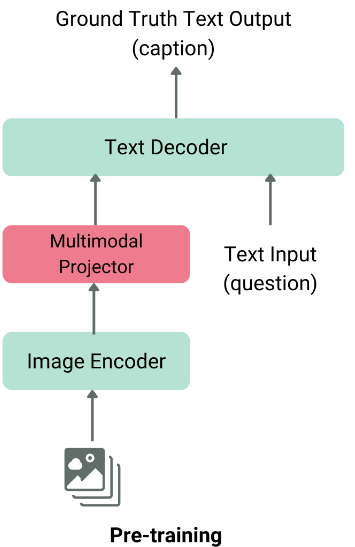
General architecture of vlm, image taken from hf blog.
There are many Vision Language Models available on the Clarifai Platform, including GPT-4o, Claude 3.5 Sonnet, Florence-2, Gemini, Qwen2-VL-7B, LLaVA, and MiniCPM-V. Try them out here!
Recent rankings indicate that Qwen-VL-Max-0809 has outperformed GPT-4o in terms of average benchmark scores. This is significant because GPT-4o was previously considered the top multimodal model. The rise of large open-source models like Qwen2-VL-7B suggests that open-source models are beginning to surpass their closed-source counterparts, including GPT-4o. Notably, Qwen2-VL-7B, despite its smaller size, achieves results that are close to those of commercial models.
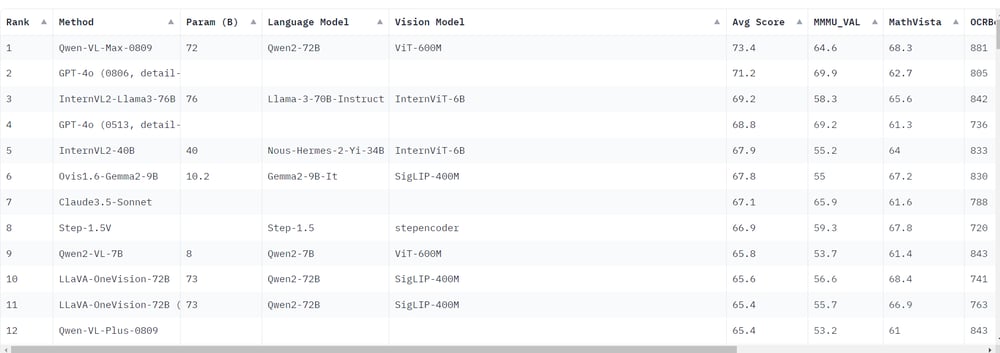
The experiments were conducted on Lambda Labs hardware with the following specifications:
|
CPU |
RAM (GB) |
GPU |
VRAM (GB) |
|---|---|---|---|
|
AMD EPYC 7J13 64-Core Processor |
216 |
A100 |
40 |
We focused on smaller models (less than 20B parameters) and included GPT-4o as a reference. The models evaluated include:
|
model |
MMMU |
|---|---|
|
Qwen/Qwen2-VL-7B-Instruct |
54.1 |
|
openbmb/MiniCPM-V-2_6 |
49.8 |
|
meta-llama/Llama-3.2-11B-Vision-Instruct |
50.7 (CoT) |
|
llava-hf/llava-v1.6-mistral-7b-hf |
33.4 |
|
microsoft/Phi-3-vision-128k-instruct |
40.4 |
|
llava-hf/llama3-llava-next-8b-hf |
41.7 |
|
OpenGVLab/InternVL2-2B |
36.3 |
|
GPT4o |
69.9 |
We employed two main inference strategies:
|
“Question: Answer this question in one word: What type of object is in this photo? Choose one from {class1, class_n}. Answer: <model answer>“ |
|
“Answer the question in one word: yes or no. Is the {class} in this photo?“ |
The Caltech256 dataset consists of 30,607 images across 256 classes, plus one background clutter class. Each class contains between 80 and 827 images, with image sizes ranging from 80 to 800 pixels. A subset of 21 classes (including background) was randomly selected for evaluation.
|
model |
macro avg |
weighted avg |
accuracy |
GPU (GB) (batch infer) |
Speed (it/s) |
|---|---|---|---|---|---|
|
gpt4 |
0.93 |
0.93 |
0.94 |
N/A |
2 |
|
Qwen/Qwen2-VL-7B-Instruct |
0.92 |
0.92 |
0.93 |
29 |
3.5 |
|
openbmb/MiniCPM-V-2_6 |
0.90 |
0.89 |
0.91 |
29 |
2.9 |
|
llava-hf/llava-v1.6-mistral-7b-hf |
0.90 |
0.89 |
0.90 |
|
|
|
llava-hf/llama3-llava-next-8b-hf |
0.89 |
0.88 |
0.90 |
|
|
|
meta-llama/Llama3.2-11B-vision-instruct |
0.84 |
0.80 |
0.83 |
33 |
1.2 |
|
OpenGVLab/InternVL2-2B |
0.81 |
0.78 |
0.80 |
27 |
1.47 |
|
openbmb/MiniCPM-V-2_6_bin |
0.75 |
0.77 |
0.78 |
|
|
|
microsoft/Phi-3-vision-128k-instruct |
0.81 |
0.75 |
0.76 |
29 |
1 |
|
Qwen/Qwen2-VL-7B-Instruct_bin |
0.73 |
0.74 |
0.75 |
|
|
|
llava-hf/llava-v1.6-mistral-7b-hf_bin |
0.67 |
0.71 |
0.72 |
|
|
|
meta-llama/Llama3.2-11B-vision-instruct_bin |
0.72 |
0.70 |
0.71 |
|
|
|
general-image-recognition |
0.73 |
0.70 |
0.70 |
N/A |
57.47 |
|
OpenGVLab/InternVL2-2B_bin |
0.70 |
0.63 |
0.65 |
|
|
|
llava-f/llama3-llava-next-8b-hf_bin |
0.58 |
0.62 |
0.63 |
|
|
|
microsoft/Phi-3-vision-128k-instruct_bin |
0.27 |
0.22 |
0.21 |
|
|
We also investigated how the number of classes affects the performance of the closed-set strategy. The results are as follows:
|
model | Number of classes |
10 |
25 |
50 |
75 |
100 |
150 |
200 |
|---|---|---|---|---|---|---|---|
|
Qwen/Qwen2-VL-7B-Instruct |
0.874 |
0.921 |
0.918 |
0.936 |
0.928 |
0.931 |
0.917 |
|
meta-llama/Llama-3.2-11B-Vision-Instruct |
0.713 |
0.875 |
0.917 |
0.924 |
0.912 |
0.737 |
0.222 |
GPT-4o remains a strong contender in the realm of vision-language models, but open-source models like Qwen2-VL-7B are closing the gap. Our general-image-recognition model, while fast, lags behind in performance, highlighting the need for further optimization or adoption of newer architectures. The impact of the number of classes on model performance also underscores the importance of carefully selecting the right model for tasks involving large class sets.