Free Printable October I-Spy Game (Cute Kawaii Activity Page)


Idk about you, but I just LOVE games, I just can’t help it, and this free printable October I-Spy game hits the spot!

I especially love how the word OCTOBER came out. I hand lettered that with all the cute little hearts and it puts a cute little kawaii flair to the October worksheet. Your kids are gonna LOVE it!!! 💖

And because it’s colorable, it doubles as a coloring page, a fun activity, AND a cool way to welcome the new month, all in one! Boo-yah! Grab your FREE 🎁 copy below…

October I-Spy Printable (October Activity For Kids)

October is such a fun month for cute activities. Kids are settled into school (and bored already, 😆 and really need things to encourage them along the way) and this free printable for October is packed with adorable little things to find, which helps with differentiation and math/counting skills! 🎃

This October theme worksheet is filled with cute little kawaii pumpkins, ghosts, mummies, haunted castles, cupcakes, lollipops, spiderwebs, and more, all tucked inside one cute bat!

Kids can search for each picture, count how many they find, and write their answers in the boxes at the bottom. It’s a super fun October counting activity for classrooms, homeschool, quiet time, parties, road trips, October early finisher activities, or a cozy screen-free afternoon.

Free printable October I-Spy game featuring a large bat filled with kawaii ghosts, mummies, pumpkins, haunted castles, lollipops, spiderwebs, and cupcakes to find and count.Free printable October I-Spy game featuring a large bat filled with kawaii ghosts, mummies, pumpkins, haunted castles, lollipops, spiderwebs, and cupcakes to find and count.

Download the Kawaii October Activity Printable PDF here. 


Creative Ways to Use This Fun October Printable Game

Moonlight Flashlight Hunt

Turn this October search and find printable into a moonlight search game! Dim the room a little and let kids use a flashlight to scan the giant bat for one picture at a time. It fits the moonlight theme of the page perfectly and makes a simple October homeschool activity feel completely different.

Predict the Winner

Before counting anything, have kids predict which picture they think appears the MOST and which appears the LEAST. After completing the October classroom activity, compare their predictions with the actual totals. Older kids can even figure out the difference between the highest and lowest numbers.

October Nocturnal Nature Study

Use as a free October printable for preschool and kindergarten and point out the bat, cat, and spider images to teach younger kids about amazing nocturnal animals that are super active during October evenings.

What sets your printables apart?

• Other printables are either functional OR cute. I bridge the gap between the two. Since I’m a single mom and don’t have time to mess around and am a kid at heart, I love something that actually propels me forward and gets the job done quickly, while still having that super cute vibe I’m known for.
• I’m a graphic designer FIRST. This means my printables, whether free or paid for, will always be of the highest quality and print crisp and clear on any printer.
• I love what I do and I do the work myself. I’m not hiring these out. This is my life, my hobby, my passion, my heart.
• My fans are obsessed with my work. To date, I’ve made over $23M on printables alone (organically) in the past 8 years.

Is this printable free to download?

Yes! Except for some large binders, all printables on the blog are 100% free for personal use. I make these because I genuinely want you to have something cute and helpful right now without having to spend a dime. You deserve a life that feels more peaceful, more organized, and more you, and if a simple printable can make your day feel lighter, I am so happy to give that to you.

All printables are for personal use only.

Printables, graphics, backgrounds, SVGs, fonts, and design elements on this site are for personal use only. You may not alter them or redistribute them for free or monetary gain without written consent from the author, Sarah Titus. If you want to share these resources with others, please share the link to the blog post. Teachers & Churches: You may share these with your classes, colleagues, and congregation as long as they are not edited in any way.

Can I use these printables for my classroom or church group?

Absolutely! You’re welcome to print as many copies as you need for your own students or church groups. I only ask that you do not edit them in any way (leaving the full copyright line in tact) or sell them or host the digital files on other websites. Please always link back to this post to share with others.

What’s the best way to print these high-quality printables?

• For best results, I recommend using standard 8.5″x11″ white paper. Since these are professionally designed as high-resolution PDFs, they’ll stay crisp and clear on any printer. To print, simply download the PDF to your device and open your printer settings. Select “Fit to Page” to ensure the printable looks perfect.
• If you’re printing stickers, I have a tutorial here.

What Using It Every Day Feels Like


DestinoDate
ID 97627734 | Dating App ©
Kawee Wateesatogkij | Dreamstime.com

Understanding the DestinoDate official website on paper is one thing. Understanding what it actually feels like to use it day to day is another. This DestinoDate review focuses on the latter: how members access the platform, what the features do in practice, where the costs appear, and what the complaints reveal about the experience over time — not just at first login.

Getting Started: Registration and Access

DestinoDate is an online dating site accessible at DestinoDate.com through any browser. There is no native application; the platform runs on a mobile-optimized website, which is worth knowing before registering if a dedicated app is a priority.

DestinoDate login requires an email address and password, set during the initial sign up process. Email confirmation is required before a profile becomes active and visible to other members — a step that ensures every browseable profile has at least confirmed an email address. That is not a deep verification, but it does reduce the volume of accounts created and immediately abandoned.

DestinoDate operates on a free-and-premium model. Creating a profile and browsing members costs nothing. Sustained use of messaging features and access to premium items like stickers involve payment. DestinoDate cost is not structured as a flat monthly subscription — users pay for the features they actually use, which means active communicators spend more than occasional ones. That distinction is practical and worth knowing before engaging in multiple simultaneous conversations.

What DestinoDate Offers Day to Day

The day-to-day experience on DestinoDate centers on four activities: browsing profiles, initiating contact, managing ongoing conversations, and adjusting account settings.

Browsing works through a member gallery with preference settings that let members filter by age and location. Filtering by shared interests, personality traits, or values is not available. The activity feed shows recent content from the platform community, which gives members a passive way to stay engaged without actively messaging.

Initiating contact involves either icebreakers — multi-send opening prompts that reach multiple people at once — or a direct message. Icebreakers are member-initiated, not automated outreach. DestinoDate also offers a private chat template function within one-on-one conversations: pre-written options that members can select or adapt when they want structure in early exchanges. Neither tool is described by the platform as bot-assisted, and both are intended to reduce the friction of opening a conversation rather than replace it.

Ongoing conversations can take the form of short exchanges or in-depth correspondence — longer-form letters distinct from quick replies — which is one of the platform’s more distinctive day-to-day features for users who prefer depth in written exchange. In-chat photo sharing is available alongside text.

Account management includes profile deactivation — reversible, hides the profile and pauses notifications — and full deletion, which is permanent. Both options are accessible from account settings. The difference between the two is meaningful: deactivation is designed for users taking a break, while deletion removes the account entirely and cannot be undone.

Costs and Features: What’s Free and What Isn’t

The free layer covers registration, profile creation, email confirmation, and basic browsing. Premium features — stickers, sustained messaging tools — involve payment. DestinoDate does not operate on a subscription model in the traditional sense; the pay structure is tied to usage rather than a fixed monthly commitment.

A quick summary of what is and is not available on the DestinoDate site:

  • Free: Registration, profile creation, profile browsing, email confirmation
  • Premium (paid): Stickers, sustained use of messaging features
  • Not available: Mobile app, video calls, voice calls, interest-based search filtering

DestinoDate support is available around the clock. Complex account or billing questions are typically resolved within five business days. Users with concerns about specific behavior or content can reach the support team through the platform’s built-in reporting system, which covers profiles, messages, photos, and posts.

Is DestinoDate Legit and Safe?

DestinoDate is an operational platform with a functional sign up and login flow, a browseable member base, and structured safety tools. The safety question — whether it is safe to use — requires the same process framing that applies to any platform of this kind.

Os DestinoDate safe? DestinoDate takes measures to minimize unwanted content and works to detect and act on suspicious profiles. Users can report profiles, specific messages, photos, and posts at any point. The Trust and Safety team reviews reports and acts in accordance with the terms of service. Blocking is available from any profile or conversation and does not require a prior report to activate.

Many users can be verified through an identity confirmation process conducted by a recognized third-party vendor. Verification is voluntary — not a condition of access — and verified profiles carry a visible badge. According to a 2024 survey cited by the International Council on Active Aging, 90% of online daters believe platforms should verify user information. DestinoDate’s voluntary verification framework is the platform’s response to that expectation; whether it goes far enough depends on how much weight a particular user places on that badge.

DestinoDate Reviews and Complaints: The Recurring Themes

DestinoDate reviews and complaints across external platforms cluster around three issues. The cost model is the most common: users who message frequently find the pay-as-you-use structure more expensive than anticipated. The absence of a native app is a consistent note among mobile-first users. Preference setting depth — age and location only — frustrates users who want interest-based filtering.

On the positive side, users who engage with the extended messaging features tend to report the experience favorably. The icebreaker system and private chat templates are cited as useful friction-reducers for early contact. DestinoDate customer support responsiveness draws neutral-to-positive mentions in reviews that address it specifically, with few serious complaints about resolution times.

DestinoDate is legit. Whether it is the right platform depends on whether its design — correspondence-first, pay-as-you-use, browser-only — fits what a user is actually trying to do.

This article is published in partnership with DestinoDate. The views and information contained herein are for general reading purposes only. This content is not professional advice and should not be treated as such.

Find a Home-Based Business to Start-Up >>> Hundreds of Business Listings.

How Small Brands Can Build a Trusted Short-Form Video Engine


Short-Form Video Engine
Deposit Photos

When it comes to social media marketing, there’s no denying that video is the most powerful tool brands can use to reach their goals, making a short-form video engine an important tool to have on hand. Video marketing grabs customers’ attention, builds trust, increases engagement, and/or drives conversions. Of all formats, short-form video content seems to bring the best results across the board.

It’s not just a TikTok trend anymore. While the platform may have started the fad, it’s become much larger than that. The success that Instagram and Facebook Reels, or YouTube Shorts enjoy stands as proof of video’s dominance and the increasingly important role it plays in shaping digital marketing strategies.

However, in order for businesses to truly leverage the power that video content holds, they need a short-form video engine that allows them to produce effective short-term videos on repeat. That’s certainly not an issue for large companies that have an army of specialists handling every aspect of their social media campaigns, but for smaller enterprises, the task of creating short-form videos consistently can be quite challenging and put a lot of pressure on marketing teams. A social media marketing agency such as Faceplant Creative can connect strategy, production, and editing in one workflow.

The good news is that even with limited resources, small businesses can still win at social media marketing as long as they know where to direct their focus and resources, so let’s see how you should go about building a video production engine that works flawlessly.

Do Your Research

One of the biggest mistakes companies make is jumping into video production without taking the time to do a bit of research and understand how video content actually works. You can’t expect to see results by randomly creating and posting videos online. In order to craft impactful videos that actually hit the mark, you first have to figure out who your target audience is and what kind of content resonates with them.

That’s why market research is absolutely essential before you move on to execution. This will help you choose topics that are related to the products/services you provide and that also address a real problem or concern that your customers might have. The whole point is to provide something of value to your audience.

Having this content pillar system in place will streamline your content strategy, as you won’t have to scramble for ideas every time you want to create a video, saving you precious time and effort, and helping you stay consistent.

Choose Your Platforms

Deciding where to post your videos is just as important. Every social media platform has its unique characteristics and can help you reach specific goals, so you need to know how they work and focus on the ones that align with your needs.

For instance, TikTok resonates with younger demographics, as the hub for casual, entertaining and trend-driven videos. Instagram is known to be popular with people from various age groups, being the perfect platform for storytelling and brand discovery.  Facebook, on the other hand, tends to do well in terms of community engagement and group building, reaching across all age categories.

You should choose the platform that makes sense for you and get the hang of it, and then, if you think it’s necessary, you can expand to others. That way, you won’t risk spreading yourself too thin or be all over the place with your marketing strategy.

Create Video Content in Batches

It’s important to be active on your socials and post videos regularly, but that doesn’t mean production and posting have to happen simultaneously. In fact, filming videos as you go can be rather time-consuming and exhausting.

Having a well-defined schedule for short-form video production and creating content in batches is a much more effective method for keeping up with the demand. You can set aside one specific day each month where you focus on creating short-form videos. Have everything prepared to shoot multiple videos in one single session, so you can get the job done as fast as possible. A short-form video engine can help you shorten longer videos, saving you time.

Then you can handle the editing later and post the videos according to the schedule you’ve established. That’s how you get a month’s worth of video content in one single day, or a few hours, depending on your goals.

Take Advantage of AI-Powered Tools

We live in the age of AI, which admittedly creates all sorts of challenges, but the controversial technology also provides numerous solutions that improve business processes on so many levels.

AI hasn’t taken over the world and it certainly can’t handle digital marketing campaigns on its own, without human assistance. What it can do is help with tasks such as researching trending topics, generating full video scripts, creating voiceovers and sound effects, editing, and so on, all of which can make the video production process run a lot smoother. By automating repetitive tasks, AI-powered tools can increase output while also ensuring consistent quality.

Post and Repurpose

Once your videos are ready, it’s time to make them work for you. If you want to post on multiple platforms, make sure you don’t move videos from one platform to another directly, as the algorithms tend to penalize watermarks and duplicate content. Instead, use editing software to export a clean version to each platform.

Repurposing is also a highly effective strategy that can save you time. Basically, you can use the same core video and adapt it so it can be posted on multiple platforms, in various forms, in order to reach a larger audience. It’s worth looking into a short-form video engine for further help.

Analyze Performance

Finally, you should make it a priority to regularly check the performance of the videos you post. For those that do well, consider making a follow-up or part-two videos, or even turn them into a series.

Short-form video production may seem complicated when you’re a small business, but it doesn’t have to be that way. With a clear system for creating video content, you can ace your social marketing strategy without exhausting your team.

Find a Home-Based Business to Start-Up >>> Hundreds of Business Listings.

Credit Union for Self-Employed: Why It Works


Self-employed person managing finances with a credit union
Depositphotos.com

Being your own boss is great until you have to deal with a bank. The moment your income stops looking like a steady paycheck, a lot of financial institutions start treating you like a risk instead of a customer. If you’ve ever tried to get a loan approved with a year of uneven 1099 income, you know the feeling: the numbers are fine, but the system doesn’t know what to do with you. For self-employed people, a credit union often handles that situation far better than a big bank does.

The reason comes down to how each type of institution is built, and who it was built to serve.

Big Banks Are Built for Salaried Customers

The large national banks run on scale, and scale means automation. Their systems are optimized for the most common customer, someone with a W-2, a predictable paycheck, and a tidy financial profile that an algorithm can approve in seconds. That’s efficient, and if you fit the mold, it works fine.

The trouble is that self-employment doesn’t fit the mold. Your income arrives in irregular chunks. Some months are strong, some are thin, and a good year can still look messy on paper. When an automated system hits a file like that, it often does the safe thing and says no, or buries you in documentation requests a salaried applicant never has to deal with. It isn’t personal. It’s just that nobody at the bank is actually looking at your situation.

Human Underwriting Actually Looks at You

This is where a credit union earns its keep for the self-employed. Because they’re smaller and member-focused, credit unions are more likely to put a human being on a file that doesn’t fit the standard template. A person can understand that two years of solid self-employment income, even if it’s uneven, is not the same as instability. An algorithm usually can’t.

A local California credit union like Wescom Financial, which serves members across the state, is the kind of institution where that human review is more likely to happen. For a self-employed borrower applying for a mortgage, an auto loan, or a personal line of credit, that difference can be what gets you approved on terms that actually reflect your situation. You’re a member with a relationship, not an application in a queue.

None of this means you skip the paperwork. You’ll still need to document your income properly. But there’s a real difference between an institution looking for a reason to say yes and one looking for a reason to say no.

Fees Matter More When Margins Are Thin

Early in self-employment, every dollar counts, and the small fees a big bank charges without thinking add up faster when your income is lumpy. This is the other place a credit union tends to help. As member-owned, not-for-profit institutions, they generally run leaner on fees:

  • Often no monthly checking fee, so a slow month doesn’t cost you extra.
  • Fewer of the nuisance charges big banks rely on for revenue.
  • More reasonable overdraft and account terms.
  • Access to large shared ATM networks, so you’re not paying to reach your own cash.

For someone drawing an unpredictable income, keeping those costs low isn’t trivial. It’s the difference between an account that works with your cash flow and one that punishes it.

Where It Falls Short

I’ll be straight about the limits, because a credit union isn’t a cure-all. If you need genuine business banking, business loans, merchant services, or commercial accounts, a consumer-focused credit union won’t cover all of it, and you may still need a separate provider for the business side. There’s also the membership requirement, though for most people it’s a quick step, and a smaller branch footprint if you travel constantly.

So keep the distinction clear. For the personal side of a self-employed life, the checking, the savings, the personal loans, the mortgage, a credit union is often the better home. For a complex business operation, you may need more. The smart move for a lot of solopreneurs is to use each for what it does well, rather than expecting one institution to do everything.

The through-line is simple enough. Self-employment makes you harder for an automated system to read, and a credit union is more willing to read you as a person. If you’ve been fighting your bank every time your income doesn’t look like everyone else’s, it’s worth seeing how a member-owned institution treats the same numbers. The paperwork won’t disappear, but the reception on the other end tends to be a lot warmer.

Find a Home-Based Business to Start-Up >>> Hundreds of Business Listings.

Best Times to Post on Social Media in 2026: A Data-Driven Guide


Best times to post on social media for maximum engagement
Depositphotos.com

Ask ten marketers when to post and you’ll get ten confident, completely different answers. Tuesday at 11am. No, Thursday evenings. Actually, weekends are dead, don’t bother. Here’s the thing though: most of this advice comes from someone’s gut feeling rather than actual data, and posting at the wrong hour genuinely tanks a good piece of content before it even gets a fair shot.

Why Timing Isn’t Just a Nice-to-Have

Every platform’s algorithm leans heavily on early engagement to decide how far a post travels. A video that gets fifty views and a dozen comments in its first thirty minutes gets pushed to more people. The same video, posted three hours later when your audience is asleep or stuck in traffic, might limp along with a fraction of that early activity, and the algorithm quietly decides it’s not worth pushing further. Same content, wildly different fate, purely down to timing.

There’s No Single Magic Hour

This is where a lot of generic advice falls apart. “Post at 9am” as a universal rule ignores that Instagram audiences behave completely differently to LinkedIn audiences, and TikTok’s rhythm looks nothing like Facebook’s. Treating all platforms the same way is like using one house key to open every door in the street. Occasionally it works. Mostly it doesn’t.

  • Instagram: engagement tends to spike during lunch breaks and again in the evening wind-down
  • LinkedIn: weekday mornings before the workday properly kicks off perform strongly
  • TikTok: evenings, especially mid-week, catch audiences in a scrolling headspace
  • Facebook: skews slightly older audiences, with midday and early evening both performing well

What the Actual Data Shows

“Our analysis of 68 million engagements provides useful insights into the best times to post on social media across major platforms. The full breakdown covers Instagram, Facebook, LinkedIn, TikTok, Pinterest, and X, with specific insights for each platform. You can find the complete analysis in the piece on the best times to post on social media in 2026, and some of the patterns are genuinely surprising.

Your Own Audience Might Break Every Rule

Here’s a wrinkle worth sitting with: general data gives you a strong starting point, but your specific audience might genuinely behave differently. A business with a heavily international following, or one skewing toward shift workers, night owls, or a particular age bracket, While general benchmarks can help identify the best times to post on social media, your own audience data should guide your final schedule. Platform analytics for your own account will tell you this eventually, if you bother checking.

Engagement Isn’t Just About the Post-Time Window

Timing affects the crucial first hour, but it’s not the entire story. A weak post published at the perfect hour still underperforms a genuinely great post published slightly off-peak. Think of timing as a multiplier, not a magic wand. It amplifies good content significantly. It won’t rescue mediocre content no matter how perfectly it’s scheduled.

Frequency and Timing Work Together

Posting once at the perfect hour beats posting five mediocre times scattered randomly throughout the day, but consistency still matters enormously. Building a predictable rhythm, even if it’s not scientifically optimised down to the minute, trains your specific audience’s habits over time. People start checking in around when they expect new content, which creates its own momentum independent of algorithmic quirks.

Weekends Aren’t Always the Wasteland People Assume

A common myth: weekends are dead zones for business content, save everything for weekdays. Reality’s messier than that. Certain platforms and certain audiences genuinely engage more on weekends, particularly lifestyle, retail, and entertainment-adjacent content. Blanket weekday-only strategies leave reach sitting on the table for plenty of businesses, purely because nobody bothered checking whether the assumption actually held for their specific audience.

Time Zones Complicate Things Fast

For businesses with a national or international audience, “the best time to post” splinters into multiple answers depending on where your followers actually live. A single posting schedule optimised for Sydney might land at an awkward hour for followers in Perth, or completely miss an international audience altogether. Scheduling tools that stagger posts, or picking a time that splits the difference reasonably across time zones, solves this without requiring five separate posting schedules.

What About Automated Scheduling Tools?

Scheduling software makes consistency easier, no argument there, but it’s not a substitute for actually checking whether the times you’ve picked are still the right ones. Plenty of businesses set a schedule once, years ago, and never revisit it, quietly leaving reach on the table while assuming the tool is handling optimisation on its own. It isn’t. It’s just doing what you told it to.

Algorithms Change, So Revisit This Regularly

What worked six months ago on a given platform can quietly stop working as the algorithm shifts priorities, sometimes without any public announcement at all. Treat your posting schedule as a living thing worth revisiting every few months, rather than a setting you configure once and forget entirely. A quick quarterly check against fresh analytics keeps the whole strategy honest.

Testing Doesn’t Need to Be Complicated

You don’t need elaborate spreadsheets or expensive tools to figure out your own sweet spot. Post the same type of content at two or three different times over a few weeks, note what happens, adjust. Simple, slightly tedious, and considerably more reliable than copying a schedule built for someone else’s audience entirely.

So What Should You Actually Do With This?

Start with the general data as your baseline, since it genuinely reflects real engagement patterns across huge sample sizes. Then test against your own analytics over a few weeks, because your specific audience might quietly break every general rule. Adjust from there, and don’t treat the perfect posting time as fixed forever, audience habits shift, algorithms change, and what worked six months ago can quietly stop working without anyone noticing until reach starts sliding.

If you’d rather have someone else handle the testing, scheduling, and constant recalibration, engage a social media ads team that builds posting strategies around this kind of data rather than recycling generic advice that may not fit your actual audience.

Wrapping It Up

Timing isn’t the whole game, but pretending it doesn’t matter is a mistake plenty of businesses make while wondering why their content underperforms. Get the hour roughly right, keep testing against your specific audience’s habits, and let the data, not gut feeling, guide the schedule going forward.

Find a Home-Based Business to Start-Up >>> Hundreds of Business Listings.

180+ Nations in the Bible That Starts with A – Z


The Bible is FULL of nations, kingdoms, lands, regions, and cities, and sometimes it can be hard to keep them all straight!

One minute you’re reading about Judah, Moab, Assyria, Persia, or some other tiny place and you’re thinking, “Wait…where is THAT?! I’ve seen it before, I’ve heard it before…why does it sound familiar to me? What happened there? Why do I remember it? Why is it important?”

So I wanted to put them all together in one massive, easy-to-reference list! 🎉

This nations in the Bible that starts with A-Z list gives you biblical nations and places alphabetically, along with a Scripture reference where each one appears so you can easily cross-reference it.

It’s such a fascinating way to study the Bible because you start noticing connections between people, wars, kingdoms, journeys, prophecies, and major events that are SO easy to miss when you’re just reading straight through Scripture. 📖❤️

For this list, I’m using the word nations broadly to include…

  • Biblical nations mentioned in the Bible
  • Kingdoms in the Bible
  • Ancient nations in the Bible
  • Biblical lands and territories
  • Places mentioned in the Bible
  • Biblical places
  • Regions
  • Countries mentioned in the Bible (any countries in the Bible)
  • City-states

…so you can explore the geography of the Bible (think: Bible geography list) as thoroughly as possible.

Complete A-Z List of Biblical Nations and Places

Whether you’re studying Bible geography, researching a particular kingdom, preparing a Sunday school lesson, homeschooling, or just wanting to understand Scripture more deeply, this alphabetical list of Bible cities and ancient Biblical empires makes it super easy to find the Biblical place you’re looking for.

It includes Old Testament geography and New Testament geography and the following translations were used to make this master list of nations found in the Bible: ESV, NASB, KJV, NKJV, LSB, NIV, CSB.

Be sure to check out my other A-Z lists for more fun! 🎉

Let’s dive in…

Nations in the Bible That Starts With A

  • Abilene (Luke 3:1)
  • Achaia (Acts 18:12)
  • Achshaph (Joshua 12:20)
  • Admah (Genesis 14:2)
  • Adullam (Joshua 12:15)
  • Ai (Joshua 12:9)
  • Amalek (1 Samuel 15:5)
  • Ammon (Psalm 83:7)
  • Aphek (Joshua 12:18)
  • Arabah (Deuteronomy 1:7)
  • Arabia (Galatians 1:17)
  • Arad (Joshua 12:14)
  • Aram (2 Samuel 15:8)
  • Aram Maakah (1 Chronicles 19:6)
  • Aram Naharaim (1 Chronicles 19:6)
  • Ararat (2 Kings 19:37)
  • Argob (Deuteronomy 3:13)
  • Armenia (2 Kings 19:37)
  • Arpad (2 Kings 19:13)
  • Ashdod (Joshua 13:3)
  • Ashkelon (Joshua 13:3)
  • Ashkenaz (Jeremiah 51:27)
  • Asia (Acts 16:6)
  • Assyria (Isaiah 19:23)

Nations in the Bible That Starts With B

  • Babylon (Jeremiah 50:1)
  • Bashan (Deuteronomy 3:1)
  • Bela (Genesis 14:2)
  • Bethel (Joshua 12:16)
  • Beth-togarmah (Ezekiel 38:6)
  • Beyond the River (Ezra 4:11)
  • Bithynia (Acts 16:7)
  • Buz (Jeremiah 25:23)

Nations in the Bible That Starts With C

  • Canaan (Genesis 12:5)
  • Cappadocia (Acts 2:9)
  • Caphtor (Amos 9:7)
  • Chaldea (Jeremiah 50:10)
  • Chinneroth (Joshua 11:2)
  • Chittim (Numbers 24:24)
  • Cilicia (Acts 15:23)
  • Crete (Titus 1:5)
  • Cush (Isaiah 43:3)
  • Cuthah (2 Kings 17:24)
  • Cyprus (Acts 11:19)

Nations in the Bible That Starts With D

  • Dalmatia (2 Timothy 4:10)
  • Decapolis (Mark 5:20)
  • Dedan (Jeremiah 25:23)
  • Dor (Joshua 12:23)

Nations in the Bible That Starts With E

  • Eden (2 Kings 19:12)
  • Edom (Genesis 36:31)
  • Eglon (Joshua 12:12)
  • Egypt (Genesis 12:10)
  • Ekron (Joshua 13:3)
  • Elam (Jeremiah 49:34)
  • Ellasar (Genesis 14:1)
  • Ethiopia (Esther 1:1)

Nations in the Bible That Starts With F

Nations in the Bible That Starts With G

  • Galatia (Galatians 1:2)
  • Galilee (Luke 3:1)
  • Gath (Joshua 13:3)
  • Gaza (Joshua 13:3)
  • Gebal (Psalm 83:7)
  • Geder (Joshua 12:13)
  • Gerar (Genesis 20:2)
  • Geshur (2 Samuel 13:37)
  • Gezer (Joshua 12:12)
  • Gilead (Genesis 31:21)
  • Goiim (Genesis 14:1)
  • Gomorrah (Genesis 14:2)
  • Goshen (Genesis 45:10)
  • Gozan (2 Kings 19:12)
  • Grecia (Daniel 8:21)
  • Greece (Daniel 8:21)

Nations in the Bible That Starts With H

  • Hadrach (Zechariah 9:1)
  • Hamath (2 Samuel 8:9)
  • Haran (2 Kings 19:12)
  • Hauran (Ezekiel 47:16)
  • Havilah (Genesis 2:11)
  • Hazor (Jeremiah 49:28)
  • Hebron (Joshua 12:10)
  • Hena (2 Kings 19:13)
  • Hepher (Joshua 12:17)
  • Heshbon (Joshua 12:2)
  • Hormah (Joshua 12:14)

Nations in the Bible That Starts With I

  • Idumaea (Mark 3:8)
  • Idumea (Mark 3:8)
  • Illyricum (Romans 15:19)
  • India (Esther 1:1)
  • Israel (1 Kings 12:20)
  • Italy (Acts 18:2)
  • Ituraea (Luke 3:1)
  • Ivvah (2 Kings 19:13)

Nations in the Bible That Starts With J

  • Jarmuth (Joshua 12:11)
  • Javan (Isaiah 66:19)
  • Jericho (Joshua 12:9)
  • Jerusalem (Joshua 12:10)
  • Jokneam (Joshua 12:22)
  • Judaea (Mark 3:7)
  • Judah (2 Kings 16:5)
  • Judea (Matthew 2:1)

Nations in the Bible That Starts With K

  • Kedar (Jeremiah 49:28)
  • Kedesh (Joshua 12:22)
  • Keveh (1 Kings 10:28)
  • Kir (Amos 9:7)
  • Kittim (Numbers 24:24)
  • Kue (1 Kings 10:28)

Nations in the Bible That Starts With L

  • Lachish (Joshua 12:11)
  • Lasharon (Joshua 12:18)
  • Lebanon (Deuteronomy 1:7)
  • Libnah (Joshua 12:15)
  • Libya (Acts 2:10)
  • Lud (Isaiah 66:19)
  • Lycaonia (Acts 14:6)
  • Lycia (Acts 27:5)

Nations in the Bible That Starts With M

  • Maacah (2 Samuel 10:6)
  • Macedonia (Acts 16:9)
  • Madon (Joshua 12:19)
  • Magog (Ezekiel 38:2)
  • Makkedah (Joshua 12:16)
  • Malta (Acts 28:1)
  • Media (Esther 1:3)
  • Megiddo (Joshua 12:21)
  • Melita (Acts 28:1)
  • Mesopotamia (Acts 2:9)
  • Midian (Exodus 2:15)
  • Minni (Jeremiah 51:27)
  • Moab (Ruth 1:1)
  • Mysia (Acts 16:7)

Nations in the Bible That Starts With N

  • Negeb (Deuteronomy 1:7)
  • Nineveh (Jonah 3:6)
  • Nod (Genesis 4:16)

Nations in the Bible That Starts With O

Nations in the Bible That Starts With P

  • Palestina (Isaiah 14:29)
  • Pamphylia (Acts 2:10)
  • Pathros (Isaiah 11:11)
  • Persia (Esther 1:3)
  • Phenice (Acts 11:19)
  • Philistia (Psalm 60:8)
  • Phoenicia (Acts 11:19)
  • Phrygia (Acts 2:10)
  • Pisidia (Acts 13:14)
  • Pontus (Acts 2:9)
  • Pul (Isaiah 66:19)
  • Put (Ezekiel 38:5)

Nations in the Bible That Starts With Q

Nations in the Bible That Starts With R

  • Rehob (2 Samuel 10:8)
  • Rezeph (2 Kings 19:12)

Nations in the Bible That Starts With S

  • Salem (Genesis 14:18)
  • Samaria (Acts 8:1)
  • Seba (Isaiah 43:3)
  • Seir (Deuteronomy 2:5)
  • Sepharvaim (2 Kings 19:13)
  • Sharon (1 Chronicles 27:29)
  • Sheba (1 Kings 10:1)
  • Shephelah (1 Kings 10:27)
  • Shimron-meron (Joshua 12:20)
  • Shinar (Genesis 14:1)
  • Sidon (Jeremiah 25:22)
  • Sodom (Genesis 14:2)
  • Spain (Romans 15:24)
  • Syene (Isaiah 49:12)
  • Syria (2 Kings 5:1)

Nations in the Bible That Starts With T

  • Taanach (Joshua 12:21)
  • Tappuah (Joshua 12:17)
  • Tarshish (Jonah 1:3)
  • Telassar (2 Kings 19:12)
  • Tema (Isaiah 21:14)
  • Teman (Jeremiah 49:7)
  • Tirzah (Joshua 12:24)
  • Tob (Judges 11:3)
  • Trachonitis (Luke 3:1)
  • Tubal (Isaiah 66:19)
  • Tyre (Jeremiah 25:22)

Nations in the Bible That Starts With U

Nations in the Bible That Starts With V

  • Valley of Rephaim (2 Samuel 5:22)

Nations in the Bible That Starts With W

  • Wadi of Egypt (Joshua 15:4)
  • Wilderness of Zin (Numbers 27:14)

Nations in the Bible That Starts With X

  • Xerxes’ Kingdom (Esther 9:30)

Nations in the Bible That Starts With Y

Nations in the Bible That Starts With Z

  • Zeboiim (Genesis 14:2)
  • Zimri (Jeremiah 25:25)
  • Zin (Numbers 13:21)
  • Zoar (Genesis 14:2)
  • Zobah (2 Samuel 8:3)


Looking for more…see all the A-Z lists here!

Ways to Go Deeper In Study

Connect Bible Characters to Their Locations

Take your favorite Bible characters and trace their movements using the nations and places on this list.

  • Where was Abraham born?
  • Where did Ruth come from?
  • Where was Daniel taken?
  • Where did Paul travel?

Instead of studying biblical people and geography separately, connect the two. Suddenly the Bible starts feeling much more like one interconnected historical story rather than dozens of unrelated events.

5 Managed Transportation Services for Mid-Market Companies


Managed Transportation Services for Mid-Market Manufacturing and Distribution
Envato.com

Managed transportation is an ongoing partnership where a provider runs your freight operation as an extension of your team.

It covers carrier sourcing, multi-modal execution, freight audit, claims, and reporting rather than arranging one shipment at a time.

Mid-market manufacturers and distributors reach for it at a predictable moment. Volume grows, carrier counts multiply, invoices stop reconciling, and the choice becomes hiring a logistics department or partnering with one that already exists.

The pressure points are consistent. Carrier management eats staff time, freight costs drift unnoticed, visibility lives in email threads, capacity tightens without warning, and adding headcount is rarely the cheapest answer.

What Are Managed Transportation Services?

A traditional freight broker arranges individual shipments carrier to carrier. Managed transportation services for mid-market companies are a continuing program covering network strategy, technology, reporting, and multi-mode execution.

The 3PL and 4PL distinction sits alongside that. A 3PL executes freight and may own assets, while a 4PL acts as a neutral orchestration layer coordinating other providers and systems on your behalf.

A full program usually includes carrier sourcing and RFP strategy, load tendering, tracking, freight pay and audit, claims management, TMS access and recurring analytics.

Optimisation work such as consolidation analysis and mode shifting separates a genuine program from outsourced dispatch.

How We Selected the Companies

Seven criteria drove this list. Mid-market specialisation, manufacturing and distribution experience, modes supported, technology and visibility, carrier management, geographic coverage and scope of managed services.

Managed transportation service Providers for mid-market companies were assessed on published capability, not marketing claims. Anything unverifiable against a company’s own materials was left out.

The 5 Best Managed Transportation Services

1. TLI

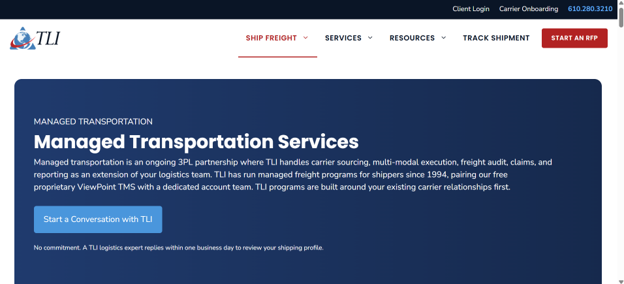
TLI has run managed freight programs

TLI has run managed freight programs for shippers since 1994, pairing its proprietary ViewPoint TMS with a dedicated account team.

Programs are built around your existing carrier relationships first, supplementing with TLI’s network only where gaps appear.

The technology is where TLI separates itself. Its rating engine reads your actual shipment history rather than working from estimates.

That foundation matters most in LTL, where pricing is genuinely opaque. Base rates, discounts off tariff, accessorials, and fuel surcharges all move independently, making costs easy to lose track of.

TLI is direct about a trap that catches many shippers. A headline discount tells you little on its own, because a 70% discount off an inflated tariff can cost more than a 55% discount off a competitive one.

Their position is that total net cost per hundredweight is the only metric worth comparing. The rating engine models contract types, weight breaks, and variables across many lanes at once, evaluating the real cost structure behind a carrier’s pricing.

Those insights then feed the negotiation. Shippers running a structured RFP through TLI’s tools benchmark base rate savings of 4% to 15% against existing direct-carrier or spot pricing.

Customization goes beyond line-haul rates. TLI negotiates custom fuel surcharge tables and tailored accessorial schedules through its motor carrier RFP sourcing events rather than accepting standard tariff terms and generic fees.

Cargo protection works the same way. TLI Advantage+ covers a shipment’s full declared value and resolves claims within 30 days without proof of carrier negligence, a different outcome from standard weight-based liability.

The audit side is quantified. TLI shippers collectively recovered $634,608 in freight bill audit findings, with TLI’s data showing an audit typically recovers 2 to 3 percent of annual freight spend in the first year.

Implementation runs roughly five to six weeks from the point historical data is shared. TLI suits companies shipping $1 million or more annually in LTL or truckload freight, particularly those with multiple facilities.

2. Sheer Logistics

Sheer Logistics for mid-market shippers

Founded in 2009 in Chesterfield, Missouri, Sheer Logistics was built around the argument that mid-market shippers have been underserved by managed transportation service providers.

It operates as a 4PL, pairing the Sheer TMS with SheerExchange, a proprietary integration platform.

That integration layer is the differentiator. Sheer states it can implement a TMS in as little as eight weeks against an industry norm of six to eighteen months, drawing on 1,000 or more pre-built integrations.

The company targets shippers moving $5 million to $100 million in freight annually and claims average cost reductions of 15 percent.

It serves mid-market manufacturers, consumer products, food and beverage, plus chemical producers.

3. Land-Link Traffic Systems

Land-Link - execution-focused managed transportation

Operating since 1978, Land-Link is a privately held 3PL with an execution-focused managed transportation offering.

Its management team carries over 200 years of combined experience, and one founding-year client reportedly remains with the business.

Retail compliance is a genuine specialisation. For manufacturers shipping to major retailers, Land-Link provides OTIF support and chargeback management aimed at protecting vendor scorecards.

Services span LTL, truckload, volume and drayage, plus freight audit and payment, analytics and KPI development. Land-Link suggests a fit for shippers with annual freight spend above $400,000.

4. Ryder

Ryder is the enterprise option

Ryder is the enterprise option, a roughly $13 billion port-to-door logistics company listed on the NYSE.

Its managed transportation sits inside a portfolio covering dedicated contract carriage, brokerage, warehousing, and fleet management.

Scale is the argument, with around $10 billion in freight managed annually and roughly 250,000 commercial vehicles across more than 20 industries.

Visibility runs through RyderShare, a collaborative platform connecting shippers, receivers and carriers in real time.

Transportation management covers network design, shipment planning, procurement, tendering, and freight bill audit.

The trade-off for mid-market shippers is whether they will be a priority account inside an operation of that size.

5. GlobalTranz

GlobalTranz - WWEX Group

Founded in 2003, GlobalTranz operates within WWEX Group alongside Worldwide Express, Unishippers, JEAR Logistics and BLX Logistics. That group reported approximately $5 billion in systemwide revenue in 2025.

Carrier network breadth is the headline, with published access to more than 75 LTL carriers and over 45,000 active truckload carriers.

Managed transportation includes freight invoice coding, approval, and payment processing, plus custom reporting and quarterly consulting from an account team.

The model suits shippers wanting flexibility between self-service booking and full outsourcing. Buyers should confirm whether their account sits with GlobalTranz directly or with an independent agent, since the service model differs.

Managed Transportation vs Traditional 3PL

Capability Managed Transportation Traditional 3PL or Broker
Engagement Ongoing program Per shipment
Pricing basis Contract rates from your shipment history Spot or published tariff rates
Technology TMS included and configured Usually none provided
Carrier sourcing Structured RFP run for you Provider’s existing panel
Freight audit Every invoice reviewed Rarely included
Claims Filed and tracked for you Filed internally
Reporting Recurring KPI and business reviews Transactional only
Team Dedicated account team Rotating reps

How to Choose the Right Provider

Start with freight volume and spend, since most programs have a practical entry threshold. TLI points to $125000 million or more annually; Sheer works in the $5 million to $100 million band, while Land-Link suggests $400,000 upward.

Then match your modes against what each provider does well. A heavy LTL profile calls for rating engine depth, while dedicated fleet needs point toward asset-backed providers, and manufacturing specifics like vendor inbound routing or retail compliance are learned specialisms worth testing for.

Finally, interrogate the carrier network, reporting cadence, pricing model, and support structure. Establish whether you get a named account team or a ticket queue, because that difference shows up on your worst day.

Conclusion

There is no universally correct answer, only a correct one for your freight profile. Enterprise shippers with dedicated fleet needs will find Ryder compelling, while pure network breadth points toward GlobalTranz.

For mid-market manufacturers and distributors, the deciding factor in managed transportation services is usually analytical depth rather than size.

TLI’s data-driven RFP approach and Sheer’s rapid integration model both target the same problem, that most shippers cannot see their true transportation costs clearly enough to negotiate against them.

Frequently Asked Questions

What Is the Difference Between Managed Transportation and Freight Brokerage?

Brokerage arranges individual shipments as one-off transactions. Managed transportation is an ongoing program covering network strategy, technology, execution, and reporting as an extension of your logistics team.

What Size Company Needs Managed Transportation?

Thresholds vary by provider, from around $400,000 to $5 million in annual freight spend. Complexity often matters more than raw volume, particularly with multiple facilities or inbound vendor routing.

Does a Bigger LTL Discount Always Mean a Lower Cost?

No, and this is one of the most common misunderstandings in LTL pricing. A large discount applied to an inflated base tariff can produce a higher net cost than a smaller discount off a competitive tariff, so compare net cost per hundredweight instead.

Find a Home-Based Business to Start-Up >>> Hundreds of Business Listings.

True Cost of Living in Spokane Valley: A Newcomer’s 2026 Guide


True Cost of Living in Spokane Valley
Deposit Photos

Spokane Valley has become one of the more appealing landing spots in the Pacific Northwest, offering a rare combination of suburban comfort, outdoor access, and a cost structure that looks genuinely reasonable next to coastal Washington and the broader West Coast. But “affordable relative to Seattle” is not the same as “cheap,” and the newcomers who settle in most comfortably are the ones who build a realistic budget before they arrive. Here is an honest, numbers-first look at what it actually costs to live in Spokane Valley in 2026.

Housing: The Biggest Line Item

Housing will be the largest part of your budget, and it is where Spokane Valley’s value shows up most clearly. As of early 2026, the median home price sits around $390,000 to $410,000. That is a fraction of what equivalent homes command in Seattle, where median values run well north of $750,000, but it is still a meaningful number that has climbed with steady demand and population growth.

There is good news for buyers right now, though. The market has shifted in a buyer-friendly direction, with rising inventory and homes averaging around 65 days on the market. That gives purchasers more leverage and less of the bidding-war pressure that defines hotter markets. Which end of the price range you land at depends heavily on the neighborhood, established family areas and newer builds near amenities command more, while emerging neighborhoods and older sections of the Valley offer lower entry points.

Renters have solid options too. Expect roughly $1,135 a month for a one-bedroom apartment, around $1,405 for a two-bedroom, and about $1,833 for a three-bedroom. Those figures are a stark contrast to coastal Washington, where equivalent spaces easily command double the price.

The Tax Picture: A Real Advantage

Here is where Spokane Valley, and Washington generally, delivers a genuine financial edge. Washington has no state income tax, which means higher take-home pay for most households compared to states that tax wages. For anyone relocating from a state with income tax, this is money that stays in your pocket every month.

Property taxes in the area run around 1 to 1.1% annually, which is moderate and predictable. Combined with the no-income-tax structure, the overall tax burden is one of Spokane Valley’s quiet selling points. Do note that Washington relies more heavily on sales tax to make up the difference, so factor that into your day-to-day spending, but the absence of income tax is a substantial net positive for most budgets.

Everyday Costs

Beyond housing and taxes, the broader cost of living rounds out the picture. The combined cost of housing, food, transportation, healthcare, and other essentials in Spokane Valley runs somewhat above the national average, roughly in the high single digits percentage-wise, but sits meaningfully below the Washington state average, which is pulled up sharply by the Seattle metro.

Utilities, groceries, and services are more reasonable than on the coast, though not bargain-basement. Healthcare is a significant budget category for many households, so factor in your insurance and any regular care needs. Transportation costs are shaped by the area’s car-dependent, spread-out layout, most errands require a vehicle, so budget for gas, insurance, and upkeep rather than assuming you can rely on transit.

The Costs Newcomers Forget

A few move-in and settling-in costs catch new residents off guard. If you are relocating from out of state, Washington requires you to transfer your driver’s license and register your vehicle after establishing residency, so budget for those fees in your first weeks. Renters should plan for security deposits, and buyers for closing costs, inspections, and the moving expenses themselves.

Winter is another line item worth anticipating. Eastern Washington has a more continental climate than the mild coast, with real snow, which means heating costs in the cold months and possibly gear or equipment you did not need in a milder climate. It is not a budget-breaker, but it is a genuine seasonal expense to plan for.

Putting a Realistic Budget Together

Adding it up, cost of living estimates for the Spokane valley area generally land around $2,400 or more per month for a single person and well over $5,000 per month for a family of four, depending heavily on your housing choice and lifestyle. Those figures move up or down significantly based on whether you rent or buy, which neighborhood you choose, and your household’s specific needs.

The practical takeaway: build your budget around your actual housing decision first, since it drives everything else, then layer in taxes (remembering the no-income-tax benefit), everyday essentials, and a cushion for the settling-in and seasonal costs most guides overlook. Newcomers who plan for the full picture rather than just the mortgage or rent tend to find Spokane Valley delivers real value without unpleasant surprises.

Planning the Move Itself

Once you have your budget mapped out, the move is the final piece, and it comes with its own costs and logistics, especially if you are relocating from the coast or out of state across the I-90 corridor. Winter weather over the mountain passes can affect timing, and the distance means real coordination. Working with experienced movers Spokane Valley residents rely on helps you plan the move accurately and avoid the last-minute costs that come from poor timing or scrambling for a crew during peak season.

The bottom line is that Spokane Valley offers a genuinely favorable cost of living for the Pacific Northwest, with affordable housing by regional standards, a strong tax advantage, and reasonable everyday expenses. It is not the cheapest place in the country, but for the lifestyle, the outdoor access, and the proximity to both Spokane and the Idaho border, the value is real. Run your numbers honestly, budget for the full picture, and you will settle into your new Spokane Valley home on solid financial footing.

Find a Home-Based Business to Start-Up >>> Hundreds of Business Listings.

10 Easiest Ways to Earn Extra Income From Home


As a single stay-at-home-mom, I’ve had the privilege of getting to know the myriad of real ways in which to earn extra income from home, which I’ve done for the past 28 years! 

I’ve seen just about everything under the sun and these are my favorite ways to earn money. Let’s break it down a bit…

  • Need money this week: sell items (#1), Marketplace (#9), surveys (#8)
  • Need steady monthly money: freelance skills (#4), photos (#5)
  • Want scalable income: Shopify (#10) + blogging (your bonus #11)

Here are my top 10 favorite income from home ideas.

1) Sell stuff around the house on ebay

Most people have no idea how much clutter, cough cough, I mean, priceless heirlooms, they have laying around the house. If you’re not using it, why not put that money in your saving account? This is how I look at it. Everything in your home has two price tags on it. What it’s worth to you…and what it’s worth to someone else. Many times, we overprice our own stuff. But, there are lots of times where things sitting around the house can fetch us some good money.

Here’s a great example…

This spring as I was de-cluttering my home, I found a children’s board game that I wanted to sell. Of course before I donate or sell anything, I always check eBay. The board game itself, as a complete deal went for $15 on eBay. Not good in my opinion, considering I’d have to spend about $8-$10 to ship it, then add 16% eBay/Paypal fees, and I’m looking at a whopping $2.60 profit. Not really worth the time.

Now being on eBay so long, I also know to search out replacement parts. You see, in many cases, you actually make MORE selling replacements parts than the item as a complete set. Totally weird, I know, but it’s true.

So, I searched and sure enough, I could make $35 by splitting it up. I made 5 small lots and made about $25 in profits.

$25 for one single board game = totally worth my time.

So, the next time you are searching for eBay for some things to sell, keep in the back of your mind that many times, splitting up your item, may just fetch you a much prettier penny!

Really, I’ve seen all kinds of things sell on eBay. I’m sure you have some old textbooks or books laying around that may be worth some money.

Amazon is great for selling books. I’ve seen people sell melted snow for thousands, I’ve seen large 3″ dust bunnies sell for $10. I’ve seen coffee mugs and old plates go for upwards of $50. Why I’ve even seen someone take apart an old mattress and sell the inner springs, a set of 10 for $30! The rarer the item is, the more money you can get. Be creative; let your imagination go wild and research everything first.

Also check out my list of 40+ Things to Sell To Make Money Now here.

2) Affiliate Marketing

This is a super quick way to make cash. Simply share with your friends the things that you love. Two of my favorite companies are Grove Collaborative (here’s how I get all my Household Products free going through them) and Ebates (now Rakuten). Both companies give you $10 and your friend gets $10 each and every single time. This adds up super quickly! As you can from my account screenshot below, I’ve earned $1,943.33 from Ebates thus far (I’ve been with them for a few years now) and if you get into referrals, you can earn a LOT more (at the time I’m writing this, I earned $2,000 this quarter JUST in referral bonuses from Ebates!). It’s DEFINITELY worth your time to sign up. You earn cash back on all your purchases as well. If you tend to forget to go through Ebates before shopping online, I like to stick a post-it note to my computer so I always remember. Once you get past $1k, trust me, you’ll start remembering! LOL.

10 Easiest Ways to Earn Extra Income From Home - Ebates Coupons Deals Promo Codes Cash Back10 Easiest Ways to Earn Extra Income From Home - Ebates Coupons Deals Promo Codes Cash Back

3) Resell

Buy for less and sell for more. This is pretty common and one of my least favorite ways of how to make money because it is so time consuming, but it seems to be pretty popular and I DID do it extensively right after I got out of the homeless shelter for many years in order to survive and to build up a savings so that I could invest in growing a bigger business, so I will include it.

If your strapped for cash, you can even go to Craigslist and find curb alerts, get the free stuff, fix it up and sell it. The possibilities are endless. You can restore old furniture. You can sell clothing, toys, repair vacuums, anything really. Anything you can get for a cheaper price, sell it for fair market value, you profit. It’s as simple as that.

Here are some posts to get you started reselling:

4) Monetize your skills

Maybe you can type 65 wpm like me. Maybe you’re really good at English grammar and can proofread. Maybe you have a knack for fixing computer issues, setting up WordPress blogs. Maybe you love creating beautiful pictures on photo editing software. Whatever it is that you like to do and your good at, you can monetize. A couple of the sites to use for this are Fiverr and Upwork. Check out this seller on Fiverr who paid off his student loans with money he made on the site!

There are also groups on Facebook that you can sell your work. You could become a virtual assistant, create printables for others, or help other bloggers blog. There’s plenty of opportunities and I have all that and more information in my course, How to Make Money From Home.

Love shopping? You can monetize those skills as well! Like taking surveys (#8 below in the list), you won’t get rich quick, but you can make some quick cash. The average you make is approx. $10-$25 and you get to keep what you purchase through MarketForce.

5) Sell your photos

If you love photography and would like to make some money, you can become a contributor on Shuttershock or IngImage or Deposit Photos. It is free to join and you can get anywhere from 25¢-$75 per download!

6) Sell handmade items or food items at craft fairs

Do you like to sew? Maybe you create clay sculptures. Whatever you hand make, you can sell at a craft fair. A friend of mine makes purses and sells them on Etsy and at craft fairs. Especially around Christmas-time, craft fairs can make good money and you’d be surprised how many different things qualify as crafts!

The best things to sell at craft fairs are food and drinks. Think about it, people walking around for an hour or two, browsing, they get hungry! Food tables are usually the best sellers at any craft fair. Things like a pretty new straw cup filled with lemonade, tied with a bow on the top. Other treats that do well are homemade brownies or protein bars. Things like cupcakes don’t do as well because it’s more messy. Think: they need a little something to tide themselves over while they finish browsing.

7) Write posts and reviews for cash

If you love to write, you can make some money writing! There are a lot of places to make money writing posts. You can get involved in Facebook groups for VA’s (virtual assistants) and find income from home jobs, assignments, and even steady blogs to write for! How much you can make depends on who hires you and your skill level, but you can expect to make at LEAST 5¢ per word.

8) Survey Companies – List of Top 25 Best

Did you know that when a company is wanting to release a new product, they hire companies, who hire you, to test the products and/or give them feedback for your opinions! There are MANY unreliable survey companies out there, please be advised. One of my favorite survey companies is Pinecone Research. I was with them for a good 7 years before stopping last year. It is hard to get into their database, so if you ever see their name in an ad, join right away. (UPDATE: CURRENTLY ACCEPTING APPLICATIONS for Male (get hubby to join), Hispanic, African American, are between the ages of 18-24, or live in Canada! HURRY!)

Other legitimate companies (not the whole list of course, there are literally thousands of companies, but these are the top 25 best):

  1. American Consumer Opinion
  2. National Consumer Panel
  3. Harris Poll Online

See the rest here in this post, Top 25 Best Survey Companies

9) Sell on Craigslist or Facebook Marketplace

Craigslist is like an online yard sale. There are so many things you can sell on there. You can purchase things on Craigslist to sell or even get things for free in the free section. I used to refinish old furniture and make quite a lot doing this. You can also check out places like Slickdeals, eBay, or yard sales and resell on Craigslist.

There are a lot of women selling things on Facebook Marketplace that are handmade (I know because I buy them often!)

Here’s a guy selling his woodworking skills at Christmastime….

10 Easiest Ways to Earn Extra Income From Home10 Easiest Ways to Earn Extra Income From Home

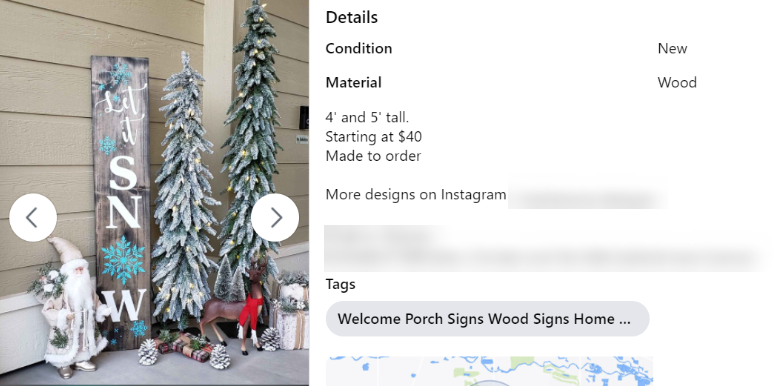
Here’s a girl selling wood signs for your door (I bought a different one and put it with the wood trees I purchased from the example above together on my fireplace for Christmas and it looked AMAZING!)…

If you have a website or something like that, this is a great place to promote yourself as well as she does!

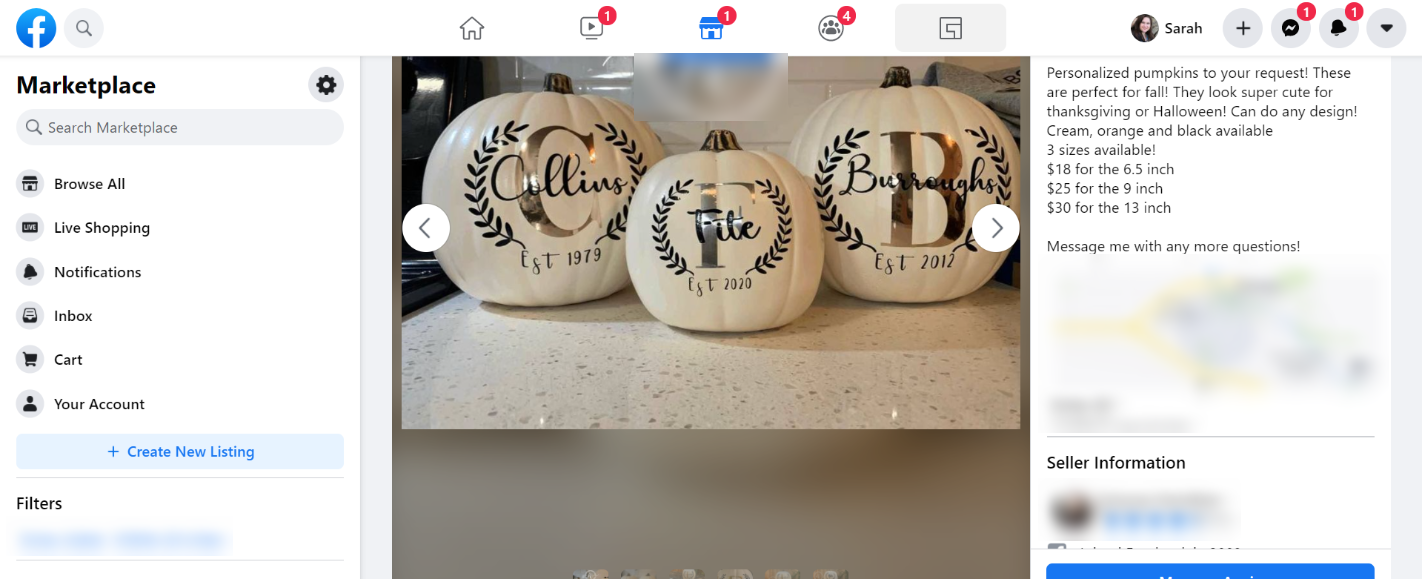
Here’s a girl selling custom pumpkins for Fall…

PumpkinPumpkin

I purchased one and put it on my bookshelf in the Fall and it looked beautiful!

10 Easiest Ways to Earn Extra Income From Home10 Easiest Ways to Earn Extra Income From Home

It’s also a great place to sell things you no longer need, around your house. But research both eBay and Facebook Marketplace because sometimes you’ll get better money for the item on eBay. Always sell it wherever you get more money!

10) Start a Shopify store (my FAVORITE WAY!)

In all my 23+ years making money online now, THIS is my favorite way! Why? Because all I have to do is set up and create the products, give a steady streamline of free printables to my email list that I BUILT much of it WITH those printables (releasing a new binder every month, giving it free to get traction, get reviews, help others in their journey, etc.) then the empire is built and now it’s really great money and I don’t have to work a ton to maintain it.

In fact, my very first month on Shopify, selling printables, I made $52,060. You read that absolutely right! Today, I make $7 million/year in revenue selling printables on Shopify. I have over 150,000 sales and it’s been an amazing ride the past couple years! It’s DEFINITELY a hot business model!

What I love about this, rather than selling physical products, is that I don’t have to chase down deals, drive around looking for stuff. I don’t have to be shipping a ton of orders each day. I don’t have to be doing any of that. They are DIGITAL products and I can make the product once, and then sell it over and over and over again.

It’s a brilliant business model, really, and it’s so little to maintain. Really after you’re done with it is just the weekly emails, which I do anyway for my blog so it’s not any extra work for me, and creating a new product each month to give them. I can make that product as big or as little as I want, depending on my time. Then it’s just about customer service emails and I have an assistant who takes care of those. There’s so little work that goes into it for me now. Maybe that will change over time, but for now, it’s a pretty cushy “job”. 😊

I’m able to sell the products well because *I* created them. I know more about them than anyone. If anyone has any questions, I can answer it. Whereas when you sell other people’s stuff, you don’t know all the answers of the questions they ask and you lose a sale. This is different. I know the answers, because I made it.

Wanna get started? Grab your Shopify Binder here. It’ll teach you exactly how to set up a brand new shop in a way that gets people to hand over their debit card number and get the sale!

BONUS #11) Start a Blog

This is #11, because it cannot be considered an EASY or fast way to make money. There is a lot of time and energy that goes into blogging. However, I CAN tell you that within my first year of blogging, I was making $10k/month income (no joke). It has most definitely changed my family’s life! Not one of the easy income from home opportunities, no, but it sure is a fantastic way to go and as time goes on, will become more and more popular, so best to get in now!!!

If you think that blogging might be the path for you, here are a couple fantastic articles that can help:

Ready to get started? Maybe you already have a blog and wanna scale your business? Check out my Blogging Bundle here.

Earning Extra Cash From Home FAQ

How can I make $100 fast from home?

The fastest way to make money online would be to sell something you have lying around your house. Sell it on Facebook Marketplace or list it on eBay.

How can I earn extra income online safely?

Do your research. Make sure you completely understand something before starting it. Look up reviews online, etc. to see if it’s a reputable company.

What’s the best option if I only have 1–2 hours/day?

Becoming a virtual assistant, writing blog posts for others, or selling things around the house can be great options if you have little time available.

Do I need money to start?

Some companies, like network marketing, will require you purchase a kit (think: essential oils) before you begin selling. If you’re starting a blog, you’ll need to pay for hosting, etc. to get started. Many things you can do don’t require money upfront, though. 😊

What should I do first if I’m overwhelmed?

Do your research, then take a step back and process everything so you can make an educated decision.

What Happens After 10 Years?


premium materials in u.s. homes
Deposit Photos

Premium materials represent a significant investment category in the US housing market, with homeowners spending thousands on upgrades they believe will pay off. From natural stone benchtops and hardwood flooring to aluminium batten cladding and custom architectural finishes, these premium materials in U.S homes are often chosen for their perceived durability, aesthetic appeal, and long-term value  The reality after 10 years, however, often contradicts these expectations. Granite countertops show wear, hardwood floors need refinishing, and yesterday’s luxury features become today’s standard expectations. This article examines what actually happens to premium materials over a decade, exploring physical deterioration, maintenance costs, depreciation patterns, and resale value impacts. Understanding these factors helps homeowners make smarter decisions about when premium upgrades genuinely make financial sense and which materials truly hold their value. 

What Counts as Premium Materials in US Homes

Stone surfaces define the premium tier in the US housing market, with distinct price brackets separating standard from luxury installations. Granite countertops cost $90 to $150 per square foot installed (1), while quartz ranges from $65 to $110 per square foot (1). Marble stands at the top, starting at $125 per square foot and reaching $250 for high-end varieties (1). Carrara marble, a popular choice, runs around $40 per square foot, while Calacatta marble commands up to $180 per square foot (1). A standard 50-square-foot kitchen in marble totals approximately $3,500 including installation (1). Edge designs add another $40 per square foot, and sink cutouts cost around $100 each (1). 

High-end countertops and surfaces 

Quartz delivers moisture and stain resistance through permanent resin sealing, eliminating the need for regular resealing that granite requires (1). Granite provides heat resistance that quartz cannot match, allowing hot pans directly on the surface (1). Marble offers luxury status but requires more maintenance than either alternative (1). Each granite and marble slab carries unique natural variations, making installations one-of-a-kind (1). 

Luxury flooring options 

Engineered hardwood distinguishes itself as one of premium materials in U.S homes from standard options through multiply core construction that provides stability across different environments. W™ Luxury Genuine Hardwood uses 100% real wood with CrystaLux Ultra™ Protection for durability against everyday wear (1). These floors carry limited lifetime structural warranties and work above or below grade (1). Hand-graded planks feature radiant heat approval and slip-resistant properties suitable for residential and commercial applications (1). 

Exotic species bring distinct visual character to premium installations. Brazilian Cherry delivers intense red shades with intricate patterns, while Tigerwood offers deep orange with dynamic graining (1). Brazilian Walnut provides sophisticated dark tones, and Santos Mahogany contributes wine-red coloring known for longevity (1). Acacia combines durability with visual intrigue, and Sapele features refined grain patterns (1). These prefinished engineered options install quickly without the mess of on-site finishing but typically last 20 years rather than a century (1). 

Premium Roofing Materials 

Metal shingles are premium materials in U.S homes that replicate slate or cedar appearance in lightweight aluminum that never rusts. Interlock metal shingles carry 50-plus year lifespans backed by Guardian lifetime limited material warranties (2). They provide 120 MPH wind resistance, Class 4 hail protection, and Class A fire resistance (2). The Alunar finish resists chalking and fading under a 30-year warranty (2). Weight runs just 0.4 pounds per square foot, allowing installation over existing roofs (2).

Cedar roofs last 30 to 50 years when properly maintained (1). Natural resistance to insects and moisture requires periodic sealing and moss removal to maintain performance (1). The material develops an elegant silvery-gray patina over time (1). Slate roofing achieves 75 to over 100 years of service as natural stone (1). Fire resistance and extreme weather tolerance come standard, though impact can cause fragility requiring careful installation (1). 

Custom cabinetry and fixtures 

Handcrafted cabinetry built to exact specifications separates premium materials in U.S homes from standard installations. Custom pieces incorporate specific wood species, finish colors, door styles, and interior accessories tailored to individual requirements (2). Functional enhancements include pull-out shelves, appliance garages, drawer organizers, hidden charging stations, and soft-close hinges (2). Premium cabinetry extends beyond kitchens into bathrooms, home offices, libraries, bars, and media centers (2).

Luxury cabinetry features precise tolerances, premium-grade materials, meticulous joinery, and multi-layered finishing processes requiring weeks to complete (2). Hand-selected veneers, substantial weight, silk-smooth glide mechanisms, and perfect alignment create tangible quality differences (2). Sequence-matched wood grains flow seamlessly across multiple doors and drawers for unified high-end appearance (2).

The Initial Cost Premium: What Homeowners Pay Upfront 

Upgrading from builder-grade to premium materials in U.S homes requires substantial financial commitment that extends beyond material costs alone. Most homeowners spend between $1,851 and $4,453 on kitchen and bath countertops, with the average landing around $3,139 (1). These figures represent complete projects including materials, labor, and associated expenses that many buyers underestimate during planning phases. 

Price differences between standard and premium materials 

The gap between standard and luxury options widens dramatically across material categories. Laminate countertops cost $20 to $50 per square foot installed, while marble ranges from $100 to $250 per square foot (1). Granite sits in the middle at $80 to $200 per square foot installed, and engineered quartz runs $90 to $200 per square foot (1). A point often overlooked: these price differences compound quickly across larger surface areas. 

Luxury home construction reveals even steeper premiums. Standard homes cost $150 to $300 per square foot, while custom luxury builds run $400 to $800 per square foot (2). Ultra-luxury projects climb beyond $800 per square foot (2). Material choices account for much of this disparity, with imported materials, custom cabinetry, and premium finishes costing significantly more than standard options (2). 

Premium materials in U.S homes deliver higher upfront costs but require less frequent replacement. Quality hardwood floors last 30 to 50 years with proper care, while standard flooring needs replacement every 10 to 15 years (3). Builder-grade materials seem cheaper initially but demand more frequent replacements (4). This lifecycle difference offsets some initial cost premiums over extended ownership periods. 

Installation costs and labor premiums 

Professional installation adds $10 to $30 per square foot on top of material prices for countertops (5). Labor costs typically range from $50 to $100 per hour, with complex materials requiring higher rates (1). Standard professional installation adds $300 to $500 to total project costs 1. Removing existing countertops before new installation adds another $200 to $500 to project budgets (1). 

Premium materials in U.S homes demand specialized installation that increases labor expenses. Certain types require specialized treatments before they become safe to use (5). Luxury home builds use more materials that take longer to source and install, with skilled specialists commanding higher labor costs than general contractors (2). Installation complexity creates premiums that match or exceed material cost differences in some cases. 

Regional variations in material pricing 

Geographic location substantially impacts material and labor costs. Northern Virginia countertop costs run higher than the national average, typical for that market (1). Building in dense metro areas means higher labor costs, stricter building permits, and more expensive land (2). Regional cost pressures play a major role in pricing variations (6). 

Material cost volatility affects regional markets differently. Lumber, steel pipe, and aluminum saw double-digit decreases over 12 months, yet concrete, glass, gypsum, and insulation experienced double-digit increases during the same period (6). Direct material costs of premium materials in U.S homes make up a significant portion of overall expenses, so even moderate increases significantly inflate project budgets (3). Trade policies on imported materials needlessly push up housing costs in certain regions (3).

What Happens to Premium Materials after 10 Years 

A decade of daily use reveals performance patterns that contradict many homeowner assumptions about premium materials. The wear timeline varies dramatically based on material composition, maintenance habits, and environmental exposure. 

Physical condition and wear patterns 

Quartz countertops are premium materials in U.S homes that look nearly identical to installation day after 10 years in most households (4). The non-porous engineered surface doesn’t oxidize, fade, or develop patina (4). Extreme heat creates the only visible damage, with resin scorch or discoloration appearing where homeowners place boiling pots directly on surfaces for years (4).

Granite maintains excellent condition through the decade as long as homeowners follow basic sealing schedules (4). The crystalline depth doesn’t dull over time, and the volcanic rock resists scratches that would cover laminate or wood surfaces with nicks (4). Quartzite delivers similar performance, maintaining sharp edges and luminous surfaces after 10 years while resisting the chemical etching that damages softer stones (4).

Marble follows a different trajectory. Etching occurs when acids from lemon juice, vinegar, or tomato sauce dull the polished surface (4). By year 10, heavily used marble resembles a kitchen in a historic European villa, with visible character marks replacing the mirror-like shine (4). Soapstone develops a deep, rich patina through daily use, with small nicks and darkened areas creating an antique appearance (4).

Hardwood floors show surface wear in high-traffic areas through scratches, scuffs, and dullness. Light scratches require refinishing every 7 to 10 years to restore natural sheen (2). Deep scratches exposing fresh wood indicate worn protective finish requiring professional intervention (2). 

Maintenance requirements over the decade 

Granite needs annual sealing tests, with resealing required when water droplets darken or absorb quickly into the surface (3). Professional inspections every one to two years include deep cleaning, minor polishing, and structural integrity checks (3). Outdoor granite requires more frequent resealing every 6 to 12 months due to elemental exposure (3). 

Hardwood maintenance follows a specific schedule when it comes to premium materials in U.S homes. Screen and recoat services every 3 to 5 years cost $2.00 to $4.00 per square foot (7). Full refinishing every 10 to 15 years runs $4.00 to $8.00 per square foot (7). A 1,000 square foot home averages $4,000 to $8,000 for complete refinishing (7).

Actual vs expected lifespan 

Granite countertops last 25 years or more with proper care, often outlasting the kitchens they occupy (3). Quartz achieves 15 to 25 year lifespans (3). Marble reaches 20 years or more when maintained properly, though its softer, more porous composition makes it susceptible to scratches and etching (3). 

Solid hardwood floors exceed 100 years with refinishing 6. Refinishing costs $6,000 every 15 years totals $24,000 over 60 years (7). 

Market perception shifts 

Materials designed for visual perfection at handover reveal stress within a few seasons when optimized for immediate impact rather than long-term behavior (8). Homes aging gracefully incorporate maintenance planning during design, allowing care to extend life rather than delay failure (8).

The Depreciation Reality: Resale Value Impact 

Appraisers assign obsolescence factors to aging structures, recognizing that properties lose value over time regardless of initial material quality (9). New homes built within the last 10 to 20 years receive higher appraisals because they present lower risk to buyers (9). Premium materials in U.S homes installed a decade ago face scrutiny around trend relevance rather than receiving automatic value credit. 

How appraisers view aged premium materials 

Timeless home designs maintain long-term value, while trendy decor and finishes face appraisal penalties when styles shift (9). Homes last updated in the 70s with period-specific finishes appraise lower because they don’t appeal to all buyers (9). In effect, appraisers evaluate whether premium materials remain current or signal needed updates. 

Comparative market analysis examines properties sharing lot sizes, square footage, bedroom counts, and bathroom configurations (5). Age and condition rank among key factors, alongside improvements made over the years and special features (5). Stone countertops factor into these assessments, with neutral tones and subtle veining appealing to broader buyer pools (1). 

Buyer preferences for vintage vs new premium features 

The 2026 buyer overwhelmingly prefers fully remodeled, move-in-ready homes (10). With stabilized interest rates, buyers have less renovation cash after down payments and want monthly mortgages covering finished products (10). Outdated homes sell primarily to investors or bargain hunters demanding price reductions exceeding actual update costs (10).

Vintage style shows signs of comeback potential, with dark wood cabinets, stained glass windows, wallpaper, and decorative bathroom tiles generating renewed interest (11). Heritage and Victorian homes in Toronto neighborhoods like Cabbagetown consistently sell for top dollar (12). Authenticity, materials, and craftsmanship never go out of style, with buyers realizing older homes were built to endure (12).

Style and trend obsolescence factors 

High-quality upgrades from real hardwood to stone counters pay back through daily durability and resale value (12). Granite countertops lower buyer resistance by signaling kitchens won’t need immediate work (1). Poor material choices undermine value when style or color doesn’t fit the home’s overall look (1). 

Comparative market analysis data 

Stone countertops significantly influence property value as focal points in kitchens and bathrooms (13). High-quality countertops enhance esthetics and functionality, attracting prospective buyers and potentially increasing selling prices (13). Stained, dated, or poor-appearing countertops deter sales, creating expensive warning marks that accumulate in buyer minds (13). 

Making Smart Material Choices for Long-term Value 

Natural stone countertops deliver the strongest long-term value retention in the US housing market when it comes to premium materials in U.S homes. Quartzite, high-quality granite, and honed marble age with character while surviving family use (14). These materials photograph well for resale and remain consistently desirable across market cycles (14). Correspondingly, hardwood flooring maintains appeal through multiple refinishing cycles, with wide-plank varieties avoiding trend obsolescence (14). Custom cabinetry with dovetail drawers, soft-close hardware, and handcrafted woodwork outperforms prefab installations for decades (14).

Materials that hold value best 

High-performance windows reduce utility costs while improving home refinement (14). Premium fixtures in solid brass and architectural lighting elevate daily tactile quality without calling attention to themselves (14). Metal roofing lasts 40 to 70 years 8, while fiber cement siding resists rot and fire with minimal maintenance 8. These durable exteriors prevent the frequent repairs that erode budgets over 20 to 30 years (15). 

When premium upgrades make financial sense 

Kitchen and bathroom remodels rank among the best property investments when markets favor sellers (16). Traditional choices deliver results: all-wood cabinets, stone countertops, and natural flooring appeal to broad buyer pools 16. Energy-efficient systems lower operational costs while modern smart home technology improves functionality (17). Buildings constructed with durable materials attract higher offers because buyers recognize reduced repair expenses (18). Therefore, premium upgrades make financial sense primarily in homes you’ll occupy long enough to recoup costs through lower maintenance and energy savings. 

Maintenance strategies to preserve value 

Regular inspections of premium materials in U.S homes identify potential issues before they become expensive failures (3). Proactive maintenance extends equipment lifespan and reduces unplanned downtime (3). Properties with documented maintenance histories retain higher resale value because buyers see evidence of proper care (3). In particular, addressing worn components early prevents cascade failures that multiply repair costs (3). Prioritizing craftsmanship over novelty and choosing materials with proven longevity creates homes that age gracefully rather than requiring constant intervention (14). 

Conclusion 

Premium materials represent substantial investments that behave differently than most homeowners expect after a decade. Quartz and quartzite maintain their appearance with minimal effort, while marble and hardwood develop character requiring acceptance of natural aging. On the other hand, resale value depends less on premium status and more on timeless appeal and documented maintenance. 

Smart buyers choose materials proven to last rather than chasing trends. Stone countertops, quality hardwood, and durable exteriors deliver returns through reduced replacement cycles and broader market appeal. Regular maintenance preserves both function and value, making the premium investment worthwhile for long-term homeowners who plan accordingly. 

References 

[1] – https://topscountertops.com/granite-countertops-and-resale-value-is-it-worth-it/

[2] – https://www.traditionalhardwoodfloors.com/how-to-know-when-hardwood-floors-need-refinishing-or-replacemen

[3] – https://rmhoist.com/about-us/blog/preserving-value-how-maintenance-impacts-lifetime-value

[4] – https://www.eastcoastsurfaces.us/blog/the-10-year-countertop-test-which-materials-still-look-good-a-decade-later

[5] – https://www.bankrate.com/mortgages/comparative-market-analysis/

[6] – https://www.garrisoncollection.com/blog/how-long-do-hardwood-floors-last

[7] – https://www.advantagefloor.com/blog/articles/how-long-should-hardwood-floors-last-heres-the-truth-about-lifespan-and-refinishing-costs

[8] – https://www.home-cost.com/affordable-building-materials-that-can-save-you-money/

[9] – https://blog.bhhsmichiganrealestate.com/13-factors-that-determine-your-home-appraisal-value/

[10] – https://www.fastexpert.com/advice/do-buyers-prefer-a-fully-remodeled-home-or-an-outdated-10155/

[11] – https://hilltoprealestate.com/blog/the-evolution-of-homebuyer-preferences-whats-trending-in-2025

[12] – https://realestateundertheradar.ca/planned-obsolescence-real-estate/

[13] – https://www.silverbostone.com/blog/the-impact-of-stone-countertops-on-home-resale-value/

[14] – https://burghomesllc.com/luxury-finishes-worth-the-investment/

[15] – https://www.troyconst.com/blog/best-building-materials-for-homes-a-practical-comparison

[16] – https://www.hgtv.com/lifestyle/clean-and-organize/which-home-improvements-pay-off

[17] – https://cohenwhiteassoc.com/key-factors-luxury-home-investment/

[18] – https://cmsmaterialsolutions.com/blogs/news/how-material-selection-affects-building-longevity-and-maintenance 

Find a Home-Based Business to Start-Up >>> Hundreds of Business Listings.