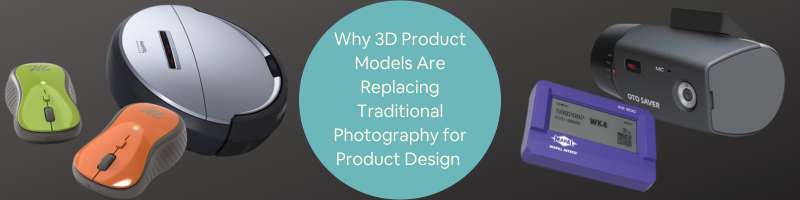
Why are 3D product models replacing traditional photography for product design companies? There was a time when the launch of a new product meant bringing in the whole crew: photographers, lighting experts, models, stylists, and even a studio cat who liked to nap in the lightbox. Each button, bottle, and bracelet needed to be photographed from every angle, then touched up and re-shot if someone sneezed near the set. It was a glamorous mess that often siphoned both time and budget.
Why 3D product models as opposed to traditional photography?
Today, product design firms quietly ditch the cameras and tripods for something far more precise, flexible, and futuristic: 3D product modeling. Instead of fighting with reflections, props, and post-production headaches, today’s brands turn to digital artists who can compose photorealistic product visuals with little more than special software and a keen eye for detail. Results? Absolutely stunning at times, such that even seasoned designers stop and squint, trying to tell whether they’re looking at a render or a photograph.
And finding those experts to make that magic happen isn’t tough either. Cad Crowd connects businesses with professional freelancers in 3D modeling services to create products in vivid digital designs of jewelry and electronics, to furniture and fashion accessories. A ready global pool of talented freelancers is just waiting for the opportunity to create models that will raise eyebrows even among the most ardent photographers. But how did we get here? Why are product design companies choosing 3D renders over traditional photography? What’s so irresistible about the digital shift that even old-school creatives have decided to take the leap? Let us dive in.
RELATED: Pros and Cons of Hiring a Freelance 3D Modeler
From cameras to code
Traditional product photography has always had a certain artistic flair to it. It’s difficult to deny the beauty in real-world lighting, textures, and the overall tactile sense that comes with capturing something tangible. The process that goes behind it, however, is not quite so romantic.
Think of what it takes to get just one great product photo:
- Creating or renting a suitable studio setup.
- Camera and lens hire and sale; lighting.
- Constant adjustments of light to avoid reflections.
- Coordinate with photographers, stylists, and retouchers.
- Extensive image editing to make every shot perfect.
Now, do that whole process for each color, size, or packaging-style variation of that same product. The costs multiply faster than you can say “retouching fee.” 3D modeling designers flips that process on its head. Instead of capturing light bouncing off of a real object, artists build the product inside a computer. And when that digital version exists, it can be rotated, retextured, resized, and lit in infinite ways. No new photo shoot. No rescheduling. No misplaced USB drives full of RAW files.
What makes this powerful to product design companies is the level of control involved: traditional photography gets you what the camera sees; 3D product models get you what your imagination wants. Every angle, every shadow, every shine can be precisely tuned. It is like going from marble sculpture to pixel editing-no marble dust, chipped edges, or angry clients asking for a new photo shoot because the lighting looks too moody.
RELATED: How to Balance Product Manufacturing Cost and Product Features for Profitability
Unlimited creative flexibility
But one major reason 3D product modeling services is taking over in product photography is quite simple: it removes limitations. In the studio, there are practical boundaries: there is gravity, light bounces in very inconvenient ways, and glass reflects everything, including the elbow of the photographer. With 3D product models, goodbye to all that.
- Want to make your new smartwatch air-levitate in midair with elegance? Easy.
- Want the latest sneaker with lightning bolts and smoke around it? Done.
- Want a jewelry collection on the surface of the moon for a campaign? Sure thing-no rocket fuel needed.
Nothing provides quite as much creative freedom as 3D modeling. Companies can visualize products in environments that, logistically, are impossible or just financially insane to shoot in real life. In lieu of renting a tropical island to photograph a bottle of sunscreen, a 3D artist can recreate one down to the last palm leaf. This really helps in the case of concept products that are not even manufactured yet.
Product design companies create prototypes, showcase upcoming launches, and use totally realistic 3D renders. This gives a head start to the marketing team in rolling out campaigns when the actual product is not available, hence saving time and creating a buzz much in advance.
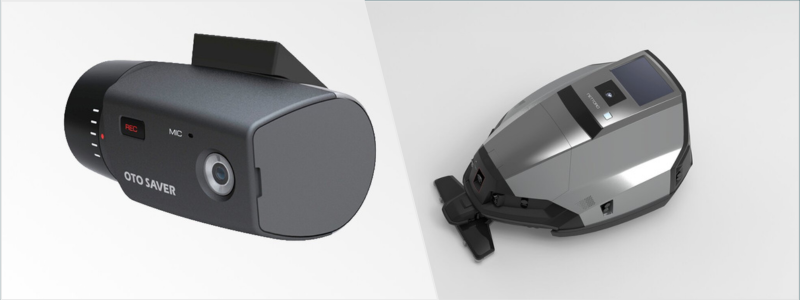
That is where platforms like Cad Crowd step in: many of the freelance 3D designers there have industrial design and engineering backgrounds, so they can make the product look good while also knowing how to make it accurate. This makes a big difference in cases when a company needs visuals reflecting true dimensions and materials, rather than pure artistic imagination. That would involve hiring a freelancer to render a diamond ring, complete with correct stone cuts, metal finishes, and lighting reflections, by a jewelry designer. The output would be similar to that in a luxury photo shoot with no diamond under the camera lens.
RELATED: The Importance of Iteration in Product Development & Working with Product Design Companies
Quicker production with lower costs
Anyone who has ever managed a photo shoot knows how quickly the costs mount up: studio rentals, photographer fees, catering, transportation, props, and retouching add up to a small mountain of bills. And that’s before anybody decides the product should be reshot with “softer lighting” or “more energy.” With the help of 3D modelers, nearly all of these types of costs are sidestepped. Once 3D product models are created, companies can reuse it endlessly: change the background, update the packaging, or show seasonal variants without a single new shoot.
Want a Christmas version of your product? Slap some digital snowflakes on it. Want to make a summer edition? Use a different color palette, refresh the textures, and adjust the lighting to make it feel like a sunny beach: A 3D model is cheaper than a professional photo session, especially when the reusability aspect is factored in. The output can be repurposed further for marketing campaigns, listing on e-commerce websites, investor presentations, and even AR applications and VR showrooms.
That level of efficiency has made 3D rendering services particularly popular with startups and small brands that want high-quality visuals without breaking the bank. Even with smaller budgets, they can be just as visually competitive as much bigger companies. Again, websites like Cad Crowd make this possible: businesses are directly connected with skilled freelancers who can work within whatever a particular budget is. Whether it be a hyper-realistic render of jewelry or just a simple mockup for a prototype, you can find someone to fit your style and budget.
RELATED: How to Use 3D Product Modeling and 3D Product Photography for Company Advertising
Realism in competition with reality
For a long time, 3D renders carried some kind of stigma with them: they looked “too digital.” The surfaces looked plastic, the shadows too sharp, and the reflections felt fake. Any person who saw one could tell straightaway that it was computer-generated. Advanced rendering technologies erase the line from real to digital, enabling today’s 3D renderers to simulate with uncanny precision how light will interact with every surface, from brushed aluminum to velvet fabric. This is made possible through a series of advanced, physically based rendering techniques that calculate how materials would really act in the real world under given conditions of lighting.
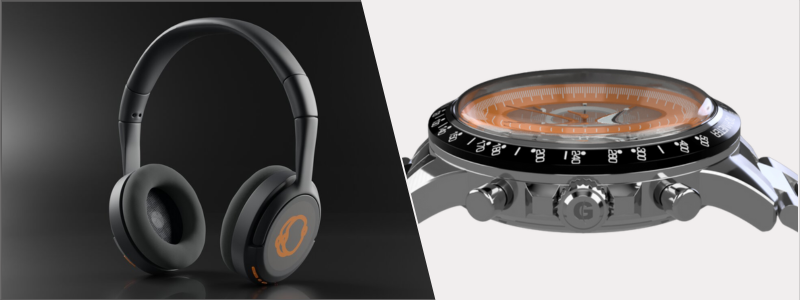
The results are 3D product models that don’t lie, not even to the most persnickety of eyes. That bottle of perfume gleaming under soft studio lights? It may never have existed in the physical world. That watch, with its faint glint of sunlight reflecting off its metal case? Completely virtual. These days, even droplets of condensation on a can of soda can be rendered so lifelike that you might instinctively reach for a napkin. That realism is revolutionary in product design firms in that one does not have to wait for prototypes to be made before starting to market the products. Materially real visuals can be presented anytime during their development and be showcased to investors, clients, and customers.
If perfection is the goal, well, it is achievable with 3D product design experts. A photographer can shoot only what is there to be shot, blemishes and all. A 3D artist has the capability to make perfect symmetry, ideal lighting, and even adjust the angle of reflection on a gemstone until it looks like magic. This is the level of detail at which freelancers on Cad Crowd really shine. Many use industry-standard enhancement software like Blender, KeyShot, or SolidWorks to take visuals to a level that often leaves clients wondering if they are looking at photographs.
RELATED: Product-Centric vs. Customer-Centric: Which Is Best for Consumer Product Design Companies?
Scalability for every product line
Now, try to imagine having to deal with a brand producing dozens or hundreds of different products in just one year. Shooting each one individually is a logistical nightmare: scheduling, lighting, editing, and storing all those thousands of high-resolution images will sap the energy of your team-and yours. Because 3D product models are infinitely scalable, once a product has been modeled by the product rendering designer, its variations need only a few clicks to be complete. Want that handbag in a dozen colors? Swap out the texture maps. Want the bottle design with three different cap styles? Swap them digitally.
This scalability is especially useful for e-commerce brands-online shoppers want to see all the options before making a purchase: color variant, material finish, packaging style-you name it. Physically shooting all those variations would take weeks; digitally rendering them takes hours, sometimes minutes. Better still, once the digital assets exist, they can be used across numerous channels: the same 3D model that appears on a website can feature in social media videos, virtual catalogs, or even in augmented reality shopping apps where customers can virtually “try” out products.
Brands like IKEA, Nike, and Apple have already made this shift. The reason they use a 3D CAD modeling professional is that the result is consistency across the world, not because it saves time. Each product is exactly the same, irrespective of the language or region. Indeed, for product design companies that have been taking the lead in this direction, 3D modeling has been found to be not only quicker in yielding results but also more reliable at keeping the standards of aesthetics. Besides, through freelance sites such as Cad Crowd, it’s easy to scale up by bringing in a number of artists who work within the same specifications and style guidelines.
RELATED: Why Product Design Services Use Photorealistic Rendering for Marketing New Products
Sustainability: a digital green revolution
For all its charm, photography is not an especially eco-friendly profession. Photo shoots require transportation and electricity, sets are made of material, and disposable props-and often a fair amount of waste. Even simple things, like product packaging design services for a shoot-boxes, bottles, display stands-can sometimes add up to a surprising environmental footprint. Meanwhile, the 3D modeling of a product is neat and green, with props on the computer, no printing of backdrops, no packaging wasted, and no carbon emissions from hauling equipment across cities.
Moving into 3D modeling is an easy way for brands, most of which today are focused on sustainability, to lessen the ecological footprint of their work without sacrificing quality visuals in their communications. It really fits in with the eco-conscious image many consumers expect from modern brands. This is more than a marketing angle; this is full-on evolution as to how creative production is taking place. An entire catalog of imagery, which once required a crew, studio, and truckload of props, can now be designed by one artist at a desk.
Even revision is greener. Rather than reshooting a product for no other reason than its package has changed, even to the slightest degree, a company can update a digital file in just minutes. Less waste. More flexibility. Better for everyone. Most of the 3D CAD freelancers, like Cad Crowd, work remotely. That means a global network of artists further streamlines the creative pipeline by reducing unnecessary travel and overhead, contributing to its efficiency and sustainability.
RELATED: How Successful Companies Utilize 3D Product Modeling Services for Compelling Product Imagery
Ideal for marketing and pre-launch campaigns
Timing means everything in marketing, and very often the firm needs visuals well in advance of when such a product exists. This is impossible with photography without a prototype, but it’s a standard practice within 3D modeling. Product design firms create anticipation via 3-D renders many months in advance. This means high-quality images and videos can circulate through all digital ads, websites, and social platforms long in advance of any actual date of manufacture, and customers talk about and may even desire something that technically doesn’t exist.
The same is true with crowdfunding. In the case of crowdfunding campaigns, it was mostly impossible to afford physical prototypes, let alone full photo shoots. They went live on Kickstarter or Indiegogo with detailed 3D renders showing what their future product would look like. Many times, those visuals make all the difference between getting ignored and reaching full funding. It doesn’t hurt that 3D renders can be animated with the help of 3D animation designers. Rather than static photos, dynamic visuals can show rotating views, exploded component animations, or lifestyle scenes-all digital in their creation.
It really lets the consumer understand the features of the product way better than any photo could. Let’s be upfront: today, digital runs on visuals that can stop scrolling in a second. It is about scroll-stopping content, period. And for that, no conventional photo can ever compete with a photorealistically rendered 3D view of a sparkling perfume bottle or a luxury ring, simply because it offers creative control over composition, lighting, and mood. Now, most brands use a mix of 3D assets and photography; both are utilized in one campaign, the difference being that the 3D renders will do much of the heavy lifting, while, sparingly, photography is used for lifestyle shots.
RELATED: Sustainable Product Design and Product Development Principles for Firms to Consider
This hybrid approach gives flexibility without sacrifice in quality. This is a marketing advantage that freelancers from Cad Crowd understand full well, as they design models with promotional materials, social ads, and product launch visuals in mind. It’s in the blending of technical skill and creative direction where they are really so valued in the work of a product design team in need of speed and artistry.
Boundaryless collaboration
Another reason product design and development firms are embracing 3D modeling is that collaboration has gotten so much easier. Traditional photography requires everyone to be in the same place at the same time. Trying to coordinate the schedules of designers, photographers, and marketing teams for days of travel and shooting can quickly turn into one big logistical headache. 3D modeling removes this obstacle altogether. A designer based in London collaborates perfectly with a 3D artist operating from Milan, while the marketing manager based in Manchester sees the result in real time. Files can be transmitted immediately, and feedback loops can be significantly reduced; changes become much faster.
Due to the fact that the entire creative process has taken place in the digital space, projects don’t slow down. This means firms can establish a long-term relationship with trusted freelance professionals. In the case of product modeling, updates for the same model can be assigned to the same artist when there are new releases, adjustments in packaging, or seasonal collections. Continuity like this will ensure that there is consistency and professionalism in the visual branding. Most firms find their go-to freelancers at Cad Crowd, where they can set milestones and collaborate directly to ensure creative control from start to finish.
RELATED: Differences Between 3D Rendering and 3D Visualization Services
The future of product visualization
It can safely be said that 3D modeling is no longer the future but is, in fact, the present. As virtual and augmented reality, together with AI-powered rendering, continue to develop, so does the future of product visualization. But soon, thanks to augmented reality apps, customers will be able to do more on a website than just see 3-D models-they’ll rotate them, test colors, and visualize them inside their homes.
The same artists and photorealistic rendering designers doing today’s photorealistic renders are laying the groundwork for that future. It is this investment in 3D modeling that keeps these product design companies ahead of the game. This does not replace photography but is a redefinition of how products will be designed, marketed, and experienced.
Conclusion
Although classic product photography may have some sort of nostalgic value to it, 3D modeling has surely taken over in the case of modern product design companies. It ensures precision, flexibility, and creative control impossible with any camera. Digital models let businesses experiment freely, from concept to launch, in ways that save on costs while showcasing their products in stellar detail well before their actual manufacture.
If your company is ready to make that leap into the future of product visualization services, Cad Crowd is the avenue through which to take it. Cad Crowd provides a rock-solid platform that connects businesses with highly qualified freelancers in the 3D product models, rendering, and visualization field. Find expert talent to help bring your ideas to life with everything from hyper-realistic prototypes to fully cataloged collections of digital assets. Consider Cad Crowd today and discover how the right 3D expert can transform how your brand conceptualizes, markets, and shines online. Get a quote today.