Commercial 3D Rendering Rates for Buildings, Services Costs, and Pricing for Architectural Firms


Let’s set one thing straight: there isn’t any difference in the process and production of commercial and residential architectural services in the sense that both aim to create a photorealistic visualization of a building, including its interior, exterior, and the surrounding environment. The only distinction between the two is the object to be rendered. Commercial rendering deals with non-residential buildings like office centers, shopping malls, universities, restaurants, hotels, airports, sports stadiums, industrial facilities, etc.

Cad Crowd is an industry leader in providing outsourced 3D rendering services for architectural and engineering companies. This article will explore 3D rendering for commercial spaces and its associated costs.


🚀 Table of contents


Rates for commercial 3D rendering

The following rates apply to 3D rendering services for commercial buildings in various project scenarios and pricing structures.

Pricing per image
Rendering scenario Provider
Freelancers Small to mid-sized businesses Large design firms
Exterior $550 – $2500 $1100 – $3500 $2500 – $5500
Interior $750 – $3000 $1500 – $5000 $3000 – $10000
Exterior and interior $1500 – $5000 $3000 – $10000 $8000 – $30000

Note: there isn’t a clear-cut price range for every service because it all depends on the project’s specific details and the experience level of the render artist or firm handling the task. An experienced freelancer with a reputable portfolio may charge higher than a mid-sized design firm for the same rendering work.

3D rendering service rates per hour
Experience levels (in Years) Provider
Freelancers Small to mid-sized businesses Large design firms
0 – 4 $30 – $60 $50 – $80 $70 – $110
5 – 10 $50 – $80 $60 – $120 $90 – $140
10 or more $110 – $140 $130 – $180 $160 – $225

Note: to ensure good quality, an entry-level render artist should be tasked only with simple work such as exterior silo rendering where the building is placed against a plain background. Senior render artists can handle and manage complex projects that require advanced techniques, extensive details, and artistic touches. 

3D Rendering Service Rates Per Square Foot
Rendering complexity Provider
Freelancers Small to mid-sized businesses Large design firms
Basic $1.50 – $3.50 $3.50 – $6.50 $7.00 – $10.00
Advanced $2.50 – $6.50 $5.00 – $8.50 $9.00 – $12.50
Complex $5.50 – $8.50 $7.50 – $13.00 $12.00 – $20.00

Note: the pricing structure is best when you only have to render a small area to save cost. Consider the number of details you expect as well because the final price might come as a surprise unless you know exactly the amount of work involved in getting the render done.

We’re talking only about static rendering here with Full HD (1920x1080p) resolution at a 16:9 ratio as the minimum viable option for online use. 2K is becoming the new standard, and anything higher than 4K can be an overkill for most purposes. Let’s not forget that a 4K visualization requires at least twice as much as Full HD rendering professionals.

For print purposes, 300 DPI should be more than acceptable for magazines, brochures, and newspaper pages. In the case of billboards, due to the sheer size of the canvas and long viewing distance, you can afford to go lower than 150 DPI without losing quality.

What affects the cost of commercial 3D rendering

While a universally agreed-upon formula to determine the cost of commercial 3D rendering services doesn’t exist, there are several factors that directly correlate with how companies calculate their prices.
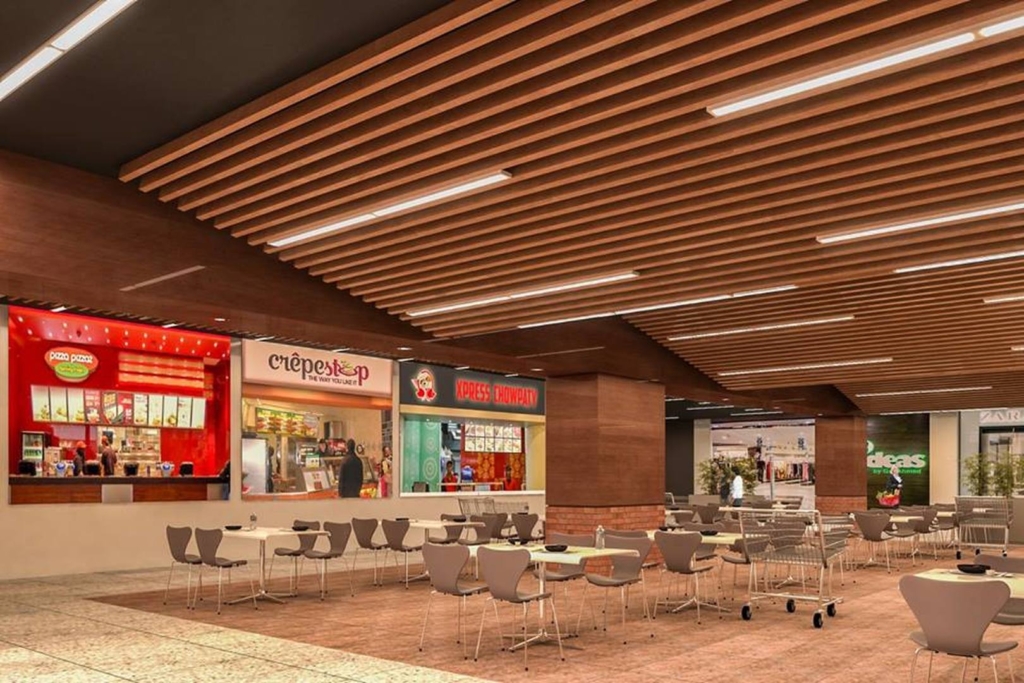
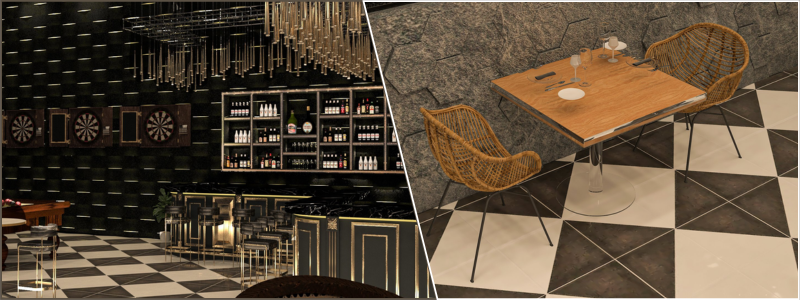
food hall interior 3d visualization

Project scenarios

Architectural 3D rendering comes in three major types: exterior, interior, and both of them. The main differences among them mainly concern size, level of detail, and number of visible objects in the frame. As far as commercial buildings are concerned, exterior rendering is likely the most affordable and the most common of the three. An exterior rendering often features a variety of environmental elements in addition to the building’s exterior itself, but the process doesn’t actually take as much level of creativity as interior visualization does.

A render artist can only do so much to generate realistic colors for the clouds, unique shapes for the trees, imagery of the moon, hues of water, piles of snow, and so on. However, the artist can be playful with the composition. Some might say imagination is the limit, although this is actually counterproductive because architectural rendering aims to resemble reality as closely as possible.

On the other hand, expert interior rendering can be as complex as it can get thanks to the limitless options for furniture design, room layout, types of light sources (natural or artificial) and placement, wall colors, flooring, and tiny yet important details like crown molding, upholstery textures, and all sorts of decorative pieces. Most (if not all) of those objects, especially when built as custom products, require a lot more modeling work compared to natural objects.

Complexity

A 3D rendering page of a typical house living room is, of course, much less complex than that of a business center lobby. In fact, the former often only includes the interior part of the building, whereas the latter usually showcases the view of the outside area as well; this is to indicate that the building is open to public access, so it needs to show people walking on the sidewalks nearby, street signs, parked cars, and sometimes a glance at adjacent buildings too. The same thing applies to cooking stations at a restaurant, which are almost always more complex than a typical home kitchen.

Complexity refers not only to the number of objects visible in the frame but also to the camera positioning or viewing angle of the image. For aerial rendering services, an aerial shot (or a zoomed-out view) has more visible objects, albeit smaller, in the frame than an eye-level angle, so it’s more expensive. A close-up view doesn’t cover a lot of objects, but it might be used to highlight specific details to serve as focal points, such as a fountain, a statue, an entrance, or unique architectural styles. Sometimes, an eye-level exterior rendering omits the background objects entirely, so the image is presented on a blank page to avoid distraction. It’s not realistic, but it allows viewers to focus solely on the building.

Modern CGI technology also offers interactive 3D rendering, where you can rotate the image to see the building at eye level from various angles. Interactive rendering like this cannot be printed on paper and is only usable as a digital file or a webpage element.
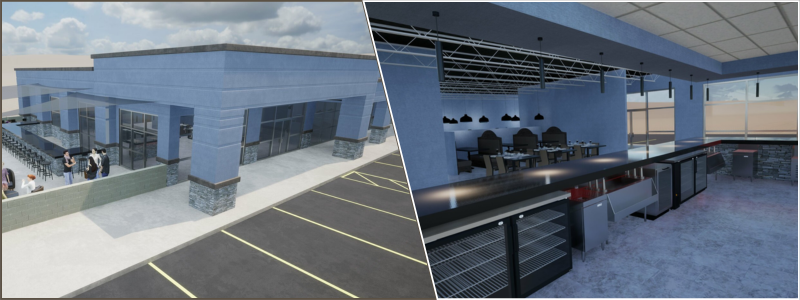
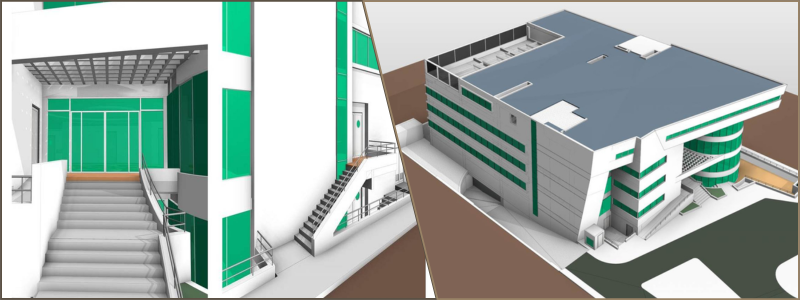
commercial building interior and exterior rendering

Level of details

Let’s take the exterior renderings of a skyscraper and a football stadium as examples. A lot of skyscrapers use a combination of concrete and glass to build the external walls; there might be some variations in terms of geometric shape, main entrances on the floor level, several decorative touches (such as gargoyles), and unique structures at the top. Most skyscrapers are rectangular, although there are some notable oddly-shaped buildings as well. An exterior rendering from an architectural design firm of a skyscraper doesn’t usually offer detailed imagery due to the monumental size of the building – you need to position the viewing angle at quite a distance from the object to see it as a whole in one frame.

You can probably say the same thing about large stadiums, but they’re admittedly more playful when it comes to architectural style. Unlike the typical rendering of a skyscraper that barely shows anything about the interior, photorealistic imagery of a football stadium cannot afford to omit details like the pitch, the stands, the lighting, and the skyboxes. And if it’s an open-roof stadium, it’s just impossible to exclude those elements.

A skyscraper is most likely pictured as a vertically imposing structure with columns and rows of window glass in the walls, whereas a football stadium has a much larger variety of objects, each with its own tiny details to highlight. Due to the differences in the expected level of detail, you can expect to spend more on the latter.

Page count

Every page is for one rendering only. A commercial building is a massive undertaking, both in planning and the actual construction work. A single rendering page simply won’t be enough to capture all the details you want to showcase. Having only one exterior rendering might be enough, but you need page after page of rendering to visualize the interior. Even if the commercial building is a mostly empty warehouse, chances are you want to highlight the flooring, the roof structure, the massive industrial-grade door, etc.

Some render artists offer one revision free of charge as long as the revised portion doesn’t exceed a specific percentage of the original work. For instance, free revision is only available when the modification amounts to no more than 10% of the submitted document; anything more will count as a new page and an additional fee.

Timeframe

The actual rendering time of an architectural visualization service doesn’t take that long, thanks to modern cloud-based rendering farms. But the early steps of drafting, modeling, and lighting setups might take a few days for a commercial rendering – and that’s assuming the project is handled by a relatively large design firm with multiple artists working on the same visualization. A one-person operation will need more time to finish the same job. Let’s not forget that the image still needs a few post-processing touches after the rendering is complete. Like all services, companies usually offer standard pricing for non-expedited projects and premium rates for rush jobs.

Commercial 3D rendering with Cad Crowd

All sorts of rendering tasks fall under the CAD (computer-aided design) category. It doesn’t matter if you need exterior or interior renderings (or both of them) in a project, Cad Crowd is an industry-leading service that helps you get in touch with some of the world’s most qualified professionals for commercial 3D rendering jobs. Every single one of our render artists has been properly vetted to the highest standard to ensure quality and value for money.

Reach out to Cad Crowd any day of the week now for your free quote, and have your commercial 3D rendering projects done by the experts in the most efficient way possible.

author avatar

MacKenzie Brown is the founder and CEO of Cad Crowd. With over 18 years of experience in launching and scaling platforms specializing in CAD services, product design, manufacturing, hardware, and software development, MacKenzie is a recognized authority in the engineering industry. Under his leadership, Cad Crowd serves esteemed clients like NASA, JPL, the U.S. Navy, and Fortune 500 companies, empowering innovators with access to high-quality design and engineering talent.

Connect with me: LinkedInXCad Crowd

Create Gorgeous 3D Restaurant Renderings When You Hire a 3D Design Services Company


Today’s post discusses the ability to create gorgeous 3D restaurant renderings when you hire a 3D design services company. Cad Crowd is a leading provider in outsourcing 3D renderings and services for the best architectural, design, and engineering firms. We’re here to explore how you can maximize 3D restaurant renderings.

It’s already common knowledge that the world has been on an endless cycle of change. What do all these changes mean to a restaurant owner? It merely implies that they, too, need to cope with the changes if they hope to rise to the top.

Restaurants are all expected to have a smooth flow to give customers the most positive experience. A seamless design also guarantees that staff members will be more effective in carrying out their day-to-day tasks and responsibilities.

A surfeit of factors taking place all at the same time allows a restaurant to operate smoothly like well-oiled hinges. Try imagining this: the chefs are busy cooking in a corner, the waiters are passing through the aisles with their hands full of trays to serve dishes, while the diners are seated at their respective tables. For example, you might have to find 3D furniture rendering services to help you make strategic decisions about furnishings.

With all of the hullaballoo occurring, it only makes sense that a restaurant should be in organized and tiptop condition to give both customers and staff members their much-needed space and elbow room.

3D restaurant visualization has a single important purpose, and that is to organize the entire space to ensure that everyone in there is well-accommodated. These models help come up with a carefully planned and complete restaurant model that can be presented to clients.

Thanks to these images, you can pinpoint problems early on and address any possible issues for the restaurant concept to be polished out through and through. A 3D restaurant render will let you envision the whole space, anticipate any areas that may have room for improvement, and get some solutions in line for them.

RELATED: 3D commercial rendering: Effective retail design layouts for your company


🚀 Table of contents


3D restaurant renderings at a glance

3D restaurant visualization involves the use of state-of-the-art motion graphics to create digital depictions of interiors. The renders are detailed displays of every aspect and element of the design. These include the layout, the textures, the lighting, and even the furniture. The primary goal is to come up with a lifelike image to allow stakeholders to envision the result before the start of the actual physical work.

3D renders for restaurants have changed the presentation procedure for design concepts to offer perks that old-school sketches and blueprints can never offer. The ability to view a photorealistic image of a product prior to its completion makes way for an improved planning process, adjustments to the design as needed, and a more visually enticing and cohesive space.

In the dog-eat-dog world of restaurants, 3D modeling design services can change your plans and marketing efforts in the most dramatic ways thanks to the improved visual appeal and ambiance.

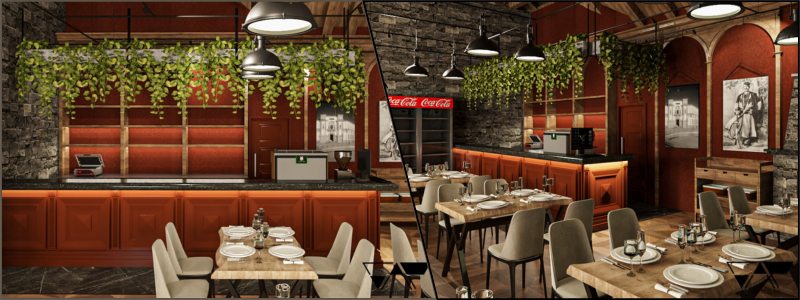
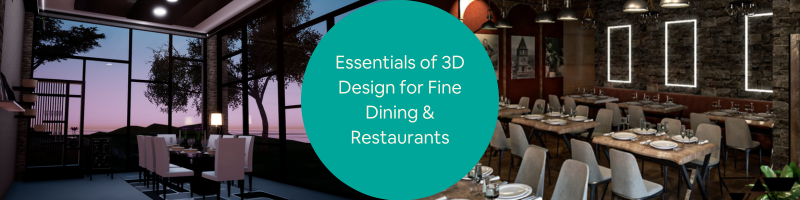
rooftop restaurant 3d interior rendering

Why use 3D restaurant renderings

You simply can never overstate the benefits that 3D restaurant renders can offer, which include but are not limited to the ones below:

  • Budget-friendly solutions

3D images for dining spaces can help significantly cut down the costs that often come with revising designs. Rather than having to make adjustments throughout the construction stage, both clients and designers will be able to view possible problems in the rendering and change them as needed. The proactive approach reduces expensive rework and errors. It can then make both the budget management and project timelines more efficient.

If, during the rendering phase, some design elements were shown to need some requirements, these can be addressed accordingly to smooth out the entire process of construction. Envisioning the design in advance minimizes the need to make changes right on-site, which saves money and time alike.

3D restaurant models are also a big help for real estate developers who need to blow away potential buyers with a restaurant design presentation. Thorough 3D commercial renderings give developers a tool for demonstrating the potential of the space and the possibility of transforming it into a bustling dining spot.

  • Unparalleled visualization

The accurate visualization of the final design of the restaurant is the most undeniable benefit of 3D renders. The images help you make wiser decisions regarding the décor, ambiance, and layout of the space.

Detailed 3D renders also allow designers to play around with various materials, colors, textures, and other design elements to view their appearance once added to the actual area. Such a level of intricate detail is something you can’t expect from conventional 2D drawing services.

Improved visualization can also help pin down possible issues with the design while the process is still in its early stages. If a specific material or color scheme doesn’t give off the same vibes it was expected to, you can make the tweaks easily right away before the start of any actual physical work. It can help you save a significant amount of money and long hours of time just to ensure that the final design will cater to the expectations of the customer.

3D restaurant renders also allow visualizing the ambiance and vibe of the area to make it a breeze to achieve the preferred look and feel for the space. Top-of-the-line restaurant renders can show the effect and relationship between different setups of lighting and their influence on the overall ambiance to create the most unforgettable dining experience.

RELATED: Why 3D rendering and retail store design services for commercial spaces are important

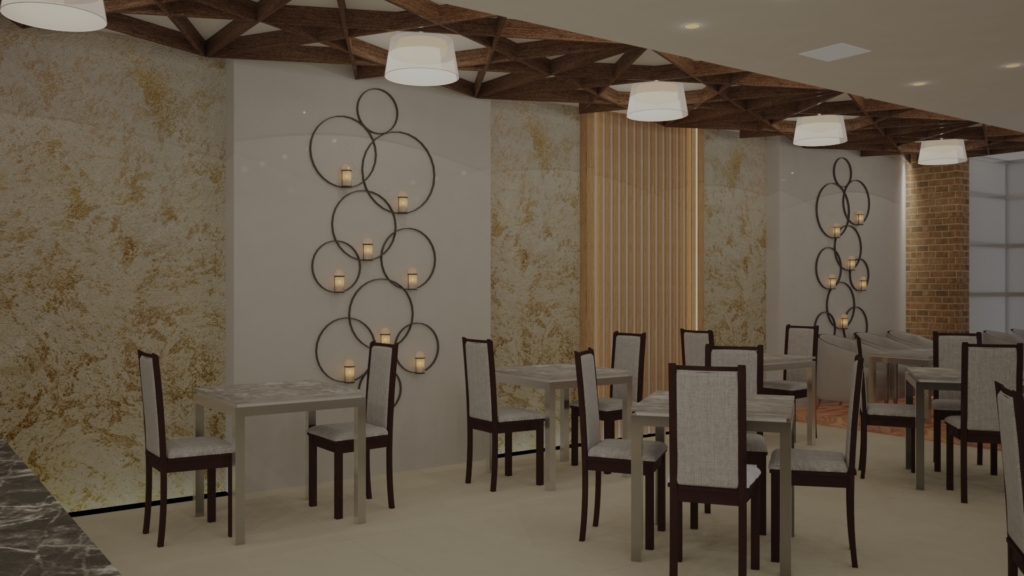
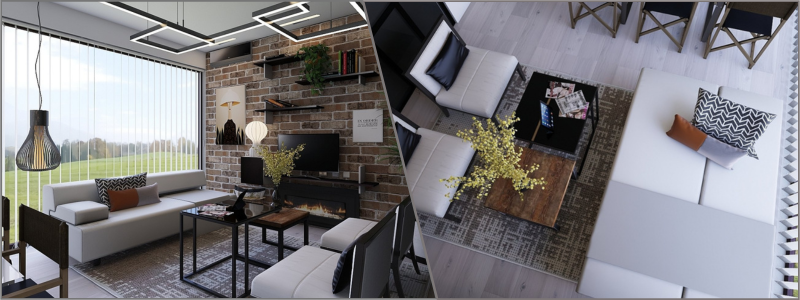
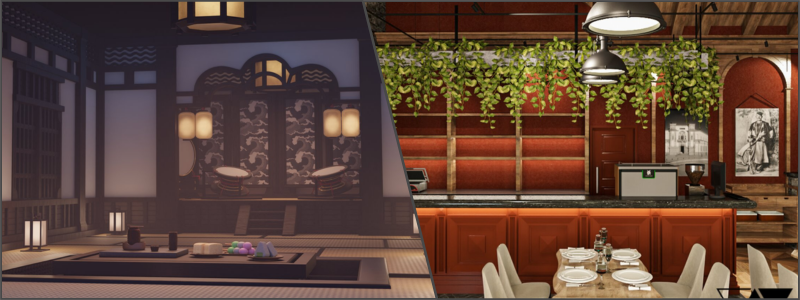
3d interior restaurant design
  • Efficient marketing endeavours

Topnotch 3D restaurant visuals can also serve as a powerful tool for marketing as they vividly present not just the design but also the ambiance of the space. You can use these visuals and add them to your social media posts, websites, and brochures. These are great enticements for prospective investors and clients because they showcase the look and feel of the restaurant.

You can even consider using the same visuals during project presentations to convey the vision of a space effectively. It is a far cry from just sticking with traditional photos or drawings of barren spaces.

With today’s hospitality market becoming even more cutthroat, you’ll be making a big difference if you use visually enticing materials for your marketing campaigns. Some companies regularly utilize 3D presentation services to make sure they get the bang for their buck when it comes to marketing.

Several hotels today are already using 3D renders to highlight the posh ambiance and vibes of their on-site restaurants not only to attract more guests but also to set themselves apart from their competitors.

Captivating and detailed visuals can help communicate the one-of-a-kind experience that the restaurant has to offer. This will then result in more positive reviews and reservations.

3D rendering services for dining places are great for marketing purposes because they give prospective diners a rare chance to experience the space first with the help of lifelike images.

The said method changes the way restaurants attract and engage with their target clients. Most importantly, it offers a more convincing and immersive glimpse of what their dining experience would be like.

How to create gorgeous 3D renders for restaurants

The following are the steps involved in the development of amazing 3D visualization images for restaurants:

1. Creating the layout in 3D

The very first step in the process of producing 3D restaurant renderings is the layout design. It encompasses adding fixtures, furniture, and other elements to guarantee that the flow and space are used optimally.

The process of making this layout involves the client and the designer working closely together to understand the former’s requirements and vision and translate these into detailed 3D models.

2. Designing the floor plan in 3D

A thorough expert 3D floor plan is designed to offer a complete glimpse of the space. It helps understand the dimensions of the various elements of the design and the spatial relationships among them. This floor plan also provides detailed configurations and measurements of the layout to give a clear blueprint for the design and construction process.

These floor plans in 3D are of great use to interior designers and real estate developers. They provide a detailed and clear representation of the area to help in the decision-making and planning process.

RELATED: Better 3D rendering and retail store design services for commercial spaces

restaurant 3d visualization example

3. Using lighting techniques in 3D

Lighting has a key role to play in the overall ambiance of restaurants. More sophisticated techniques for 3D lighting design services are used to replicate different lighting scenes. These ensure that the final design will achieve the preferred atmosphere and mood. These lighting methods can include artificial lighting setups, simulations of natural lighting, and special effects to achieve a particular ambiance.

With the use of state-of-the-art 3D lighting methods, designers can come up with lifelike images that are accurate representations of how the space will look under various lighting conditions. It then creates the desired atmosphere and vibe for the restaurant.

4. Adding textures, materials, and decoration

To create a realistic restaurant rendering, it’s critical to choose the right textures, materials, and decorations. Detailed decorations and high-quality textures can breathe like into the render and make it resemble reality as closely as possible.

The materials that the rendering uses must be a representation of the actual materials to be used during the construction to create the final design’s accurate depiction.

With the help of reliable 3D design services, it’s possible to create realistic and detailed textures that can boost the render’s quality in general. It includes the use of sophisticated rendering methods and high-resolution images to produce a naturalistic demonstration of the decorations and materials.

How Cad Crowd can help

Cad Crowd will be more than happy to connect you with the most dependable 3D design service company that can transform the design of your restaurant with gorgeous 3D renderings. We have more than 14 years of experience connecting top architectural, design, and engineering companies to pre-vetted professionals quickly and reliably. We will guide you in finding the right team that can create realistic and detailed renders that are guaranteed to attract more traffic to your restaurant. Get a quote today.

author avatar

MacKenzie Brown is the founder and CEO of Cad Crowd. With over 18 years of experience in launching and scaling platforms specializing in CAD services, product design, manufacturing, hardware, and software development, MacKenzie is a recognized authority in the engineering industry. Under his leadership, Cad Crowd serves esteemed clients like NASA, JPL, the U.S. Navy, and Fortune 500 companies, empowering innovators with access to high-quality design and engineering talent.

Connect with me: LinkedInXCad Crowd

Main Differences between Architectural Construction Drawings, Shop Drawings & As-Builts Services Companies


Architectural construction plans, shop plans, and as-built plans are all important for a variety of reasons. These plans have different purposes, address different stakeholders, and have different roles to play during the project cycle. As a contractor, architect, or services company with a focus on these types of services, understanding the differences can simplify project workflows and enhance communication.

Cad Crowd is a standout in the industry when it comes to architectural construction drawings, shop drawings, and as-built services. Cad Crowd will give you proficient experts who will help your company with its next ventures.


🚀 Table of contents


Architectural construction drawings: the blueprint of intent

Architectural construction drawings are the foundation of every construction project since they are the intent of closing the gap between design and build. They represent the architect’s vision, an actualization in the form of the overall intent design that drives every stage of construction. They are not only works of beauty; they are technical plans in the form of detailed information imperative in realizing an idea design into reality.

Most important features of architectural construction drawings

  • Focus on design: At the heart of architectural construction drawings is the architect’s creative and functional design. They represent both the aesthetic desire and functional requirements of the project. These comprise spatial planning, with an aim towards efficient utilization of space and adherence to local building codes and standards. The drawings describe how the building is going to look and operate, taking aspects such as lighting, flow, and accessibility into consideration.
  • Extent of detailing: These drawings include many details necessary in the construction process. Besides the standard floor plans and elevations, they have structural plans showing load-carrying members, electrical and plumbing plans symbolizing wiring and piping routes, HVAC systems, and even landscapes where applicable. The extensive detail ensures every element of the building is planned and coordinated well.
  • Guidance tool: Architectural construction drawings serve as crucial guidance tools for contractors, engineers, project managers, and construction workers. They provide precise instructions on what to build, how different components fit together, and what materials to employ. By providing clear and detailed visual representations, these drawings made by architectural design firms help minimize misunderstandings and errors during construction.

RELATED: How CAD technology is transforming the future of architectural design services companies

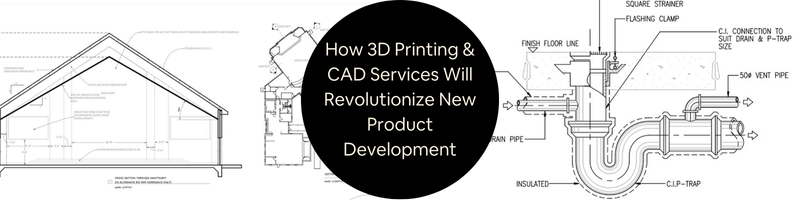
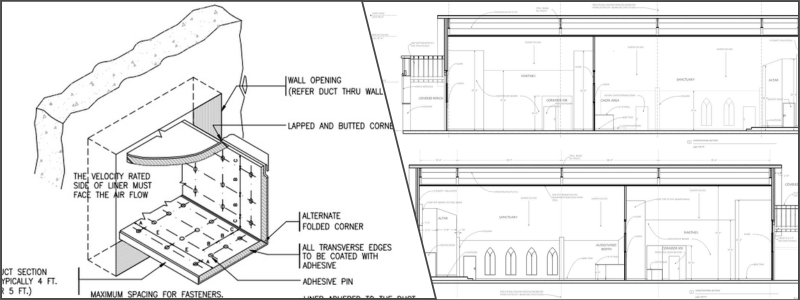
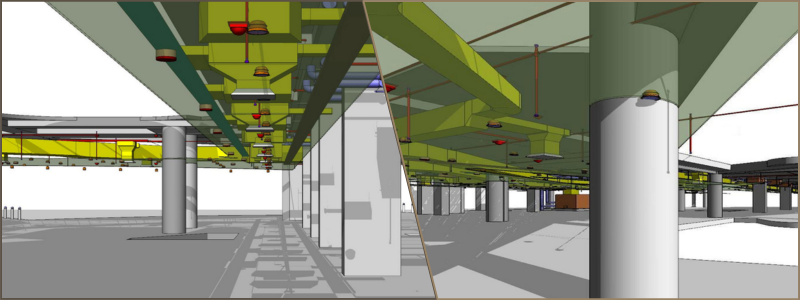
shop drawings examples of hvac and a building

Standard components of architectural construction drawings

  • Floor plans and site layouts: Top-down illustrations of how areas within the building are arranged, i.e., room dimensions, where walls, doors, windows, and equipment are located. Site layouts further the view to include where the building is in relation to the surrounding site, including parking lots, access, and landscaping.
  • Elevations and cross-sections: Elevations provide a view from the front of each facade, illustrating the exterior look of the building, including materials, textures, and architectural elements. Cross-sections cut through the building to reveal the inside construction, illustrating relations between floors, rooms, and building components.
  • Structural, mechanical, and electrical details: These types of building blueprints explore aspects that have to do with the way the building should be assembled. Structural drawings focus on the importance of the body of the building, i.e., beams, columns, and foundations. Mechanical drawings touch upon HVAC systems, while electrical designs cover wiring, outlets, and lighting configurations.
  • Specifications of materials: Detailed notes and schedules specify material types to be utilized, as well as quality, finishes, and installation techniques. This assists in ensuring conformity and ease in procurement and estimating costs.

Service firms importance

Construction plans are largely reliant on architectural services companies in an effort to provide accurate and efficient project outcomes. Such plans play a crucial role in:

  • Cost estimation: They provide the detailed information needed to create reliable budgets, including material quantities and labor requirements.
  • Construction planning: By defining construction sequences and processes, they help schedule tasks, allocate resources, and manage time effectively.
  • Regulatory compliance: Building drawings guarantee that the project is in compliance with building codes, zoning regulations, and safety standards, reducing the likelihood of legal disputes or costly changes.
  • Contractual basis: They are binding agreements in contracts between clients, architects, and contractors, defining the scope of work and expectations for the delivery of the project.

Ultimately, architectural site plan services are responsible for not just blueprints but the keystone to successful building, bridging an architect’s vision to a buildable, structured entity.

RELATED: Techniques for 3D architectural visualizations and tips for your services firm

Shop Drawings: the fabrication blueprint

While building plans provide a general design overview, shop drawings focus on the minute details needed for fabrication and installation. Drafted by contractors, subcontractors, manufacturers, or specialized drafting companies, shop drawings are the critical link between architectural concepts and real construction. They translate the architect’s intent into actionable plans for specific building components so that every detail is accurately captured before it’s delivered to the job site.

Key features of shop drawings

  • Exact specifications: Shop drawings focus on detailed details that may not be given importance by construction drawings. They give exact dimensions, manufacturing specifications, material specifications, and installation procedures for components like structural steel beams, HVAC units, cabinetry, electrical panels, and piping. These specifications allow manufacturers to create items accurately and with little scope for interpretation or error.
  • Technical accuracy: Shop drawings differ from general design plans in that they contain very technical information. They specify fabrication methods, welding details, screw and bolt locations, assembly procedures, and tolerable deviation. This degree of accuracy guarantees that parts fit together perfectly when installed, ensuring the integrity of the overall design.
  • Review and approval process: Shop drawings are strictly reviewed and approved by architects, engineers, and project managers. The tiered review process checks that the drawings meet the original construction documents and project specifications. Differences are identified and adjusted before fabrication to prevent on-site mistakes and delays, which are extremely expensive.

Elements of shop drawings in common

  • Accurate illustrations of prefabricated components: These plans show individual elements and assemblies, illustrating how every element is integral to the complete structure.
  • Material grades and finishes: Shop drawings services clearly indicate the materials to be utilized, including grades, coatings, and surface finishes, to meet functional and aesthetic requirements.
  • Installation instructions and connection details: They give sequential instructions for the assembly and installation of elements, including connection techniques, anchor locations, and interface information with other structural components.

Significance to service firms

Shop drawing service firms are essential in bridging the gap between design and construction. Their experts ensure each part is manufactured with accuracy, minimizing errors and conserving materials. With precise instructions, these drawings optimize on-site productivity, allowing construction crews to work faster and more effectively.

Besides, accurate shop drawings can reduce project costs significantly. They allow problems that might arise during construction to be established from the start, saving costly time and effort on rework. In complex projects such as high-rise buildings or factories, the significance of accurate shop drawings cannot be overstated—they are crucial in the maintenance of project schedules and the structural stability of the build.

Short of being mere technical documents, shop drawings are the foundation on which successful fabrication and installation rest. By their capacity to interpret architectural imaginations and translate them into accurate, actionable plans, they ensure all components fit hand in glove, function as designed, and serve to enhance the quality of the finished building.

RELATED: Top tips you need to know for choosing a BIM company for architectural design & CAD services firms

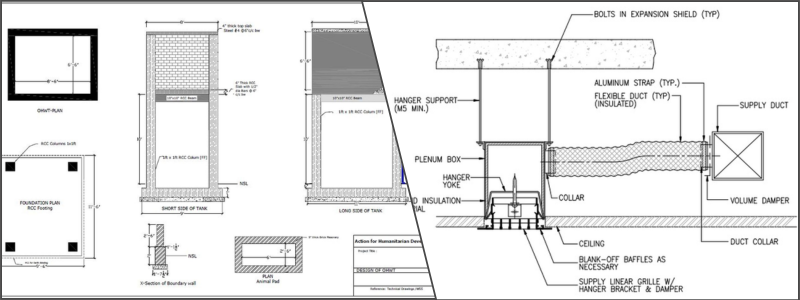
drawings of a water tank design

As-built drawings: the record of reality

When the dust has settled, and the construction phase is nearing completion, as-built drawings are an integral part of the project records. These important documents record the “as-is” condition of the completed building, including all the changes and variations from the original building plans. Unlike design blueprints, which are the hoped-for vision, as-built drawings services depict factual and detailed descriptions of what has been built.

Key features

  • Recording changes: One of the primary reasons as-built drawings are employed is to record all changes that take place during the construction process. These changes can include dimension changes, material changes, location changes of mechanical, electrical, and plumbing systems, and unforeseen adjustments required because of site conditions or design changes. Construction projects have real-world conditions that demand decisions to be made on the spot, and as-built drawings assist in recording these decisions in detail.
  • Detailed records: As-built drawings are not sketches. They include detailed annotations, redlines, and comments showing deviations from the original plan. These records form a middle link between original plans and final results, giving a comprehensive overview of how the project went. The fine detailing is such that all changes, however small or big, are captured for posterity.
  • Facility management tool: As-built drawings are a treasure trove for facility management, being a major tool for future repairs, renovations, and maintenance. They provide an accurate record of the built environment, allowing property managers, maintenance personnel, and contractors to understand the conditions as they exist without guesswork. From locating hidden utilities to designing new installations or resolving issues, as-built drawings serve as a point of reference certainty.

Common components

  • Final floor plans, elevations, and sections: These are the final layout and any modifications from the original design. 3D floor plan design services provide a clear image of the spatial relationship and structural details.
  • Final locations of structural, mechanical, and electrical systems: The accurate location of these systems is crucial for future building. As-built drawings indicate where pipes, ducts, wiring, and support structures are actually located, which may vary from the initial plans.
  • Deviation notes from original specifications: Comprehensive notes describe why some changes were implemented, giving context that can be useful for future projects or legal purposes.

Significance for service companies:

As-built services companies specialize in creating these detailed reports, offering documentation that makes facility management, legal compliance, and future project planning easier. They are a treasure to property owners, maintenance staff, and renovation contractors.

Accurate as-built drawings can make renovation projects run more smoothly, save money by preventing surprises, and ensure that any changes comply with safety and building codes. Furthermore, they can serve as legal documents, attesting that construction was in accordance with contractual requirements and regulatory requirements.

In brief, as-built drawings are greater than end-of-construction blueprints; they are the ultimate snapshot of a project’s existence. Their accuracy and detail make them a treasured resource for anyone involved in a building’s life cycle, from construction and management to renovation and even demolition.

RELATED: Marketing real estate: top real estate 3D rendering trends for companies and firms

How service companies address these differences

Service companies that specialize in architectural drawings, shop drawings, and as-built documentation must be sensitive to the specific demands of each. This is how they effectively obtain these differences:

  • Specialized expertise: Each of these kinds of drawings typically has its own dedicated personnel at firms so that employees with the right expertise perform specific work.
  • Workflow integration: Seamless workflow between design, fabrication, and construction documentation teams reduces errors and ensures consistency across project phases.
  • Technology utilization: Advanced CAD design experts, BIM software, and cloud-based tools allow for efficient drawing-making, checking, and managing.
  • Quality check: In-depth checking procedures confirm cross-checking of drawings against project requirements, building codes, and site conditions.

Cad Crowd is here to help

Understanding the distinctions between architectural construction drawings, shop drawings, and as-built drawings is not merely an intellectual exercise—it’s a necessity for anyone who works with construction projects.

Cad Crowd has worked with tons of architectural, real estate, and design companies to find the best-outsourced talent as an industry-leading platform. Contact us at Cad Crowd today for a quick and easy free quote.

author avatar

MacKenzie Brown is the founder and CEO of Cad Crowd. With over 18 years of experience in launching and scaling platforms specializing in CAD services, product design, manufacturing, hardware, and software development, MacKenzie is a recognized authority in the engineering industry. Under his leadership, Cad Crowd serves esteemed clients like NASA, JPL, the U.S. Navy, and Fortune 500 companies, empowering innovators with access to high-quality design and engineering talent.

Connect with me: LinkedInXCad Crowd

5 Key Factors Influencing 3D Exterior Rendering Costs, Rates & Pricing for CAD Companies and Firms


3D exterior rendering is quickly becoming very important for architects, developers of real estate, and design firms. What it does is create highly photorealistic visualizations, which will help a client or a stakeholder in making investment decisions as complex design concepts are transformed into vivid images before one brick is laid on the ground.

Interior 3D rendering services cost has recently become the standard of costs on an architect’s presentation budget. The benefits of architectural photorealistic visualization are rather obvious: clients see a vivid, almost tangible preview of a built project, making it infinitely more convincing than a traditional sketch by hand. Architects can, therefore, present their vision more successfully and often enjoy increased client enthusiasm and approval.

Professional 3D rendering companies can accept even the most complicated and detailed visualizations. It is quite logical to believe that the more complex and detailed 3D visualization is, the costlier it will be.

The question is, what factors directly affect the cost of 3D visualization?

Pricing, however, is very complex, and the price setting for 3D exterior rendering services is questionable. There are factors that comprise the service charged by firms to their clients, and understanding those factors gives architects a clearer idea of what they pay for. They thus exercise more influence over costs as well as the impact of visualizations on clients.

An astute architect who needs to cut some expenses can cut out the non-essential elements.

Cad Crowd is an industry leader in providing architectural, design, and engineering firms with the best 3D rendering experts. Today, we are spelling out the five main factors that impact the cost of exterior 3D rendering and a guide on how to navigate those decisions in terms of how one determines the best way to proceed.


🚀 Table of contents


Project complexity

The complexity of the project is perhaps the most significant factor influencing the cost of 3D exterior rendering. CAD companies charge based on how detailed and intricate the project is, which directly impacts the amount of time, effort, and skill required to produce high-quality renders.

Intricate architectural designs, such as in the facade, with intricate patterns, ornate decorations, and complex geometrical patterns, take more time to model and demand more experience. The higher the detail, the more realistic the rendering software and techniques must be to reproduce those details. A simple structure like that of a suburban house will definitely take less time and effort to render compared to a modern skyscraper with complex facades and uniquely designed elements.

  • Landscaping and the surrounding environment

All this, including the surrounding environment, landscaping, and natural elements such as trees, gardens, water bodies, or even the surroundings of the urban area, adds complexity to the project. Creating landscapes with realism that get beautifully attached to the architectural structure requires intricate techniques that add to costs for architectural design firms.

For example, a villa in the midst of deep green forests can add intricate details of the vegetation, lighting adjustments, and further textures to create true-to-life visuality.

  • Special features and custom elements

Custom features – unique lighting setups, animated objects, or bespoke materials – also contribute to complexity. Extra assets in the scene – such as swimming pools, outdoor furniture, cars, or fountains – require more work from a rendering team, which translates into higher price points.

A CAD company usually examines the complexity of the entire scene and will price before arriving at a quote – in other words; they take specific uniqueness of project factors into account.

RELATED: How emotional design in architecture enhances mood for 3D modeling & architectural services firms

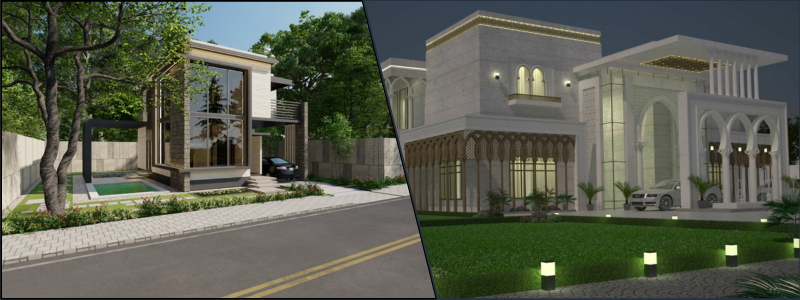
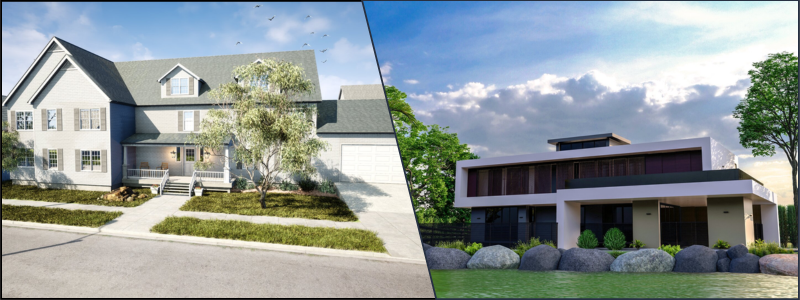
3D visualization of a duplex building and large residence

Rendering quality and resolution

The final render quality and resolution are of great significance in pricing. CAD design companies offer varying levels of rendering quality, ranging from simple low resolutions sufficient for preliminary stage concept design to ultra-high resolutions photorealistic renders for marketing purposes and client presentations.

  • Simple render vs. photorealistic render

The simple render tends to be less expensive as it would take less time and fewer resources. They tend to work on early phases of the design, especially when the client will need to see an initial view of the project’s scale, layout, and proportions.

Photorealistic rendering services and the inclusion of precise textures, reflections, and shadows is a huge deal: it requires advanced software, powerful hardware, and highly skilled artists, which makes it expensive. The level of quality is usually required in highly-charged presentations or marketing materials where details are important.

Another element is the resolution of the final images. Higher-resolution rendering requires more processing time and bigger file sizes, which might impact the speed of the overall rendering pipeline. For example, rendering at 1080p is less expensive than one at 4K or even 8K because there will be a longer processing time needed to reach enough detail for the final image. High-resolution renditions are critical for large-format print materials, such as billboards, whereas lower-resolution images would suffice for digital presentations or usage on the web.

  • Post-production enhancements

Such post-production services as color grading, the addition of atmospheric effects like fog or modification of lighting conditions, and tweaking of the general look can push the overall expense into a high range. Although these final embellishments can turn an excellent rendering into an eye-catching one, they would need specific skill and time, which adds to the cost.

RELATED: Marketing real estate: Top real estate 3D rendering trends for companies and firms

Software and tools used

Another critical factor that determines the cost is the software and tools being used in the rendering process. Different CAD firms may use various tools and software with different capabilities and levels of complexity. The quality of output and time taken for the project depends on the type of software selected.

  • Industry-standard vs. specialized software

Expert CAD professionals use applications primarily industry-standard, such as Autodesk 3ds Max, V-Ray, Lumion, and SketchUp, that have licensing fees and require special education. They provide the best, most professional way to create photo-realistic textures, lighting, and animations; however, the cost could escalate the project.

Other companies may select additional specialized software depending on the type of work that needs to be done again; Rhino or Blender, for example, also affects price based on what those other tools can deliver.

  • Rendering engines and hardware requirements

Rendering engines like V-Ray and Corona are often used for realistic photograph simulation, that is to say, realistically photorealistic image production, which is computationally expensive by definition. High-quality rendering demands a lot of hardware that can make effective use of multi-core processors, GPUs, and large amounts of RAM to minimize rendering times and remain efficient.

The biggest influence on the final price charged to clients is the demand for advanced hardware setups, which some rendering firms maintain at a considerable cost. The more complex the scene and the higher the resolution required, the more computational power will be needed, therefore increasing the cost.

3D visualization of a two-storey home and a lakeside house

RELATED: Camera angles in the 3D architectural visualization realm for your projects

Turnaround time and deadlines

Time = money, and in the 3D world, expediting work is pricey. Things have to get done fast in the construction world; the same applies to real estate architecture firms or engineering firms. The speed at which a client needs a job can, therefore, cost deeply.

Most CAD companies offer turnaround times, which can vary from a few days to several weeks. When a client demands the creation of a project on short notice, the rendering teams might have to work overtime, hire extra resources to handle the job, or push some other projects aside. Expedited delivery services can cost up to 25% more in total for the project, depending on how fast the client needs the renders done.

  • Project and revision stages

Turnaround time will also largely depend on how many revisions the client wishes to make to the final project. Most rendering firms factor a few revisions into their price packages. Beyond these standard revisions, especially in the later stages, increase costs and lead to delays. The clients should be made aware, at the outset, about the scope of the allowed revisions so that they are not faced with cost surprises later.

Location and labor cost

The location of the 3D rendering firm or CAD company largely dictates the cost of 3D exterior rendering. Labor costs vary drastically in relation to the location of the firm, and such factors are usually transferred to the client.

This also tends to reflect in the form of a lower price that companies in India, China, or other developing countries like Eastern Europe can offer as opposed to the prices offered by North American, Western European, or Australian firms. It might very well be the case wherein offshore companies can provide the same quality as a local company but for a fraction of the cost. Nevertheless, working with offshore companies might also pose challenges like time zones, language barriers, and possible problems with project management and overall monitoring and control.

Even within the same country, conditions governing prices can differ depending on local market conditions. Within the same country, in an urban area with high demand for an architectural visualization service, CAD firms charge more than in areas such as smaller towns or other regions that charge low prices to remain competitive.

RELATED: Creating exterior renderings using 3D exterior rendering services for architects

Conclusion

There are several main factors that determine the costs of 3D exterior rendering services for CAD companies and firms. Some of the major variables ruling the pricing scale here include project complexity, quality of renders, software and tools, turnaround, and location.

With this understanding, they will be able to make the best and most informed decisions when choosing a rendering service provider for their project and devising a suitable budget. With the scope of work for a particular project and its specific needs in mind, the clients will be able to settle for an equilibrium between value for money and the quality so received.

The fast world of architecture and design is one where, for a project, initial impressions can make or break it. Doing so would require investment in high-quality 3D exterior rendering experts. At the same time, though, with a good understanding of what drives costs, clients would be able to navigate this pricing landscape better, choosing the right rendering firm that meets their needs yet does not infringe on their budget.

How Cad Crowd can help

CAD companies and firms follow some key factors that guide their determination of cost, rate, and pricing for their 3D exterior rendering projects. Cad Crowd is an industry-leading platform that can connect you with the perfect professionals who can deliver excellent results within or according to your budget. Request a quote now.

author avatar

MacKenzie Brown is the founder and CEO of Cad Crowd. With over 18 years of experience in launching and scaling platforms specializing in CAD services, product design, manufacturing, hardware, and software development, MacKenzie is a recognized authority in the engineering industry. Under his leadership, Cad Crowd serves esteemed clients like NASA, JPL, the U.S. Navy, and Fortune 500 companies, empowering innovators with access to high-quality design and engineering talent.

Connect with me: LinkedInXCad Crowd

Exploring the Different Versions of Dynamic 3D Visuals in Architecture and Design Services


Today’s article explores the varieties of dynamic 3D visuals in architecture and design services. Did you notice how the architecture and design services industry has been enjoying a colossal change with the rise of 3D technology, specifically rendering? Indeed, 3D technology simplifies transforming even the most basic ideas and concepts into visual masterpieces that speak so much before the actual groundbreaking. The most recent breakthroughs in technology have helped a lot in making architectural concepts more transparent and captivating.

What’s most interesting is that they also serve as the much-needed sandbox for innovation and experimentation. Digging deeper into the newest trends shaping the future of 3D visuals will tell you right away that this tool is no longer as simple an accessory as it once was. Instead, it has now become a true cornerstone in the nonstop evolution and development of designs and architectural concepts. High-quality dynamic 3D renders created by expert 3D architectural rendering firms are essential for presenting architecture and design projects.

Cad Crowd has years of experience working with the best design and architecture firms, and this allowed us to observe how 3D visualization and its purposes and techniques evolved over the years. Let’s take a look at what we learned.


:rocket: Table of contents


RELATED: Why companies need 3D visualization

It doesn’t matter if it’s for the purpose of a client presentation, a marketing promotion, or a competition bid; you’re expected to use visual materials that can convey your ideas down to the T. It’s an open secret that static images alone can no longer keep up with the extremely short attention spans of modern audiences. Expert 3D renders are now poised to become the new norm that will wow viewers, including the most perceptive ones. 

Exploring the different versions of dynamic 3D visuals in architecture and design services 

3D visuals in design and architecture 

The shift from traditional blueprint designs to modern digital 3D renders is a real breakthrough in and of itself. The transformation endowed designers and architects with a larger-than-life tool that can come up with more accurate, detailed, and immersive representations of their ideas and concepts. What makes these 3D renders truly essential is the fact that they bring life to the spatial dynamics, lighting, and textures of future designs.

It’s no surprise, then, that 3D visuals have made an imprint in the design and architectural industries. Most of today’s rendering companies produce different types and forms of 3D renders. The following are only among the most popular formats that might change the game for you and your company:

RELATED: What is a 3D visualizer?

360-degree view

360-degree renderings that are full of life allow viewers to rotate realistic 3D models of buildings and inspect them from all sides. Out of all the common 3D visualization service types, 360-degree views are particularly at home for mobile apps and websites alike. These views are also more effective and impactful for commercial and residential projects as they make room for more scrupulous scrutiny from all angles. 

3D animation

3D animations are no doubt some of the most engaging and versatile out of all 3D renders. With these animations, architects and designers can come up with a narrative or story around their ideas and throw in spectacular effects, music, voiceovers, transitions, and viewpoints. The format can also illustrate projects at different points of the day or seasons to add more context and depth to the overall visual experience. The use of this footage captured by drones in 3D animations can also endow a unique mishmash of cinematic quality and realism.

However, this might hamper creative freedom when it comes to lighting and weather conditions. It’s because they will look exactly like what the drone footage has captured. These animations are more cost-effective because you no longer need to build a detailed 3D landscape from the ground up. Unlike the rest of the 3D renders listed here, 3D animation professionals are also recommended unequivocally for aerial views. 

RELATED: What factors influence 3D animation services rates, costs, and pricing for companies?

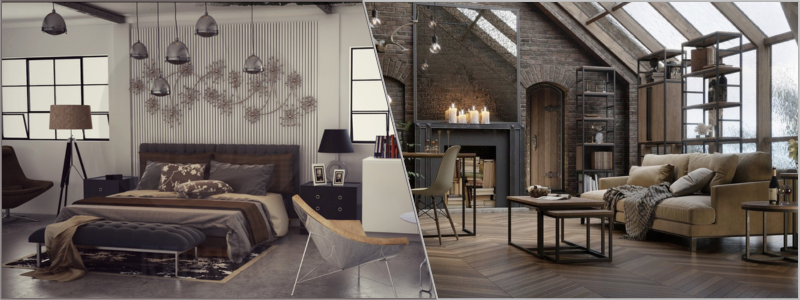
interior rendering services

Machine learning and AI

Machine learning and artificial intelligence, or AI, are on the brink of redefining the creativity and efficiency of 3D renders. These two modern-day technologies are starting to put into autopilot the more tiring components of rendering, such as optimizing textures and lighting. This will give designers and architects more free time to pay attention to the creative facets of their projects. 

Algorithms that are based on AI are also starting to recommend modifications in design to perk up functionality or aesthetics. It can possibly spearhead a new wave of encroachment in architectural and design industries. 

Augmented reality

Augmented reality, or simply AR, can spread the digital details over those of the actual world. 3D AR/VR architectural services improve the physical environment using data and 3D models in an engaging and dynamic way. Using AI on-site makes it possible to superimpose the suggested designs over the existing surroundings. As a result, it provides a more tangible sense of context and scale. The state-of-the-art technology is a big help during design presentations while making the construction process enjoy better accuracy. 

RELATED: Top 9 augmented reality apps for architecture & AR for architectural design firms

Cinemagraphs

Did those moving photos in the Harry Potter flicks blow you away? These are the perfect examples of cinematography: dynamic 3D visuals with minor repeated movements included. These cinematographic techniques can be used to capture the viewers’ attention in a more powerful way while maintaining the subtlety preferred. When these techniques are used in archviz, they can highlight specific design elements or set the favored ambiance or atmosphere. Cinemagraphs can breathe life into static images and heighten the emotional effects during presentations. 

Hyper-realistic renders

The realism requirement in 3D renders has paved the way for substantial breakthroughs in simulating texture and lighting. Modern renders can now copy the multifaceted interplay of materials and light, from the rough textures of old wood to the morning sun’s soft flow on the façade of a building. Hyper-realistic visuals are appealing to the eyes and offer a more defined depiction of the finished product. The result is that clients can make better decisions along the way. 

Immersive 3D tours

Immersive 3D tours created by 3D architectural visualization designers take the customary virtual experience to the next level with interactive elements. The tours feature real-time renders of environments that are dramatically realistic. Users can also engage in active interactions with such tours. They can customize the interior design or change the lighting, too.  

RELATED: Mistakes to avoid when deciding an architectural visualization firm

BIM integration 

BIM or Building Information Modeling, and 3D rendering can join forces to produce more accurate and efficient representations of design and architectural projects. The objective of BIM is to create digital representations of the buildings’ functional and physical characteristics. The data is visually brought to life with the help of 3D renders. The combination of these two technologies creates a seamless workflow. It’s because the changes crafted in the BIM model are shown in the 3D render in a snap of a finger. It encourages collaboration among everyone involved, from construction professionals to engineers, architects, and designers.

Green design and sustainable visuals

With the sustainable movement growing bigger across the globe and with the ever-increasing awareness about it, the architecture and design industries have also switched to green design and practices. 3D rendering services & 3D designers play a critical role in this newest trend as it helps envisage the sustainable features of buildings. These include the use of eco-friendly materials and natural lighting combined with energy efficiency. The renders call attention to the environmental advantages and present sustainable design principles and their practical and aesthetic applications and uses. All of these make green design more appealing and accessible to today’s clients. 

3D virtual tours

3D virtual tours are a variety of 3D renders that allow users to find their way around a digital setting as if they were in that very area themselves. These tours also come in several categories. VR fusions, for example, allow users to interact with the design and customize it at the same time. Thanks to this, VR fusion offers a more personalized and immersive experience. 

3D virtual tours

RELATED: How to create a virtual tour of homes with 3D rendering services

Meanwhile, the virtual maps are 3D visualizations from 3D visualizer experts that work hand in hand with Google Maps so that the audience can see future projects in the same context in real life. These 3D virtual tours are of great help for large-scale or complex projects because they provide a more interactive and meticulous exploration. 

Virtual reality

Virtual reality, or VR, is one of the most cutting-edge of all 3D renders because of the completely immersive experience they offer. VR can whisk viewers right into the proposed project before its actual construction begins. Users can use VR headsets to explore every nook and cranny of a digital space to gain a better understanding and become more familiar with the materials and dimensions of the space.

VR is practical during the finalization of the design details with the clients. It ensures that every element is just as needed before the construction begins. Architects and designers can also use VR to the fullest by teaming up in a shared virtual space. It makes it a win-win choice for every phase of the project. 

RELATED: How 3D virtual reality rendering is shaping the construction industry

The future of dynamic 3D visuals in design and architecture 

With the entire world gearing up for the future, it‘s quite obvious that 3D renders will continue with their evolution. This is driven by their integration with more digital tools and technological advancements. The existing trends lay down the path for an exciting journey toward more intelligent, immersive, and sustainable design practices. These 3D visuals crafted by experienced 3D designers play a decisive role in shaping the built environment, and their possibilities are just starting to be realized. 

In the ruthless world of architecture and design, the aptitude to present designs in an unforgettable and captivating way is a must for professionals who like to leave lasting impressions on their audience. It is where the different types of dynamic 3D visuals stand out the most. They provide architects and designers with a helpful toolbox of breakthrough formats that can take their presentations to the next level. It also encourages a more effective engagement with their target audience. 

RELATED: All you need to know about 3D visualization for architectural design and CGI projects

How Cad Crowd can help

Do you feel like you can use a dynamic 3D visual that can highlight your design and architectural project in a way that is not like anything before? Cad Crowd has helped designers and firms come together to create 3D visualizations that translate to impact and profit, with our leading network of engineers and designers built from years of experience.

Contact Cad Crowd today to get those captivating visuals that everyone will love and appreciate!

author avatar

MacKenzie Brown is the founder and CEO of Cad Crowd. With over 18 years of experience in launching and scaling platforms specializing in CAD services, product design, manufacturing, hardware, and software development, MacKenzie is a recognized authority in the engineering industry. Under his leadership, Cad Crowd serves esteemed clients like NASA, JPL, the U.S. Navy, and Fortune 500 companies, empowering innovators with access to high-quality design and engineering talent.

Connect with me: LinkedInXCad Crowd

Backdrop Photo or Full 3D Aerial View Rendering Options: Which is the Better Choice for Architects?


Today’s post talks about backdrop photos or full 3D aerial view rendering options to identify the better choice for architects. An ever-increasing number of architects today are making the most out of 3D aerial view renderings, both animated and static, to spice up their architectural visualization projects. 3D aerial rendering services are enjoying a higher demand because these renderings are informative, captivating, and striking. 

But how are they even made in the first place? What actually goes into creating aerial view renderings? Aside from the 3D models of the main structure, a large-scale detailed backdrop photo is also required to show its immediate surroundings. 

There are two popular methods you can choose from to produce such backdrops. These are the use of drone photography and 3D scenes. The methods have their own sets of strengths and weaknesses that can make or break the final CGI’s visual impact. Familiarizing their upsides and downsides will affect your project and its results. 

Cad Crowd has worked with both general design firms and the aerospace industry (NASAJPL) and understands how each industry uses varied levels of aerial views for different purposes. In this article, however, we’ll take those insights and focus on their use for architects and architecture firms.


:rocket: Table of contents


RELATED: How can 3D architectural aerial renderings benefit your company?

Drone-captured backdrop photos

Those footage captured by drones can make your backdrop photos look accurate and real. They do so by showing the environment and its appearance in the real world. Apart from giving viewers a real-life glimpse of the nearby landscape, it is also a more economical solution than a 3D designer trying to capture a scene in full aerial rendering. It also happens to be a speedier process, provided that you capture the ideal weather and lighting conditions right on the first try of shooting with the drone. 

There’s a catch here, though. With the rendering relying a lot on the footage of the existing environment, the 3D artists won’t have any other options but to exert more effort to give the backdrop some tweaks here and there. The following factors distinguish backdrop photos from aerial renders:

Reasonable and authentic

Backdrop photos can be quite appealing when added to archviz projects mainly because they are as authentic as they can get. These images illustrate the immediate environment to give the proposed structure a more realistic context. Such level of authenticity becomes more enticing while presenting the project to the clients. As you might already know, it is common for clients to focus their attention on the project’s real-life representation and how it works with its surroundings. 

RELATED: Optimal angles for real estate rendering services: immediately enhancing your listings

Meeting the preferences and perception of clients 

With backdrop photos at your disposal, you can give your target clients a more familiar perspective that reassures them. It’s that one thing that traditional architectural presentation services may not offer.  The proposals of planned buildings in their actual locations that look realistic can boost the confidence of clients. It also urges them to decide sensibly during every stage of the life cycle of the project.

One with the surroundings 

Backdrop images can blend the proposed building and its surrounding environment. This combination allows both architects and clients to envision how the proposed structure will interact in the future with the neighboring streets, other structures, and the rest of the nearby landscapes. This also promotes better decision-making when it comes to the elements that go or don’t go well with the backdrop. 

Efficient use of monetary and time resources 

Opting for backdrop photos can save the monetary and time resources used when hiring a 3D architectural rendering company. Instead of having to produce the 3D environment from the ground up, architects can direct their focus to the details of the structure itself and the photo as a reference for external context as they do so. Such a sleek tactic is advantageous for your projects whose deadlines are tight or budgets are limited. 

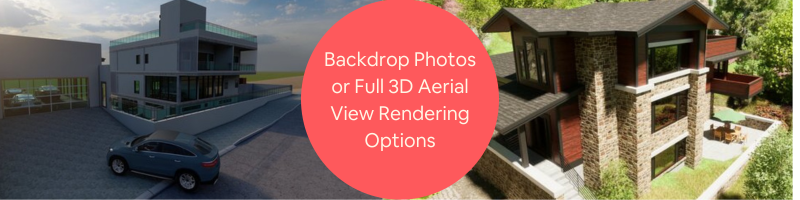
3d aerial rendering services

RELATED: How better 3D residential renderings help architects, builders, realtors, and companies

Despite the benefits of backdrop images, their limited flexibility remains their major shortcoming. The variations in lighting conditions, as well as changes in season and weather, all have an influence on the background imagery and even its consistency as opposed to 3D rendering services. Tweaks to the design of the structure may also require the backdrop photo to be updated. This can make the project more complex and expensive in the end. 

To put it simply, backdrop photos have the following key strengths:

  • The level of realism is higher because the scenery in real life is being depicted.
  • Turnaround time is faster.
  • Background photos are more economical compared to aerial renderings, making them suitable for projects whose budgets might be limited. 

On the other hand, below are some of the challenges that architects may encounter if they consider using backdrop photos:

  • A backdrop photo depends on light and weather conditions that may change out of the blue. While producing the views may be faster if the weather is favorable, delays may still happen while trying to wait for the conditions to become more ideal.
  • There is less control over the details of the surroundings. 
  • There might restrictions when it comes to the angles and perspectives that the camera may capture like when trying to shoot in a neighborhood dotted with buildings. 

RELATED: Highrise 3D rendering designs: CGI for architectural company’s presentations

Full 3D aerial view rendering

The 3D modeling designer can enjoy more freedom in terms of creativity and better control if you opt for a 3D aerial view render. It gives you a chance to play around with diverse points of view, weather, and lighting to portray scenarios that might be complicated or even downright impossible to shoot or capture in real life. A good example of this is showing quick transitions between different seasons. 

Control and customize with enhanced creativity

Among the best perks of complete 3D aerial view rendering is the fact that they provide an unparalleled level of control and customization. It’s possible for the architects to design the different parts and areas of the surroundings, such as nearby terrains, vegetation, and buildings, with extra care. It gives the assurance that everything will be in perfect synchronization with the proposed structure. Such a detailed approach gives architects the opportunity to showcase precise and artistically refined visions. 

Keep it consistent and flexible 

Aerial renders in full 3D are different from backdrop photos in the sense that they are more consistent as far as changes in lighting, weather conditions, and seasons are concerned. Architects will also enjoy better flexibility in terms of making dynamic adjustments to the elements to showcase the building and how it can adapt to different environmental conditions. This level of consistency ensures that the images rendered are an accurate reflection of the proposed architectural vision during the entire life cycle of the project. 

RELATED: What is 3D architectural rendering, and how do companies benefit from its use?

Future-ready designs

The 3D visualization expert can create an aerial view 3D render that can also be used for developing architectural designs for the future. They can be used to anticipate and accommodate future developments in the surrounding urban landscape. It is something critical for large-scale developments or projects in urban areas that change too fast and require long-term planning and adaptability. 

Upfront expertise and investment 

To create a full 3D aerial view render, upfront investments in software resources and a skilled workforce are non-negotiable. Architects who have already become masters of the art of 3D rendering and modeling methods and those who collaborate with 3D visuailizer teams specializing in visualization can use their abilities to produce immersive and eye-catching renders. While the initial investment might be costly, the long-term benefits such as the quality of presentations and the flexibility in design can offset the costs easily. 

Exceptional visualization and design

3D aerial renders support a good design process for the architects to explore various design alternatives and scenarios with the least effort on their part. It’s also feasible to envision the changes or adjustments to the orientation of the building, urban context, or landscaping in real time. It helps architects to make more educated decisions and make further improvements to their designs. 

RELATED: 7 Benefits of 3D architectural rendering services for real estate

Below are some of the most notable benefits of using full 3D aerial view renders:

  • You can come up with aerial views and angles that drones alone might never be able to shoot or capture. 
  • There’s no need to depend on natural weather or lighting conditions. 
  • There are endless possibilities to be creative and to customize. Full 3D renders are ideal if the aerial view has a touch and feel of artistry. 

Using full 3D aerial view renders also has its own drawbacks:

  • These full renders are more expensive as a result of the numerous resources and extensive work needed for the production of a realistic aerial rendering. 
  • The timeframes for producing aerial renders are often longer. 3D artists need a longer time to develop large-scale detailed scenes and then render them afterward. 
  • You should also take into account that this method needs a higher level of 3D rendering and modeling expertise. Access to modern and state-of-the-art equipment is also a must.
  • Work with an inexperienced 3D artist or an agency that doesn’t maintain a rendering farm. It might have negative effects on both the timelines and the overall quality of the results. It explains why it’s important to hire only the best CGI contractors armed with the right skills and toolset to pull off the job. 

How Cad Crowd can help

Do you need the best 3D architectural visualization services that can take your presentations to the next level? Never waste your precious time and contact Cad Crowd for the best and most suitable 3D artists who can bring your renders to life. It doesn’t matter if you prefer the high realism of backdrop photos or conceptual full aerial rendering, Cad Crowd will connect you with the team that can uplift your marketing materials and presentations. 

Contact us for a free quote today.

author avatar

MacKenzie Brown is the founder and CEO of Cad Crowd. With over 18 years of experience in launching and scaling platforms specializing in CAD services, product design, manufacturing, hardware, and software development, MacKenzie is a recognized authority in the engineering industry. Under his leadership, Cad Crowd serves esteemed clients like NASA, JPL, the U.S. Navy, and Fortune 500 companies, empowering innovators with access to high-quality design and engineering talent.

Connect with me: LinkedInXCad Crowd

Explore Costs of 3D Laser Scanning, 3D Modeling Services Pricing, and Rates with Freelance Design Firms


3D scanners are precision devices that collect the geometrical data of an object, including but not limited to dimension, shape, texture, volume, and color. The data can then be used to build a digital three-dimensional model of the scanned object with great accuracy. There are two types of 3D scanners: contact and non-contact. The former utilizes some sort of robotic arms and probes attached to various fixed points on the object’s surface to map coordinates based on distance, whereas the non-contact equipment emits radiation (usually laser or light) to the object and generates geometrical map/data from what’s reflected by the surface. As far as architectural 3D scanning is concerned, the non-contact type is almost always the preferred option.

In the hands of professionals, advanced 3D scanning equipment can capture every fine detail in an architectural object. So long as the detail is observable from the surface – rather than being obscured by overlapping design elements – the equipment can generate enough data to create 3D CAD models. In the highest quality of 3D modeling work, the result might look as if the physical object was built based on the digital file instead of the other way around. And as you might expect, the whole process is not cheap.

Cad Crowd has helped various projects using advanced 3D scanning accomplish their goals by finding professionals and services to maximize their advantages. Here’s all we learned about the associated costs you need to know.


🚀 Table of contents


3D scanning and modeling cost

Many (but not all) 3D scanning firms also offer 3D modeling services, while others only provide STL files; you should know that STL files are for 3D printing purposes, so it’s mostly good when the scanned object is relatively small. While some companies have done some experimental residential building construction projects using 3D printing techniques with varying success, it’s still at the moment a novelty idea at best. Creating 3D models from scanned objects is, on the other hand, a mainstream practice.

Depending on the project size, most 3D scanning and modeling services charge by the hour. In certain cases where the project requires lengthy on-site scanning, such as when the object/building to be scanned is pretty substantial in size, you might come across firms that charge by the day.

Project Size Pricing Estimated cost Note
Small to medium projects, where the scanning is done within one working day or less Hourly rate $100 – $500 Mind you, that the cost is only for the scanning services.
Large projects, requiring multiple days of on-site scanning Daily rate $1,000 – $3,000

Assuming travel is necessary for on-site scanning, you will have to reimburse the associated cost, adding up to the total rate. The exact dollar value entirely depends on the geographic location of the object.

RELATED: The most important considerations when hiring freelancers for real time rendering services for companies

Per-project pricing

One of the biggest problems with hourly or daily rates is the difficulty of measuring the exact amount of time you need to finish a project. If the building is rather intricate or geographically challenging, you might as well go with per-project pricing. There’s no telling whether a project will be completed in 100 hours or a week, especially when accuracy is a top priority. The scanning alone might be done within just a few days, even for a skyscraper (with the right equipment, of course), but the modeling task and the time it takes to ensure accuracy can be much longer than expected, especially if the work involves multiple revisions. The average 3D scanning and 3D modeling costs, based on the complexity level, in the United States are as follows.

Complexity Scope of work Estimated cost (USD)
3D scanning 3D modeling
Small At the higher end of the spectrum, you have projects that involve an entire residential complex, state-of-the-art facilities, stadiums, highway intersections, a campus with multiple buildings, an entire shopping mall, state hospitals, and so on.

There’s no limit to what you can scan; the larger the object, the more expensive the cost. Not only are those objects notably enormous, but the level of detail required is monumental, to say the least.

You can always choose to have an “acceptable-quality” 3D model to save cost. It might beat the purpose of having to scan the object in the first place, but this is not an uncommon practice. If you’re going all out with zero compromises on quality, however, expect to spend somewhere in the range of $40,000 for a detailed modeling. 

$2,000 – $3,000 $2,000 – $3,000
Medium Many scanning projects fall under this category. Buildings of a medium scanning complexity include playgrounds, a public swimming pool, a monument, a courtyard, etc. What you need to understand is that sometimes, the intricate details of any given object, regardless of size, can make it a “medium” complexity scanning project.

For instance, the exterior of a car is pretty simple, but the engine is anything but. Although size does matter a lot in 3D scanning and modeling, you must also take intricacy into account.

As the level of detail gets more demanding, the modeling cost increases accordingly. An inexperienced modeler can probably build a 3D model of a car if you give them enough time, but only an expert can produce a quality model of a complex engine. In another example, basic modeling of a roadside café is likely easier than creating a detailed model of a commercial-grade espresso machine, although the former is clearly larger.

$3,000 – $10,000 $4,000 – $20,000
High At the higher end of the spectrum, you have projects that involve an entire residential complex, state-of-the-art facilities, stadiums, highway intersections, a campus with multiple buildings, an entire shopping mall, state hospitals, and so on.

There’s no limit to what you can scan; the larger the object, the more expensive the cost. Not only are those objects notably enormous, the level of detail required is monumental, to say the least.

You can always choose to have an “acceptable-quality” 3D model to save cost. It might beat the purpose of having to scan the object in the first place, but this is not an uncommon practice. If you’re going all out with zero compromises on quality, however, expect to spend somewhere in the range of $40,000 for a detailed modeling. 

$10,000 + $40,000 +

Here’s one thing to remember: even if the firm gives you a detailed pricing list of scanning and modeling services (with examples and estimated timeline), chances are you have the freedom to ask for a custom quote, regardless of the project scale. With custom pricing, you can easily fine-tune the project requirements. To give you an idea of the typical competition time of a project, take a look at the following examples:

Object/building Completion time Average cost (USD)
3D scanning 3D modeling
Battery plant 6 days 200 hours $38,000
Geothermal power plant 3 days 100 hours $19,000
Hotel (exterior only) 2 days 40 hours  $5,000
Storefront 1 day 20 hours $1,500

The pricing and timeframe in the examples above are given under the assumption that the modeling requires high-quality details. Keep in mind that 3D modeling is not “photorealistic rendering” by any means.

RELATED: Key signs it’s time to reach out to outsourcing companies to improve your engineering business

Basic workflow

No matter how advanced a 3D scanner is, it cannot directly produce a solid 3D CAD model. The scanning process generates mesh data or point clouds, consisting of numerous triangles that define the shape. Apart from that, mesh data barely contains any information about the object. Assuming the end goal of the project is to learn how a structure or a building is constructed, point clouds are pretty much unusable, unless you convert them into a solid model format.

3d scanned to reverse engineer

Make the data usable

When the project involves a large object, the conversion process can be quite complicated. Once the data is captured via scanning, it must be cleaned to decontaminate raw data. A scanner doesn’t actually understand what it’s supposed to scan, so it will capture just about everything in its line of sight. The term “cleaning” refers to not only removing errant points, but also filling holes in the shape. Each point (a vertex of a triangle that functions like a building block of the shape) is transformed into a mesh, and then imported to CAD software. At this point, you still only have mesh data instead of a solid model. The good thing is that you can convert it into an STL format in case you want to 3D print the file.

If you’re scanning a relatively small object for 3D printing services purposes, the workflow basically ends here.

Mesh to solid

To generate a solid model, the mesh must be first cut using a polyline generation tool. It’s the most complex part of the process, simply because you have no software to do it automatically; there’s no tool that can create primitive-based solid directly from mesh data. Much of the cutting and converting is manual work.

For a simple model consisting of simple primitives, you might as well create a solid from scratch using the mesh only as a reference. If the model is complex with a lot of curves and other intricate geometries, you will need to create cross-section cuts (of the mesh) to build spline contours first. And throughout the process, you want everything to be mistake-free; otherwise, you’ll get an inaccurate result. In some cases, you might be able to reconstruct each mesh as a surface and then combine them all together, but this process is extremely hardware-demanding.

There are actually many tools to convert or reverse engineer a mesh to solid, such as Siemens’ Solid Edge and Autodesk Fusion 360, but the default functionality only caters to simple geometries. Most modelers will instead tackle the process manually by using the mesh merely as guidance to redraw the entire object.

RELATED: Designing prototypes: 3D design services for inventors and companies

Architectural 3D scanning

Just about every building today was constructed using modern methods, with the likes of 3D CAD software, BIM, and simulation software. But widespread adoption of computer-assisted design and construction in the architectural industry didn’t really happen until a few decades ago. In case you can’t remember, Autodesk released AutoCAD in 1982, and Dassault Systèmes came out with SolidWorks in 1995; the massively popular SketchUp is only 24 years old today. This means a lot of old buildings still have no proper digital archives. Well, they probably do, but mostly in the form of two-dimensional drawings scanned to PDF files.

3D scanning generates mesh data that can be converted into 3D models. As mentioned above, the mesh data needs to go through quite a lot of refinements to be usable, but at the end of the day, you get detailed 3D models that you can use for documentation, restoration, or archeological purposes. For architectural 3D scanning, the two most common techniques are:

Photogrammetry: scanning is done by taking pictures of an object or a building. The pictures are then stitched together to create a single three-dimensional image.

Light detection and ranging (Lidar): a type of remote-sensing technology that uses lasers to scan thousands of dots/points of a building every second. It creates a 3D map based on the time/distance covered by each ray of laser as it gets reflected from the surface back to the device.

As long as you use the right equipment, there’s no limit as to the size of the building you can scan. Some scanners are able to capture data from an area with a radius of more than 1000 ft in a single take. Height is also no problem, because you can mount the device to a drone.

3D scan to BIM

RELATED: Robotic industry replacement parts and applications: All you need to know about using 3D printing design services

Applications

If you’re an AEC professional, 3D scanning allows you to capture accurate data and generate detailed drawings of an existing project or building. And the resulting expert 3D models can help you minimize design conflicts, create documentations, expedite construction, manage the assets, and plan for modifications if necessary. In a little bit more detail, here are some of the most common applications for 3D scanning.

  • Digital twin: some buildings, especially the old ones, have no digital archives. If you want to create 3D models for them, you can either measure everything manually or use 3D scanning equipment to get accurate data. The latter is much more practical.
  • Building renovations: in essence, 3D scanning a building gives you an as-built drawing that outlines its precise layout and dimensions. If you’re using advanced laser scanners and software, you can even get accurate images of MEP features, exposed columns, railings, roof, windows, etc. In a renovation project, the models generated from the scans become invaluable data to plan for renovations, minor or major.
  • Equipment retrofitting: when you plan to retrofit equipment, piping, flanges, vessels, etc. into a building, you want to have an accurate depiction of the existing installation. You may also need to compare the 3D scan data with the original blueprint to make sure if your plan is accurate.
  • Maintenance: the same thing applies to maintenance projects. 3D models from laser scanning help you identify components or areas that suffer from structural degradation, corrosion, and wear.
  • Modification: having a digital model, or virtual layout of a building gives you the confidence that the next expansion project will integrate seamlessly with the existing structure.

Cad Crowd is here to help

The raw capture of 3D scanning combined with the technical imagery of 3D modeling give you some of the powerful tools for various architectural purposes from quality control and design construction to heritage restoration and reverse engineering. 3D scanning and modeling services are not cheap, but Cad Crowd helps you make sure you get the most for your money by connecting you with the most talented and experienced professionals for the jobs.

Contact Cad Crowd today for your free quote.

author avatar

MacKenzie Brown is the founder and CEO of Cad Crowd. With over 18 years of experience in launching and scaling platforms specializing in CAD services, product design, manufacturing, hardware, and software development, MacKenzie is a recognized authority in the engineering industry. Under his leadership, Cad Crowd serves esteemed clients like NASA, JPL, the U.S. Navy, and Fortune 500 companies, empowering innovators with access to high-quality design and engineering talent.

Connect with me: LinkedInXCad Crowd

Impacts of BIM Design on Reducing Carbon Footprint for Architectural Firms & CAD Companies


Sustainability has been the buzzword across many industries, leading to a global effort to promote business practices that focus on environmental responsibility.

The architectural design services industry is no exception. In fact, construction activities are considered major contributors to climate change because of their tendency to consume large amounts of naturally occurring resources, generate massive volumes of demolition waste, produce enormous carbon footprints during the fabrication and transportation of materials, and basically use too much energy to build anything. Construction is resource-intensive. The bigger the project, the more energy it consumes and the more waste it generates. It’s a crushing criticism, but otherwise, pretty accurate.

Cad Crowd helps designers and firms find the best BIM modelers, while our extensive experience has allowed us to vet many top BIM design experts who value sustainability. Here’s what we learned about the impact of BIM and how it can make your projects more sustainable.


🚀 Table of contents


What exactly is sustainability?

According to the Brundtland Commission (formerly known as the World Commission of Environment), the word “sustainability” can be defined as an approach to development that fulfills today’s necessities without having to compromise the next generations’ abilities to meet their future needs as well.

To put it in the context of architecture, sustainability talks mainly about design and how to create living spaces that have minimum environmental impacts, efficient power consumption, and effective waste management. Therefore, an architectural product can be regarded as “sustainable” when it implements environment-friendly approaches to material selections, component fabrications, construction methods, power generation, building maintenance, and waste disposal. This doesn’t in any way suggest that architects only have to think about the ecological impacts of their designs; the buildings (or all other architectural products, for that matter) can still be aesthetically pleasing without losing their sustainability credentials.

It’s then no surprise that the architectural industry has become much more environmentally considerate in just about everything it does. Not only is it about addressing the persistent criticisms but also adhering to the new standards in efficiency. Thankfully, with BIM (Building Information Modeling) services, sustainable architecture is no longer a vague concept but a realistic objective.

BIM of a hospital

RELATED: 3D commercial rendering: Effective retail design layouts for your company

From 3D CAD to 6D BIM

Over the last several decades, 3D CAD (computer-aided design) software has been a major driving force in the construction industry and architectural study at large. The ability to see and modify a building as a three-dimensional model on a computer screen has played a crucial role in better workflow, increased efficiency, and improved productivity in general. You’ve probably seen some online renderings of fancy architectural concepts created using 3D CAD services, too; they’re not real buildings but only photorealistic digital assets to showcase what the software is capable of.

BIM takes the sophistication a step higher. It does everything a 3D CAD software can and adds to the equation three more variables, including time, cost, and building operation, hence 6D. When all those aspects are considered, it becomes much easier to plan for sustainability. BIM still uses 3D modeling, but the software can handle a larger dataset that includes every minute detail about the project, like Bill of Materials, off-site and onsite component fabrication techniques, potential green energy output, and power consumption from typical daily operations (such as HVAC), waste collection and recycling, and more.

In addition to three-dimensional modeling and planning, BIM helps you make well-informed decisions about everything that matters in a sustainable design. Here are just a few examples.

Eco-friendly material selection

BIM and services companies allow you to choose from a wide range of construction materials. If sustainability is of the utmost importance, you can always go with certain materials that have the lowest environmental impact. Whether or not this would be the best decision will likely depend on the materials’ overall strength, workability, and durability. For example, it might not matter much if you’re choosing between steel or recycled steel as a load-bearing structure because both options have exactly the same properties anyway. That being said, the latter remains the better option as it takes much less energy to produce than the former.

Things can also get a little bit more complicated when it comes to flooring options. For instance, your client in a residential project wants to use hardwood flooring. Hardwood is indeed renewable, but it takes decades until you can possibly replace the trees harvested to fabricate your floor. Bamboos are also renewable, and they grow much faster than hardwood trees. The good thing is that reclaimed hardwood flooring is a viable option as well, but only if your client can approve the selection. BIM only facilitates the selection. You still have to make the decision.

RELATED: Creating exterior renderings using 3D exterior rendering services for architects

Off-site prefabrication

Not every little piece of the building component has to be assembled onsite. BIM gives you the means to manage off-site prefabrication, which often involves partial installation, before transporting the components to the main construction area. Such an approach is not exactly unique or new and has been used forever to avoid unnecessary use of space, tooling, and, yes, labor. Both modular construction and off-site prefabrication features in BIM can help your project reduce material waste, power consumption, and emissions associated with transportation. Since everything is data-driven, computerized, and visualized in 3D, you don’t have to worry about inaccuracy.

Save power with natural lights

An effective way to save power is to turn off the lights and open the windows instead, but like many other things, it turns out to be much easier said than done. BIM software, through 3D modeling services, offers countless configurations for window layouts, sizes, and positioning to give you a better idea of what configuration works best in any design. More than just a digital modeling service, BIM simulates how the windows and ventilation affect natural light penetration and heating. You can tinker with a lot of options in the software interface to find the best configuration so that the occupants don’t rely too much on artificial lighting and electricity-hungry AC. This helps reduce power consumption but without sacrificing occupants’ comfort.

RELATED: Better 3D rendering and retail store design services for commercial spaces

BIM Clash detection

Environmental analysis

One thing that separates BIM software from typical 3D CAD modeling programs is its ability to offer detailed environmental analysis of a construction project. A lot of things can affect how a building functions or consumes energy, and BIM offers a clear overview of how a building can minimize its power usage.

For example, some materials can absorb heat and retain a comfortable temperature in a house all year round without having to use too much power for heating and cooling. When the temperature outside fluctuates, “thermal mass” materials like concrete or stone masonry help keep the inside temperature steady; drywall made of PCM (phase-change material) has also been found effective in reducing HVAC power consumption. And if the budget allows, water (such as a small indoor pool) has an excellent thermal mass as well.

Another important part of environmental analysis is the feasibility of solar panel installation. Based on the building/house orientation, elevation, and the topographic maps of the area, BIM might be used to measure sunlight duration and the potential amount of solar energy absorbed by a building’s roof and facade. BIM is not actually a solar modeling software, but it comes with capable features to offer useful insights into solar feasibility. You might need additional data, such as solar irradiation and PV cell specifications, to get more accurate results. If you happen to partner with BIM service providers based in the United States, most of them have additional tools to create a detailed simulation for solar panel installation, energy output estimation, and efficiency rate.

RELATED: How 3D rendering enhances great architectural design presentations for companies

Proactive approach to sustainability

You can say that everything about BIM forces you to be proactive in finding the right solutions to achieve sustainable architecture. Its three-dimensional modeling allows you to be creative in design optimization, whereas the environmental analysis opens the door to maximum energy efficiency. The good thing is that BIM does it all not only over the course of the construction activities but continuously even after the building is completed.

The integration makes it easy to devise computerized (automated) monitoring for any building. For example, you can set a predetermined range of power consumption or solar energy generation; if the data falls outside of the range, it’s a sign that there’s a problem with the electrical system. It can be a faulty appliance, loose connection, wiring issues, etc. Thanks to early problem detection and constant monitoring, the building manager can pinpoint the root of the problem before the efficiency suffers too much.

Sustainable architecture is all about creating green designs that blend resource conservation and energy efficiency. The challenge is to make sure that all the reductions in power consumption and the use of non-renewable materials do not negatively affect the occupants’ well-being. And when the architectural planning and design firm’s focus is on environmental concerns, chances are you can’t do much better than tapping into the power of BIM software to help plan and monitor the entire project. At the end of the day, BIM is more than just a software, but a state-of-the-art methodological approach to sustainability that’s applicable at any stage of a project, from design and construction to building operation and maintenance.

BIM professionals at Cad Crowd

Although it’s easy to throw around the terms “sustainable architectures” and “green buildings” when planning for a project, creating a design that does prioritize resource conservation, functionality, and comfort at the same time is a monumental task. BIM is great and all, but you can only make it work to its full potential in the hands of a professional.

Cad Crowd is home to experienced BIM service providers in the United States. Every firm and independent freelancer in Cad Crowd has been vetted for technical skills, educational background, and BIM expertise to ensure their abilities to work effectively as part of your team.

Give Cad Crowd a call and get your free quote today.

author avatar

MacKenzie Brown is the founder and CEO of Cad Crowd. With over 18 years of experience in launching and scaling platforms specializing in CAD services, product design, manufacturing, hardware, and software development, MacKenzie is a recognized authority in the engineering industry. Under his leadership, Cad Crowd serves esteemed clients like NASA, JPL, the U.S. Navy, and Fortune 500 companies, empowering innovators with access to high-quality design and engineering talent.

Connect with me: LinkedInXCad Crowd

How Emotional Design in Architecture Enhances Mood for 3D Modeling & Architectural Services Firms


Architecture and neuroscience are two completely different disciplines you don’t usually find used in the same topic. That being said, it’s hard to argue with the idea t hat the human brain, or specifically the part that controls emotion, is somehow affected and constantly adapting to the living environment. For example, a well-built house design with an emphasis on nature, greenery, and natural lighting can help induce the sensations of calmness and tranquility in the occupants. Such an approach is often observed in medical facility design in the hope of encouraging inpatients to have a general peace of mind during treatment and recovery.

Unfortunately, the opposite is also true. While you can’t exactly define the character of a building, or whether it has any at all, some architectural designs can be harmful in the sense that it increases stress level and encourages some sort of self-isolation. When a design is crafted without any intention to invoke positive emotions, both the occupants and the passerby have little incentive to relate to their built environment in any way, let alone care for it. And this is where emotion design should come to the rescue.


🚀 Table of contents


living room in 3D

RELATED: 3D architectural rendering: How your company shapes mood, weather, and season

Emotional Architecture

The notion of emotional design revolves around the idea that a design can bring positive emotions to people and result in a much better user experience. And this principle also applies to all sorts of designs, from tiny jewelries to gargantuan jumbo jets; but that’s a discussion for another time. We’re here to discuss emotional design as it relates to architectural studies and architectural design services, more precisely about how it affects or enhances mood.

You probably think that “emotional architecture” is a relatively new concept that has recently emerged somewhere along the line of sustainable and environment-friendly design discussions that keep popping-up everywhere you look these days. The term “emotional architecture” itself actually dates back to 1959 as the brainchild of Mexican sculptor/painter Mathias Goeritz and architect/engineer Luis Barragán. One of the main ideas behind their vision was to come up with spiritually uplifting buildings. They figured that with the right combination of light, shadows, and colors, a building might just encourage people or visitors to reflect and meditate. That vision turns out today as prophetic.

Keep in mind that 1959 was way before today’s digital era where people seem to simply lock on to their screens everywhere. Whether you’re at home, at work, on a train, or in the streets, it’s difficult not to see how everyone couldn’t care less about their surroundings. Laptops and smartphones are great and all, but sometimes technology makes the users oblivious to their own nature as social creatures who need to appreciate, if not cherish, the neighborhood and everything else in it. To an extent, it’s also a strong criticism towards contemporary architectural style.

Architects and engineers put a lot of science into their craft, but the glaring omission of emotional approach makes modern buildings somewhat boring; they’re mostly rectangular, flat, shiny, and monotonous. The lack of liveliness in the designs makes them dull and characterless. Only a handful of them, especially in big cities, offer a view of nature. Most buildings have glass windows indeed, but the only things you can see through them are just other buildings, and such a thing doesn’t exactly encourage real, meaningful interactions. With an emotional design approach, architects are expected to create buildings that infuse intimate relationships between the occupants and their immediate vicinity.

Refreshing change to architectural services

The newly rejuvenated spirit of emotional design will, without a shred of a doubt, affect how 3D modeling & architectural services firms do their work. It’s technically still the same-old practice of using CAD software to design a building; however, the end goal is not just to create a new building for the sake of architectural exercise but to reintroduce emotional connection between the people and the infrastructure.

It’s projected that seven out of 10 people will live in a city by 2050. We’re only a few decades away from that, and yet the architectural industry at large still refuses to stop creating characterless spaces believed to evoke emotional indifference in people. Whether you’re in downtown Paris, Tokyo, Hong Kong, Toronto, or basically any major city across the world, you can’t help but notice how the urban designs seem to be devoid of human touch. Social isolation is growing, and the people appear as if they’re overwhelmed – rather than pleased – by their surroundings.

Every skyscraper, residential area, neighborhood, and commercial establishment does bear their own names above the front doors, although this doesn’t take away the impression of the city being flooded with monotonous buildings. According to designer Thomas Lutherwick (whose projects include the Lantern House in New York City, the Paternoster Vents in London, and the Pacific Place in Hong Kong), monotonous buildings have created some kind of epidemic of boringness.

RELATED: Architectural visualization services: a complete comprehensive guide to mood and atmosphere

You can argue that functionality could be a major driving force behind the design decision; tall and square buildings are everywhere, because they work well to provide shelter and optimize the otherwise limited land area. They offer great space for business activities and provide good privacy for the occupants. At the same time, they’re terrible if you want them to be parts of active urban life, and even worse at provoking emotional responses from passersby. In other words, cities with monotonous buildings are bad examples of emotional design.

fraternity house 3D exterior

But changes are coming.

Emotional architecture aims to mean something to occupants and visitors. It’s supposed to yearn to connect with people and intend to make it easy for them to do so. The main objective is for the building to encourage social interactions among people, infuse mutual integration between the city and the environment, promote a strong sense of identity, and eventually make positive contributions to the quality of life and mental well-being of the occupants.

It won’t take much longer until major cities start realizing the value of emotional design. Architectural services will be presented with the exciting development of diverse designs that deliver a mixture of good functionality and aesthetic quality to bring about social cohesion. Focusing solely on functionality is not exactly bad, but the boredom that comes out of the approach isn’t going to be competitive in the near future. Forward-thinking developers, business owners, CEOs, lawmakers, architects, engineers, and designers are rapidly embracing architectural designs that may engage, inspire, and entice people.

Also, there are already advanced tools for it. All the reputable architectural services firms worth their cents no longer rely “only” on 3D CAD software to model their designs, run simulations to check the structural integrity of a construction, and manage items BOM. Over the last few years, big design firms have been making the switch from CAD-only approach to BIM or Building Information Modeling services. Among the most welcome features of BIM software include the ability to generate environmental data as it relates to the materials, green energy feasibility, natural lighting, and more.

Now, this might not look like much at first glance, until you realize that architecture never happens without the context of culture. Every work of architecture is a reflection of culture, and that’s why you see how different societies have produced distinctive architectural styles. Another thing you should know is that big parts of those distinctive styles are the selection of materials and fabrication methods.

Take the Gothic architecture as an example; the masonry style, the massive stained-glass windows, the exposed steel beams, and the extensive use of natural stones weren’t there simply because they just happened to be around. Gothic architectures used those materials because they represented the tradition and spirituality of the people during the time period of 12th – 16th century Europe. Back then, architects and designers wanted their buildings to be celebrated by the people. It’s an example of how an architectural design worked wonders to bring everyone together.

On a smaller scale, have you seen a Japanese tea house? Every single piece of the architectural elements of a Japanese tea house emphasizes connection to nature, simplicity, subtle complexity, and harmony between the people and the environment. Again, the house is meant to reflect the cultural values of the people.

RELATED: How 3D rendering enhances great architectural design presentations for companies

With ingenuity and a little bit of help from BIM software, an architectural design can boast a strong identity – instead of anonymity as often seen in modern yet monotonous city’s skyscrapers – by selecting the right materials that reflect the location’s socio-cultural nuance, the landscape, the site’s specific conditions, and the general characters of the area. Let’s not forget that creating connections with nature, or sustainability if you’d like, is one of the things that BIM does best. It can help you choose from a range of renewable materials, simulate how natural lights can save power consumption, and showcase the potential for solar panel installation, and so on.

Of course, BIM can only do what it is programmed to do. The bigger part of the equation is how willing architectural services firms are to walk the path of emotional design. Since provoking positive emotions is the eventual objective, there are some effective ways to achieve it. Selecting locally-sourced materials can help strengthen the building’s cultural identity and using tradition-approved fabrication methods will give it a proper place in a social context. Architects and designers also have to take into account local knowledge and adapt to the site-specific circumstances. Finally, a proper selection of textures and colors that represent the local values can add cultural richness and engage the visual sense, and by extension emotion, in a positive fashion.

Emotional design with Cad Crowd professionals

It’s bewildering to think that people walk down the city street and not feel moved at all by all the imposing buildings in their sight. Emotional design brings hope that the architectural industry may once again bring liveliness and a positive vibe to urban settings. Buildings are not just places where people take care of their business and rest, but monuments to be celebrated and safe shelters where we can gather to engage in colorful social life. Here at Cad Crowd, you can find hundreds of experienced design consultants, architects, engineers, and BIM professionals to materialize your ideas for emotional design.

Contact Cad Crowd any of the day week for your free quote.

author avatar

MacKenzie Brown is the founder and CEO of Cad Crowd. With over 18 years of experience in launching and scaling platforms specializing in CAD services, product design, manufacturing, hardware, and software development, MacKenzie is a recognized authority in the engineering industry. Under his leadership, Cad Crowd serves esteemed clients like NASA, JPL, the U.S. Navy, and Fortune 500 companies, empowering innovators with access to high-quality design and engineering talent.

Connect with me: LinkedInXCad Crowd

Essentials of 3D Design for Fine Dining & Restaurants: What Makes a Restaurant Truly Stand Out


As people in the restaurant industry nowadays are in a tough competition, gone are the days when it is just about good food or wonderful service. As times progress with social media and with the rise of ever-changing dining trends, the ambiance of a restaurant along with its aesthetics is as essential to the dining experience as the meal itself.

Probably the most effective tool to deliver such an authentic and exciting experience is nothing short of 3D design. Technology lets restaurant owners, designers, and architects to see every miniscule element in the three dimensions and modify or enhance a concept long before a building structure even hits the ground and helps result in an even more nuanced and delightful setting that could easily transform a culinary experience.

This article will discuss the fundamental principles of 3D design services when applied to fine dining and restaurants and explore where it helps in developing the ultimate unforgettable experience. At the same time, it looks into what makes a restaurant truly distinctive among many others.


🚀 Table of contents


Role of 3D design in restaurant

Visualize the concept

3D design can take any abstract idea to the physical dimension by visualizing. It is essential to come up with an exact vision of how the place would work or look. 3D design tools for restaurant owners or designers allow this to be accomplished by bringing this vision to reality using photorealistic renderings of the space.

These visualizations help ensure that the restaurant design is in line with the brand identity and concept. For example, a fine-dining French bistro and a trendy, casual sushi restaurant would have different design requirements. Using 3D architectural visualization services, designers can try out concepts for lighting, layout, furniture, and color schemes before expensive decisions are made.

RELATED: Creating exterior renderings using 3D exterior rendering services for architects

Space planning and optimization

Effective space planning is a very essential aspect of restaurant design. The restaurant has to balance comfort, aesthetics, and functionality so that the customers are able to dine in a pleasing atmosphere while servers are able to easily navigate the area. With 3D design, both front and back-of-the-house space can be accurately planned so potential problems are known before the actual construction process.

For example, 3D modeling allows there to be ample space between tables so that the guests do not feel crowded. This also gives the designers a chance to look at the flow of traffic so that the servers can easily move in and out of the kitchen to the dining area. In addition, 3D tools will optimize the kitchen space so that the staff will have enough space to work without overcrowding.

Accurate lighting and ambiance projections

Lighting determines the ambiance of a restaurant. While an upscale fine dining restaurant would want soft, warm lighting, a trendy bistro might want bright, modern lighting. Using 3D design software, designers can create the idea of how light will work in one area versus another to ensure that the lighting dictates the intended atmosphere in the restaurant.

Other than the visualization of the lighting effect, 3D modeling firms will also consider other practical lighting concerns that involve energy efficiency and placement with a view of avoiding glare or shadow. It is the accuracy of lighting projection that gives this space an aesthetic appeal and functionality.

3d rendering fine dining restaurant

RELATED: How has architectural visualization changed the way companies present projects

Exploring materials and finishes

The materials and finishes in a restaurant often play a great role in determining the overall design and feel of the space. Be it luxurious marble for a fine dining experience or reclaimed wood for a rustic bistro, 3D design allows for testing various materials and finishes without costly prototypes or physical samples.

This part of 3D architectural design services is also where testing of the texture and colors would come in, from the floor coverings to furniture, everything being in perfect coordination with the ambiance of the restaurant. By having a 3D model and simulating many materials, one can immediately view how these are going to function with light and space as well as other components of design.

Branding and identity

A restaurant’s style should resonate in its branding so that there would be consistency as guests walk out of it. Whether a sophisticated, simple setup or something edgier with more eccentricness and vibrant tone, 3D design tools come in handy for correlating the place with the restaurants’ conceptualizing brand identity in general.

These can all be put into the 3D model in terms of logos, color schemes, and signage, making visual identity coherent in all the spaces: exterior façade and details of the interior like menus, wall art, even uniforms of the staff.

What makes a restaurant stand out?

Though 3D design is very valuable for a restaurant’s visually appealing and functional nature, there are many other elements that contribute to making a restaurant truly stand out. All these factors together make the dining experience unforgettable, keeping customers coming back for more.

Unique concept and ambience

A very good concept from a restaurant should be one of its prime distinctions. Between themes and approaches in restaurants, it is hard to distinguish which make them distinctive. It is either the farm-to-table concept or an immersive experience, or anything multi-sensory restaurant-a clear and distinctive concept sets restaurants apart from the rest.

Ambience is integrated into this concept. Ambiance should supplement the kind of dining experience being offered by the restaurant. Whether minimal décor is going to create the elegant atmosphere of the restaurant or it’s going to be bold with vibrant colors creating an energetic feeling in a more casual environment, the interior must reflect and strengthen the overall idea. 3D design could help explore what style, what color, or what material, to achieve the ultimate ambiance.

Exceptional customer service

Customer service is what often makes a good restaurant great. Great service will make guests feel valued and ensures that their dining experience is smooth and enjoyable. In the context of design, this means creating an environment where service staff can easily attend to customers, anticipate their needs, and respond quickly.

3D architectural design and drafting services would contribute some values in the optimizing the lay out and flow within the restaurant on how to ensure efficient service is carried out. For example, where the serving stations are put up, positioning of tables and positioning of areas with kitchen installations make all the difference in whether staff will successfully connect with customers for good service delivery.

RELATED: Leading home design & modeling 3D technology for builders, companies, and firms

3d restaurant example with floor plan

Culinary competency and innovations

At the end of it all, food is what differentiates any restaurant. Such restaurants need to provide dishes that are unique, high quality, and meet the concept. The restaurants specializing in fine dining rely on menus with creative approaches to serving and exceptional ingredients for their food to leave an indelible memory for customers.

3D design can also support culinary creativity by helping to visualize plating presentations and layout. For example, fine dining restaurants can use 3D modeling to test how plates, cutlery, and glassware complement the dish’s presentation and design the optimal space for plating in the kitchen.

Technology integration

In today’s world, technology has a very major impact on customer experience in business. The adoption of ordering systems via tablet, digital menus, and even reservation platforms gives tech-savvy restaurants a chance to innovate and become more convenient. Integrating these technologies into the restaurant’s design means that when the customer arrives at the restaurant, they can have an excellent experience.

This would be possible with 3D architectural planning services in how technology will fit into the restaurant’s layout, be it an in-wall speaker, a point-of-sale system, or a digital menu board. In this way, technology does not disrupt the flow of the space but enhances the overall experience.

Sustainability and eco-friendliness

For restaurants, sustainability has become a big concern in this modern world because of the rising awareness of the public about the environmental issues that have been created. Sustainable design helps a restaurant be different while it attracts environmentally conscious customers by the use of eco-friendly materials during construction and designing, energy-efficient systems, and waste reduction practices.

3D design allows for sustainable design elements to be explored such as energy-efficient lighting and low-impact materials. It can help in planning areas for waste management and optimizing airflow and lighting for energy consumption reduction.

RELATED: Why as-built drawings services are important for architects and designers

Conclusion

Fine dining and restaurants are worlds where competition is so high; thus, what will make a place stand out from the rest is as vital as the food quality and the services provided. With 3D design, the owners and designers can visualize the perfect space with perfection, guaranteeing that atmosphere, functionality, and aesthetic appeal of the space correspond to the concept and brand of the restaurant.

All these integral factors together with a unique concept, exceptional customer service, great food, technology, and sustainability can make a restaurant pretty special with 3D design.

How Cad Crowd can help

Through the integration of all essentials within the thought process and harnessing the power of 3D design, restaurant owners can build and craft the spaces that attract customers yet show minimal details that leave their taste buds in absolute amazement. Cad Crowd will be right there by your side every step of the way. Let us help you turn your restaurant and fine dining venues into three-dimensional visions with the help of experts in 3D design. Request a quote today!

author avatar

MacKenzie Brown is the founder and CEO of Cad Crowd. With over 18 years of experience in launching and scaling platforms specializing in CAD services, product design, manufacturing, hardware, and software development, MacKenzie is a recognized authority in the engineering industry. Under his leadership, Cad Crowd serves esteemed clients like NASA, JPL, the U.S. Navy, and Fortune 500 companies, empowering innovators with access to high-quality design and engineering talent.

Connect with me: LinkedInXCad Crowd