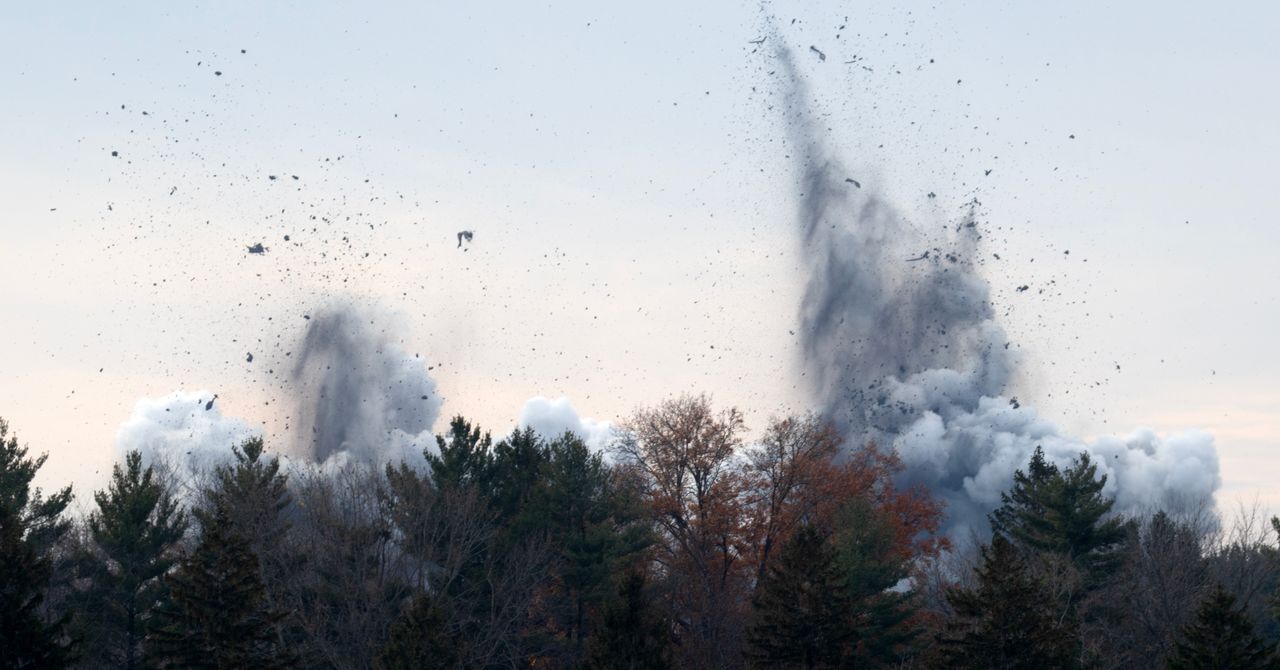
On Wednesday morning, the US Army detonated nearly five tons of degraded lead azide outside of Middletown, Iowa.
Environmental Protection Administration chief Lee Zeldin told CNN shortly after the explosion that preliminary monitoring from the site detected no lead in the air around the site.
But the full extent of the fallout may not be certain for at least a few days. A barrage of government, university, and citizen monitoring and testing projects are underway. Air, soil, and water samples they’ve collected will determine the extent of lead exposure, if any, in Middletown and the surrounding area.
The lead azide has been on the base near Middletown for decades, but recently the Army deemed it unstable and too dangerous to move and remediate. Poor communication between the Army and towns in the path of the fallout led to a public uproar. While the federal government stepped up its mitigation measures—the Army dug a dam around the detonation site, while NASA stepped in with research jets and satellites for monitoring—universities had already been swinging into action due to the chaotic rollout.
Several departments at the University of Iowa kicked into gear to begin to set up air and soil monitoring stations late last week. “Initially we did not know that [the] EPA or Army or anybody else was going to be doing anything,” says Peter Thorne, a professor of environmental health at the university.
Scientists at Purdue University, nearly 300 miles away, also put out a call for soil samples from Middletown.
“We learned about the detonation late last week; once we learned of the initial delay in detonation date we decided to put forth the call,” says Ellen Wells, a professor of public health at Purdue who is helping lead the testing.
Surrounding towns were notified in late October that the Army wanted to conduct pre- and post-detonation soil sampling for “an intentional, controlled detonation” of a “quantity of lead azide”—seemingly the only notification that many towns in the initial modeled path of the fallout say they received before a press release issued by the Army days before the planned explosion.
The lack of communication has, understandably, instilled a lot of public distrust in the federal government, including agencies’ monitoring programs. Thorne says that efforts like the University of Iowa’s are not meant to displace federal monitoring, but rather to supplement and support it—and hopefully reassure the public.
“We and the EPA are doing similar exposure assessment efforts. If they agree, they can give us some confidence,” he says. “For people who might be concerned about the veracity of what the government tells them, if their findings are in alignment with ours, then I think that helps quell some of those concerns.”