How to Change Dimensions in AutoCAD: Tuesday Tips With Frank | AutoCAD Blog


In the previous Tuesday Tips, I talked about some of the more important settings to pay attention to when creating your dimension styles. In today’s post, I’ll be talking about various methods of editing existing dimensions and how to change dimensions in AutoCAD.

OK, let’s set the scene. You defined the location of the dimension incorrectly, or you need to alter its appearance or placement. By far, the easiest thing to do is to use the dimension object’s editing grips.

In the animation below, you’ll see how easy it is to select the dimension, make one of the definition points hot and place it into a new position.

After that, I hover over a dimension line grip. You’ll see a small popup menu display where you can use the dimension as the start for a continue or baseline dimension, or you can even flip the arrow! In this case, I use the grip to pull the dimension up into the room above.

Finally, hovering on the grip of the text string, will again display a popup menu with various options. Here, I choose Move with Leader to re-locate the text and draw a leader. If I had just wanted to move the text string, I would use the grip much like the prior two edits.

None of that is very hard, and it’s a very efficient way to make geometric edits to your dimensions.

Text Overrides With Special Characters

Back to Dim Style settings for a moment. A style definition will let you put the dimension text above the dimension line, or below, but not both. How can you overcome this? The answer lies in the Text Override property of the dimension object.

Below, you see a typical example of doing this. I’ve got a number of these 5’-4” dimensions and I want to add TYP below the line.

Select the dimension object, and from the Properties palette, scroll down to the Text panel. At the bottom, you’ll first see the measurement in gray, so you can’t edit it (more on that in a minute). Below that is Text override. This is the field that you’ll want to edit

There are two parts to the special characters you’re going to use. AutoCAD will interpret <> as the dimensioned measurement, the \X as a line break, and TYP as the text to place under the dimension line. By the way, the X here must be capitalized.

Text override screenshot

Please Don’t Do the Following

I just said that the Measurement property is grayed out and can’t be changed via the Properties palette. That’s great. But it can still be done. And, it’s as easy as double clicking on the text string, and typing in whatever you want.

Below, I’ve done just that. The 5’-4” measurement has changed, but instead of editing the geometry and/or making sure the definition points are accurately place, the lazy drafter just edits the text and moves on.

Here’s the worst part. You won’t know they’ve done it. It looks right, so you just assume that it is. I actually worked with a person who did this. Don’t be that person.

Measurement screenshot

Trust But Verify

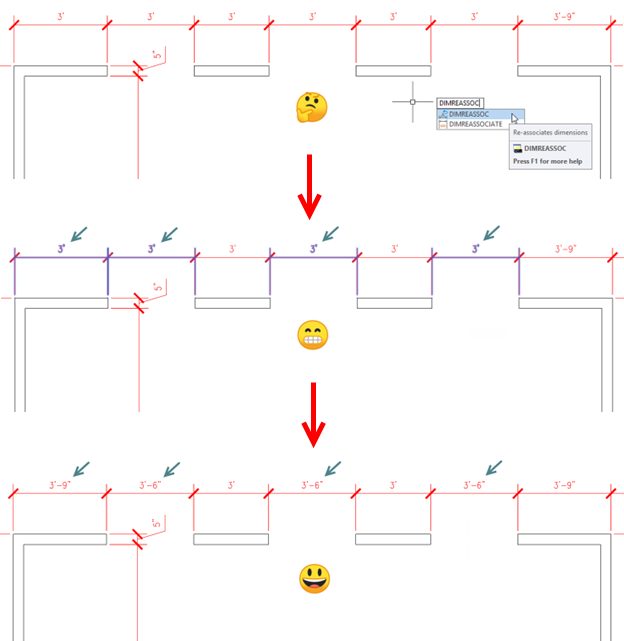
There’s an old Russian proverb that says, “Trust but verify.” To fix overridden dimension strings, type DIMREASSOC in either the Dynamic Input Box or the Command Line. You’ll be prompted to select objects. At this point, select an area, or just type in ALL since the command filters out anything that’s not a dimension. In other words, don’t take extra time to carefully select only dimensions – DIMREASSOC doesn’t care.

Note: There is also a command called DIMREASSOCIATE – fully spelled out. It does something entirely different, so please be aware.

DIMREASSOC screenshot

If there are any dimensions that have overridden text, they will be immediately highlighted for you, as shown below. Here, I find that four of the 3’ dimensions are wrong.

Incorrect dimensions screenshot

Now comes the easy part. Just hit Enter to end object selection, and Boom! All the overridden dimensions now read accurately.

There you go, dear readers. Dimension settings and editing in two parts. Next time, I’ll be presenting some of the more important things you need to pay attention to with your CAD standards, and maybe even some ways to manage them.

More Tuesday Tips

Check out our whole Tuesday Tips series for ideas on how to make AutoCAD work for you. 

AutoCAD Potpourri: Tuesday Tips With Frank | AutoCAD Blog


All of us here at Tuesday Tips Headquarters love getting feedback from our readers. It may take the form of expanding on a tip or maybe explaining how they utilize it at their job. Of course, we get plenty of suggestions for tips (lots of great ideas have made their way into the blog.)

We also get a lot of readers looking for a solution to a particular problem they’re having. Much like Santa at the North Pole, we try to answer as many as we can, but there’s just not enough time. So, occasionally, we like to open up the old mailbag and pick out a few that deserve attention but may not warrant an entire blog post. We like to call it AutoCAD Potpourri because you never know just what you’ll get.

Murray from Minneapolis writes:

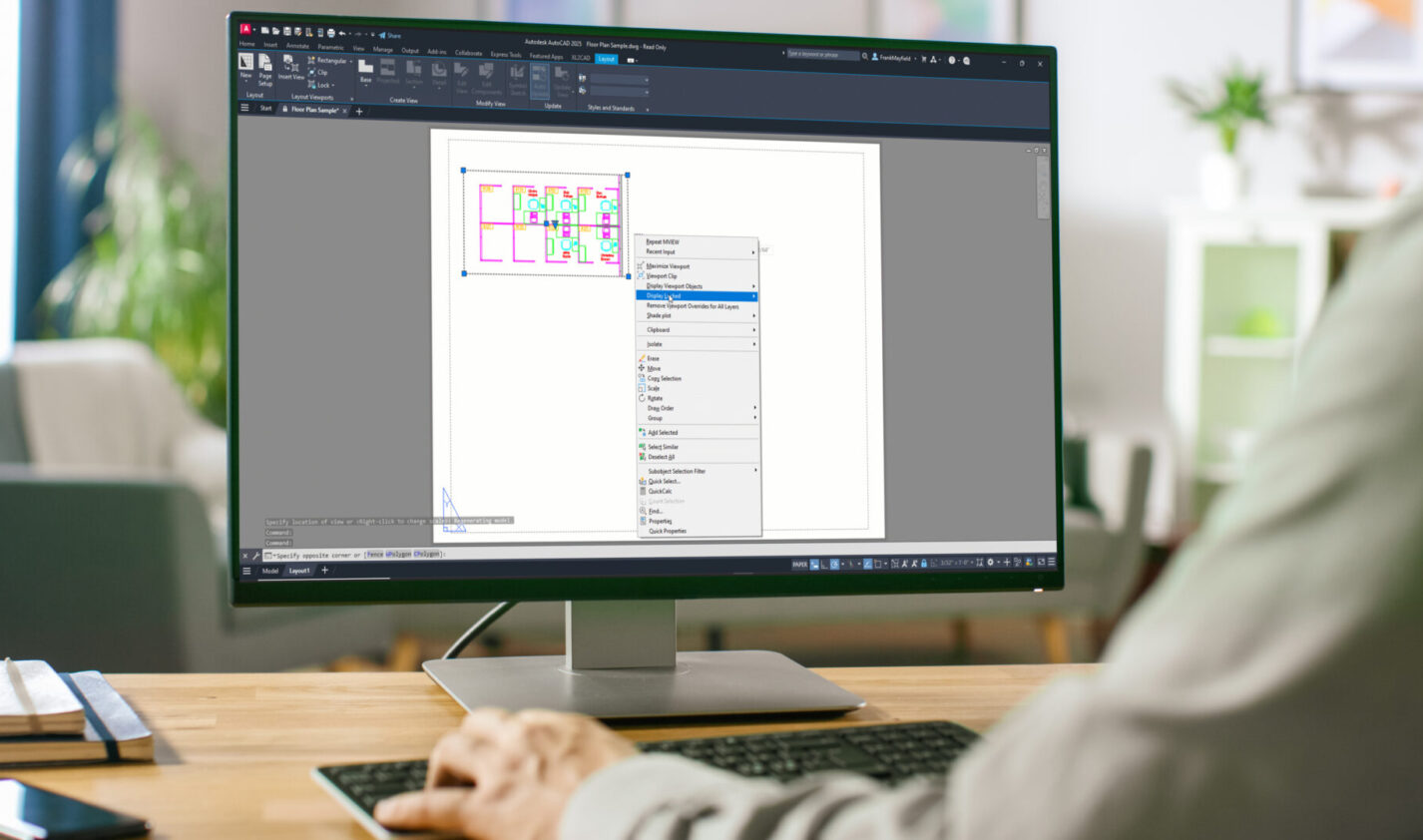
I have a co-worker who’s driving me crazy by forgetting to set their newly created Layout Viewports as being locked. Is there an automated lisp routine or something to help me with this? I don’t know how many times the zoom or scale has been messed up because of this.

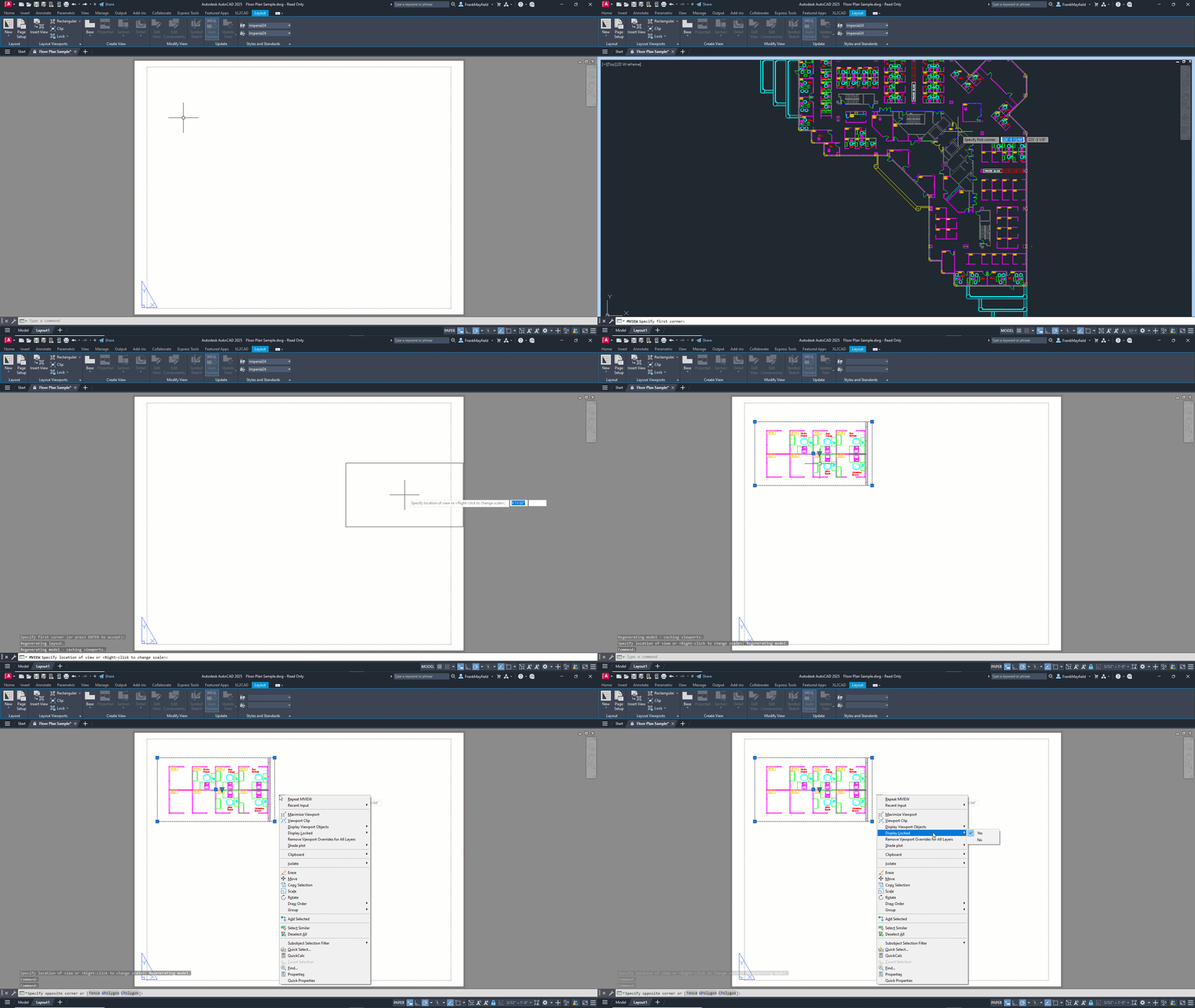
Hi Murray, instead of that, how about you just make an easy change in your workflow? From the blue contextual Layout ribbon tab, you’ll find an Insert View tool in the Layer Viewports panel. This will let you insert any named view as a viewport. You don’t even have to use named views to use it. If you don’t have any views, it will go directly into New View mode, where you can select an area of your model. When you’re satisfied with the selection, hit enter, and you’ll return to your layout, where you can now drop in the viewport.

AutoCAD will do its best to scale it correctly for you, but you can always change it. And, best of all, it will automatically be locked after you insert it using this method. Viola! Problem solved.

Utilize Activity Insights

Emily from Chicago asks us:

Is there an easy way to know who did what in our drawings? In particular, who was working on it, who saved it, and who managed the Xrefs in it?

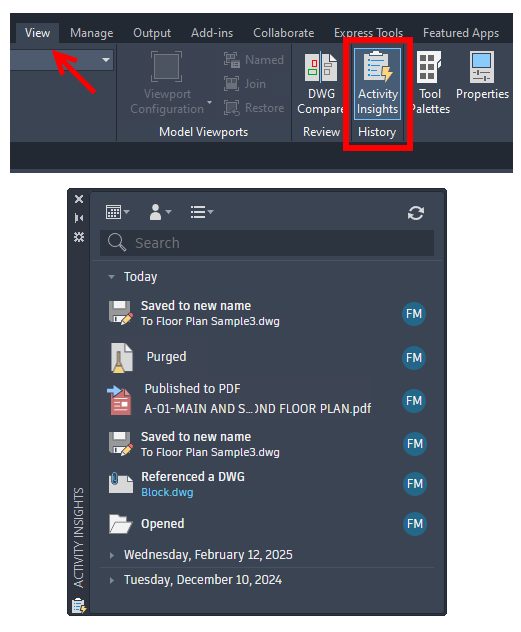
Emily – you didn’t mention what version of AutoCAD you are using, but if you’re on 2024.1 or higher, you sound like a perfect fit for the new Activity Insights palette. You’ll find it in the View tab of the ribbon. It’s the only icon in the History panel. Turn it on, and you’ll get a palette view of various activities, telling you who did what and when they did it. Click on any entry to get more info on it. Just follow this link to learn more about it.

Screenshot of Activity Insights in AutoCAD

Use Paste Special to Insert Image Files

Louie from New York wants to know:

We don’t use externally referenced drawing files in our work, but we do insert numerous images into our drawings. Of course, this references the image, which, in turn, creates problems for our users who aren’t used to working with the image paths. In other words, the path is often broken. Is there a way to attach an image so that it’s not externally referenced (thus pathed?)

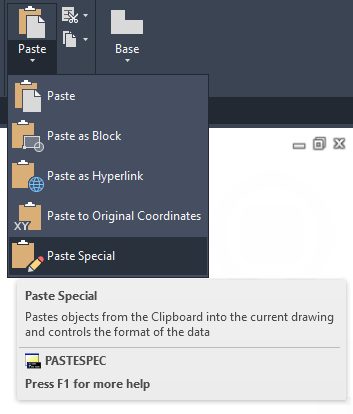
Louie, in a word, yes! It’s a simple three-step process. First, open the image file in MS Paint® or pretty much any graphic software. Next, select “all” and perform a clipboard copy. Finally, in AutoCAD, do a “paste special” (not a regular paste) to place the image directly into your drawing. Baddabing! No more lost image files.

Screenshot of AutoCAD Paste Special

Reset Overridden Dimension Strings

Bailey from Cincinnati asks:

Let me start by saying that I work with that co-worker. The lazy drafter who prefers to override dimension text instead of just doing it right to begin with. Of course, there’s no way to know if it’s been overridden or not (I wish they would get flagged similar to Anno Monitor). Do you have any suggestions for me?

Yes, Bailey, I do! There’s an Express Tool called DIMREASSOC. You can type it into either the Dynamic Input Box or the Command Line. You can also find it as “Reset Text” in the Dimension panel of the Express Tools tab in the ribbon. To use it, select an area of dimensions or just type in ALL since the command filters out anything that’s not a dimension.

Any dimensions that have overridden text will immediately be highlighted for you. Just hit Enter to end object selection, and Boom! All the overridden dimensions now read accurately.

How’s that for an easy fix? I just wish we could do the same with your co-worker!

Screenshot in AutoCAD

Coming Clean

If you were paying close attention, you may have noticed a pattern in our questions. They were all from fictional characters in classic TV sitcoms.

That’s right, there’s no actual mailbag full of letters that we pulled from. That’s shocking here in 2025, I know. But we do hear from a lot of you via emails or comments, so we also have plenty of shorter tips to share, so this is always a fun way to get them out there.

I hope to do another AutoCAD Potpourri post someday, so please make sure you keep those letters and questions coming!

Celebrity Guest Stars:

Murray Slaughter – The Mary Tyler Moore Show

Emily Hartley – The Bob Newhart Show

Louie De Palma – Taxi

Bailey Quarters – WKRP in Cincinnati

More Tuesday Tips

Check out our whole Tuesday Tips series for ideas on how to make AutoCAD work for you.