We’ll need to see if a 9060 can beat the RTX 5060, but what’s more important is if it manages to maintain its price after launch.
In the battle of the low-end, 60-class graphics cards, AMD wants to see if it can pull off the same sucker punch of price and performance it gave Nvidia during the launch of its mid-range GPUs. The graphics card maker offered the first, sparse details on its Radeon RX 9060 XT graphics processors late Tuesday at Computex. The card may offer enough power for your PC to hit solid gaming performance at 1440p resolution, similar to the $450 Nvidia GeForce RTX 5060 Ti, on cheaper gaming rigs. The real inflection point of this latest card will be whether you can actually buy it for its base price.
The Radeon RX 9060 XT is the step down in GPU performance from the RX 9070 that AMD launched back in March. It’s based on the same RDNA 4 microarchitecture of the mid-range cards, but with 32 of the company’s latest compute units compared to the 56 on the higher-end card. The GPU comes with two options: one with 8 GB and another with 16 GB of GDDR6 VRAM. The version with more memory will be better for your rig long-term, especially if you plan to hook your PC up to a 1440p monitor and run the latest, more graphically intensive games.
AMD did not offer us the full range of specs, which makes it hard to pin down just where this GPU will land in terms of raw performance compared to Nvidia’s latest cards. While the number of RDNA 4 compute units—the core clusters on AMD cards that process the thousands of calculations necessary for graphically intensive tasks—offers a vague impression of performance compared to the RX 9070, AMD didn’t provide any charts to compare FPS between games. The GPU runs on a 3.13GHz boost clock and has between 150W and 182W of board power compared to the 2.54 GHz clock and 304W board power on the company’s Radeon RX 9070 XT.
Without a price tag, it’s impossible to judge how much of a step down the latest card is compared to the RX 9070. AMD didn’t offer any word on a non-XT variant, either. The card will require a PCIe 5.0 x16 interface, the same as its other cards. AMD doesn’t craft its own GPUs and instead relies on AIC (add-in card) makers to produce its cards. We’ll update this article if AMD announces details on price or availability during its Computex keynote.
The crown jewel of AMD’s current lineup of graphics cards is the RX 9070 XT. AMD made headlines when it set the suggested sale price of the GPU at $600, only $50 more than the 9070, but it packs enough performance to get playable framerates out of multiple intensive games at 4K with a fair amount of ray tracing settings turned up. Unfortunately, because of a combination of tariffs and stock woes, the 9070 XT ended up priced at over $800 and as high as $1,000 at some online retailers.
We’ve seen prices fluctuate regularly over the past several months, but a near 20% price inflation to what should be a mid-range card is simply too much to stomach. However, the lower-end GPUs are faring better. The RTX 5060 Ti MSRP is set at $450, and the lowest price we’ve seen so far is $480. The $300 RTX 5060 is sitting closer to $320 from some AIC makers like Gigabyte. A fair number of Nvidia’s lowest-end GPUs are currently listed as “Out of Stock” or “Coming Soon” on sites like Newegg and Best Buy. Those buying a lower-end GPU are more price sensitive than people who can drop $2,000 on an RTX 5090 without blinking. AMD has even more impetus to set a price people can afford, and make sure it can keep costs level when the card finally hits store shelves.
It looks like I may have played myself again. I was genuinely excited about AMD’s RX 9070 XT, but now, I’m starting to worry about its future. I always knew that the new AMD flagship wouldn’t be able to compete against some of Nvidia’s best graphics cards, but I had a lot of hope that it’d still be a great competitor for a number of other reasons.
I’m not doubting the performance of the RX 9070 XT. I have no reason to, as we don’t know a thing about it — and that’s exactly why I’m worried. Not only are the GPUs still a complete mystery, but they’ve also reportedly been delayed. At this rate, I fear that AMD may have lost the war before it even started, and I’m not alone.
I felt pretty excited for the RX 9070 XT, but so far, the launch of RDNA 4 has been a harsh lesson in managing your expectations.
Get your weekly teardown of the tech behind PC gaming
First, the GPUs barely got a mention during AMD’s 45-minute-long CES 2025 keynote. Then, the few slides that AMD released to the press offered very little information; we basically only learned a little bit about the RDNA 4 architecture and AMD’s performance goals. The information was vague, too — think “improved ray tracing performance” and the like.
The GPUs themselves were spotted at CES, but only those made by AMD’s partners, and they didn’t come with any specifications. So, at this stage, it’s been revealed that the RX 9070 XT comes with three fans in its Gigabyte design. That’s… not a lot.
But wait — there’s hope, or so I thought. AMD told Digital Trends that RDNA 4 would be released “in a matter of weeks,” and that the company thought that the new RX 9000 series deserved its own event. But only silence has followed.
The first update came not from AMD itself, but from B&H. The retailer put the RX 9070 XT up for sale with a January 22 preorder date. The cards had been taken down, but then they reappeared with a release date of March 22. Finally, this tracks.
Radeon 9000 series hardware and software are looking great and we are planning to have a wide assortment of cards available globally. Can’t wait for gamers to get their hands on the cards when they go on sale in March!
David McAfee, AMD’s vice president and general manager of the Ryzen CPU and Radeon graphics division, revealed on X (Twitter) that the cards will go on sale in March. McAfee later added that AMD is holding onto the GPUs a little while longer in order to optimize their software stack, including FSR 4.
Meanwhile, various leakers and tipsters are having a field day with AMD’s troubled RDNA 4 launch. Recent whispers point to AMD still holding off to see how Nvidia fares. At this rate, AMD will likely get to see the RTX 5070 Ti and the RTX 5070 in their full glory before it launches the RX 9070 XT.
AMD wanted to announce its new graphics cards alongside Nvidia, but it clearly didn’t have a solid plan for actually releasing them. Now, we’ve had to cobble together various ideas about the cards from leaks, board partners, and social media posts, which doesn’t inspire a lot of confidence.
As soon as I saw David McAfee announce that RDNA 4 wouldn’t be here until March, I knew what was coming — and I wasn’t wrong. PC gaming enthusiasts, including both AMD and Nvidia fans, weren’t happy with the way it’s all gone down.
Scrolling through the hundreds of comments under McAfee’s post reveals just how badly the general public wants to know what’s going on.
Not even, a proper announcement with slides of performance, features. Could be even "price will be reveled at, a later date". This is so bad PR… i have no words.
Sitting at over 500 likes, a comment from GawroskiT on X makes a dig at AMD’s PR team. “Not even a proper announcement. […] This is [such] bad PR. I have no words.”
Another user, PlaysRingle, promises to ditch AMD for Nvidia based on how things are going. “AMD is going to make me upgrade my RX 7900 XTX to an RTX 5080. I can’t keep defending AMD when it keeps doing these things.”
I know that I’m being fairly critical of AMD here myself, but I can’t help feeling bad when reading these comments and seeing the reactions. Some of it is really quite harsh, such as this comment from noremac258: “Does AMD ever not fail to capitalize on an opportunity? […] AMD’s graphics division is a disaster.”
What ARE you guys doing? What sort of "marketing" is this "stealth" reveal??? Your CES presence was so uninformative you'd have been better off not showing up at all, and all we get since then is THIS?
I tried to find more supportive comments, but there are very few of those to be found. However, Hardware Unboxed made a separate post defending AMD, which is what prompted McAfee to clarify that the delayed launch comes down to software optimization.
AMD delaying the launch of RDNA4 to March is the right move. The last thing they want is stuffing up the launch yet again, which they risk doing if they launch before Nvidia.
And very few people would have bought a 9070 XT just because it launched a week or two before the 5070.…
I know that X is a tough crowd, so I decided to check Reddit for more reactions. Long story short — it wasn’t pretty.
The comments under this post, sharing that RDNA 4 won’t arrive until March, are still harsh. One commenter said: “Nvidia’s release was looking rather underwhelming, so AMD had to pull out all the stops to make sure they miss the opportunity this time.”
“I perceive this as having no confidence in your own product. [AMD] had the opportunity here to seize this midrange market segment by coming out first,” said another user, pointing out that waiting for Nvidia’s RTX 5070 might backfire.
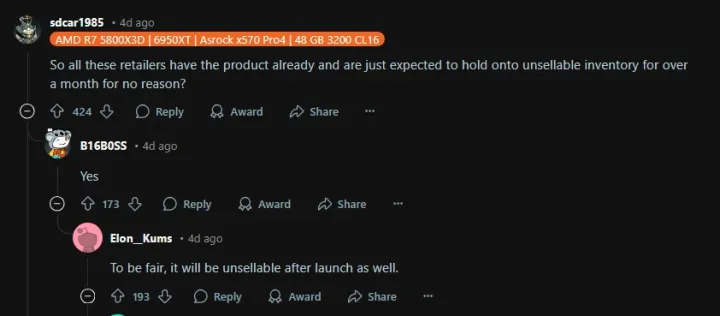
In search of people who are more in favor of AMD than Nvidia, I ventured into the r/AMD community. This post quickly showed me that people aren’t willing to cut AMD any slack.
Other than the top comment thread pictured above, all the other highly-rated comments criticize AMD. “Absolute incompetence from AMD’s GPU division, again,” says one poster. “Doesn’t a significant amount of retailers already have the cards in stock? What a fumble,” adds another.
I could go on, but you get the gist. It’s clear that people aren’t pleased, and while the internet at large is hardly ever satisfied, some of this might’ve been avoided if AMD had been more forthcoming about the RX 9000 series. People are frustrated with the delay, but also with the lack of information.
AMD could still make the RX 9070 XT a success
Jacob Roach / Digital Trends
Things are looking a little bleak for RDNA 4 right now, but the internet is quick to forget. It’s still entirely possible for AMD to turn this around and make the launch of the RX 9000 series a success.
My opinion is that sharing some information would be better than sharing next to none; even a basic spec sheet would go a long way. Although McAfee plays a key role in AMD’s GPU strategy, most fans don’t check his X account on a daily basis. Those people are either kept in the dark or they’re left to rely on third parties to tell them what’s going on.
Letting the general public figure out AMD’s plans based on social media means that a lot of people who might have otherwise been happy to wait will now be influenced by people who are decidedly not happy. If there are hundreds of comments all saying that AMD is doing a bad job, it’s easy to start believing it yourself if you don’t have anyone telling you otherwise.
Unfortunately, right now, AMD is really not doing much to dispel that notion. A quick X post, even when coming from an AMD executive, doesn’t cut it.
Aside from some marketing efforts to drive up the hype, I think it’s now more important than ever for AMD to lean into that performance-per-dollar metric that makes GPUs like Intel’s Arc B580 such a great deal. The fact is that the RX 9070 XT might still be an exceptional GPU even if it won’t be able to beat all of its Nvidia rivals.
Most people won’t be spending $2,000 (or more) on an RTX 5090. The GPU market needs graphics cards that provide value while being able to run the latest games, and to that end, AMD’s usually done a pretty good job. Strangely enough, some of its best GPUs are the ones that didn’t get a lot of love from the marketing department, such as the RX 7900 GRE — but that’s no reason for the RX 9070 XT to also be launched with so little fanfare.
In the consumer graphics market, AMD is a small fish; Nvidia is a massive shark. Following a troubled launch, AMD may therefore now face an uphill climb with the RX 9070 XT — but I’m still hopeful.
If AMD gets the pricing right, the RX 9070 XT might still turn out to be an amazing card. On the other hand, if it’s too expensive when compared to its Nvidia rivals, it might end up being overlooked regardless of AMD’s marketing efforts. And let’s hope that those efforts actually begin soon, because so far, Nvidia’s winning the battle — but AMD could still walk away unscathed from the war.