India’s mobile payments dilemma | TechCrunch


India’s payments regulator is set to decide as early as Monday whether to curb the dominance of Walmart’s PhonePe and Google in the nation’s fast-growing mobile payments market, a move that could reshape how its billion-plus population moves money.

The decision centers on UPI, or Unified Payments Interface, a network backed by more than 50 retail banks that has changed how Indians pay for everything from groceries to taxi rides. The platform processes over 13 billion transactions monthly, making it one of the world’s largest digital payment networks. It’s also, by far, the most popular way Indians transact online.

At issue is whether the National Payments Corporation of India, which reports to India’s central bank, will enforce a rule limiting companies to handling no more than 30% of all UPI transactions.

The rule, first proposed in 2020, would particularly affect Walmart-owned PhonePe, which handles 47.8% of all UPI payments, and Google Pay, which processes 37.1%.

The uncertainty has thrown a wrench into PhonePe’s plans to go public. The startup, valued at $12 billion and backed by Walmart, would be one of India’s most prominent technology IPOs. PhonePe’s co-founder and chief executive, Sameer Nigam, said in August that the startup cannot go public “if there is uncertainty on the regulatory side.”

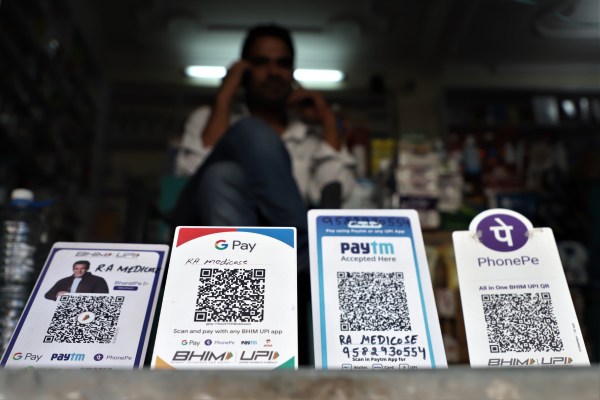
“If you are buying a share at Rs 100 and you price it assuming we have 48-49% market share, then there is an uncertainty about whether it will come down to 30% and by when,” said Nigam (pictured above) at a fintech conference. “We are requesting them [the regulator], if they can find another way to at least solve whatever their concerns are or tell us what the list of concerns is.”

The issue also impacts the growth potential of numerous fintech startups that are attempting to make deeper inroads in digital payments. If the regulator imposes restrictions on PhonePe and Google Pay’s ability to onboard new users or puts a check on how many transactions they process, many other startups stand to gain grounds.

The regulator is inclined to delay enforcing the cap again or may increase the limit to more than 40%, people briefed on the situation told TechCrunch. The agency has already pushed back the deadline several times, from January 2021 to 2023, and then to 2025, as it struggled with implementation. It has held talks with many stakeholders as recently as last week over the decision.

Enforcing a limitation on the market share will impact the consumer experience, some of the people said.

The situation highlights India’s efforts to balance technological innovation with market competition. UPI has been a cornerstone of Prime Minister Narendra Modi’s push to digitize India’s economy and reduce its reliance on cash. The system allows instant transfers between bank accounts using simple identifiers like phone numbers, making it more accessible than traditional banking services.

A market share cap would mark one of India’s most significant interventions in its technology sector, which has attracted massive investments from global companies like Walmart, Google, and Meta. These companies view India, with its young, increasingly digital population, as a crucial growth market.

Paytm sells PayPay stake to SoftBank for $279.2 million


Paytm has agreed to sell its stake in Japanese payments firm PayPay to SoftBank for $279.2 million, as the Indian firm sheds non-core assets following a bruising regulatory clampdown earlier this year.

The sale of Paytm’s stake in PayPay, which it received through acquisition rights six years ago, follows months of restructuring at the Indian firm that saw the company sell its entertainment ticketing unit to Zomato for $246 million in August.

PayPay, controlled by SoftBank and Yahoo Japan parent Z Holdings, is a leading payments app in Japan.

The stake sale will boost Paytm’s cash reserves to $1.46 billion as it attempts to recover market share in India’s fiercely competitive payments market. The company’s banking affiliate was severely restricted by regulators in January, leading to an exodus of customers to rival services.

Shares in Paytm have nearly tripled since June after India’s payments regulator allowed it to resume adding customers to its flagship UPI service. The company reported its first quarterly profit in September, though this was largely due to proceeds from asset sales rather than operational improvements.

“We are grateful to Masayoshi-san and the PayPay team for giving us the opportunity to together create a mobile payment revolution in Japan,” Paytm said in a statement. “We remain fully committed and will continue to support PayPay’s product and technology innovations in future. We are working on introducing new AI-powered features to accelerate PayPay’s vision in Japan.”

Saturday’s deal marks the end of Paytm’s relationship with SoftBank, which divested its remaining shares in June after being an early backer through its Vision Fund.

India’s Paytm wins approval to resume payments growth


Paytm, a leading Indian financial services firm, has received regulatory approval to resume adding new UPI payments users, following an eight-month restriction on many of its operations.

UPI, which processes over 15 billion monthly transactions, dominates India’s online payments. Walmart-owned PhonePe and Google Pay process about 87% of UPI transactions, whereas Paytm’s market share has shrunk from 13% to 8% after this year’s central bank restrictions.

The Reserve Bank of India ordered Paytm to cease many of the businesses at its affiliate payments bank early this year over repeated violation of rules. NPCI, the regulatory body that oversees UPI, approved Paytm’s application on Tuesday.

Analysts at Bernstein and Goldman Sachs said the approval is a “significant” development that will help revive Paytm’s transacting user growth. Paytm’s monthly transacting users has fallen to 68 million as of last month from 100 million in December.

Paytm on Tuesday reported revenue of $197.4 million in the quarter ending September, up from $178.6 million in the previous quarter but down 34% year-on-year from $299.5 million. Profit in the quarter climbed to $110 million after factoring in a one-time gain of $160 million from the sale of entertainment ticketing biz to Zomato.

India scrambles to curb PhonePe and Google’s dominance in mobile payments


The National Payments Corporation of India (NPCI), the governing body overseeing the country’s widely used Unified Payments Interface (UPI) mobile payment system, is set to engage with various fintech startups this month to develop a strategy to address the growing market dominance of PhonePe and Google Pay in the UPI ecosystem.

NPCI executives plan to meet with representatives from CRED, Flipkart, Fampay and Amazon among other players to discuss their key initiatives aimed at boosting UPI transactions on their respective apps and to understand the assistance they require, people familiar with the matter told TechCrunch.

UPI, built by a coalition of Indian banks, has become the most popular way Indians transact online, processing over 10 billion transactions monthly.

The new meetings are part of an increasing effort to address concerns raised by lawmakers and industry players regarding the market share concentration of Google Pay and PhonePe, which together account for nearly 86% of UPI transactions by volume, up from 82.5% at the end of December. Walmart owns more than three-fourths of PhonePe.

Paytm, the third-largest UPI player, has seen its market share decline to 9.1% by the end of March, down from 13% at the end of 2023, following a clampdown by the Reserve Bank of India (RBI).

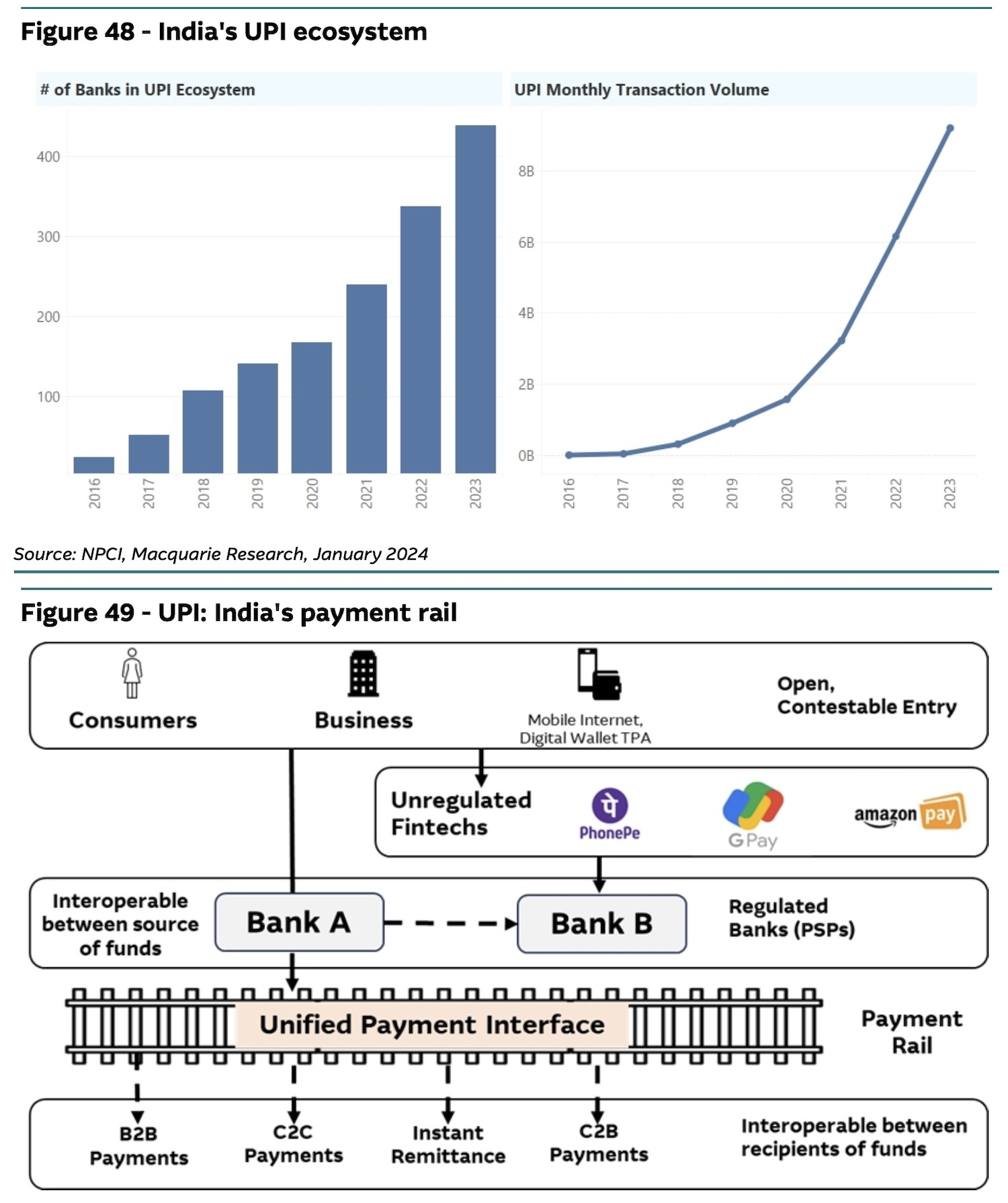
An overview of India’s UPI ecosystem. (Image: Macquarie)

The conversation follows the central bank expressing “displeasure” to the NPCI over the growing duopoly in the payments space, a person familiar with the matter said. An NPCI spokesperson declined to comment.

In February, a parliamentary panel in India urged the government to support the growth of domestic fintech players that can offer alternatives to the Walmart-backed PhonePe and Google Pay apps.

The NPCI has long advocated for limiting the market share of individual companies participating in the UPI ecosystem to 30%. However, it has extended the deadline for firms to comply with this directive to the end of December 2024. The organization faces a unique challenge in enforcing this directive: It believes that it currently lacks a technical mechanism to do so, TechCrunch previously reported.

The RBI is also weighing an incentive plan to create a more favorable competitive field for emerging UPI players, another person familiar with the matter said. Indian daily Economic Times separately reported Wednesday that the NPCI is encouraging fintech companies to offer incentives to their users, promoting the use of their respective apps for making UPI transactions.